Making Symptoms Visible: The Impact of Real-Time PROM Integration in Pediatric Oncology

 , , and
Highlights
- Children with cancer often experience severe symptoms that go undetected, including appetite changes, fatigue, nausea and vomiting and pain.
- Use of Patient-Reported Outcome Measures (PROMs) could address this gap, but such measures are rarely implemented in routine clinical practice.
- This study demonstrates the impact of routine PROM use on symptom detection and clinical workflow.
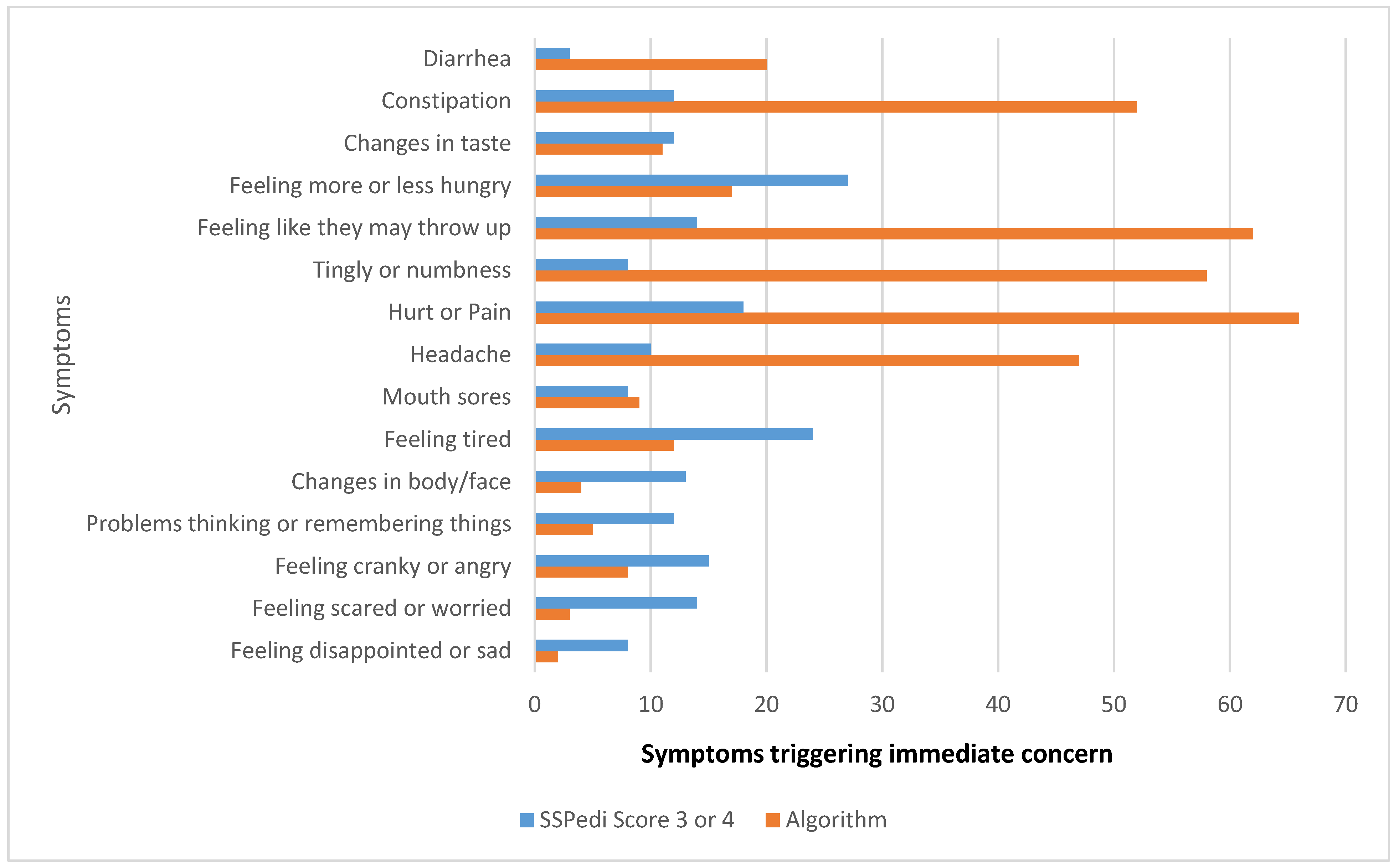
- Clinical algorithms enhance sensitivity for identifying symptoms but may increase alert burden highlighting the need for workflow and alert optimization.
Abstract
1. Introduction
2. Materials and Methods
2.1. Study Design and Participants
- Child aged 4–18 years
- Receiving active treatment within one or two weeks of enrolment
- Caregiver provided informed consent.
2.2. Symptom Assessment Using SSPedi
2.3. Medical Record Data Collection
2.4. Clinical Algorithm for Level of Concern
- Low (no action required),
- Moderate (discuss with clinical team with next visit)
- Immediate (contact clinical team for advice)
2.5. Data Analysis
3. Results
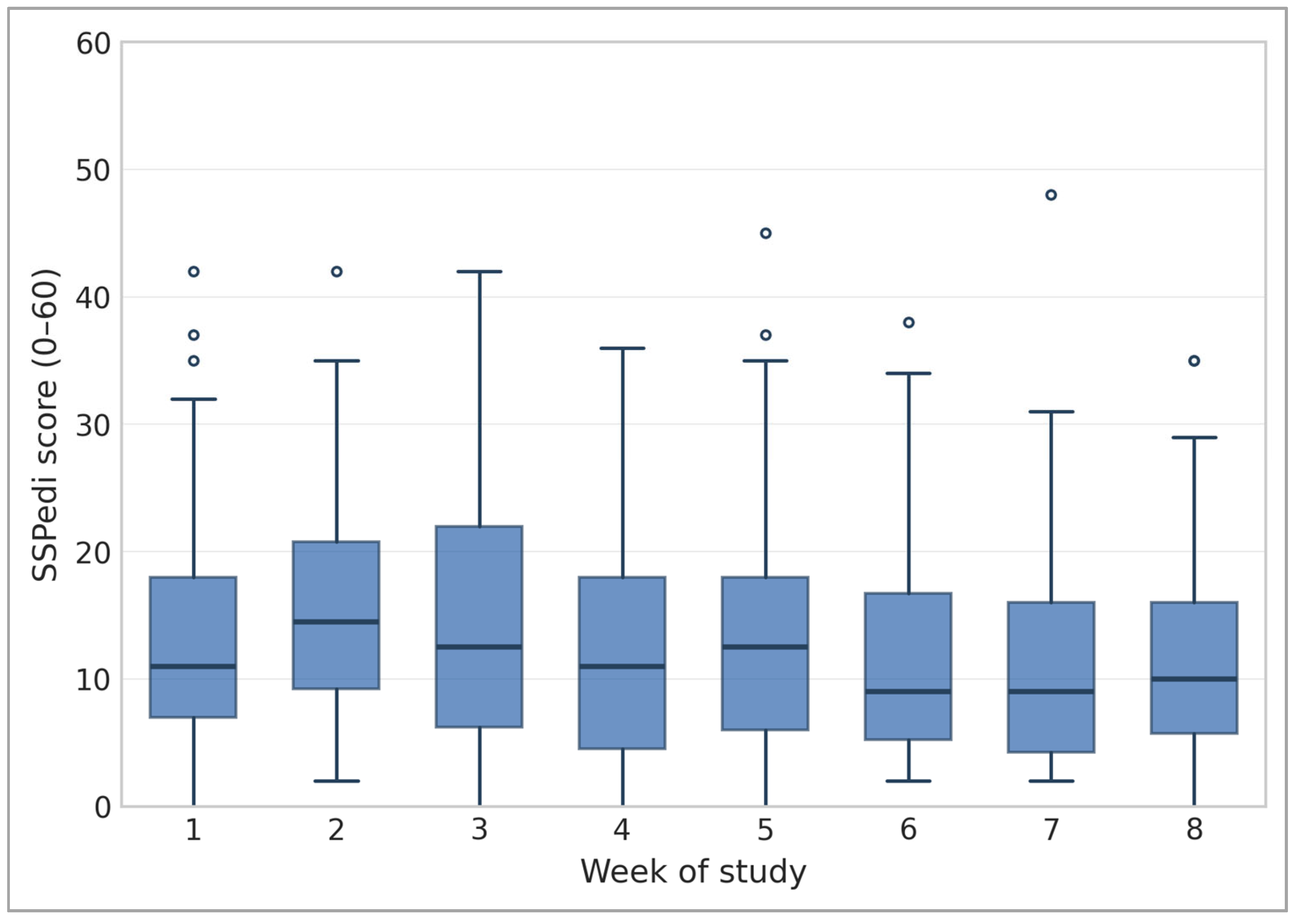
3.1. Symptom Bother Reported by SSPedi
- Appetite changes (12.1%)
- Feeling tired (11.3%)
- Nausea/Vomiting (9%)
- Hurt or pain (8.8%)
3.2. Documentation of Symptom Assessment in Medical Records Compared with Prevalence Reported by SSPedi
3.3. Algorithm Versus Score Based Concern Levels
3.4. Estimated Impact on Clinical Services
4. Discussion
4.1. Symptom Detection and Documentation
4.2. Algorithm Versus Score-Based Thresholds
4.3. Limitations
4.4. Clinical and Research Implications
5. Conclusions
Supplementary Materials
Author Contributions
Funding
Institutional Review Board Statement
Informed Consent Statement
Data Availability Statement
Acknowledgments
Conflicts of Interest
Abbreviations
| PROM | Patient Reported Outcome Measure |
| SSPedi | Symptom Screening in Pediatrics |
References
- Graupner, C.; Kimman, M.L.; Mul, S.; Slok, A.H.; Claessens, D.; Kleijnen, J.; Dirksen, C.D.; Breukink, S.O. Patient outcomes, patient experiences and process indicators associated with the routine use of patient-reported outcome measures (PROMs) in cancer care: A systematic review. Support. Care Cancer 2021, 29, 573–593. [Google Scholar] [CrossRef]
- Montgomery, K.E.; Raybin, J.L.; Ward, J.; Balian, C.; Gilger, E.; Murray, P.; Li, Z. Using patient-reported outcomes to measure symptoms in children with advanced cancer. Cancer Nurs. 2020, 43, 281–289. [Google Scholar] [CrossRef]
- Leahy, A.B.; Schwartz, L.A.; Li, Y.; Reeve, B.B.; Bekelman, J.E.; Aplenc, R.; Basch, E.M. Electronic symptom monitoring in pediatric patients hospitalized for chemotherapy. Cancer 2021, 127, 2980–2989. [Google Scholar] [CrossRef]
- Lopes-Júnior, L.C.; Grassi, J.; Freitas, M.B.; Trigo, F.E.S.; Jardim, F.A.; Nunes, K.Z.; Vasconcelos, K.A.D.; Lima, R.A.G.D. Cancer Symptom Clusters in Children and Adolescents with Cancer Undergoing Chemotherapy: A Systematic Review. Nurs. Rep. 2025, 15, 163. [Google Scholar] [CrossRef] [PubMed]
- Lo Greco, M.C.; Milazzotto, R.; Liardo, R.L.E.; Foti, P.V.; Palmucci, S.; Basile, A.; Pergolizzi, S.; Spatola, C. The Role of Reirradiation in Childhood Progressive Diffuse Intrinsic Pontine Glioma (DIPG): An Ongoing Challenge beyond Radiobiology. Brain Sci. 2023, 13, 1449. [Google Scholar] [CrossRef] [PubMed]
- Dupuis, L.L.; Cook, S.; Robinson, P.D.; Tomlinson, D.; Vettese, E.; Sung, L. Optimizing symptom control in children and adolescents with cancer. Pediatr. Res. 2019, 86, 573–578. [Google Scholar] [CrossRef] [PubMed]
- O’Sullivan, C.; Dupuis, L.L.; Gibson, P.; Johnston, D.L.; Baggott, C.; Portwine, C.; Spiegler, B.; Kuczynski, S.; Tomlinson, D.; Tomlinson, G.A.; et al. Evaluation of the electronic self-report Symptom Screening in Pediatrics Tool (SSPedi). BMJ Support. Palliat. Care 2018, 8, 110–116. [Google Scholar] [CrossRef]
- Yan, A.P.; Tomlinson, D.; Dupuis, L.L.; Sung, L. SSPedi and SPARK: Promise for The Future of Electronic Patient Reported Outcomes in Pediatric Oncology. EJC Paediatr. Oncol. 2025, 5, 100238. [Google Scholar] [CrossRef]
- Basch, E.; Deal, A.M.; Kris, M.G.; Scher, H.I.; Hudis, C.A.; Sabbatini, P.; Rogak, L.; Bennett, A.V.; Dueck, A.C.; Atkinson, T.M.; et al. Symptom monitoring with patient-reported outcomes during routine cancer treatment: A randomized controlled trial. J. Clin. Oncol. 2016, 34, 557–565. [Google Scholar] [CrossRef]
- Yost, K.; Coles, T. Using Patient-Reported Outcome Measures for Screening; International Society of Quality of Life Research (ISOQOL): Milwaukee, WI, USA, 2023. [Google Scholar]
- Bradford, N.; Slater, P.; Fielden, P.; Condon, P.; Skrabal Ross, X.; Douglas, M.; Radford, C.; Carter, A.; Walker, R.; Badat, A.; et al. Care at your fingertips: Codesign, development, and evaluation of the oncology hub app for remote symptom management in pediatric oncology. JCO Clin. Cancer Inform. 2023, 7, e2200134. [Google Scholar] [CrossRef]
- Bradford, N.; Condon, P.; Pitt, E.; Tyack, Z.; Alexander, K. Optimising symptom management in children with cancer using a novel mobile phone application: Protocol for a controlled hybrid effectiveness implementation trial (RESPONSE). BMC Health Serv. Res. 2021, 21, 942. [Google Scholar] [CrossRef]
- Ross, X.S.; Condon, P.; Yates, P.; Walker, R.; Herbert, A.; Bradford, N. Feasibility of weekly electronic patient-and proxy-reported outcome measures in pediatric oncology. Cancer Nurs. 2024, 47, E318–E326. [Google Scholar] [CrossRef] [PubMed]
- Tomlinson, D.; Chakkalackal, L.; Calligan, M.; Tardif-Theriault, C.; Kuczynski, S.; Schechter, T.; Vettese, E.; Tomlinson, G.A.; Dupuis, L.L.; Sung, L. Symptom documentation and intervention in paediatric cancer care-association with severity: Observational study. BMJ Support. Palliat. Care 2024, 13, e1265–e1271. [Google Scholar] [CrossRef] [PubMed]
- Cheng, L.; Liu, F.; Feng, S.; Wang, Y.; Gu, Y.; Kang, Q. Symptom Experience of Children with Cancer Younger Than Eight Years of Age: An Integrative Review. J. Pain Symptom Manag. 2019, 58, 157–166. [Google Scholar] [CrossRef] [PubMed]
- Torres, V.; Nunes, M.D.R.; Silva-Rodrigues, F.M.; Bravo, L.; Adlard, K.; Secola, R.; Fernandes, A.M.; Nascimento, L.C.; Jacob, E. Frequency, Severity, and Distress Associated with Physical and Psychosocial Symptoms at Home in Children and Adolescents with Cancer. J. Pediatr. Health Care 2019, 33, 404–414. [Google Scholar] [CrossRef]
- McCulloch, R.; Hemsley, J.; Kelly, P. Symptom management during chemotherapy. Paediatr. Child Health 2018, 28, 189–195. [Google Scholar] [CrossRef]
- Olsavsky, A.L.; Montgomery, K.E.; Kochashvili, M.; Benhayoun, A.; Ranalli, M.; Skeens, M.A. Differences in Symptom Reporting by Children with Cancer, Caregivers, and Care Teams. J. Pain Symptom Manag. 2025, 70, 278–286. [Google Scholar] [CrossRef]
- Hyslop, S.; Davis, H.; Duong, N.; Loves, R.; Schechter, T.; Tomlinson, D.; Tomlinson, G.A.; Dupuis, L.L.; Sung, L. Symptom documentation and intervention provision for symptom control in children receiving cancer treatments. Eur. J. Cancer 2019, 109, 120–128. [Google Scholar] [CrossRef]
- Basch, E.; Leahy, A.B.; Reeve, B.B. Symptom monitoring with patient-reported outcomes during pediatric cancer care. JAMA 2024, 332, 1979–1980. [Google Scholar] [CrossRef]
- Relias LLC. Clinical Documentation Integrity’s Quality and Cost Implications; Relias: Morrisville, NC, USA, 2021. [Google Scholar]
- Blackwell, A. Overcoming Compassion Fatigue and Burnout in Pediatric Oncology Nurses: Implementation of a Staff Well-Being Program. J. Pediatr. Hematol. Oncol. Nurs. 2024, 41, 408–418. [Google Scholar] [CrossRef]
- Fallon, A.; Haralambides, K.; Mazzillo, J.; Gleber, C. Addressing alert fatigue by replacing a burdensome interruptive alert with passive clinical decision support. Appl. Clin. Inform. 2024, 15, 101–110. [Google Scholar] [CrossRef] [PubMed]
- Dupuis, L.L.; Johnston, D.L.; Dix, D.; McKillop, S.; Cook, S.; Crellin-Parsons, N.; Kulkarni, K.; Patel, S.; lssai Vanan, M.; Gibson, P.; et al. Symptom Screening for Hospitalized Pediatric Patients with Cancer: A Randomized Clinical Trial. JAMA Pediatr. 2025, 179, 11–18. [Google Scholar] [CrossRef] [PubMed]
- Dupuis, L.L.; Vettese, E.; Grimes, A.C.; Beauchemin, M.P.; Klesges, L.M.; Baggott, C.; Demedis, J.; Aftandilian, C.; Freyer, D.R.; Crellin-Parsons, N.; et al. Symptom Screening Linked to Care Pathways for Pediatric Patients with Cancer: A Randomized Clinical Trial. JAMA 2024, 332, 1981–1991. [Google Scholar] [CrossRef] [PubMed]



| Variable | Participants (n) | % (All Participants) |
|---|---|---|
| Child Age Group (years) | ||
| 2–3 | 11 | 15.7 |
| 4–7 | 29 | 41.4 |
| 8–12 | 8 | 11.4 |
| 13–18 | 22 | 31.4 |
| Child Sex | ||
| Male | 33 | 47.1 |
| Female | 37 | 52.8 |
| Caregivers’ Age Group (years) | ||
| 18–39 | 30 | 42.8 |
| 40–49 | 33 | 47.1 |
| 50–69 | 7 | 10.0 |
| Caregivers’ Sex | ||
| Male | 10 | 14.2 |
| Female | 59 | 84.2 |
| Unknown | 1 | 1.6 |
| Time Since Diagnosis | ||
| <3 Months | 21 | 30.0 |
| 3–12 Months | 33 | 47.1 |
| >12 Months | 14 | 20.0 |
| Unknown | 2 | 2.9 |
| Child Cancer Type | ||
| Blood | 53 | 75.7 |
| Solid | 17 | 24.2 |
| SSPedi Domain and Score | Home n = 291 (%) | Hospital n = 188 (%) | |||||
|---|---|---|---|---|---|---|---|
| A Documented | B SPPedi Score 3 or 4 | A/B Rate % | C Documented | D SPPedi Score 3 or 4 | C/D Rate % | ||
| Feeling sad or disappointed | |||||||
| 2 | 8 | 25% | 9 | 14 | 64% | ||
| Feeling scared or worried | |||||||
| 3 | 14 | 21% | 10 | 20 | 50% | ||
| Feeling cranky or angry | |||||||
| 2 | 15 | 13% | 4 | 20 | 20% | ||
| Problems with thinking or remembering things | |||||||
| 0 | 12 | - | 1 | 5 | 20% | ||
| Changes in how your body or face looks | |||||||
| 0 | 6 | - | 1 | 8 | 13% | ||
| Feeling tired | |||||||
| 2 | 24 | 8% | 14 | 30 | 47% | ||
| Mouth sores | |||||||
| 2 | 8 | 25% | 1 | 3 | 33% | ||
| Headache | |||||||
| 1 | 10 | 10% | 4 | 11 | 36% | ||
| Hurt or Pain | |||||||
| 4 | 18 | 22% | 15 | 24 | 63% | ||
| Tingly or numb hands or feet | |||||||
| 0 | 8 | - | 0 | 4 | - | ||
| Throwing up or feeling like you might throw up (vomiting or nausea) | |||||||
| 3 | 14 | 21% | 24 | 29 | 83% | ||
| Feeling more or less hungry than usual (changes in appetite) | |||||||
| 3 | 27 | 11% | 17 | 31 | 55% | ||
| Changes in taste | |||||||
| 0 | 22 | - | 2 | 19 | 11% | ||
| Constipation (hard to poop) | |||||||
| 1 | 12 | 8% | 5 | 10 | 50% | ||
| Diarrhea (watery runny poop) | |||||||
| 1 | 3 | 33% | 6 | 10 | 60% | ||
| Clinical Algorithm | % | Score | % | |
|---|---|---|---|---|
| Home environment n = 291 | ||||
| Low concern | 63 | 22% | 61 | 21% |
| Moderate concern | 60 | 21% | 139 | 48% |
| Immediate concern | 168 | 58% | 91 | 31% |
| Hospital environment n = 188 | ||||
| Low concern | 44 | 23% | 54 | 29% |
| Moderate concern | 25 | 13% | 103 | 55% |
| Immediate concern | 119 | 63% | 31 | 17% |
Disclaimer/Publisher’s Note: The statements, opinions and data contained in all publications are solely those of the individual author(s) and contributor(s) and not of MDPI and/or the editor(s). MDPI and/or the editor(s) disclaim responsibility for any injury to people or property resulting from any ideas, methods, instructions or products referred to in the content. |
© 2026 by the authors. Licensee MDPI, Basel, Switzerland. This article is an open access article distributed under the terms and conditions of the Creative Commons Attribution (CC BY) license.
Share and Cite
Bradford, N.; Whalan, E.; Condon, P.; Semerci, R.; Bowers, A.; Skrabal Ross, X. Making Symptoms Visible: The Impact of Real-Time PROM Integration in Pediatric Oncology. Children 2026, 13, 164. https://doi.org/10.3390/children13020164
Bradford N, Whalan E, Condon P, Semerci R, Bowers A, Skrabal Ross X. Making Symptoms Visible: The Impact of Real-Time PROM Integration in Pediatric Oncology. Children. 2026; 13(2):164. https://doi.org/10.3390/children13020164
Chicago/Turabian StyleBradford, Natalie, Ethan Whalan, Paula Condon, Remziye Semerci, Alison Bowers, and Xiomara Skrabal Ross. 2026. "Making Symptoms Visible: The Impact of Real-Time PROM Integration in Pediatric Oncology" Children 13, no. 2: 164. https://doi.org/10.3390/children13020164
APA StyleBradford, N., Whalan, E., Condon, P., Semerci, R., Bowers, A., & Skrabal Ross, X. (2026). Making Symptoms Visible: The Impact of Real-Time PROM Integration in Pediatric Oncology. Children, 13(2), 164. https://doi.org/10.3390/children13020164