Examining the Level of Knowledge of Teachers About Asthma, Diabetes and Epilepsy in Children: A Systematic Review

 ,
,  , , , and
Abstract
1. Introduction
- Assessing teachers’ understanding of the symptoms, triggers, and management procedures for children with asthma, T1DM, and epilepsy.
- Identifying gaps in knowledge and confidence related to managing acute episodes during school hours.
- Examining the effectiveness of existing educational interventions designed to improve teachers’ competencies in managing these chronic conditions.
2. Materials and Methods
2.1. Eligibility Criteria
2.2. Information Source
2.3. Search Strategy
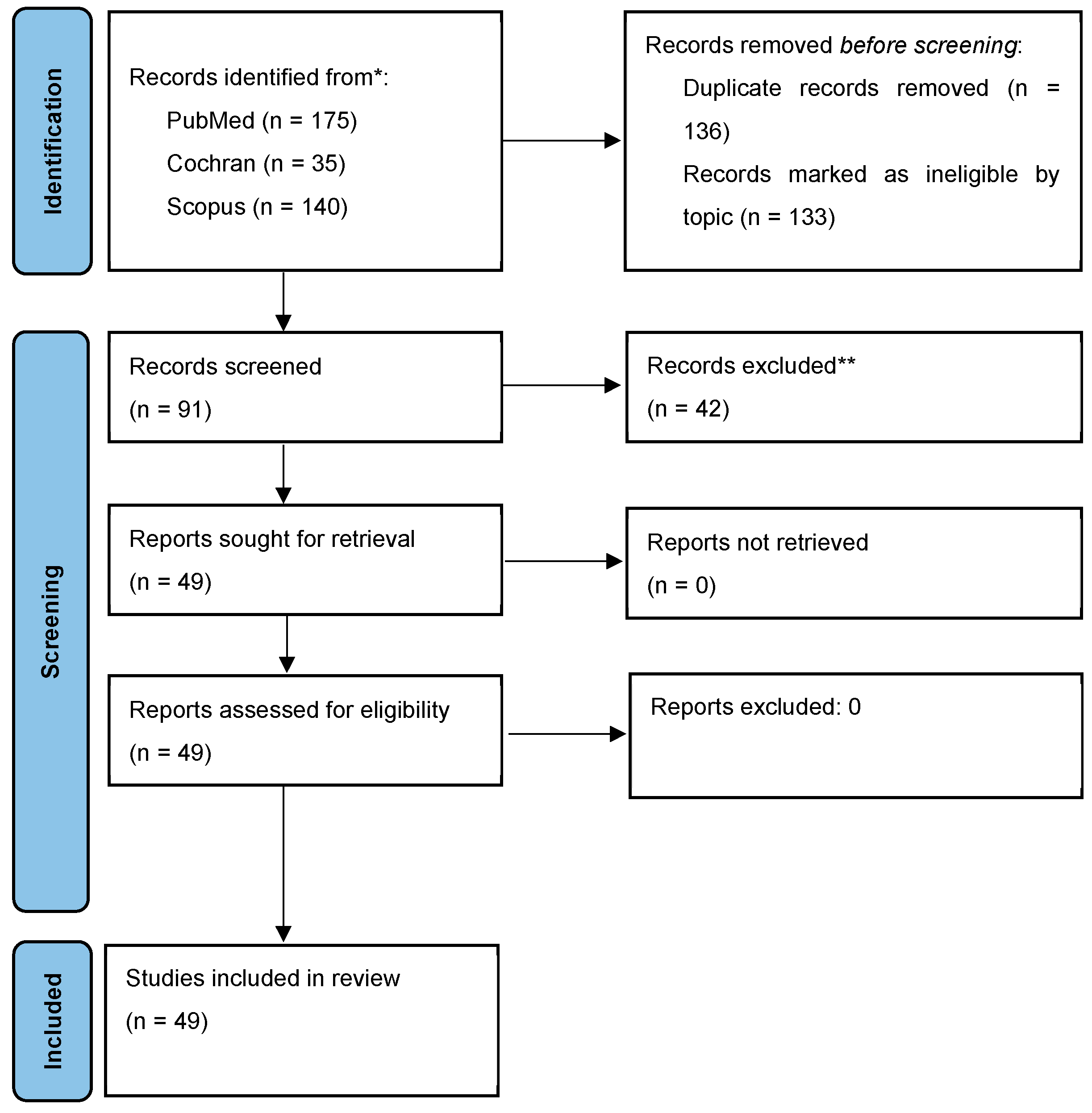
2.4. Selection Process
2.5. Data Collection Process
2.6. Data Items
2.7. Risk of Bias Assessment
2.8. Synthesis Method
3. Results
3.1. AXIS Assessment
3.2. Findings from Studies on Asthma
3.3. Findings from Studies on Diabetes
3.4. Findings from Studies on Epilepsy
4. Discussion
5. Conclusions
Supplementary Materials
Author Contributions
Funding
Institutional Review Board Statement
Informed Consent Statement
Data Availability Statement
Conflicts of Interest
References
- Langton, C.R.; Hollenbach, J.P.; Simoneau, T.; Cloutier, M.M. Asthma management in school: Parents’ and school personnel perspectives. J. Asthma 2020, 57, 295–305. [Google Scholar] [CrossRef]
- Detsis, D.; Vlachou, E.; Adamakidou, T.; Zartaloudi, A. Knowledge Attitudes and Sense of Self-Efficacy of Primary Education Teachers towards Students with Insulin-Dependent Diabetes Mellitus. Eur. Psychiatry 2023, 66, S984–S985. [Google Scholar] [CrossRef]
- Pitta, S.; Papadopoulos, A.; Tsiamaki, E.; Tsapanou, A.; Trimmis, N.; Michou, E.; Jelastopulu, E.; Plotas, P. Teachers’ and School Professionals’ Knowledge and Attitudes Towards Epilepsy in Greece: Misconceptions and Management Options for Affected Students—A Survey Study. Educ. Sci. 2025, 15, 591. [Google Scholar] [CrossRef]
- Akinbami, L.J.; Moorman, J.E.; Liu, X. Asthma Prevalence, Health Care Use, and Mortality: United States, 2005–2009; Report No.: 32; National Center for Health Statistics: Hyattsville, MD, USA, 2011.
- Croisant, S. Epidemiology of asthma: Prevalence and burden of disease. In Heterogeneity in Asthma; Advances in Experimental Medicine and Biology; Humana Press: Boston, MA, USA, 2014; Volume 795, pp. 17–29. [Google Scholar]
- Nurmagambetov, T.; Kuwahara, R.; Garbe, P. The economic burden of asthma in the United States, 2008–2013. Ann. Am. Thorac. Soc. 2018, 15, 348–356. [Google Scholar] [CrossRef]
- Crump, C.; Rivera, D.; London, R.; Landau, M.; Erlendson, B.; Rodriguez, E. Chronic health conditions and school performance among children and youth. Ann. Epidemiol. 2013, 23, 179–184. [Google Scholar] [CrossRef] [PubMed]
- Jones, C.M.; DeWalt, D.A.; Huang, I.C. Impaired patientreported outcomes predict poor school functioning and daytime sleepiness: The PROMIS pediatric asthma study. Acad. Pediatr. 2017, 17, 850–854. [Google Scholar] [CrossRef]
- Lange, K.; Jackson, C.; Deeb, L. Diabetes care in schools--the disturbing facts. Pediatr Diabetes. 2009, 10, 28–36. [Google Scholar] [CrossRef]
- Bassi, M.; Scalas, M.; Spacco, G.; Perasso, V.; Franzone, D.; Strati, M.F.; Dufour, F.; Lionetti, B.; Rizza, F.; Parodi, S.; et al. Management of Type 1 Diabetes in a school setting: Effectiveness of an online training program for school staff. Front. Public Health 2024, 11, 1228975. [Google Scholar] [CrossRef] [PubMed]
- Alamri, S.; Al Thobaity, A. Teachers and epilepsy: What they know, do not know, and need to know: A cross-sectional study of Taif City. J. Fam. Med. Prim. Care 2020, 9, 2704–2709. [Google Scholar] [CrossRef]
- Rani, A.; Thomas, P.T. Stress and perceived stigma among parents of children with epilepsy. Neurol. Sci. 2019, 40, 1363–1370. [Google Scholar] [CrossRef]
- Hughes, D. Childhood asthma and school. Paediatr. Child Health 2020, 26, e4–e5. [Google Scholar] [CrossRef]
- Al Kindi, Z.; McCabe, C.; Mc Cann, M. School Nurses’ Available Education to Manage Children with Asthma at Schools: A Scoping Review. J. Pediatr. Nurs. 2021, 60, 46–57. [Google Scholar] [CrossRef]
- McCabe, E.M.; McDonald, C.; Connolly, C.; Lipman, T.H. A Review of School Nurses’ Self-Efficacy in Asthma Care. J. Sch. Nurs. 2019, 35, 15–26. [Google Scholar] [CrossRef]
- Coffman, J.M.; Cabana, M.D.; Yelin, E.H. Do school-based asthma education programs improve self-management and health outcomes? Pediatrics 2009, 124, 729–742. [Google Scholar] [CrossRef]
- Willgerodt, M.A.; Brock, D.M.; Maughan, E.D. Public School Nursing Practice in the United States. J. Sch. Nurs. 2018, 34, 232–244. [Google Scholar] [CrossRef] [PubMed]
- Kew, K.M.; Carr, R.; Donovan, T.; Gordon, M. Asthma education for school staff. Cochrane Database Syst. Rev. 2017, 4, CD012255. [Google Scholar] [CrossRef] [PubMed]
- Liberati, A.; Altman, D.G.; Tetzlaff, J.; Mulrow, C.; Gøtzsche, P.C.; Ioannidis, J.P.; Clarke, M.; Devereaux, P.J.; Kleijnen, J.; Moher, D. The PRISMA statement for reporting systematic reviews and meta-analyses of studies that evaluate healthcare interventions: Explanation and elaboration. BMJ 2009, 339, b2700. [Google Scholar] [CrossRef]
- Medical Subject Headings. Available online: https://www.ncbi.nlm.nih.gov/mesh/ (accessed on 1 September 2025).
- Page, M.J.; McKenzie, J.E.; Bossuyt, P.M.; Boutron, I.; Hoffmann, T.C.; Mulrow, C.D.; Shamseer, L.; Tetzlaff, J.M.; Akl, E.A.; Brennan, S.E.; et al. The PRISMA 2020 statement: An updated guideline for reporting systematic reviews. Syst. Rev. 2021, 10, 89. [Google Scholar] [CrossRef] [PubMed]
- Downes, M.J.; Brennan, M.L.; Williams, H.C.; Dean, R.S. Development of a critical appraisal tool to assess the quality of cross-sectional studies (AXIS). BMJ Open 2016, 6, e011458. [Google Scholar] [CrossRef]
- Getch, Y.Q.; Neuharth-Pritchett, S.; Schilling, E.J. Asthma and the Public School Teacher: A Two State Study. Pediatr. Allergy Immunol. Pulmonol. 2019, 32, 109–116. [Google Scholar] [CrossRef]
- Brosso, L.; Zonta, J.B.; Levada, A.F.; Barbosa, N.G.; Lima, R.A.G.; Okido, A.C.C. Knowledge and experience of Primary Education teachers regarding childhood asthma: Mixed study. Rev. Esc. Enferm. USP 2023, 57, e20220329. [Google Scholar] [CrossRef]
- Salih, M.R.M.; Abd, A.Y.; Fawzi, H.A. Awareness of asthma and its management in primary school teachers in Baghdad, Iraq. F1000Research 2022, 11, 367. [Google Scholar] [CrossRef]
- Reznik, M.; Halterman, J.S. School asthma policies and teachers’ confidence and attitudes about their role in asthma management. Ann. Allergy Asthma Immunol. 2016, 116, 473–475. [Google Scholar] [CrossRef][Green Version]
- Nour, A.; Alsayed, A.R.; Basheti, I. Prevalence of Asthma amongst Schoolchildren in Jordan and Staff Readiness to Help. Healthcare 2023, 11, 183. [Google Scholar] [CrossRef]
- Adeyeye, O.O.; Kuyinu, Y.A.; Ozoh, O.B. Assessment of the knowledge of teachers about asthma and the availability of facilities for asthma care in public secondary schools in Lagos, Nigeria. Afr. J. Thorac. Crit. Care Med. 2018, 24, 76–81. [Google Scholar] [CrossRef]
- Mohammadzadeh, I.; Mosaffa, S.; Alizadeh-Navaei, R. Asthma knowledge level of primary school teachers in Babol, Iran, 2008. Iran. J. Pediatr. 2010, 20, 373–374. [Google Scholar]
- Ones, U.; Akcay, A.; Tamay, Z.; Guler, N.; Dogru, M. Asthma knowledge level of primary schoolteachers in Istanbul, Turkey. Asian Pac. J. Allergy Immunol. 2006, 24, 9–15. [Google Scholar] [PubMed]
- Awadalla, M.F.M.; Yousef, A.; Shiba, H.A.A.; Almatani, M.U.H.; Ashshi, M.A.M.; Melibari, A.M.I.; Alahmadi, A.A.M.; Dhahwah, A.F.M.; Bukhari, A.M.A.; Alharbi, R.A.M.; et al. Knowledge and response of school teachers towards asthma exacerbation among school children in two arab countries. Clin. Epidemiol. Glob. Health 2024, 26, 101533. [Google Scholar] [CrossRef]
- Govender, D.; Gray, A. Knowledge of primary school teachers about asthma: A cross-sectional survey in the Umdoni sub-district, KwaZulu-Natal. S. Afr. Fam. Pract. 2012, 54, 347–351. [Google Scholar] [CrossRef]
- Canitez, Y.; Cekic, S.; Celik, U.; Kocak, A.; Sapan, N. Health-care conditions in elementary schools and teachers’ knowledge of childhood asthma. Paediatr. Int. Child Health 2016, 36, 64–71. [Google Scholar] [CrossRef]
- Varela, A.L.S.; Esteban, S.R.; Díaz, S.P.; Murúa, J.K.; Fernández-Oliva, C.R.R.; Jiménez, J.S.; Sansano, M.I.U.; Bernabé, J.J.M.; López, B.I.; Gómez, M.M.; et al. Knowledge of asthma in school teachers in nine Spanish cities. Pediatr. Pulmonol. 2016, 51, 678–687. [Google Scholar] [CrossRef] [PubMed]
- Juliá-Benito, J.C.; Escarrer-Jaume, M.; Guerra-Pérez, M.T.; Contreras-Porta, J.; Tauler-Toro, E.; Madroñero-Tentor, A.; Cerdá-Mir, J.C. Knowledge of asthma and anaphylaxis among teachers in Spanish schools. Allergol. Immunopathol. 2017, 45, 369–374. [Google Scholar] [CrossRef] [PubMed]
- Urrutia-Pereira, M.; Mocellin, L.P.; de Oliveira, R.B.; Simon, L.; Lessa, L.; Solé, D. Knowledge on asthma, food allergies, and anaphylaxis: Assessment of elementary school teachers, parents/caregivers of asthmatic children, and university students in Uruguaiana, in the state of Rio Grande do Sul, Brazil. Allergol. Immunopathol. 2018, 46, 421–430. [Google Scholar] [CrossRef]
- Caruana, M.; Bonnici West, L.M.; Cordina, M. School practices in supporting children with asthma in Malta. J. Asthma 2022, 59, 1742–1749. [Google Scholar] [CrossRef]
- Al-Motlaq, M.; Al-Omari, H. An Alarming Poor Knowledge with Moderate Confidence Towards Asthma Management among School Teachers: The Dunning–Kruger Effect. Child Care Pract. 2024, 1–10. [Google Scholar] [CrossRef]
- Sandsund, M.; Thomassen, M.; Reinertsen, R.E.; Steinshamn, S. Exercise-induced asthma in adolescents: Challenges for physical education teachers. Chronic Respir. Dis. 2011, 8, 171–179. [Google Scholar] [CrossRef] [PubMed]
- Alkhamis, Z.N.; Hashim, S.A. Awareness of asthma and its management in primary school teachers in Eastern Province. J. Fam. Med. Prim. Care 2019, 8, 1908–1913, Erratum in J. Fam. Med. Prim. Care 2019, 8, 2554. https://doi.org/10.4103/2249-4863.263823. [Google Scholar] [CrossRef]
- Bruzzese, J.M.; Unikel, L.H.; Evans, D.; Bornstein, L.; Surrence, K.; Mellins, R.B. Asthma knowledge and asthma management behavior in urban elementary school teachers. J. Asthma 2010, 47, 185–191. [Google Scholar] [CrossRef] [PubMed]
- Aljefree, N.M.; Almoraie, N.M.; Althaiban, M.A.; Hanbazaza, M.A.; Wazzan, H.A.; Shatwan, I.M. Gender differences in knowledge, attitudes, and practices with respect to type 1 diabetes among Saudi public-school teachers. BMC Public Health 2023, 23, 118. [Google Scholar] [CrossRef]
- dos Anjos Coelho Rodrigues Dixe, M.; Gomes de Oliveira Gordo, C.M.; Borges Pereira Catarino, H.; Kraus, T.; da Silva Guilherme Menino, E.P. Effects of an education program on knowledge and self-perception of school personnel in preparing to care for type 1 diabetes students. Einstein 2020, 18, eAO5101. [Google Scholar] [CrossRef]
- Aycan, Z.; Önder, A.; Çetinkaya, S.; Bilgili, H.; Yıldırım, N.; Baş, V.N.; Kendirci, H.N.P.; Ağladıoğlu, S.Y. Assessment of the knowledge of diabetes mellitus among school teachers within the scope of the managing diabetes at school program. J. Clin. Res. Pediatr. Endocrinol. 2012, 4, 199–203. [Google Scholar] [CrossRef]
- Stefanowicz-Bielska, A.; Miszk, M.; Rąpała, M. Teachers’ knowledge about the principles of dealing with a student with type 1 diabetes mellitus. BMC Public Health 2024, 24, 3164. [Google Scholar] [CrossRef]
- Alshammari, F.M.; Haridi, H.K. Teachers’ knowledge about type 1 diabetes in public female elementary schools in Northern Saudi Arabia. J. Prev. Med. Hyg. 2021, 62, E673–E680. [Google Scholar] [CrossRef] [PubMed]
- Gutzweiler, R.F.; Neese, M.; In-Albon, T. Teachers’ Perspectives on Children with Type 1 Diabetes in German Kindergartens and Schools. Diabetes Spectr. 2020, 33, 201–209. [Google Scholar] [CrossRef]
- Gutiérrez-Manzanedo, J.V.; Carral-San Laureano, F.; Moreno-Vides, P.; de Castro-Maqueda, G.; Fernández-Santos, J.R.; Ponce-González, J.G. Teachers’ knowledge about type 1 diabetes in south of Spain public schools. Diabetes Res. Clin. Pract. 2018, 143, 140–145. [Google Scholar] [CrossRef] [PubMed]
- Gökçe, T.; Sakarya, S.; Muradoğlu, S.; Mutlu, G.Y.; Can, E.; Cemhan, K.; Kurtulmuş, M.F.; Gülşen, M.; Aycan, Z.; Darendeliler, F.; et al. An evaluation of the knowledge and attitudes of school staff related to diabetes care at school: The 10th year of the “diabetes program at school” in Turkey. Pediatr. Diabetes 2021, 22, 233–240. [Google Scholar] [CrossRef] [PubMed]
- Bradbury, A.J.; Smith, C.S. An assessment of the diabetic knowledge of school teachers. Arch. Dis. Child. 1983, 58, 692–696. [Google Scholar] [CrossRef]
- Karimi, N.; Heidari, M. Knowledge and attitudes toward epilepsy among school teachers in West of Iran. Iran. J. Neurol. 2015, 14, 130–135. [Google Scholar]
- Almarwani, B.; Alqelaiti, E.; Aljohani, A.; Abuanq, L.; Alhujaili, R.; Aljohani, R. Knowledge and Attitude About Epilepsy Among School Teachers in Madinah, Saudi Arabia. Cureus 2023, 15, e44572. [Google Scholar] [CrossRef]
- Elhassan, M.A.; Alemairy, A.A.; Amara, Z.M.; Hamadelneel, A.A.; Mohamed, A.H.; Elaimeri, A.A. Epilepsy: Knowledge, Attitude, and Practice Among Secondary School Teachers in Khartoum State. Neurol. Ther. 2017, 6, 225–235. [Google Scholar] [CrossRef]
- Abulhamail, A.S.; Al-Sulami, F.E.; Alnouri, M.A.; Mahrous, N.M.; Joharji, D.G.; Albogami, M.M.; Jan, M.M. Primary school teacher’s knowledge and attitudes toward children with epilepsy. Seizure 2014, 23, 280–283. [Google Scholar] [CrossRef]
- Assadeck, H.; Toudou Daouda, M.; Moussa Konate, M.; Mamadou, Z.; Douma Maiga, D.; Sanoussi, S. Knowledge, attitudes, and practices with respect to epilepsy among primary and secondary school teachers in the city of Niamey, Niger. Brain Behav. 2020, 10, e01539. [Google Scholar] [CrossRef]
- Ibinga, E.; Druet-Cabanac, M.; Revegue, M.H.D.T.; Engohang-Ndong, J.; Bisvigou, U.; Ategbo, S.J.; Preux, P.-M.; Ngoungou, E.B. Impact of knowledge, attitudes, and sociocultural factors on school enrollment of children with epilepsy in Gabon. Seizure 2019, 71, 145–150. [Google Scholar] [CrossRef] [PubMed]
- Al-Hashemi, E.; Ashkanani, A.; Al-Qattan, H.; Mahmoud, A.; Al-Kabbani, M.; Al-Juhaidli, A.; Jaafar, A.; Al-Hashemi, Z. Knowledge about Epilepsy and Attitudes toward Students with Epilepsy among Middle and High School Teachers in Kuwait. Int. J. Pediatr. 2016, 2016, 5138952. [Google Scholar] [CrossRef] [PubMed]
- Al-Harbi, A.F.; Alsaid, L.A.; Parameaswari, P.J. Primary school female teachers’ knowledge, attitude, and practice toward students with epilepsy in Riyadh, Saudi Arabia. J. Fam. Med. Prim. Care 2018, 7, 331–336. [Google Scholar] [CrossRef] [PubMed]
- Iannone, L.F.; Roberti, R.; Arena, G.; Mammone, S.; Pulitano, P.; De Sarro, G.; Mecarelli, O.; Russo, E. Assessing knowledge and attitudes toward epilepsy among schoolteachers and students: Implications for inclusion and safety in the educational system. PLoS ONE 2021, 16, e0249681. [Google Scholar] [CrossRef]
- Kanjo, M.; Najjar, A.; Bokhari, A.Y.; Alqarni, G.A.; Darwesh, E.A.; Alqarni, G.S. Knowledge of Epilepsy and seizure first aid among teachers in Jeddah, Saudi Arabia. Epilepsy Behav. Rep. 2021, 16, 100475. [Google Scholar] [CrossRef]
- Adal, O.; Abebe, A. First aid knowledge and practice toward students with epileptic seizure among governmental high school teachers in Addis Ababa, Ethiopia: Cross-sectional study. Epilepsy Behav. 2022, 134, 108767. [Google Scholar] [CrossRef]
- Gebrewold, M.A.; Enquselassie, F.; Teklehaimanot, R.; Gugssa, S.A. Ethiopian teachers: Their knowledge, attitude and practice towards epilepsy. BMC Neurol. 2016, 16, 167. [Google Scholar] [CrossRef]
- Dantas, F.G.; Cariri, G.A.; Cariri, G.A.; Ribeiro Filho, A.R.V. Knowledge and attitudes toward epilepsy among primary, secondary and tertiary level teachers. Arq. Neuro-Psiquiatr. 2001, 59, 712–716. [Google Scholar] [CrossRef]
- Toudou-Daouda, M.; Ibrahim-Mamadou, A.K. Teachers’ Knowledge About Epilepsy and Their Attitudes Toward Students with Epilepsy: A Cross-Sectional Survey in the City of Tahoua (Niger). Neuropsychiatr. Dis. Treat. 2020, 16, 2327–2333. [Google Scholar] [CrossRef]
- Babikar, H.E.; Abbas, I.M. Knowledge, practice and attitude toward epilepsy among primary and secondary school teachers in South Gezira locality, Gezira State, Sudan. J. Fam. Community Med. 2011, 18, 17–21. [Google Scholar] [CrossRef]
- Owolabi, L.F.; Shehu, N.M.; Owolabi, S.D. Epilepsy and education in developing countries: A survey of school teachers’ knowledge about epilepsy and their attitude towards students with epilepsy in Northwestern Nigeria. Pan Afr. Med. J. 2014, 18, 255. [Google Scholar] [CrossRef]
- Babore, G.O.; Habebo, T.T.; Ashine, T.M.; Helizo, A.Z.; Anshebo, D.G. Knowledge and Practice Toward Epilepsy and its Associated Factors Among Teachers, in Hossana Town Administration, Southern Ethiopia, 2020. SAGE Open Nurs. 2025, 11, 23779608241272584. [Google Scholar] [CrossRef]
- Vujisić, S.; Vodopić, S. Epilepsy awareness, knowledge and attitudes among secondary school teachers in Montenegro. Srp. Arh. Celok. Lek. 2017, 145, 129–135. [Google Scholar] [CrossRef][Green Version]
- Khanal, K.; Maharjan, R.; Pokharel, B.; Sanjel, S. School Teachers’ Knowledge about Epilepsy in Kathmandu Metropolitan City. Kathmandu Univ. Med. J. 2017, 13, 316–322. [Google Scholar] [CrossRef]
- Alenazi, S.A.; Alruwaili, S.M.M.; Alanazi, N.K.J.; Albalawi, D.A.; Alanazi, N.F.; Alanazi, D.M.; Elmorsy, E. Awareness About Epilepsy Among Schoolteachers in the Northern Border Region, Saudi Arabia. Dubai Med. J. 2025, 8, 219–229. [Google Scholar] [CrossRef]
- Cicutto, L.; Conti, E.; Evans, H.; Lewis, R.; Murphy, S.; Rautiainen, K.C.; Sharrard, S. Creating asthma-friendly schools: A public health approach. J. Sch. Health 2006, 76, 255–258. [Google Scholar] [CrossRef] [PubMed]
- Cain, A.; Reznik, M. Asthma management in New York City schools: A classroom teacher perspective. J. Asthma 2016, 53, 744–750. [Google Scholar] [CrossRef] [PubMed]
- Smith, A.; Harris, C. Type 1 Diabetes: Management Strategies. Am. Fam. Physician 2018, 98, 154–162. [Google Scholar]
- Wu, S.; Ding, Y. Type 1 diabetes and the risk of epilepsy: A meta-analysis. J. Diabetes Investig. 2024, 15, 364–373. [Google Scholar] [CrossRef] [PubMed]
- Carvalho Coelho, A.C.; Barretto Cardoso, L.S.; de Souza-Machado, C.; Souza-Machado, A. The Impacts of Educational Asthma Interventions in Schools: A Systematic Review of the Literature. Can. Respir. J. 2016, 2016, 8476206. [Google Scholar] [CrossRef] [PubMed]
- Leroy, Z.C.; Wallin, R.; Lee, S. The Role of School Health Services in Addressing the Needs of Students with Chronic Health Conditions. J. Sch. Nurs. 2017, 33, 64–72. [Google Scholar] [CrossRef]
- Bakir, E.; Sezer, T.A. The efficacy of interventions provided by nurses to improve glycemic control of children with type 1 diabetes: A systematic review. J. Spec. Pediatr. Nurs. 2023, 28, e12397. [Google Scholar] [CrossRef] [PubMed]


| Reference Number | Authors and Publication Year | Study Type | Country | Number of Schools | Type of School (Elementary, High School) | Number of Teachers | Gender/Age of Teacher | Type of Questionnaire | Grade of Knowledge About Disease (Percentage) |
|---|---|---|---|---|---|---|---|---|---|
| [23] | YQ Getch et al., 2019 | Cross-sectional survey | United States | NA | Elementary and middle schools | 593 | Gender not reported 20–50 years | Self-administered survey | 60.6% reported not feeling well prepared |
| [24] | Brosso L et al., 2023 | Mixed study (sequential explanatory) | Brazil | NA | Elementary school | 207 | 92% female mean age of 40.5 | Newcastle Asthma Knowledge Questionnaire | 63.8% had unsatisfactory performance |
| [25] | R M Salih M et al., 2022 | Cross-sectional survey | Iraq | NA | Elementary school | 103 | 82.5% female Most were under 40 years (70%) | Self-administered survey, modified from previous authors | 72.44% mean total confidence score in managing children with asthma |
| [26] | Reznik M et al., 2016 | Cross-sectional survey | United States | 4 | Elementary schools | 65 | 95% female Age not stated | Self-administered based on NHLBI guidelines | 68% felt uncomfortable assessing/managing asthma attacks |
| [27] | Nour A et al., 2023 | Cross-sectional study | Jordan | 20 | Elementary schools | 200 | NA | Self-administered asthma first-aid knowledge questionnaire | Nearly 50% of questions were incorrectly answered |
| [28] | Adeyeye OO et al., 2018 | Cross-sectional survey | Nigeria | 54 | High school | 988 | 64.1 females Mean age 44.6 | Self-administered questionnaire with a knowledge score (maximum 32) | 48.1% Poor knowledge |
| [29] | Mohammadzadeh I et al., 2010 | Cross-sectional descriptive analytical study | Iran | 80 | Elementary school | 425 | Gender not reported Mean age 42.7 | Custom 16-item questionnaire assessing asthma knowledge, max score 16, α = 0.822 | Mean knowledge score 12 (intermediate level) |
| [30] | Ones U et al., 2006 | Cross-sectional descriptive study | Turkey | 73 | Elementary school | 792 | 58.5% female Mean age 38 ± 9 years | questionnaire adapted from KASE-AQ, max score 130 | Mean score = 96.7 (around 74.3% of max)—satisfied levels of knowledge |
| [31] | Awadalla et al., 2024 | Analytical cross-sectional | Saudi Arabia | 16 | Elementary school | 384 | 58.6% female; age mostly 41–50 | Self-administered questionnaire, α = 0.793 | 44.8% unsatisfied knowledge |
| [32] | Govender et al., 2012 | Cross-sectional survey | South Africa | 19 | Primary schools | 226 | 88.9% female mean age 43 ± 8.2 years | 55-item questionnaire on asthma knowledge, administered face-to-face via Mobile Researcher® app | 38.5% scored <50% (limited knowledge), 61.5% scored ≥50% |
| [33] | Canitez et al., 2016 | Cross-sectional survey | Turkey | 141 | Public elementary schools | 2779 | 62.4% female/median age 37.6 | Asthma characteristics (unvalidated) and Detailed asthma knowledge, Likert scale (validated) | Mean score for both 60.4% |
| [34] | Varela et al., 2016 | Cross-sectional, observational | Spain | 208 | Pre-school, primary, secondary | 4679 | 72.6% female, mean age 42.8 ± 10.2 years | Newcastle Asthma Knowledge Questionnaire (NAKQ), validated | Mean score 16/31 (~52% correct); only 6.8% knew main symptoms, 1.5% triggers, 8.6% rescue meds, 32.7% inhaler side effects, 3.8% exercise prevention |
| [35] | Juliá-Benito et al., 2017 | Cross-sectional survey | Spain | NA | Primary, Secondary, High school | 2481 | Female 69.5% 20–50 years 64.5% 6 | 25-item self-administered survey developed for study; pilot-tested | 97.0% knew what asthma is; 44.5% claimed to know what to do in asthma attack; 54% did not know how to administer asthma medication |
| [36] | Urrutia-Pereira et al., 2018 | Cross-sectional survey | Brazil | NA | Elementary school | 177 | NA | Portuguese version of Newcastle Asthma Knowledge Questionnaire (NAKQ) | misconceptions on asthma triggers, 4.2% identifying the three main symptoms, 66.1% recognizing bronchial inflammation as the main cause, 91.0% agreeing that children with asthma should not be exposed to smoke, 80.8% knowing preventive medicines must be used daily, and 87.4% acknowledging that severe attacks can lead to hospitalization |
| [37] | Caruana et al., 2022 | Cross-sectional electronic survey | Malta | 26 | Primary schools | 167 | NA | Electronic self-reported survey assessing | Mean 5.5 ± 3.3 out of 14 total points (low knowledge) |
| [38] | Al-Motlaq et al., 2024 | Cross-sectional survey | Iraq | NA | Primary school teachers | 150 | NA | 29 multiple true–false questions on asthma facts and management | mean total knowledge score 20.27 ± 2.97, mean confidence score 72.44 ± 13.61 |
| [39] | Sandsund M et al., 2011 | cross-sectional survey and qualitative study | Norway | NA | Secondary schools | 106 | Female 46.2%; mostly 30–39 years 39.6% | Self-administered questionnaire developed from interviews and expert review; Likert-scale items | 25.9% reported sufficient knowledge to teach pupils with asthma 89.4% reported need for training |
| [40] | Alkhamis et al., 2019 | Cross-sectional observational survey | Saudi Arabia | NA | Primary/Elementary school | 396 | Mostly 30–50 years (80.8%), Gender not reported | Self-administered electronic questionnaire | 59.6% had high overall asthma awareness; Symptoms: 73.2%; Triggers: 60.9%; Treatment: 69.7% |
| [41] | Bruzzese et al., 2010 | Cross-sectional survey study | United States | 25 | Public elementary schools | 320 | NA | Self-reported questionnaire, α = 0.74 to 0.98 | Mean total correct score = 68.9%—satisfied levels of knowledge; 93.8% recognized wheezing/shortness of breath as sign, 31.9% correctly identified preventive medication before exercise |
| Reference Number | Authors and Publication Year | Study Type | Country | Number of Schools | Type of School (Elementary, High School) | Number of Teachers | Gender/Age of Teacher | Type of Questionnaire | Grade of Knowledge About Disease (Percentage) |
|---|---|---|---|---|---|---|---|---|---|
| [42] | Aljefree NM et al., 2023 | Cross-sectional study | Saudi Arabia | NA | Elementary and high school | 378 | Majority female, age 45–54 years | Online survey–self-administered questionnaire (score ranged from to 0–7 for knowledge and 0–5 for attitude) | The average knowledge score was 4.4 (moderate knowledge); Theaverage attitude score was 3.5 (favorable) |
| [43] | Dixe et al., 2020 | Experimental pre-test/post-test study | Portugal | 12 | Pre-school to high school | 129 | Not included | self-completed questionnaire, α = 0.926 (score from 0 to 17) | Knowledge scores pre-test was 10.8 (moderate) |
| [44] | Aycan Z et al., 2012 | Cross-sectional study | Turkey | NA | Elementary and high school | 1054 | 73% females, Mean age 38.8 years | Self-administered questionnaire | Moderate knowledge: 47.6% Low knowledge: 32.4% |
| [45] | Stefanowicz-Bielska et al., 2024 | Cross-sectional survey | Poland | NA | Elementary and high school | 808 | 86.4% females, over the 40 years | An original 29-item knowledge test developed by the authors | Median score: 20/29 (69%)—moderate |
| [46] | Alshammari & Haridi, 2021 | Cross-sectional survey | Saudi Arabia | 18 | Elementary and high school | 504 | 100% female; mean age 39.2 | Structured self-administered questionnaire with 20-item Test of Diabetes Knowledge for Teachers | Mean score: 13.2/20 (66.0%)—moderate |
| [47] | RF Gutzweiler et al., 2020 | Cross-sectional survey | Germany | NA | Elementary and high school | 678 | 89% female; age distribution not specified | Structured survey, 5-point Likert scale | Not explicitly stated |
| [48] | Gutiérrez-Manzanedo et al., 2018 | Descriptive observational (cross-sectional) | Spain | 44 | Public pre-, primary, and secondary schools | 765 | 61.7% female, mean age 44.3 ± 8.8 years | Test of Diabetes Knowledge for Teachers (TDKT | Not enough knowledge: 58% (≤7 points), Basic knowledge: 36.9% (8–12 points), Effective support: 5.1% (13–16 points) |
| [49] | Gökçe et al., 2019 | Cross-sectional survey (online) | Turkey | NA | Public, Private, Specialized | 42,349 | Mean age 37.9 (20–73), 56% female | 55-item online survey (39 knowledge + 16 attitude questions, True/False/Don’t know), α = 0.71 | Mean knowledge score 17.7/39 (min −13, max 39); 75% of those aware of DPS reported increase in knowledge |
| [50] | Bradbury et al., 1983 | Cross-sectional survey | United Kingdom | 40 | Primary and Secondary | 97 | NA | Self-administered questionnaire (18 knowledge questions + sections on sources & attitudes) | Only 24 teachers (25%) had “adequate” knowledge (score ≥14/18) |
| Reference Number | Authors and Publication Year | Study Type | Country | Number of Schools | Type of School (Elementary, High School) | Number of Teachers | Gender/Age of Teacher | Type of Questionnaire | Grade of Knowledge About Disease (Percentage) |
|---|---|---|---|---|---|---|---|---|---|
| [52] | Almarwani et al., 2023 | Cross-sectional | Saudi Arabia | NA | Primary, middle, and high schools | 394 | 64.7% female; age older than 40 | Self-administered electronic questionnaire, adapted from previous studies | The mean score 28.8—good knowledge |
| [53] | Elhassan MA et al., 2017 | Cross-sectional descriptive study | Sudan | NA | Secondary schools | 317 | 52.7% male; age range 46–60 years | Self-administered questionnaire Knowledge scores scaled 0–14, α = 0.83 | mean knowledge score 8.1—intermediate level |
| [54] | Abulhamail AS et al., 2014 | Cross-sectional survey | Saudi Arabia | NA | Primary schools | 615 | 53% female; mean age 36 years | Structured 37-item questionnaire, Likert-scale items included | Only 17% of teachers felt very well informed about epilepsy |
| [51] | Karimi N et al., 2015 | Cross-sectional study | Iran | 25 | Primary and secondary schools | 305 | 71.5% female, mean age 38.4 years | 39-item structured questionnaire, 5-point Likert scale; validated for Persian | 82% knew symptoms, 61.3% observed an epileptic fit, 40% reported correct first-aid knowledge |
| [55] | Assadeck HA et al. 2020 | Cross-sectional survey | Niger | NA | Primary and secondary schools | 145 | 64.1% female, mean age: 39.6 years | Self-administered questionnaire | 42.1% considered epilepsy a brain disease, 46.2% considered it a contagious disease, 79.3% believed epilepsy is treatable, 11% considered it hereditary, 38.9% viewed it as an impurity, 6.9% thought it was incurable |
| [56] | Ibinga E et al. 2019 | Cross-sectional survey | Gabon | NA | Primary and secondary schools, specialized schools for children with intellectual disabilities | 813 | 57.7% female, mean age 40.1 years | Self-administered questionnaire (19 items) | Brief loss of consciousness: 58.2%, Sudden and brief flexion of neck/limbs: 37.2%, Falling of objects held by child: 33.3%, Contagious: 27.5%, Demonic possession: 16.0%, Brain disease: 43.6%, Neurologic disease: 58.0% |
| [57] | Al-Hashemi E et al., 2016 | Cross-sectional | Kuwait | 24 | Middle and High Schools | 824 | 55.1% males, mean age 36.9 years | Modified Scale of Attitudes Toward Persons with Epilepsy (ATPE) | knowledge about epilepsy 5 out of 13—weak. attitudes towards epilepsy of 10 out of 15—moderate |
| [58] | Al-Harbi AF et al., 2018 | Cross-sectional survey | Saudi Arabia | NA | Primary female schools | 582 | 100% females, mean age 39 | Self-administered, cross-culturally validated questionnaire | 79.2% of teachers had heard of epilepsy, 14.3% felt epileptic students should be transferred to special-needs schools, 31.8% expressed ability to give first aid, 27.5% accepted giving prescribed medications to students |
| [59] | Iannone LF et al., 2021 | Cross-sectional survey | Italy | 24 | Primary and secondary schools | 667 | 91.8% female, mostly older than 35 years | Custom-designed and validated questionnaires in Italian | 32.2% obtained their information from personal experience, and 26.5% from formal training or scientific literature in 16.6%. 22.2% were aware of prevalence, 40% of teachers believed epilepsy to be hereditary, 43.9% of teachers believed epilepsy to be incurable. |
| [60] | Kanjo M et al., 2021 | Cross-sectional survey | Saudi Arabia | NA | Primary, intermediate, secondary schools | 822 | 54.1% male, mean age 45 | Self-administered validated questionnaire assessing demographic data, knowledge about epilepsy and seizure first aid | 69% had moderate knowledge of epilepsy, 16.8% good knowledge, and 14.2% had poor knowledge |
| [61] | Adal O et al., 2022 | Institution-based cross-sectional study | Ethiopia | 4 | High school | 378 | Male: 71.7%, Mean age 34 | Structured self-administered questionnaire (English version, adapted from previous study, with 10 knowledge and 5 practice questions) | Good knowledge: 41.1% Poor knowledge: 58.9% Good practice: 40.9% Poor practice: 59.1% |
| [62] | Gebrewold MA et al., 2016 | Cross-sectional survey | Ethiopia | 20 | Primary school | 845 | 58.1 males, mean age 29 | Standardized self-administered questionnaire (multi-stage cluster sampling) | Knowledge: 45%—moderate; Attitude: 55%—moderat. Practice: 50%—moderate |
| [63] | Dantas FG et al., 2001 | Cross-sectional study | Brazil | 38 | Primary, secondary, and tertiary school | 300 | Female, age not stated | Structured questionnaire with yes/no/don’t know questions | 43% of teachers had knowledge of the correct initial procedures during a seizure; other knowledge aspects were lower |
| [64] | Toudou-Daouda M et al., 2020 | Cross-sectional survey | Niger | NA | Primary and secondary school | 284 | 61.6% female, Mean age 37.32 years | Self-administered structured questionnaire in French; 30 questions assessing knowledge (18) and attitudes (12) toward epilepsy | Median score attitudes 60% (18/30)—moderate knowledge attitudes: median 58% (7/12), moderate knowledge |
| [65] | Babikar HE et al., 2011 | Cross-sectional | Sudan | 22 | Primary and Secondary school | 200 | 56% females, mostly older than 40 years | Pretested, semi-structured, 35-item questionnaire | 55% of teachers had knowledge of initial procedures to help a child during a seizure |
| [66] | Owolabi LF et al., 2014 | Cross-sectional survey | Nigeria | NA | Nursery, primary, and secondary schools | 200 | 62% males, median age of 26 | Validated 20-item semi-structured self-administered questionnaire | 29.5% had fair to good knowledge about epilepsy |
| [67] | Babore GO et al., 2025 | Institutional-based cross-sectional study | Ethiopia | 13 | Primary and Secondary school | 310 | 61% male, mean age 33.69 years | Structured self-administered questionnaire; reliability α = 0.74 | 39.4% had good knowledge and 40.2% actually provided at least one appropriate first-aid measure |
| [68] | Vujisić S et al., 2017 | Cross-sectional survey | Montenegro | 9 | Secondary school | 219 | 74.9% female; mean age 43.38 years | Self-administered 16-item questionnaire | 97.7% had heard or read about epilepsy, 57.5% knew someone with epilepsy, 21% had a pupil with epilepsy in their class, 57% had witnessed a seizure, 40% believed epilepsy could be cured, Only 28.3% knew how to provide proper first aid |
| [3] | Pitta S et al., 2025 | Cross-sectional survey study | Greece | NA | Primary schools | 546 | 77.2% females, mean age 40.6 years | Structured questionnaire adapted from an Italian validated study | Aware of epilepsy: 99.3%, Witnessed a seizure: 46.8%, Aware of real prevalence in Greece—10%, Could identify at least one cause: >40%, Knew epilepsy is not psychiatric: >60%, Identified treatment options: >50%, Knew epilepsy is not curable: 33% |
| [69] | Khanal et al., 2017 | Cross-sectional survey | Nepal | 6 | Primary, secondary; public and private | 165 | 69 M/96 F; age 20–57 (median 29) | Self-administered structured & multiple-choice questionnaire | Poor (<50%): 47.9% Good (≥50%): 52.1% |
| [70] | Alenazi et al., 2025 | Cross-sectional survey | Saudi Arabia | 15 | Primary, secondary; public and private | 366 | 56% female, 40–49 years 47.3%, | Validated self-administered Arabic questionnaire (6 knowledge questions + demographics) | 57.9% had satisfactory knowledge scores (>3/6) |
Disclaimer/Publisher’s Note: The statements, opinions and data contained in all publications are solely those of the individual author(s) and contributor(s) and not of MDPI and/or the editor(s). MDPI and/or the editor(s) disclaim responsibility for any injury to people or property resulting from any ideas, methods, instructions or products referred to in the content. |
© 2026 by the authors. Licensee MDPI, Basel, Switzerland. This article is an open access article distributed under the terms and conditions of the Creative Commons Attribution (CC BY) license.
Share and Cite
Petrušić, A.; Milosavljević, M.N.; Pavlović, M.; Sovrlić, M.M.; Stepovic, M.; Folic, N.; Marinković, V.; Milošević Georgiev, A. Examining the Level of Knowledge of Teachers About Asthma, Diabetes and Epilepsy in Children: A Systematic Review. Children 2026, 13, 91. https://doi.org/10.3390/children13010091
Petrušić A, Milosavljević MN, Pavlović M, Sovrlić MM, Stepovic M, Folic N, Marinković V, Milošević Georgiev A. Examining the Level of Knowledge of Teachers About Asthma, Diabetes and Epilepsy in Children: A Systematic Review. Children. 2026; 13(1):91. https://doi.org/10.3390/children13010091
Chicago/Turabian StylePetrušić, Aleksandar, Miloš N. Milosavljević, Mladen Pavlović, Miroslav M. Sovrlić, Milos Stepovic, Nevena Folic, Valentina Marinković, and Andrijana Milošević Georgiev. 2026. "Examining the Level of Knowledge of Teachers About Asthma, Diabetes and Epilepsy in Children: A Systematic Review" Children 13, no. 1: 91. https://doi.org/10.3390/children13010091
APA StylePetrušić, A., Milosavljević, M. N., Pavlović, M., Sovrlić, M. M., Stepovic, M., Folic, N., Marinković, V., & Milošević Georgiev, A. (2026). Examining the Level of Knowledge of Teachers About Asthma, Diabetes and Epilepsy in Children: A Systematic Review. Children, 13(1), 91. https://doi.org/10.3390/children13010091