Long-Term Kidney Outcomes After SARS-CoV-2 Infection in Children Aged 0–12 Years: A Systematic Review

 , ,
, ,
Highlights
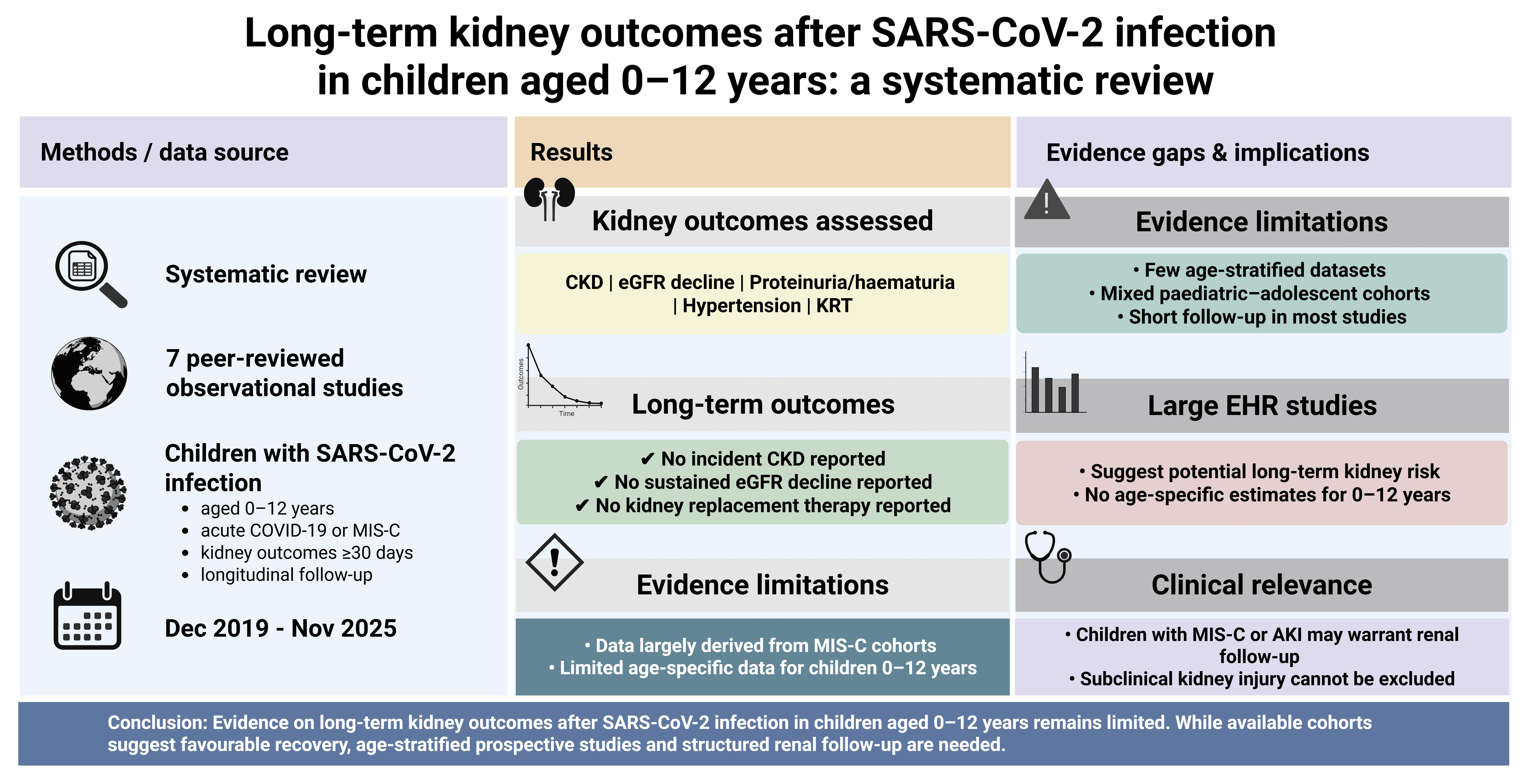
- Evidence on long-term kidney outcomes after SARS-CoV-2 infection in children aged 0–12 years is scarce, with only a small number of studies providing extractable age-specific data.
- Available MIS-C and mild COVID-19 cohorts generally show favourable short- to medium-term renal recovery, but larger EHR studies suggest potential long-term kidney risk in broader paediatric populations without age-stratified estimates for young children.
- Current evidence is insufficient to draw firm conclusions about long-term kidney outcomes in children aged 0–12 years, highlighting the need for age-stratified prospective studies with extended follow-up.
- Structured renal follow-up may be warranted for children with severe COVID-19, MIS-C, or acute kidney injury until more definitive long-term data become available.
Abstract
1. Introduction
2. Methods
2.1. Design
2.2. Data Sources and Search Strategy
2.3. Eligibility Criteria
2.3.1. Inclusion Criteria
- Included children aged 0–12 years with confirmed or probable SARS-CoV-2 infection (acute COVID-19 or MIS-C/PIMS-TS);
- Reported kidney outcomes assessed at post-acute (≥30 days) or long-term (≥90 days) time points after infection, including single post-acute cross-sectional assessments;
- Used observational designs with longitudinal follow-up or post-acute cross-sectional evaluation (prospective or retrospective cohort, case–control, registry/EHR cohort);
- Provided extractable data for children ≤ 12 years or had a median/mean cohort age ≤ 12 years.
2.3.2. Exclusion Criteria
- Randomised trials, case reports, case series with <7 participants, cross-sectional studies without follow-up, qualitative studies, reviews, editorials, commentaries;
- Purely acute cross-sectional studies reporting kidney outcomes only during the initial infection period (<30 days);
- Studies without identifiable SARS-CoV-2 infection status;
- Non-peer-reviewed manuscripts and non-English publications.
2.4. Definitions
- SARS-CoV-2 infection: confirmed by PCR, antigen test, serology, or clinical diagnosis according to national/WHO criteria [15].
- Age definition (0–12 years): children were defined as those aged 0–12 years to capture a biologically homogeneous paediatric group with shared renal and immune developmental profiles [1,22]. Adolescents were excluded because their near-adult kidney maturation, blood pressure physiology, and inflammatory responses differ substantially from younger children, which could confound age-specific renal outcome assessment [11,12,23].
- Long-term follow-up: ≥90 days after infection or hospital discharge, in line with WHO post-COVID-19 condition definitions [18].
- CKD: KDIGO 2012 criteria (eGFR < 90 mL/min/1.73 m2 or markers of kidney damage for ≥3 months) [21].
- AKI: KDIGO or AKIN creatinine-based definitions when reported [20].
- Proteinuria/haematuria: assessed per individual study methods (dipstick, ACR, PCR, microscopy) [21].
- Hypertension: defined according to paediatric blood pressure percentiles or thresholds specified in each study [10].
2.5. Data Extraction
2.6. Risk of Bias Assessment
2.7. Data Synthesis
3. Results
4. Discussion
4.1. Strengths and Limitations
4.2. Clinical Implications
5. Conclusions
Supplementary Materials
Author Contributions
Funding
Institutional Review Board Statement
Informed Consent Statement
Data Availability Statement
Acknowledgments
Conflicts of Interest
Abbreviations
References
- Dong, Y.; Mo, X.; Hu, Y.; Qi, X.; Jiang, F.; Jiang, Z.; Tong, S. Epidemiology of COVID-19 among children in China. Pediatrics 2020, 145, e20200702. [Google Scholar] [CrossRef]
- Shekerdemian, L.S.; Mahmood, N.R.; Wolfe, K.K.; Riggs, B.J.; Ross, C.E.; McKiernan, C.A.; Heidemann, S.M.; Kleinman, L.C.; Sen, A.I.; Hall, M.W. Characteristics and outcomes of children with coronavirus disease 2019 (COVID-19) infection admitted to US and Canadian pediatric intensive care units. JAMA Pediatr. 2020, 174, 868–873. [Google Scholar] [CrossRef]
- Ludvigsson, J.F. Systematic review of COVID-19 in children shows milder cases and a better prognosis than adults. Acta Paediatr. 2020, 109, 1088–1095. [Google Scholar] [CrossRef] [PubMed]
- Penner, J.; Abdel-Mannan, O.; Grant, K.; Maillard, S.; Kucera, F.; Hassell, J.; Eyre, M.; Berger, Z.; Hacohen, Y.; Moshal, K. 6-month multidisciplinary follow-up and outcomes of patients with paediatric inflammatory multisystem syndrome (PIMS-TS) at a UK tertiary paediatric hospital: A retrospective cohort study. Lancet Child Adolesc. Health 2021, 5, 473–482. [Google Scholar] [CrossRef]
- Centers for Disease Control and Prevention. Information for Healthcare Providers About Multisystem Inflammatory Syndrome in Children (MIS-C); Centers for Disease Control and Prevention: Atlanta, GA, USA, 2020.
- Pawar, S.M. Multi system inflammatory syndrome in children and adolescents temporally related to COVID-19. GFNPSS-Int. J. Multidiscip. Res. 2020, 1, 97–102. [Google Scholar] [CrossRef]
- Whittaker, E.; Bamford, A.; Kenny, J.; Kaforou, M.; Jones, C.E.; Shah, P.; Ramnarayan, P.; Fraisse, A.; Miller, O.; Davies, P. Clinical characteristics of 58 children with a pediatric inflammatory multisystem syndrome temporally associated with SARS-CoV-2. JAMA 2020, 324, 259–269. [Google Scholar] [CrossRef]
- Feldstein, L.R.; Rose, E.B.; Horwitz, S.M.; Collins, J.P.; Newhams, M.M.; Son, M.B.F.; Newburger, J.W.; Kleinman, L.C.; Heidemann, S.M.; Martin, A.A. Multisystem inflammatory syndrome in US children and adolescents. N. Engl. J. Med. 2020, 383, 334–346. [Google Scholar] [CrossRef]
- Tripathi, A.K.; Pilania, R.K.; Bhatt, G.C.; Atlani, M.; Kumar, A.; Malik, S. Acute kidney injury following multisystem inflammatory syndrome associated with SARS-CoV-2 infection in children: A systematic review and meta-analysis. Pediatr. Nephrol. 2023, 38, 357–370. [Google Scholar] [CrossRef] [PubMed]
- Flynn, J.T.; Kaelber, D.C.; Baker-Smith, C.M.; Blowey, D.; Carroll, A.E.; Daniels, S.R.; De Ferranti, S.D.; Dionne, J.M.; Falkner, B.; Flinn, S.K. Clinical practice guideline for screening and management of high blood pressure in children and adolescents. Pediatrics 2017, 140, e20171904. [Google Scholar] [CrossRef]
- Simon, A.K.; Hollander, G.A.; McMichael, A. Evolution of the immune system in humans from infancy to old age. Proc. R. Soc. B Biol. Sci. 2015, 282, 20143085. [Google Scholar] [CrossRef] [PubMed]
- Luyckx, V.A.; Brenner, B.M. The clinical importance of nephron mass. J. Am. Soc. Nephrol. 2010, 21, 898–910. [Google Scholar] [CrossRef]
- Ronco, C.; Reis, T.; Husain-Syed, F. Management of acute kidney injury in patients with COVID-19. Lancet Respir. Med. 2020, 8, 738–742. [Google Scholar] [CrossRef]
- Hirsch, J.S.; Ng, J.H.; Ross, D.W.; Sharma, P.; Shah, H.H.; Barnett, R.L.; Hazzan, A.D.; Fishbane, S.; Jhaveri, K.D.; Abate, M. Acute kidney injury in patients hospitalized with COVID-19. Kidney Int. 2020, 98, 209–218. [Google Scholar] [CrossRef]
- World Health Organization. COVID-19 Clinical Management: Living Guidance, 25 January 2021; World Health Organization: Geneva, Switzerland, 2021. [Google Scholar]
- Amir-Behghadami, M.; Janati, A. Population, Intervention, Comparison, Outcomes and Study (PICOS) design as a framework to formulate eligibility criteria in systematic reviews. Emerg. Med. J. 2020, 37, 387. [Google Scholar] [CrossRef] [PubMed]
- Page, M.J.; McKenzie, J.E.; Bossuyt, P.M.; Boutron, I.; Hoffmann, T.C.; Mulrow, C.D.; Shamseer, L.; Tetzlaff, J.M.; Akl, E.A.; Brennan, S.E. The PRISMA 2020 statement: An updated guideline for reporting systematic reviews. BMJ 2021, 372, 71. [Google Scholar] [CrossRef]
- World Health Organization. A Clinical Case Definition of Post COVID-19 Condition by a Delphi Consensus. 6 October 2021. Available online: https://www.who.int/publications/i/item/WHO-2019-nCoV-Post_COVID-19_condition-Clinical_case_definition-2021.1 (accessed on 29 November 2025).
- Royal College of Paediatrics and Child Health. Paediatric Multisystem Inflammatory Syndrome Temporally Associated with COVID-19 (PIMS)—Guidance for Clinicians. 1 May 2020. Available online: https://www.rcpch.ac.uk/resources/paediatric-multisystem-inflammatory-syndrome-temporally-associated-covid-19-pims-national (accessed on 3 December 2025).
- Kidney Disease: Improving Global Outcomes (KDIGO) Acute Kidney Injury Work Group. KDIGO Clinical Practice Guideline for Acute Kidney Injury. Kidney Int. Suppl. 2012, 2, 1–138. Available online: https://kdigo.org/wp-content/uploads/2016/10/KDIGO-2012-AKI-Guideline-English.pdf (accessed on 29 November 2025).
- Workgroup, KDIGO. KDIGO 2012 clinical practice guideline for the evaluation and management of chronic kidney disease. Kidney Int. 2013, 3, 1–150. [Google Scholar]
- Bixler, D. SARS-CoV-2–associated deaths among persons aged 21 years—United States, February 12–July 31, 2020. MMWR Morb. Mortal. Wkly. Rep. 2020, 69, 1324–1329. [Google Scholar] [CrossRef] [PubMed]
- Bjornstad, E.C.; Seifert, M.E.; Sanderson, K.; Feig, D.I. Kidney implications of SARS-CoV-2 infection in children. Pediatr. Nephrol. 2022, 37, 1453–1467. [Google Scholar] [CrossRef]
- Wells, G.A.; Shea, B.; O’Connell, D.; Peterson, J.; Welch, V.; Losos, M.; Tugwell, P. The Newcastle-Ottawa Scale (NOS) for Assessing the Quality of Nonrandomised Studies in Meta-Analyses; Ottawa Hospital Research Institute: Ottawa, ON, Canada, 2000. [Google Scholar]
- Sterne, J.A.; Hernán, M.A.; Reeves, B.C.; Savović, J.; Berkman, N.D.; Viswanathan, M.; Henry, D.; Altman, D.G.; Ansari, M.T.; Boutron, I. ROBINS-I: A tool for assessing risk of bias in non-randomised studies of interventions. BMJ 2016, 355, i4919. [Google Scholar] [CrossRef] [PubMed]
- Li, L.; Zhou, T.; Lu, Y.; Chen, J.; Lei, Y.; Wu, Q.; Arnold, J.; Becich, M.J.; Bisyuk, Y.; Blecker, S. Kidney function following COVID-19 in children and adolescents. JAMA Netw. Open 2025, 8, e254129. [Google Scholar] [CrossRef]
- Lehman, J.R.; Schuchman, M.; Mitchell, E.; Capone, C.A.; Sethna, C.B. Hypertension after multisystem inflammatory syndrome in children (MIS-C). Pediatr. Nephrol. 2023, 38, 4083–4091. [Google Scholar] [CrossRef] [PubMed]
- Marcellino, A.; Bloise, S.; Pirone, C.; Brandino, G.; Barberi, A.; Del Giudice, E.; Martucci, V.; Sanseviero, M.; Ventriglia, F.; Lubrano, R. Increased Measured GFR and Proteinuria in Children with Previous Infection by SARS-CoV-2: Should We Be Concerned? Microorganisms 2025, 13, 1008. [Google Scholar] [CrossRef]
- Meneghel, A.; Masenello, V.; Alfier, F.; Giampetruzzi, S.; Sembenini, C.; Martini, G.; Tirelli, F.; Meneghesso, D.; Zulian, F. Renal involvement in multisystem inflammatory syndrome in children: Not only acute kidney injury. Children 2023, 10, 1661. [Google Scholar] [CrossRef] [PubMed]
- Zahir, Z.W.A.; Malik, I.; Bhat, M.F.; Jeelani, T.; Aiman, A.; Akhtar, R. Acute kidney injury in children with COVID-19–related multisystem inflammatory syndrome in children (MIS-C). Curr. Pediatr. Res. 2024, 28, 1–5. [Google Scholar]
- Zuccotti, G.; Calcaterra, V.; Mannarino, S.; D’Auria, E.; Bova, S.M.; Fiori, L.; Verduci, E.; Milanese, A.; Marano, G.; Garbin, M. Six-month multidisciplinary follow-up in multisystem inflammatory syndrome in children: An Italian single-center experience. Front. Pediatr. 2023, 10, 1080654. [Google Scholar] [CrossRef]
- Basalely, A.; Gurusinghe, S.; Schneider, J.; Shah, S.S.; Siegel, L.B.; Pollack, G.; Singer, P.; Castellanos-Reyes, L.J.; Fishbane, S.; Jhaveri, K.D. Acute kidney injury in pediatric patients hospitalized with acute COVID-19 and multisystem inflammatory syndrome in children associated with COVID-19. Kidney Int. 2021, 100, 138–145. [Google Scholar] [CrossRef]
- Robinson, C.H.; Jeyakumar, N.; Luo, B.; Askenazi, D.; Deep, A.; Garg, A.X.; Goldstein, S.; Greenberg, J.H.; Mammen, C.; Nash, D.M. Long-term kidney outcomes after pediatric acute kidney injury. J. Am. Soc. Nephrol. 2024, 10, 1681. [Google Scholar] [CrossRef]
- Baek, H.S.; Cho, M.H. Kidney complications associated with COVID-19 infection and vaccination in children and adolescents: A brief review. Clin. Exp. Pediatr. 2023, 66, 424. [Google Scholar] [CrossRef]
- Molteni, E.; Sudre, C.H.; Canas, L.S.; Bhopal, S.S.; Hughes, R.C.; Antonelli, M.; Murray, B.; Kläser, K.; Kerfoot, E.; Chen, L. Illness duration and symptom profile in symptomatic UK school-aged children tested for SARS-CoV-2. Lancet Child Adolesc. Health 2021, 5, 708–718. [Google Scholar] [CrossRef]
- El-Halaby, H.; Eid, R.; Elagamy, A.; El-Hussiny, A.; Moustafa, F.; Hammad, A.; Zeid, M. A retrospective analysis of acute kidney injury in children with post-COVID-19 multisystem inflammatory syndrome: Insights into promising outcomes. Ital. J. Pediatr. 2024, 50, 23. [Google Scholar] [CrossRef] [PubMed]
- Nugent, J.; Aklilu, A.; Yamamoto, Y.; Simonov, M.; Li, F.; Biswas, A.; Ghazi, L.; Greenberg, J.H.; Mansour, S.G.; Moledina, D.G. Assessment of acute kidney injury and longitudinal kidney function after hospital discharge among patients with and without COVID-19. JAMA Netw. Open 2021, 4, e211095. [Google Scholar] [CrossRef] [PubMed]
- Rai, V. COVID-19 and kidney: The importance of follow-up and long-term screening. Life 2023, 13, 2137. [Google Scholar] [CrossRef] [PubMed]


| Component | Description |
|---|---|
| Population (P) | Studies involving children aged 0–12 years with confirmed or probable SARS-CoV-2 infection, including acute COVID-19 or MIS-C/PIMS-TS. Studies with broader paediatric age ranges are eligible only if data for children ≤ 12 years are extractable or the median age is ≤12 years. |
| Intervention/Exposure (I) | Natural SARS-CoV-2 infection. This includes infection confirmed by PCR, antigen, serology, or clinical diagnosis. No therapeutic interventions are considered as exposures. |
| Comparison (C) |
|
| Outcomes (O) | Primary outcomes:
Secondary outcomes:
Follow-up definitions:
|
| Study Design (S) | Observational studies with longitudinal follow-up, including prospective or retrospective cohort studies, case–control studies, and registry or electronic health record [EHR]-based cohort analyses. Excluded: randomised controlled trials, cross-sectional studies without follow-up, case reports, case series with <7 participants, qualitative studies, reviews, editorials, and non-human studies. |
| Author, Year | Country | Study Design | Sample Size (Total/Infected/Controls) | Age (Years) (b) | COVID-19 Phenotype | Follow-Up Duration | Kidney Outcomes Assessed |
|---|---|---|---|---|---|---|---|
| MIS-C/PIMS-TS cohorts | |||||||
| Lehman et al. [27], 2023 | United States | Retrospective cohort | 63/63/0 | Mean 9.7 (SD 4.2) | MIS-C (CDC) | Median 8.5 months | Post-discharge hypertension; no long-term eGFR, CKD, proteinuria, or haematuria |
| Meneghel et al. [29], 2023 | Italy | Retrospective MIS-C cohort | 55/55/0 | Mean 8 (range 1.2–17.5) | MIS-C (WHO) | 6 months | Resolution of AKI and tubular dysfunction; no persistent proteinuria, haematuria, CKD, or KRT |
| Penner et al. [4], 2021 | United Kingdom | Retrospective MIS-C/PIMS-TS cohort | 46/46/0 | Median 10.2 (IQR 8.8–13.3) | PIMS-TS (RCPCH) | 6 weeks and 6 months | Creatinine, proteinuria, albumin, RBP/Cr; no CKD or eGFR trajectories reported |
| Zahir et al. [30], 2024 | India | Retrospective MIS-C cohort | 7/7/0 | Median 11 (range 4–18) | MIS-C (CDC) | 1 year | Complete renal recovery; no CKD, hypertension, proteinuria, haematuria, or KRT |
| Zuccotti et al. [31], 2023 | Italy | Prospective MIS-C cohort | 33/33/0 | Median 10 (IQR 7–14) | MIS-C (CDC) | 6 months | Acute creatinine elevation only; no long-term renal function, proteinuria, haematuria, or BP outcomes |
| Acute COVID-19 cohorts | |||||||
| Li et al. [26], 2025 (a) | United States | Multicentre EHR-based cohort | 1,900,146/487,378/1,412,768 | Mean 8.2 (SD 6.2) | Acute COVID-19 | 28–729 days | CKD incidence and eGFR decline (reported for <21 years; not extractable for 0–12 years) |
| Marcellino et al. [28], 2025 | Italy | Cross-sectional post-COVID clinic | 199/148/51 | Mean 10.1 (SD 4.2) | Mild acute COVID-19 | Median 3 months | Single assessment of measured GFR, proteinuria, microhaematuria; no longitudinal outcomes |
| Author, Year | Group | Follow-Up Window | N with Follow-Up | CKD Incidence | eGFR Change/≥30% Decline | Persistent Proteinuria | Persistent Haematuria | HTN | KRT Initiation | Composite Kidney Outcome | Notes |
|---|---|---|---|---|---|---|---|---|---|---|---|
| MIS-C/PIMS-TS cohorts | |||||||||||
| Lehman et al. [27], 2023 (a) | MIS-C | >30 days (median 8.5 mo) | 50 | Not reported | Not reported | Not reported | Not reported | 14% (7/50) | 0 | Not reported | HTN was the only long-term renal outcome assessed |
| Meneghel et al. [29], 2023 | MIS-C | 6 months (≥180 d) | 55 | 0 | Not reported | 0 | 0 | 1.8% (1/55) | 0 | Not defined | All renal abnormalities resolved except mild HTN in one child |
| Penner et al. [4], 2021 | PIMS-TS | 6 wk and 6 mo | 6 wk: 46; 6 mo: 44 | Not reported | Not reported | 6 wk: 9%; 6 mo: 2% | Not reported | 6 wk: 7%; 6 mo: 10% | 0 | Not reported | Creatinine normalised; no CKD or eGFR data |
| Zahir et al. [30], 2024 | MIS-C with AKI | 1 year (≥365 d) | 7 | 0 | Not reported | 0 | 0 | 0 | 0 | Not reported | Complete renal recovery in all children |
| Zuccotti et al. [31], 2023 | MIS-C | 6 months (≥180 d) | 33 | Not reported | Not reported | Not reported | Not reported | Not reported | 0 | Not reported | No persistent kidney abnormalities; no long-term renal testing performed |
| Acute COVID-19 cohorts | |||||||||||
| Li et al. [26], 2025 | Acute COVID-19 | 28–179 d and ≥180 d | Not extractable for 0–12 y | Not extractable | Not extractable | Not reported | Not reported | Not reported | Not reported | Not extractable | Only <21-year aggregate EHR outcomes available |
| Marcellino et al. [28], 2025 | Mild COVID-19 | Single assessment (median 3 mo) | 148 | Not assessed | Not applicable (no baseline) | 52.7% (single measurement) | 10.9% (single measurement) | Not reported | 0 | Not reported | Cross-sectional; chronicity cannot be determined |
| Author, Year | Outcome | Follow-Up Window | Comparison | Effect Measure | Effect Size (95% CI) | Adjusted? | Key Covariates Included | Notes |
|---|---|---|---|---|---|---|---|---|
| Lehman et al. [27], 2023 | No comparative outcomes reported | >30 days (median 8.5 mo) | N/A | N/A | N/A | N/A | N/A | Single-arm MIS-C cohort; post-discharge HTN prevalence 14% |
| Li et al. [26], 2025 (a) | New-onset CKD (stage ≥ 2) | 28–729 d | COVID-19+ vs. COVID-19− | HR | 1.17 (1.12–1.22) | Yes | Age, sex, race/ethnicity, PMCA category, obesity, healthcare utilisation, vaccination, comorbidities | Full <21-year cohort; no 0–12 y stratification |
| Li et al. [26], 2025 (a) | New-onset CKD (stage ≥ 3) | 28–729 d | COVID-19+ vs. COVID-19− | HR | 1.35 (1.13–1.62) | Yes | Same as above | Same |
| Li et al. [26], 2025 (a) | Composite kidney outcome * (pre-existing CKD) | 28–179 d | COVID-19+ vs. COVID-19− | HR | 1.15 (1.04–1.27) | Yes | Same as above | Applies to CKD subgroup (<21 y) |
| Li et al. [26], 2025 (a) | Composite kidney outcome * (pre-existing CKD) | 180–729 d | COVID-19+ vs. COVID-19− | HR | 1.14 (1.06–1.22) | Yes | Same as above | Same |
| Li et al. [26], 2025 (a) | eGFR decline ≥ 30% | 28–179 d | COVID-19+ vs. COVID-19− | HR | 1.14 (1.03–1.25) | Yes | Same as above | <21-year cohort; non-stratified |
| Li et al. [26], 2025 (a) | eGFR decline ≥ 30% | 180–729 d | COVID-19+ vs. COVID-19− | HR | 1.13 (1.05–1.20) | Yes | Same as above | Same |
| Li et al. [26], 2025 (a) | eGFR decline ≥ 40% | 90–179 d | COVID-19+ vs. COVID-19− | HR | 1.24 (1.10–1.41) | Yes | Same as above | AKI subgroup (<21 y) |
| Li et al. [26], 2025 (a) | eGFR decline ≥ 40% | 180–729 d | COVID-19+ vs. COVID-19− | HR | 1.41 (1.21–1.63) | Yes | Same as above | Same |
| Li et al. [26], 2025 (a) | eGFR decline ≥ 50% | 90–179 d | COVID-19+ vs. COVID-19− | HR | 1.47 (1.06–2.03) | Yes | Same as above | Same |
| Li et al. [26], 2025 (a) | eGFR decline ≥ 50% | 180–729 d | COVID-19+ vs. COVID-19− | HR | 1.42 (1.31–1.55) | Yes | Same as above | Same |
| Li et al. [26], 2025 (a) | Composite kidney outcome * (AKI subgroup) | 90–179 d | COVID-19+ vs. COVID-19− | HR | 1.29 (1.21–1.38) | Yes | Same as above | Applies only to acute-phase AKI subgroup |
| Li et al. [26], 2025 (a) | Composite kidney outcome * (AKI subgroup) | 180–729 d | COVID-19+ vs. COVID-19− | HR | 1.33 (1.21–1.47) | Yes | Same as above | Same |
| Other included studies (Marcellino 2025 [28]; Meneghel 2023 [29]; Penner 2021 [4]; Zahir 2024 [30]; Zuccotti 2023 [31]) | None reported | N/A | N/A | N/A | N/A | N/A | N/A | All were single-arm cohorts without comparator groups |
Disclaimer/Publisher’s Note: The statements, opinions and data contained in all publications are solely those of the individual author(s) and contributor(s) and not of MDPI and/or the editor(s). MDPI and/or the editor(s) disclaim responsibility for any injury to people or property resulting from any ideas, methods, instructions or products referred to in the content. |
© 2026 by the authors. Licensee MDPI, Basel, Switzerland. This article is an open access article distributed under the terms and conditions of the Creative Commons Attribution (CC BY) license.
Share and Cite
Alhumaid, S.; Alkhamees, A.A.; Al Dossary, N.; Almuslim, A.A.; Majzoub, R.A.; Alalwan, Q.M.; Alsaeed, M.J.; Aljowaisem, F.M.; Alqahtani, M.A.; Alamer, A.I.; et al. Long-Term Kidney Outcomes After SARS-CoV-2 Infection in Children Aged 0–12 Years: A Systematic Review. Children 2026, 13, 75. https://doi.org/10.3390/children13010075
Alhumaid S, Alkhamees AA, Al Dossary N, Almuslim AA, Majzoub RA, Alalwan QM, Alsaeed MJ, Aljowaisem FM, Alqahtani MA, Alamer AI, et al. Long-Term Kidney Outcomes After SARS-CoV-2 Infection in Children Aged 0–12 Years: A Systematic Review. Children. 2026; 13(1):75. https://doi.org/10.3390/children13010075
Chicago/Turabian StyleAlhumaid, Saad, Abdullah Abdulrahman Alkhamees, Nourah Al Dossary, Anwar A. Almuslim, Rabab Abbas Majzoub, Qasem M. Alalwan, Mohammed Jassim Alsaeed, Fahad Mohammed Aljowaisem, Manahi Ayadh Alqahtani, Abdulmohsen Ibrahim Alamer, and et al. 2026. "Long-Term Kidney Outcomes After SARS-CoV-2 Infection in Children Aged 0–12 Years: A Systematic Review" Children 13, no. 1: 75. https://doi.org/10.3390/children13010075
APA StyleAlhumaid, S., Alkhamees, A. A., Al Dossary, N., Almuslim, A. A., Majzoub, R. A., Alalwan, Q. M., Alsaeed, M. J., Aljowaisem, F. M., Alqahtani, M. A., Alamer, A. I., ALDuhailan, M. I., Al Nasser, D. A., Almuhanna, M. S., Al-Kamees, M. A., Alhadab, H. A., Alsultan, A. A., Bukhamseen, A. N., Alabdullah, A. A., Alhaddad, K. S., ... Alabdulqader, M. (2026). Long-Term Kidney Outcomes After SARS-CoV-2 Infection in Children Aged 0–12 Years: A Systematic Review. Children, 13(1), 75. https://doi.org/10.3390/children13010075