

Highlights
What are the main findings?
- Sepsis and respiratory failure were the leading reasons for PICU admission among pediatric oncology patients, with hematologic malignancies representing the majority of cases.
- Mechanical ventilation and prior therapeutic interventions were the strongest independent predictors of mortality, whereas PRISM-IV score was not associated with mortality in adjusted analysis.
What are the implications of the main findings?
- Early recognition of high-risk patients and rapid initiation of organ-supportive therapies are crucial to improving survival in pediatric oncology patients requiring intensive care.
- Reliance on general severity scoring tools may be insufficient; targeted risk-stratification strategies may be needed to better identify children at greatest risk of deterioration.
Abstract
Background/Objectives: Advances in pediatric oncology have improved survival; however, critically ill children with cancer remain at high risk for adverse outcomes and frequently require admission to the pediatric intensive care unit (PICU). Despite the rising burden of pediatric cancer in Saudi Arabia, data on PICU utilization and outcomes remain limited. This study aimed to describe the clinical characteristics, critical care interventions, and outcomes of pediatric oncology patients admitted to a tertiary PICU and to identify predictors of mortality. Methods: This is a retrospective cohort study was conducted including pediatric oncology patients (<14 years) admitted to the PICU at King Abdullah Specialized Children’s Hospital, Riyadh, between 2015 and 2021. Demographic, oncologic, and clinical variables; admission indications; PRISM-IV scores; and PICU interventions were collected. Predictors of mortality were evaluated using Cox proportional hazards modeling. Results: A total of 126 pediatric oncology patients were admitted to the PICU during the study period. The median age was 6 years (IQR 3–11), and 59% were female. Hematologic malignancies accounted for 63% of admissions. Sepsis (41%) and respiratory failure (21%) were the leading indications for PICU admission. Comorbidities were present in 33% of patients, and 70% had received prior therapeutic interventions, most commonly chemotherapy. Organ dysfunction occurred in 39% of patients, including 32% with multiorgan failure. Mechanical ventilation was required in 35% of patients, vasopressor support in 30%, and dialysis in a smaller proportion. The overall mortality rate was 19%, with more than half of deaths occurring during the PICU stay. Non-survivors had higher rates of comorbidities and invasive organ support, and higher PRISM scores. Mechanical ventilation (HR 3.02; 95% CI 1.16–7.60) and prior therapeutic interventions (HR 3.19; 95% CI 1.24–8.19) were independent predictors of mortality. Conclusions: Pediatric oncology patients admitted to the PICU experience substantial morbidity and mortality, underscoring the need for early risk identification and optimized supportive care.
1. Introduction
The global burden of childhood cancer continues to rise. In 2022, the International Agency for Research on Cancer (IARC) estimated approximately 275,000 new cancer cases among children and adolescents aged 0–19 years worldwide [1]. In Saudi Arabia, the 2014 Saudi Cancer Registry reported 822 new pediatric cancer cases, and more recent national data indicate an incidence of 15.3 per 100,000 among individuals under 20 years of age [2]. Over recent decades, survival outcomes for children with cancer have markedly improved at the population level, with overall five-year survival increasing from approximately 40% in the 1970s to more than 80% in 2017 [3]. Despite these advances, substantial global disparities persist; more than 90% of children with cancer in high-income countries achieve long-term cure, compared with less than 30% in low- and middle-income countries [4].
Advances in chemotherapy, multimodal treatment approaches, and supportive care have significantly improved outcomes for pediatric oncology patients [5]. However, pediatric oncology treatment involves cytotoxic chemotherapy and intensive multimodal therapies that confer substantial toxicity and immunosuppression, predisposing affected children to severe complications and critical illness. Immunosuppression related to both the underlying malignancy and its treatment predisposes patients to severe infections, respiratory compromise, and organ dysfunction, frequently necessitating critical care support. Up to 38% of pediatric oncology patients require at least one admission to the pediatric intensive care unit (PICU) during their treatment course, most commonly within the first three years following diagnosis [5,6].
PICU admission in this population is typically precipitated by respiratory failure, sepsis, multiorgan dysfunction, or disease-specific complications [3,6,7] Hematologic malignancies are associated with a higher risk of critical illness due to greater degrees of immunosuppression and treatment intensity [4,6,7,8]. The need for invasive organ support, including mechanical ventilation and vasoactive therapy, has been consistently associated with worse outcomes and increased mortality [8,9,10]. In low- and middle-income countries, reported PICU mortality rates among pediatric oncology patients range from 27.8% to over 51% [9,10,11], whereas high-resource settings demonstrate substantially lower mortality. For example, a recent multicenter Italian cohort reported a mortality rate of 15%, suggesting improved outcomes within a high-income healthcare setting, while acknowledging potential variability in critical care resources across centers [10]. Severity-of-illness scoring systems, such as the Pediatric Risk of Mortality (PRISM) score, are widely used to assess physiological derangement at PICU admission and have been shown to correlate with observed mortality [12].
Despite the expansion of pediatric oncology services in Saudi Arabia and the increasing number of newly diagnosed childhood cancer cases, outcomes among pediatric oncology patients requiring PICU admission have not been systematically evaluated. Published data remain limited, and the burden of critical illness, patterns of PICU utilization, and predictors of mortality in this population are not well characterized at the national level.
To address this gap, we evaluated PICU admission rates, clinical characteristics, critical care interventions, and mortality outcomes among pediatric oncology patients admitted to a tertiary care PICU in Saudi Arabia between 2015 and 2021. Our objective was to delineate the burden of critical illness in this population and identify predictors of mortality to inform future improvements in supportive and critical care delivery.
2. Materials and Methods
2.1. Study Design and Setting
A retrospective cohort study was conducted in the Pediatric Intensive Care Unit (PICU) at King Abdullah Specialized Children’s Hospital (KASCH), Riyadh, Saudi Arabia. KASCH is a tertiary referral pediatric center within the National Guard Health Affairs system, serving approximately 1.15 million beneficiaries and providing advanced pediatric oncology and intensive care services. The PICU is a high-resource unit with access to comprehensive organ support and multidisciplinary subspecialty care.
Electronic medical records were reviewed using the BESTCare electronic health record system (Oracle Cerner, Kansas City, MO, USA) to extract clinical, demographic, and outcome data for all eligible patients admitted between January 2015 and December 2021. The study period corresponds to a phase of ongoing maturation and expansion of pediatric oncology and critical care services in Saudi Arabia, including the development of specialized tertiary referral centers and enhancements in supportive and intensive care capabilities, which may have influenced observed outcomes.
2.2. Study Population
Pediatric oncology patients aged <14 years admitted to the PICU during the study period were eligible for inclusion. This age cutoff reflects institutional policy and national healthcare practice in Saudi Arabia, where pediatric oncology and pediatric intensive care services are provided to patients younger than 14 years, while older adolescents are typically managed within adult oncology and intensive care services. Oncology patients were defined as those with a histopathologically confirmed diagnosis of a hematologic malignancy or solid tumor. Patients admitted solely for postoperative monitoring were excluded.
2.3. Data Collection and Study Variables
Demographic and clinical variables collected included age at PICU admission, sex, source of admission (oncology ward, emergency department, or other), presence of comorbidities, prior oncologic therapies, and the type of treatment received before PICU admission.
Underlying malignancies were classified according to the World Health Organization (WHO) classification of childhood cancers and categorized as hematologic malignancies or solid tumors. Hematologic malignancies included B-cell acute lymphoblastic leukemia (B-ALL), T-cell acute lymphoblastic leukemia (T-ALL), acute myeloid leukemia (AML), hemophagocytic lymphohistiocytosis (HLH), non-Hodgkin lymphoma (NHL), and acute lymphoblastic leukemia (ALL). Solid tumors included neuroblastoma, intracranial solid tumors such as medulloblastoma and astrocytoma, bone tumors including osteosarcoma and Ewing sarcoma, kidney tumors such as Wilms tumor, rhabdomyosarcoma, and other solid tumors.
PICU-related variables included the reason for admission; the requirement and duration of mechanical ventilation; the use of vasopressor support; and the need for renal replacement therapy. Severity of illness at PICU admission was assessed using the Pediatric Risk of Mortality IV (PRISM IV) score, calculated from the worst physiological values recorded during the first 24 h of PICU admission [12].
Organ dysfunction was defined as the presence of clinically significant dysfunction of one or more organ systems occurring during the PICU stay and requiring active medical intervention or organ support, including respiratory failure requiring mechanical ventilation, cardiovascular dysfunction requiring vasopressor support, renal dysfunction requiring renal replacement therapy, or documented multiorgan failure involving two or more organ systems.
2.4. Outcomes
The primary outcome measures of interest were mortality during PICU admission, mortality following PICU discharge, and length of PICU stay.
2.5. Statistical Analysis
Descriptive statistics were used to summarize demographic and clinical characteristics. Continuous variables were presented as means with standard deviations or medians with interquartile ranges (IQRs), as appropriate based on data distribution, which was assessed using the Shapiro–Wilk test. Categorical variables were summarized as frequencies and percentages.
Comparisons between groups (survivors vs. non-survivors and hematologic vs. solid malignancies) were performed using the chi-square test or Fisher’s exact test for categorical variables and the Mann–Whitney U test for continuous variables.
Univariate Cox proportional hazards regression analysis was conducted to identify predictors of PICU mortality. Variables with a p-value < 0.05 in univariate analysis were entered into a multivariable Cox proportional hazards model with clustered standard errors to estimate adjusted hazard ratios (HRs) and 95% confidence intervals (CIs). The proportional hazards assumption was assessed using log–log survival plots and the STATA “estat phtest” command.
Survival probability was estimated using Kaplan–Meier analysis. Statistical significance was defined as a two-sided p-value < 0.05. All statistical analyses were performed using Stata version 15.0 (StataCorp, College Station, TX, USA).
2.6. Ethical Approval
The study received approval from the Institutional Review Board of King Abdullah International Medical Research Center (KAIMRC) (Approval No.: RC18.334R). All patient data were de-identified to maintain confidentiality.
3. Results
3.1. Incidence and Characteristics of PICU Admission
King Abdullah Specialized Children’s Hospital is a large tertiary pediatric referral center that provides comprehensive subspecialty care, including pediatric oncology and intensive care services. During the study period (2015–2021), the PICU managed a high volume of critically ill pediatric patients annually. All pediatric oncology patients admitted to the PICU during this period were screened for eligibility. Of these, 126 patients aged <14 years with a confirmed diagnosis of malignancy met the inclusion criteria and were included in the final analysis, representing 42.1% of pediatric oncology patients at the institution during the study period. Of these, 100 patients (79%) were admitted once, while 26 patients (21%) required multiple admissions.
The median age at PICU admission was 6 years (IQR 3–11), and 59% of patients were female. Most PICU admissions were transfers from the oncology ward, whereas 26.1% were transferred from the emergency department. Patient demographic and clinical characteristics are summarized in Table 1.
Table 1.
Characteristics of pediatric oncology patients admitted to the Pediatric Intensive Care Unit (PICU).
Approximately one-third (33%) of patients had preexisting comorbidities, most commonly genetic disorders (23%). Among patients who received oncologic treatment prior to PICU admission (n = 89), chemotherapy alone was the most common modality, administered to 64 patients (71.9%). Combination therapies included chemotherapy with radiotherapy in 7 patients (7.8%), chemotherapy with radiotherapy and surgery in 5 patients (5.6%), and chemotherapy with surgery in 4 patients (4.4%). A smaller proportion received chemotherapy combined with targeted therapy (3.3%) or steroids alone (2.2%). Other treatment modalities accounted for 4.4% of cases. These findings highlight that the majority of PICU admissions occurred in the context of recent exposure to cytotoxic therapy.
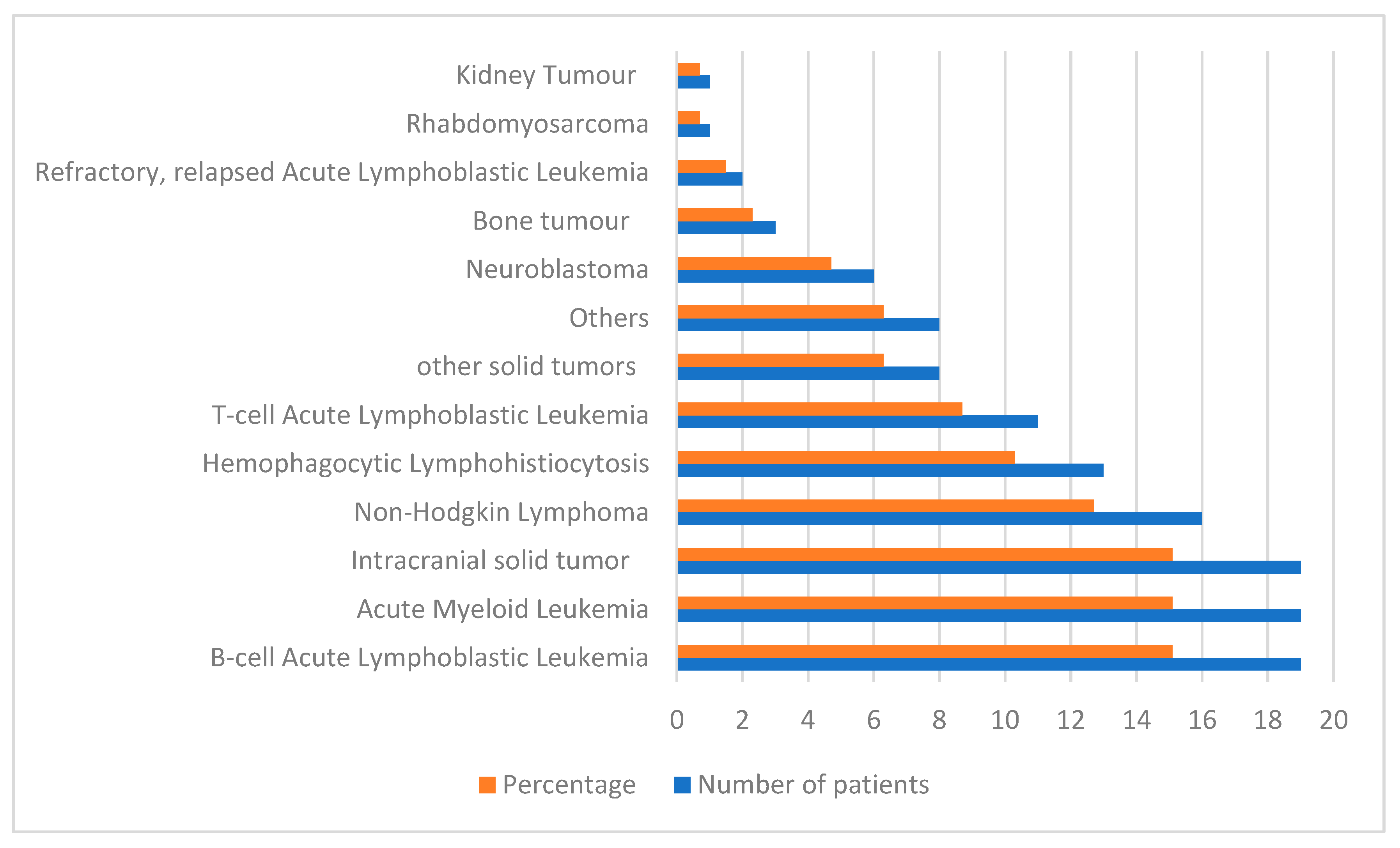
The leading indications for PICU admission were sepsis (41%) and respiratory failure (21%). Hematologic malignancies accounted for 63% of all admissions (Figure 1), with B-cell acute lymphoblastic leukemia (B-ALL) representing 15% of PICU admissions.
Figure 1.
Distribution of underlying malignancies among pediatric oncology patients admitted to the pediatric intensive care unit (PICU). The “Others” category includes rare hematologic malignancies, such as Hodgkin lymphoma, non-Langerhans-cell histiocytosis, and marginal zone lymphoma. The “other solid tumors” category includes extracranial germ cell tumors, embryonal carcinoma, adrenocortical carcinoma, and pleuropulmonary carcinoma.
3.2. PICU Interventions and Organ Dysfunction
During PICU admission, 50 patients (39%) developed organ failure. Among these, 34 patients (68%) experienced single-organ failure, while 16 patients (32%) developed multi-organ failure involving two or more organ systems. The remaining 76 patients (61%) did not meet criteria for organ failure as defined by the need for organ-supportive interventions. Regarding intensive care interventions, mechanical ventilation was required in 35% of patients, and vasopressor support was administered to 30%. Renal replacement therapy was required in 2 patients (1.6%), with a median duration of dialysis of 3 days. Details of intensive care interventions and outcomes are summarized in Table 2.
Table 2.
Outcomes of pediatric oncology patients admitted to the Pediatric Intensive Care Unit.
3.3. Study Outcomes
The overall mortality rate among the study population was 19% (25/126 patients). Among these, 13 deaths (52%) occurred during the PICU admission, while 12 deaths (48%) occurred after discharge from the PICU.
During the PICU stay, causes of death included sepsis (n = 10), of which five progressed to multiorgan failure, respiratory failure (n = 2), and disease progression (n = 1).
Four additional deaths occurred after transfer from the PICU but during the same hospital admission and were attributed to gastrointestinal bleeding (n = 1), sepsis leading to multi-organ failure (n = 1), respiratory failure (n = 1), and disease progression (n = 1).
The remaining eight deaths occurred after hospital discharge during subsequent admissions and were related to sepsis (n = 4), disease progression (n = 2), and respiratory failure (n = 2) Table 3.
Table 3.
Timing and Causes of Death Among PICU Patients (n = 25).
Compared with patients who survived, those who died had a higher prevalence of comorbidities (48% vs. 26%; p = 0.039) and were significantly more likely to require invasive organ support during PICU admission, including mechanical ventilation (76% vs. 25%; p < 0.001) and vasopressor support (52% vs. 24%; p = 0.008) (Table S1). Survival outcomes according to baseline characteristics are presented in Table 4.
Table 4.
Risk factors related to survival for pediatric oncology patients admitted to the pediatric intensive care unit (PICU).
3.4. Predictors of Mortality
In the multivariable Cox proportional hazards model, prior therapeutic interventions before PICU admission and the requirement for mechanical ventilation remained independently associated with increased mortality (Table 5). Patients who had received therapeutic interventions prior to PICU admission had a more than threefold higher risk of death (HR: 3.19; 95% CI: 1.24–8.19). Similarly, the need for mechanical ventilation was associated with a significantly increased risk of mortality (HR: 3.02; 95% CI: 1.16–7.60). Although higher PRISM scores and the presence of comorbidities were more common among patients who died, these variables were not independently associated with mortality after adjustment for other covariates. No significant association was observed between tumor type and mortality in the adjusted analysis.
Table 5.
Bivariate Cox proportional hazards regression analysis to identify predictors of in-hospital mortality in the PICU.
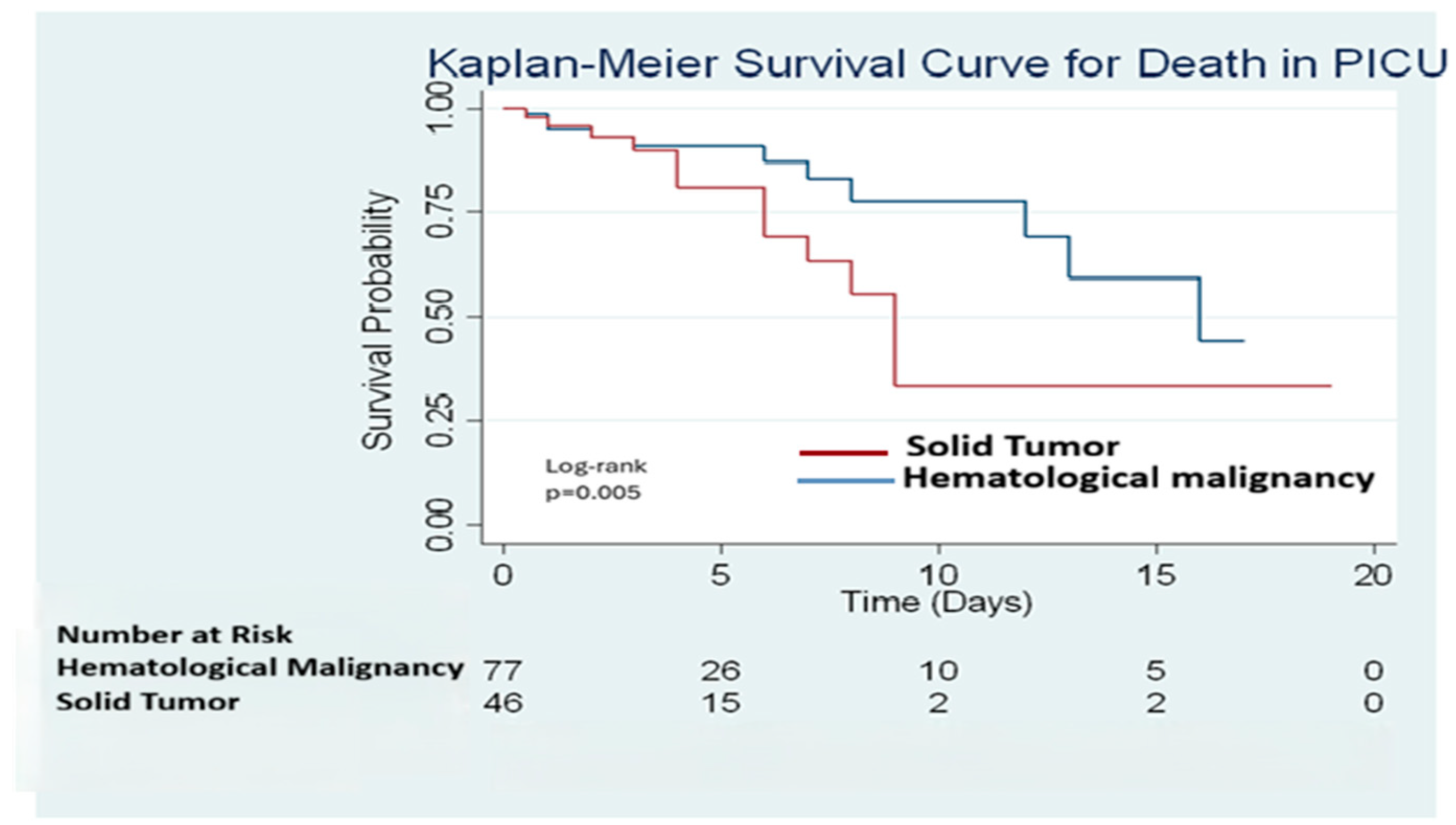
Kaplan–Meier survival analysis demonstrated a statistically significant difference in survival between patients with hematologic malignancies and those with solid tumors (log-rank test, p = 0.005; Figure 2). However, tumor type did not remain an independent predictor of mortality after adjustment for clinical severity and critical care interventions in the multivariable Cox regression model.
Figure 2.
Kaplan–Meier survival curves comparing survival probability between pediatric oncology patients with hematologic malignancies and solid tumors admitted to the pediatric intensive care unit (PICU). Survival differed significantly between groups (log-rank test, p = 0.005).
4. Discussion
This study provides one of the most detailed evaluations to date of pediatric oncology patients requiring PICU admission in Saudi Arabia and adds important regional data to a literature largely derived from high-income Western healthcare systems. Our findings confirm that pediatric oncology patients admitted to the PICU represent a highly vulnerable population characterized by significant morbidity, frequent need for advanced organ support, and substantial mortality risk. In this cohort, the overall hospital mortality rate was 19%, with a PICU mortality of 10.3%, aligning with previously reported mortality rates ranging from 10 to 30% in critically ill pediatric oncology populations, depending on disease severity and indication for intensive care admission [3,7,10,13].
Consistent with prior international studies, sepsis and respiratory failure were the leading causes of critical illness and death in our cohort [3,6]. Sepsis frequently progressed to multi-organ failure, underscoring the profound vulnerability of immunocompromised children despite advances in antimicrobial therapy and supportive care [4,6,11]. The predominance of hematologic malignancies further reflects the heightened risk associated with prolonged neutropenia, intensive chemotherapy regimens, and cumulative immunosuppression [3,4,6]. Together, these findings emphasize the continued importance of early infection recognition, rapid antimicrobial escalation, and close respiratory monitoring within pediatric oncology care pathways.
The burden of organ dysfunction in this cohort was substantial, with nearly 40% of patients developing organ failure and more than one-third requiring mechanical ventilation or vasopressor support. These rates are comparable to those reported in large hemato-oncology PICU cohorts from Europe and North America [5,6,12]. Importantly, the need for invasive organ support has emerged as a strong marker of disease severity and a critical determinant of outcome. Mechanical ventilation, in particular, was independently associated with a threefold increase in mortality risk, consistent with multiple prior studies identifying respiratory failure as one of the strongest predictors of adverse outcomes in critically ill pediatric oncology patients [5,7,13,14,15]. These findings highlight the prognostic importance of respiratory compromise and suggest that strategies aimed at earlier recognition and escalation of care—before progression to advanced respiratory failure—may improve outcomes.
Notably, a substantial proportion of deaths occurred after discharge from the PICU, either during the same hospitalization or following readmission. This observation underscores the prolonged vulnerability of pediatric oncology patients beyond the acute phase of critical illness and highlights the importance of structured post-PICU surveillance, multidisciplinary follow-up, and early recognition of clinical deterioration. Similar patterns have been reported in previous studies, suggesting that survival beyond the PICU does not necessarily equate to recovery and may reflect ongoing physiologic instability [7,10,13].
Mortality in this cohort was driven primarily by clinical severity and treatment-related factors rather than malignancy subtype. Although earlier studies suggested worse outcomes among patients with hematologic malignancies [14], tumor type was not independently associated with mortality in our multivariable analysis. This likely reflects improvements in supportive care delivery, infection management, and standardized treatment protocols within specialized oncology centers. Nevertheless, infection—particularly sepsis—remained a dominant contributor to clinical deterioration, reinforcing the need for robust infection prevention strategies, early warning systems, and rapid-response pathways tailored to pediatric oncology patients.
Prior therapeutic exposure emerged as an independent predictor of mortality, conferring a threefold increased hazard of death. This finding highlights the cumulative physiologic burden of cancer-directed therapy and underscores the vulnerability of patients with extensive prior treatment exposure. Similar associations between cumulative treatment burden, organ toxicity, and adverse PICU outcomes have been reported previously [11,12,14]. These findings support the importance of close collaboration between oncology and critical care teams to identify high-risk patients and optimize the timing of PICU admission.
Although PRISM IV scores were higher among patients who died, they did not remain independently predictive of mortality in multivariable analysis. This finding aligns with prior reports questioning the discriminatory performance of general severity-of-illness scoring systems in pediatric oncology populations [10,12]. Factors such as chronic comorbidities, treatment-related toxicities, and disease- or therapy-associated immunosuppression may not be adequately captured by physiologic scoring systems alone, underscoring the need for oncology-specific prognostic tools that better reflect the complexity of this population.
By contextualizing PICU outcomes within the Saudi Arabian healthcare system, this study highlights both the progress achieved and the persistent challenges in pediatric oncology critical care. As pediatric oncology services continue to expand nationally, our findings emphasize the importance of early risk stratification, timely escalation of organ support, and standardized sepsis management protocols to reduce preventable mortality. Moreover, these data provide a valuable benchmark against which future quality improvement initiatives and multicenter collaborations can be evaluated.
Key limitations include the retrospective, single-center design and the potential for residual confounding. In addition, documentation regarding limitation of life-sustaining therapy and end-of-life decision-making was not consistently available, precluding detailed evaluation of these factors. Long-term post-PICU outcomes and functional recovery were also not systematically assessed. As such, the generalizability of these findings may be limited to similar tertiary referral settings. Future prospective, multi-center studies with extended follow-up are needed to refine prognostic indicators, validate severity scoring systems in pediatric oncology populations, and inform the development of standardized, evidence-based care pathways for critically ill children with cancer.
5. Conclusions
Pediatric oncology patients requiring PICU admission experience substantial morbidity and mortality, particularly those with prior therapeutic exposure or who require invasive organ support such as mechanical ventilation and vasopressor therapy. Sepsis and respiratory failure remain the primary drivers of critical illness in this population. Early recognition of clinical deterioration, aggressive infection prevention and management, and timely initiation of supportive therapies are essential to improving outcomes. Incorporation of validated severity scoring tools may aid in early risk stratification and support clinical decision-making. Multicenter, prospective studies with long-term follow-up are needed to further refine prognostic indicators and optimize care pathways for critically ill pediatric oncology patients.
Supplementary Materials
The following supporting information can be downloaded at: https://www.mdpi.com/article/10.3390/children13010058/s1. Table S1: Survival status (during and after PICU admission) and study variables.
Author Contributions
W.A.: conceived and designed the study, coordinated and contributed to data collection, interpreted the findings, drafted the background section of the manuscript, supervised the overall project, provided expert guidance during data interpretation, critically reviewed the manuscript for important intellectual content, and approved the final version. F.O.: performed the primary data analysis, assisted with data acquisition and verification, drafted the Methods and Results sections, and provided critical revisions to the manuscript. F.A. (Faisal Alrashed): contributed to data collection and drafted the Discussion section. F.A. (Faisal Althaqeel): contributed to data collection and drafted the Discussion section. O.A.: contributed to data collection and drafted the Discussion section. All authors have read and agreed to the published version of the manuscript.
Funding
The authors declare that this research received no external funding.
Institutional Review Board Statement
The study was approved by the Institutional Review Board of King Abdullah International Medical Research Center (KAIMRC) (Approval No.: RC18.334R; approved on 25 October 2018). All patient data were de-identified to ensure confidentiality.
Informed Consent Statement
Patient Informed consent was waived by the Institutional Review Board because the study involved retrospective review of de-identified patient data.
Data Availability Statement
The datasets generated and analyzed during the current study are not publicly available due to patient privacy and institutional regulations but are available from the corresponding author on reasonable request and with appropriate ethical approvals.
Conflicts of Interest
The authors declare no conflicts of interest.
Abbreviations
The following abbreviations are used in this manuscript:
| ALL | Acute Lymphoblastic Leukemia |
| AML | Acute Myeloid Leukemia |
| CI | Confidence Interval |
| ED | Emergency Department |
| HLH | Hemophagocytic Lymphohistiocytosis |
| HR | Hazard Ratio |
| IQR | Interquartile Range |
| KASCH | King Abdullah Specialized Children’s Hospital |
| KM | Kaplan–Meier |
| NHL | Non-Hodgkin Lymphoma |
| PRISM | Pediatric Risk of Mortality |
| WHO | World Health Organization |
References
- International Agency for Research on Cancer. Global Cancer Observatory: Cancer Today; International Agency for Research on Cancer: Lyon, France, 2022; Available online: https://gco.iarc.fr/ (accessed on 30 November 2025).
- Saudi Cancer Registry. Cancer Incidence Report Saudi Arabia; Saudi Cancer Registry: Riyadh, Saudi Arabia, 2014. Available online: https://shc.gov.sa/Arabic/NCC/Activities/AnnualReports/2014.pdf (accessed on 30 November 2025).
- Dalton, H.J.; Slonim, A.D.; Pollack, M.M. Multicenter outcome of pediatric oncology patients requiring intensive care. Pediatr. Hematol. Oncol. 2003, 20, 643–649. [Google Scholar] [CrossRef] [PubMed]
- Wösten-van Asperen, R.M.; van Gestel, J.P.J.; van Grotel, M.; Tschiedel, E.; Dohna-Schwake, C.; Valla, F.V.; Willems, J.; Angaard Nielsen, J.S.; Krause, M.F.; Potratz, J. PICU mortality of children with cancer admitted to pediatric intensive care unit a systematic review and meta-analysis. Crit. Rev. Oncol. Hematol. 2019, 142, 153–163. [Google Scholar] [CrossRef] [PubMed]
- Rosenman, M.B.; Vik, T.; Hui, S.L.; Breitfeld, P.P. Hospital resource utilization in childhood cancer. J. Pediatr. Hematol. Oncol. 2005, 27, 295–300. [Google Scholar] [CrossRef] [PubMed]
- Zinter, M.S.; DuBois, S.G.; Spicer, A.; Matthay, K.; Sapru, A. Pediatric cancer type predicts critical care needs and mortality. Intensive Care Med. 2014, 40, 1536–1544. [Google Scholar] [CrossRef] [PubMed]
- Demaret, P.; Pettersen, G.; Hubert, P.; Teira, P.; Emeriaud, G. The critically-ill pediatric hemato-oncology patient: Epidemiology, management, and strategy of transfer to the pediatric intensive care unit. Ann. Intensive Care 2012, 2, 14. [Google Scholar] [CrossRef] [PubMed]
- AlAbdullah, H.; Alanzi, F.; Alhuthil, R.; Alshaibani, T.; AlBeeshi, N.; Alqahtani, A.; Alabdulsalam, M.; Alayed, T.; Alturki, A.; Alofisan, T.; et al. Post hematopoietic stem cell transplant (HSCT) outcomes in pediatric intensive care unit, experience from a referral center for cellular therapy and hematopoietic stem cell transplantation. Hematol. Oncol. Stem Cell Ther. 2024, 17, 227–232. [Google Scholar] [CrossRef] [PubMed]
- Reschke, A.; Richards, R.M.; Smith, S.M.; Long, A.H.; Marks, L.J.; Schultz, L.; Kamens, J.L.; Aftandilian, C.; Davis, K.L.; Gruber, T.; et al. Development of clinical pathways to improve multidisciplinary care of high-risk pediatric oncology patients. Front. Oncol. 2022, 12, 1033993. [Google Scholar] [CrossRef] [PubMed]
- Hallahan, A.R.; Shaw, P.J.; Rowell, G.; O’Connell, A.; Schell, D.; Gillis, J. Improved outcomes of children with malignancy admitted to a pediatric intensive care unit. Crit. Care Med. 2000, 28, 3718–3721. Available online: https://pubmed.ncbi.nlm.nih.gov/11098979/ (accessed on 30 November 2025). [CrossRef] [PubMed]
- Quintana, J.H.; López-Vanegas, C.D.; Rivas-Tafurt, G.P.; Ordoñez-Mora, L.T.; Lozada-Ramos, H.; Daza-Arana, J.E. Mortality risk factors in patients with Hematologic Neoplasm Admitted to the Intensive Care Unit: A systematic review. Curr. Oncol. 2025, 32, 132. [Google Scholar] [CrossRef] [PubMed]
- Pollack, M.M.; Dean, J.M.; Butler, J.; Holubkov, R.; Doctor, A.; Meert, K.L.; Newth, C.J.; Berg, R.A.; Moler, F.; Dalton, H.; et al. The ideal time interval for critical care severity-of-illness assessment. Pediatr. Crit. Care Med. 2013, 14, 448–453. [Google Scholar] [CrossRef] [PubMed]
- Ali, A.M.; Sayed, H.A.; Mohammed, M.M. The Outcome of Critically Ill Pediatric Cancer Patients Admitted to the Pediatric Intensive Care Unit in a Tertiary University Oncology Center in a Developing Country: A 5-Year Experience. J. Pediatr. Hematol. Oncol. 2016, 38, 355–359. [Google Scholar] [CrossRef] [PubMed]
- Ben Abraham, R.; Toren, A.; Ono, N.; Weinbroum, A.A.; Vardi, A.; Barzilay, Z.; Paret, G. Predictors of outcome in the pediatric intensive care units of children with malignancies. J. Pediatr. Hematol. Oncol. 2002, 24, 23–26. [Google Scholar] [CrossRef] [PubMed]
- Tamburro, R.F.; Barfield, R.C.; Shaffer, M.L.; Rajasekaran, S.; Woodard, P.; Morrison, R.R.; Howard, S.C.; Fiser, R.T.; Schmidt, J.E.; Sillos, E.M. Changes in outcomes (1996–2004) for pediatric oncology and hematopoietic stem cell transplant patients requiring invasive mechanical ventilation. Pediatr. Crit. Care Med. 2008, 9, 270–277. [Google Scholar] [CrossRef] [PubMed]
Disclaimer/Publisher’s Note: The statements, opinions and data contained in all publications are solely those of the individual author(s) and contributor(s) and not of MDPI and/or the editor(s). MDPI and/or the editor(s) disclaim responsibility for any injury to people or property resulting from any ideas, methods, instructions or products referred to in the content. |
© 2025 by the authors. Licensee MDPI, Basel, Switzerland. This article is an open access article distributed under the terms and conditions of the Creative Commons Attribution (CC BY) license.