

Oral Health Status of Children in Strasbourg: An Epidemiological Study (2018–2022)

Highlights
- •
- Children participating in a school-based oral health prevention and screening program show progressive improvement in their oral health throughout their school years.
- •
- Children’s oral health seems to have been deteriorating for several years. Socioeconomic inequalities remain significant.
- •
- National programs should be implemented to prevent the deterioration of the children’s oral health and to gather data since no national study was performed since 2006.
- •
- Prevention programs in schools combining primary, secondary and tertiary prevention should be implemented.
Abstract
1. Introduction
2. Methods
2.1. Population/Eligibility Criteria
2.2. Data Collection
- •
- Demographic data: age and sex.
- •
- Year of data collection.
- •
- Geographical and school-related data: grade level, school name, district of the school (not analyzed in this article considering how hard it would be to interpret for people not familiar with Strasbourg’s geography), and school within the “Priority Education Network” (“Réseau d’Education Prioritaire”) with REP or REP+ status, i.e., schools cumulating unfavorable social determinants, especially for REP+. The REP status has been linked to a higher caries risk [10].
- •
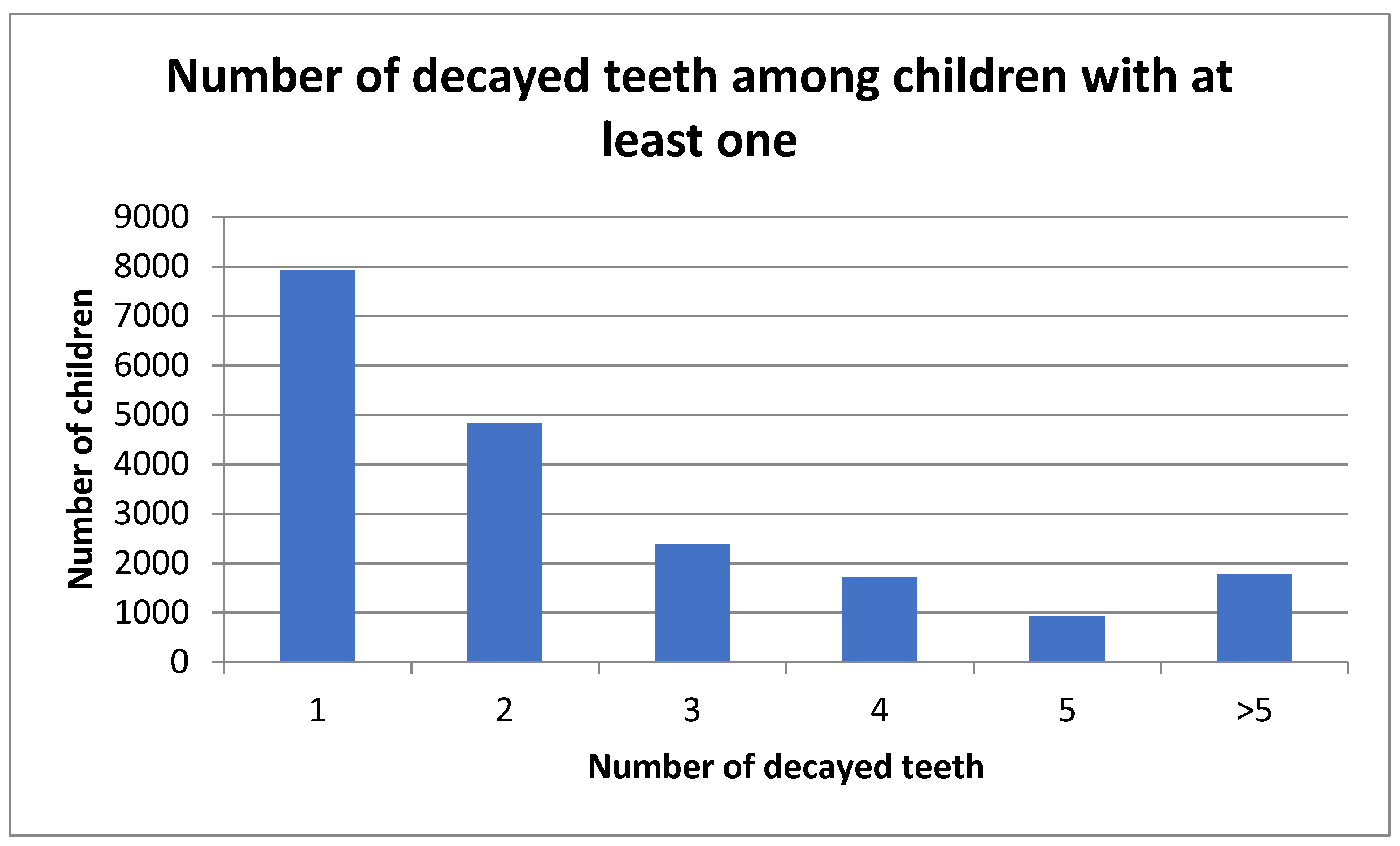
- Carious status: caries-free, treated (with no active caries), or presenting untreated carious lesions. The term “decayed tooth” will be used to refer to a tooth with an untreated carious lesion.
- •
- Number of decayed teeth, when applicable.
- •
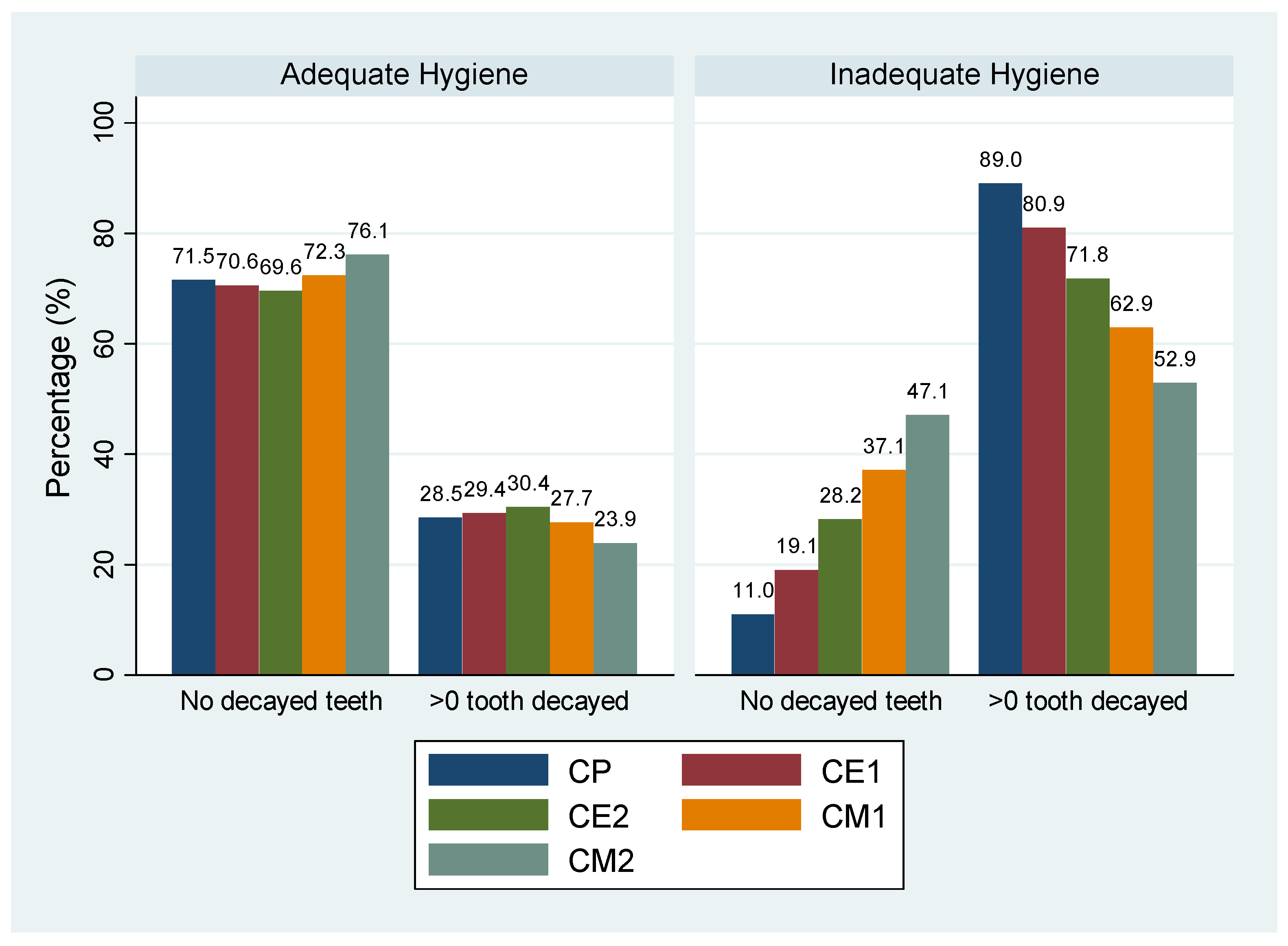
- Oral hygiene assessment according to the investigator: adequate or requiring improvement (inadequate).
- •
- Other required dental care: sealants and/or scaling.
- •
- Children anonymous ID: required for the mixed-effect logistic regression.
2.3. Statistical Methods
3. Results
3.1. Population
3.2. Univariate Analysis
3.3. Bivariate Analysis
3.4. Multivariate Analysis
4. Discussion
4.1. Key Results
4.2. Limitations of This Study
4.3. Public Health Prevention Policies
5. Conclusions
Author Contributions
Funding
Institutional Review Board Statement
Informed Consent Statement
Data Availability Statement
Conflicts of Interest
References
- Selwitz, R.H.; Ismail, A.I.; Pitts, N.B. Dental caries. Lancet 2007, 369, 51–59. [Google Scholar] [CrossRef] [PubMed]
- Jain, N.; Dutt, U.; Radenkov, I.; Jain, S. WHO’s global oral health status report 2022: Actions, discussion and implementation. Oral Dis. 2024, 30, 73–79. [Google Scholar] [CrossRef] [PubMed]
- James, S.L.; Abate, D.; Abate, K.H.; Abay, S.M.; Abbafati, C.; Abbasi, N.; Abbastabar, H.; Abd-Allah, F.; Abdela, J.; Abdelalim, A.; et al. Global, regional, and national incidence, prevalence, and years lived with disability for 354 diseases and injuries for 195 countries and territories, 1990–2017: A systematic analysis for the Global Burden of Disease Study 2017. Lancet 2018, 392, 1789–1858. [Google Scholar] [CrossRef] [PubMed]
- Fernandez de Grado, G.; Ehlinger, V.; Godeau, E.; Arnaud, C.; Nabet, C.; Benkirane-Jessel, N.; Musset, A.M.; Offner, D. Changes in tooth brushing frequency and its associated factors from 2006 to 2014 among French adolescents: Results from three repeated cross sectional HBSC studies. PLoS ONE 2021, 16, e0249129. [Google Scholar] [CrossRef] [PubMed]
- Cohen, F.; Bazart, J.; Brun, C.; Clément, C.; Espié, J.-P.; Tenenbaum, A.; Musset, A.-M.; L’Aspbd, P.L.B.N.D. La santé orale, un enjeu de santé publique en 2023—Réflexions et actions de l’ASPBD. Santé Publique 2023, 35, 153–155. [Google Scholar] [CrossRef] [PubMed]
- Vergnes, J.-N.; Mazevet, M. Oral diseases: A global public health challenge. Lancet 2020, 395, 186. [Google Scholar] [CrossRef] [PubMed]
- Peres, M.; Macpherson, L.; Weyant, R.; Daly, B.; Venturelli, R.; Mathur, M.; Listl, S.; Celeste, R.; Guarnizo-Herreño, C.; Kearns, C.; et al. Oral diseases: A global public health challenge. Lancet 2019, 394, 249–260. [Google Scholar] [CrossRef] [PubMed]
- Direction Générale de la Santé; Union Française pour la Santé Bucco Dentaire. La Santé Bucco-Dentaire des Enfants de 6 et 12 ans en France, en 2006; Direction Générale de la Santé: Paris, France; Union Française pour la Santé Bucco Dentaire: Paris, France, 2006. [Google Scholar]
- Mascre, C.; Bas, A.C. Use of free preventive dental programme for children: 10 years of Lov’U’r Teeth, France. J. Paediatr. Child Health 2024, 60, 831–837. [Google Scholar] [CrossRef] [PubMed]
- Muller-Bolla, M.; Zakarian, B.; Lupi-Pegurier, L.; Velly, A.M. Oral health and individual caries risk according to the schooling zone with educational priority or not. Epidemiological survey in 2004–2005 in Nice. Rev. D’odonto-Stomatol. 2006, 35, 219–238. [Google Scholar]
- Sadjadpour, F.; Hosseinichimeh, N.; Pahel, B.T.; Metcalf, S.S. Systems mapping of multilevel factors contributing to dental caries in adolescents. Front. Oral Health 2024, 4, 1285347. [Google Scholar] [CrossRef] [PubMed]
- Twetman, S. Why Is Caries Prevention in Children So Difficult? A Narrative Opinion. Int. J. Environ. Res. Public Health 2024, 21, 1316. [Google Scholar] [CrossRef] [PubMed]
- Fernandez de Grado, G.; Ehlinger, V.; Godeau, E.; Sentenac, M.; Arnaud, C.; Nabet, C.; Monsarrat, P. Socioeconomic and behavioral determinants of tooth brushing frequency: Results from the representative French 2010 HBSC cross-sectional study. J. Public Health Dent. 2018, 78, 221–230. [Google Scholar] [CrossRef] [PubMed]
- Lukacs, J.R. Sex differences in dental caries experience: Clinical evidence, complex etiology. Clin. Oral Investig. 2011, 15, 649–656. [Google Scholar] [CrossRef] [PubMed]
- Bakaloudi, D.R.; Jeyakumar, D.T.; Jayawardena, R.; Chourdakis, M. The impact of COVID-19 lockdown on snacking habits, fast-food and alcohol consumption: A systematic review of the evidence. Clin. Nutr. 2022, 41, 3038–3045. [Google Scholar] [CrossRef] [PubMed]
- Bauer, L. Évolution de la Prévalence de la Carie Chez les Enfants des Ecoles Elémentaires de Strasbourg de 2008 à 2018. DDS. Thesis, Université de Strasbourg, Strasbourg, France, 2021. [Google Scholar]
- Subhash, G.; Sumbul, N. Comparative evaluation of oral hygiene status by using oral hygiene index, simplified oral hygiene index, and modified oral hygiene index: Revalidation of modified oral hygiene index. J. Indian Soc. Periodontol. 2025, 28, 461–467. [Google Scholar] [CrossRef]
- Tenenbaum, A.; Denis, F. Rapport sur la Pertinence du Brossage des Dents à L’école. Doctoral Dissertation, Collège des Enseignants en Odontologie Pédiatrique (CEOP), Collège National des Chirurgiens-Dentistes Universitaires en Santé Publique (CNCDUSP), Toulouse, France, 2023. [Google Scholar]
- Thomson, W.M.; Poulton, R.; Milne, B.J.; Caspi, A.; Broughton, J.R.; Ayers, K.M. Socioeconomic inequalities in oral health in childhood and adulthood in a birth cohort. Community Dent. Oral Epidemiol. 2004, 32, 345–353. [Google Scholar] [CrossRef] [PubMed]


| N (%) | Children with at Least One Decayed Tooth | p | Number of Decayed Teeth (Mean ± SD) | p | Number of Decayed Teeth Among Children with at Least One Decayed Tooth | p | |
|---|---|---|---|---|---|---|---|
| Total | 58,287 (100%) | 19,928 (34%) | 0.85 ± 1.68 | 2.5 ± 2.04 | |||
| Sex | <0.001 | <0.001 | |||||
| Girl | 28,590 (49%) | 9350 (33%) | ref | 0.79 ± 1.61 | 2.47 ± 1.99 | ||
| Boy | 29,697 (51%) | 10,578 (36%) | <0.001 | 0.91 ± 2.75 | 2.60 ± 2.09 | ||
| Age (years) | <0.001 | <0.001 | |||||
| 6 | 6020 (10%) | 2182 (36%) | ref | 1.10 ± 2.12 | 3.09 ± 2. 56 | ||
| 7 | 11,258 (19%) | 4084 (36%) | 0.97 | 1.05 ± 1.98 | 2.92 ± 2.33 | ||
| 8 | 11,703 (20%) | 4339 (37%) | 0.28 | 0.97 ± 1.77 | 2.66 ± 2.04 | ||
| 9 | 11,774 (20%) | 4132 (35%) | 0.13 | 0.80 ± 1.53 | 2.34 ± 1.79 | ||
| 10 | 11,745 (20%) | 3632 (30%) | <0.001 | 0.63 ± 1.29 | 2.10 ± 1.58 | ||
| 11 | 5680 (10%) | 1526 (26%) | <0.001 | 0.53 ± 1.19 | 2.01 ± 1.55 | ||
| 12 | 107 (<1%) | 33 (30%) | 0.25 | 0.52 ± 1.00 | 1.75 ± 1.11 | ||
| REP status | <0.001 | <0.001 | |||||
| Not REP | 31,142 (54%) | 8265 (27%) | ref | 0.61 ± 1.43 | 2.37 ± 1.94 | ||
| REP | 13,224 (23%) | 5657 (43%) | <0.001 | 1.15 ± 1.94 | 2.70 ± 2.16 | ||
| REP+ | 13,543 (23%) | 5827 (43%) | <0.001 | 1.10 ± 1.85 | 2.63± 2.04 | ||
| Grade level | <0.001 | <0.001 | |||||
| CP (1st) | 11,477 (20%) | 4218 (37%) | ref | 1.12 ± 2.12 | 3.09 ± 2.52 | ||
| CE1 (2nd) | 11,939 (20%) | 4449 (37%) | 0.45 | 1.03 ± 1.9 | 2.82 ± 2.20 | ||
| CE2 (3rd) | 11,844 (20%) | 4307 (36%) | 0.50 | 0.86 ± 1.59 | 2.44 ± 1.83 | ||
| CM1(4th) | 11,333 (20%) | 3719 (33%) | <0.001 | 0.70 ± 1.38 | 2.2 ± 1.64 | ||
| CM2 (5th) | 11,415 (20%) | 3128 (27%) | <0.001 | 0.52 ± 1.14 | 1.95 ± 1.44 | ||
| Year | <0.001 | <0.001 | |||||
| 2018 | 8705 (15%) | 2883 (33%) | ref | 0.78 ± 1.55 | 2.42 ± 1.82 | ||
| 2019 | 14,804 (25%) | 4797 (32%) | 0.3 | 0.83 ± 1.73 | 2.64 ± 2.17 | ||
| 2020 | 9358 (16%) | 3454 (37%) | <0.001 | 0.95 ± 1.82 | 2.63 ± 2.2 | ||
| 2021 | 13,366 (23%) | 4556 (34%) | 0.12 | 0.84 ± 1.63 | 2.54 ± 1.93 | ||
| 2022 | 12,054 (21%) | 4238 (35%) | 0.002 | 0.85 ± 1.65 | 2.44 ± 1.99 | ||
| Hygiene | <0.001 | <0.001 | |||||
| Adequate | 47,839 (86%) | 13,393 (28%) | ref | 0.49 ± 0.99 | 1.74 ± 1.14 | ||
| Inadequate | 7922 (14%) | 5701 (72%) | <0.001 | 3.09 ± 2.92 | 4.30 ± 2.58 |
| Variable (ref = Reference Level) | Odds Ratio | Standard Deviation | p | 95% Confidence Interval | |
|---|---|---|---|---|---|
| Sex (ref = Girl) | |||||
| Boy | 1.17 | 0.04 | <0.001 | 1.10 | 1.25 |
| Year (ref = 2018) | |||||
| 2019 | 0.84 | 0.04 | <0.001 | 0.77 | 0.91 |
| 2020 | 1.00 | 0.05 | 0.985 | 0.91 | 1.10 |
| 2021 | 0.86 | 0.04 | 0.002 | 0.78 | 0.95 |
| 2022 | 0.87 | 0.04 | 0.004 | 0.79 | 0.95 |
| Grade level and hygiene (ref = CP (1st grade) with adequate hygiene) | |||||
| Adequate oral hygiene | |||||
| CE1 (2nd) | 1.10 | 0.05 | 0.026 | 1.01 | 1.19 |
| CE2 (3rd) | 1.15 | 0.05 | 0.001 | 1.06 | 1.25 |
| CM1(4th) | 0.95 | 0.04 | 0.295 | 0.87 | 1.04 |
| CM2 (5th) | 0.69 | 0.03 | <0.001 | 0.63 | 0.76 |
| Inadequate oral hygiene | |||||
| CP (1st) | 44.66 | 5.20 | <0.001 | 35.55 | 56.10 |
| CE1 (2nd) | 16.88 | 1.54 | <0.001 | 14.11 | 20.19 |
| CE2 (3rd) | 8.69 | 0.72 | <0.001 | 7.39 | 10.22 |
| CM1(4th) | 5.05 | 0.41 | <0.001 | 4.30 | 5.92 |
| CM2 (5th) | 3.15 | 0.27 | <0.001 | 2.66 | 3.72 |
| REP Status (ref = non-REP) | |||||
| REP | 2.48 | 0.10 | <0.001 | 2.29 | 2.69 |
| REP+ | 2.68 | 0.11 | <0.001 | 2.47 | 2.91 |
| Residual variance of the random intercept (between individual variances) | 2.95 | 0.10 | 2.76 | 3.17 | |
Disclaimer/Publisher’s Note: The statements, opinions and data contained in all publications are solely those of the individual author(s) and contributor(s) and not of MDPI and/or the editor(s). MDPI and/or the editor(s) disclaim responsibility for any injury to people or property resulting from any ideas, methods, instructions or products referred to in the content. |
© 2025 by the authors. Licensee MDPI, Basel, Switzerland. This article is an open access article distributed under the terms and conditions of the Creative Commons Attribution (CC BY) license.
Share and Cite
Offner, D.; Heddoub, H.; Chemouni, S.; Fernandez de Grado, G. Oral Health Status of Children in Strasbourg: An Epidemiological Study (2018–2022). Children 2026, 13, 4. https://doi.org/10.3390/children13010004
Offner D, Heddoub H, Chemouni S, Fernandez de Grado G. Oral Health Status of Children in Strasbourg: An Epidemiological Study (2018–2022). Children. 2026; 13(1):4. https://doi.org/10.3390/children13010004
Chicago/Turabian StyleOffner, Damien, Hayat Heddoub, Sabine Chemouni, and Gabriel Fernandez de Grado. 2026. "Oral Health Status of Children in Strasbourg: An Epidemiological Study (2018–2022)" Children 13, no. 1: 4. https://doi.org/10.3390/children13010004
APA StyleOffner, D., Heddoub, H., Chemouni, S., & Fernandez de Grado, G. (2026). Oral Health Status of Children in Strasbourg: An Epidemiological Study (2018–2022). Children, 13(1), 4. https://doi.org/10.3390/children13010004