Multidimensional Analysis of Parent-Perceived Quality of Life in Children with Cerebral Palsy: A Cross-Sectional Study

 , , , , , and
Highlights
- •
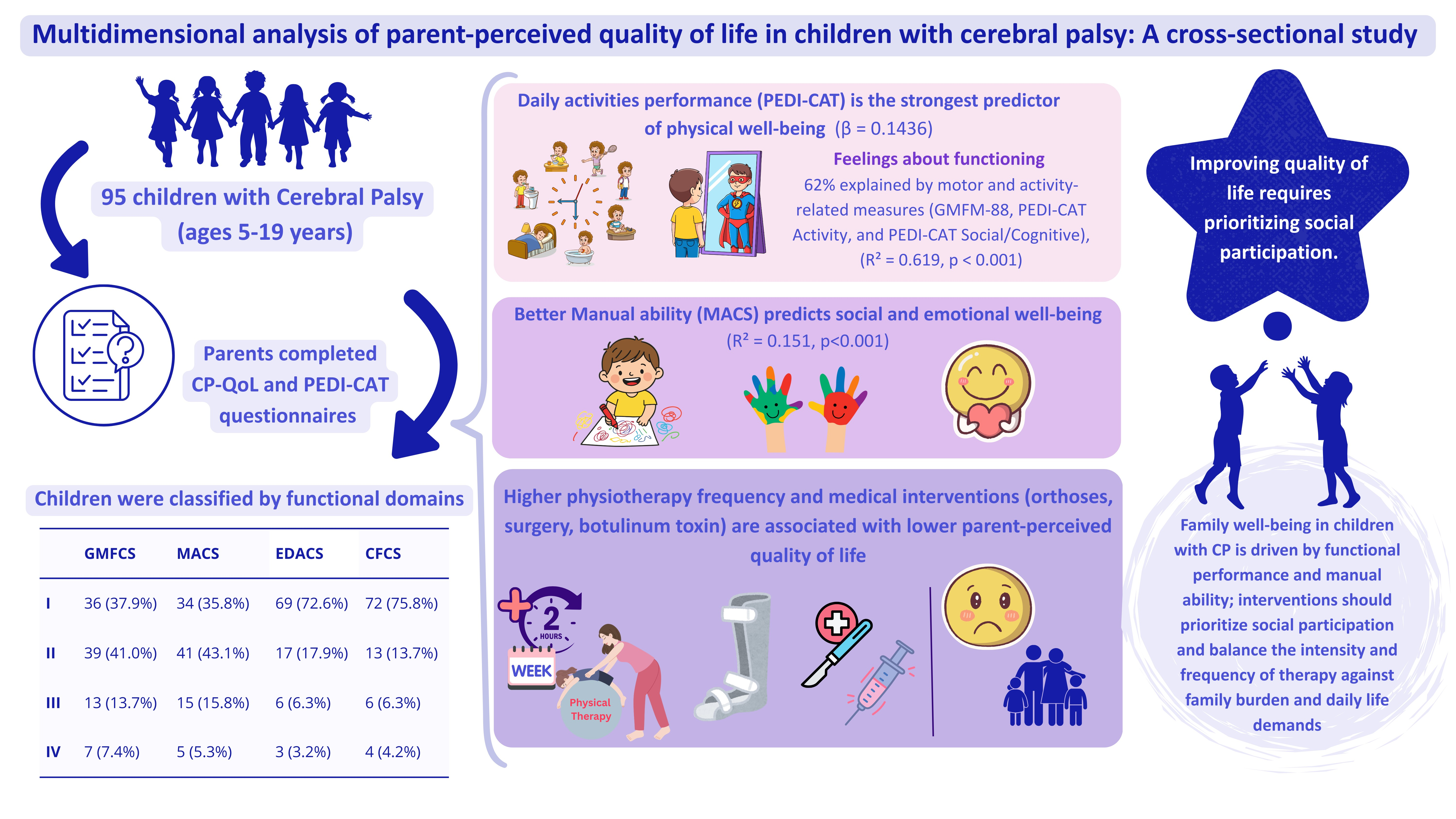
- Parents of children using AFOs, receiving botulinum toxin, undergoing pelvic surgery, or engaging in intensive physical therapy (>2 h/week) reported significantly lower scores in multiple domains of quality of life, including “Social well-being”, “Emotional well-being”, “Feelings about functioning”, and “Family health”.
- •
- The ‘Feelings about Functioning’ domain was 62% explained by motor and activity-related measures (GMFM-88, PEDI-CAT Activity, and PEDI-CAT Social/Cognitive), with PEDI-CAT Activity emerging as the strongest predictor.
- •
- The association between specific medical interventions and lower quality-of-life scores underscores the need for holistic care strategies that address psychosocial well-being alongside physical treatment in children with CP.
- •
- Identifying PEDI-CAT Activity as the strongest predictor of the ‘Feelings about Functioning’ domain highlights the importance of prioritizing functional activity in rehabilitation programs to enhance perceived quality of life.
Abstract
1. Introduction
2. Materials and Methods
2.1. Study Design
2.2. Outcomes
2.2.1. Cerebral Palsy Quality of Life (CP-QoL)
2.2.2. Pediatric Disability Inventory Computer Adaptive Test (PEDI-CAT)
2.2.3. Gross Motor Function Measure-88 (GMFM-88)
2.2.4. Gross Motor Function Classification System (GMFCS)
2.2.5. Manual Ability Classification System (MACS)
2.2.6. Communication Function Classification System (CFCS)
2.2.7. Eating and Drinking Ability Classification System (EDACS)
2.3. Study Procedures
2.4. Data Analysis
3. Results
4. Discussion
4.1. Limitations
4.2. Future Research Directions
5. Conclusions
Author Contributions
Funding
Institutional Review Board Statement
Informed Consent Statement
Data Availability Statement
Acknowledgments
Conflicts of Interest
References
- Rosenbaum, P.; Paneth, N.; Leviton, A.; Goldstein, M.; Bax, M.; Damiano, D.; Dan, B.; Jacobsson, B. A Report: The Definition and Classification of Cerebral Palsy April 2006. Dev. Med. Child Neurol. Suppl. 2007, 109, 8–14. [Google Scholar] [PubMed]
- McIntyre, S.; Goldsmith, S.; Webb, A.; Ehlinger, V.; Hollung, S.J.; McConnell, K.; Arnaud, C.; Smithers-Sheedy, H.; Oskoui, M.; Khandaker, G.; et al. Global Prevalence of Cerebral Palsy: A Systematic Analysis. Dev. Med. Child Neurol. 2022, 64, 1494–1506. [Google Scholar] [CrossRef]
- Tan, S.S.; van Meeteren, J.; Ketelaar, M.; Schuengel, C.; Reinders-Messelink, H.A.; Raat, H.; Dallmeijer, A.J.; Roebroeck, M.E. Long-Term Trajectories of Health-Related Quality of Life in Individuals with Cerebral Palsy: A Multicenter Longitudinal Study. Arch. Phys. Med. Rehabil. 2014, 95, 2029–2039. [Google Scholar] [CrossRef] [PubMed]
- Group, W. Development of the WHOQOL: Rationale and Current Status. Int. J. Ment. Health 1994, 23, 24–56. [Google Scholar] [CrossRef]
- Davis, E.; Reddihough, D.; Murphy, N.; Epstein, A.; Reid, S.M.; Whitehouse, A.; Williams, K.; Leonard, H.; Downs, J. Exploring Quality of Life of Children with Cerebral Palsy and Intellectual Disability: What Are the Important Domains of Life? Child Care Health Dev. 2017, 43, 854–860. [Google Scholar] [CrossRef]
- Tsoi, W.S.E.; Zhang, L.A.; Wang, W.Y.; Tsang, K.L.; Lo, S.K. Improving Quality of Life of Children with Cerebral Palsy: A Systematic Review of Clinical Trials. Child Care Health Dev. 2012, 38, 21–31. [Google Scholar] [CrossRef]
- Varni, J.W.; Seid, M.; Kurtin, P.S. PedsQLTM 4.0: Reliability and Validity of the Pediatric Quality of Life InventoryTM Version 4.0 Generic Core Scales in Healthy and Patient Populations. Med. Care 2001, 39, 800–812. [Google Scholar] [CrossRef]
- Ravens-Sieberer, U.; Herdman, M.; Devine, J.; Otto, C.; Bullinger, M.; Rose, M.; Klasen, F. The European KIDSCREEN Approach to Measure Quality of Life and Well-Being in Children: Development, Current Application, and Future Advances. Qual. Life Res. 2014, 23, 791–803. [Google Scholar] [CrossRef]
- Waters, E.; Davis, E.; Mackinnon, A.; Boyd, R.; Graham, H.K.; Kai Lo, S.; Wolfe, R.; Stevenson, R.; Bjornson, K.; Blair, E.; et al. Psychometric Properties of the Quality of Life Questionnaire for Children with CP. Dev. Med. Child Neurol. 2007, 49, 49–55. [Google Scholar] [CrossRef]
- Davis, E.; Mackinnon, A.; Davern, M.; Boyd, R.; Waters, E.; Graham, H.K.; Reid, S.; Reddihough, D. Description and Psychometric Properties of the CP QOL-Teen: A Quality of Life Questionnaire for Adolescents with Cerebral Palsy. Res. Dev. Disabil. 2013, 34, 344–352. [Google Scholar] [CrossRef]
- Badia, M.; Orgaz, M.B.; Riquelme, I.; Gómez-Iruretagoyena, J. Domains of the Cerebral Palsy Quality of Life Questionnaire (CP QOL) for Children and Adolescents: Spanish Adaptation and Psychometric Properties. J. Dev. Phys. Disabil. 2020, 33, 331–349. [Google Scholar] [CrossRef]
- McDougall, J.; Wright, V.; Schmidt, J.; Miller, L.; Lowry, K. Applying the ICF Framework to Study Changes in Quality-of-Life for Youth with Chronic Conditions. Dev. Neurorehabilit. 2011, 14, 41–53. [Google Scholar] [CrossRef] [PubMed]
- Findlay, B.; Switzer, L.; Narayanan, U.; Chen, S.; Fehlings, D. Investigating the Impact of Pain, Age, Gross Motor Function Classification System, and Sex on Health-related Quality of Life in Children with Cerebral Palsy. Dev. Med. Child Neurol. 2016, 58, 292–297. [Google Scholar] [CrossRef]
- Nurani Gharaborghe, S.; Sarhady, M.; Hosseini, S.M.S.; Mortazavi, S.S. Quality of Life and Gross Motor Function in Children with Cerebral Palsy (Aged 4–12). Iran. Rehabil. J. 2015, 13, 59–63. [Google Scholar]
- Davis, E.; Young, D.; Gilson, K.M.; Swift, E.; Chan, J.; Gibbs, L.; Tonmukayakul, U.; Reddihough, D.; Williams, K. A Rights-Based Approach for Service Providers to Measure the Quality of Life of Children with a Disability. Value Health 2018, 21, 1419–1427. [Google Scholar] [CrossRef] [PubMed]
- Dickinson, H.O.; Parkinson, K.N.; Ravens-Sieberer, U.; Schirripa, G.; Thyen, U.; Arnaud, C.; Beckung, E.; Fauconnier, J.; McManus, V.; Michelsen, S.I.; et al. Self-Reported Quality of Life of 8–12-Year-Old Children with Cerebral Palsy: A Cross-Sectional European Study. Lancet 2007, 369, 2171–2178. [Google Scholar] [CrossRef]
- Davis, E.; Waters, E.; Mackinnon, A.; Reddihough, D.; Boyd, R.; Graham, H.K. Quality of Life of Children with CP: Condition-specific Instrument and Proxy Reports. Dev. Med. Child Neurol. 2008, 50, 167. [Google Scholar] [CrossRef] [PubMed]
- Carlberg, E.B.; Hadders-Algra, M. Postural Dysfunction in Children with Cerebral Palsy: Some Implications for Therapeutic Guidance. Neural Plast. 2005, 12, 221–228. [Google Scholar] [CrossRef]
- Chakraborty, S.; Nandy, A.; Kesar, T.M. Gait Deficits and Dynamic Stability in Children and Adolescents with Cerebral Palsy: A Systematic Review and Meta-Analysis. Clin. Biomech. 2020, 71, 11–23. [Google Scholar] [CrossRef] [PubMed]
- Ko, J.; Kim, M. Reliability and Responsiveness of the Gross Motor Function Measure-88 in Children with Cerebral Palsy. Phys. Ther. 2013, 93, 393–400. [Google Scholar] [CrossRef] [PubMed]
- Ferre-Fernández, M.; Murcia-González, M.A.; Ríos-Díaz, J. Intra- and Interrater Reliability of the Spanish Version of the Gross Motor Function Measure (GMFM-SP-88). Pediatr. Phys. Ther. 2022, 34, 193–200. [Google Scholar] [CrossRef]
- Palisano, R.J.; Rosenbaum, P.; Bartlett, D.; Livingston, M.H. Content Validity of the Expanded and Revised Gross Motor Function Classification System. Dev. Med. Child Neurol. 2008, 50, 744–750. [Google Scholar] [CrossRef]
- Eliasson, A.C.; Krumlinde-Sundholm, L.; Rösblad, B.; Beckung, E.; Arner, M.; Öhrvall, A.M.; Rosenbaum, P. The Manual Ability Classification System (MACS) for Children with Cerebral Palsy: Scale Development and Evidence of Validity and Reliability. Dev. Med. Child Neurol. 2006, 48, 549–554. [Google Scholar] [CrossRef] [PubMed]
- Hidecker, M.J.C.; Paneth, N.; Rosenbaum, P.L.; Kent, R.D.; Lillie, J.; Eulenberg, J.B.; Cherster, K., Jr.; Johnson, B.; Michalsen, L.; Evatt, M.; et al. Developing and Validating the Communication Function Classification System for Individuals with Cerebral Palsy. Dev. Med. Child Neurol. 2011, 53, 704–710. [Google Scholar] [CrossRef]
- Sellers, D.; Mandy, A.; Pennington, L.; Hankins, M.; Morris, C. Development and Reliability of a System to Classify the Eating and Drinking Ability of People with Cerebral Palsy. Dev. Med. Child Neurol. 2014, 56, 245–251. [Google Scholar] [CrossRef]
- Morris, C.; Kurinczuk, J.J.; Fitzpatrick, R.; Rosenbaum, P.L. Do the Abilities of Children with Cerebral Palsy Explain Their Activities and Participation? Dev. Med. Child Neurol. 2006, 48, 954–961. [Google Scholar] [CrossRef]
- Dumas, H.M.; Fragala-Pinkham, M.A.; Rosen, E.L.; Lombard, K.A.; Farrell, C. Pediatric Evaluation of Disability Inventory Computer Adaptive Test (PEDI-CAT) and Alberta Infant Motor Scale (AIMS): Validity and Responsiveness. Phys. Ther. 2015, 95, 1559–1568. [Google Scholar] [CrossRef] [PubMed]
- World Health Organization. International Classification of Functioning, Disability, and Health: Children & Youth Version: ICF-CY; World Health Organization: Geneva, Switzerland, 2007. [Google Scholar]
- Jackman, M.; Sakzewski, L.; Morgan, C.; Boyd, R.N.; Brennan, S.E.; Langdon, K.; Toovey, R.A.M.; Greaves, S.; Thorley, M.; Novak, I. Interventions to Improve Physical Function for Children and Young People with Cerebral Palsy: International Clinical Practice Guideline. Dev. Med. Child Neurol. 2022, 64, 536–549. [Google Scholar] [CrossRef] [PubMed]
- López-Ruiz, J.; Estrada-Barranco, C.; Martín-Gómez, C.; Egea-Gámez, R.M.; Valera-Calero, J.A.; Martín-Casas, P.; López-de-Uralde-Villanueva, I. Trunk Control Measurement Scale (TCMS): Psychometric Properties of Cross-Cultural Adaptation and Validation of the Spanish Version. Int. J. Environ. Res. Public Health 2023, 20, 5144. [Google Scholar] [CrossRef]
- López-Ruiz, J.; Estrada-Barranco, C.; Giménez-Mestre, M.J.; Villarroya-Mateos, I.; Martín-Casas, P.; López-de-Uralde-Villanueva, I. Differences between Novice and Expert Raters Assessing Trunk Control Using the Trunk Control Measurement Scale Spanish Version (TCMS-S) in Children with Cerebral Palsy. J. Clin. Med. 2023, 12, 3568. [Google Scholar] [CrossRef]
- Cuschieri, S. The STROBE Guidelines. Saudi J. Anaesth. 2019, 13, 31. [Google Scholar] [CrossRef]
- Longo, E.; Badia, M.; Orgaz, M.B.; Gómez-vela, M. Comparing Parent and Child Reports of Health-Related Quality of Life and Their Relationship with Leisure Participation in Children and Adolescents with Cerebral Palsy. Res. Dev. Disabil. 2017, 71, 214–222. [Google Scholar] [CrossRef]
- Almasri, N.A.; Alquaqzeh, F.A. Determinants of Quality of Life of Children and Adolescents with Cerebral Palsy: A Systematic Review. Phys. Occup. Ther. Pediatr. 2023, 43, 367–388. [Google Scholar] [CrossRef]
- Aza, A.; Riquelme, I.; Gómez Vela, M.; Badia, M. Proxy- and Self-Report Evaluation of Quality of Life in Cerebral Palsy: Using Spanish Version of CPQOL for Children and Adolescents. Res. Dev. Disabil. 2024, 154, 104844. [Google Scholar] [CrossRef]
- Mancini, M.C.; Coster, W.J.; Amaral, M.F.; Avelar, B.S.; Freitas, R.; Sampaio, R.F. New Version of the Pediatric Evaluation of Disability Inventory (PEDI-CAT): Translation, Cultural Adaptation to Brazil and Analyses of Psychometric Properties. Braz. J. Phys. Ther. 2016, 20, 561–570. [Google Scholar] [CrossRef]
- Haley, S.M.; Coster, W.J.; Dumas, H.M.; Fragala-Pinkham, M.A.; Kramer, J.; Ni, P.; Tian, F.; Kao, Y.C.; Moed, R.; Ludlow, L.H. Accuracy and Precision of the Pediatric Evaluation of Disability Inventory Computer-Adaptive Tests (PEDI-CAT). Dev. Med. Child Neurol. 2011, 53, 1100–1106. [Google Scholar] [CrossRef]
- PEDI CAT—Pearson Clinical Assessment España. Available online: https://www.pearsonclinical.es/pedi-cat?utm_source=google&utm_medium=cpc&utm_campaign=16142275884&utm_content=159106567625&utm_term=pedi%20cat&utm_source=google&utm_medium=cpc&utm_campaign=OT_products&utm_content=PEDI-CAT&utm_id=159106567625&gad_source=1&gad_campaignid=16142275884&gbraid=0AAAAADyRHBqxGnNZA5dB-k9NB5keTxhGQ&gclid=Cj0KCQiApfjKBhC0ARIsAMiR_Itfe_LfFP5yWJPvDiRux3e97TowfviuA5jjQscTZLBLzeJTikImJecaAhIwEALw_wcB (accessed on 7 January 2026).
- Russell, D.J.; Hart, H. Gross motor function measure (GMFM-66 & GMFM-88) User’s manual. In Clinics in Developmental Medicine, 2nd ed.; Mac Keith Press: London, UK, 2013; ISBN 9781908316899 1908316896. [Google Scholar]
- Alotaibi, M.; Long, T.; Kennedy, E.; Bavishi, S. The Efficacy of GMFM-88 and GMFM-66 to Detect Changes in Gross Motor Function in Children with Cerebral Palsy (CP): A Literature Review. Disabil. Rehabil. 2013, 36, 617–627. [Google Scholar] [CrossRef] [PubMed]
- Ferre-Fernández, M.; Murcia-González, M.A.; Ríos-Díaz, J. Translation and Cross-Cultural Adaptation of the Gross Motor Function Measure to the Spanish Population of Children with Cerebral Palsy. Rev. Neurol. 2020, 71, 177–185. [Google Scholar] [CrossRef] [PubMed]
- Palisano, R.J.; Rosenbaum, P.L.; Walter, S.D.; Russell, D.J.; Wood, E.; Galuppi, B.E. Development and Reliability of a System to Classify Gross Motor Function in Children with Cerebral Palsy. Class. Pap. Orthop. 1997, 39, 214–223. [Google Scholar] [CrossRef] [PubMed]
- Russell, D.; Avery, L.; Rosenbaum, P.; Raina, P.; Walter, S.; Palisano, R. Improved Scaling of the Gross Motor Function Measure for Children with Cerebral Palsy: Evidence of Reliability and Validity. Phys. Ther. 2000, 80, 873–885. [Google Scholar] [CrossRef]
- Palisano, R.J.; Avery, L.; Gorter, J.W.; Galuppi, B.; McCoy, S.W. Stability of the Gross Motor Function Classification System, Manual Ability Classification System, and Communication Function Classification System. Dev. Med. Child Neurol. 2018, 60, 1026–1032. [Google Scholar] [CrossRef]
- Mukaka, M.M. Statistics Corner: A Guide to Appropriate Use of Correlation Coefficient in Medical Research. Malawi. Med. J. 2012, 24, 69–71. [Google Scholar]
- Carnahan, K.D.; Arner, M.; Hägglund, G. Association between Gross Motor Function (GMFCS) and Manual Ability (MACS) in Children with Cerebral Palsy. A Population-Based Study of 359 Children. BMC Musculoskelet. Disord. 2007, 8, 50. [Google Scholar] [CrossRef]
- Gunel, M.K.; Mutlu, A.; Tarsuslu, T.; Livanelioglu, A. Relationship among the Manual Ability Classification System (MACS), the Gross Motor Function Classification System (GMFCS), and the Functional Status (WeeFIM) in Children with Spastic Cerebral Palsy. Eur. J. Pediatr. 2009, 168, 477–485. [Google Scholar] [CrossRef]
- Compagnone, E.; Maniglio, J.; Camposeo, S.; Vespino, T.; Losito, L.; De Rinaldis, M.; Gennaro, L.; Trabacca, A. Functional Classifications for Cerebral Palsy: Correlations between the Gross Motor Function Classification System (GMFCS), the Manual Ability Classification System (MACS) and the Communication Function Classification System (CFCS). Res. Dev. Disabil. 2014, 35, 2651–2657. [Google Scholar] [CrossRef]
- Elema, A.; Zalmstra, T.A.L.; Boonstra, A.M.; Narayanan, U.G.; Reinders-Messelink, H.A.; Annette, A.A.J. Pain and Hospital Admissions Are Important Factors Associated with Quality of Life in Nonambulatory Children. Acta Paediatr. Int. J. Paediatr. 2016, 105, e419–e425. [Google Scholar] [CrossRef]
- Power, R.; Galea, C.; Muhit, M.; Heanoy, E.; Karim, T.; Badawi, N.; Khandaker, G. What Predicts the Proxy-Reported Health-Related Quality of Life of Adolescents with Cerebral Palsy in Bangladesh? BMC Public Health 2020, 20, 18. [Google Scholar] [CrossRef]
- Blasco, M.; García-Galant, M.; Laporta-Hoyos, O.; Ballester-Plané, J.; Jorba-Bertran, A.; Caldú, X.; Miralbell, J.; Alonso, X.; Meléndez-Plumed, M.; Toro-Tamargo, E.; et al. Factors Related to Quality of Life in Children with Cerebral Palsy. Pediatr. Neurol. 2023, 141, 101–108. [Google Scholar] [CrossRef] [PubMed]
- Di Lieto, M.C.; Matteucci, E.; Martinelli, A.; Beani, E.; Menici, V.; Martini, G.; Barzacchi, V.; Dubbini, N.; Sgandurra, G. Impact of Social Participation, Motor, and Cognitive Functioning on Quality of Life in Children with Cerebral Palsy. Res. Dev. Disabil. 2025, 161, 105004. [Google Scholar] [CrossRef] [PubMed]
- Chen, K.L.; Tseng, M.H.; Shieh, J.Y.; Lu, L.; Huang, C.Y. Determinants of Quality of Life in Children with Cerebral Palsy: A Comprehensive Biopsychosocial Approach. Res. Dev. Disabil. 2014, 35, 520–528. [Google Scholar] [CrossRef]
- Gelkop, N.; Engel-Yeger, B. Participation, Environment, and Quality of Life in Children with Cerebral Palsy and Physical Disabilities. Dev. Med. Child Neurol. 2025. online ahead of print. [Google Scholar] [CrossRef]
- Waters, E.; Shelly, A.; Davis, E. Condition-Specific Instruments to Measure the Quality of Life (QoL) of Children and Adolescents with Cerebral Palsy (CP). In Quality of Life Measurement in Neurodegenerative and Related Conditions; Cambridge University Press: Cambridge, UK, 2011; pp. 95–113. [Google Scholar]
- Keawutan, P.; Bell, K.L.; Oftedal, S.; Davies, P.S.W.; Ware, R.S.; Boyd, R.N. Quality of Life and Habitual Physical Activity in Children with Cerebral Palsy Aged 5 Years: A Cross-Sectional Study. Res. Dev. Disabil. 2018, 74, 139–145. [Google Scholar] [CrossRef]
- Sharawat, I.K.; Panda, P.K. Quality of Life and Its Association with Level of Functioning in Young Children with Cerebral Palsy. Neuropediatrics 2022, 53, 227–234. [Google Scholar] [CrossRef]
- Badia, M.; Riquelme, I.; Orgaz, B.; Acevedo, R.; Longo, E.; Montoya, P. Pain, Motor Function and Health-Related Quality of Life in Children with Cerebral Palsy as Reported by Their Physiotherapists. BMC Pediatr. 2014, 14, 192. [Google Scholar] [CrossRef]
- Rapp, M.; Eisemann, N.; Arnaud, C.; Ehlinger, V.; Fauconnier, J.; Marcelli, M.; Michelsen, S.I.; Nystrand, M.; Colver, A.; Thyen, U. Predictors of Parent-Reported Quality of Life of Adolescents with Cerebral Palsy: A Longitudinal Study. Res. Dev. Disabil. 2017, 62, 259–270. [Google Scholar] [CrossRef]
- Shore, B.J.; Allar, B.G.; Miller, P.E.; Matheney, T.H.; Snyder, B.D.; Fragala-Pinkham, M. Measuring the Reliability and Construct Validity of the Pediatric Evaluation of Disability Inventory–Computer Adaptive Test (PEDI-CAT) in Children With Cerebral Palsy. Arch. Phys. Med. Rehabil. 2019, 100, 45–51. [Google Scholar] [CrossRef]
- Shelly, A.; Davis, E.; Waters, E.; Mackinnon, A.; Reddihough, D.; Boyd, R.; Reid, S.; Graham, H.K. The Relationship between Quality of Life and Functioning for Children with Cerebral Palsy. Dev. Med. Child Neurol. 2008, 50, 199–203. [Google Scholar] [CrossRef] [PubMed]
- Milićević, M. Functional and Environmental Predictors of Health-related Quality of Life of School-age Children with Cerebral Palsy: A Cross-sectional Study of Caregiver Perspectives. Child Care Health Dev. 2023, 49, 62–72. [Google Scholar] [CrossRef] [PubMed]
- Makris, T.; Dorstyn, D.; Crettenden, A. Quality of Life in Children and Adolescents with Cerebral Palsy: A Systematic Review with Meta-Analysis. Disabil. Rehabil. 2021, 43, 299–308. [Google Scholar] [CrossRef] [PubMed]

| Variables | n (%) |
|---|---|
| Age | |
| 5–12 years | 46 (48.4) |
| 13–19 years | 49 (51.6) |
| Diagnostic | |
| Hemiparesis | 37 (39.0) |
| Spastic diplegic CP | 32 (33.7) |
| Spastic quadriplegic CP | 20 (21.1) |
| Ataxic CP | 6 (6.3) |
| Ankle–foot orthoses (AFO) | |
| None | 19 (20.0) |
| Daytime AFO | 48 (50.5) |
| Nighttime AFO | 11 (11.6) |
| Daytime AFO + Nighttime AFO | 17 (17.9) |
| Assistive devices | |
| None | 70 (73.7) |
| Walker | 2 (2.1) |
| Wheelchair | 5 (5.3) |
| Walker + Wheelchair | 18 (19.0) |
| Standing frame (Yes) | 14 (14.7) |
| Glasses (Yes) | 42 (44.2) |
| Surgery affecting pelvis (Yes) | 21 (22.1) |
| Botulinum toxin (Yes) | 25 (26.3) |
| Physical therapy | |
| None or <1 h/week | 15 (15.8) |
| 1–2 h/week | 32 (33.7) |
| >2–3 h/week | 23 (24.2) |
| >3 h/week | 25 (26.3) |
| Occupational therapy (>2 h/week) | 20 (21.1) |
| Speech therapy (>2 h/week) | 17 (17.9) |
| School | |
| Special | 6 (6.3) |
| Ordinary with adaptations | 64 (67.4) |
| Ordinary | 25 (26.3) |
| Sport practice (Yes) | 47 (49.5) |
| Significant cognitive or language disability | 23 (24.2) |
| Father’s educational level | |
| Primary/Secondary | 23 (24.2) |
| Intermediate | 38 (40.0) |
| University | 34 (35.8) |
| Mother’s educational level | |
| Primary/Secondary | 23 (24.2) |
| Intermediate | 28 (29.5) |
| University | 44 (46.3) |
| GMFCS | MACS | EDACS | CFCS | |
|---|---|---|---|---|
| I | 36 (37.9) | 34 (35.8) | 69 (72.6) | 72 (75.8) |
| II | 39 (41.0) | 41 (43.1) | 17 (17.9) | 13 (13.7) |
| III | 13 (13.7) | 15 (15.8) | 6 (6.3) | 6 (6.3) |
| IV | 7 (7.4) | 5 (5.3) | 3 (3.2) | 4 (4.2) |
| Social Well-Being, Acceptance, and Participation | Feelings About Functioning | Emotional Wellbeing and Self-Esteem | Family Health | |||||||||
|---|---|---|---|---|---|---|---|---|---|---|---|---|
| NO | YES | p | NO | YES | p | NO | YES | p | NO | YES | p | |
| Ankle–foot orthoses (AFO) | 16.0 (15.0–17.0) | 14.0 (12.0–16.0) | 0.008 | 14.0 (12.0–14.5) | 12.0 (11.0–13.3) | 0.035 | 14.0 (13.0–15.0) | 13.0 (11.0–15.0) | 0.103 | 13.0 (11.4–14.0) | 11.0 (10.0–12.0) | 0.003 |
| Botulinum toxin | 15.0 (13.0–17.0) | 13.0 (11.0–14.0) | 0.004 | 13.0 (11.0–14.0) | 13.0 (11.0–14.0) | 0.905 | 14.0 (12.0–15.0) | 13.0 (11.0–13.0) | 0.014 | 11.5 (10.0–13.0) | 10.0 (9.0–12.0) | 0.008 |
| Surgery affecting pelvis | 15.0 (12.3–17.0) | 13.0 (12.0–15.0) | 0.098 | 13.0 (11.0–14.0) | 12.0 (10.0–14.0) | 0.095 | 14.0 (12.0–15.0) | 12.0 (11.0–14.0) | 0.008 | 11.0 (10.0–13.0) | 11.0 (9.0–12.0) | 0.035 |
| <2 h/week | >2 h/week | p | <2 h/week | >2 h/week | p | <2 h/week | >2 h/week | p | <2 h/week | >2 h/week | p | |
| Physical therapy | 15.0 (13.0–17.0) | 14.0 (11.0–16.0) | 0.108 | 14.0 (12.0–14.0) | 12.0 (10.0–13.0) | <0.001 | 14.0 (13.0–15.0) | 13.0 (11.0–15.0) | 0.027 | 12.0 (10.5–13.5) | 11.0 (10.0–12.0) | 0.018 |
| Occupational therapy | 15.0 (12.0–16.5) | 14.0 (12.8–15.0) | 0.337 | 13.0 (11.0–14.0) | 12.0 (11.0–13.0) | 0.038 | 14.0 (11.5–15.0) | 13.0 (11.8–16.0) | 0.825 | 11.0 (10.0–13.0) | 11.5 (10.0–12.0) | 0.875 |
| Social Well-Being, Acceptance, and Participation | Feelings About Functioning | Emotional Well-Being and Self-Esteem | Pain and Impact of Disability | School | Access to Services | Family Health | |
|---|---|---|---|---|---|---|---|
| Total GMFM-88 | 0.239, p = 0.020 | 0.616, p < 0.001 | 0.298, p = 0.003 | −0.085, p = 0.413 | 0.110, p = 0.289 | 0.292, p = 0.004 | 0.245, p = 0.017 |
| PEDI-CAT Activity | 0.357, p < 0.001 | 0.738, p < 0.001 | 0.288, p = 0.005 | 0.051, p = 0.621 | 0.221, p = 0.031 | 0.215, p = 0.036 | 0.245, p = 0.017 |
| PEDI-CAT Mobility | 0.266, p = 0.009 | 0.619, p < 0.001 | 0.300, p = 0.003 | 0.090, p = 0.388 | 0.123, p = 0.234 | 0.283, p = 0.005 | 0.269, p = 0.008 |
| PEDI-CAT Social/Cognitive | 0.206, p = 0.004 | 0.505, p < 0.001 | 0.080, p = 0.440 | −0.014, p = 0.893 | 0.255, p = 0.013 | −0.001, p = 0.993 | 0.235, p = 0.022 |
| GMFCS | −0.294, p = 0.004 | −0.612, p < 0.001 | −0.333, p < 0.001 | 0.003, p = 0.980 | −0.169, p = 0.101 | −0.278, p = 0.006 | −0.268, p = 0.009 |
| MACS | −0.442, p < 0.001 | −0.571, p < 0.001 | −0.322, p = 0.001 | −0.032, p = 0.756 | −0.308, p = 0.002 | −0.179, p = 0.082 | −0.294, p = 0.004 |
| EDACS | −0.291, p = 0.004 | −0.479, p < 0.001 | −0.196, p = 0.056 | −0.085, p = 0.412 | −0.076, p = 0.467 | −0.149, p = 0.148 | −0.169, p = 0.101 |
| CFCS | −0.294, p = 0.004 | −0.448, p < 0.001 | −0.188, p = 0.067 | −0.056, p = 0.592 | −0.075, p = 0.470 | −0.212, p = 0.039 | −0.144, p = 0.164 |
| Ankle–foot orthoses (AFO) | −0.117, p = 0.259 | −0.093, p = 0.368 | −0.145, p = 0.162 | −0.007, p = 0.943 | −0.148, p = 0.151 | −0.176, p = 0.088 | −0.132, p = 0.202 |
| Walker/wheelchair | −0.189, p = 0.067 | −0.571, p < 0.001 | −0.159, p = 0.124 | 0.040, p = 0.703 | −0.146, p = 0.157 | −0.177, p = 0.085 | −0.207, p = 0.045 |
| Physical Therapy | −0.181, p = 0.080 | −0.430, p < 0.001 | −0.270, p = 0.008 | 0.044, p = 0.669 | −0.043, p = 0.680 | −0.229, p = 0.026 | −0.228, p = 0.026 |
| Mother’s education level | −0.085, p = 0.414 | −0.101, p = 0.331 | 0.010, p = 0.924 | −0.116, p = 0.264 | 0.069, p = 0.503 | 0.000, p = 0.999 | 0.127, p = 0.219 |
| Father’s education level | −0.034, p = 0.743 | −0.000, p = 0.997 | −0.034, p = 0.742 | 0.023, p = 0.827 | −0.074, p = 0.475 | 0.064, p = 0.538 | 0.066, p = 0.526 |
| Adjusted R2 | Variables (Final Model) | Beta (95% CI) | p | |
|---|---|---|---|---|
| Social Well-being, Acceptance, and Participation | 0.191, p < 0.001 | MACS | −1.35 (−1.90, −0.791) | <0.001 |
| Feelings about Functioning | 0.619, p < 0.001 | Total GMFM-88 | 0.018 (0.012, 0.025) | <0.001 |
| PEDI-CAT Activity | 0.1436 (0.069, 0.218) | <0.001 | ||
| PEDI-CAT Social/Cognitive | 0.1005 (0.025, 0.176) | 0.010 | ||
| Emotional Well-being and Self-Esteem | 0.151, p < 0.001 | MACS | −0.746 (−1.272, −0.220) | 0.006 |
| Physical therapy | −0.469 (−0.898, −0.041) | 0.032 | ||
| Access to services | 0.066, p = 0.007 | PEDI-CAT Mobility | 0.113 (0.032, 0.194) | 0.007 |
| Family health | 0.0679, p = 0.006 | MACS | −0.664 (−1.13, −0.193) | 0.006 |
Disclaimer/Publisher’s Note: The statements, opinions and data contained in all publications are solely those of the individual author(s) and contributor(s) and not of MDPI and/or the editor(s). MDPI and/or the editor(s) disclaim responsibility for any injury to people or property resulting from any ideas, methods, instructions or products referred to in the content. |
© 2026 by the authors. Licensee MDPI, Basel, Switzerland. This article is an open access article distributed under the terms and conditions of the Creative Commons Attribution (CC BY) license.
Share and Cite
López-Ruiz, J.; Giménez, M.-J.; Castel-Sánchez, M.; Rico-Mena, P.; Mallo-López, A.; Salniccia, F.; Martín-Casas, P. Multidimensional Analysis of Parent-Perceived Quality of Life in Children with Cerebral Palsy: A Cross-Sectional Study. Children 2026, 13, 128. https://doi.org/10.3390/children13010128
López-Ruiz J, Giménez M-J, Castel-Sánchez M, Rico-Mena P, Mallo-López A, Salniccia F, Martín-Casas P. Multidimensional Analysis of Parent-Perceived Quality of Life in Children with Cerebral Palsy: A Cross-Sectional Study. Children. 2026; 13(1):128. https://doi.org/10.3390/children13010128
Chicago/Turabian StyleLópez-Ruiz, Javier, María-José Giménez, Marina Castel-Sánchez, Patricia Rico-Mena, Ana Mallo-López, Federico Salniccia, and Patricia Martín-Casas. 2026. "Multidimensional Analysis of Parent-Perceived Quality of Life in Children with Cerebral Palsy: A Cross-Sectional Study" Children 13, no. 1: 128. https://doi.org/10.3390/children13010128
APA StyleLópez-Ruiz, J., Giménez, M.-J., Castel-Sánchez, M., Rico-Mena, P., Mallo-López, A., Salniccia, F., & Martín-Casas, P. (2026). Multidimensional Analysis of Parent-Perceived Quality of Life in Children with Cerebral Palsy: A Cross-Sectional Study. Children, 13(1), 128. https://doi.org/10.3390/children13010128