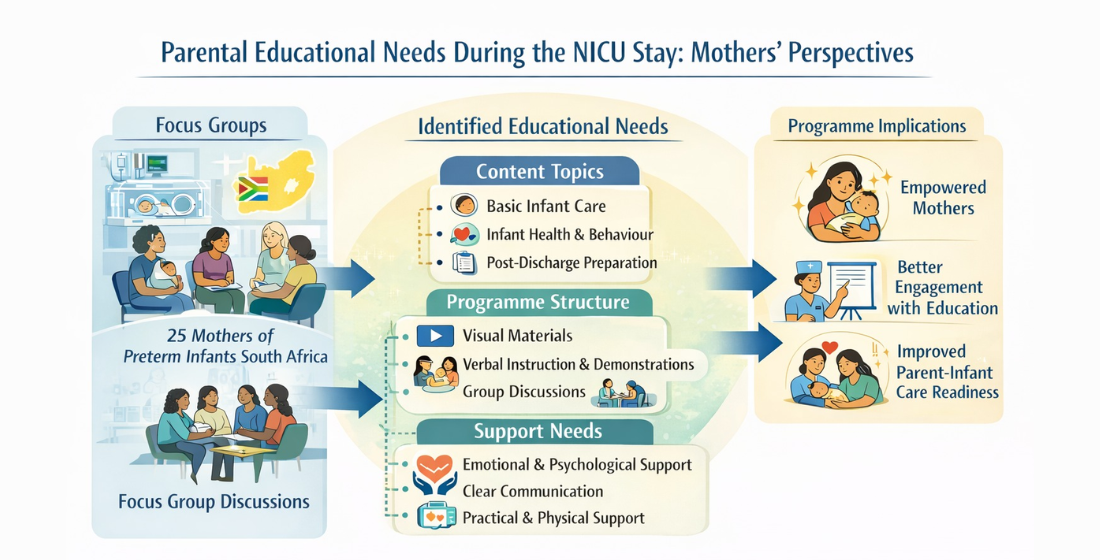

Parental Educational Needs During the NICU Stay: Mothers’ Perspectives

Highlights
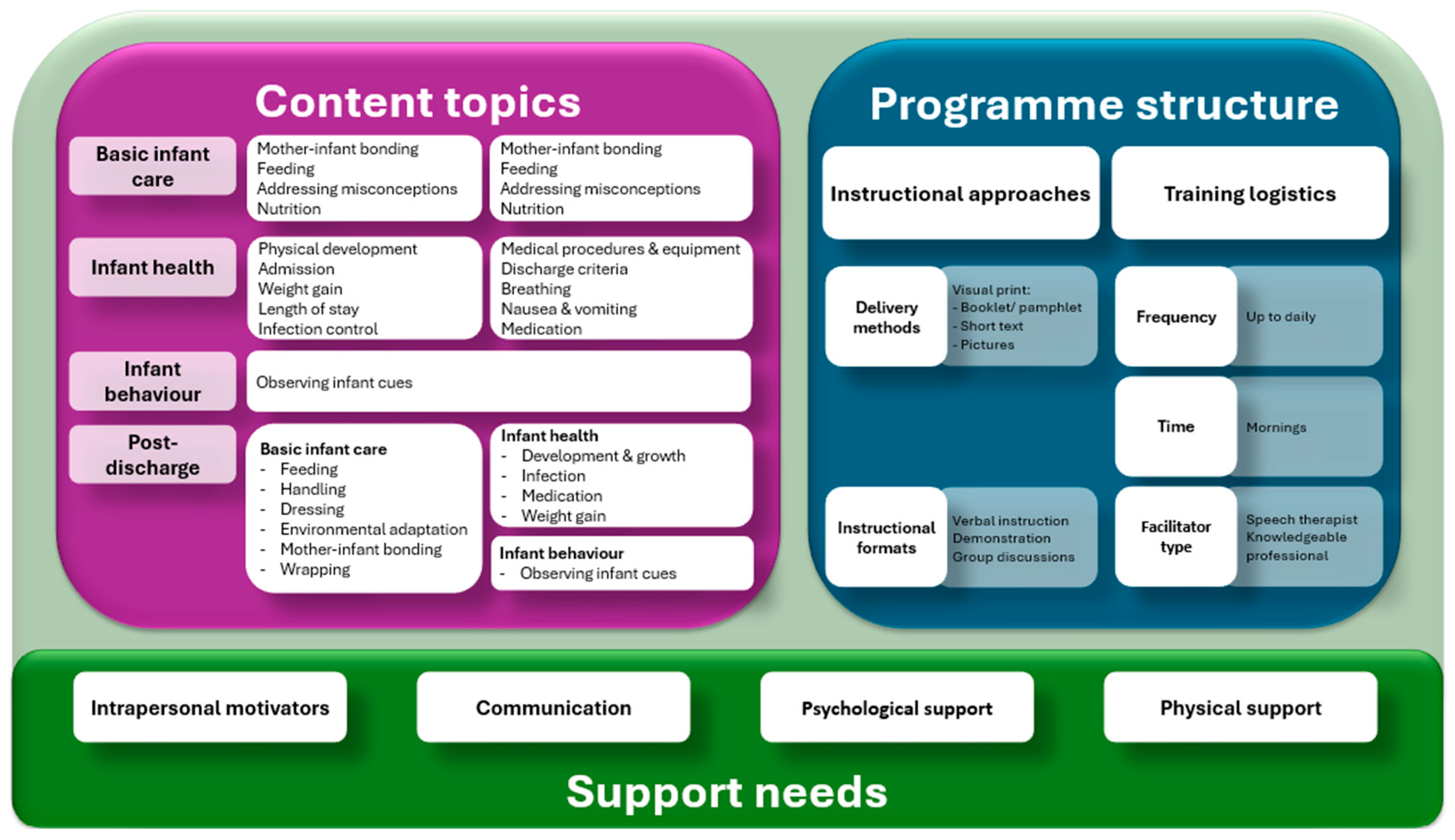
- Mothers identified key educational needs regarding basic infant care, infant health/behaviour, and post-discharge preparation.
- Preferred programme features included visual materials, verbal instruction with demonstrations, group discussions, and consistent, knowledgeable facilitators.
- Parent education programmes should be context-specific and aligned with mothers’ real-time NICU experiences.
- Addressing psychological, communication, and practical support needs is essential for parents to fully engage in and benefit from education.
Abstract
1. Background
2. Methods
2.1. Aim and Design
2.2. Setting
2.3. Participants
2.4. Recruitment of Participants
2.5. Data Collection
2.6. Data Analysis
3. Results
3.1. Category A: Content Topics
3.2. Category B: Programme Structure
3.3. Category C: Support Needs
4. Discussion
4.1. Limitations and Strengths of the Study
4.2. Implications for Practice and Further Research
5. Conclusions
Supplementary Materials
Author Contributions
Funding
Institutional Review Board Statement
Informed Consent Statement
Data Availability Statement
Acknowledgments
Conflicts of Interest
Abbreviations
| COPE | Creating Opportunities for Parent Empowerment |
| FCC | Family-centred Care |
| FICare | Family Integrated Care |
| FGDs | Focus Group Discussions |
| NICU | Neonatal Intensive Care Unit |
References
- Furtak, S.L.; Gay, C.L.; Kriz, R.M.; Bisgaard, R.; Bolick, S.C.; Lothe, B.; Cormier, D.M.; Joe, P.; Sasinski, J.K.; Kim, J.H.; et al. What parents want to know about caring for their preterm infant: A longitudinal descriptive study. Patient Educ. Couns. 2021, 104, 2732–2739. [Google Scholar] [CrossRef] [PubMed]
- Treyvaud, K.; Spittle, A.; Anderson, P.J.; O’Brien, K. A multilayered approach is needed in the NICU to support parents after the preterm birth of their infant. Early Hum. Dev. 2019, 139, 104838. [Google Scholar] [CrossRef] [PubMed]
- Gehl, M.B.; Alter, C.C.; Rider, N.; Gunther, L.G.; Russell, R.B. Improving the efficiency and effectiveness of parent education in the neonatal intensive care unit. Adv. Neonatal Care 2020, 20, 59–67. [Google Scholar] [CrossRef]
- Springer, C.; Elleman, B.; Cooper, O. The effectiveness of parental education programs within neonatal intensive care units: A systematic review. Res. Directs Ther. Sci. 2023, 2, 1–10. [Google Scholar] [CrossRef]
- Brett, J.; Staniszewska, S.; Newburn, M.; Jones, N.; Taylor, L. A systematic mapping review of effective interventions for communicating with, supporting, and providing information to parents of preterm infants. BMJ Open 2011, 1, e000023. [Google Scholar] [CrossRef]
- Melnyk, B.M.; Feinstein, N.F.; Alpert-Gillis, L.; Fairbanks, E.; Crean, H.F.; Sinkin, R.A.; Stone, P.W.; Small, L.; Tu, X.; Gross, S.J. Reducing premature infants’ length of stay and improving parents’ mental health outcomes with the creating opportunities for parent empowerment (COPE) neonatal intensive care unit program: A randomized controlled trial. Pediatrics 2006, 118, e1414–e1427. [Google Scholar] [CrossRef]
- Lubbe, W.; Donald, K.; Kruger, I.M. Key components of parenting education interventions for preterm infant–parent dyads admitted to the NICU: A systematic review. SSRN 2024, 73, e178–e206. [Google Scholar] [CrossRef]
- University of the Witwatersrand. 2023; admissions registers of the hospital complex (unpublished internal document prepared by the nursing services manager).
- Palinkas, L.A.; Horwitz, S.M.; Green, C.A.; Wisdom, J.P.; Duan, N.; Hoagwood, K. Purposeful sampling for qualitative data collection and analysis in mixed-method implementation research. Adm. Policy Ment. Health 2015, 42, 533–544. [Google Scholar] [CrossRef]
- Marques, I.C.D.S.; Theiss, L.M.; Johnson, C.Y.; McLin, E.; Ruf, B.A.; Vickers, S.M.; Fouad, M.N.; Scarinci, I.C.; Chu, D.I. Implementation of virtual focus groups for qualitative data collection in a global pandemic. Am. J. Surg. 2021, 221, 918–922. [Google Scholar] [CrossRef]
- World Medical Association. World Medical Association Declaration of Helsinki: Ethical principles for medical research involving human subjects. J. Am. Med. Assoc. 2013, 310, 2191–2194. [Google Scholar] [CrossRef] [PubMed]
- National Health Research Ethics Council. South African Ethics in Health Research Guidelines: Principles, Processes and Structures, 3rd ed.; NdoH: Pretoria, South Africa, 2024.
- Gill, P.; Stewart, K.; Treasure, E.; Chadwick, B. Methods of data collection in qualitative research: Interviews and focus groups. Br. Dent. J. 2008, 204, 291–295. [Google Scholar] [CrossRef]
- Love, B.; Vetere, A.; Davis, P. Should interpretative phenomenological analysis (IPA) be used with focus groups? Int. J. Qual. Methods 2020, 19, 1609406920921600. [Google Scholar] [CrossRef]
- Hennink, M.; Kaiser, B.N. Sample sizes for saturation in qualitative research: A systematic review of empirical tests. Soc. Sci. Med. 2022, 292, 114523. [Google Scholar] [CrossRef]
- Creswell, J.W. Research Design: Qualitative, Quantitative, and Mixed Methods Approaches, 3rd ed.; Sage Publications: Thousand Oaks, CA, USA, 2009. [Google Scholar]
- Tesch, R. Qualitative Research: Analysis Types and Software Tools; Falmer: New York, NY, USA, 1990. [Google Scholar]
- Bostanabad, M.A.; Areshtanab, H.N.; Balila, M.; Jafarabadi, M.A.; Ravanbakhsh, K. Effect of a supportive-training intervention on mother–infant attachment. Iran. J. Pediatr. 2017, 27, e10565. [Google Scholar] [CrossRef]
- Bracht, M.; O’Leary, L.; Lee, S.K.; O’Brien, K. Implementing family-integrated care in the NICU: A parent education and support program. Adv. Neonatal Care 2013, 13, 115–126. [Google Scholar] [CrossRef] [PubMed]
- Chen, Y.L.; Lee, T.Y.; Gau, M.L.; Lin, K.C. The effectiveness of an intervention program for fathers of hospitalized preterm infants on paternal support and attachment 1 month after discharge. J. Perinat. Neonatal Nurs. 2019, 33, 160–169. [Google Scholar] [CrossRef]
- Fotiou, C.; Vlastarakos, P.V.; Bakoula, C.; Papagaroufalis, K.; Bakoyannis, G.; Darviri, C.; Chrousos, G. Parental stress management using relaxation techniques in a neonatal intensive care unit: A randomized controlled trial. Intensive Crit. Care Nurs. 2016, 32, 20–28. [Google Scholar] [CrossRef]
- Heo, Y.J.; Oh, W.O. The effectiveness of a parent participation improvement program for parents on partnership, attachment, and infant growth in a neonatal intensive care unit: A randomized controlled trial. Int. J. Nurs. Stud. 2019, 95, 19–27. [Google Scholar] [CrossRef]
- Jafarzadeh, Z.A.; Maghsoudi, J.; Barekatain, B.; Marofi, M. Effect of telenursing on attachment and stress in mothers of preterm infants. Iran. J. Neonatol. 2019, 10, 65–71. [Google Scholar] [CrossRef]
- Maria, A.; Litch, J.A.; Stepanchak, M.; Sarin, E.; Wadhwa, R.; Kumar, H. Assessment of feasibility and acceptability of family-centered care implemented at a neonatal intensive care unit in India. BMC Pediatr. 2021, 21, 171. [Google Scholar] [CrossRef]
- Mianaei, S.J.; Karahroudy, F.A.; Rassouli, M.; Tafreshi, M.Z. The effect of creating opportunities for parent empowerment program on maternal stress, anxiety, and participation in NICU wards in Iran. Iran. J. Nurs. Midwifery Res. 2014, 19, 94–100. Available online: https://www.ncbi.nlm.nih.gov/pmc/articles/PMC3917192/ (accessed on 10 June 2024).
- Moreno-Sanz, B.; Montes, M.T.; Antón, M.; Serrada, M.T.; Cabrera, M.; Pellicer, A. Scaling up the family integrated care model in a level IIIc neonatal intensive care unit: A systematic approach to the methods and effort taken for implementation. Front. Pediatr. 2021, 9, 682097. [Google Scholar] [CrossRef] [PubMed]
- Moudi, Z.; Molashahi, B.; Ansari, H.; Imani, M. The effect of a care program and social support on anxiety level in mothers of late preterm infants in Sistan and Baluchestan, Iran. Women Health 2019, 59, 569–578. [Google Scholar] [CrossRef] [PubMed]
- Mousavi, S.S.; Keramat, A.; Chaman, R.; Mohagheghi, P.; Mousavi, S.A.; Khosravi, A. Impact of maternity support program on the stress of mothers in the first encounter with the preterm infants. Int. J. Prev. Med. 2021, 12, 68. [Google Scholar] [CrossRef]
- Ong, S.L.; Abdullah, K.L.; Danaee, M.; Soh, K.L.; Soh, K.G.; Lee, D.S.K.; Hussin, E.O.D. The effectiveness of a structured nursing intervention program on maternal stress and ability among mothers of premature infants in a neonatal intensive care unit. J Clin. Nurs. 2019, 28, 641–649. [Google Scholar] [CrossRef]
- Peyrovi, H.; Mosayebi, Z.; Mohammad-Doost, F.; Chehrzad, M.M.; Mehran, A. The effect of empowerment program on “perceived readiness for discharge” of mothers of premature infants. J. Matern. Fetal Neonatal Med. 2016, 29, 752–757. [Google Scholar] [CrossRef]
- Rostami, F.F.; Soleimani, F.; Norouzi, M.; Hatamizadeh, N.; Mokhtarinouri, J.; Poshtmashhadi, M. Preterm infant neurodevelopmental care training program and mother–infant attachment. Int. J. Womens Health Reprod. Sci. 2020, 8, 192–197. [Google Scholar] [CrossRef]
- Sivanandan, S.; Bethou, A.; Ramanujam, S.S.; Kumar, C.; Chinnasamy, K.; Natarajan, P.; Ravichandran, M. Implementing family-centered care in the neonatal intensive care unit—A quality improvement initiative. Indian J. Pediatr. 2021, 88, 872–878. [Google Scholar] [CrossRef] [PubMed]
- Viera, C.S.; Bugs, B.M.; Fonseca, L.M.M.; Guimarães, A.T.B.; Machinesk, G.G. Educative activity and maternal stress of premature infant: Controlled trial. Arq. Bras. Psic. 2019, 71, 19–35. Available online: http://pepsic.bvsalud.org/scielo.php?script=sci_arttext&pid=S1809-52672019000100003&nrm=iso (accessed on 13 March 2024).
- Chen, Y.; Zhang, J.; Bai, J. Effect of an educational intervention on parental readiness for premature infant discharge from the neonatal intensive care units. J. Adv. Nurs. 2016, 72, 135–146. [Google Scholar] [CrossRef] [PubMed]
- Kadiroğlu, T.; Güdücü, T. Effect of infant care training on maternal bonding, motherhood self-efficacy, and self-confidence in mothers of preterm newborns. Matern. Child Health J. 2022, 26, 131–138. [Google Scholar] [CrossRef]
- Lv, B.; Gao, X.R.; Sun, J.; Li, T.T.; Liu, Z.Y.; Zhu, L.H.; Latour, J.M. Family-centered care improves clinical outcomes of very-low-birth-weight infants: A quasi-experimental study. Front. Pediatr. 2019, 7, 138. [Google Scholar] [CrossRef]
- Milgrom, J.; Newnham, C.; Martin, P.R.; Anderson, P.J.; Doyle, L.W.; Hunt, R.W.; Achenbach, T.M.; Ferretti, C.; Holt, C.J.; Inder, T.E.; et al. Early communication in preterm infants following intervention in the NICU. Early Hum. Dev. 2013, 89, 755–762. [Google Scholar] [CrossRef]
- Nieves, H.; Clements-Hickman, A.; Davies, C.C. Effect of a parent empowerment program on parental stress, satisfaction, and length of stay in the neonatal intensive care unit. J. Perinat. Neonatal Nurs. 2021, 35, 92–99. [Google Scholar] [CrossRef]
- Petteys, A.R.; Adoumie, D. Mindfulness-based neurodevelopmental care: Impact on NICU parent stress and infant length of stay; a randomized controlled pilot study. Adv. Neonatal Care 2018, 18, E12–E22. [Google Scholar] [CrossRef]
- Phianching, K.; Chaimongkol, N.; Pongjaturawit, Y. Effects of the parental sensitivity intervention among mothers and fathers of preterm infants: A quasi-experimental study. Pac. Rim Int. J. Nurs. Res. 2020, 24, 246–259. Available online: https://he02.tci-thaijo.org/index.php/PRIJNR/article/view/195126 (accessed on 24 April 2025).
- Yu, N.K.K.; Shum, K.K.M.; Lam, Y.Y.; Kwan, Q.K.L.; Ng, S.Y.P.; Chan, N.T.T. Sensitivity training for mothers with premature infants: A randomized controlled trial. J. Pediatr. Psychol. 2022, 47, 1167–1184. [Google Scholar] [CrossRef] [PubMed]
- Khanjari, S.; Bell, E.F.; Mohagheghi, P.; Sadeghi, L.S.; Haghani, S.; Rokhsatichenijani, E. The effect of family-centered education on the quality of life of the parents of premature infants. J. Neonatal Nurs. 2022, 28, 407–412. [Google Scholar] [CrossRef]
- Morey, J.A.; Gregory, K. Nurse-led education mitigates maternal stress and enhances knowledge in the NICU. MCN Am. J. Matern. Child Nurs. 2012, 37, 182–191. [Google Scholar] [CrossRef] [PubMed]
- Gök, P.Y.; Efe, E. The effect of web-based preterm infant care training on mothers’ self-confidence. Health Care Women Int. 2022, 1–13. [Google Scholar] [CrossRef]
- Broom, M.; Parsons, G.; Carlisle, H.; Kecskes, Z. Exploring parental and staff perceptions of the family-integrated care model: A qualitative focus group study. Adv. Neonatal Care 2017, 17, E12–E19. [Google Scholar] [CrossRef]
- Zhang, R.; Huang, R.W.; Gao, X.R.; Peng, X.M.; Zhu, L.H.; Rangasamy, R.; Latour, J.M. Involvement of parents in the care of preterm infants: A pilot study evaluating a family-centered care intervention in a Chinese neonatal ICU. Pediatr. Crit. Care Med. 2018, 19, 741–747. [Google Scholar] [CrossRef] [PubMed]
- Cheng, Y.C.; Chen, L.L.; Chang, Y.S.; Li, T.C.; Chen, C.J.; Huang, L.C. The effectiveness of learning portfolios in learning participation and learners’ perceptions of skills and confidence in the mother of preterm infant. Midwifery 2018, 62, 86–91. [Google Scholar] [CrossRef] [PubMed]
- Jahri Sheijani, M.; Chehrzad, M.M.; Reza Masouleh, S.; Nezhad Leyli, E.K.; Bidabadi, E. The effect of “creating opportunities for parent empowerment” program on parents of children with epilepsy and other chronic neurological conditions. Iran. J. Child Neurol. 2020, 14, 65–76. Available online: https://pubmed.ncbi.nlm.nih.gov/32021630/ (accessed on 5 July 2024).
- Ahn, Y.M.; Kim, N.H. Parental perception of neonates, parental stress and education for NICU parents. Asian Nurs. Res. 2007, 1, 199–210. [Google Scholar] [CrossRef] [PubMed]
- Gerstein, E.D.; Njoroge, W.F.M.; Paul, R.A.; Smyser, C.D.; Rogers, C.E. Maternal depression and stress in the neonatal intensive care unit: Associations with mother–child interactions at age 5 years. J. Am. Acad. Child Adolesc. Psychiatry 2019, 58, 350–358.e2. [Google Scholar] [CrossRef]
- Hunter, L.M.L.; Blake, S.; Simmons, C.; Thompson, J.; Derouin, A. Implementing a parent education program in the special care nursery. J. Pediatr. Health Care 2019, 33, 131–137. [Google Scholar] [CrossRef]
- Khazaii, T.; Taheri, F.; Hosseini, S.M.; Parhiz, Z.; Namdari, S. The effects of preterm infant care education on stress among the mothers of preterm infants hospitalized in neonatal intensive care units. Mod. Care J. 2018, 15, e69476. [Google Scholar] [CrossRef]
- Harper, M.; Cole, P. Member checking: Can benefits be gained similar to group therapy? Qual. Rep. 2012, 17, 510–517. [Google Scholar] [CrossRef]
- Roberts, K.; Dowell, A.; Nie, J.B. Attempting rigour and replicability in thematic analysis of qualitative research data: A case study of codebook development. BMC Med. Res. Methodol. 2019, 19, 66. [Google Scholar] [CrossRef]

Disclaimer/Publisher’s Note: The statements, opinions and data contained in all publications are solely those of the individual author(s) and contributor(s) and not of MDPI and/or the editor(s). MDPI and/or the editor(s) disclaim responsibility for any injury to people or property resulting from any ideas, methods, instructions or products referred to in the content. |
© 2026 by the authors. Licensee MDPI, Basel, Switzerland. This article is an open access article distributed under the terms and conditions of the Creative Commons Attribution (CC BY) license.
Share and Cite
Lubbe, W.; Donald, K.A. Parental Educational Needs During the NICU Stay: Mothers’ Perspectives. Children 2026, 13, 126. https://doi.org/10.3390/children13010126
Lubbe W, Donald KA. Parental Educational Needs During the NICU Stay: Mothers’ Perspectives. Children. 2026; 13(1):126. https://doi.org/10.3390/children13010126
Chicago/Turabian StyleLubbe, Welma, and Kirsten A. Donald. 2026. "Parental Educational Needs During the NICU Stay: Mothers’ Perspectives" Children 13, no. 1: 126. https://doi.org/10.3390/children13010126
APA StyleLubbe, W., & Donald, K. A. (2026). Parental Educational Needs During the NICU Stay: Mothers’ Perspectives. Children, 13(1), 126. https://doi.org/10.3390/children13010126