
Perceived Financial Strain and Adolescent Mental Health: Evidence from a Population-Based Study in South Tyrol, Italy
 , , , , and
Highlights
- Self-perceived burden due to rising prices was the strongest socioeconomic correlate of adolescent mental health, showing consistent associations with depressive symptoms, emotional/behavioral difficulties and anxiety.
- Parental burden reports and objective family affluence showed weak or no associations, and female adolescents were particularly vulnerable to the psychological impact of financial strain.
- Subjective financial stress among adolescents should be prioritized in assessment and prevention, as it is a more proximal indicator of mental health risk than structural socioeconomic status measures.
- Public health strategies should directly address the psychological experience of financial strain, complementing economic policies with school-, family-, and community-based interventions, with particular attention to supporting the mental health of adolescent girls.
Abstract
1. Introduction
2. Methods
2.1. Study Design and Sample
2.2. Measures
2.2.1. Sociodemographic and Family Variables
2.2.2. Socioeconomic Stressors
- Car ownership: “Does your family own a car?” The response options were coded as 0 (no), 1 (one car), and 2 (two or more cars).
- Own bedroom: “Does your child have its own room?” (yes/no).
- Number of computers: Total number of computers, laptops, or tablets in the household (excluding gaming consoles and smartphones), coded from 0 to 3+.
- Number of bathrooms: Total number of bathrooms in the household, coded from 0 to 3+.
- Dishwasher ownership: Presence of a dishwasher in the household (yes/no).
- Holiday frequency: Number of family vacations taken in the past year, with response options ranging from 0 (none) to 3 (more than twice per year).
2.2.3. Mental Health Outcomes
- Strengths and Difficulties Questionnaire (SDQ): The self-rated SDQ was used to evaluate emotional and behavioral difficulties [49]. For this study, the Total Difficulties Score (excluding the prosocial scale) was dichotomized based on official cut-offs, with “borderline” and “abnormal” classifications grouped as elevated.
2.3. Statistical Analysis
2.4. Use of Generative Artificial Intelligence (GenAI)
3. Results
3.1. Sample Characteristics
3.2. Distribution of Socioeconomic Stressors
3.3. Economic Stressors and Demographic Parameters
3.4. Associations Between Socioeconomic Stressors and Mental Health Outcomes
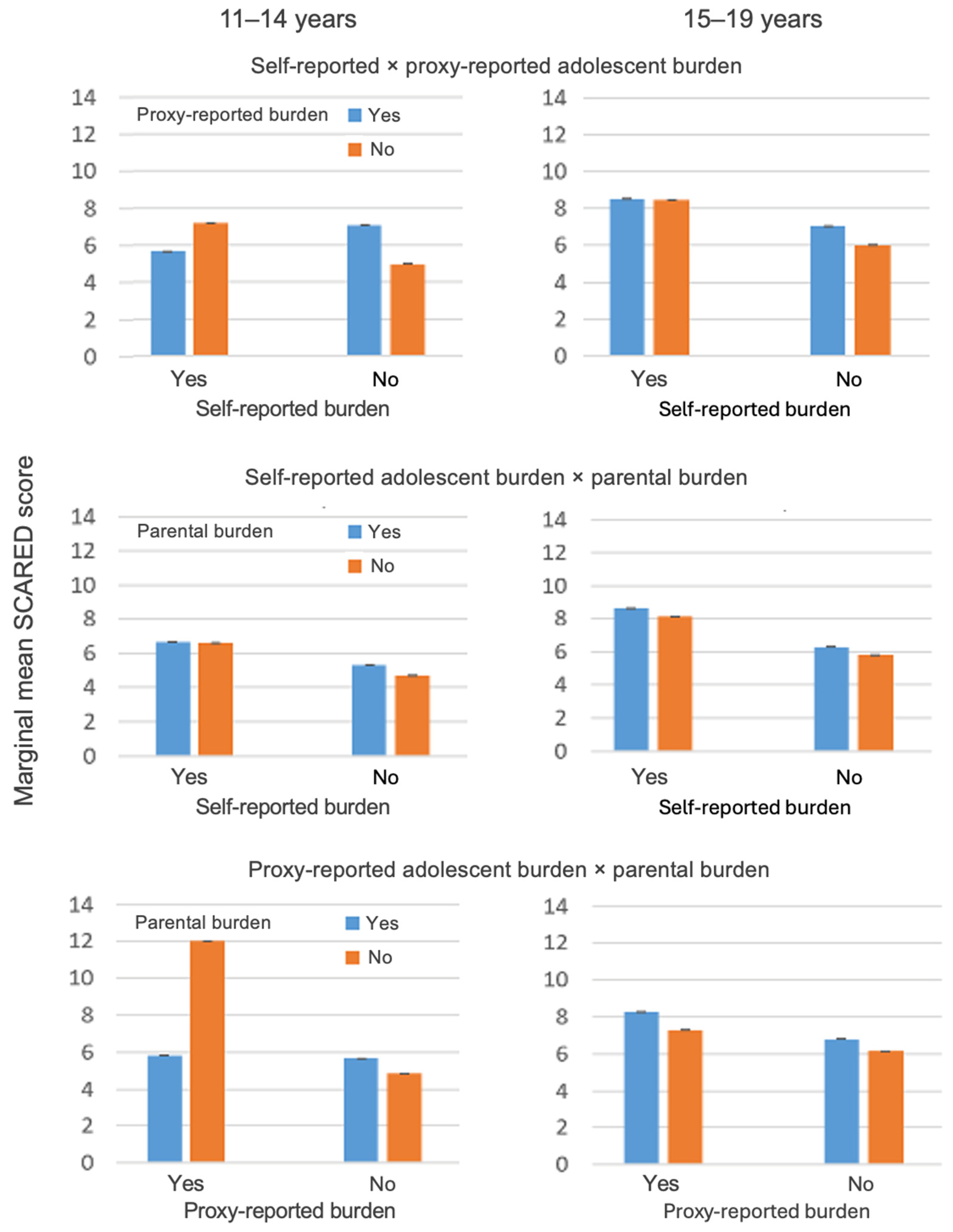
3.5. Associations Between Financial Burden and Anxiety (ANOVA Models)
3.5.1. Self- and Proxy-Reported Adolescent Burden
3.5.2. Self-Reported Adolescent Burden vs. Parental Self-Burden
3.5.3. Proxy-Reported Adolescent Burden vs. Parental Self-Burden
4. Discussion
4.1. Socioeconomic Stress and Adolescent Mental Health
4.2. Gender Differences
4.3. Broader Context and Implications
4.4. Strengths and Limitations
5. Conclusions
Author Contributions
Funding
Institutional Review Board Statement
Informed Consent Statement
Data Availability Statement
Conflicts of Interest
Abbreviations
| ANOVA | Analysis of variance |
| CASMIN | Comparative Analysis of Social Mobility in Industrial Nations |
| CI | Confidence interval |
| COP-S | Corona and Psyche South Tyrol |
| COPSY | Corona and Psyche |
| COVID-19 | Corona virus disease 2019 |
| FAS | Family affluence scale |
| OR | Odds ratio |
| GAD | Generalized Anxiety Subscale |
| PHQ-2 | Patient Health Questionnaire-2 |
| SCARED | Screen for Child Anxiety-Related Emotional Disorders |
| SD | Standard deviation |
| SDQ | Strengths and Difficulties Questionnaire |
| SES | Socioeconomic status |
References
- Clayborne, Z.M.; Varin, M.; Colman, I. Systematic Review and Meta-Analysis: Adolescent Depression and Long-Term Psychosocial Outcomes. J. Am. Acad. Child Adolesc. Psychiatry 2019, 58, 72–79. [Google Scholar] [CrossRef] [Scilit] [PubMed]
- Cairns, K.E.; Yap, M.B.H.; Pilkington, P.D.; Jorm, A.F. Risk and Protective Factors for Depression That Adolescents Can Modify: A Systematic Review and Meta-Analysis of Longitudinal Studies. J. Affect. Disord. 2014, 169, 61–75. [Google Scholar] [CrossRef] [Scilit] [PubMed]
- Naicker, K.; Galambos, N.L.; Zeng, Y.; Senthilselvan, A.; Colman, I. Social, Demographic, and Health Outcomes in the 10 Years Following Adolescent Depression. J. Adolesc. Health 2013, 52, 533–538. [Google Scholar] [CrossRef] [Scilit] [PubMed]
- Goodman, E. The Role of Socioeconomic Status Gradients in Explaining Differences in US Adolescents’ Health. Am. J. Public Health 1999, 89, 1522–1528. [Google Scholar] [CrossRef] [Scilit]
- Reiss, F. Socioeconomic Inequalities and Mental Health Problems in Children and Adolescents: A Systematic Review. Soc. Sci. Med. 2013, 90, 24–31. [Google Scholar] [CrossRef] [Scilit]
- Foster, J.C.; Hodges, H.R.; Beloborodova, A.; Cohodes, E.M.; Phillips, M.Q.; Anderson, E.; Fagbenro, B.; Gee, D.G. Integrating Developmental Neuroscience with Community-Engaged Approaches to Address Mental Health Outcomes for Housing-Insecure Youth: Implications for Research, Practice, and Policy. Dev. Cogn. Neurosci. 2024, 68, 101399. [Google Scholar] [CrossRef] [Scilit]
- Guan, N.; Guariglia, A.; Moore, P.; Xu, F.; Al-Janabi, H. Financial Stress and Depression in Adults: A Systematic Review. PLoS ONE 2022, 17, e0264041. [Google Scholar] [CrossRef] [Scilit]
- Jakobsen, A.L. Long-Term Association between Neighbourhood Socioeconomic Deprivation in Early Childhood and Perceived Stress in Early Adulthood: A Multilevel Cohort Study. J. Epidemiol. Community Health 2023, 77, 447–453. [Google Scholar] [CrossRef] [Scilit]
- Hock, E.S.; Blank, L.; Fairbrother, H.; Clowes, M.; Cuevas, D.C.; Booth, A.; Clair, A.; Goyder, E. Exploring the Impact of Housing Insecurity on the Health and Wellbeing of Children and Young People in the United Kingdom: A Qualitative Systematic Review. BMC Public Health 2024, 24, 2453. [Google Scholar] [CrossRef] [Scilit]
- Surachman, A. Financial Hardship Is Associated with Repeated Stressors as Measured by Stressor Diversity. Innov. Aging 2024, 8, 107–108. [Google Scholar] [CrossRef] [Scilit]
- Samuel, L.J.; Saylor, M.A.; Lutz, M.; Choe, M.Y.; Wright, R.S.; Kim, B.; Szanton, S.L.; Nkimbeng, M.; Mena-Carrasco, F.; Austin, R.; et al. Financial Strain and Child Health: Measures and Evidence from a Systematic Literature Review. Am. J. Prev. Med. Focus 2025, 4, 100337. [Google Scholar] [CrossRef] [Scilit]
- Zehrung, R.; Hu, D.; Guo, Y.; Zheng, K.; Chen, Y. Investigating the Effects of Housing Instability on Depression, Anxiety, and Mental Health Treatment in Childhood and Adolescence. AMIA Annu. Symp. Proc. 2024, 2024, 1303–1312. [Google Scholar] [PubMed]
- Keen, R.; Chen, J.T.; Slopen, N.; Sandel, M.; Copeland, W.E.; Tiemeier, H. Prospective Associations of Childhood Housing Insecurity with Anxiety and Depression Symptoms During Childhood and Adulthood. JAMA Pediatr. 2023, 177, 818–826. [Google Scholar] [CrossRef] [Scilit]
- World Economic Forum. This Is What’s Worrying #GenZ and #millennials in 2023. Available online: https://www.weforum.org/stories/2023/05/gen-z-millennials-work-cost-living/ (accessed on 12 July 2025).
- Ettman, C.K.; Fan, A.Y.; Philips, A.P.; Adam, G.P.; Ringlein, G.; Clark, M.A.; Wilson, I.B.; Vivier, P.M.; Galea, S. Financial Strain and Depression in the U.S.: A Scoping Review. Transl. Psychiatry 2023, 13, 168. [Google Scholar] [CrossRef] [Scilit] [PubMed]
- Vidal-Ribas, P.; Krebs, G.; Silver, J.; Tseng, W.-L.; Ford, T.; Stringaris, A. The Hidden Burden: Self-Reported Irritability in Adolescent Girls Signals Higher Psychiatric Risk. BMC Public Health 2025, 25, 1832. [Google Scholar] [CrossRef] [Scilit]
- Singh, I.; Asnani, M.R.; Harrison, A. Health-Related Quality of Life in Adolescents with Chronic Illness in Jamaica: Adolescent and Parent Reports. J. Adolesc. Health 2023, 72, 12–20. [Google Scholar] [CrossRef] [Scilit]
- Du Rietz, E.; Kuja-Halkola, R.; Brikell, I.; Jangmo, A.; Sariaslan, A.; Lichtenstein, P.; Kuntsi, J.; Larsson, H. Predictive Validity of Parent- and Self-Rated ADHD Symptoms in Adolescence on Adverse Socioeconomic and Health Outcomes. Eur. Child Adolesc. Psychiatry 2017, 26, 857–867. [Google Scholar] [CrossRef] [Scilit]
- Nosè, M.; Turrini, G.; Muriago, G.; Badino, M.; Cristofalo, D.; Sartori, R.; Tedeschi, F.; Barbui, C. Psychological Distress and Well-Being in University and High School Students: A Cross-Sectional Study in Italy. BMJ Open 2025, 15, e101446. [Google Scholar] [CrossRef] [Scilit] [PubMed]
- Donato, F.; Triassi, M.; Loperto, I.; Maccaro, A.; Mentasti, S.; Crivillaro, F.; Elvetico, A.; Croce, E.; Raffetti, E. Symptoms of Mental Health Problems among Italian Adolescents in 2017-2018 School Year: A Multicenter Cross-Sectional Study. Environ. Health Prev. Med. 2021, 26, 67. [Google Scholar] [CrossRef] [Scilit] [PubMed]
- Barbieri, V.; Wiedermann, C.J.; Piccoliori, G.; Mahlknecht, A.; Plagg, B.; Ausserhofer, D.; Ravens-Sieberer, U.; Engl, A. Evolution of Youth’s Mental Health and Quality of Life during the COVID-19 Pandemic in South Tyrol, Italy: Comparison of Two Representative Surveys. Children 2023, 10, 895. [Google Scholar] [CrossRef] [Scilit]
- Dalmasso, P.; Comoretto, R.I.; Ciardullo, S.; Pierannunzio, D.; Vieno, A.; Lazzeri, G.; Nardone, P. La Sorveglianza HBSC-Italia 2022 Health Behaviour in School-Aged Children: Benessere e Salute Sessuale; Istituto Superiore di Sanità: Roma, Italy, 2025. [Google Scholar]
- Bersia, M.; Charrier, L.; Berchialla, P.; Cosma, A.; Comoretto, R.I.; Dalmasso, P. The Mental Well-Being of Italian Adolescents in the Last Decade through the Lens of the Dual Factor Model. Children 2022, 9, 1981. [Google Scholar] [CrossRef] [Scilit] [PubMed]
- Pearlin, L.I.; Lieberman, M.A.; Menaghan, E.G.; Mullan, J.T. The Stress Process. J. Health Soc. Behav. 1981, 22, 337–356. [Google Scholar] [CrossRef] [Scilit] [PubMed]
- Pearlin, L.I. The Sociological Study of Stress. J. Health Soc. Behav. 1989, 30, 241–256. [Google Scholar] [CrossRef] [Scilit]
- Lund, C.; Brooke-Sumner, C.; Baingana, F.; Baron, E.C.; Breuer, E.; Chandra, P.; Haushofer, J.; Herrman, H.; Jordans, M.; Kieling, C.; et al. Social Determinants of Mental Disorders and the Sustainable Development Goals: A Systematic Review of Reviews. Lancet Psychiatry 2018, 5, 357–369. [Google Scholar] [CrossRef] [Scilit]
- Marmot, M.; Wilkinson, R. Social Determinants of Health; Oup: Oxford, UK, 2005; ISBN 0-19-157848-7. [Google Scholar]
- Conger, R.D.; Conger, K.J.; Martin, M.J. Socioeconomic Status, Family Processes, and Individual Development. J. Marriage Fam. 2010, 72, 685–704. [Google Scholar] [CrossRef] [Scilit]
- De Los Reyes, A.; Kazdin, A.E. Informant Discrepancies in the Assessment of Childhood Psychopathology: A Critical Review, Theoretical Framework, and Recommendations for Further Study. Psychol. Bull. 2005, 131, 483–509. [Google Scholar] [CrossRef] [Scilit]
- Wiedermann, C.J.; Barbieri, V.; Piccoliori, G.; Engl, A. Problematic Internet Use in Adolescents Is Driven by Internal Distress Rather Than Family or Socioeconomic Contexts: Evidence from South Tyrol, Italy. Behav. Sci. 2025, 15, 1534. [Google Scholar] [CrossRef] [Scilit]
- Barbieri, V.; Piccoliori, G.; Engl, A.; Wiedermann, C.J. Parental Mental Health, Gender, and Lifestyle Effects on Post-Pandemic Child and Adolescent Psychosocial Problems: A Cross-Sectional Survey in Northern Italy. Int. J. Environ. Res. Public Health 2024, 21, 933. [Google Scholar] [CrossRef] [Scilit]
- Barbieri, V.; Wiedermann, C.J.; Kaman, A.; Erhart, M.; Piccoliori, G.; Plagg, B.; Mahlknecht, A.; Ausserhofer, D.; Engl, A.; Ravens-Sieberer, U. Quality of Life and Mental Health in Children and Adolescents after the First Year of the COVID-19 Pandemic: A Large Population-Based Survey in South Tyrol, Italy. Int. J. Environ. Res. Public Health 2022, 19, 5220. [Google Scholar] [CrossRef] [Scilit]
- Ravens-Sieberer, U.; Kaman, A.; Erhart, M.; Otto, C.; Devine, J.; Löffler, C.; Hurrelmann, K.; Bullinger, M.; Barkmann, C.; Siegel, N.A.; et al. Quality of Life and Mental Health in Children and Adolescents during the First Year of the COVID-19 Pandemic: Results of a Two-Wave Nationwide Population-Based Study. Eur. Child Adolesc. Psychiatry 2021, 32, 575–588. [Google Scholar] [CrossRef] [Scilit] [PubMed]
- Brauns, H.; Scherer, S.; Steinmann, S. The CASMIN Ducational Classification in International Comparative Research. In Advances in Cross-National Comparison: A European Working Book for Demographic and Socio-Economic Variables; Hoffmeyer-Zlotnik, J.H.P., Wolf, C., Eds.; Springer US: Boston, MA, USA, 2003; pp. 221–244. ISBN 978-1-4419-9186-7. [Google Scholar]
- Currie, C.; Molcho, M.; Boyce, W.; Holstein, B.; Torsheim, T.; Richter, M. Researching Health Inequalities in Adolescents: The Development of the Health Behaviour in School-Aged Children (HBSC) Family Affluence Scale. Soc. Sci. Med. 2008, 66, 1429–1436. [Google Scholar] [CrossRef] [Scilit]
- Currie, C.; Alemán Díaz, A.Y.; Bosáková, L.; de Looze, M. The International Family Affluence Scale (FAS): Charting 25 Years of Indicator Development, Evidence Produced, and Policy Impact on Adolescent Health Inequalities. SSM Popul. Health 2024, 25, 101599. [Google Scholar] [CrossRef] [Scilit]
- Boyce, W.; Torsheim, T.; Currie, C.; Zambon, A. The Family Affluence Scale as a Measure of National Wealth: Validation of an Adolescent Self-Report Measure. Soc. Indic. Res. 2006, 78, 473–487. [Google Scholar] [CrossRef] [Scilit]
- Hobza, V.; Hamrik, Z.; Bucksch, J.; De Clercq, B. The Family Affluence Scale as an Indicator for Socioeconomic Status: Validation on Regional Income Differences in the Czech Republic. Int. J. Environ. Res. Public Health 2017, 14, 1540. [Google Scholar] [CrossRef] [Scilit] [PubMed]
- Hartley, J.E.K.; Levin, K.; Currie, C. A New Version of the HBSC Family Affluence Scale-FAS III: Scottish Qualitative Findings from the International FAS Development Study. Child Ind. Res. 2016, 9, 233–245. [Google Scholar] [CrossRef] [Scilit]
- Torsheim, T.; Cavallo, F.; Levin, K.A.; Schnohr, C.; Mazur, J.; Niclasen, B.; Currie, C.; the FAS Development Study Group. Psychometric Validation of the Revised Family Affluence Scale: A Latent Variable Approach. Child Ind. Res. 2016, 9, 771–784. [Google Scholar] [CrossRef] [Scilit]
- Liu, Y.; Wang, M.; Villberg, J.; Torsheim, T.; Tynjälä, J.; Lv, Y.; Kannas, L. Reliability and Validity of Family Affluence Scale (FAS II) among Adolescents in Beijing, China. Child Ind. Res. 2012, 5, 235–251. [Google Scholar] [CrossRef] [Scilit]
- Roh, H.J.; Kim, E.; Lee, K.Y.; Choi, J.; Bhang, S.-Y. Elucidating the Impact of Socioeconomic Status on Adolescent Internet Gaming Disorder Using the Family Affluence Scale. Int. J. Ment. Health Addict. 2024, 23, 2478–2495. [Google Scholar] [CrossRef] [Scilit]
- Molcho, M.; Gabhainn, S.N.; Kelleher, C.C. Assessing the Use of the Family Affluence Scale (FAS) among Irish Schoolchildren. Ir. Med. J. 2007, 100, 37–39. [Google Scholar]
- Corell, M.; Chen, Y.; Friberg, P.; Petzold, M.; Löfstedt, P. Does the Family Affluence Scale Reflect Actual Parental Earned Income, Level of Education and Occupational Status? A Validation Study Using Register Data in Sweden. BMC Public Health 2021, 21, 1995. [Google Scholar] [CrossRef] [Scilit]
- D’Argenio, P.; Minardi, V.; Mirante, N.; Mancini, C.; Cofini, V.; Carbonelli, A.; Diodati, G.; Granchelli, C.; Trinito, M.O.; Tarolla, E. Confronto Tra Due Test per La Sorveglianza Dei Sintomi Depressivi Nella Popolazione. Not. Ist. Super Sanità 2013, 26. [Google Scholar]
- Schuler, M.; Strohmayer, M.; Mühlig, S.; Schwaighofer, B.; Wittmann, M.; Faller, H.; Schultz, K. Assessment of Depression before and after Inpatient Rehabilitation in COPD Patients: Psychometric Properties of the German Version of the Patient Health Questionnaire (PHQ-9/PHQ-2). J. Affect. Disord. 2018, 232, 268–275. [Google Scholar] [CrossRef] [Scilit]
- Weitkamp, K.; Romer, G.; Rosenthal, S.; Wiegand-Grefe, S.; Daniels, J. German Screen for Child Anxiety Related Emotional Disorders (SCARED): Reliability, Validity, and Cross-Informant Agreement in a Clinical Sample. Child Adolesc. Psychiatry Ment. Health 2010, 4, 19. [Google Scholar] [CrossRef] [Scilit] [PubMed]
- Crocetti, E.; Hale, W.W.; Fermani, A.; Raaijmakers, Q.; Meeus, W. Psychometric Properties of the Screen for Child Anxiety Related Emotional Disorders (SCARED) in the General Italian Adolescent Population: A Validation and a Comparison between Italy and The Netherlands. J. Anxiety Disord. 2009, 23, 824–829. [Google Scholar] [CrossRef] [Scilit]
- Goodman, R. Psychometric Properties of the Strengths and Difficulties Questionnaire. J. Am. Acad. Child Adolesc. Psychiatry 2001, 40, 1337–1345. [Google Scholar] [CrossRef] [Scilit] [PubMed]
- Gignac, G.E.; Szodorai, E.T. Effect Size Guidelines for Individual Differences Researchers. Pers. Individ. Dif. 2016, 102, 74–78. [Google Scholar] [CrossRef] [Scilit]
- Selenko, E.; Batinic, B. Beyond Debt. A Moderator Analysis of the Relationship between Perceived Financial Strain and Mental Health. Soc. Sci. Med. 2011, 73, 1725–1732. [Google Scholar] [CrossRef] [Scilit]
- McCloud, T.; Bann, D. Financial Stress and Mental Health among Higher Education Students in the UK up to 2018: Rapid Review of Evidence. J. Epidemiol. Community Health 2019, 73, 977–984. [Google Scholar] [CrossRef] [Scilit]
- Ettman, C.K.; Thornburg, B.; Abdalla, S.M.; Meiselbach, M.K.; Galea, S. Financial Assets and Mental Health over Time. Sci. Rep. 2024, 14, 27370. [Google Scholar] [CrossRef] [Scilit]
- Huang, Y.; Heflin, C.M.; Validova, A. Material Hardship, Perceived Stress, and Health in Early Adulthood. Ann. Epidemiol. 2021, 53, 69–75.e3. [Google Scholar] [CrossRef] [Scilit]
- Barrows, C.E.; Belle, J.M.; Fleishman, A.; Lubitz, C.C.; James, B.C. Financial Burden of Thyroid Cancer in the United States: An Estimate of Economic and Psychological Hardship among Thyroid Cancer Survivors. Surgery 2020, 167, 378–384. [Google Scholar] [CrossRef] [Scilit]
- Chai, L.; Lu, Z. The Association between Financial Strain and Mental Health: The Mediating and Moderating Roles of Sleep Problems in the UK Household Longitudinal Study (UKHLS). J. Affect. Disord. 2025, 377, 245–253. [Google Scholar] [CrossRef] [Scilit]
- Marshall, G.L.; Kahana, E.; Gallo, W.T.; Stansbury, K.L.; Thielke, S. The Price of Mental Well-Being in Later Life: The Role of Financial Hardship and Debt. Aging Ment. Health 2021, 25, 1338–1344. [Google Scholar] [CrossRef] [Scilit] [PubMed]
- Jones, S.M.; Henrikson, N.B.; Panattoni, L.; Syrjala, K.L.; Shankaran, V. A Theoretical Model of Financial Burden after Cancer Diagnosis. Future Oncol. 2020, 16, 3095–3105. [Google Scholar] [CrossRef] [Scilit]
- Inguva, S.; Priyadarshini, M.; Shah, R.; Bhattacharya, K. Financial Toxicity and Its Impact on Health Outcomes and Caregiver Burden among Adult Cancer Survivors in the USA. Future Oncol. 2022, 18, 1569–1581. [Google Scholar] [CrossRef] [Scilit]
- Chen, M.-H.; Zhao, J.; Ogongo, M.K.; Han, X.; Zheng, Z.; Yabroff, K.R. Associations of Financial Hardship and Health Status, Social Functioning, and Mental Health Among Cancer Survivors in the United States: Findings From a Nationally Representative Study. JCO Oncol. Pract. 2025, 21, 78–88. [Google Scholar] [CrossRef] [Scilit]
- Erikson, E.H. Identity Youth and Crisis; WW Norton & company: New York, NY, USA, 1968; ISBN 0-393-31144-9. [Google Scholar]
- Yang, Q.; Zhang, W.; Wu, H.; Huang, B.; Zhang, C.; Niu, G. The Association between Perceived Family Financial Stress and Adolescent Suicide Ideation: A Moderated Mediation Model. Behav. Sci. 2023, 13, 948. [Google Scholar] [CrossRef] [Scilit]
- Hamilton, H.A.; Noh, S.; Adlaf, E.M. Perceived Financial Status, Health, and Maladjustment in Adolescence. Soc. Sci. Med. 2009, 68, 1527–1534. [Google Scholar] [CrossRef] [Scilit] [PubMed]
- Argabright, S.T.; Tran, K.T.; Visoki, E.; DiDomenico, G.E.; Moore, T.M.; Barzilay, R. COVID-19-Related Financial Strain and Adolescent Mental Health. Lancet Reg. Health Am. 2022, 16, 100391. [Google Scholar] [CrossRef] [Scilit] [PubMed]
- Shaigerova, L.; Shilko, R.; Almazova, O. Perception of Financial Well-Being as a Factor of Physical and Mental Health of Adolescents. Eur. Psychiatry 2021, 64, S220. [Google Scholar] [CrossRef] [Scilit]
- Low, N.; Mounts, N.S. Economic Stress, Parenting, and Adolescents’ Adjustment during the COVID-19 Pandemic. Fam. Relat. 2022, 71, 90–107. [Google Scholar] [CrossRef] [Scilit]
- Belardinelli, P.; Torbica, A.; Fattore, G. Longitudinal Associations between Different Measures of Socioeconomic Status and Health Behavior among Adolescents. Data from a Wealthy Italian Region. Prev. Med. 2022, 160, 107092. [Google Scholar] [CrossRef] [Scilit] [PubMed]
- Maenhout, L.; Peuters, C.; Cardon, G.; Compernolle, S.; Crombez, G.; DeSmet, A. The Association of Healthy Lifestyle Behaviors with Mental Health Indicators among Adolescents of Different Family Affluence in Belgium. BMC Public Health 2020, 20, 958. [Google Scholar] [CrossRef] [Scilit] [PubMed]
- Elgar, F.J.; Xie, A.; Pförtner, T.-K.; White, J.; Pickett, K.E. Relative Deprivation and Risk Factors for Obesity in Canadian Adolescents. Soc. Sci. Med. 2016, 152, 111–118. [Google Scholar] [CrossRef] [Scilit]
- Edet, B.; Essien, E.; Eleazu, F.; Abang, R.; Ochijele, E.; Daniel, F. The Relative Role of Family Affluence and Social Support on Depression and Self-Esteem among Adolescents in Nigeria: A Cross-Sectional Study. Acta Med. Acad. 2023, 52, 201–211. [Google Scholar] [CrossRef] [Scilit] [PubMed]
- Salk, R.H.; Hyde, J.S.; Abramson, L.Y. Gender Differences in Depression in Representative National Samples: Meta-Analyses of Diagnoses and Symptoms. Psychol. Bull. 2017, 143, 783–822. [Google Scholar] [CrossRef] [Scilit]
- Van Droogenbroeck, F.; Spruyt, B.; Keppens, G. Gender Differences in Mental Health Problems among Adolescents and the Role of Social Support: Results from the Belgian Health Interview Surveys 2008 and 2013. BMC Psychiatry 2018, 18, 6. [Google Scholar] [CrossRef] [Scilit]
- Campbell, O.L.K.; Bann, D.; Patalay, P. The Gender Gap in Adolescent Mental Health: A Cross-National Investigation of 566,829 Adolescents across 73 Countries. SSM Popul. Health 2021, 13, 100742. [Google Scholar] [CrossRef] [Scilit]
- Matud, M.P.; Ibáñez, I.; Fortes, D.; Bethencourt, J.M. Adolescent Stress, Psychological Distress and Well-Being: A Gender Analysis. Child Youth Serv. Rev. 2024, 45, 300–323. [Google Scholar] [CrossRef] [Scilit]
- Rudolph, K.D. Gender Differences in Emotional Responses to Interpersonal Stress during Adolescence. J. Adolesc. Health 2002, 30, 3–13. [Google Scholar] [CrossRef] [Scilit]
- Sun, Y.; Zhong, Y.; Sun, W.; Chu, L.; Long, J.; Fan, X.W. More Prevalent and More Severe: Gender Differences of Depressive Symptoms in Chinese Adolescents. Front. Public Health 2023, 11, 1167234. [Google Scholar] [CrossRef] [Scilit] [PubMed]
- Cela-Bertran, X.; Peguero, G.; Serral, G.; Sánchez-Ledesma, E.; Martínez-Hernáez, A.; Pié-Balaguer, A. Understanding the Relationship between Gender and Mental Health in Adolescence: The Gender Adherence Index (GAI). Eur. Child Adolesc. Psychiatry 2024, 33, 229–240. [Google Scholar] [CrossRef] [Scilit] [PubMed]
- Richter, K.; Buechel, C.; Augustin, M.; Friedmann, A.; Mall, V.; Nehring, I. Psychosocial Stress in Families of Young Children after the Pandemic: No Time to Rest. Child Adolesc. Psychiatry Ment. Health 2025, 19, 50. [Google Scholar] [CrossRef] [Scilit] [PubMed]
- Zrnić Novaković, I.; Ajduković, D.; Ajduković, M.; Kenntemich, L.; Lotzin, A.; Schäfer, I.; Anastassiou-Hadjicharalambous, X.; Evgeniou, E.; Borges, C.; Figueiredo-Braga, M.; et al. Mental Health during and after the COVID-19 Pandemic—A Longitudinal Study over 42 Months in Five European Countries. Eur. J. Psychotraumatol. 2025, 16, 2488700. [Google Scholar] [CrossRef] [Scilit]
- Cournède, B.; Plouin, M. No Home for The Young; OECD: Paris, France, 2022. [Google Scholar]
- Louie, P.; Wu, C.; Shahidi, F.V.; Siddiqi, A. Inflation Hardship, Gender, and Mental Health. SSM Popul. Health 2023, 23, 101452. [Google Scholar] [CrossRef] [Scilit]
- Xiao, Y.; Brown, T.T.; Snowden, L.R.; Chow, J.C.-C.; Mann, J.J. COVID-19 Policies, Pandemic Disruptions, and Changes in Child Mental Health and Sleep in the United States. JAMA Netw. Open 2023, 6, e232716. [Google Scholar] [CrossRef] [Scilit]
- Wiedermann, C.J.; Barbieri, V.; Plagg, B.; Marino, P.; Piccoliori, G.; Engl, A. Fortifying the Foundations: A Comprehensive Approach to Enhancing Mental Health Support in Educational Policies Amidst Crises. Healthcare 2023, 11, 1423. [Google Scholar] [CrossRef] [Scilit]
- Larik, M.O.; Khan, Z.; Urooj, M. A Rising Endemic within a Pandemic: Impact of Inflation on Mental Health. J. Pak. Med. Assoc. 2023, 73, 1167. [Google Scholar] [CrossRef] [Scilit]
- Reismann, H. „Bildung” als Leitbegriff der konzepttheoretischen Begründung einer schulbezogenen Jugendarbeit. In Soziallandschaften: Perspektiven Sozialer Arbeit als Profession und Disziplin; Spitzer, H., Höllmüller, H., Hönig, B., Eds.; VS Verlag für Sozialwissenschaften: Wiesbaden, Germany, 2011; pp. 191–207. ISBN 978-3-531-92773-2. [Google Scholar]
- Reismann, H. Soziale Arbeit Im Internet Als Eine Zeitgemäße Form Der Dienstleistungsarbeit. Sozialer Fortschritt 2023, 72, 829–847. [Google Scholar] [CrossRef] [Scilit]


| Burden Due to Price Increases | Age Group | Valid n | Burden Rating (%) | p-Value | ||||
|---|---|---|---|---|---|---|---|---|
| Not at All | Slight | Moderate | Strong | Very Strong | ||||
| Adolescent (self-report) | 11–19 | 1598 | 24.8 | 25.6 | 26.5 | 15.5 | 7.6 | — |
| 11–14 | 826 | 30.3 | 24.6 | 24.9 | 14.2 | 6.1 | <0.001 | |
| 15–19 | 772 | 19.0 | 26.7 | 28.1 | 17.0 | 9.2 | ||
| Adolescent (parental report) | 11–19 | 1597 | 32.6 | 35.9 | 20.7 | 7.8 | 3.0 | — |
| 11–14 | 820 | 38.2 | 34.5 | 18.7 | 6.0 | 2.7 | <0.001 | |
| 15–19 | 767 | 26.6 | 37.4 | 22.9 | 9.6 | 3.4 | ||
| Parental (parental report) | 11–19 | 1595 | 1.6 | 10.6 | 28.4 | 36.2 | 23.2 | — |
| 11–14 | 824 | 1.8 | 9.0 | 28.0 | 37.3 | 23.9 | n.s. | |
| 15–19 | 771 | 1.3 | 12.3 | 28.8 | 35.1 | 22.4 | ||
| FAS III Indicator | Valid n | Category | n (%) |
|---|---|---|---|
| Car ownership | 1598 | 0 cars | 22 (1.4) |
| 1 car | 602 (37.7) | ||
| 2+ cars | 974 (61.0) | ||
| Own bedroom | 1598 | Yes | 1377 (86.2) |
| No | 221 (13.8) | ||
| Computers | 1598 | 0 | 2 (0.1) |
| 1 | 170 (10.6) | ||
| 2 | 383 (24.0) | ||
| 3+ | 1043 (65.3) | ||
| Bathrooms | 1598 | 0 | 633 (39.6) |
| 1 | 805 (50.4) | ||
| 2 | 160 (10.0) | ||
| 3+ | 213 (11.2) | ||
| Dishwasher | 1598 | Yes | 1512 (94.6) |
| No | 86 (5.4) | ||
| Family holidays (last year) | 1598 | None | 177 (11.1) |
| Once | 612 (38.3) | ||
| Twice | 446 (27.9) | ||
| >2 times | 363 (22.7) |
| Variable | Burden Due to Price Increases (%) | FAS III (Low) 1 | ||||||
|---|---|---|---|---|---|---|---|---|
| Adolescent (Self-Report) | Adolescent (Parent-Report) | Parental (Parent-Report) | ||||||
| Age Group | Age Group | Age Group | Age Group | |||||
| 11–14 | 15–19 | 11–14 | 15–19 | 11–14 | 15–19 | 11–14 | 15–19 | |
| Gender | ||||||||
| Male | 21.9 | 27.1 | 9.1 | 13.7 | 62.3 | 59.2 | 16.5 | 13.8 |
| Female | 18.4 | 25.3 | 8.2 | 12.4 | 60.0 | 56.1 | 20.1 | 18.2 |
| p-value | n.s. | n.s. | n.s. | n.s. | n.s. | n.s. | n.s. | n.s. |
| Parental household | ||||||||
| Two-parent | 19.2 | 25.7 | 7.8 | 12.1 | 58.6 | 54.7 | 14.5 | 12.0 |
| Single parent | 29.1 | 29.8 | 16.7 | 19.2 | 81.4 | 76.9 | 50.0 | 42.3 |
| p-value | 0.03 | n.s. | 0.006 | 0.046 | <0.001 | <0.001 | <0.001 | <0.001 |
| Residence | ||||||||
| Urban | 22.0 | 23.9 | 7.8 | 9.3 | 64.8 | 52.2 | 21.6 | 16.8 |
| Rural | 19.5 | 27.1 | 9.0 | 14.6 | 59.8 | 59.8 | 17.0 | 15.8 |
| p-value | n.s. | n.s. | n.s. | n.s. | n.s. | n.s. | n.s. | n.s. |
| Migration background | ||||||||
| Yes | 16.7 | 26.5 | 6.1 | 13.4 | 48.5 | 55.9 | 13.6 | 22.1 |
| No | 20.4 | 26.0 | 8.8 | 12.8 | 61.7 | 57.1 | 18.6 | 15.4 |
| p-value | n.s. | n.s. | n.s. | n.s. | 0.035 | n.s. | n.s. | n.s. |
| Parental education | ||||||||
| Low | 28.7 | 27.8 | 13.4 | 16.7 | 71.1 | 73.3 | 32.0 | 25.2 |
| Medium | 18.4 | 29.5 | 7.3 | 15.5 | 61.4 | 58.4 | 19.6 | 18.1 |
| High | 18.3 | 20.8 | 8.1 | 7.8 | 56.7 | 48.2 | 10.9 | 8.1 |
| p-value | 0.018 | 0.040 | n.s. | 0.006 | 0.010 | <0.001 | <0.001 | <0.001 |
| Parental mental problems | ||||||||
| No | 19.7 | 26.1 | 8.3 | 13.0 | 61.3 | 56.7 | 17.9 | 15.6 |
| Yes | 28.9 | 29.4 | 13.2 | 14.7 | 57.9 | 73.5 | 23.7 | 20.6 |
| p-value | n.s. | n.s. | n.s. | n.s. | n.s. | n.s. | n.s. | n.s. |
| Family language | ||||||||
| German | 20.3 | 24.6 | 8.7 | 13.8 | 59.6 | 57.7 | 18.1 | 15.2 |
| Italian | 22.2 | 29.6 | 8.6 | 5.60 | 70.9 | 52.8 | 19.7 | 19.4 |
| Other | 11.1 | 43.6 | 7.4 | 22.6 | 55.6 | 71.9 | 18.5 | 18.8 |
| p-value | n.s. | 0.036 | n.s. | 0.018 | n.s. | n.s. | n.s. | n.s. |
| Physical activity | ||||||||
| 0–2 days a week | 22.4 | 26.7 | 11.9 | 13.8 | 65.1 | 57.0 | 21.9 | 15.6 |
| 3 or more days a week | 19.6 | 25.8 | 7,70 | 12.6 | 60.0 | 57.7 | 17.2 | 16.2 |
| p-value | n.s. | n.s. | n.s. | n.s. | n.s. | n.s. | n.s. | n.s. |
| Screen time for private purposes | ||||||||
| 0–2 h a day | 17.6 | 26.4 | 7.7 | 14.8 | 60.6 | 57.1 | 17.4 | 16.6 |
| 2 or more hours a day | 26.3 | 26.1 | 11.1 | 11.7 | 63.5 | 58.5 | 20.4 | 15.2 |
| p-value | 0.004 | n.s. | n.s. | n.s. | n.s. | n.s. | n.s. | n.s. |
| Screen time for school purposes | ||||||||
| 0–2 h a day | 19.8 | 24.3 | 8.7 | 12.0 | 60.6 | 58.2 | 19.0 | 16.6 |
| 2 or more hours a day | 28.9 | 33.3 | 8.9 | 16.8 | 71.1 | 55.6 | 6.7 | 15.0 |
| p-value | n.s. | 0.016 | n.s. | n.s. | n.s. | n.s. | 0.038 | n.s. |
| Mental Health | Stressor | Total Sample | Male | Female | 11–14 yrs | 15–19 yrs |
|---|---|---|---|---|---|---|
| Depressive symptoms (PHQ-2 score) | Family Affluence | 0.014 | 0.049 | –0.017 | 0.001 | 0.024 |
| Burden due to price increases | ||||||
| Parental (parent report) | 0.166 *** | 0.126 *** | 0.218 *** | 0.151 *** | 0.149 *** | |
| Adolescent (self-report) | 0.088 *** | 0.037 | 0.141 *** | 0.086 ** | 0.049 | |
| Adolescent (parent report) | 0.038 | 0.037 | 0.047 | 0.040 | 0.056 | |
| Anxiety symptoms (SCARED-GAD score) | Family Affluence | 0.011 | 0.062 * | –0.033 | 0.006 | 0.015 |
| Burden due to price increases | ||||||
| Parental (parent report) | 0.190 *** | 0.194 *** | 0.207 *** | 0.153 *** | 0.213 *** | |
| Adolescent (self-report) | 0.089 *** | 0.085 ** | 0.097 *** | 0.070 * | 0.087 ** | |
| Adolescent (parent report) | 0.070 *** | 0.086 ** | 0.067 * | 0.076 ** | 0.078 ** | |
| Emotional/behavioral difficulties (SDQ score) | Family Affluence | –0.032 | 0.011 | –0.070 ** | –0.047 | –0.016 |
| Burden due to price increases | ||||||
| Parental (parent report) | 0.156 *** | 0.158 *** | 0.160 *** | 0.152 *** | 0.152 *** | |
| Adolescent (self-report) | 0.041 * | 0.032 | 0.052 | 0.031 | 0.039 | |
| Adolescent (parent-report) | 0.039 | 0.046 | 0.038 | 0.018 | 0.067 * |
| Predictor | 11–14 Years ηp2 (p) | 15–19 Years ηp2 (p) |
|---|---|---|
| Self-reported vs. proxy-reported adolescent burden | ||
| Self-reported | 0.000 (0.672) | 0.001 (0.378) |
| Proxy-reported | 0.000 (0.555) | 0.013 (0.002) |
| Interaction (Self × Proxy) | 0.009 (0.008) | 0.001 (0.456) |
| Model p-value | <0.001 | <0.001 |
| N | 779 | 740 |
| Levene (median) | n.s. | n.s. |
| Self-reported adolescent burden vs. parental burden | ||
| Self-reported | 0.015 (0.001) | 0.035 (<0.001) |
| Parental self | 0.001 (0.447) | 0.001 (0.302) |
| Interaction (Self × Parental self) | 0.000 (0.580) | 0.000 (0.988) |
| Model p-value | <0.001 | <0.001 |
| N | 783 | 744 |
| Levene (median) | n.s. | n.s. |
| Proxy-reported adolescent burden vs. parental burden | ||
| Proxy-reported | 0.007 (0.021) | 0.003 (0.110) |
| Parental self | 0.004 (0.088) | 0.001 (0.317) |
| Interaction | 0.006 (0.025) | 0.000 (0.804) |
| Model p-value | 0.008 | 0.006 |
| N | 777 | 739 |
| Levene (median) | n.s. | n.s. |
Disclaimer/Publisher’s Note: The statements, opinions and data contained in all publications are solely those of the individual author(s) and contributor(s) and not of MDPI and/or the editor(s). MDPI and/or the editor(s) disclaim responsibility for any injury to people or property resulting from any ideas, methods, instructions or products referred to in the content. |
© 2026 by the authors. Licensee MDPI, Basel, Switzerland. This article is an open access article distributed under the terms and conditions of the Creative Commons Attribution (CC BY) license.
Share and Cite
Wiedermann, C.J.; Barbieri, V.; Reismann, H.; Piccoliori, G.; Engl, A.; Hager von Strobele-Prainsack, D. Perceived Financial Strain and Adolescent Mental Health: Evidence from a Population-Based Study in South Tyrol, Italy. Children 2026, 13, 121. https://doi.org/10.3390/children13010121
Wiedermann CJ, Barbieri V, Reismann H, Piccoliori G, Engl A, Hager von Strobele-Prainsack D. Perceived Financial Strain and Adolescent Mental Health: Evidence from a Population-Based Study in South Tyrol, Italy. Children. 2026; 13(1):121. https://doi.org/10.3390/children13010121
Chicago/Turabian StyleWiedermann, Christian J., Verena Barbieri, Hendrik Reismann, Giuliano Piccoliori, Adolf Engl, and Doris Hager von Strobele-Prainsack. 2026. "Perceived Financial Strain and Adolescent Mental Health: Evidence from a Population-Based Study in South Tyrol, Italy" Children 13, no. 1: 121. https://doi.org/10.3390/children13010121
APA StyleWiedermann, C. J., Barbieri, V., Reismann, H., Piccoliori, G., Engl, A., & Hager von Strobele-Prainsack, D. (2026). Perceived Financial Strain and Adolescent Mental Health: Evidence from a Population-Based Study in South Tyrol, Italy. Children, 13(1), 121. https://doi.org/10.3390/children13010121