Article

Impact of Heart Rate Monitoring Using Dry-Electrode ECG Immediately After Birth on Time to Start Ventilation: A Randomized Trial

1
Department of Simulation-Based Learning, Stavanger University Hospital, 4068 Stavanger, Norway
2
Faculty of Health Sciences, University of Stavanger, 4036 Stavanger, Norway
3
Strategic Research, Laerdal Medical, 4002 Stavanger, Norway
4
Department of Research, Section of Biostatistics, Stavanger University Hospital, 4068 Stavanger, Norway
5
Department of Mathematics and Physics, University of Stavanger, 4036 Stavanger, Norway
6
Department of Pediatrics, Stavanger University Hospital, 4068 Stavanger, Norway
7
Department of Clinical Science, University of Bergen, 5021 Bergen, Norway
8
Department of Neurology, Stavanger University Hospital, 4068 Stavanger, Norway
9
The Royal Women’s Hospital, University of Melbourne, Parkville, Melbourne, VIC 3052, Australia
*
Author to whom correspondence should be addressed.
Children 2025, 12(8), 1082; https://doi.org/10.3390/children12081082

Submission received: 18 July 2025 / Revised: 5 August 2025 / Accepted: 14 August 2025 / Published: 18 August 2025
(This article belongs to the Special Issue Advances in Neonatal Resuscitation and Intensive Care)

Abstract

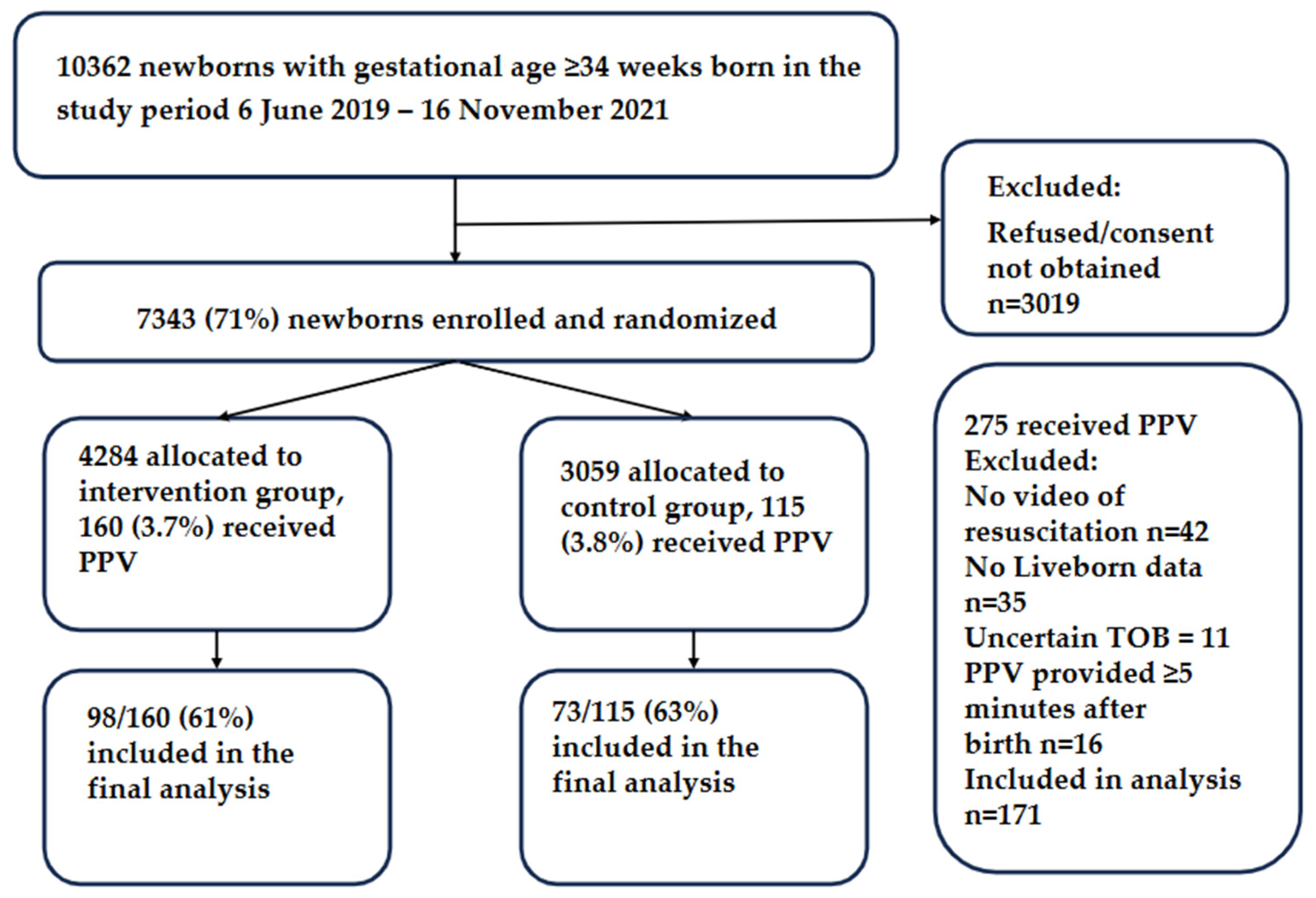
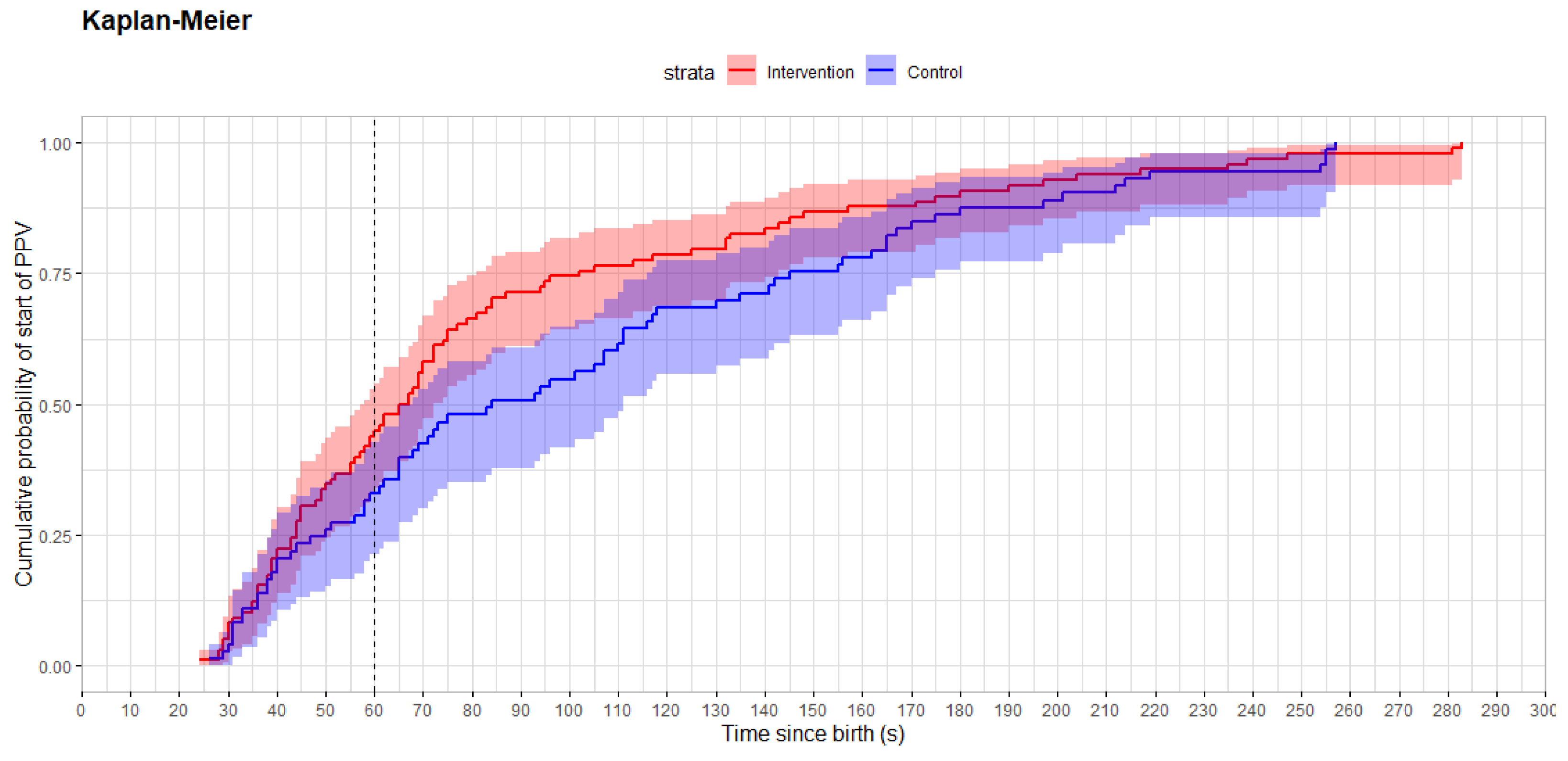
Background/Objectives: Newborn heart rate is an integral part of resuscitation algorithms, but the impact of ECG monitoring on resuscitative interventions and clinical outcomes has been identified as a knowledge gap. The objective was to evaluate the impact of routine use of dry-electrode ECG in all newborns immediately after birth on time to start positive pressure ventilation (PPV) when indicated. Methods: We conducted a randomized clinical trial from June 2019 to November 2021 at Stavanger University Hospital, Norway. Dry-electrode ECG sensors were applied immediately after birth to all newborns ≥ 34 weeks’ gestation. Randomization determined whether the heart rate display was visible or masked. Time of birth was registered in an observation app. Time to start ventilation was calculated from video recordings. Results: In total, 7343 newborns ≥ 34 weeks’ gestation were enrolled, 4284 in the intervention and 3059 in the control group, and 3.7% and 3.8% received ventilation, respectively. In 171/275 (62%) of the newborns the exact time of birth and a video of the resuscitation were available, for 98 in the intervention and 73 in the control group. Ventilation was provided within 60 s to 44/98 (45%) in the intervention and 24/73 (33%) in the control group, p = 0.12. Time from birth to start of PPV was a median of 66 (44, 102) s in the intervention and 84 (49, 148) s in the control group, p = 0.058. Resuscitated newborns were apneic (74%) or breathing ineffectively (26%) at the start of PPV, and only 36% had a heart rate < 100 beats per minute. Conclusions: The use of dry-electrode ECG heart rate monitoring did not change the proportion of newborns that received ventilation within 60 s after birth, but early termination due to employee protests to video recordings rendered the trial inadequately powered to detect a difference. Breathing status was likely a more important determinant of starting ventilation than bradycardia.
Keywords: dry-electrode ECG; heart rate; heart rate monitoring; newborn resuscitation; positive pressure ventilation; newborn resuscitation algorithm dry-electrode ECG; heart rate; heart rate monitoring; newborn resuscitation; positive pressure ventilation; newborn resuscitation algorithm