Article

Anxiety in Children: The Contribution of Parental Characteristics
by
Beáta Bécsi
1,†,
Jenifer Pataki
2,3,† and
Gergő József Szőllősi
4,*
1
Faculty of Health Sciences, University of Debrecen, 4028 Debrecen, Hungary
2
Department of Integrative Health Sciences, Institute of Health Sciences, Faculty of Health Sciences, University of Debrecen, 4028 Debrecen, Hungary
3
Doctoral School of Health Sciences, University of Debrecen, 4032 Debrecen, Hungary
4
Coordination Center for Research in Social Sciences, Faculty of Economics and Business, University of Debrecen, 4032 Debrecen, Hungary
*
Author to whom correspondence should be addressed.
These authors contributed equally to this work.
Children 2025, 12(5), 553; https://doi.org/10.3390/children12050553

Submission received: 9 March 2025 / Revised: 15 April 2025 / Accepted: 23 April 2025 / Published: 25 April 2025

Abstract

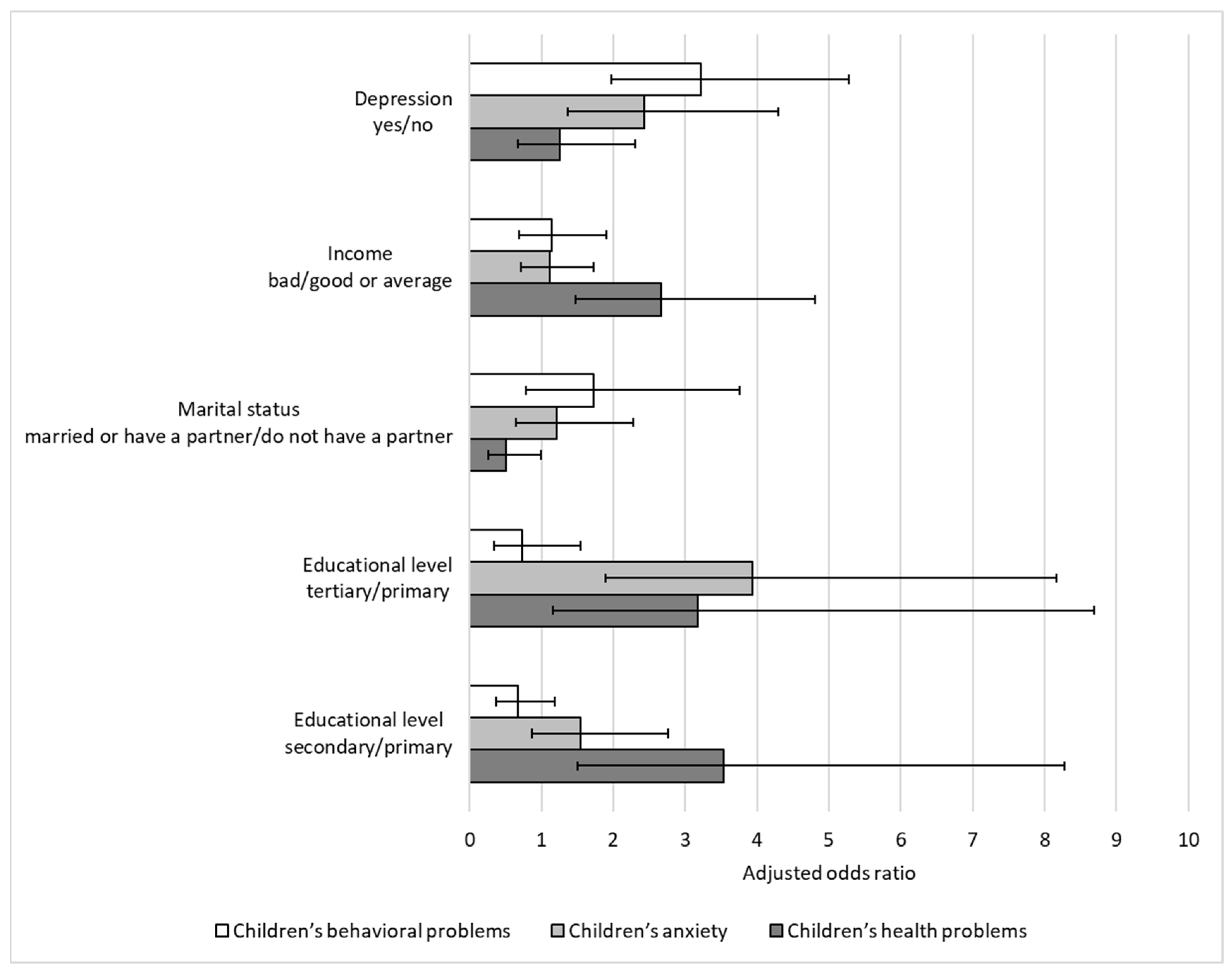
Background/Objectives: The prevalence of behavioral problems and mental health issues, including anxiety, among children is rising, potentially affecting their long-term well-being and social functioning. Therefore, this study aims to identify the key determinants of children’s health status, with a particular focus on parental mental health, health behaviors, and socio-demographic factors. Methods: The data were sourced from a Hungarian representative database from 2019. The analysis was executed using multivariate and multiple logistic regressions. Results: Our sample consisted of data from 5603 individuals, of which 775 (14%) completed the children’s module. Significant associations were found between the parent’s tertiary education level (AOR = 3.93 [1.89–8.16]) and the child’s restlessness and anxiety, as well as between the parent’s existing depression and the child’s behavioral difficulties (AOR = 3.22 [1.97–5.28]) and anxiety (AOR = 2.43 [1.37–4.30]). Additionally, a significant association was observed between the parent’s secondary education level (AOR = 3.53 [1.51–8.27]) and the child’s health problems, which was also associated with cases of tertiary education (AOR = 3.17 [1.16–8.69]). Conclusions: Our findings suggest that parental education and mental health significantly influence children’s psychological and overall health, which is why targeted prevention and health promotion strategies are essential to support both children and families.
Keywords: anxiety; children; mental health; prevention anxiety; children; mental health; prevention