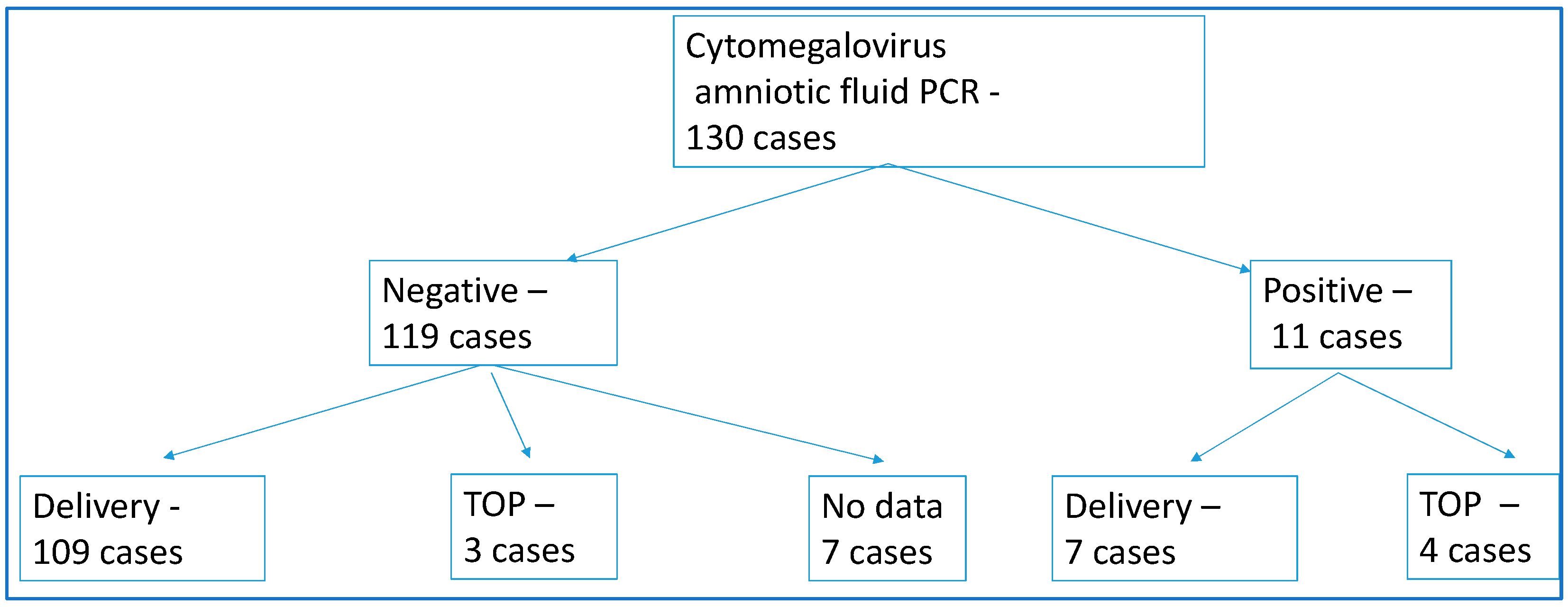
Between 2001 and 2023, 130 samples of amniotic fluid were subjected to molecular microbiological testing (PCR) for human CMV DNA at the Department of Obstetrics and Gynecology, Semmelweis University, Budapest. The mean maternal age of the cases was 31.62 ± 5 years. Of the 123 pregnancies (94.61%) that we know of that resulted in a birth, 116 infants were born. Based on the processing of birth data, we determined the proportion of preterm and term newborns. The proportion of premature newborns was found to be 7.76% (9 cases), while the other 107 cases (92.24%) were mature newborns.
3.1. Processing Our Ultrasound Results
The first table contains the indications for amniotic fluid sampling and CMV PCR tests (
Table 1). In 67 of the 130 cases, routine CMV serological screening confirmed primary CMV infection; in 51 of these cases, no ultrasound abnormality was observed during pregnancy, and in 16 cases ultrasound abnormality developed later. In 63 of the 130 cases, CMV serology was performed due to a suspicious ultrasound abnormality: in 27 cases, one; in 27 cases, two ultrasound abnormalities were detected in the fetus; in 6 cases, three; in 2 cases, four; and in 1 case, five ultrasound abnormalities were detected.
First, the prevalence and percentage distribution of fetal abnormalities observed by ultrasound are presented.
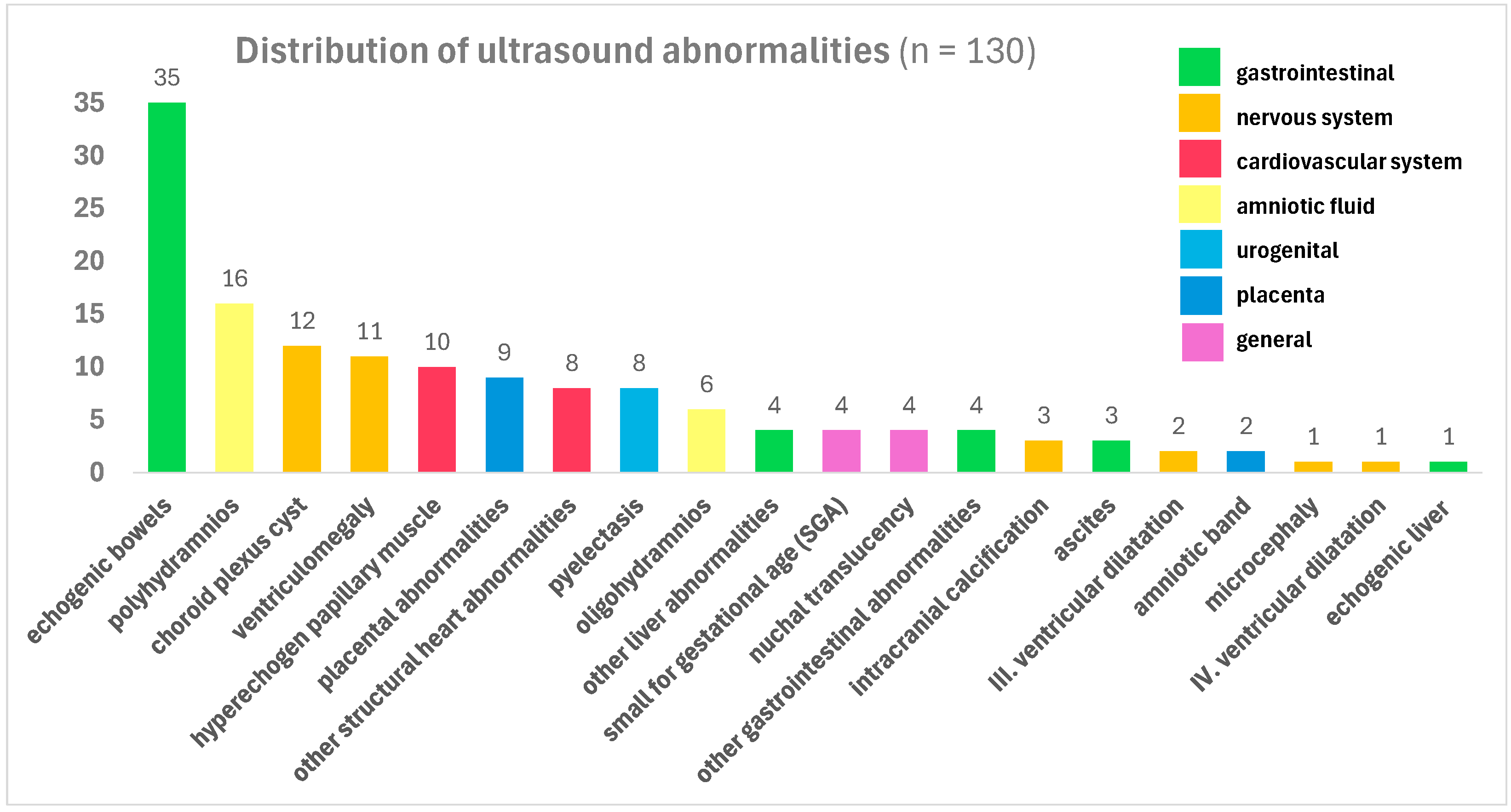
The ratio of ultrasound deviations was analyzed based on the total number of cases (130) and grouped by organ system.
Figure 1 shows the distribution of ultrasound abnormalities.
In the literature, the most common ultrasound abnormalities are echogenic bowel, issues with craniospinal development (calcifications or enlarged ventricles), microcephaly, growth restriction, poly- or oligohydramnion, problems with the placenta, hepatosplenomegaly with or without intrahepatic calcification, ascites, and hydrops [
4].
The presence of abnormal amniotic fluid during ultrasound examination can be a cause for concern. In
Table 2, it is observed that of the 130 cases accumulated over the years, 17 cases (13.08%) presented polyhydramnios, while oligohydramnios occurred in only 6 cases (4.62%). Intrauterine growth restriction was also detected in only a small number of cases (4 cases, 3.08%).
Table 3 summarizes fetal anatomical differences.
In the ultrasound diagnosis of cytomegalovirus infection, cranial abnormalities are considered warning signs. Out of 130 cases, cumulatively 38 cases (29.23%) showed cranial abnormalities, most commonly cerebral ventriculomegaly was the dominant lesion, detected in 14 cases (10.77%). In six cases, the lesion was bilateral. Interestingly, the choroid plexus cyst, classified as a minor anomaly, was the second most common abnormality in 13 cases (10%), of which 3 cases were bilateral. Cerebral ventricular dilatation III was found in two cases (1.54%), but microcephaly and cerebral ventricular dilatation IV were found in only one case each (0.77%). Cerebral calcification was detected in two cases (1.54%). Posterior fossa cyst and cysterna magna dilatation were not detected in any of the cases.
The next part of the table illustrates the heart and chest abnormalities. Of the 130 cases, 15 (11.53%) were cardiac abnormalities, while chest and lung abnormalities were found in a smaller proportion of cases, in only 3 cases (2.3%). Of the significant number of cardiac abnormalities, hyperechogenic papillary muscle was dominant, found in 10 cases (7.69%).
Dilated cardiac cavity and other structural abnormalities were diagnosed in four cases (3.08%), but pericardial effusion was found in only one fetus (0.77%). Among the thoracic abnormalities, a narrow chest was seen in two cases (1.54%), while pleural effusion was seen in only one case (0.77%).
A further part of
Table 3 summarizes and represents our results on abdominal anomalies. Out of 130 cases, 58 cases (44.62%) presented alarming abdominal abnormalities. Renal involvement was relatively frequent, with pyelectasia confirmed in eight cases (6.15%). Liver abnormalities were detected less frequently in only seven cases (5.38%). Of these, inhomogeneous liver structure was found in two fetuses (1.53%). Echodense liver was found in three cases (2.31%). Hepatomegaly and perihepatic fluid were diagnosed in one case each (0.77%).
Particular attention should be paid to lesions involving the intestines, which were present in 39 cases (30%). In 26.92% of our total patient population, 35 cases of echogenic bowel were detected, making it the most prevalent abnormality in our table. Ascites was detected in four cases (3.07%), dilated bowels were detected in three cases (2.31%), while no visible gastric filling was detected in one case (0.77%).
The fetal subcutaneous edema occurs in a smaller proportion of cases. Edema of the nuchal fold was described in 4 cases (3.08%). In contrast, hydrops, anasarca, and hygroma did not occur in any of the fetuses.
Finally, the anomalies of the placenta are shown in
Table 4. Abnormalities in the placenta exposed to transplacentally transmitted pathogens may indicate possible infection. In our studied cases, we encountered nine cases (6,92%) of placental abnormalities, most commonly cystic parts of the placenta, detected in seven cases (5.38%).
Placental calcification and thickened placenta were confirmed in one case each (0.77%). Amniotic bands were detected in two cases (1.54%).
Less characteristic fetal circulation anomalies were found in four cases (3.07%). A reverse A wave was detected in the ductus venosus, and singular umbilical artery (SUA) was described in two cases each (1.53%).
3.4. Association Between Ultrasound Abnormalities and Neonatal Complications
Fisher’s exact test was used to examine whether there was a difference between a positive ultrasound finding and later complications. A significant result was found between polyhydramnios and later complications (0.003) (
Table 7).
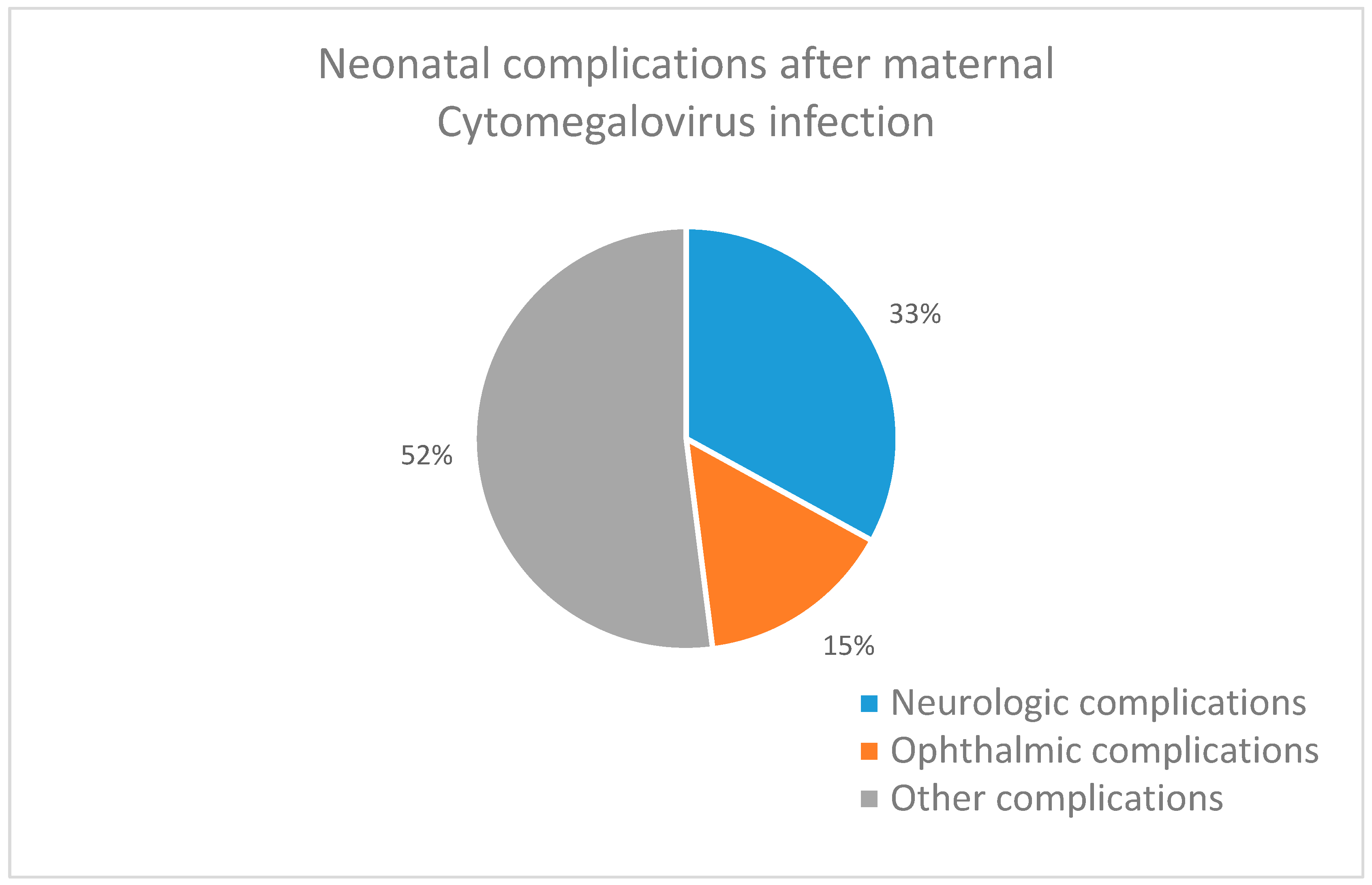
Based on the neonatological follow-up examinations in 116 deliveries, 18 newborns had complications (15.52%), and 33 types of complications were identified (28.45%).
Among the 11 neurological complications (9.48%), we found 1 case each (0.86%) of severe inoperable intracranial space occupation, hydrocephalus, balance disorder, sleep disorder–sleep apnea, and speech development disorder. Two cases (1.72%) were found to have rigid muscles, epilepsy, and hypotonic muscles. Ophthalmological complications occurred in five cases (4.31%): enophthalmos, cataract, and retinopathy of prematurity (ROP) in one case each, and two cases of strabismus. Other complications were detected in 17 cases (14.66%).
There was one case (0.86%) each of scoliosis, autoimmune disease, cardiomegaly, insufficient weight gain, cumulative food allergy, pneumonia, and chronic peritonitis. A higher proportion of 2 cases (1.72%) had icterus, multiple malformations, hyperinsulinemic hypoglycaemia, and pulmonary edema. Unfortunately, severe neonatal conditions resulted in postpartum exitus in two cases (1.72%).