Analysis of Specific IgG4 Antibody and sIgG4/sIgE Antibody Ratio as Marker of Immune Tolerance to IgE-Mediated Response in Allergic Children

Abstract
1. Introduction
2. Materials and Methods
2.1. Subjects
2.2. Methods
2.2.1. Laboratory Tests
2.2.2. Classification of Patient Groups by Symptom Presence
2.2.3. Study Design
2.3. Statistical Method
3. Results
3.1. Demographics and Clinical Characteristics of the Subjects
3.2. Association of Specific Antibodies (sIgE, sIgG4, and sIgG4/sIgE Ratio) with Clinical Symptoms by Allergen
3.3. ROC Curve of Specific Antibodies According to Allergen
3.3.1. Inhalant Allergens
3.3.2. Food Allergens
4. Discussion
Author Contributions
Funding
Institutional Review Board Statement
Informed Consent Statement
Data Availability Statement
Conflicts of Interest
Abbreviations
| sIgE | Specific IgE |
| sIgG4 | Specific IgG4 |
| D. farinae | Dermatophagoides farinae |
| ECP | Eosinophilic Cationic Protein |
| ROC | Receiver operating characteristic |
| AUC | Area Under the Curve |
| IL-10 | Interleukin-10 |
| OFC | Oral Food Challenge |
| PPV | Positive Predictive Value |
| NPV | Negative Predictive Value |
References
- Gabryszewski, S.J.; Dudley, J.; Shu, D.; Faerber, J.A.; Grundmeier, R.W.; Fiks, A.G.; Hill, D.A. Patterns in the Development of Pediatric Allergy. Pediatrics 2023, 152, e2022060531. [Google Scholar] [CrossRef]
- Sicherer, S.H.; Wood, R.A. Allergy testing in childhood: Using allergen-specific IgE tests. Pediatrics 2012, 129, 193–197. [Google Scholar] [CrossRef]
- Chang, M.L.; Cui, C.; Liu, Y.H.; Pei, L.C.; Shao, B. Analysis of total immunoglobulin E and specific immunoglobulin E of 3,721 patients with allergic disease. Biomed. Rep. 2015, 3, 573–577. [Google Scholar] [CrossRef]
- Heinzerling, L.; Mari, A.; Bergmann, K.-C.; Bresciani, M.; Burbach, G.; Darsow, U.; Durham, S.; Fokkens, W.; Gjomarkaj, M.; Haahtela, T. The skin prick test–European standards. Clin. Transl. Allergy 2013, 3, 3. [Google Scholar] [CrossRef]
- Boyce, J.A.; Assa’ad, A.; Burks, A.W.; Jones, S.M.; Sampson, H.A.; Wood, R.A.; Plaut, M.; Cooper, S.F.; Fenton, M.J.; Arshad, S.H. Guidelines for the diagnosis and management of food allergy in the United States: Summary of the NIAID-sponsored expert panel report. J. Pediatr. Nurs. 2011, 26, e2–e17. [Google Scholar] [CrossRef]
- Bernstein, I.L.; Li, J.T.; Bernstein, D.I.; Hamilton, R.; Spector, S.L.; Tan, R.; Sicherer, S.; Golden, D.B.; Khan, D.A.; Nicklas, R.A. Allergy diagnostic testing: An updated practice parameter. Ann. Allergy Asthma Immunol. 2008, 100, S1–S148. [Google Scholar] [CrossRef]
- Chung SangJin, C.S.; Han YoungShin, H.Y.; Chung SeungWon, C.S.; Ahn KangMo, A.K.; Park HwaYoung, P.H.; Lee SangIl, L.S.; Cho YoungYeun, C.Y.; Choi HyeMi, C.H. Marasmus and kwashiorkor by nutritional ignorance related to vegetarian diet and infants with atopic dermatitis in South Korea. Korean J. Nutr. 2004, 37, 540–549. [Google Scholar]
- Frati, F.; Incorvaia, C.; Cavaliere, C.; Di Cara, G.; Marcucci, F.; Esposito, S.; Masieri, S. The skin prick test. J. Biol. Regul. Homeost. Agents 2018, 32 (Suppl. S1), 19–24. [Google Scholar]
- Niggemann, B.; Beyer, K. Diagnosis of food allergy in children: Toward a standardization of food challenge. J. Pediatr. Gastroenterol. Nutr. 2007, 45, 399–404. [Google Scholar] [CrossRef]
- Fleischer, D.M.; Bock, S.A.; Spears, G.C.; Wilson, C.G.; Miyazawa, N.K.; Gleason, M.C.; Gyorkos, E.A.; Murphy, J.R.; Atkins, D.; Leung, D.Y. Oral food challenges in children with a diagnosis of food allergy. J. Pediatr. 2011, 158, 578–583. e571. [Google Scholar] [CrossRef]
- Stapel, S.O.; Asero, R.; Ballmer-Weber, B.; Knol, E.; Strobel, S.; Vieths, S.; Kleine-Tebbe, J. Testing for IgG4 against foods is not recommended as a diagnostic tool: EAACI Task Force Report. Allergy 2008, 63, 793–796. [Google Scholar] [CrossRef] [PubMed]
- Ito, K.; Futamura, M.; Movérare, R.; Tanaka, A.; Kawabe, T.; Sakamoto, T.; Borres, M.P. The usefulness of casein-specific IgE and IgG4 antibodies in cow’s milk allergic children. Clin. Mol. Allergy 2012, 10, 1. [Google Scholar] [CrossRef]
- Sicherer, S.H. Food allergy: When and how to perform oral food challenges. Pediatr. Allergy Immunol. 1999, 10, 226–234. [Google Scholar] [CrossRef]
- Smoldovskaya, O.; Feyzkhanova, G.; Voloshin, S.; Arefieva, A.; Chubarova, A.; Pavlushkina, L.; Filatova, T.; Antonova, E.; Timofeeva, E.; Butvilovskaya, V. Allergen-specific IgE and IgG4 patterns among patients with different allergic diseases. World Allergy Organ. J. 2018, 11, 35. [Google Scholar] [CrossRef]
- Caubet, J.C.; Bencharitiwong, R.; Moshier, E.; Godbold, J.H.; Sampson, H.A.; Nowak-Węgrzyn, A. Significance of ovomucoid-and ovalbumin-specific IgE/IgG4 ratios in egg allergy. J. Allergy Clin. Immunol. 2012, 129, 739–747. [Google Scholar] [CrossRef]
- Jones, S.M.; Pons, L.; Roberts, J.L.; Scurlock, A.M.; Perry, T.T.; Kulis, M.; Shreffler, W.G.; Steele, P.; Henry, K.A.; Adair, M. Clinical efficacy and immune regulation with peanut oral immunotherapy. J. Allergy Clin. Immunol. 2009, 124, 292–300.e297. [Google Scholar] [CrossRef]
- GEHLHAR; SCHLAAK; BECKER; BUFE. Monitoring allergen immunotherapy of pollen-allergic patients: The ratio of allergen-specific IgG4 to IgG1 correlates with clinical outcome. Clin. Exp. Allergy 1999, 29, 497–506. [Google Scholar] [CrossRef]
- Tomičić, S.; Norrman, G.; Fälth-Magnusson, K.; Jenmalm, M.C.; Devenney, I.; Böttcher, M.F. High levels of IgG4 antibodies to foods during infancy are associated with tolerance to corresponding foods later in life. Pediatr. Allergy Immunol. 2009, 20, 35–41. [Google Scholar] [CrossRef] [PubMed]
- Burnett, M.; Wegienka, G.; Havstad, S.; Kim, H.; Johnson, C.C.; Ownby, D.; Zoratti, E. Relationship of dog-and cat-specific IgE and IgG4 levels to allergic symptoms on pet exposure. J. Allergy Clin. Immunol. Pract. 2013, 1, 350–353. [Google Scholar] [CrossRef] [PubMed]
- Lim, J.H.; Jeong, K.U.; Lee, J.-M.; Lee, K.E.; Lee, S. Usefulness of casein specific IgE and IgG antibodies to immediate type cow’s milk allergy. Allergy Asthma Respir. Dis. 2015, 3, 139–144. [Google Scholar] [CrossRef][Green Version]
- Platts-Mills, T.; Vaughan, J.; Squillace, S.; Woodfolk, J.; Sporik, R. Sensitisation, asthma, and a modified Th2 response in children exposed to cat allergen: A population-based cross-sectional study. Lancet 2001, 357, 752–756. [Google Scholar] [CrossRef]
- Lemon-Mulé, H.; Sampson, H.A.; Sicherer, S.H.; Shreffler, W.G.; Noone, S.; Nowak-Wegrzyn, A. Immunologic changes in children with egg allergy ingesting extensively heated egg. J. Allergy Clin. Immunol. 2008, 122, 977–983.e971. [Google Scholar] [CrossRef]
- Juvonen, P.; Månsson, M.; Kjellman, N.I.M.; Björkstén, B.; Jakobsson, I. Development of immunoglobulin G and immunoglobulin E antibodies to cow’s milk proteins and ovalbumin after a temporary neonatal exposure to hydrolyzed and whole cow’s milk proteins. Pediatr. Allergy Immunol. 1999, 10, 191–198. [Google Scholar] [CrossRef]
- Till, S.J.; Francis, J.N.; Nouri-Aria, K.; Durham, S.R. Mechanisms of immunotherapy. J. Allergy Clin. Immunol. 2004, 113, 1025–1034. [Google Scholar] [CrossRef]
- Akdis, C.A.; Akdis, M. Mechanisms of allergen-specific immunotherapy. J. Allergy Clin. Immunol. 2011, 127, 18–27. [Google Scholar] [CrossRef] [PubMed]
- Qin, L.; Tang, L.-F.; Cheng, L.; Wang, H.-Y. The clinical significance of allergen-specific IgG4 in allergic diseases. Front. Immunol. 2022, 13, 1032909. [Google Scholar] [CrossRef]
- Ruiter, B.; Knol, E.; Van Neerven, R.; Garssen, J.; Bruijnzeel-Koomen, C.; Knulst, A.; Van Hoffen, E. Maintenance of tolerance to cow’s milk in atopic individuals is characterized by high levels of specific immunoglobulin G4. Clin. Exp. Allergy 2007, 37, 1103–1110. [Google Scholar] [CrossRef] [PubMed]
- García-Ara, C.; Boyano-Martínez, T.; Díaz-Pena, J.M.; Martín-Muñoz, F.; Reche-Frutos, M.; Martín-Esteban, M. Specific IgE levels in the diagnosis of immediate hypersensitivity to cows’ milk protein in the infant. J. Allergy Clin. Immunol. 2001, 107, 185–190. [Google Scholar] [CrossRef] [PubMed]
- Vazquez-Ortiz, M.; Pascal, M.; Jiménez-Feijoo, R.; Lozano, J.; Giner, M.; Alsina, L.; Martín-Mateos, M.; Plaza, A. Ovalbumin-specific IgE/IgG4 ratio might improve the prediction of cooked and uncooked egg tolerance development in egg-allergic children. Clin. Exp. Allergy 2014, 44, 579–588. [Google Scholar] [CrossRef]
- Okamoto, S.; Taniuchi, S.; Sudo, K.; Hatano, Y.; Nakano, K.; Shimo, T.; Kaneko, K. Predictive value of IgE/IgG 4 antibody ratio in children with egg allergy. Allergy Asthma Clin. Immunol. 2012, 8, 9. [Google Scholar] [CrossRef]
- Santos, A.F.; James, L.K.; Bahnson, H.T.; Shamji, M.H.; Couto-Francisco, N.C.; Islam, S.; Houghton, S.; Clark, A.T.; Stephens, A.; Turcanu, V. IgG4 inhibits peanut-induced basophil and mast cell activation in peanut-tolerant children sensitized to peanut major allergens. J. Allergy Clin. Immunol. 2015, 135, 1249–1256. [Google Scholar] [CrossRef] [PubMed]
- Flinterman, A.E.; Knol, E.F.; Lencer, D.A.; Bardina, L.; den Hartog Jager, C.F.; Lin, J.; Pasmans, S.G.; Bruijnzeel-Koomen, C.A.; Sampson, H.A.; van Hoffen, E. Peanut epitopes for IgE and IgG4 in peanut-sensitized children in relation to severity of peanut allergy. J. Allergy Clin. Immunol. 2008, 121, 737–743.e710. [Google Scholar] [CrossRef] [PubMed]
- Du Toit, G.; Levin, M.; Motala, C.; Perkin, M.; Stephens, A.; Turcanu, V.; Lack, G. Peanut allergy and peanut-specific IgG4 characteristics among Xhosa children in Cape Town. J. Allergy Clin. Immunol. 2007, 119, S196. [Google Scholar] [CrossRef]
- Datema, M.R.; Eller, E.; Zwinderman, A.H.; Poulsen, L.K.; Versteeg, S.A.; van Ree, R.; Bindslev-Jensen, C. Ratios of specific IgG4 over IgE antibodies do not improve prediction of peanut allergy nor of its severity compared to specific IgE alone. Clin. Exp. Allergy 2019, 49, 216–226. [Google Scholar] [CrossRef]
- Wilson, J.M.; Workman, L.; Schuyler, A.J.; Rifas-Shiman, S.L.; McGowan, E.C.; Oken, E.; Gold, D.R.; Hamilton, R.G.; Platts-Mills, T.A. Allergen sensitization in a birth cohort at midchildhood: Focus on food component IgE and IgG4 responses. J. Allergy Clin. Immunol. 2018, 141, 419–423.e415. [Google Scholar] [CrossRef]



| Characteristics | Result |
|---|---|
| Age (years) | 5.77 (2.67; 9.15) |
| Male:Female | 253:162 (1.56:1) |
| Diagnosed allergic diseases n (%) | |
| Asthma | 70 (16.9%) |
| Allergic rhinitis | 64 (15.4%) |
| Atopic dermatitis | 63 (15.2%) |
| Chronic urticaria | 79 (19.0%) |
| Food allergy | 44(10.6%) |
| Other (e.g., viral rash, allergic conjunctivitis, chronic cough, anaphylaxis) | 95(22.9%) |
| Variable | Results | No. (%) |
|---|---|---|
| Presence of symptoms among patients with allergen-specific IgE positivity | ||
| Dermatophagoides farina | 171:110 (64.3%) | |
| Dog dander | 96:36 (37.5%) | |
| Birch | 107:67 (62.6%) | |
| Egg white | 153:49 (32.0%) | |
| Peanut | 105:26 (24.8%) | |
| Casein | 65:16 (24.6%) | |
| Total eosinophil count (/mm3) | 260 (130; 480) | |
| Eosinophilia (>500) n (%) | 101 (24.3%) | |
| Total serum IgE (IU/mL) | 91.8 (27.0; 295.9) | |
| Elevated IgE (>200) n (%) | 138 (33.3%) | |
| ECP (µg/L) | 17.9 (9.7; 34.1) | |
| Symptomatic | Asymptomatic | p Value | |
|---|---|---|---|
| Dermatophagoides farinae (N) | 110 | 61 | |
| sIgG4 | 0.20 (0.10; 0.30) | 0.10 (0.10; 0.30) | 0.247 |
| sIgE | 28.30 (8.62; 72.50) | 5.87 (0.91; 27.00) | <0.003 |
| sIgG4/E ratio | 0.01 (0.00; 0.02) | 0.03 (0.01; 0.15) | <0.001 |
| Dog dander (N) | 36 | 60 | |
| sIgG4 | 2.25 (1.25; 4.20) | 2.15 (0.80; 4.55) | 0.883 |
| sIgE | 4.75 (1.36; 21.4) | 0.86 (0.49; 2.38) | <0.001 |
| sIgG4/E ratio | 0.40 (0.07; 1.21) | 1.62(0.39; 5.10) | <0.001 |
| Birch (N) | 67 | 40 | |
| sIgG4 | 0.40 (0.10; 1.30) | 0.40 (0.15; 1.20) | 0.951 |
| sIgE | 25.00 (2.29; 66.85) | 3.98 (0.77; 15.85) | <0.001 |
| sIgG4/E ratio | 0.03 (0.01; 0.10) | 0.15 (0.02; 0.47) | 0.003 |
| Casein (N) | 16 | 49 | |
| sIgG4 | 0.90 (0.35; 3.70) | 18.10 (7.90; 30.00) | <0.001 |
| sIgE | 4.60 (1.10; 21.15) | 0.63 (0.45; 1.42) | <0.001 |
| sIgG4/E ratio | 0.12 (0.02; 1.48) | 21.39 (7.38; 40.54) | <0.001 |
| Egg white (N) | 49 | 104 | |
| sIgG4 | 0.50 (0.10; 6.60) | 22.55 (12.00; 30.00) | <0.001 |
| sIgE | 5.13 (1.60; 16.50) | 0.91 (0.58; 1.56) | <0.001 |
| sIgG4/E ratio | 0.16 (0.02; 0.63) | 21.93 (7.71; 37.56) | <0.001 |
| Peanut (N) | 26 | 79 | |
| sIgG4 | 0.30 (0.10; 1.00) | 0.50 (0.10; 1.00) | 0.371 |
| sIgE | 6.00 (0.95; 9.68) | 1.41 (0.82; 3.79) | 0.029 |
| sIgG4/E ratio | 0.08 (0.02; 0.17) | 0.26 (0.05; 0.79) | 0.019 |
| Variable | Specific IgE (kU/L) | Specific IgG4 (kU/L) | Specific IgG4/E Ratio | ||||||
|---|---|---|---|---|---|---|---|---|---|
| D. farinae | Dog Dander | Birch | D. farinae | Dog Dander | Birch | D. farinae | Dog Dander | Birch | |
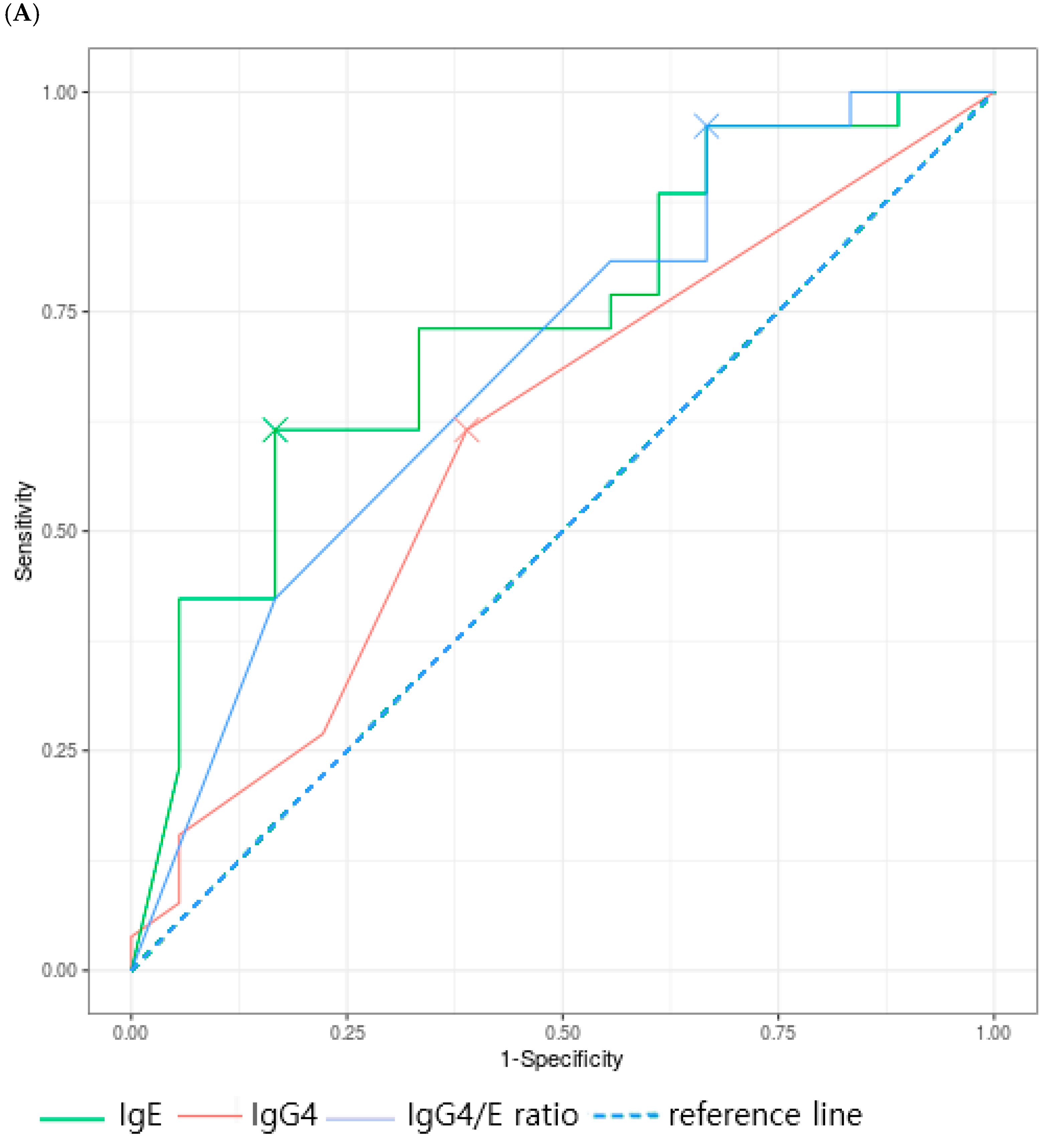
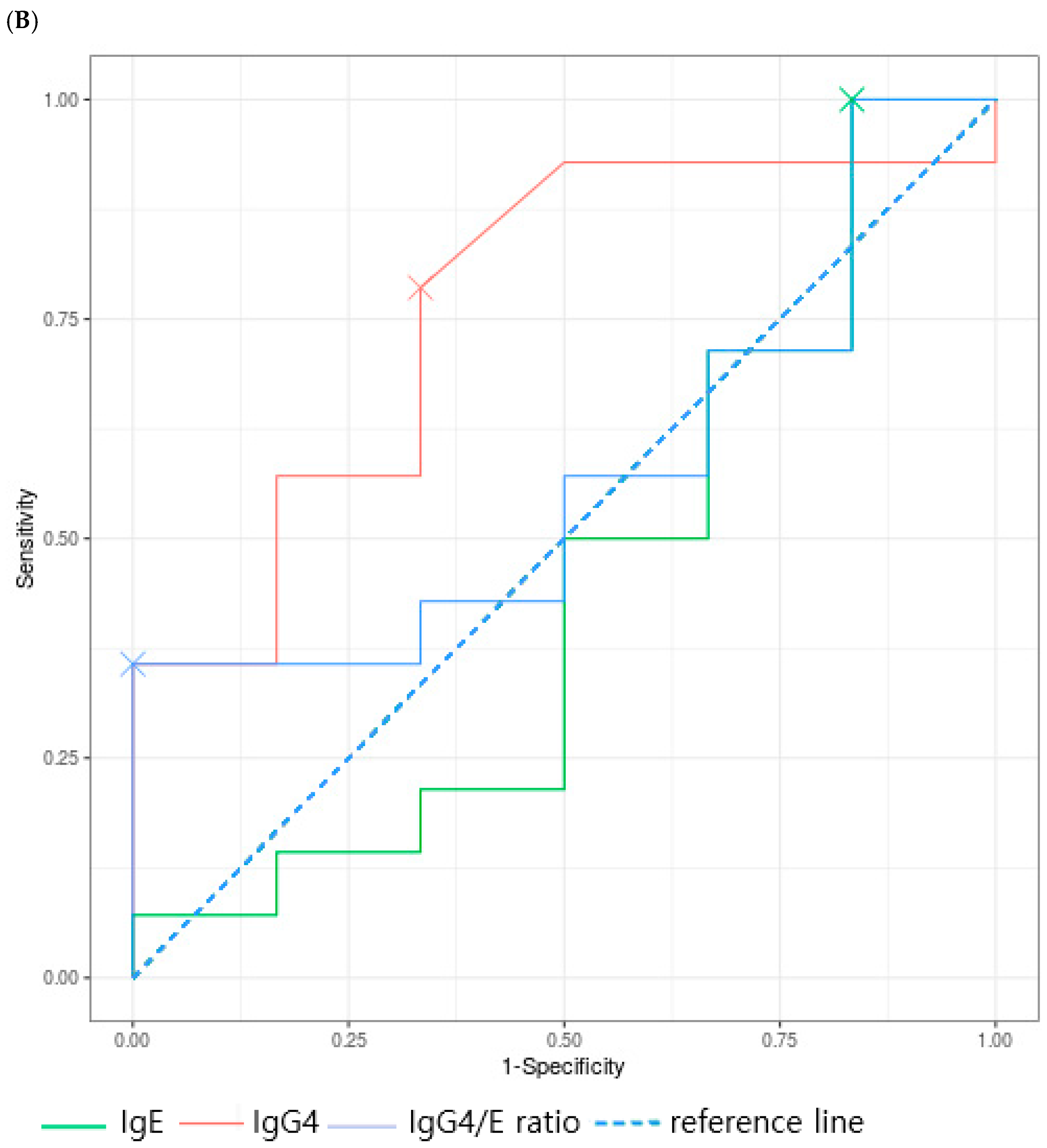
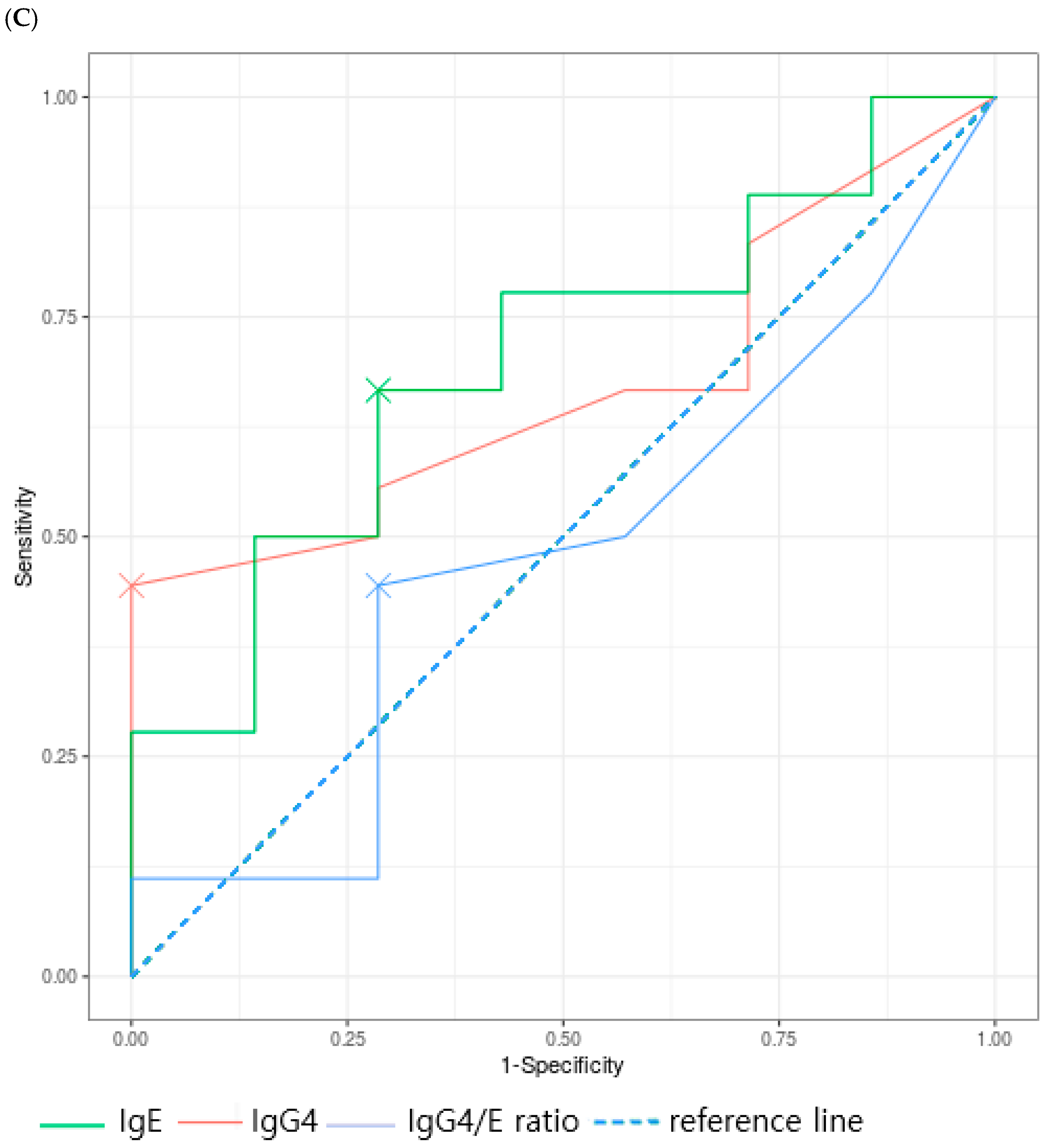
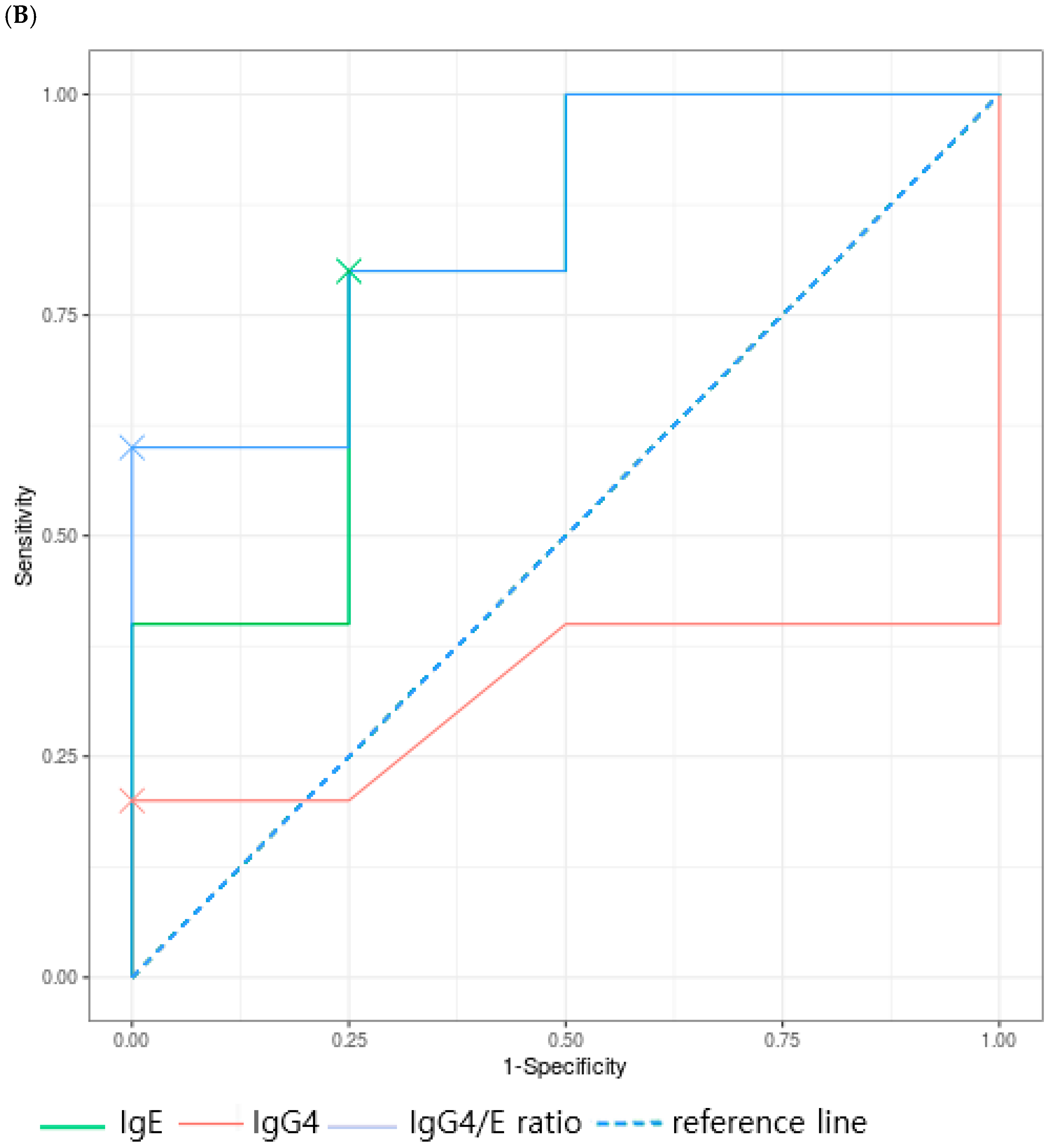
| Area under curve | 0.735 | 0.44 | 0.698 | 0.606 | 0.762 | 0.667 | 0.691 | 0.571 | 0.476 |
| 95% CI | 0.584–0.886 | 0.237–0.882 | 0.47–0.927 | 0.444–0.768 | 0.521–1 | 0.451–0.882 | 0.536–0.846 | 0.295–0.848 | 0.266–0.782 |
| p value | <0.001 | <0.001 | <0.001 | 0.2 | <0.001 | 0.564 | 0.009 | 0.628 | 0.006 |
| Cut off value | 27.7 | 0.6 | 31 | 0.2 | 3.8 | 0.8 | 0.06 | 0.04 | 0.03 |
| Sensitivity (%) | 61.5 | 100 | 66.7 | 61.5 | 78.6 | 44.4 | 96.2 | 35.7 | 44.4 |
| Specificity (%) | 83.3 | 16.7 | 71.4 | 61.1 | 66.7 | 100 | 33.3 | 100 | 71.4 |
| PPV (%) | 84.2 | 73.7 | 85.7 | 69.6 | 84.6 | 100 | 67.6 | 100 | 80.0 |
| NPV (%) | 60.0 | 100 | 45.5 | 52.4 | 57.1 | 41.2 | 85.7 | 40 | 33.3 |
| Variable | Specific IgE (kU/L) | Specific IgG4(kU/L) | Specific IgG4/E Ratio | ||||||
|---|---|---|---|---|---|---|---|---|---|
| Egg White | Peanut | Casein | Egg White | Peanut | Casein | Egg White | Peanut | Casein | |
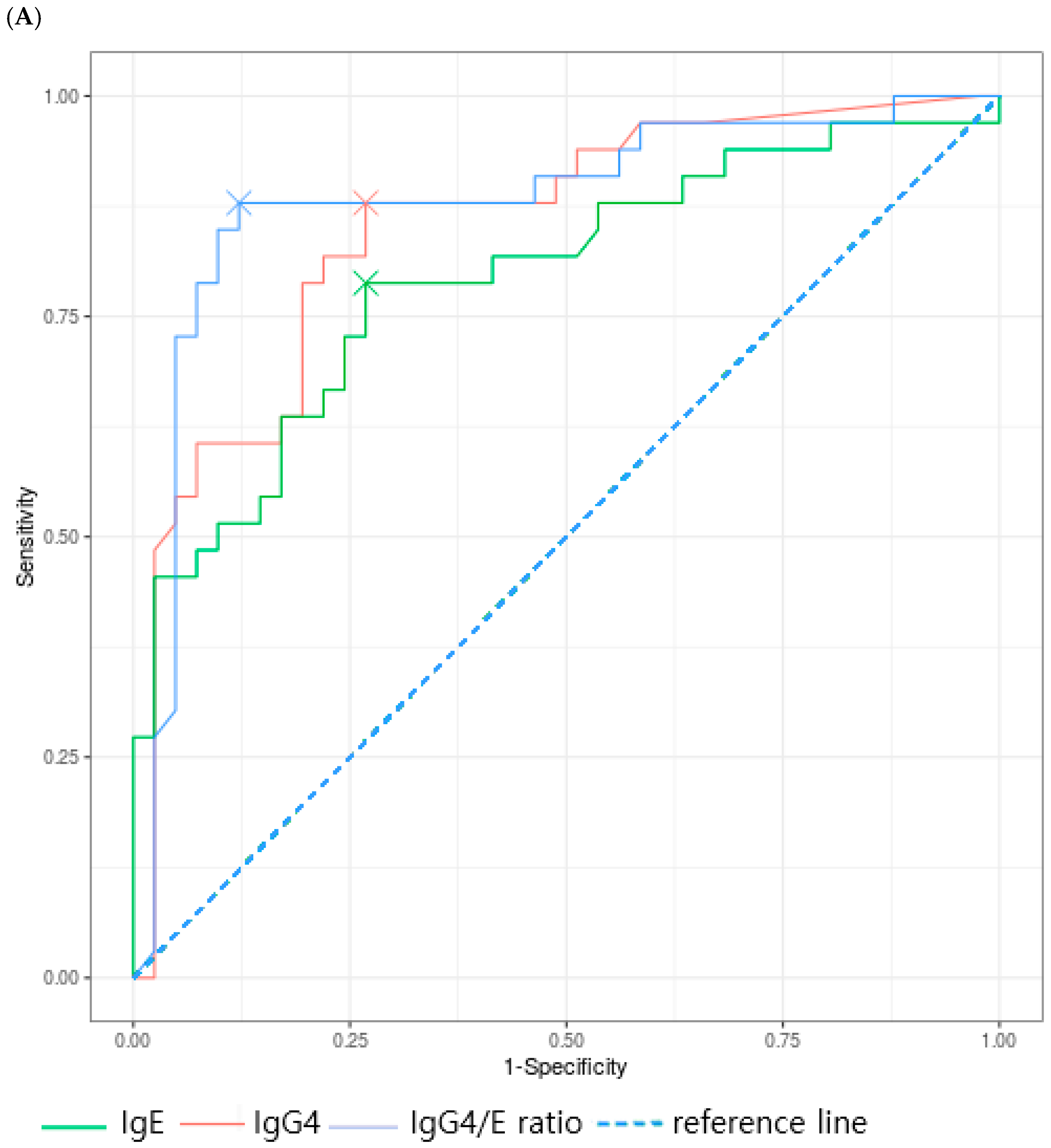
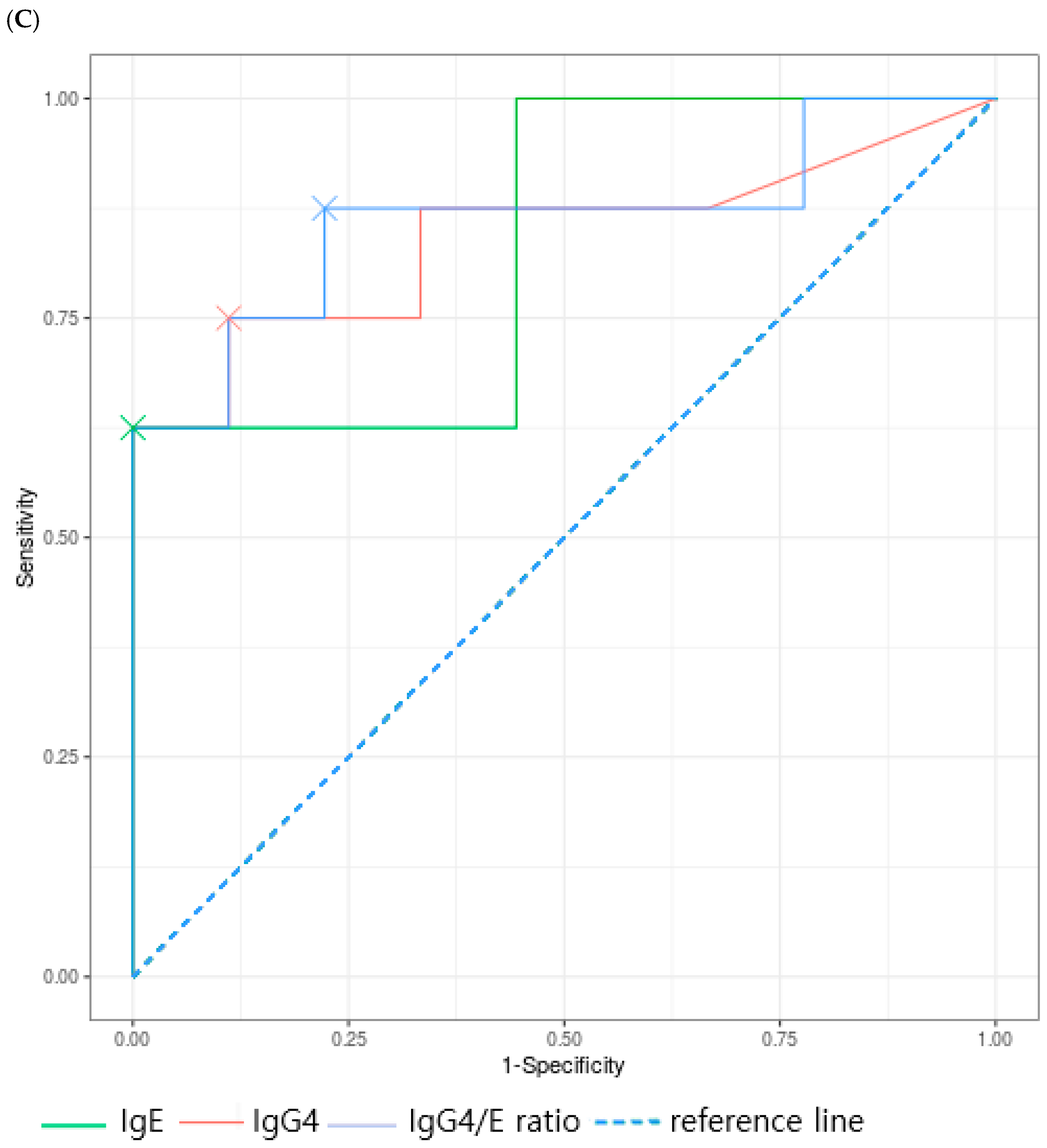
| Area under curve | 0.793 | 0.8 | 0.833 | 0.851 | 0.25 | 0.84 | 0.882 | 0.85 | 0.861 |
| 95% CI | 0.687–0.9 | 0.468–1 | 0.623–1 | 0.761–0.941 | 0.257–1 | 0.623–1 | 0.795–0.97 | 0.579–1 | 0.659–1 |
| p value | <0.001 | 0.002 | <0.001 | <0.001 | 1 | <0.001 | <0.001 | 0.928 | <0.001 |
| Cut off value | 1.45 | 6.71 | 6.47 | 15.2 | 3.1 | 2 | 4.1 | 0.01 | 4.34 |
| Sensitivity (%) | 78.8 | 80.0 | 62.5 | 87.9 | 20 | 75.0 | 87.9 | 60 | 87.5 |
| Specificity (%) | 73.2 | 75.0 | 100 | 73.2 | 100 | 88.9 | 87.8 | 100 | 77.8 |
| PPV (%) | 70.3 | 80.0 | 100 | 72.5 | 100 | 85.7 | 85.3 | 100 | 77.8 |
| NPV (%) | 81.1 | 75.0 | 75.0 | 88.2 | 50 | 80.0 | 90 | 66.7 | 87.5 |
| Cut off value | 1.45 | 6.71 | 6.47 | 15.2 | 3.1 | 2 | 4.1 | 0.01 | 4.34 |
Disclaimer/Publisher’s Note: The statements, opinions and data contained in all publications are solely those of the individual author(s) and contributor(s) and not of MDPI and/or the editor(s). MDPI and/or the editor(s) disclaim responsibility for any injury to people or property resulting from any ideas, methods, instructions or products referred to in the content. |
© 2025 by the authors. Licensee MDPI, Basel, Switzerland. This article is an open access article distributed under the terms and conditions of the Creative Commons Attribution (CC BY) license (https://creativecommons.org/licenses/by/4.0/).
Share and Cite
Kim, H.; Kang, B.; Choi, B.S. Analysis of Specific IgG4 Antibody and sIgG4/sIgE Antibody Ratio as Marker of Immune Tolerance to IgE-Mediated Response in Allergic Children. Children 2025, 12, 1679. https://doi.org/10.3390/children12121679
Kim H, Kang B, Choi BS. Analysis of Specific IgG4 Antibody and sIgG4/sIgE Antibody Ratio as Marker of Immune Tolerance to IgE-Mediated Response in Allergic Children. Children. 2025; 12(12):1679. https://doi.org/10.3390/children12121679
Chicago/Turabian StyleKim, HyeonA, Ben Kang, and Bong Seok Choi. 2025. "Analysis of Specific IgG4 Antibody and sIgG4/sIgE Antibody Ratio as Marker of Immune Tolerance to IgE-Mediated Response in Allergic Children" Children 12, no. 12: 1679. https://doi.org/10.3390/children12121679
APA StyleKim, H., Kang, B., & Choi, B. S. (2025). Analysis of Specific IgG4 Antibody and sIgG4/sIgE Antibody Ratio as Marker of Immune Tolerance to IgE-Mediated Response in Allergic Children. Children, 12(12), 1679. https://doi.org/10.3390/children12121679