Association Between Plant Food Consumption and Depressive Symptoms in Adolescents: A Systematic Review

 ,
,  ,
, 
Highlights
- Consumption of plant foods is negatively associated with symptoms of depression in adolescents.
- Greater consumption of phytochemical-rich foods was associated with nearly 50% lower odds of depression.
- The study underscores the importance of promoting fruit- and vegetable-rich diets not only for physical health, but also as a potentially modifiable factor in supporting psychological well-being during adolescence.
- Increased consumption of plant foods could be a modifiable factor for the prevention or improvement of symptoms of depression in adolescents.
Abstract
1. Introduction
2. Materials and Methods
2.1. Literature Search Strategy
2.2. Eligibility Criteria
2.3. Quality Assessment
2.4. Data Collection Process
2.5. Compliance with Ethics Guidelines
3. Results
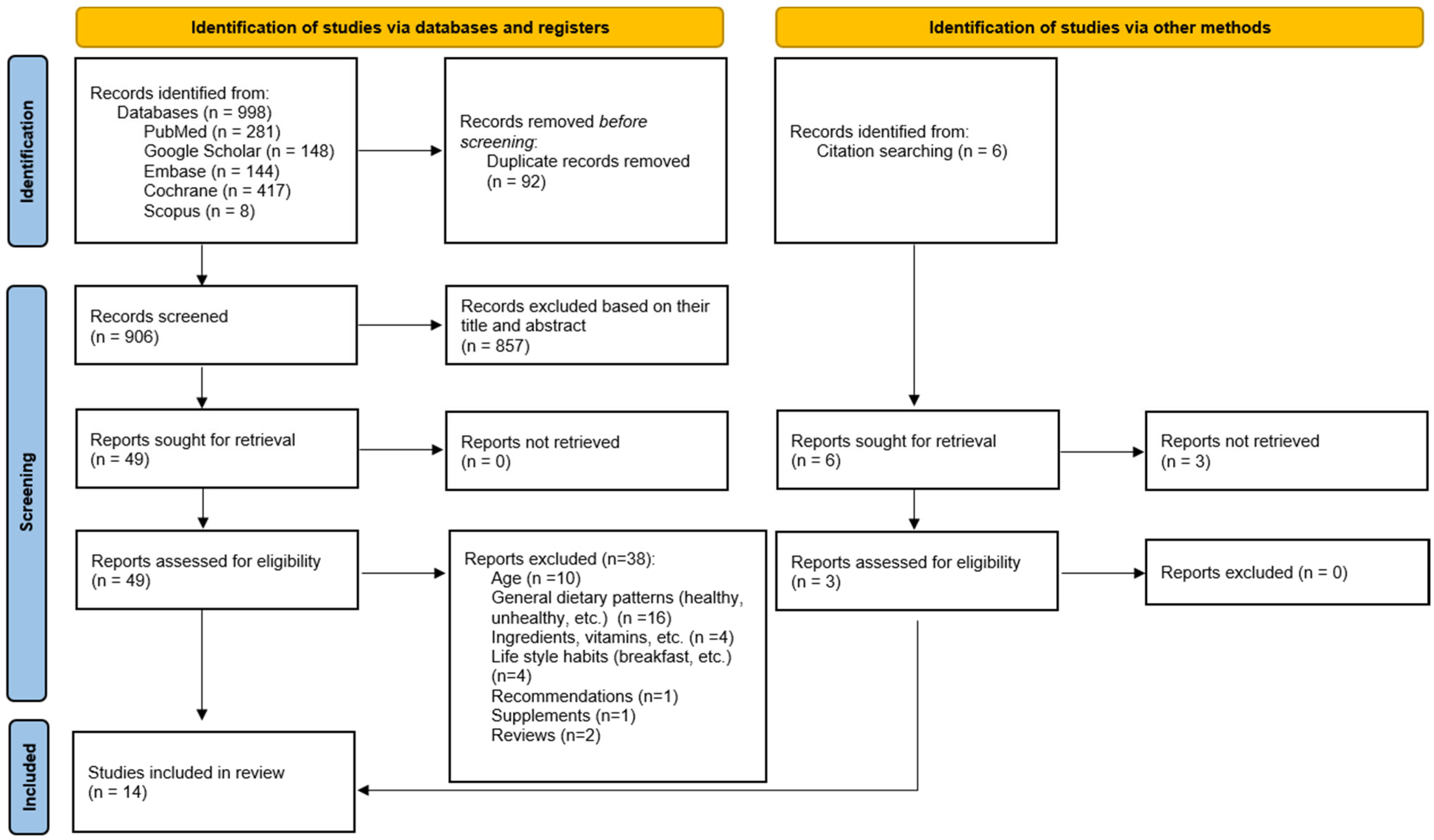
3.1. Eligible Studies
3.2. Characteristics of Eligible Studies and Population
3.3. Prospective Studies
3.4. Cross-Sectional Studies
3.4.1. Case–Control Study
3.4.2. Intervention Study
3.4.3. Quality Assessment of the Reviewed Studies
4. Discussion
5. Conclusions
Supplementary Materials
Author Contributions
Funding
Institutional Review Board Statement
Informed Consent Statement
Data Availability Statement
Conflicts of Interest
References
- World Health Organization. Mental Health Action Plan 2013–2020. 2013. Available online: https://www.who.int/publications/i/item/9789241506021 (accessed on 8 February 2025).
- World Health Organization. Guidelines on Mental Health Promotive and Preventive Interventions for Adolescents: Helping Adolescents Thrive; World Health Organization: Geneva, Switzerland, 2020; WHO Guidelines Approved by the Guidelines Review Committee. Available online: http://www.ncbi.nlm.nih.gov/books/NBK565375/ (accessed on 8 February 2025).
- UNICEF. Regional Brief: Europe on My Mind. The State of the World ’s Children 2021 Promoting, Protecting and Caring for Children’s Mental Health. 2021. Available online: https://www.unicef.org/media/108121/file/SOWC-2021-Europe-regional-brief.pdf (accessed on 8 February 2025).
- World Health Assembly 65. Global Burden of Mental Disorders and the Need for a Comprehensive, Coordinated Response from Health and Social Sectors at the Country Level: Report by the Secretariat. 2012. Available online: https://iris.who.int/handle/10665/78898 (accessed on 8 February 2025).
- World Health Organization. Depressive Disorder (Depression). 2023. Available online: https://www.who.int/news-room/fact-sheets/detail/depression (accessed on 8 February 2025).
- Jacka, F.N.; O’Neil, A.; Opie, R.; Itsiopoulos, C.; Cotton, S.; Mohebbi, M.; Castle, D.; Dash, S.; Mihalopoulos, C.; Chatterton, M.L.; et al. A randomised controlled trial of dietary improvement for adults with major depression (the “SMILES” trial). BMC Med. 2017, 15, 23. [Google Scholar] [CrossRef] [PubMed]
- Bremner, J.D.; Moazzami, K.; Wittbrodt, M.T.; Nye, J.A.; Lima, B.B.; Gillespie, C.F.; Rapaport, M.H.; Pearce, B.D.; Shah, A.J.; Vaccarino, V. Diet, Stress and Mental Health. Nutrients 2020, 12, 2428. [Google Scholar] [CrossRef]
- Axelsdóttir, B.; Biedilæ, S.; Sagatun, Å.; Nordheim, L.V.; Larun, L. Review: Exercise for depression in children and adolescents—A systematic review and meta-analysis. Child. Adolesc. Ment. Health 2021, 26, 347–356. [Google Scholar] [CrossRef]
- Matison, A.P.; Mather, K.A.; Flood, V.M.; Reppermund, S. Associations between nutrition and the incidence of depression in middle-aged and older adults: A systematic review and meta-analysis of prospective observational population-based studies. Ageing Res. Rev. 2021, 70, 101403. [Google Scholar] [CrossRef]
- Głąbska, D.; Guzek, D.; Groele, B.; Gutkowska, K. Fruit and vegetables intake in adolescents and mental health: A systematic review. Rocz. Panstw. Zakl. Hig. 2020, 71, 15–25. [Google Scholar] [CrossRef]
- Głąbska, D.; Guzek, D.; Groele, B.; Gutkowska, K. Fruit and Vegetable Intake and Mental Health in Adults: A Systematic Review. Nutrients 2020, 12, 115. [Google Scholar] [CrossRef] [PubMed]
- Jacka, F.N. Nutritional Psychiatry: Where to Next? eBioMedicine 2017, 17, 24–29. [Google Scholar] [CrossRef]
- Adan, R.A.H.; van der Beek, E.M.; Buitelaar, J.K.; Cryan, J.F.; Hebebrand, J.; Higgs, S.; Schellekens, H.; Dickson, S.L. Nutritional psychiatry: Towards improving mental health by what you eat. Eur. Neuropsychopharmacol. 2019, 29, 1321–1332. [Google Scholar] [CrossRef]
- Lai, J.S.; Hiles, S.; Bisquera, A.; Hure, A.J.; McEvoy, M.; Attia, J. A systematic review and meta-analysis of dietary patterns and depression in community-dwelling adults. Am. J. Clin. Nutr. 2014, 99, 181–197. [Google Scholar] [CrossRef]
- Saghafian, F.; Malmir, H.; Saneei, P.; Milajerdi, A.; Larijani, B.; Esmaillzadeh, A. Fruit and vegetable consumption and risk of depression: Accumulative evidence from an updated systematic review and meta-analysis of epidemiological studies. Br. J. Nutr. 2018, 19, 1087–1101. [Google Scholar] [CrossRef] [PubMed]
- Tuck, N.J.; Farrow, C.; Thomas, J.M. Assessing the effects of vegetable consumption on the psychological health of healthy adults: A systematic review of prospective research. Am. J. Clin. Nutr. 2019, 110, 196–211. [Google Scholar] [CrossRef]
- Dharmayani, P.N.A.; Juergens, M.; Allman-Farinelli, M.; Mihrshahi, S. Association between Fruit and Vegetable Consumption and Depression Symptoms in Young People and Adults Aged 15–45: A Systematic Review of Cohort Studies. Int. J. Environ. Res. Public Health 2021, 18, 780. [Google Scholar] [CrossRef]
- Ventriglio, A.; Sancassiani, F.; Contu, M.P.; Latorre, M.; Di Salvatore, M.; Fornaro, M.; Bhugra, D. Mediterranean Diet and its Benefits on Health and Mental Health: A Literature Review. Clin. Pract. Epidemiol. Ment. Health 2020, 16 (Suppl. S1), 156–164. [Google Scholar] [CrossRef] [PubMed]
- O’Neil, A.; Quirk, S.E.; Housden, S.; Brennan, S.L.; Williams, L.J.; Pasco, J.A.; Berk, M.; Jacka, F.N. Relationship between diet and mental health in children and adolescents: A systematic review. Am. J. Public Health 2014, 104, e31–e42. [Google Scholar] [CrossRef] [PubMed]
- Khanna, P.; Chattu, V.K.; Aeri, B.T. Nutritional Aspects of Depression in Adolescents—A Systematic Review. Int. J. Prev. Med. 2019, 10, 42. [Google Scholar] [CrossRef] [PubMed]
- Page, M.J.; McKenzie, J.E.; Bossuyt, P.M.; Boutron, I.; Hoffmann, T.C.; Mulrow, C.D.; Shamseer, L.; Tetzlaff, J.M.; Akl, E.A.; Brennan, S.E.; et al. The PRISMA 2020 statement: An updated guideline for reporting systematic reviews. Syst. Rev. 2021, 10, 81. [Google Scholar] [CrossRef]
- Winpenny, E.M.; van Harmelen, A.L.; White, M.; van Sluijs, E.M.; Goodyer, I.M. Diet quality and depressive symptoms in adolescence: No cross-sectional or prospective associations following adjustment for covariates. Public Health Nutr. 2018, 21, 2376–2384. [Google Scholar] [CrossRef]
- Swann, O.G.; Breslin, M.; Kilpatrick, M.; O’Sullivan, T.A.; Mori, T.A.; Beilin, L.J.; Lin, A.; Oddy, W.H. Dietary fibre intake and its associations with depressive symptoms in a prospective adolescent cohort. Br. J. Nutr. 2021, 125, 1166–1176. [Google Scholar] [CrossRef]
- Yim, H.R.; Yun, H.J.; Lee, J.H. An Investigation on Korean Adolescents’ Dietary Consumption: Focused on Sociodemographic Characteristics, Physical Health, and Mental Health. Int. J. Environ. Res. Public Health 2021, 18, 9773. [Google Scholar] [CrossRef]
- Hong, S.A.; Peltzer, K. Dietary behaviour, psychological well-being and mental distress among adolescents in Korea. Child. Adolesc. Psychiatry Ment. Health 2017, 11, 56. [Google Scholar] [CrossRef]
- Tanaka, M.; Hashimoto, K. Impact of consuming green and yellow vegetables on the depressive symptoms of junior and senior high school students in Japan. PLoS ONE 2019, 14, e0211323. [Google Scholar] [CrossRef] [PubMed]
- Lv, J.; Guo, X.; Meng, C.; Fei, J.; Ren, H.; Zhang, Y.; Qin, Z.; Hu, Y.; Yuan, T.; Liang, L.; et al. The cross-sectional study of depressive symptoms and associated factors among adolescents by backpropagation neural network. Public Health 2022, 208, 52–58. [Google Scholar] [CrossRef] [PubMed]
- Smout, S.; Gardner, L.A.; Newton, N.; Champion, K.E. Dose-response associations between modifiable lifestyle behaviours and anxiety, depression and psychological distress symptoms in early adolescence. Aust. N. Z. J. Public Health 2023, 47, 100010. [Google Scholar] [CrossRef]
- Kleppang, A.L.; Haugland, S.H.; Bakken, A.; Stea, T.H. Lifestyle habits and depressive symptoms in Norwegian adolescents: A national cross-sectional study. BMC Public Health 2021, 21, 816. [Google Scholar] [CrossRef]
- Liang, K.; Chen, S.; Chi, X. Care Their Diet and Mind: Association between Eating Habits and Mental Health in Chinese Left-behind Children. Nutrients 2022, 14, 524. [Google Scholar] [CrossRef]
- Khayyatzadeh, S.S.; Omranzadeh, A.; Miri-Moghaddam, M.M.; Arekhi, S.; Naseri, A.; Ziaee, A.; Khajavi, L.; Nejati Salehkhani, F.; Ferns, G.A.; Ghayour-Mobarhan, M. Dietary antioxidants and fibre intake and depressive symptoms in Iranian adolescent girls. Public Health Nutr. 2021, 24, 5650–5656. [Google Scholar] [CrossRef]
- Sangouni, A.A.; Vasmehjani, A.A.; Ghayour-Mobarhan, M.; Ferns, G.A.; Khayyatzadeh, S.S. The association between dietary phytochemical index with depression and quality of life in Iranian adolescent girls. Biopsychosoc. Med. 2022, 16, 5. [Google Scholar] [CrossRef]
- Park, S.; Rim, S.J.; Lee, J.H. Associations between dietary behaviours and perceived physical and mental health status among Korean adolescents. Nutr. Diet. 2018, 75, 488–493. [Google Scholar] [CrossRef]
- Kim, T.H.; Choi Jyoung Lee, H.H.; Park, Y. Associations between Dietary Pattern and Depression in Korean Adolescent Girls. J. Pediatr. Adolesc. Gynecol. 2015, 28, 533–537. [Google Scholar] [CrossRef]
- Fisk, J.; Khalid, S.; Reynolds, S.A.; Williams, C.M. Effect of 4 weeks daily wild blueberry supplementation on symptoms of depression in adolescents. Br. J. Nutr. 2020, 124, 181–188. [Google Scholar] [CrossRef] [PubMed]
- Liu, M.W.; Chen, Q.T.; Towne SDJr Zhang, J.; Yu, H.J.; Tang, R.; Gasevic, D.; Wang, P.G.; He, Q.Q. Fruit and vegetable intake in relation to depressive and anxiety symptoms among adolescents in 25 low- and middle-income countries. J. Affect Disord. 2020, 261, 172–180. [Google Scholar] [CrossRef] [PubMed]
- Yang, M.; Cai, C.; Yang, Z.; Wang, X.; Li, G.; Li, J.; Liu, J.; Zhang, Z. Effect of dietary fibre on cognitive function and mental health in children and adolescents: A systematic review and meta-analysis. Food Funct. 2024, 15, 8618–8628. [Google Scholar] [CrossRef]
- Figueiredo Godoy, A.C.; Frota, F.F.; Araújo, L.P.; Valenti, V.E.; Pereira, E.D.S.B.M.; Detregiachi, C.R.P.; Galhardi, C.M.; Caracio, F.C.; Haber, R.S.A.; Fornari Laurindo, L.; et al. Neuroinflammation and Natural Antidepressants: Balancing Fire with Flora. Biomedicines 2025, 13, 1129. [Google Scholar] [CrossRef]
- Borrego-Ruiz, A.; Borrego, J.J. Plant-Derived Nutraceuticals in Mental Health and Brain Function: Mechanisms of Action and Therapeutic Potential. Int. J. Mol. Sci. 2025, 26, 8849. [Google Scholar] [CrossRef]
- Fiore, M.; Terracina, S.; Ferraguti, G. Brain Neurotrophins and Plant Polyphenols: A Powerful Connection. Molecules 2025, 30, 2657. [Google Scholar] [CrossRef] [PubMed]
- Agh, F.; Hasani, M.; Khazdouz, M.; Amiri, F.; Heshmati, J.; Aryaeian, N. The Effect of Zinc Supplementation on Circulating Levels of Brain-Derived Neurotrophic Factor (BDNF): A Systematic Review and Meta-Analysis of Randomized Controlled Trials. Int. J. Prev. Med. 2022, 13, 117. [Google Scholar] [CrossRef]
- Punde, S.; Mandade, R.J.; Behere, S. Mitochondria-Targeted Nutraceuticals in Depression: Linking Energy Metabolism and Mood. Int. J. Pharm. Sci. 2025, 3, 2073–2091. [Google Scholar] [CrossRef]
- Lu, P.M. Potential Benefits of Specific Nutrients in the Management of Depression and Anxiety Disorders. AMR 2024, 3, 1–10. [Google Scholar] [CrossRef]
- Santhiravel, S.; Bekhit, A.E.-D.A.; Mendis, E.; Jacobs, J.L.; Dunshea, F.R.; Rajapakse, N.; Ponnampalam, E.N. The Impact of Plant Phytochemicals on the Gut Microbiota of Humans for a Balanced Life. Int. J. Mol. Sci. 2022, 23, 8124. [Google Scholar] [CrossRef]
- Dabravolskaj, J.; Marozoff, S.; Maximova, K.; Campbell, S.; Veugelers, P.J. Relationship Between Fruit and Vegetables Intake and Common Mental Disorders in Youth: A Systematic Review. Public Health Rev. 2022, 43, 1604686. [Google Scholar] [CrossRef] [PubMed]
- Jain, R.; Larsuphrom, P.; Degremont, A.; Latunde-Dada, G.O.; Philippou, E. Association between vegetarian and vegan diets and depression: A systematic review. Nut. Bull. 2022, 47, 27–49. [Google Scholar] [CrossRef] [PubMed]
- O’Reilly, M.; Svirydzenka, N.; Adams, S.; Dogra, N. Review of mental health promotion interventions in schools. Soc. Psychiatry Psychiatr. Epidemiol. 2018, 53, 647–662. [Google Scholar] [CrossRef] [PubMed]
- Sotiraki, M.; Malliou, A.; Tachirai, N.; Kellari, N.; Grammatikopoulou, M.G.; Sergentanis, T.N.; Vassilakou, T. Burden of Childhood Malnutrition: A Roadmap of Global and European Policies Promoting Healthy Nutrition for Infants and Young Children. Children 2022, 9, 1179. [Google Scholar] [CrossRef] [PubMed]


| Search string (fruit* OR vegetable* OR ‘whole grain*’ OR ‘dietary fiber*’ OR ‘plant foods’ OR legumes OR diet OR nutrition OR seeds OR antioxidants OR ‘olive oil’ OR ‘plant oils’ OR ‘seed oils’ OR nuts) AND depression AND adolescents. |
| Participants | Intervention | Comparison | Outcomes | Study Design |
|---|---|---|---|---|
| Adolescents 10–19 years old | Consumption of plant foods (fruits, vegetables, whole grains, legumes, olive oil, vegetable oils, nuts and seeds) | High consumption of plant foods compared to low or no consumption of plant foods | Depression/symptoms of depression | Primary studies (cross-sectional studies, prospective cohort studies, intervention studies, patient-control studies) |
| Inclusion Criteria |
|
| Exclusion Criteria |
|
| Study, Country | Type of Study | Sample Size | Age | Exposure Assessment | Impact Measurement | Confounders | Key Findings | |
|---|---|---|---|---|---|---|---|---|
| 1 | Winpenny et al., 2018 [22], United Kingdom | Prospective | N = 603 (40.0% boys) | Mean age = 14.5 (SD = 0.3) years old and 17.5 (SD = 4.1) years old | Dietary diary for 4 days (2 weekdays and 2 weekend days) | Moods and Feelings Questionnaire (MFQ) | Adjustment for sociodemographic (age, sex, socioeconomic status SES), BMI, behavioral factors (smoking, alcohol, physical activity, sleep), psychosocial factors (friendship quality, self-esteem, family functioning), medication use, energy intake | No prospective associations were found between fruit and vegetable intake and later depression score (β = 0.14, 95% CI −0.15, 0.43). At age 14 a negative cross- sectional association between fruit and vegetable intake and depressive symptoms was found (β = −0.35, 95% CI = −0.65, −0.05) but after adjusting for behavioral covariates, the association was no longer significant |
| 2 | Swann et al., 2021 [23], Australia | Prospective | N = 1913 | 14 years old and 17 years old | Food Frequency Questionnaire Commonwealth Scientific and Industrial Research Organization (CSIRO) | Beck Depression Inventory for Youth (BDI-Y). | Adjustment for age, sex, energy intake, dietary misreporting, adiposity, family factors (parental education, income, history of mental health, functioning), lifestyle factors (binge drinking, leisure time, physical activity), dietary patterns (healthy and Western), inflammation. | The odds of moderate/high symptoms of depression were lower in the quartile with the highest fiber intake compared to the quartile with the lowest intake (OR 0.273; 95% CI 0.09, 0.81). |
| 3 | Yim et al., 2021 [24], North Korea | Cross-sectional | N = 187,622 (51.5% boys) | 12–18 years old | Food Frequency Questionnaire | Questionnaire of Experiences with depression and suicide attempts | No confounding factors were examined. | Negative correlation between depression and consumption of vegetables (OR = 0.932, 95% CI = 0.884–0.982, p-value 0.001) and fruits (OR = 0.984, 95% CI = 0.948–1.021, p-value 0.391) |
| 4 | Hong and Pletzer, 2017 [25], North Korea | Cross-sectional | N = 65,212 (51.8% boys) | 12–18 years old (Mean = 15.1, SD = 0.02) | Questionnaire assessing eating behaviors | Questionnaire for evaluation of depression, anxiety (last 12 months), health, happiness and sleep | Adjustment for sociodemographic factors (age, gender, socioeconomic status (SES), geolocality, school level), physical activity, substances’ use (alcohol, tobacco) | Negative correlation between depressive symptoms and consumption of - fruits, twice a day vs. eating no fruits (OR = 0.86, 95% CI, 0.78, 0.94) - vegetables, twice a day vs. eating no fruits (OR = 0.78, 95% CI, 0.70, 0.86) |
| 5 | Tanaka and Hashimoto, 2019 [26], Japan | Cross-sectional | N = 858 (45.3% boys) | Mean age = 15.49 years old (SD = 1.78) | Food Frequency Questionnaire (FFQ) | Depression Scale (CES-D) of Center for Epidemiological Studies | Control for age, sex, sleep duration | Significant negative correlations between regular green and yellow vegetable consumption and symptoms of depression in both middle school and high school students (r = −0.15, 95% CI: −0.24, −0.06, p < 0.01, r = −0.11, 95% CI: −0.21, −0.02, p < 0.05, respectively). Adolescents who consumed green and yellow vegetables every day had significantly fewer symptoms of depression than those who ate them never or 1–2 times a week (F (2, 853) = 4.82, p < 0.01). |
| 6 | Lv et al., 2022 [27], China | Cross-sectional | Ν = 6251 (47.2% boys) | 11–19 years old (Μean = 14.7, SD = 1.74) | Food Frequency Questionnaire | Depression Scale of Center for Epidemiologic Research | No confounding factors were examined. | Negative correlation between fresh fruit and vegetable consumption and symptoms of depression (p < 0.001, χ2/t = 71.527, p < 0.001, χ2/t = 50.598) |
| 7 | Smout et al., 2023 [28], Australia | Cross-sectional | N = 6185 (49.3% boys) | Mean age = 12.7 years old (SD = 0.5) | Student Physical Activity and Nutrition Survey (SPANS) Questionnaire | Depression-Patient Health Questionnaire for Adolescents Scale (PHQ-A) Stress—scale PROMIS Anxiety Pediatric (PROMIS-AP) | Adjustment for age, gender, linguistic diversity (CALD) status and relative family affluence and clustering at the school level | Higher fruit and vegetable consumption correlated to less depression symptoms (F7.5548 = 13.31, p < 0.001 for fruits and F7.5597 = 10.72, p < 0.001 for vegetables). The lowest mean symptom scores were observed in participants who consumed - three servings of fruit in a typical day, average depression symptom score 37% lower (ΔMscore: 2.5, 95% CI: 1.9–3.2) than those who consumed less than one serving of fruit in a typical day - two servings of vegetables in a typical day, average depression symptom score 34% lower (ΔMscore: 2.3, 95% CI: 1.6–3.1) than those who consumed less than one serving of vegetables in a typical day |
| 8 | Kleppang et al., 2021 [29], Norway | Cross-sectional | Ν = 244,250 (47.8% boys) | 13–19 years old | Questionnaire assessing Nutrition, Physical Activity, Social Media Use, PC/Tablet/Mobile Gaming, Alcohol and Tobacco Use | Hopkins Symptom Checklist 90 Questionnaire/Scale (past week) | Adjustment for age, perceived family economy, parental higher education) | Negative correlation between depressive symptoms and consumption of - fruit every day or more: OR = 0.92, 95% CI = 0.88–0.96, p < 0.001 (girls) - whole grain bread: OR = 0.89, 95% CI = 0.85–0.92, p < 0.001 (girls) OR = 0.91, 95% CI = 0.87–0.96, p < 0.001 (boys) Positive correlation between depressive symptoms and consumption of vegetables every day or more: OR = 1.09, 95% CI = 1.05–1.14, p < 0.001, (girls) OR = 1.11, 95% CI = 1.04–1.17, p < 0.01 (boys) |
| 9 | Liang et al., 2022 [30], China | Cross-sectional | N = 3314 (43.9% boys) | 12–17 years old (Mean boys = 14.21, SD = 0.96, girls = 14.14, SD = 0.94) | Questionnaire -Subscale of the Chinese version of the Health Promoting Lifestyle Profile-II (HPLP-II) | Patient Health Questionnaire-9 (PHQ-9)—Depression Scale, Insomnia Scale, YSIS Generalized Anxiety Disorder Scale-7 (GAD-7) | Analyses were stratified by sex. Adjustment for age, grade, sibling status, parental education, family structure and income) | The frequency of eating fruits was significantly inversely correlated to the severity of depression in females: - Never eating fruits: RR = 1.34, 95% CI = 1.12–1.62, p = 0.002 - Sometimes eating fruits: RR = 1.18, 95% CI = 1.01–1.37, p = 0.033 The correlation of eating vegetables and depression severity was not significant in both sexes. |
| 10 | Khayyatzadeh et al., 2021 [31], Iran | Cross-sectional | N = 988 girls | 12–18 years old (Mean = 14.5, SD = 1.54) | Food Frequency Questionnaire (FFQ) for assessment of dietary intake. Energy and nutrient intake was estimated using Nutritionist IV software | Beck Depression Inventory (last 2 weeks) | Adjusted for age, energy intake, menstruation, family members, parental death, parental divorce, BMI, physical activity | Subjects with no or minimal symptoms of depression had significantly higher dietary intakes of α-carotene (p = 0.01), β-carotene (p = 0.006), lutein (p = 0.03), vitamin C (p = 0.04) and dietary fibers (p < 0.001) compared to subjects with mild or severe symptoms of depression. OR (95% CI) of depressive symptoms for the highest v. lowest quartile of nutrient intakes were as follows: - 0.61 (95% CI 0.37, 1.01) for vitamin C - 0.42 (95% CI 0.26, 0.69) for β-carotene - 0.50 (95% CI 0.31, 0.79) for α-carotene - 0.71 (95% CI 0.44, 1.15) for lutein - 0.51 (95% CI 0.32, 0.82) for soluble dietary fiber - 0.42 (95% CI 0.25, 0.68) for insoluble dietary fiber |
| 11 | Sangouni et al., 2022 [32], Iran | Cross-sectional | N = 733 girls | 12–18 years old Mean age = 14.5 years old | Food Frequency Questionnaire (FFQ), Dietary phytochemical index (DPI) score | Beck Depression Inventory (BDI) Quality of Life (SF-12v2) | Adjustment for age, energy intake, BMI, parental divorce or death, physical activity | Higher dietary phytochemical index (DPI) score correlated to 50% lower odds of depression compared to lower score (OR: 0.50; 95% CI: 0.30–0.84, p = 0.009) |
| 12 | Park et al., 2018 [33], North Korea | Cross-sectional | N = 65,529 (51.6% boys) | 12–18 years old | KYRBS-2016 Questionnaire (Korean Youth Risk Behavior Survey) | Questionnaire for physical and mental health variables | Adjustment for sex, school grade, residency, socioeconomic status (SES), other dietary behaviors | Fruits >= 1 times/day had no significant effect on depressive mood (OR = 1.03, 95% CI 0.99–1.08); however, there was a positive significant association with perceived general health (OR = 1.10), perceived happiness (OR = 1.17), and perceived sleep satisfaction (OR = 1.13). Vegetables >= 3 times/day had no significant effect on depressive mood (OR = 1.01, 95% CI 0.97–1.06); however, there was a positive significant association with perceived general health (OR = 1.29), perceived happiness (OR = 1.23), and perceived sleep satisfaction (OR = 1.16) and stress (OR = 1.01) |
| 13 | Kim et al., 2015 [34], North Korea | Case–control | N = 849 girls | 12–18 years old Μean age = 15.0 (SD = 1.5) years old | Food Frequency Questionnaire (FFQ) published by the Korean Health and Nutrition Examination Survey | The Korean version of the Beck Depression Inventory (K-BDI) | Adjustment for energy intake, menstrual regularity | Negative correlation between risk of depression and: - Three servings of green vegetables consumption [p = 0.049, OR (95% CI) = 0.61(0.35–1.04)] - One to three servings of fruit per day [p = 0.205, OR (95% CI) = 0.56(0.34–0.94), two servings, OR (95% CI) = 0.63(0.37–1.06), three servings] |
| 14 | Fisk et al., 2020 [35], United Kingdom | Interventional | N = 64 (45.3% boys) | 12–17 years old Mean age = 14.2 (SD = 1.71) | Intervention group: daily supplement of wild blueberry powder in drink for 4 weeks, Control group: placebo fruit drink | Mood and Feelings Questionnaire (MFQ) and Revised Children’s Anxiety and Depression Scale | No confounding factors were examined. | Following the intervention period, there were significantly fewer reported symptoms of depression in participants who received a wild blueberry supplement compared to placebo (p = 0.02; 95% CI −6.71, −5.35) |
Disclaimer/Publisher’s Note: The statements, opinions and data contained in all publications are solely those of the individual author(s) and contributor(s) and not of MDPI and/or the editor(s). MDPI and/or the editor(s) disclaim responsibility for any injury to people or property resulting from any ideas, methods, instructions or products referred to in the content. |
© 2025 by the authors. Licensee MDPI, Basel, Switzerland. This article is an open access article distributed under the terms and conditions of the Creative Commons Attribution (CC BY) license (https://creativecommons.org/licenses/by/4.0/).
Share and Cite
Pitsika, A.; Kontele, I.; Sergentanis, T.N.; Pantou, S.-A.; Kornarou, E.; Vassilakou, T. Association Between Plant Food Consumption and Depressive Symptoms in Adolescents: A Systematic Review. Children 2025, 12, 1617. https://doi.org/10.3390/children12121617
Pitsika A, Kontele I, Sergentanis TN, Pantou S-A, Kornarou E, Vassilakou T. Association Between Plant Food Consumption and Depressive Symptoms in Adolescents: A Systematic Review. Children. 2025; 12(12):1617. https://doi.org/10.3390/children12121617
Chicago/Turabian StylePitsika, Amalia, Ioanna Kontele, Theodoros N. Sergentanis, Stavroula-Angeliki Pantou, Eleni Kornarou, and Tonia Vassilakou. 2025. "Association Between Plant Food Consumption and Depressive Symptoms in Adolescents: A Systematic Review" Children 12, no. 12: 1617. https://doi.org/10.3390/children12121617
APA StylePitsika, A., Kontele, I., Sergentanis, T. N., Pantou, S.-A., Kornarou, E., & Vassilakou, T. (2025). Association Between Plant Food Consumption and Depressive Symptoms in Adolescents: A Systematic Review. Children, 12(12), 1617. https://doi.org/10.3390/children12121617