Beyond Restriction: Relationship Quality and Gender as Moderators of the Association Between Parental Restrictive Mediation and Adolescent Cyberbullying in China


Highlights
- This study reveals a positive association between parental restrictive mediation and adolescent cyberbullying (including both aggression and victimization) in the Chinese context, challenging the conventional perception of restrictive mediation as a protective factor.
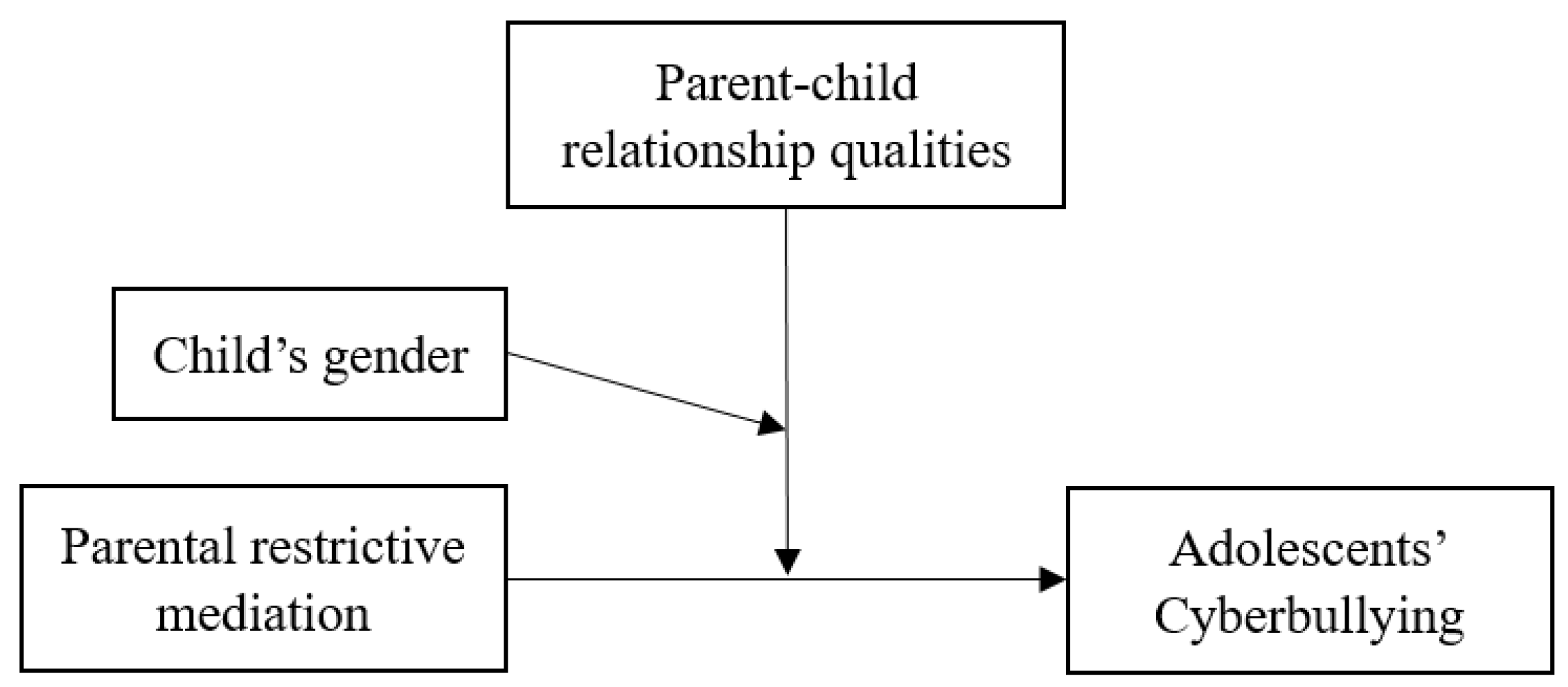
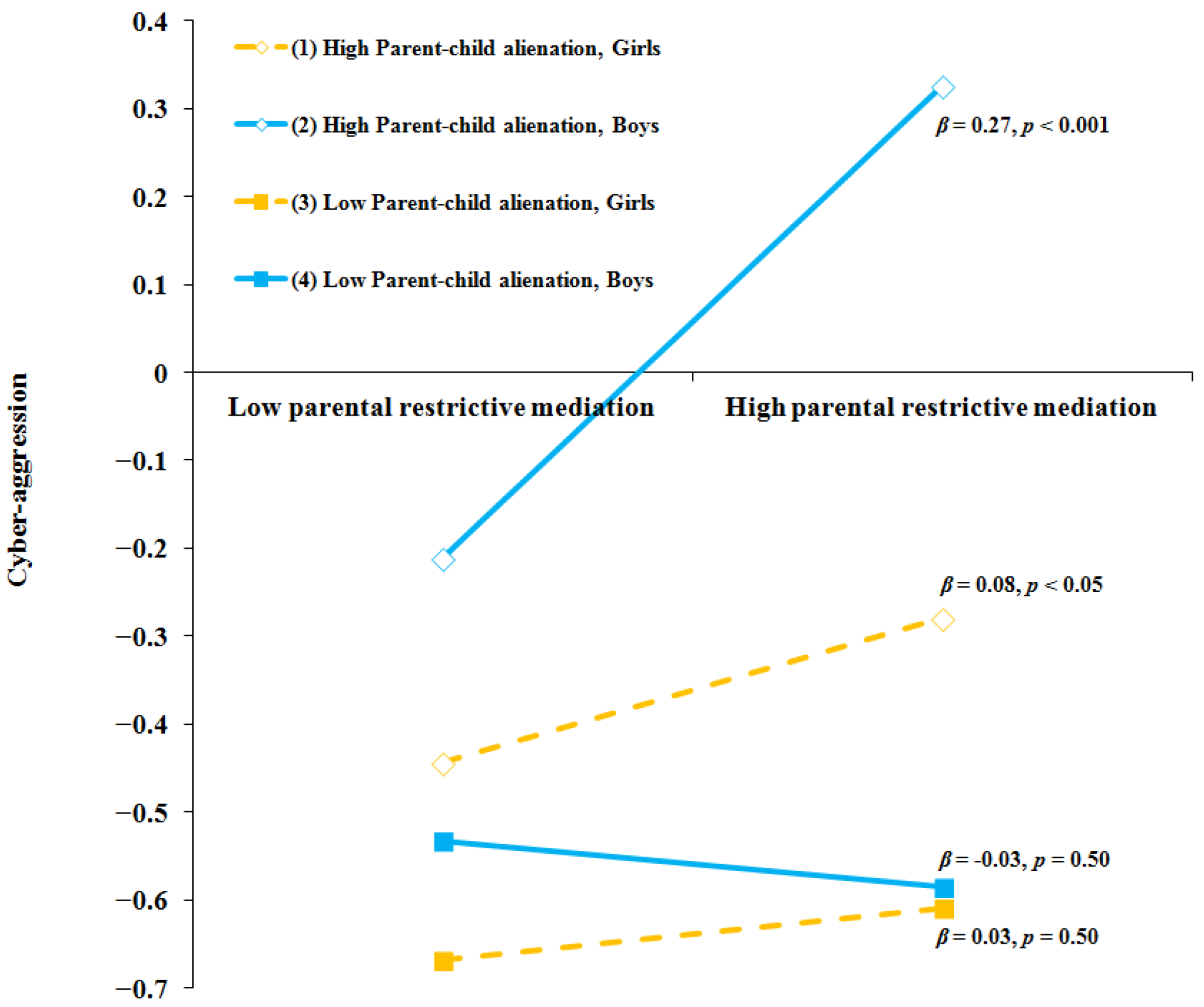
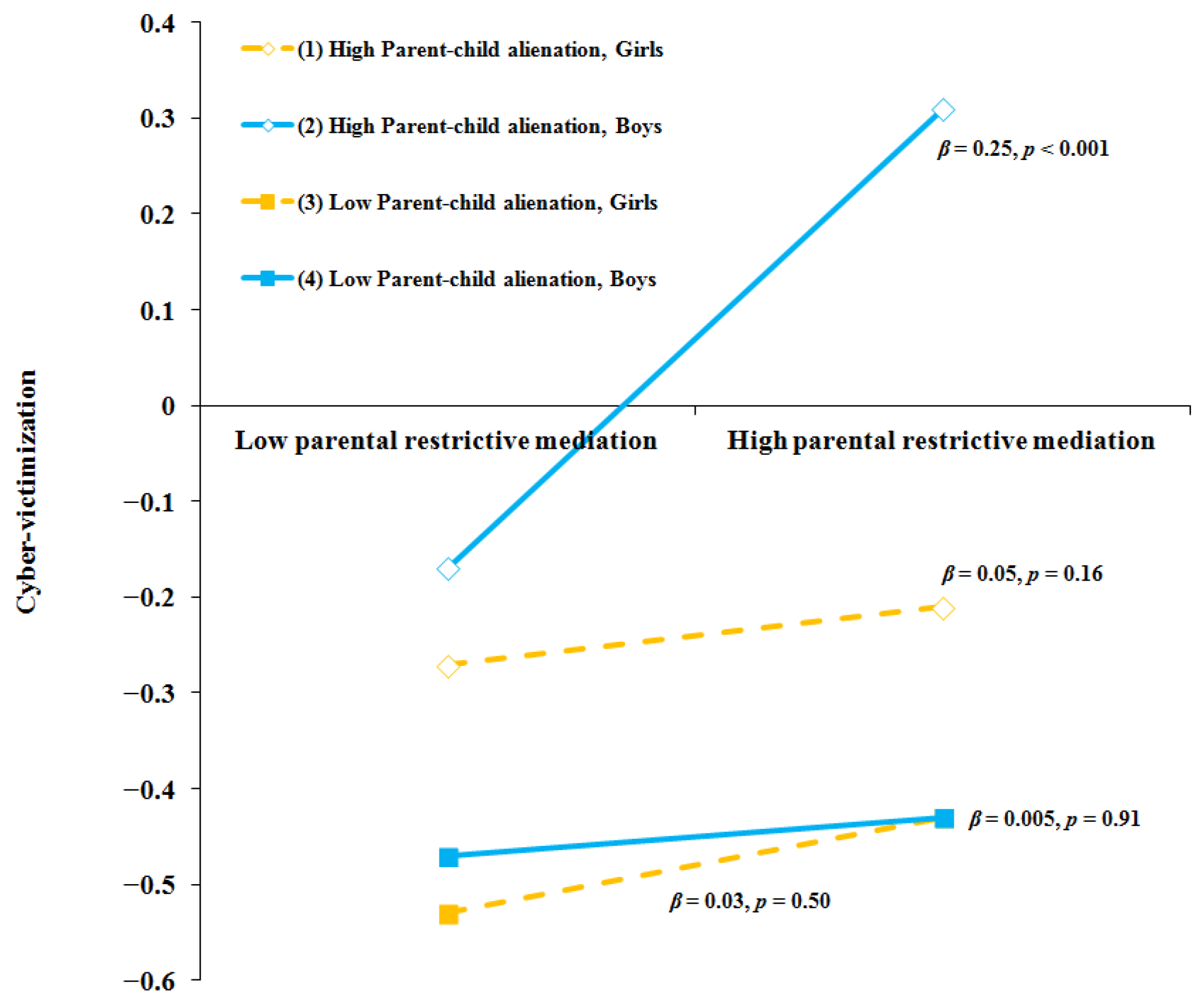
- Parent–child alienation is identified as a critical moderator. Specifically, under conditions of high alienation, restrictive mediation predicts increased cyberbullying involvement, with this exacerbating effect being particularly pronounced among adolescent boys.
- These findings provide a pivotal explanation for the contradictory evidence in the field, underscoring that parent–child relationship quality is a fundamental prerequisite for assessing the efficacy of parenting practices.
- The results strongly suggest that effective cyberbullying prevention must pivot from mere technical oversight to fostering trusting and emotionally connected parent–child relationships—a transition of particular importance for interventions targeting adolescent boys.
Abstract
1. Introduction
1.1. Internet Use and Cyberbullying Among Adolescents
1.2. The Relationship Between Parental Restrictive Mediation and Cyber-Aggression and Cyber-Victimization
1.3. Moderating Role of Parent–Child Relationship Qualities
1.4. The Present Study
2. Materials and Methods
2.1. Participants
2.2. Procedure
2.3. Measures
2.3.1. Parental Restrictive Mediation
2.3.2. Parent–Child Trust and Alienation
2.3.3. Cyberbullying
2.4. Analytical Strategy
3. Results
3.1. Preliminary Analyses
3.2. Moderating Effects of Parent–Child Relationship Qualities on the Relationship Between Parental Restrictive Mediation and Cyber-Aggression
3.3. Moderating Effects of Parent–Child Relationship Qualities on the Relationship Between Parental Restrictive Mediation and Cyber-Victimization
4. Discussion
4.1. Relationship Between Parental Restrictive Mediation and Cyberbullying
4.2. The Moderating Role of Parent–Child Relationship Qualities and Adolescent Gender
4.3. Cultural Context and Theoretical Implications
4.4. Limitations and Future Directions
5. Conclusions
Author Contributions
Funding
Institutional Review Board Statement
Informed Consent Statement
Data Availability Statement
Conflicts of Interest
References
- Lan, M.; Law, N.; Pan, Q. Effectiveness of anti-cyberbullying educational programs: A socio-ecologically grounded systematic review and meta-analysis. Comput. Hum. Behav. 2022, 130, 107200. [Google Scholar] [CrossRef]
- Shin, W.; Kang, H. Adolescents’ privacy concerns and information disclosure online: The role of parents and the Internet. Comput. Hum. Behav. 2016, 54, 114–123. [Google Scholar] [CrossRef]
- Wright, M.F. Parental mediation, cyberbullying, and cybertrolling: The role of gender. Comput. Hum. Behav. 2017, 71, 189–195. [Google Scholar] [CrossRef]
- Álvarez-García, D.; Núñez, J.C.; González-Castro, P.; Rodríguez, C.; Cerezo, R. The effect of parental control on cyber-victimization in adolescence: The mediating role of impulsivity and high-risk behaviors. Front. Psychol. 2019, 10, 1159. [Google Scholar] [CrossRef]
- Elsaesser, C.; Russell, B.; Ohannessian, C.M.; Patton, D. Parenting in a digital age: A review of parents’ role in preventing adolescent cyberbullying. Aggress Violent Behav. 2017, 35, 62–72. [Google Scholar] [CrossRef]
- Faverio, M.; Sidoti, O. Teens, Social Media & Technology 2024. Pew Research Center, 2024. Available online: https://www.pewresearch.org/internet/2024/12/12/teens-social-media-and-technology-2024/ (accessed on 1 November 2025).
- CNNIC. The 5th Report on the National Study of Minors’ Internet Use. CNNIC, 2023. Available online: https://www.cnnic.net.cn/NMediaFile/2023/1225/MAIN1703484375296SPBHV29S0V.pdf (accessed on 29 September 2025).
- CNNIC. The 54th China Statistical Report on Internet Development. CNNIC, 2024. Available online: https://www.cnnic.net.cn/NMediaFile/2024/0911/MAIN1726017626560DHICKVFSM6.pdf (accessed on 29 September 2025).
- Li, L.; Ma, Y.; Friesen, D.; Zhang, Z.; Jin, S.; Rozelle, S. The impact of Internet use on adolescent learning outcomes: Evidence from rural China. China Agric. Econ. Rev. 2021, 13, 569–592. [Google Scholar] [CrossRef]
- Pereira, F.; Matos, M. Cyber-stalking victimization: What predicts fear among Portuguese adolescents? Eur. J. Crim. Policy Res. 2016, 22, 253–270. [Google Scholar] [CrossRef]
- Wang, L.; Ngai, S.Y. Understanding the effects of personal factors and situational factors for adolescent cyberbullying perpetration: The roles of internal states and parental mediation. J. Adolesc. 2021, 89, 28–40. [Google Scholar] [CrossRef]
- Smith, P.K. Cyberbullying and cyber aggression. In Handbook of School Violence and School Safety; Jimerson, S.R., Nickerson, A.B., Mayer, M.J., Furlong, M.J., Eds.; Routledge: New York, NY, USA, 2012; pp. 93–103. [Google Scholar]
- Tokunaga, R.S. Following you home from school: A critical review and synthesis of research on cyberbullying victimization. Comput. Hum. Behav. 2010, 26, 277–287. [Google Scholar] [CrossRef]
- Camerini, A.-L.; Marciano, L.; Carrara, A.; Schulz, P.J. Cyberbullying perpetration and victimization among children and adolescents: A systematic review of longitudinal studies. Telemat. Inform. 2020, 49, 101362. [Google Scholar] [CrossRef]
- Garaigordobil, M. Prevalence and consequences of cyberbullying: A review. Int. J. Psychol. Psychol. Ther. 2011, 11, 233–254. [Google Scholar]
- Bonanno, R.A.; Hymel, S. Cyber bullying and internalizing difficulties: Above and beyond the impact of traditional forms of bullying. J. Youth Adolesc. 2013, 42, 685–697. [Google Scholar] [CrossRef]
- Chen, L.; Ho, S.S.; Lwin, M.O. A meta-analysis of factors predicting cyber-bullying perpetration and victimization: From the social cognitive and media effects approach. New Media Soc. 2017, 19, 1194–1213. [Google Scholar] [CrossRef]
- Chng, G.S.; Liau, A.; Khoo, A.; Li, D. Parental mediation and cyberbullying—A longitudinal study. Annu. Rev. CyberTherapy Telemed. 2014, 12, 98–102. Available online: http://www.arctt.info/volume-12-summer-2014 (accessed on 29 September 2025).
- Moreno-Ruiz, D.; Martínez-Ferrer, B.; García-Bacete, F. Parenting styles, cyberaggression, and cybervictimization among adolescents. Comput. Hum. Behav. 2019, 93, 252–259. [Google Scholar] [CrossRef]
- Coyne, S.M.; Radesky, J.; Collier, K.M.; Gentile, D.A.; Linder, J.R.; Nathanson, A.I.; Rasmussen, E.E.; Reich, S.M.; Rogers, J. Parenting and digital media. Pediatrics 2017, 140, S112–S116. [Google Scholar] [CrossRef]
- Warren, R. In words and deeds: Parental involvement and mediation of children’s television viewing. J. Fam. Commun. 2001, 1, 211–231. [Google Scholar] [CrossRef]
- Jiow, H.J.; Lim, S.S.; Lin, J. Level up! Refreshing parental mediation theory for our digital media landscape. Commun. Theory 2017, 27, 309–328. [Google Scholar] [CrossRef]
- Fu, X.; Liu, J.; Liu, R.D.; Ding, Y.; Jiang, S. The impact of parental active mediation on adolescent mobile phone dependency: A moderated mediation model. Comput. Hum. Behav. 2020, 107, 106280. [Google Scholar] [CrossRef]
- Strouse, G.A.; O’Doherty, K.; Troseth, G.L. Effective coviewing: Preschoolers’ learning from video after a dialogic questioning intervention. Dev. Psychol. 2013, 49, 2368–2382. [Google Scholar] [CrossRef]
- Young, R.; Tully, M. Autonomy vs. control: Associations among parental mediation, perceived parenting styles, and U.S. adolescents’ risky online experiences. Cyberpsychol. J. Psychosoc. Res. Cyberspace 2022, 16, 5. [Google Scholar] [CrossRef]
- Yao, X.; Wu, J.; Guo, Z.; Yang, Y.; Zhang, M.; Zhao, Y.; Kou, Y. Parental psychological control and adolescents’ problematic mobile phone use: The serial mediation of basic psychological need experiences and negative affect. J. Child Fam. Stud. 2022, 31, 2039–2049. [Google Scholar] [CrossRef]
- Marinoni, C.; Trombetta, T.; Negri, R.; Zanetti, M.A. The role of parental mediation in cybervictimization among adolescents: A systematic review. Int. J. Bullying Prev. 2024, 1–20. [Google Scholar] [CrossRef]
- Khurana, A.; Bleakley, A.; Jordan, A.B.; Romer, D. The protective effects of parental monitoring and internet restriction on adolescents’ risk of online harassment. J. Youth Adolesc. 2015, 44, 1039–1047. [Google Scholar] [CrossRef] [PubMed]
- Caivano, O.; Leduc, K.; Talwar, V. When you think you know: The effectiveness of restrictive mediation on parental awareness of cyberbullying experiences among children and adolescents. Cyberpsychol. J. Psychosoc. Res. Cyberspace 2020, 14, 2. [Google Scholar] [CrossRef]
- Leemis, R.W.; Espelage, D.L.; Basile, K.C.; Kollar, L.; Davis, J.P. Traditional and cyber bullying and sexual harassment: A longitudinal assessment of risk and protective factors. Aggress. Behav. 2019, 45, 181–192. [Google Scholar] [CrossRef]
- Navarro, R.; Serna, C.; Martínez, V.; Ruiz-Oliva, R. The role of internet use and parental mediation on cyberbullying victimization among Spanish children from rural public schools. Eur. J. Psychol. Educ. 2013, 28, 725–745. [Google Scholar] [CrossRef]
- Zhou, Z.; Tang, H.; Tian, Y.; Wei, H.; Zhang, F.; Morrison, C.M. Cyberbullying and its risk factors among Chinese high school students. Sch. Psychol. Int. 2013, 34, 630–647. [Google Scholar] [CrossRef]
- Sasson, H.; Mesch, G. The role of parental mediation and peer norms on the likelihood of cyberbullying. J. Genet. Psychol. 2017, 178, 15–27. [Google Scholar] [CrossRef]
- Smetana, J.G. Parenting styles and conceptions of parental authority during adolescence. Child Dev. 1995, 66, 299–316. [Google Scholar] [CrossRef]
- Soenens, B.; Vansteenkiste, M.; Sierens, E. How are parental psychological control and autonomy-support related? A cluster-analytic approach. J. Marriage Fam. 2009, 71, 187–202. [Google Scholar] [CrossRef]
- Brehm, S.S.; Brehm, J.W. Psychological Reactance: A Theory of Freedom and Control; Academic Press: New York, NY, USA, 1981. [Google Scholar]
- Padilla-Walker, L.M.; Coyne, S.M.; Collier, K.M. Longitudinal relations between parental media monitoring and adolescent aggression, prosocial behavior, and externalizing problems. J. Adolesc. 2016, 46, 86–97. [Google Scholar] [CrossRef]
- Soenens, B.; Vansteenkiste, M. A theoretical upgrade of the concept of parental psychological control: Proposing new insights on the basis of self-determination theory. Dev. Rev. 2010, 30, 74–99. [Google Scholar] [CrossRef]
- Jordan, A.; Prendella, K. The invisible children of media research. J. Child. Media 2019, 13, 235–240. [Google Scholar] [CrossRef]
- Chen, L.; Shi, J. Reducing harm from media: A meta-analysis of parental mediation. J. Mass Commun. Q. 2019, 96, 173–193. [Google Scholar] [CrossRef]
- Zhou, C.Y. Parenting with Chinese characteristics in the digital age: Chinese parents’ perspectives and parental mediation of children’s media use. Int. J. Commun. 2024, 18, 3292–3311. [Google Scholar]
- Lim, S.S. Transcendent Parenting: Raising Children in the Digital Age; Oxford University Press: New York, NY, USA, 2020. [Google Scholar]
- Wu, M.Y. The concept of guan in the Chinese parent-child relationship. In The Psychological Well-Being of East Asian Youth; Yi, C.C., Ed.; Springer: Dordrecht, The Netherlands, 2013; pp. 29–49. [Google Scholar]
- Kim, S.W.; Brown, K.E.; Fong, V.L. Chinese individualisms: Childrearing aspirations for the next generation of middle-class Chinese citizens. Ethos 2017, 45, 342–366. [Google Scholar] [CrossRef]
- Chao, R.K. Beyond parental control and authoritarian parenting style: Understanding Chinese parenting through the cultural notion of training. Child Dev. 1994, 65, 1111–1119. [Google Scholar] [CrossRef]
- Pomerantz, E.M.; Wang, Q. The role of parental control in children’s development in Western and East Asian countries. Curr. Dir. Psychol. Sci. 2009, 18, 285–289. [Google Scholar] [CrossRef]
- Bao, Z.; Zhang, W.; Lai, X.; Sun, W.; Wang, Y. Parental attachment and Chinese adolescents’ delinquency: The mediating role of moral disengagement. J. Adolesc. 2015, 44, 37–47. [Google Scholar] [CrossRef]
- Goldstein, S.E. Adolescents’ disclosure and secrecy about peer behavior: Links with cyber aggression, relational aggression, and overt aggression. J. Child Fam. Stud. 2015, 25, 1430–1440. [Google Scholar] [CrossRef]
- Kokkinos, C.M.; Antoniadou, N.; Asdre, A.; Voulgaridou, K. Parenting and internet behavior predictors of cyber-bullying and cyber-victimization among preadolescents. Deviant Behav. 2016, 37, 439–455. [Google Scholar] [CrossRef]
- Garaigordobil, M.; Machimbarrena, J.M. Stress, competence, and parental educational styles in victims and aggressors of bullying and cyberbullying. Psicothema 2017, 29, 335–340. [Google Scholar] [CrossRef]
- Wang, J.; Iannotti, R.J.; Nansel, T.R. School bullying among adolescents in the United States: Physical, verbal, relational, and cyber. J. Adolesc. Health 2009, 45, 368–375. [Google Scholar] [CrossRef]
- Gómez-Ortiz, O.; Romera, E.M.; Ortega-Ruiz, R.; Del Rey, R. Parenting practices as risk or preventive factors for adolescent involvement in cyberbullying: Contribution of children and parent gender. Int. J. Environ. Res. Public Health 2018, 15, 2664. [Google Scholar] [CrossRef]
- Sabatine, E.; Lippold, M.; Kainz, K. The unique and interactive effects of parent and school bonds on adolescent delinquency. J. Appl. Dev. Psychol. 2017, 53, 54–63. [Google Scholar] [CrossRef][Green Version]
- Davis, K.; Koepke, L. Risk and protective factors associated with cyberbullying: Are relationships or rules more protective? Learn. Media Technol. 2015, 41, 521–545. [Google Scholar] [CrossRef]
- Laird, R.D.; Zeringue, M.M.; Lambert, E.S. Negative reactions to monitoring: Do they undermine the ability of monitoring to protect adolescents? J. Adolesc. 2018, 63, 75–84. [Google Scholar] [CrossRef]
- Gorman-Smith, D.; Henry, D.B.; Tolan, P.H. Exposure to community violence and violence perpetration: The protective effects of family functioning. J. Clin. Child Adolesc. Psychol. 2004, 33, 439–455. [Google Scholar] [CrossRef] [PubMed]
- Steele, E.H.; McKinney, C. Emerging adult psychological problems and parenting style: Moderation by parent-child relationship quality. Pers. Individ. Differ. 2019, 146, 201–208. [Google Scholar] [CrossRef]
- Livingstone, S.; Helsper, E.J. Parental mediation of children’s internet use. J. Broadcast. Electron. Media 2008, 52, 581–599. [Google Scholar] [CrossRef]
- Stattin, H.; Kerr, M. Parental monitoring: A reinterpretation. Child Dev. 2000, 71, 1072–1085. [Google Scholar] [CrossRef]
- Law, D.M.; Shapka, J.D.; Olson, B.F. To control or not to control? Parenting behaviours and adolescent online aggression. Comput. Hum. Behav. 2010, 26, 1651–1656. [Google Scholar] [CrossRef]
- Raja, S.N.; McGee, R.; Stanton, W.R. Perceived attachments to parents and peers and psychological well-being in adolescence. J. Youth Adolesc. 1992, 21, 471–485. [Google Scholar] [CrossRef]
- Pan, Y.; Yang, C.; Liu, G.; Chan, M.; Liu, C.; Zhang, D. Peer victimisation and problem behaviors: The roles of self-esteem and parental attachment among Chinese adolescents. Child Dev. 2020, 91, e968–e983. [Google Scholar] [CrossRef] [PubMed]
- Shapka, J.D.; Onditi, H.Z.; Collie, R.J.; Lapidot-Lefler, N. Cyberbullying and cybervictimization within a cross-cultural context: A study of Canadian and Tanzanian adolescents. Child Dev. 2018, 89, 89–99. [Google Scholar] [CrossRef]
- Xie, X.; Zheng, H.; Ju, K.; Xiao, B.; Liu, J.; Shapka, J.D. Examining the validity and reliability of the short form of cyberbullying and cybervictimization (CAV) scale. Chin. J. Clin. Psychol. 2022, 30, 1155–1159. [Google Scholar]
- Aiken, L.S.; West, S.G. Multiple Regression: Testing and Interpreting Interactions; Sage: Newbury Park, CA, USA, 1991. [Google Scholar]
- Wright, M.F. The role of parental mediation and age in the associations between cyberbullying victimization and bystanding and children’s and adolescents’ depression. Children 2024, 11, 777. [Google Scholar] [CrossRef] [PubMed]
- Sasson, H.; Mesch, G. Parental mediation, peer norms and risky online behavior among adolescents. Comput. Hum. Behav. 2014, 33, 32–38. [Google Scholar] [CrossRef]
- Smahel, D.; Wright, M.F. (Eds.) Meaning of Online Problematic Situations for Children. In Results of Qualitative Cross-Cultural Investigation in Nine European Countries; EU Kids Online, London School of Economics and Political Science: London, UK, 2014. [Google Scholar]
- Nikken, P.; de Graaf, H. Reciprocal relationships between friends’ and parental mediation of adolescents’ media use and their sexual attitudes and behavior. J. Youth Adolesc. 2012, 42, 1696–1707. [Google Scholar] [CrossRef]
- Accordino, D.B.; Accordino, M.P. An exploratory study of face-to-face and cyberbullying in sixth grade students. Am. Second. Educ. 2011, 40, 14–30. [Google Scholar]
- Martínez, I.; Murgui, S.; Garcia, O.F.; Garcia, F. Parenting in the digital era: Protective and risk parenting styles for traditional bullying and cyberbullying victimization. Comput. Hum. Behav. 2019, 90, 84–92. [Google Scholar] [CrossRef]
- Baumrind, D. Patterns of parental authority and adolescent autonomy. New Dir. Child Adolesc. Dev. 2005, 108, 61–69. [Google Scholar] [CrossRef] [PubMed]
- Hong, J.S.; Kim, D.H.; DeLara, E.W.; Wei, H.S.; Prisner, A.; Alexander, N.B. Parenting style and bullying and victimization: Comparing foreign-born Asian, U.S.-born Asian, and White American adolescents. J. Fam. Violence 2021, 36, 799–811. [Google Scholar] [CrossRef]
- Keijsers, L.; Poulin, F. Developmental changes in parent–child communication throughout adolescence. Dev. Psychol. 2013, 49, 2301–2308. [Google Scholar] [CrossRef]



| 1 | 2 | 3 | 4 | 5 | 6 | 7 | |
|---|---|---|---|---|---|---|---|
| 1. Parental restrictive mediation | 1 | ||||||
| 2. Parent–child trust | 0.001 | 1 | |||||
| 3. Parent–child alienation | 0.09 *** | −0.43 *** | 1 | ||||
| 4. Cyber-aggression | 0.11 *** | −0.15 *** | 0.24 *** | 1 | |||
| 5. Cyber-victimization | 0.10 *** | −0.16 *** | 0.23 *** | 0.76 *** | 1 | ||
| 6. Gender | −0.04 | 0.04 * | 0.03 | −0.14 *** | −0.10 *** | 1 | |
| 7. Age | −0.02 | −0.03 | 0.05 * | 0.10 ** | 0.08 ** | −0.01 | 1 |
| M | 2.62 | 2.80 | 1.67 | 1.16 | 1.17 | 0.55 | 16.50 |
| SD | 10.51 | 0.65 | 0.61 | 0.39 | 0.40 | 0.50 | 3.11 |
| Predictor | Cyber-Aggression | ||||
|---|---|---|---|---|---|
| β | SE | t Value | p | 95% CI | |
| Constant | −0.25 | 0.11 | −2.169 * | 0.033 | [−0.47, −0.02] |
| Gender | −0.25 | 0.04 | −5.957 *** | 0.000 | [−0.33, −0.16] |
| Age | 0.02 | 0.01 | 3.358 ** | 0.001 | [0.01,0.04] |
| Parental restrictive mediation | 0.13 | 0.03 | 4.189 *** | 0.000 | [0.07, 0.19] |
| Parent–child trust | −0.07 | 0.03 | −2.204 * | 0.028 | [−0.14, −0.09] |
| Parent–child alienation | 0.28 | 0.03 | 8.418 *** | 0.000 | [0.21, 0.34] |
| Parental restrictive mediation × Gender | −0.07 | 0.04 | −1.609 | 0.108 | [−0.15, 0.02] |
| Parent–child trust × Gender | 0.03 | 0.05 | 0.692 | 0.489 | [−0.06, 0.12] |
| Parent–child alienation × Gender | −0.16 | 0.05 | −3.485 *** | 0.001 | [−0.25, −0.07] |
| Parental restrictive mediation × Parent–child trust | −0.04 | 0.03 | −1.390 | 0.165 | [−0.10, 0.02] |
| Parental restrictive mediation × Parent–child alienation | 0.13 | 0.03 | 4.390 *** | 0.000 | [0.07, 0.19] |
| Parental restrictive mediation × Parent–child trust × Gender | 0.07 | 0.04 | 0.395 | 0.693 | [−0.06, 0.10] |
| Parental restrictive mediation × Parent–child alienation × Gender | −0.12 | 0.04 | −2.744 ** | 0.006 | [−0.20, −0.03] |
| Predictor | Cyber-Victimization | ||||
|---|---|---|---|---|---|
| β | SE | t Value | p | 95% CI | |
| Constant | −0.19 | 0.11 | −1.657 | 0.098 | [−0.41, 0.04] |
| Gender | −0.17 | 0.04 | −4.072 *** | 0.000 | [−0.25, −0.09] |
| Age | 0.02 | 0.01 | 2.445 * | 0.015 | [0.003, 0.03] |
| Parental restrictive mediation | 0.13 | 0.03 | 4.336 *** | 0.000 | [0.07, 0.19] |
| Parent–child trust | −0.07 | 0.03 | −2.149 * | 0.032 | [−0.14, −0.01] |
| Parent–child alienation | 0.26 | 0.04 | 7.724 *** | 0.000 | [0.19, 0.32] |
| Parental restrictive mediation × Gender | −0.09 | 0.05 | −2.042 * | 0.041 | [−0.17, −0.003] |
| Parent–child trust × Gender | 0.01 | 0.05 | 0.244 | 0.807 | [−0.08, 0.10] |
| Parent–child alienation × Gender | −0.14 | 0.03 | −3.082 ** | 0.002 | [−0.23, −0.05] |
| Parental restrictive mediation × Parent–child trust | −0.02 | 0.03 | −0.754 | 0.451 | [−0.08, 0.04] |
| Parental restrictive mediation × Parent–child alienation | 0.11 | 0.03 | 3.730 *** | 0.000 | [0.05, 0.17] |
| Parental restrictive mediation × Parent–child trust × Gender | −0.02 | 0.04 | −0.506 | 0.613 | [−0.10, 0.06] |
| Parental restrictive mediation × Parent–child alienation × Gender | −0.12 | 0.04 | −2.805 ** | 0.005 | [−0.20, −0.04] |
Disclaimer/Publisher’s Note: The statements, opinions and data contained in all publications are solely those of the individual author(s) and contributor(s) and not of MDPI and/or the editor(s). MDPI and/or the editor(s) disclaim responsibility for any injury to people or property resulting from any ideas, methods, instructions or products referred to in the content. |
© 2025 by the authors. Licensee MDPI, Basel, Switzerland. This article is an open access article distributed under the terms and conditions of the Creative Commons Attribution (CC BY) license (https://creativecommons.org/licenses/by/4.0/).
Share and Cite
Xie, X.; Xiao, B.; Hu, Y.; Shapka, J.; Liu, J. Beyond Restriction: Relationship Quality and Gender as Moderators of the Association Between Parental Restrictive Mediation and Adolescent Cyberbullying in China. Children 2025, 12, 1604. https://doi.org/10.3390/children12121604
Xie X, Xiao B, Hu Y, Shapka J, Liu J. Beyond Restriction: Relationship Quality and Gender as Moderators of the Association Between Parental Restrictive Mediation and Adolescent Cyberbullying in China. Children. 2025; 12(12):1604. https://doi.org/10.3390/children12121604
Chicago/Turabian StyleXie, Xiaolong, Bowen Xiao, Yihao Hu, Jennifer Shapka, and Junsheng Liu. 2025. "Beyond Restriction: Relationship Quality and Gender as Moderators of the Association Between Parental Restrictive Mediation and Adolescent Cyberbullying in China" Children 12, no. 12: 1604. https://doi.org/10.3390/children12121604
APA StyleXie, X., Xiao, B., Hu, Y., Shapka, J., & Liu, J. (2025). Beyond Restriction: Relationship Quality and Gender as Moderators of the Association Between Parental Restrictive Mediation and Adolescent Cyberbullying in China. Children, 12(12), 1604. https://doi.org/10.3390/children12121604