Effects of Developmental Gymnastics Exercise Program on Preschoolers’ Motor Skills: A Randomised Controlled Trial

 ,
,  , , , and
Highlights
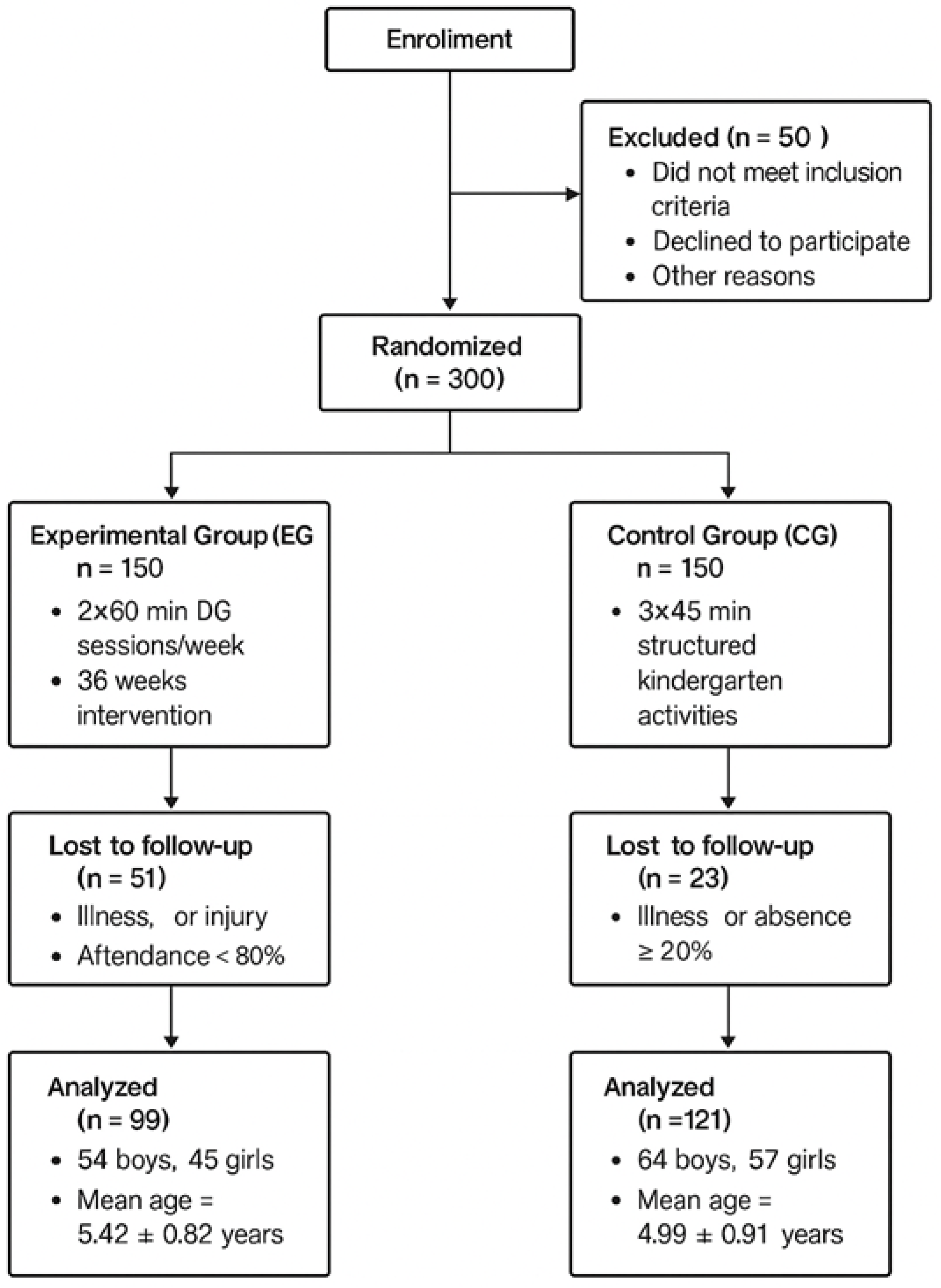
- The 36-week developmental gymnastics (DG) programme greatly helped preschoolers with their object control and locomotor skills. The effect sizes ranged from small to large.
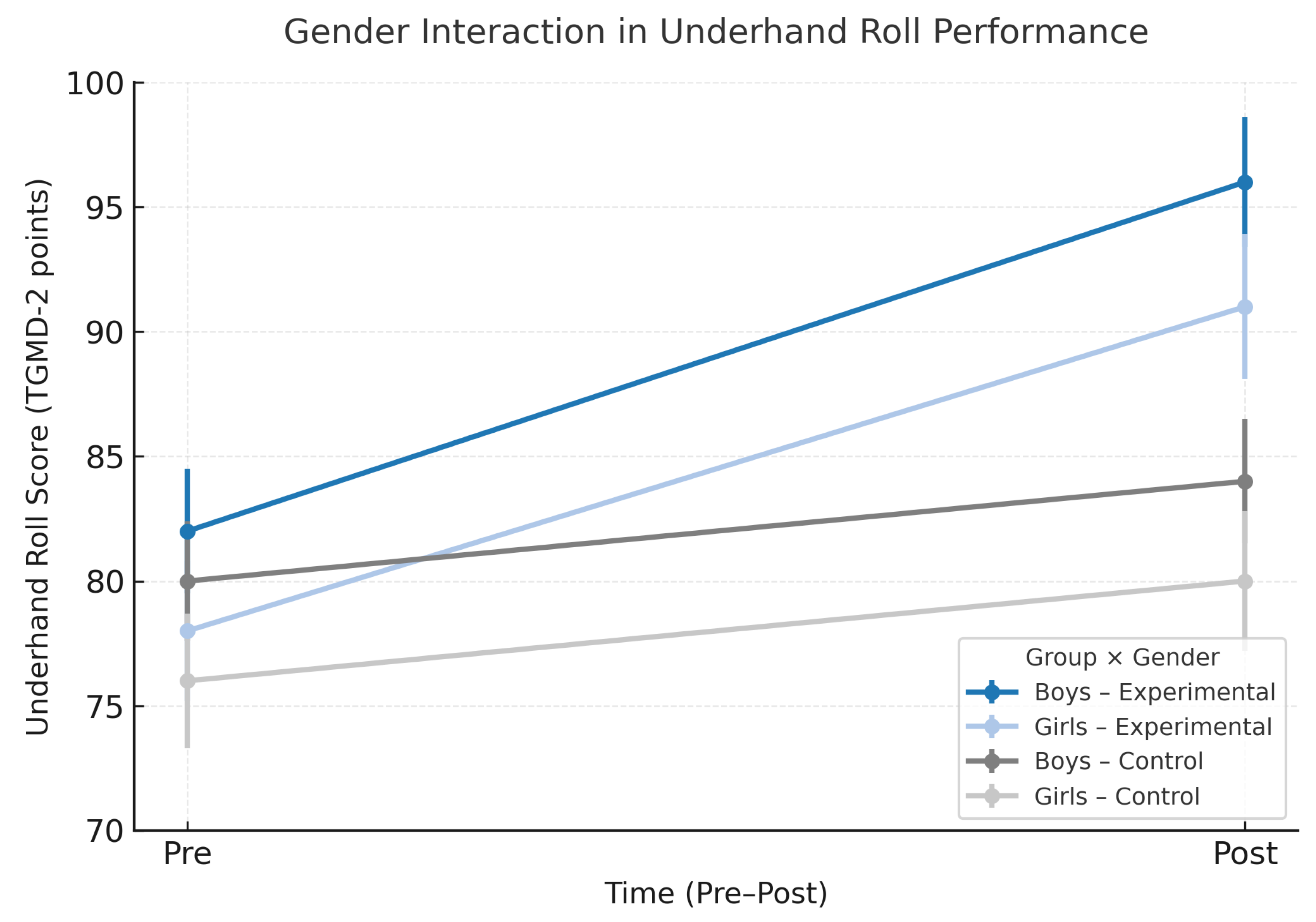
- Age and gender influenced specific improvements: girls excelled in locomotor tasks, whereas boys exhibited superior enhancements in object control performance.
- Two structured DG sessions weekly are adequate to promote gross motor skill development in early childhood.
- Adding DG to preschool physical education can help children improve locomotor performance and stay active and healthy for a long time.
Abstract
1. Introduction
2. Materials and Methods
2.1. Participants
2.2. Procedure
TGMD-2
2.3. Experimental Session
- (1)
- Warm-up—including various movements, games, speed-varied exercises, exercises for plantar activation, stretching, posture improvement activities, and a focus on proper performance awareness (15 min).
- (2)
- Main part—This segment concentrated on the structured development of GMS through progressive practice of previously learned movements combined with the introduction of new motor tasks. Each session involved repetitions of core DG elements to reinforce movement patterns, followed by circuit-based and station-based exercises aimed at improving coordination, balance, and agility (40 min).
- (3)
- Cool-down—stretching, relaxing, casual talk with feedback from the coach (5 min).
2.4. Statistical Analysis
3. Results
3.1. Baseline Characteristics
3.2. Dependence of TGMD-2 Outcomes on Gender, Age, and BMI (Model 1)
3.3. DG Programme Effects on the TGMD-2 Outcomes (Model 2 and Model 3)
3.3.1. Interaction Effects (Model 2)
3.3.2. Gender-Specific Effects (Model 2)
3.3.3. Baseline-Adjusted Intervention Effects (Model 3)
4. Discussion
4.1. Influence of Baseline Differences and Covariates
4.2. Intervention Effects in the Mixed ANCOVA (Model 2)
4.3. ANCOVA with Baseline Adjustment (Model 3)
4.4. Practical Implications
4.5. Strengths and Limitations
5. Conclusions
Author Contributions
Funding
Institutional Review Board Statement
Informed Consent Statement
Data Availability Statement
Acknowledgments
Conflicts of Interest
Abbreviations
| DG | Developmental Gymnastics |
| GMSs | Gross Motor Skills |
| TGMD-2 | Test of Gross Motor Development-2 |
| ANCOVA | Analysis Of Covariance |
| PA | Physical Activity |
| EG | Experimental Group |
| CG | Control Group |
| BMI | Body Mass Index |
| CI | Confidence Interval |
| SPSS | Statistical Package for the Social Sciences |
| Ŋ2/η2 | Partial Eta Squared |
| SD | Standard Deviation |
| CI95%/95% CI | 95% Confidence Interval |
| df | Degrees of Freedom |
| F | F-statistic |
| p | p-value (probability value) |
| d | Cohen’s d (effect size) |
| Δ | Delta (change/difference) |
| ICC | Intraclass Correlation Coefficient |
| WHO | World Health Organization |
| RCT | Randomised Controlled Trial |
References
- Fisher, A.; Reilly, J.J.; Kelly, L.A.; Montgomery, C.; Williamson, A.; Paton, J.Y.; Grant, S. Fundamental movement skills and habitual physical activity in young children. Med. Sci. Sports Exerc. 2005, 37, 684–688. [Google Scholar] [CrossRef]
- Fransen, J.; Pion, J.; Vandendriessche, J.; Vandorpe, B.; Vaeyens, R.; Lenoir, M.; Philippaerts, R.M. Differences in physical fitness and gross motor coordination in boys aged 6-12 years specializing in one versus sampling more than one sport. J. Sports Sci. 2012, 30, 379–386. [Google Scholar] [CrossRef]
- Wrotniak, B.H.; Epstein, L.H.; Dorn, J.M.; Jones, K.E.; Kondilis, V.A. The relationship between motor proficiency and physical activity in children. Pediatrics 2006, 118, e1758–e1765. [Google Scholar] [CrossRef]
- Škundrić, G.; Mačak, D.; Damjanović, S.; Popović, B. Motor competence of children with different levels of physical activity. Exerc. Qual. Life 2023, 15, 37–43. [Google Scholar] [CrossRef]
- Eime, R.M.; Young, J.A.; Harvey, J.T.; Charity, M.J.; Payne, W.R. A systematic review of the psychological and social benefits of participation in sport for adults: Informing development of a conceptual model of health through sport. Int. J. Behav. Nutr. Phys. Act. 2013, 10, 135. [Google Scholar] [CrossRef]
- Janssen, I.; LeBlanc, A.G. Systematic review of the health benefits of physical activity and fitness in school-aged children and youth. Int. J. Behav. Nutr. Phys. Act. 2010, 7, 40. [Google Scholar] [CrossRef]
- Hardy, L.L.; Reinten-Reynolds, T.; Espinel, P.; Zask, A.; Okely, A.D. Prevalence and correlates of low fundamental movement skill competency in children. Pediatrics 2012, 130, e390–e398. [Google Scholar] [CrossRef] [PubMed]
- Stodden, D.F.; Goodway, J.D.; Langendorfer, S.J.; Roberton, M.A.; Rudisill, M.E.; Garcia, C.; Garcia, L.E. A Developmental Perspective on the Role of Motor Skill Competence in Physical Activity: An Emergent Relationship. Quest 2008, 60, 290–306. [Google Scholar] [CrossRef]
- Almond, L. Serious flaws in an FMS interpretation of physical literacy. Sci. Sports 2014, 29, S60. [Google Scholar] [CrossRef]
- Gallahue, D. Understanding Motor Development; McGraw-Hill Higher Education: New York, NY, USA, 2011. [Google Scholar]
- Haywood, K.; Getchell, N. Lifespan Motor Development; Human Kinetics: Champaign, IL, USA, 2009. [Google Scholar]
- Malina, R.M.; Bouchard, C.; Bar-Or, O. Growth, Maturation, and Physical Activity; Human Kinetics: Champaign, IL, USA, 2004. [Google Scholar] [CrossRef]
- Bolger, L.E.; Bolger, L.A.; Neill, C.O.; Coughlan, E.; O’Brien, W.; Lacey, S.; Burns, C. Age and Sex Differences in Fundamental Movement Skills Among a Cohort of Irish School Children. J. Mot. Learn. Dev. 2018, 6, 81. [Google Scholar] [CrossRef]
- Bryant, E.S.; Duncan, M.J.; Birch, S.L.; James, R.S. Can Fundamental Movement Skill Mastery Be Increased via a Six Week Physical Activity Intervention to Have Positive Effects on Physical Activity and Physical Self-Perception? Sports 2016, 4, 10. [Google Scholar] [CrossRef] [PubMed]
- Duncan, M.J.; Eyre, E.L.J.; Oxford, S.W. The Effects of 10-week Integrated Neuromuscular Training on Fundamental Movement Skills and Physical Self-efficacy in 6–7-Year-Old Children. J. Strength Cond. Res. 2018, 32, 3348–3356. [Google Scholar] [CrossRef]
- Logan, S.W.; Robinson, L.E.; Wilson, A.E.; Lucas, W.A. Getting the fundamentals of movement: A meta-analysis of the effectiveness of motor skill interventions in children. Child Care Health Dev. 2012, 38, 305–315. [Google Scholar] [CrossRef]
- Akbari, H.; Abdoli, B.; Shafizadeh, M.; Khalaji, H.; Hajihosseini, S.; Ziaee, V. The Effect of Traditional Games in Fundamental Motor Skill Development in 7–9 Year-Old Boys. Iran. J. Pediatr. 2009, 19, 123–129. [Google Scholar]
- Coe, D.P. Means of Optimizing Physical Activity in the Preschool Environment. Am. J. Lifestyle Med. 2020, 14, 16–23. [Google Scholar] [CrossRef] [PubMed]
- Fotrousi, F.; Bagherly, J.; Ghasemi, A. The Compensatory Impact of Mini-Basketball Skills on the Progress of Fundamental Movements in Children. Procedia-Soc. Behav. Sci. 2012, 46, 5206–5210. [Google Scholar] [CrossRef][Green Version]
- Piek, J.P.; McLaren, S.; Kane, R.; Jensen, L.; Dender, A.; Roberts, C.; Rooney, R.; Packer, T.; Straker, L. Does the Animal Fun program improve motor performance in children aged 4–6 years? Hum. Mov. Sci. 2013, 32, 1086–1096. [Google Scholar] [CrossRef]
- Tomić, B.; Balać, S.; Mesaroš Živkov, A. Effects of rhythmic-based exercise program in children. Exerc. Qual. Life 2024, 16, 33–40. [Google Scholar] [CrossRef]
- Ortega, F.B.; Ruiz, J.R.; Castillo, M.J.; Sjöström, M. Physical fitness in childhood and adolescence: A powerful marker of health. Int. J. Obes. 2008, 32, 1–11. [Google Scholar] [CrossRef]
- Lubans, D.R.; Morgan, P.J.; Cliff, D.P.; Barnett, L.M.; Okely, A.D. Fundamental movement skills in children and adolescents: Review of associated health benefits. Sports Med. 2010, 40, 1019–1035. [Google Scholar] [CrossRef]
- Popović, B.; Gušić, M.; Radanović, D.; Andrašić, S.; Madić, D.M.; Mačak, D.; Stupar, D.; Đukić, G.; Grujičić, D.; Trajković, N. Evaluation of Gross Motor Coordination and Physical Fitness in Children: Comparison between Soccer and Multisport Activities. Int. J. Environ. Res. Public Health 2020, 17, 5902. [Google Scholar] [CrossRef]
- Popovic, B.; Cvetkovic, M.; Macak, D.; Scepanovic, T.; Cokorilo, N.; Belic, A.; Trajkovic, N.; Andrasic, S.; Bogataj, S. Nine Months of a Structured Multisport Program Improve Physical Fitness in Preschool Children: A Quasi-Experimental Study. Int. J. Environ. Res. Public Health 2020, 17, 4935. [Google Scholar] [CrossRef]
- Han, A.; Fu, A.; Cobley, S.; Sanders, R. Effectiveness of exercise intervention on improving fundamental movement skills and motor coordination in overweight/obese children and adolescents: A systematic Review. J. Sci. Med. Sport 2017, 21, 89–102. [Google Scholar] [CrossRef]
- Wasenius, N.S.; Grattan, K.P.; Harvey, A.L.J.; Naylor, P.J.; Goldfield, G.S.; Adamo, K.B. The effect of a physical activity intervention on preschoolers’ fundamental motor skills-A cluster RCT. J. Sci. Med. Sport 2018, 21, 714–719. [Google Scholar] [CrossRef]
- Hnatiuk, J.A.; Brown, H.E.; Downing, K.L.; Hinkley, T.; Salmon, J.; Hesketh, K.D. Interventions to increase physical activity in children 0–5 years old: A systematic review, meta-analysis and realist synthesis. Obes. Rev. Off. J. Int. Assoc. Study Obes. 2019, 20, 75–87. [Google Scholar] [CrossRef]
- Jaksic, D.; Mandic, S.; Maksimovic, N.; Milosevic, Z.; Roklicer, R.; Vukovic, J.; Pocek, S.; Lakicevic, N.; Bianco, A.; Cassar, S.; et al. Effects of a Nine-Month Physical Activity Intervention on Morphological Characteristics and Motor and Cognitive Skills of Preschool Children. Int. J. Environ. Res. Public Health 2020, 17, 6609. [Google Scholar] [CrossRef] [PubMed]
- Stupar, D.; Popovic, B.; Romanov, R.; Jankovic, M.; Jezdimirovic, T.; Medjedovic, B. The Effects of Specific Exercise Program on Anthropometric Characteristics and Motor Abilities of Preschool Children. Int. J. Morphol. 2017, 35, 1050–1057. [Google Scholar] [CrossRef][Green Version]
- García-Hermoso, A.; Alonso-Martinez, A.M.; Ramírez-Vélez, R.; Izquierdo, M. Effects of Exercise Intervention on Health-Related Physical Fitness and Blood Pressure in Preschool Children: A Systematic Review and Meta-Analysis of Randomized Controlled Trials. Sports Med. 2020, 50, 187–203. [Google Scholar] [CrossRef]
- Sheerin, K.; Williams, S.; Hume, P.; Whatman, C.; Gleave, J. Effects of gymnastics training on physical function in children. In Proceedings of the 30th Conference of the International Society of Biomechanics in Sports, Melbourne, Australia, 2–6 July 2012; p. 4. [Google Scholar]
- Yılmaz, S.; Sicim-Sevim, B. The examination of the differences in the motor proficiency skills of children practising gymnastics vs. non-sportive children. Early Child Dev. Care 2020, 190, 1455–1462. [Google Scholar] [CrossRef]
- Anderson, N.; Button, C.; Lamb, P. The effect of educational gymnastics on postural control of young children. Front. Psychol. 2022, 13, 936680. [Google Scholar] [CrossRef]
- Fallah, E.; Nourbakhsh, P.; Bagherly, J. The Effect of Eight Weeks of Gymnastics Exercises on the Development of Gross Motor Skills of Five to Six Years Old Girls. Eur. Online J. Nat. Soc. Sci. 2015, 4, 845–852. [Google Scholar]
- Rudd, J.R.; Barnett, L.M.; Farrow, D.; Berry, J.; Borkoles, E.; Polman, R. The Impact of Gymnastics on Children’s Physical Self-Concept and Movement Skill Development in Primary Schools. Meas. Phys. Educ. Exerc. Sci. 2017, 21, 92–100. [Google Scholar] [CrossRef]
- Madic, D.; Cvetkovic, M.; Popovic, B.; Marinkovic, D.; Radanovic, D.; Trajkovic, N. Effects of developmental gymnastics on motor fitness in preschool girls. Facta Univ. Ser. Phys. Educ. Sport 2018, 16, 11–18. [Google Scholar] [CrossRef]
- Čičirkaitė, F. Do 5–6-Year-Old Girls Who Attend Gymnastics Achieve Better Motor Skills’ Assessment Results Compared to those Who Do Not Attend Gymnastics. Reabil. Moksl. Slauga Kineziter. Ergoter. 2022, 2, 68–74. [Google Scholar] [CrossRef]
- University of Novi Sad (UNS). Effects of Developmental Gymnastics on Preschoolers’ Motor Skills (GymKids). Available online: https://clinicaltrials.gov/study/NCT06315036 (accessed on 17 May 2025).
- Ulrich, D. Test of Gross Motor Development-2; PRO-ED, Inc.: Austin, TX, USA, 2000. [Google Scholar]
- Lopes, V.P.; Saraiva, L.; Rodrigues, L.P. Reliability and construct validity of the test of gross motor development-2 in Portuguese children. Int. J. Sport Exerc. Psychol. 2018, 16, 250–260. [Google Scholar] [CrossRef]
- Butler, L.S.; Sugimoto, D.; Erdman, A.; Yoder, J.; Greiner, K.; Larroque, C.; Latz, K.; Loewen, A.; Wyatt, C.W.; DeVerna, A.; et al. Highly Active Middle School Athletes Demonstrate Poor Motor Skill Proficiency. Sports Health 2023, 16, 19417381231178822. [Google Scholar] [CrossRef]
- Nagy, Á.; Wilhelm, M.; Győri, F.; Domokos, M.; Berki, T. Assessment Tools Measuring Fundamental Movement Skills of Primary School Children: A Narrative Review in Methodological Perspective. Sports 2023, 11, 178. [Google Scholar] [CrossRef]
- Radanovic, D. The Effects of the Developmental Gymnastics Program on the Development of Motor Skills and Abilities and Morphological Characteristics of Preschool Children. Ph.D. Thesis, University of Novi Sad, Novi Sad, Serbia, 2018. [Google Scholar]
- Cohen, J. Statistical Power Analysis for the Behavioral Sciences, 2nd ed.; Routledge: New York, NY, USA, 2013. [Google Scholar] [CrossRef]
- Roth, K.; Ruf, K.; Obinger, M.; Mauer, S.; Ahnert, J.; Schneider, W.; Graf, C.; Hebestreit, H. Is there a secular decline in motor skills in preschool children? Scand. J. Med. Sci. Sports 2010, 20, 670–678. [Google Scholar] [CrossRef]
- Coelho, J. Gymnastics and Movement Instruction. J. Phys. Educ. Recreat. Danc. 2010, 81, 14–18. [Google Scholar] [CrossRef]
- Mostafavi, R.; Ziaee, V.; Akbari, H.; Haji-Hosseini, S. The effects of spark physical education program on fundamental motor skills in 4-6 year-old children. Iran. J. Pediatr. 2013, 23, 216. [Google Scholar]
- Rudd, J.; Buszard, T.; Spittle, S.; O’Callaghan, L.; Oppici, L. Comparing the efficacy (RCT) of learning a dance choreography and practicing creative dance on improving executive functions and motor competence in 6–7 years old children. Psychol. Sport Exerc. 2021, 53, 101846. [Google Scholar] [CrossRef]
- Vandorpe, B.; Vandendriessche, J.; Vaeyens, R.; Pion, J.; Matthys, S.; Lefevre, J.; Philippaerts, R.; Lenoir, M. Relationship between sports participation and the level of motor coordination in childhood: A longitudinal approach. J. Sci. Med. Sport 2012, 15, 220–225. [Google Scholar] [CrossRef]
- Bandeira, P.F.R.; Duncan, M.; Pessoa, M.L.; Soares, Í.; da Silva, L.; Mota, J.; Martins, C. TGMD-2 Short Version: Evidence of Validity and Associations with Sex, Age, and BMI in Preschool Children. J. Mot. Learn. Dev. 2020, 8, 528–543. [Google Scholar] [CrossRef]
- Melo, M.; Nascimento, R.; Oliveira, V.; Tertuliano, I. Physical activity and motor development of children: The use of TGMD-2. Man. Ther. Posturology Rehabil. J. 2018, 16. [Google Scholar] [CrossRef][Green Version]
- Trecroci, A.; Invernizzi, P.L.; Monacis, D.; Colella, D. Actual and Perceived Motor Competence in Relation to Body Mass Index in Primary School-Aged Children: A Systematic Review. Sustainability 2021, 13, 9994. [Google Scholar] [CrossRef]
- Martins, D.; Maia, J.; Seabra, A.; Garganta, R.; Lopes, V.; Katzmarzyk, P.; Beunen, G. Correlates of changes in BMI of children from the Azores islands. Int. J. Obes. 2010, 34, 1487–1493. [Google Scholar] [CrossRef]
- Bowers, B.J.; Roles, K. Effects of Overweight and Obesity on Running Mechanics in Children. Med. Sci. Sports Exerc. 2021, 53, 2101–2110. [Google Scholar] [CrossRef]
- Mehmedinović, S.; Mohammadi, F.; Begić, H.; Šarić, E.; Morić, N.; Sinanović, A. Assessment of fundamental motor skills in boys and girls. Sport Sci. Pract. Asp. Int. Sci. J. Kinesiol. 2022, 19. [Google Scholar] [CrossRef]
- Spessato, B.C.; Gabbard, C.; Valentini, N.; Rudisill, M. Gender differences in Brazilian children’s fundamental movement skill performance. Early Child Dev. Care 2013, 183, 916–923. [Google Scholar] [CrossRef]
- Cinar, E.; Fitzpatrick, C.; Almeida, M.L.; Camden, C.; Garon-Carrier, G. Motor Skills are More Strongly Associated to Academic Performance for Girls Than Boys. Can. J. Sch. Psychol. 2023, 38, 252–267. [Google Scholar] [CrossRef]
- Sheehan, D.; Lienhard, K.; Ammar, D. Reducing the Object Control Skills Gender Gap in Elementary School Boys and Girls. Adv. Phys. Educ. 2020, 10, 155–168. [Google Scholar] [CrossRef]



| Outcomes | EG (N = 99) | CG (N = 121) |
|---|---|---|
| Gender [1] (%) | 45.5 | 47.1 |
| Age (years) | 5.42 ± 0.82 ** | 4.99 ± 0.91 |
| TGMD-2 | ||
| Items | ||
| Run | 3.25 ± 1.73 ** | 2.68 ± 1.53 |
| Hop | 4.20 ± 1.64 ** | 3.59 ± 1.94 |
| Horizontal jump | 2.76 ± 1.36 | 2.83 ± 1.25 |
| Gallop | 4.46 ± 1.48 ** | 3.37 ± 1.51 |
| Leap | 2.06 ± 1.11 | 2.27 ± 1.28 |
| Slide | 5.43 ± 1.38 ** | 4.88 ± 1.80 |
| Striking stationary ball | 2.92 ± 1.63 | 2.53 ± 1.54 |
| Stationary dribble | 3.57 ± 2.37 ** | 2.21 ± 2.34 |
| Catch | 3.24 ± 1.61 ** | 2.31 ± 1.48 |
| Kick | 2.80 ± 1.31 | 2.53 ± 1.58 |
| Overhand throw | 3.47 ± 2.14 * | 2.95 ± 1.84 |
| Underhand roll | 3.94 ± 2.11 ** | 3.21 ± 2.16 |
| Total | ||
| Locomotor skills | 22.17 ± 5.74 ** | 19.62 ± 6.18 |
| Object control skills | 19.94 ± 6.99 ** | 15.73 ± 6.74 |
| Total TGMD-2 | 42.11 ± 11.54 ** | 35.36 ± 11.22 |
| Outcome | Predictor | β | 95% CI | p | Partial η2 |
|---|---|---|---|---|---|
| Run | Gender | 0.11 | 0.02–0.20 | 0.02 | 0.011 |
| Age | 0.25 | 0.16–0.33 | <0.001 | 0.064 | |
| BMI | −0.10 | −0.20–(−0.01) | 0.03 | 0.009 | |
| Hop | Gender | 0.02 | −0.07–0.11 | 0.63 | 0.001 |
| Age | 0.26 | 0.18–0.35 | <0.001 | 0.069 | |
| BMI | −0.09 | −0.18–(−0.01) | 0.04 | 0.008 | |
| Horizontal jump | Gender | 0.12 | 0.03–0.22 | 0.01 | 0.013 |
| Age | 0.31 | 0.21–0.40 | <0.001 | 0.092 | |
| BMI | −0.03 | −0.13–0.07 | 0.54 | 0.001 | |
| Gallop | Gender | 0.18 | 0.08–0.27 | 0.001 | 0.022 |
| Age | 0.27 | 0.18–0.36 | <0.001 | 0.073 | |
| BMI | −0.07 | −0.17–0.03 | 0.16 | 0.003 | |
| Leap | Gender | 0.06 | −0.03–0.15 | 0.18 | 0.003 |
| Age | 0.16 | 0.07–0.25 | 0.001 | 0.028 | |
| BMI | −0.04 | −0.14–0.06 | 0.41 | 0.002 | |
| Slide | Gender | 0.13 | 0.03–0.22 | 0.01 | 0.014 |
| Age | 0.25 | 0.16–0.33 | <0.001 | 0.066 | |
| BMI | −0.08 | −0.18–0.02 | 0.12 | 0.004 | |
| Striking stationary ball | Gender | 0.09 | −0.02–0.20 | 0.11 | 0.005 |
| Age | 0.31 | 0.21–0.40 | <0.001 | 0.092 | |
| BMI | −0.03 | −0.13–0.08 | 0.60 | 0.001 | |
| Stationary dribble | Gender | 0.04 | −0.06–0.15 | 0.42 | 0.002 |
| Age | 0.24 | 0.15–0.34 | <0.001 | 0.061 | |
| BMI | −0.01 | −0.11–0.09 | 0.86 | <0.001 | |
| Catch | Gender | 0.10 | 0.01–0.20 | 0.04 | 0.008 |
| Age | 0.22 | 0.13–0.31 | <0.001 | 0.047 | |
| BMI | −0.04 | −0.14–0.05 | 0.38 | 0.002 | |
| Kick | Gender | 0.14 | 0.04–0.24 | 0.01 | 0.016 |
| Age | 0.18 | 0.08–0.27 | <0.001 | 0.029 | |
| BMI | −0.03 | −0.13–0.08 | 0.62 | 0.001 | |
| Overhand throw | Gender | 0.04 | −0.06–0.15 | 0.43 | 0.002 |
| Age | 0.18 | 0.08–0.28 | <0.001 | 0.030 | |
| BMI | −0.03 | −0.13–0.07 | 0.56 | 0.001 | |
| Underhand roll | Gender | 0.05 | −0.05–0.15 | 0.33 | 0.003 |
| Age | 0.20 | 0.11–0.29 | <0.001 | 0.040 | |
| BMI | −0.03 | −0.13–0.06 | 0.51 | 0.001 | |
| Locomotor total | Gender | 0.14 | 0.05–0.24 | 0.002 | 0.020 |
| Age | 0.31 | 0.22–0.40 | <0.001 | 0.094 | |
| BMI | −0.06 | −0.16–0.04 | 0.24 | 0.003 | |
| Object control total | Gender | 0.21 | 0.11–0.31 | <0.001 | 0.033 |
| Age | 0.29 | 0.20–0.38 | <0.001 | 0.084 | |
| BMI | −0.04 | −0.14–0.06 | 0.41 | 0.002 | |
| Total TGMD-2 | Gender | 0.17 | 0.07–0.27 | 0.001 | 0.025 |
| Age | 0.34 | 0.25–0.44 | <0.001 | 0.109 | |
| BMI | −0.05 | −0.15–0.05 | 0.32 | 0.003 |
| Outcome | Group | Mean Difference (Post–Pre) (95% CI) | Time × Group (%) | Time × Group × Gender (%) |
|---|---|---|---|---|
| Run | EG | 2.03 (1.65–2.41) | 1.5 | <0.1 |
| CG | 1.58 (1.29–1.87) | |||
| Hop | EG | 1.57 (1.24–1.91) | 6.2 | <0.1 |
| CG | 0.75 (0.50–1.01) | |||
| Horizontal jump | EG | 1.64 (1.33–1.96) | 13.5 | <0.1 |
| CG | 0.47 (0.23–0.71) | |||
| Gallop | EG | 1.07 (0.88–1.27) | 4.8 | <0.1 |
| CG | 0.65 (0.50–0.80) | |||
| Leap | EG | 0.54 (0.37–0.71) | <0.1 | 0.6 |
| CG | 0.54 (0.41–0.67) | |||
| Slide | EG | 1.43 (1.22–1.64) | 5.6 | 0.2 |
| CG | 0.94 (0.77–1.10) | |||
| Striking stationary ball | EG | 0.81 (0.37–1.25) | 0.1 | 0.5 |
| CG | 0.94 (0.61–1.28) | |||
| Stationary dribble | EG | 0.82 (0.34–1.30) | 1.8 | |
| CG | 0.58 (0.22–0.95) | |||
| Catch | EG | 0.88 (0.47–1.30) | 0.8 | 0.4 |
| CG | 0.53 (0.22–0.85) | |||
| Kick | EG | 0.65 (0.34–0.95) | 0.3 | <0.1 |
| CG | 0.48 (0.25–0.72) | |||
| Overhand throw | EG | 0.67 (0.16–1.18) | <0.1 | 0.7 |
| CG | 0.65 (0.26–1.04) | |||
| Underhand roll | EG | 0.40 (0.15–0.95) | 1.9 | 2.0 |
| CG | 1.13 (0.71–1.54) | |||
| Locomotor total | EG | 8.29 (7.55–9.02) | 18.8 | <0.1 |
| CG | 4.92 (4.36–5.48) | |||
| Object control total | EG | 4.23 (3.06–5.41) | <0.1 | 2.5 |
| CG | 4.33 (3.43–5.23) | |||
| Total TGMD-2 | EG | 12.52 (11.05–13.98) | 5.3 | 1.7 |
| CG | 9.24 (8.12–10.36) |
| Outcome | EG Adjusted Mean | CG Adjusted Mean | Mean Diff (EG–CG) | F(1198) | p | Partial η2 | Cohen’s d |
|---|---|---|---|---|---|---|---|
| Run | 94.40 | 85.41 | 8.99 | 32.61 | <0.001 | 0.075 | 0.57 |
| Hop | 91.08 | 85.50 | 5.58 | 288.45 | <0.001 | 0.419 | 1.70 |
| Horizontal jump | 90.84 | 82.33 | 8.51 | 112.86 | <0.001 | 0.220 | 1.06 |
| Gallop | 104.31 | 91.17 | 13.14 | 214.38 | <0.001 | 0.349 | 1.46 |
| Leap | 87.44 | 84.90 | 2.54 | 87.51 | <0.001 | 0.179 | 0.94 |
| Slide | 91.23 | 85.40 | 5.83 | 33.02 | <0.001 | 0.076 | 0.57 |
| Striking stationary ball | 103.79 | 92.90 | 10.89 | 126.44 | <0.001 | 0.240 | 1.12 |
| Stationary dribble | 90.62 | 85.85 | 4.77 | 94.13 | <0.001 | 0.117 | 0.73 |
| Catch | 100.43 | 76.48 | 23.95 | 26.28 | <0.001 | 0.062 | 0.51 |
| Kick | 91.62 | 76.27 | 15.35 | 91.21 | <0.001 | 0.168 | 1.06 |
| Overhand throw | 102.74 | 84.44 | 18.30 | 152.01 | <0.001 | 0.167 | 1.09 |
| Underhand roll | 100.42 | 84.88 | 15.54 | 40.19 | <0.001 | 0.091 | 0.63 |
| Locomotor total | 93.21 | 90.11 | 3.10 | 70.54 | <0.001 | 0.150 | 0.84 |
| Object control total | 103.59 | 91.16 | 12.43 | 87.18 | <0.001 | 0.179 | 0.93 |
| Total TGMD-2 | 102.85 | 85.79 | 17.06 | 125.11 | <0.001 | 0.238 | 1.12 |
Disclaimer/Publisher’s Note: The statements, opinions and data contained in all publications are solely those of the individual author(s) and contributor(s) and not of MDPI and/or the editor(s). MDPI and/or the editor(s) disclaim responsibility for any injury to people or property resulting from any ideas, methods, instructions or products referred to in the content. |
© 2025 by the authors. Licensee MDPI, Basel, Switzerland. This article is an open access article distributed under the terms and conditions of the Creative Commons Attribution (CC BY) license (https://creativecommons.org/licenses/by/4.0/).
Share and Cite
Radanović, D.; Marinković, D.; Mačak, D.; Milić, Z.; Popović, B.; Pantović, M.; Madić, D.M. Effects of Developmental Gymnastics Exercise Program on Preschoolers’ Motor Skills: A Randomised Controlled Trial. Children 2025, 12, 1590. https://doi.org/10.3390/children12121590
Radanović D, Marinković D, Mačak D, Milić Z, Popović B, Pantović M, Madić DM. Effects of Developmental Gymnastics Exercise Program on Preschoolers’ Motor Skills: A Randomised Controlled Trial. Children. 2025; 12(12):1590. https://doi.org/10.3390/children12121590
Chicago/Turabian StyleRadanović, Danilo, Dragan Marinković, Draženka Mačak, Zoran Milić, Boris Popović, Milan Pantović, and Dejan M. Madić. 2025. "Effects of Developmental Gymnastics Exercise Program on Preschoolers’ Motor Skills: A Randomised Controlled Trial" Children 12, no. 12: 1590. https://doi.org/10.3390/children12121590
APA StyleRadanović, D., Marinković, D., Mačak, D., Milić, Z., Popović, B., Pantović, M., & Madić, D. M. (2025). Effects of Developmental Gymnastics Exercise Program on Preschoolers’ Motor Skills: A Randomised Controlled Trial. Children, 12(12), 1590. https://doi.org/10.3390/children12121590