The Legacy of Adversity? The Impact of Caregivers’ Childhood Experiences and Children’s Mental Health on Family Dynamics and Perceived Burden During the COVID-19 Pandemic



Highlights
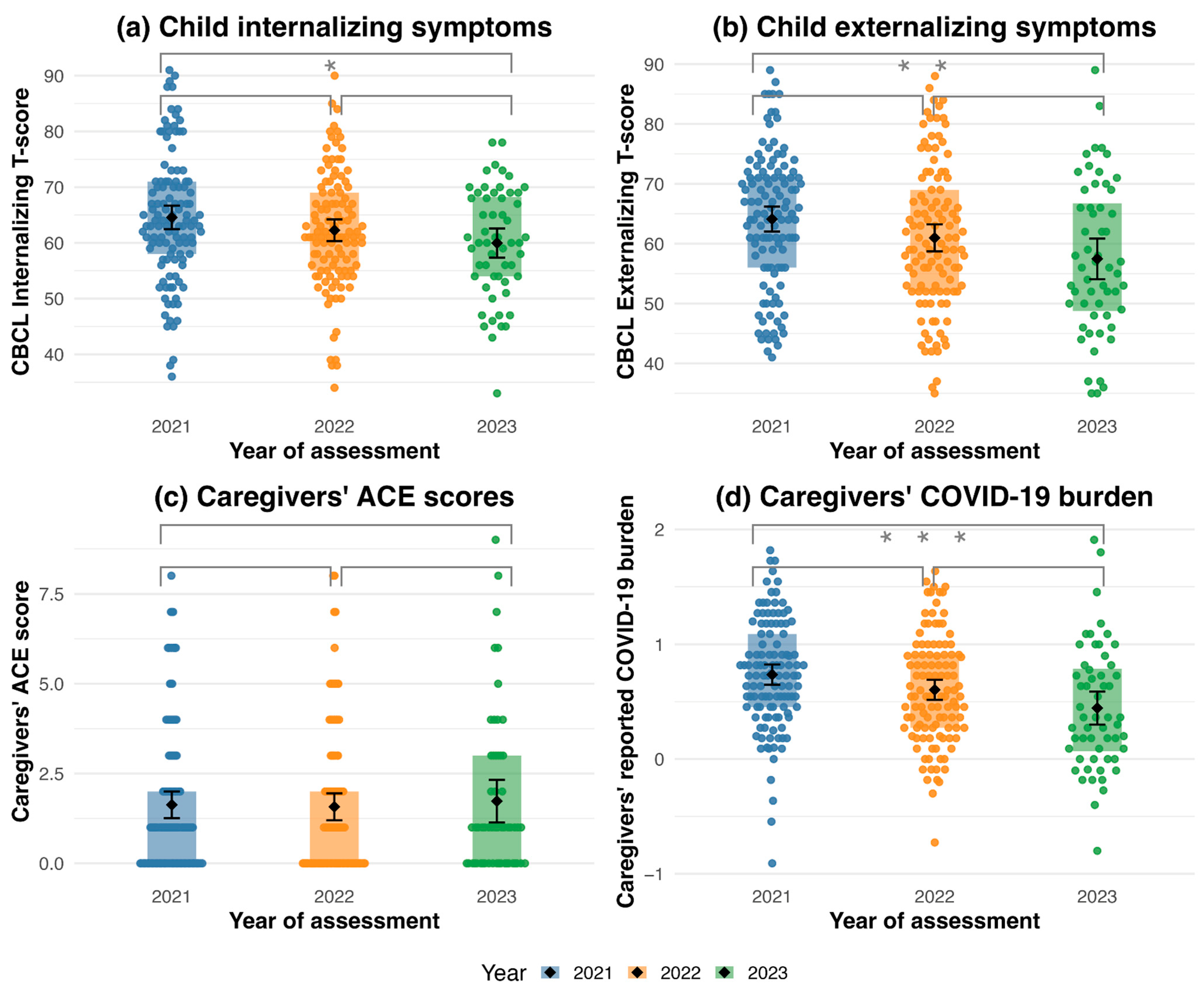
- Higher caregiver ACEs were not directly linked to perceived COVID-19 burden but were indirectly linked via increased child psychopathology, which significantly predicted caregiver burden.
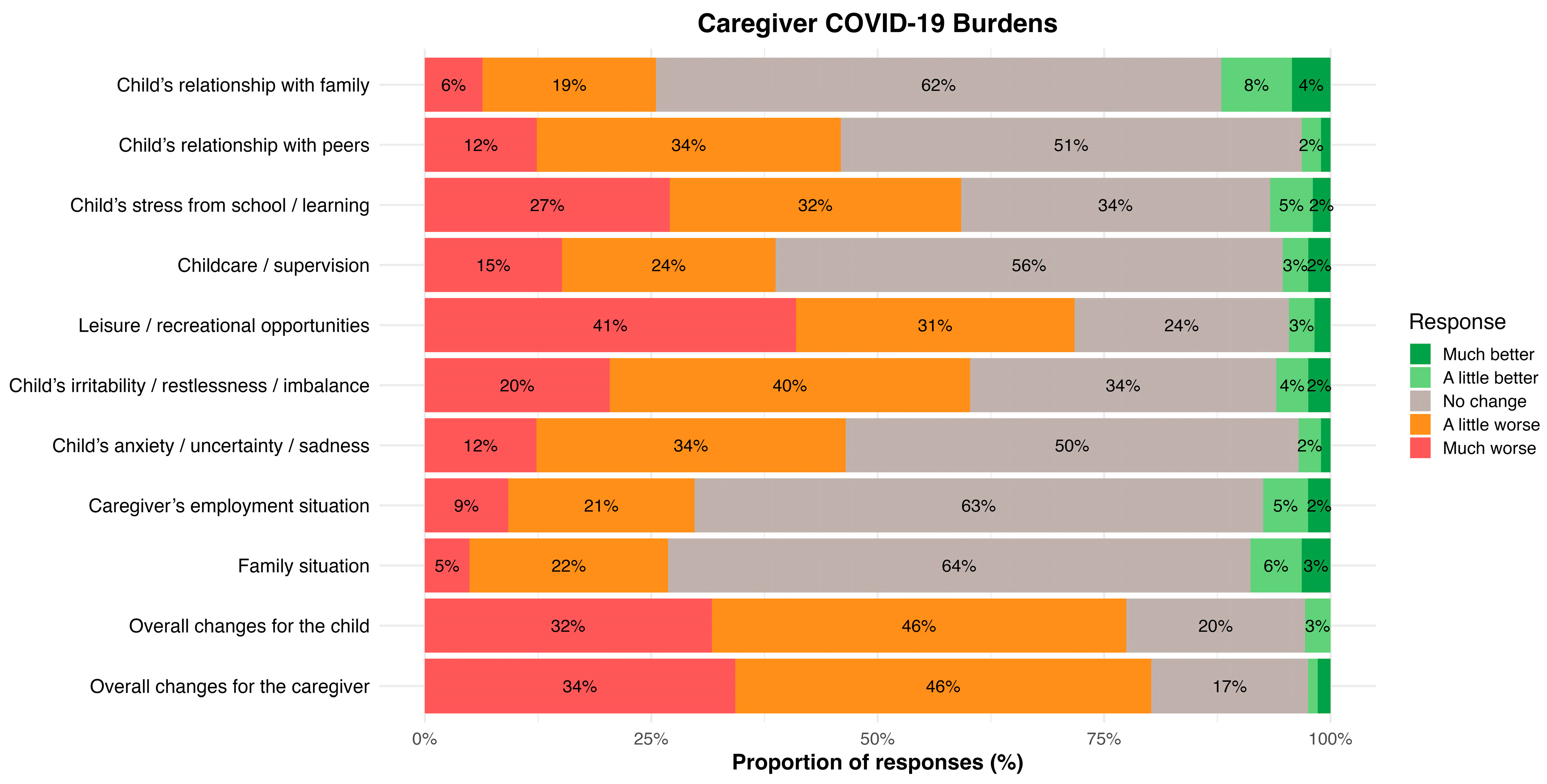
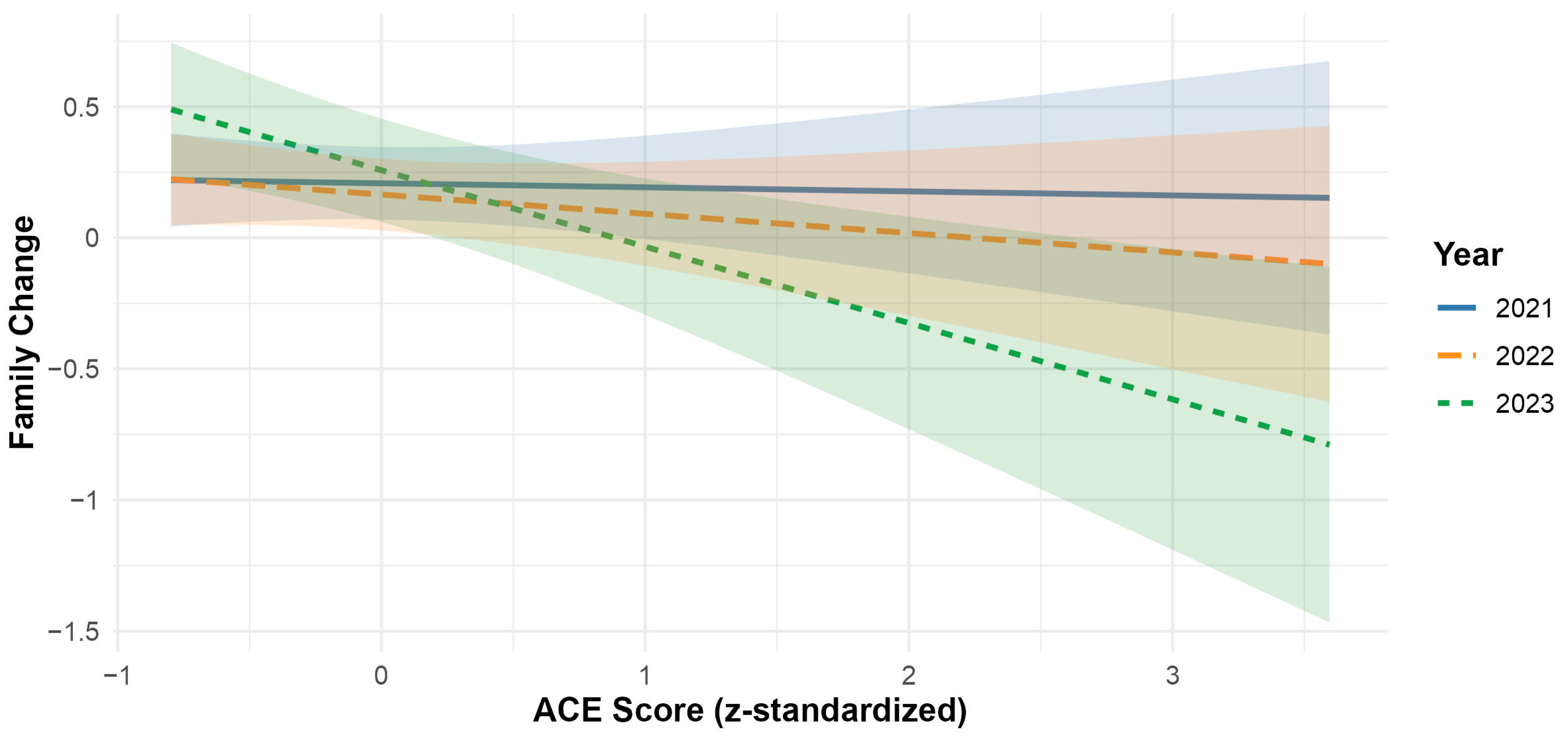
- While caregivers generally perceived pandemic-related family changes as slightly negative, higher ACEs were unexpectedly associated with less negative changes, especially in 2023.
- Child psychopathology plays a key role in the intergenerational transmission of stress, highlighting the need to address children’s mental health in families with high caregiver adversity.
- Unexpected resilience among high-ACE caregivers suggests that support systems, coping strategies, or shifted expectations may buffer family relationship burden during prolonged crises.
Abstract
1. Introduction
1.1. The Present Study
1.2. Research Questions, Study Outline and Hypotheses
- Did caregivers of children with mental health disorders experience increased burden during the COVID-19 pandemic?
- How did caregivers perceive pandemic-related changes in family relationships?
- Are higher ACE scores among caregivers associated with increased caregiver burden and greater perceived changes in family relationships?
- Does child psychopathology mediate the association between caregivers’ ACEs and caregiver COVID-19-related burden? (exploratory)
2. Materials and Methods
2.1. Sample
2.2. Study Design and Procedure
2.3. Measurements
2.4. Data Analysis
2.5. Bias and Limitations
3. Results
3.1. Sample Characteristics
3.2. Child Psychopathology
3.3. ACE of Caregivers
3.4. Association Between Caregiver ACE and Child Psychopathology
3.5. Comparison of ACE Scores with a German Reference Sample
3.6. Perceived COVID-19 Burden of Caregivers
3.7. Predictor Selection Based on Correlational Analyses
3.8. H1: Changes in Caregiver Burden Related to the COVID-19 Pandemic
Exploratory Mediation Analysis of the Relationship Between Caregiver ACEs and Caregiver Burden via Child Psychopathology
3.9. H2: Changes in Family Relationships Related to the COVID-19 Pandemic
3.9.1. H2.a: Average Perceived Changes in Family Relationships
3.9.2. H2.b: Association Between Caregivers’ ACE Scores and COVID-19-Related Changes in Family Relationships
4. Discussion
4.1. Caregiver ACEs and COVID-19 Burden (H1.a)
4.2. Child Psychopathology and Caregiver Burden (H1.b)
4.3. Exploratory Mediation Analysis
4.4. Perceived Changes in Family Relationships (H2.a and H2.b)
4.5. Clinical Implications
4.6. Limitations
4.7. Future Research
5. Conclusions
Author Contributions
Funding
Institutional Review Board Statement
Informed Consent Statement
Data Availability Statement
Acknowledgments
Conflicts of Interest
Abbreviations
| ANOVA | Analysis of Variance |
| CFI | Comparative Fit Index |
| CI | Confidence Interval |
| OR | Odds Ratio |
| TLI | Tucker–Lewis Index |
| SRMR | Standardized Root Mean Square Residual |
Appendix A

| Group | Diagnosis | N | |
|---|---|---|---|
| Externalizing | 151 | ||
| ADHD | Disturbance of activity and attention (F90.0; 89); Hyperkinetic conduct disorder (F90.1; 13) | 102 | |
| ODD | Oppositional defiant disorder (F91.3; 35) | 35 | |
| Conduct Disorder | Conduct disorder confined to the family context (F91.0; 3); Conduct disorder with lack of social bonds (F91.1; 1); Depressive conduct disorder (F92.0; 4); Other mixed disorders of conduct and emotions (F92.8; 5); Unspecified mixed disorder of conduct and emotions (F92.9; 1) | 14 | |
| Internalizing | 93 | ||
| Depressive disorders | Mild depressive episode (F32.0; 11); Moderate depressive episode (F32.1; 16); Severe depressive episode with psychotic symptoms (F32.3; 1); Prolonged depressive reaction (F43.21; 1) | 29 | |
| Anxiety disorders | Agoraphobia with panic disorder (F40.01; 1); Panic disorder (F41.0; 5); Generalized anxiety disorder (F41.1; 1); Social phobias (F40.1; 11); Specific phobias (F40.2; 4) | 22 | |
| PTSD & Adjustment | Post-traumatic stress disorder (F43.1; 7); Adjustment disorders (F43.2; 12); Reaction to severe stress, unspecified (F43.9; 1) | 20 | |
| Child-hood anxiety | Social anxiety disorder of childhood (F93.2; 3); Separation anxiety disorder of childhood (F93.1; 6); Phobic anxiety disorder of childhood (F93.0; 1) | 10 | |
| Other | Other childhood emotional disorders (F93.8; 7) | 7 | |
| OCD | Obsessive–compulsive disorder with predominant obsessions (F42.0; 1); Mixed obsessional thoughts and acts (F42.2; 4) | 5 | |
| Developmental | 62 | ||
| Scholastic skills | Specific reading disorder (F81.0; 13); Specific spelling disorder (F81.1; 7); Specific disorder of arithmetical skills (F81.2; 4); Mixed disorder of scholastic skills (F81.3; 1); Developmental learning disorder, unspecified (F81.9; 1) | 26 | |
| Mixed | Mixed specific developmental disorders (F83; 15) | 15 | |
| Speech | Phonological disorder (F80.0; 4); Expressive language disorder (F80.1; 3); Receptive language disorder (F80.2; 2) | 9 | |
| Autism spectrum | Childhood autism (F84.0; 1); Atypical autism (F84.1; 2); Asperger’s syndrome (F84.5; 5); Pervasive developmental disorder, unspecified (F84.9; 1) | 9 | |
| Motor | Specific developmental disorder of motor function (F82; 1); Developmental disorder of fine and graphomotor coordination (F82.1; 1); Developmental motor disorder, unspecified (F82.9; 1) | 3 | |
| Intellectual disability | Mild- Unspecified | Mild intellectual disability with/without behavioral impairment (F70; 1); Unspecified mental retardation with significant behavioral problems (F79.1; 1) | 2 |
| Other | 241 | ||
| Incontinence | Nonorganic enuresis (F98.0; 81); Nonorganic encopresis (F98.1; 41); Other specified urinary incontinence (R32.8; 37); Reflex incontinence (R32.0; 8) | 167 | |
| Behavioral and emotional disorders | Other specified behavioral and emotional disorders with onset usually occurring in childhood and adolescence (F98.8; 19); Elective mutism (F94.0; 4); Disinhibited attachment disorder of childhood (F94.2; 2); Stuttering (Stammering; F98.5; 1) | 26 | |
| Tic Disorder | Transient tic disorder (F95.0; 4); Chronic motor or vocal tic disorder (F95.1; 3); Tourette syndrome (F95.2; 1) | 8 | |
| Eating Disorders | Other eating disorders (F50.8; 3); Atypical bulimia nervosa (F50.3; 2); Anorexia nervosa (F50.0; 2); Atypical anorexia nervosa (F50.1; 1) | 8 | |
| Gender Identity Disorders | Transsexualism (F64.0; 1); Gender identity disorder of childhood (F64.2; 1); Other gender identity disorders (F64.8; 1) | 3 | |
| Dissociative & Psychotic Disorders | Dissociative motor disorders (F44.4; 1); Disorganized schizophrenia (F20.1; 1) | ||
| Sleep Disorders | Nonorganic insomnia (F51.0; 2) | 2 | |
| Impulse Control Disorders | Other specified habit and impulse disorders (F63.8; 2) | 2 | |
Appendix B

References
- Chams, N.; Chams, S.; Badran, R.; Shams, A.; Araji, A.; Raad, M.; Mukhopadhyay, S.; Stroberg, E.; Duval, E.J.; Barton, L.M.; et al. COVID-19: A Multidisciplinary Review. Front. Public Health 2020, 8, 383. [Google Scholar] [CrossRef]
- WHO Coronavirus Disease (COVID-19) Pandemic [Internet]. World Health Organization, 2023. Available online: https://www.who.int/europe/emergencies/situations/covid-19 (accessed on 30 June 2025).
- Msemburi, W.; Karlinsky, A.; Knutson, V.; Aleshin-Guendel, S.; Chatterji, S.; Wakefield, J. The WHO estimates of excess mortality associated with the COVID-19 pandemic. Nature 2023, 613, 130–137. [Google Scholar] [CrossRef] [PubMed]
- Hosseinzadeh, P.; Zareipour, M.; Baljani, E.; Rezaee, M. Social Consequences of the COVID-19 Pandemic. A Systematic Review. Investig. Educ. Enfermería 2022, 40, e10. [Google Scholar] [CrossRef]
- Ravens-Sieberer, U.; Kaman, A.; Erhart, M.; Otto, C.; Devine, J.; Löffler, C.; Hurrelmann, K.; Bullinger, M.; Barkmann, C.; Siegel, N.A.; et al. Quality of life and mental health in children and adolescents during the first year of the COVID-19 pandemic: Results of a two-wave nationwide population-based study. Eur. Child Adolesc. Psychiatry 2023, 32, 575–588. [Google Scholar] [CrossRef]
- Fegert, J.M.; Vitiello, B.; Plener, P.L.; Clemens, V. Challenges and burden of the Coronavirus 2019 (COVID-19) pandemic for child and adolescent mental health: A narrative review to highlight clinical and research needs in the acute phase and the long return to normality. Child Adolesc. Psychiatry Ment. Health 2020, 14, 20. [Google Scholar] [CrossRef]
- Arowolo, T.; Animasahun, A.; Baptiste-Roberts, K.; Bronner, Y. Effect of Covid-19 Pandemic response and parental adverse childhood experiences on child health and well-being. J. Child Adolesc. Trauma 2024, 17, 5–14. [Google Scholar] [CrossRef]
- Felitti, V.J.; Anda, R.F.; Nordenberg, D.; Williamson, D.F.; Spitz, A.M.; Edwards, V.; Koss, M.P.; Marks, J.S. Relationship of childhood abuse and household dysfunction to many of the leading causes of death in adults: The adverse childhood experiences (ACE) study. Am. J. Prev. Med. 1998, 14, 245–258. [Google Scholar] [CrossRef] [PubMed]
- Hughes, K.; Bellis, M.; Hardcastle, K.; Sethi, D.; Mikton, C.; Jones, L.; Dunne, M. The effect of multiple adverse childhood experiences on health: A systematic review and meta-analysis. Lancet Public Health 2017, 2, e356–e366. [Google Scholar] [CrossRef] [PubMed]
- Witt, A.; Sachser, C.; Plener, P.L.; Brähler, E.; Fegert, J.M. The Prevalence and Consequences of Adverse Childhood Experiences in the German Population. Dtsch. Ärzteblatt Int. 2019, 116, 635. [Google Scholar] [CrossRef]
- Condon, E.; Holland, M.; Slade, A.; Redeker, N.; Mayes, L.; Sadler, L. Maternal adverse childhood experiences, family strengths, and chronic stress in children. Nurs. Res. 2019, 68, 189–199. [Google Scholar] [CrossRef]
- Schickedanz, A.; Halfon, N.; Sastry, N.; Chung, P. Parents’ adverse childhood experiences and their children’s behavioral health problems. Pediatrics 2018, 142, e20180023. [Google Scholar] [CrossRef]
- Schulz, W.; Cornelius, J.; Supke, M. Die Bedeutung kritischer Lebensereignisse in der Kindheit für die psychische Gesundheit von Jugendlichen—Ergebnisse einer 10-Jahres-Katamnese. Z. Kinder-Jugendpsychiatrie Psychother. 2020, 49, 7–17. [Google Scholar] [CrossRef]
- Lange, B.C.L.; Callinan, L.S.; Smith, M.V. Adverse childhood experiences and their relation to parenting stress and parenting practices. Community Ment. Health J. 2019, 55, 651–662. [Google Scholar] [CrossRef]
- Folger, A.T.; Eismann, E.A.; Stephenson, N.B.; Shapiro, R.A.; Macaluso, M.; Brownrigg, M.E.; Gillespie, R.J. Parental adverse childhood experiences and offspring development at 2 years of age. Pediatrics 2018, 141, e20172826. [Google Scholar] [CrossRef] [PubMed]
- Gassman-Pines, A.; Ananat, E.; Fitz-Henley, J. COVID-19 crisis impacts on parent and child psychological well-being. Pediatrics 2020, 146, e2020007294. [Google Scholar] [CrossRef] [PubMed]
- Patrick, S.W.; Henkhaus, L.E.; Zickafoose, J.S.; Lovell, K.; Halvorson, A.; Loch, S.; Letterie, M.; Davis, M.M. Well-being of parents and children during the covid-19 pandemic: A national survey. Pediatrics 2020, 146, e2020016824. [Google Scholar] [CrossRef]
- Marchetti, D.; Fontanesi, L.; Mazza, C.; Di Giandomenico, S.; Roma, P.; Verrocchio, M.C. Parenting-related exhaustion during the italian COVID-19 lockdown. J. Pediatr. Psychol. 2020, 45, 1114–1123. [Google Scholar] [CrossRef]
- Brik, A.B.; Wang, Y. Family resources, resilience beliefs, and parental adaptation: A moderated mediation analysis. Fam. Process 2025, 64, e13067. [Google Scholar] [CrossRef]
- Perry, K.J.; Penner, F.; Contreras, H.T.; Santos, R.P.; Sarver, D.E. A U.S. National Study of Family Resilience During the COVID-19 Pandemic. J. Child Fam. Stud. 2023, 32, 1627–1642. [Google Scholar] [CrossRef]
- Prime, H.; Wade, M.; Browne, D.T. Risk and resilience in family well-being during the COVID-19 pandemic. Am. Psychol. 2020, 75, 631. [Google Scholar] [CrossRef] [PubMed]
- Marzilli, E.; Cerniglia, L.; Tambelli, R.; Trombini, E.; De Pascalis, L.; Babore, A.; Trumello, C.; Cimino, S. The COVID-19 Pandemic and Its Impact on Families’ Mental Health: The Role Played by Parenting Stress, Parents’ Past Trauma, and Resilience. Int. J. Environ. Res. Public Health 2021, 18, 11450. [Google Scholar] [CrossRef]
- Wu, Q.; Xu, Y. Parenting stress and risk of child maltreatment during the COVID-19 pandemic: A family stress theory-informed perspective. Dev. Child Welf. 2020, 2, 180–196. [Google Scholar] [CrossRef]
- Wingenfeld, K.; Schäfer, I.; Kirsten, T.; Heike, G.; Martin, D.; Hans, G.; Bernd, L.; Carsten, S. Reliable valide und ökonomische Erfassung früher Traumatisierung: Erste psychometrische Charakterisierung der deutschen Version des Adverse Childhood Experiences Questionnaire (ACE). Psychother. Psychosom. Med. Psychol. 2011, 61, e10–e14. [Google Scholar] [CrossRef]
- Dube, S.R.; Williamson, D.F.; Thompson, T.; Felitti, V.J.; Anda, R.F. Assessing the reliability of retrospective reports of adverse childhood experiences among adult HMO members attending a primary care clinic. Child Abus. Negl. 2004, 28, 729–737. [Google Scholar] [CrossRef] [PubMed]
- Achenbach, T. CBCL 1 1/2–5 Child Behavior Checklist 1 1/2–5–Deutsche Fassung. Elternfragebogen für Klein-und Vorschulkinder; Hogrefe: Göttingen, Germeny, 2000. [Google Scholar]
- Döpfner, M.; Achenbach, T.M.; Plück, J.; Kinnen, C.; Plück, J. CBCL/6-18R-TRF/6-18R-YSR/11-18R: Deutsche Schulalter-Formen der Child Behavior Checklist von Thomas M. In Achenbach: Elternfragebogen über das Verhalten von Kindern und Jugendlichen (CBCL/6-18R), Lehrerfragebogen über das Verhalten von Kindern und Jugendlichen (TRF/6-18R), Fragebogen für Jugendliche (YSR/11-18R); Hogrefe: Göttingen, Germany, 2014. [Google Scholar]
- Döpfner, M.; Görtz-Dorten, A. Corona Belastungsbogen [Unpublished Manuscript]; Department of Child and Adolescent Psychiatry; Psychosomatics and Psychotherapy of the University Hospital Cologne: Cologne, Germany, 2020. [Google Scholar]
- Döpfner, M.; Adam, J.; Habbel, C.; Schulte, B.; Schulze-Husmann, K.; Simons, M.; Heuer, F.; Wegner, C.; Bender, S.; Schwendowius, J.; et al. Die psychische Belastung von Kindern, Jugendlichen und ihren Familien während der COVID-19-Pandemie und der Zusammenhang mit emotionalen und Verhaltensauffälligkeiten. Bundesgesundheitsblatt-Gesundheitsforschung-Gesundheitsschutz 2021, 64, 1522–1532. [Google Scholar] [CrossRef] [PubMed]
- R Core Team. A Language and Environment for Statistical Computing; R Foundation for Statistical Computing: Vienna, Austria, 2025; Available online: https://www.R-project.org/ (accessed on 5 June 2025).
- Metsämuuronen, J. R Effect Size and Generalized Cohen d 2024 with Name; ResearchGate: Berlin, Germany, 2024. [Google Scholar]
- Rosseel, Y. Lavaan: An r package for structural equation modeling. J. Stat. Softw. 2011, 48, 1–36. [Google Scholar] [CrossRef]
- Zeileis, A.; Hothorn, T. Diagnostic checking in regression relationships. R News 2002, 2, 7–10. [Google Scholar]
- Lenth, R.V. Emmeans: Estimated Marginal Means, Aka Least-Squares Means. 2025. Available online: https://doi.org/10.32614/CRAN.package.emmeans (accessed on 25 June 2025).
- Scorza, P.; Corbeil, T.; Wall, M.; Monk, C.; Suglia, S.; Wainberg, M.; Alegria, M.; Canino, G.; Bird, H.; Duarte, C.S. Adverse childhood experiences and perceived stress in early adulthood in the context of disadvantage. Child Abus. Negl. 2022, 131, 105687. [Google Scholar] [CrossRef]
- Wade, M.; Zeanah, C.H.; Fox, N.A.; Tibu, F.; Ciolan, L.E.; Nelson, C.A. Stress sensitization among severely neglected children and protection by social enrichment. Nat. Commun. 2019, 10, 5771. [Google Scholar] [CrossRef]
- Zong, X.; Simmons, C.; Yang, L. Context matters: Longitudinal associations between childhood adversity and mental health outcomes of middle-aged and older adults in 26 countries during the COVID-19 pandemic. J. Affect. Disord. 2025, 389, 119649. [Google Scholar] [CrossRef]
- Neece, C.L.; Green, S.A.; Baker, B.L. Parenting stress and child behavior problems: A transactional relationship across time. Am. J. Intellect. Dev. Disabil. 2012, 117, 48–66. [Google Scholar] [CrossRef]
- Shnitzer-Meirovich, S.; Aviad, S.; Bechar-katz, I.; Araten-Bergman, T.; Shenaar-Golan, V.; Gur, A. The associations between child behavioral problems, parents’ emotional regulation difficulties, and parental burnout among Israeli parents of children with autism during wartime. Front. Psychol. 2024, 15, 1439384. [Google Scholar] [CrossRef] [PubMed]
- Vaughan, E.L.; Feinn, R.; Bernard, S.; Brereton, M.; Kaufman, J.S. Relationships between child emotional and behavioral symptoms and caregiver strain and parenting stress. J. Fam. Issues 2013, 34, 534–556. [Google Scholar] [CrossRef] [PubMed]
- Sameroff, A. The transactional model. In The Transactional Model of Development: How Children and Contexts Shape Each Other; American Psychological Association: Washington, DC, USA, 2009; pp. 3–21. [Google Scholar] [CrossRef]
- Schermerhorn, A.C.; Cummings, E.M. Transactional family dynamics: A new framework for conceptualizing family influence processes. Adv. Child Dev. Behav. 2008, 36, 187–250. [Google Scholar] [CrossRef] [PubMed]
- Chiang, S.-C.; Bai, S. Bidirectional associations between parenting stress and child psychopathology: The moderating role of maternal affection. Dev. Psychopathol. 2024, 36, 1810–1820. [Google Scholar] [CrossRef]
- Goodrum, N.M.; Armistead, L.P.; Masyn, K.; Schulte, M.; Murphy, D.A. Longitudinal bidirectional relations among parenting quality, parenting stress, and child functioning in HIV-affected families. J. Youth Adolesc. 2021, 50, 1663–1678. [Google Scholar] [CrossRef]
- Beach, S.R.; Schulz, R.; Donovan, H.; Rosland, A.-M. Family caregiving during the COVID-19 pandemic. Gerontologist 2021, 61, 650–660. [Google Scholar] [CrossRef]
- Raviv, T.; Warren, C.M.; Washburn, J.J.; Kanaley, M.K.; Eihentale, L.; Goldenthal, H.J.; Russo, J.; Martin, C.P.; Lombard, L.S.; Tully, J.; et al. Caregiver perceptions of children’s psychological well-being during the COVID-19 pandemic. JAMA Netw. Open 2021, 4, e2111103. [Google Scholar] [CrossRef]
- Israel, E.S.; Gibb, B.E. A transactional mediation model of risk for the intergenerational transmission of depression: The role of maternal criticism. Dev. Psychopathol. 2024, 36, 92–100. [Google Scholar] [CrossRef]
- Tisborn, K.; Pelz, J.D.; Schneider, S.; Seehagen, S. The mental well-being of young children and families at the beginning of the COVID-19 pandemic in Germany. Z. Entwicklungspsychologie Pädagogische Psychol. 2022, 54, 51–66. [Google Scholar] [CrossRef]
- Cheong, E.V.; Sinnott, C.; Dahly, D.; Kearney, P.M. Adverse childhood experiences (ACEs) and later-life depression: Perceived social support as a potential protective factor. BMJ Open 2017, 7, e013228. [Google Scholar] [CrossRef]
- Oginni, O.; Ogunbajo, A.; Oke, T.; Ibigbami, O.; Okanlawon, K.; Oloniniyi, I.; Abu-Ba’are, G.; Mapayi, B.; Mosaku, K. Perceived social support as a protective factor against psychological distress in the context of COVID-19-related stress and sexual minority status in Nigeria. Psychol. Sex. Orientat. Gend. Divers. 2023, 11, 679–689. [Google Scholar] [CrossRef]
- Kok, A.A.L.; Twisk, J.W.R.; Blom, F.; Beekman, A.T.F.; Huisman, M. Steeling or sensitizing? A longitudinal examination of how ongoing accumulation of negative life events affects depressive symptoms in older adults. J. Gerontol. Ser. B 2021, 76, 2041–2053. [Google Scholar] [CrossRef] [PubMed]
- Rutter, M. Resilience as a dynamic concept. Dev. Psychopathol. 2012, 24, 335–344. [Google Scholar] [CrossRef] [PubMed]
- Francisco, R.; Pedro, M.; Delvecchio, E.; Espada, J.P.; Morales, A.; Mazzeschi, C.; Orgilés, M. Psychological symptoms and behavioral changes in children and adolescents during the early phase of COVID-19 quarantine in three european countries. Front. Psychiatry 2020, 11, 570164. [Google Scholar] [CrossRef]
- Gatell-Carbó, A.; Alcover-Bloch, E.; Balaguer-Martínez, J.V.; Pérez-Porcuna, T.; Esteller-Carceller, M.; Álvarez-Garcia, P.; Fortea-Gimeno, E. State of child and adolescent mental health during the first wave of the COVID-19 pandemic and at the beginning of the 2020–2021 school year. An. Pediatría (Engl. Ed.) 2021, 95, 354–363. [Google Scholar] [CrossRef]
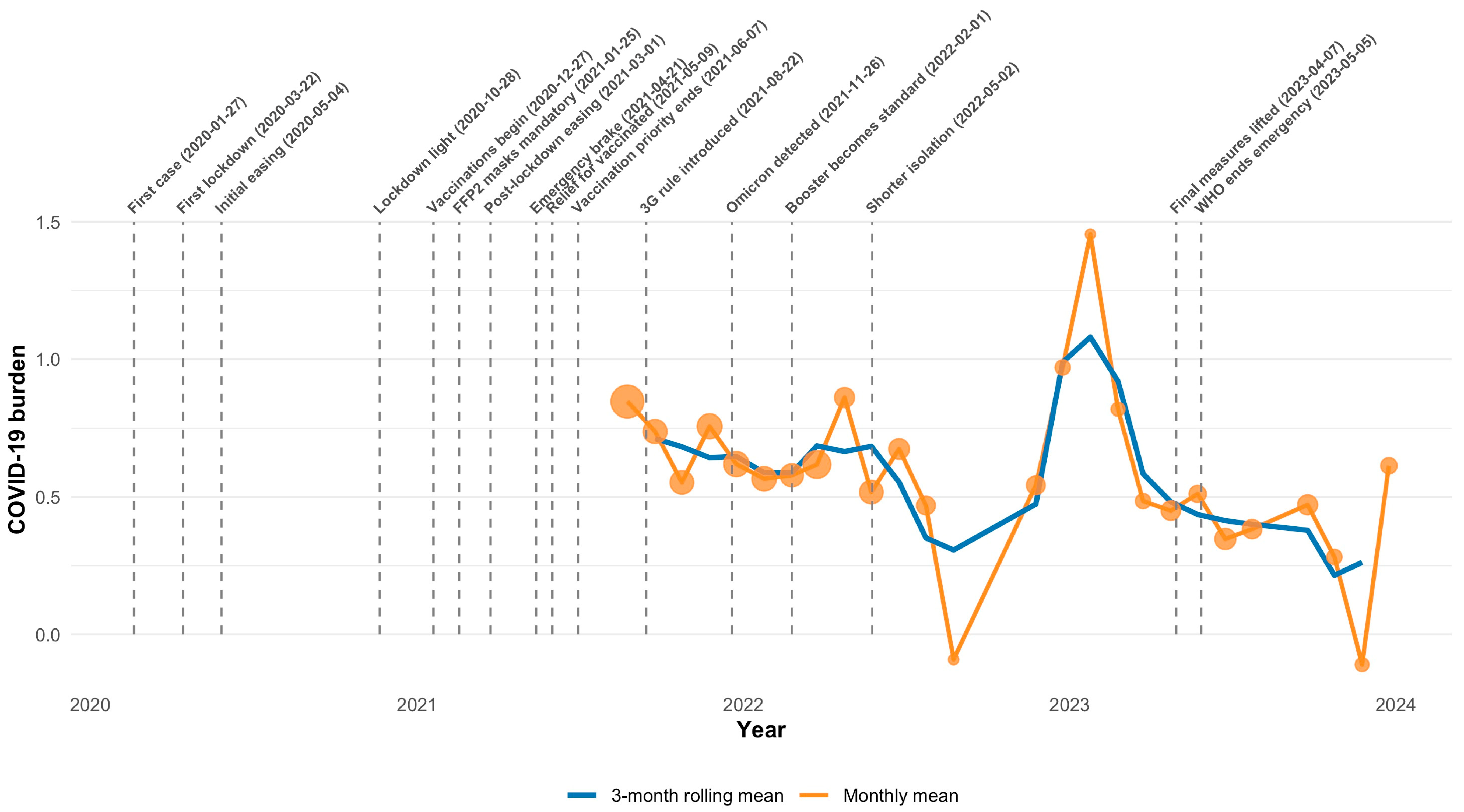
- Bundesministerium für Gesundheit Coronavirus-Pandemie: Was Geschah Wann? [Internet]. Bundesministerium für Gesundheit, 2023. Available online: https://www.bundesgesundheitsministerium.de/coronavirus/chronik-coronavirus.html (accessed on 10 June 2025).


| Variable | M (SD) | Range | N | % |
|---|---|---|---|---|
| Age child | 10.19 (3.36) | 3.58–17.67 | 285 | |
| Gender child | 285 | |||
| male | 177 | 62.1% | ||
| female | 107 | 37.5% | ||
| diverse | 1 | 0.4% | ||
| Year Questionnaire | 285 | |||
| 2021 | 116 | 40.7% | ||
| 2022 | 113 | 39.6% | ||
| 2023 | 56 | 19.6% | ||
| Psychopathology child | ||||
| CBCL Internalizing | 62.75 (10.86) | 33–91 | ||
| CBCL Externalizing | 61.56 (12.14) | 35–89 | ||
| CBCL Total Score | 65.12 (11.29) | 32–91 | ||
| Clinical diagnoses child a | 285 | |||
| Externalizing | 151 | 53.0% | ||
| Internalizing | 93 | 32.6% | ||
| Developmental | 62 | 21.8% | ||
| Intellectual disability | 2 | 0.7% | ||
| Other | 241 | 84.6% | ||
| ACE score caregiver | 1.63 (2.05) | 0–9 | 285 | |
| COVID-19 burden caregiver b | 0.63 (0.50) | −0.91–1.91 | 285 |
| Study Sample (%) | Reference Sample (%) | 95% CI | p-Value | Cohen’s h | |
|---|---|---|---|---|---|
| ACE Frequencies | |||||
| Emotional abuse | 23.3 | 12.5 | [18.5, 28.7] | <0.001 *** | 0.28 |
| Physical abuse | 16.5 | 9.1 | [12.4, 21.4] | <0.001 *** | 0.22 |
| Sexual abuse | 9.2 | 4.3 | [6.1, 13.2] | <0.001 *** | 0.20 |
| Emotional neglect | 23.9 | 13.4 | [19.0, 29.2] | <0.001 *** | 0.27 |
| Physical neglect | 7.4 | 4.3 | [4.6, 11.0] | 0.018 * | 0.13 |
| Parental separation/divorce | 26.4 | 19.4 | [21.4, 31.9] | 0.004 ** | 0.17 |
| Witnessed domestic violence | 7.1 | 9.8 | [4.4, 10.7] | <0.134 | −0.10 |
| Household substance use | 19.9 | 16.7 | [15.4, 25.0] | 0.151 | 0.08 |
| Mental illness in the household | 25.9 | 10.6 | [20.9, 31.4] | <0.001 *** | 0.40 |
| Incarcerated family member | 4.2 | 3.5 | [2.2, 7.3] | 0.514 | 0.04 |
| Cumulative ACE | |||||
| 0 ACEs | 41.9 | 56.3 | [36.0, 48.0] | <0.001 *** | −0.29 |
| 1 ACEs | 22.1 | 20.7 | [17.3, 27.5] | 0.600 | 0.03 |
| 2 ACEs | 11.4 | 8.6 | [7.9, 15.8] | 0.104 | 0.09 |
| 3 ACEs | 6.2 | 5.4 | [3.7, 9.8] | 0.502 | 0.03 |
| ≥4 ACEs | 18.4 | 8.9 | [14.0, 23.5] | <0.001 *** | 0.28 |
| Year | Child Age | Gender Child | CBCL Total | CBCL Ext. | CBCL Int. | COVID-19 Burden | ACE Care-Giver | |
|---|---|---|---|---|---|---|---|---|
| Year | - | |||||||
| Age Child | −0.32 *** | - | ||||||
| Gender Child a | −0.08 | −0.05 | - | |||||
| CBCL total b | −0.21 *** | 0.25 *** | 0.00 | - | ||||
| CBCL ext. b | −0.21 *** | 0.08 | 0.05 | 0.87 *** | - | |||
| CBCL int. b | −0.16 ** | 0.31 *** | −0.11 | 0.79 *** | 0.52 *** | - | ||
| COVID-19 burden | −0.22 *** | 0.20 *** | 0.06 | 0.39 *** | 0.33 *** | 0.33 *** | - | |
| ACE caregiver c | −0.02 | −0.02 | 0.02 | 0.18 ** | 0.18 ** | 0.13 * | 0.11 | - |
| Predictor | Estimate | Std. Coeff. | 95% CI | t-Value | p-Value |
|---|---|---|---|---|---|
| K1 a | 0.08 | 0.11 | [0.00, 0.23] | 1.89 | 0.060 |
| K2 b | 0.04 | 0.06 | [−0.05, 0.18] | 1.06 | 0.288 |
| Age child (z) | 0.04 | 0.09 | [−0.03, 0.21] | 1.43 | 0.154 |
| Gender c | 0.03 | 0.06 | [0.04, 0.17] | 1.63 | 0.246 |
| CBCL Int. (z) | 0.09 | 0.18 | [0.05, 0.32] | 2.67 | 0.008 ** |
| CBCL Ext. (z) | 0.10 | 0.20 | [0.07, 0.33] | 3.05 | 0.003 ** |
| ACE score (z) | 0.01 | 0.01 | [−0.10, 0.12] | 0.23 | 0.815 |
| Predictor | Estimate | Std. Coeff. | 95% CI | t-Value | p-Value |
|---|---|---|---|---|---|
| K1 a | −0.00 | 0.00 | [−0.12, 0.12] | −0.04 | 0.972 |
| K2 b | −0.05 | −0.05 | [−0.17, 0.07] | −0.76 | 0.448 |
| Age child (z) | −0.13 | −0.12 | [−0.24, −0.01] | −2.73 | 0.007 ** |
| Gender c | 0.08 | 0.10 | [−0.03, 0.24] | 1.51 | 0.131 |
| CBCL Int. (z) | 0.08 | 0.10 | [−0.03, 0.24] | 1.50 | 0.136 |
| CBCL Ext. (z) | 0.11 | 0.11 | [−0.01, 0.23] | 1.83 | 0.069 |
| ACE score (z) | 0.10 | 0.11 | [−0.01, 0.22] | 1.86 | 0.064 |
Disclaimer/Publisher’s Note: The statements, opinions and data contained in all publications are solely those of the individual author(s) and contributor(s) and not of MDPI and/or the editor(s). MDPI and/or the editor(s) disclaim responsibility for any injury to people or property resulting from any ideas, methods, instructions or products referred to in the content. |
© 2025 by the authors. Licensee MDPI, Basel, Switzerland. This article is an open access article distributed under the terms and conditions of the Creative Commons Attribution (CC BY) license (https://creativecommons.org/licenses/by/4.0/).
Share and Cite
Baschab, J.F.; Feindel, K.; Moehler, E.; Hussong, J. The Legacy of Adversity? The Impact of Caregivers’ Childhood Experiences and Children’s Mental Health on Family Dynamics and Perceived Burden During the COVID-19 Pandemic. Children 2025, 12, 1519. https://doi.org/10.3390/children12111519
Baschab JF, Feindel K, Moehler E, Hussong J. The Legacy of Adversity? The Impact of Caregivers’ Childhood Experiences and Children’s Mental Health on Family Dynamics and Perceived Burden During the COVID-19 Pandemic. Children. 2025; 12(11):1519. https://doi.org/10.3390/children12111519
Chicago/Turabian StyleBaschab, Julia Franziska, Kristina Feindel, Eva Moehler, and Justine Hussong. 2025. "The Legacy of Adversity? The Impact of Caregivers’ Childhood Experiences and Children’s Mental Health on Family Dynamics and Perceived Burden During the COVID-19 Pandemic" Children 12, no. 11: 1519. https://doi.org/10.3390/children12111519
APA StyleBaschab, J. F., Feindel, K., Moehler, E., & Hussong, J. (2025). The Legacy of Adversity? The Impact of Caregivers’ Childhood Experiences and Children’s Mental Health on Family Dynamics and Perceived Burden During the COVID-19 Pandemic. Children, 12(11), 1519. https://doi.org/10.3390/children12111519