Chain of Call: Learning How to Effectively Communicate with Emergency Medical Services at School
 , , , , , and
Highlights
- The use of didactic materials specifically developed by the research team is effective in helping schoolchildren acquire emergency call skills.
- A sequential learning approach allows the training to be tailored to the cognitive development and learning capacity of different age groups.
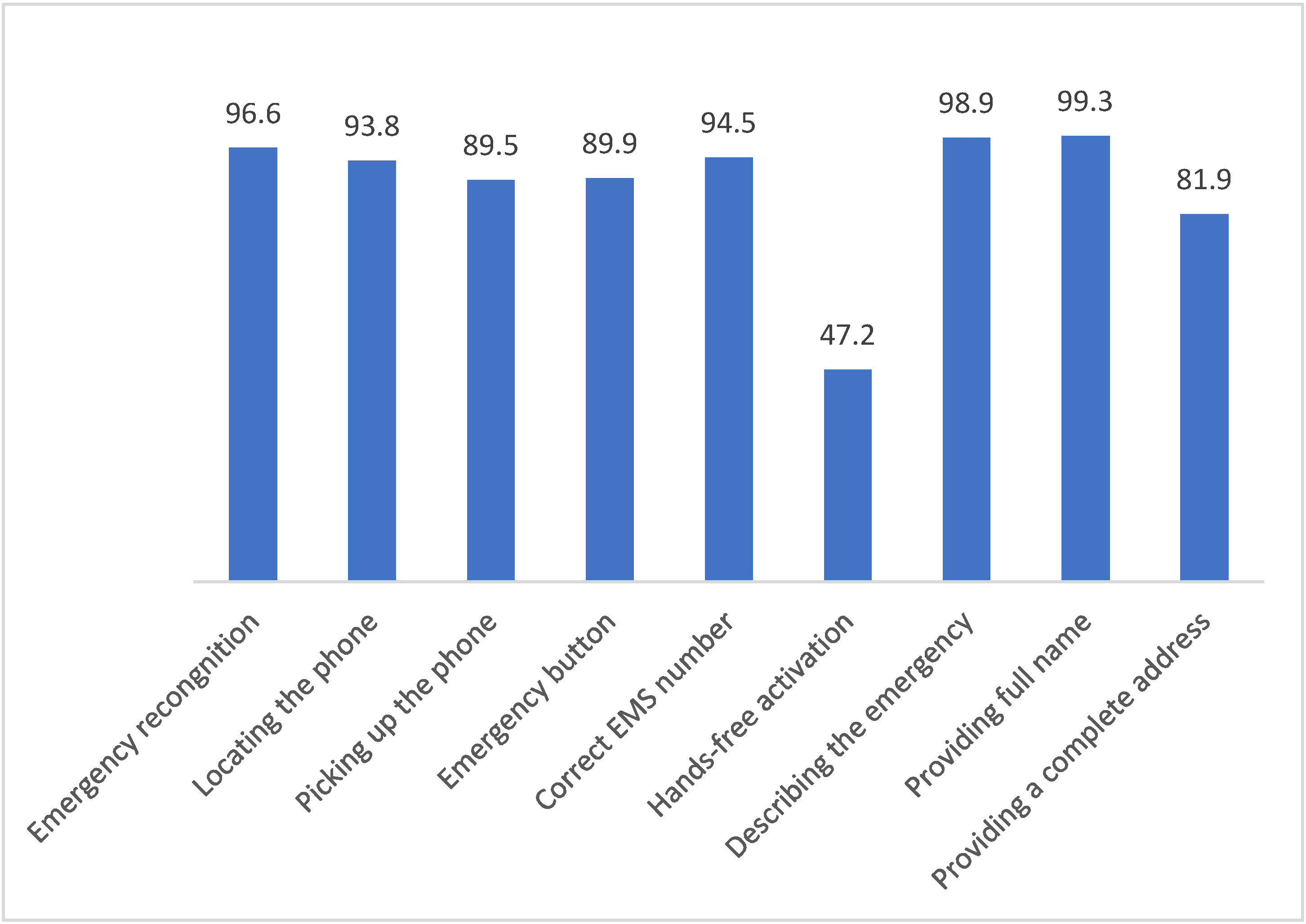
- This methodology enables schoolchildren to recognise emergency situations and initiate an EMS call, although some challenges remain in activating the hands-free function.
- These findings support the development of evidence-based recommendations for basic life support training in school settings.
Abstract
1. Introduction
2. Materials and Methods
2.1. Design
2.2. Participants
2.3. Intervention
2.4. Teaching and Training Materials
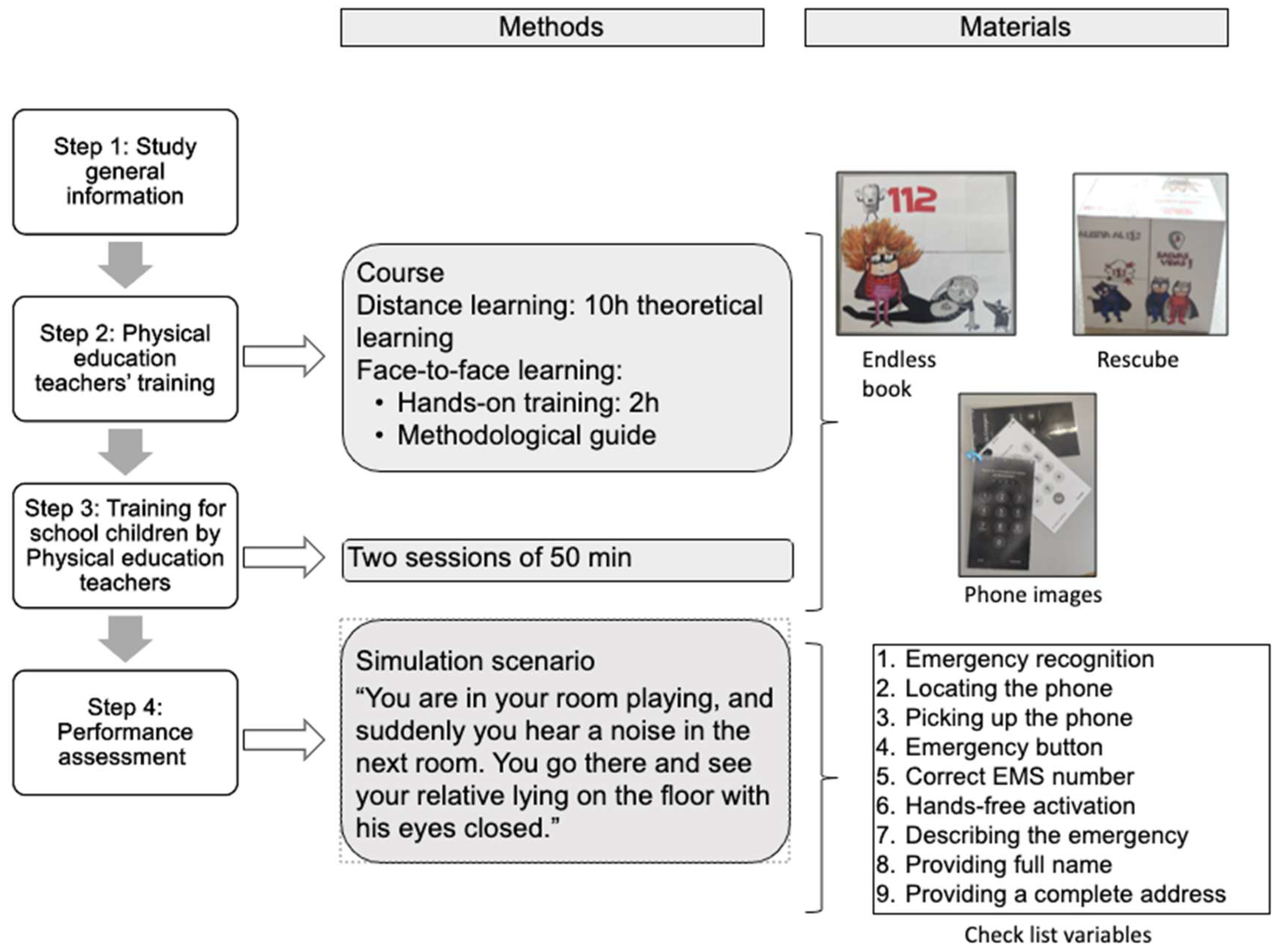
2.5. Assessment Checklist (Figure 1)
- -
- Emergency recognition: recognising the case as an emergency where it is necessary to alert emergency services.
- -
- Locating the phone: locating the phone at the scene.
- -
- Picking up the phone: deciding to call the emergency service.
- -
- Emergency button: pressing the emergency call button on the screen of a locked mobile phone.
- -
- Correct EMS number: dialling the correct emergency number (112).
- -
- Hands-free activation: pressing the corresponding icon on the phone model to activate hands-free mode.
- -
- Describing the emergency.
- -
- Providing full name.
- -
- Providing a complete address.
2.6. Statistical Analysis
3. Results
4. Discussion
Limitations
5. Conclusions
Supplementary Materials
Author Contributions
Funding
Institutional Review Board Statement
Informed Consent Statement
Data Availability Statement
Conflicts of Interest
Abbreviations
| EMS | Emergency medical system |
| BLS | Basic life support |
| EE | Elementary education |
| SS | Secondary school |
References
- Olasveengen, T.M.; Semeraro, F.; Ristagno, G.; Castren, M.; Handley, A.; Kuzovlev, A.; Monsieurs, K.G.; Raffay, V.; Smyth, M.; Soar, J.; et al. European Resuscitation Council Guidelines 2021: Basic Life Support. Resuscitation 2021, 161, 98–114. [Google Scholar] [CrossRef]
- Bohn, A.; Lukas, R.P.; Breckwoldt, J.; Böttiger, B.W.; Van Aken, H. ‘Kids save lives’: Why schoolchildren should train in cardiopulmonary resuscitation. Curr. Opin. Crit. Care 2015, 21, 220. [Google Scholar] [CrossRef] [PubMed]
- Schroeder, D.C.; Finke, S.-R.; Grübl, T.; Jänig, C.W.; Böttiger, B.W. Education of schoolchildren in cardiopulmonary resuscitation—Overview of the current literature. Curr. Opin. Crit. Care 2023, 29, 616–620. [Google Scholar] [CrossRef]
- Böttiger, B.W.; Aken, H.V. Kids save lives—Training school children in cardiopulmonary resuscitation worldwide is now endorsed by the World Health Organization (WHO). Resuscitation 2015, 94, A5–A7. [Google Scholar] [CrossRef]
- Schroeder, D.C.; Semeraro, F.; Greif, R.; Bray, J.; Morley, P.; Parr, M.; Nakagawa, N.K.; Iwami, T.; Finke, S.-R.; Hansen, C.M.; et al. KIDS SAVE LIVES: Basic Life Support Education for Schoolchildren: A Narrative Review and Scientific Statement From the International Liaison Committee on Resuscitation. Circulation 2023, 147, 1854–1868, Erratum in Circulation 2023, 148, e1. [Google Scholar] [CrossRef] [PubMed]
- Lukas, R.-P.; Van Aken, H.; Mölhoff, T.; Weber, T.; Rammert, M.; Wild, E.; Bohn, A. Kids save lives: A six-year longitudinal study of schoolchildren learning cardiopulmonary resuscitation: Who should do the teaching and will the effects last? Resuscitation 2016, 101, 35–40. [Google Scholar] [CrossRef]
- Semeraro, F.; Wingen, S.; Schroeder, D.C.; Ecker, H.; Scapigliati, A.; Ristagno, G.; Böttiger, B.W. KIDS SAVE LIVES implementation in Europe: A survey through the ERC Research NET. Resuscitation 2016, 107, e7–e9. [Google Scholar] [CrossRef]
- Semeraro, F.; Imbriaco, G.; Giudice, D.D.; Antognoli, M.; Celin, D.; Cuttitta Met, A.L. Empowering the Next Generation: An innovative “Kids Save Lives” blended learning program for schoolchildren training. Resuscitation 2024, 194, 110088. [Google Scholar] [CrossRef]
- Nolan, J.; Soar, J.; Eikeland, H. The chain of survival. Resuscitation 2006, 71, 270–271. [Google Scholar] [CrossRef]
- De Buck, E.; Van Remoortel, H.; Dieltjens, T.; Verstraeten, H.; Clarysse, M.; Moens, O.; Vandekerckhove, P. Evidence-based educational pathway for the integration of first aid training in school curricula. Resuscitation 2015, 94, 8–22. [Google Scholar] [CrossRef]
- Huber, J.F.; Davis, S.; Phan, J.; Jegathesan, T.; Campbell, D.M.; Chau, R.; Walsh, C.M. Children’s Ability to Call 911 in an Emergency: A Simulation Study. Pediatrics 2021, 147, e2020010520. [Google Scholar] [CrossRef] [PubMed]
- Rossetto, A.; Morgan, A.J.; Hart, L.M.; Kelly, C.M.; Jorm, A.F. Frequency and quality of first aid offered by older adolescents: A cluster randomised crossover trial of school-based first aid courses. PeerJ 2020, 8, e9782. [Google Scholar] [CrossRef] [PubMed] [PubMed Central]
- Reveruzzi, B.; Buckley, L.; Sheehan, M. First aid training in secondary schools: A comparative study and implementation considerations. J. Saf. Res. 2020, 75, 32–40. [Google Scholar] [CrossRef] [PubMed]
- Martínez-Isasi, S.; Carballo-Fazanes, A.; Jorge-Soto, C.; Otero-Agra, M.; Fernández-Méndez, F.; Barcala-Furelos, R.; Izquierdo, V.; García-Martínez, M.; Rodríguez-Núñez, A. School children brief training to save foreign body airway obstruction. Eur. J. Pediatr. 2023, 182, 5483–5491. [Google Scholar] [CrossRef]
- Greif, R.; Lockey, A.; Breckwoldt, J.; Carmona, F.; Conaghan, P.; Kuzovlev, A.; Pflanzl-Knizacek, L.; Sari, F.; Shammet, S.; Scapigliati, A.; et al. European Resuscitation Council Guidelines 2021: Education for resuscitation. Resuscitation 2021, 161, 388–407. [Google Scholar] [CrossRef]
- Varela-Casal, C.; Abelairas-Gómez, C.; Otero-Agra, M.; Barcala-Furelos, R.; Rodríguez-Núñez, A.; Greif, R. Teaching Basic Life Support to 5- to 8-Year-Old Children: A Cluster Randomized Trial. Pediatrics 2021, 148, e2021051408. [Google Scholar] [CrossRef] [PubMed]
- Böttiger, B.W.; Semeraro, F.; Wingen, S. “Kids Save Lives”: Educating Schoolchildren in Cardiopulmonary Resuscitation Is a Civic Duty That Needs Support for Implementation. J. Am. Heart Assoc. 2017, 6, e005738. [Google Scholar] [CrossRef] [PubMed]
- Ko, J.S.; Kim, S.R.; Cho, B.J. The Effect of Cardiopulmonary Resuscitation (CPR) Education on the CPR Knowledge, Attitudes, Self-Efficacy, and Confidence in Performing CPR among Elementary School Students in Korea. Healthcare 2023, 11, 2047. [Google Scholar] [CrossRef] [PubMed] [PubMed Central]
- Horriar, L.; Rott, N.; Böttiger, B.W. Improving survival after cardiac arrest in Europe: The synergetic effect of rescue chain strategies. Resusc. Plus 2023, 17, 100533. [Google Scholar] [CrossRef] [PubMed] [PubMed Central]
- Younas, S.; Raynes, A.; Morton, S.; Mackway-Jones, K. An evaluation of the effectiveness of the Opportunities for Resuscitation and Citizen Safety (ORCS) defibrillator training programme designed for older school children. Resuscitation 2006, 71, 222–228. [Google Scholar] [CrossRef]
- Paudel, S.; Jancey, J.; Subedi, N.; Leavy, J. Correlates of mobile screen media use among children aged 0–8: A systematic review. BMJ Open 2017, 7, e014585. [Google Scholar] [CrossRef]
- Martínez-Isasi, S.; Abelairas-Gómez, C.; Pichel-López, M.; Barcala-Furelos, R.; Varela-Casal, C.; Vázquez-Santamariña, D.; Sánchez-Santos, L.; Sánchez-Santos, L. Learning to resuscitate at school. Study in 8–12 year-old schoolchildren. An. Pediatr. (Engl. Ed.) 2020, 96, 17–24. [Google Scholar] [CrossRef]
- Bollig, G.; Wahl, H.A.; Svendsen, M.V. Elementary education children are able to perform basic life-saving first aid measures. Resuscitation 2009, 80, 689–692. [Google Scholar] [CrossRef]
- Handley, A.J.; Koster, R.; Monsieurs, K.; Perkins, G.D.; Davies, S.; Bossaert, L. European Resuscitation Council. European Resuscitation Council guidelines for resuscitation 2005. Section 2. Adult basic life support and use of automated external defibrillators. Resuscitation 2005, 67 (Suppl. S1), S7–S23, Erratum in Resuscitation 2006, 69, 351. [Google Scholar] [CrossRef] [PubMed]
- Ong, M.E.H.; Perkins, G.D.; Cariou, A. Out-of-hospital cardiac arrest: Prehospital management. Lancet 2018, 391, 980–988. [Google Scholar] [CrossRef] [PubMed]



| Academic Grade | N | % |
|---|---|---|
| 1st EE A | 158 | 11.8 |
| 2nd EE | 167 | 12.5 |
| 3rd EE | 173 | 12.9 |
| 4th EE | 186 | 13.9 |
| 5th EE | 178 | 13.3 |
| 6th EE | 199 | 14.9 |
| 1st SS B | 128 | 9.6 |
| 2nd SS | 151 | 11.3 |
| Variable | Elementary Education (N = 903) | Secondary School (N = 279) | p Value a | RR b (95% CI) | Effect Size c |
|---|---|---|---|---|---|
| Emergency recognition | 886 | 258 | <0.001 | 2.45 | 0.136 |
| (98.1) | (92.5) | (1.80; 3.32) | |||
| Locating the phone | 862 | 253 | 0.003 | 1.71 | 0.088 |
| (95.5) | (90.7) | (1.24; 2.35) | |||
| Picking up the phone | 815 | 253 | 0.91 | - | - |
| (90.5) | (90.7) | ||||
| Emergency button | 838 | 260 | 0.871 | - | - |
| (92.9) | (93.2) | ||||
| Correct EMS number | 867 | 264 | 0.318 | - | - |
| (96) | (94.6) | ||||
| Hands-free activation | 455 | 129 | 0.225 | - | - |
| (50.4) | (46.2) | ||||
| Describing the emergency | 897 | 274 | 0.086 | - | - |
| (99.3) | (98.2) | ||||
| Providing full name | 900 | 275 | 0.036 | 2.44 | 0.061 |
| (99.7) | (98.6) | (1.27; 4.67) | |||
| Providing complete address | 748 | 256 | <0.001 | 1.16 | 0.106 |
| (82.8) | (91.8) | (1.09; 1.25) |
| Gender | Grade | Model | ||||
|---|---|---|---|---|---|---|
| OR (IC95%) | p Value | OR (IC95%) | p Value | p Value | R a | |
| Emergency recognition | 1.196 (0.621–2.302) | 0.591 | 0.233 (0.121–0.449) | 0.000 | 0.000 | 0.063 |
| Locating the phone | 1.882 (1.132–3.126) | 0.015 | 0.445 (0.266–0.744) | 0.002 | 0.001 | 0.034 |
| Picking up the phone | 1.810 (1.215–2.694) | 0.004 | 0.995 (0.627–1.580) | 0.982 | 0.013 | 0.016 |
| Emergency button | 2.051 (1.290–3.266) | 0.002 | 1.006 (0.590–1.714) | 0.983 | 0.008 | 0.020 |
| Correct EMS number | 1.638 (0.926–2.899) | 0.090 | 0.711 (0.383–1.321) | 0.281 | 0.144 | 0.011 |
| Hands-free activation | 1.238 (0.984–1.556) | 0.068 | 0.837 (0.639–1.097) | 0.195 | 0.090 | 0.005 |
| Describing the emergency | 3.145 (0.828–11.95) | 0.093 | 0.345 (0.104–1.142) | 0.082 | 0.057 | 0.048 |
| Providing Full name | 3.015 (0.580–15.68) | 0.190 | 0.216 (0.048–0.975) | 0.046 | 0.062 | 0.067 |
| Providing Complete address | 1.159 (0.840–1.598 | 0.368 | 2.289 (1.444–3.628) | 0.000 | 0.000 | 0.023 |
Disclaimer/Publisher’s Note: The statements, opinions and data contained in all publications are solely those of the individual author(s) and contributor(s) and not of MDPI and/or the editor(s). MDPI and/or the editor(s) disclaim responsibility for any injury to people or property resulting from any ideas, methods, instructions or products referred to in the content. |
© 2025 by the authors. Licensee MDPI, Basel, Switzerland. This article is an open access article distributed under the terms and conditions of the Creative Commons Attribution (CC BY) license (https://creativecommons.org/licenses/by/4.0/).
Share and Cite
Martínez-Isasi, S.; Jorge-Soto, C.; Varela-Casal, C.; Fernández-Méndez, M.; García-Martínez, M.; Seijas-Vijande, A.; Berlanga-Macías, C.; Pichel-López, M.; Agra-Tuñas, C.; Rodríguez-Núñez, A. Chain of Call: Learning How to Effectively Communicate with Emergency Medical Services at School. Children 2025, 12, 1501. https://doi.org/10.3390/children12111501
Martínez-Isasi S, Jorge-Soto C, Varela-Casal C, Fernández-Méndez M, García-Martínez M, Seijas-Vijande A, Berlanga-Macías C, Pichel-López M, Agra-Tuñas C, Rodríguez-Núñez A. Chain of Call: Learning How to Effectively Communicate with Emergency Medical Services at School. Children. 2025; 12(11):1501. https://doi.org/10.3390/children12111501
Chicago/Turabian StyleMartínez-Isasi, Santiago, Cristina Jorge-Soto, Cristina Varela-Casal, María Fernández-Méndez, María García-Martínez, Adriana Seijas-Vijande, Carlos Berlanga-Macías, María Pichel-López, Carmen Agra-Tuñas, and Antonio Rodríguez-Núñez. 2025. "Chain of Call: Learning How to Effectively Communicate with Emergency Medical Services at School" Children 12, no. 11: 1501. https://doi.org/10.3390/children12111501
APA StyleMartínez-Isasi, S., Jorge-Soto, C., Varela-Casal, C., Fernández-Méndez, M., García-Martínez, M., Seijas-Vijande, A., Berlanga-Macías, C., Pichel-López, M., Agra-Tuñas, C., & Rodríguez-Núñez, A. (2025). Chain of Call: Learning How to Effectively Communicate with Emergency Medical Services at School. Children, 12(11), 1501. https://doi.org/10.3390/children12111501