
Article

The Optimal Cut-Off Point of Physical Activity for the Prevention of Childhood Overweight and Obesity

by
Shuxian Wu
,
Yu Huang
,
Lei Wang
,
Xiang Zhao
,
Qiaohong Lv
and
Qingqing Wu
*
Zhejiang Provincial Center for Disease Control and Prevention, Hangzhou 310051, China
*
Author to whom correspondence should be addressed.
Children 2024, 11(5), 569; https://doi.org/10.3390/children11050569

Submission received: 1 April 2024 / Revised: 29 April 2024 / Accepted: 7 May 2024 / Published: 9 May 2024
(This article belongs to the Section Pediatric Endocrinology & Diabetes)

Abstract

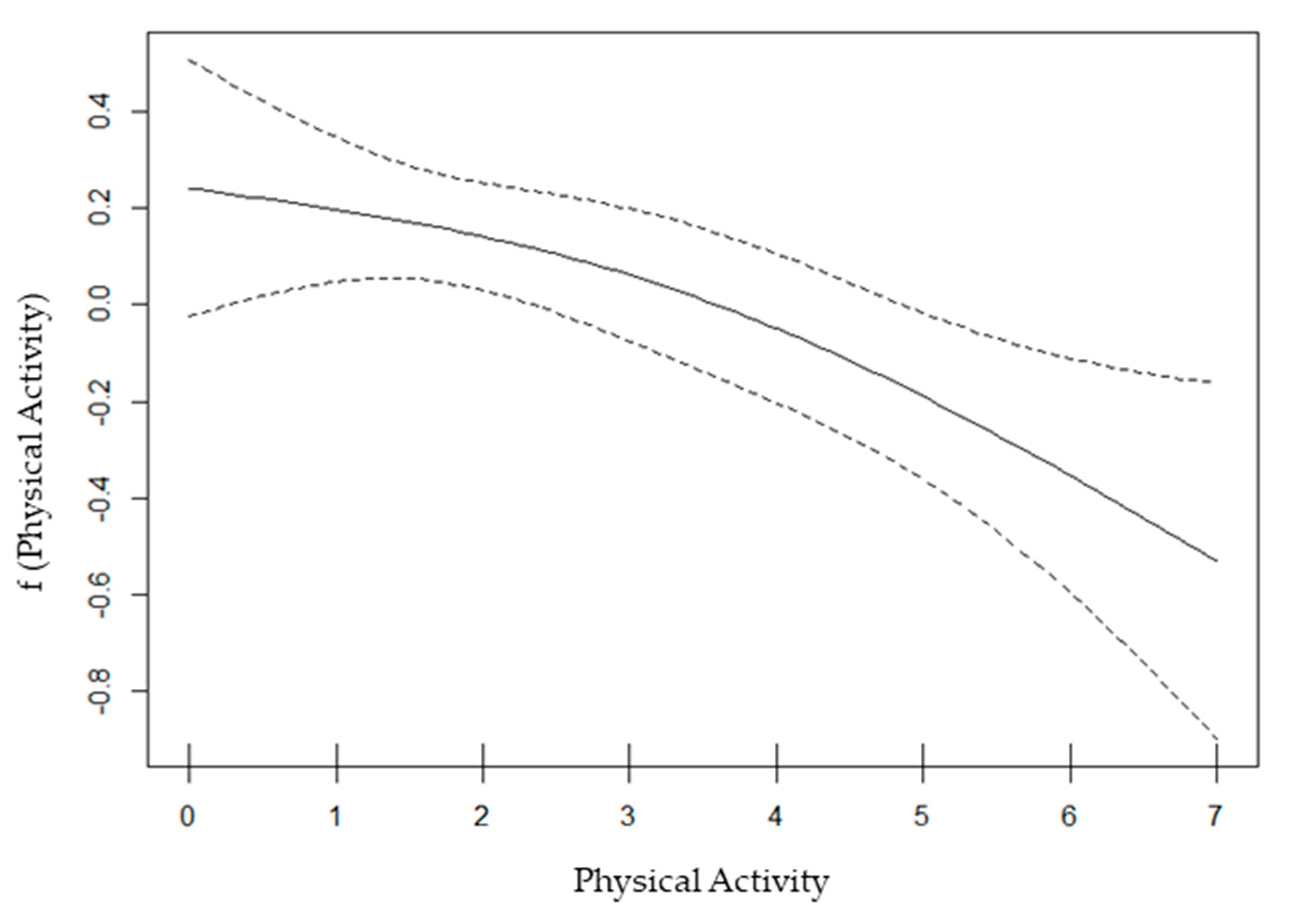
Childhood obesity might threaten children’s current and adulthood health outcomes. Previous studies have illustrated the positive effects of physical activity on weight control; however, there is a lack of evidence on the optimal dose of physical activity. Therefore, we aimed to explore the relationship between physical activity and overweight and obesity, as well as the optimal threshold for physical activity. The median (interquartile range) and number (proportion) were used to describe the statistics. The Mann–Whitney U test and chi-square test were used for an univariable analysis. The generalized additive model with a smooth function was used to depict the preliminary relationship between physical activity and overweight and obesity. The cut-off level of physical activity was identified using AddFor algorithms, and a logistic regression model was applied to explore the multivariable relationship between physical activity and overweight and obesity after adjusting for control variables. According to the statistical analyses, 24.3% of 842 children and adolescents had overweight and obesity. The average number of days that the participants engaged in more than one hour of physical activity was three days a week. The optimal cut-off level of physical activity for the prevention of childhood overweight and obesity was 4 times a week. The participants who exercised more than four times a week (AOR(95% CI) = 0.56(0.38, 0.83), p = 0.004) were less likely to be overweight and obese. In the context of the general lack of physical activity among children and adolescents, we recommend that children and adolescents engage in 60 min of physical activity more than four times a week for a healthy weight.
Keywords: physical activity; overweight; obesity; children; adolescents physical activity; overweight; obesity; children; adolescents