Article

National Trends in Rotavirus Enteritis among Infants in South Korea, 2010–2021: A Nationwide Cohort


1
Department of Pediatrics, Kyung Hee University Medical Center, Kyung Hee University College of Medicine, Seoul 02447, Republic of Korea
2
Department of Korean Medicine, Kyung Hee University College of Korean Medicine, Seoul 02447, Republic of Korea
3
Center for Digital Health, Medical Science Research Institute, Kyung Hee University College of Medicine, Seoul 02447, Republic of Korea
*
Author to whom correspondence should be addressed.
Children 2023, 10(9), 1436; https://doi.org/10.3390/children10091436

Submission received: 19 July 2023 / Revised: 18 August 2023 / Accepted: 21 August 2023 / Published: 23 August 2023
(This article belongs to the Section Pediatric Infectious Diseases)

Abstract

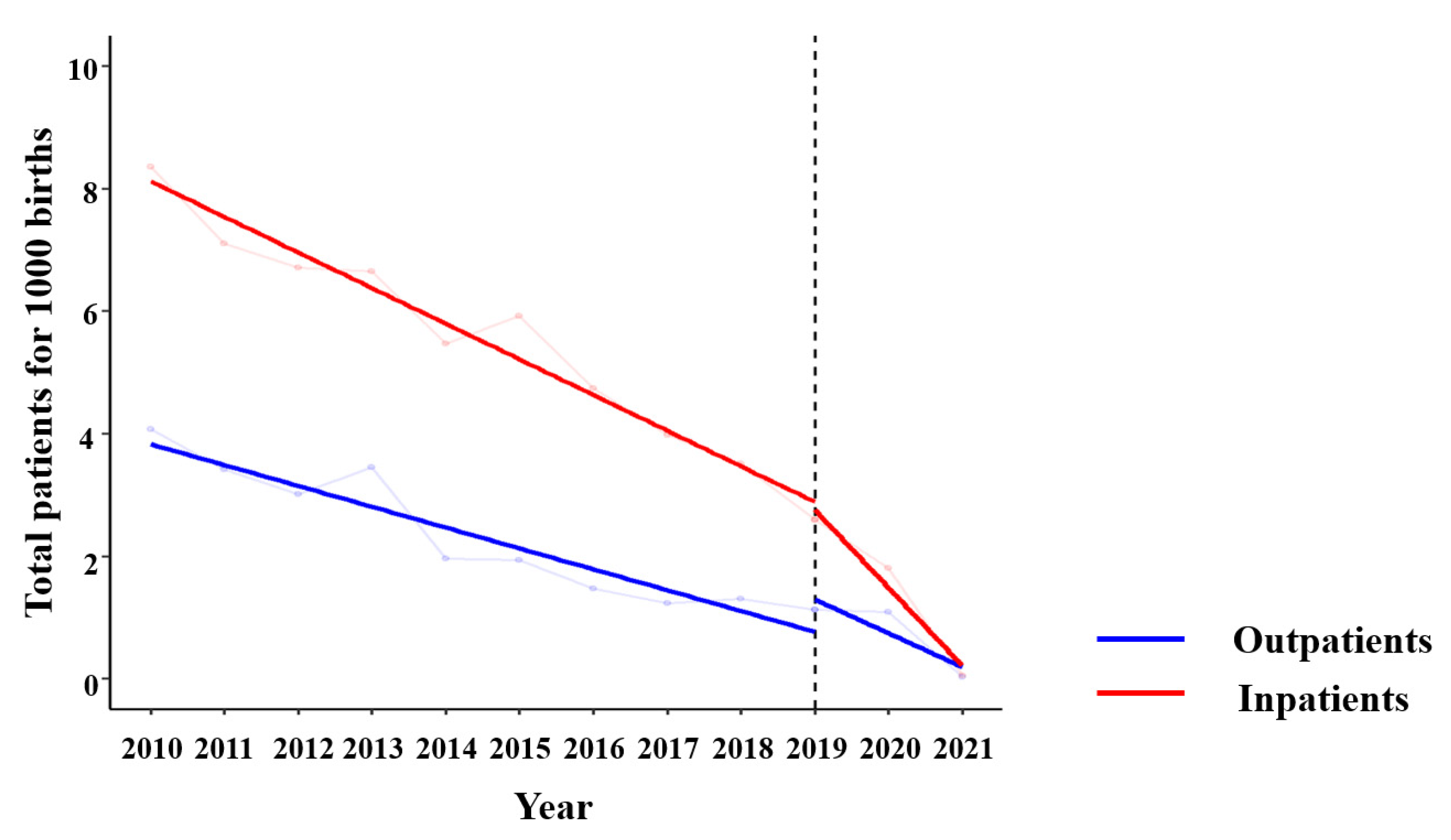
Rotavirus causes a gastrointestinal tract infection that primarily affects young children. Due to the COVID-19 pandemic, individuals infected with the virus were subjected to quarantine measures, with strong emphases on personal hygiene and social distancing. The present study aimed to evaluate the characteristics of rotaviruses and compare the prevalence of rotavirus infection before and during the COVID-19 pandemic. This nationwide representative study was conducted using data acquired from the National Health Insurance Service between 2010 and 2021. We analyzed the data of patients younger than 12 months old who were diagnosed with rotavirus enteritis between January 2010 and December 2021. During the study period, a total of 34,487 infants younger than 12 months were diagnosed with rotavirus enteritis in South Korea. During the two-year COVID-19 pandemic (2020–2021), the rate of decline was significant (5843 cases in 2010 and 1125 in 2019), and by 2021, the total number of patients was almost negligible, as there are only 18 cases in 2021. A significant increase in the ratio of low birth weight (LBW) infants of inpatient department was observed from 2010 to 2021 (4.86% in 2010; 7.77% in 2019; and 23.08% in 2021), indicating that LBW infants are more vulnerable than infants born with normal weight. Average medical expenses related to rotavirus infections also declined significantly from 3,789,443,998 per year (pre-pandemic) to 808,353,795 per year (pandemic). Overall, personal hygiene and social distancing may play important roles in reducing rotavirus infections. However, further studies are needed to determine whether this decreasing trend persists after quarantine and whether the social life of individuals resumes.
Keywords: COVID-19; rotavirus; vaccination; birth; South Korea COVID-19; rotavirus; vaccination; birth; South Korea