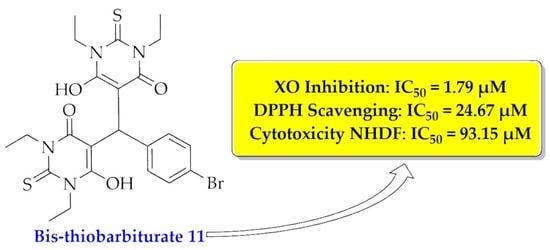
Bis-thiobarbiturates as Promising Xanthine Oxidase Inhibitors: Synthesis and Biological Evaluation
 , ,
, ,  ,
,  and
and 
Abstract
Share and Cite
Serrano, J.L.; Lopes, D.; Reis, M.J.A.; Boto, R.E.F.; Silvestre, S.; Almeida, P. Bis-thiobarbiturates as Promising Xanthine Oxidase Inhibitors: Synthesis and Biological Evaluation. Biomedicines 2021, 9, 1443. https://doi.org/10.3390/biomedicines9101443
Serrano JL, Lopes D, Reis MJA, Boto REF, Silvestre S, Almeida P. Bis-thiobarbiturates as Promising Xanthine Oxidase Inhibitors: Synthesis and Biological Evaluation. Biomedicines. 2021; 9(10):1443. https://doi.org/10.3390/biomedicines9101443
Chicago/Turabian StyleSerrano, João L., Diana Lopes, Melani J. A. Reis, Renato E. F. Boto, Samuel Silvestre, and Paulo Almeida. 2021. "Bis-thiobarbiturates as Promising Xanthine Oxidase Inhibitors: Synthesis and Biological Evaluation" Biomedicines 9, no. 10: 1443. https://doi.org/10.3390/biomedicines9101443
APA StyleSerrano, J. L., Lopes, D., Reis, M. J. A., Boto, R. E. F., Silvestre, S., & Almeida, P. (2021). Bis-thiobarbiturates as Promising Xanthine Oxidase Inhibitors: Synthesis and Biological Evaluation. Biomedicines, 9(10), 1443. https://doi.org/10.3390/biomedicines9101443