Review

A New Role for Vitamin D: The Enhancement of Oncolytic Viral Therapy in Pancreatic Cancer


by
Christopher J. LaRocca
and
Susanne G. Warner
*
Department of Surgery, City of Hope National Medical Center, Duarte, CA 91010, USA
*
Author to whom correspondence should be addressed.
Biomedicines 2018, 6(4), 104; https://doi.org/10.3390/biomedicines6040104

Submission received: 21 September 2018 / Revised: 25 October 2018 / Accepted: 30 October 2018 / Published: 5 November 2018
(This article belongs to the Special Issue Viruses in Cancer and Therapy)

Abstract

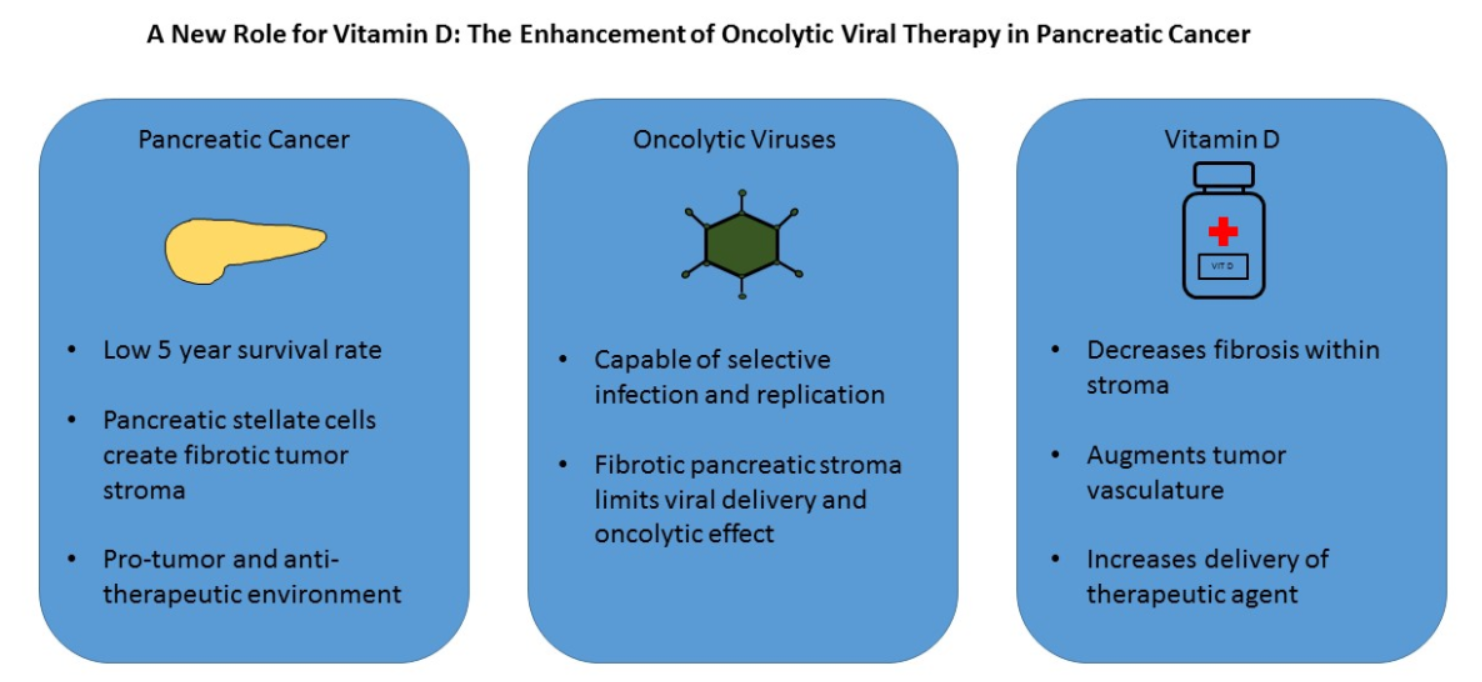
Oncolytic viruses have emerged as a novel class of anti-cancer therapeutics with one virus already receiving United States Food and Drug Administration (FDA) approval (talimogene laherparepvec) and many others undergoing testing in clinical trials. These viruses have direct lytic effects on tumor cells as well as immunomodulatory functions to increase inflammatory cell infiltrates in the tumor microenvironment. Despite all of the advances in cancer care, pancreatic cancer remains a highly lethal malignancy. One of the main barriers to successful systemic treatment of the disease is the fibrotic tumor stroma, as the unique extracellular matrix creates an environment that promotes tumor growth and is resistant to chemotherapy and other anti-cancer agents. The pleiotropic effects of Vitamin D have been widely studied, but recent research has now demonstrated it to be an effective agent in modulating pancreatic cancer stroma to facilitate the enhanced delivery of cytotoxic chemotherapy and immunogenicity in response to treatment. This review will explore the combination of Vitamin D with oncolytic viruses and how this novel application of Vitamin D’s ability to modulate pancreatic tumor stroma may result in a potential mechanism for increasing the efficacy of oncolytic virotherapy in pancreatic cancer.
Keywords: oncolytic virus; virotherapy; vitamin D; paricalcitol; pancreatic cancer oncolytic virus; virotherapy; vitamin D; paricalcitol; pancreatic cancer
Graphical Abstract