Review

Cannabinoids in Motor Control: From Receptor Distribution to Motor Disorders

by
Dan Faganeli
and
Metoda Lipnik-Stangelj
*
Institute of Pharmacology and Experimental Toxicology, Faculty of Medicine, University of Ljubljana, Korytkova 2, 1000 Ljubljana, Slovenia
*
Author to whom correspondence should be addressed.
Biomedicines 2026, 14(4), 844; https://doi.org/10.3390/biomedicines14040844
Submission received: 25 February 2026 / Revised: 30 March 2026 / Accepted: 2 April 2026 / Published: 8 April 2026

Abstract

Cannabinoid receptors occupy strategic control nodes within motor circuitry, making them potential targets for modulating different motor manifestations. They are positioned both within basal ganglia circuits that regulate movement and within spinal circuits that control skeletal muscle tone. Consequently, cannabinoids have been studied across diverse motor disorders, most notably in movement disorders and tone disorders, particularly those resulting in spasticity. Because motor control spans multiple anatomically and functionally distinct levels, relating cannabinoid signaling to effects on motor function is not straightforward. Limited understanding of cannabinoid receptor distribution has led to cannabinoids being tested even in disorders where receptor localization would predict little or no benefit. Mapping receptor distribution within individual motor circuits and integrating them with their pharmacological effects can help anticipate how cannabinoid signaling shapes motor output. Combined with characteristic motor manifestations, one can identify motor disorders in which cannabinoids may have therapeutic value. In this review, we integrate existing evidence to place cannabinoid receptors within key motor pathways, ranging from basal ganglia circuits controlling movement to peripheral mechanisms governing muscle tone. We consider both cannabinoid 1 receptor (CB1R) and cannabinoid 2 receptor (CB2R), with CB2R gaining attention only recently for its potential relevance within the central nervous system. Building on this framework, we infer how cannabinoids acting at these sites may modulate motor control, and consequently, influence motor manifestations across major motor disorders. Finally, we examine how these distribution-based expectations align with available clinical observations.

1. Introduction

The endocannabinoid system is recognized as a major modulatory signaling network that shapes synaptic and cellular functions across the body. It is defined by cannabinoid receptors and their endogenous ligands, the endocannabinoids. These receptors are strategically positioned, most commonly at neuronal synapses, where they support activity-dependent, local control of neurotransmission. Following excitatory stimulation, endocannabinoids are typically synthesized in the postsynaptic membrane and released into the synaptic cleft, acting retrogradely on presynaptic cannabinoid receptors to modulate additional neurotransmitter release. The principal endocannabinoids, 2-arachidonoylglycerol (2-AG) and anandamide (AEA), are produced de novo from membrane phospholipids [1]. In this respect, they resemble prostaglandins, which are likewise generated de novo from membrane precursors, and once released, modulate signaling in neighboring cells in a paracrine manner.
As the expression sites and distribution of cannabinoid receptors have been mapped in greater detail, the role of the endocannabinoid system has become increasingly clear. Cannabinoid receptors are well-characterized in peripheral tissues, where they modulate, among other functions, the enteric nervous system and reduce gastrointestinal motility [2]. A substantial proportion is also expressed within the central nervous system (CNS). In general, knowledge of the anatomical distribution of cannabinoid receptors allows inferences about the functions that cannabinoids are likely to modulate. In several nuclei and pathways of the CNS, receptor distribution is already well-established, enabling relatively straightforward explanations on effects such as appetite via hypothalamic receptors or impaired memory via hippocampal receptors [3,4].
In contrast, relating cannabinoid signaling to motor function is less direct. Motor control is distributed across multiple anatomically and functionally distinct levels, extending from cortical and basal ganglia circuits involved in movement selection and planning to spinal networks and muscle spindles governing skeletal muscle tone. Moreover, modulation of even adjacent subregions within the same anatomical area can markedly influence motor outcomes. The difference between a hyperkinetic and a hypokinetic disorder, for example, may depend only whether modulation occurs at the primary or secondary neuron within same basal ganglia loop. Such organization provides a rationale for why the same cannabinoids have been explored clinically across motor disorders with apparently opposing motor manifestations, such as those in Parkinson’s disease and in Huntington’s disease. Reviews that would attempt to integrate cannabinoid receptor distribution across motor pathways are currently lacking. Such a framework would help explain how cannabinoids influence different motor outcomes. Although numerous reviews address cannabinoid effects in motor disorders, they typically adopt a disorder-specific approach and interpret mechanisms within that single clinical context [5,6,7]. As a result, the literature on cannabinoid involvement in system-level motor control remains fragmented. Integrative publications that do exist are largely restricted to basal ganglia circuitry and are now more than a decade old [8,9,10]. Such studies also provide only a limited coverage of CB2R. Only recently has the potential relevance of CB2R gained attention due to reports suggesting their broader distribution and inducible expression within the CNS [11]. An incomplete understanding of cannabinoid receptor distribution has led to cannabinoids being tested clinically across a broad range of motor disorders, even in cases where receptor localization would allow one to anticipate that any therapeutic effect will be minimal or absent.
This review will therefore try to integrate existing evidence to place cannabinoid receptors within all key motor pathways, ranging from basal ganglia circuits controlling movement to peripheral mechanisms governing muscle tone. Building on this framework, we will infer how cannabinoids acting at these sites may modulate motor control, and consequently, influence motor manifestations across major motor disorders.

2. Motor Control and Dysregulation

The motor system is a broad term used to describe all the central and peripheral structures that support motor behavior [12]. One way to classify their involvement in motor control is phenomenologically, meaning by the manifestations one sees at the patient’s bedside, especially in the case of dysregulation (see Box 1). Most broadly, the motor system is involved in controlling two principal categories: movement and muscle-tone. This distinction reflects whether the primary difference is expressed in the quantity or quality of movement, or in the resistance of a muscle to passive stretch. In the case of movement dysregulation, it can either be hypokinetic, where it is reduced or slowed, or hyperkinetic, where it is characterized by excessive, involuntary, or inappropriate moves.
Box 1. Phenomenological classification of motor dysregulation with related manifestations.
Phenomenological classification of motor dysregulation with related clinical manifestations
 
Movement disorders:
  • Hypokinetic: akinesia, bradykinesia, reduced amplitude (Example: Parkinson’s disease)
  • Hyperkinetic: chorea, dystonia, myoclonus, tics and other dyskinesias (Example: Huntington’s disease)
Tone abnormalities:
  • Increased tone: spasticity, rigidity, paratonia, tonic dystonia (Example: multiple sclerosis, cerebral palsy, stroke)
  • Decreased tone: flaccidity, hypotonia (Example: spinal muscular atrophy, peripheral neuronal lesions, myopathies)
  • Accompanied by strength disorders: paresis, paralysis
Coordination and gait disorders:
  • Ataxia, dysmetria
Muscle-tone control, in contrast, is reflected in the degree of baseline muscle resistance to passive movement. If it is pathologically increased, it manifests as spasticity or rigidity, or if decreased, it is seen as flaccidity or hypotonia. Tone abnormalities frequently coexist with strength deficits, since both functions depend on the integrity of upper motor neurons, lower motor neurons, and the peripheral musculature.
In addition to movement and muscle tone, the broader motor system also controls coordination, which relies predominantly on cerebellar processing. Disruption of these circuits can lead to manifestations such as ataxia, dysmetria, and other impairments of movement timing and accuracy. In contrast, the primary mechanistic scaffold for the motor manifestations addressed is provided by basal ganglia and spinal loops. Cerebellar contributions are not negligible, but they are likely to be more important for movement refinement than for a first-order explanation of the phenomena discussed here. Moreover, the integration of cerebellar circuits into motor control is highly complex and would warrant a separate dedicated analysis beyond the scope of the present review. Accordingly, although coordination may be considered part of motor control in a broader sense, the present review focuses on motor control in the narrower, predominantly basal ganglia- and spinal-related sense.

2.1. Regulation of Movement

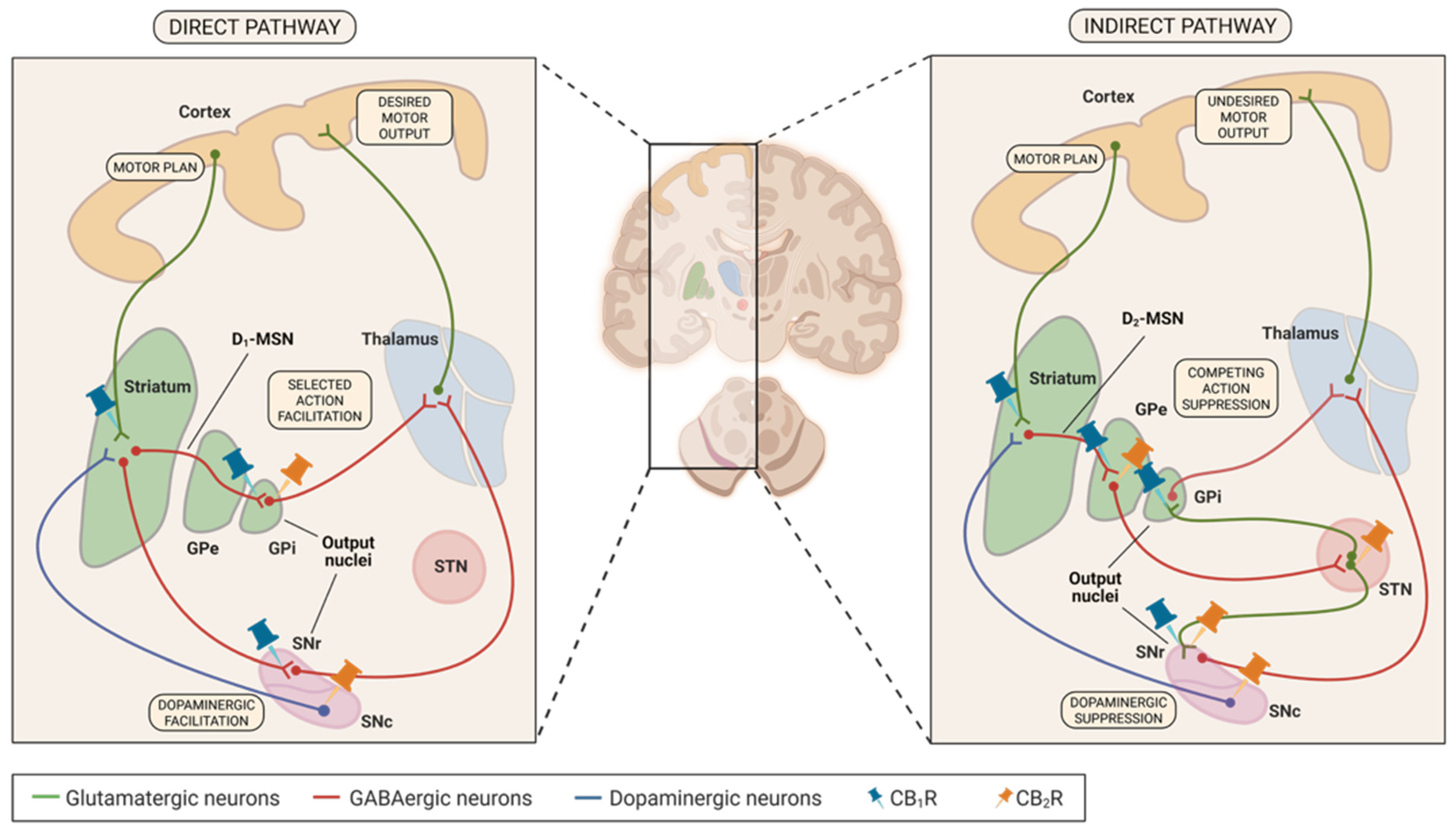
Gating, selection, and scaling of movement action happens in the basal ganglia. The motor cortex then constructs and sends out the detailed movement commands. In the basal ganglia, movement is regulated by two intertwined circuits, the direct and indirect pathways. Both begin in the striatum, which receives glutamatergic projections from the motor cortex, particularly when a desired move is to be initiated. The striatum contains GABAergic medium spiny neurons (MSNs) that project to the output nuclei, globus pallidus internus (GPi), and substantia nigra pars reticulata (SNr). These projections regulate the inhibitory output to the thalamus, thereby controlling how much thalamic excitation is returned to motor cortex and how a specific movement is expressed (see Figure 1).

2.2. Muscle Tone Control

When a signal for movement passes from the motor cortex, corticospinal neurons provide the precise, fractionated command to peripheral neurons. This causes coordinated muscle contraction, resulting in movement. However, even without such signals for a voluntary move, in an awake, healthy person, most postural muscles and many limb muscles still have some baseline action potential firing, seen as skeletal muscle tone.
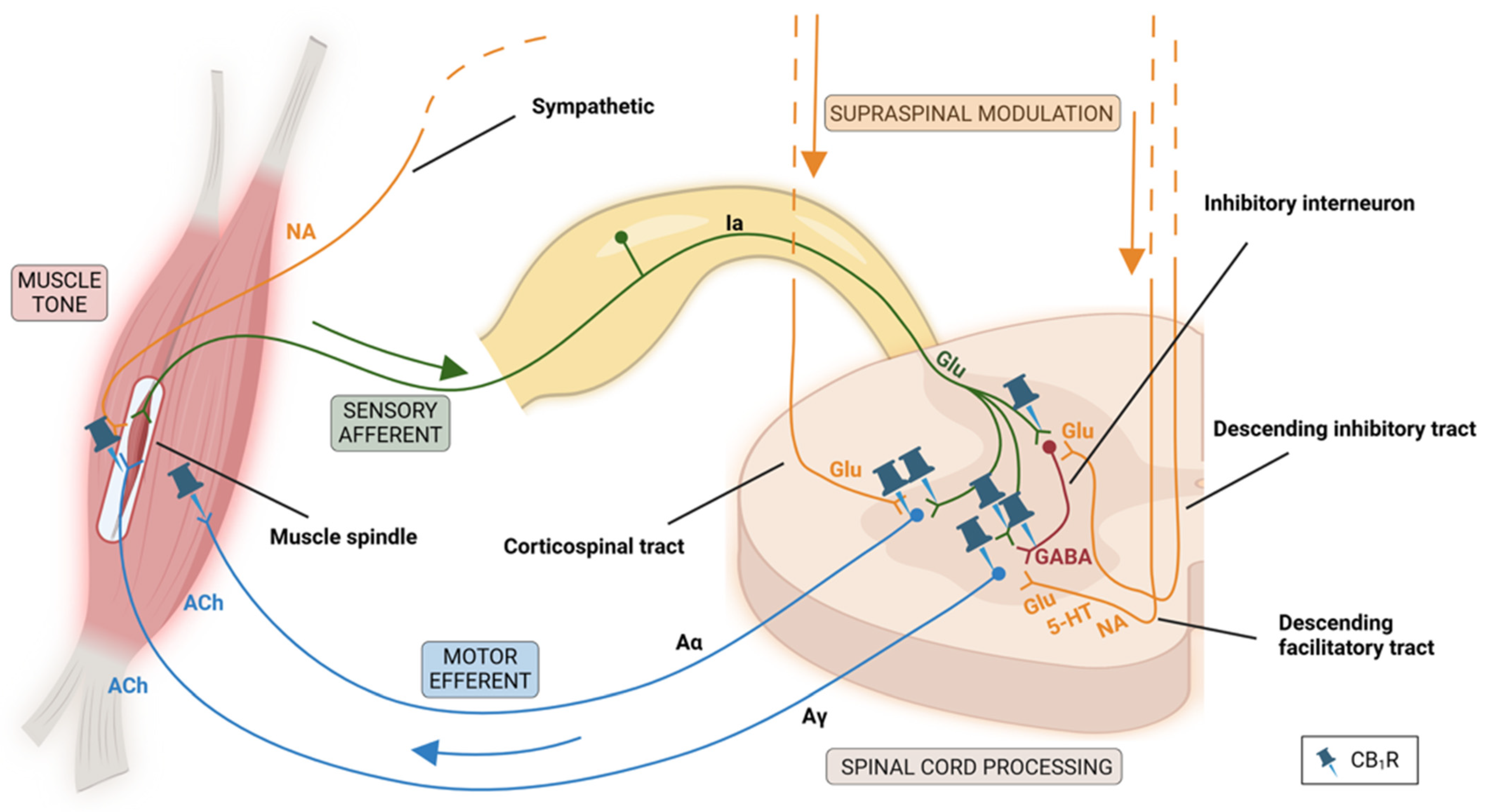
Such muscle tone is produced by two coupled processes, continuous stretch-reflex micro adjustments and a tonic descending drive that sets spinal excitability. Continuous muscle micro-stretches and sway activate muscle spindle afferents and thus engage the spinal stretch reflex causing constant muscle micro adjustments. In an awake person, postural muscles additionally receive tonic baseline excitation from extrapyramidal tracts (reticulo-/vestibulospinal tracts), providing drive to lower motor neurons (LMNs) innervating muscles involved in posture [13]. Additionally, monoaminergic descending pathways also tune the gain of the stretch reflexes, so that a given degree of stretch produces an appropriately sized corrective response. This way, the muscle tone is constantly being tuned for different situations. For example, it decreases while sleeping, in coma, etc. and increases when standing upright, with alertness and anxiety (see Figure 2).

3. Cannabinoids in Motor Control

To be directly involved in motor control, cannabinoids must first modulate neuronal excitation. With the anatomical distribution of cannabinoid receptors and their direct effect on neuronal excitability, one can explain how cannabinoids modulate motor output. The general effects of cannabinoid receptors on metabolism, proliferation, and general homeostasis are important for chronic processes such as synaptic plasticity and regeneration [14]. However, these effects are of lesser importance in the case of both movement execution and tone modulation.
Two main cannabinoid receptors have been characterized, CB1R and CB2R, both G protein-coupled receptors (GPCRs) that couple primarily to Gi/o proteins. In both cases, their activation inhibits adenylyl cyclase, suppresses voltage-gated Ca2+ channels, activates several inwardly rectifying potassium channels, and ultimately reduces neuronal excitability [1].
CB1R is abundant in different circuits involved in motor control. Typically, it is heavily concentrated presynaptically on axon terminals, where it mostly acts as a fast synaptic and excitability regulator. Since CB1R is Gi/o-coupled, it rapidly suppresses transmitter release by inhibiting Ca2+ channels and modulating vesicle machinery; this way, in motor control, CB1R is wired into different circuits as a classic synaptic knob [15].
On the other hand, CB2R is expressed predominantly in immune and hematopoietic cells and was long thought to be absent from a healthy brain [16]. However, newer studies suggest that CB2R is also present in various parts of the CNS including the striatum, pallidum, substantia nigra, and basal thalamus [17]. Still, compared to CB1R, the presence of CB2R is much lower and more condition-dependent, and a lot, if not most of the signal, is in the glia and microglia. CB2R in the CNS is expressed in orders of magnitude lower compared to peripheral immune tissues [18]. The expression on neurons themselves is even more negligible, frequently causing the CB2R signal from the glia to overshadow the neuronal signal [19]. CB2R in the CNS is consequently mostly studied for its effect on metabolic and proliferative functions and not for its effect on direct neuronal excitability [20,21]. Nevertheless, there are studies that show that CB2R is also at least partially directly involved in neuronal excitation, most commonly of dopaminergic pathways [18,22,23].
Beyond CB1 and CB2, several other GPCRs have been proposed to participate in cannabinoid-related signaling, most notably GPR55, GPR18, and GPR119. These receptors are considered putative cannabinoid-related GPCRs rather than classical cannabinoid receptors because their pharmacology and the physiological relevance of their proposed endogenous ligands remain less firmly established [24]. Of these, only GPR55 has shown meaningful motor-related evidence including expression in movement-related nuclei and modest preclinical motor effects in rodent studies [25]. However, these findings remain preclinical and far less robust than the extensive evidence for CB1R or even CB2R. Accordingly, these receptors are unlikely to be of major relevance to direct motor control.

4. Distribution of Cannabinoid Receptors in Motor Circuits

4.1. Involvement of CB Receptors in Basal Ganglia—Direct Pathway

In the direct pathway, CB1Rs localize predominantly to presynaptic terminals on both corticostriatal glutamatergic inputs and striatal GABAergic outputs (See Figure 1). Consistent with the predominant CNS pattern, CB1Rs within basal ganglia circuits are largely presynaptic. In the case of corticostriatal projections, this results in CB1R labelling within the striatum, which is in line with both functional [26] and immunohistochemical evidence [27]. Likewise, CB1R is also present on D1-MSN terminals in the basal ganglia’s output nuclei, namely the GPi. First, studies to suggest the latter were conducted using autoradiography [28] and immunohistochemistry [29], which showed binding of the CB1R marker in the globus pallidus internus (GPi) and pars reticulata of substantia nigra (SNr). After selective destruction of the striatum containing somata of D1-MSN, binding of the CB1R marker in globus pallidus disappeared. A similar conclusion can be obtained from gene expression studies [30,31,32,33] and electron microscopy [30,34]. While most CB1Rs are observed in terminal ends located in the output nuclei, a subset of D1-MSNs also gives rise to local axon collaterals ending in the striatum, where the CB1R signal is also present [30,34] (Figure 1). Consequently, CB1Rs can suppress GABAergic transmission to the output nuclei, as demonstrated with electrophysiological recordings [35].
Nigrostriatal dopaminergic neurons, which provide dopamine that modulates D1- and D2-MSNs in the striatum, show a different pattern. In general, dopaminergic neurons, including nigrostriatal neurons, do not express CB1Rs [36]. Studies using tyrosine hydroxylase labelling identify dopaminergic neuronal somata, whereas the absence of CB1R transcripts and CB1R immunostaining argues against CB1R expression by these neurons [28,29]. Fluorescence in situ hybridization (FISH) provides additional support for this conclusion [37].
Besides CB1Rs, CB2Rs have also been described within direct-pathway circuitry. Most prominently, they are localized on pallidothalamic GABAergic output neurons and nigrostriatal dopaminergic neurons. Unlike CB1Rs, which localize predominantly to presynaptic terminals, CB2Rs appear mainly somatodendritic. In macaques, hybridization-based approaches report CB2R labelling specifically on the somatodendritic membranes of pallidothalamic neurons [38]. CB2Rs have also been reported on midbrain dopaminergic pathways. While CB1Rs are generally not detected on the somatodendritic membranes of these neurons, nigrostriatal dopaminergic neurons represent a second major CB2R source within direct-pathway-related circuitry [6,23]. In mice, immunofluorescence studies localize CB2R predominantly to the somatodendritic compartment of nigrostriatal neurons in SNc [39], while electrophysiological recordings support functional CB2R signaling in these neurons [39,40,41]. Through this somatodendritic localization, CB2Rs primarily affect dopaminergic output to both D1- and D2-MSNs, rather than acting primarily via the presynaptic control of MSN terminals, as is typical for CB1R. Certain reviews also tend to report the presence of CB2R on nigrostriatal terminals in the striatum, however, direct, definitive localization to DA terminals is less consistent and often inferred from functional studies [42] rather than clean anatomical proof. Additionally, some evidence suggests low CB2R expression in striatal projection neurons, which can increase after metabolic or excitotoxic insults [43]. These data imply that D1-MSNs and D2-MSNs possess some somatodendritic CB2Rs, however, direct modulation of MSNs’ GABA release is still attributed mainly to CB1Rs from their terminal ends.

4.2. Involvement of CB Receptors in Basal Ganglia—Indirect Pathway

Since both direct and indirect pathways share most of their anatomical locations, cannabinoid receptor expression in both is mostly similar. Receptor expression appears primarily region-, rather than pathway-, dependent. Accordingly, receptor profiles for shared components, including in nigrostriatal dopaminergic projections, are treated as the same here and are not repeated. The main differences arise at pathway-specific elements, particularly in the subthalamic nucleus (STN), which participates only in the indirect pathway, and D2-MSNs, which project to the external globus pallidus (GPe) rather than the GPi (See Figure 1).
Even though D2-MSNs express distinct dopamine receptors, they seem to resemble their D1 counterparts in terms of CB1R expression, consistent with their similar anatomical organization. As in the direct pathway, the main CB1R function in the indirect pathway is the presynaptic inhibition of D2-MSN axonal terminals, which unlike the direct pathway, terminate in the external globus pallidus (GPe). The GPe displays some of the highest CB1R binding in the brain. Lesions of striatum sharply reduce the CB1R signal in GPe, and slice recordings show that CB1R agonists depress GABA release from striatopallidal terminals, with effects blocked by CB1R antagonists [30,44]. CB1Rs are also present on terminals of D2-MSN collaterals within the striatum where it contributes to endocannabinoid-dependent short-term plasticity [34,35] (Figure 2). Some CB1Rs have also been reported on somatodendritic parts of D2-MSNs located in the striatum, as demonstrated with mRNA and immunostaining [31,32,33], however, less compared to their axonal counterparts.
STN neurons form glutamatergic projections to the GPi and SNr and express CB1Rs on their axon terminals, consistent with the predominantly presynaptic localization of CB1Rs. Studies show that the stimulation of STN projection neurons evokes excitatory postsynaptic currents (EPSCs) in both SN [45,46] and GPi [47]. In those studies, CB1R agonists reduced EPSC while CB1R antagonists restored them, without a change in postsynaptic sensitivity to glutamate, indicating that CB1Rs are located on axon terminals.
Within the indirect pathway, CB2Rs show similar regional distribution patterns to that of its direct-pathway counterparts. Beyond the locations shared with the direct pathway, CB2Rs are also expressed at several nodes of the indirect pathway. Pallidal neurons, projecting from GPe to STN, express CB2Rs on their somatodendritic ends located in GPe [38]. This parallels direct-pathway CB2R expression in the somatodendritic compartment of pallidal neurons in the GPi, again supporting the view that CB2R expression is region-, rather than pathway-dependent. In contrast, neurons projecting from STN provide a clear example of CB2R expression in both somatodendritic and their axonal compartments in SNr. Studies have shown CB2R mRNA transcripts and CB2R immunostaining on slices and primary STN cultures. Electron-microscopy studies combined with studies of cannabinoids’ effects on presynaptic glutamatergic release additionally demonstrate CB2R presence on their axon terminals in SNr [48]. Consistent with regional analogies, similar CB2R presence should exist at STN terminals in GPi, as the other site of the projection, though this remains yet to be documented.

4.3. Involvement of CB Receptors in Spinal Cord Reflex Circuitry

In circuits involved in spinal cord reflexes governing muscle tone, CB1Rs are demonstrably present at several key strategic nodes. Primarily, they are expressed on presynaptic membranes of primary afferent neurons, in defined dorsal horn interneuron populations, in ventral horn motoneuron somatodendritic compartments, and at the neuromuscular junction (NMJ) on the presynaptic motor terminal (see Figure 2).
In primary afferent neurons, CB1Rs are present both in sensory neuron somata as well as their terminals. Molecular and immunohistochemical approaches demonstrated CB1R mRNA and CB1R protein presence already in perikarya of the dorsal root ganglion (DRG) [49]. Nevertheless, a substantial fraction of spinal cannabinoid receptors resides on primary afferent terminals. In a classic autoradiographic study, unilateral dorsal rhizotomy reduced spinal cannabinoid radioligand binding on the injured side by roughly half, indicating that a substantial fraction of CB1Rs in the dorsal horn is associated with primary afferent terminals [50]. Complementary immunocytochemical work reported CB1R immunolabeling in heterogeneous DRG neurons, more specifically on their axons in Lissauer’s tract [51]. These studies provide strong evidence for presynaptic CB1Rs on various primary afferent inputs to the spinal cord, but they do not, on their own, identify CB1R specifically on the terminals of Ia muscle spindle afferents.
Within intrinsic spinal circuitry, CB1Rs have been localized to defined interneuron populations, most clearly in the dorsal horn. Most work has characterized CB1Rs in the context of sensory processing and gating of pain. Nevertheless, similar interneuron-mediated mechanisms that gate nociceptive inputs also shape the afferent drive that feeds into spinal reflex circuits, making this literature also relevant from a motor-control standpoint. Immunocytochemical mapping in the rat spinal cord suggests that a substantial portion of CB1R immunoreactivity arises from intrinsic spinal interneuron networks [52]. Double-labelling additionally indicates that CB1R-positive dorsal horn interneurons are inhibitory including GABAergic or NO synthase-positive [51]. What remains notably less resolved, however, is whether CB1Rs can be assigned to the specific interneuron classes commonly invoked in muscle tone control such as the interneurons mediating classical presynaptic inhibition onto Ia afferents.
Evidence for CB1Rs within the motor output apparatus becomes more direct in the ventral horn and at the neuromuscular junction. A primate study reported CB1R labelling in ventral horn, specifically on the somatodendritic part of motoneurons [53]. Notably, this finding diverges from the predominant localization of CB1Rs on axon terminals where they modulate presynaptic membranes [15,54]. Thus, even though ultrastructural work in primate spinal cord reports CB1R immunoreactivity in dendritic profiles, these postsynaptic CB1Rs on α-motoneurons are still likely to represent only a smaller fraction of the overall CB1R pool within ventral-horn circuitry. Nonetheless, cannabinoids do influence the presynaptic side of motor output by acting directly at motor terminals on peripheral neuromuscular junctions. In vertebrate NMJ preparations, such as a lizard and frog NMJ models, endocannabinoids reduced presynaptic calcium transients and transmitter release in a manner consistent with presynaptic CB1R-mediated control of neurotransmission [55,56]. On the postsynaptic side of the junction, CB1Rs do not seem to be present, even if some CB1Rs have been reported in skeletal muscle at subcellular sites such as the mitochondria [57].
Primary localization studies reported little or no CB2R immunoreactivity in both the DRG or spinal cord. CB2Rs become detectable only after nerve injury or stress, which includes some CB2R induction in DRG and its ipsilateral dorsal horn [58]. CB2R upregulation, however, is typically not linked to neurons but to activated microglia and astrocytes [59,60]. Accordingly, basal CB2Rs in spinal reflex circuitry and tract-terminal CB2Rs in descending pathways remain unsupported.

4.4. Involvement of CB Receptors in Supraspinal Modulatory Tracts

Besides segmental spinal circuitry, cannabinoid receptors might also influence descending spinal pathways modulating the excitability of this circuitry. CB1R expression is demonstrable in multiple brainstem nuclei. It is present in the vestibular nuclei [61,62], which give rise to vestibulospinal pathways, and in the pontomedullary reticular formation [63], which forms the source of reticulospinal pathways. Additionally, CB1Rs are present in monoaminergic nuclei, including the raphe nuclei [64] and the locus coeruleus [65], whose monoaminergic projections modulate segmental spinal circuitry. Nevertheless, even though the signal is present, there is currently no evidence that CB1Rs are located on somatodendritic parts of the actual descending neurons modulating spinal reflex circuitry and not just on axon terminals from other sources terminating in those nuclei. Furthermore, CB1Rs neither seem to be expressed on the axon terminals of the descending tracts located in the spinal cord. CB1R immunoreactivity is prominent in the dorsolateral funiculus and in dorsal horn neuropil. However, interrupting descending input by a rostral spinal cord hemisection in rats only produces a minor change in CB1R immunoreactivity, thus arguing that most CB1R-mediated signals do not come from severed descending systems [52]. The influence of CB1Rs on the supraspinal modulation of segmental spinal circuits is therefore, at best, mediated only indirectly.

5. Applying the Distribution of Cannabinoid Receptors to Motor Disorders

Cannabinoid receptors are positioned at strategic control nodes within motor circuitry. As a result, the modulation of cannabinoid signaling could, in principle, influence the major domains of motor function, spanning the selection and execution of movement as well as the regulation of skeletal muscle tone. This positioning suggests that cannabinoids may offer symptomatic benefit across different motor manifestations. Accordingly, they have been investigated clinically across mechanistically diverse conditions, most commonly in movement disorders and among the tone disorders, particularly in those resulting in spasticity. On the basis of receptor distribution along motor pathways, together with receptor-type-specific signaling properties, it is possible to infer how cannabinoid signaling may influence the final motor output. Together with a neuroanatomical understanding of clinical signs in motor disorders (see Box 2), one could implicate what disorders are expected to respond to treatment with cannabinoids. A summary comparing the proposed effects of cannabinoid signaling on motor outcomes with clinical outcomes is presented in Table 1. Based on their anatomical distribution, both CB1R and CB2R may be involved in motor control. Although CB2R expression is reported within elements of motor circuitry, effects on motor manifestations are more readily inferred from CB1R distribution. CB1Rs show markedly higher and more consistently observed expression in relevant neuronal compartments. In contrast, CB2Rs are generally better conceptualized as neuroprotective modulators. Any impact on motor disorders is more likely to arise indirectly through anti-inflammatory and survival-promoting actions, rather than directly affecting their motor signs [11].
Box 2. Neuroanatomical basis of motor disorders.
Neuroanatomical basis of motor disorders
 
Motor disorders reflect a dysfunction anywhere along the motor pathway, from the motor cortex and basal ganglia through the brainstem and spinal cord to peripheral nerves, neuromuscular junction, and muscle. When the pathology affects the basal ganglia, for instance, in Parkinson’s disease and Huntington’s disease, the result is the broad family of classic movement disorders, including Parkinsonian syndromes, choreas, dystonias, and dyskinesias (see Box 1). Lesions involving the spinal cord reflex circuitry primarily affect muscle tone. For instance, lesions of upper motor neurons give rise to spastic weakness, as inhibitory supraspinal modulation of spinal reflexes is compromised. Such lesions may follow stroke, upper motor neuron disease, or spinal cord damage. When the pathology shifts to the lower motor neurons, as in spinal muscular atrophy, the clinical picture changes to flaccidity, as both spinal reflex arches and voluntary movement are unable to reach the skeletal muscle. Disorders rooted in the cerebellum primarily manifest coordination impairment and are seen as ataxic syndromes (see Box 1). The anatomically most peripheral group of motor disorders consists of neuromuscular junction disorders, in which impaired synaptic transmission leads to fatigable weakness and primary disorders of the muscle itself, collectively termed myopathies. Although typically considered as motor disorders, myopathies are primarily cell-intrinsic disorders of the effector organ, whereas others are predominantly disorders of neuronal circuits that control movement.
According to the proposed CB1R localization in basal ganglia, CB1R signaling is expected to suppress thalamocortical drive and reduce abnormal movement, despite some pro-kinetic actions on the indirect pathway. On corticostriatal terminals, CB1R agonists reduce glutamate release onto D1-MSNs, so these neurons are less effectively recruited by cortical motor commands. On D1-MSN axon terminals in GPi and SNr, CB1R activation suppresses GABA release, relieving the inhibition of GPi/SNr neurons and thereby strengthening their inhibitory output to the thalamus. A smaller CB1R population on local D1-MSN axon collaterals in the striatum reduces GABAergic self- and lateral inhibition, which favors D1-MSN firing. However, this effect is probably minor compared with the strong presynaptic control at the corticostriatal synapses. Because nigrostriatal dopaminergic neurons lack CB1Rs, dopamine itself is not directly modulated.
Inferring from this CB1R distribution in basal ganglia, CB1R agonists are expected to modulate and ameliorate abnormal hyperkinetic movements, clinically seen as tics and other dyskinesias. Hypokinetic movements, on the other hand, are not expected to be affected from the proposed distribution (see Box 1). Interestingly, within movement disorders, systematic reviews show that the most relevant clinical benefit of cannabinoids is observed in tic disorders such as Tourette syndrome, where cannabinoids may reduce tic severity and the premonitory urge in some patients [66,67]. For Parkinson’s disease, which is primarily a hypokinetic movement disorder, clinical results have generally been mixed or negative. When improvements occur, they tend to be modest, variable between individuals, and not reliably reflected in objective motor scales [68,69,70]. Such variability arises from levodopa-induced dyskinesias, which are a hyperkinetic treatment complication and are in theory expected to respond to cannabinoid treatment. A clinical study using a synthetic THC derivative, nabilone, actually reported the reduction in such dyskinesias [71], whereas a controlled crossover study using an oral cannabis extract found no improvement [72]. Furthermore, movement disorders like Huntington’s disease, although primarily hyperkinetic, also show mixed clinical results, despite CB1R distribution alone possibly suggesting a potential benefit [68,73,74]. These findings highlight two points. First, hyperkinesia does not automatically predict a reproducible response to cannabinoids. Second, different cannabinoids may affect motor manifestations in different ways. In clinical studies, different cannabinoids are used, most commonly THC, CBD, nabiximols, and nabilone, which may differ in efficacy for specific clinical manifestations. If a compound acts mainly through CB1R, such as nabilone, CB1R localization may provide a reasonable first approximation of the expected motor modulation. In contrast, oral cannabinoids, CBD especially, have lower affinity for CB1R, so CB1R distribution alone is unlikely to predict its clinical impact. More broadly, even with the receptor profile considered, alignment with the observed clinical outcomes remains difficult. Most movement disorders combine hyper- and hypokinetic elements. Symptomatic therapies, especially dopaminergic treatments, further reshape motor output. As a result, clinical data rarely allow for a clear inference about how cannabinoids modulate hyperkinetic versus hypokinetic manifestations in isolation.
In the case of muscle tone, cannabinoids are primarily expected to lower it, according to the proposed receptor localization in spinal circuits. By activating presynaptic CB1R on axon terminals within spinal circuitry, cannabinoids reduce transmitter release onto spinal networks. This way, both the motor output to extrafusal muscle via α-motoneurons and likely also γ-motoneuron-related gain control of spindle sensitivity are dampened. A smaller additional effect may come from postsynaptic CB1R on α-motoneuron dendrites, which could modestly reduce motoneuron excitability. Peripherally, presynaptic CB1R at the neuromuscular junction can reduce acetylcholine release, further lowering effective muscle activation. CB1R within spinal interneuron networks can shift motoneuron drive in either direction: suppressing inhibitory interneuron output may increase reflex gain, whereas inhibitory–inhibitory wiring can strengthen downstream inhibition and reduce gain. Consequently, its net effect on tone is difficult to infer from localization alone and may be secondary to other presynaptic CB1R sites.
Table 1. Observed clinical outcomes vs. the proposed effects of cannabinoids on motor manifestations.
Motor DisordersClinical OutcomesRefs.Proposed Motor Outcomes *
MovementHyperkinetic disordersBeneficial effects observed, especially
in tics in Tourette syndrome
[66,67,74]Reduced movement
Hypokinetic disordersMixed or negative results[68,69,70,74]
ToneIncreased toneBeneficial effects observed, especially
in spasticity related with multiple sclerosis
[75,76,77]Lowered muscle tone
Decreased toneNot enough clinical data
* Proposed outcomes are based on CB1R distribution in basal ganglia (see Figure 1) and spinal cord circuits (see Figure 2). Background colors are used to more readily distinguish subtypes within each motor disorder group.
Inferring from CB1R distribution in spinal circuits, CB1R agonists are therefore expected to ameliorate symptoms of increased muscle tone, clinically observed as spasticity. Consequently, it is partially to be expected that clinical studies are showing reproducible therapeutic effects of cannabinoids in spasticity syndromes (see Box 1). The best and most reproducible clinical effects of cannabinoids are observed particularly in multiple sclerosis [75,76] and to some lesser extent in motor neuron disease-related spasticity [78]. In these settings, cannabinoids consistently improve patient-reported stiffness, frequency, and intensity of involuntary spasms. Accordingly, in several jurisdictions, cannabinoid-based medicines, nabiximols, are approved for the symptomatic treatment of spasticity in multiple sclerosis [79]. Nevertheless, due to the same limitations as those discussed in movement outcomes, we cannot expect the proposed distribution-based predictions to align consistently with all tone abnormalities. At least for post-stroke, spinal cord injury, and cerebral palsy-associated spasticity, the evidence of cannabinoids’ efficacy is currently smaller and more heterogeneous [5,74,77,80].
In both the basal ganglia and spinal circuits, available evidence suggests that CB2R agonists play a comparatively minor role, consistent with lower receptor expression density. According to their distribution, they are expected to exert weaker but more selective circuit effects, most notably by reducing SNc dopamine neuron firing and STN glutamate output. Nevertheless, CB2Rs are still best understood as neuroprotective modulators whose long-term impact on motor function in basal-ganglia disease stems more from anti-inflammatory and survival-promoting actions than from acute, global changes in motor circuit excitability [11]. CB2R should therefore be discussed primarily in the context of disease modification, rather than the symptomatic treatment of motor manifestations.
Finally, several important limitations should be acknowledged when inferring motor outcomes from receptor localization. Despite inclusion of the major motor circuits involved in motor control, the predictive model remains a simplification. Basal ganglia function emerges from an interacting network, meaning that the same agonist may act at several sites with opposing consequences, making the overall motor effect difficult to predict. This problem is also further compounded by the fact that cannabinoids act outside the basal ganglia and spinal circuits including in the cortical, cerebellar, and brainstem circuits. Clinical effects therefore reflect broader actions such as sedation and altered coordination, both affecting motor manifestations in clinical practice. Disease itself also modifies receptor expression, coupling, and circuit balance, so static receptor maps are a better predictor of clinical outcomes in physiological conditions. It is also worth noting that much of the mechanistic rationale relies on rodent CB1R mapping and physiology. Cannabinoid receptor expression and cellular localization differ between species, thus limiting direct translation to humans [81].

6. Conclusions

Because cannabinoid receptors occupy strategic control points within motor control circuitry, cannabinoids can modulate a broad spectrum of motor manifestations, ranging from effects on movement execution to effects on skeletal muscle tone. Given the distribution of cannabinoid receptors within basal ganglia circuits, together with their inhibitory signaling properties, cannabinoids are expected to bias motor output toward reduced movement. Their localization within spinal motor reflex circuits, in turn, suggests a capacity to reduce muscle tone. By understanding the characteristic motor manifestations of individual diseases, one can infer the potential therapeutic utility of cannabinoids for the symptomatic treatment of motor disorders. Overall, the proposed distribution-based expectations align with clinical observations. Cannabinoids appear most plausible for hyperkinetic disorders, whereas effects on hypokinetic signs, such as those seen in Parkinson’s disease, tend to be less consistent. With respect to muscle tone, cannabinoids would likewise be expected to improve spasticity, consistent with their clinical use in multiple sclerosis. In this context, CB1Rs likely exert a stronger influence on motor function, as they are more abundantly expressed within motor circuits compared to CB2Rs and can therefore better modulate circuit activity.
For a more comprehensive prediction of the effects on motor control, cannabinoid receptor distribution in the cerebellum should also be examined. This could also extend distribution-based inferences to ataxic disorders. In addition to rodent studies, further work in non-rodent species, ideally including primates and human tissue, would help define cannabinoid receptor distribution more precisely. Based on the proposed findings on receptor distribution, we suggest that future studies evaluate potent CB1R agonists for the symptomatic treatment of motor manifestations. For CB2Rs, studies using selective CB2R agonists are needed to better define their contribution to motor function and avoid CB1R-mediated effects overshadowing the observed outcomes. As selective CB2R agonists are not yet available for human use, initial studies should be conducted in animal models.

Author Contributions

D.F. and M.L.-S. were involved in the drafting and critical revision of the manuscript. All authors have read and agreed to the published version of the manuscript.

Funding

This research received no external funding.

Institutional Review Board Statement

Not applicable.

Informed Consent Statement

Not applicable.

Data Availability Statement

No new data were created or analyzed in this study. Data sharing is not applicable to this article.

Acknowledgments

AI-assisted language tools (ChatGPT 5.2, OpenAI) were used solely to improve the English language and clarity of the manuscript. Figure 1 was created in BioRender. Faganeli, D. (2026) https://BioRender.com/9vh1s2z, accessed on 25 February 2026. Figure 2 was created in BioRender. Faganeli, D. (2026) https://BioRender.com/i0rk94v, accessed on 30 March 2026. The publication licenses are available on request from the author.

Conflicts of Interest

The authors declare no conflicts of interest.

Abbreviations

The following abbreviations are used in this manuscript:
CB1RCannabinoid receptor 1
CB2RCannabinoid receptor 2
2-AG2-arachidonoylglycerol
AEAAnandamide
CNSCentral nervous system
GABAGamma-aminobutyric acid
MSNMedium spiny neurons
GPiGlobus pallidus internus
SNrSubstantia nigra pars reticulata
LMNLower motor neuron
GPCRG protein-coupled receptor
D1-MSNsD1 receptor-expressing medium spiny neuron
D2-MSNsD2 receptor-expressing medium spiny neuron
STNSubthalamic nucleus
SNcSubstantia nigra pars compacta
5-HT25-hydroxytryptamine
EPSCExcitatory postsynaptic current
NMJNeuromuscular junction
DRGDorsal root ganglion

References

  1. Lu, H.-C.; Mackie, K. An introduction to the endogenous cannabinoid system. Biol. Psychiatry 2016, 79, 516–525. [Google Scholar] [CrossRef]
  2. Izzo, A.A.; Sharkey, K.A. Cannabinoids and the gut: New developments and emerging concepts. Pharmacol. Ther. 2010, 126, 21–38. [Google Scholar] [CrossRef]
  3. Mackie, K. Distribution of Cannabinoid Receptors in the Central and Peripheral Nervous System. In Handbook of Experimental Pharmacology; Springer: Berlin/Heidelberg, Germany, 2005. [Google Scholar]
  4. Zou, S.; Kumar, U. Cannabinoid receptors and the endocannabinoid system: Signaling and function in the central nervous system. Int. J. Mol. Sci. 2018, 19, 833. [Google Scholar] [CrossRef]
  5. Nielsen, S.; Murnion, B.; Campbell, G.; Young, H.; Hall, W. Cannabinoids for the treatment of spasticity. Dev. Med. Child Neurol. 2019, 61, 631–638. [Google Scholar] [CrossRef]
  6. Wang, M.; Liu, H.; Ma, Z. Roles of the Cannabinoid System in the Basal Ganglia in Parkinson’s Disease. Front. Cell. Neurosci. 2022, 16, 832854. [Google Scholar] [CrossRef]
  7. Tejeda-Martínez, A.; Viveros-Paredes, J.; Flores-Soto, M. Involvement of the Endocannabinoid System in the pathophysiology and therapeutics of movement disorders. Neurol. Perspect. 2022, 2, 240–249. [Google Scholar] [CrossRef]
  8. El Manira, A.; Kyriakatos, A. The role of endocannabinoid signaling in motor control. Physiology 2010, 25, 230–238. [Google Scholar] [CrossRef]
  9. Fernandez-Ruiz, J.; Gonzalez, S. Cannabinoid Control of Motor Function at the Basal Ganglia. In Cannabinoids; Pertwee, R., Ed.; Springer: Berlin/Heidelberg, Germany, 2005; pp. 479–507. [Google Scholar] [CrossRef]
  10. Benarroch, E.; Benarroch, E.E. Endocannabinoids in basal ganglia circuits Implications for Parkinson disease. Neurology 2007, 69, 306–309. [Google Scholar] [CrossRef]
  11. Bala, K.; Porel, P.; Aran, K.R. Emerging roles of cannabinoid receptor CB2 receptor in the central nervous system: Therapeutic target for CNS disorders. Psychopharmacology 2024, 241, 1939–1954. [Google Scholar] [CrossRef] [PubMed]
  12. Augustine, G.J.; Groh, J.M.; Huettel, S.A.; LaMantia, A.-S.; White, L.E.; Purves, D. Neuroscience; Oxford University Press: Oxford, UK, 2024; ISBN -10: 0197616240. [Google Scholar]
  13. Takakusaki, K. Functional Neuroanatomy for Posture and Gait Control. J. Mov. Disord. 2017, 10, 1–17. [Google Scholar] [CrossRef] [PubMed]
  14. Simankowicz, P.; Stępniewska, J. The Role of Endocannabinoids in Physiological Processes and Disease Pathology: A Comprehensive Review. J. Clin. Med. 2025, 14, 2851. [Google Scholar] [CrossRef]
  15. Busquets-Garcia, A.; Bains, J.; Marsicano, G. CB1 Receptor Signaling in the Brain: Extracting Specificity from Ubiquity. Neuropsychopharmacology 2018, 43, 4–20. [Google Scholar] [CrossRef]
  16. Munro, S.; Thomas, K.L.; Abu-Shaar, M. Molecular characterization of a peripheral receptor for cannabinoids. Nature 1993, 365, 61–65. [Google Scholar] [CrossRef] [PubMed]
  17. Howlett, A.C.; Abood, M.E. CB1 and CB2 Receptor Pharmacology. Adv. Pharmacol. 2017, 80, 169–206. [Google Scholar] [CrossRef] [PubMed]
  18. Liu, Q.-R.; Canseco-Alba, A.; Zhang, H.-Y.; Tagliaferro, P.; Chung, M.; Dennis, E.; Sanabria, B.; Schanz, N.; Escosteguy-Neto, J.C.; Ishiguro, H.; et al. Cannabinoid type 2 receptors in dopamine neurons inhibits psychomotor behaviors, alters anxiety, depression and alcohol preference. Sci. Rep. 2017, 7, 17410. [Google Scholar] [CrossRef]
  19. Sagredo, O.; González, S.; Aroyo, I.; Pazos, M.R.; Benito, C.; Lastres-Becker, I.; Romero, J.P.; Tolón, R.M.; Mechoulam, R.; Brouillet, E.; et al. Cannabinoid CB2receptor agonists protect the striatum against malonate toxicity: Relevance for Huntington’s disease. Glia 2008, 57, 1154–1167. [Google Scholar] [CrossRef] [PubMed]
  20. García-Gutiérrez, M.S.; Torregrosa, A.B.; Navarrete, F.; Navarro, D.; Manzanares, J. A comprehensive review of the multifaceted role of cannabinoid receptor type 2 in neurodegenerative and neuropsychiatric disorders. Pharmacol. Res. 2025, 213, 107657. [Google Scholar] [CrossRef]
  21. Grabon, W.; Rheims, S.; Smith, J.; Bodennec, J.; Belmeguenai, A.; Bezin, L. CB2 receptor in the CNS: From immune and neuronal modulation to behavior. Neurosci. Biobehav. Rev. 2023, 150, 105226. [Google Scholar] [CrossRef]
  22. Zhang, H.Y.; Gao, M.; Liu, Q.-R.; Bi, G.-H.; Li, X.; Yang, H.-J.; Gardner, E.L.; Wu, J.; Xi, Z.-X. Cannabinoid CB2 receptors modulate midbrain dopamine neuronal activity and dopamine-related behavior in mice. Proc. Natl. Acad. Sci. USA 2014, 111, E5007–E5015. [Google Scholar] [CrossRef]
  23. Chen, D.-J.; Gao, M.; Gao, F.-F.; Su, Q.-X.; Wu, J. Brain cannabinoid receptor 2: Expression, function and modulation. Acta Pharmacol. Sin. 2017, 38, 312–316. [Google Scholar] [CrossRef]
  24. Morales, P.; Reggio, P.H. An Update on Non-CB1, Non-CB2 Cannabinoid Related G-Protein-Coupled Receptors. Cannabis Cannabinoid Res. 2017, 2, 265–273. [Google Scholar] [CrossRef]
  25. Celorrio, M.; Rojo-Bustamante, E.; Fernández-Suárez, D.; Sáez, E.; de Mendoza, A.E.-H.; Müller, C.E.; Ramírez, M.J.; Oyarzábal, J.; Franco, R.; Aymerich, M.S. GPR55: A therapeutic target for Parkinson’s disease? Neuropharmacology 2017, 125, 319–332. [Google Scholar] [CrossRef]
  26. Gerdeman, G.; Lovinger, D.M. CB1 Cannabinoid Receptor Inhibits Synaptic Release of Glutamate in Rat Dorsolateral Striatum. J. Neurophysiol. 2001, 85, 468–471. [Google Scholar] [CrossRef]
  27. Köfalvi, A.; Rodrigues, R.J.; Ledent, C.; Mackie, K.; Vizi, E.S.; Cunha, R.A.; Sperlágh, B. Involvement of cannabinoid receptors in the regulation of neurotransmitter release in the rodent striatum: A combined immunochemical and pharmacological analysis. J. Neurosci. 2005, 25, 2874–2884. [Google Scholar] [CrossRef]
  28. Herkenham, M.; Lynn, A.B.; de Costa, B.R.; Richfield, E.K. Neuronal localization of cannabinoid receptors in the basal ganglia of the rat. Brain Res. 1991, 547, 267–274. [Google Scholar] [CrossRef]
  29. Julian, M.D.; Martin, A.; Cuellar, B.; De Fonseca, F.R.; Navarro, M.; Moratalla, R.; Garcia-Segura, L. Neuroanatomical relationship between type 1 cannabinoid receptors and dopaminergic systems in the rat basal ganglia. Neuroscience 2003, 119, 309–318. [Google Scholar] [CrossRef] [PubMed]
  30. Mátyás, F.; Yanovsky, Y.; MacKie, K.; Kelsch, W.; Misgeld, U.; Freund, T. Subcellular localization of type 1 cannabinoid receptors in the rat basal ganglia. Neuroscience 2006, 137, 337–361. [Google Scholar] [CrossRef] [PubMed]
  31. Freund, A.F.; Katona, A.; Piomelli, D. Role of Endogenous Cannabinoids in Synaptic Signaling. Physiol. Rev. 2003, 83, 1017–1066. [Google Scholar] [CrossRef] [PubMed]
  32. Martín, A.B.; Fernandez-Espejo, E.; Ferrer, B.; Gorriti, M.A.; Bilbao, A.; Navarro, M.; de Fonseca, F.R.; Moratalla, R. Expression and function of CB1 receptor in the rat striatum: Localization and effects on D1 and D2 dopamine receptor-mediated motor behaviors. Neuropsychopharmacology 2008, 33, 1667–1679. [Google Scholar] [CrossRef]
  33. Monory, K.; Blaudzun, H.; Massa, F.; Kaiser, N.; Lemberger, T.; Schütz, G.; Wotjak, C.T.; Lutz, B.; Marsicano, G. Genetic dissection of behavioural and autonomic effects of Δ9-tetrahydrocannabinol in mice. PLoS Biol. 2007, 5, e269. [Google Scholar] [CrossRef]
  34. Rodríguez, J.J.; Mackie, K.; Pickel, V.M. Ultrastructural Localization of the CB1 Cannabinoid Receptor in μ-Opioid Receptor Patches of the Rat Caudate Putamen Nucleus. J. Neurosci. 2001, 21, 823–833. [Google Scholar] [CrossRef]
  35. Szabo, B.; Dörner, L.; Pfreundtner, C.; Nörenberg, W.; Starke, K. Inhibition of GABAergic inhibitory postsynaptic currents by cannabinoids in rat corpus striatum. Neuroscience 1998, 85, 395–403. [Google Scholar] [CrossRef] [PubMed]
  36. More, S.V.; Choi, D.-K. Promising cannabinoid-based therapies for Parkinson’s disease: Motor symptoms to neuroprotection. Mol. Neurodegener. 2015, 10, 17. [Google Scholar] [CrossRef]
  37. Baddenhausen, S.; Lutz, B.; Hofmann, C. Cannabinoid type-1 receptor signaling in dopaminergic Engrailed-1 expressing neurons modulates motivation and depressive-like behavior. Front. Mol. Neurosci. 2024, 17, 1379889. [Google Scholar] [CrossRef] [PubMed]
  38. Sierra, S.; Luquin, N.; Rico, A.J.; Gómez-Bautista, V.; Roda, E.; Dopeso-Reyes, I.G.; Vázquez, A.; Martínez-Pinilla, E.; Labandeira-García, J.L.; Franco, R.; et al. Detection of cannabinoid receptors CB1 and CB2 within basal ganglia output neurons in macaques: Changes following experimental parkinsonism. Anat. Embryol. 2015, 220, 2721–2738. [Google Scholar] [CrossRef] [PubMed]
  39. Zhao, S.; Liu, S.; Gong, Y.; Ma, Z. The effect of cannabinoid type II receptor on the excitability of substantia nigra dopaminergic neurons. Front. Pharmacol. 2025, 16, 1522210. [Google Scholar] [CrossRef]
  40. Yu, H.; Liu, X.; Chen, B.; Vickstrom, C.R.; Friedman, V.; Kelly, T.J.; Bai, X.; Zhao, L.; Hillard, C.J.; Liu, Q.-S. The neuroprotective effects of the cb2 agonist gw842166x in the 6-ohda mouse model of parkinson’s disease. Cells 2021, 10, 3548. [Google Scholar] [CrossRef]
  41. Shi, J.; Cai, Q.; Zhang, J.; He, X.; Liu, Y.; Zhu, R.; Jin, L. AM1241 alleviates MPTP-induced Parkinson’s disease and promotes the regeneration of DA neurons in PD mice. Oncotarget 2017, 8, 67837–67850. [Google Scholar] [CrossRef]
  42. López-Ramírez, G.; Sánchez-Zavaleta, R.; Ávalos-Fuentes, A.; Sierra, J.J.; Paz-Bermúdez, F.; Leyva-Gómez, G.; Vila, J.S.; Cortés, H.; Florán, B. D2 autoreceptor switches CB2 receptor effects on [3H]-dopamine release in the striatum. Synapse 2020, 74, e22139. [Google Scholar] [CrossRef]
  43. Zhang, H.-Y.; De Biase, L.; Chandra, R.; Shen, H.; Liu, Q.-R.; Gardner, E.; Lobo, M.K.; Xi, Z.-X. Repeated cocaine administration upregulates CB2 receptor expression in striatal medium-spiny neurons that express dopamine D1 receptors in mice. Acta Pharmacol. Sin. 2022, 43, 876–888. [Google Scholar] [CrossRef]
  44. Sitzia, G.; Abrahao, K.P.; Liput, D.; Calandra, G.M.; Lovinger, D.M. Distinct mechanisms of CB1 and GABAB receptor presynaptic modulation of striatal indirect pathway projections to mouse globus pallidus. J. Physiol. 2023, 601, 195–209. [Google Scholar] [CrossRef]
  45. Sañudo-Peña, M.C.; Walker, J.M. Role of the Subthalamic Nucleus in Cannabinoid Actions in the Substantia Nigra of the Rat. J. Neurophysiol. 1997, 77, 1635–1638. [Google Scholar] [CrossRef] [PubMed]
  46. Szabo, B.; Wallmichrath, I.; Mathonia, P.; Pfreundtner, C. Cannabinoids inhibit excitatory neurotransmission in the substantia nigra pars reticulata. Neuroscience 2000, 97, 89–97. [Google Scholar] [CrossRef] [PubMed]
  47. Freiman, I.; Szabo, B. Cannabinoids depress excitatory neurotransmission between the subthalamic nucleus and the globus pallidus. Neuroscience 2005, 133, 305–313. [Google Scholar] [CrossRef]
  48. Sánchez-Zavaleta, R.; Cortés, H.; Avalos-Fuentes, J.A.; García, U.; Vila, J.S.; Erlij, D.; Florán, B. Presynaptic cannabinoid CB2 receptors modulate [3H]-Glutamate release at subthalamo-nigral terminals of the rat. Synapse 2018, 72, e22061. [Google Scholar] [CrossRef]
  49. Bridges, D.; Rice, A.; Egertová, M.; Elphick, M.; Winter, J.; Michael, G. Localisation of cannabinoid receptor 1 in rat dorsal root ganglion using in situ hybridisation and immunohistochemistry. Neuroscience 2003, 119, 803–812. [Google Scholar] [CrossRef] [PubMed]
  50. Hohmann, A.G.; Briley, E.M.; Herkenham, M. Pre- and postsynaptic distribution of cannabinoid and mu opioid receptors in rat spinal cord. Brain Res. 1999, 822, 17–25. [Google Scholar] [CrossRef]
  51. Salio, C.; Fischer, J.; Franzoni, M.; Conrath, M. Pre- and postsynaptic localizations of the CB1 cannabinoid receptor in the dorsal horn of the rat spinal cord. Neuroscience 2002, 110, 755–764. [Google Scholar] [CrossRef]
  52. Farquhar-Smith, W.; Egertová, M.; Bradbury, E.J.; McMahon, S.B.; Rice, A.S.; Elphick, M.R. Cannabinoid CB1 receptor expression in rat spinal cord. Mol. Cell. Neurosci. 2000, 15, 510–521. [Google Scholar] [CrossRef]
  53. Ong, W.; Mackie, K. A light and electron microscopic study of the CB1 cannabinoid receptor in the primate spinal cord. J. Neurocytol. 1999, 28, 39–45. [Google Scholar] [CrossRef]
  54. Freundt-Revilla, J.; Kegler, K.; Baumgärtner, W.; Tipold, A. Spatial distribution of cannabinoid receptor type 1 (CB1) in normal canine central and peripheral nervous system. PLoS ONE 2017, 12, e0181064. [Google Scholar] [CrossRef]
  55. Newman, Z.; Malik, P.; Wu, T.; Ochoa, C.; Watsa, N.; Lindgren, C. Endocannabinoids mediate muscarine-induced synaptic depression at the vertebrate neuromuscular junction. Eur. J. Neurosci. 2007, 25, 1619–1630. [Google Scholar] [CrossRef]
  56. Sánchez-Pastor, E.; Trujillo, X.; Huerta, M.; Andrade, F. Effects of cannabinoids on synaptic transmission in the frog neuromuscular junction. J. Pharmacol. Exp. Ther. 2007, 321, 439–445. [Google Scholar] [CrossRef]
  57. Mendizabal-Zubiaga, J.; Melser, S.; Bénard, G.; Ramos, A.; Reguero, L.; Arrabal, S.; Elezgarai, I.; Gerrikagoitia, I.; Suarez, J.; De Fonseca, F.R.; et al. Cannabinoid CB1 receptors are localized in striated muscle mitochondria and regulate mitochondrial respiration. Front. Physiol. 2016, 7, 476. [Google Scholar] [CrossRef] [PubMed]
  58. Wotherspoon, G.; Fox, A.; McIntyre, P.; Colley, S.; Bevan, S.; Winter, J. Peripheral nerve injury induces cannabinoid receptor 2 protein expression in rat sensory neurons. Neuroscience 2005, 135, 235–245. [Google Scholar] [CrossRef] [PubMed]
  59. Zhang, J.; Hoffert, C.; Vu, H.K.; Groblewski, T.; Ahmad, S.; O’DOnnell, D. Induction of CB2 receptor expression in the rat spinal cord of neuropathic but not inflammatory chronic pain models. Eur. J. Neurosci. 2003, 17, 2750–2754. [Google Scholar] [CrossRef] [PubMed]
  60. Yiangou, Y.; Facer, P.; Durrenberger, P.; Chessell, I.P.; Naylor, A.; Bountra, C.; Banati, R.R.; Anand, P. COX-2, CB2 and P2X7-immunoreactivities are increased in activated microglial cells/macrophages of multiple sclerosis and amyotrophic lateral sclerosis spinal cord. BMC Neurol. 2006, 6, 12. [Google Scholar] [CrossRef]
  61. Ashton, J.C.; Zheng, Y.; Liu, P.; Darlington, C.L.; Smith, P.F. Immunohistochemical characterisation and localisation of cannabinoid CB1 receptor protein in the rat vestibular nucleus complex and the effects of unilateral vestibular deafferentation. Brain Res. 2004, 1021, 264–271. [Google Scholar] [CrossRef]
  62. Suárez, J.; Bermúdez-Silva, F.J.; Mackie, K.; Ledent, C.; Zimmer, A.; Cravatt, B.F.; de Fonseca, F.R. Immunohistochemical description of the endogenous cannabinoid system in the rat cerebellum and functionally related nuclei. J. Comp. Neurol. 2008, 509, 400–421. [Google Scholar] [CrossRef]
  63. Saenz, C.; Fernandez, G.; Llovera, R.; Tolosa, M.J.; Cantel, S.; Fehrentz, J.-A.; Mackie, K.; Leggio, L.; Zigman, J.; De Francesco, P.N.; et al. Growth hormone secretagogue receptor and cannabinoid receptor type 1 intersection in the mouse brain. Brain Struct. Funct. 2024, 230, 15. [Google Scholar] [CrossRef]
  64. Häring, M.; Marsicano, G.; Lutz, B.; Monory, K. Identification of the cannabinoid receptor type 1 in serotonergic cells of raphe nuclei in mice. Neuroscience 2007, 146, 1212–1219. [Google Scholar] [CrossRef]
  65. Scavone, J.L.; Mackie, K.; Van Bockstaele, E.J. Characterization of cannabinoid-1 receptors in the locus coeruleus: Relationship with mu-opioid receptors. Brain Res. 2010, 1312, 18–31. [Google Scholar] [CrossRef] [PubMed]
  66. Mosley, P.E.; Webb, L.; Suraev, A.; Hingston, L.; Turnbull, T.; Foster, K.; Ballard, E.; Gomes, L.; Mohan, A.; Sachdev, P.S.; et al. Tetrahydrocannabinol and Cannabidiol in Tourette Syndrome. NEJM Evid. 2023, 2, EVIDoa2300012. [Google Scholar] [CrossRef] [PubMed]
  67. Serag, I.; Elsakka, M.M.; Moawad, M.H.E.D.; Ali, H.T.; Sarhan, K.; Shayeb, S.; Nadim, I.; Abouzid, M. Efficacy of cannabis-based medicine in the treatment of Tourette syndrome: A systematic review and meta-analysis. Eur. J. Clin. Pharmacol. 2024, 80, 1483–1493. [Google Scholar] [CrossRef] [PubMed]
  68. Oikonomou, P.; Jost, W.H. Randomized controlled trials on the use of cannabis-based medicines in movement disorders: A systematic review. J. Neural Transm. 2022, 129, 1247–1256. [Google Scholar] [CrossRef]
  69. Urbi, B.; Corbett, J.; Hughes, I.; Owusu, M.A.; Thorning, S.; Broadley, S.A.; Sabet, A.; Heshmat, S. Effects of Cannabis in Parkinson’s Disease: A Systematic Review and Meta-Analysis. J. Park. Dis. 2022, 12, 495–508. [Google Scholar] [CrossRef]
  70. Thanabalasingam, S.J.; Ranjith, B.; Jackson, R.; Wijeratne, D.T. Cannabis and its derivatives for the use of motor symptoms in Parkinson’s disease: A systematic review and meta-analysis. Ther. Adv. Neurol. Disord. 2021, 14, 17562864211018561. [Google Scholar] [CrossRef]
  71. Sieradzan, K.; Fox, S.; Hill, M.; Dick, J.; Crossman, A.; Brotchie, J. Cannabinoids reduce levodopa-induced dyskinesia in Parkinson’s disease: A pilot study. Neurology 2001, 57, 2108–2111. [Google Scholar] [CrossRef]
  72. Carroll, C.B.; Bain, P.G.; Teare, L.; Liu, X.; Joint, C.; Wroath, C.; Parkin, S.G.; Fox, P.; Wright, D.; Hobart, J.; et al. Cannabis for dyskinesia in Parkinson disease: A randomized double-blind crossover study. Neurology 2004, 63, 1245–1250. [Google Scholar] [CrossRef]
  73. Curtis, A.; Mitchell, I.; Patel, S.; Ives, N.; Rickards, H. A pilot study using nabilone for symptomatic treatment in Huntington’s disease. Mov. Disord. 2009, 24, 2254–2259. [Google Scholar] [CrossRef]
  74. Bilbao, A.; Spanagel, R. Medical cannabinoids: A pharmacology-based systematic review and meta-analysis for all relevant medical indications. BMC Med. 2022, 20, 259. [Google Scholar] [CrossRef] [PubMed]
  75. Azadvari, M.; Pourshams, M.; Guitynavard, F.; Emami-Razavi, S.Z.; Taftian-Banadkouki, E.; Ghajarzade, M.; Rastkar, M. Cannabinoids for spasticity in patients with multiple sclerosis: A systematic review and meta-analysis. Mult. Scler. J. Exp. Transl. Clin. 2024, 10, 20552173241282379. [Google Scholar] [CrossRef] [PubMed]
  76. Filippini, G.; Minozzi, S.; Borrelli, F.; Cinquini, M.; Dwan, K. Cannabis and cannabinoids for symptomatic treatment for people with multiple sclerosis. Cochrane Database Syst. Rev. 2022, 2022, CD013444. [Google Scholar] [CrossRef]
  77. Nabata, K.J.; Tse, E.K.; Nightingale, T.E.; Lee, A.H.; Eng, J.J.; Querée, M.; Walter, M.; Krassioukov, A.V. The Therapeutic Potential and Usage Patterns of Cannabinoids in People with Spinal Cord Injuries: A Systematic Review. Curr. Neuropharmacol. 2020, 19, 402–432. [Google Scholar] [CrossRef]
  78. Riva, N.; Mora, G.; Sorarù, G.; Lunetta, C.; E Ferraro, O.; Leocani, L.; Fazio, R.; Comola, M.; Comi, G.; Formaglio, F.; et al. Safety and efficacy of nabiximols on spasticity symptoms in patients with motor neuron disease (CANALS): A multicentre, double-blind, randomised, placebo-controlled, phase 2 trial. Lancet Neurol. 2019, 18, 155–164. [Google Scholar] [CrossRef]
  79. Novotna, A.; Mares, J.; Ratcliffe, S.; Novakova, I.; Vachova, M.; Zapletalova, O.; Gasperini, C.; Pozzilli, C.; Cefaro, L.; Comi, G.; et al. A randomized, double-blind, placebo-controlled, parallel-group, enriched-design study of nabiximols* (Sativex®), as add-on therapy, in subjects with refractory spasticity caused by multiple sclerosis. Eur. J. Neurol. 2011, 18, 1122–1131. [Google Scholar] [CrossRef]
  80. Marinelli, L.; Puce, L.; Mori, L.; Leandri, M.; Rosa, G.M.; Currà, A.; Fattapposta, F.; Trompetto, C. Cannabinoid Effect and Safety in Spasticity Following Stroke: A Double-Blind Randomized Placebo-Controlled Study. Front. Neurol. 2022, 13, 892165. [Google Scholar] [CrossRef]
  81. Lawley, S.; Green, A.; Johnson, C.; Burton, M.D. Interspecies differences in the expression of cannabinoid receptors at the tissue and cellular levels. Neural Regen. Res. 2025, 21, 1–9. [Google Scholar] [CrossRef] [PubMed]
Figure 1. Basal ganglia circuits involved in movement with CB receptor distribution *. In the direct pathway, cortical glutamatergic input excites D1 receptor-expressing MSNs (D1-MSNs) in the striatum. These MSNs are GABAergic and project directly to the internal segment of the globus pallidus (GPi) and substantia nigra pars reticulata (SNr), which themselves are GABAergic output nuclei. At rest, GPi/SNr neurons fire tonically and inhibit the motor thalamus. When the direct-pathway MSNs are activated, their GABAergic inhibition of GPi/SNr reduces this tonic inhibitory outflow. The thalamus is thereby disinhibited, increases its glutamatergic drive to motor cortex, and voluntary movement is facilitated in the pyramidal tract. In the indirect pathway, cortical glutamatergic input excites a different population of GABAergic MSNs that primarily express D2 receptors (D2-MSNs). These project first to the external segment of the globus pallidus (GPe), which is also GABAergic and normally inhibits the subthalamic nucleus (STN). Activation of D2-MSNs inhibits GPe, relieving its GABAergic brake on the STN. The disinhibited glutamatergic STN then increases its excitatory drive onto GPi/SNr. This boosts GABAergic inhibition from GPi/SNr to the thalamus, reducing thalamocortical glutamatergic output and thereby suppressing movement. Both direct and indirect tracts are modulated with dopaminergic neurons projecting from the substantia nigra pars compacta (SNc) to the striatum. Dopamine in the striatum acts on MSNs, which besides glutamatergic receptors also express dopaminergic receptors. Indirect-pathway D1-MSNs express stimulatory D1 receptors, causing dopamine from SNc to enhance their activity. Indirect pathway D2-MSNs express inhibitory D2 receptors, causing dopamine to inhibit them. Thus, dopamine simultaneously strengthens the pro-kinetic direct pathway and weakens the anti-kinetic indirect pathway, biasing this system toward movement. Figure was created in BioRender. Faganeli, D. (2026) https://BioRender.com/i0rk94v, accessed on 30 March 2026. * Only sites with robust CB receptor expression are indicated.
Biomedicines 14 00844 g001
Figure 2. Spinal circuits involved in muscle tone with CB receptor distribution *. At the neural level, skeletal muscle tone is primarily implemented by spinal stretch-reflex circuits. When muscle is lengthened, sensory axons from muscle spindles, such as Ia, send signals to the spinal cord. In the ventral horn, they make an excitatory connection onto the extrafusal muscle’s α-motoneurons, largely through glutamatergic (glu) transmission. In this way, they increase α firing and produce a restoring contraction. Ia afferents simultaneously activate interneurons that presynaptically inhibit Ia terminals, thereby reducing stretch reflex gain in a negative feedback manner. The spindle itself is actively tuned by γ-motoneurons (Aγ) that regulate spindle tension, thereby setting the gain of the stretch reflex. Supraspinal systems set the operating point by influencing motoneuron excitability and setting the reflex gain. Main facilitatory descending influences are pontoreticulospinal and vestibulospinal pathways, central to posture and balance. They provide a tonic excitatory drive to extensor-related spinal circuits and simultaneously raise their stretch-reflex gain to make antigravity muscle tone sustainable. Overlaying this, descending noradrenergic (NA) and serotonergic (5-HT) projections can further facilitate the same spinal circuits by acting on excitatory receptors in the ventral horn, both on motoneurons and interneurons. In contrast, bulboreticulospinal neurons provide inhibitory influence on spinal motor circuits, largely by engaging spinal inhibitory interneurons and by the presynaptic inhibition of Ia afferent terminals, so that stretch inputs do not produce excessive reflex contraction. Normal muscle tone reflects the dynamic balance between these facilitatory and inhibitory tendencies. Finally, muscle tone can also be influenced peripherally at the muscle via sympathetic activity. Skeletal muscle expresses β2-adrenergic receptors involved in metabolic regulation, which increases contractile responsiveness. Figure was created in BioRender. Faganeli, D. (2026) https://BioRender.com/wfppnwi, accessed on 25 February 2026. * Only sites with robust CB receptor expression are indicated.
Biomedicines 14 00844 g002
Disclaimer/Publisher’s Note: The statements, opinions and data contained in all publications are solely those of the individual author(s) and contributor(s) and not of MDPI and/or the editor(s). MDPI and/or the editor(s) disclaim responsibility for any injury to people or property resulting from any ideas, methods, instructions or products referred to in the content.