Technological Innovations and the Translational Path of Kidney Organoids




Abstract
1. Introduction
2. Key Technological Advancements in Kidney Organoids
2.1. Precise Regulation of Stem Cell Differentiation Strategies
2.2. Engineering Innovation of Culture Systems
2.3. Standardization Breakthrough in Quality Assessment Technologies
3. Core Applications of Kidney Organoids
3.1. Disease Modeling
3.1.1. Diabetic Kidney Disease (DKD)
3.1.2. Genetic Kidney Diseases
3.1.3. Acute Kidney Injury
3.1.4. Polycystic Kidney Disease
3.1.5. Renal Carcinoma
3.1.6. Chronic Kidney Disease (CKD) and Fibrosis
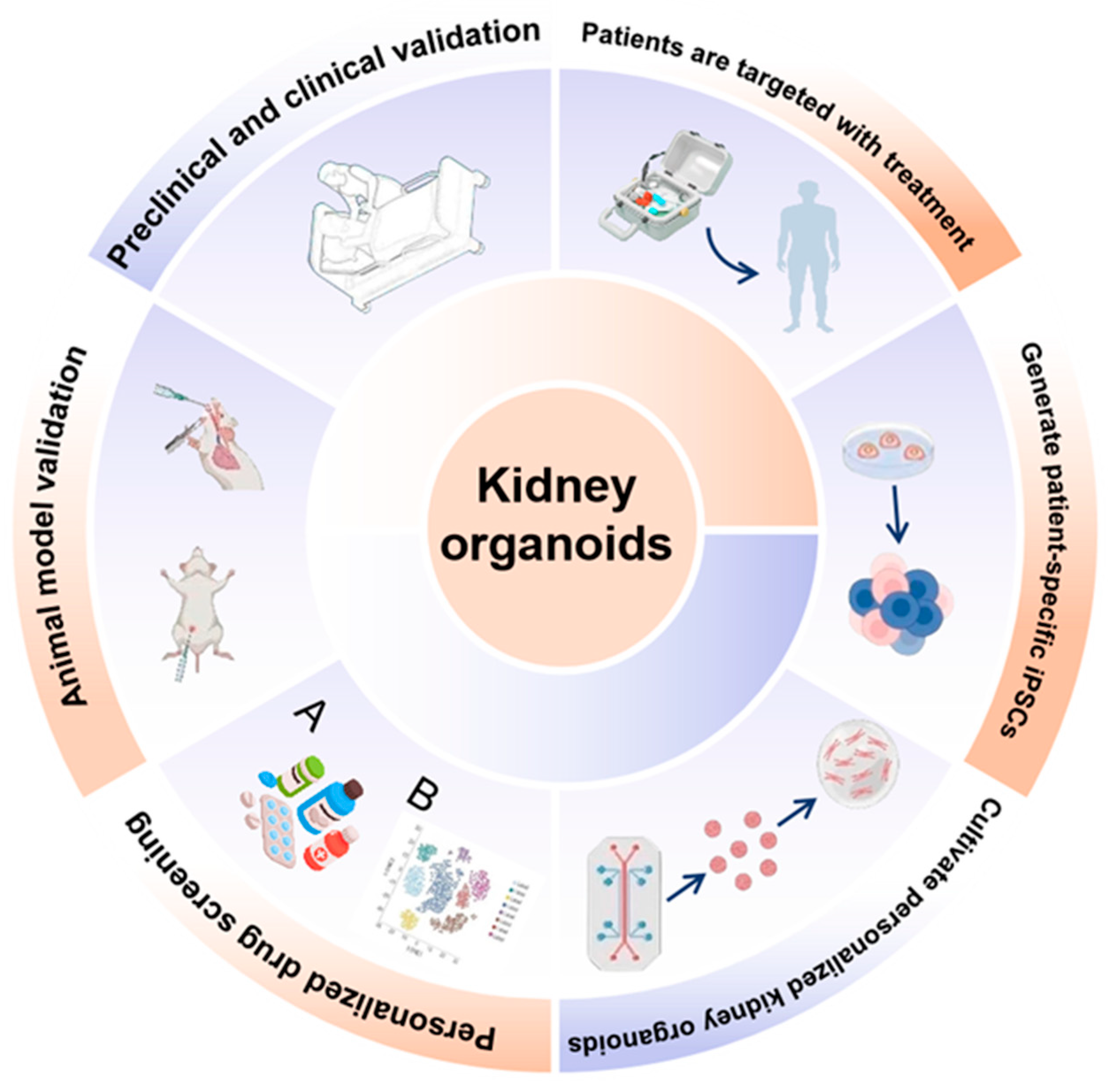
3.2. Kidney Organoids as Drug Development Platforms
3.3. Regenerative Medicine
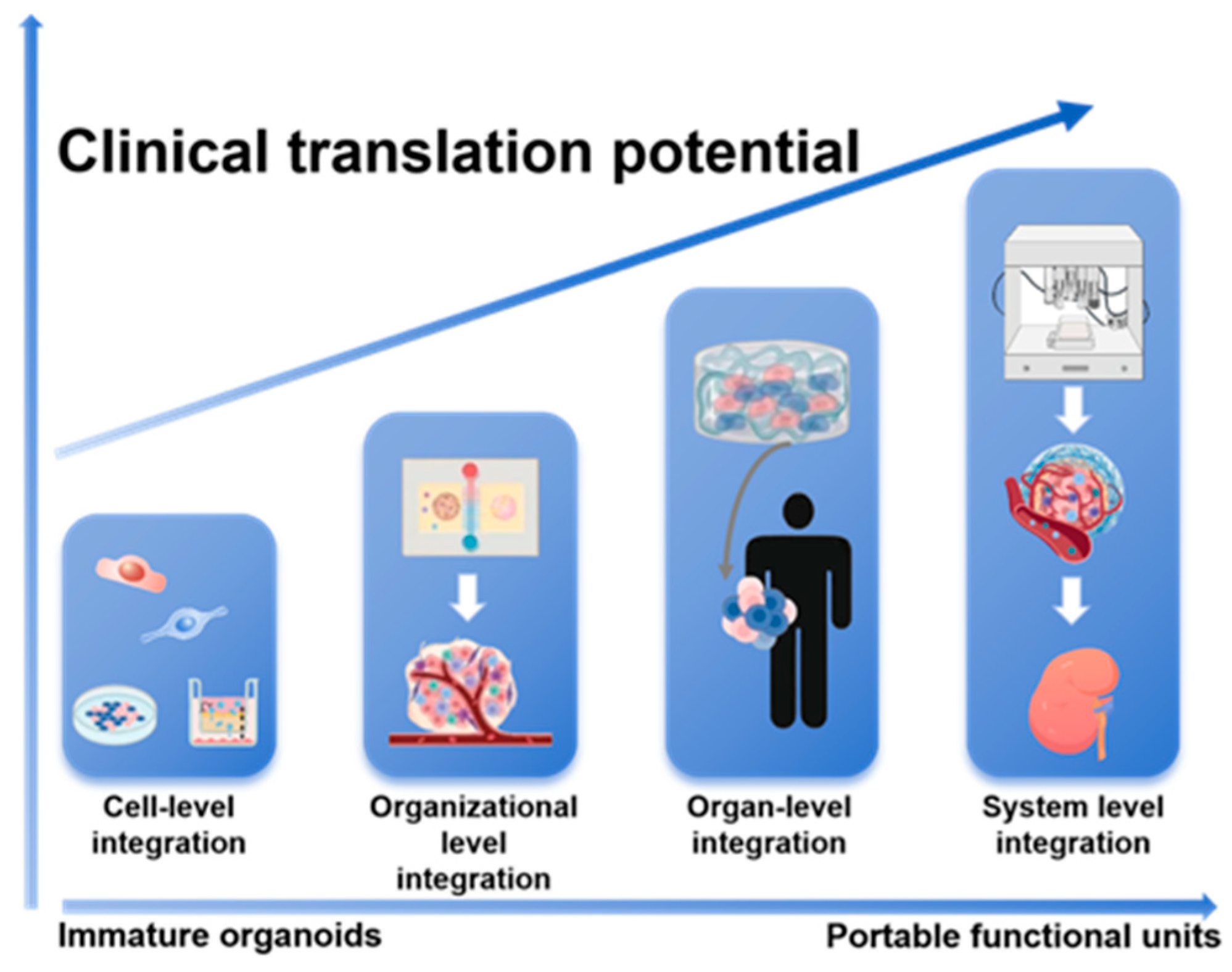
4. Discussion
Author Contributions
Funding
Institutional Review Board Statement
Informed Consent Statement
Data Availability Statement
Conflicts of Interest
Abbreviations
| Abbreviation | Full Term |
| ACE2 | Angiotensin-converting enzyme 2 |
| AKI | Acute Kidney Injury |
| ADPKD | Autosomal Dominant Polycystic Kidney Disease |
| CKD | Chronic Kidney Disease |
| DKD | Diabetic Kidney Disease |
| ECM | Extracellular Matrix |
| GelMA | Gelatin Methacryloyl |
| hPSC | Human Pluripotent Stem Cell |
| iPSC | Induced Pluripotent Stem Cell |
| PKD | Polycystic Kidney Disease |
| TGF-β | Transforming Growth Factor Beta |
References
- Li, J.; Pandian, V.; Davidson, P.M.; Song, Y.; Chen, N.; Fong, D.Y.T. Burden and attributable risk factors of non-communicable diseases and subtypes in 204 countries and territories, 1990–2021: A systematic analysis for the global burden of disease study 2021. Int. J. Surg. 2025, 111, 2385–2397. [Google Scholar] [CrossRef]
- Sun, H.; Saeedi, P.; Karuranga, S.; Pinkepank, M.; Ogurtsova, K.; Duncan, B.B.; Stein, C.; Basit, A.; Chan, J.C.N.; Mbanya, J.C.; et al. IDF Diabetes Atlas: Global, regional and country-level diabetes prevalence estimates for 2021 and projections for 2045. Diabetes Res. Clin. Pract. 2022, 183, 109119. [Google Scholar] [CrossRef]
- Kovesdy, C.P. Epidemiology of chronic kidney disease: An update 2022. Kidney Int. Suppl. 2022, 12, 7–11. [Google Scholar] [CrossRef]
- Yang, C.; Wang, H.; Zhao, X.; Matsushita, K.; Coresh, J.; Zhang, L.; Zhao, M.H. CKD in China: Evolving Spectrum and Public Health Implications. Am. J. Kidney Dis. 2020, 76, 258–264. [Google Scholar] [CrossRef]
- Vivante, A. Genetics of Chronic Kidney Disease. N. Engl. J. Med. 2024, 391, 627–639. [Google Scholar] [CrossRef] [PubMed]
- Tangri, N.; Chadban, S.; Cabrera, C.; Retat, L.; Sánchez, J.J.G. Projecting the Epidemiological and Economic Impact of Chronic Kidney Disease Using Patient-Level Microsimulation Modelling: Rationale and Methods of Inside CKD. Adv. Ther. 2023, 40, 265–281. [Google Scholar] [CrossRef] [PubMed]
- Jha, V.; Al-Ghamdi, S.M.G.; Li, G.; Wu, M.S.; Stafylas, P.; Retat, L.; Card-Gowers, J.; Barone, S.; Cabrera, C.; Garcia Sanchez, J.J. Global Economic Burden Associated with Chronic Kidney Disease: A Pragmatic Review of Medical Costs for the Inside CKD Research Programme. Adv. Ther. 2023, 40, 4405–4420. [Google Scholar] [CrossRef]
- Chadban, S.; Arıcı, M.; Power, A.; Wu, M.S.; Mennini, F.S.; Arango Álvarez, J.J.; Garcia Sanchez, J.J.; Barone, S.; Card-Gowers, J.; Martin, A.; et al. Projecting the economic burden of chronic kidney disease at the patient level (Inside CKD): A microsimulation modelling study. eClinicalMedicine 2024, 72, 102615. [Google Scholar] [CrossRef]
- Navarra, S.; Solini, A.; Baroni, M.G.; Frova, L.; Grande, E. A long-term nationwide study on chronic kidney disease-related mortality in Italy: Trends and associated comorbidity. J. Nephrol. 2022, 35, 505–515. [Google Scholar] [CrossRef] [PubMed]
- Gibertoni, D.; Mandreoli, M.; Rucci, P.; Fantini, M.P.; Rigotti, A.; Scarpioni, R.; Santoro, A. Excess mortality attributable to chronic kidney disease. Results from the PIRP project. J. Nephrol. 2016, 29, 663–671. [Google Scholar] [CrossRef]
- Clevers, H. Modeling Development and Disease with Organoids. Cell 2016, 165, 1586–1597. [Google Scholar] [CrossRef]
- Tekguc, M.; Gaal, R.C.V.; Uzel, S.G.M.; Gupta, N.; Riella, L.V.; Lewis, J.A.; Morizane, R. Kidney organoids: A pioneering model for kidney diseases. Transl. Res. 2022, 250, 1–17. [Google Scholar] [CrossRef]
- Hammerman, M.R. Tissue engineering the kidney. Kidney Int. 2003, 63, 1195–1204. [Google Scholar] [CrossRef][Green Version]
- Bonventre, J.V.; Hurst, F.P.; West, M.; Wu, I.; Roy-Chaudhury, P.; Sheldon, M. A Technology Roadmap for Innovative Approaches to Kidney Replacement Therapies: A Catalyst for Change. Clin. J. Am. Soc. Nephrol. 2019, 14, 1539–1547. [Google Scholar] [CrossRef] [PubMed]
- Takasato, M.; Er, P.X.; Chiu, H.S.; Maier, B.; Baillie, G.J.; Ferguson, C.; Parton, R.G.; Wolvetang, E.J.; Roost, M.S.; Chuva de Sousa Lopes, S.M.; et al. Kidney organoids from human iPS cells contain multiple lineages and model human nephrogenesis. Nature 2015, 526, 564–568. [Google Scholar] [CrossRef]
- Takasato, M.; Er, P.X.; Chiu, H.S.; Little, M.H. Generation of kidney organoids from human pluripotent stem cells. Nat. Protoc. 2016, 11, 1681–1692. [Google Scholar] [CrossRef]
- Kuang, Z.; Pang, C.; Wang, H.; Wei, X.; Ye, X.; Gao, X.; Sun, L. Generation of kidney organoids derived from human expanded potential stem cells. Cells Dev. 2025, 182, 204025. [Google Scholar] [CrossRef] [PubMed]
- Kim, J.W.; Nam, S.A.; Yi, J.; Kim, J.Y.; Lee, J.Y.; Park, S.Y.; Sen, T.; Choi, Y.M.; Lee, J.Y.; Kim, H.L.; et al. Kidney Decellularized Extracellular Matrix Enhanced the Vascularization and Maturation of Human Kidney Organoids. Adv. Sci. 2022, 9, e2103526. [Google Scholar] [CrossRef]
- Davis, S.N.; Grindel, S.H.; Viola, J.M.; Liu, G.Y.; Liu, J.; Qian, G.; Porter, C.M.; Hughes, A.J. Nephron progenitors rhythmically alternate between renewal and differentiation phases that synchronize with kidney branching morphogenesis. bioRxiv 2024. [Google Scholar] [CrossRef]
- Du, Z.; Bas-Cristóbal Menéndez, A.; Urban, M.; Hartley, A.; Ratsma, D.; Koedam, M.; van den Bosch, T.P.P.; Clahsen-van Groningen, M.; Gribnau, J.; Mulder, J.; et al. Erythropoietin delivery through kidney organoids engineered with an episomal DNA vector. Stem Cell Res. Ther. 2025, 16, 174. [Google Scholar] [CrossRef]
- Kinoshita, Y.; Kobayashi, E.; Matsui, K.; Inage, Y.; Morimoto, K.; Yamamoto, S.; Iwai, S.; Kitada, K.; Iwasawa, K.; Saito, Y.; et al. Life-supporting functional kidney replacement by integration of embryonic metanephros-bladder composite tissue transplants. Kidney Int. 2025, 107, 1051–1063. [Google Scholar] [CrossRef]
- Taguchi, A.; Nishinakamura, R. Higher-Order Kidney Organogenesis from Pluripotent Stem Cells. Cell Stem Cell 2017, 21, 730–746.e6. [Google Scholar] [CrossRef]
- Morizane, R.; Bonventre, J.V. Generation of nephron progenitor cells and kidney organoids from human pluripotent stem cells. Nat. Protoc. 2017, 12, 195–207. [Google Scholar] [CrossRef]
- Becherucci, F.; Mazzinghi, B.; Allinovi, M.; Angelotti, M.L.; Romagnani, P. Regenerating the kidney using human pluripotent stem cells and renal progenitors. Expert Opin. Biol. Ther. 2018, 18, 795–806. [Google Scholar] [CrossRef] [PubMed]
- Taguchi, A.; Kaku, Y.; Ohmori, T.; Sharmin, S.; Ogawa, M.; Sasaki, H.; Nishinakamura, R. Redefining the in vivo origin of metanephric nephron progenitors enables generation of complex kidney structures from pluripotent stem cells. Cell Stem Cell 2014, 14, 53–67. [Google Scholar] [CrossRef] [PubMed]
- Yanofsky, S.M.; Dugas, C.M.; Katsurada, A.; Liu, J.; Saifudeen, Z.; El-Dahr, S.S.; Satou, R. Angiotensin II biphasically regulates cell differentiation in human iPSC-derived kidney organoids. Am. J. Physiol. Ren. Physiol. 2021, 321, F559–F571. [Google Scholar] [CrossRef] [PubMed]
- Vanslambrouck, J.M.; Tan, K.S.; Mah, S.; Little, M.H. Generation of proximal tubule-enhanced kidney organoids from human pluripotent stem cells. Nat. Protoc. 2023, 18, 3229–3252. [Google Scholar] [CrossRef]
- Huang, B.; Zeng, Z.; Kim, S.; Fausto, C.C.; Koppitch, K.; Li, H.; Li, Z.; Chen, X.; Guo, J.; Zhang, C.C.; et al. Long-term expandable mouse and human-induced nephron progenitor cells enable kidney organoid maturation and modeling of plasticity and disease. Cell Stem Cell 2024, 31, 921–939.e17. [Google Scholar] [CrossRef]
- Homan, K.A.; Gupta, N.; Kroll, K.T.; Kolesky, D.B.; Skylar-Scott, M.; Miyoshi, T.; Mau, D.; Valerius, M.T.; Ferrante, T.; Bonventre, J.V.; et al. Flow-enhanced vascularization and maturation of kidney organoids in vitro. Nat. Methods 2019, 16, 255–262. [Google Scholar] [CrossRef]
- Treacy, N.J.; Clerkin, S.; Davis, J.L.; Kennedy, C.; Miller, A.F.; Saiani, A.; Wychowaniec, J.K.; Brougham, D.F.; Crean, J. Growth and differentiation of human induced pluripotent stem cell (hiPSC)-derived kidney organoids using fully synthetic peptide hydrogels. Bioact. Mater. 2023, 21, 142–156. [Google Scholar] [CrossRef]
- Nerger, B.A.; Sinha, S.; Lee, N.N.; Cheriyan, M.; Bertsch, P.; Johnson, C.P.; Mahadevan, L.; Bonventre, J.V.; Mooney, D.J. 3D Hydrogel Encapsulation Regulates Nephrogenesis in Kidney Organoids. Adv. Mater. 2024, 36, e2308325. [Google Scholar] [CrossRef]
- Pahuja, A.; Goux Corredera, I.; Moya-Rull, D.; Garreta, E.; Montserrat, N. Engineering physiological environments to advance kidney organoid models from human pluripotent stem cells. Curr. Opin. Cell Biol. 2024, 86, 102306. [Google Scholar] [CrossRef] [PubMed]
- Clerkin, S.; Singh, K.; Davis, J.L.; Treacy, N.J.; Krupa, I.; Reynaud, E.G.; Lees, R.M.; Needham, S.R.; MacWhite-Begg, D.; Wychowaniec, J.K.; et al. Tuneable gelatin methacryloyl (GelMA) hydrogels for the directed specification of renal cell types for hiPSC-derived kidney organoid maturation. Biomaterials 2025, 322, 123349. [Google Scholar] [CrossRef]
- Garreta, E.; Prado, P.; Tarantino, C.; Oria, R.; Fanlo, L.; Martí, E.; Zalvidea, D.; Trepat, X.; Roca-Cusachs, P.; Gavaldà-Navarro, A.; et al. Fine tuning the extracellular environment accelerates the derivation of kidney organoids from human pluripotent stem cells. Nat. Mater. 2019, 18, 397–405. [Google Scholar] [CrossRef] [PubMed]
- Koning, M.; Dumas, S.J.; Avramut, M.C.; Koning, R.I.; Meta, E.; Lievers, E.; Wiersma, L.E.; Borri, M.; Liang, X.; Xie, L.; et al. Vasculogenesis in kidney organoids upon transplantation. NPJ Regen. Med. 2022, 7, 40. [Google Scholar] [CrossRef] [PubMed]
- Low, J.H.; Li, P.; Chew, E.G.Y.; Zhou, B.; Suzuki, K.; Zhang, T.; Lian, M.M.; Liu, M.; Aizawa, E.; Rodriguez Esteban, C.; et al. Generation of Human PSC-Derived Kidney Organoids with Patterned Nephron Segments and a De Novo Vascular Network. Cell Stem Cell 2019, 25, 373–387.e379. [Google Scholar] [CrossRef]
- Shi, M.; Crouse, B.; Sundaram, N.; Pode Shakked, N.; Thorner, K.; King, N.M.; Dutta, P.; Ester, L.; Zhang, W.; Govindarajah, V.; et al. Integrating collecting systems in human kidney organoids through fusion of distal nephron to ureteric bud. Cell Stem Cell 2025, 32, 1055–1070.e8. [Google Scholar] [CrossRef]
- Wu, H.; Humphreys, B.D. Single Cell Sequencing and Kidney Organoids Generated from Pluripotent Stem Cells. Clin. J. Am. Soc. Nephrol. 2020, 15, 550–556. [Google Scholar] [CrossRef]
- Yoshimura, Y.; Muto, Y.; Ledru, N.; Wu, H.; Omachi, K.; Miner, J.H.; Humphreys, B.D. A single-cell multiomic analysis of kidney organoid differentiation. Proc. Natl. Acad. Sci. USA 2023, 120, e2219699120. [Google Scholar] [CrossRef]
- Park, K.; Lee, J.Y.; Lee, S.Y.; Jeong, I.; Park, S.Y.; Kim, J.W.; Nam, S.A.; Kim, H.W.; Kim, Y.K.; Lee, S. Deep learning predicts the differentiation of kidney organoids derived from human induced pluripotent stem cells. Kidney Res. Clin. Pract. 2023, 42, 75–85. [Google Scholar] [CrossRef]
- Przepiorski, A.; Sander, V.; Tran, T.; Hollywood, J.A.; Sorrenson, B.; Shih, J.H.; Wolvetang, E.J.; McMahon, A.P.; Holm, T.M.; Davidson, A.J. A Simple Bioreactor-Based Method to Generate Kidney Organoids from Pluripotent Stem Cells. Stem Cell Rep. 2018, 11, 470–484. [Google Scholar] [CrossRef]
- Parigoris, E.; Lee, J.H.; Liu, A.Y.; Zhao, X.; Takayama, S. Extended longevity geometrically-inverted proximal tubule organoids. Biomaterials 2022, 290, 121828. [Google Scholar] [CrossRef]
- Cruz, N.M.; Song, X.; Czerniecki, S.M.; Gulieva, R.E.; Churchill, A.J.; Kim, Y.K.; Winston, K.; Tran, L.M.; Diaz, M.A.; Fu, H.; et al. Organoid cystogenesis reveals a critical role of microenvironment in human polycystic kidney disease. Nat. Mater. 2017, 16, 1112–1119. [Google Scholar] [CrossRef]
- Digby, J.L.M.; Vanichapol, T.; Przepiorski, A.; Davidson, A.J.; Sander, V. Evaluation of cisplatin-induced injury in human kidney organoids. Am. J. Physiol. Ren. Physiol. 2020, 318, F971–F978. [Google Scholar] [CrossRef] [PubMed]
- Garreta, E.; Prado, P.; Stanifer, M.L.; Monteil, V.; Marco, A.; Ullate-Agote, A.; Moya-Rull, D.; Vilas-Zornoza, A.; Tarantino, C.; Romero, J.P.; et al. A diabetic milieu increases ACE2 expression and cellular susceptibility to SARS-CoV-2 infections in human kidney organoids and patient cells. Cell Metab. 2022, 34, 857–873.e859. [Google Scholar] [CrossRef] [PubMed]
- Mae, S.I.; Hattanda, F.; Morita, H.; Nozaki, A.; Katagiri, N.; Ogawa, H.; Teranaka, K.; Nishimura, Y.; Kudoh, A.; Yamanaka, S.; et al. Human iPSC-derived renal collecting duct organoid model cystogenesis in ADPKD. Cell Rep. 2023, 42, 113431. [Google Scholar] [CrossRef] [PubMed]
- Xu, Y.; Kuppe, C.; Perales-Patón, J.; Hayat, S.; Kranz, J.; Abdallah, A.T.; Nagai, J.; Li, Z.; Peisker, F.; Saritas, T.; et al. Adult human kidney organoids originate from CD24(+) cells and represent an advanced model for adult polycystic kidney disease. Nat. Genet. 2022, 54, 1690–1701. [Google Scholar] [CrossRef]
- Vishy, C.E.; Thomas, C.; Vincent, T.; Crawford, D.K.; Goddeeris, M.M.; Freedman, B.S. Genetics of cystogenesis in base-edited human organoids reveal therapeutic strategies for polycystic kidney disease. Cell Stem Cell 2024, 31, 537–553.e5. [Google Scholar] [CrossRef]
- Xu, P.; Li, K.; Liu, H.; Xu, A.; Zhang, Z.; Yang, Y.; Lai, X.; Hao, K.; Fang, K.; Lai, Z.; et al. Inhibition of AMPKα Pathway by Podocyte GOLM1 Exacerbates Diabetic Nephrology in Mice. Adv. Sci. 2025, 12, e05695. [Google Scholar] [CrossRef] [PubMed]
- Jiang, W.; Wang, J.; Shen, X.; Lu, W.; Wang, Y.; Li, W.; Gao, Z.; Xu, J.; Li, X.; Liu, R.; et al. Establishment and Validation of a Risk Prediction Model for Early Diabetic Kidney Disease Based on a Systematic Review and Meta-Analysis of 20 Cohorts. Diabetes Care 2020, 43, 925–933. [Google Scholar] [CrossRef]
- Morizane, R.; Lamers, M.M. Organoids in disease modeling and regenerative medicine. Cell. Mol. Life Sci. 2025, 82, 169. [Google Scholar] [CrossRef]
- Wang, B.; Xue, Y.; Zhai, W. Integration of Tumor Microenvironment in Patient-Derived Organoid Models Help Define Precision Medicine of Renal Cell Carcinoma. Front. Immunol. 2022, 13, 902060. [Google Scholar] [CrossRef] [PubMed]
- Li, Z.; Xu, H.; Yu, L.; Wang, J.; Meng, Q.; Mei, H.; Cai, Z.; Chen, W.; Huang, W. Patient-derived renal cell carcinoma organoids for personalized cancer therapy. Clin. Transl. Med. 2022, 12, e970. [Google Scholar] [CrossRef]
- Zhang, X.; Hong, B.; Yu, W.; Miao, Q.; Wang, W.; Wang, Y.; Sun, Z.; Bo, Y.; Zhang, J.; Zhang, H.; et al. Comprehensive pan-cancer analysis reveals CD70 as a promising therapeutic target and biomarker in clear cell renal cell carcinoma. Int. J. Biol. Macromol. 2025, 307, 142079. [Google Scholar] [CrossRef]
- Zhao, S.; Li, R.; Xia, Y.; Wang, X.; Liu, Z.; Chu, Q.; He, J.; Zhang, J.; Guo, Y.; Wang, Y.; et al. Targeting ECM-producing cells with CAR-T therapy alleviates fibrosis in chronic kidney disease. Cell Stem Cell 2025, 32, 1390–1402.e9. [Google Scholar] [CrossRef]
- Yang, X.; Delsante, M.; Daneshpajouhnejad, P.; Fenaroli, P.; Mandell, K.P.; Wang, X.; Takahashi, S.; Halushka, M.K.; Kopp, J.B.; Levi, M.; et al. Bile Acid Receptor Agonist Reverses Transforming Growth Factor-β1-Mediated Fibrogenesis in Human Induced Pluripotent Stem Cells-Derived Kidney Organoids. Lab. Investig. 2024, 104, 100336. [Google Scholar] [CrossRef] [PubMed]
- Hiratsuka, K.; Miyoshi, T.; Kroll, K.T.; Gupta, N.R.; Valerius, M.T.; Ferrante, T.; Yamashita, M.; Lewis, J.A.; Morizane, R. Organoid-on-a-chip model of human ARPKD reveals mechanosensing pathomechanisms for drug discovery. Sci. Adv. 2022, 8, eabq0866. [Google Scholar] [CrossRef] [PubMed]
- Shin, J.; Tabatabaei Rezaei, N.; Choi, S.; Li, Z.; Kim, D.H.; Kim, K. Photocrosslinkable Kidney Decellularized Extracellular Matrix-Based Bioink for 3D Bioprinting. Adv. Healthc. Mater. 2025, 14, e2501616. [Google Scholar] [CrossRef]
- Wang, J.; Xie, W.; Li, N.; Li, W.; Zhang, Z.; Fan, N.; Ouyang, Z.; Zhao, Y.; Lai, C.; Li, H.; et al. Generation of a humanized mesonephros in pigs from induced pluripotent stem cells via embryo complementation. Cell Stem Cell 2023, 30, 1235–1245.e1236. [Google Scholar] [CrossRef]
- Morizane, R.; Lam, A.Q.; Freedman, B.S.; Kishi, S.; Valerius, M.T.; Bonventre, J.V. Nephron organoids derived from human pluripotent stem cells model kidney development and injury. Nat. Biotechnol. 2015, 33, 1193–1200. [Google Scholar] [CrossRef]



| Year | Milestone Achievement | Significance | Key References |
|---|---|---|---|
| 2014–2015 | First generation of kidney organoids from human pluripotent stem cells (hPSCs) that contain multiple nephron segments. | Established the foundational protocol; demonstrated the principle of mimicking nephrogenesis in vitro. | [15,22] |
| 2017 | Modeling polycystic kidney disease (PKD): using patient-specific organoids and identifying microenvironmental cues critical for cystogenesis. | Provided the first proof-of-concept for using organoids to model a complex genetic kidney disease and study its mechanism. | [43] |
| 2019 | Enhanced vascularization and maturation: via flow-induced mechanical stimulation in microfluidic chips. | Introduced bioengineering tools (organ-on-a-chip) to significantly improve organoid maturity and vascular network formation. | [29,34] |
| 2020–2022 | Advanced disease modeling: for diabetic kidney disease (DKD) and acute kidney injury (AKI), linking in vitro phenotypes to clinical biomarkers. | Demonstrated the utility of organoids in modeling acquired diseases and validating clinical correlations (e.g., drug toxicity, KIM-1 biomarker). | [44,45] |
| 2022–2023 | Precise genetic disease modeling: using gene-edited and patient-derived iPSCs for Alport syndrome and ADPKD. | Enabled isogenic comparisons and deep mechanistic studies of genetic disorders, advancing towards personalized medicine. | [46,47] |
| 2023–2024 | Single-cell multi-omics and deep learning: for standardized quality control and profiling of organoid heterogeneity. | Established new standards for objective assessment and revealed cell-type-specific responses, enabling high-throughput screening. | [28,39] |
| 2024–2025 | Functional maturation & drug discovery: Generation of long-term expandable nephron progenitors and application in compound screening (e.g., for ADPKD). | Addressed long-term culture and scalability challenges, directly applying organoids to identify therapeutic candidates. | [33,48] |
| 2025 | Towards clinical translation: Focus on integrated vascularization, immune microenvironment incorporation, and in vivo functional assessment. | Represent the current frontier aimed at overcoming the final barriers to regenerative medicine applications. | [20,37] |
| Disease Category | Pathological Feature | Organoid Model/Strategy | Key Findings |
|---|---|---|---|
| Diabetic Kidney Disease | Hyperglycemia-induced podocyte injury, oxidative stress, fibrosis | hiPSC-derived organoids under high-glucose conditions or TGF-β1 treatment; microenvironment tuning (e.g., matrix stiffness). | Recapitulated GOLM1-EGFR-PPARγ-AMPKα axis exacerbating injury; softer matrices reduced TGF-β-induced fibrotic markers. |
| Genetic Kidney Diseases (e.g., Alport Syndrome) | Podocyte slit diaphragm defects, abnormal glomerular basement membrane (type IV collagen) | CRISPR-Cas9 gene-edited hPSCs (e.g., NPHS1, COL4A5 mutations) differentiated into organoids. | Reproduced genotype-specific structural defects; platform for genotype-phenotype correlation and mechanistic dissection. |
| Acute Kidney Injury (AKI) | Tubular cell apoptosis, brush border loss, biomarker (e.g., KIM-1) upregulation | Chemical induction (e.g., cisplatin) or ischemia-reperfusion modeling in hPSC-derived organoids. | Dose-dependent injury response mirroring clinical trends; superior pathological sensitivity vs. 2D models. |
| Polycystic Kidney Disease (PKD) | Spontaneous cyst formation, tubular dilation | hiPSC-derived ureteric bud/collecting duct organoids from PKD1-mutant cells; base-edited organoids (e.g., PKD1-R2430X). | Elucidated cyst initiation mechanisms; platform for drug screening (e.g., read-through compounds). |
| Renal Carcinoma (e.g., ccRCC) | Tumor heterogeneity, key mutation retention (e.g., VHL), tumor microenvironment | Patient-derived tumor organoids (PDTOs) from surgical samples; co-culture models (e.g., with CAR-T cells). | Retained original tumor genetics and drug response profiles; useful for immunotherapy efficacy testing. |
| Chronic Kidney Disease/Fibrosis | Progressive fibrosis, myofibroblast activation, ECM deposition | Chronic TGF-β stimulation, metabolite accumulation models in long-term organoid cultures. | Models key aspects of fibrotic progression; used for testing anti-fibrotic therapies. |
| Drug/Compound Name | Stage/Purpose | Kidney Organoid Model Used | Key Findings/Progress |
|---|---|---|---|
| Tamibarotene | Phase IIa Clinical Trial | iPSC-derived collecting duct organoids (ADPKD cyst model) | Identified via screening in ADPKD patient iPSC-derived cyst organoids. This retinoic acid receptor agonist significantly inhibited cystogenesis and has entered a Phase IIa trial for ADPKD. |
| Minoxidil | Preclinical validation & drug repurposing | iPSC-derived polycystic kidney disease organoids | Revealed a link between cystogenesis and autophagy defects. Validated the FDA-approved drug minoxidil as an autophagy activator, effectively attenuating cyst formation both in vitro and in vivo. |
| Tolvaptan | Efficacy validation of an approved drug | iPSC-derived collecting duct organoids (ADPKD cyst model) | Validated the cyst-inhibiting effect of tolvaptan (the only clinically approved drug for ADPKD) in this human organoid model, confirming the platform’s reliability for efficacy assessment. |
| Imatinib | Drug repurposing/nephroprotective agent | iPSC-derived kidney organoids (cisplatin injury model) | Established an automated high-throughput screening platform using kidney organoids. Screened an FDA-approved drug library and identified imatinib’s potential protective effect against cisplatin-induced acute kidney injury. |
| Doxorubicin | Nephrotoxicity assessment | hiPSC-derived functional kidney organoids (3D-bioprinted) | Demonstrated that the bioprinted kidney organoids recapitulated doxorubicin-induced injury (e.g., upregulation of injury marker KIM-1), validating their utility for nephrotoxicity testing. |
| (Various compound libraries) | High-throughput nephrotoxicity/therapeutic screening | iPSC-derived kidney organoids | Established a screening pipeline integrating automated 3D imaging and machine learning analysis of kidney organoids for large-scale compound evaluation of nephrotoxicity and therapeutic effects. |
| Fibrolisine (candidate) | Preclinical candidate evaluation | Advanced human kidney fibrosis organoid | The EU-funded FibroTarg project utilizes a sophisticated human kidney fibrosis organoid model to evaluate the efficacy of its first-in-class anti-fibrotic candidate, Fibrolisine. |
Disclaimer/Publisher’s Note: The statements, opinions and data contained in all publications are solely those of the individual author(s) and contributor(s) and not of MDPI and/or the editor(s). MDPI and/or the editor(s) disclaim responsibility for any injury to people or property resulting from any ideas, methods, instructions or products referred to in the content. |
© 2026 by the authors. Licensee MDPI, Basel, Switzerland. This article is an open access article distributed under the terms and conditions of the Creative Commons Attribution (CC BY) license.
Share and Cite
Li, A.; Chai, Z.; Jandeleit-Dahm, K.; Jha, J.C. Technological Innovations and the Translational Path of Kidney Organoids. Biomedicines 2026, 14, 327. https://doi.org/10.3390/biomedicines14020327
Li A, Chai Z, Jandeleit-Dahm K, Jha JC. Technological Innovations and the Translational Path of Kidney Organoids. Biomedicines. 2026; 14(2):327. https://doi.org/10.3390/biomedicines14020327
Chicago/Turabian StyleLi, Anni, Zhonglin Chai, Karin Jandeleit-Dahm, and Jay C. Jha. 2026. "Technological Innovations and the Translational Path of Kidney Organoids" Biomedicines 14, no. 2: 327. https://doi.org/10.3390/biomedicines14020327
APA StyleLi, A., Chai, Z., Jandeleit-Dahm, K., & Jha, J. C. (2026). Technological Innovations and the Translational Path of Kidney Organoids. Biomedicines, 14(2), 327. https://doi.org/10.3390/biomedicines14020327