
Mouse Models of Muscle Fibrosis: Mechanisms, Methods, and Applications

 , ,
, , 
Abstract
1. Introduction
2. Mouse Models of Muscle Injury
2.1. Volumetric Muscle Loss
2.2. Laceration
2.3. Myotoxin Injection
2.4. Other Models
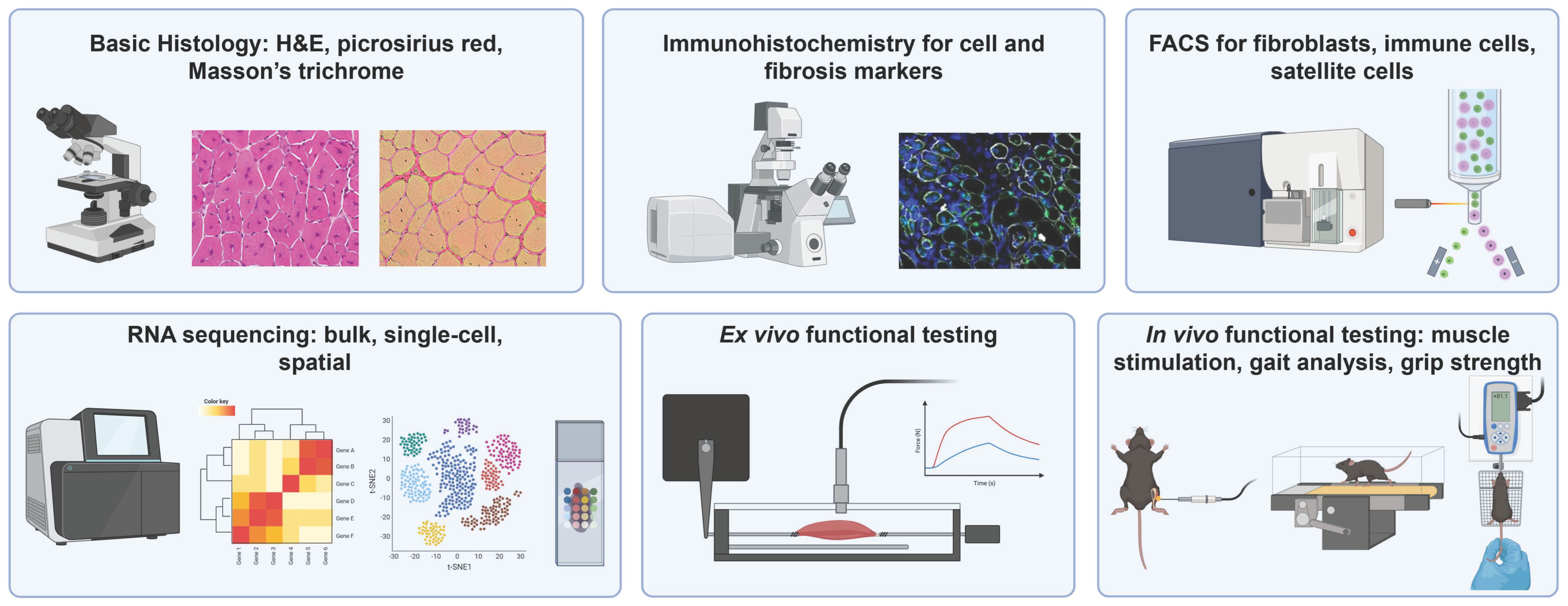
3. Outcome Measures
4. Summary and Future Directions
5. Conclusions
Author Contributions
Funding
Institutional Review Board Statement
Informed Consent Statement
Data Availability Statement
Acknowledgments
Conflicts of Interest
Appendix A
References
- Frontera, W.R.; Ochala, J. Skeletal Muscle: A Brief Review of Structure and Function. Calcif. Tissue Int. 2015, 96, 183–195. [Google Scholar] [CrossRef] [PubMed]
- Mahdy, M.A.A. Skeletal muscle fibrosis: An overview. Cell Tissue Res. 2018, 375, 575–588. [Google Scholar] [CrossRef]
- Fernández-Costa, J.M.; Fernández-Garibay, X.; Velasco-Mallorquí, F.; Ramón-Azcón, J. Bioengineered in vitro skeletal muscles as new tools for muscular dystrophies preclinical studies. J. Tissue Eng. 2021, 12, 2041731420981339. [Google Scholar] [CrossRef]
- Ma, N.; Chen, D.; Lee, J.-H.; Kuri, P.; Hernandez, E.B.; Kocan, J.; Mahmood, H.; Tichy, E.D.; Rompolas, P.; Mourkioti, F. Piezo1 regulates the regenerative capacity of skeletal muscles via orchestration of stem cell morphological states. Sci. Adv. 2022, 8, eabn0485. [Google Scholar] [CrossRef]
- Asakura, A.; Rudnicki, M.A.; Komaki, M. Muscle satellite cells are multipotential stem cells that exhibit myogenic, osteogenic, and adipogenic differentiation. Differentiation 2001, 68, 245–253. [Google Scholar] [CrossRef] [PubMed]
- Serrano, A.L.; Muñoz-Cánoves, P. Mouse Models of Muscle Fibrosis; Methods in Molecular Biology; Springer: Berlin/Heidelberg, Germany, 2021; Volume 2299. [Google Scholar] [CrossRef]
- Contreras, O.; Cruz-Soca, M.; Theret, M.; Soliman, H.; Tung, L.W.; Groppa, E.; Rossi, F.M.; Brandan, E. Cross-talk between TGF-β and PDGFRα signaling pathways regulates the fate of stromal fibro–adipogenic progenitors. J. Cell Sci. 2019, 132, jcs232157. [Google Scholar] [CrossRef] [PubMed]
- Järvinen, T.A.H.; Järvinen, T.L.N.; Kääriäinen, M.; Kalimo, H.; Järvinen, M. Muscle Injuries: Biology and Treatment. Am. J. Sports Med. 2005, 33, 745–764. [Google Scholar] [CrossRef]
- Edouard, P.; Reurink, G.; Mackey, A.L.; Lieber, R.L.; Pizzari, T.; Järvinen, T.A.H.; Gronwald, T.; Hollander, K.; Edouard, P.; Reurink, G.; et al. Traumatic muscle injury. Nat. Rev. Dis. Primers 2023, 9, 56. [Google Scholar] [CrossRef]
- Edouard, P.; Branco, P.; Alonso, J.-M. Muscle injury is the principal injury type and hamstring muscle injury is the first injury diagnosis during top-level international athletics championships between 2007 and 2015. Br. J. Sports Med. 2016, 50, 619–630. [Google Scholar] [CrossRef]
- Corona, B.T.; Rivera, C.C.; Owens, J.G.; Wenke, J.C.; Rathbone, C.R. Volumetric muscle loss leads to permanent disability following extremity trauma. J. Rehabil. Res. Dev. 2015, 52, 785–792. [Google Scholar] [CrossRef]
- Parker, J.B.; Valencia, C.; Akras, D.; DiIorio, S.E.; Griffin, M.F.; Longaker, M.T.; Wan, D.C. Understanding Fibroblast Heterogeneity in Form and Function. Biomedicines 2023, 11, 2264. [Google Scholar] [CrossRef]
- DiIorio, S.E.; Young, B.; Parker, J.B.; Griffin, M.F.; Longaker, M.T. Understanding Tendon Fibroblast Biology and Heterogeneity. Biomedicines 2024, 12, 859. [Google Scholar] [CrossRef]
- Ge, X.; Jin, Y.; He, J.; Jia, Z.; Liu, Y.; Xu, Y. Extracellular matrix in skeletal muscle injury and atrophy: Mechanisms and therapeutic implications. J. Orthop. Transl. 2025, 52, 404–418. [Google Scholar] [CrossRef]
- Chen, W.; You, W.; Valencak, T.G.; Shan, T. Bidirectional roles of skeletal muscle fibro-adipogenic progenitors in homeostasis and disease. Ageing Res. Rev. 2022, 80, 101682. [Google Scholar] [CrossRef]
- Dewi, N.M.; Meiliana, A.; Defi, I.R.; Amalia, R.; Sartika, C.R.; Wijaya, A.; Barliana, M.I. Targeted Therapy for Skeletal Muscle Fibrosis: Regulation of Myostatin, TGF-β, MMP, and TIMP to Maintain Extracellular Matrix Homeostasis. Biol. Targets Ther. 2025, 19, 213–229. [Google Scholar] [CrossRef] [PubMed]
- Bedair, H.S.; Karthikeyan, T.; Quintero, A.; Li, Y.; Huard, J.; Hany, S.; Bedair, T.K.; Quintero, A.; Li, Y.; Huard, J. Angiotensin II Receptor Blockade Administered after Injury Improves Muscle Regeneration and Decreases Fibrosis in Normal Skeletal Muscle. Am. J. Sports Med. 2008, 36, 1548–1554, Erratum in Am. J. Sports Med. 2008, 36, 2465. [Google Scholar] [CrossRef] [PubMed]
- Setayesh, K.; Villarreal, A.; Gottschalk, A.; Tokish, J.M.; Choate, W.S. Treatment of Muscle Injuries with Platelet-Rich Plasma: A Review of the Literature. Curr. Rev. Musculoskelet. Med. 2018, 11, 635–642. [Google Scholar] [CrossRef] [PubMed]
- Darby, I.A.; Hewitson, T.D. Fibroblast differentiation in wound healing and fibrosis. Int. Rev. Cytol. 2007, 257, 143–179. [Google Scholar] [CrossRef]
- Wang, Z.; Tang, Z. Composition and Function of Extracellular Matrix in Development of Skeletal Muscle. In Composition and Function of the Extracellular Matrix in the Human Body; InTech: London, UK, 2016. [Google Scholar]
- Prazeres, P.H.D.M.; Turquetti, A.O.M.; Azevedo, P.O.; Barreto, R.S.N.; Miglino, M.A.; Mintz, A.; Delbono, O.; Birbrair, A. Perivascular cell αv integrins as a target to treat skeletal muscle fibrosis. Int. J. Biochem. Cell Biol. 2018, 99, 109–113. [Google Scholar] [CrossRef]
- Stumm, J.; Vallecillo-García, P.; Hofe-Schneider, S.V.; Ollitrault, D.; Schrewe, H.; Economides, A.N.; Marazzi, G.; Sassoon, D.A.; Stricker, S. Odd skipped-related 1 (Osr1) identifies muscle-interstitial fibro-adipogenic progenitors (FAPs) activated by acute injury—PubMed. Stem Cell Res. 2018, 32, 8–16. [Google Scholar] [CrossRef]
- Bersini, S.; Gilardi, M.; Mora, M.; Krol, S.; Arrigoni, C.; Candrian, C.; Zanotti, S.; Moretti, M. Tackling muscle fibrosis: From molecular mechanisms to next generation engineered models to predict drug delivery. Adv. Drug Deliv. Rev. 2018, 129, 64–77. [Google Scholar] [CrossRef]
- Castor-Macias, J.A.; Larouche, J.A.; Wallace, E.C.; Spence, B.D.; Eames, A.; Duran, P.; Yang, B.A.; Fraczek, P.M.; Davis, C.A.; Brooks, S.V.; et al. Maresin 1 repletion improves muscle regeneration after volumetric muscle loss. eLife 2023, 12, e86437. [Google Scholar] [CrossRef]
- Wang, H.D.; Lough, D.M.; Kurlander, D.E.; Lopez, J.; Quan, A.; Kumar, A.R. Muscle-Derived Stem Cell-Enriched Scaffolds Are Capable of Enhanced Healing of a Murine Volumetric Muscle Loss Defect. Plast. Reconstr. Surg. 2019, 143, 329e–339e. [Google Scholar] [CrossRef]
- Jacobsen, N.L.; Morton, A.B.; Segal, S.S. Angiogenesis precedes myogenesis during regeneration following biopsy injury of skeletal muscle. Skelet. Muscle 2023, 13, 3. [Google Scholar] [CrossRef]
- Rogers, R.G.; Li, L.; Peck, K.; Sanchez, L.; Liu, W.; Ciullo, A.; Alfaro, J.; Rannou, A.; Fournier, M.; Lee, Y.; et al. Cardiosphere-derived cells, with and without a biological scaffold, stimulate myogenesis and recovery of muscle function in mice with volumetric muscle loss. Biomaterials 2021, 274, 120852. [Google Scholar] [CrossRef]
- Corona, B.T.; Henderson, B.E.; Ward, C.L.; Greising, S.M. Contribution of minced muscle graft progenitor cells to muscle fiber formation after volumetric muscle loss injury in wild-type and immune deficient mice. Physiol. Rep. 2017, 5, e13249. [Google Scholar] [CrossRef] [PubMed]
- Nuutila, K.; Sakthivel, D.; Kruse, C.; Tran, P.; Giatsidis, G.; Sinha, I. Gene expression profiling of skeletal muscle after volumetric muscle loss. Wound Repair Regen. 2017, 25, 408–413. [Google Scholar] [CrossRef] [PubMed]
- Matthias, N.; Hunt, S.D.; Wu, J.; Lo, J.; Smith Callahan, L.A.; Li, Y.; Huard, J.; Darabi, R. Volumetric muscle loss injury repair using in situ fibrin gel cast seeded with muscle-derived stem cells (MDSCs). Stem Cell Res. 2018, 27, 65–73. [Google Scholar] [CrossRef]
- Sicari, B.M.; Agrawal, V.; Siu, B.F.; Medberry, C.J.; Dearth, C.L.; Turner, N.J.; Badylak, S.F. A murine model of volumetric muscle loss and a regenerative medicine approach for tissue replacement. Tissue Eng. Part A 2012, 18, 1941–1948, Erratum in Tissue Eng. Part A 2018, 24, 861. [Google Scholar] [CrossRef] [PubMed]
- Quarta, M.; Cromie, M.; Chacon, R.; Blonigan, J.; Garcia, V.; Akimenko, I.; Hamer, M.; Paine, P.; Stok, M.; Shrager, J.B.; et al. Bioengineered constructs combined with exercise enhance stem cell-mediated treatment of volumetric muscle loss. Nat. Commun. 2017, 8, 15613. [Google Scholar] [CrossRef]
- Quarta, M.; Cromie Lear, M.J.; Blonigan, J.; Paine, P.; Chacon, R.; Rando, T.A. Biomechanics show stem cell necessity for effective treatment of volumetric muscle loss using bioengineered constructs. NPJ Regen. Med. 2018, 3, 18. [Google Scholar] [CrossRef]
- Hu, C.; Ayan, B.; Chiang, G.; Chan, A.H.P.; Rando, T.A.; Huang, N.F. Comparative Effects of Basic Fibroblast Growth Factor Delivery or Voluntary Exercise on Muscle Regeneration after Volumetric Muscle Loss. Bioengineering 2022, 9, 37. [Google Scholar] [CrossRef]
- Menetrey, J.; Kasemkijwattana, C.; Fu, F.H.; Moreland, M.S.; Huard, J. Suturing versus immobilization of a muscle laceration. A morphological and functional study in a mouse model. Am. J. Sports Med. 1999, 27, 222–229. [Google Scholar] [CrossRef]
- Hara, M.; Yokota, K.; Saito, T.; Kobayakawa, K.; Kijima, K.; Yoshizaki, S.; Okazaki, K.; Yoshida, S.; Matsumoto, Y.; Harimaya, K.; et al. Periostin Promotes Fibroblast Migration and Inhibits Muscle Repair After Skeletal Muscle Injury. J. Bone Jt. Surg. 2018, 100, e108. [Google Scholar] [CrossRef] [PubMed]
- Fukushima, K.; Badlani, N.; Usas, A.; Riano, F.; Fu, F.H.; Huard, J. The use of an antifibrosis agent to improve muscle recovery after laceration. Am. J. Sports Med. 2001, 29, 394–402, Erratum in Am. J. Sports Med. 2006, 34, 146. [Google Scholar] [CrossRef]
- Shen, W.; Li, Y.; Tang, Y.; Cummins, J.; Huard, J. NS-398, a Cyclooxygenase-2-Specific Inhibitor, Delays Skeletal Muscle Healing by Decreasing Regeneration and Promoting Fibrosis. Am. J. Pathol. 2005, 167, 1105–1117. [Google Scholar] [CrossRef]
- Zhu, J.; Li, Y.; Shen, W.; Qiao, C.; Ambrosio, F.; Lavasani, M.; Nozaki, M.; Branca, M.F.; Huard, J. Relationships between Transforming Growth Factor-β1, Myostatin, and Decorin: Implications for Skeletal Muscle Fibrosis. J. Biol. Chem. 2007, 282, 25852–25863. [Google Scholar] [CrossRef] [PubMed]
- Murray, I.R.; Gonzalez, Z.N.; Baily, J.; Dobie, R.; Wallace, R.J.; Mackinnon, A.C.; Smith, J.R.; Greenhalgh, S.N.; Thompson, A.I.; Conroy, K.P.; et al. αv integrins on mesenchymal cells regulate skeletal and cardiac muscle fibrosis. Nat. Commun. 2017, 8, 1118. [Google Scholar] [CrossRef] [PubMed]
- Corbiere, T.F.; Weinheimer-Haus, E.M.; Judex, S.; Koh, T.J. Low-Intensity Vibration Improves Muscle Healing in a Mouse Model of Laceration Injury. J. Funct. Morphol. Kinesiol. 2017, 3, 1. [Google Scholar] [CrossRef]
- Song, H.; Tian, X.; He, L.; Liu, D.; Li, J.; Mei, Z.; Zhou, T.; Liu, C.; He, J.; Jia, X.; et al. CREG1 deficiency impaired myoblast differentiation and skeletal muscle regeneration. J. Cachexia Sarcopenia Muscle 2024, 15, 587–602. [Google Scholar] [CrossRef]
- Guardiola, O.; Andolfi, G.; Tirone, M.; Iavarone, F.; Brunelli, S.; Minchiotti, G. Induction of Acute Skeletal Muscle Regeneration by Cardiotoxin Injection. J. Vis. Exp. JoVE 2017, 119, e54515. [Google Scholar] [CrossRef]
- Feng, F.; Cui, B.; Fang, L.; Lan, T.; Luo, K.; Xu, X.; Lu, Z. DDAH1 Protects against Cardiotoxin-Induced Muscle Injury and Regeneration. Antioxidants 2023, 12, 1754. [Google Scholar] [CrossRef] [PubMed]
- Yao, Y.; Luo, Y.; Liang, X.; Zhong, L.; Wang, Y.; Hong, Z.; Song, C.; Xu, Z.; Wang, J.; Zhang, M. The role of oxidative stress-mediated fibro-adipogenic progenitor senescence in skeletal muscle regeneration and repair. Stem Cell Res. Ther. 2025, 16, 104. [Google Scholar] [CrossRef]
- Brigitte, M.; Schilte, C.; Plonquet, A.; Baba-Amer, Y.; Henri, A.; Charlier, C.; Tajbakhsh, S.; Albert, M.; Gherardi, R.K.; Chrétien, F. Muscle resident macrophages control the immune cell reaction in a mouse model of notexin-induced myoinjury. Arthritis Rheum. 2010, 62, 268–279. [Google Scholar] [CrossRef]
- Tierney, M.T.; Sacco, A. Inducing and Evaluating Skeletal Muscle Injury by Notexin and Barium C; Methods in Molecular Biology; Springer: Berlin/Heidelberg, Germany, 2016. [Google Scholar] [CrossRef]
- Yao, L.; Tichy, E.D.; Zhong, L.; Mohanty, S.; Wang, L.; Ai, E.; Yang, S.; Mourkioti, F.; Qin, L. Gli1 Defines a Subset of Fibro-adipogenic Progenitors that Promote Skeletal Muscle Regeneration with Less Fat Accumulation. J. Bone Miner. Res. 2021, 36, 1159–1173. [Google Scholar] [CrossRef]
- Morton, A.B.; Norton, C.E.; Jacobsen, N.L.; Fernando, C.A.; Cornelison, D.D.W.; Segal, S.S.; Morton, A.B.; Norton, C.E.; Jacobsen, N.L.; Fernando, C.A.; et al. Barium chloride injures myofibers through calcium-induced proteolysis with fragmentation of motor nerves and microvessels. Skelet. Muscle 2019, 9, 27. [Google Scholar] [CrossRef]
- Hardy, D.; Besnard, A.; Latil, M.; Jouvion, G.; Briand, D.; Thépenier, C.; Pascal, Q.; Guguin, A.; Gayraud-Morel, B.; Cavaillon, J.M.; et al. Comparative Study of Injury Models for Studying Muscle Regeneration in Mice. PLoS ONE 2016, 11, e0147198. [Google Scholar] [CrossRef] [PubMed]
- Li, C.; Vargas-Franco, D.; Saha, M.; Davis, R.M.; Manko, K.A.; Draper, I.; Pacak, C.A.; Kang, P.B. Megf10 deficiency impairs skeletal muscle stem cell migration and muscle regeneration. FEBS Open Bio 2020, 11, 114–123. [Google Scholar] [CrossRef]
- Downing, K.; Prisby, R.; Varanasi, V.; Zhou, J.; Pan, Z.; Brotto, M. Old and new biomarkers for volumetric muscle loss. Curr. Opin. Pharmacol. 2021, 59, 61–69. [Google Scholar] [CrossRef]
- Testa, S.; Fornetti, E.; Fuoco, C.; Sanchez-Riera, C.; Rizzo, F.; Ciccotti, M.; Cannata, S.; Sciarra, T.; Gargioli, C. The War after War: Volumetric Muscle Loss Incidence, Implication, Current Therapies and Emerging Reconstructive Strategies, a Comprehensive Review. Biomedicines 2021, 9, 564. [Google Scholar] [CrossRef] [PubMed]
- Kim, H.; Kwon, Y.T.; Zhu, C.; Wu, F.; Kwon, S.; Yeo, W.H.; Choo, H.J. Real-Time Functional Assay of Volumetric Muscle Loss Injured Mouse Masseter Muscles via Nanomembrane Electronics. Adv. Sci. 2021, 8, e2101037. [Google Scholar] [CrossRef] [PubMed]
- Narayanan, N.; Jia, Z.; Kim, K.H.; Kuang, L.; Lengemann, P.; Shafer, G.; Bernal-Crespo, V.; Kuang, S.; Deng, M. Biomimetic glycosaminoglycan-based scaffolds improve skeletal muscle regeneration in a Murine volumetric muscle loss model. Bioact. Mater. 2021, 6, 1201–1213. [Google Scholar] [CrossRef]
- Grasman, J.M.; Do, D.M.; Page, R.L.; Pins, G.D. Rapid release of growth factors regenerates force output in volumetric muscle loss injuries. Biomaterials 2015, 72, 49–60. [Google Scholar] [CrossRef]
- Dalske, K.A.; Raymond-Pope, C.J.; McFaline-Figueroa, J.; Basten, A.M.; Call, J.A.; Greising, S.M. Independent of physical activity, volumetric muscle loss injury in a murine model impairs whole-body metabolism. PLoS ONE 2021, 16, e0253629. [Google Scholar] [CrossRef]
- Zhao, N.; Huang, Y.; Cheng, X.; Xie, L.; Xiao, W.; Shi, B.; Li, J. A critical size volumetric muscle loss model in mouse masseter with impaired mastication on nutrition. Cell Prolif. 2024, 57, e13610. [Google Scholar] [CrossRef]
- Hu, C.; Chiang, G.; Chan, A.H.; Alcazar, C.; Nakayama, K.H.; Quarta, M.; Rando, T.A.; Huang, N.F. A mouse model of volumetric muscle loss and therapeutic scaffold implantation. Nat. Protoc. 2025, 20, 608–619. [Google Scholar] [CrossRef] [PubMed]
- Shayan, M.; Huang, N.F. Pre-Clinical Cell Therapeutic Approaches for Repair of Volumetric Muscle Loss. Bioengineering 2020, 7, 97. [Google Scholar] [CrossRef]
- Anderson, S.E.; Han, W.M.; Srinivasa, V.; Mohiuddin, M.; Ruehle, M.A.; Moon, J.Y.; Shin, E.; San Emeterio, C.L.; Ogle, M.E.; Botchwey, E.A.; et al. Determination of a Critical Size Threshold for Volumetric Muscle Loss in the Mouse Quadriceps. Tissue Eng. Part C Methods 2019, 25, 59–70. [Google Scholar] [CrossRef]
- Zhu, C.; Sklyar, K.; Karvar, M.; Endo, Y.; Sinha, I. Scaffold tissue engineering strategies for volumetric muscle loss. Plast. Aesthetic Res. 2023, 10, 58. [Google Scholar] [CrossRef]
- Jain, I.; Oropeza, B.P.; Hu, C.; Chiang, G.; Aravindan, S.; Reyes, R.; Li, D.Y.; Cheng, P.; Huang, N.F. Temporal dynamics of gene and protein signatures following volumetric muscle loss. Front. Cell Dev. Biol. 2025, 13, 1606609. [Google Scholar] [CrossRef] [PubMed]
- Larouche, J.A.; Wallace, E.C.; Spence, B.D.; Buras, E.; Aguilar, C.A. Spatiotemporal mapping of immune and stem cell dysregulation after volumetric muscle loss. JCI Insight 2023, 8, e162835. [Google Scholar] [CrossRef]
- Nicholson, P.R.; Raymond-Pope, C.J.; Lillquist, T.J.; Bruzina, A.S.; Call, J.A.; Greising, S.M. In Sequence Antifibrotic Treatment and Rehabilitation after Volumetric Muscle Loss Injury. Adv. Wound Care 2025, 14, 101–113. [Google Scholar] [CrossRef]
- Sarrafian, T.L.; Bodine, S.C.; Murphy, B.; Grayson, J.K.; Stover, S.M. Extracellular matrix scaffolds for treatment of large volume muscle injuries: A review. Vet. Surg. 2018, 47, 524–535. [Google Scholar] [CrossRef]
- Roberts, K.; Kim, J.T.; Huynh, T.; Schluns, J.; Dunlap, G.; Hestekin, J.; Wolchok, J.C. Transcriptome profiling of a synergistic volumetric muscle loss repair strategy. BMC Musculoskelet. Disord. 2023, 24, 321. [Google Scholar] [CrossRef] [PubMed]
- Carnes, M.E.; Pins, G.D. Skeletal Muscle Tissue Engineering: Biomaterials-Based Strategies for the Treatment of Volumetric Muscle Loss. Bioengineering 2020, 7, 85. [Google Scholar] [CrossRef]
- Carleton, M.M.; Locke, M.; Sefton, M.V. Methacrylic acid-based hydrogels enhance skeletal muscle regeneration after volumetric muscle loss in mice. Biomaterials 2021, 275, 120909. [Google Scholar] [CrossRef] [PubMed]
- Baker, H.B.; Passipieri, J.A.; Siriwardane, M.; Ellenburg, M.D.; Vadhavkar, M.; Bergman, C.R.; Saul, J.M.; Tomblyn, S.; Burnett, L.; Christ, G.J. Cell and Growth Factor-Loaded Keratin Hydrogels for Treatment of Volumetric Muscle Loss in a Mouse Model. Tissue Eng. Part A 2017, 23, 572–584. [Google Scholar] [CrossRef] [PubMed]
- Marcinczyk, M.; Dunn, A.; Haas, G.; Madsen, J.; Scheidt, R.; Patel, K.; Talovic, M.; Garg, K. The Effect of Laminin-111 Hydrogels on Muscle Regeneration in a Murine Model of Injury. Tissue Eng. Part A 2019, 25, 1001–1012. [Google Scholar] [CrossRef]
- Corona, B.T.; Wenke, J.C.; Ward, C.L. Pathophysiology of Volumetric Muscle Loss Injury. Cells Tissues Organs 2016, 202, 180–188. [Google Scholar] [CrossRef]
- Giannakis, N.; Sansbury, B.E.; Patsalos, A.; Hays, T.T.; Riley, C.O.; Han, X.; Spite, M.; Nagy, L. Dynamic changes to lipid mediators support transitions among macrophage subtypes during muscle regeneration. Nat. Immunol. 2019, 20, 626–636, Erratum in Nat. Immunol. 2019, 20, 765–767. [Google Scholar] [CrossRef]
- Kulwatno, J.; Goldman, S.M.; Dearth, C.L. Volumetric Muscle Loss: A Bibliometric Analysis of a Decade of Progress. Tissue Eng. Part B Rev. 2023, 29, 299–309. [Google Scholar] [CrossRef]
- Chan, Y.-S.; Li, Y.; Foster, W.; Horaguchi, T.; Somogyi, G.; Fu, F.H.; Huard, J. Antifibrotic effects of suramin in injured skeletal muscle after laceration. J. Appl. Physiol. 2003, 95, 771–780. [Google Scholar] [CrossRef]
- Foster, W.; Li, Y.; Usas, A.; Somogyi, G.; Huard, J. Gamma interferon as an antifibrosis agent in skeletal muscle. J. Orthop. Res. 2003, 21, 798–804. [Google Scholar] [CrossRef] [PubMed]
- Mu, X.; Xiang, G.; Rathbone, C.R.; Pan, H.; Bellayr, I.H.; Walters, T.J.; Li, Y. Slow-adhering stem cells derived from injured skeletal muscle have improved regenerative capacity. Am. J. Pathol. 2011, 179, 931–941. [Google Scholar] [CrossRef] [PubMed]
- Shi, M.; Ishikawa, M.; Kamei, N.; Nakasa, T.; Adachi, N.; Deie, M.; Asahara, T.; Ochi, M. Acceleration of skeletal muscle regeneration in a rat skeletal muscle injury model by local injection of human peripheral blood-derived CD133-positive cells. Stem Cells 2009, 27, 949–960. [Google Scholar] [CrossRef]
- Park, J.-K.; Ki, M.-R.; Lee, E.-M.; Kim, A.-Y.; You, S.-Y.; Han, S.-Y.; Lee, E.-J.; Hong, I.-H.; Kwon, S.-H.; Kim, S.-J.; et al. Losartan improves adipose tissue-derived stem cell niche by inhibiting transforming growth factor-β and fibrosis in skeletal muscle injury. Cell Transplant. 2012, 21, 2407–2424. [Google Scholar] [CrossRef] [PubMed]
- Thooyamani, A.S.; Mukhopadhyay, A. PDGFRα mediated survival of myofibroblasts inhibit satellite cell proliferation during aberrant regeneration of lacerated skeletal muscle. Sci. Rep. 2021, 11, 63. [Google Scholar] [CrossRef]
- Harris, J.B. Myotoxic phospholipases A2 and the regeneration of skeletal muscles. Toxicon 2003, 42, 933–945. [Google Scholar] [CrossRef]
- Plant, D.R.; Colarossi, F.E.; Lynch, G.S. Notexin causes greater myotoxic damage and slower functional repair in mouse skeletal muscles than bupivacaine. Muscle Nerve 2006, 34, 577–585. [Google Scholar] [CrossRef]
- Jomard, C.; Boyer, N.; Fessard, A.; Chazaud, B.; Gondin, J. Effect of analgesic treatments on voluntary activity, mechanical sensitivity and muscle regeneration after cardiotoxin injection in mice. Sci. Rep. 2025, 15, 27921. [Google Scholar] [CrossRef]
- Head, S.I.; Houweling, P.J.; Chan, S.; Chen, G.; Hardeman, E.C. Properties of regenerated mouse extensor digitorum longus muscle following notexin injury. Exp. Physiol. 2014, 99, 664–674. [Google Scholar] [CrossRef]
- Tierney, M.T.; Aydogdu, T.; Sala, D.; Malecova, B.; Gatto, S.; Puri, P.L.; Latella, L.; Sacco, A. STAT3 signaling controls satellite cell expansion and skeletal muscle repair. Nat. Med. 2014, 20, 1182–1186. [Google Scholar] [CrossRef]
- Pasnoor, M.; Barohn, R.J.; Dimachkie, M.M. Toxic Myopathies. Neurol. Clin. 2014, 32, 647–670. [Google Scholar] [CrossRef]
- Furubeppu, H.; Ito, T.; Kakuuchi, M.; Yasuda, T.; Kamikokuryo, C.; Yamada, S.; Maruyama, I.; Kakihana, Y. Differential Regulation of Damage-Associated Molecular Pattern Release in a Mouse Model of Skeletal Muscle Ischemia/Reperfusion Injury. Front. Immunol. 2021, 12, 628822. [Google Scholar] [CrossRef]
- Bunn, J.R.; Canning, J.; Burke, G.; Mushipe, M.; Marsh, D.R.; Li, G. Production of consistent crush lesions in murine quadriceps muscle--a biomechanical, histomorphological and immunohistochemical study. J. Orthop. Res. 2004, 22, 1336–1344. [Google Scholar] [CrossRef] [PubMed]
- Miyauchi, H.; Okubo, K.; Iida, K.; Kawakami, H.; Takayama, K.; Hayashi, Y.; Haruta, J.; Sasaki, J.; Hayashi, K.; Hirahashi, J. Multiple site inflammation and acute kidney injury in crush syndrome. Front. Pharmacol. 2024, 15, 1458997. [Google Scholar] [CrossRef]
- Voss, J.G.; Shagal, A.G.; Tsuji, J.M.; MacDonald, J.W.; Bammler, T.K.; Farin, F.M.; St. Pierre Schneider, B. Time Course of Inflammatory Gene Expression Following Crush Injury in Murine Skeletal Muscle. Nurs. Res. 2017, 66, 63–74. [Google Scholar] [CrossRef] [PubMed]
- Le, G.; Lowe, D.A.; Kyba, M. Freeze Injury of the Tibialis Anterior Muscle; Methods in Molecular Biology; Springer: Berlin/Heidelberg, Germany, 2016; Volume 1460. [Google Scholar] [CrossRef]
- Schultz, E.; Jaryszak, D.L.; Gibson, M.C.; Albright, D.J. Absence of exogenous satellite cell contribution to regeneration of frozen skeletal muscle. J. Muscle Res. Cell Motil. 1986, 7, 361–367. [Google Scholar] [CrossRef]
- Fioretti, D.; Ledda, M.; Iurescia, S.; Carletti, R.; Gioia, C.D.; Lolli, M.G.; Marchese, R.; Lisi, A.; Rinaldi, M. Severely Damaged Freeze-Injured Skeletal Muscle Reveals Functional Impairment, Inadequate Repair, and Opportunity for Human Stem Cell Application. Biomedicines 2024, 12, 30. [Google Scholar] [CrossRef] [PubMed]
- Putten, M.v.; Lloyd, E.M.; Greef, J.C.d.; Raz, V.; Willmann, R.; Grounds, M.D. Mouse models for muscular dystrophies: An overview. Dis. Models Mech. 2020, 13, dmm043562. [Google Scholar] [CrossRef]
- Kennedy, T.L.; Dugdale, H.F. Cardiac and Skeletal Muscle Pathology in the D2/mdx Mouse Model and Caveats Associated with the Quantification of Utrophin; Methods in Molecular Biology; Springer: Berlin/Heidelberg, Germany, 2023; Volume 2587. [Google Scholar] [CrossRef]
- Hammers, D.W.; Hart, C.C.; Matheny, M.K.; Wright, L.A.; Armellini, M.; Barton, E.R.; Sweeney, H.L. The D2.mdx mouse as a preclinical model of the skeletal muscle pathology associated with Duchenne muscular dystrophy. Sci. Rep. 2020, 10, 14070. [Google Scholar] [CrossRef]
- Morrison-Nozik, A.; Haldar, S.M. Probing the Pathogenesis of Duchenne Muscular Dystrophy Using Mouse Models; Methods in Molecular Biology; Springer: Berlin/Heidelberg, Germany, 2018; Volume 1687. [Google Scholar] [CrossRef]
- Pessina, P.; Muñoz-Cánoves, P. Fibrosis-Inducing Strategies in Regenerating Dystrophic and Normal Skeletal Muscle; Methods in Molecular Biology; Springer: Berlin/Heidelberg, Germany, 2016; Volume 1460. [Google Scholar] [CrossRef]
- Desguerre, I.; Arnold, L.; Vignaud, A.; Cuvellier, S.; Yacoub-youssef, H.; Gherardi, R.K.; Chelly, J.; Chretien, F.; Mounier, R.; Ferry, A.; et al. A new model of experimental fibrosis in hindlimb skeletal muscle of adult mdx mouse mimicking muscular dystrophy. Muscle Nerve 2012, 45, 803–814. [Google Scholar] [CrossRef]
- Gardner, T.; Kenter, K.; Li, Y. Fibrosis following Acute Skeletal Muscle Injury: Mitigation and Reversal Potential in the Clinic. J. Sports Med. 2020, 2020, 059057. [Google Scholar] [CrossRef] [PubMed]
- Lazure, F.; Farouni, R.; Sahinyan, K.; Blackburn, D.M.; Hernández-Corchado, A.; Perron, G.; Lu, T.; Osakwe, A.; Ragoussis, J.; Crist, C.; et al. Transcriptional reprogramming of skeletal muscle stem cells by the niche environment. Nat. Commun. 2023, 14, 535. [Google Scholar] [CrossRef]
- Chen, G.; Ning, B.; Shi, T. Frontiers | Single-Cell RNA-Seq Technologies and Related Computational Data Analysis. Front. Genet. 2019, 10, 317. [Google Scholar] [CrossRef] [PubMed]
- Grandi, F.C.; Modi, H.; Kampman, L.; Corces, M.R. Chromatin accessibility profiling by ATAC-seq. Nat. Protoc. 2022, 17, 1518–1552. [Google Scholar] [CrossRef]
- Okafor, A.E.; Lin, X.; Situ, C.; Wei, X.; Xiang, Y.; Wei, X.; Wu, Z.; Diao, Y. Single-cell chromatin accessibility profiling reveals a self-renewing muscle satellite cell state. J. Cell Biol. 2023, 222, e202211073. [Google Scholar] [CrossRef]
- D’Ercole, C.; D’Angelo, P.; Ruggieri, V.; Proietti, D.; Virtanen, L.; Parisi, C.; Riera, C.S.; Renzini, A.; Macone, A.; Marzullo, M.; et al. Spatially resolved transcriptomics reveals innervation-responsive functional clusters in skeletal muscle. Cell Rep. 2022, 41, 111861. [Google Scholar] [CrossRef]
- Højfeldt, G.; Hoegsbjerg, C.; Keudell, A.G.v.; Mackey, A.L. The repair capacity spectrum of human skeletal muscle injury from sports to surgical trauma settings. J. Physiol. 2025, 603, 7441–7454. [Google Scholar] [CrossRef] [PubMed]
- Greising, S.M.; Rivera, J.C.; Goldman, S.M.; Watts, A.; Aguilar, C.A.; Corona, B.T. Unwavering Pathobiology of Volumetric Muscle Loss Injury. Sci. Rep. 2017, 7, 13179. [Google Scholar] [CrossRef]
- Mukherjee, P.; Roy, S.; Ghosh, D.; Nandi, S.K. Role of animal models in biomedical research: A review. Lab. Anim. Res. 2022, 38, 18. [Google Scholar] [CrossRef]
- Crum, R.J.; Johnson, S.A.; Jiang, P.; Jui, J.H.; Zamora, R.; Cortes, D.; Kulkarni, M.; Prabahar, A.; Bolin, J.; Gann, E.; et al. Transcriptomic, Proteomic, and Morphologic Characterization of Healing in Volumetric Muscle Loss. Tissue Eng. Part A 2022, 28, 941–957. [Google Scholar] [CrossRef]
- Turner, N.J.; Badylak, J.S.; Weber, D.J.; Badylak, S.F. Biologic Scaffold Remodeling in a Dog Model of Complex Musculoskeletal Injury. J. Surg. Res. 2012, 176, 490–502. [Google Scholar] [CrossRef] [PubMed]
- Rodriguez, B.L.; Vega-Soto, E.E.; Kennedy, C.S.; Nguyen, M.H.; Cederna, P.S.; Larkin, L.M. A tissue engineering approach for repairing craniofacial volumetric muscle loss in a sheep following a 2, 4, and 6-month recovery. PLoS ONE 2020, 15, e0239152. [Google Scholar] [CrossRef]
- Rodriguez, B.L.; Novakova, S.S.; Vega-Soto, E.E.; Nutter, G.P.; Macpherson, P.C.D.; Larkin, L.M. Repairing Volumetric Muscle Loss in the Ovine Peroneus Tertius Following a 6-Month Recovery. Tissue Eng. Part A 2022, 28, 606–620. [Google Scholar] [CrossRef] [PubMed]
- Su, E.Y.; Kennedy, C.S.; Vega-Soto, E.E.; Pallas, B.D.; Lukpat, S.N.; Hwang, D.H.; Bosek, D.W.; Forester, C.E.; Loebel, C.; Larkin, L.M. Repairing Volumetric Muscle Loss with Commercially Available Hydrogels in an Ovine Model. Tissue Eng. Part A 2024, 30, 440–453. [Google Scholar] [CrossRef]
- Corona, B.T.; Rivera, J.C.; Dalske, K.A.; Wenke, J.C.; Greising, S.M. Pharmacological Mitigation of Fibrosis in a Porcine Model of Volumetric Muscle Loss Injury. Tissue Eng. Part A 2020, 26, 636–646. [Google Scholar] [CrossRef]
- Fukuda, K.; Kuroda, T.; Tamura, N.; Mita, H.; Miyata, H.; Kasashima, Y. Platelet Lysate Enhances Equine Skeletal Muscle Regeneration in A Bupivacaine-Induced Muscle Injury Model. J. Equine Vet. Sci. 2022, 112, 103892. [Google Scholar] [CrossRef] [PubMed]
- Muraine, L.; Bensalah, M.; Butler-Browne, G.; Bigot, A.; Trollet, C.; Mouly, V.; Negroni, E. Update on anti-fibrotic pharmacotherapies in skeletal muscle disease. Curr. Opin. Pharmacol. 2023, 68, 102332. [Google Scholar] [CrossRef]
- Wang, Y.-J.; Chen, Z.-H.; Shen, Y.-T.; Wang, K.-X.; Han, Y.-M.; Zhang, C.; Yang, X.-M.; Chen, B.-Q. Stem cell therapy: A promising therapeutic approach for skeletal muscle atrophy. World J. Stem Cells 2025, 17, 98693. [Google Scholar] [CrossRef]
- Hammond, J.W.; Hinton, R.Y.; Curl, L.A.; Muriel, J.M.; Lovering, R.M. Use of Autologous Platelet-rich Plasma to Treat Muscle Strain Injuries. Am. J. Sports Med. 2009, 37, 1135–1142. [Google Scholar] [CrossRef]
- Andrade, B.M.; Baldanza, M.R.; Ribeiro, K.C.; Porto, A.; Peçanha, R.; Fortes, F.S.A.; Zapata-Sudo, G.; Campos-de-Carvalho, A.C.; Goldenberg, R.C.S.; Werneck-de-Castro, J.P. Bone Marrow Mesenchymal Cells Improve Muscle Function in a Skeletal Muscle Re-Injury Model. PLoS ONE 2015, 10, e0127561. [Google Scholar] [CrossRef]
- Erfanian, S.; Mostafaei, F.; Ajalloueian, F.; Baharvand, H.; Rajabi, S.; Ashtiani, M.K. Controlled delivery of PRP from decellularized extracellular matrix enhances skeletal muscle regeneration. Sci. Rep. 2025, 15, 12719. [Google Scholar] [CrossRef] [PubMed]
- Matthias, N.; Hunt, S.D.; Wu, J.; Darabi, R. Skeletal muscle perfusion and stem cell delivery in muscle disorders using intra-femoral artery canulation in mice. Exp. Cell Res. 2015, 339, 103–111. [Google Scholar] [CrossRef]
- Borrione, P.; Fossati, C.; Pereira, M.T.; Giannini, S.; Davico, M.; Minganti, C.; Pigozzi, F. The use of platelet-rich plasma (PRP) in the treatment of gastrocnemius strains: A retrospective observational study. Platelets 2018, 29, 596–601. [Google Scholar] [CrossRef] [PubMed]
- Qazi, T.H.; Duda, G.N.; Ort, M.J.; Perka, C.; Geissler, S.; Winkler, T. Cell therapy to improve regeneration of skeletal muscle injuries. J. Cachexia Sarcopenia Muscle 2019, 10, 501–516. [Google Scholar] [CrossRef] [PubMed]



| Common Muscles | Technique Summary | References |
|---|---|---|
| VML | ||
| Quad, TA | Biopsy punch ablation: A sterile circular punch tool (ranging from 1 mm to 5 mm in diameter) pressed into the muscle to remove a full or partial thickness defect. | Castor-Macias et al., 2023 [24]; Wang et al., 2019 [25]; Jacobsen et al., 2023 [26]; Rogers et al., 2021 [27]; Corona et al., 2017 [28] |
| Surgical resection: A scalpel or surgical scissors used to excise a pre-defined rectangular segment or a specific weight of muscle tissue from the target area | Nuutila et al., 2017 [29]; Matthias et al., 2018 [30]; Sicari et al., 2012 [31]; Quarta et al., 2017 [32]; Quarta et al., 2018 [33] | |
| Multi-biopsy punch ablation: Two or more adjoining or overlapping biopsy punches made in sequence to expand the size of the ablation. | Hu et al., 2022 [34] | |
| Laceration | ||
| TA, Gastrocnemius | Partial: Transverse incision through 60% of muscle length, through 75% of width and 50% of thickness. | Menetrey et al., 1999 [35]; Hara et al., 2018 [36] |
| Full-Thickness: Transverse incision through 50% of the muscle width and 100% of thickness at the widest point. | Fukushima et al., 2001 [37]; Shen et al., 2005 [38]; Zhu et al., 2007 [39]; Murray et al., 2017 [40] | |
| Lateral Full-Thickness: Transverse full-thickness laceration of the lateral gastrocnemius at its widest point, extending from the central neurovascular complex to the lateral muscle edge (~4 mm). | Corbiere et al., 2017 [41] | |
| Myotoxin Injection | ||
| TA, Gastrocnemius, EDL | CTX injection: Injection of 50–100 µL of 10 µM, or 20 µL of 70µM CTX. | Song et al., 2024 [42]; Guardiola et al., 2017 [43]; Feng et al., 2023 [44]; Yao, Y. et al., 2025 [45] |
| NTX injection: Injection of 10 µL of 10 or 25 µg/mL NTX, often with an insulin syringe. | Brigitte et al., 2010 [46]; Tierney and Sacco, 2016 [47]; Yao, L. et al., 2021 [48] | |
| BaCl2 injection: Injection of either 10 or 50 µL of 1.2% BaCl2 solution. | Morton et al., 2019 [49]; Hardy et al., 2016 [50]; Li et al., 2020 [51]; Tierney and Sacco, 2016 [47] | |
| Re-injury model: Injection of CTX, NTX, or BaCl2 and repeated injury 28 days later | Hardy et al., 2016 [50] |
Disclaimer/Publisher’s Note: The statements, opinions and data contained in all publications are solely those of the individual author(s) and contributor(s) and not of MDPI and/or the editor(s). MDPI and/or the editor(s) disclaim responsibility for any injury to people or property resulting from any ideas, methods, instructions or products referred to in the content. |
© 2026 by the authors. Licensee MDPI, Basel, Switzerland. This article is an open access article distributed under the terms and conditions of the Creative Commons Attribution (CC BY) license.
Share and Cite
DiIorio, S.E.; Fowler, M.J.; Young, B.; Griffin, M.F.; Longaker, M.T. Mouse Models of Muscle Fibrosis: Mechanisms, Methods, and Applications. Biomedicines 2026, 14, 328. https://doi.org/10.3390/biomedicines14020328
DiIorio SE, Fowler MJ, Young B, Griffin MF, Longaker MT. Mouse Models of Muscle Fibrosis: Mechanisms, Methods, and Applications. Biomedicines. 2026; 14(2):328. https://doi.org/10.3390/biomedicines14020328
Chicago/Turabian StyleDiIorio, Sarah E., Mia J. Fowler, Bill Young, Michelle F. Griffin, and Michael T. Longaker. 2026. "Mouse Models of Muscle Fibrosis: Mechanisms, Methods, and Applications" Biomedicines 14, no. 2: 328. https://doi.org/10.3390/biomedicines14020328
APA StyleDiIorio, S. E., Fowler, M. J., Young, B., Griffin, M. F., & Longaker, M. T. (2026). Mouse Models of Muscle Fibrosis: Mechanisms, Methods, and Applications. Biomedicines, 14(2), 328. https://doi.org/10.3390/biomedicines14020328