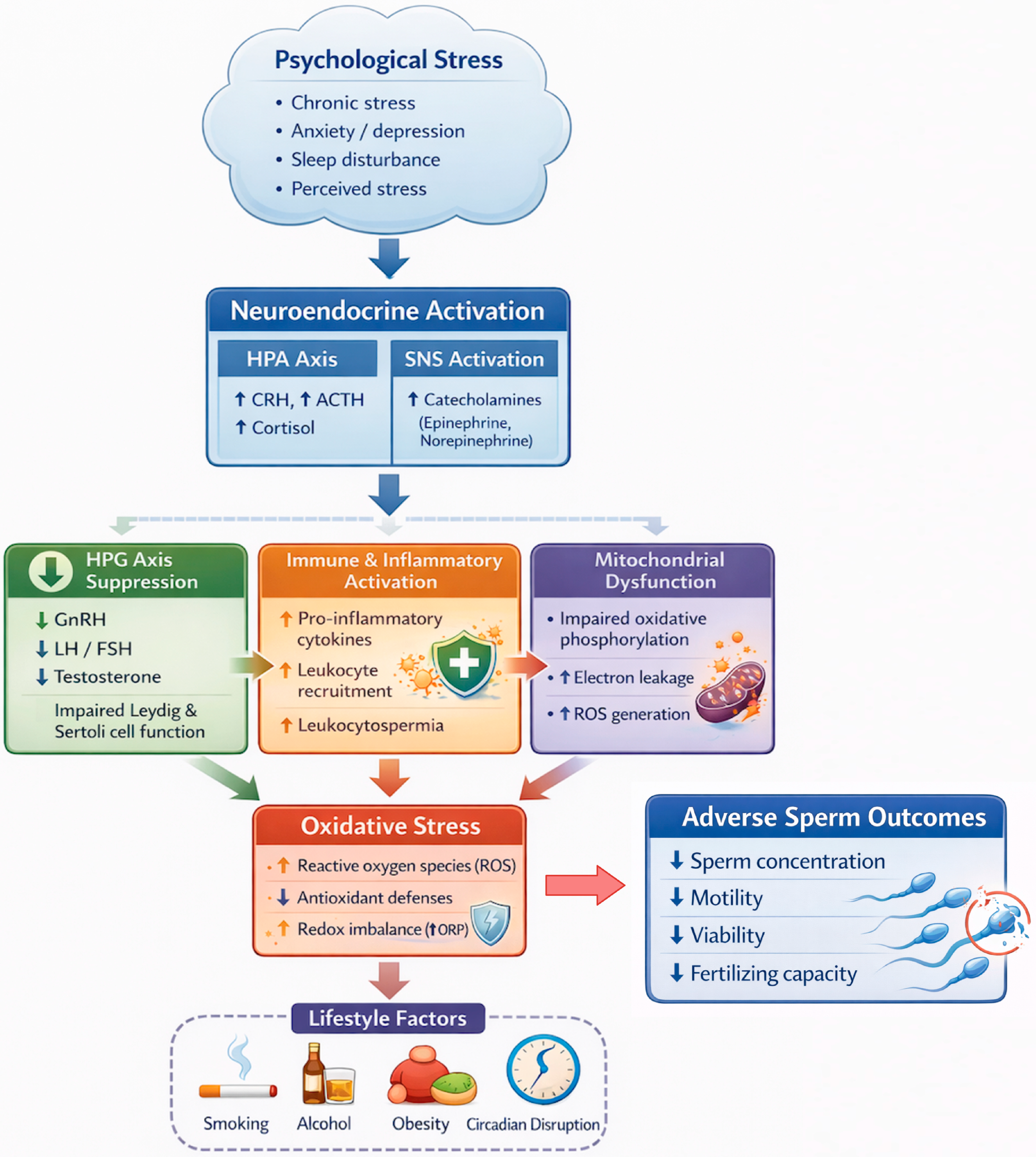
Psychological Stress and Male Infertility: Oxidative Stress as the Common Downstream Pathway

 ,
,  , ,
, ,
Abstract
1. Introduction
2. Methods and Literature Search Strategy
3. Psychological Stress and Oxidative Stress: Molecular Mechanisms
3.1. Stress Physiology and Neuroendocrine Responses
3.2. Induction of Oxidative Stress by Psychological Stress
4. Oxidative Stress in the Male Reproductive System and Impact on Sperm
4.1. Lipid Peroxidation
4.2. DNA Damage
4.3. Protein Oxidation and Enzyme Inactivation
4.4. Apoptosis of Germ Cells
5. Evidence from Human Studies
5.1. Cross-Sectional Studies of Stress and Semen Quality
5.2. Mechanistic and Biomarker Studies
5.3. Stress from Infertility and Treatment
5.4. Psychological Stress Constructs and Measurement Instruments
6. Evidence from Animal and Experimental Studies
6.1. Rodent Models of Chronic Stress
6.2. Molecular Pathways and Transgenerational Effects
7. Behavioral and Lifestyle Pathways Linking Stress to Male Infertility
7.1. Smoking and Tobacco Use
7.2. Alcohol and Substance Use
7.3. Sleep Disturbances and Circadian Disruption
7.4. Other Lifestyle Factors
8. Limitations, Clinical and Translational Implications, and Future Directions
8.1. Study Limitations
8.2. Clinical Implications
8.3. Translational and Public Health Implications
8.4. Gaps in Knowledge
8.5. Future Research Directions
9. Conclusions
Author Contributions
Funding
Data Availability Statement
Conflicts of Interest
References
- WHO. Guideline for the Prevention, Diagnosis and Treatment of Infertility; World Health Organization: Geneva, Switzerland, 2025.
- Minhas, S.; Boeri, L.; Capogrosso, P.; Cocci, A.; Corona, G.; Dinkelman-Smit, M.; Falcone, M.; Jensen, C.F.; Gul, M.; Kalkanli, A.; et al. European Association of Urology Guidelines on Male Sexual and Reproductive Health: 2025 Update on Male Infertility. Eur. Urol. 2025, 88, 76–102. [Google Scholar] [CrossRef] [PubMed]
- Biggs, S.N.; Halliday, J.; Hammarberg, K. Psychological consequences of a diagnosis of infertility in men: A systematic analysis. Asian J. Androl. 2024, 26, 10–19. [Google Scholar] [CrossRef]
- Simbar, M.; Ghasemi, V.; Taherian, R.; Kalhor, M.; Mohammadian, F.; Kiani, Z. Prevalence of anxiety symptoms in infertile men: A systematic review and meta-analysis. BMC Public Health 2024, 24, 1805. [Google Scholar] [CrossRef]
- Kaltsas, A. Oxidative Stress and Male Infertility: The Protective Role of Antioxidants. Medicina 2023, 59, 1769. [Google Scholar] [CrossRef]
- Christoforaki, V.; Venetis, C.; Goulis, D.G.; Zepiridis, L.; Chatzimeletiou, K.; Mitsoli, A.; Savvaidou, D.; Grimbizis, G.; Kolibianakis, E.M. The role of seminal oxidation-reduction potential in male infertility: Systematic review and meta-analysis. Reprod. Biomed. Online 2025, 104858. [Google Scholar] [CrossRef]
- Kaltsas, A.; Zachariou, A.; Dimitriadis, F.; Chrisofos, M.; Sofikitis, N. Empirical Treatments for Male Infertility: A Focus on Lifestyle Modifications and Medicines. Diseases 2024, 12, 209. [Google Scholar] [CrossRef]
- Carter, J.R.; Goldstein, D.S. Sympathoneural and adrenomedullary responses to mental stress. Compr. Physiol. 2015, 5, 119–146. [Google Scholar] [CrossRef] [PubMed]
- Chu, B.; Marwaha, K.; Sanvictores, T.; Awosika, A.O.; Ayers, D. Physiology, Stress Reaction. In StatPearls; StatPearls Publishing: Treasure Island, FL, USA, 2025. [Google Scholar]
- Gonzalez, C.R.; Gonzalez, B. Exploring the Stress Impact in the Paternal Germ Cells Epigenome: Can Catecholamines Induce Epigenetic Reprogramming? Front. Endocrinol. 2020, 11, 630948. [Google Scholar] [CrossRef]
- Whirledge, S.; Cidlowski, J.A. Glucocorticoids, stress, and fertility. Minerva Endocrinol. 2010, 35, 109–125. [Google Scholar]
- Breen, K.M.; Karsch, F.J. Does cortisol inhibit pulsatile luteinizing hormone secretion at the hypothalamic or pituitary level? Endocrinology 2004, 145, 692–698. [Google Scholar] [CrossRef] [PubMed]
- Hu, G.X.; Lian, Q.Q.; Lin, H.; Latif, S.A.; Morris, D.J.; Hardy, M.P.; Ge, R.S. Rapid mechanisms of glucocorticoid signaling in the Leydig cell. Steroids 2008, 73, 1018–1024. [Google Scholar] [CrossRef]
- Gao, H.B.; Tong, M.H.; Hu, Y.Q.; You, H.Y.; Guo, Q.S.; Ge, R.S.; Hardy, M.P. Mechanisms of glucocorticoid-induced Leydig cell apoptosis. Mol. Cell. Endocrinol. 2003, 199, 153–163. [Google Scholar] [CrossRef]
- Yazawa, H.; Sasagawa, I.; Nakada, T. Apoptosis of testicular germ cells induced by exogenous glucocorticoid in rats. Hum. Reprod. 2000, 15, 1917–1920. [Google Scholar] [CrossRef]
- Andrews, C.J.; Yapura, J.; Potter, M.A.; McGlade, K.; Perrott, M.R.; Thomas, D.G. Exogenous glucocorticoid treatment affects Sertoli cell load and epididymal sperm quality in domestic cats (Felis catus). Theriogenology 2022, 189, 20–30. [Google Scholar] [CrossRef] [PubMed]
- Whirledge, S.; Cidlowski, J.A. A role for glucocorticoids in stress-impaired reproduction: Beyond the hypothalamus and pituitary. Endocrinology 2013, 154, 4450–4468. [Google Scholar] [CrossRef] [PubMed]
- Siervo, G.; Ogo, F.M.; Staurengo-Ferrari, L.; Anselmo-Franci, J.A.; Cunha, F.Q.; Cecchini, R.; Guarnier, F.A.; Verri, W.A., Jr.; Fernandes, G.S.A. Sleep restriction during peripuberty unbalances sexual hormones and testicular cytokines in rats. Biol. Reprod. 2019, 100, 112–122. [Google Scholar] [CrossRef] [PubMed]
- Yazawa, H.; Sasagawa, I.; Ishigooka, M.; Nakada, T. Effect of immobilization stress on testicular germ cell apoptosis in rats. Hum. Reprod. 1999, 14, 1806–1810. [Google Scholar] [CrossRef]
- Andric, S.A.; Kojic, Z.; Bjelic, M.M.; Mihajlovic, A.I.; Baburski, A.Z.; Sokanovic, S.J.; Janjic, M.M.; Stojkov, N.J.; Stojilkovic, S.S.; Kostic, T.S. The opposite roles of glucocorticoid and alpha1-adrenergic receptors in stress triggered apoptosis of rat Leydig cells. Am. J. Physiol. Endocrinol. Metab. 2013, 304, E51–E59. [Google Scholar] [CrossRef]
- Clarke, I.J.; Bartolini, D.; Conductier, G.; Henry, B.A. Stress Increases Gonadotropin Inhibitory Hormone Cell Activity and Input to GnRH Cells in Ewes. Endocrinology 2016, 157, 4339–4350. [Google Scholar] [CrossRef]
- Tobari, Y.; Kansaku, N.; Tsutsui, K. Noradrenergic modulation of gonadotrophin-inhibitory hormone gene expression in the brain of Japanese quail. J. Neuroendocrinol. 2017, 29, e12503. [Google Scholar] [CrossRef]
- Odetayo, A.F.; Akhigbe, R.E.; Bassey, G.E.; Hamed, M.A.; Olayaki, L.A. Impact of stress on male fertility: Role of gonadotropin inhibitory hormone. Front. Endocrinol. 2023, 14, 1329564. [Google Scholar] [CrossRef]
- Zou, P.; Wang, X.; Yang, W.; Liu, C.; Chen, Q.; Yang, H.; Zhou, N.; Zeng, Y.; Chen, H.; Zhang, G.; et al. Mechanisms of Stress-Induced Spermatogenesis Impairment in Male Rats Following Unpredictable Chronic Mild Stress (uCMS). Int. J. Mol. Sci. 2019, 20, 4470. [Google Scholar] [CrossRef]
- Breen, K.M.; Oakley, A.E.; Pytiak, A.V.; Tilbrook, A.J.; Wagenmaker, E.R.; Karsch, F.J. Does cortisol acting via the type II glucocorticoid receptor mediate suppression of pulsatile luteinizing hormone secretion in response to psychosocial stress? Endocrinology 2007, 148, 1882–1890. [Google Scholar] [CrossRef]
- Mues, H.M.; Markert, C.; Feneberg, A.C.; Nater, U.M. Bidirectional associations between daily subjective stress and sexual desire, arousal, and activity in healthy men and women. Ann. Behav. Med. 2025, 59, kaaf007. [Google Scholar] [CrossRef] [PubMed]
- Demirci, A.; Hizli, F.; Hamurcu, H.D.; Basar, H. Erectile dysfunction, anxiety, perceived stress, and insomnia are more common among acquired premature ejaculation patients compared to other premature ejaculation syndromes. Andrology 2023, 11, 425–432. [Google Scholar] [CrossRef]
- Samir, H.; ElSayed, M.I.; Radwan, F.; Hedia, M.; Hendawy, H.; Hendawy, A.O.; Elbadawy, M.; Watanabe, G. An updated insight on testicular hemodynamics: Environmental, physiological, and technical perspectives in farm and companion animals. Vet. Res. Commun. 2023, 47, 323–345. [Google Scholar] [CrossRef]
- Akhigbe, R.E.; Odetayo, A.F.; Akhigbe, T.M.; Hamed, M.A.; Ashonibare, P.J. Pathophysiology and management of testicular ischemia/reperfusion injury: Lessons from animal models. Heliyon 2024, 10, e27760. [Google Scholar] [CrossRef] [PubMed]
- Esteves, S.C.; Humaidan, P. The role of luteinizing hormone activity in spermatogenesis: From physiology to clinical practice. Reprod. Biol. Endocrinol. 2025, 23, 6. [Google Scholar] [CrossRef] [PubMed]
- Ragni, G.; Caccamo, A. Negative effect of stress of in vitro fertilization program on quality of semen. Acta. Eur. Fertil. 1992, 23, 21–23. [Google Scholar]
- Ilacqua, A.; Izzo, G.; Emerenziani, G.P.; Baldari, C.; Aversa, A. Lifestyle and fertility: The influence of stress and quality of life on male fertility. Reprod. Biol. Endocrinol. 2018, 16, 115. [Google Scholar] [CrossRef]
- Geddie, H.; Cairns, M.; Smith, L.; van Wyk, M.; Beselaar, L.; Truter, N.; Rautenbach, F.; Marnewick, J.L.; Joseph, D.E.; Essop, M.F. The impact of chronic stress on intracellular redox balance: A systems level analysis. Physiol. Rep. 2023, 11, e15640. [Google Scholar] [CrossRef]
- Voituron, Y.; Roussel, D.; Le Galliard, J.F.; Dupoue, A.; Romestaing, C.; Meylan, S. Mitochondrial oxidative phosphorylation response overrides glucocorticoid-induced stress in a reptile. J. Comp. Physiol. B 2022, 192, 765–774. [Google Scholar] [CrossRef]
- Kokkinopoulou, I.; Moutsatsou, P. Mitochondrial Glucocorticoid Receptors and Their Actions. Int. J. Mol. Sci. 2021, 22, 6054. [Google Scholar] [CrossRef]
- Kumar, N. Sperm Mitochondria, the Driving Force Behind Human Spermatozoa Activities: Its Functions and Dysfunctions—A Narrative Review. Curr. Mol. Med. 2023, 23, 332–340. [Google Scholar] [CrossRef]
- Stamatellos, G.; Kyrgiafini, M.-A.; Kaltsas, A.; Mamuris, Z. Mitochondrial Dysregulation in Male Infertility: A Preliminary Study for Infertility-Specific lncRNA Variants. DNA 2025, 5, 38. [Google Scholar]
- Karunyam, B.V.; Abdul Karim, A.K.; Naina Mohamed, I.; Ugusman, A.; Mohamed, W.M.Y.; Faizal, A.M.; Abu, M.A.; Kumar, J. Infertility and cortisol: A systematic review. Front. Endocrinol. 2023, 14, 1147306. [Google Scholar] [CrossRef] [PubMed]
- Spitzer, T.L.; Trussell, J.C.; Coward, R.M.; Hansen, K.R.; Barnhart, K.T.; Cedars, M.I.; Diamond, M.P.; Krawetz, S.A.; Sun, F.; Zhang, H.; et al. Biomarkers of Stress and Male Fertility. Reprod. Sci. 2022, 29, 1262–1270. [Google Scholar] [CrossRef]
- Alam, M.M.; Okazaki, K.; Nguyen, L.T.T.; Ota, N.; Kitamura, H.; Murakami, S.; Shima, H.; Igarashi, K.; Sekine, H.; Motohashi, H. Glucocorticoid receptor signaling represses the antioxidant response by inhibiting histone acetylation mediated by the transcriptional activator NRF2. J. Biol. Chem. 2017, 292, 7519–7530. [Google Scholar] [CrossRef]
- Lacher, S.E.; Krznarich, J.; Levings, D.C.; Pathak, S.S.; Pufall, M.; Yang, Y.M.; Slattery, M. The Glucocorticoid Receptor Inhibits NRF2-Mediated Expression of SLC7A11. Free Radic. Biol. Med. 2025, 241, 53–63. [Google Scholar] [CrossRef] [PubMed]
- Meng, X.; Peng, L.; Xu, J.; Guo, D.; Cao, W.; Xu, Y.; Li, S. Betaine attenuate chronic restraint stress-induced changes in testicular damage and oxidative stress in male mice. Reprod. Biol. Endocrinol. 2022, 20, 80. [Google Scholar] [CrossRef]
- Nirupama, M.; Devaki, M.; Nirupama, R.; Yajurvedi, H.N. Chronic intermittent stress-induced alterations in the spermatogenesis and antioxidant status of the testis are irreversible in albino rat. J. Physiol. Biochem. 2013, 69, 59–68. [Google Scholar] [CrossRef] [PubMed]
- Freire, B.M.; de Melo, F.M.; Basso, A.S. Adrenergic signaling regulation of macrophage function: Do we understand it yet? Immunother. Adv. 2022, 2, ltac010. [Google Scholar] [CrossRef]
- Wang, Y.M.; Dong, H.K.; Dai, M.; Wang, J.X.; Xu, X.Y.; Zhu, G.Q.; Li, X.Z. Norepinephrine promotes oxidative stress in vascular adventitial fibroblasts via PKC/NFkappaB-mediated NOX2 upregulation. Redox. Rep. 2025, 30, 2494314. [Google Scholar] [CrossRef] [PubMed]
- Sandroni, P.B.; Fisher-Wellman, K.H.; Jensen, B.C. Adrenergic Receptor Regulation of Mitochondrial Function in Cardiomyocytes. J. Cardiovasc. Pharmacol. 2022, 80, 364–377, Erratum in J. Cardiovasc. Pharmacol. 2022, 80, 753–754. [Google Scholar] [CrossRef]
- Gonzalez, P.; Lozano, P.; Ros, G.; Solano, F. Hyperglycemia and Oxidative Stress: An Integral, Updated and Critical Overview of Their Metabolic Interconnections. Int. J. Mol. Sci. 2023, 24, 9352. [Google Scholar] [CrossRef] [PubMed]
- Frungieri, M.B.; Mayerhofer, A. Biogenic amines in the testis: Sources, receptors and actions. Front. Endocrinol. 2024, 15, 1392917. [Google Scholar] [CrossRef]
- Zhang, L.; Gao, S.; Xiong, X.; Liu, X.; Li, R.; Wang, X.; Han, L.; Xiao, X.; Wang, X.; Li, W.; et al. Norepinephrine Induces Sertoli Cell Ferroptosis via Receptors Desensitization Causing Stress-Related Male Reproductive Dysfunction. Adv. Sci. 2025, 12, e04817. [Google Scholar] [CrossRef]
- Alotiby, A. Immunology of Stress: A Review Article. J. Clin. Med. 2024, 13, 6394. [Google Scholar] [CrossRef]
- Kuhn, A.M.; Bosis, K.E.; Wohleb, E.S. Looking Back to Move Forward: Research in Stress, Behavior, and Immune Function. Neuroimmunomodulation 2024, 31, 211–229. [Google Scholar] [CrossRef]
- Miller, E.S.; Apple, C.G.; Kannan, K.B.; Funk, Z.M.; Plazas, J.M.; Efron, P.A.; Mohr, A.M. Chronic stress induces persistent low-grade inflammation. Am. J. Surg. 2019, 218, 677–683. [Google Scholar] [CrossRef]
- Amer, S.; Fouad, A.M.; El-Samahy, M.; Hashem, A.A.; Saati, A.A.; Sarhan, A.A.; Anani, M. Mental Stress, Anxiety and Depressive Symptoms and Interleuken-6 Level among Healthcare Workers during the COVID-19 Pandemic. J. Prim. Care Community Health 2021, 12, 21501327211027432. [Google Scholar] [CrossRef]
- Bai, J.; Gu, L.; Chen, Y.; Liu, X.; Yang, J.; Li, M.; Dong, X.; Yang, S.; Huang, B.; Wang, T.; et al. Evaluation of psychological stress, cortisol awakening response, and heart rate variability in patients with chronic prostatitis/chronic pelvic pain syndrome complicated by lower urinary tract symptoms and erectile dysfunction. Front. Psychol. 2022, 13, 903250. [Google Scholar] [CrossRef]
- Miller, H.C. Stress prostatitis. Urology 1988, 32, 507–510. [Google Scholar] [CrossRef] [PubMed]
- Dutta, S.; Bocu, K.; Agarwal, A. Role of Leukocytospermia in the Management of Male Infertility: Decoding a Mystery for the Busy Clinicians. World J. Mens. Health 2025, 43, 465–476. [Google Scholar] [CrossRef]
- Sharma, R.; Gupta, S.; Agarwal, A.; Henkel, R.; Finelli, R.; Parekh, N.; Saleh, R.; Arafa, M.; Ko, E.; Zini, A.; et al. Relevance of Leukocytospermia and Semen Culture and Its True Place in Diagnosing and Treating Male Infertility. World J. Mens. Health 2022, 40, 191–207. [Google Scholar] [CrossRef] [PubMed]
- Yumura, Y.; Takeshima, T.; Kawahara, T.; Sanjo, H.; Kuroda, S.N.; Asai, T.; Mori, K.; Kondou, T.; Uemura, H.; Iwasaki, A. Reactive oxygen species measured in the unprocessed semen samples of 715 infertile patients. Reprod. Med. Biol. 2017, 16, 354–363. [Google Scholar] [CrossRef]
- Li, X.; Ni, M.; Xing, S.; Yu, Y.; Zhou, Y.; Yang, S.; Li, H.; Zhu, R.; Han, M. Reactive Oxygen Species Secreted by Leukocytes in Semen Induce Self-Expression of Interleukin-6 and Affect Sperm Quality. Am. J. Mens. Health 2020, 14, 1557988320970053. [Google Scholar] [CrossRef]
- Pasqualotto, F.F.; Sharma, R.K.; Potts, J.M.; Nelson, D.R.; Thomas, A.J.; Agarwal, A. Seminal oxidative stress in patients with chronic prostatitis. Urology 2000, 55, 881–885. [Google Scholar] [CrossRef]
- He, H.; Luo, H.; Qian, B.; Xu, H.; Zhang, G.; Zou, X.; Zou, J. Autonomic Nervous System Dysfunction Is Related to Chronic Prostatitis/Chronic Pelvic Pain Syndrome. World J. Mens. Health 2024, 42, 1–28. [Google Scholar] [CrossRef] [PubMed]
- Song, S.; Zhang, C.; Zhang, B.; Yin, J.; Yu, C.; Wang, X.; Wang, Q.; Ma, F.; Yang, C.; Chang, D. Targeting the brain-gut-prostate axis in chronic prostatitis: Mechanisms and therapeutics. Front. Endocrinol. 2025, 16, 1628094. [Google Scholar] [CrossRef]
- Ayad, B.; Omolaoye, T.S.; Louw, N.; Ramsunder, Y.; Skosana, B.T.; Oyeipo, P.I.; Du Plessis, S.S. Oxidative Stress and Male Infertility: Evidence From a Research Perspective. Front. Reprod. Health 2022, 4, 822257. [Google Scholar] [CrossRef] [PubMed]
- Wang, Y.; Fu, X.; Li, H. Mechanisms of oxidative stress-induced sperm dysfunction. Front. Endocrinol. 2025, 16, 1520835. [Google Scholar] [CrossRef]
- Sengupta, P.; Pinggera, G.M.; Calogero, A.E.; Agarwal, A. Oxidative stress affects sperm health and fertility-Time to apply facts learned at the bench to help the patient: Lessons for busy clinicians. Reprod. Med. Biol. 2024, 23, e12598. [Google Scholar] [CrossRef]
- Evans, E.P.P.; Scholten, J.T.M.; Mzyk, A.; Reyes-San-Martin, C.; Llumbet, A.E.; Hamoh, T.; Arts, E.; Schirhagl, R.; Cantineau, A.E.P. Male subfertility and oxidative stress. Redox. Biol. 2021, 46, 102071. [Google Scholar] [CrossRef]
- Ayala, A.; Munoz, M.F.; Arguelles, S. Lipid peroxidation: Production, metabolism, and signaling mechanisms of malondialdehyde and 4-hydroxy-2-nonenal. Oxid. Med. Cell. Longev. 2014, 2014, 360438. [Google Scholar] [CrossRef]
- Nowicka-Bauer, K.; Nixon, B. Molecular Changes Induced by Oxidative Stress that Impair Human Sperm Motility. Antioxidants 2020, 9, 134. [Google Scholar] [CrossRef]
- Kumar, N.; Deepthi, K.N.; Padugupati, S.; Ghose, S. Assessing Seminal Plasma Malondialdehyde Acid as a Diagnostic Tool for Male Infertility: A Case-Control Study. Rev. Recent Clin. Trials 2025, 20, 36–44. [Google Scholar] [CrossRef]
- Li, L.; Feng, T.; Wu, R.; Zhang, Y.; Wang, N.; Wu, M.; Pang, Y.; Yang, S.; Yang, A.; Zhang, D.; et al. The role of total antioxidant capacity and malondialdehyde of seminal plasma in the association between air pollution and sperm quality. Environ. Pollut. 2023, 335, 122324. [Google Scholar] [CrossRef] [PubMed]
- Santiso, R.; Tamayo, M.; Gosalvez, J.; Meseguer, M.; Garrido, N.; Fernandez, J.L. Simultaneous determination in situ of DNA fragmentation and 8-oxoguanine in human sperm. Fertil. Steril. 2010, 93, 314–318. [Google Scholar] [CrossRef]
- Panner Selvam, M.K.; Baskaran, S.; O’Connell, S.; Almajed, W.; Hellstrom, W.J.G.; Sikka, S.C. Association between Seminal Oxidation-Reduction Potential and Sperm DNA Fragmentation-A Meta-Analysis. Antioxidants 2022, 11, 1563. [Google Scholar] [CrossRef] [PubMed]
- Li, N.; Wang, H.; Zou, S.; Yu, X.; Li, J. Perspective in the Mechanisms for Repairing Sperm DNA Damage. Reprod. Sci. 2025, 32, 41–51. [Google Scholar] [CrossRef]
- Lourenco, M.L.; Moura, G.A.; Rocha, Y.M.; Rodrigues, J.P.V.; Monteiro, P.B. Impact of sperm DNA fragmentation on the clinical outcome of assisted reproduction techniques: A systematic review of the last five years. JBRA Assist Reprod. 2023, 27, 282–291. [Google Scholar] [CrossRef]
- Hammadeh, M.E.; Radwan, M.; Al-Hasani, S.; Micu, R.; Rosenbaum, P.; Lorenz, M.; Schmidt, W. Comparison of reactive oxygen species concentration in seminal plasma and semen parameters in partners of pregnant and non-pregnant patients after IVF/ICSI. Reprod. Biomed. Online 2006, 13, 696–706. [Google Scholar] [CrossRef]
- Mahfouz, R.; Sharma, R.; Thiyagarajan, A.; Kale, V.; Gupta, S.; Sabanegh, E.; Agarwal, A. Semen characteristics and sperm DNA fragmentation in infertile men with low and high levels of seminal reactive oxygen species. Fertil. Steril. 2010, 94, 2141–2146. [Google Scholar] [CrossRef]
- Pavuluri, H.; Bakhtiary, Z.; Panner Selvam, M.K.; Hellstrom, W.J.G. Oxidative Stress-Associated Male Infertility: Current Diagnostic and Therapeutic Approaches. Medicina 2024, 60, 1008. [Google Scholar] [CrossRef] [PubMed]
- Castleton, P.E.; Deluao, J.C.; Sharkey, D.J.; McPherson, N.O. Measuring Reactive Oxygen Species in Semen for Male Preconception Care: A Scientist Perspective. Antioxidants 2022, 11, 264. [Google Scholar] [CrossRef] [PubMed]
- Kurkowska, W.; Bogacz, A.; Janiszewska, M.; Gabrys, E.; Tiszler, M.; Bellanti, F.; Kasperczyk, S.; Machon-Grecka, A.; Dobrakowski, M.; Kasperczyk, A. Oxidative Stress is Associated with Reduced Sperm Motility in Normal Semen. Am. J. Mens. Health 2020, 14, 1557988320939731. [Google Scholar] [CrossRef]
- Vahedi Raad, M.; Firouzabadi, A.M.; Tofighi Niaki, M.; Henkel, R.; Fesahat, F. The impact of mitochondrial impairments on sperm function and male fertility: A systematic review. Reprod. Biol. Endocrinol. 2024, 22, 83. [Google Scholar] [CrossRef] [PubMed]
- Grunewald, S.; Fitzl, G.; Springsguth, C. Induction of ultra-morphological features of apoptosis in mature and immature sperm. Asian J. Androl. 2017, 19, 533–537. [Google Scholar] [CrossRef]
- Asadi, A.; Ghahremani, R.; Abdolmaleki, A.; Rajaei, F. Role of sperm apoptosis and oxidative stress in male infertility: A narrative review. Int. J. Reprod. Biomed. 2021, 19, 493–504. [Google Scholar] [CrossRef]
- Hofmann, M.C.; McBeath, E. Sertoli Cell-Germ Cell Interactions Within the Niche: Paracrine and Juxtacrine Molecular Communications. Front. Endocrinol. 2022, 13, 897062. [Google Scholar] [CrossRef]
- Sharma, P.; Kaushal, N.; Saleth, L.R.; Ghavami, S.; Dhingra, S.; Kaur, P. Oxidative stress-induced apoptosis and autophagy: Balancing the contrary forces in spermatogenesis. Biochim. Biophys. Acta. Mol. Basis. Dis. 2023, 1869, 166742. [Google Scholar] [CrossRef]
- Juarez-Rojas, L.; Vigueras-Villasenor, R.M.; Casillas, F.; Retana-Marquez, S. Gradual decrease in spermatogenesis caused by chronic stress. Acta Histochem. 2017, 119, 284–291. [Google Scholar] [CrossRef]
- Xu, Y.; Hu, P.; Chen, W.; Chen, J.; Liu, C.; Zhang, H. Testicular fibrosis pathology, diagnosis, pathogenesis, and treatment: A perspective on related diseases. Andrology 2025, 13, 1322–1332. [Google Scholar] [CrossRef] [PubMed]
- Boeri, L.; Kandil, H.; Ramsay, J. Idiopathic male infertility—What are we missing? Arab. J. Urol. 2025, 23, 215–229. [Google Scholar] [CrossRef]
- Solorzano Vazquez, J.F.; Maldonado Rosas, I.; Villar Munoz, L.G.; Leyva Macias, L.B.; Ramirez Dominguez, L.B.; Kesari, K.K.; Marsal Martinez, E.E.; Bonifacio Leon, E.; Roychoudhury, S. Oxidative Stress-Induced Male Infertility: Role of Antioxidants in Cellular Defense Mechanisms. Adv. Exp. Med. Biol. 2022, 1391, 275–309. [Google Scholar] [CrossRef]
- Tan, Y.; Yuan, Y.; Yang, X.; Wang, Y.; Liu, L. Diagnostic value of oxidation-reduction potential for male infertility: A systematic review and meta-analysis. Transl. Androl. Urol. 2024, 13, 1228–1238. [Google Scholar] [CrossRef] [PubMed]
- Nguyen, N.D.; Le, M.T.; Dang, H.N.T.; Van Nguyen, T.; Nguyen, Q.H.V.; Cao, T.N. Impact of semen oxidative stress on sperm quality: Initial results from Vietnam. J. Int. Med. Res. 2023, 51, 3000605231188655. [Google Scholar] [CrossRef]
- Agarwal, A.; Cannarella, R.; Saleh, R.; Harraz, A.M.; Kandil, H.; Salvio, G.; Boitrelle, F.; Kuroda, S.; Farkouh, A.; Rambhatla, A.; et al. Impact of Antioxidant Therapy on Natural Pregnancy Outcomes and Semen Parameters in Infertile Men: A Systematic Review and Meta-Analysis of Randomized Controlled Trials. World J. Mens. Health 2023, 41, 14–48. [Google Scholar] [CrossRef] [PubMed]
- Wang, W.; Qikai, W.; Zilin, W.; Junyan, S.; Xiaocui, J.; Qi, L.; Shuhui, C.; Yangyang, Z.; Mengjie, G.; Siyi, C.; et al. Depression, anxiety, and stress impair sperm quality via dysregulation of the mitochondrial PDK-PDC axis. Reprod. Biol. Endocrinol. 2025, 23, 127. [Google Scholar] [CrossRef]
- Ye, Y.X.; Chen, H.G.; Sun, B.; Chen, Y.J.; Duan, P.; Meng, T.Q.; Xiong, C.L.; Wang, Y.X.; Pan, A. Associations between depression, oxidative stress, and semen quality among 1,000 healthy men screened as potential sperm donors. Fertil. Steril. 2022, 117, 86–94. [Google Scholar] [CrossRef]
- Nordkap, L.; Priskorn, L.; Brauner, E.V.; Marie Hansen, A.; Kirstine Bang, A.; Holmboe, S.A.; Winge, S.B.; Egeberg Palme, D.L.; Morup, N.; Erik Skakkebaek, N.; et al. Impact of psychological stress measured in three different scales on testis function: A cross-sectional study of 1362 young men. Andrology 2020, 8, 1674–1686. [Google Scholar] [CrossRef] [PubMed]
- Bräuner, E.V.; Nordkap, L.; Priskorn, L.; Hansen, A.M.; Bang, A.K.; Holmboe, S.A.; Schmidt, L.; Jensen, T.K.; Jorgensen, N. Psychological stress, stressful life events, male factor infertility, and testicular function: A cross-sectional study. Fertil. Steril. 2020, 113, 865–875. [Google Scholar] [CrossRef] [PubMed]
- Janevic, T.; Kahn, L.G.; Landsbergis, P.; Cirillo, P.M.; Cohn, B.A.; Liu, X.; Factor-Litvak, P. Effects of work and life stress on semen quality. Fertil. Steril. 2014, 102, 530–538. [Google Scholar] [CrossRef] [PubMed]
- Nouri, K.; Litschauer, B.; Sator, M.; Tiringer, D.; Ott, J.; Walch, K.; Hefler, L.A.; Tempfer, C.B. Decline of semen quality during IVF is not associated with subjective male stress. Asian J. Androl. 2014, 16, 597–601. [Google Scholar] [CrossRef]
- Vellani, E.; Colasante, A.; Mamazza, L.; Minasi, M.G.; Greco, E.; Bevilacqua, A. Association of state and trait anxiety to semen quality of in vitro fertilization patients: A controlled study. Fertil. Steril. 2013, 99, 1565–1572. [Google Scholar] [CrossRef]
- Li, Y.; Lin, H.; Li, Y.; Cao, J. Association between socio-psycho-behavioral factors and male semen quality: Systematic review and meta-analyses. Fertil. Steril. 2011, 95, 116–123. [Google Scholar] [CrossRef]
- Eskiocak, S.; Gozen, A.S.; Yapar, S.B.; Tavas, F.; Kilic, A.S.; Eskiocak, M. Glutathione and free sulphydryl content of seminal plasma in healthy medical students during and after exam stress. Hum. Reprod. 2005, 20, 2595–2600. [Google Scholar] [CrossRef]
- Hjollund, N.H.; Bonde, J.P.; Henriksen, T.B.; Giwercman, A.; Olsen, J.; Danish First Pregnancy Planner Study, T. Reproductive effects of male psychologic stress. Epidemiology 2004, 15, 21–27. [Google Scholar] [CrossRef]
- Clarke, R.N.; Klock, S.C.; Geoghegan, A.; Travassos, D.E. Relationship between psychological stress and semen quality among in-vitro fertilization patients. Hum. Reprod. 1999, 14, 753–758. [Google Scholar] [CrossRef]
- Wang, X.; Chen, Q.; Zou, P.; Liu, T.; Mo, M.; Yang, H.; Zhou, N.; Sun, L.; Chen, H.; Ling, X.; et al. Sleep duration is associated with sperm chromatin integrity among young men in Chongqing, China. J. Sleep Res. 2018, 27, e12615. [Google Scholar] [CrossRef] [PubMed]
- Zhang, Y.; Chen, B.; Wang, Y.; Liu, C.; Sun, J.; Zhang, Z.; Guan, L.; Xiao, K.; Zhu, Z.; Luo, J. Association between mental health and male fertility: Depression, rather than anxiety, is linked to decreased semen quality. Front. Endocrinol. 2024, 15, 1478848. [Google Scholar] [CrossRef]
- Reddy, A.G.; Williams, P.L.; Souter, I.; Ford, J.B.; Dadd, R.; Abou-Ghayda, R.; Hauser, R.; Chavarro, J.E.; Minguez-Alarcon, L.; Team, E.S. Perceived stress in relation to testicular function markers among men attending a fertility center. Fertil. Steril. 2025, 124, 62–70. [Google Scholar] [CrossRef] [PubMed]
- De Iuliis, G.N.; Thomson, L.K.; Mitchell, L.A.; Finnie, J.M.; Koppers, A.J.; Hedges, A.; Nixon, B.; Aitken, R.J. DNA damage in human spermatozoa is highly correlated with the efficiency of chromatin remodeling and the formation of 8-hydroxy-2′-deoxyguanosine, a marker of oxidative stress. Biol. Reprod. 2009, 81, 517–524. [Google Scholar] [CrossRef]
- Shukla, K.K.; Mahdi, A.A.; Ahmad, M.K.; Jaiswar, S.P.; Shankwar, S.N.; Tiwari, S.C. Mucuna pruriens Reduces Stress and Improves the Quality of Semen in Infertile Men. Evid. Based Complement. Alternat. Med. 2010, 7, 137–144. [Google Scholar] [CrossRef]
- Braverman, A.M.; Davoudian, T.; Levin, I.K.; Bocage, A.; Wodoslawsky, S. Depression, anxiety, quality of life, and infertility: A global lens on the last decade of research. Fertil. Steril. 2024, 121, 379–383. [Google Scholar] [CrossRef]
- Pasch, L.A.; Gregorich, S.E.; Katz, P.K.; Millstein, S.G.; Nachtigall, R.D.; Bleil, M.E.; Adler, N.E. Psychological distress and in vitro fertilization outcome. Fertil. Steril. 2012, 98, 459–464. [Google Scholar] [CrossRef]
- Boivin, J.; Schmidt, L. Infertility-related stress in men and women predicts treatment outcome 1 year later. Fertil. Steril. 2005, 83, 1745–1752. [Google Scholar] [CrossRef] [PubMed]
- Kim, Y.M.; Nho, J.H. The effects of a lifestyle intervention for men in infertile couples in South Korea: A non-randomized controlled trial. J. Korean Acad. Nurs. 2025, 55, 191–204. [Google Scholar] [CrossRef]
- Yadav, A.; Tiwari, P.; Kumar, R.; Dada, R. Impact of a 12-week Yoga Intervention on Seminal Oxidative Stress, Sperm Quality, and DNA Fragmentation Index in Infertile Men: A Pre-post Intervention Study. Int. J. Yoga 2025, 18, 209–217. [Google Scholar] [CrossRef]
- Harris, K.M.; Gaffey, A.E.; Schwartz, J.E.; Krantz, D.S.; Burg, M.M. The Perceived Stress Scale as a Measure of Stress: Decomposing Score Variance in Longitudinal Behavioral Medicine Studies. Ann. Behav. Med. 2023, 57, 846–854. [Google Scholar] [CrossRef]
- Lovibond, P.F.; Lovibond, S.H. The structure of negative emotional states: Comparison of the Depression Anxiety Stress Scales (DASS) with the Beck Depression and Anxiety Inventories. Behav. Res. Ther. 1995, 33, 335–343. [Google Scholar] [CrossRef]
- Julian, L.J. Measures of anxiety: State-Trait Anxiety Inventory (STAI), Beck Anxiety Inventory (BAI), and Hospital Anxiety and Depression Scale-Anxiety (HADS-A). Arthritis Care Res. 2011, 63, S467–S472. [Google Scholar] [CrossRef]
- Roopnarinesingh, R.; El-Hantati, T.; Keane, D.; Harrison, R. An assessment of mood in males attending an infertility clinic. Ir. Med. J. 2004, 97, 310–311. [Google Scholar]
- Gao, J.; Zhang, X.; Su, P.; Liu, J.; Shi, K.; Hao, Z.; Zhou, J.; Liang, C. Relationship between sexual dysfunction and psychological burden in men with infertility: A large observational study in China. J. Sex. Med. 2013, 10, 1935–1942. [Google Scholar] [CrossRef] [PubMed]
- Newton, C.R.; Sherrard, W.; Glavac, I. The Fertility Problem Inventory: Measuring perceived infertility-related stress. Fertil. Steril. 1999, 72, 54–62. [Google Scholar] [CrossRef]
- Fenster, L.; Katz, D.F.; Wyrobek, A.J.; Pieper, C.; Rempel, D.M.; Oman, D.; Swan, S.H. Effects of psychological stress on human semen quality. J. Androl. 1997, 18, 194–202. [Google Scholar] [CrossRef]
- Lampiao, F. Variation of semen parameters in healthy medical students due to exam stress. Malawi. Med. J. 2009, 21, 166–167. [Google Scholar] [CrossRef] [PubMed][Green Version]
- Hammond, K.R.; Kretzer, P.A.; Blackwell, R.E.; Steinkampf, M.P. Performance anxiety during infertility treatment: Effect on semen quality. Fertil. Steril. 1990, 53, 337–340. [Google Scholar] [CrossRef] [PubMed]
- Kiani, Z.; Fakari, F.R.; Hakimzadeh, A.; Hajian, S.; Fakari, F.R.; Nasiri, M. Prevalence of depression in infertile men: A systematic review and meta-analysis. BMC Public Health 2023, 23, 1972. [Google Scholar] [CrossRef]
- Simbar, M.; Rashidi, F.; Taherian, R.; Ghasemi, V.; Kalhor, M.; Kiani, Z. Is stress different in infertile women and men? A systematic review and meta-analysis. BMC Public Health 2025, 25, 3725. [Google Scholar] [CrossRef] [PubMed]
- Nargund, V.H. Effects of psychological stress on male fertility. Nat. Rev. Urol. 2015, 12, 373–382. [Google Scholar] [CrossRef] [PubMed]
- Yang, T.; Liu, X.; Kang, C.; Hou, G.; Shen, Y.; Liu, Z. Chronic psychological stress induces testicular oxidative stress affecting reproductive behavior in rats. Reprod. Biol. 2025, 25, 100934. [Google Scholar] [CrossRef] [PubMed]
- Vijayprasad, S.; Bb, G.; Bb, N. Effect of vitamin C on male fertility in rats subjected to forced swimming stress. J. Clin. Diagn. Res. 2014, 8, HC05–HC08. [Google Scholar] [CrossRef]
- Hidayatik, N.; Purnomo, A.; Fikri, F.; Purnama, M.T.E. Amelioration on oxidative stress, testosterone, and cortisol levels after administration of Vitamins C and E in albino rats with chronic variable stress. Vet. World 2021, 14, 137–143. [Google Scholar] [CrossRef]
- Kolbasi, B.; Bulbul, M.V.; Karabulut, S.; Altun, C.E.; Cakici, C.; Ulfer, G.; Mudok, T.; Keskin, I. Chronic unpredictable stress disturbs the blood-testis barrier affecting sperm parameters in mice. Reprod. Biomed. Online 2021, 42, 983–995. [Google Scholar] [CrossRef]
- Yadav, S.; Yadav, A.; Mishra, R.K. Chronic unpredictable stress exposure disrupts testicular function by modulating germ cell-junctional dynamics and Nrf2/HO-1/IKKbeta/NF-kappaB pathway. Reprod. Toxicol. 2025, 132, 108845. [Google Scholar] [CrossRef]
- Guo, Y.; Sun, J.; Li, T.; Zhang, Q.; Bu, S.; Wang, Q.; Lai, D. Melatonin ameliorates restraint stress-induced oxidative stress and apoptosis in testicular cells via NF-kappaB/iNOS and Nrf2/HO-1 signaling pathway. Sci. Rep. 2017, 7, 9599. [Google Scholar] [CrossRef]
- Peng, L.; Tang, X.; Tang, P.; Zhou, C.; Xiang, Y.; Cao, W.; Li, Y.; Peng, C.; Xu, Y.; Li, S. Overactivation of PERK-Mediated Endoplasmic Reticulum Stress-Induced Testis Damage in Chronically Stressed Mice. ACS Omega 2025, 10, 44937–44947. [Google Scholar] [CrossRef]
- Rodgers, A.B.; Morgan, C.P.; Bronson, S.L.; Revello, S.; Bale, T.L. Paternal stress exposure alters sperm microRNA content and reprograms offspring HPA stress axis regulation. J. Neurosci. 2013, 33, 9003–9012. [Google Scholar] [CrossRef]
- Rodgers, A.B.; Morgan, C.P.; Leu, N.A.; Bale, T.L. Transgenerational epigenetic programming via sperm microRNA recapitulates effects of paternal stress. Proc. Natl. Acad. Sci. USA 2015, 112, 13699–13704. [Google Scholar] [CrossRef]
- Valcarce, D.G.; Riesco, M.F.; Cuesta-Martin, L.; Esteve-Codina, A.; Martinez-Vazquez, J.M.; Robles, V. Stress decreases spermatozoa quality and induces molecular alterations in zebrafish progeny. BMC Biol. 2023, 21, 70. [Google Scholar] [CrossRef]
- Wang, T.; Liu, Z.; He, M.; Wu, Y.; Zuo, Z.; Li, H.; Zhao, Z.; Lv, L.; Dai, X.; Zhang, C.; et al. Morinda officinalis oligosaccharides alleviated mice chronic unpredictable mild stress induced sexual dysfunction. Sex. Med. 2025, 13, qfaf074. [Google Scholar] [CrossRef]
- Choowong-In, P.; Sattayasai, J.; Poodendaen, C.; Iamsaard, S. Decreased expression of AKAP4 and TyrPho proteins in testis, epididymis, and spermatozoa with low sexual performance of mice induced by modified CUMS. Andrologia 2021, 53, e13977. [Google Scholar] [CrossRef]
- Rahmani, M.; Tavalaee, M.; Drevet, J.R.; Nasr-Esfahani, M.H. Role of Endoplasmic Reticulum Stress in The Male Reproductive System. Cell J. 2023, 25, 437–446. [Google Scholar] [CrossRef]
- Ord, J.; Heath, P.R.; Fazeli, A.; Watt, P.J. Paternal effects in a wild-type zebrafish implicate a role of sperm-derived small RNAs. Mol. Ecol. 2020, 29, 2722–2735. [Google Scholar] [CrossRef]
- Ren, L.; Xin, Y.; Sun, X.; Zhang, Y.; Chen, Y.; Liu, S.; He, B. Small Noncoding RNAs Contribute to Sperm Oxidative Stress-Induced Programming of Behavioral and Metabolic Phenotypes in Offspring. Oxid. Med. Cell. Longev. 2022, 2022, 6877283. [Google Scholar] [CrossRef] [PubMed]
- Patane, G.T.; Moreira, R.J.; Russo, A.; Pereira, M.L.; Oliveira, P.F.; Barreca, D.; Alves, M.G. Lifestyle implications of the paradox and management of oxidative stress in sperm. J. Physiol. 2025. [Google Scholar] [CrossRef] [PubMed]
- Kurhaluk, N.; Kaminski, P.; Tkaczenko, H. Oxidative Stress, Antioxidants, Gut Microbiota and Male Fertility. Cell. Physiol. Biochem. 2025, 59, 82–123. [Google Scholar] [CrossRef] [PubMed]
- Alpers, S.E.; Druckrey-Fiskaaen, K.T.; Madebo, T.; Vold, J.H.; Pallesen, S.; Skogen, J.C.; Lunde, L.H.; Maeland, S.; Fadnes, L.T. The association of psychological distress and economic and health worries with tobacco smoking behavior during the COVID-19 pandemic: A two-year longitudinal cohort study. BMC Public Health 2024, 24, 375. [Google Scholar] [CrossRef]
- Barroso-Hurtado, M.; Suarez-Castro, D.; Martinez-Vispo, C.; Becona, E.; Lopez-Duran, A. Perceived Stress and Smoking Cessation: The Role of Smoking Urges. Int. J. Environ. Res. Public Health 2023, 20, 1257. [Google Scholar] [CrossRef]
- Lykkesfeldt, J.; Carr, A.C. Vitamin C—A scoping review for Nordic Nutrition Recommendations 2023. Food Nutr. Res. 2023, 67, 7828. [Google Scholar] [CrossRef]
- Osadchuk, L.; Kleshchev, M.; Osadchuk, A. Effects of cigarette smoking on semen quality, reproductive hormone levels, metabolic profile, zinc and sperm DNA fragmentation in men: Results from a population-based study. Front. Endocrinol. 2023, 14, 1255304. [Google Scholar] [CrossRef]
- Fan, S.; Zhang, Z.; Wang, H.; Luo, L.; Xu, B. Associations between tobacco inhalation and semen parameters in men with primary and secondary infertility: A cross-sectional study. Front. Endocrinol. 2024, 15, 1396793. [Google Scholar] [CrossRef] [PubMed]
- Szabo, A.; Vancsa, S.; Hegyi, P.; Varadi, A.; Forintos, A.; Filipov, T.; Acs, J.; Acs, N.; Szarvas, T.; Nyirady, P.; et al. Lifestyle-, environmental-, and additional health factors associated with an increased sperm DNA fragmentation: A systematic review and meta-analysis. Reprod. Biol. Endocrinol. 2023, 21, 5. [Google Scholar] [CrossRef] [PubMed]
- Saleh, R.A.; Agarwal, A.; Sharma, R.K.; Nelson, D.R.; Thomas, A.J., Jr. Effect of cigarette smoking on levels of seminal oxidative stress in infertile men: A prospective study. Fertil. Steril. 2002, 78, 491–499. [Google Scholar] [CrossRef] [PubMed]
- Pasqualotto, F.F.; Umezu, F.M.; Salvador, M.; Borges, E., Jr.; Sobreiro, B.P.; Pasqualotto, E.B. Effect of cigarette smoking on antioxidant levels and presence of leukocytospermia in infertile men: A prospective study. Fertil. Steril. 2008, 90, 278–283. [Google Scholar] [CrossRef]
- Perrin, J.; Tassistro, V.; Mandon, M.; Grillo, J.M.; Botta, A.; Sari-Minodier, I. Tobacco consumption and benzo(a)pyrene-diol-epoxide-DNA adducts in spermatozoa: In smokers, swim-up procedure selects spermatozoa with decreased DNA damage. Fertil. Steril. 2011, 95, 2013–2017. [Google Scholar] [CrossRef]
- Ragheb, A.; Abdelbary, A.; Massoud, A.; Abd Elkhalek, M.; Elbatanony, A. Evaluating the effect of smoking and its cessation on semen parameters. Reprod. Fertil. 2025, 6, e240135. [Google Scholar] [CrossRef]
- Practice Committee of the American Society for Reproductive Medicine. Electronic address, a.a.o. Tobacco or marijuana use and infertility: A committee opinion. Fertil. Steril. 2024, 121, 589–603. [Google Scholar] [CrossRef]
- Brannigan, R.E.; Hermanson, L.; Kaczmarek, J.; Kim, S.K.; Kirkby, E.; Tanrikut, C. Updates to Male Infertility: AUA/ASRM Guideline (2024). J. Urol. 2024, 212, 789–799. [Google Scholar] [CrossRef]
- Menshov, V.A.; Trofimov, A.V.; Zagurskaya, A.V.; Berdnikova, N.G.; Yablonskaya, O.I.; Platonova, A.G. Influence of Nicotine from Diverse Delivery Tools on the Autonomic Nervous and Hormonal Systems. Biomedicines 2022, 10, 121. [Google Scholar] [CrossRef]
- Genchi, V.A.; Cignarelli, A.; Sansone, A.; Yannas, D.; Dalla Valentina, L.; Renda Livraghi, D.; Spaggiari, G.; Santi, D. Understanding the Role of Alcohol in Metabolic Dysfunction and Male Infertility. Metabolites 2024, 14, 626. [Google Scholar] [CrossRef]
- Finelli, R.; Mottola, F.; Agarwal, A. Impact of Alcohol Consumption on Male Fertility Potential: A Narrative Review. Int. J. Environ. Res. Public Health 2021, 19, 328. [Google Scholar] [CrossRef]
- Nguyen-Thanh, T.; Hoang-Thi, A.P.; Anh Thu, D.T. Investigating the association between alcohol intake and male reproductive function: A current meta-analysis. Heliyon 2023, 9, e15723. [Google Scholar] [CrossRef]
- Amor, H.; Hammadeh, M.E.; Mohd, I.; Jankowski, P.M. Impact of heavy alcohol consumption and cigarette smoking on sperm DNA integrity. Andrologia 2022, 54, e14434. [Google Scholar] [CrossRef] [PubMed]
- Szabo, A.; Nyirady, P.; Kopa, Z. Impact of lifestyle and environmental factors on fertility. Curr. Opin. Urol. 2025, 35, 685–690. [Google Scholar] [CrossRef]
- Salas-Huetos, A.; Mitsunami, M.; Minguez-Alarcon, L.; Ortiz-Panozo, E.; Murphy, M.M.; Souter, I.; Chavarro, J.E.; Team, E.S. The association of men’s beverage intake with semen quality and assisted reproduction outcomes in patients undergoing fertility treatment. Andrology 2025, 13, 473–484. [Google Scholar] [CrossRef] [PubMed]
- Schwandt, M.L.; Cullins, E.; Ramchandani, V.A. The role of resilience in the relationship between stress and alcohol. Neurobiol. Stress 2024, 31, 100644. [Google Scholar] [CrossRef] [PubMed]
- Davinelli, S.; Medoro, A.; Savino, R.; Scapagnini, G. Sleep and Oxidative Stress: Current Perspectives on the Role of NRF2. Cell. Mol. Neurobiol. 2024, 44, 52. [Google Scholar] [CrossRef]
- Zhong, O.; Liao, B.; Wang, J.; Liu, K.; Lei, X.; Hu, L. Effects of Sleep Disorders and Circadian Rhythm Changes on Male Reproductive Health: A Systematic Review and Meta-analysis. Front. Physiol. 2022, 13, 913369. [Google Scholar] [CrossRef]
- Coleman, C.M.; Wesselink, A.K.; Yland, J.J.; Sommer, G.J.; Eisenberg, M.L.; Bertisch, S.M.; Rothman, K.J.; Hatch, E.E.; Wise, L.A. A North American preconception study of sleep health and semen quality. Hum. Reprod. 2025, deaf228. [Google Scholar] [CrossRef]
- Zhou, R.; Zhang, M.; Ge, C.; Xiong, Y.; Wang, M.; Wu, K.; Zhang, Y. Association of male sleep quality with semen parameters and pregnancy outcomes in infertile couple. Basic. Clin. Androl. 2025, 35, 37. [Google Scholar] [CrossRef] [PubMed]
- Gaml-Sorensen, A.; Frolich, M.K.; Brix, N.; Ernst, A.; Bonde, J.P.E.; Hougaard, K.S.; Tottenborg, S.S.; Clemmensen, P.J.; Toft, G.; Ramlau-Hansen, C.H. Sleep duration and biomarkers of fecundity in young men: A cross-sectional study from a population-based cohort. Andrology 2024, 12, 1125–1136. [Google Scholar] [CrossRef] [PubMed]
- Dominguez-Salazar, E.; Hurtado-Alvarado, G.; Medina-Flores, F.; Dorantes, J.; Gonzalez-Flores, O.; Contis-Montes de Oca, A.; Velazquez-Moctezuma, J.; Gomez-Gonzalez, B. Chronic sleep loss disrupts blood-testis and blood-epididymis barriers, and reduces male fertility. J. Sleep Res. 2020, 29, e12907. [Google Scholar] [CrossRef]
- Li, Z.; Gong, S.; Yu, Z.; Luo, Y.; Zhao, Y.; Xue, E.; Lu, H.; Xiang, D.; Sun, F. Sleep deprivation impacts the immunological milieu of epididymis leading to low sperm quality in rats. Commun. Biol. 2025, 8, 644. [Google Scholar] [CrossRef]
- Karimi, F.; Noorafshan, A.; Karbalay-Doust, S.; Naseh, M. Sleep deprivation induces structural changes in the adult rat testis: The protective effects of olive oil. Clin. Exp. Reprod. Med. 2023, 50, 19–25. [Google Scholar] [CrossRef] [PubMed]
- Viramgami, A.; Balachandar, R.; Bagepally, B.S.; Sheth, A. Study on the association between night shift work and reproductive functions among male workers: A systematic review and meta-analysis. Endocrine 2025, 88, 410–419. [Google Scholar] [CrossRef]
- Boeri, L.; Passarelli, F.; Basadonna, L.M.; Sorba, E.; Graps, G.; Ciamarra, F.; Dagnino, D.; Parolin, V.; Nizzardo, M.; Lucignani, G.; et al. Oxidative Stress and Semen Quality Among Night- and Day-Shift Workers: A Cross-Sectional Study. Antioxidants 2025, 14, 802. [Google Scholar] [CrossRef]
- Peel, A.; Lyons, H.; Tully, C.A.; Vincent, A.D.; Jesudason, D.; Wittert, G.; McPherson, N.O. The effect of obesity interventions on male fertility: A systematic review and meta-analysis. Hum. Reprod. Update 2025, dmaf025. [Google Scholar] [CrossRef]
- Macdonald, A.A.; Stewart, A.W.; Farquhar, C.M. Body mass index in relation to semen quality and reproductive hormones in New Zealand men: A cross-sectional study in fertility clinics. Hum. Reprod. 2013, 28, 3178–3187. [Google Scholar] [CrossRef]
- Lo Giudice, A.; Asmundo, M.G.; Cimino, S.; Morgia, G.; Cocci, A.; Falcone, M.; Sokolakis, I.; Capogrosso, P.; Morgado, A.; Russo, G.I.; et al. Effects of Physical Activity on Fertility Parameters: A Meta-Analysis of Randomized Controlled Trials. World J. Mens. Health 2024, 42, 555–562. [Google Scholar] [CrossRef]
- Donato, F.; Rota, M.; Ceretti, E.; Viviana Viola, G.C.; Marullo, M.; Zani, D.; Lorenzetti, S.; Montano, L.; FASt Study Group. Intensity and type of physical activity and semen quality in healthy young men. Fertil. Steril. 2025, 123, 88–96. [Google Scholar] [CrossRef]
- Kumar, N.; Kakoti, S.; Chung, E. Pandemic of testosterone abuse: Considerations for male fertility. Arab. J. Urol. 2025, 23, 183–189. [Google Scholar] [CrossRef]
- Mulawkar, P.M.; Maheshwari, P.N.; Gauhar, V.; Agrawal, S.G.; Mohammed, T.O.; Singh, A.G.; Tak, G.R.; Shah, U.S.; Shukla, D.P.; Mamankar, D. Use of Anabolic-Androgenic Steroids and Male Fertility: A Systematic Review and Meta-analysis. J. Hum. Reprod. Sci. 2023, 16, 268–285. [Google Scholar] [CrossRef]
- Hamed, M.A.; Ekundina, V.O.; Akhigbe, R.E. Psychoactive drugs and male fertility: Impacts and mechanisms. Reprod. Biol. Endocrinol. 2023, 21, 69. [Google Scholar] [CrossRef]
- Gameiro, S.; Boivin, J.; Dancet, E.; de Klerk, C.; Emery, M.; Lewis-Jones, C.; Thorn, P.; Van den Broeck, U.; Venetis, C.; Verhaak, C.M.; et al. ESHRE guideline: Routine psychosocial care in infertility and medically assisted reproduction-a guide for fertility staff. Hum. Reprod. 2015, 30, 2476–2485. [Google Scholar] [CrossRef] [PubMed]
- Markopoulou, A.; Papadimitriou, N.; Tsimtsiou, Z.; Goulis, D.G.; Haidich, A.B. Screening on distress in fertility treatment (SCREENIVF): A systematic review. Eur. J. Obstet. Gynecol. Reprod. Biol. 2025, 307, 203–210. [Google Scholar] [CrossRef]
- Szigeti, F.J.; Sexty, R.E.; Szabo, G.; Kazinczi, C.; Keki, Z.; Sipos, M.; Ujma, P.P.; Purebl, G. The SCREENIVF Hungarian version is a valid and reliable measure accurately predicting possible depression in female infertility patients. Sci. Rep. 2024, 14, 12880. [Google Scholar] [CrossRef] [PubMed]
- Agarwal, A.; Mostafa, T.; Al Hashimi, M.; Çayan, S.; Pescatori, E.; Singh, K.; Şahin, B.; Zini, A.; Chung, E.; Arafa, M.; et al. Global Andrology Forum Clinical Guidelines on Antioxidant Use in the Treatment of Male Infertility. World J. Mens. Health 2026, 44. [Google Scholar] [CrossRef] [PubMed]
- Dimitriadis, F.; Symeonidis, E.N.; Tsounapi, P.; Kaltsas, A.; Hatzichristodoulou, G.; Sokolakis, I.; Zachariou, A.; Takenaka, A.; Sofikitis, N. Administration of Antioxidants in Infertile Male: When it may have a Detrimental Effect? Curr. Pharm. Des. 2021, 27, 2796–2801. [Google Scholar] [CrossRef]
- de Ligny, W.R.; de Bruin, J.P.; Smits, R.M.; Goovaerts, I.G.F.; Peeters, K.; Nap, A.W.; Boxmeer, J.C.; Donker, R.B.; Schoonenberg, M.; Koks, C.A.M.; et al. Antioxidant Treatment and the Chance to Conceive in Men Seeking Fertility Care: The SUMMER Randomized Clinical Trial. JAMA Netw. Open 2025, 8, e2532405. [Google Scholar] [CrossRef] [PubMed]
- Priskorn, L.; Lindahl-Jacobsen, R.; Jensen, T.K.; Holmboe, S.A.; Hansen, L.S.; Kriegbaum, M.; Lind, B.S.; Siersma, V.; Andersen, C.L.; Jorgensen, N. Semen quality and lifespan: A study of 78 284 men followed for up to 50 years. Hum. Reprod. 2025, 40, 730–738. [Google Scholar] [CrossRef] [PubMed]
- Song, W.; Peng, Y.; Jiang, Z.; Quan, Z. Effectiveness of exercise interventions on sperm quality: A systematic review and network meta-analysis. Front. Endocrinol. 2025, 16, 1537271. [Google Scholar] [CrossRef] [PubMed]


| Study (Reference) | Design/ Setting | Stress Measure/Exposure | Semen/Reproductive Outcomes | Oxidative Stress/Biomarker Outcomes | Main Findings |
|---|---|---|---|---|---|
| Wang et al., 2025 [92] | Cross-sectional mechanistic study (human sperm) | Depression/anxiety/stress scores (Construct: general psychological distress) | Sperm motility (focus) and quality indices | Mitochondrial bioenergetic signature (PDK–PDC axis) | Depression/anxiety/stress associated with impaired sperm quality, linked to dysregulation of the mitochondrial PDK–PDC axis (Effect size: NR; Reversibility: not assessed) |
| Ye et al., 2022 [93] | Cross-sectional; sperm donor candidates (n = 1000) | Depressive symptoms (questionnaire) (Construct: general depression symptoms) | Semen quality parameters | Oxidative stress markers; 8-OH-Dg | Depressive symptoms associated with poorer semen quality and higher oxidative stress and oxidative DNA damage (Effect size: NR; Reversibility: not assessed) |
| Nordkap et al., 2020 [94] | Cross-sectional; young men (n = 1362) | Perceived stress, stressful life events, and stress symptoms (3 scales) (Construct: general perceived stress vs. life event exposure) | Sperm concentration, total count, motility; FSH | NR | Perceived stress showed the most consistent associations: highest vs. lowest stress linked to ~38% lower concentration, ~42% lower total count, and lower motility; FSH ~25% higher; major life events not associated (Reversibility: not assessed) |
| Bräuner et al., 2020 [95] | Cross-sectional case–control; male-factor infertility vs. fertile controls (n = 423) | Stress symptoms/chronic stress indices; stressful life events (Construct: general stress symptoms and life event exposure in infertility evaluation context) | Semen parameters; testicular function markers | NR | No significant differences in general stress scores between groups; semen parameters were not clearly associated with questionnaire-derived stress measures (Reversibility: not assessed) |
| Janevic et al., 2014 [96] | Cross-sectional; clinical sample | Work-related and life stress (questionnaires) (Construct: occupational and general life stress) | Sperm concentration; morphology; oligospermia prevalence | NR | Higher stress associated with lower sperm concentration and fewer morphologically normal sperm; higher prevalence of oligospermia (Effect size: NR; Reversibility: not assessed) |
| Nouri et al., 2014 [97] | IVF patients; within-cycle comparison | Subjective/chronic stress questionnaires (Construct: general distress assessed within infertility and IVF context) | Semen quality across IVF cycle | NR | Decline in semen quality during IVF was not associated with subjective male stress (Temporal sampling within IVF cycle; Reversibility after stress cessation not assessed) |
| Vellani et al., 2013 [98] | Controlled study; IVF patients | State and trait anxiety (validated scales) (Construct: general anxiety assessed in infertility and ART setting) | Semen quality parameters | Sperm oxidative DNA damage marker(s) (e.g., 8-OH-dG) | Higher anxiety associated with poorer semen quality and increased oxidative DNA damage in sperm in clinical infertility context (Effect size: NR; Reversibility: not assessed) |
| Li et al., 2011 [99] | Systematic review and meta-analysis | Socio-psycho-behavioral stressors (pooled) (Construct: general psychosocial stressors) | Abnormal semen parameters (pooled) | NR | Overall inverse association between stressors and semen quality; most consistent adverse associations for concentration, total count, and motility; morphology findings less uniform (Reversibility: not assessed) |
| Eskiocak et al., 2005 [100] | Repeated-measures; healthy medical students | Exam stress (during vs. after examinations) (Construct: acute situational stress with post-stressor assessment) | NR | Seminal plasma antioxidants (glutathione; free sulfhydryl content) | Antioxidant markers decreased during exam stress and improved after the stress period (Reversibility: at least partially reversible after stress cessation) |
| Hjollund et al., 2004 [101] | Cross-sectional; healthy men (Denmark) | Perceived psychological stress (questionnaire) (Construct: general perceived stress) | Standard semen parameters; fecundability | NR | No clear association with standard semen parameters; stress tended toward reduced fecundability, particularly in men with suboptimal semen quality (Effect size: NR; Reversibility: not assessed) |
| Clarke et al., 1999 [102] | IVF patients; within-cycle sampling | Psychological stress questionnaires (Construct: infertility and ART context distress, including situational pressure around sample provision in some measures) | Semen quality across the IVF cycle | NR | Selected stress appraisals (e.g., pressure around sample provision) were linked to poorer semen parameters, but associations were heterogeneous across measures and parameters (Reversibility: not assessed) |
| Ragni and Caccamo, 1992 [31] | ART setting; acute situational stress | Stress/anxiety around semen collection for IVF (Construct: acute infertility and ART-related situational stress) | Sperm concentration and motility (day of retrieval) | NR | Anxiety during IVF sample provision associated with ~39% lower sperm concentration and ~48% lower motility on the day of oocyte retrieval (Reversibility: not assessed) |
| Model (Reference) | Species | Stress Paradigm/Duration | Major Reproductive Outcomes | Oxidative Stress/Mechanistic Endpoints | Notes (Intervention/Reversibility) |
|---|---|---|---|---|---|
| Chronic intermittent stress (restraint + swim) [43] | Rat | 60 days; recovery assessed after cessation | Reduced sperm count and motility; increased abnormal morphology; germ cell loss/apoptosis; reduced testosterone | Increased testicular MDA; >50% decrease in SOD, CAT, and GPx activity | Reversibility: incomplete —many oxidative and sperm defects not fully normalized after a prolonged recovery period (reported as ~4 months) |
| Chronic restraint stress ± betaine [42] | Mouse | Chronic restraint stress (protocol-dependent) | Testicular damage and stress-related reproductive impairment (model of chronic stress) | Oxidative stress increased under stress; betaine attenuated oxidative and tissue injury | Intervention: betaine partially attenuated stress-related oxidative and tissue injury; Reversibility: after stress cessation not assessed |
| Chronic psychological stress (behavioral paradigm) [125] | Rat | Chronic psychological stress (duration per protocol) | Seminiferous tubule disruption; reduced sexual/reproductive behavior (female preference; mating attempts) | Increased testicular MDA and nitric oxide levels | Reversibility: not assessed (no post-stress recovery arm reported) |
| Forced swimming stress + vitamin C [126] | Rat | Forced swimming stress (experimental) | Stress-related decline in fertility-related endpoints | Redox-related injury implied; vitamin C improved outcomes | Intervention: vitamin C partially restored fertility-related endpoints in the stress model; Reversibility: after stress cessation not assessed |
| Chronic variable stress + vitamins C and E [127] | Rat | Chronic variable stress | Endocrine disruption (testosterone/cortisol) and stress-related reproductive impairment | Improved oxidative stress profile with vitamin C/E supplementation | Intervention: vitamins C and E improved endocrine and oxidative stress profile in the stress model; Reversibility: after stress cessation not assessed |
| Chronic unpredictable stress (BTB disruption) [128] | Mouse | Chronic unpredictable stress paradigm | Impaired sperm parameters in association with disrupted blood–testis barrier | Loss of tight junction/BTB integrity consistent with ROS-linked injury | Mechanistic barrier disruption model; Reversibility: after stress cessation or intervention not assessed |
| Chronic unpredictable stress (redox/inflammation signaling) [129] | Mouse | Chronic unpredictable stress exposure | Testicular dysfunction with altered germ cell junction dynamics | Modulation of Nrf2/HO-1 and IKbeta/NF-kappaB pathways consistent with pro-oxidant/pro-inflammatory shift | Mechanistic redox-sensitive signaling changes; Reversibility: not assessed |
| Restraint stress + melatonin [130] | Mouse | Restraint stress | Testicular cell apoptosis and functional impairment under stress | Reduced oxidative stress and apoptosis via NF-kappaB/iNOS and Nrf2/HO-1 signaling | Intervention: melatonin partially ameliorated oxidative stress and apoptosis; Reversibility: after stress cessation not assessed |
| Chronic stress and ER stress activation [131] | Mouse | Chronic stress model | Testis damage associated with cellular stress responses | Overactivation of PERK-mediated endoplasmic reticulum stress (interacts with oxidative stress pathways) | ER stress pathway activation model; Reversibility: not assessed |
| Paternal stress and sperm microRNA remodeling [132,133] | Mouse | Chronic paternal stress paradigms | Offspring phenotype changes (e.g., altered HPA-axis regulation/stress responsivity) | Altered sperm microRNA content; experimental microRNA delivery to zygotes recapitulated selected traits | Epigenetic and transgenerational model; Reversibility: not assessed |
| Chronic stress in fish with offspring effects [134] | Zebrafish | Chronic unpredictable stress (male) | Reduced sperm quality; molecular alterations in progeny | Sperm/offspring molecular signatures implicating small RNA and stress pathways | Transgenerational model beyond rodents; Reversibility: not assessed |
Disclaimer/Publisher’s Note: The statements, opinions and data contained in all publications are solely those of the individual author(s) and contributor(s) and not of MDPI and/or the editor(s). MDPI and/or the editor(s) disclaim responsibility for any injury to people or property resulting from any ideas, methods, instructions or products referred to in the content. |
© 2026 by the authors. Licensee MDPI, Basel, Switzerland. This article is an open access article distributed under the terms and conditions of the Creative Commons Attribution (CC BY) license.
Share and Cite
Kaltsas, A.; Papaharitou, S.; Dimitriadis, F.; Chrisofos, M.; Sofikitis, N. Psychological Stress and Male Infertility: Oxidative Stress as the Common Downstream Pathway. Biomedicines 2026, 14, 259. https://doi.org/10.3390/biomedicines14020259
Kaltsas A, Papaharitou S, Dimitriadis F, Chrisofos M, Sofikitis N. Psychological Stress and Male Infertility: Oxidative Stress as the Common Downstream Pathway. Biomedicines. 2026; 14(2):259. https://doi.org/10.3390/biomedicines14020259
Chicago/Turabian StyleKaltsas, Aris, Stamatis Papaharitou, Fotios Dimitriadis, Michael Chrisofos, and Nikolaos Sofikitis. 2026. "Psychological Stress and Male Infertility: Oxidative Stress as the Common Downstream Pathway" Biomedicines 14, no. 2: 259. https://doi.org/10.3390/biomedicines14020259
APA StyleKaltsas, A., Papaharitou, S., Dimitriadis, F., Chrisofos, M., & Sofikitis, N. (2026). Psychological Stress and Male Infertility: Oxidative Stress as the Common Downstream Pathway. Biomedicines, 14(2), 259. https://doi.org/10.3390/biomedicines14020259