Review

Cognitive Functions following Trigeminal Neuromodulation

1
Department of Biomedical Sciences, University of Sassari, 07100 Sassari, Italy
2
AOU Sassari, Unit of Endocrinology, Nutritional and Metabolic Disorders, 07100 Sassari, Italy
*
Author to whom correspondence should be addressed.
Biomedicines 2023, 11(9), 2392; https://doi.org/10.3390/biomedicines11092392

Submission received: 20 July 2023 / Revised: 13 August 2023 / Accepted: 25 August 2023 / Published: 27 August 2023
(This article belongs to the Special Issue State-of-the-Art Research in Trigeminal Nerve Stimulation)

Abstract

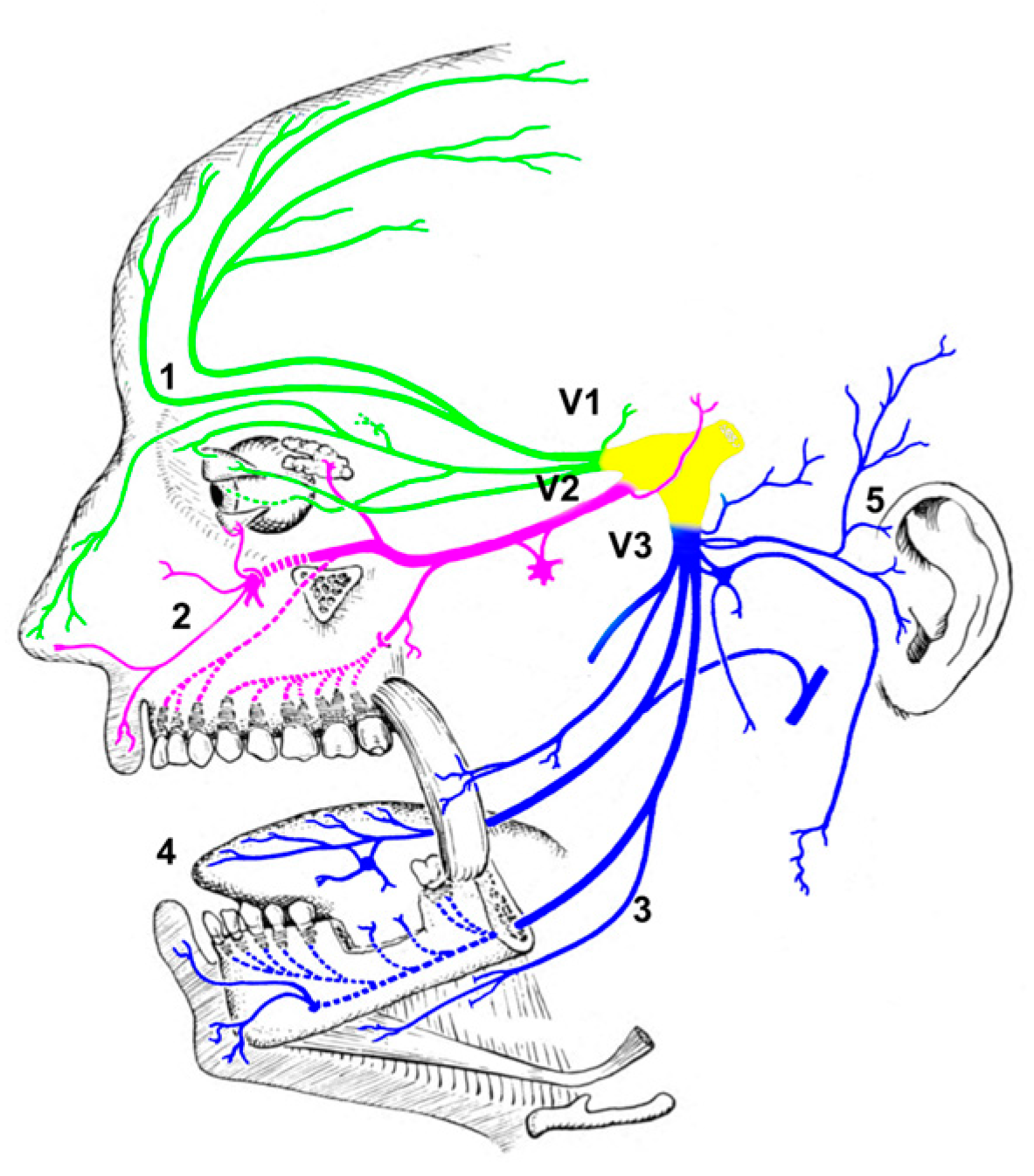
Vast scientific effort in recent years have been focused on the search for effective and safe treatments for cognitive decline. In this regard, non-invasive neuromodulation has gained increasing attention for its reported effectiveness in promoting the recovery of multiple cognitive domains after central nervous system damage. In this short review, we discuss the available evidence supporting a possible cognitive effect of trigeminal nerve stimulation (TNS). In particular, we ask that, while TNS has been widely and successfully used in the treatment of various neuropsychiatric conditions, as far as research in the cognitive field is concerned, where does TNS stand? The trigeminal nerve is the largest cranial nerve, conveying the sensory information from the face to the trigeminal sensory nuclei, and from there to the thalamus and up to the somatosensory cortex. On these bases, a bottom-up mechanism has been proposed, positing that TNS-induced modulation of the brainstem noradrenergic system may affect the function of the brain networks involved in cognition. Nevertheless, despite the promising theories, to date, the use of TNS for cognitive empowering and/or cognitive decline treatment has several challenges ahead of it, mainly due to little uniformity of the stimulation protocols. However, as the field continues to grow, standardization of practice will allow for data comparisons across studies, leading to optimized protocols targeting specific brain circuitries, which may, in turn, influence cognition in a designed manner.
Keywords: trigeminal nerve; neuromodulation; cognition; peripheral nerve stimulation; transcutaneous trigeminal nerve stimulation trigeminal nerve; neuromodulation; cognition; peripheral nerve stimulation; transcutaneous trigeminal nerve stimulation