Systematic Review

Epigenetic Mechanisms and Nephrotic Syndrome: A Systematic Review

1
Translational Health Sciences, Bristol Medical School, University of Bristol, Bristol BS8 1UD, UK
2
MRC Integrative Epidemiology Unit, Population Health Sciences, Bristol Medical School, University of Bristol, Bristol BS8 1UD, UK
*
Author to whom correspondence should be addressed.
Biomedicines 2023, 11(2), 514; https://doi.org/10.3390/biomedicines11020514

Submission received: 13 January 2023 / Revised: 30 January 2023 / Accepted: 1 February 2023 / Published: 10 February 2023
(This article belongs to the Special Issue Genetics and Epigenetics of Kidney Diseases)

Abstract

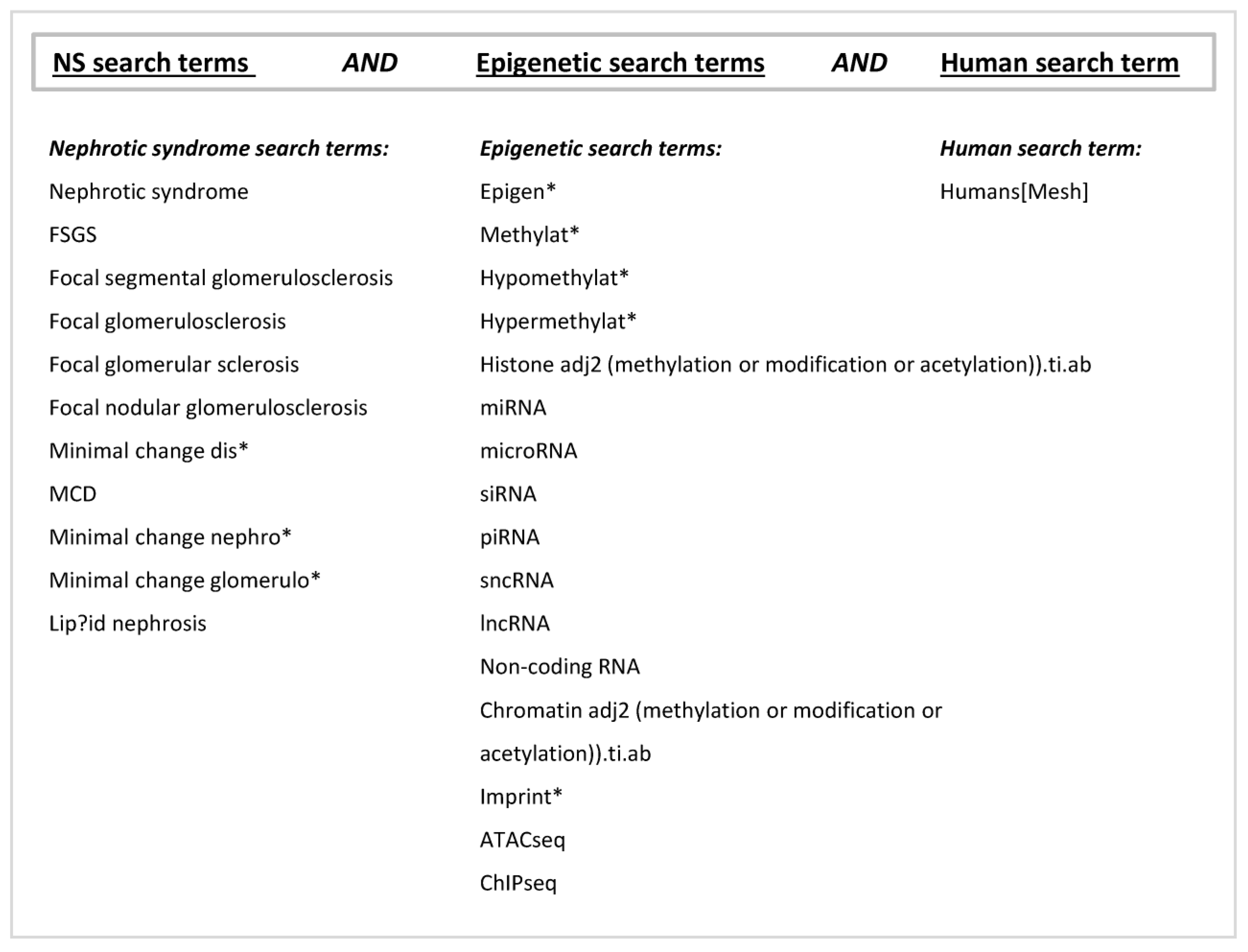
A small subset of people with nephrotic syndrome (NS) have genetically driven disease. However, the disease mechanisms for the remaining majority are unknown. Epigenetic marks are reversible but stable regulators of gene expression with utility as biomarkers and therapeutic targets. We aimed to identify and assess all published human studies of epigenetic mechanisms in NS. PubMed (MEDLINE) and Embase were searched for original research articles examining any epigenetic mechanism in samples collected from people with steroid resistant NS, steroid sensitive NS, focal segmental glomerulosclerosis or minimal change disease. Study quality was assessed by using the Joanna Briggs Institute critical appraisal tools. Forty-nine studies met our inclusion criteria. The majority of these examined micro-RNAs (n = 35, 71%). Study quality was low, with only 23 deemed higher quality, and most of these included fewer than 100 patients and failed to validate findings in a second cohort. However, there were some promising concordant results between the studies; higher levels of serum miR-191 and miR-30c, and urinary miR-23b-3p and miR-30a-5p were observed in NS compared to controls. We have identified that the epigenome, particularly DNA methylation and histone modifications, has been understudied in NS. Large clinical studies, which utilise the latest high-throughput technologies and analytical pipelines, should focus on addressing this critical gap in the literature.
Keywords: nephrotic syndrome; FSGS; minimal change disease; SRNS; SSNS; epigenetics; micro-RNA; DNA methylation; long non-coding RNA; histone modification nephrotic syndrome; FSGS; minimal change disease; SRNS; SSNS; epigenetics; micro-RNA; DNA methylation; long non-coding RNA; histone modification