Review

Role of Base Excision Repair in Innate Immune Cells and Its Relevance for Cancer Therapy
1
Division of Pharmacology and Toxicology, Dell Pediatric Research Institute, College of Pharmacy, The University of Texas at Austin, 1400 Barbara Jordan Blvd. R1800, Austin, TX 78723, USA
2
Department of Cell Systems & Anatomy, University of Texas Health, San Antonio, TX 78229, USA
3
Biology and Environment Science Department, College of Art and Science, University of New Haven, 300 Boston Post Rd., West Haven, CT 06516, USA
4
Department of Epigenetics and Molecular Carcinogenesis, The University of Texas MD Anderson Cancer Center, Science Park, Smithville, TX 78957, USA
*
Author to whom correspondence should be addressed.
Biomedicines 2022, 10(3), 557; https://doi.org/10.3390/biomedicines10030557

Submission received: 25 December 2021 / Revised: 18 February 2022 / Accepted: 24 February 2022 / Published: 26 February 2022
(This article belongs to the Special Issue Evolving Landscape of DNA Repair in Cancer Therapy)

Abstract

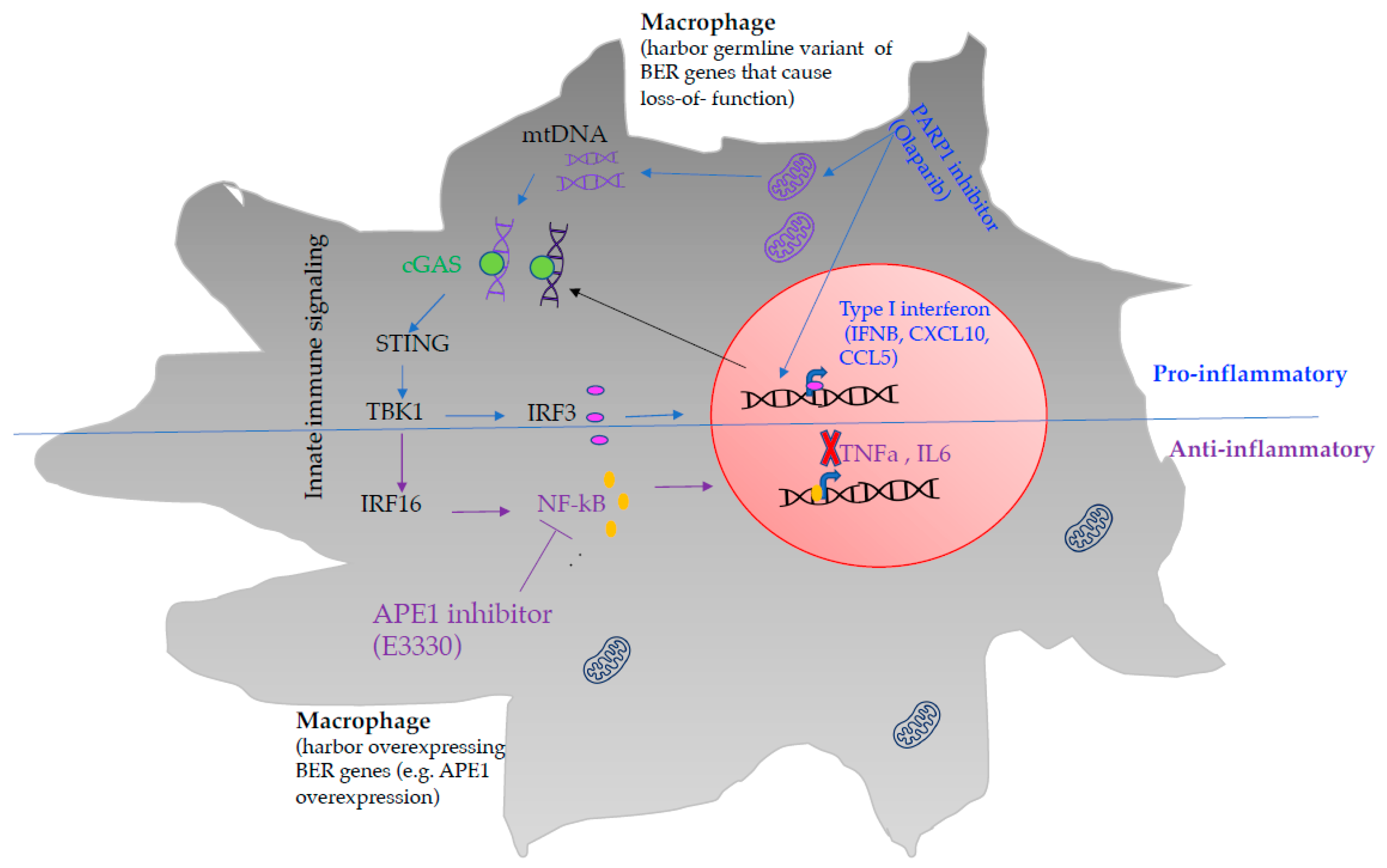
Innate immunity is critical for immediate recognition and elimination of invading pathogens or defense against cancer cell growth. Dysregulation of innate immune systems is associated with the pathogenesis of different types of inflammatory diseases, including cancer. In addition, the maintenance of innate immune cells’ genomic integrity is crucial for the survival of all organisms. Oxidative stress generated from innate immune cells may cause self-inflicted DNA base lesions as well as DNA damage on others neighboring cells, including cancer cells. Oxidative DNA base damage is predominantly repaired by base excision repair (BER). BER process different types of DNA base lesions that are presented in cancer and innate immune cells to maintain genomic integrity. However, mutations in BER genes lead to impaired DNA repair function and cause insufficient genomic integrity. Moreover, several studies have implicated that accumulation of DNA damage leads to chromosomal instability that likely activates the innate immune signaling. Furthermore, dysregulation of BER factors in cancer cells modulate the infiltration of innate immune cells to the tumor microenvironment. In the current review, the role of BER in cancer and innate immune cells and its impact on innate immune signaling within the tumor microenvironment is summarized. This is a special issue that focuses on DNA damage and cancer therapy to demonstrate how BER inhibitor or aberrant repair modulates innate inflammatory response and impact immunotherapy approaches. Overall, the review provides substantial evidence to understand the impact of BER in innate immune response dynamics within the current immune-based therapeutic strategy.
Keywords: base excision repair; innate immune cells; innate inflammatory signaling; immunotherapy base excision repair; innate immune cells; innate inflammatory signaling; immunotherapy