Chiral Covalent Organic Frameworks for Enantioselective Sensing: Electrochemical, Electrochemiluminescence, and Photoelectrochemical Platforms



Abstract
1. Introduction
2. Construction and Electrode Immobilization of CCOFs
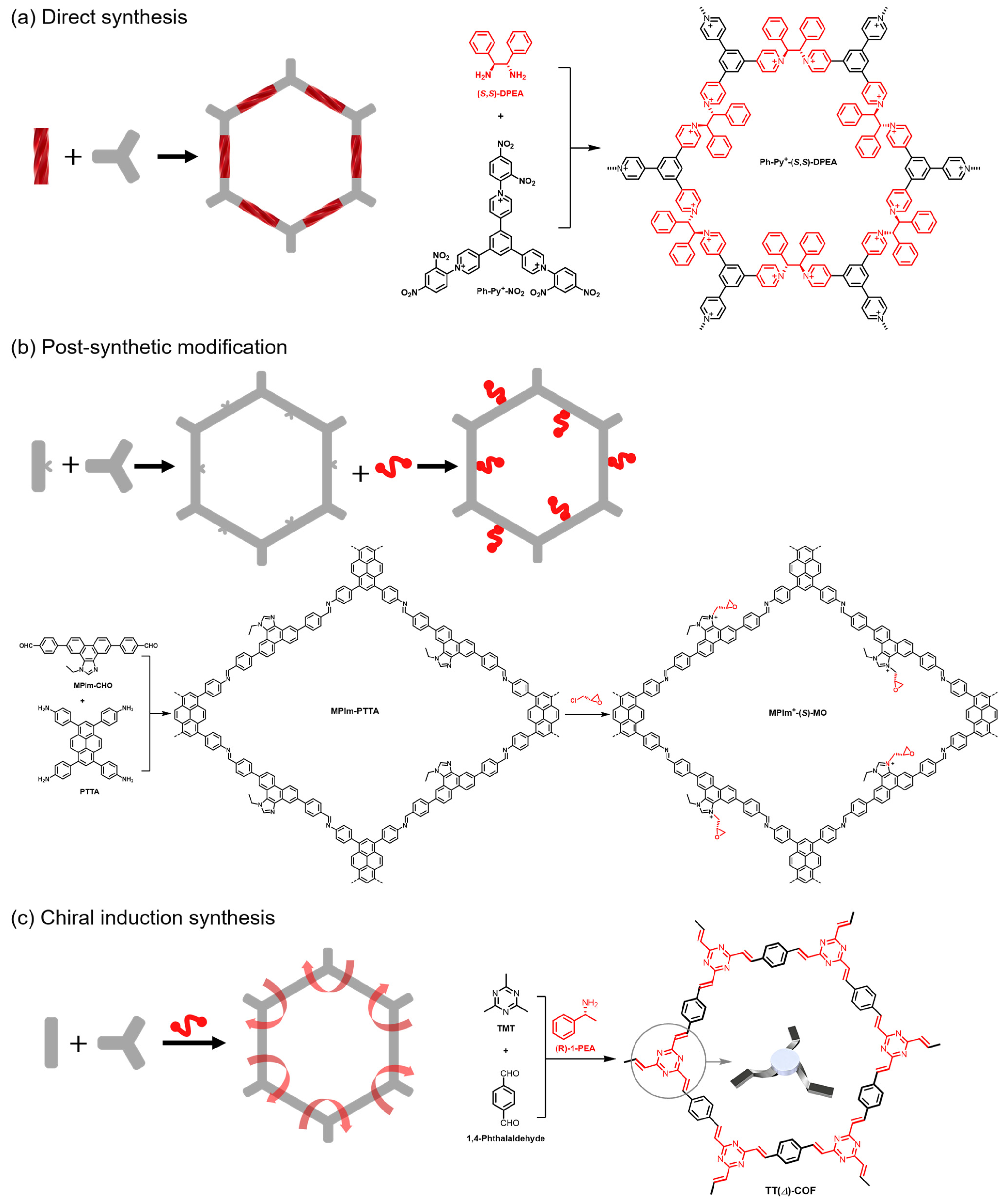
2.1. Synthetic Strategies for CCOFs
2.1.1. Direct Synthesis
2.1.2. Post-Synthetic Modification
2.1.3. Chiral Induction Synthesis

2.2. Electrode Modification Strategies for CCOFs
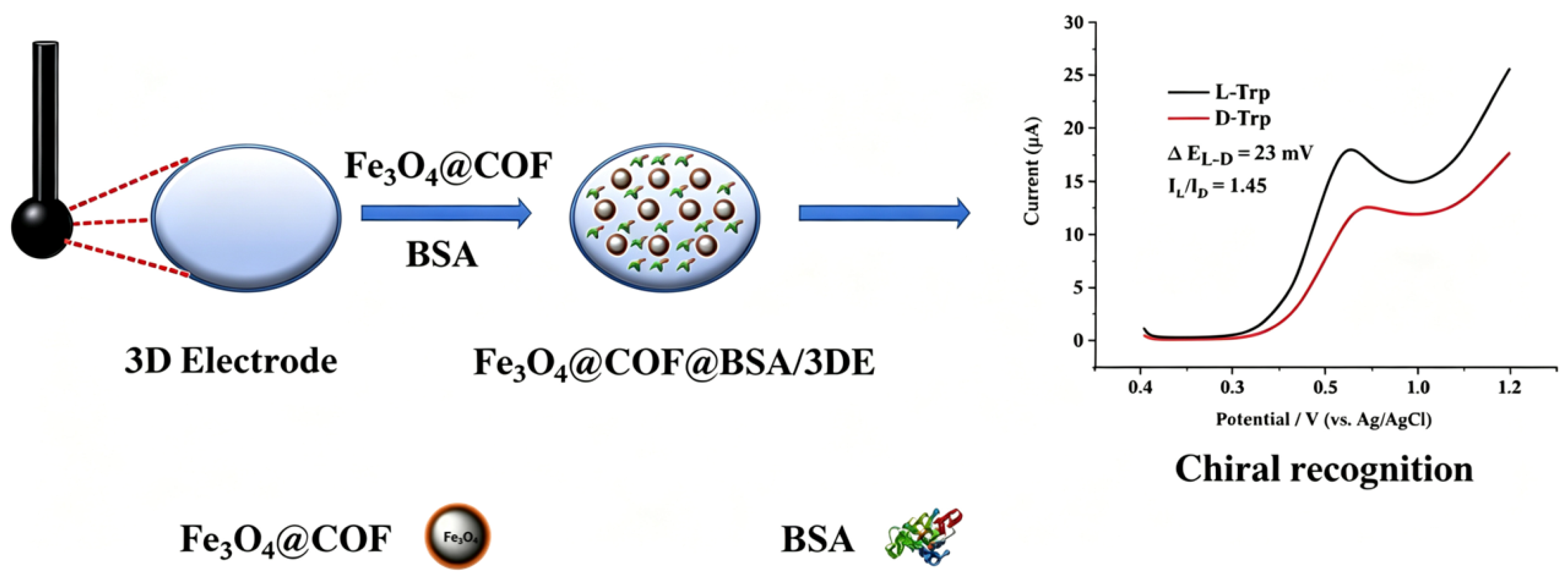
2.2.1. Drop-Casting
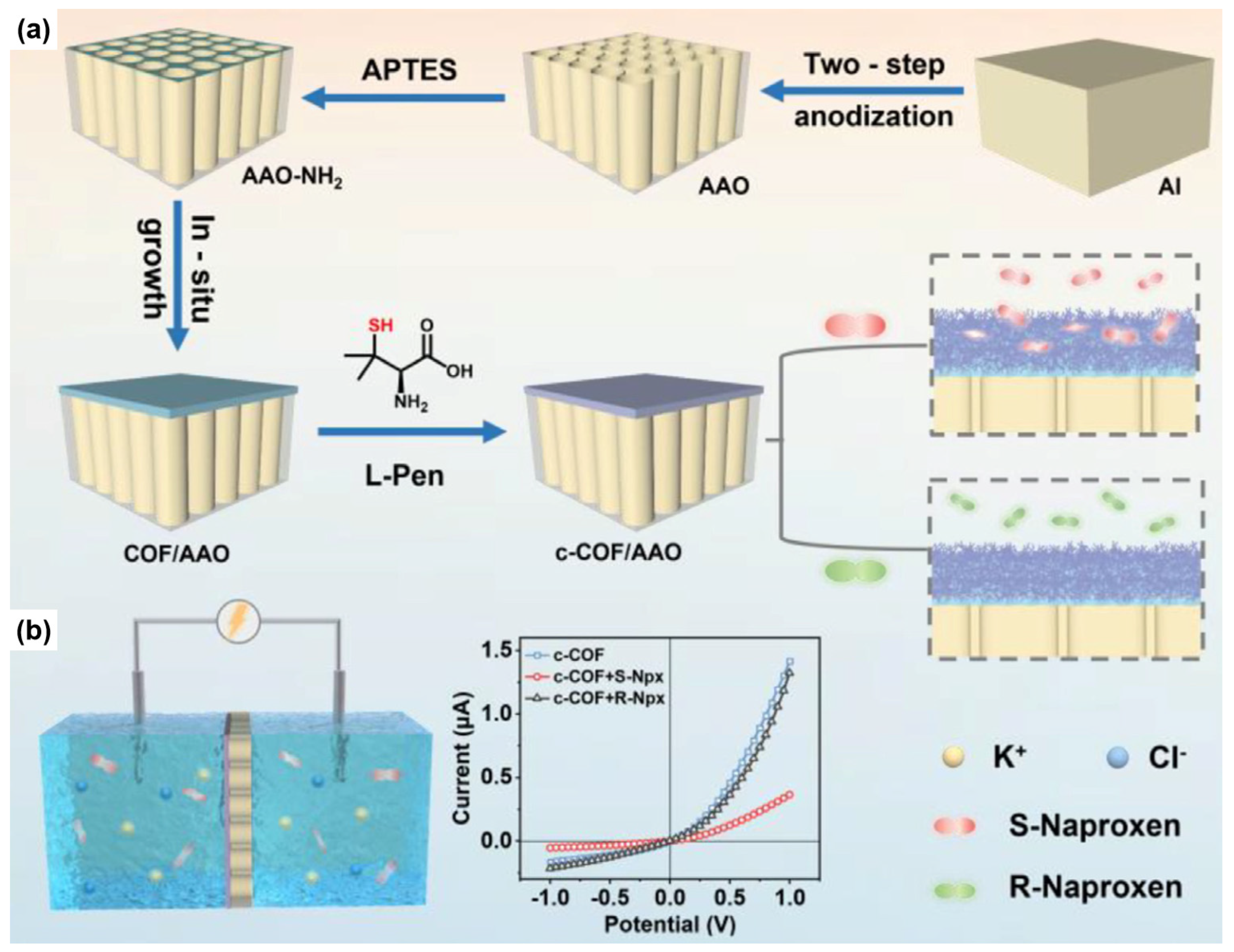
2.2.2. In Situ Growth
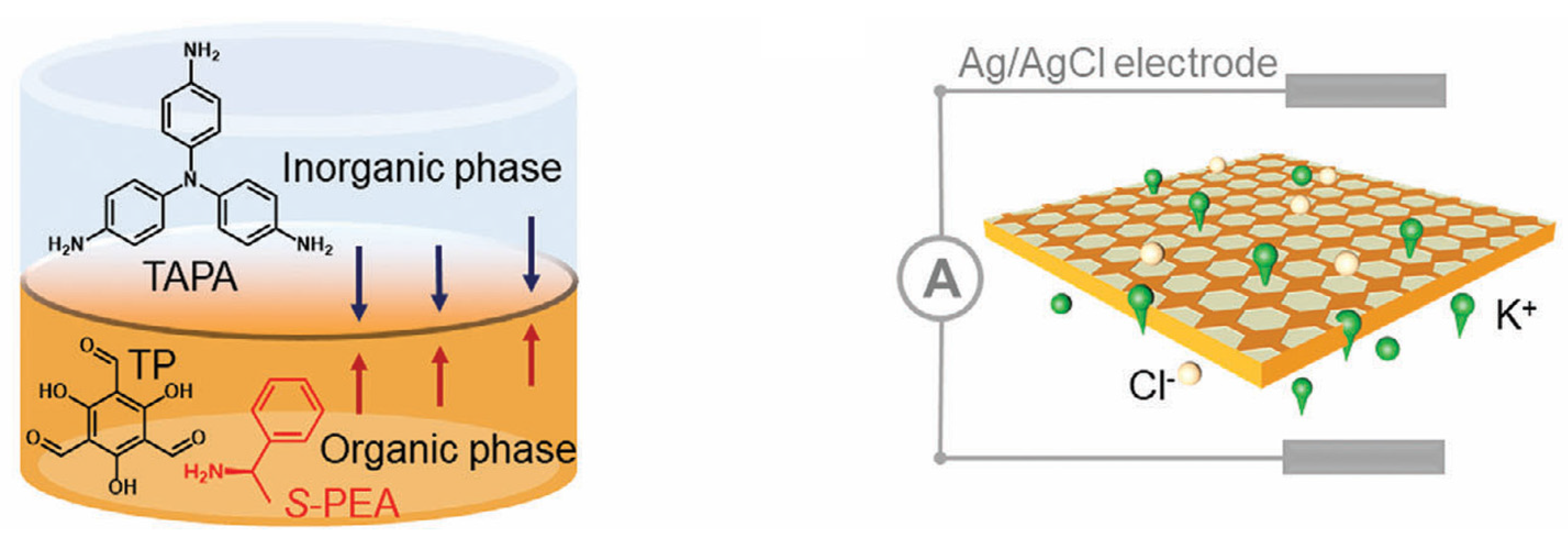
2.2.3. Self-Standing and Composite Membranes
2.2.4. Nanopipette Modification
3. Enantioselective Electroanalysis of CCOFs
3.1. Electrochemical Sensing
3.1.1. Planar Electrode Sensing
3.1.2. Nanofluidic Ion-Transport Sensing
Electrostatic Gating
Exclusion Gating
Coordination-Amplified Gating
Redox Gating
3.2. Electrochemiluminescence (ECL) Sensing
3.2.1. Intrinsic Skeleton Emitters
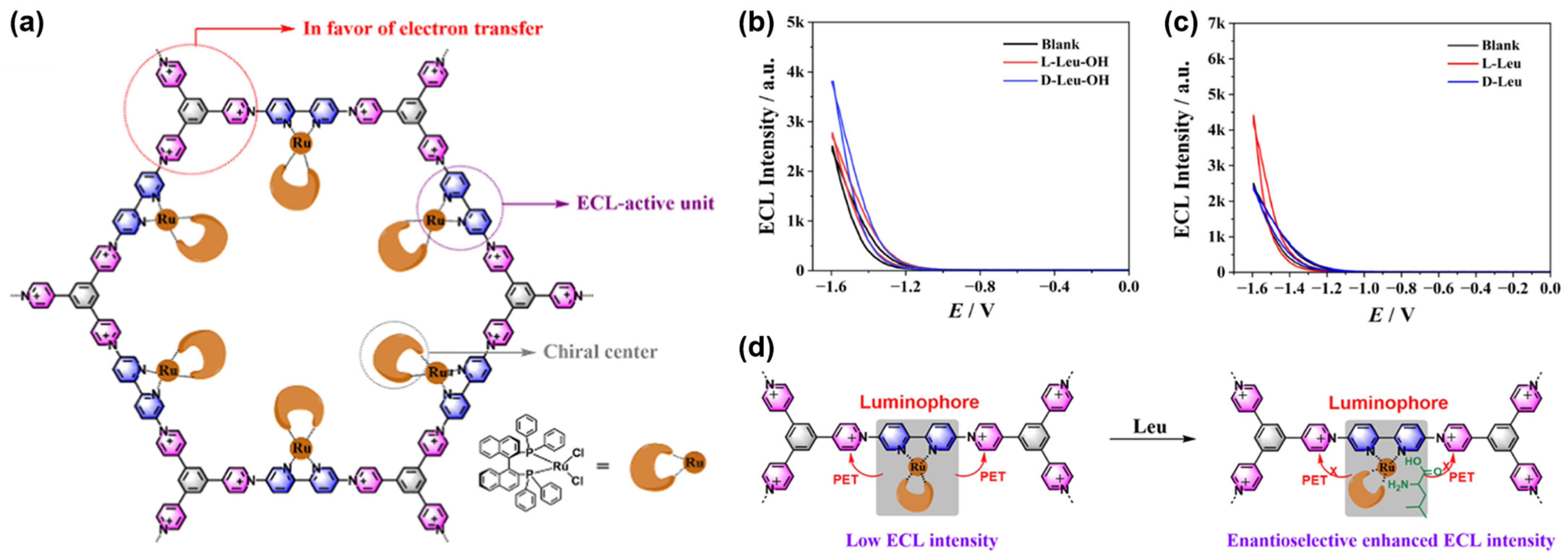
3.2.2. Coordination Modification
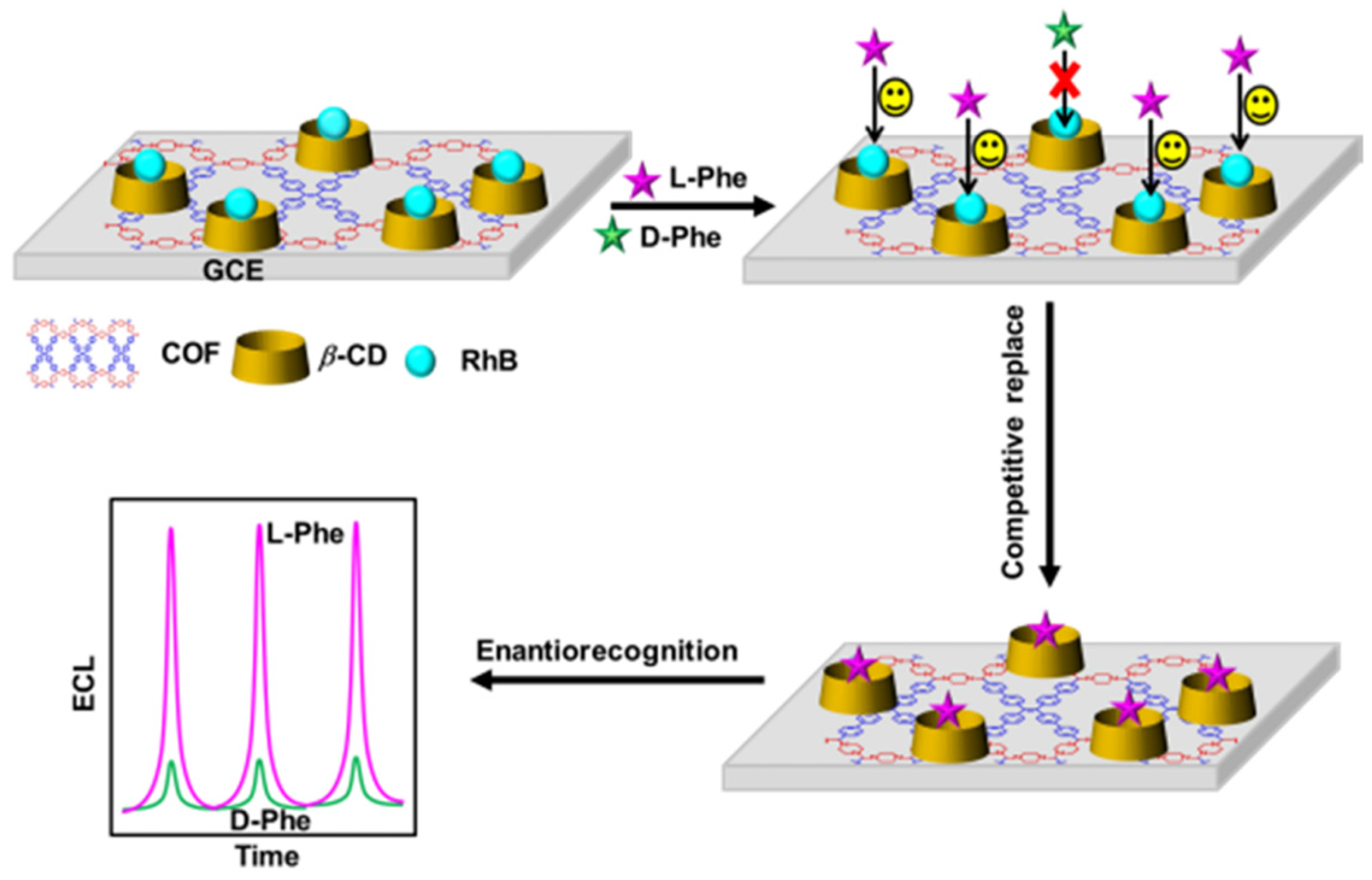
3.2.3. Physical Loading
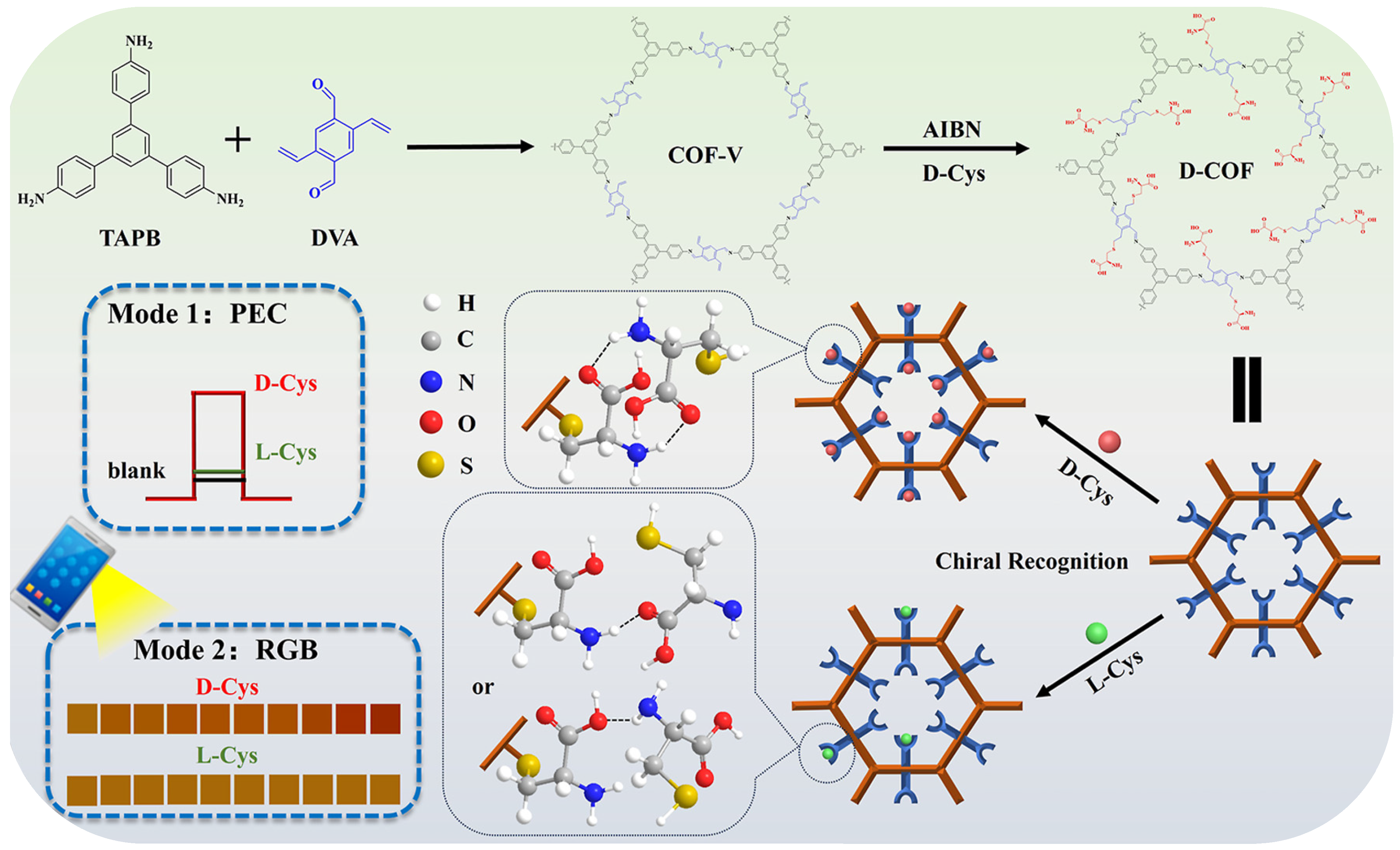
3.3. Photoelectrochemical (PEC) Sensing
3.4. Section Summary: From Physical Principles to Practical Selection
4. Conclusions and Future Perspectives
Author Contributions
Funding
Institutional Review Board Statement
Informed Consent Statement
Data Availability Statement
Acknowledgments
Conflicts of Interest
Abbreviations
| AAO | Anodic Aluminum Oxide |
| BINOL | 1,1′-bi-2-naphthol |
| BSA | Bovine Serum Albumin |
| CCNC | Chiral COF nanosheet–nanochannel composite |
| CCOFs | Chiral Covalent Organic Frameworks |
| CD | Cyclodextrin |
| COFs | Covalent Organic Frameworks |
| DFT | Density Functional Theory |
| DOPA | 3,4-Dihydroxyphenylalanine |
| DPV | Differential Pulse Voltammetry |
| ECL | Electrochemiluminescence |
| EDA | Energy Decomposition Analysis |
| ERET | Electrochemiluminescence Resonance Energy Transfer |
| FT-IR | Fourier Transform Infrared Spectroscopy |
| GCE | Glassy Carbon Electrode |
| HOMO | Highest Occupied Molecular Orbital |
| HPLC | High-Performance Liquid Chromatography |
| ICR | Ion Current Rectification |
| IDC | Interdigitated Capacitive |
| IGM | Independent Gradient Model |
| IRCT | Intramolecular Charge Transfer |
| ITO | Indium Tin Oxide |
| LSV | Linear Sweep Voltammetry |
| LUMO | Lowest Unoccupied Molecular Orbital |
| NMR | Nuclear Magnetic Resonance |
| PEA | Phenylethylamine |
| PEC | Photoelectrochemical |
| PET | Photoinduced Electron Transfer |
| PSM | Post-Synthetic Modification |
| PTCDA | 3,4,9,10-Perylenetetracarboxylic dianhydride |
| RGB | Red–Green–Blue |
| RhB | Rhodamine B |
| RSD | Relative Standard Deviation |
| SEM | Scanning Electron Microscopy |
| SPR | Surface Plasmon Resonance |
| TEM | Transmission Electron Microscopy |
| Tp | 1,3,5-triformylphloroglucinol |
| TPE-TAM | Tetrakis(4-aminophenyl)ethene |
| TPrA | Tripropylamine |
| XPS | X-ray Photoelectron Spectroscopy |
| XRD | X-ray Diffraction |
| β-CD | β-Cyclodextrin |
References
- Kandula, J.S.; Rayala, V.P.K.; Pullapanthula, R. Chirality: An Inescapable Concept for the Pharmaceutical, Bio-Pharmaceutical, Food, and Cosmetic Industries. Sep. Sci. Plus 2023, 6, 2200131. [Google Scholar] [CrossRef] [Scilit]
- Yao, Y.; Ávalos-Ovando, O.; Ding, T.; Alvarez-Puebla, R.A.; Yu, P.; Ashalley, E.; Ma, L.; Wang, Z.; Markovich, G.; Govorov, A.O. From Chiral Biomolecules to Chiral Nanocrystals: A Review of the Latest Developments and Emerging Concepts. Chem 2025, 11, 102544. [Google Scholar] [CrossRef] [Scilit]
- Wang, L.-K.; Chen, X.-R.; Lin, T.-Y.; Ban, Y.-L.; Liu, Z.-C.; Jia, H.-L.; Wang, H.; Lan, Y.-B. Chiral Covalent Organic Frameworks for Enantioselective Fluorescence Sensing. Chemosensors 2026, 14, 120. [Google Scholar] [CrossRef] [Scilit]
- Cho, N.H.; Guerrero-Martinez, A.; Ma, J.; Bals, S.; Kotov, N.A.; Liz-Marzan, L.M.; Nam, K.T. Bioinspired Chiral Inorganic Nanomaterials. Nat. Rev. Bioeng. 2023, 1, 88–106. [Google Scholar] [CrossRef] [Scilit]
- Chotera-Ouda, A.; Trzeciak, K.; Potrzebowski, M.J. Importance of Chirality in the Self-Organizing Peptides—From Single Molecules to Functional Supramolecular Structures. Phys. Chem. Chem. Phys. 2025, 27, 18062–18092. [Google Scholar] [CrossRef] [Scilit] [PubMed]
- Okunlola, G.A.; Aleku, G.A. Stereoselective Biotransformation: Transfer of Learning to Advance Drug Metabolism and Biocatalysis. Angew. Chem. Int. Ed. 2026, 65, e26152. [Google Scholar] [CrossRef] [Scilit] [PubMed]
- Senkuttuvan, N.; Komarasamy, B.; Krishnamoorthy, R.; Sarkar, S.; Dhanasekaran, S.; Anaikutti, P. The Significance of Chirality in Contemporary Drug Discovery—A Mini Review. RSC Adv. 2024, 14, 33429–33448. [Google Scholar] [CrossRef] [Scilit] [PubMed]
- Satapathy, S.; Kumar, S.; Kurmi, B.D.; Gupta, G.D.; Patel, P. Expanding the Role of Chiral Drugs and Chiral Nanomaterials as a Potential Therapeutic Tool. Chirality 2024, 36, e23698. [Google Scholar] [CrossRef] [Scilit] [PubMed]
- Tokunaga, E.; Yamamoto, T.; Ito, E.; Shibata, N. Understanding the Thalidomide Chirality in Biological Processes by the Self-Disproportionation of Enantiomers. Sci. Rep. 2018, 8, 17131. [Google Scholar] [CrossRef] [Scilit] [PubMed]
- Wnendt, S.; Zwingenberger, K. Thalidomide’s Chirality. Nature 1997, 385, 303–304. [Google Scholar] [PubMed]
- Malacarne, F.; Grecchi, S.; Niamlaem, M.; Bonczak, B.; Salinas, G.; Arnaboldi, S. Unconventional Approaches for Chiral Resolution. Anal. Bioanal. Chem. 2024, 416, 3677–3685. [Google Scholar] [CrossRef] [Scilit] [PubMed]
- Beyrami, H.; Golshan, M.; Kucińska-Lipka, J.; Saeb, M.R.; Salami-Kalajahi, M. Chiral-Based Optical and Electrochemical Biosensors: Synthesis, Classification, Mechanisms, Nanostructures, and Applications. Chem. Eng. J. 2024, 497, 155562. [Google Scholar] [CrossRef] [Scilit]
- Penasa, R.; Licini, G.; Zonta, C. Advances in Chiral Analysis: From Classical Methods to Emerging Technologies. Chem. Soc. Rev. 2025, 54, 10940–10955. [Google Scholar] [CrossRef] [Scilit] [PubMed]
- Sharma, V.; Mishra, A.K.; Mishra, N.K.; Vinod. Chiral Luminescent Sensor for Enantiomer Discrimination. Chirality 2025, 37, e70057. [Google Scholar] [CrossRef] [Scilit] [PubMed]
- Izake, E.L. Chiral Discrimination and Enantioselective Analysis of Drugs: An Overview. J. Pharm. Sci. 2007, 96, 1659–1676. [Google Scholar] [CrossRef] [Scilit] [PubMed]
- Singh, A.; Kaur, N.; Chopra, H.K. Chiral Recognition Methods in Analytical Chemistry: Role of the Chiral Ionic Liquids. Crit. Rev. Anal. Chem. 2019, 49, 553–569. [Google Scholar] [CrossRef] [Scilit] [PubMed]
- Wang, X.; Tang, Y.; Ma, K.; Wang, Y.; Yang, X.; He, B.; Xu, S. A Novel Fluorescent Sensing Probe Based on Cerium, Nitrogen Co-Doped Carbon Dots Combined with Molecularly Imprinted Polymer for Sensitive and Selective Determination of Oxytetracycline in Milk. Microchem. J. 2025, 215, 114503. [Google Scholar] [CrossRef] [Scilit]
- De Luca, C.; Felletti, S.; Franchina, F.A.; Bozza, D.; Compagnin, G.; Nosengo, C.; Pasti, L.; Cavazzini, A.; Catani, M. Recent Developments in the High-Throughput Separation of Biologically Active Chiral Compounds via High Performance Liquid Chromatography. J. Pharm. Biomed. Anal. 2024, 238, 115794. [Google Scholar] [CrossRef] [Scilit] [PubMed]
- Dhurjad, P.; Dhalaram, C.S.; Ali, N.; Kumari, N.; Sonti, R. Metal-Organic Frameworks in Chiral Separation of Pharmaceuticals. Chirality 2022, 34, 1419–1436. [Google Scholar] [CrossRef] [Scilit] [PubMed]
- Bernardo-Bermejo, S.; Adámez-Rodríguez, S.; Castro-Puyana, M.; Marina, M.L. Chiral Analysis by Capillary Electromigration Techniques. Trends Anal. Chem. 2025, 189, 118256. [Google Scholar] [CrossRef] [Scilit]
- Sharifzadeh, Z.; Berijani, K.; Morsali, A. Chiral Metal-Organic Frameworks Based on Asymmetric Synthetic Strategies and Applications. Coord. Chem. Rev. 2021, 445, 214083. [Google Scholar] [CrossRef] [Scilit]
- Sarkany, A.; Hancu, G.; Cârje, A.; Drăguț, C.; Papp, L.A. Chiral Separation of Tramadol Enantiomers by Capillary Electrophoresis Using Cyclodextrins as Chiral Selectors and Experimental Design Method Optimization. Chem. Pap. 2019, 73, 2363–2370. [Google Scholar] [CrossRef] [Scilit]
- Gogolashvili, A.; Chankvetadze, L.; Takaishvili, N.; Salgado, A.; Chankvetadze, B. Separation of Terbutaline Enantiomers in Capillary Electrophoresis with Neutral Cyclodextrin-Type Chiral Selectors and Investigation of the Structure of Selector-Selectand Complexes Using Nuclear Magnetic Resonance Spectroscopy. Electrophoresis 2020, 41, 1023–1030. [Google Scholar] [CrossRef] [Scilit] [PubMed]
- Pieckowski, M.; Olędzka, I.; Bączek, T.; Kowalski, P. Deep Eutectic Solvents in Capillary Electromigration Techniques—A Review of Recent Advancements. Molecules 2025, 30, 3674. [Google Scholar] [CrossRef] [Scilit] [PubMed]
- Konya, Y.; Izumi, Y.; Hamase, K.; Bamba, T. Ultrafast Simultaneous Chiral Analysis of Native Amino Acid Enantiomers Using Supercritical Fluid Chromatography/Tandem Mass Spectrometry. J. Chromatogr. A 2022, 1677, 463305. [Google Scholar] [CrossRef] [Scilit] [PubMed]
- Bernardo-Bermejo, S.; Sánchez-López, E.; Castro-Puyana, M.; Marina, M.L. Chiral Capillary Electrophoresis. Trends Anal. Chem. 2020, 124, 115807. [Google Scholar] [CrossRef] [Scilit]
- Kaya, S.I.; Cetinkaya, A.; Ozkan, S.A. Green Analytical Chemistry Approaches on Environmental Analysis. Trends Environ. Anal. Chem. 2022, 33, e00157. [Google Scholar] [CrossRef] [Scilit]
- Canfarotta, F.; Rapini, R.; Piletsky, S. Recent Advances in Electrochemical Sensors Based on Chiral and Nano-Sized Imprinted Polymers. Curr. Opin. Electrochem. 2018, 7, 146–152. [Google Scholar] [CrossRef] [Scilit]
- Zheng, A.L.T.; Teo, E.Y.L.; Marzuki, O.F.; Boonyuen, S.; Chung, E.L.T.; Tan, K.B.; Andou, Y. Interfacial Engineering for Enantioselective Electrochemical Sensing of Tryptophan: Materials, Recognition Strategies, and Performance Benchmarking. Anal. Sci. 2026, 42, 827–845. [Google Scholar] [CrossRef] [Scilit] [PubMed]
- Cruz-Pacheco, A.F.; Avendaño, S.; Orozco, J. Portable Electrochemical Sensing, Chemometrics, and Data-Driven Analytics for Pharmaceutical Monitoring. Electrochim. Acta 2026, 545, 147759. [Google Scholar] [CrossRef] [Scilit]
- Atta, N.F.; Galal, A.; Ahmed, Y.M. Highly Conductive Crown Ether/Ionic Liquid Crystal-Carbon Nanotubes Composite Based Electrochemical Sensor for Chiral Recognition of Tyrosine Enantiomers. J. Electrochem. Soc. 2019, 166, B623–B630. [Google Scholar] [CrossRef] [Scilit]
- Brannelly, N.T.; Killard, A.J. An Electrochemical Sensor Device for Measuring Blood Ammonia at the Point of Care. Talanta 2017, 167, 296–301. [Google Scholar] [CrossRef] [Scilit] [PubMed]
- Healy, B.; Yu, T.; da Silva Alves, D.C.; Okeke, C.; Breslin, C.B. Cyclodextrins as Supramolecular Recognition Systems: Applications in the Fabrication of Electrochemical Sensors. Materials 2021, 14, 1668. [Google Scholar] [CrossRef] [Scilit] [PubMed]
- Heikenfeld, J.; Jajack, A.; Rogers, J.; Gutruf, P.; Tian, L.; Pan, T.; Li, R.; Khine, M.; Kim, J.; Wang, J.; et al. Wearable Sensors: Modalities, Challenges, and Prospects. Lab Chip 2018, 18, 217–248. [Google Scholar] [CrossRef] [Scilit] [PubMed]
- Karadurmus, L.; Gumustas, M.; Bakirhan, N.K.; Ozkan, S.A. Chiral Sensing as a Future Challenge in Electroanalytical Chemistry: Cyclodextrin-Based Chiral Sensors. Crit. Rev. Anal. Chem. 2021, 53, 498–519. [Google Scholar] [CrossRef] [Scilit] [PubMed]
- Hasanova, S.; Ait Lahcen, A.; Zor, E. Recent Advances in Molecular Imprinting Techniques for the Electrochemical Analysis of Chiral Compounds. J. Pharm. Biomed. Anal. Open 2024, 4, 100046. [Google Scholar] [CrossRef] [Scilit]
- Ricks, N.J.; Pence, M.A.; Brachi, M.; Minteer, S.D. High-Throughput Optical Analysis to Inform Design of Electrochemical Biosensors. ACS Meas. Sci. Au 2026, 6, 567–578. [Google Scholar] [CrossRef] [Scilit] [PubMed]
- Grecchi, S.; Arnaboldi, S. Wireless Enantioselective Bipolar Electrocatalysis: Visual Quantification of Chiral Tryptophan via Kinetic pH-Transduction. ChemCatChem 2026, 18, e00002. [Google Scholar] [CrossRef] [Scilit]
- Carone, A.; Mariani, P.; Désert, A.; Parola, S. Colloidal Assemblies of Chiral Plasmonic Nanoparticles Induce Tunable Circular Dichroism Response. Adv. Opt. Mater. 2023, 11, 2300119. [Google Scholar] [CrossRef] [Scilit]
- Zhang, H.; Li, Q.; Weng, B.; Xiao, L.; Tian, Z.; Yang, J.; Liu, T.; Lai, F. Edge Engineering of Platinum Nanoparticles via Porphyrin-Based Ultrathin 2D Metal–Organic Frameworks for Enhanced Photocatalytic Hydrogen Generation. Chem. Eng. J. 2022, 442, 136144. [Google Scholar] [CrossRef] [Scilit]
- Shi, W.-J.; Chen, M.-W.; Li, Y.-Z.; Chen, H.-Y.; Lin, Y.; Wang, H.; Hou, L.; Wang, G.-D. Integrating Hydrogen-Bonding Nanotrap into a Cage-Like MOF for Natural Gas Upgrade and MTO Product Separation. Chem. Eng. J. 2025, 526, 170811. [Google Scholar] [CrossRef] [Scilit]
- Abdelhamid, H.N.; Chamkha, A.J. Metal–Organic Frameworks (MOFs) for Chiral Separation and Biosensing. Anal. Chem. 2025, 97, 23721–23742. [Google Scholar] [CrossRef] [Scilit] [PubMed]
- Hassanpour, S.; Niaei, N.; Petr, J. Metal-Organic Frameworks-Based Analytical Devices for Chiral Sensing and Separations: A Review (2012–2022). Chemosensors 2023, 11, 29. [Google Scholar] [CrossRef] [Scilit]
- Slater, B.D.; Hill, M.R.; Ladewig, B.P. Solvent-Induced Enantioselectivity Reversal in a Chiral Metal Organic Framework. J. Sep. Sci. 2021, 44, 3319–3323. [Google Scholar] [CrossRef] [Scilit] [PubMed]
- Bortolami, M.; Curulli, A.; Di Matteo, P.; Petrucci, R.; Feroci, M. Carbon Dots in Enantioselective Sensing. Sensors 2024, 24, 3945. [Google Scholar] [CrossRef] [Scilit] [PubMed]
- Nwaji, N.; Gwak, J.; Nguyen, M.-C.; Nguyen, H.-Q.; Kang, H.; Choi, Y.; Kim, Y.; Chen, H.; Lee, J. Emerging Potentials of Fe-Based Nanomaterials for Chiral Sensing and Imaging. Med. Res. Rev. 2024, 44, 897–918. [Google Scholar] [CrossRef] [Scilit] [PubMed]
- Bettini, S.; Syrgiannis, Z.; Pagano, R.; Dordevic, L.; Salvatore, L.; Prato, M.; Giancane, G.; Valli, L. Perylene Bisimide Aggregates as Probes for Subnanomolar Discrimination of Aromatic Biogenic Amines. ACS Appl. Mater. Interfaces 2019, 11, 17079–17089. [Google Scholar] [CrossRef] [Scilit] [PubMed]
- Jiang, J.; Zhao, Y.; Yaghi, O.M. Covalent Chemistry Beyond Molecules. J. Am. Chem. Soc. 2016, 138, 3255–3265. [Google Scholar] [CrossRef] [Scilit] [PubMed]
- Diercks, C.S.; Yaghi, O.M. The Atom, the Molecule, and the Covalent Organic Framework. Science 2017, 355, eaal1585. [Google Scholar] [CrossRef] [Scilit] [PubMed]
- Jarju, J.J.; Lavender, A.M.; Espiña, B.; Romero, V.; Salonen, L.M. Covalent Organic Framework Composites: Synthesis and Analytical Applications. Molecules 2020, 25, 5404. [Google Scholar] [CrossRef] [Scilit] [PubMed]
- Nguyen, H.L. Reticular Design and Crystal Structure Determination of Covalent Organic Frameworks. Chem. Sci. 2021, 12, 8632–8647. [Google Scholar] [CrossRef] [Scilit] [PubMed]
- Kim, T.; Kim, J.; Kim, N.; Lim, H. Recent Advances in Single Crystal COFs from Synthesis to Applications. Chem. Commun. 2025, 61, 17516–17529. [Google Scholar] [CrossRef] [Scilit] [PubMed]
- Geng, K.; He, T.; Liu, R.; Dalapati, S.; Tan, K.T.; Li, Z.; Tao, S.; Gong, Y.; Jiang, Q.; Jiang, D. Covalent Organic Frameworks: Design, Synthesis, and Functions. Chem. Rev. 2020, 120, 8814–8933. [Google Scholar] [CrossRef] [Scilit] [PubMed]
- Alsudairy, Z.; Brown, N.; Campbell, A.; Ambus, A.; Brown, B.; Smith-Petty, K.; Li, X. Covalent Organic Frameworks in Heterogeneous Catalysis: Recent Advances and Future Perspective. Mater. Chem. Front. 2023, 7, 3298–3331. [Google Scholar] [CrossRef] [Scilit]
- Segura, J.L.; Mancheno, M.J.; Zamora, F. Covalent Organic Frameworks Based on Schiff-Base Chemistry: Synthesis, Properties and Potential Applications. Chem. Soc. Rev. 2016, 45, 5635–5671. [Google Scholar] [CrossRef] [Scilit] [PubMed]
- Yuan, Z.-L.; Xie, L.-X.; Liu, R.-L.; Li, Z.-F.; Li, G. Latest Advancements of Proton-Conductive Covalent Organic Frameworks and Related Membranes over the Past Five Years. Adv. Colloid Interface Sci. 2026, 351, 103810. [Google Scholar] [CrossRef] [Scilit] [PubMed]
- Sato, K.; Imamura, K.; Inagi, S. Electrochemically Controlled Interface Synthesis and Applications of Imine-Bonded Covalent Organic Framework Films. Chem. Lett. 2026, 55, uag037. [Google Scholar] [CrossRef] [Scilit]
- Frimpong, S.O.; Pacheco, M.; Xie, H.; Zeppuhar, A.N.; Farha, O.K.; Taylor, M.K. Tailoring a 3D Covalent Organic Framework Toward Facile Functionalization. Small 2026, 22, e11087. [Google Scholar] [CrossRef] [Scilit] [PubMed]
- Han, X.; Yuan, C.; Hou, B.; Liu, L.; Li, H.; Liu, Y.; Cui, Y. Chiral Covalent Organic Frameworks: Design, Synthesis and Property. Chem. Soc. Rev. 2020, 49, 6248–6272. [Google Scholar] [CrossRef] [Scilit] [PubMed]
- Wang, L.-K.; Lin, T.-Y.; Chen, X.-R.; Wang, X.-T.; Ban, Y.-L.; Liu, Z.-C.; Lan, Y.-B. Chiral Nanoporous Covalent Organic Frameworks in Asymmetric Catalysis: A Review on Synthetic Strategies and Catalytic Performance. ACS Appl. Nano Mater. 2026, 9, 15538–15571. [Google Scholar] [CrossRef] [Scilit]
- Han, X.; Li, W.; Yang, B.; Jiang, C.; Qu, Z.; Xu, H.; Liu, Y.; Cui, Y. Reticulating Crystalline Porous Materials for Asymmetric Heterogeneous Catalysis. Adv. Mater. 2024, 37, 2415574. [Google Scholar] [CrossRef] [Scilit] [PubMed]
- Wu, X.; Han, X.; Xu, Q.; Liu, Y.; Yuan, C.; Yang, S.; Liu, Y.; Jiang, J.; Cui, Y. Chiral BINOL-Based Covalent Organic Frameworks for Enantioselective Sensing. J. Am. Chem. Soc. 2019, 141, 7081–7089. [Google Scholar] [CrossRef] [Scilit] [PubMed]
- Liu, G.; Sheng, J.; Zhao, Y. Chiral Covalent Organic Frameworks for Asymmetric Catalysis and Chiral Separation. Sci. China Chem. 2017, 60, 1015–1022. [Google Scholar] [CrossRef] [Scilit]
- Wang, F.; Cai, W.; Tan, L.; Li, J.; Wu, D.; Kong, Y. A Liquid–Liquid Interfacial Strategy for Construction of Electroactive Chiral Covalent–Organic Frameworks with the Aim to Enlarge the Testing Scope of Chiral Electroanalysis. Anal. Chem. 2024, 96, 3200–3207. [Google Scholar] [CrossRef] [Scilit] [PubMed]
- Yuan, S.; Cai, W.; Zhao, L.; Wang, L.; Zhang, R.; Li, J.; Wu, D.; Kong, Y. Strong Electrochemiluminescence Response Derived from Ionic Chiral Covalent Organic Frameworks for Enantioselective Discrimination of Amino Acid Enantiomers via an Electrostatic Attraction Effect. ACS Appl. Mater. Interfaces 2024, 16, 65340–65347. [Google Scholar] [CrossRef] [Scilit] [PubMed]
- Wu, M.-Y.; Mo, R.-J.; Chen, S.; Rafique, S.; Bian, S.-J.; Tang, Y.-J.; Li, Z.-Q.; Xia, X.-H. Beta-Cyclodextrin-Modified Covalent Organic Framework Nanochannel for Electrochemical Chiral Recognition of Amino Acids. Anal. Chem. 2024, 96, 17665–17671. [Google Scholar] [CrossRef] [Scilit] [PubMed]
- Zhao, X.; Pachfule, P.; Thomas, A. Covalent Organic Frameworks (COFs) for Electrochemical Applications. Chem. Soc. Rev. 2021, 50, 6871–6913. [Google Scholar] [CrossRef] [Scilit] [PubMed]
- Haase, F.; Lotsch, B.V. Solving the COF Trilemma: Towards Crystalline, Stable and Functional Covalent Organic Frameworks. Chem. Soc. Rev. 2020, 49, 8469–8500. [Google Scholar] [CrossRef] [Scilit] [PubMed]
- Hou, B.; Yang, S.; Yang, K.; Han, X.; Tang, X.; Liu, Y.; Jiang, J.; Cui, Y. Confinement-Driven Enantioselectivity in 3D Porous Chiral Covalent Organic Frameworks. Angew. Chem. Int. Ed. 2021, 60, 6086–6093. [Google Scholar] [CrossRef] [Scilit] [PubMed]
- Wang, L.K.; Zhou, J.J.; Lan, Y.B.; Ding, S.Y.; Yu, W.; Wang, W. Divergent Synthesis of Chiral Covalent Organic Frameworks. Angew. Chem. Int. Ed. 2019, 58, 9443–9447. [Google Scholar] [CrossRef] [Scilit] [PubMed]
- Wan, J.; Shi, W.; Li, Y.; Yu, Y.; Wu, X.; Li, Z.; Lee, S.Y.; Lee, K.H. Excellent Crystallinity and Stability Covalent–Organic Frameworks with High Emission and Anions Sensing. Macromol. Rapid Commun. 2022, 43, 2200393. [Google Scholar] [CrossRef] [Scilit] [PubMed]
- Zhang, S.; Zhou, J.; Li, H. Chiral Covalent Organic Framework Packed Nanochannel Membrane for Enantioseparation. Angew. Chem. Int. Ed. 2022, 61, e202204012. [Google Scholar] [CrossRef] [Scilit] [PubMed]
- Grieshaber, D.; MacKenzie, R.; Vörös, J.; Reimhult, E. Electrochemical Biosensors—Sensor Principles and Architectures. Sensors 2008, 8, 1400–1458. [Google Scholar] [CrossRef]
- Zarei, M. Sensitive Visible Light-Driven Photoelectrochemical Aptasensor for Detection of Tetracycline Using ZrO2/g-C3N4 Nanocomposite. Sens. Int. 2020, 1, 100029. [Google Scholar] [CrossRef] [Scilit]
- Yoshinobu, T.; Miyamoto, K.-I. Efficient Illumination for a Light-Addressable Potentiometric Sensor. Sensors 2022, 22, 4541. [Google Scholar] [CrossRef] [Scilit] [PubMed]
- Han, X.; Huang, J.-J.; Yuan, C.; Liu, Y.; Cui, Y. Chiral 3D Covalent Organic Frameworks for High Performance Liquid Chromatographic Enantioseparation. J. Am. Chem. Soc. 2018, 140, 892–895. [Google Scholar] [CrossRef] [Scilit] [PubMed]
- Wang, X.; Han, X.; Zhang, J.; Wu, X.; Liu, Y.; Cui, Y. Homochiral 2D Porous Covalent Organic Frameworks for Heterogeneous Asymmetric Catalysis. J. Am. Chem. Soc. 2016, 138, 12332–12335. [Google Scholar] [CrossRef] [Scilit] [PubMed]
- Xu, H.-S.; Ding, S.-Y.; An, W.-K.; Wu, H.; Wang, W. Constructing Crystalline Covalent Organic Frameworks from Chiral Building Blocks. J. Am. Chem. Soc. 2016, 138, 11489–11492. [Google Scholar] [CrossRef] [Scilit] [PubMed]
- Tang, X.; Liao, X.; Cai, X.; Wu, J.; Wu, X.; Zhang, Q.; Yan, Y.; Zheng, S.; Jiang, H.; Fan, J.; et al. Self-Assembly of Helical Nanofibrous Chiral Covalent Organic Frameworks. Angew. Chem. Int. Ed. 2023, 62, e202216310. [Google Scholar] [CrossRef] [Scilit] [PubMed]
- Wang, L.-Y.; Feng, J.; Wang, R.-L.; Xu, H.-S.; Zhu, X.-Y.; Zhang, S.-S.; Ding, S.-Y.; Wang, W. Vinylene-Linked Helical Covalent Organic Frameworks. J. Am. Chem. Soc. 2026, 148, 23932–23940. [Google Scholar] [CrossRef] [Scilit] [PubMed]
- Liu, Q.; Kuang, X. Electrochemiluminescent Chiral Sensor Based on Covalent Organic Frameworks for Discrimination of Phenylalanine Enantiomers. Chirality 2025, 37, e70040. [Google Scholar] [CrossRef] [Scilit] [PubMed]
- Ruan, Y.; Kuang, X.; Zheng, X.; Sun, X.; Kuang, R. Bidirectional Ecl Response of Chiral COFs for the Discrimination of Penicillamine Enantiomers. Talanta 2025, 293, 128081. [Google Scholar] [CrossRef] [Scilit] [PubMed]
- Xu, H.; Chen, X.; Gao, J.; Lin, J.; Addicoat, M.; Irle, S.; Jiang, D. Catalytic Covalent Organic Frameworks via Pore Surface Engineering. Chem. Commun. 2014, 50, 1292–1294. [Google Scholar] [CrossRef] [Scilit] [PubMed]
- Xu, H.; Gao, J.; Jiang, D. Stable, Crystalline, Porous, Covalent Organic Frameworks as a Platform for Chiral Organocatalysts. Nat. Chem. 2015, 7, 905–912. [Google Scholar] [CrossRef] [Scilit] [PubMed]
- Khojastehnezhad, A.; Samie, A.; Bisio, A.; El-Kaderi, H.M.; Siaj, M. Impact of Postsynthetic Modification on the Covalent Organic Framework (COF) Structures. ACS Appl. Mater. Interfaces 2024, 17, 11415–11442. [Google Scholar] [CrossRef] [Scilit] [PubMed]
- Martín-Illán, J.A.; Royuela, S.; Mar Ramos, M.; Segura, J.L.; Zamora, F. Gas–Solid Heterogeneous Postsynthetic Modification of Imine-Based Covalent Organic Frameworks. Chem. Eur. J. 2020, 26, 6495–6498. [Google Scholar] [CrossRef] [Scilit] [PubMed]
- Ma, M.; Zhang, Y.; Huang, F.; Xu, Y. Chiral Hydroxyl-Controlled Covalent Organic Framework-Modified Stationary Phase for Chromatographic Enantioseparation. Microchim. Acta 2024, 191, 203. [Google Scholar] [CrossRef] [Scilit] [PubMed]
- Tan, L.; Cai, W.; Wang, F.; Li, J.; Wu, D.; Kong, Y. Postsynthetic Modification Strategy for Constructing Electrochemiluminescence-Active Chiral Covalent Organic Frameworks Performing Efficient Enantioselective Sensing. Anal. Chem. 2024, 96, 3942–3950. [Google Scholar] [CrossRef] [Scilit] [PubMed]
- Yuan, S.; Tan, L.; Zhao, L.; Wang, F.; Cai, W.; Li, J.; Wu, D.; Kong, Y. Chiral Ru-Based Covalent Organic Frameworks as an Electrochemiluminescence-Active Platform for the Enantioselective Sensing of Amino Acids. ACS Appl. Mater. Interfaces 2024, 16, 13161–13169. [Google Scholar] [CrossRef] [Scilit] [PubMed]
- Zhang, R.; Wang, L.; Suo, R.; Zhu, C.; Wu, D.; Cai, W.; Li, J.; Kong, Y. Electron Donor–Acceptor Systems in Electrochemiluminescent Chiral Covalent Organic Frameworks for Enantioselective Discrimination. Adv. Opt. Mater. 2026, 14, e03001. [Google Scholar] [CrossRef] [Scilit]
- Weng, W.; Zhu, Z.; Xu, X.; Guo, J. Chirality-Induced Stereoselective Synthesis of Chiral sp2-Carbon-Conjugated Covalent Organic Frameworks. Chem. Sci. 2026, 17, 7486–7495. [Google Scholar] [CrossRef] [Scilit] [PubMed]
- Han, X.; Zhang, J.; Huang, J.; Wu, X.; Yuan, D.; Liu, Y.; Cui, Y. Chiral Induction in Covalent Organic Frameworks. Nat. Commun. 2018, 9, 1294. [Google Scholar] [CrossRef] [Scilit] [PubMed]
- Wang, J.C.; Kan, X.; Shang, J.Y.; Qiao, H.; Dong, Y.B. Catalytic Asymmetric Synthesis of Chiral Covalent Organic Frameworks from Prochiral Monomers for Heterogeneous Asymmetric Catalysis. J. Am. Chem. Soc. 2020, 142, 16915–16920. [Google Scholar] [CrossRef] [Scilit] [PubMed]
- Huang, M.; Zhou, Z.; Dong, X.; Li, Y.; Yang, Y.; Zhan, C.; Lu, J.; Wei, X.; Hong, Y.; Cheng, W.; et al. Synthesis of Three-Dimensional Chiral Covalent Organic Frameworks Using Surfactant as Inducer in Water. Chin. J. Chem. 2024, 42, 3093–3098. [Google Scholar] [CrossRef] [Scilit]
- Li, W.; Xu, H.; Zhang, H.; Chen, H.; Ke, S.; Guo, G.; Wei, F.; Fu, J.; Jing, C.; Cheng, J.; et al. Enantiopure Dual-Helical Covalent Organic Framework Nanotubes Mediated by Supramolecular Assembly. J. Am. Chem. Soc. 2025, 147, 41320–41330. [Google Scholar] [CrossRef] [Scilit] [PubMed]
- Zheng, C.-Y.; Qian, H.-L.; Yang, C.; Yan, X.-P. Design of Self-Standing Chiral Covalent-Organic Framework Nanochannel Membrane for Enantioselective Sensing. Small Methods 2025, 9, 2401120. [Google Scholar] [CrossRef] [Scilit] [PubMed]
- Yang, F.; Zhao, X.; Usman, K.A.S.; Jiang, D.; Razal, J.M.; Wang, J.; Tao, J.; Zhang, J. Engineering Coaxial MXene@CNT Fibers via Wet-Spinning for Balanced Mechanical, Electrical, and Electrochemical Performance. J. Energy Storage 2025, 137, 118719. [Google Scholar] [CrossRef] [Scilit]
- DeBlase, C.R.; Hernández-Burgos, K.; Silberstein, K.E.; Rodríguez-Calero, G.G.; Bisbey, R.P.; Abruña, H.D.; Dichtel, W.R. Rapid and Efficient Redox Processes within 2D Covalent Organic Framework Thin Films. ACS Nano 2015, 9, 3178–3183. [Google Scholar] [CrossRef] [Scilit] [PubMed]
- Liu, W.; Chen, Z.; Ma, Z.; Li, J.; Liu, Y.; Zhang, Y.; Feng, Y. High-Load Ti3C2 Mxene Cathode through Surface Modification for Degradable Aqueous Zinc-Ion Micro-Supercapacitors with Excellent Energy Density and Anti-Self-Discharge. Chem. Eng. J. 2024, 494, 153149. [Google Scholar] [CrossRef] [Scilit]
- Gonçalves, D.A.; Estadulho, G.L.; Guima, K.-E.; Martins, C.A. Multi-Electrode Platform for Selective Electrochemical Sensing: 3D-Printed Insulating Plastic is Turned into a Five-Electrodes Chip. Talanta 2022, 250, 123705. [Google Scholar] [CrossRef] [Scilit] [PubMed]
- Pumera, M. Graphene-Based Nanomaterials and Their Electrochemistry. Chem. Soc. Rev. 2010, 39, 4146–4157. [Google Scholar] [CrossRef] [Scilit] [PubMed]
- Abdalla, A.; Patel, B.A. 3D Printed Electrochemical Sensors. Annu. Rev. Anal. Chem. 2021, 14, 47–63. [Google Scholar] [CrossRef] [Scilit] [PubMed]
- Kalambate, P.K.; Rao, Z.; Dhanjai; Wu, J.; Shen, Y.; Boddula, R.; Huang, Y. Electrochemical (Bio)Sensors Go Green. Biosens. Bioelectron. 2020, 163, 112270. [Google Scholar] [CrossRef] [Scilit] [PubMed]
- Martínez-Periñán, E.; Martínez-Fernández, M.; Segura, J.L.; Lorenzo, E. Electrochemical (Bio)Sensors Based on Covalent Organic Frameworks (COFs). Sensors 2022, 22, 4758. [Google Scholar] [CrossRef] [Scilit] [PubMed]
- Singh Shergill, R.; Perez, F.; Abdalla, A.; Anil Patel, B. Comparing Electrochemical Pre-Treated 3D Printed Native and Mechanically Polished Electrode Surfaces for Analytical Sensing. J. Electroanal. Chem. 2022, 905, 115994. [Google Scholar] [CrossRef] [Scilit]
- Kumar, K.A.; Ghosh, K.; Alduhaish, O.; Pumera, M. Metal-Plated 3D-Printed Electrode for Electrochemical Detection of Carbohydrates. Electrochem. Commun. 2020, 120, 106827. [Google Scholar] [CrossRef] [Scilit]
- Hernández-García, F.; Álvarez-Romero, G.A.; Colorado-Peralta, R.; Cruz-Navarro, J.A.; Morales-Morales, D. Review—Advances on Covalent Organic-Frameworks as Innovative Materials for Designing Electrochemical Sensors. J. Electrochem. Soc. 2024, 171, 077521. [Google Scholar] [CrossRef] [Scilit]
- Wang, L.; Gao, W.; Ng, S.; Pumera, M. Chiral Protein–Covalent Organic Framework 3D-Printed Structures as Chiral Biosensors. Anal. Chem. 2021, 93, 5277–5283. [Google Scholar] [CrossRef] [Scilit] [PubMed]
- Song, L.; Gao, W.; Wang, S.; Bi, H.; Deng, S.; Cui, L.; Zhang, C.-Y. Construction of an Aminal-Linked Covalent Organic Framework-Based Electrochemiluminescent Sensor for Enantioselective Sensing Phenylalanine. Sens. Actuators B 2022, 373, 132751. [Google Scholar] [CrossRef] [Scilit]
- Wang, Y.-A.; Wu, Q.; Wang, X.; Jiang, M.; Zhang, R.; Chen, X.-J.; Liang, R.-P.; Qiu, J.-D. In Situ Electrochemical Interfacial Polymerization for Covalent Organic Frameworks with Tunable Electrochromism. Angew. Chem. Int. Ed. 2024, 63, e202413071. [Google Scholar] [CrossRef] [Scilit] [PubMed]
- Imamura, K.; Sato, K.; Inagi, S. Electrochemically Controlled Deposition of Oriented Fluorinated Covalent Organic Framework Films for Selective Electrochemical Sensing. Chem. Mater. 2026, 38, 1469–1477. [Google Scholar] [CrossRef] [Scilit]
- Medina, D.D.; Werner, V.; Auras, F.; Tautz, R.; Dogru, M.; Schuster, J.; Linke, S.; Döblinger, M.; Feldmann, J.; Knochel, P.; et al. Oriented Thin Films of a Benzodithiophene Covalent Organic Framework. ACS Nano 2014, 8, 4042–4052. [Google Scholar] [CrossRef] [Scilit] [PubMed]
- Nandre, B.K.; Halder, S.; Dalapati, S.; Bhaumik, A.; Chakraborty, C. In Situ Grown Benzotrithiophene-Containing Covalent Organic Framework Film for Dual-Responsive Visible-to-Near-Infrared Electrochromic and Bright-to-Quenched Electrofluorochromic Smart Windows. Sol. Energy Mater. Sol. Cells 2026, 295, 113979. [Google Scholar] [CrossRef] [Scilit]
- Khalil, S.; Sun, M.; Yang, Z.; Marciel, A.B.; Jones, M.R.; Verduzco, R. In Situ Observation of Covalent Organic Framework Growth in Solution. Small 2025, 21, e02087. [Google Scholar] [CrossRef] [Scilit] [PubMed]
- Pan, Z.; Wei, Y.; Guo, H.; Liu, B.; Sun, L.; Lu, Z.; Wei, X.; Zhang, H.; Chen, Y.; Yang, W. Sensitive Detection of Sulfamethoxazole by an Electrochemical Sensing Platform with a Covalent Organic Framework In Situ Grown on Polyaniline. Microporous Mesoporous Mater. 2023, 348, 112409. [Google Scholar] [CrossRef] [Scilit]
- Wang, C.; Xie, H.; Xia, R.; Liao, X.; Wang, J.; Yang, H.; Wang, C. Nanofluidic Ion Rectification Sensor for Enantioselective Recognition and Detection. Chin. Chem. Lett. 2025, 36, 110642. [Google Scholar] [CrossRef] [Scilit]
- Giancane, G.; Pagano, R.; Naitana, M.L.; Magna, G.; Stefanelli, M.; Monti, D.; Paolesse, R.; Bettini, S.; Valli, L. Proline Enantiomers Discrimination by (L)-Prolinated Porphyrin Derivative Langmuir–Schaefer Films: Proof of Concept for Chiral Sensing Applications. Chemosensors 2022, 10, 331. [Google Scholar] [CrossRef] [Scilit]
- Kumar, S.; Alqadhi, N.; Hu, J.; Szekely, G. Swift Fabrication of Thin-Film Composite Membranes with Azine-Linked Covalent Organic Framework for High-Temperature Organic Solvent Nanofiltration. J. Membr. Sci. 2024, 691, 122257. [Google Scholar] [CrossRef] [Scilit]
- Yakoh, A.; Chaiyo, S.; Siangproh, W.; Chailapakul, O. 3D Capillary-Driven Paper-Based Sequential Microfluidic Device for Electrochemical Sensing Applications. ACS Sens. 2019, 4, 1211–1221. [Google Scholar] [CrossRef] [Scilit] [PubMed]
- Akai, H.; Shoji, K. Nanopipette–DNA-Nanopore Hybrid System for Small Molecule Detection. ChemPlusChem 2026, 91, e202500720. [Google Scholar] [CrossRef] [Scilit] [PubMed]
- Chen, G.; Chen, G.; Cao, F.; Zhang, R.; Gao, H.; Liang, Z. Mass Transfer Performance and Correlation for CO2 Absorption into Aqueous 3-Diethylaminopropylamine Solution in a Hollow Fiber Membrane Contactor. Chem. Eng. Process. Process Intensif. 2020, 152, 107932. [Google Scholar] [CrossRef] [Scilit]
- Yang, K.; Wang, R.; Lu, J.; Wang, J.; Liao, X.; Wang, C. A Covalent Organic Framework Nanosheet-Nanochannel Composite with Signal Amplification Strategy for Electrochemical Enantioselective Recognition. Talanta 2024, 277, 126331. [Google Scholar] [CrossRef] [Scilit] [PubMed]
- Trojanowicz, M.; Kaniewska, M. Electrochemical Chiral Sensors and Biosensors. Electroanalysis 2009, 21, 229–238. [Google Scholar] [CrossRef] [Scilit]
- Abdulraheem, M.I.; Barwant, M.M.; Hazzan, O.O.; Gudeta, K.; Rahimi, M. Interfacial Engineering and Transduction Amplification in Electrochemical Sensors and Biosensors through Nanomaterial Integration. Kuwait J. Sci. 2026, 53, 100620. [Google Scholar] [CrossRef] [Scilit]
- Salinas, G.; Niamlaem, M.; Kuhn, A.; Arnaboldi, S. Recent Advances in Electrochemical Transduction of Chiral Information. Curr. Opin. Colloid Interface Sci. 2022, 61, 101626. [Google Scholar] [CrossRef] [Scilit]
- Upadhyay, S.S.; Dar, M.A.; Gadhari, N.S.; Manoj, D.; Kalambate, P.K. Chiral Carbon Paste Electrode with (+)-TCA/Graphene for Voltammetric Discrimination of Tryptophan Isomers. J. Electrochem. Soc. 2025, 172, 057506. [Google Scholar] [CrossRef] [Scilit]
- Simone, G. Asymmetric Polarization in a Rough Multilayer: Towards the Discrimination of Enantiomer Pairs. Nanomaterials 2024, 14, 1109. [Google Scholar] [CrossRef] [Scilit] [PubMed]
- Iacob, B.-C.; Bodoki, E.; Farcau, C.; Barbu-Tudoran, L.; Oprean, R. Study of the Molecular Recognition Mechanism of an Ultrathin MIP Film-Based Chiral Electrochemical Sensor. Electrochim. Acta 2016, 217, 195–202. [Google Scholar] [CrossRef] [Scilit]
- Bushira, F.A.; Gao, Z.; Dong, H.; Jin, Y. Electrochemiluminescence Coordination Systems: Recent Advances for Sensing, Imaging and Biomedical Applications. Coord. Chem. Rev. 2026, 557, 217738. [Google Scholar] [CrossRef] [Scilit]
- Bakranov, N.; Shevchenko, Y.; Serikkanov, A.; Bakranova, D. Photoelectrochemical Biosensors: Critical Review and Foresight toward Multiplexed and Clinically Relevant Platforms. Chem. Eng. J. Adv. 2026, 27, 101315. [Google Scholar] [CrossRef] [Scilit]
- Singh, R.; Gupta, R.; Bansal, D.; Bhateria, R.; Sharma, M. A Review on Recent Trends and Future Developments in Electrochemical Sensing. ACS Omega 2024, 9, 7336–7356. [Google Scholar] [CrossRef] [Scilit] [PubMed]
- Karadurmus, L.; Ozcelikay, G.; Armutcu, C.; Ozkan, S.A. Electrochemical Chiral Sensor Based on Molecularly Imprinted Polymer for Determination of (1S,2S)-Pseudoephedrine in Dosage Forms and Biological Sample. Microchem. J. 2022, 181, 107820. [Google Scholar] [CrossRef] [Scilit]
- Lee, D.H.; Lee, W.-Y. Enantioselective Electrochemical L-Phenylalanine Sensor Based on Molecularly Imprinted Polymer Embedded with Redox Probes. Microchem. J. 2025, 209, 112641. [Google Scholar] [CrossRef] [Scilit]
- Villani, E.; Valenti, G.; Marcaccio, M.; Mattarozzi, L.; Barison, S.; Garoli, D.; Cattarin, S.; Paolucci, F. Coreactant Electrochemiluminescence at Nanoporous Gold Electrodes. Electrochim. Acta 2018, 277, 168–175. [Google Scholar] [CrossRef] [Scilit]
- Liu, J.; Zhou, H.; Yang, W.; Ariga, K. Soft Nanoarchitectonics for Enantioselective Biosensing. Acc. Chem. Res. 2020, 53, 644–653. [Google Scholar] [CrossRef] [Scilit] [PubMed]
- Rahn, K.L.; Peramune, U.; Zhang, T.; Anand, R.K. Label-Free Electrochemical Methods for Disease Detection. Annu. Rev. Anal. Chem. 2023, 16, 49–69. [Google Scholar] [CrossRef] [Scilit] [PubMed]
- Bruckschlegel, C.; Fleischmann, V.; Gajovic-Eichelmann, N.; Wongkaew, N. Non-Enzymatic Electrochemical Sensors for Point-of-Care Testing: Current Status, Challenges, and Future Prospects. Talanta 2025, 291, 127850. [Google Scholar] [CrossRef] [Scilit] [PubMed]
- Kim, J.; Jeong, J.; Ko, S.H. Electrochemical Biosensors for Point-of-Care Testing. Bio-Des. Manuf. 2024, 7, 548–565. [Google Scholar] [CrossRef] [Scilit]
- d’Astous, É.V.; Dauphin-Ducharme, P. Harnessing Host–Guest Chemistry for Electrochemical Sensing in Complex Matrices. Curr. Opin. Electrochem. 2022, 34, 101029. [Google Scholar] [CrossRef] [Scilit]
- Krauss, T.F.; Miller, L.; Wälti, C.; Johnson, S. Photonic and Electrochemical Biosensors for near-Patient Tests–a Critical Comparison. Optica 2024, 11, 1408–1418. [Google Scholar] [CrossRef] [Scilit] [PubMed]
- Wang, F.; Tan, L.; Li, J.; Cai, W.; Wu, D.; Kong, Y. π–π+ Interaction Promoting the Absorption of Electroactive Chiral Selectors into the Cavity of Conductive Covalent Organic Framework for Enantioselective Sensing of Electrochemically Silent Molecules. Anal. Chem. 2024, 96, 7626–7633. [Google Scholar] [CrossRef] [Scilit] [PubMed]
- Ülgüt, B. Instrumentation for Electrochemical Impedance Spectroscopy. Electrochem. Soc. Interface 2025, 34, 69–72. [Google Scholar] [CrossRef] [Scilit]
- Liu, W.; Zhang, J.; Li, J.; Ma, Z.; Sun, L.; Feng, Y.; Zhang, L. High-Performance Aqueous Zinc-Ion Hybrid Micro-Supercapacitors Enabled by Surface-Modified Ti3C2 MXene Anode and Polar Organic Molecule Intercalated AlxV2O5 Cathode. Energy 2025, 334, 137648. [Google Scholar] [CrossRef] [Scilit]
- Lee, W.; Li, H.; Du, Z.; Feng, D. Ion Transport Mechanisms in Covalent Organic Frameworks: Implications for Technology. Chem. Soc. Rev. 2024, 53, 8182–8201. [Google Scholar] [CrossRef] [Scilit] [PubMed]
- Lai, Z.; Lv, H.; Guo, Q.; Sun, Q. Design Principles of Permselective Nanochannels for Iontronic Applications in the Energy-Water Nexus: Taking Covalent Organic Frameworks as an Example. Small 2026, 22, e10616. [Google Scholar] [CrossRef] [Scilit] [PubMed]
- Hernández Parra, L.M.; Huamani, A.L.; Matelo, I.T.; Cortez, M.L.; Rafti, M.; Laucirica, G.; Marmisollé, W.; Azzaroni, O. Host–Guest Chemistry as a Supramolecular Engine for Iontronic Transduction in Nanochannels. Molecules 2026, 31, 713. [Google Scholar] [CrossRef] [Scilit] [PubMed]
- Di Trani, N.; Racca, N.; Demarchi, D.; Grattoni, A. Comprehensive Analysis of Electrostatic Gating in Nanofluidic Systems. ACS Appl. Mater. Interfaces 2022, 14, 35400–35408. [Google Scholar] [CrossRef] [Scilit] [PubMed]
- You, X.; Cao, L.; Liu, Y.; Wu, H.; Li, R.; Xiao, Q.; Yuan, J.; Zhang, R.; Fan, C.; Wang, X.; et al. Charged Nanochannels in Covalent Organic Framework Membranes Enabling Efficient Ion Exclusion. ACS Nano 2022, 16, 11781–11791. [Google Scholar] [CrossRef] [Scilit] [PubMed]
- Zheng, C.-Y.; Qian, H.-L.; Yang, C.; Ran, X.-Q.; Yan, X.-P. Pure Covalent-Organic Framework Membrane as a Label-Free Biomimetic Nanochannel for Sensitive and Selective Sensing of Chiral Flavor Substances. ACS Sens. 2023, 8, 4747–4755. [Google Scholar] [CrossRef] [Scilit] [PubMed]
- Yu, X.; Li, C.; Chang, J.; Wang, Y.; Xia, W.; Suo, J.; Guan, X.; Valtchev, V.; Yan, Y.; Qiu, S.; et al. Gating Effects for Ion Transport in Three-Dimensional Functionalized Covalent Organic Frameworks. Angew. Chem. Int. Ed. 2022, 61, e202200820. [Google Scholar] [CrossRef] [Scilit] [PubMed]
- Laucirica, G.; Marmisollé, W.A.; Toimil-Molares, M.A.E.; Trautmann, C.; Azzaroni, O. Redox-Driven Reversible Gating of Solid-State Nanochannels. ACS Appl. Mater. Interfaces 2019, 11, 30001–30009. [Google Scholar] [CrossRef] [Scilit] [PubMed]
- Zheng, C.-Y.; Li, H.-Z.; Qian, H.-L.; Yang, C.; Yan, X.-P. Self-Standing Chiral Copper-Coordinated Covalent-Organic Framework Nanochannel Membrane for Enantioselective Sensing of Reducing Amino Acids. Anal. Chem. 2025, 97, 14067–14075. [Google Scholar] [CrossRef] [Scilit] [PubMed]
- Yu, J.; Stankovic, D.; Vidic, J.; Sojic, N. Recent Advances in Electrochemiluminescence Immunosensing. Sens. Diagn. 2024, 3, 1887–1898. [Google Scholar] [CrossRef] [Scilit]
- Babamiri, B.; Bahari, D.; Salimi, A. Highly Sensitive Bioaffinity Electrochemiluminescence Sensors: Recent Advances and Future Directions. Biosens. Bioelectron. 2019, 142, 111530. [Google Scholar] [CrossRef] [Scilit] [PubMed]
- Zanut, A.; Fiorani, A.; Canola, S.; Saito, T.; Ziebart, N.; Rapino, S.; Rebeccani, S.; Barbon, A.; Irie, T.; Josel, H.-P.; et al. Insights into the Mechanism of Coreactant Electrochemiluminescence Facilitating Enhanced Bioanalytical Performance. Nat. Commun. 2020, 11, 2668. [Google Scholar] [CrossRef] [Scilit] [PubMed]
- Luo, R.; Lv, H.; Liao, Q.; Wang, N.; Yang, J.; Li, Y.; Xi, K.; Wu, X.; Ju, H.; Lei, J. Intrareticular Charge Transfer Regulated Electrochemiluminescence of Donor–Acceptor Covalent Organic Frameworks. Nat. Commun. 2021, 12, 6808. [Google Scholar] [CrossRef] [Scilit] [PubMed]
- Sun, B.; Cui, L. Rational Design of Covalent Organic Frameworks for Enhanced Reticular Electrochemiluminescence and Biosensing Applications. Biosensors 2025, 15, 760. [Google Scholar] [CrossRef] [Scilit] [PubMed]
- Zeng, W.-J.; Wang, K.; Liang, W.-B.; Chai, Y.-Q.; Yuan, R.; Zhuo, Y. Covalent Organic Frameworks as Micro-Reactors: Confinement-Enhanced Electrochemiluminescence. Chem. Sci. 2020, 11, 5410–5414. [Google Scholar] [CrossRef] [Scilit] [PubMed]
- Zhao, L.; Cai, W.; Yuan, S.; Wang, L.; Zhang, R.; Li, J.; Wu, D.; Kong, Y. Optically Pure Co(III) Complex Absorbed by Electrochemiluminescence-Active Covalent Organic Framework as an Enantioselective Recognition Platform to Give Opposite Responses toward Amino Alcohol Enantiomers. ACS Appl. Mater. Interfaces 2024, 16, 57649–57658. [Google Scholar] [CrossRef] [Scilit] [PubMed]
- Meng, M.; Qin, W.; Li, C.; Xu, K.; Xu, L.; Li, J.; Ma, L.; Liu, K.; Li, J.; Qin, N.; et al. Synergistic Effect of Photonic Crystals and Oxygen Vacancies on Photoelectrochemical Water Splitting of TiO2 Nanotube. J. Nanoelectron. Optoelectron. 2020, 15, 226–230. [Google Scholar] [CrossRef] [Scilit]
- Weng, W.; Guo, J. Chiral Covalent Organic Framework Films with Enhanced Photoelectrical Performances. J. Am. Chem. Soc. 2024, 146, 13201–13209. [Google Scholar] [CrossRef] [Scilit] [PubMed]
- Luo, G.; Zhang, W.; Sun, Y.; Du, C.; Zhang, X.; Chen, J. Construction of Homochiral Covalent Organic Frameworks as Enantioselective Probes for Homogeneous Photoelectrochemical-Red–Green–Blue Dual-Mode Selective Sensing of D-Cysteine. Anal. Chem. 2025, 97, 24795–24802. [Google Scholar] [CrossRef] [Scilit] [PubMed]
- Keller, N.; Bein, T. Optoelectronic Processes in Covalent Organic Frameworks. Chem. Soc. Rev. 2021, 50, 1813–1845. [Google Scholar] [CrossRef] [Scilit] [PubMed]
- Nguyen, L.H.V.; Huang, H.; Roseng, L.E.; Masaud, Z.; Wang, K. Conductive Metal-Covalent Organic Frameworks for Electrochemical and Sensing Applications: Structural Design and Charge Transport Mechanisms. Mater. Today Energy 2025, 54, 102132. [Google Scholar] [CrossRef] [Scilit]
- Park, S.S.; Park, S. Chiral Reticular Frameworks as Emerging Spin Filters. Trends Chem. 2026, 8, 119–129. [Google Scholar] [CrossRef] [Scilit]
- Ji, W.; Hamachi, L.S.; Natraj, A.; Flanders, N.C.; Li, R.L.; Chen, L.X.; Dichtel, W.R. Solvothermal Depolymerization and Recrystallization of Imine-Linked Two-Dimensional Covalent Organic Frameworks. Chem. Sci. 2021, 12, 16014–16022. [Google Scholar] [CrossRef] [Scilit] [PubMed]
- Anjana, P.N.; Pulikkal, A.K. Synthesis, Derivation, and Applications of Imine-Linked Covalent Organic Frameworks: A Comprehensive Review. Microporous Mesoporous Mater. 2025, 387, 113516. [Google Scholar] [CrossRef] [Scilit]
- Cusin, L.; Peng, H.; Ciesielski, A.; Samorì, P. Chemical Conversion and Locking of the Imine Linkage: Enhancing the Functionality of Covalent Organic Frameworks. Angew. Chem. Int. Ed. 2021, 60, 14236–14250. [Google Scholar] [CrossRef] [Scilit] [PubMed]
- Hirani, Z.; Schweitzer, N.M.; Vitaku, E.; Dichtel, W.R. A Phenazine-Based Two-Dimensional Covalent Organic Framework for Photochemical CO2 Reduction with Increased Selectivity for Two-Carbon Products. Angew. Chem. Int. Ed. 2025, 64, e202502799. [Google Scholar] [CrossRef] [Scilit] [PubMed]
- Xu, S.; Richter, M.; Feng, X. Vinylene-Linked Two-Dimensional Covalent Organic Frameworks: Synthesis and Functions. Acc. Mater. Res. 2021, 2, 252–265. [Google Scholar] [CrossRef] [Scilit]
- Halder, A.; Karak, S.; Addicoat, M.; Bera, S.; Chakraborty, A.; Kunjattu, S.H.; Pachfule, P.; Heine, T.; Banerjee, R. Ultrastable Imine-Based Covalent Organic Frameworks for Sulfuric Acid Recovery: An Effect of Interlayer Hydrogen Bonding. Angew. Chem. Int. Ed. 2018, 57, 5797–5802. [Google Scholar] [CrossRef] [Scilit] [PubMed]
- Zeppuhar, A.N.; Rollins, D.S.; Huber, D.L.; Bazan-Bergamino, E.A.; Chen, F.; Evans, H.A.; Taylor, M.K. Linkage Transformations in a Three-Dimensional Covalent Organic Framework for High-Capacity Adsorption of Perfluoroalkyl Substances. ACS Appl. Mater. Interfaces 2023, 15, 52622–52630. [Google Scholar] [CrossRef] [Scilit] [PubMed]
- Ibrahim, A.H.; Vijay Kumar, S.; Das, A. Chiral Covalent Organic Frameworks: Emerging Standalone Photocatalysts for Asymmetric Organic Transformations. Chem. Commun. 2026, 62, 10815–10824. [Google Scholar] [CrossRef] [Scilit] [PubMed]
- Suwankaisorn, B.; Aroonratsameruang, P.; Kuhn, A.; Wattanakit, C. Enantioselective Recognition, Synthesis, and Separation of Pharmaceutical Compounds at Chiral Metallic Surfaces. ChemMedChem 2024, 19, e202300557. [Google Scholar] [CrossRef] [Scilit] [PubMed]
- Manoranjan, N.; Fang, W.; Zhu, Y.; Jin, J. A Chiral COFs Membrane for Enantioselective Amino Acid Separation. Angew. Chem. Int. Ed. 2025, 64, e202417088. [Google Scholar] [CrossRef] [Scilit] [PubMed]
- Knebel, A.; Caro, J. Metal–Organic Frameworks and Covalent Organic Frameworks as Disruptive Membrane Materials for Energy-Efficient Gas Separation. Nat. Nanotechnol. 2022, 17, 911–923. [Google Scholar] [CrossRef] [Scilit] [PubMed]
- Eliasson, K.; Jiang, F.; Åhlén, M.; Strømme, M.; Xu, C. Scalable and Versatile Fabrication of Free-Standing Covalent Organic Framework Membranes with Tunable Microstructure for Molecular Separation. J. Am. Chem. Soc. 2025, 147, 29271–29281. [Google Scholar] [CrossRef] [Scilit] [PubMed]
- Parkinson, M.; Vardhan, H.; Verduzco, R.; Fortner, J.; Elimelech, M. Toward Continuous, Oriented Covalent Organic Framework Membranes for Precise Molecular Separations. ACS Nano 2025, 19, 29934–29960. [Google Scholar] [CrossRef] [Scilit] [PubMed]
- Mahato, A.K.; Paul, S.; Banerjee, R. Synthesis Innovations for Crystallizing Covalent Organic Framework Thin Films on Biological and Non-Biological Substrates. Chem. Soc. Rev. 2025, 54, 3578–3598. [Google Scholar] [CrossRef] [Scilit] [PubMed]
- Dortez, S.; Pacheco, M.; Gasull, T.; Crevillen, A.G.; Escarpa, A. A Dual Colorimetric-Electrochemical Microfluidic Paper-Based Analytical Device for Point-of-Care Testing of Ischemic Strokes. Lab Chip 2024, 24, 4253–4263. [Google Scholar] [CrossRef] [Scilit] [PubMed]
- Zhang, Y.; Guo, D.; Wu, X.; Zhao, F.; Liu, C.; Hu, Q.; Li, T.; Feng, W.; Wang, Y.; Guo, W. Controlled Synthesis of CdS/Ti3C2 Mxene Heterojunctions for Highly Sensitive and Environment-Stable Humidity Sensors. Measurement 2026, 271, 120924. [Google Scholar] [CrossRef] [Scilit]
- Bai, H.; Feng, C.; Guo, R.; Chen, Y.; Yuan, W.; Du, Y.; Feng, Y.; Liu, W.; Liu, K.; Guo, F.; et al. Wireless Gas Sensor Based on Monolayer Ti3C2Tx-Modified Gan/Cuo Heterostructures for Ultrafast and Trace Detection of NO2 Gas. Chem. Eng. J. 2025, 524, 169751. [Google Scholar] [CrossRef] [Scilit]
- Bharti, A.M.; Rakesh Kumar, R.K.; Chuang, C.-H.; Shaikh, M.O. Universal Nanocomposite Coating with Antifouling and Redox Capabilities for Electrochemical Affinity Biosensing in Complex Biological Fluids. Nanoscale Horiz. 2024, 9, 843–852. [Google Scholar] [CrossRef] [Scilit] [PubMed]
- Yadav, S.; Bhardwaj, L.; Singh, J.P. Ultrasensitive Plasmonic Chiral SERS Substrate for Ligand-Free Enantioselective Discrimination and Molecular Fingerprinting. ACS Appl. Mater. Interfaces 2025, 17, 46383–46395. [Google Scholar] [CrossRef] [Scilit] [PubMed]
- Meng, Z.; Stolz, R.M.; Mirica, K.A. Two-Dimensional Chemiresistive Covalent Organic Framework with High Intrinsic Conductivity. J. Am. Chem. Soc. 2019, 141, 11929–11937. [Google Scholar] [CrossRef] [Scilit] [PubMed]
- Skorjanc, T.; Shetty, D.; Valant, M. Covalent Organic Polymers and Frameworks for Fluorescence-Based Sensors. ACS Sens. 2021, 6, 1461–1481. [Google Scholar] [CrossRef] [Scilit] [PubMed]
- Arul, P.; Narayanamoorthi, E.; John, S.A. Covalent Organic Framework Film as an Effective Electrocatalyst for the Simultaneous Determination of Dihydroxybenzene Isomers in Water Samples. Sens. Actuators B Chem. 2020, 313, 128033. [Google Scholar] [CrossRef] [Scilit]
- Rodríguez-San-Miguel, D.; Zamora, F. Processing of Covalent Organic Frameworks: An Ingredient for a Material to Succeed. Chem. Soc. Rev. 2019, 48, 4375–4386. [Google Scholar] [CrossRef] [Scilit] [PubMed]
- Manchanda, P.; Chisca, S.; Upadhyaya, L.; Musteata, V.; Carrington, M.; Nunes, S.P. Diffusion-Induced In Situ Growth of Covalent Organic Frameworks for Composite Membranes. J. Mater. Chem. A 2019, 7, 25802–25807. [Google Scholar] [CrossRef] [Scilit]
- Martín-Illán, J.Á.; Suárez, J.A.; Gómez-Herrero, J.; Ares, P.; Gallego-Fuente, D.; Cheng, Y.; Zhao, D.; Maspoch, D.; Zamora, F. Ultralarge Free-Standing Imine-Based Covalent Organic Framework Membranes Fabricated via Compression. Adv. Sci. 2022, 9, 2104643. [Google Scholar] [CrossRef] [Scilit] [PubMed]
- Kumar, J.; Liz-Marzán, L.M. Recent Advances in Chiral Plasmonics—Towards Biomedical Applications. Bull. Chem. Soc. Jpn. 2018, 92, 30–37. [Google Scholar] [CrossRef] [Scilit]
- Yang, M.; Hanayama, H.; Fang, L.; Addicoat, M.A.; Guo, Y.; Graf, R.; Harano, K.; Kikkawa, J.; Jin, E.; Narita, A.; et al. Saturated Linkers in Two-Dimensional Covalent Organic Frameworks Boost Their Luminescence. J. Am. Chem. Soc. 2023, 145, 14417–14426. [Google Scholar] [CrossRef] [Scilit] [PubMed]
- Koh, J.X.; Geng, K.; Jiang, D. Smart Covalent Organic Frameworks: Dual Channel Sensors for Acids and Bases. Chem. Commun. 2021, 57, 9418–9421. [Google Scholar] [CrossRef] [Scilit] [PubMed]
- Salem, A.H.M.; Zhang, J.; Lam, A.; Wang, H.; Cheema, U.; Lovat, L.B.; Tiwari, M.K. Robust Ph Sensing Using a Graphene Oxide and Covalent Organic Frameworks Composite for Gastro-Esophageal Reflux Disease Diagnosis. Adv. Healthc. Mater. 2025, 14, e02106. [Google Scholar] [CrossRef] [Scilit] [PubMed]



| Strategy | Advantages | Limitations | Typical Applications |
|---|---|---|---|
| Drop-Casting | Simple, versatile, widely applicable | Uneven film, batch-to-batch variation | Pure electrochemical, ECL sensing |
| In Situ Growth | Strong adhesion, uniform films | Requires compatible synthesis conditions | Nanofluidic ICR, capacitive sensors |
| Membrane/Nanochannel | Nanoconfinement amplification, label-free | Complex fabrication, difficult integration | Ion-transport sensing, chiral separation |
| Nanopipette | Ultrahigh sensitivity, minimal sample consumption | Specialized equipment, skilled operation | Single-channel nanofluidic sensing |
| Feature | Pure Electrochemical | ECL | PEC |
|---|---|---|---|
| Photon role | None | Output (emission) | Input (excitation) |
| Core readout | Current/potential/impedance/ionic current | Luminescence intensity | Photocurrent |
| Excitation source | Electrode potential | Electrode potential | Light source + electrode potential |
| Instrumentation | Potentiostat/galvanostat (simplest) | Potentiostat + photomultiplier tube or CCD | Potentiostat + light source |
| Background signal | Non-Faradaic charging current (for Faradaic modes) | Near-zero optical background | Low (excitation and detection are separated) |
| Distinct advantage | Widely available instrumentation; rich readout strategies | Ultimate selectivity; zero-background; bidirectional response | Independent optimization of light absorption and charge transfer |
| Typical applications | Rapid screening; quantitative ee% analysis | Ultra-sensitive chiral discrimination; mechanistic studies | Multi-mode signal cross-validation; visual/colorimetric readout |
| CCOF Platform | Transduction | Analyte | Enantioselectivity Factor (Definition, Concentration in mol L−1) | Linear Range (mol L−1) | Detection Limit (mol L−1) | Reproducibility/Durability | Ref. |
|---|---|---|---|---|---|---|---|
| Ph-Py+-(S,S)-DPEA | Electrochemical | 7 chiral acids (Trp, Asp, Glu, Ser, Tyr, MA, MDA) | IL/ID = 1.31–2.68 (peak-current ratio, 5.0 × 10⁻⁴) | 5.0 × 10⁻⁶–5.0 × 10⁻⁴ (Trp) | n.r. | RSD < 2.3% (n = 5) | [64] |
| triPy+Ph-(S)-Fc | Amino alcohols (Pro-OH, Val-OH, Leu-OH, Ala-OH); amino acids (Met, Ser, Pen) | IP ratio = 1.46–1.72 (peak-current ratio at 0.46 V, 1.0 × 10⁻³) | 1.0 × 10⁻⁶–1.0 × 10⁻³ (Pro-OH) | n.r. | RSD < 2.6% (n = 3) | [141] | |
| Fe3O4@COF@BSA/3DE | L-/D-Trp | IL/ID = 1.45 ± 0.008 (peak-current ratio, 1.0 × 10⁻⁴) | 1.0 × 10⁻⁴ | n.r. | repeatability (triplicate) | [108] | |
| TT(D)-/TT(L)-COF | L-/D-Trp | selectivity factor = 2.6 (capacitance-response ratio, 1.0 × 10⁻²) | 1.0 × 10⁻²–4.0 × 10⁻² | n.r. | stable over 5 sensing–regeneration cycles | [91] | |
| CD-COF membrane | L-/D-Trp | η = RL/RD = 19.2 (transmembrane ionic-current ratio, 1.0 × 10⁻³) | n.r. (tested 1.0 × 10⁻⁹–1.0 × 10⁻²) | 2.8 × 10⁻¹⁰ | regenerable (30 min water rinse) | [66] | |
| c-COF/AAO | S-/R-naproxen (Npx) | ΔI at +1.0 V (ion-current change, qualitative, 1.0 × 10⁻⁴) | 1.0 × 10⁻¹¹–1.0 × 10⁻⁴ | 3.88 × 10⁻¹² | stable in KCl for 15 days | [116] | |
| cCOF-2-S-PEA | (R)/(S)-limonene | ΔIR/ΔIS = 11.6 (current-change-rate ratio, 7.3 × 10⁻⁶) | 7.3 × 10⁻¹⁰–3.7 × 10⁻⁶ | 1.4 × 10⁻¹⁰ | intra-/inter-assay RSD 3.9–4.6%/3.7–4.4% (n = 6) | [96] | |
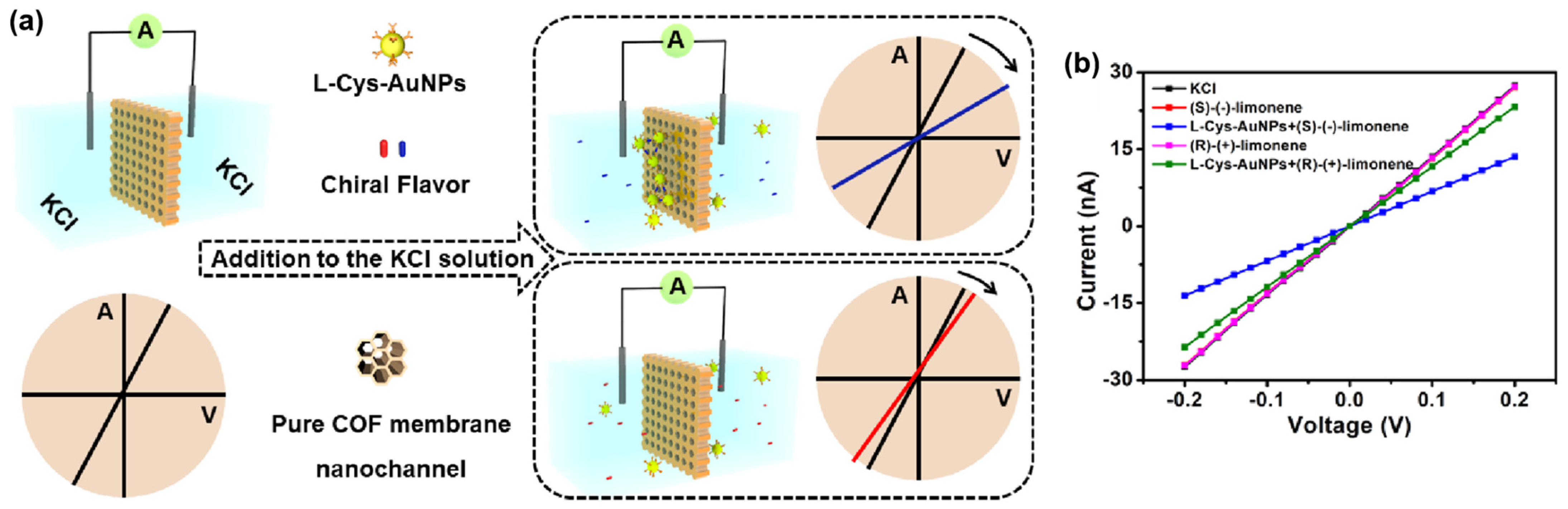
| L-Cys-AuNP/COF membrane | (S/R)-limonene and other flavor enantiomers | ΔIS/ΔIR = 50.5/14.9 (gating ratio, 7.3 × 10⁻⁶) | 7.3 × 10⁻¹⁰–7.3 × 10⁻⁶ | 2.6 × 10⁻¹⁰ | intra-/inter-assay RSD < 5% | [149] | |
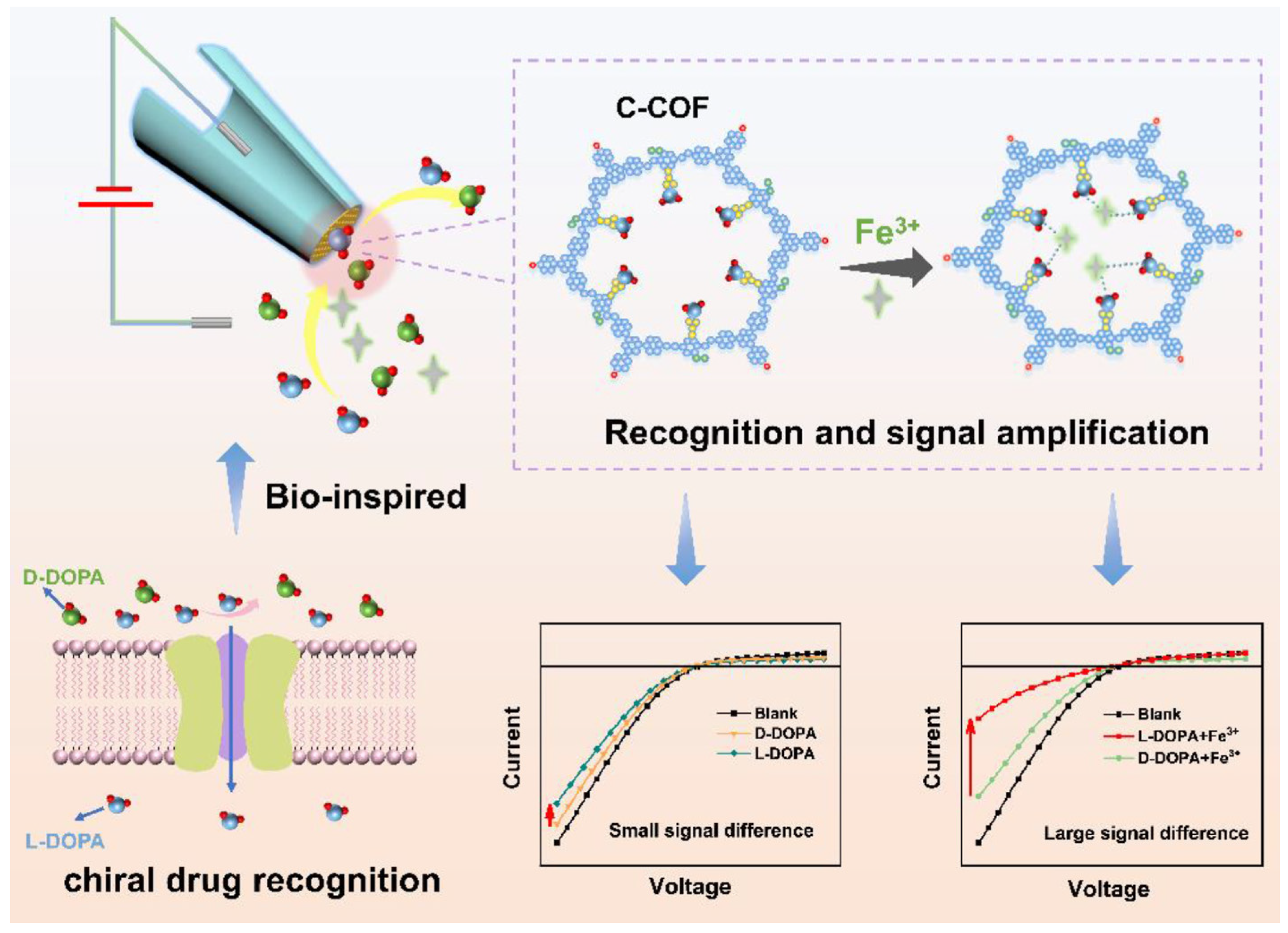
| CCNC nanopipette | L-/D-DOPA | (I0 − I)/I0 at −0.8 V (current-change ratio, 1.0 × 10⁻⁶) | 1.0 × 10⁻¹²–1.0 × 10⁻⁵ | 2.1 × 10⁻¹³ | reversible (2 h water rinse) | [122] | |
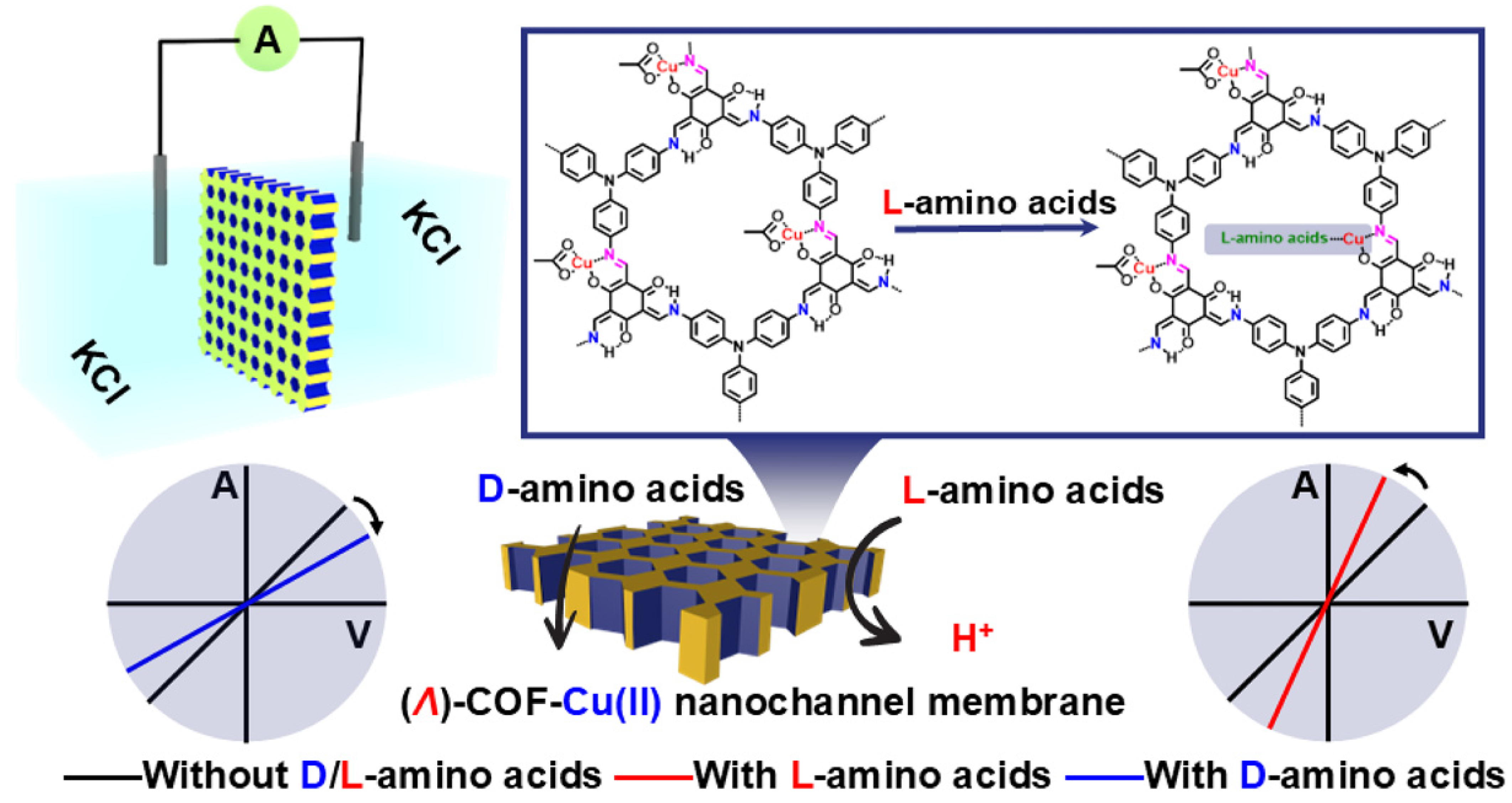
| (Λ)-COF-Cu(II) | L-/D-Cys and other reducing amino acids | (I − I0)/I0 = +20.5% (L-Cys)/−11.7% (D-Cys) (current-change rate, 8.3 × 10⁻⁶) | 8.3 × 10⁻¹¹–8.3 × 10⁻⁵ | 1.1 × 10⁻¹³ (L-Cys)/1.7 × 10−13 (D-Cys) | RSD < 2.3% (intra/inter, n = 6); stable over 5 days | [152] | |
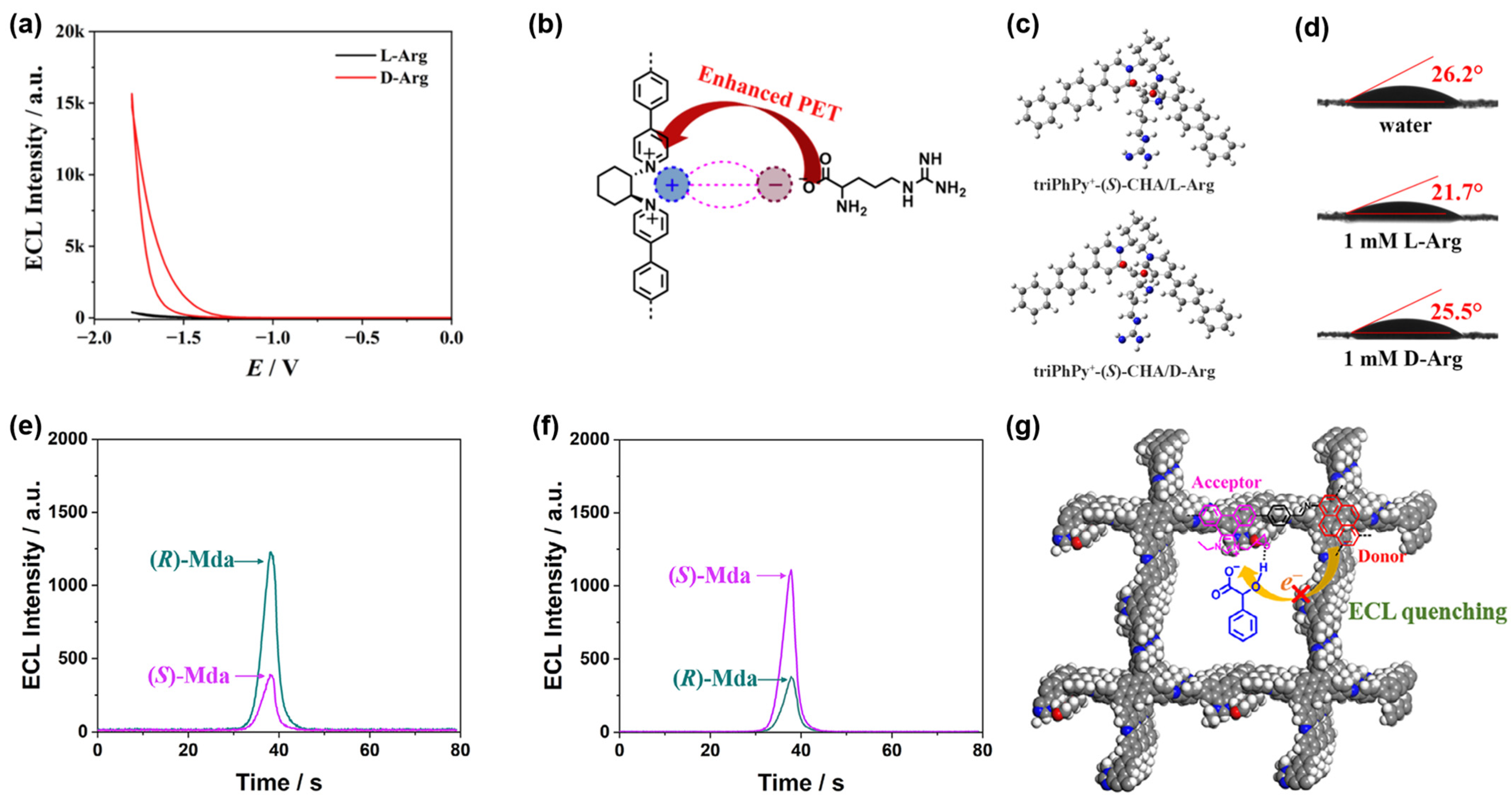
| triPyPh+-(S)-CHA | ECL | L-/D-Arg (also Leu, Lys, Ala) | ID/IL = 33.0 (Arg) and 2.4–2.6 (Leu/Lys/Ala) (ECL intensity ratio, 1.0 × 10⁻³) | 1.0 × 10⁻⁷–1.0 × 10⁻³ | n.r. | RSD 0.79% (10 scans in 180 s) | [65] |
| MPIm+-(S)-MO | (R)/(S)-MDA and other chiral acids/amino acids/alcohols | IR/IS = 1.6–13.1 (ECL intensity ratio, 1.0 × 10⁻³) | 1.0 × 10⁻⁷–1.0 × 10⁻³ | n.r. | RSD < 0.94% (10 scans); inter-/intra-batch < 2.7%; stable 2 months | [90] | |
| CC-MP CCTF | D-/L-Phe | ID/IL = 1.96 (ECL response ratio, 2.0 × 10⁻⁴–1.0 × 10⁻³) | 2.0 × 10⁻⁴–1.0 × 10⁻³ | 1.0 × 10⁻⁴ | n.r. | [81] | |
| (R)-PTCDA-RMP | D-/L-penicillamine (PA) | sign of ECL–C regression slope: D-PA +1780/L-PA −2731 a.u. mM−1 (5.0 × 10⁻⁵–1.0 × 10⁻³) | 5.0 × 10⁻⁵–1.0 × 10⁻³ | 9.74 × 10⁻⁶ (L-PA)/4.96 × 10−5 (D-PA) | n.r. | [82] | |
| Ph-triPy+-(R)-Ru(II) | Amino acids and amino alcohols | IL/ID = 1.30–1.94 (amino acids)/ID/IL = 1.25–1.38 (amino alcohols) (ECL intensity ratio, 1.0 × 10⁻³) | 1.0 × 10⁻⁴–2.0 × 10⁻² (L-Leu-OH) | n.r. | RSD 2.06% (600 s continuous scans) | [88] | |
| Ru(bpy)(S-CHDA)22+ | Amino acids (Trp, Leu, Met, Thr, His) | ECL intensity ratio up to 1.75 (5.0 × 10⁻⁴) | 5.0 × 10⁻⁴ (ee calibration) | n.r. | RSD 1.92% (600 s); 2.2% (3 electrodes); 3.4% (5 scans) | [89] | |
| β-CD/aminal-COF + RhB | L-/D-Phe | IL/ID = 8972/1022 (ECL intensity ratio, 5.0 × 10⁻⁶) | 5.0 × 10⁻⁸–1.0 × 10⁻⁴ | 4.5 × 10⁻⁸ | RSD 3.2% (n = 6); stable 2 weeks | [109] | |
| TriPyPh+-BiPy + Co(III) | Amino alcohols (Ala-OH, Val-OH, Leu-OH, Pro-OH, 2-amino-1-butanol) | IS/IR = 47.7 (Ala-OH) and 8.7 (Leu-OH) (ECL intensity ratio, 1.0 × 10⁻³) | 1.0 × 10⁻⁵–1.0 × 10⁻³ ((R)-Leu-OH) | n.r. | RSD 1.29% (10 consecutive scans) | [159] | |
| D-COF | PEC | D-/L-Cys | ΔID/ΔIL = 12.0 (photocurrent ratio, 1.0 × 10⁻⁴) | 1.0 × 10⁻⁹–1.0 × 10⁻³ | 1.3 × 10⁻¹⁰ | RSD 1.65% (PEC, 5 platforms) | [162] |
Disclaimer/Publisher’s Note: The statements, opinions and data contained in all publications are solely those of the individual author(s) and contributor(s) and not of MDPI and/or the editor(s). MDPI and/or the editor(s) disclaim responsibility for any injury to people or property resulting from any ideas, methods, instructions or products referred to in the content. |
© 2026 by the authors. Licensee MDPI, Basel, Switzerland. This article is an open access article distributed under the terms and conditions of the Creative Commons Attribution (CC BY) license.
Share and Cite
Wang, L.-K.; Zhu, J.-K.; Pei, X.-Y.; Chen, K.-D.; Wang, S.-H.; Zhu, D.-D.; Li, F.-G.; Meng, Z.-Z.; Lin, T.-Y.; Chen, X.-R.; et al. Chiral Covalent Organic Frameworks for Enantioselective Sensing: Electrochemical, Electrochemiluminescence, and Photoelectrochemical Platforms. Chemosensors 2026, 14, 208. https://doi.org/10.3390/chemosensors14090208
Wang L-K, Zhu J-K, Pei X-Y, Chen K-D, Wang S-H, Zhu D-D, Li F-G, Meng Z-Z, Lin T-Y, Chen X-R, et al. Chiral Covalent Organic Frameworks for Enantioselective Sensing: Electrochemical, Electrochemiluminescence, and Photoelectrochemical Platforms. Chemosensors. 2026; 14(9):208. https://doi.org/10.3390/chemosensors14090208
Chicago/Turabian StyleWang, Li-Ke, Jie-Kai Zhu, Xin-Yu Pei, Ke-Da Chen, Shao-Hui Wang, Dan-Dan Zhu, Feng-Geng Li, Zhen-Zhen Meng, Tong-Yu Lin, Xin-Ru Chen, and et al. 2026. "Chiral Covalent Organic Frameworks for Enantioselective Sensing: Electrochemical, Electrochemiluminescence, and Photoelectrochemical Platforms" Chemosensors 14, no. 9: 208. https://doi.org/10.3390/chemosensors14090208
APA StyleWang, L.-K., Zhu, J.-K., Pei, X.-Y., Chen, K.-D., Wang, S.-H., Zhu, D.-D., Li, F.-G., Meng, Z.-Z., Lin, T.-Y., Chen, X.-R., & Lan, Y.-B. (2026). Chiral Covalent Organic Frameworks for Enantioselective Sensing: Electrochemical, Electrochemiluminescence, and Photoelectrochemical Platforms. Chemosensors, 14(9), 208. https://doi.org/10.3390/chemosensors14090208