This is an early access version, the complete PDF, HTML, and XML versions will be available soon.
Article

Electronic Nose-Based Volatile Fingerprinting for Chronic Kidney Disease Stratification


1
National Research Council of Italy, Institute for Microelectronics and Microsystems (CNR-IMM), 73100 Lecce, Italy
2
Department of Experimental Medicine, University of Salento, 73100 Lecce, Italy
3
Department of Engineering for Innovation, University of Salento, 73100 Lecce, Italy
4
Department of Precision and Regenerative Medicine and Ionian Area (DiMePRe-J), University of Bari Aldo Moro, 70124 Bari, Italy
*
Authors to whom correspondence should be addressed.
Chemosensors 2026, 14(9), 206; https://doi.org/10.3390/chemosensors14090206

Submission received: 28 July 2026 / Revised: 3 September 2026 / Accepted: 14 September 2026 / Published: 16 September 2026

Abstract

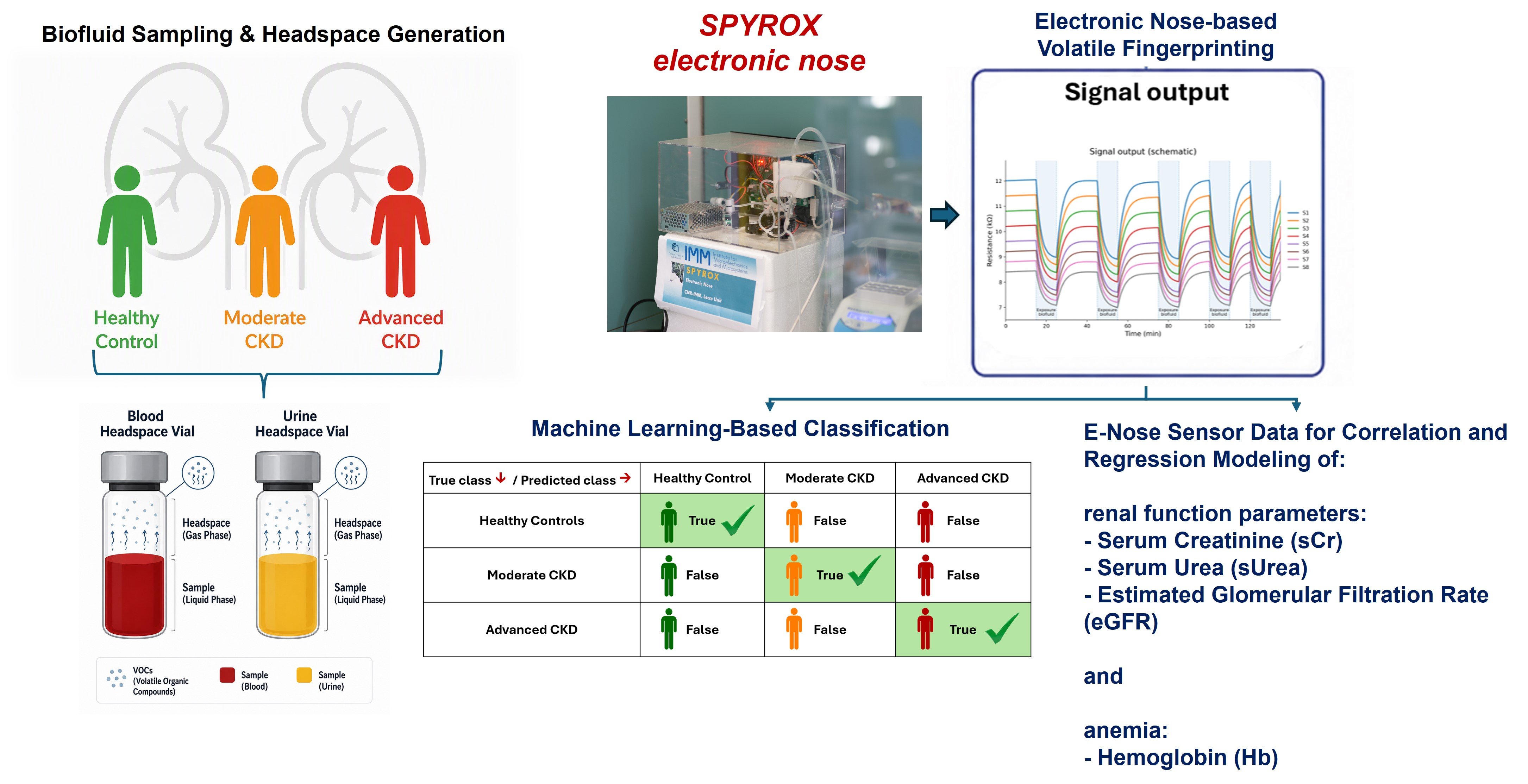
Chronic kidney disease (CKD) is associated with metabolic alterations that may affect the volatile organic compound (VOC) profiles of biological fluids. Electronic nose systems capture complex VOC patterns as characteristic sensor-response fingerprints rather than identifying individual VOCs, thereby providing a global representation of the underlying metabolic state and enabling disease assessment and stratification. In this pilot study, a prototype electronic nose (SPYROX) was applied to blood and urine samples collected from healthy individuals and patients with moderate or advanced CKD. Sensor responses were analyzed using partial least squares–discriminant analysis (PLS-DA) to assess the ability of the sensor array to discriminate different stages of renal impairment. PLS-DA models built from blood and urine sensor responses achieved cross-validated classification accuracy of 76.9% and 68.7%, respectively. Distinct sensor-response fingerprints associated with CKD status and severity were identified, while variable importance analysis highlighted the sensors contributing most strongly to class discrimination. Significant associations were observed between sensor responses and clinical parameters, including hemoglobin (Hb), serum creatinine (sCr), serum urea (sUrea), and estimated glomerular filtration rate (eGFR). Regression models achieved coefficients of determination ranging from 0.675 to 0.884, with the strongest prediction obtained for serum creatinine (R2 = 0.884, p = 0.003). These findings support the feasibility of electronic nose-based volatile fingerprinting as a rapid and minimally invasive approach for CKD stratification. Although limited by cohort size, this proof-of-concept study provides a foundation for future validation in larger and independent patient populations.
Keywords: electronic nose; chronic kidney disease; volatile fingerprinting; volatile organic compounds; sensor array; PLS-DA; disease stratification; biological fluids electronic nose; chronic kidney disease; volatile fingerprinting; volatile organic compounds; sensor array; PLS-DA; disease stratification; biological fluids
Graphical Abstract