1. Introduction
With the continuous expansion of industrial production, processing and circulation scale of agricultural products, potential food safety risks have become increasingly prominent, among which mycotoxin contamination has emerged as a critical factor affecting food safety [
1]. Aflatoxins (AFs), a class of secondary metabolites produced by fungi such as Aspergillus flavus and Aspergillus parasiticus, are widely present in grain and oil crops (e.g., corn, rice, peanut) and various processed foods [
2]. Among them, aflatoxin B1 (AFB1) possesses the strongest toxicity and highest carcinogenicity, which can accumulate in the human body through the food chain. Long-term intake of food containing residual AFB1 may cause digestive system disorders, neuronal damage, and interfere with the functions of the hematopoietic and immune systems, ultimately inducing malignant tumors such as liver cancer and gastric cancer [
3]. To ensure food safety, countries around the world have formulated strict limit standards for AFB1 residues in food. The European Union stipulates the maximum allowable level of AFB1 in food as 12 ppb for certain nuts, dried fruits, and spices (Commission Regulation EC 1881/2006), while China requires the AFB1 residue in food to be controlled within 20 ppb in corn, peanuts, and related oils (GB 2761 2017) [
4]. Therefore, the establishment of a rapid, sensitive, specific and convenient method for AFB1 detection is of great theoretical significance and practical application value for preventing food safety risks and safeguarding human health.
Currently, the main detection methods for AFB1 include High-Performance Liquid Chromatography (HPLC) [
5], electrochemical analysis [
6], Enzyme-Linked Immunosorbent Assay (ELISA) [
7], colorimetry and fluorometry [
8]. Thus, these methods may have some disadvantages, such as expensive instruments, complex operation, a long detection cycle, false positive results and the need for professional operators, making it difficult to meet the demand for on-site rapid detection [
9]. Fluorometry has become a research hotspot in the field of AFB1 detection due to its simple operation, fast detection speed, low cost, high sensitivity, and ease of miniaturization and on-site detection, but it also has the problem of poor anti-interference ability [
10].
Fluorescent Immunoassay (FIA) is an analytical method that combines the high specificity of immune recognition with the high sensitivity of fluorescence detection. It achieves selective recognition of the target analyte through the specific binding of antigen and antibody, and completes quantitative detection by the change in fluorescence signal from fluorescent labels [
11]. The performance of fluorescent labels directly affects the detection effect of FIA methods, common fluorescent labels include inorganic luminescent materials [
12], organic luminescent materials [
13] and fluorescent proteins [
14]. As a new type of inorganic fluorescent nanomaterial, Quantum Dots (QDs) have unique advantages such as a broad excitation spectrum, narrow emission spectrum, good photostability, high luminescence efficiency and tunable fluorescence emission wavelength [
15]. Compared with traditional organic fluorescent dyes, QDs have a longer fluorescence lifetime and stronger anti-photobleaching ability, making them ideal fluorescent labeling materials.
In addition, Fe
3O
4 magnetic microspheres, as a new type of functional nanomaterial, exhibit good magnetic responsiveness, large specific surface area, excellent biocompatibility and easy surface functionalization [
16]. They can realize rapid and efficient separation of target substances by an external magnetic field, effectively reducing the interference of the sample matrix and improving the sensitivity and selectivity of detection methods. Thus, Fe
3O
4 magnetic microspheres have been widely used in biomedicine, environmental monitoring and food detection [
17]. Some novel magnetic nanoparticles assist common detection methods such as QuEChERS-UHPLC-MS/MS and fluorescent nanosensors for the determination of mycotoxins in complex sample matrices. By virtue of their high enrichment capacity, they can shorten the pretreatment time by 10–50 times, significantly reduce matrix interference and improve the signal-to-noise ratio [
18].
Based on the above research background, green-emitting carbon quantum dots were conjugated with AFB1 monoclonal antibody to prepare GCDs@AFB1 mAb, and AFB1 oxime was grafted onto the surface of Fe3O4 magnetic microspheres to obtain AFB1-Ox@Fe3O4 NPs. Red fluorescent silver nanoclusters (R-AgNCs) were used as the fluorescent internal reference. After the immune competitive adsorption of GCDs@AFB1 mAb by AFB1-Ox@Fe3O4 NPs and free AFB1, magnetic separation was conducted. The residual GCDs@AFB1 mAb and R-AgNCs were used to construct a GCDs/R-AgNCs ratiometric fluorescent system for the detection of AFB1 content.
2. Materials and Methods
2.1. Synthesis of Silver Nanoclusters (AgNCs)
AgNCs were synthesized with minor modifications based on previously reported methods [
19]. The detailed procedures are as follows: 5 mL of ultrapure water was added to a clean beaker, followed by the addition of 125 μL of 20 mM AgNO
3 solution and 150 μL of 50 mM glutathione solution, which were mixed thoroughly with gentle stirring. The pH of the mixture was adjusted to 9.0 with 1 M NaOH solution. A total of 5 mg of L-lipoic acid was mixed with 10 μL of freshly prepared 0.6 M NaBH
4, the solution was pale yellow and turbid. Atter 30 min the pale-yellow turbid suspension turned transparent, which indicated that the L-lipoic acid was converted into dihydrolipoic acid. All the obtained dihydrolipoic acid solution was slowly added to the above AgNO
3-glutathione mixture, vigorously stirred for 1 min, and then 5 μL of NaBH
4 solution was added dropwise. The mixture was incubated at room temperature for 1.5 h. The reaction solution was placed in a dialysis bag and dialyzed against ultrapure water for 24 h to remove unreacted impurities, yielding a purified AgNCs solution. The purified AgNCs solution was stored in a refrigerator at 4 °C for subsequent use.
2.2. Preparation of AFB1 Monoclonal Antibody-Labeled Green-Emitting Carbon Quantum Dots (GCDs@AFB1 mAb)
AFB1 mAb was conjugated to the surface of GCDs via the EDC/NHSS method, and the residual carboxyl groups on the surface of the conjugate were covalently blocked with D-(+)-glucosamine. The detailed steps are as follows. A total of 1300 μL of boric acid buffer solution (pH = 5.0, I = 0.025 M) was added to a clean beaker, followed by 20 μL of GCDs solution, and shaken gently. A total of 6.94 μg of NHSS and 30.67 μg of EDC were added to the mixture successively, and the reaction was stirred at room temperature for 30 min to activate the carboxyl groups on the GCDs surface. A total of 40 μL of AFB1 mAb solution was added to the activated GCDs solution, and the conjugation reaction of GCDs with AFB1 mAb was completed by continuous stirring at room temperature for 15 min. A total of 200 μL of 2% (w/v) D-(+)-glucosamine solution was added and stirred for 1 h to block the residual carboxyl groups on the conjugate surface. The pH of the solution was adjusted to 4.5 with 1 M HCl or 1 M NaOH, followed by centrifugation (8000 r/min, 10 min), and the supernatant was discarded. The precipitate was redissolved with 500 μL of phosphate-buffered saline (PBS, 0.01 M, pH = 7.4) containing 20% glycerol to obtain the GCDs@AFB1 mAb conjugate solution, which was stored at 4 °C for later use.
2.3. Preparation of Aflatoxin B1 Oxime (AFB1-Ox)
A total of 1 mg of AFB1 and 2 mg of CMO were dissolved in 200 μL of pyridine, and the reaction was carried out with shaking at 30 °C in the dark for 8 h. After the reaction, the reaction solution was placed in a fume hood, and the solvent was blown dry with nitrogen. A total of 1 mL of ultrapure water was added to the residue to dissolve it thoroughly, and the pH of the solution was adjusted to 2.0 with 1 M HCl, at which point flocculent AFB1-Ox precipitate appeared. The mixture was centrifuged (10,000 r/min, 10 min) to collect the precipitate and supernatant. The precipitate and supernatant were repeatedly extracted with ethyl acetate three times until no AFB1-Ox was detected in the aqueous phase (verified by fluorescence detection). All organic phases were combined and dried in vacuo to obtain solid AFB1-Ox, which was stored at 4 °C for subsequent use.
2.4. Preparation of AFB1 Oxime-Immobilized Fe3O4 Magnetic Nanoparticles (AFB1-Ox@Fe3O4 NPs)
AFB1-Ox was conjugated to the surface of Fe3O4 magnetic microspheres via the DCC/NHS active ester method. The detailed procedures are as follows: The above-prepared solid AFB1-Ox was added to 300 μL of DMF and dissolved by ultrasonication. A total of 0.3 mg of NHS and 3 mg of DCC were added to the solution successively, and the reaction was carried out with shaking at 37 °C in the dark for 60 min. An equal amount of NHS and DCC were added again, and the activation of AFB1-Ox was completed by continuous shaking at 37 °C in the dark for another 60 min. After the reaction, the mixture was centrifuged (8000 r/min, 10 min), the precipitate was discarded, and the supernatant was retained. The supernatant was placed in a fume hood and dried with nitrogen at 55 °C to obtain activated AFB1-Ox. The activated AFB1-Ox was fully dissolved with 100 μL of DMF, and slowly added dropwise to 100 μL of Fe3O4 magnetic microsphere solution. The conjugation reaction of AFB1-Ox with Fe3O4 magnetic microspheres was performed with stirring at room temperature in the dark for 90 min. Magnetic separation was achieved with an external magnetic field, and the conjugate was washed repeatedly with DMF until no free AFB1-Ox was detected in the washing solution (verified by fluorescence detection). The washed AFB1-Ox@Fe3O4 NPs conjugate was collected and stored at 4 °C for later use.
2.5. Detection of AFB1 and Establishment of the Calibration Curve
The dosage of GCDs@AFB1 mAb was fixed, and the concentration of AFB1 was detected by the fluorescence intensity ratio based on the principle of specific antigen–antibody immune recognition. The detailed steps are as follows: A series of clean centrifuge tubes were taken, and 30 μL of GCDs@AFB1 mAb solution was added to each tube, followed by the addition of AFB1 methanol solutions with different concentrations (0, 20, 40, 80, 120, 160, 200, 240, 400, 600 pg/mL), and shaken gently. The reaction was carried out in a water bath at 40 °C for 1 h to allow sufficient binding of AFB1 to GCDs@AFB1 mAb. A total of 40 μL of AFB1-Ox@Fe3O4 NPs conjugate was added to each centrifuge tube, and the reaction was continued in a water bath at 40 °C for another 60 min to enable the specific binding of unbound GCDs@AFB1 mAb to AFB1-Ox@Fe3O4 NPs. The AFB1-Ox@Fe3O4 NPs-GCDs@AFB1 mAb complex was removed by magnetic separation with an external magnetic field, and the supernatant was retained. A total of 400 μL of AgNCs solution was added to the supernatant and shaken gently. The fluorescence spectrum of the supernatant was detected with a fluorescence spectrophotometer at an excitation wavelength of 365 nm with a scanning range of 450~750 nm. The fluorescence intensities at 530 nm (characteristic emission peak of GCDs) and 653 nm (characteristic emission peak of AgNCs) were recorded, and the fluorescence intensity ratio (I530/I653) was calculated. The calibration curve was plotted with the AFB1 concentration as the abscissa and the fluorescence intensity ratio (I530/I653) as the ordinate, the linear regression equation was established.
2.6. Optimization of Reaction Conditions
To improve the detection performance and repeatability of the sensor, the coupling reaction conditions of AFB1-Ox@Fe
3O
4 NPs with GCDs@AFB1 mAb were optimized by controlling reaction variables, with the reaction temperature and reaction time as the key parameters. Under the same experimental conditions, the reaction temperatures were set to 25, 30, 35, 40, 45 and 50 °C, respectively. The experiments were carried out according to the detection method in
Section 2.5, and the fluorescence intensity ratios (I
530/I
653) at different temperatures were determined. The optimal reaction temperature was identified with the fluorescence intensity ratio as the evaluation index. Under the same experimental conditions, the reaction times were set to 0, 20, 40, 60, 80 and 100 min, respectively. The experiments were performed according to the detection method in
Section 2.5, and the fluorescence intensity ratios (I
530/I
653) at different times were measured. The optimal reaction time was determined with the fluorescence intensity ratio as the evaluation index.
All subsequent experiments were carried out under the optimized reaction conditions.
2.7. Pretreatment and Detection of Real Samples
Commercially available rice and cow feed were selected as the real sample, and sample pretreatment was performed with reference to previously reported methods [
20]. Generally, 5.0 g of sample was crushed into a uniform powder with a grinder. The powder was placed in a 50 mL centrifuge tube, and 25 mL of an 80% methanol/20% deionized water was added, followed by vortex mixing for 2 min for extraction. The mixture was centrifuged at room temperature (4000 r/min, 2 min), and the supernatant was collected. The supernatant was diluted 16 times with PBS (0.01 M, pH = 7.4) to obtain the rice sample extract, which was stored at 4 °C for later use as actual detection matrices. Working solutions with low AFB
1 concentrations were prepared by a serial dilution of standard stock solution. An accurate volume of standard solution was added into solid samples, followed by vortex blending and standing for sufficient adsorption. The actual spiked concentration was calculated based on the added toxin mass and sample weight. This procedure ensures accurate and reliable spiking results even at trace levels.
3. Results and Discussion
3.1. Characterization and Verification of Conjugates
To verify the successful preparation of GCDs@AFB1 mAb and AFB1-Ox@Fe3O4 NPs conjugates, transmission electron microscopy (TEM) and Fourier transform infrared spectroscopy (FTIR) were used for their characterization. Meanwhile, the magnetic separation effect was verified by fluorescence spectroscopy, providing a theoretical basis for the construction of the sensor.
3.1.1. Transmission Electron Microscopy (TEM) Characterization
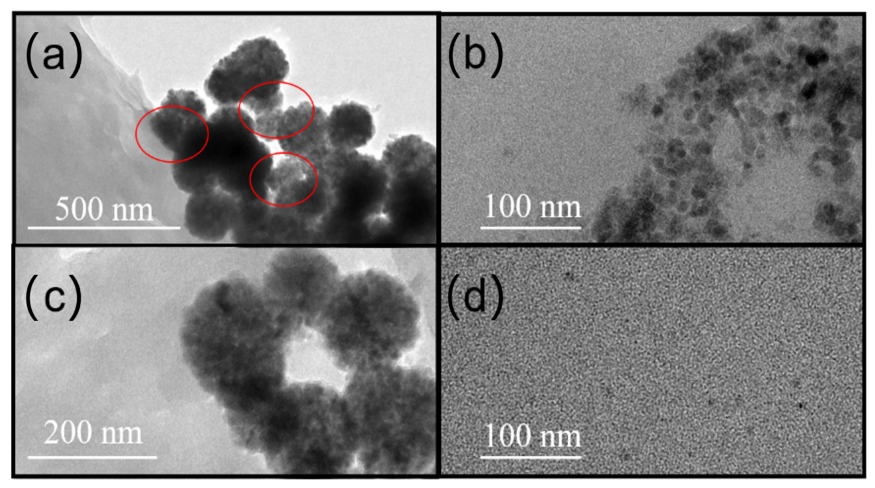
The TEM images of Fe
3O
4 NPs, AFB1-Ox@Fe
3O
4 NPs, GCDs and GCDs@AFB1 mAb were examined first. As shown in
Figure 1c, Fe
3O
4 magnetic microspheres were spherical with good dispersibility, uniform particle size, smooth surface and an average particle size of about 150 nm before conjugation with AFB1-Ox. In contrast, as shown in
Figure 1a, a thin coating layer was clearly observed on the surface of Fe
3O
4 magnetic microspheres after conjugation with AFB1-Ox. As shown in
Figure 1d, pure GCDs were uniform spherical nanoparticles with good dispersibility and a small particle size (about 10~20 nm). After conjugation with AFB1 mAb, the obtained GCDs@AFB1 mAb nanocomposites (
Figure 1b) exhibited a larger particle size than individual GCDs. This is because AFB1 mAb is a macromolecular protein, and its conjugation with the GCDs leads to a larger particle size, further confirming the successful conjugation of GCDs with AFB1 mAb. The above TEM characterization results indicate that both key conjugates were successfully prepared, laying a foundation for the construction of the sensor.
3.1.2. Fluorescence Verification of Magnetic Separation Effect
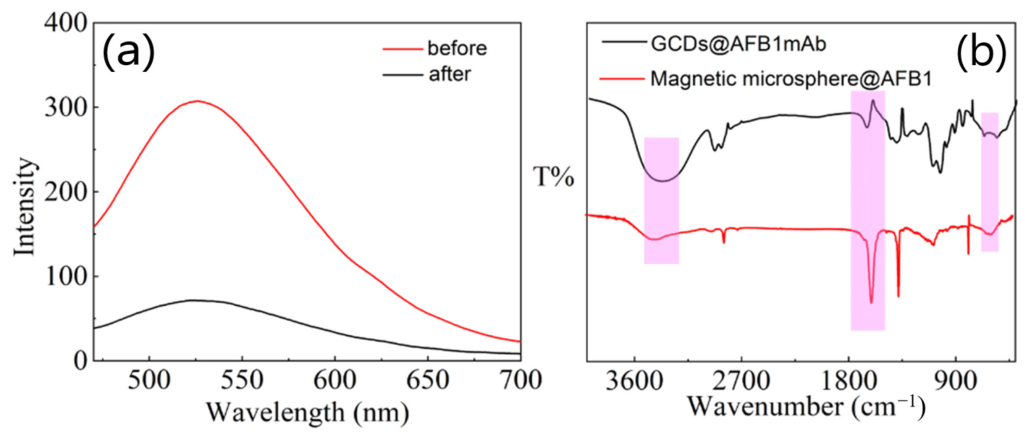
The fluorescence spectra of the mixture of GCDs@AFB1 mAb and AFB1-Ox@Fe3O4 NPs before and after magnetic separation were investigated. As can be seen from the spectrum, the solution exhibited a strong fluorescence intensity at 530 nm (characteristic emission peak of GCDs) before magnetic separation. This is because antibody-bound GCDs@AFB1 mAb and free unbound GCDs@AFB1 mAb coexisted in the solution, both of which exhibited photoluminescence. After magnetic separation, the fluorescence intensity of the solution at 530 nm decreased significantly. This is because GCDs@AFB1 mAb bound to AFB1-Ox@Fe3O4 NPs was successfully separated by an external magnetic field, and only a small amount of unbound GCDs@AFB1 mAb remained in the solution to produce photoluminescence, resulting in weak fluorescence. The results demonstrate that AFB1-Ox@Fe3O4 NPs possess excellent magnetic responsiveness and can rapidly capture antibody-bound GCDs@AFB1 mAb via magnetic separation. This strategy effectively eliminates background fluorescence interference and significantly improves detection sensitivity. Meanwhile, it further verified that specific binding could occur between the two conjugates, providing experimental support for the detection principle of the sensor.
3.1.3. Fourier Transform Infrared Spectroscopy (FTIR) Characterization
Figure 2b shows the FTIR spectra of GCDs@AFB1 mAb and AFB1-Ox@Fe
3O
4 NPs. It can be seen from the spectra that both conjugates exhibited an obvious characteristic absorption peak at around 1587 cm
−1, which corresponds to the stretching vibration of the amide bond (N–C=O). This result is consistent with the N–C=O stretching peak at 1577.21 cm
−1 reported in the previous literature [
21]. The amide bond absorption peak of GCDs@AFB1 mAb originated from the condensation reaction between the carboxyl groups on the GCDs surface and the amino groups in AFB1 mAb molecules, while the amide bond absorption peak of AFB1-Ox@Fe
3O
4 NPs was derived from the condensation reaction between the amino groups in AFB1-Ox molecules and the carboxyl groups on the Fe
3O
4 magnetic microsphere surface. In addition, the characteristic absorption peak of hydroxyl (-OH) at around 3400 cm
−1 in the spectrum of GCDs@AFB1 mAb was the characteristic absorption peak of GCDs, indicating the successful conjugation of GCDs with AFB1 mAb. The absorption peak at 580 cm
−1 in the spectrum of AFB1-Ox@Fe
3O
4 NPs was the characteristic absorption peak of Fe-O [
22], indicating the successful conjugation of Fe
3O
4 with AFB1-Ox. Combined with the above TEM characterization results, it was further confirmed that GCDs@AFB1 mAb and AFB1-Ox@Fe
3O
4 NPs conjugates were successfully prepared.
3.2. Sensing Mechanism for AFB1 Detection
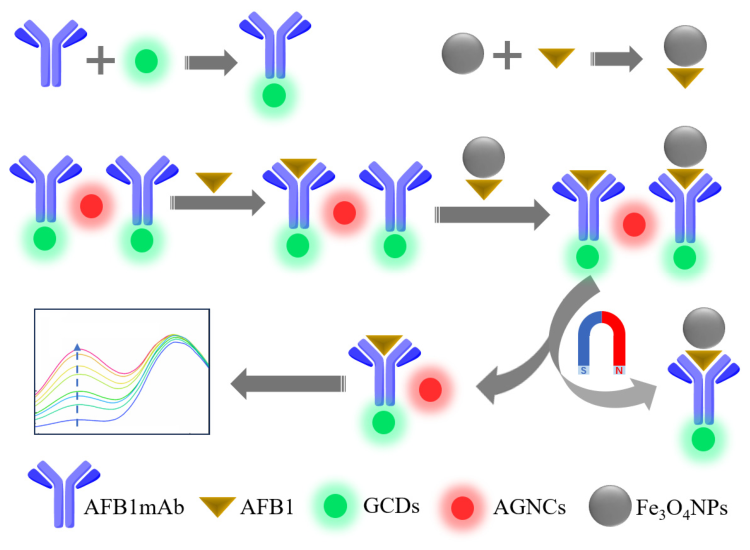
The magnetic immuno-ratiometric fluorescent sensor constructed in this study is based on the specific antigen–antibody immune recognition, magnetic separation technology and ratiometric fluorescence output signal, and the specific reaction process is shown in
Figure 3. Firstly, GCDs were conjugated with AFB1 mAb to prepare the fluorescent label GCDs@AFB1 mAb, in which AFB1 mAb could specifically recognize AFB1. Notably, the conjugation ratio is not strictly 1:1 and diverse binding configurations actually exist. Material proportion and experimental conditions were strictly controlled throughout the conjugation procedure to guarantee experimental repeatability. AFB1-Ox was conjugated with Fe
3O
4 NPs to prepare the capture probe AFB1-Ox@Fe
3O
4 NPs; AFB1-Ox has the same antigenic epitope as AFB1 and can specifically bind to AFB1 mAb. AgNCs were used as the internal reference fluorescent material, whose fluorescence signal is stable and unaffected by AFB1 concentration and reaction conditions, and is used to correct the systematic errors in the fluorescence detection process.
In the detection process, after adding AFB1 samples with different concentrations to the system, AFB1 specifically binds to GCDs@AFB1 mAb to form a GCDs@AFB1 mAb-AFB1 complex. Then AFB1-Ox@Fe
3O
4 NPs are added, and the unbound GCDs@AFB1 mAb specifically binds to AFB1-Ox@Fe
3O
4 NPs to form an AFB1-Ox@Fe
3O
4 NPs-GCDs@AFB1 mAb complex. The AFB1-Ox@Fe
3O
4 NPs-GCDs@AFB1 mAb complex can be rapidly removed by magnetic separation with an external magnetic field as shown in
Figure S3. Thus, the GCDs@AFB1 mAb-AFB1 complex remains in the solution, which forms a ratiometric fluorescent system with the AgNCs solution in the solution.
With the increase in AFB1 concentration, more GCDs@AFB1 mAb bound to AFB1 in the system. The active sites of antibodies are occupied by AFB1 and no longer bind to AFB1-Ox@Fe3O4, so more GCDs@AFB1 mAb remain in the solution after magnetic separation, and the fluorescence intensity of GCDs (I530) in the solution increases accordingly. As an internal reference, the fluorescence intensity of AgNCs (I653) remains stable at all times. Therefore, the fluorescence intensity ratio (I530/I653) is positively correlated with AFB1 concentration, and the quantitative detection of AFB1 can be realized by establishing the linear relationship between them. The advantages of this detection mechanism are as follows: first, the specific binding of antigen and antibody improves the selectivity of the sensor; second, the unbound fluorescent labels are rapidly removed by magnetic separation technology, reducing background interference and improving detection sensitivity; third, the ratiometric fluorescent system effectively overcomes the defects of single fluorescent labels that are susceptible to instrument errors, environmental factors and sample matrix interference, improving the accuracy and repeatability of the detection method.
3.3. Optimization of Reaction Conditions and Its Influence Analysis
Reaction temperature and reaction time are key factors affecting the antigen–antibody binding efficiency and the completeness of the coupling reaction, and directly affect the detection performance of the sensor. Therefore, the coupling reaction temperature and time of AFB1-Ox@Fe3O4 NPs with GCDs@AFB1 mAb were optimized in this study, and the optimal reaction conditions were determined with the fluorescence intensity ratio (I530/I653) as the evaluation index, providing a guarantee for the efficient detection of the sensor.
3.3.1. Optimization of Reaction Temperature
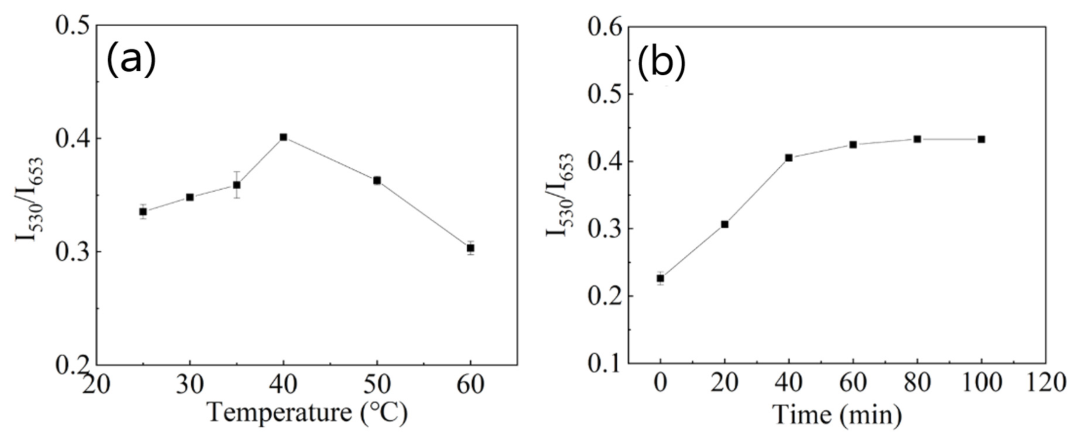
The variation curve of the fluorescence intensity ratio of the sensor at different reaction temperatures is shown in
Figure 4a. It can be seen from the figure that in the temperature range of 25~40 °C, the fluorescence intensity ratio gradually increases with the increase in reaction temperature. This is because the increase in temperature accelerates the antigen–antibody binding rate, promotes the sufficient binding of AFB1-Ox@Fe
3O
4 NPs to unbound GCDs@AFB1 mAb, resulting in an increase in the fluorescence intensity of GCDs in the solution after magnetic separation and a corresponding increase in the fluorescence intensity ratio. When the reaction temperature reaches 40 °C, the fluorescence intensity ratio reaches the maximum value, indicating that the antigen–antibody binding efficiency is the highest and the coupling reaction is the most complete at this temperature. When the reaction temperature exceeds 40 °C, the fluorescence intensity ratio gradually decreases with the further increase in temperature. This is because excessively high temperature causes changes in the spatial conformation of the antibody, destroys the specific binding sites of antigen and antibody, reduces antibody activity, and also affects the fluorescence stability of GCDs and AgNCs, leading to a decrease in fluorescence intensity. Therefore, considering the coupling reaction efficiency and the stability of fluorescent materials comprehensively, the optimal reaction temperature was determined to be 40 °C.
3.3.2. Optimization of Reaction Time
Figure 4b shows the variation curve of the fluorescence intensity ratio of the sensor at different reaction times. It can be seen from the figure that in the time range of 0~60 min, the fluorescence intensity ratio gradually increases with the extension of reaction time. This is because the extension of reaction time allows the sufficient reaction and more complete binding of AFB1-Ox@Fe
3O
4 NPs to unbound GCDs@AFB1 mAb, resulting in a gradual increase in the fluorescence intensity of GCDs in the solution after magnetic separation. When the reaction time reaches 40 min, the fluorescence intensity ratio almost reaches the maximum value, indicating that the coupling reaction has reached equilibrium and the antigen–antibody binding tends to be complete at this time. When the reaction time exceeds 60 min, the fluorescence intensity ratio remains basically unchanged. This is because the continuous extension of reaction time will not increase the amount of antigen–antibody binding after the reaction reaches equilibrium, and may affect the stability of the fluorescence signal. Therefore, to ensure the complete completion of the immune reaction, the optimal reaction time was determined to be 60 min.
3.4. Fluorescent Sensing Performance and Calibration Curve
Under the optimized reaction conditions (reaction temperature 40 °C, reaction time 60 min), the fluorescence response of the sensor to different concentrations of AFB1 was investigated, and the calibration curve was plotted to evaluate the linear range and LOD of the sensor, which are the core indicators for measuring the detection performance of the sensor.
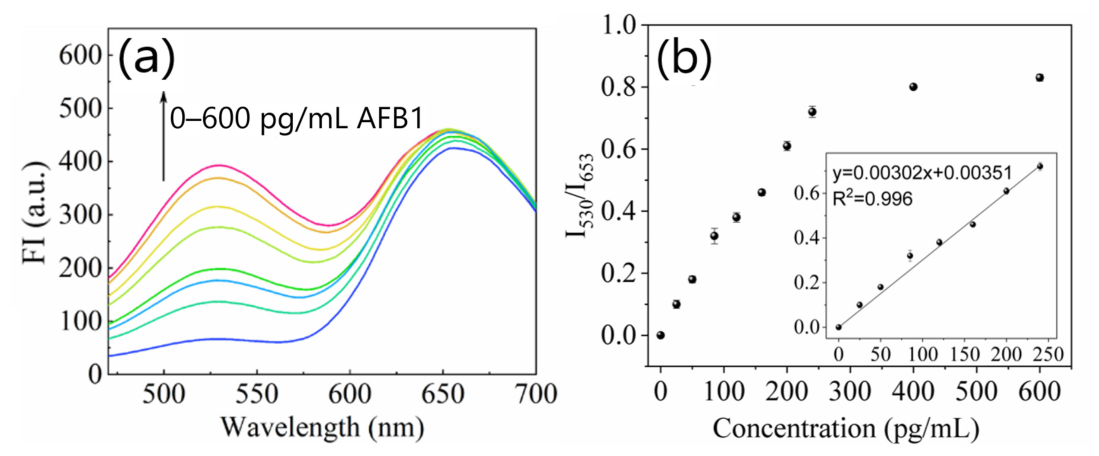
Figure 5a shows the fluorescence spectra of the sensor with different concentrations of AFB1. It can be seen from the figure that in the concentration range of 20~240 pg/mL, the fluorescence intensity of the solution at 530 nm gradually increases with the increase in AFB1 concentration, while the fluorescence intensity at 653 nm remains basically unchanged. The higher the AFB1 concentration, the more AFB1 molecules bind to GCDs@AFB1 mAb, and the fewer unbound GCDs@AFB1 mAb exist. After magnetic separation, more GCDs@AFB1 mAb-AFB1 complexes remain in the solution, resulting in a stronger fluorescence intensity of GCDs. As an internal reference, the fluorescence signal of AgNCs is not affected by the AFB1 concentration and remains stable at all times, which effectively corrects the systematic errors in the detection process.
Figure 5b shows the linear relationship between the AFB1 concentration and the fluorescence intensity ratio (I
530/I
653). Linear regression analysis was performed with the AFB1 concentration as the abscissa and the fluorescence intensity ratio as the ordinate, and the linear equation was obtained as y = 0.00302x + 0.00351 with a correlation coefficient R
2 = 0.996, indicating that the sensor has a good linear response to AFB1 in the range of 0~240 pg/mL with an excellent linear relationship. For comparison, the single-emission fluorescent detection system (
Figure S1) displays a linear response at a single emission wavelength toward AFB1 in a narrower linear range of 0~200 pg/mL, with the linear regression equation of
y = 0.699
x + 23.546 and correlation coefficient R
2 = 0.985. Benefiting from the self-reference effect of ratiometric fluorescence strategy, the dual-emission sensor exhibits distinctly higher linear correlation, stronger anti-interference ability against external environment fluctuations, instrument drift and background noise, as well as a wider linear detection range, compared with the traditional single-emission fluorescence detection mode. These superiorities endow the ratiometric sensor with more accurate quantitative detection performance for AFB1. According to the calculation based on the standard 3σ/slope criterion, the LOD of the sensor for AFB1 is 18 pg/mL, which is lower than the maximum allowable residual levels of AFB1 in food stipulated by China (20,000 pg/mL) and the European Union (12,000 pg/mL). All conjugation experiments were strictly controlled and performed in triplicate. Small SD (error bars) and nearly unchanged LOD verify good repeatability. This indicates that the sensor has high detection sensitivity and can meet the demand for trace detection of AFB1 residues in food.
3.5. Selectivity of the Sensor
Selectivity is one of the important indicators for evaluating the performance of the sensor, which directly determines the application value of the sensor in complex sample matrices. To investigate the specific recognition ability of the magnetic immuno-ratiometric fluorescent sensor constructed in this study for AFB1, five other common mycotoxins in food were selected as interfering substances, including zearalenone (ZEN), ochratoxin A (OTA), aflatoxin G1 (AFG1), fumonisin B1 (FB1) and citrinin (CIT). The effects of these interfering substances on the detection of AFB1 by the sensor were investigated.
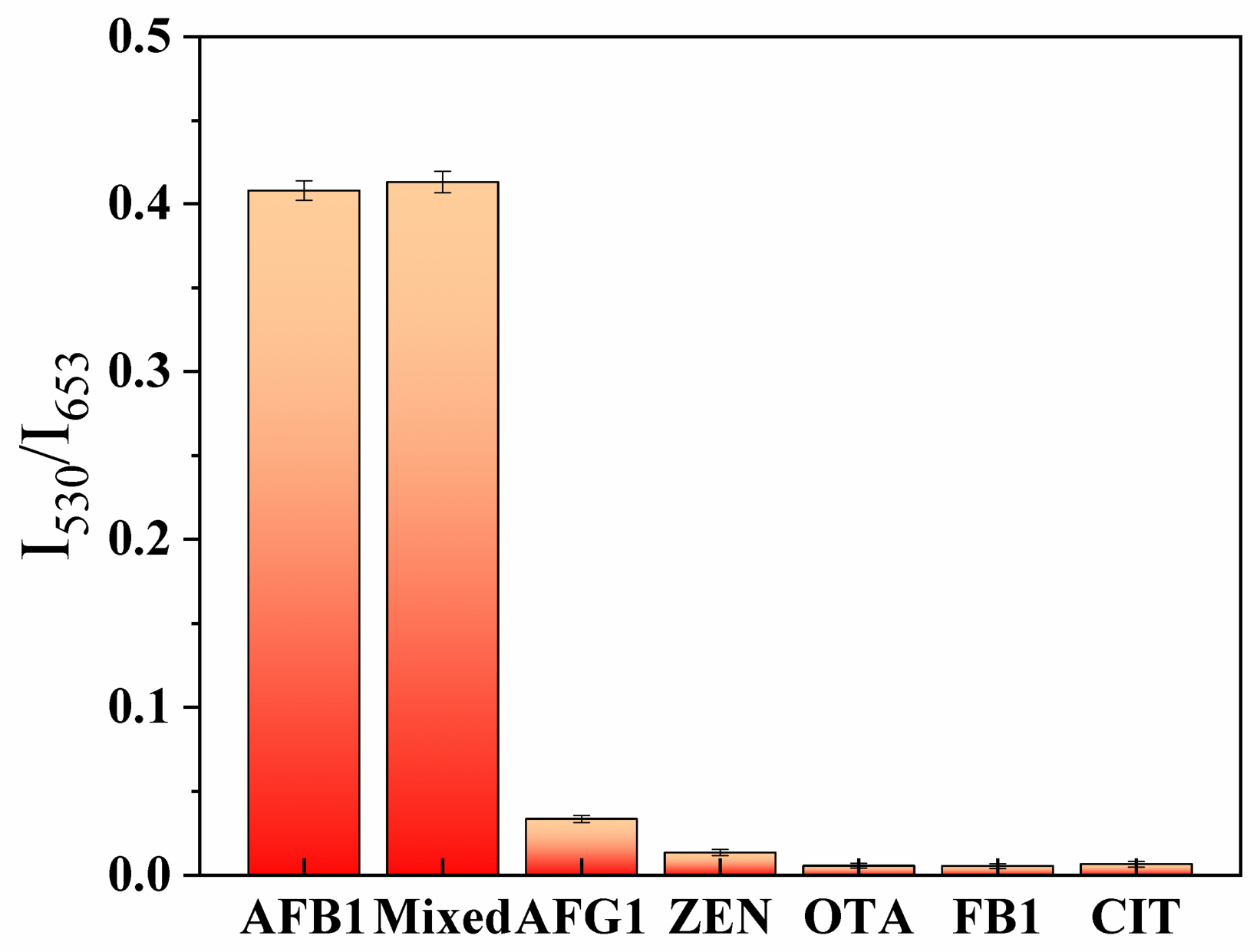
In the experiment, the concentrations of AFB1 and the above five interfering substances were all set to 200 pg/mL. The experiments were carried out according to the detection method in
Section 2.5, and the fluorescence intensity ratios I
530/I
653 of the sensor with different substances were determined, and the results are shown in
Figure 6. It can be seen that the fluorescence intensity ratio remains nearly consistent for AFB1 alone and the mixed sample, while it is significantly higher than when other interfering substances are added alone. When ZEN, OTA, AFG1, FB1, and CIT are added, the fluorescence intensity ratio has no significant difference from that of the blank control group, indicating that these interfering substances cannot specifically bind to GCDs@AFB1 mAb and will not cause obvious interference to the detection of AFB1.
The results indicate that the sensor constructed in this study has excellent selectivity. The main reasons are as follows: AFB1 mAb in GCDs@AFB1 mAb has high specificity and can specifically recognize the antigenic epitope of AFB1 without cross-reaction with other mycotoxins; meanwhile, magnetic separation technology can further remove the interfering substances in the sample matrix and reduce the influence caused by non-specific binding, thus ensuring the highly specific detection of AFB1 by the sensor and providing a guarantee for the accurate detection of AFB1 in complex food samples.
3.6. Detection of AFB1 in Real Samples and Method Reliability Analysis
To verify the feasibility and reliability of the sensor in the detection of real samples, commercially available rice and dairy cow feed were selected as real samples, and spiked recovery experiments were carried out by the standard addition method. Before spiking, blank rice and cow feed samples were preliminarily tested by commercial ELISA kits, and no AFB
1 was found. Subsequent measurement using our fluorescent probe also gave undetectable results. The spiked recoveries and RSD of the sensor were determined to evaluate the accuracy and repeatability of the sensor. After pretreatment, the rice and feed samples were spiked with AFB1 standard solutions at three concentration gradients (50, 100, 150 pg/mL), and each concentration was determined in triplicate. The detection results are shown in
Table 1.
It can be seen from
Table 1 that no obvious background AFB1 was detected in the pretreated rice and dairy cow feed samples, and the detection results of the two samples at the three spiked concentrations all showed good accuracy and repeatability. The spiked recoveries of the rice sample at the three concentrations (50, 100, 150 pg/mL) ranged from 93.94% to 108.68%, and the RSD ranged from 0.57% to 4.21%. The spiked recoveries of the cow feed sample at the three concentrations ranged from 92.14% to 110.02%, and the RSD ranged from 2.47% to 4.58%. The above spiked recovery and RSD results indicate that the sensor has good accuracy and repeatability, can effectively overcome the interference of two different matrix samples, accurately detect the actual spiked content of AFB1 in the samples, and has no obvious matrix effect on the detection results. Thus, it can meet the demand for rapid and accurate detection of AFB1 in actual food and feed samples.
To further highlight the advantages of the magnetic immuno-ratiometric fluorescent sensor constructed in this study, it was compared with the existing common AFB1 detection methods, and the specific comparison results are shown in
Table S1 [
23,
24,
25,
26,
27,
28,
29]. It can be seen that this method has a narrower linear range, and it is suitable for trace detection with lower LOD, simpler operation, no need for expensive instruments and lower detection cost. Also, this method adopts a ratiometric fluorescent system and magnetic separation technology, which effectively reduces background interference and has higher detection sensitivity and better selectivity. Furthermore, a comprehensive comparison with various commercially available AFB1 rapid detection products was also performed, as summarized in
Table S2. Compared with conventional commercial AFB1 detection kits and test strips, the developed sensor exhibits superior anti-interference capability and more reliable quantitative accuracy. In summary, this method provides a more suitable trace, rapid, and accurate detection of AFB1 in food, with significant advantages and potential practical application value.