Article

Pyranochromene/Nafion-Modified Glassy Carbon Electrode for Selective Electrochemical Determination of Cd(II): Synthesis, Interfacial Mechanism, and Water Analysis


by
Nada K. H. Alzahrani
1,
Naha Meslet Alsebaii
1,
Fatmah M. Alshareef
1,
Azhaar T. Alsaggaf
2,
Mohamed A. El Hamd
3,4,*,
A. Al Solami
5,
Najwa Ali Asiri
5,
Eman Alsolmy
5 and
Wejdan T. Alsaggaf
1,*
1
Department of Chemistry, Faculty of Science, King Abdulaziz University, P. O. Box 80203, Jeddah 21589, Saudi Arabia
2
Department of Chemistry, Faculty of Science, Taibah University, P. O. Box 285004, Medina 42353, Saudi Arabia
3
Department of Pharmaceutical Chemistry, College of Pharmacy, Shaqra University, Shaqra 11961, Saudi Arabia
4
Department of Pharmaceutical Analytical Chemistry, Faculty of Pharmacy, Qena University, Qena 83523, Egypt
5
Department of Chemistry, College of Science, University of Jeddah, P. O. Box 80237, Jeddah 21589, Saudi Arabia
*
Authors to whom correspondence should be addressed.
Chemosensors 2026, 14(6), 137; https://doi.org/10.3390/chemosensors14060137 (registering DOI)
Submission received: 2 May 2026 / Revised: 8 June 2026 / Accepted: 10 June 2026 / Published: 14 June 2026
(This article belongs to the Section Electrochemical Devices and Sensors)

Abstract

A pyranochromene-based ligand, 2-amino-4-(4-chlorophenyl)-5-oxo-4H,5H-pyrano[3,2-c]chromene-3-carbonitrile (ACLPh-PC-3-CN), was employed as a chelating modifier for the electrochemical determination of Cd(II) in water samples. ACLPh-PC-3-CN was co-immobilized with Nafion on a glassy carbon electrode to form a stable ACLPh-PC-3-CN/Nafion film that combines ligand-based coordination with cation-exchange-assisted preconcentration of Cd2+ at the electrode surface. The Cd(II) response at the modified electrode was characterized by cyclic voltammetry and differential pulse anodic stripping voltammetry, and the data support a predominantly 1:1 Cd(II)–ligand interaction at the interface under the selected conditions. At an optimized pH of 6.0, the sensor provided a linear calibration range from 16.21 to 56.72 μM, with a detection limit of 0.60 μM and a quantification limit of 2.0 μM, and showed good precision (repeatability 2.3% RSD, reproducibility 3.1% RSD) and short-term stability (94% of the initial response after 14 days). The ACLPh-PC-3-CN/Nafion-modified electrode tolerated common inorganic ions and surfactant species (≤5% signal change) and was successfully applied to the determination of Cd(II) in tap water and Red Sea water, affording recoveries between 98.7% and 101%. While the current detection limit is higher than typical guideline values for Cd in drinking water, the proposed sensor compares favorably with several reported electrochemical Cd(II) sensors in terms of simplicity, precision, and matrix tolerance, and represents a useful platform for coordination-based electrochemical sensing of cadmium in environmental water samples.

1. Introduction

Cadmium ions (Cd2+) are regarded as high-priority environmental pollutants because they persist in the environment, bioaccumulate in food chains, and exert toxicity on several organs, particularly the kidneys, lungs, and bones [1,2]. Emissions from industrial activities such as mining, electroplating, and battery manufacture introduce Cd2+ into natural waters, where it can promote oxidative stress, functional damage to tissues, and carcinogenic effects in exposed organisms [3,4,5,6]. To limit these risks, international regulations, such as the World Health Organization (WHO) guideline value of 3 μg L−1 (0.027 μmol L−1) [7] and the U.S. Environmental Protection Agency (EPA) maximum contaminant level of 5 μg L−1 (0.044 μmol L−1) [8] for Cd in drinking water, require analytical methods capable of monitoring very low concentrations.
Conventional instrumental approaches, atomic absorption spectroscopy (AAS) [9,10], atomic fluorescence spectroscopy (AFS) [11,12], X-ray fluorescence (XRF) [13,14], and inductively coupled plasma mass spectrometry (ICP-MS) [15],provide excellent figures of merit but rely on expensive instrumentation, multistep sample handling, and specialized operators, which complicates rapid or on-site measurements [6,16]. Electrochemical methods have emerged as attractive alternatives because they can be implemented in compact, low-cost devices and exploit the intrinsic redox behavior of Cd2+ for direct detection [17,18,19]. In particular, differential pulse anodic stripping voltammetry (DP-ASV) combines an efficient preconcentration step with sensitive stripping detection and has been widely applied for sub-ppb determination of Cd(II), Pb(II), Cu(II), and Zn(II) in environmental waters and other complex matrices [20,21,22,23,24].
The overall performance of electrochemical sensors for Cd2+ strongly depends on the properties of the working electrode. Bare electrodes may suffer from slow electron-transfer kinetics, surface fouling, and limited selectivity [25,26]. These limitations can be mitigated by modifying the electrode with chelating ligands containing nitrogen and oxygen donor atoms together with ion-exchange polymers such as Nafion, which enhance metal-ion preconcentration while improving mechanical stability and resistance to fouling [27,28,29]. Nafion is a perfluorosulfonated polymer consisting of a hydrophobic fluorocarbon backbone and pendant sulfonic acid groups, which are ionized under typical working conditions and behave as fixed anionic sites; in thin films on electrode surfaces, these sulfonate groups confer pronounced cation-exchange properties and assist in the preconcentration of metal cations. At the same time, it is worth noting that, despite its widespread use as an ion-exchange binder and protective film in electrochemical sensors and fuel-cell technology, Nafion is not inherently inert under all conditions, and prolonged exposure to strongly oxidizing environments, extreme pH, high temperature, or aggressive operating regimes can induce chemical and mechanical degradation, ultimately affecting its transport properties and durability [30].
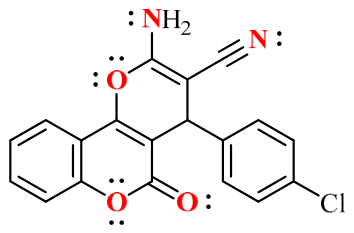
A variety of chelating agents have been incorporated into electrochemical sensors for Cd(II), including nitrogen- and oxygen-donor ligands, ion-imprinted polymers, and hybrid organic–inorganic films, which can improve preconcentration and selectivity but often rely on ill-defined adsorption sites or complex composite architectures. Against this background, pyrano[3,2-c]chromene derivatives are attractive candidates as surface-confined ligands because their rigid conjugated frameworks and multiple heteroatom donors can provide suitable coordination environments for Cd2+ and other borderline or soft metal ions; however, their use as electrochemical recognition elements specifically for Cd2+ has not been described. In designing the present sensor, 2-amino-4-(4-chlorophenyl)-5-oxo-4H,5H-pyrano[3,2-c]chromene-3-carbonitrile (ACLPh-PC-3-CN; Figure 1) was selected as a pyranochromene ligand that offers a single, well-defined tridentate N/O donor set attached to an extended aromatic system, providing specific coordination sites for Cd2+ together with a π-conjugated backbone that can support efficient interfacial charge transfer. This molecular architecture is expected to favor 1:1 metal–ligand binding, enhance Cd2+ accumulation at the interface, and promote a stable immobilized film when co-deposited with Nafion, allowing the electroanalytical performance to be directly related to the ligand structure rather than to non-specific adsorption.
In this work, ACLPh-PC-3-CN is co-immobilized with Nafion on a glassy carbon electrode to construct a Cd2+ chemosensor (Scheme 1). In the resulting interface, ACLPh-PC-3-CN provides a structurally defined coordination environment, while the Nafion film acts as a cation-exchange matrix that enhances mass transport and stabilizes the ligand on the electrode surface. Potential limitations associated with Nafion were mitigated by operating in mildly acidic to near-neutral aqueous media, using relatively short accumulation and measurement times, and employing a thin ACLPh-PC-3-CN/Nafion layer on a polished glassy carbon electrode. Under these conditions, the ACLPh-PC-3-CN/Nafion coating retained approximately 94% of its initial Cd2+ stripping signal after 14 days and afforded low RSD values for repeatability and reproducibility, indicating adequate stability for the intended analytical application in environmental water samples. The study focuses on the electrochemical characteristics, analytical performance, selectivity, and applicability of the ACLPh-PC-3-CN/Nafion-modified electrode for Cd2+ determination in tap water and Red Sea water.

2. Materials and Methods

2.1. Chemicals and Materials

All reagents were of analytical grade and were used as supplied. Ultrapure water produced by a Milli-Q system (resistivity 18.2 MΩ·cm) was employed for solution preparation and was stored in low-density polyethylene bottles. Glassware was washed with laboratory detergent, thoroughly rinsed with tap water, and finally rinsed several times with ultrapure water before use.
Cadmium nitrate [Cd(NO3)2] was purchased from BDH Chemicals Ltd., Poole, England. Sodium hydroxide (NaOH) was purchased from BDH Chemicals Ltd., Poole, England. Acetic acid (CH3COOH) and phosphoric acid (H3PO4) were purchased from NTL Nentech Ltd., Brixworth, U.K. Boric acid was purchased from Fluka AG, Buchs, Switzerland. Sodium acetate trihydrate (CH3COONa·3H2O) and ethanol were purchased from VWR BDH PROLABO CHEMICALS, Fontenay-sous-Bois, France. Nitric acid was purchased from CHEM-LAB (Zedelgem, Belgium). Acetone was purchased from Honeywell Research Chemicals, Seelze, Germany. 4-hydroxycoumarin was purchased from Fluka AG, Buchs, Switzerland. 4-chlorobenzaldehyde (98%) was purchased from ACROS Organics (Geel, Belgium). Malononitrile (98%) was purchased from Loba Chemie Pvt. Ltd., Mumbai, India. Nafion solution (5 wt%) was purchased from Sigma-Aldrich, St. Louis, MO, USA. Triton X-100 was purchased from BDH Chemicals Ltd., Poole, England.
A Cd(II) stock solution (5.8 × 10⁻³ mol L−1) was prepared by dissolving Cd(NO3)2 in water and stored in the dark. Working solutions (1.0 × 10⁻⁴ mol L−1) were freshly prepared by dilution on the day of use to minimize adsorption or contamination effects [31]. Britton–Robinson (B–R) buffer solutions in the pH range 2–9 were prepared from a mixed acid solution (0.04 mol L−1 each of acetic, phosphoric, and boric acids) and adjusted to the desired pH with 0.2 mol L−1 NaOH [31].
Acetate buffer (0.2 mol L−1, pH 4) and phosphate buffer (0.1 mol L−1, pH 4) were prepared according to standard procedures [32,33]. Solutions of potential interfering ions (Na+, K+, Mg2+, Ca2+, Mn2+, Co2+, Ni2+, Pb2+, Zn2+, Cu2+, Ag+, Cl, NO3, SO42−) were prepared from their corresponding nitrate or chloride salts.

2.2. Instrumentation

The 1H and 13C Nuclear Magnetic Resonance (NMR) measurements were carried out on a Bruker spectrometer operating at 500 MHz (Bruker, Billerica, MA, USA).
FT-IR spectra between 400 and 4000 cm−1 were recorded using a PerkinElmer Waltham, MA, USA (Spectrum 100) FT-IR spectrometer.
A Metrohm 757 VA tracer analyzer (software version 1.3.1) and a 747 VA stand (Basel, Switzerland) were used to perform cyclic voltammetry and differential pulsed anodic stripping voltammetry (DP-ASV) experiments. GCE electrodes (diameter = 2 mm) were used as working electrodes, Ag/AgCl di-junction (3.0 mol/L) KCl was used as reference electrodes, and a platinum wire (BAS model MW-1032) was used as a counter electrode in a three-chamber borosilicate Voltammetric electrochemical cell (Metrohm, Herisau, Switzerland) with a 10 mL capacity. After soaking in 10% v/v nitric acid, the electrochemical cell was cleaned with deionized water. Both the preparation of standard and test solutions and the transfer of sample solutions to the electrochemical cell were done using digital micropipettes with volume ranges of 0.5–10 µL and 10–1000 µL (Volac, Essex, UK). At room temperature, the electrochemical data were captured.
The pH of the buffer solutions was measured using an Adwa pH-meter (Adwa Instruments, Szeged, Romania).
Throughout the experiment, ultra-pure water from a Milli-Q Plus system (Millipore, Bedford, MA, USA) was utilized.
Data analysis and graph plotting were performed using Origin 2025 (OriginLab Corporation, Northampton, MA, USA) and Microsoft Excel 2021 (Microsoft Corporation, Redmond, WA, USA).

2.3. Synthesis of ACLPh-PC-3-CN

The ligand ACLPh-PC-3-CN was prepared via a base-catalyzed three-component condensation (Figure S1, Supplementary Information). 4-Chlorobenzaldehyde (0.32 g, 2.3 mmol), malononitrile (0.15 g, 2.3 mmol), and 4-hydroxycoumarin (0.37 g, 2.3 mmol) were dissolved in ethanol (15 mL) and heated under reflux in the presence of piperidine (three drops) as a catalyst until the reaction was complete, as monitored by thin-layer chromatography. After cooling to room temperature, the precipitated solid was collected by filtration, washed with ethanol (20 mL), and purified by stirring in ethanol for an additional 4 h. The product was then filtered and dried under vacuum to give a pale-yellow solid in 78% yield. The structure of ACLPh-PC-3-CN was confirmed by FT-IR and NMR spectroscopy (Section 3.1).

2.4. Electrode Preparation

The glassy carbon working electrode was first polished with 0.05 μm alumina slurry on a polishing pad, rinsed with water, and then sonicated sequentially in 1% (v/v) HNO3 and ethanol for 1 min each. The electrode was finally rinsed with water and dried under a gentle nitrogen stream.
The GCE was polished with 0.05 μm alumina slurry, sonicated in 1% (v/v) HNO3 and ethanol for 1 min each, and rinsed with deionized water. For modification, 10.0 μL of a 2.0 mg mL−1 ACLPh-PC-3-CN solution in acetone was drop-cast onto the cleaned GCE surface using a calibrated 10 μL micropipette and allowed to dry in air for 3 min. Subsequently, 5.0 μL of a 1% (v/v) Nafion solution in ethanol was applied, and the electrode was dried in air for 10 min at room temperature to obtain a uniform ACLPh-PC-3-CN/Nafion film (Figure S2, Supplementary Information). A schematic diagram of the electrochemical cell and electrode configuration used in this study is provided in Figure S3, Supporting Information.

2.5. Electrochemical Measurements

For DP-ASV, solutions were purged with high-purity nitrogen for 15 min prior to the first measurement while being stirred at 600 rpm and were kept under a nitrogen blanket during the experiments. Cd2+ was preconcentrated at the ACLPh-PC-3-CN/Nafion-modified GCE by applying a deposition potential of −1.35 V vs. Ag/AgCl for 210 s while stirring (600 rpm). After deposition, stirring was stopped, and a 5 s equilibration period was allowed before recording the stripping scan. Differential pulse anodic stripping voltammograms were then recorded from −1.50 to −0.50 V using a step potential of 5 mV, pulse amplitude of 70 mV, and pulse time of 50 ms and a step potential of 5 mV. Cyclic voltammetry was performed in B–R buffer at pH 6 containing 0.10 mmol L−1 Cd(II). The potential was cycled between −1.0 and 1.0 V at a scan rate of 50 mV s−1.
The wider potential window used in cyclic voltammetry (−1.0 to +1.0 V) was chosen to examine the general redox behavior of Cd(II) at the modified electrode without applying very negative potentials, whereas the more negative deposition potential employed in DP-ASV (−1.35 V vs. Ag/AgCl) was selected specifically to ensure efficient preconcentration of Cd(II) as metallic Cd prior to the anodic stripping step.
All electrochemical measurements were carried out at (25 ± 2) °C, at least in triplicate, and the relative standard deviation (RSD) of the peak current was used to assess precision.

2.6. Selectivity Studies

The effect of potentially interfering species on the Cd(II) response was evaluated by adding excess concentrations of common cations and anions to solutions containing 4.8 μmol L−1 Cd(II). Interfering ions included Na+, K+, Mg2+, Ca2+, Mn2+, Co2+, Ni2+, Pb2+, Zn2+, Cu2+, Ag+, Cl, NO3, and SO42−, typically at up to 100-fold molar excess relative to Cd(II). The tolerance limit was defined as the interferent concentration that caused less than ±5% change in the Cd(II) anodic peak current.

2.7. Real Sample Analysis

Tap water samples were collected from the chemistry laboratories at King Abdulaziz University (Jeddah, Saudi Arabia), and Red Sea water samples were obtained from the coastal area of North Jeddah. Samples were filtered through 0.45 μm membrane filters to remove suspended particles and prevent fouling of the electrode surface. However, with the filtration process and under mildly acidic to neutral conditions used (B–R buffer, pH 6), cadmium is present predominantly as dissolved Cd(II), and it does not significantly adsorb onto or precipitate on the 0.45 μm membrane; therefore, loss of Cd(II) during filtration is expected to be negligible.
For analysis, 1.5 mL of the sample was transferred to the electrochemical cell and mixed with B–R buffer (pH 6) to the required volume. Cd(II) was quantified by the standard addition method over the range 0–20 μmol L−1, and recoveries were calculated from the slopes of the standard addition plots based on the measured peak currents.

3. Results

3.1. Ligand Characterization

FT-IR spectroscopy. The FT-IR spectrum of ACLPh-PC-3-CN (Figure S4: Supplementary Information) shows a band at 2200 cm−1 assigned to C≡N stretching, strong bands at 1712 and 1671 cm−1 attributed to carbonyl (C=O) vibrations, and two bands at 3364 and 3193 cm−1 corresponding to N–H stretching of the NH2 group.
Additional bands are observed at 764 cm−1 (C–Cl stretching), 1375 cm−1 (C–H bending), and in the 1170–1054 cm−1 region (C–O and C–O–C stretching), in agreement with the expected functional groups of the pyranochromene ligand reported for related structures [34].
NMR spectroscopy. In the 1H NMR spectrum of ACLPh-PC-3-CN (DMSO-d6, 600 MHz; Figure S5A, Supplementary Information), signals appear at δ 8.50 (singlet, H-10), 7.93–7.31 (multiplets, aromatic and heterocyclic protons), and 4.48 ppm (singlet, CH). The 13C NMR spectrum (150 MHz; Figure S5B, Supplementary Information) contains resonances in the regions expected for aromatic, heterocyclic, carbonyl, and nitrile carbons. These data confirm the formation of ACLPh-PC-3-CN with the anticipated structure and are consistent with NMR data reported for related pyranochromene derivatives [35,36].

3.2. Electrochemical Response of Cd(II)

3.2.1. Bare and Modified Electrodes

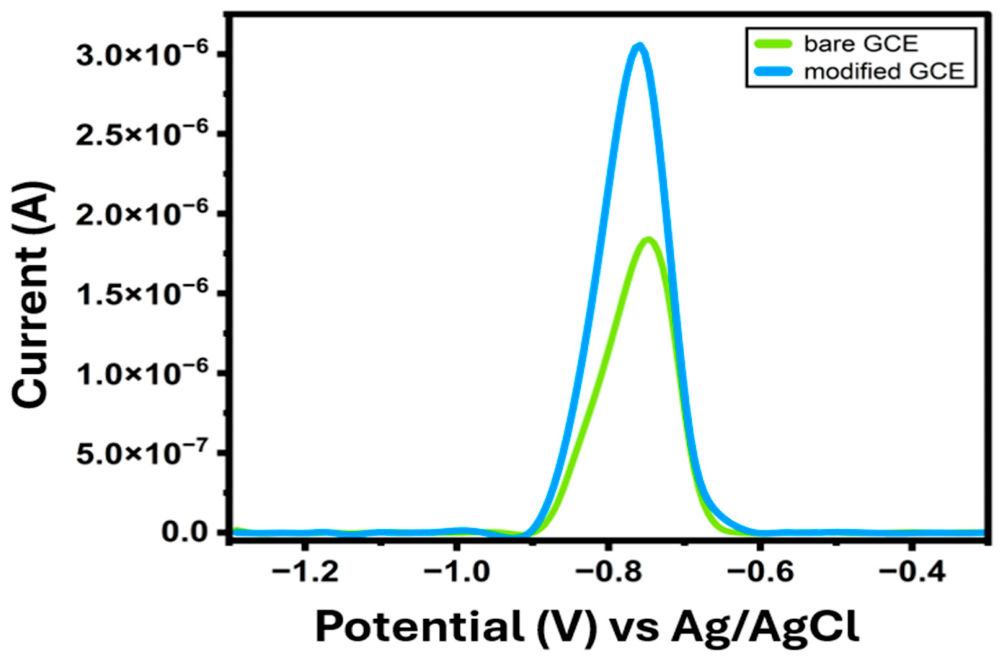
Differential pulse anodic stripping voltammograms recorded in B–R buffer (pH 4) containing 4.8 μmol L−1 Cd(II) are shown in Figure 2. At the bare GCE, a relatively small stripping peak is observed at approximately −0.75 V vs. Ag/AgCl. When the ACLPh-PC-3-CN/Nafion-modified GCE is used under the same conditions, the peak current increases by about a factor of four.

3.2.2. Cyclic Voltammetry

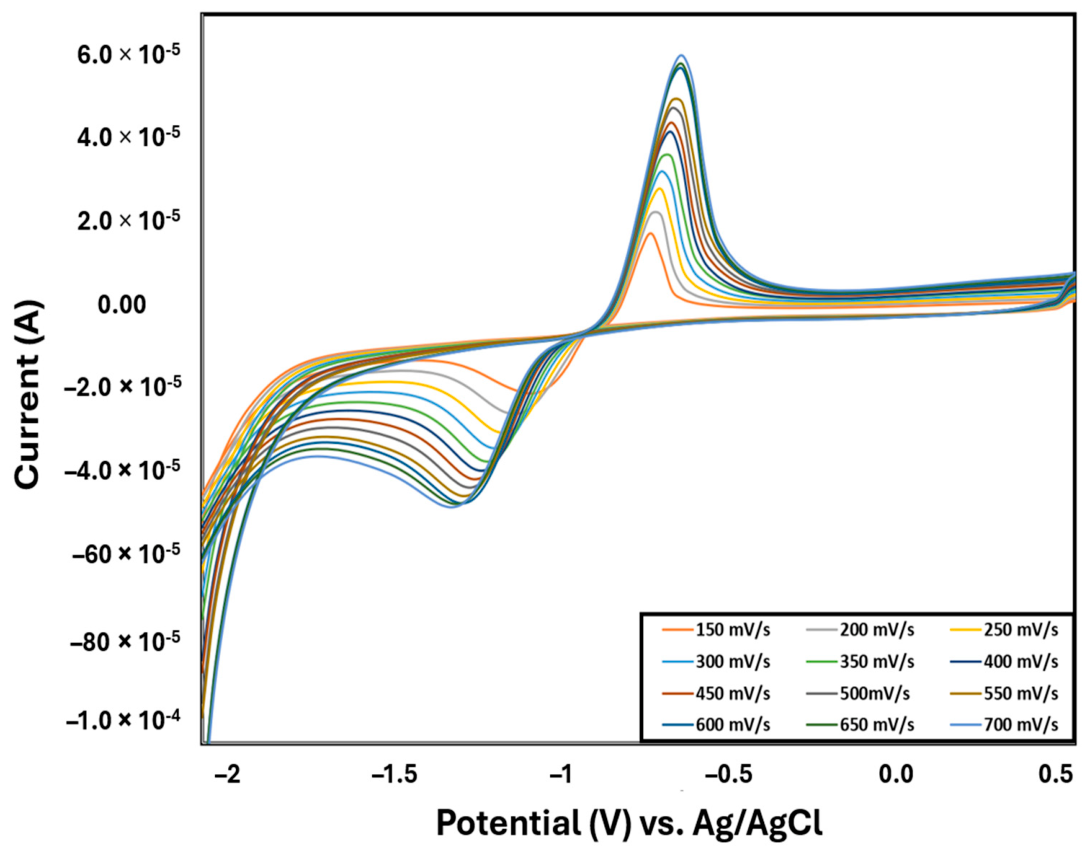
Figure 3 shows cyclic voltammograms of 0.10 mmol L−1 Cd(II) recorded at the ACLPh-PC-3-CN/Nafion-modified GCE in B–R buffer (pH 6) at scan rates between 150 and 700 mV s−1. An anodic peak is observed in the potential range −0.713 to −0.624 V vs. Ag/AgCl, with only a small cathodic signal on the reverse scan. As the scan rate increases, the anodic peak current increases and the peak potential shifts slightly in a positive direction.

3.3. Scan Rate Dependence

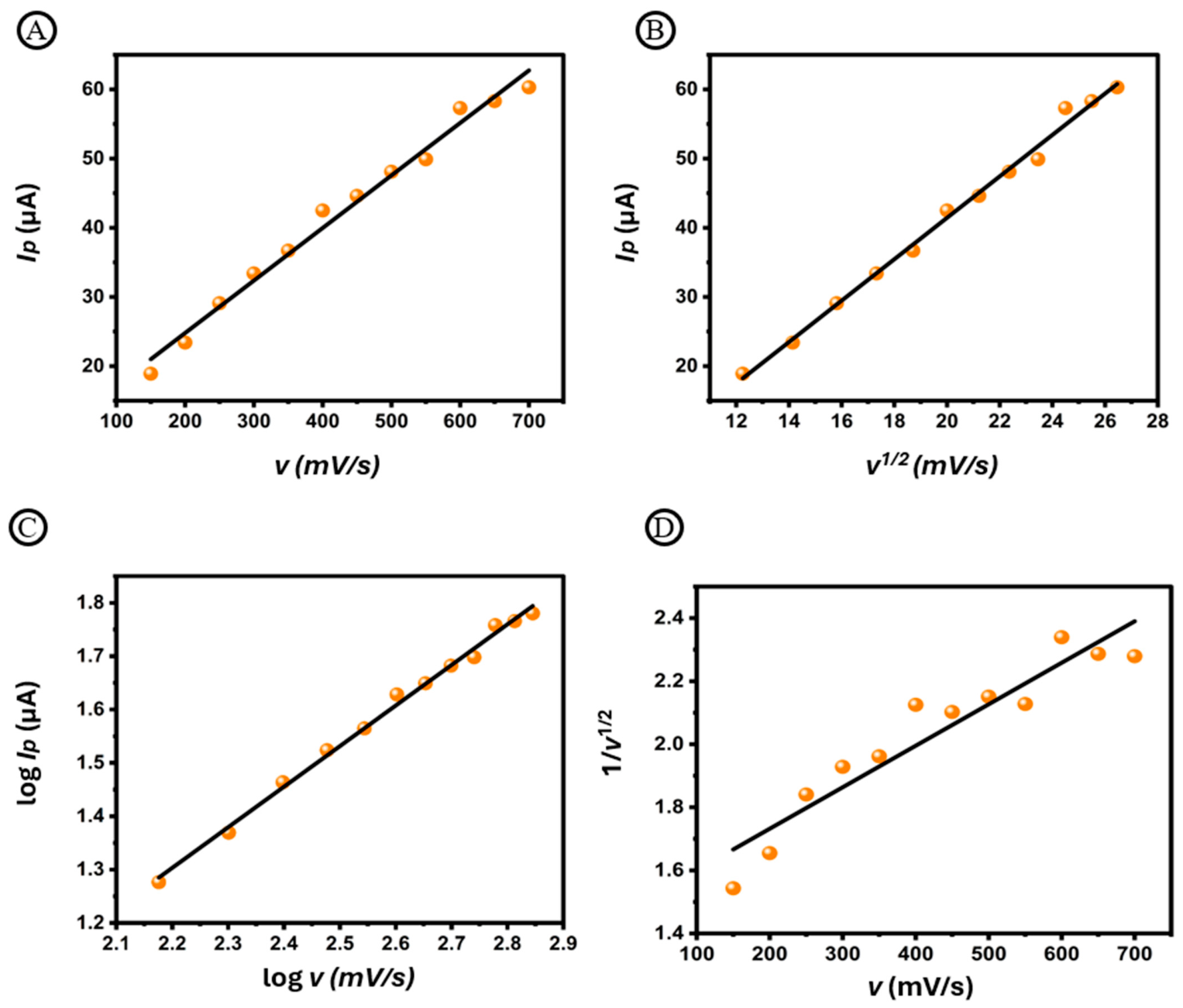
The effect of scan rate on the anodic peak current was examined in B–R buffer (pH 6). The plot of peak current (I, μA) versus scan rate (v, mV s−1) is linear, described by:
I ( μ A ) = 0.0759 v + 9.6077 ( R 2 = 0.9864 )
(Figure 4A). From these data, the surface coverage (Γ) of electroactive Cd species at the electrode was calculated as 1.82 × 10⁻¹⁰ mol cm−2 using the appropriate equation.
When the peak current is plotted against the square root of scan rate (v1/2), a second linear relationship is obtained:
I ( μ A ) = 2.9941 v 1 / 2 18.432 ( R 2 = 0.9939 )
(Figure 4B). The log–log plot of peak current versus scan rate follows:
l o g i p = 0.7607 l o g v 0.3702 ( R 2 = 0.9950 )
(Figure 4C). The variation of ip/√v with scan rate is shown in Figure 4D.
However, the scan-rate analysis was carried out directly with Cd(II) at the ACLPh-PC-3-CN/Nafion-modified electrode to probe the response of the preconcentrated Cd species; no separate determination of the electrochemically active surface area using an external redox probe was performed, as the focus of this study is on the Cd(II) accumulation and stripping behavior at a fixed modified surface.

3.4. Optimization of Operational Parameters

The influence of supporting electrolyte, pH, Nafion volume, deposition potential, deposition time, and pulse amplitude on the stripping response was investigated (Figures S6–S11, Supplementary Information). B–R buffer at pH 6 produced the highest Cd(II) peak current and was selected as the optimal medium. A Nafion volume of 2 μL on the electrode surface gave a maximum signal.
The deposition potential and deposition time were optimized at −1.35 V vs. Ag/AgCl and 210 s, respectively, and a pulse amplitude of 70 mV provided the best signal quality under the chosen conditions. The deposition potential was varied in the range −0.8 to −1.6 V vs. Ag/AgCl (Figure S7A,B, Supplementary Information), and −1.35 V was selected because it provided the maximum and most stable Cd(II) stripping peak current without visible film degradation.

3.5. Analytical Characteristics

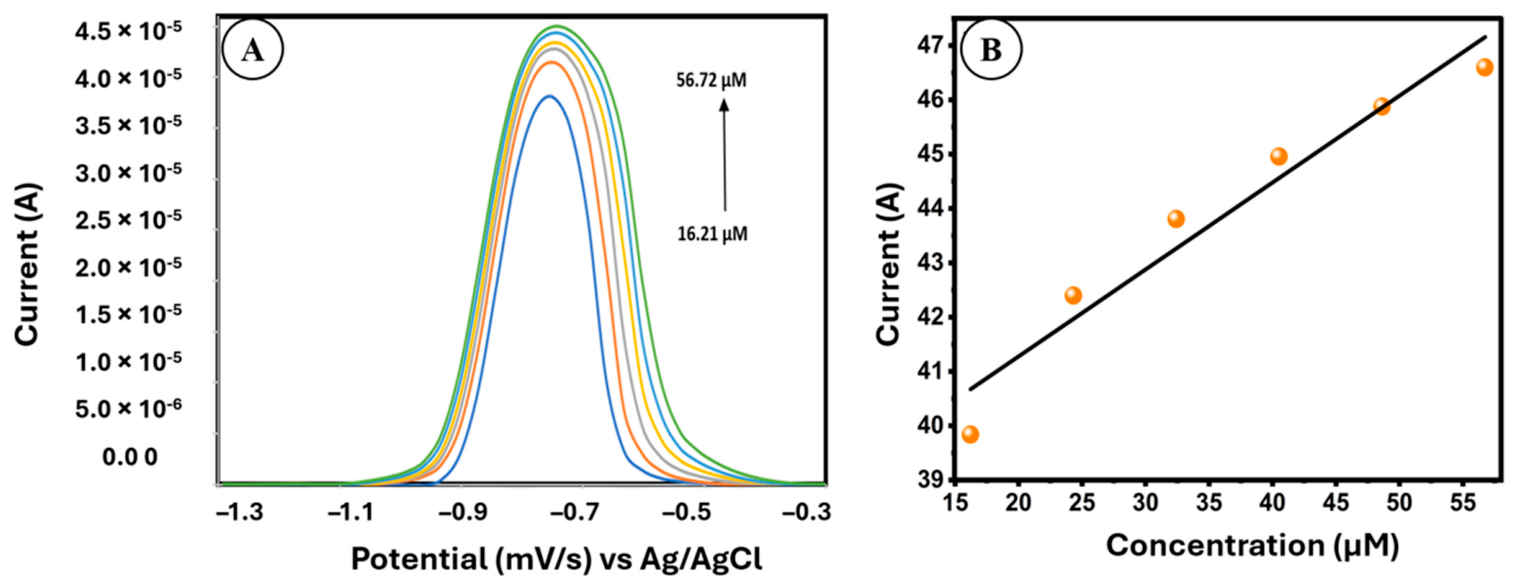
Under the optimized DP-ASV conditions (B–R buffer at pH 6, deposition potential −1.35 V, deposition time 210 s, pulse amplitude 70 mV), the ACLPh-PC-3-CN/Nafion-modified GCE exhibited a linear response toward Cd(II) over the concentration range 16.21–56.72 μmol L−1. Each calibration point was obtained from three independent measurements (n = 3), and the mean peak-current values were used to construct the calibration plot (Figure 5A,B). Within the concentration range 16.21–56.72 μmol L−1, the I–C plot in Figure 5B follows a linear trend, and no systematic curvature was observed in the calibration data. The resulting regression equation was:
I ( μ A ) = 0.16 C + 38.08 ( R 2 = 0.9720 )
where C is the Cd(II) concentration in μmol L−1. The limit of detection (LOD) and limit of quantification (LOQ), calculated as 3 σ/m and 10 σ/m, respectively (σ = standard deviation of the blank, m = slope), were 0.60 and 2.0 μmol L−1, confirming that the modified electrode provides adequate sensitivity for Cd(II) determination in the studied range.
The main analytical performance parameters of the ACLPh-PC-3-CN/Nafion-modified GCE are summarized in Table 1. The precision of the method was evaluated in terms of repeatability and reproducibility. For repeatability, the anodic peak current at a fixed Cd(II) concentration was measured seven times using the same modified electrode in a single day, yielding a relative standard deviation (RSD) of 2.3%. For reproducibility, five independently prepared ACLPh-PC-3-CN/Nafion-modified electrodes were tested under identical conditions, giving an RSD of 3.1%. The long-term stability of the sensing layer was assessed by recording the Cd(II) stripping signal over a 14-day storage period; approximately 94% of the initial peak current was retained, indicating that the film remains functional over at least two weeks. These results indicate that the ACLPh-PC-3-CN/Nafion film exhibits adequate stability under the experimental conditions and time frame considered in this work and is therefore suitable for the intended analytical application.
To further assess the analytical applicability of the proposed sensor, Cd(II) was determined in tap water and Red Sea water by the standard addition method. For each sample and addition level, three replicate measurements were performed (n = 3), and the “found” concentrations and recoveries were expressed as mean ± standard deviation (Table 2). The RSD values (≤3.1%) confirm that the method provides consistent results in real matrices, while the recoveries in the range 98.7–101% indicate satisfactory accuracy for Cd(II) determination in the tested water samples. Although no parallel measurements with ICP-MS, ICP-OES, or AAS were carried out in this study, the good agreement between added and found concentrations in two different water matrices supports the reliability of the proposed electrochemical method within its working range.
A summary of detection limits reported for selected electrochemical methods for Cd(II) determination is provided in Table 2, including classical carbon-paste and Nafion-modified electrodes as well as more recent nanostructured and composite sensing platforms. This expanded comparison shows that several advanced nanomaterial-based sensors reach much lower detection limits (down to the low-nanomolar range), whereas the LOD of the present ACLPh-PC-3-CN/Nafion/GCE (0.60 μM) is higher but still comparable to, or better than, many ligand-based and polymer-modified electrodes reported for Cd(II) analysis.

3.6. Selectivity and Real Sample Measurements

The effect of coexisting ions on the Cd(II) peak current was examined by adding potential interferents to solutions containing 4.8 μmol L−1 Cd(II). At up to 100-fold excess of Na+, K+, Mg2+, Ca2+, Mn2+, Co2+, Ni2+, Pb2+, Zn2+, Cu2+, Ag+, Cl, NO3, and SO42−, the change in the Cd(II) stripping peak remained within ±5% (Table S1, Supplementary Information).
The developed procedure was applied to the determination of Cd(II) in tap water and Red Sea water by the standard addition method. The results are summarized in Table 3. For an additional level of 48.6 μmol L−1, the found concentrations were 48.0 and 49.4 μmol L−1 for tap water and Red Sea water, corresponding to recoveries of 98.7% and 101%, respectively. Recoveries were calculated according to:
Recovery   ( % ) = C found C blank C added × 100
However, for comparison with regulatory values, the WHO guideline value for cadmium in drinking water is 0.003 mg L−1 (3 µg L−1), whereas the LOD of the present method (0.60 µmol L−1) corresponds to about 67 µg L−1 Cd(II), i.e., roughly one order of magnitude above the guideline, indicating that the sensor is more suitable for screening moderately contaminated waters than for direct monitoring at the WHO limit.

4. Discussion

4.1. Ligand Design and Coordination Concept

The experimental results show that ACLPh-PC-3-CN can be effectively used as a surface-confined chelating unit for Cd(II). The ligand contains an NH2 group, a carbonyl function, and a nitrile moiety (–NH2, C=O, –C≡N), providing an N/O donor set that is well suited for binding Cd2+, which is a relatively soft Lewis’s acid. The FT-IR and NMR data (Figures S4 and S5, Supplementary Information) confirm that these functional groups are present in the final structure, and the enhanced stripping response at the modified electrode relative to the bare GCE (Figure 2) indicates that these sites participate in Cd(II) preconcentration. In addition, the extended π-conjugation of the pyrano[3,2-c]chromene framework is expected to facilitate charge delocalization, which can facilitate electron-transfer processes during the stripping step. This combination of defined coordination sites and a conjugated backbone differentiates ACLPh-PC-3-CN from more generic modifiers that act mainly through adsorption or non-specific interactions.
Thus, the pyranochromene framework in ACLPh-PC-3-CN is not used merely as an organic coating but as a deliberately engineered coordination unit, where the amino group, carbonyl oxygen, and nitrile nitrogen define a single tridentate pocket for Cd2+, consistent with typical N/O-donor coordination motifs reported for Cd(II) complexes. This contrasts with many empirical ligand or polymer modifiers, in which the exact binding sites and stoichiometry are less clearly defined, and underpins the mechanistic interpretation developed in the following sections [45].

4.2. Synergy Between ACLPh-PC-3-CN and Nafion

The pronounced increase in Cd(II) stripping peak current at the ACLPh-PC-3-CN/Nafion-modified GCE compared with the bare electrode (approximately fourfold at 4.8 μmol L−1 Cd(II), Figure 2) demonstrates a clear synergistic effect between the ligand and the Nafion film. The estimated surface coverage of electroactive Cd species (Γ = 1.82 × 10⁻¹⁰ mol cm−2) provides evidence of substantial accumulation at the interface, consistent with coordination of Cd(II) to ACLPh-PC-3-CN. The cation-exchange properties of Nafion not only enhance Cd(II) accumulation but also contribute to the low interference from common inorganic ions and to the good signal stability over 14 days, as observed for other Nafion-based sensors.
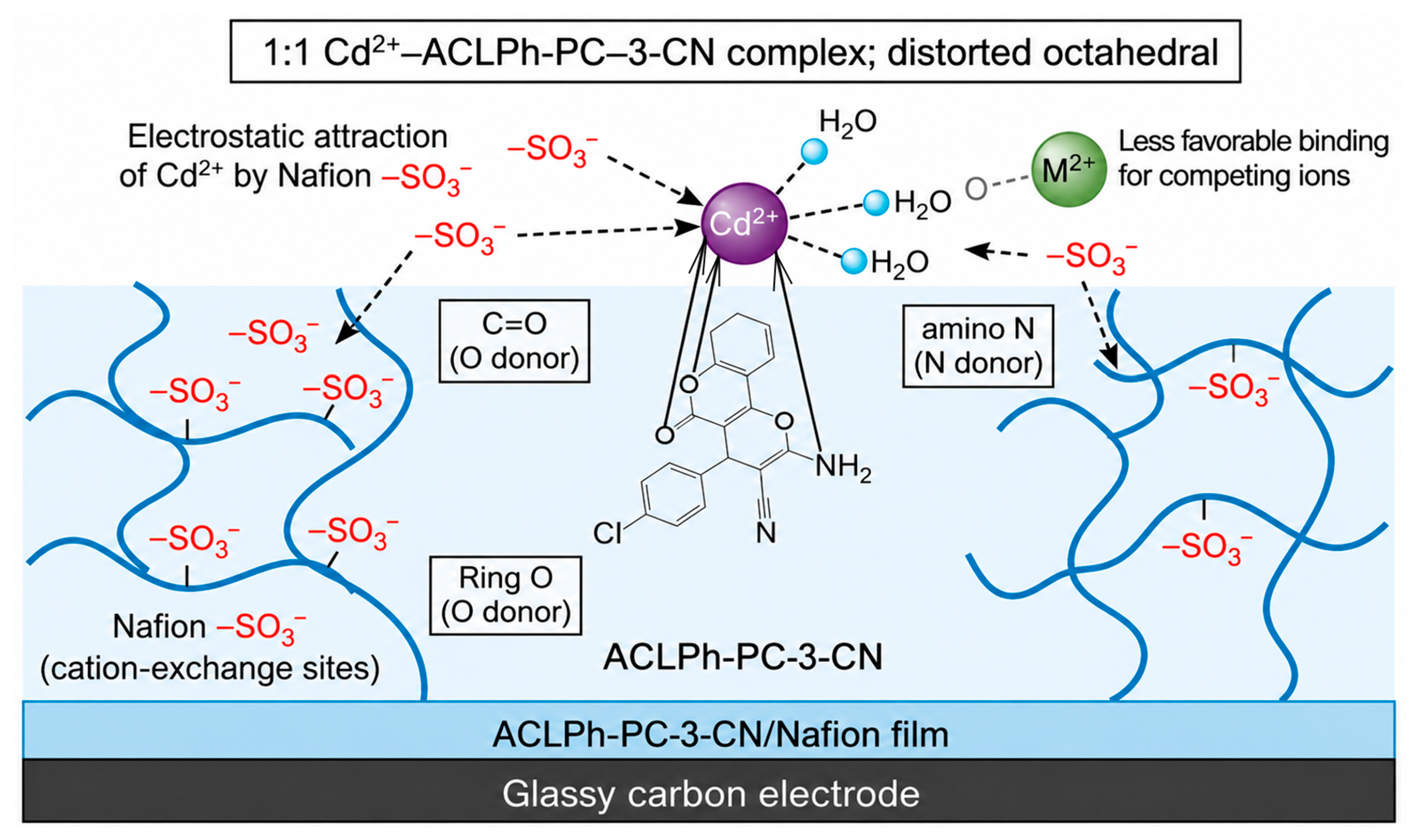
In this architecture, Nafion contributes fixed sulfonate groups that are negatively charged at the working pH and electrostatically attract Cd2+ from solution, thereby promoting cation-exchange-assisted preconcentration and stabilizing the ligand layer on the electrode surface. By contrast, ACLPh-PC-3-CN provides a structurally defined N/O donor set that enables specific Cd2+–ligand complexation. Literature on Nafion-modified electrodes indicates that Nafion alone enhances metal-ion accumulation but typically offers only moderate selectivity; incorporating ACLPh-PC-3-CN therefore adds a selective coordination component on top of the ion-exchange effect [41]. Overall, the Cd(II) response of the modified electrode arises from the combined action of Nafion-mediated cation exchange and ligand-driven complexation, rather than from nonspecific adsorption alone, which distinguishes this platform from more conventional Nafion-based sensors.
In this sense, the sensor architecture couples the ion-exchange properties of Nafion with a structurally defined coordination site provided by the pyranochromene ligand, which distinguishes the present platform from more conventional Nafion-based electrodes that rely mainly on non-specific accumulation of Cd2+ or other metal ions.

4.3. Interpretation of Scan-Rate Behavior and Mechanism

Scan-rate studies showed that both surface-confined species and diffusion from the bulk solution contribute to the Cd(II) oxidation current. The linear dependence of ip on v (Equation (1)) and the value of Γ support the presence of a surface-confined Cd species, whereas the linear ip versus v1/2 relationship (Equation (2)) indicates that diffusion from the bulk solution also contributes to the current [46]. The slope of 0.7607 obtained from the log ip versus log v plot (Equation (3)) lies between the theoretical values for purely diffusion-controlled and purely adsorption-controlled reactions, which is characteristic of a mixed adsorption–diffusion regime. Similar behavior has been described for other metal–ligand systems in which preconcentration at the surface is followed by diffusion-assisted replenishment from solution.
The increase of ip/√v with scan rate (Figure 4D) is consistent with a mechanism in which electrochemical steps dominate over a simple EC pathway [47]. Taking these observations together, a plausible sequence involves (i) complex formation between Cd2+ and the surface-confined ligand, (ii) reduction in the complex to a surface-bound metallic state during the deposition step, and (iii) oxidative stripping of Cd back to Cd2+ during the DP-ASV scan:
Cd2+ + L ⇌ [CdL]2+
[CdL]2+ + ne → [CdL]0 (E_dep = −1.35 V)
[CdL]0 → Cd2+ + L + ne (stripping near −0.65 V)
The maximum analytical response at pH 6 is in agreement with this picture [39,48]: at higher pH values, hydrolysis and Cd(OH)2 formation become more important, while at lower pH values, protonation of donor sites can reduce ligand–metal binding efficiency.
Thus, the electrochemical behavior, surface-coverage analysis, and Job’s plot, considered together with the ligand’s single tridentate coordination site, consistently support a 1:1 Cd(II)–ligand interaction at the electrode interface.

4.4. Relationship Between Mechanism and Analytical Performance

The analytical figures of merit obtained under optimized conditions (linear range 16.21–56.72 μmol L−1, LOD 0.60 μmol L−1, LOQ 2.0 μmol L−1) can be rationalized in terms of the preconcentration and electron-transfer characteristics of the modified electrode. The chosen deposition time of 210 s represents a compromise between increasing surface coverage and avoiding saturation, which would limit further signal growth. The detection limit is comparable to or lower than values reported for several other Cd(II) sensors based on carbon paste or Nafion-modified electrodes; for example, the LOD of 0.60 μmol L−1 obtained here is slightly lower than that reported for an MCM-41-NH2/Nafion/GCE system (0.71 μmol L−1) while using a simpler organic ligand as the recognition element [41]. When the broader range of systems summarized in Table 1 is considered, including nanostructured carbon-based electrodes, Ti3AlC2@graphene oxide composites, and self-powered microchip platforms, it becomes clear that several advanced nanomaterial-based sensors achieve substantially lower detection limits (down to the low-nanomolar range), whereas the ACLPh-PC-3-CN/Nafion/GCE offers intermediate sensitivity but with a relatively simple, ligand-based architecture and straightforward film fabrication.
The good precision (RSD ≤ 3.1%) and the retention of 94% of the initial signal after 14 days indicate that the ACLPh-PC-3-CN/Nafion film is stable under the experimental conditions. This stability likely arises from a combination of non-covalent interactions between the ligand and the polymer and the physical entrapment of the ligand within the Nafion matrix, as seen in other Nafion-immobilized functional materials. The low degree of interference from common metal ions and electrolytes (variation within ±5% at up to 100-fold excess) is consistent with the preference of Cd2+ for N/O donor environments relative to some competing cations, in line with hard–soft acid–base considerations. Additionally, the difference in stripping potentials between Cd(II) and other metals facilitates their resolution in voltammetric measurements.
Finally, we note that the present study is based primarily on electrochemical and spectroscopic evidence and does not yet include direct imaging or elemental analysis of the ACLPh-PC-3-CN/Nafion film. Techniques such as SEM or AFM (to probe surface morphology and film uniformity), EDX or XPS (to confirm elemental composition and Cd–ligand coordination at the interface), and EIS (to quantify changes in interfacial charge-transfer resistance upon modification and Cd(II) binding) would provide complementary information on the structure and function of the sensing layer. Incorporating these measurements in future work will allow a more comprehensive correlation between film architecture, interfacial properties, and analytical performance.

4.5. Implications for Environmental Applications

The satisfactory recoveries obtained for tap water and Red Sea water (98.7–101%, Table 3) show that the ACLPh-PC-3-CN/Nafion-modified electrode can be applied to real samples without extensive sample pretreatment. The successful analysis of Red Sea water, which has a complex matrix with high ionic strength and natural organic matter, suggests that the sensor tolerates typical components that often complicate electrochemical measurements in saline waters. Although the current detection limit is higher than some regulatory thresholds for Cd(II) in drinking water, the sensor provides a portable and relatively simple option for screening moderately contaminated waters and for use in laboratory or field settings where high-end instrumentation such as ICP-MS is not available. Further improvements in sensitivity, for example, by optimizing film thickness, deposition conditions, or ligand loading, could extend the applicability toward lower concentration levels. The combination of a structurally defined pyranochromene ligand, a Nafion matrix, and a well-characterized electrochemical mechanism distinguishes this system from many empirical modifier-based sensors. In this context, the present work can be viewed as a step toward rational design of coordination-based electrochemical chemosensors, in which ligand architecture and polymer environment are used deliberately to tune preconcentration and stripping behavior.
These results demonstrate that the ACLPh-PC-3-CN/Nafion-modified electrode can provide reliable determinations in such matrices, although its current LOD (0.60 μM) limits direct application at very low Cd(II) levels close to guideline concentrations. For situations where Cd(II) occurs nearer to these low background levels, it would be desirable to investigate lower concentration ranges, examine matrix effects in more detail, and extend the study to a broader set of environmental samples (for example, groundwater, river water, and industrial effluents), potentially in combination with a simple off-line pre-concentration step to access lower effective concentrations.
Furthermore, it should also be noted that the present detection limit of 0.60 μM is higher than the maximum Cd2+ levels recommended for drinking water (≈3 μg L−1, ~0.027 μM) and therefore does not yet allow direct trace-level compliance monitoring of pristine waters. However, in many real polluted systems, Cd2+ concentrations can substantially exceed this guideline value, so the current sensor is still useful for screening and monitoring moderately-to-highly contaminated waters and industrial effluents. Where lower concentration ranges are targeted, the method could be combined with a simple off-line pre-concentration step (for example, sorbent-based or evaporative pre-concentration prior to voltammetric measurement) and with further optimization of the ACLPh-PC-3-CN/Nafion film (thickness and ligand loading), deposition conditions, and electrode surface area. These strategies are expected to extend the operational range toward lower Cd2+ levels in future work while preserving the selectivity provided by the pyranochromene ligand.

5. Ligand–Cd(II) Binding Studies

5.1. Evidence for 1:1 Stoichiometry

The electrochemical and spectroscopic observations together support the formation of a 1:1 complex between Cd(II) and ACLPh-PC-3-CN under the conditions used. The presence of a single dominant stripping peak and the estimated surface coverage are consistent with the binding of individual Cd2+ ions to ligand sites arranged at the electrode surface. The tridentate N/O donor set of ACLPh-PC-3-CN is similar to that of other ligands reported to form 1:1 complexes with Cd2+ in solution and in solid-state coordination compounds.

5.2. Job’s Plot Analysis

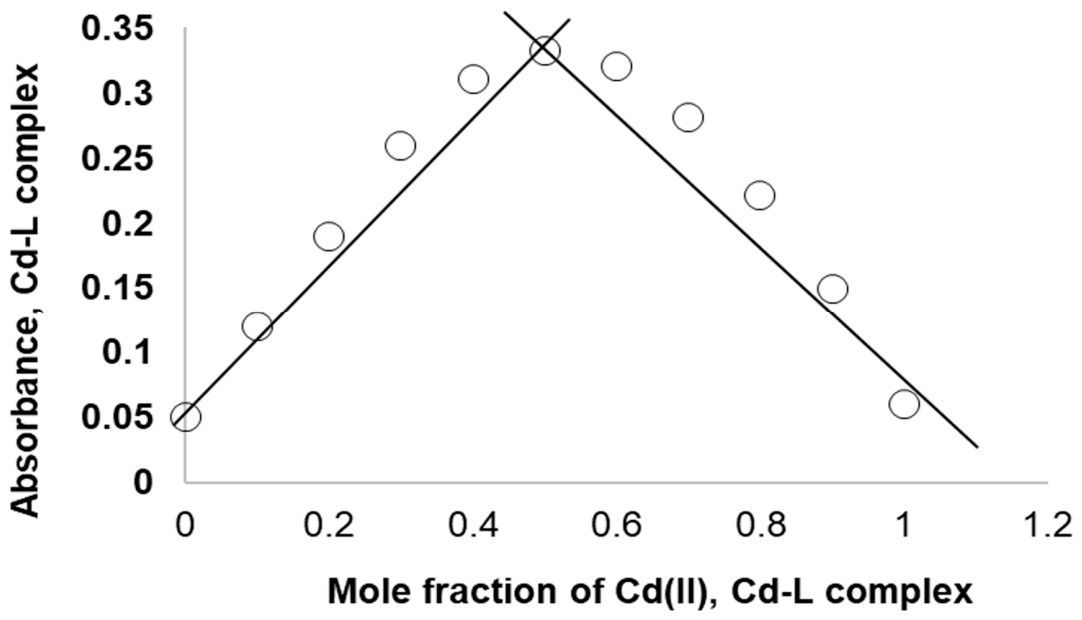
The stoichiometry of the Cd(II)–ACLPh-PC-3-CN complex in solution was further examined using the method of continuous variations (Job’s method), which is widely employed to determine the composition of metal–ligand complexes. In the present case, solutions were prepared at constant total concentration ([Cd(II)] + [ligand] = 40 μmol L−1) while varying the mole fraction of Cd(II), and the absorbance at 415 nm was monitored. The Job’s plot of XCd·A versus XCd (Figure 6) exhibits a maximum at a Cd(II) mole fraction of approximately 0.5. According to the usual interpretation of Job’s method, a maximum at XCd ≈ 0.5 indicates that the predominant species in solution has a 1:1 metal–ligand stoichiometry. This finding is therefore consistent with the design of ACLPh-PC-3-CN as a tridentate ligand that coordinates a single Cd(II) center and supports the mechanistic assumption of a 1:1 Cd(II)–ligand interaction at the electrode interface.
Additionally, taken together, the presence of a single tridentate N/O donor environment in ACLPh-PC-3-CN and the Job’s plot maximum at XCd ≈ 0.5 indicate that the predominant species formed under the experimental conditions is a 1:1 Cd(II)–ACLPh-PC-3-CN complex. This conclusion is in line with the most commonly observed 1:1 stoichiometry in metal–ligand systems characterized by continuous-variation methods and similar ligand architectures.

5.3. Limitations of the Present Sensor

Although the ACLPh-PC-3-CN/Nafion-modified electrode shows good precision and acceptable linearity in the range 16.21–56.72 μmol L−1, several practical limitations should be noted. The method still requires laboratory-type sample handling (filtration, pH adjustment to 6, and standard additions), which may restrict direct on-site use. The Cd2+ response is pH-dependent and optimized around pH 6; significant deviations from this value can decrease the signal due to protonation of donor sites or hydrolysis of Cd(II). While the film retains about 94% of its initial response after 14 days and shows low RSD values, long-term stability or operation under strongly oxidizing conditions or at extreme pH values has not been evaluated and may require further optimization. In addition, although the sensor tolerates large excesses of common inorganic ions, more complex environmental matrices containing organic matter, surfactants, or other chelating agents could still influence Cd2+ accumulation and may necessitate matrix-matched calibration. Finally, the current detection limit (0.60 μmol L−1, ≈67 μg L−1) exceeds the WHO guideline level for Cd in drinking water, so the present configuration is better suited for screening moderately contaminated waters or laboratory monitoring than for direct compliance testing at regulatory limits.

6. Conclusions

In this work, the pyrano[3,2-c]chromene ligand ACLPh-PC-3-CN was co-immobilized with Nafion on a glassy carbon electrode and employed as a surface-confined chelating element for the electrochemical determination of Cd2+ in aqueous samples. Under optimized DP-ASV conditions at pH 6.0, the ACLPh-PC-3-CN/Nafion-modified electrode exhibited a linear relationship between peak current and Cd2+ concentration in the range 16.21–56.72 µmol L−1, with a limit of detection of 0.60 µmol L−1, a limit of quantification of 2.0 µmol L−1, and low RSD values for repeatability and reproducibility. The response characteristics, together with the scan-rate dependence of the peak current, surface coverage estimates, and the predominantly 1:1 Cd2+–ligand stoichiometry, support a mechanism in which Cd2+ is accumulated via surface complexation by ACLPh-PC-3-CN within the Nafion matrix, reduced to a surface-bound metallic state during the deposition step, and subsequently oxidatively stripped during the voltammetric scan. The ACLPh-PC-3-CN/Nafion film showed adequate short-term operational stability, retaining about 94% of its initial stripping current after 14 days, and maintained the Cd2+ peak current within ±5% in the presence of large excesses of common coexisting ions and surfactant species, although more complex matrices may still require matrix-matched calibration. While the current LOD (≈67 µg L−1 Cd2+) exceeds typical guideline values for drinking water and thus limits direct compliance monitoring at regulatory levels, the sensor is suitable for screening moderately contaminated waters and for applications where simple, low-cost electrochemical measurements are preferred over more sophisticated techniques. Overall, these findings demonstrate that combining a structurally defined pyranochromene ligand with a Nafion matrix offers a viable route to coordination-based electrochemical chemosensors for Cd2+, and the general design strategy could be extended to other metal ions through appropriate ligand modification and optimization of the sensing layer.

Supplementary Materials

The following supporting information can be downloaded at: https://www.mdpi.com/article/10.3390/chemosensors14060137/s1; Figure S1: Schematic illustration of the synthesis procedure of 2-amino-4-(4-chlorophenyl)-5-oxo-4H,5H-pyrano[3,2-c]chromene-3-carbonitrile (ACLPh-PC-3-CN). The ligand was synthesized via a one-pot multicomponent reaction of 4-chlorobenzaldehyde, malononitrile, and 4-hydroxycoumarin in ethanol, catalyzed by piperidine, followed by filtration, ethanol washing, and drying. Figure S2: Cleaning and pretreatment procedure of the glassy carbon electrode prior to modification. Figure S3: Schematic representation of the fabrication procedure of the ACLPh-PC-3-CN/Nafion modified glassy carbon electrode (ACLPh-PC-3-CN/Nafion/GCE). A solution of ACLPh-PC-3-CN in acetone was drop-cast onto the pretreated GCE surface together with Nafion solution, followed by air drying to form a uniform film prior to electrochemical measurements using DP-ASV. Figure S4. FT-IR spectrum of ACLPh-PC-3-CN (500–4000 cm−1). Figure S5. (A) 1H NMR and (B) 13C NMR spectra of ACLPh-PC-3-CN in DMSO-d6. Figure S6 (A and B): DP-ASV voltammogram at different supporting electrolytes (A) and influence of the supporting electrolytes on the peak current of Cd(II) ions (4.8 × 10⁻⁶ mol L−1) at ACLPh-PC-3-CN/Nafion/GCE vs the Ag/AgCl electrode (B). Experimental conditions: deposition potential −0.6 V, deposition time 120 s, pulse amplitude 50 mV. Figure S7 (A and B): Effect of Nafion amount on the DP-ASV response of Cd(II) (4.8 × 10⁻⁶ mol L−1) at the ACLPh-PC-3-CN/Nafion modified electrode: (A) DP-ASV voltammograms recorded with different Nafion volumes (0–6 μL); (B) corresponding variation of anodic peak current with Nafion volume. Experimental conditions: deposition potential −0.6 V, deposition time 120 s, B-R buffer solution at pH 4. Figure S8 (A and B): Effect of pH on the DP-ASV response of Cd(II) (4.8 × 10⁻⁶ mol L−1) at the ACLPh-PC-3-CN/Nafion modified electrode: (A) DP-ASV voltammograms recorded at different pH values (2–9); (B) corresponding variation of anodic peak current with pH. Experimental conditions: deposition potential −0.6 V, deposition time 120 s, pulse amplitude 50 mV, B-R buffer solution. Figure S9 (A and B): Effect of deposition potential on the DP-ASV response of Cd(II) (4.8 × 10⁻⁶ mol L−1) at the ACLPh-PC-3-CN/Nafion modified electrode: (A) DP-ASV voltammograms recorded at different deposition potentials; (B) corresponding variation of anodic peak current with deposition potential. Experimental conditions: deposition time 120 s, pulse amplitude 50 mV, B-R buffer solution at pH 6. Figure S10 (A and B): Effect of pulse amplitude on the DP-ASV response of Cd(II) (4.8 × 10⁻⁶ mol L−1) at the ACLPh-PC-3-CN/Nafion modified electrode: (A) DP-ASV voltammograms recorded at different pulse amplitudes (10–100 mV); (B) corresponding variation of anodic peak current with pulse amplitude. Experimental conditions: deposition potential −1.35 V, deposition time 120 s, B-R buffer solution at pH 6. Figure S11 (A and B): Effect of deposition time on the DP-ASV response of Cd(II) (4.8 × 10⁻⁶ mol L−1) at the ACLPh-PC-3-CN/Nafion modified electrode: (A) DP-ASV voltammograms recorded at different deposition times; (B) corresponding variation of anodic peak current with deposition time. Experimental conditions: deposition potential −1.35 V, pulse amplitude 70 mV, B-R buffer solution at pH 6.; Table S1: Influence of potential interfering ions on the determination of Cd(II) (4.8 × 10⁻⁶ mol L−1) using the ACLPh-PC-3-CN/Nafion modified electrode.

Author Contributions

N.K.H.A.: Conceptualization, methodology, investigation, formal analysis, data curation, visualization, and writing—original draft. N.M.A.: Conceptualization, methodology, investigation, formal analysis, data curation, resources, supervision, validation, and writing—review and editing. F.M.A.: Methodology, investigation, validation, data curation, and writing—review and editing. A.T.A.: Investigation, validation, data curation, visualization, writing—review and editing. M.A.E.H.: Conceptualization, Investigation, Formal analysis, Validation, Data curation, Writing—Review and editing. A.A.S.: Investigation, validation, data curation, visualization, writing—review and editing. N.A.A. and E.A.: Investigation, validation, data curation, visualization, writing—review and editing. W.T.A.: Conceptualization, methodology, investigation, formal analysis, data curation, resources, supervision, validation, and writing—review and editing. All authors have read and agreed to the published version of the manuscript.

Funding

This research received no external funding.

Institutional Review Board Statement

Not applicable.

Informed Consent Statement

Not applicable.

Data Availability Statement

The datasets generated and/or analyzed during the current study are available from the corresponding author upon reasonable request.

Acknowledgments

The author would like to thank King Abdulaziz University, Jeddah, Saudi Arabia. The authors would like to thank the Deanship of Scientific Research at Shaqra University for supporting this work.

Conflicts of Interest

The authors declare that they have no known competing financial interests or personal relationships that could have appeared to influence the work reported in this paper.

References

  1. Li, G.; Feng, S.; Yan, L.; Yang, L.; Huo, B.; Wang, L.; Luo, S.; Yang, D. Direct electrochemical detection of Cu (II) ions in juice and tea beverage samples using MWCNTs-BMIMPF6-Nafion modified GCE electrodes. Food Chem. 2023, 404, 134609. [Google Scholar] [CrossRef]
  2. Bakhsh, E.M.; Khan, S.B.; Marwani, H.M.; Danish, E.Y.; Asiri, A.M. Efficient electrochemical detection and extraction of copper ions using ZnSe–CdSe/SiO2 core–shell nanomaterial. J. Ind. Eng. Chem. 2019, 73, 118–127. [Google Scholar] [CrossRef]
  3. Wang, Y.; Wang, L.; Huang, W.; Zhang, T.; Hu, X.; Perman, J.A.; Ma, S. A metal–organic framework and conducting polymer based electrochemical sensor for high performance cadmium ion detection. J. Mater. Chem. A 2017, 5, 8385–8393. [Google Scholar] [CrossRef]
  4. Grabarczyk, M.; Wardak, C.; Piech, R.; Wawruch, A. An electrochemical sensor for the determination of trace concentrations of cadmium, based on spherical glassy carbon and nanotubes. Materials 2023, 16, 3252. [Google Scholar] [CrossRef] [PubMed]
  5. Tchounwou, P.B.; Yedjou, C.G.; Patlolla, A.K.; Sutton, D.J. Heavy metal toxicity and the environment. In Molecular, Clinical and Environmental Toxicology: Volume 3: Environmental Toxicology; Springer: Berlin/Heidelberg, Germany, 2012; pp. 133–164. [Google Scholar]
  6. Solís, J.C.; Galicia, M. High performance of MWCNTs-chitosan modified glassy carbon electrode for voltammetric trace analysis of Cd (II). Int. J. Electrochem. Sci. 2020, 15, 6815–6828. [Google Scholar] [CrossRef]
  7. World Health Organization. Guidelines for Drinking-Water Quality: Incorporating the First and Second Addenda; World Health Organization: Geneva, Switzerland, 2022. [Google Scholar]
  8. U.S. Environmental Protection Agency. National Primary Drinking Water Regulations: Inorganic Chemicals–Cadmium (MCL 0.005 mg/L); U.S. Environmental Protection Agency: Washington, DC, USA, 2025. [Google Scholar]
  9. Souza, J.P.; Cerveira, C.; Miceli, T.M.; Moraes, D.P.; Mesko, M.F.; Pereira, J.S.F. Evaluation of sample preparation methods for cereal digestion for subsequent As, Cd, Hg and Pb determination by AAS-based techniques. Food Chem. 2020, 321, 126715. [Google Scholar] [CrossRef] [PubMed]
  10. Arbab-Zavar, M.H.; Chamsaz, M.; Youssefi, A.; Aliakbari, M. Electrochemical hydride generation atomic absorption spectrometry for determination of cadmium. Anal. Chim. Acta 2005, 546, 126–132. [Google Scholar] [CrossRef]
  11. Yuan, X.; Yang, L.; Liu, S.; Yang, H.; Tang, Y.; Huang, K.; Zhang, M. An effective analytical system based on an ultraviolet atomizer for trace cadmium determination using atomic fluorescence spectrometry. Anal. Methods 2018, 10, 4821–4826. [Google Scholar] [CrossRef]
  12. Xue, J.; Gong, S.; Wang, X.; Fan, Y.; Li, X. Determination of Hg, As, Pb, and Cd in orchard soils by sequential injection vapor generation atomic fluorescence spectrometry. Anal. Lett. 2012, 45, 2257–2268. [Google Scholar] [CrossRef]
  13. Jurowski, K. The toxicological assessment of hazardous elements (Pb, Cd and Hg) in low-cost jewelry for adults from Chinese E-commerce platforms: In situ analysis by portable X-ray fluorescence measurement. J. Hazard. Mater. 2023, 460, 132167. [Google Scholar] [CrossRef]
  14. Wang, Y.; Dong, S.; Xiao, J.; Hu, Q.; Zhao, L. A rapid and multi-element method for the determination of As, Cd, Ni, Pb, Sn, and Zn in scallops using high definition X-ray fluorescence (HDXRF) spectrometry. Food Anal. Methods 2022, 15, 2712–2724. [Google Scholar] [CrossRef]
  15. Akoury, E.; Baroud, C.; El Kantar, S.; Hassan, H.; Karam, L. Determination of heavy metals contamination in thyme products by inductively coupled plasma mass spectrometry. Toxicol. Rep. 2022, 9, 1962–1967. [Google Scholar] [CrossRef] [PubMed]
  16. Hu, T.; Lai, Q.; Fan, W.; Zhang, Y.; Liu, Z. Advances in portable heavy metal ion sensors. Sensors 2023, 23, 4125. [Google Scholar] [CrossRef] [PubMed]
  17. Wang, Y.; Wu, X.; Sun, J.; Wang, C.; Zhu, G.; Bai, L.-P.; Jiang, Z.-H.; Zhang, W. Stripping voltammetric determination of cadmium and lead ions based on a bismuth oxide surface-decorated nanoporous bismuth electrode. Electrochem. Commun. 2022, 136, 107233. [Google Scholar] [CrossRef]
  18. Mohamad Nor, N.; Ramli, N.H.; Poobalan, H.; Qi Tan, K.; Abdul Razak, K. Recent advancement in disposable electrode modified with nanomaterials for electrochemical heavy metal sensors. Crit. Rev. Anal. Chem. 2023, 53, 253–288. [Google Scholar] [CrossRef] [PubMed]
  19. Jjagwe, J.; Olupot, P.W.; Kulabako, R.; Carrara, S. Electrochemical sensors modified with iron oxide nanoparticles/nanocomposites for voltammetric detection of Pb (II) in water: A review. Heliyon 2024, 10, e29743. [Google Scholar] [CrossRef]
  20. Lu, Y.; Liang, X.; Niyungeko, C.; Zhou, J.; Xu, J.; Tian, G. A review of the identification and detection of heavy metal ions in the environment by voltammetry. Talanta 2018, 178, 324–338. [Google Scholar] [CrossRef]
  21. Abdallah, A.B.; El-Kholany, M.R.; Molouk, A.F.S.; Ali, T.A.; El-Shafei, A.A.; Khalifa, M.E. Selective and sensitive electrochemical sensors based on an ion imprinting polymer and graphene oxide for the detection of ultra-trace Cd (ii) in biological samples. RSC Adv. 2021, 11, 30771–30780. [Google Scholar] [CrossRef]
  22. Tajik, S.; Beitollahi, H.; Nejad, F.G.; Dourandish, Z.; Khalilzadeh, M.A.; Jang, H.W.; Venditti, R.A.; Varma, R.S.; Shokouhimehr, M. Recent developments in polymer nanocomposite-based electrochemical sensors for detecting environmental pollutants. Ind. Eng. Chem. Res. 2021, 60, 1112–1136. [Google Scholar] [CrossRef]
  23. Borrill, A.J.; Reily, N.E.; Macpherson, J.V. Addressing the practicalities of anodic stripping voltammetry for heavy metal detection: A tutorial review. Analyst 2019, 144, 6834–6849. [Google Scholar] [CrossRef]
  24. Vilasó-Cadre, J.E.; Hidalgo, J.; Leyte-Vidal, J.J.P.; Ramírez-Rodríguez, A.; López-Álvarez, I.A.; Martínez, G.R.; Aguilar-Carrillo, J.; Reyes-Domínguez, I.A.; Cruz, R.; Rosales-Marín, G. Square wave anodic stripping voltammetric method for thallium in coal ash using a gold electrode modified with a titanium (IV)-oxo-carboxylate cluster-chitosan composite. Microchem. J. 2025, 219, 115912. [Google Scholar] [CrossRef]
  25. Meng, R.; Zhu, Q.; Long, T.; He, X.; Luo, Z.; Gu, R.; Wang, W.; Xiang, P. The innovative and accurate detection of heavy metals in foods: A critical review on electrochemical sensors. Food Control 2023, 150, 109743. [Google Scholar] [CrossRef]
  26. Tajik, S.; Beitollahi, H.; Jang, H.W.; Shokouhimehr, M. A screen printed electrode modified with Fe3O4@ polypyrrole-Pt core-shell nanoparticles for electrochemical detection of 6-mercaptopurine and 6-thioguanine. Talanta 2021, 232, 122379. [Google Scholar] [CrossRef]
  27. Munonde, T.S.; Nomngongo, P.N. Nanocomposites for electrochemical sensors and their applications on the detection of trace metals in environmental water samples. Sensors 2020, 21, 131. [Google Scholar] [CrossRef]
  28. Tesfaye, E.; Chandravanshi, B.S.; Negash, N.; Tessema, M. Development of a new electrochemical method for the determination of copper (II) at trace levels in environmental and food samples. RSC Adv. 2022, 12, 35367–35382. [Google Scholar] [CrossRef] [PubMed]
  29. Shen, C.-H.; Chang, Y.-N.; Chen, Y.-L.; Kung, C.-W. Sulfonate-grafted metal–organic framework─ a porous alternative to Nafion for electrochemical sensors. ACS Mater. Lett. 2023, 5, 1938–1943. [Google Scholar] [CrossRef]
  30. Kelarakis, A. Nafion in Biomedicine and Healthcare. Polymers 2025, 17, 2054. [Google Scholar] [CrossRef] [PubMed]
  31. Shaikh, A.A.; Firdaws, J.; Islam, S.; Bakshi, P.K. Interaction of Cu (II) with Cytosine in Britton-Robinson Buffer Solution-A Cyclic Voltammetric Study. Dhaka Univ. J. Sci. 2015, 63, 31–36. [Google Scholar] [CrossRef]
  32. Nasiri-Majd, M.; Taher, M.A.; Fazelirad, H. Preparation and application of a simple electrochemical sensor for the determination of copper in some real and standard samples. Ionics 2016, 22, 289–296. [Google Scholar] [CrossRef]
  33. Koirala, K.; Santos, J.H.; Tan, A.L.; Ali, M.A.; Mirza, A.H. Chemically modified carbon paste electrode for the detection of lead, cadmium and zinc ions. Sens. Rev. 2016, 36, 339–346. [Google Scholar] [CrossRef]
  34. Arif, N.; Shafiq, Z.; Noureen, S.; Khalid, M.; Ashraf, A.; Yaqub, M.; Irshad, S.; Khan, M.U.; Arshad, M.N.; Carmo Braga, A.A.; et al. Synthesis, spectroscopic, SC-XRD/DFT and non-linear optical (NLO) properties of chromene derivatives. RSC Adv. 2023, 13, 464–477. [Google Scholar] [CrossRef]
  35. Alblewi, F.F.; Alsehli, M.H.; Hritani, Z.M.; Eskandrani, A.; Alsaedi, W.H.; Alawad, M.O.; Elhenawy, A.A.; Ahmed, H.Y.; El-Gaby, M.S.A.; Afifi, T.H.; et al. Synthesis and Characterization of a New Class of Chromene-Azo Sulfonamide Hybrids as Promising Anticancer Candidates with the Exploration of Their EGFR, hCAII, and MMP-2 Inhibitors Based on Molecular Docking Assays. Int. J. Mol. Sci. 2023, 24, 16716. [Google Scholar] [CrossRef]
  36. Zakarieie, M.; Taherimehr, M. 3,4-Dihydropyrano [C] chromene Synthesis Using Fe3O4@SiO2-SO3H Magnetic Nanocatalyst. J. Water Environ. Nanotechnol. 2024, 9, 327–339. [Google Scholar] [CrossRef]
  37. Stozhko, N.Y.; Malakhova, N.A.; Fyodorov, M.V.; Brainina, K.Z. Modified carbon-containing electrodes in stripping voltammetry of metals: Part I. Glassy carbon and carbon paste electrodes. J. Solid State Electrochem. 2008, 12, 1185–1204. [Google Scholar] [CrossRef]
  38. Somerset, V.S.; Hernandez, L.H.; Iwuoha, E.I. Stripping voltammetric measurement of trace metal ions using screen-printed carbon and modified carbon paste electrodes on river water from the Eerste-Kuils River System. J. Environ. Sci. Health Part A 2011, 46, 17–32. [Google Scholar] [CrossRef]
  39. Nguyen, T.H.; Pham, T.M.; Do, M.H. Eco-Friendly Green Synthesis of Reduced Graphene Oxide as An Electrocatalytic Platform for The Simultaneous Detection of Cd (II) and Pb (II). Anal. Bioanal. Electrochem. 2025, 17, 428–445. [Google Scholar]
  40. Wu, K.-H.; Lo, H.-M.; Wang, J.-C.; Yu, S.-Y.; Yan, B.-D. Electrochemical detection of heavy metal pollutant using crosslinked chitosan/carbon nanotubes thin film electrodes. Mater. Express 2017, 7, 15–24. [Google Scholar] [CrossRef]
  41. Sacara, A.-M.; Pitzalis, F.; Salis, A.; Turdean, G.L.; Muresan, L.M. Glassy carbon electrodes modified with ordered mesoporous silica for the electrochemical detection of cadmium ions. ACS Omega 2019, 4, 1410–1415. [Google Scholar] [CrossRef]
  42. Ahmad, M.; Neha; Ai, Y.; Ahmad, N.; Ara, B.; Sun, W. High-performance electrochemical sensor for Cd2+ and Cu2+ utilizing Ti3AlC2@graphene oxide-modified glassy carbon electrode. New J. Chem. 2026, 50, 3407–3417. [Google Scholar] [CrossRef]
  43. Xu, J.; Luo, X.; Cao, C.; Ling, G.; Zheng, Y.; Zhang, W. A portability self-powered sensor facilitates sensitive Cd2+ detection: Dual mechanism and three quantitative mode. Food Chem. 2024, 459, 140380. [Google Scholar] [CrossRef]
  44. Gezahegn, T.F.; Ambaye, A.D.; Mekoyete, T.M.; Malefane, M.E.; Oyedotun, K.O.; Mokrani, T. Breakthroughs in nanostructured-based chemical sensors for the detection of toxic metals. Talanta Open 2024, 10, 100354. [Google Scholar] [CrossRef]
  45. Jalilehvand, F.; Leung, B.O.; Mah, V. Cadmium(II) complex formation with cysteine and penicillamine. Inorg. Chem. 2009, 48, 5758–5771. [Google Scholar] [CrossRef]
  46. Alsaggaf, W.T.; El-Shahawi, M.S. Electrooxidation and Development of a Highly Sensitive Electrochemical Probe for Trace Determination of the Steroid 11-Desoxycorticosterone Drug Residues in Water. Int. J. Electrochem. 2022, 2022, 2074908. [Google Scholar] [CrossRef]
  47. Alshareef, F.M.; Orif, M.I.; Al-Harbi, E.A.; El-Shahawi, M.S. A highly sensitive electrochemical sensor based on electrocatalytic reduction effect of Cu2+ on trace determination of malathion in soil and other complex matrices. Int. J. Electrochem. 2021, 2021, 8110364. [Google Scholar] [CrossRef]
  48. Wang, F.; Peng, X.; Xiao, Z.; Ge, Y.; Tao, B.; Shou, Z.; Feng, Y.; Yuan, J.; Xiao, L. Simultaneous Trace Analysis of Lead and Cadmium in Drinking Water, Milk, and Honey Samples Through Modified Screen-Printed Electrode. Biosensors 2025, 15, 267. [Google Scholar] [CrossRef] [PubMed]
Figure 1. Chemical structure of the ACLPh-PC-3-CN (2-amino-4-(4-chlorophenyl)-5-oxo-4H,5H-pyrano[3,2-c]chromene-3-carbonitrile) ligand.
Chemosensors 14 00137 g001
Scheme 1. Proposed coordination of Cd2+ by ACLPh-PC-3-CN within the ACLPh-PC-3-CN/Nafion film at the glassy carbon electrode. In this schematic, Cd2+ is coordinated by the tridentate N, O, O donor set of ACLPh-PC-3-CN (amide carbonyl O, ring O in the pyran/chromene unit, and amino N), while additional water molecules complete a distorted octahedral coordination sphere. Sulfonate groups of the Nafion matrix attract Cd2+ electrostatically and help retain the surface-confined Cd–ligand complex, contributing to preconcentration and selectivity toward Cd2+ compared with other metal ions.
Chemosensors 14 00137 sch001
Figure 2. DP-ASV curves obtained at a bare GCE (green) and an ACLPh-PC-3-CN/Nafion-modified GCE (blue) in B–R buffer (pH 4) containing 4.8 μmol L−1 Cd(II). Conditions: deposition potential −0.60 V, deposition time 120 s, pulse amplitude 50 mV.
Chemosensors 14 00137 g002
Figure 3. Cyclic voltammograms of 0.10 mmol L−1 Cd(II) at the ACLPh-PC-3-CN/Nafion-modified GCE in B–R buffer (pH 6) at scan rates from 150 to 700 mV s−1.
Chemosensors 14 00137 g003
Figure 4. (A) Dependence of anodic peak current, Ip, on scan rate (V); (B) dependence of peak current on v1/2; (C) plot of log Ip versus log v; (D) dependence of Ip/√v on scan rate for Cd(II) at the ACLPh-PC-3-CN/Nafion-modified GCE in B–R buffer (pH 6).
Chemosensors 14 00137 g004
Figure 5. (A) DP-ASV responses obtained for increasing Cd(II) concentrations; (B) Calibration curve for Cd2+ at the ACLPh-PC-3-CN/Nafion-modified GCE, showing peak current (I, μA) as a function of Cd2+ concentration (C, 16.21–56.72 μmol L−1). The data were fitted with a linear regression I = 0.16 C + 38.08 (R2 = 0.9720).
Chemosensors 14 00137 g005
Figure 6. Job’s plot for the Cd(II)–ACLPh-PC-3-CN system at λ = 415 nm ([Cd(II)] + [ligand] = 40 μmol L−1, pH 6), showing a maximum at XCd ≈ 0.5, consistent with a 1:1 complex.
Chemosensors 14 00137 g006
Table 1. Analytical performance of the ACLPh-PC-3-CN/Nafion-modified GCE for Cd(II) determination (mean ± SD).
ParameterCondition/LevelResult * (Mean ± SD or RSD)
Linear range16.21–56.72 μmol L−1
Slope0.16 ± 0.01 μA·μmol−1·L
Intercept38.08 ± 1.2 μA
LOD0.60 μmol L−1
LOQ2.0 μmol L−1
Repeatability (n = 7)4.8 μmol L−1 Cd(II), same electrode2.3% RSD (50.0 ± 1.2 μA)
Reproducibility (n = 5)4.8 μmol L−1 Cd(II), five modified electrodes3.1% RSD (50.0 ± 1.6 μA)
Signal stability (14 days)4.8 μmol L−1 Cd(II), stored electrode94% of initial signal (50.0 → 47.0 μA)
* The example mean ± SD values in Table 1 are representative of the observed current responses at 4.8 μmol L−1 Cd(II) and are consistent with the overall precision (RSD 2.3–3.1%) obtained from repeatability and reproducibility experiments.
Table 2. Comparison of limits of detection for selected electrochemical methods for Cd(II) determination.
TechniqueModifier/ElectrodeLOD (μM)Ref.
DP-ASVCyclodextrin/CPE2.00[37]
DP-ASVMPT/CPE1.40[38]
DPVrGO/aGCE1.10[39]
SW-ASVChitosan/CNTs/GCE6.50[40]
SW-ASVMCM-41-NH2/Nafion/GCE0.71[41]
SW-ASVNafion/GCE4.79[41]
DPVTi3AlC2@graphene oxide/GCE0.055[42]
MicrochipSelf-powered Cd2+ electrochemical microchip~0.005–0.01[43]
SW-ASV/DPVNanostructured carbon-based electrodes (CNTs, graphene, plasma-treated carbon)<0.10 (down to nM range)[44]
DP-ASVACLPh-PC-3-CN/Nafion/GCE0.60This work
Table 3. Determination of Cd(II) in tap water/Red Sea water (mean ± SD, n = 3).
SampleAdded (μM)Found (μM); n = 3Recovery (%)
Tap water48.648.0 ± 1.298.7 ± 2.5
Red Sea48.649.4 ± 1.3101 ± 2.6
Disclaimer/Publisher’s Note: The statements, opinions and data contained in all publications are solely those of the individual author(s) and contributor(s) and not of MDPI and/or the editor(s). MDPI and/or the editor(s) disclaim responsibility for any injury to people or property resulting from any ideas, methods, instructions or products referred to in the content.