Article

An Isothermal Amplification Method for SARS-CoV-2 Variant Differentiation via Targeted Genomic RNA Detection

1
Department of Biomedical Engineering, University of California, Irvine, CA 92697, USA
2
Department of Mechanical and Aerospace Engineering, University of California, Irvine, CA 92697, USA
3
Center for Virus Research, University of California, Irvine, CA 92697, USA
4
School of Engineering and Science, Tecnológico de Monterrey, Monterrey 64849, Mexico
*
Authors to whom correspondence should be addressed.
Chemosensors 2026, 14(6), 135; https://doi.org/10.3390/chemosensors14060135 (registering DOI)
Submission received: 6 May 2026 / Revised: 9 June 2026 / Accepted: 11 June 2026 / Published: 14 June 2026

Abstract

The rapid emergence of SARS-CoV-2 variants underscores the need for accurate, rapid, and affordable diagnostic tools, particularly in resource-limited settings. An isothermal amplification-based assay was developed integrating reverse-transcriptase recombinase polymerase amplification (RT-RPA), T7 transcription, and duplex-specific nuclease (DSN)-mediated detection for variant discrimination. The assay targets three genomic regions: a conserved region within ORF1a and two variant regions, ORF1a (Δ3675–3677) and the S gene (Δ69–70), enabling differentiation between the Wuhan-Hu-1 reference isolate and the B.1.1.7 variant. The method demonstrated high specificity and a limit of detection of 200 copies per sample using low-cost instrumentation. DSN-mediated cleavage improved discrimination between matched and mismatched RNA targets while enabling signal amplification through target recycling. The assay requires minimal laboratory infrastructure, relying on a heat block and fluorescent plate reader. These results demonstrate a scalable and cost-effective strategy for SARS-CoV-2 variant screening with potential as a future strategy for pathogen screening and variant surveillance.

1. Introduction

Since the emergence of SARS-CoV-2 in 2019, continued viral evolution and the emergence of new variants have underscored the need for rapid, scalable diagnostic tools capable of supporting decentralized and population-level screening [1,2,3,4]. Conventional RNA-based diagnostics, particularly reverse transcription polymerase chain reaction (RT-PCR), provide high sensitivity and specificity but rely on complex instrumentation, trained personnel, and centralized laboratory infrastructure, limiting accessibility in resource-constrained settings [5,6,7,8,9]. The growing demand for accessible molecular diagnostics has stimulated the development of alternative nucleic acid sensing technologies capable of operating outside centralized laboratory settings. Such approaches have the potential to improve healthcare delivery while maintaining the analytical performance required for reliable disease surveillance and diagnosis.
Isothermal amplification methods such as loop-mediated isothermal amplification (LAMP) and recombinase polymerase amplification (RPA), enable simplified workflows but often suffer from nonspecific amplification and false-positive signals due to reduced primer binding stringency [10]. Recent approaches integrating CRISPR/Cas systems and alternative amplification strategies have improved sensitivity and reduced equipment requirements; however, challenges remain in achieving high specificity, assay robustness, and multiplexed variant discrimination [11,12,13,14,15].
Nuclease-assisted detection strategies provide a promising route to enhance specificity in nucleic acid sensing. Duplex-specific nuclease (DSN), derived from Paralithodes camtschaticus, selectively cleaves DNA in DNA–RNA duplexes while remaining inactive toward single-stranded RNA, enabling sequence-dependent signal generation with strong mismatch discrimination [16,17,18]. This selective activity allows DSN to function as both a specificity-enhancing element and a signal amplification mechanism, supporting integration into biosensing platforms for viral RNA detection [19,20,21,22]. Recent DSN-based assays have demonstrated highly sensitive SARS-CoV-2 detection using fluorescence and electrochemical readouts, achieving detection limits down to femtomolar and attomolar concentrations [23,24].
Here, we report a nucleic acid sensing platform for SARS-CoV-2 variant screening that integrates reverse transcription recombinase polymerase amplification (RT-RPA), T7 transcription, and DSN-mediated fluorescence detection. Three genomic loci were targeted based on sequence alignment: a conserved region within ORF1a (nsp3) for universal detection, and two variant-associated regions corresponding to deletions in ORF1a.
(nsp6, Δ3675–3677) and the spike (S) gene (Δ69–70), enabling discrimination between the Wuhan-Hu-1 reference strain and the B.1.1.7 (Alpha) variant. Following RT-RPA, products were transcribed into RNA using T7 RNA polymerase to generate substrates for downstream sensing.
Sequence-specific detection was achieved using fluorophore–quencher (FRET)-labeled DNA probes complementary to each target region. Upon hybridization with target RNA, DNA–RNA duplexes are formed and selectively cleaved by DSN, resulting in fluorophore release and measurable fluorescence. This DSN-mediated process enables target recycling and linear signal amplification, improving sensitivity while maintaining high specificity for deletion-based variant discrimination. The multiplexed detection of conserved and variant-specific regions allows simultaneous confirmation of SARS-CoV-2 infection and identification of variant signatures, providing a rapid, sensitive, and scalable approach for decentralized viral diagnostics.
To our knowledge, this proof-of-concept work represents the first demonstration of an RT-RPA/T7 transcription/DSN sensing workflow for viral variant discrimination. By coupling isothermal amplification with DSN-mediated recognition of deletions within DNA:RNA heteroduplexes, the platform extends DSN applications beyond conventional microRNA analysis and establishes a general framework for sequence-specific identification of emerging pathogens and relevant variant strains. As an exploratory study, this work evaluates the feasibility of DSN-based isothermal sensing as an alternative platform for rapid nucleic acid screening applications.

2. Materials and Methods

2.1. Reagents and Materials

Duplex-specific nuclease (DSN, Evrogen, Moscow, Russia) was prepared according to the manufacturer’s instructions by reconstitution in 50 mM Tris-HCl followed by addition of glycerol to a final concentration of 50%. The enzyme was diluted to a working concentration of 0.1 U μL−1 in 50 mM Tris-HCl (pH 8.0). DNA probes and primers (Integrated DNA Technologies, Coralville, IA, USA; Thermo Fisher Scientific, Waltham, MA, USA) were resuspended in nuclease-free water to 100 μM stock solutions and diluted to working concentrations of 1 μM (probes) and 10 μM (primers).

2.2. Primer and Probe Design

Primers and FRET-based DNA probes were designed to target conserved and variant regions of the SARS-CoV-2 genome using sequences from Wuhan-Hu-1 (MN908947.3) and B.1.1.7 (EPI_ISL_710528). Primer design was performed using Primer-BLAST (NCBI Bethesda, MD, USA; Primer3), and probe melting temperatures were optimized to 54–55 °C using IDT OligoAnalyzer to minimize nonspecific hybridization and secondary structure formation. Probes and primer sequences were purchased from Thermofisher Scientific and prepared prior to use.
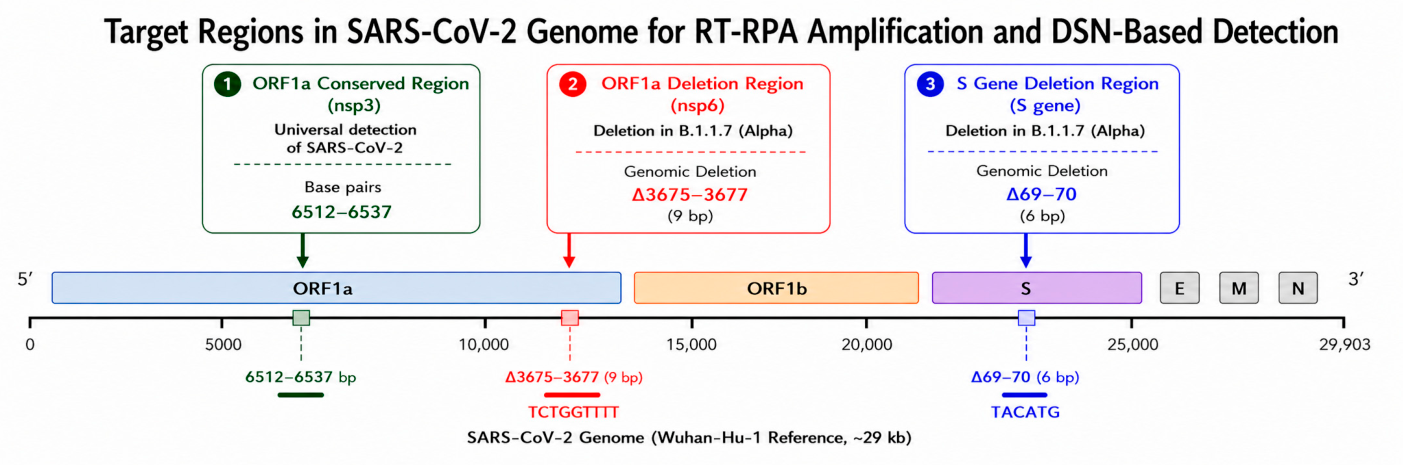
Target regions included a conserved ORF1a (nsp3) region for universal detection and variant-specific deletions in ORF1a (Δ3675–3677) and the S gene (Δ69–70) as shown in Figure 1. Fluorophore–quencher probes were designed to hybridize with RNA targets following amplification and transcription. DSN-mediated cleavage of matched DNA:RNA duplexes separates fluorophore and quencher, generating a fluorescence signal, while mismatched duplexes remain largely intact.
Table 1, Table 2, Table 3, Table 4 and Table 5 list all primer, probe, synthetic RNA fragment, RT-RPA amplicon, and RT-RPA/T7-transcribed RNA sequences used throughout this study, including Wuhan-Hu-1 (MN908947.3) and B.1.1.7 (EPI_ISL_710528) target regions.

2.3. Synthetic RNA Standards

No clinical specimens or extracted patient samples were used in this study. All experiments were performed using synthetic oligonucleotide targets and commercially obtained synthetic SARS-CoV-2 genomic RNA standards.
25 base-pair and ~100 base-pair RNA and DNA sequences used as targets of interest during DSN activity validation and multiplexing feasibility testing were purchased from Integrated DNA Technologies and aliquoted in RNase-free H2O for storage at −80 °C. Synthetic SARS-CoV-2 RNA controls corresponding to the Wuhan-Hu-1 and B.1.1.7 (Alpha) strains were obtained from Twist Bioscience (South San Francisco, CA, USA). These synthetic RNA standards were designed to mimic the full SARS-CoV-2 genome and were used as surrogate viral templates throughout the study. The use of genomic RNA standards allowed assessment of RT-RPA, T7 transcription, and DSN-mediated detection in the context of a larger nucleic acid template containing native viral sequence architecture rather than short synthetic target oligonucleotides alone. Serial dilutions of the synthetic RNA controls were prepared to generate the input copy numbers evaluated in this study.

2.4. RT-RPA

RT-RPA was performed using the TwistAmp Basic Kit (TwistDx, Cambridge, UK) based on previously reported protocols [25]. Each reaction contained rehydrated RPA pellet, forward and reverse primers (1 μL each, 10 μM), and Protoscript® II reverse transcriptase (1 μL, 200 U μL−1). Synthetic SARS-CoV-2 RNA (Wuhan-Hu-1 or B.1.1.7) was added (6.5 μL), and reactions were initiated with MgOAc (1 μL, 280 mM). Samples were incubated at 37 °C for 60 min, followed by cooling on ice and brief centrifugation.

2.5. T7 Transcription

T7 transcription was performed using T7 RNA polymerase purchased from New England Biolabs. Reaction mixtures contained T7 RNA polymerase buffer (10×), ribonucleotide mix (25 mM), RNase inhibitor, and T7 RNA polymerase (50 U μL−1). RT-RPA products (2 μL) were added and incubated at 37 °C for 60 min, followed by cooling and centrifugation.

2.6. DSN Reaction and Fluorescence Detection

DSN reactions were prepared with DNA probes (final 0.1 μM), Rnase inhibitor, DSN enzyme (0.25 U), and reaction buffer (50 mM Tris-HCl, 5 mM MgCl2, 1 mM DTT). T7-transcribed RNA (4 μL) was added to a final volume of 30 μL. Samples were incubated at 55 °C for 30–55 min, followed by EDTA quenching. Fluorescence measurements were performed using a SPECTRAmax® GEMINI XS (Molecular Devices, Sunnyvale, CA, USA) plate reader at excitation/emission wavelengths of 485/538 nm (FAM), 544/590 nm (ABY), and 635/675 nm (Cy5).

2.7. Multiplex Detection Workflow

Amplified and transcribed RNA products corresponding to each target region were combined in equal volumes prior to DSN detection. Probe mixtures were added at equal concentrations (0.1 μM each), and DSN-mediated cleavage reactions were performed as described above. Multiplex fluorescence signals were recorded across all detection channels to enable simultaneous detection of conserved and variant-specific regions.

2.8. Data Analysis

Data was analyzed using two-tailed Welch’s t-test with sample sizes of n = 3, with statistical significance assigned as p < 0.05 (*), p < 0.01 (**), and p < 0.005 (***). Analytical sensitivity was assessed by identifying the lowest input copy number at which matched duplexes produced a statistically significant fluorescence increase relative to mismatched duplexes and exceeded the baseline defined as signal without DSN by at least three standard deviations.

3. Results

3.1. Validation of Duplex-Specific Nuclease Enzyme Activity and Specificity Conditions

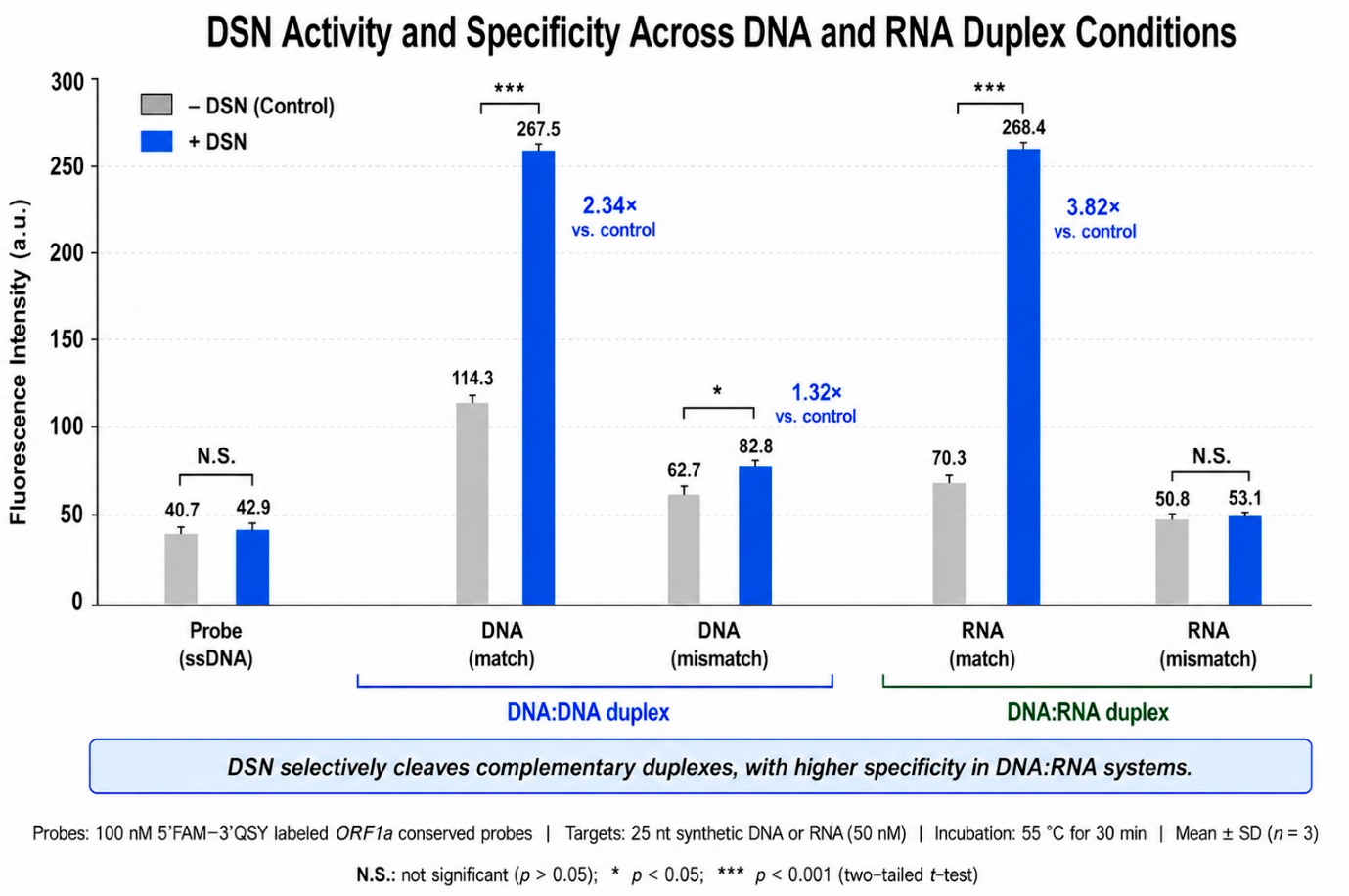
The activity and specificity of duplex-specific nuclease (DSN) were evaluated using FRET-labeled probes targeting the conserved ORF1a region. Assays were performed using synthetic 25 nt complementary DNA and RNA targets to assess DSN cleavage in the presence of DNA:DNA and DNA:RNA duplexes. In previous works, DSN has been found to have high fidelity with the ability to differentiate mismatched complexes down to 10 base-pairs for DNA:DNA hybrids and 15 base-pairs for DNA:RNA hybrids [26]. To further evaluate specificity, noncomplementary targets containing a 10 base-pair mismatch within the 25 nt sequence were also tested for both DNA and RNA analytes.
Five conditions were examined (Figure 2): (1) single-stranded DNA (ssDNA), (2) fully complementary DNA:DNA duplex, (3) mismatched DNA:DNA duplex, (4) fully complementary DNA:RNA duplex, and (5) mismatched DNA:RNA duplex. Samples were incubated at 55 °C for 30 min in the presence or absence of DSN, and endpoint fluorescence was measured to quantify probe cleavage [27,28].
Minimal fluorescence change was observed for ssDNA (Condition 1) and mismatched DNA:RNA duplexes (Condition 5), indicating negligible DSN activity under these conditions. In contrast, significant signal increases were observed for fully complementary DNA:DNA and DNA:RNA duplexes, with fluorescence enhancements of up to 2.34× and 3.82× increase, respectively, upon addition and incubation with DSN. Notably, the mismatched DNA:DNA duplex (Condition 3) also produced a measurable increase in signal, indicating partial cleavage activity despite the presence of sequence mismatches.

3.2. Multiplexed Probe Specificity and Cross-Reactivity Analysis

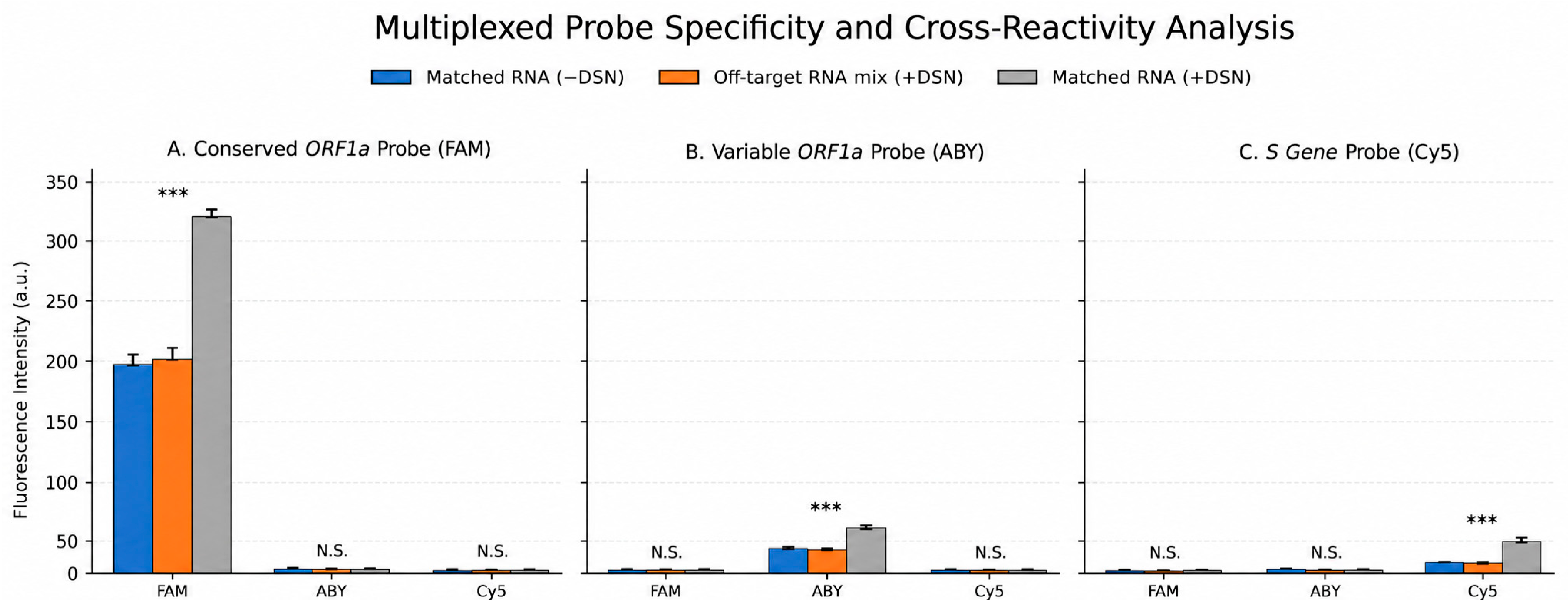
Due to potential interference from secondary structure in amplified products and the possibility of probe cross-reactivity under multiplexed conditions, probe specificity was evaluated using synthetic ~100 nt RNA fragments to mimic RT-RPA/T7 transcription products. Probes targeting the ORF1a conserved region, ORF1a variable region, and S gene variable region were labeled with FAM, ABY, and Cy5 fluorophores, respectively, and prepared at 50 nM. Each probe was incubated with either complementary target RNA or a mixture of off-target RNA fragments (total 10 nM) in the presence of 0.25 U DSN. Fluorescence was measured across all detection channels to assess both enzymatic specificity and spectral overlap.
As shown in Figure 3, each probe exhibited a strong fluorescence response exclusively in its corresponding detection channel in the presence of complementary RNA. Specifically, the ORF1a conserved (FAM) probe produced a dominant signal in the FAM channel with minimal signal observed in the ABY and Cy5 channels, corresponding to an approximate ~69-fold increase relative to off-target channels. Similarly, the ORF1a variable (ABY) probe demonstrated selective activation in the ABY channel (~12-fold), while the S gene (Cy5) probe exhibited the highest signal in the Cy5 channel (~7-fold), with negligible signal detected in non-target channels.
In contrast, incubation with mismatched RNA resulted in minimal fluorescence change across all channels, indicating limited nonspecific DSN activity and effective rejection of mismatched DNA:RNA duplexes. Importantly, fluorescence measured in non-corresponding channels remained at baseline levels under all conditions, demonstrating negligible spectral overlap between fluorophores.
Together, these results confirm that each probe maintains high sequence specificity and channel orthogonality under multiplexed conditions. The minimal cross-reactivity and low signal crosstalk observed across all probe sets support the feasibility of simultaneous detection of multiple SARS-CoV-2 genomic targets within a single assay.

3.3. DSN Specificity of Variable Region Detection of RT-RPA/T7 RNA Versus RT-RPA DNA

The inclusion of a T7 transcription step following RT-RPA increases overall assay time (1–16 h depending on input concentration and amplification efficiency), making it important to evaluate whether this step is necessary for downstream DSN-based detection. T7 transcription serves two primary functions: (i) enhancing signal output through target recycling and linear amplification of RNA substrates, and (ii) improving assay specificity by reducing nonspecific DSN activity observed in DNA:DNA duplexes. To assess its necessity, samples containing 102–104 copies of synthetic genomic SARS-CoV-2 RNA standards (Twist Bioscience) were amplified using either RT-RPA alone (DNA products) or RT-RPA followed by T7 transcription (RNA products), and subsequently subjected to DSN-mediated detection using region-specific probes.
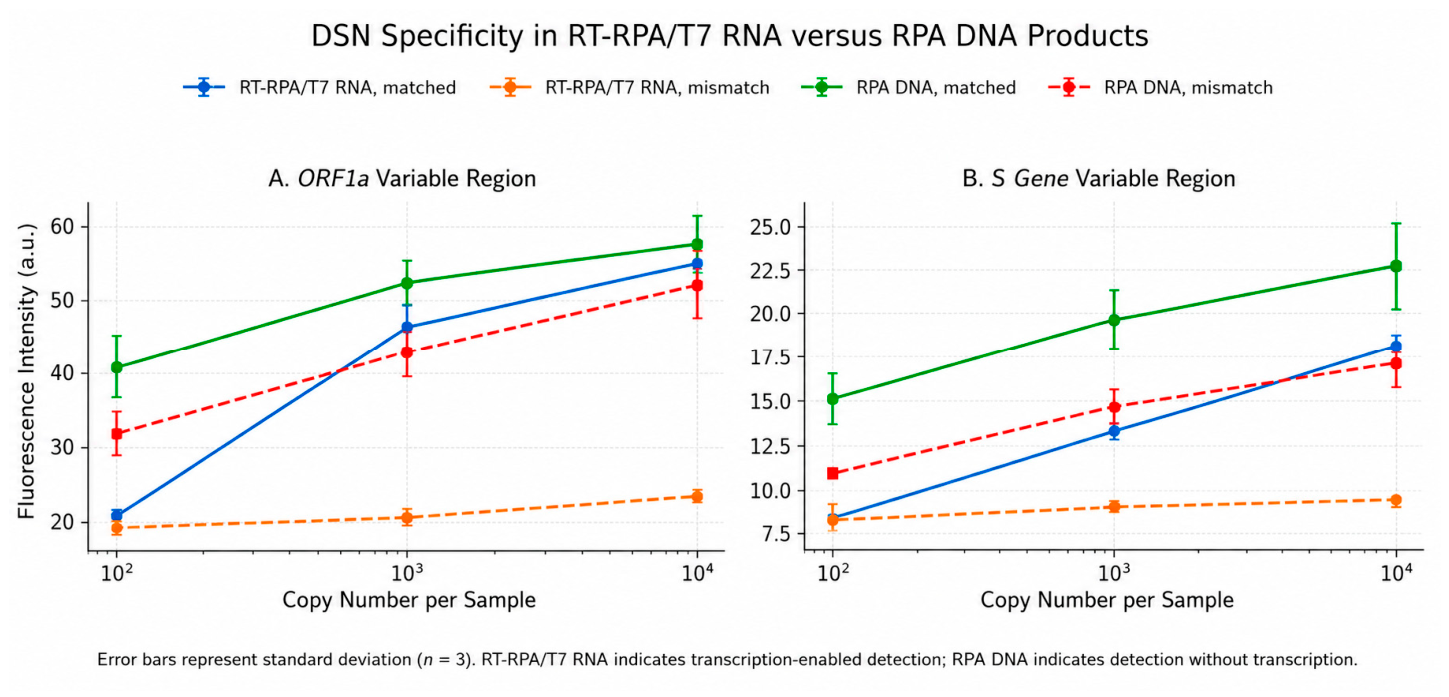
As demonstrated in Figure 4, DSN activity was observed in the presence of complementary duplexes for both DNA:DNA and DNA:RNA systems. However, a marked difference in specificity was observed for mismatched targets. In DNA-only samples (RT-RPA without transcription), DSN retained significant activity toward mismatched DNA:DNA duplexes, resulting in substantial nonspecific signal. In contrast, DSN activity was strongly suppressed in mismatched DNA:RNA duplexes generated following T7 transcription, consistent with the enzyme’s higher discrimination against mismatches in DNA:RNA hybrids.
A pronounced specificity gap was observed between RT-RPA DNA and RT-RPA/T7 RNA conditions, with mismatched DNA samples producing ~2–3× higher fluorescence signal than mismatched RNA samples at equivalent input concentrations. This difference was consistent across both ORF1a and S gene targets, indicating significantly improved mismatch discrimination in DNA:RNA duplexes.
Notably, the comparable signal intensity between RT-RPA DNA and RT-RPA/T7 RNA samples for matched targets indicates that DSN-mediated signal amplification occurs in both duplex types. However, the substantial reduction in nonspecific signal observed in RNA-based detection demonstrates that T7 transcription is critical for maintaining assay specificity. Without this step, DSN-mediated cleavage of mismatched DNA:DNA duplexes leads to elevated background signal and potential false-positive variant identification. Despite increasing total assay time, incorporation of the T7 transcription step is therefore essential for accurate variant discrimination in this platform, ensuring high specificity of DSN-mediated detection while minimizing nonspecific enzymatic activity.

3.4. DSN Detection of Target Regions from Wuhan-Hu-1 and B1.1.7 RNA

  • Conserved Region Detection for SARS-CoV-2 Confirmation
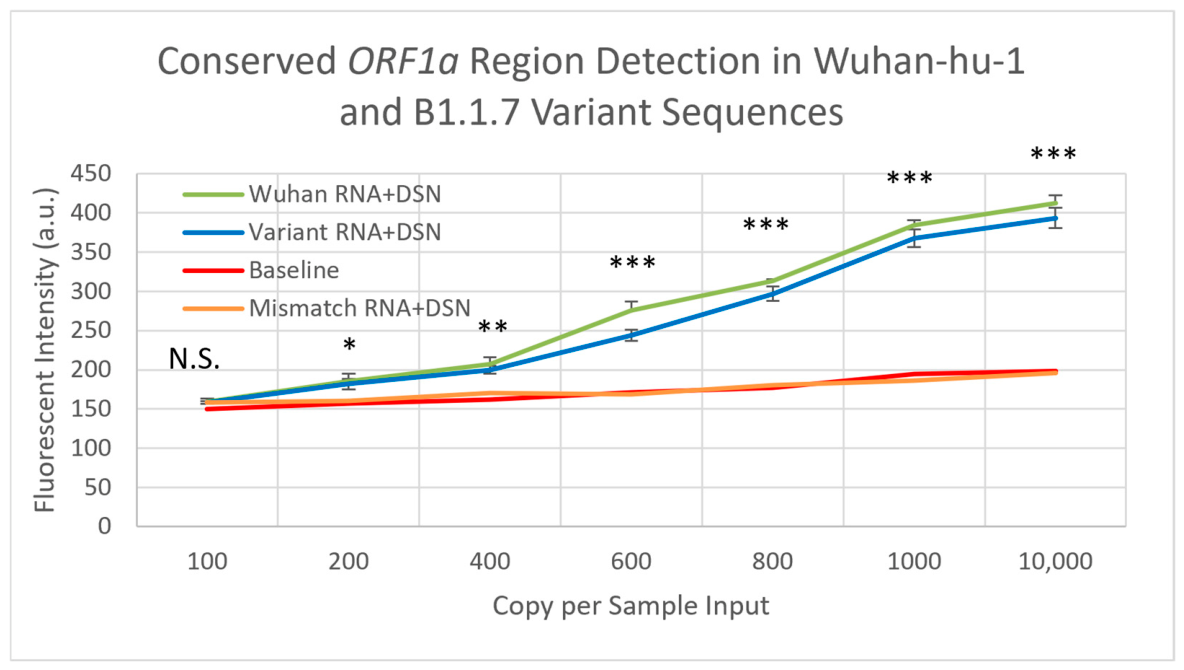
Detection of a conserved ORF1a region was used to confirm the presence of SARS-CoV-2 independent of variant type. As shown in Figure 5, both Wuhan-Hu-1 and B.1.1.7 probe sets produced a concentration-dependent increase in fluorescence with matched RNA targets, while mismatch and baseline controls remained near background levels. The consistent response from both Wuhan and variant probes against the conserved ORF1a region demonstrates that this target can serve as a reliable indicator of viral presence, independent of mutation status. This conserved-region detection provides an internal confirmation step within the assay, ensuring accurate identification of SARS-CoV-2 prior to downstream variant discrimination.
  • Variant Region Detection for Strain Differentiation
To evaluate the ability of the DSN-based platform to differentiate SARS-CoV-2 variants across a range of input concentrations, synthetic Wuhan-Hu-1 and B.1.1.7 RNA samples were prepared at 100–10,000 copies per reaction and subjected to RT-RPA followed by T7 transcription. Amplified products were incubated with 0.25 U DSN at 55 °C for 30 min, and fluorescence was measured using a SPECTRAmax® GEMINI XS plate reader at the corresponding excitation/emission wavelengths. These conditions were selected to assess assay performance near relevant detection limits reported for early molecular diagnostic platforms [29].
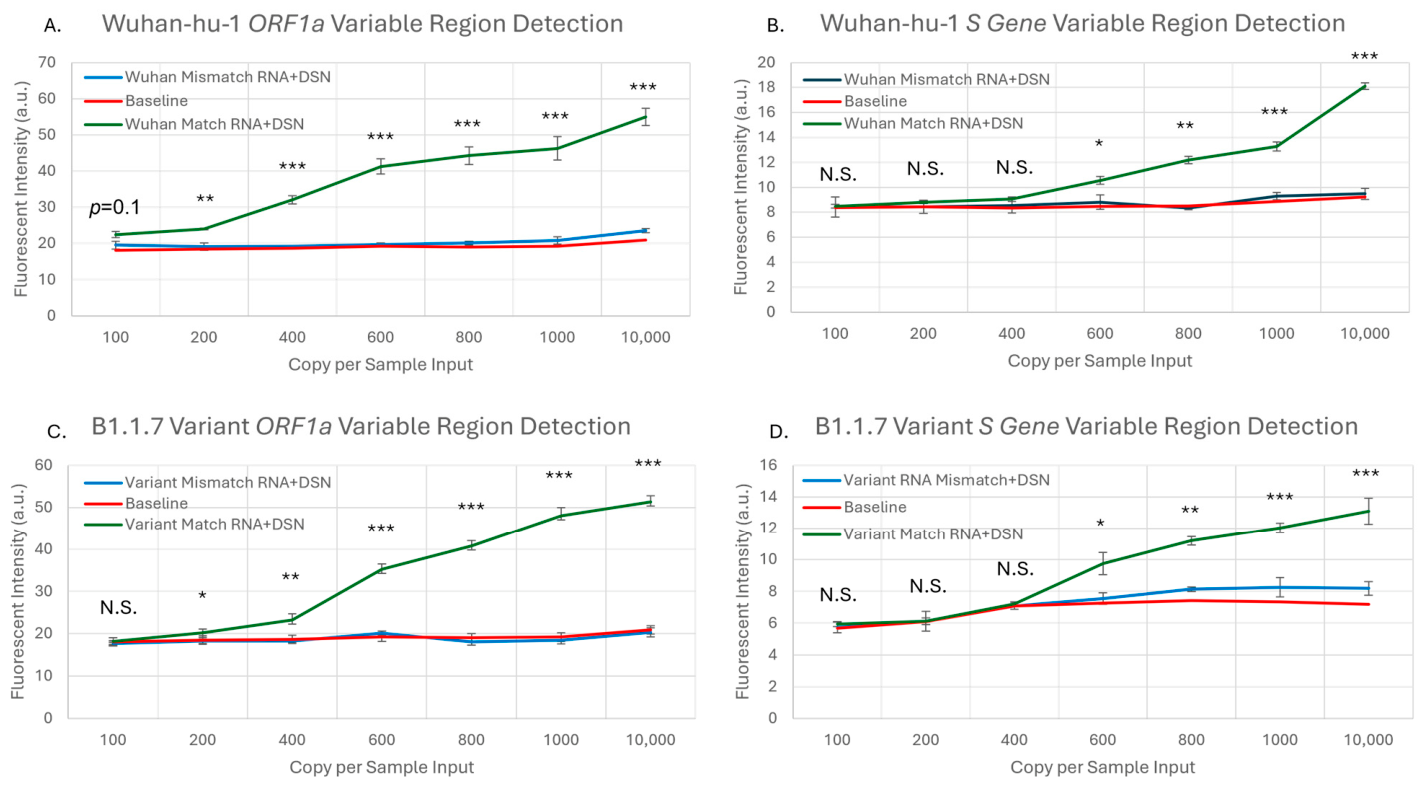
As shown in Figure 6, DSN-mediated detection of matched targets resulted in a concentration-dependent increase in fluorescence signal for both ORF1a and S gene variable regions, while mismatched targets consistently remained near baseline across all input levels. Baseline signal was defined using probe-only controls (0.1 μM), enabling quantification of DSN-specific cleavage in the presence of complementary DNA:RNA duplexes. Statistical analysis confirmed significant differences between matched and mismatched samples across most concentrations, demonstrating robust target discrimination.
For the ORF1a variable region, variant differentiation was achieved with high sensitivity, with statistically significant signal separation observed down to 200 copies per sample. In contrast, S gene detection exhibited reduced sensitivity, with reliable differentiation achieved down to 600 copies. This reduced performance is consistent with previously reported challenges in amplifying the spike region, particularly near the Δ69–70 deletion site, where reverse transcription efficiency is compromised and may contribute to S-gene target failure [30]. To mitigate this limitation, extended amplification conditions (2 h RT-RPA and up to 16 h T7 transcription) were employed to improve RNA yield. Despite these adjustments, S gene detection showed lower overall signal intensity and increased background relative to ORF1a, indicating inherent limitations associated with this target region.
Importantly, mismatched RNA samples exhibited minimal fluorescence increase in the presence of DSN across all tested conditions, further supporting the high specificity of DSN-mediated cleavage in DNA:RNA duplexes. Collectively, these results demonstrate that the DSN-based platform enables sensitive and specific discrimination of SARS-CoV-2 variants, with performance dependent on target region accessibility and amplification efficiency.

4. Discussion

This work presents a proof-of-concept nucleic acid sensing strategy that integrates RT-RPA, T7 transcription, and duplex-specific nuclease (DSN)-mediated fluorescence detection for sequence-specific discrimination of SARS-CoV-2 variants. The results demonstrate that DSN can be effectively incorporated into a biosensing framework to achieve highly selective detection of matched DNA:RNA duplexes, while suppressing signal generation from mismatched targets.
A key finding of this study is the strong dependence of DSN activity on duplex composition. While DSN exhibited cleavage activity in both DNA:DNA and DNA:RNA systems, mismatched DNA:DNA duplexes generated measurable background signal, whereas mismatched DNA:RNA duplexes remained near baseline. This behavior establishes DNA:RNA hybrids as the preferred substrate for achieving high specificity and highlights the importance of duplex chemistry in DSN-based sensing. The incorporation of T7 transcription was therefore critical, enabling conversion of amplified DNA into RNA and significantly improving mismatch discrimination without increasing signal output for matched targets.
An important aspect of this work is the demonstration of duplex-specific nuclease (DSN) as a tool for sequence-specific viral variant discrimination. Previous studies have primarily utilized DSN for microRNA analysis and general nucleic acid detection, leveraging its ability to selectively cleave DNA within duplexes while exhibiting strong mismatch discrimination [18,19]. In contrast, the present study applies DSN to the identification of SARS-CoV-2 variants through recognition of deletion-containing target sequences following RT-RPA and T7 transcription.
To our knowledge, this is the first report employing DSN-mediated cleavage of DNA:RNA heteroduplexes generated from amplified viral targets for discrimination of SARS-CoV-2 genomic variants. Notably, assay performance was evaluated using synthetic SARS-CoV-2 genomic RNA standards designed to mimic the full viral genome rather than isolated target oligonucleotides alone. This enabled assessment of RT-RPA, T7 transcription, and DSN-mediated detection within a larger and more complex nucleic acid background, providing a more realistic proof-of-concept for future application to clinical samples. These findings highlight DSN as a potentially valuable addition to the molecular diagnostic toolbox, particularly for applications requiring sequence-specific discrimination of pathogen variants. More broadly, the sequence-independent duplex recognition properties of DSN, coupled with its sensitivity to mismatches and deletions, may enable adaptation of this approach to other emerging pathogens and genetically diverse infectious agents.
Wuhan-Hu-1 and B.1.1.7 were selected as model targets because they contain well-characterized deletion signatures within both the ORF1a (Δ3675–3677) and S gene (Δ69–70) regions, providing a controlled system for evaluating DSN-mediated mismatch discrimination following RT-RPA and T7 transcription. The targeted deletions were widely utilized during the early stages of the pandemic as molecular markers for SARS-CoV-2 variant surveillance [31]. In particular, the Δ69–70 deletion was exploited through S-gene target failure (SGTF) in multiplex RT-qPCR assays, while both deletion sites were investigated in alternative nucleic acid detection platforms, including CRISPR-Cas12a-based screening strategies [15,31,32]. The use of these established genomic signatures therefore enabled evaluation of DSN-mediated variant discrimination against previously validated surveillance targets while providing a proof-of-concept framework that can be readily adapted to emerging variants through redesign of the DNA probe component without modification of the underlying detection chemistry.
From a sensing perspective, the platform demonstrates several desirable characteristics. First, low background signal was consistently observed for mismatched RNA targets, addressing a major limitation of isothermal amplification methods, which often suffer from nonspecific amplification. Second, the use of fluorophore–quencher probes combined with DSN-mediated cleavage enables target recycling and linear signal amplification, providing a measurable fluorescence response without the need for complex instrumentation. Third, multiplexed detection was achieved using spectrally distinct fluorophores, with minimal crosstalk between channels, supporting the feasibility of simultaneous multi-target sensing.
The assay further demonstrated concentration-dependent detection across the range of synthetic genomic RNA inputs evaluated in this study, with variant discrimination achieved down to 200 copies for the ORF1a region and 600 copies for the S gene region. The reduced sensitivity observed for the S gene is consistent with known challenges in amplifying this region, particularly near the Δ69–70 deletion, where secondary structure and sequence context can impair reverse transcription efficiency. Notably, early iterations of Thermo Fisher TaqPath COVID-19 Combo Kit commonly utilized S-gene target failure, or the failure to amplify the spike gene in the presence of Δ69–70 deletion, as a proxy marker for variants carrying the deletion [33]. These findings indicate that overall assay performance is influenced not only by DSN specificity but also by upstream amplification efficiency and target accessibility.
Despite these promising results, several limitations remain. The inclusion of a T7 transcription step increases assay time and may limit rapid deployment in point-of-care settings. Additionally, variability in amplification efficiency across target regions may impact reproducibility in multiplexed formats. Future optimization should focus on improving amplification uniformity, reducing assay time, and integrating the workflow into miniaturized or automated sensing platforms.
Relative to multiplexing capability, the current iteration of the assay also showed sizeable fluctuations in signal between the different fluorescent markers. In particular, the ORF1a conserved FAM probe exhibited elevated baseline fluorescence relative to the ABY and Cy5 probe systems. This behavior likely reflects probe-specific optical properties rather than nonspecific DSN activity. FAM is known to exhibit high fluorescence brightness due to its favorable quantum yield and extinction coefficient and is commonly recommended for low-abundance targets because of its strong signal output [34]. In contrast, differences in probe sequence composition may influence fluorophore–quencher interactions, as quenching efficiency depends strongly on fluorophore–quencher proximity, probe conformation, and secondary structure. A/T-rich probe regions may require longer probe designs and can alter fluorophore–quencher spacing, potentially reducing quenching efficiency and increasing baseline fluorescence [35,36]. Despite the elevated baseline, matched targets produced statistically significant fluorescence increases relative to both mismatched and –DSN controls, supporting the specificity of DSN-mediated detection.
Direct comparison against RT-qPCR was also not performed in the present study and therefore analytical sensitivity and diagnostic accuracy relative to clinical gold-standard methods remain to be established. Future studies incorporating clinical specimens and side-by-side RT-qPCR benchmarking will be required to determine the practical diagnostic performance of the platform.
Although the current implementation of the assay is not yet optimized for deployment as a low-cost point-of-care diagnostic, the results provide an initial assessment of DSN-mediated detection as a potential screening strategy for decentralized settings. The workflow presently requires multiple sequential steps, including RT-RPA, T7 transcription, and DSN-mediated detection, which increase assay complexity and reliance on laboratory reagents and instrumentation. Consequently, the present study should be viewed primarily as a proof-of-concept demonstration rather than a fully developed diagnostic platform.
Despite these limitations, DSN-based detection possesses several characteristics that may support future adaptation to decentralized and resource-limited environments. DSN reactions are performed under isothermal conditions, eliminating the need for thermal cycling instrumentation and reducing equipment requirements relative to conventional RT-PCR workflows. In addition, previous studies have successfully integrated DSN-mediated sensing with a variety of amplification and detection strategies, including one-pot and single-step assay formats capable of reducing workflow complexity and achieving turnaround times of approximately 30–60 min [37,38]. Furthermore, DSN-based nucleic acid sensing has been incorporated into lateral-flow and microfluidic platforms for microRNA detection, highlighting the adaptability of the technology to portable and user-friendly diagnostic formats [39,40]. Collectively, these prior developments suggest that further optimization and workflow integration may enable DSN-based sensing strategies to serve as practical tools for decentralized nucleic acid screening applications.
Within the broader context of nucleic acid biosensing, DSN offers a complementary alternative to CRISPR-based detection systems. Unlike CRISPR/Cas platforms, DSN does not require guide RNA design or sequence-specific recognition motifs, enabling greater flexibility in probe design and target selection. This simplicity, combined with strong mismatch discrimination in DNA:RNA duplexes, supports the potential of DSN-mediated sensing as a versatile platform for mutation-specific detection.
Overall, this study establishes DSN-mediated detection as a viable sensing mechanism for sequence-specific RNA analysis, with demonstrated specificity, multiplexing capability, and compatibility with isothermal amplification. Although further optimization and clinical validation are required, the results demonstrate the feasibility of using DSN-mediated mismatch discrimination for viral variant screening and highlight the potential of DSN-based isothermal sensing strategies as a foundation for the development of next-generation biosensors for pathogen screening and variant surveillance.

Author Contributions

Conceptualization: A.S., M.J.M., R.N. and P.F.; Methodology: A.S., L.K., E.E.H., R.N. and P.F.; Validation: A.S. and E.E.H.; Formal analysis: A.S. and L.K.; Investigation: A.S. and E.E.H.; Resources: M.J.M. and L.K.; Data curation: A.S.; Writing—original draft: A.S.; Writing—review and editing: L.K.; Supervision, M.J.M., L.K. and E.E.H.; Project administration: M.J.M., L.K. and E.E.H.; Funding acquisition: M.J.M. All authors have read and agreed to the published version of the manuscript.

Funding

This work was supported by funding from AMDI Inc. (Autonomous Medical Devices Incorporated).

Institutional Review Board Statement

Not Applicable.

Informed Consent Statement

Not Applicable.

Data Availability Statement

The raw data supporting the conclusions of this article will be made available by the authors on request. Further inquiries can be directed to the corresponding authors.

Acknowledgments

We acknowledge Horacio Kido of University of California, Irvine for his contribution of fluorescent imaging instruments and expertise for bioassay sample analysis in this work. We also acknowledge Kimya Pezeshki of University of California, Irvine for experimentation for feasibility and optimization of bioassay conditions.

Conflicts of Interest

The authors declare no conflicts of interest.

References

  1. Cascella, M.; Rajnik, M.; Aleem, A.; Dulebohn, S.C.; Di Napoli, R. Features, evaluation, and treatment of coronavirus (COVID-19). In StatPearls; StatPearls Publishing: Treasure Island, FL, USA, 2022. [Google Scholar]
  2. Giri, A.K.; Rana, D.R. Charting the challenges behind the testing of COVID-19 in developing countries: Nepal as a case study. Biosaf. Health 2020, 2, 53–56. [Google Scholar] [CrossRef]
  3. Faramarzi, A.; Norouzi, S.; Dehdarirad, H.; Aghlmand, S.; Yusefzadeh, H.; Javan-Noughabi, J. The global economic burden of COVID-19 disease: A comprehensive systematic review and meta-analysis. Syst. Rev. 2024, 13, 68. [Google Scholar] [CrossRef]
  4. Qasmieh, S.A.; Robertson, M.M.; Teasdale, C.A.; Kulkarni, S.G.; Jones, H.E.; Larsen, D.A.; Dennehy, J.J.; McNairy, M.; Borrell, L.N.; Nash, D. The prevalence of SARS-CoV-2 infection and other public health outcomes during the BA.2/BA.2.12.1 surge, New York City, April–May 2022. Commun. Med. 2023, 3, 92. [Google Scholar] [CrossRef] [PubMed]
  5. Song, Q.; Sun, X.; Dai, Z.; Gao, Y.; Gong, X.; Zhou, B.; Wu, J.; Wen, W. Point-of-care testing detection methods for COVID-19. Lab Chip 2021, 21, 1634–1660. [Google Scholar] [CrossRef] [PubMed]
  6. Chakraborty, S. Democratizing nucleic acid-based molecular diagnostic tests for infectious diseases at resource-limited settings–from point of care to extreme point of care. Sens. Diagn. 2024, 3, 536–561. [Google Scholar] [CrossRef]
  7. Thwala, L.N.; Ndlovu, S.C.; Mpofu, K.T.; Lugongolo, M.Y.; Mthunzi-Kufa, P. Nanotechnology-based diagnostics for diseases prevalent in developing countries: Current advances in point-of-care tests. Nanomaterials 2023, 13, 1247. [Google Scholar] [CrossRef]
  8. Lee, J.; Song, J.U.; Shim, S.R. Comparing the diagnostic accuracy of rapid antigen detection tests to real time polymerase chain reaction in the diagnosis of SARS-CoV-2 infection: A systematic review and meta-analysis. J. Clin. Virol. 2021, 144, 104985. [Google Scholar] [CrossRef]
  9. Rezaei, M.; Razavi Bazaz, S.; Zhand, S.; Sayyadi, N.; Jin, D.; Stewart, M.P.; Ebrahimi Warkiani, M. Point of Care Diagnostics in the Age of COVID-19. Diagnostics 2020, 11, 9. [Google Scholar] [CrossRef]
  10. Becherer, L.; Borst, N.; Bakheit, M.; Frischmann, S.; Zengerle, R.; von Stetten, F. Loop-mediated isothermal amplification (LAMP)–review and classification of methods for sequence-specific detection. Anal. Methods 2020, 12, 717–746. [Google Scholar] [CrossRef]
  11. Ghosh, P.; Chowdhury, R.; Hossain, M.E.; Hossain, F.; Miah, M.; Rashid, U.; Baker, J.; Rahman, M.Z.; Rahman, M.; Ma, X.; et al. Evaluation of recombinase-based isothermal amplification assays for point-of-need detection of SARS-CoV-2 in resource-limited settings. Int. J. Infect. Dis. 2022, 114, 105–111. [Google Scholar] [CrossRef]
  12. Chaibun, T.; Puenpa, J.; Ngamdee, T.; Boonapatcharoen, N.; Athamanolap, P.; O’Mullane, A.P.; Vongpunsawad, S.; Poovorawan, Y.; Lee, S.Y.; Lertanantawong, B. Rapid electrochemical detection of coronavirus SARS-CoV-2. Nat. Commun. 2021, 12, 802. [Google Scholar] [CrossRef] [PubMed]
  13. Khan, P.; Aufdembrink, L.M.; Engelhart, A.E. Isothermal SARS-CoV-2 diagnostics: Tools for enabling distributed pandemic testing as a means of supporting safe reopenings. ACS Synth. Biol. 2020, 9, 2861–2880. [Google Scholar] [CrossRef]
  14. Kumar, M.; Gulati, S.; Ansari, A.H.; Phutela, R.; Acharya, S.; Kathpalia, P.; Kanakan, A.; Maurya, R.; Vasudevan, J.S.; Murali, A.; et al. RAY: CRISPR diagnostic for rapid and accurate detection of SARS-CoV2 variants on a paper strip. medRxiv 2021. [Google Scholar] [CrossRef]
  15. Sun, Y.; Yu, L.; Liu, C.; Ye, S.; Chen, W.; Li, D.; Huang, W. One-tube SARS-CoV-2 detection platform based on RT-RPA and CRISPR/Cas12a. J. Transl. Med. 2021, 19, 74. [Google Scholar] [CrossRef]
  16. Gerasimova, Y.V.; Kolpashchikov, D.M. Enzyme-assisted target recycling (EATR) for nucleic acid detection. Chem. Soc. Rev. 2014, 43, 6405–6438. [Google Scholar] [CrossRef] [PubMed]
  17. Shagin, D.A.; Rebrikov, D.V.; Kozhemyako, V.B.; Altshuler, I.M.; Shcheglov, A.S.; Zhulidov, P.A.; Bogdanova, E.A.; Staroverov, D.B.; Rasskazov, V.A.; Lukyanov, S. A novel method for SNP detection using a new duplex-specific nuclease from crab hepatopancreas. Genome Res. 2002, 12, 1935–1942. [Google Scholar] [CrossRef]
  18. Qiu, X.; Zhang, H.; Yu, H.; Jiang, T.; Luo, Y. Duplex-specific nuclease-mediated bioanalysis. Trends Biotechnol. 2015, 33, 180–188. [Google Scholar] [CrossRef]
  19. Tan, L.; Xu, L.; Liu, J.W.; Tang, L.J.; Tang, H.; Yu, R. Duplex-specific nuclease-mediated target recycling amplification for fluorescence detection of microRNA. Anal. Methods 2019, 11, 200–204. [Google Scholar] [CrossRef]
  20. Liu, M.; Li, H.; Jia, Y.; Mak, P.I.; Martins, R.P. SARS-CoV-2 RNA detection with duplex-specific nuclease signal amplification. Micromachines 2021, 12, 197. [Google Scholar] [CrossRef]
  21. Han, G.; Deng, W.; Lyu, Q.; Ma, Q.; Qiao, L. Multiplexed discrimination of SARS-CoV-2 variants via duplex-specific nuclease combined MALDI-TOF MS. Anal. Bioanal. Chem. 2024, 416, 1833–1842. [Google Scholar] [CrossRef]
  22. Zhao, C.; Tang, Y.; Xu, M.; Wang, Y.; Luo, B.; Wang, P.; Gao, S. A highly sensitive on-site duplex genotyping method dRPG for simultaneous detection of SARS-CoV-2 key mutations with single nucleotide resolution. Sens. Actuators B Chem. 2024, 418, 136238. [Google Scholar] [CrossRef]
  23. Ghosh, M.; Isago, K.; Dasgupta, U.; Shimizu, H.; Suzuki, T.; Vidic, J.; Chowdhury, A.D.; Park, E.Y. Duplex-specific nuclease assisted magnetic nanoprobe for cyclic amplified RNA detection. Sens. Actuators B Chem. 2024, 399, 134833. [Google Scholar] [CrossRef]
  24. Zhou, K.; Dai, J. A duplex-specific nuclease based electrochemical biosensor for the assay of SARS-CoV-2 RdRp RNA. Anal. Biochem. 2023, 661, 114983. [Google Scholar] [CrossRef]
  25. Patchsung, M.; Jantarug, K.; Pattama, A.; Aphicho, K.; Suraritdechachai, S.; Meesawat, P.; Sappakhaw, K.; Leelahakorn, N.; Ruenkam, T.; Wongsatit, T.; et al. Clinical validation of a Cas13-based assay for the detection of SARS-CoV-2 RNA. Nat. Biomed. Eng. 2020, 4, 1140–1149. [Google Scholar] [CrossRef]
  26. Tahamtan, A.; Ardebili, A. Real-time RT-PCR in COVID-19 detection: Issues affecting the results. Expert Rev. Mol. Diagn. 2020, 20, 453–454. [Google Scholar] [CrossRef] [PubMed]
  27. Yin, B.C.; Liu, Y.Q.; Ye, B.C. One-step, multiplexed fluorescence detection of microRNAs based on duplex-specific nuclease signal amplification. J. Am. Chem. Soc. 2012, 134, 5064–5067. [Google Scholar] [CrossRef] [PubMed]
  28. Anisimova, V.E.; Rebrikov, D.V.; Shagin, D.A.; Kozhemyako, V.B.; Menzorova, N.I.; Staroverov, D.B.; Ziganshin, R.; Vagner, L.L.; Rasskazov, V.A.; Lukyanov, S.A.; et al. Isolation, characterization and molecular cloning of duplex-specific nuclease from the hepatopancreas of the Kamchatka crab. BMC Biochem. 2008, 9, 14. [Google Scholar] [CrossRef] [PubMed]
  29. Arnaout, R.; Lee, R.A.; Lee, G.R.; Callahan, C.; Yen, C.F.; Smith, K.P.; Arora, R.; Kirby, J.E. SARS-CoV2 testing: The limit of detection matters. bioRxiv 2020. [Google Scholar] [CrossRef]
  30. Brown, K.A.; Gubbay, J.; Hopkins, J.; Patel, S.; Buchan, S.A.; Daneman, N.; Goneau, L.W. S-gene target failure as a marker of variant B. 1.1. 7 among SARS-CoV-2 isolates in the greater Toronto area, December 2020 to March 2021. JAMA 2021, 325, 2115–2116. [Google Scholar] [CrossRef]
  31. European Centre for Disease Prevention and Control; World Health Organization—Regional Office for Europe. Methods for the Detection and Identification of SARS-CoV-2 Variants; World Health Organization Regional—Office for Europe: Copenhagen, Denmark, 2021; Available online: https://iris.who.int/handle/10665/340067 (accessed on 6 June 2026).
  32. Vogels, C.B.; Breban, M.I.; Ott, I.M.; Alpert, T.; Petrone, M.E.; Watkins, A.E.; Kalinich, C.C.; Earnest, R.; Rothman, J.E.; de Jesus, J.G.; et al. Multiplex qPCR discriminates variants of concern to enhance global surveillance of SARS-CoV-2. PLoS Biol. 2021, 19, e3001236. [Google Scholar] [CrossRef]
  33. McMillen, T.; Jani, K.; Robilotti, E.V.; Kamboj, M.; Babady, N.E. The spike gene target failure (SGTF) genomic signature is highly accurate for the identification of Alpha and Omicron SARS-CoV-2 variants. Sci. Rep. 2022, 12, 18968. [Google Scholar] [CrossRef] [PubMed]
  34. Fam, T.K.; Klymchenko, A.S.; Collot, M. Recent advances in fluorescent probes for lipid droplets. Materials 2018, 11, 1768. [Google Scholar] [CrossRef]
  35. Livak, K.J.; Flood, S.J.; Marmaro, J.; Giusti, W.; Deetz, K. Oligonucleotides with fluorescent dyes at opposite ends provide a quenched probe system useful for detecting PCR product and nucleic acid hybridization. Genome Res. 1995, 4, 357–362. [Google Scholar] [CrossRef]
  36. Zimmers, Z.A.; Adams, N.M.; Gabella, W.E.; Haselton, F.R. Fluorophore-quencher interactions effect on hybridization characteristics of complementary oligonucleotides. Anal. Methods 2019, 11, 2862–2867. [Google Scholar] [CrossRef]
  37. Wei, H.; Peng, Y.; Bai, Z.; Rong, Z.; Wang, S. Duplex-specific nuclease signal amplification-based fluorescent lateral flow assay for the point-of-care detection of microRNAs. Analyst 2021, 146, 558–564. [Google Scholar] [CrossRef]
  38. Shandilya, R.; Ranjan, S.; Khare, S.; Bhargava, A.; Goryacheva, I.Y.; Mishra, P.K. Point-of-care diagnostics approaches for detection of lung cancer-associated circulating miRNAs. Drug Discov. Today 2021, 26, 1501–1509. [Google Scholar] [CrossRef]
  39. Wang, N.; Zhang, J.; Xiao, B.; Sun, X.; Xie, R.; Chen, A. Recent advances in the rapid detection of microRNA with lateral flow assays. Biosens. Bioelectron. 2022, 211, 114345. [Google Scholar] [CrossRef] [PubMed]
  40. Ying, N.; Ju, C.; Sun, X.; Li, L.; Chang, H.; Song, G.; Li, Z.; Wan, J.; Dai, E. Lateral flow nucleic acid biosensor for sensitive detection of microRNAs based on the dual amplification strategy of duplex-specific nuclease and hybridization chain reaction. PLoS ONE 2017, 12, e0185091. [Google Scholar] [CrossRef] [PubMed]
Figure 1. Target regions in the Wuhan-Hu-1 reference genome (NC_045512.2) used for SARS-CoV-2 detection and differentiation of the B.1.1.7 (Alpha) variant. Three genomic targets were utilized: (1) a conserved region within ORF1a (nsp3; positions 6512–6537) for SARS-CoV-2 detection, and (2) the ORF1a Δ3675–3677 deletion in nsp6 and (3) the spike (S) gene Δ69–70 deletion for B.1.1.7 variant differentiation.
Chemosensors 14 00135 g001
Figure 2. Validation of duplex-specific nuclease (DSN) activity and specificity using 5′FAM–3′QSY-labeled probes targeting the ORF1a conserved region. Probes (100 nM) were incubated with synthetic 25 nt DNA or RNA targets (50 nM) in the presence or absence of 0.1 U DSN at 55 °C for 30 min. Fluorescence was measured using a SPECTRAmax® GEMINI XS plate reader (λ_ex = 485 nm, λ_em = 538 nm). Data represent mean fluorescence intensity ± standard deviation (n = 3). Conditions (left to right): (1) probe with nonspecific sheared duplex DNA, (2) probe with complementary DNA, (3) probe with noncomplementary DNA, (4) probe with complementary RNA, and (5) probe with noncomplementary RNA. Fold change calculated relative to –DSN control.
Chemosensors 14 00135 g002
Figure 3. Evaluation of probe specificity and cross-reactivity under multiplexed conditions using synthetic RNA targets. Probes targeting the ORF1a conserved region (FAM), ORF1a variable region (ABY), and S gene variable region (Cy5) were incubated with either complementary target RNA or a mixture of mismatched, off-target RNA fragments (total 10 nM) in the presence of 0.25 U duplex-specific nuclease (DSN). Fluorescence intensity was measured across all detection channels to assess sequence specificity and spectral overlap. Each probe exhibited strong signal exclusively in its corresponding fluorescence channel in the presence of matched RNA, with minimal signal observed in non-target channels, corresponding to high specificity ratios (~69× for FAM, ~12× for ABY, and ~7× for Cy5). In contrast, samples containing mismatched RNA showed negligible fluorescence increase across all channels, indicating minimal nonspecific DSN activity. Data represent mean ± standard deviation (n = 3). These results demonstrate minimal cross-reactivity and negligible spectral crosstalk, supporting the suitability of the probe set for multiplexed detection of SARS-CoV-2 target regions. *** p < 0.005.
Chemosensors 14 00135 g003
Figure 4. Comparison of DSN specificity for detection of variable regions using RT-RPA DNA and RT-RPA/T7-transcribed RNA. Fluorescence intensity was measured across increasing target copy numbers (102–104 copies) for both matched and mismatched targets in the ORF1a (A) and S gene (B) regions. Solid lines represent RT-RPA/T7 RNA products, while dashed lines represent RT-RPA DNA products. Matched targets exhibit comparable signal intensity between RNA and DNA conditions, indicating effective DSN-mediated signal amplification in both duplex types. However, mismatched targets show substantially elevated signal in RT-RPA DNA samples (61.18–143.87% above baseline), whereas RT-RPA/T7 RNA samples maintain low nonspecific signal (≤9.57% above baseline), demonstrating improved mismatch discrimination in DNA:RNA duplexes. Data represent mean ± SD (n = 3).
Chemosensors 14 00135 g004
Figure 5. DSN-mediated detection of the conserved ORF1a region across Wuhan-Hu-1 and B.1.1.7 RNA samples. Fluorescence intensity is shown as a function of input RNA copy number following RT-RPA and T7 transcription, with subsequent incubation using 0.25 U duplex-specific nuclease (DSN) at 55 °C for 30 min. Matched RNA targets from both Wuhan-Hu-1 and B.1.1.7 strains produced a concentration-dependent increase in fluorescence signal, while mismatched RNA and baseline (probe-only) controls remained near background levels. Error bars represent standard deviation from triplicate measurements. Statistical significance was determined relative to mismatch RNA controls using two-tailed t-tests (*** p < 0.005, ** p < 0.01, * p < 0.05, N.S. p > 0.05).
Chemosensors 14 00135 g005
Figure 6. DSN-mediated detection of SARS-CoV-2 variable regions using Wuhan and variant probe sets. Panels show fluorescence signal as a function of input RNA copy number for (A) ORF1a variable region with Wuhan probe, (B) S gene variable region with Wuhan probe, (C) ORF1a variable region with variant probe, and (D) S gene variable region with variant probe. Matched targets exhibit increasing fluorescence intensity with increasing copy number, while mismatched targets remain near baseline, demonstrating high specificity of DSN-mediated cleavage. Statistical significance was determined relative to mismatch RNA controls using two-tailed t-tests (*** p < 0.005, ** p < 0.01, * p < 0.05, N.S. p > 0.05). Detection sensitivity was achieved down to 200 copies for ORF1a and 600 copies for the S gene.
Chemosensors 14 00135 g006
Table 1. Probes and Sequences Used in the Validation of Duplex-specific Nuclease Enzyme Activity and Specificity Conditions.
SARS-CoV-2 StrainRNA RegionSequence TypeSequence
Wuhan-Hu-1
GenBank® Accession Code: MN908947.3
Open Reading Frame Conserved RegionDNA Detection ProbeFAM 5′ CCAACCTCTTCTGTAATTTTTAAAC 3′ QSY
DNA (match)5′ GTTTAAAAATTACAGAAGAGGTTGG 3′
DNA (mismatch)5′ ACTAGTTTGTCTGGTTTTAAGCTAA 3′
RNA (match)5′ GUUUAAAAAUUACAGAAGAGGUUGG 3′
RNA (mismatch)5′ ACUAGUUUGUCUGGUUUUAAGCUAA 3′
Table 2. Probes and RNA Sequences Used in Multiplexed Probe Specificity and Cross-Reactivity Analysis.
SARS-CoV-2 StrainRNA RegionSynthetic RNA FragmentDNA Detection Probe
Wuhan-Hu-1
GenBank® Accession Code: MN908947.3
Open Reading Frame Conserved Region5′ GUAGGAGACAUUAUACUUAAACCAGCAAAUAAUAGUUUAAAAAUUACAGAAGAGGUUGGCCACACAGAUCUAAUGGCUGCUUAUGUAGACAAUU 3′FAM 5′ CCAACCTCTTCTGTAATTTTTAAAC 3′ QSY
Open Reading Frame Variable Region5′ GUGAUGCGUAUUAUGACAUGGUUGGAUAUGGUUGAUACUAGUUUGUCUGGUUUUAAGCUAAAAGACUGUGUUAUGUAUGCAUCAGCUGUAGUGUUACUAAU 3′ ABY 5′ TTAGCTTAAAACCAGACAAACTAGT 3′ QSY
S Gene Variable Region5′ GACUUGUUCUUACCUUUCUUUUCCAAUGUUACUUGGUUCCAUGCUAUACAUGUCUCUGGGACCAAUGGUACUAAGAGGUUUGAUAACCCUGUCCUACCAUUUAAUGAUGGUGUUUAUUUUG 3′Cy5 5′ TCCCAGAGACATGTATAGCATGGAA 3′ BHQ
Table 3. RT-RPA/T7 RNA Primers and Probes. The T7 transcription promoter sequence is inserted at the 5′ end of the forward primer.
SARS-CoV-2 StrainRNA RegionForward PrimerReverse PrimerDNA Detection Probe
Wuhan-Hu-1
GenBank® Accession Code: MN908947.3
Open Reading Frame Conserved RegionTAATACGACTCACTATAGGGTAGGAGACATTATACTTAAACCAGCAAATAATAATTGTCTACATAAGCAGCCATTAGATCTGTFAM 5′ CCAACCTCTTCTGTAATTTTTAAAC 3′ QSY
Open Reading Frame Variable RegionTAATACGACTCACTATAGGGTGATGCGTATTATGACATGGTTGGATATGATTAGTAACACTACAGCTGATGCATACATAACAABY 5′ TTAGCTTAAAACCAGACAAACTAGT 3′ QSY
S Gene Variable RegionTAATACGACTCACTATAGGGACTTGTTCTTACCTTTCTTTTCCAATGTTACTCAAAATAAACACCATCATTAAATGGTAGGACACy5 5′ TCCCAGAGACATGTATAGCATGGAA 3′ BHQ
B.1.1.7
GenBank® Accession Code:
EPI_ISL_710528
Open Reading Frame Conserved RegionTAATACGACTCACTATAGGGTAGGAGACATTATACTTAAACCAGCAAATAATAATTGTCTACATAAGCAGCCATTAGATCTGTFAM 5′ CCAACCTCTTCTGTAATTTTTAAAC 3′ QSY
Open Reading Frame Variable RegionTAATACGACTCACTATAGGGTGATGCGTATTATGACATGGTTGGATATGATTAGTAACACTACAGCTGATGCATACATAACAABY 5′ AGTCTTTTAGCTTCAAACTAGTATC 3′ QSY
S Gene Variable RegionTAATACGACTCACTATAGGGACTTGTTCTTACCTTTCTTTTCCAATGTTACTCAAAATAAACACCATCATTAAATGGTAGGACACy5 5′ ATTGGTCCCAGAGATAGCATGGAAC 3′ BHQ
Table 4. RT-RPA Predicted DNA Products.
SARS-CoV-2 StrainRNA RegionRT-RPA DNA Fragment
Wuhan-Hu-1
GenBank® Accession Code: MN908947.3
Open Reading Frame Conserved Region5′ TAATACGACTCACTATAGGGTAGGAGACATTATACTTAAACCAGCAAATAATAGTTTAAAAATTACAGAAGAGGTTGGCCACACAGATCTAATGGCTGCTTATGTAGACAATT 3′
Open Reading Frame Variable Region5′ TAATACGACTCACTATAGGGTGATGCGTATTATGACATGGTTGGATATGGTTGATACTAGTTTGTCTGGTTTTAAGCTAAAAGACTGTGTTATGTATGCATCAGCTGTAGTGTTACTAAT 3′
S Gene Variable Region5′ TAATACGACTCACTATAGGGACTTGTTCTTACCTTTCTTTTCCAATGTTACTTGGTTCCATGCTATACATGTCTCTGGGACCAATGGTACTAAGAGGTTTGATAACCCTGTCCTACCATTTAATGATGGTGTTTATTTTG 3′
B.1.1.7
GenBank® Accession Code:
EPI_ISL_710528
Open Reading Frame Conserved Region5′ TAATACGACTCACTATAGGGTAGGAGACATTATACTTAAACCAGCAAATAATAGTTTAAAAATTACAGAAGAGGTTGGCCACACAGATCTAATGGCTGCTTATGTAGACAATT 3′
Open Reading Frame Variable Region5′ TAATACGACTCACTATAGGGTGATGCGTATTATGACATGGTTGGATATGGTTGATACTAGTTTGAAGCTAAAAGACTGTGTTATGTATGCATCAGCTGTAGTGTTACTAAT 3′
S Gene Variable Region5′ TAATACGACTCACTATAGGGACTTGTTCTTACCTTTCTTTTCCAATGTTACTTGGTTCCATGCTATCTCTGGGACCAATGGTACTAAGAGGTTTGATAACCCTGTCCTACCATTTAATGATGGTGTTTATTTTG 3′
Table 5. RT-RPA/T7 Transcription Predicted RNA Products.
SARS-CoV-2 StrainRNA RegionRT-RPA/T7 Transcription RNA Fragment
Wuhan-Hu-1
GenBank® Accession Code: MN908947.3
Open Reading Frame Conserved Region5′ GUAGGAGACAUUAUACUUAAACCAGCAAAUAAUAGUUUAAAAAUUACAGAAGAGGUUGGCCACACAGAUCUAAUGGCUGCUUAUGUAGACAAUU 3′
Open Reading Frame Variable Region5′ GUGAUGCGUAUUAUGACAUGGUUGGAUAUGGUUGAUACUAGUUUGUCUGGUUUUAAGCUAAAAGACUGUGUUAUGUAUGCAUCAGCUGUAGUGUUACUAAU 3′
S Gene Variable Region5′ GACUUGUUCUUACCUUUCUUUUCCAAUGUUACUUGGUUCCAUGCUAUACAUGUCUCUGGGACCAAUGGUACUAAGAGGUUUGAUAACCCUGUCCUACCAUUUAAUGAUGGUGUUUAUUUUG 3′
B.1.1.7
GenBank® Accession Code:
EPI_ISL_710528
Open Reading Frame Conserved Region5′ GUAGGAGACAUUAUACUUAAACCAGCAAAUAAUAGUUUAAAAAUUACAGAAGAGGUUGGCCACACAGAUCUAAUGGCUGCUUAUGUAGACAAUU 3′
Open Reading Frame Variable Region5′ GUGAUGCGUAUUAUGACAUGGUUGGAUAUGGUUGAUACUAGUUUGAAGCUAAAAGACUGUGUUAUGUAUGCAUCAGCUGUAGUGUUACUAAU 3′
S Gene Variable Region5′ GACUUGUUCUUACCUUUCUUUUCCAAUGUUACUUGGUUCCAUGCUAUCUCUGGGACCAAUGGUACUAAGAGGUUUGAUAACCCUGUCCUACCAUUUAAUGAUGGUGUUUAUUUUG 3′
Disclaimer/Publisher’s Note: The statements, opinions and data contained in all publications are solely those of the individual author(s) and contributor(s) and not of MDPI and/or the editor(s). MDPI and/or the editor(s) disclaim responsibility for any injury to people or property resulting from any ideas, methods, instructions or products referred to in the content.