1. Introduction
TEA is a typical nitrogen-containing VOC widely employed in industrial scenarios including pharmaceutical synthesis, pesticide production, epoxy resin curing, and surfactant manufacturing [
1,
2]. Due to its high volatility (boiling point of 89.5 °C), acute toxicity, and flammability, TEA poses severe threats to environmental safety and human health. Prolonged exposure to high concentrations of TEA can cause irreversible damage to the respiratory system, skin, and central nervous system, even leading to pulmonary edema and life-threatening organ failure at excessive doses [
3]. The U.S. Occupational Safety and Health Administration (OSHA) has set a strict 8-h time-weighted average permissible exposure limit of 10 ppm for TEA in industrial workplaces. In recent years, TEA detection has also extended to non-invasive food safety monitoring, as TEA is a characteristic biomarker for fish and meat spoilage [
4]. This further highlights the urgent demand for reliable, real-time, and high-sensitivity TEA detection technologies to ensure occupational health, environmental safety, and food quality [
1,
4].
Various analytical technologies, such as gas chromatography-mass spectrometry (GC-MS), optical fiber sensors, electrochemical sensors, and emerging colorimetric sensors, have been developed for detecting VOCs, including the typical analyte TEA [
1,
5]. Next-generation transduction schemes—such as electrochemiluminescent quantum dot platforms—further push the sensitivity envelope, yet their instrumental complexity still hinders field deployment for routine TEA monitoring [
6]. While GC-MS and optical detection methods offer high quantitative accuracy and ppb-level detection limits, their practical on-site applications are severely limited by bulky instrumentation, high cost, complex operation, and long detection cycles [
1,
4]. Electrochemical sensors feature low cost and room-temperature operation, but they generally suffer from poor long-term stability and severe cross-sensitivity to coexisting reducing gases [
3,
7]. Colorimetric sensors provide visual detection results, but they lack quantitative accuracy and reusability [
5]. Optical approaches based on biomass-derived carbon dots have also achieved real-time amine vapor identification via fluorescence quenching [
8]; however, their quantitative precision and long-term stability under fluctuating humidity remain challenging compared with established resistive platforms. In contrast, chemiresistive gas sensors based on metal oxide semiconductors (MOS) have become the mainstream solution for portable and real-time TEA monitoring, owing to their simple device structure, low cost, easy miniaturization, and compatibility with microelectromechanical systems (MEMSs) [
9,
10,
11].
Among various MOS materials, SnO
2, a classic n-type wide band gap (~3.6 eV) semiconductor, stands out for TEA sensing due to its excellent chemical stability, well-established gas-sensing mechanism, and high intrinsic sensitivity to reducing gases [
11,
12]. Comprehensive reviews on SnO
2 nanostructure engineering emphasize that tailored dimensionality (e.g., 2D nanosheets) and surface crystallinity are decisive for gas-surface interactions [
13]. Nevertheless, traditional pure SnO
2 sensors still face critical bottlenecks that restrict their practical application, including insufficient surface active sites, uncontrollable surface defect distribution, high operating temperature, poor selectivity, weak humidity resistance, and unbalanced response-recovery performance [
11,
14,
15]. Quantum chemical assessments further indicate that certain N-heterocyclic frameworks exhibit exceptionally strong binding affinity toward TEA, supporting the notion that surface Lewis acidity/basicity matching governs selectivity at the molecular level [
16].
To address these limitations, various modification strategies have been extensively explored in the past decade, including interface engineering, heteroatom doping, noble metal functionalization, heterostructure construction, and morphology regulation [
9,
10,
12,
17]. Specifically, Co and Pd doping can modulate the energy band structure and surface defect-site density of SnO
2, effectively reducing the operating temperature [
18,
19]; Au and Pd nanoparticle modification enhances catalytic activity and selectivity via electronic and chemical sensitization effects [
20,
21]; n-n and p-n heterojunctions promote interfacial charge separation and transfer, further improving sensitivity and anti-interference ability [
12,
15,
22,
23]. Beyond compositional tuning, systematic characterization studies on additive-doped nanocrystalline SnO
2 highlight that the type, spatial distribution, and surface chemical state of defect-associated sites ultimately govern real sensing behavior [
24].
Recently, using MOFs as sacrificial templates to synthesize porous MOS materials has emerged as a particularly promising approach. MOF-derived metal oxides can inherit the high specific surface area and tunable porous structure of MOF precursors, while realizing controllable defect engineering via thermal treatment, which effectively addresses the shortcomings of traditional SnO
2 materials. Unlike single-parameter modification methods such as heteroatom doping or plasma treatment, MOF templating enables simultaneous and synergistic regulation of specific surface area, pore size distribution, and surface defect density [
25]. Related works also demonstrate that non-SnO
2 MOF-derived oxides (e.g., Zn-Sn-O systems) can deliver competitive TEA responses when the mesoporous network and surface reactivity are jointly optimized [
26], motivating us to explore alternative Sn-based MOF ligands for targeted TEA detection.
However, most reported Sn-MOF precursors for gas-sensing are built on carboxylate linkers (e.g., terephthalate/fumarate-type), and the use of imidazole/halogenated-imidazole ligands to construct Sn-based MOFs as sacrificial templates for TEA sensing remains scarce; to our knowledge, a 4,5-dichloroimidazole-derived Sn-MOF → SnO
2 route with systematic calcination-tuning and comprehensive sensing–structure correlation has not been reported. Moreover, many studies still optimize a singlemicrostructural knob (surface area or grain size) to boost response, whereas the synergy among specific surface area, mesopore accessibility, and surface oxygen-chemistry (e.g., surface defect sites/adsorbed oxygen species) is what governs real-world metrics such as selectivity, humidity robustness, and stability [
11,
25].
It is worth noting that surface ionization detectors (SID) can achieve extremely high chemical selectivity toward amines such as triethylamine, with reported selectivity ratios >10
6 and fg-level detection in GC–SID systems [
27,
28]. However, the practical implementation of SID relies on emitters operating at high temperatures, which makes miniaturization and low-power operation very challenging.
In this work, a novel Sn-based MOF (Sn-MOF) with 4,5-dichloroimidazole as the ligand was synthesized via a facile solvothermal method, and used as a sacrificial precursor to prepare porous SnO2 materials through controlled calcination at 400, 500, and 600 °C. By tuning the calcination temperature, the specific surface area, pore size distribution, and surface defect-site density of the derived SnO2 were simultaneously and precisely regulated. Systematic characterizations and gas-sensing tests demonstrate that the optimized SnO2-400 °C sensor exhibits an ultra-high response of 85.0 toward 100 ppm TEA at a low operating temperature of 190 °C, with a low detection limit of 1 ppm, superior selectivity, good repeatability, acceptable humidity resistance, and excellent long-term stability. The enhanced sensing performance is attributed to the synergistic effect of large specific surface area, abundant surface defect-site density, and suitable mesoporous structure. This work aims to fill the research gap in imidazole-based Sn-MOF-derived gas sensors and provide a new approach for defect engineering of MOF-derived metal oxide sensing materials.
2. Materials and Methods
2.1. Materials Synthesis
All chemicals were of analytical grade and used as received without further purification. Stannous chloride dihydrate (SnCl2·2H2O, ≥98%), 4,5-dichloroimidazole (98%), anhydrous methanol (≥99.5%), and N,N-dimethylformamide (DMF, ≥99.5%) were purchased from commercial suppliers.
The Sn-MOF precursor was synthesized via a facile solvothermal method. To the best of our knowledge, the solvothermal synthesis of Sn-MOF using 4,5-dichloroimidazole as the sole ligand has not been reported in any previous literature, and its application as a sacrificial template for the preparation of SnO2-based triethylamine gas sensors is also unprecedented. The reagent dosage was determined through a series of pre-experiments: when the molar ratio of SnCl2·2H2O to 4,5-dichloroimidazole was 1:3, the Sn-MOF precursor with good crystallinity and highest yield could be obtained; when the volume ratio of solvent DMF to methanol was 2:1, the morphology of the precursor was the most uniform. Typically, 455.1 mg of SnCl2·2H2O was dissolved in 20 mL of DMF under magnetic stirring, and 1314.9 mg of 4,5-dichloroimidazole was dissolved in 10 mL of methanol. The two solutions were mixed under magnetic stirring for 15 min and then transferred to a 50 mL Teflon-lined stainless-steel autoclave. The autoclave was sealed and heated at 180 °C for 6 h. After cooling to room temperature naturally, the precipitate was collected by centrifugation at 8000 rpm for 10 min, washed three times with DMF and methanol sequentially, and dried under vacuum at 80 °C overnight to obtain the Sn-MOF precursor. The as-prepared Sn-MOF precursor was calcined in static air at 400, 500, and 600 °C for 2 h with a heating rate of 2 °C·min−1 to produce MOF-derived SnO2 samples, denoted as SnO2-400 °C, SnO2-500 °C, and SnO2-600 °C, respectively.
2.2. Characterization
Crystal structures were analyzed by X-ray diffraction (XRD; XRD-7000s, Shimadzu, Kyoto, Japan) with Cu-K radiation ( = 0.15406 nm) at 40 kV and 30 mA over a 2 range of 10–80° at a scanning rate of 5°·min−1. Morphologies and microstructures were characterized by scanning electron microscopy (SEM; Nova Nano SEM 450, FEI, Hillsboro, OR, USA) and transmission electron microscopy (TEM; Tecnai G2 F30 STWIN, FEI, Hillsboro, OR, USA) operated at an accelerating voltage of 200 kV.
Surface chemical compositions and electronic states were analyzed by X-ray photoelectron spectroscopy (XPS; ESCALAB 250Xi, Thermo Fisher Scientific, Waltham, MA, USA) with monochromatic Al K
radiation. All binding energies were calibrated using the adventitious C 1s peak at 284.8 eV. Surface defect chemistry was further characterized by photoluminescence (PL; F-7000, Hitachi, Tokyo, Japan) with an excitation wavelength of 310 nm at room temperature. Mott–Schottky measurements were performed on a CHI660E electrochemical workstation (Chenhua Instruments, Shanghai, China) in 0.5 M Na
2SO
4 aqueous solution with a standard three-electrode system. A platinum sheet was used as the counter electrode, a saturated calomel electrode (SCE) as the reference electrode, and fluorine-doped tin oxide (FTO) glass loaded with the sample as the working electrode. The carrier density (N) was calculated using the Mott–Schottky equation [
29]:
where
is the elementary charge (1.602 × 10
−19 C),
is the relative dielectric constant of SnO
2 (
= 9.86),
0 is the vacuum permittivity (8.854 × 10
−14 F·cm
−1),
is the effective electrode area, and
= d(1/C
2)/dV is the slope of the Mott–Schottky plot. Specific surface areas and pore size distributions were determined by N
2 adsorption–desorption isotherms measured on a Brunauer–Emmett–Teller (BET) instrument (Autosorb-iQ-C, Quantachrome, Boynton Beach, FL, USA) at 77 K. Specific surface areas were calculated by the BET method, and pore size distributions were derived from the desorption branches using the Barrett–Joyner–Halenda (BJH) method.
2.3. Gas Sensor Fabrication and Measurement Process
The as-prepared powder was thoroughly ground and mixed with a small amount of anhydrous ethanol to form a homogeneous slurry, which was uniformly coated onto an Al2O3 ceramic tube pre-deposited with two parallel gold electrodes. The coated tube was annealed at 400 °C for 2 h to remove residual organic solvents and stabilize the electrical resistance. A Ni–Cr alloy coil was inserted into the ceramic tube as a heating element to precisely control the operating temperature. Electrical resistance signals were recorded using a CGS-8 series intelligent gas-sensing test system (Beijing Elite Technology Co., Ltd., Beijing, China).
Most gas-sensing tests were performed in a 20 L static sealed test chamber. Target gas concentrations were prepared by injecting calculated volumes of liquid standards into the chamber based on the ideal gas law. A small high-speed fan was installed inside the chamber to ensure rapid and uniform mixing. To accurately evaluate the effect of humidity on sensor performance, humidity-dependent tests were conducted in the same sealed static test chamber. The relative humidity was controlled by placing saturated salt solutions at the bottom of the chamber to maintain a stable humidity environment. The sensor was placed above the solution, and the baseline stabilization time was 30 min before each test to ensure data reliability.
Prior to gas-sensing measurements, all sensors were aged in air at 190 °C for 24 h to obtain a stable baseline resistance (Ra). For ammonia testing, a 25 wt% aqueous ammonia solution was used as the standard, while other VOCs including TEA were analytical-grade pure liquids. After exposing the sensor to the target gas atmosphere until the resistance stabilized (Rg), fresh air was introduced into the chamber to allow recovery. For the reducing gas TEA, the sensor response (S) was defined as S = Ra/Rg. Response time and recovery time were defined as the time required for the sensor resistance to reach 90% of the total resistance change during gas adsorption and desorption processes, respectively. All tests were carried out at an ambient temperature of 20 ± 2 °C under atmospheric pressure.
3. Results and Discussion
3.1. Morphology and Structure Characteristics
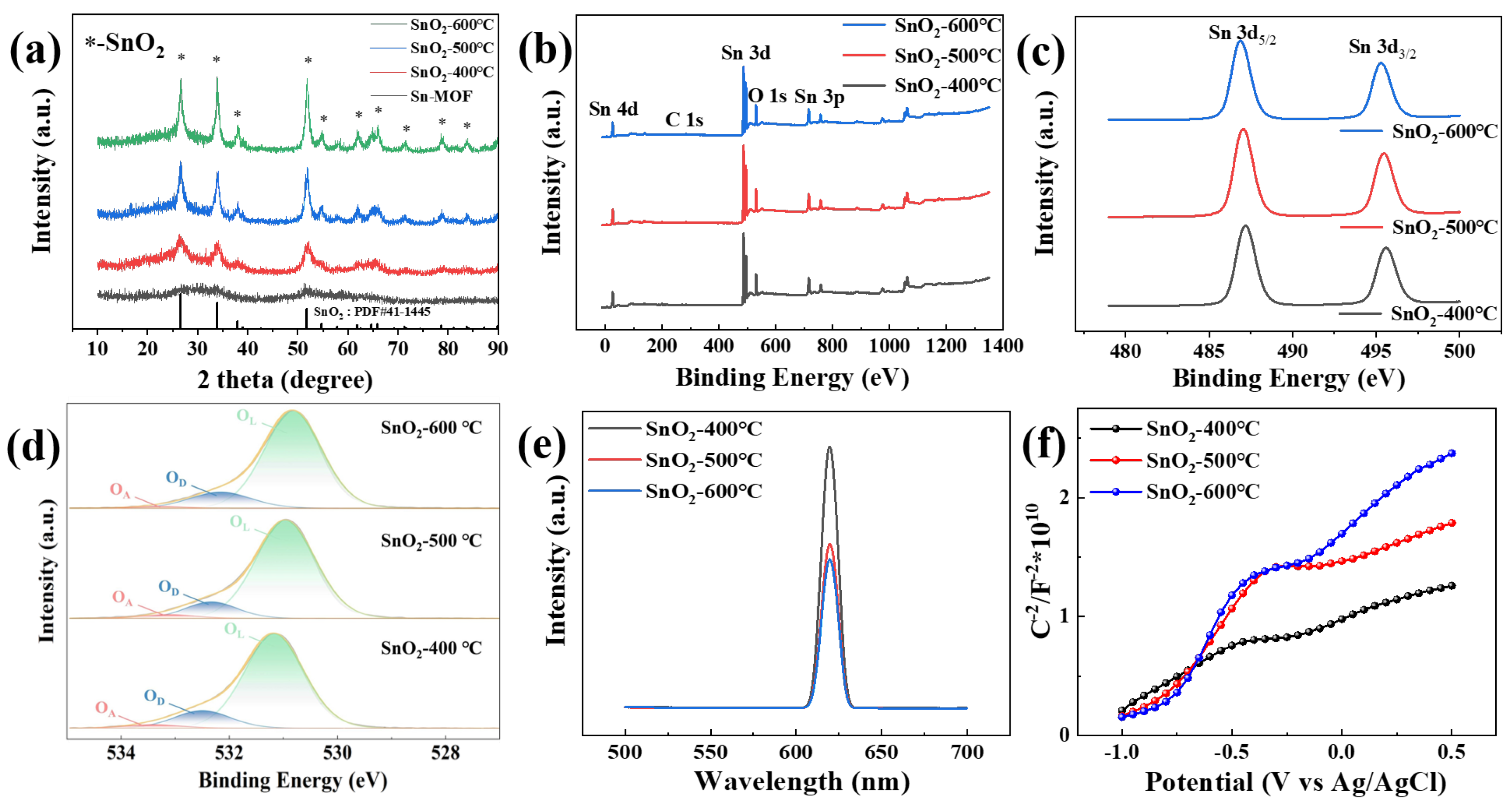
The crystal phases and structures of the Sn-MOF precursor and the derived SnO
2 samples were characterized by XRD, as shown in
Figure 1a. All diffraction peaks of the calcined samples were well indexed to the tetragonal rutile SnO
2 (JCPDS No. 41–1445), and no impurity peaks were detected, confirming the high phase purity of the products. The Sn-MOF precursor exhibited broad and weak diffraction peaks, indicating its low crystallinity or amorphous nature. This XRD characteristic is consistent with amorphous MOFs reported in the literature [
30], where broad features without sharp Bragg reflections indicate the absence of long-range order. Such an amorphous structure typically endows the precursor with a larger specific surface area and a higher density of surface active sites, which is beneficial for the formation of porous SnO
2 materials with enhanced gas sensing performance after calcination. With increasing calcination temperature, the diffraction peaks became sharper and more intense, which was attributed to improved crystallinity and increased grain size due to high-temperature sintering. The dominant diffraction peaks at 2
= 26.6°, 33.8°, and 51.7° corresponded to the (110), (101), and (211) crystal planes of SnO
2, respectively, revealing that SnO
2 nanocrystals preferentially grew along these three crystallographic directions.
XPS was employed to investigate the surface chemical compositions and electronic states of the as-prepared samples. The survey spectra (
Figure 1b) only showed characteristic peaks of Sn and O, confirming the absence of detectable hetero-element impurities. The high-resolution Sn 3d spectrum (
Figure 1c) displayed two symmetric peaks at 487.18 and 495.59 eV, corresponding to Sn 3d
5/
2 and Sn 3d
3/
2 of Sn
4+, respectively, indicating that tin is predominantly present as SnO
2 after calcination. The O1s spectra (
Figure 1d) were deconvoluted into three distinct components [
31,
32]: O
L at ~531 eV (lattice oxygen, Sn–O–Sn); O
def/OH at ~532 eV (oxygen at defect-associated/low-coordination surface sites, dominated in ex situ conditions by surface hydroxyl species); O
ads at ~533 eV (adsorbed/loosely bound H
2O-related species). The O
def/OH proportion decreases monotonically from SnO
2-400 °C to SnO
2-500 °C and then to SnO
2-600 °C, paralleling the PL and Mott–Schottky trends. It is therefore used here as a semi-quantitative indicator of relative surface defective-site density rather than a direct measure of oxygen vacancies.
The relative contents of O
L, O
def/OH and O
ads are summarized in
Table 1. SnO
2-400 °C possesses the highest content of O
def/OH, which gradually decreases as the calcination temperature rises. This trend, consistent with the PL and Mott–Schottky measurements, suggests that samples with richer intrinsic surface defects tend to adsorb and dissociate more atmospheric water molecules, forming abundant surface hydroxyl groups. These surface oxygen-containing species act as active sites and play a vital role in the gas-sensing reaction toward TEA.
PL spectroscopy and Mott–Schottky measurements were further conducted to characterize the surface defect chemistry and electronic properties of the samples. As shown in
Figure 1e, all samples exhibited a strong red emission peak centered at ~620 nm, which is characteristic of radiative recombination of electrons trapped at surface-localized defect states, commonly associated with undercoordinated surface environments or oxygen-deficient domains in SnO
2 [
33]. The PL intensity decreased monotonically with increasing calcination temperature, paralleling the decreasing trend of the O
def/OH fraction in XPS, thereby supporting an enriched density of electron-trapping surface sites in SnO
2-400 °C. The relatively narrow full width at half maximum (FWHM, ~20 nm) observed here indicates the dominance of a single class of shallow surface defect states (e.g., low-coordination Sn sites or surface hydroxyl-associated traps), whereas broader PL emissions reported elsewhere often reflect a superposition of multiple defect-related transitions (e.g., deep vs. shallow traps, or surface vs. subsurface contributions). These PL trends are further corroborated by the Mott–Schottky results (
Figure 1f), which show a progressive increase in slope with calcination temperature, indicating a reduction in carrier density consistent with thermal elimination of surface defect sites.
Figure 1f shows the Mott–Schottky curves measured at 1 kHz in 0.5 M Na
2SO
4 solution. All samples showed positive slopes, confirming their n-type semiconductor characteristics. SnO
2-400 °C exhibited the smallest slope, implying the highest carrier density. This was attributed to its highest surface defect-site density, consistent with the PL observations.
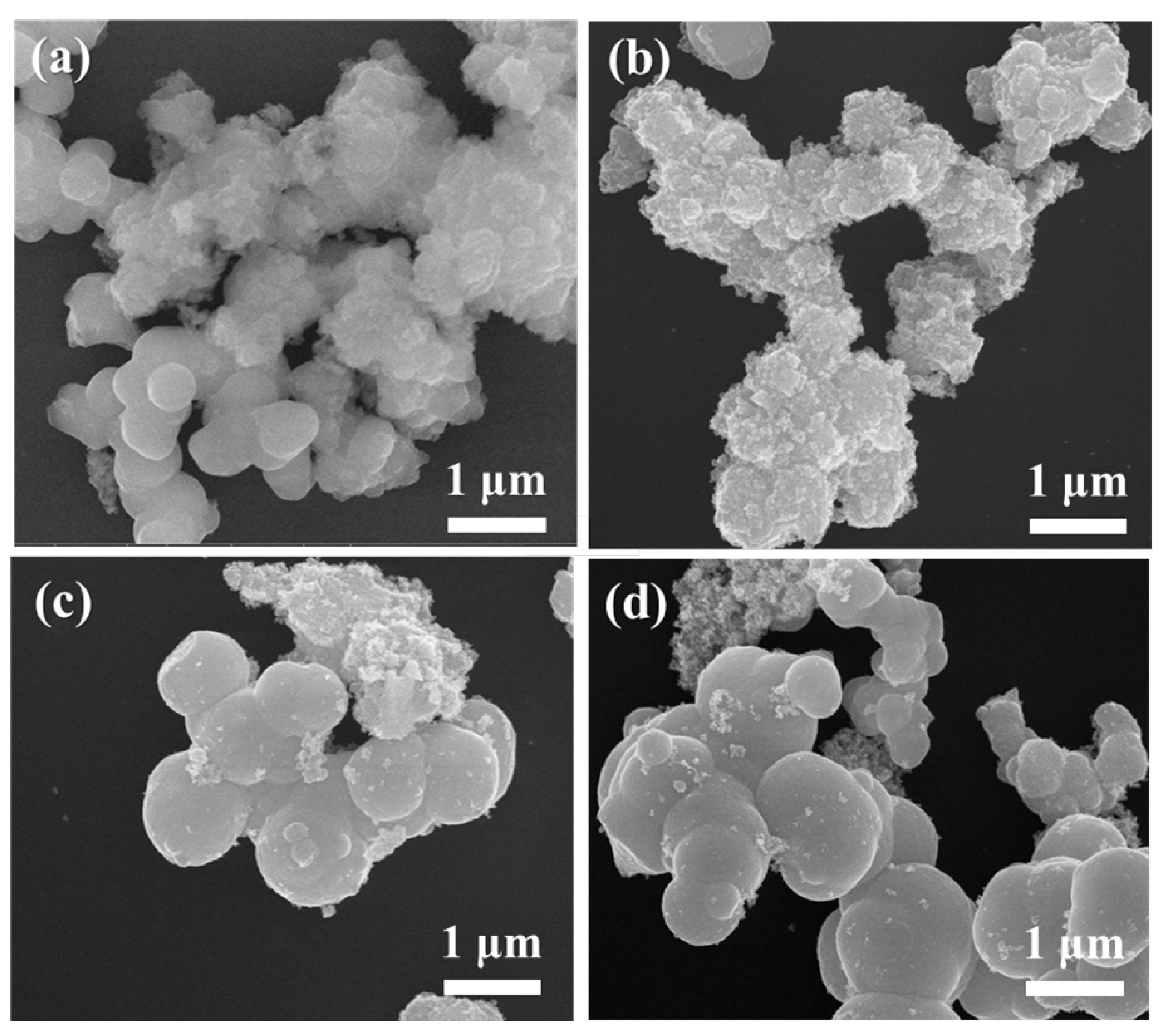
The morphologies and microstructures of the Sn-MOF precursor and the calcined SnO
2 samples were characterized by SEM. As shown in
Figure 2, all samples were composed of aggregated nanoparticles. Before calcination, the surface of the Sn-MOF precursor was relatively smooth (
Figure 2a). After calcination at 400 °C, the MOF-derived SnO
2 partially retained the structural features of the precursor; numerous small nanoparticles grew on the surface of larger aggregates, resulting in a rougher surface (
Figure 2b). This increased surface roughness contributed to a higher specific surface area and exposed more active sites, facilitating the adsorption of target gas molecules. At higher calcination temperatures (500 and 600 °C), the material surface became smoother and the particle size increased (
Figure 2c,d), which was attributed to particle aggregation and sintering induced by high-temperature treatment [
34].
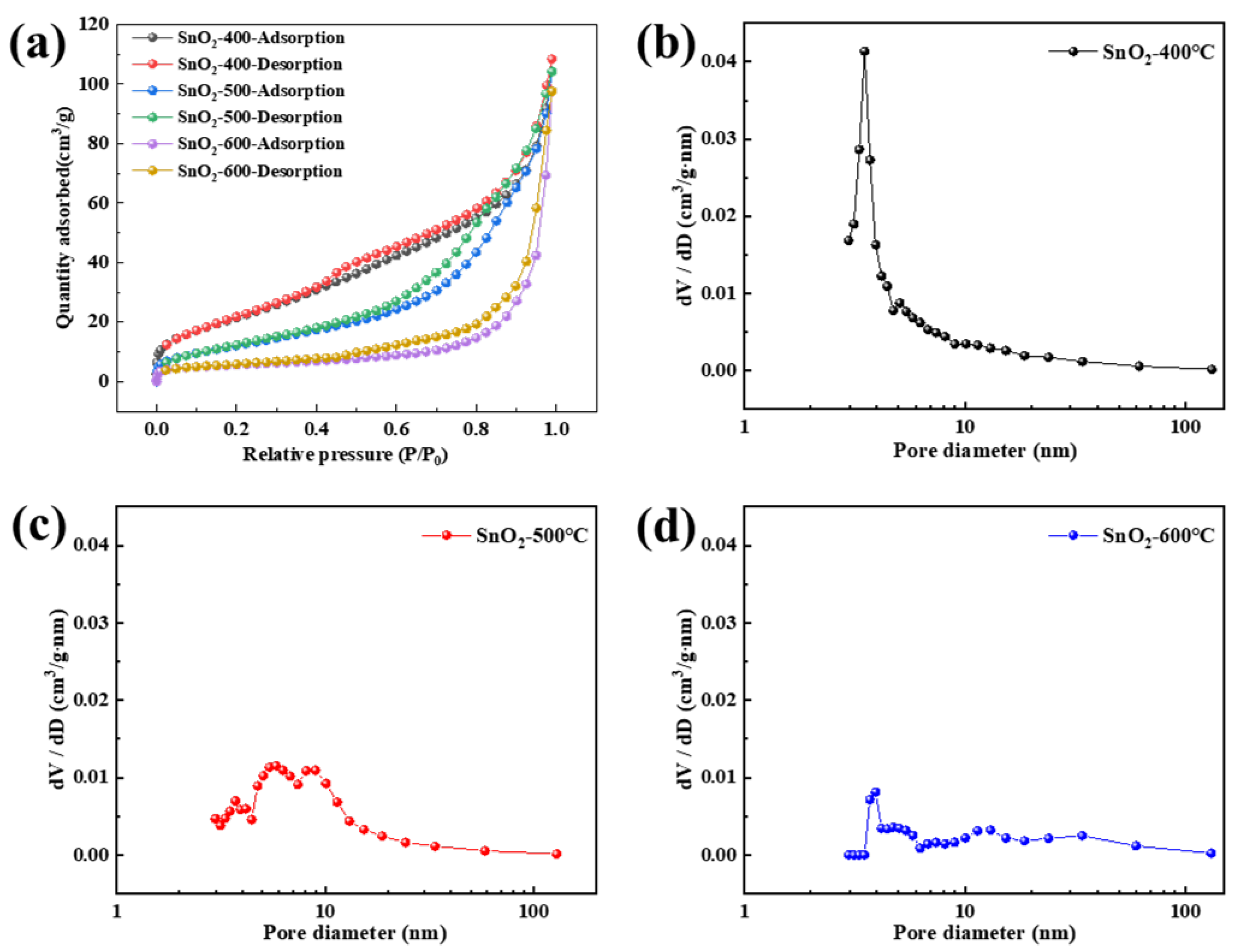
N
2 adsorption–desorption isotherms were measured to determine the specific surface areas and pore size distributions of the SnO
2 samples. As shown in
Figure 3a, all samples exhibited type IV isotherms with H3-type hysteresis loops, characteristic of mesoporous materials formed by particle aggregation. The specific surface areas of SnO
2-400 °C, SnO
2-500 °C, and SnO
2-600 °C were calculated to be 84.7, 47.7, and 19.9 m
2·g
−1, respectively. The corresponding average pore sizes, derived from the desorption branches using the BJH method, were 7.9, 13.5, and 30.5 nm for SnO
2-400 °C, SnO
2-500 °C, and SnO
2-600 °C, respectively (
Figure 3b–d). These results confirm that higher calcination temperatures caused nanoparticle aggregation and sintering, resulting in decreased specific surface area and increased pore size.
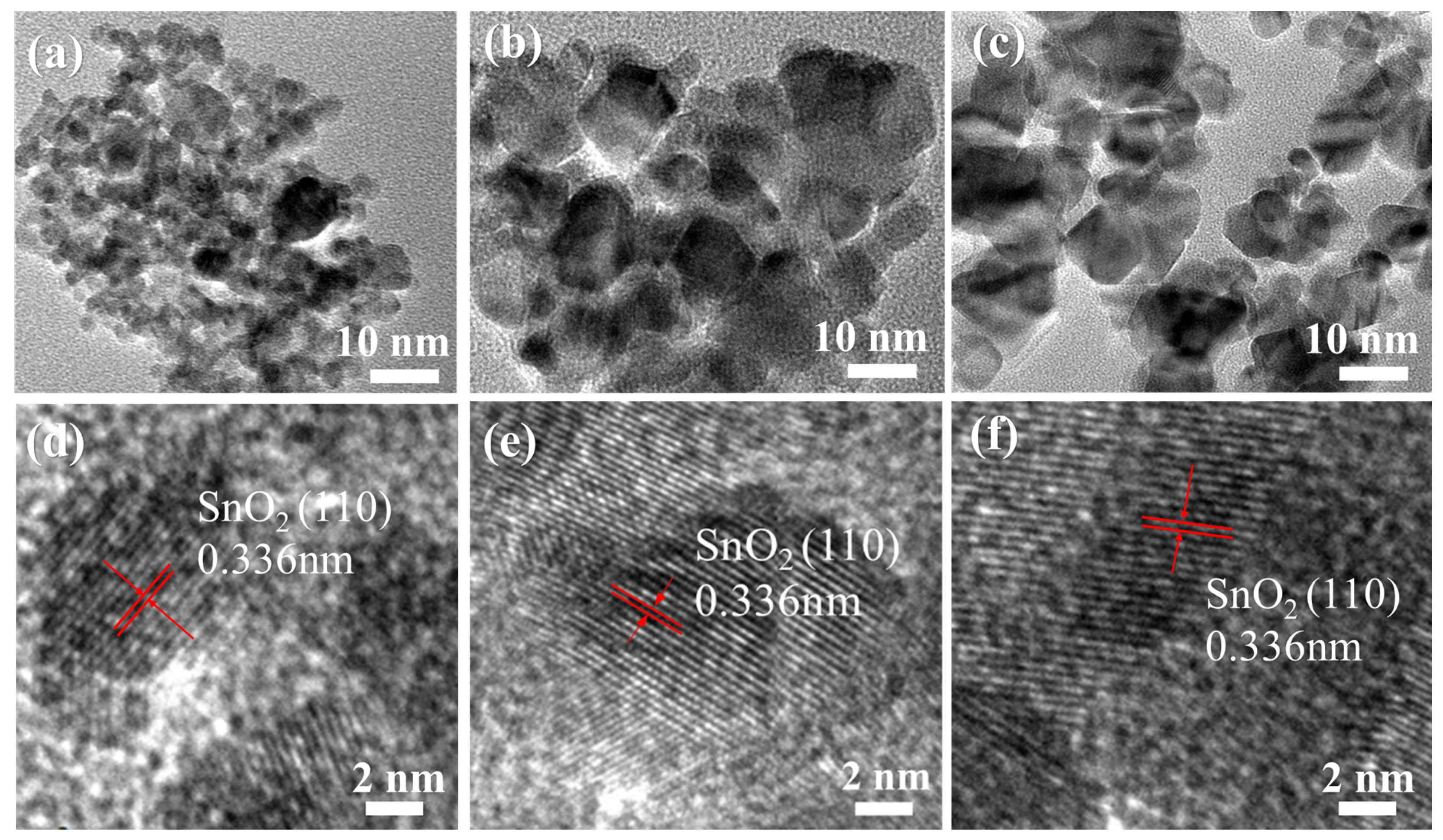
TEM was used to further characterize the microstructures of the calcined SnO
2 samples. Consistent with the SEM observations, all samples consisted of small nanoparticles with diameters in the range of 10–50 nm (
Figure 4a–c). The nanoparticle size increased with rising calcination temperature, confirming particle aggregation at higher temperatures. High-resolution TEM (HRTEM) images (
Figure 4d–f) revealed clear lattice fringes with an interplanar spacing of 0.336 nm, corresponding to the (110) crystal plane of rutile SnO
2. The crystallinity improved with increasing calcination temperature, as evidenced by more distinct lattice fringes in the SnO
2-500 °C and SnO
2-600 °C samples.
3.2. Gas Sensing Properties
The gas-sensing performance of the MOF-derived SnO
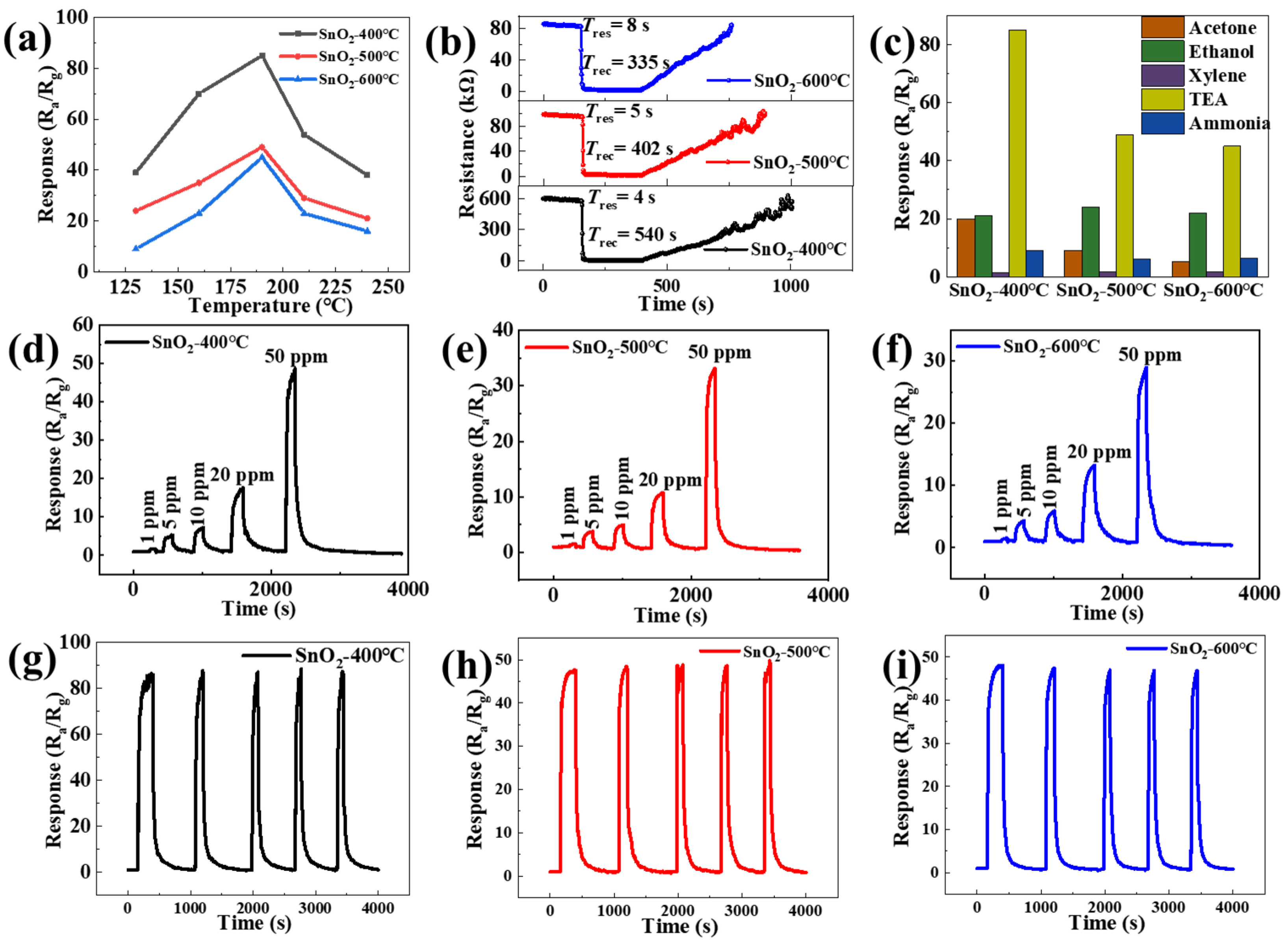
2 sensors toward TEA was investigated as a function of operating temperature. As shown in
Figure 5a, the sensor response to 100 ppm TEA was measured in the temperature range of 100–240 °C. For all sensors, the response first increased and then decreased with increasing temperature, following a typical “volcano-shaped” curve. This behavior is governed by the adsorption–reaction kinetics on the sensing layer surface: at low temperatures, adsorbed TEA molecules lack sufficient thermal energy to overcome the activation barrier for reaction with adsorbed oxygen species; at high temperatures, the desorption rate of gas molecules exceeds the adsorption rate, leading to a decrease in response.
All sensors exhibited their maximum response at 190 °C: the responses of SnO2-400 °C, SnO2-500 °C, and SnO2-600 °C to 100 ppm TEA at this temperature were 85, 49, and 45, respectively. The response decreased monotonically with increasing calcination temperature, consistent with the variation trend of specific surface area and surface defect density.
As summarized in
Table 2, compared with other SnO
2-based TEA gas sensors reported in the literature, the as-prepared SnO
2-400 °C sensor exhibits a competitive response at a relatively low operating temperature. All response values in
Table 2 are unified as S = R
a/R
g for reducing gases (TEA), with literature data recalculated accordingly to enable direct comparison.
The response and recovery characteristics of the sensors were evaluated at 190 °C. As shown in
Figure 5b, the response/recovery times of SnO
2-400 °C, SnO
2-500 °C, and SnO
2-600 °C were 4/540, 5/402, and 8/335 s, respectively. SnO
2-400 °C exhibited the shortest response time (4 s) but the longest recovery time, showing a typical response–recovery trade-off commonly observed in metal oxide gas sensors.
Selectivity is a critical parameter for practical sensor applications.
Figure 5c shows the responses of the SnO
2-400 °C sensor to 100 ppm of various interfering gases, including acetone, ethanol, xylene, and ammonia, as well as TEA. The interference gas concentration of 100 ppm was selected to match the TEA test level, enabling a direct evaluation of selectivity under identical exposure conditions, a protocol widely adopted in TEA sensing benchmarks. At this concentration, the response difference between TEA and interfering gases is sufficiently obvious, allowing a reliable and intuitive evaluation of the sensor selectivity. The sensor exhibited the highest response to TEA, with a response value more than four times higher than that to ethanol (the gas with the second-highest response), indicating superior selectivity. This preferential detection of TEA may be attributed to the combined effects of molecular size, basicity, and specific interactions with the SnO
2 surface.
The detection limits of the sensors were evaluated by measuring their responses to TEA at different concentrations.
Figure 5d–f show the response curves of SnO
2-400 °C, SnO
2-500 °C, and SnO
2-600 °C to TEA in the concentration range of 1–50 ppm at the optimal operating temperature of 190 °C. As the TEA concentration decreased, the sensor response gradually decreased. Notably, even at a TEA concentration as low as 1 ppm, the response of SnO
2-400 °C reached 1.6, indicating its remarkable capability for detecting low concentrations of TEA. The response increased monotonically with TEA concentration, suggesting potential for quantitative detection.
The repeatability of the sensors was evaluated by consecutive measurements. As shown in
Figure 5g–i, at 190 °C, each sensor was subjected to five consecutive cycles of exposure to 100 ppm TEA, followed by recovery in fresh air. The response values of each cycle exhibited minimal variation, with relative standard deviations (RSDs) below 5%, confirming the good repeatability of the samples.
Humidity is an important factor affecting the practical performance of gas sensors. Following the widely used protocols in the literature [
10,
39,
42], we conducted humidity-dependent tests using the static saturated salt solution method.
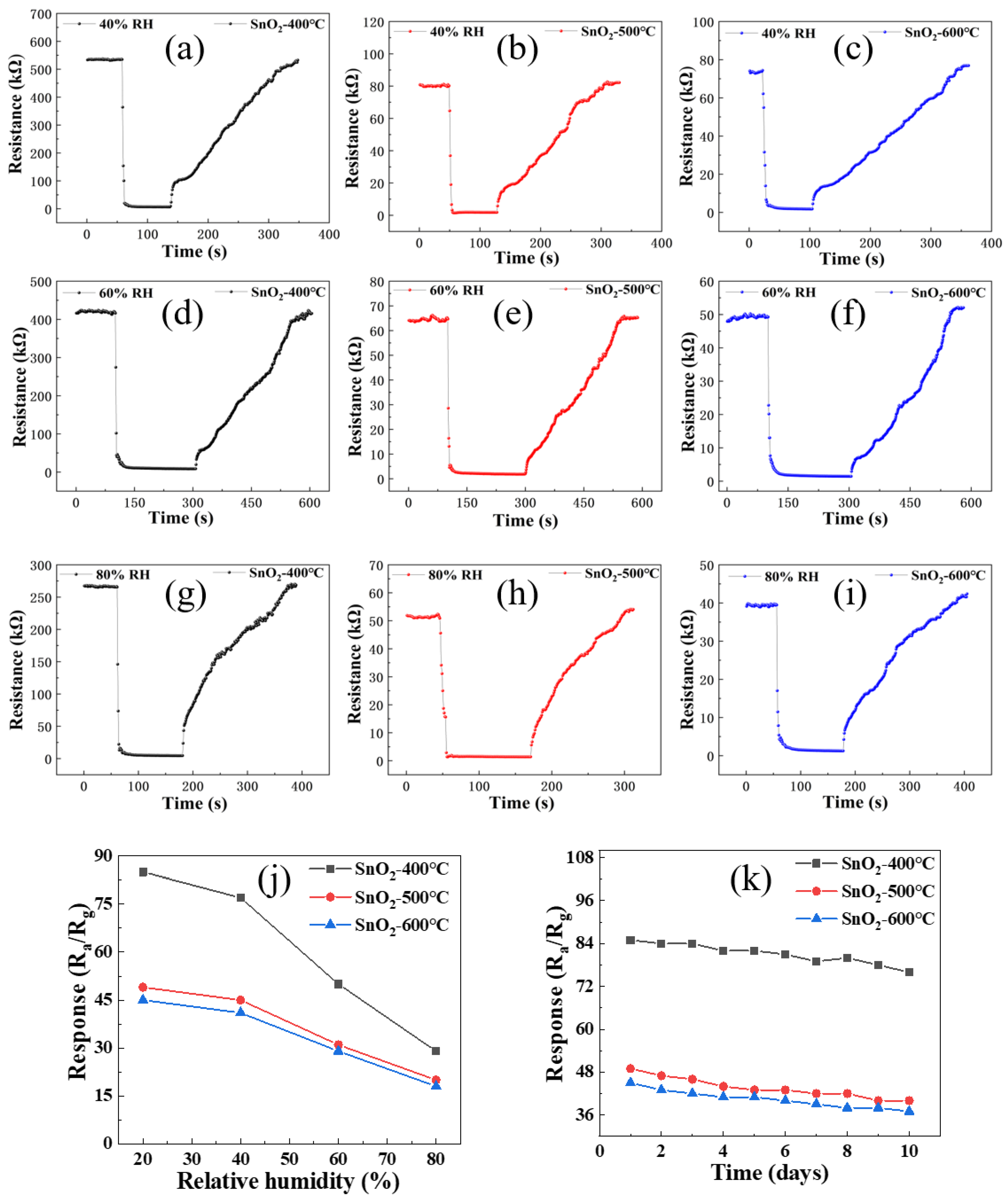
Figure 6a–i show the response curves of SnO
2-400 °C, SnO
2-500 °C, and SnO
2-600 °C to 100 ppm TEA at 190 °C under different relative humidity levels (20%, 40%, 60%, and 80%). The corresponding response values at each humidity level are summarized in
Figure 6j. With increasing relative humidity, the response values of all sensors gradually decreased. At 80% RH, the response of SnO
2-400 °C decreased to approximately 60% of its value at 20% RH. This humidity-dependent behavior can be explained by the competitive adsorption of water molecules and TEA molecules on the SnO
2 surface [
45]. Water molecules adsorb on the SnO
2 surface and consume adsorbed oxygen ions (
,
), reducing the number of active sites available for TEA reaction. Consequently, the electron release from TEA oxidation is weakened, leading to a smaller resistance change and lower sensor response.
Humidity fluctuation widely exists in actual industrial environments and directly influences on-site detection accuracy. Industrial environments typically exhibit wide and dynamic humidity fluctuations (ranging from 20% RH in dry chemical production workshops to over 80% RH in food processing, cold chain storage, and outdoor monitoring scenarios). Uncontrolled humidity interference can lead to significant baseline drift, false negative/positive alarms, and inaccurate quantitative detection, which directly threatens occupational safety (e.g., underestimating TEA leakage concentrations in high-humidity workshops) and compromises the reliability of food freshness monitoring. In this work, the SnO2-400 °C sensor can still maintain 60% of its response value at 80% RH, indicating that it has certain anti-humidity interference ability. In practical industrial applications, the influence of humidity can be further eliminated by installing a simple dehumidification device or adopting a temperature compensation algorithm, so as to meet the detection requirements of complex industrial environments.
Long-term stability is another critical parameter for practical sensor applications.
Figure 6k shows the long-term stability of the SnO
2-400 °C sensor to 100 ppm TEA at 190 °C over a period of 30 days. The response value decreased slightly by less than 8% over this period, with a RSD of approximately 3%, indicating excellent long-term stability. This stability can be attributed to the robust crystal structure of SnO
2 and the stable porous framework inherited from the MOF precursor.
3.3. Gas Sensing Mechanism
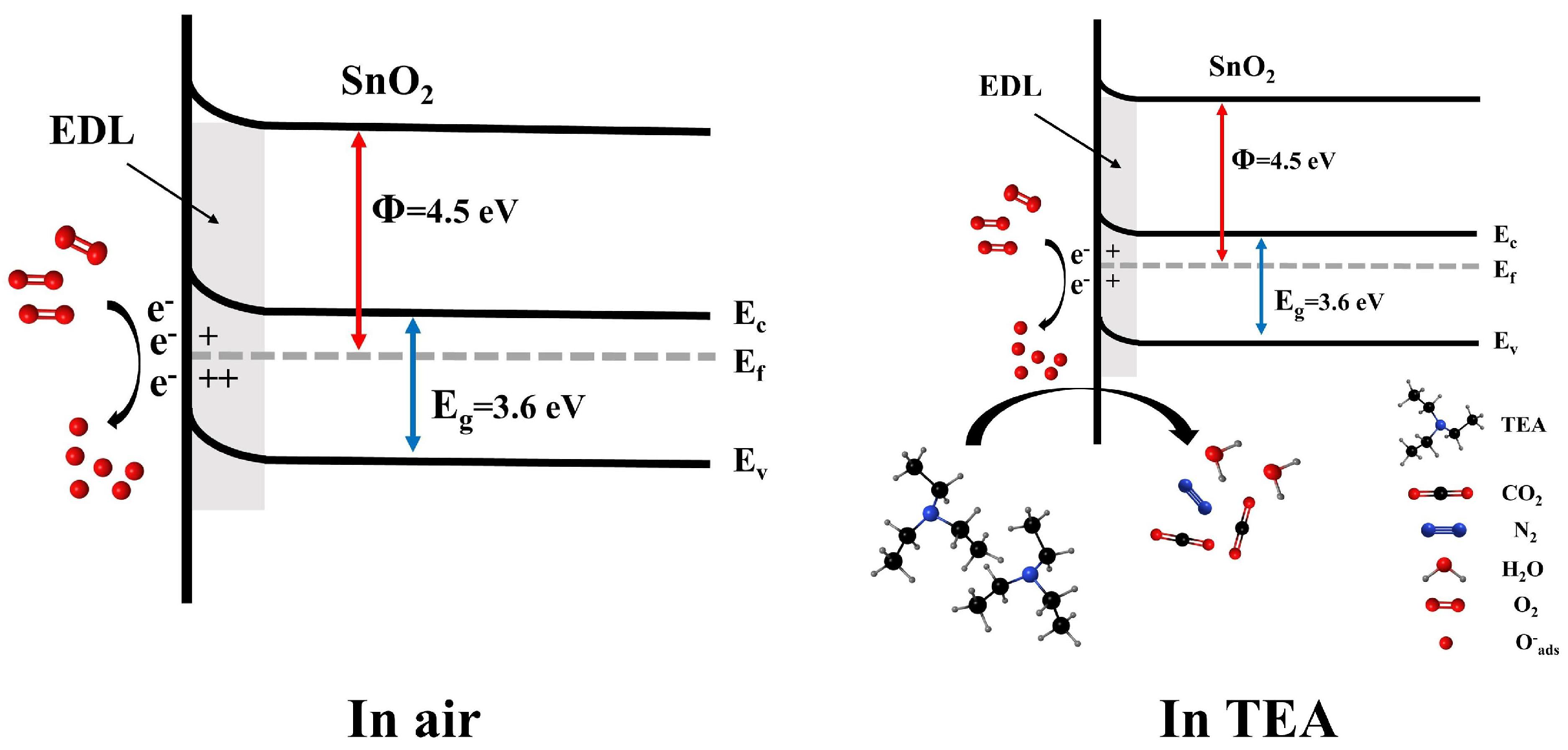
The gas sensing mechanism is schematically illustrated in
Figure 7, which depicts the energy band structure evolution and electron transfer process in both air (left panel) and TEA atmospheres (right panel). As a typical n-type wide-bandgap semiconductor (E
g = 3.6 eV, work function
= 4.5 eV), the gas-sensing mechanism of SnO
2 is primarily governed by the resistance change induced by the modulation of the surface electron depletion layer (EDL, indicated by the gray shaded region in
Figure 7) via gas adsorption and reaction [
45]. When the sensor is exposed to air at the optimal operating temperature of 190 °C (within the range of 100–300 °C), oxygen molecules adsorb on the SnO
2 surface and capture electrons from the conduction band (E
c) to form adsorbed oxygen species (mainly
at this temperature). This process can be described by the following Equations [
46]:
The electron transfer from SnO
2 to adsorbed oxygen creates an electron depletion layer on the material surface, increasing the electrical resistance. Subsequently, when the sensor is exposed to TEA, the reducing gas molecules react with the adsorbed oxygen ions, releasing electrons back to the conduction band:
This reaction reduces the width of the electron depletion layer, decreasing the electrical resistance of the material. The magnitude of the resistance change determines the sensor response.
The superior gas-sensing performance of SnO2-400 °C can be attributed to the synergistic effects of three key factors: (1) high specific surface area, (2) abundant defect-associated surface hydroxyl sites and (3) suitable mesoporous structure.
High specific surface area: SnO2-400 °C possesses the largest specific surface area (84.7 m2·g−1) among the three samples, providing abundant active sites for TEA adsorption. This facilitates the gas–solid interaction and promotes the reaction between TEA molecules and adsorbed oxygen species, leading to a higher response.
Abundant defect-associated surface hydroxyl sites: PL and Mott–Schottky analyses confirmed that SnO2-400 °C possesses the highest density of surface defect sites, which induce the formation of abundant surface hydroxyl species (Odef/OH) under ambient conditions. These hydroxyl species serve as the main active sites for oxygen adsorption and TEA oxidation, while the underlying defect sites act as electron donors to increase carrier concentration, as confirmed by Mott–Schottky measurements, further enhancing the gas-sensing response.
Suitable mesoporous structure: The mesoporous structure with an average pore size of 7.9 nm in SnO2-400 °C facilitates the diffusion of TEA molecules into the sensing layer while providing sufficient surface area for reaction. However, the relatively small pore size also hinders the desorption of reaction products, which explains the long recovery time observed for this sample.
The superior selectivity toward TEA can be explained by the molecular properties of the tested gases. TEA has a larger molecular size and higher basicity compared to other VOCs such as ethanol and acetone. The acidic nature of the SnO2 surface (due to surface defect sites and abundant hydroxyl groups) promotes the preferential adsorption of basic molecules like TEA through acid–base interactions. Additionally, the three ethyl groups in TEA provide more reaction sites for oxidation, resulting in a higher response.
4. Conclusions
In summary, porous SnO2 nanomaterials with tunable microstructures and surface defect-site density were successfully synthesized via a facile solvothermal method using a novel 4,5-dichloroimidazole-based Sn-MOF as the sacrificial precursor, followed by controlled calcination at 400, 500, and 600 °C. The effects of calcination temperature on the crystal structure, morphology, specific surface area, surface defect chemistry, and gas-sensing performance of the derived SnO2 were systematically investigated.
The results show that the SnO2-400 °C sensor, which possesses the largest specific surface area (84.7 m2·g−1) and the highest Odef/OH fraction (15.36%), exhibits the best comprehensive TEA-sensing performance at an optimal operating temperature of 190 °C. Specifically, it shows a high response of 85 to 100 ppm TEA, a low detection limit of 1 ppm, superior selectivity, good repeatability (RSD < 5%), and excellent long-term stability (<8% degradation over 30 days). The enhanced performance is attributed to the synergistic effects of high specific surface area, abundant defect-associated surface sites, and suitable mesoporous structure.
This work not only provides a high-performance TEA gas sensor for industrial and food safety applications but also offers a general strategy for the rational design of MOF-derived metal oxide gas sensors with tailored microstructures and defect properties. However, the relatively long recovery time of the SnO2-400 °C sensor remains a limitation for practical rapid detection, which will be systematically addressed in our future work through pore structure optimization and surface functionalization modification.