This is an early access version, the complete PDF, HTML, and XML versions will be available soon.
Review

Nanozyme-Powered Biosensing: A Systematic Review of Advanced Strategies for Bacterial Detection


1
Institute of Biomedical Engineering, College of Life Science, Qingdao University, Qingdao 266071, China
2
Department of Critical Care Medicine, Zibo Central Hospital Affiliated to Binzhou Medical University, Zibo 255036, China
*
Authors to whom correspondence should be addressed.
These authors contributed equally to this work.
Chemosensors 2026, 14(5), 121; https://doi.org/10.3390/chemosensors14050121

Submission received: 27 March 2026 / Revised: 16 May 2026 / Accepted: 19 May 2026 / Published: 21 May 2026
(This article belongs to the Special Issue Nanozyme-Based Sensing Platforms for Biomedical Applications)

Abstract

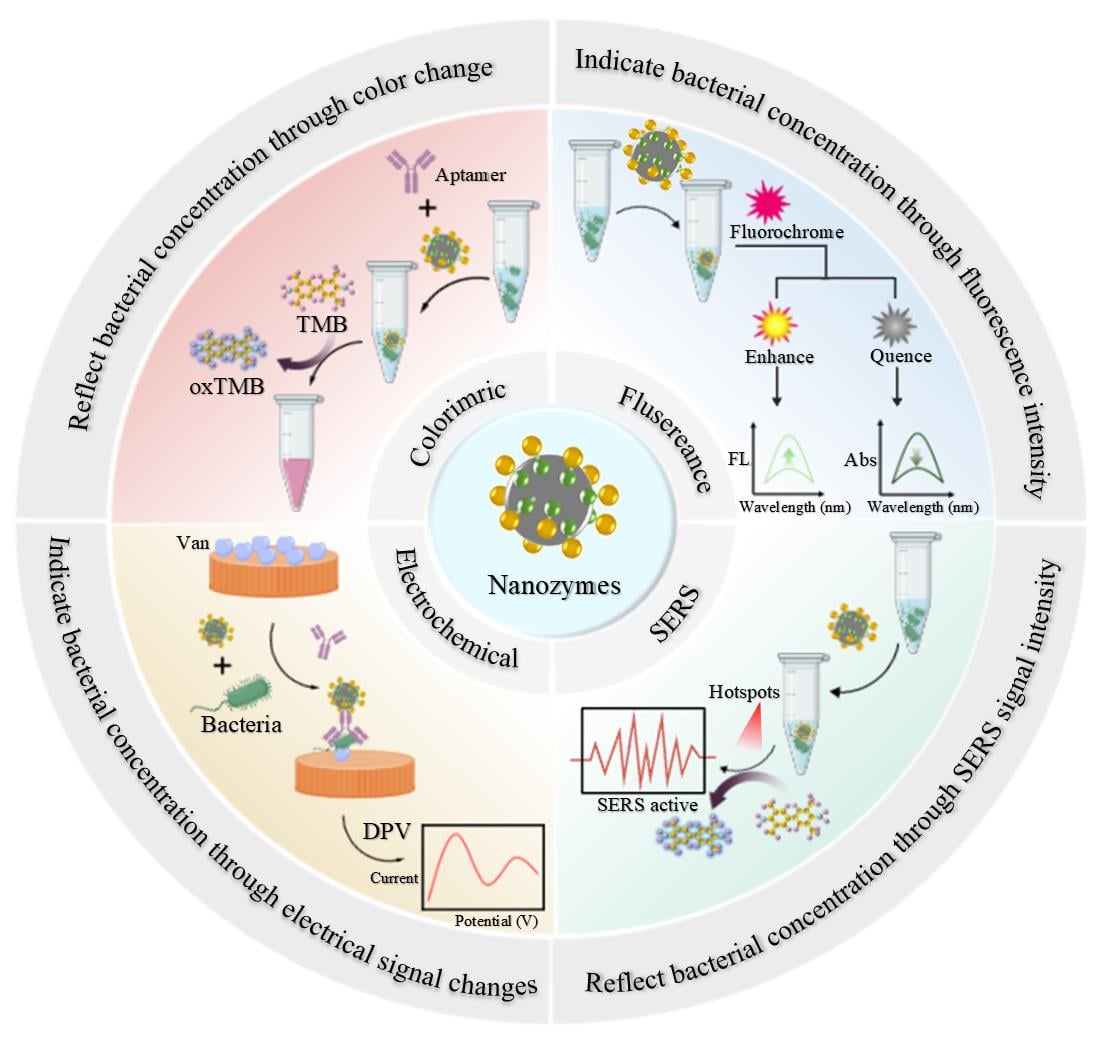
Bacterial infections pose a persistent global threat to public health, driving the demand for rapid, sensitive, and specific detection technologies applicable to disease diagnosis, food safety, and environmental monitoring. Conventional methods like plate culture and polymerase chain reaction are often hampered by lengthy procedures, dependence on complex instrumentation, and requirements for specialized personnel. The emergence of nanozymes and nanomaterials with enzyme-like catalytic activities has introduced a paradigm shift in biosensing, offering superior stability, cost-effectiveness, and tunable functionality compared to their natural counterparts. This review provides a comprehensive and systematic analysis of the latest advancements in nanozyme-mediated bacterial detection. It is structured around the primary signal transduction modalities: colorimetric, fluorescence, electrochemical, and surface-enhanced Raman scattering (SERS) analyses. For each approach, we outline the fundamental design principles, which commonly integrate a synergistic cascade of specific recognition, catalytic signal amplification, and signal readout, and present representative applications for detecting key pathogens like Staphylococcus aureus, Salmonella, and Listeria monocytogenes in complex samples. We evaluate and contrast the advantages, analytical performance, and appropriateness of these different platforms for various practical scenarios. Finally, we address current challenges, including achieving high specificity in complex matrices, precise modulation of nanozyme activity, and method standardization. Perspectives on future research directions aimed at developing next-generation, high-performance, and potentially portable bacterial detection systems are also provided.
Keywords: nanozyme; bacterial detection; colorimetric; fluorescence; electrochemical detection nanozyme; bacterial detection; colorimetric; fluorescence; electrochemical detection
Graphical Abstract