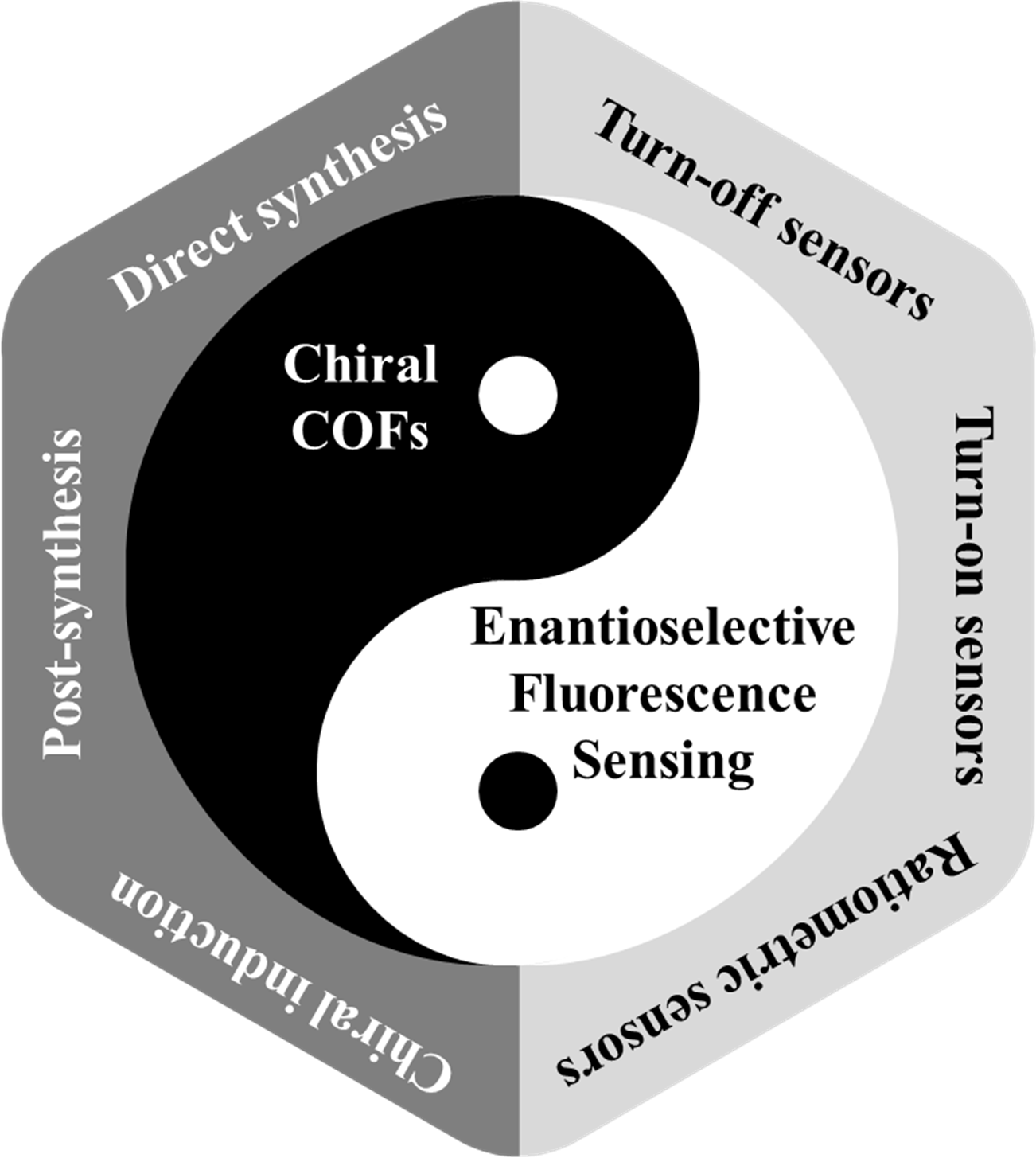
Chiral Covalent Organic Frameworks for Enantioselective Fluorescence Sensing

 and
and 
Abstract
1. Introduction
2. Synthetic Strategies for CCOFs
2.1. Direct Synthesis
2.2. Post-Synthetic Modification
2.3. Chiral Induction Synthesis
3. Enantioselective Fluorescence Sensing of CCOFs
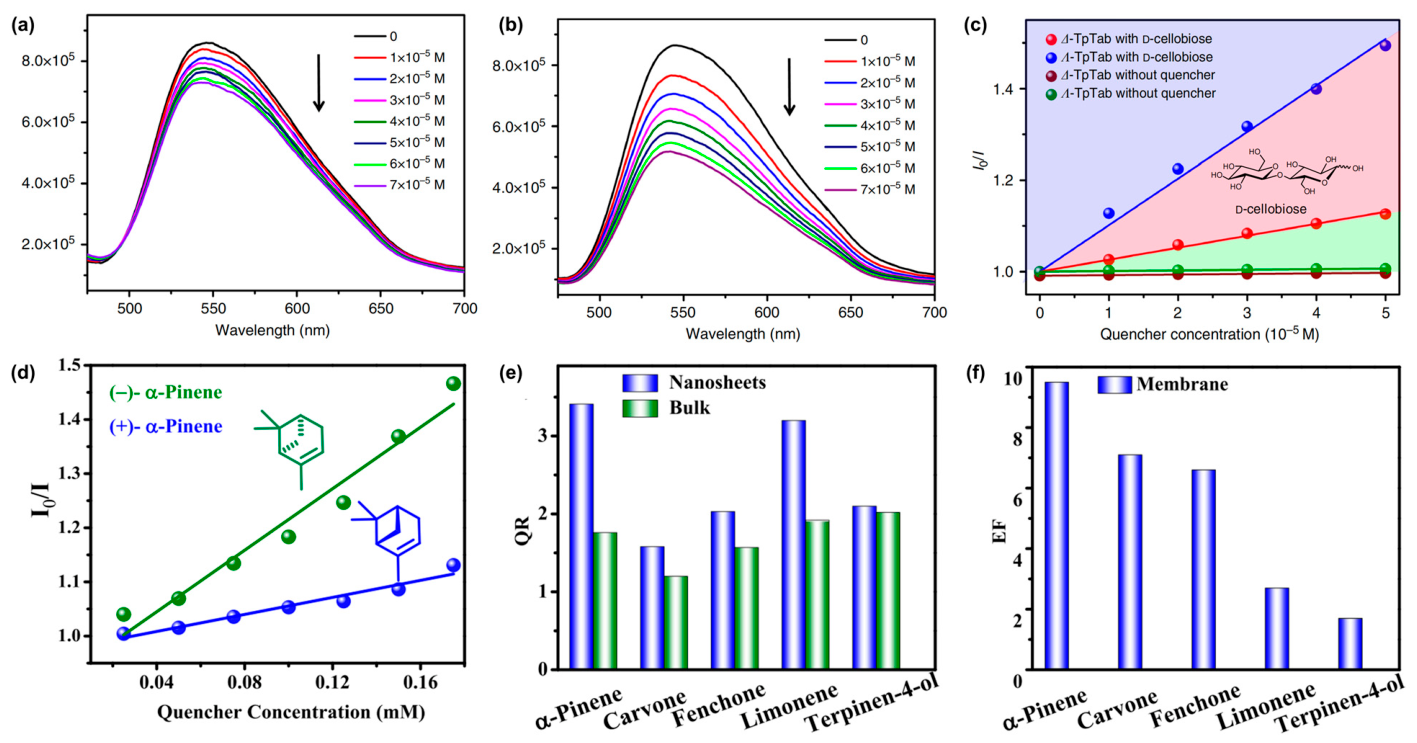
3.1. Turn-Off (Quenching) Sensors
3.1.1. Static Quenching via Host–Guest Complexation
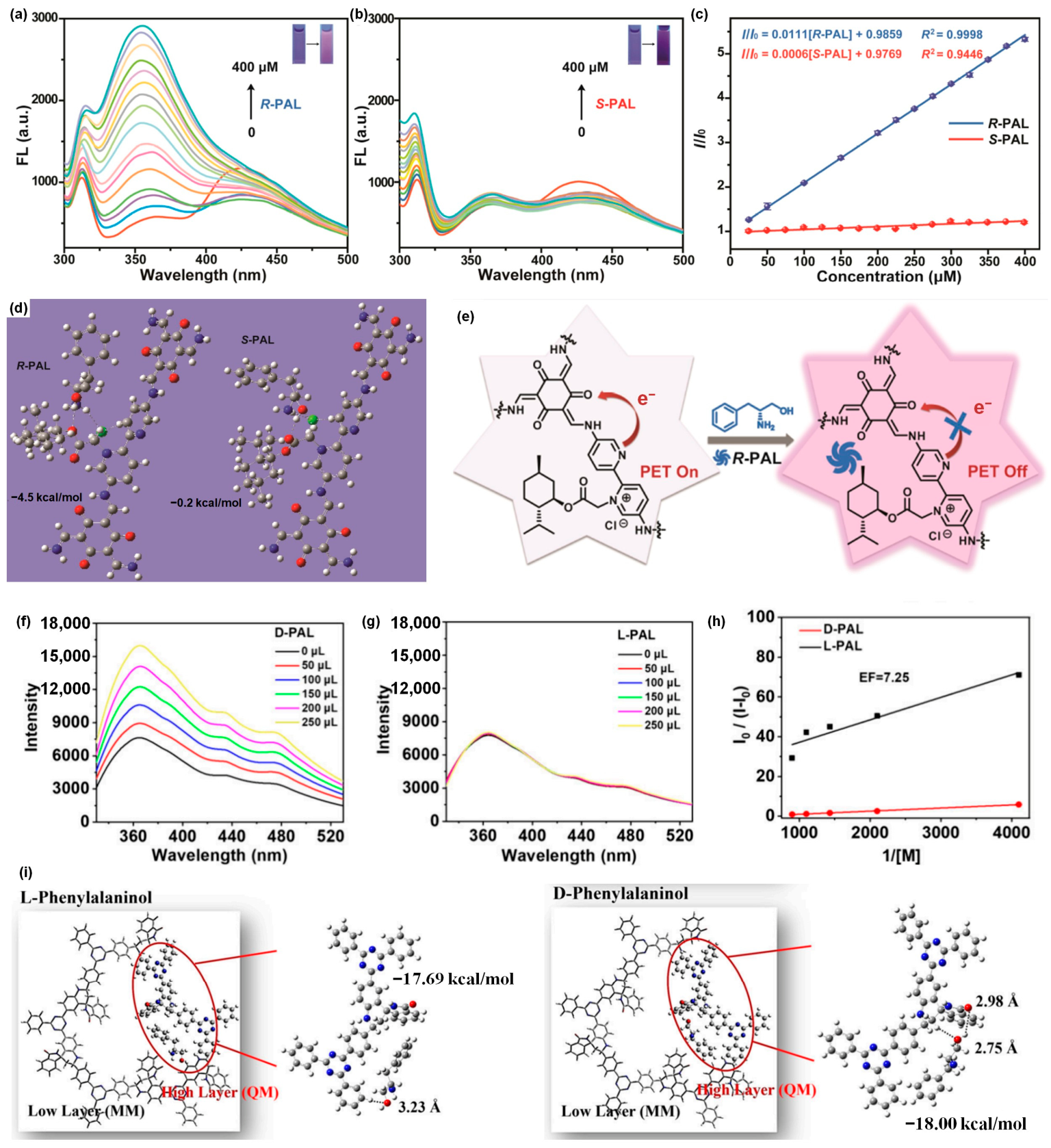
3.1.2. PET-Promoted Quenching
3.2. Turn-On (Enhancement) Sensors
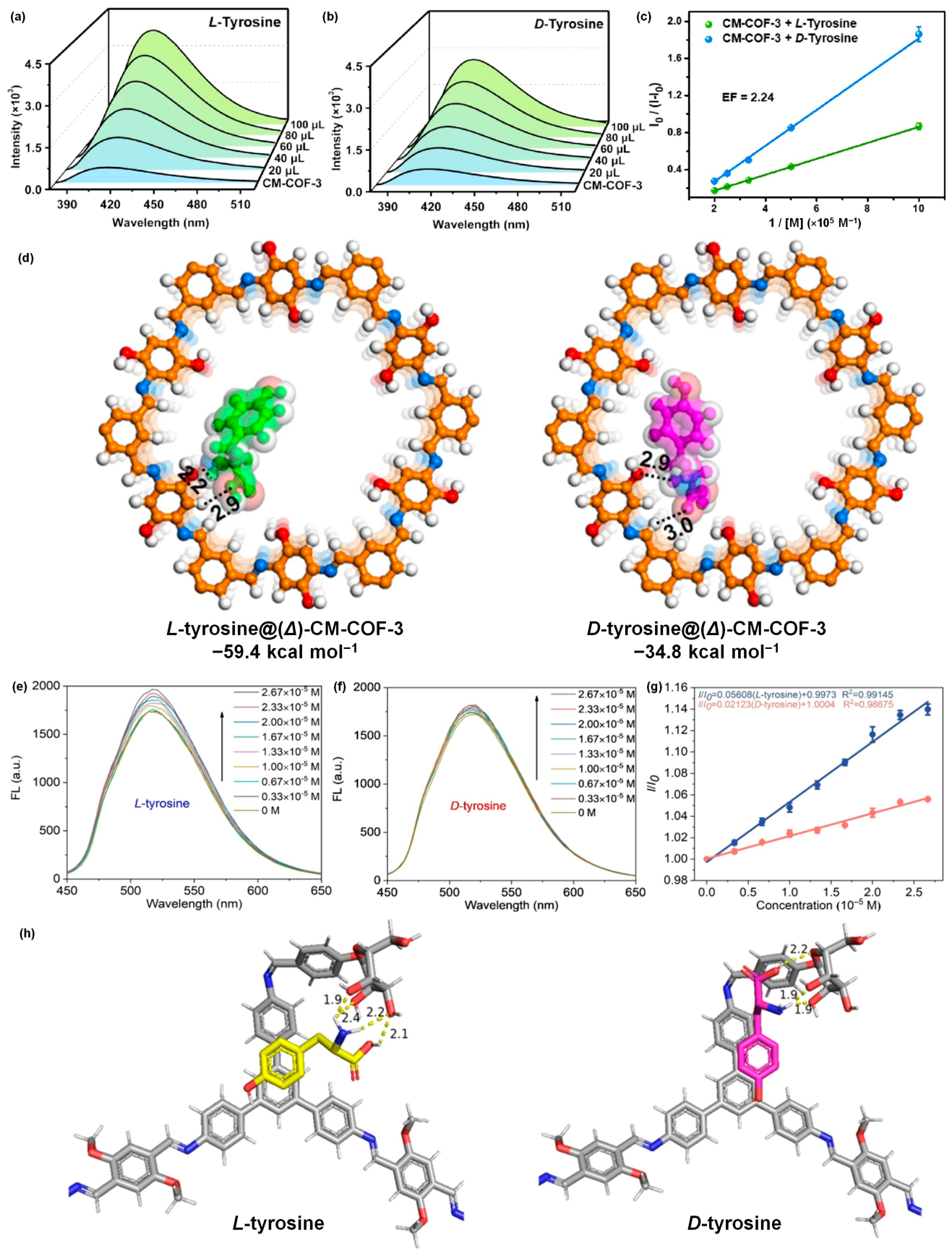
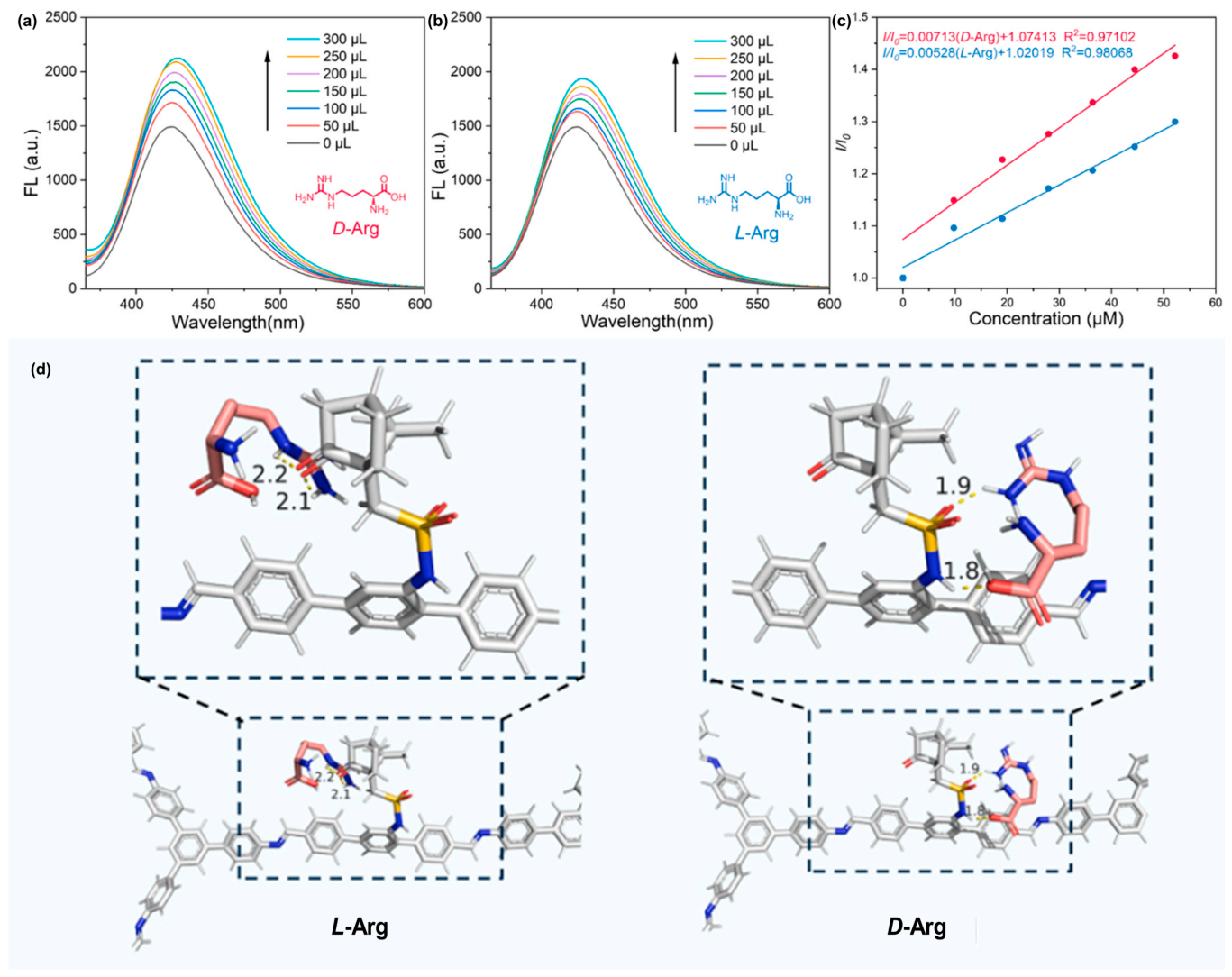
3.2.1. Rigidification-Induced Enhancement
3.2.2. PET-Suppressed Enhancement
3.3. Ratiometric Sensors
4. Conclusions and Future Perspectives
Author Contributions
Funding
Institutional Review Board Statement
Informed Consent Statement
Data Availability Statement
Acknowledgments
Conflicts of Interest
Abbreviations
| COFs | Covalent Organic Frameworks |
| CCOFs | Chiral Covalent Organic Frameworks |
| CMOFs | Chiral Metal–Organic Frameworks |
| HPLC | High-Performance Liquid Chromatography |
| PSM | Post-Synthetic Modification |
| BINOL | 1,1′-Bi-2-naphthol |
| TPE-TAM | Tetrakis(4-aminophenyl)ethene |
| Tp | 1,3,5-Triformylphloroglucinol |
| CD | Cyclodextrin |
| γ-CD | γ-Cyclodextrin |
| PET | Photoinduced Electron Transfer |
| TAPB | 1,3,5-Tris(4-aminophenyl)benzene |
| DMTP | 2,5-Dimethoxyterephthaldehyde |
| HD | Helicid |
| DCC | Dynamic Covalent Chemistry |
| TASN | Tris(N-salicylideneamine) |
| 1-PEA | 1-Phenylethylamine |
| MIDO | 3-Methyleneisoindolin-1-one |
| TAPT | 1,3,5-Tris(4-aminophenyl)triazine |
| TFPT | 1,3,5-Tris(4-formylphenyl)triazine |
| PAL | Phenylalaninol |
| PGL | Phenylglycinol |
| TPL | Tryptophanol |
| EF | Enantioselectivity Factor |
| QR | Quenching Ratio |
| ee | Enantiomeric Excess |
| DFT | Density Functional Theory |
| PVDF | Polyvinylidene Fluoride |
| 7-NS | BINOL-based COF Nanosheets |
| BET | Brunauer–Emmett–Teller |
| PXRD | Powder X-ray Diffraction |
| FT-IR | Fourier Transform Infrared Spectroscopy |
| NMR | Nuclear Magnetic Resonance |
| CP-MAS | Cross-Polarization Magic Angle Spinning |
| CC | Carbazole-Conjugated |
| Tb@CD-COF | Terbium-exchanged Cyclodextrin COF |
References
- Bada, J.L. Origins of homochirality. Nature 1995, 374, 594–595. [Google Scholar] [CrossRef]
- Yao, Y.; Ávalos-Ovando, O.; Ding, T.; Alvarez-Puebla, R.A.; Yu, P.; Ashalley, E.; Ma, L.; Wang, Z.; Markovich, G.; Govorov, A.O. From chiral biomolecules to chiral nanocrystals: A review of the latest developments and emerging concepts. Chem 2025, 11, 102544. [Google Scholar] [CrossRef]
- Mejdrová, I.; Węgrzyn, E.; Carell, T. Step-by-Step Towards Biological Homochirality—From Prebiotic Randomness To Perfect Asymmetry. Chem. Asian J. 2025, 20, e202401074. [Google Scholar] [CrossRef] [PubMed]
- Kandula, J.S.; Rayala, V.P.K.; Pullapanthula, R. Chirality: An inescapable concept for the pharmaceutical, bio-pharmaceutical, food, and cosmetic industries. Sep. Sci. Plus 2023, 6, 2200131. [Google Scholar] [CrossRef]
- Bouz, G.; Žádný, J.; Storch, J.; Vacek, J. Chiral helical scaffolds: Unlocking their potential in biomolecular interactions and biomedical applications. Biotechnol. Adv. 2025, 79, 108513. [Google Scholar] [CrossRef]
- Chen, Z.; Chi, Z.; Sun, Y.; Lv, Z. Chirality in peptide-based materials: From chirality effects to potential applications. Chirality 2021, 33, 618–642. [Google Scholar] [CrossRef]
- Pieckowski, M.; Olędzka, I.; Bączek, T.; Kowalski, P. Deep Eutectic Solvents in Capillary Electromigration Techniques—A Review of Recent Advancements. Molecules 2025, 30, 3674. [Google Scholar] [CrossRef]
- Bernardo-Bermejo, S.; Adámez-Rodríguez, S.; Castro-Puyana, M.; Marina, M.L. Chiral analysis by capillary electromigration techniques. Trends Anal. Chem. 2025, 189, 118256. [Google Scholar] [CrossRef]
- Qiu, S.; Chen, G.-Y.; Qin, Y.-D.; Li, T.-T.; Yang, F.-Q. Recent Advance in Electrochemical Chiral Recognition Based on Biomaterials (2019–2024). Molecules 2025, 30, 3386. [Google Scholar] [CrossRef] [PubMed]
- Sharma, V.; Mishra, A.K.; Mishra, N.K.; Vinod. Chiral Luminescent Sensor for Enantiomer Discrimination. Chirality 2025, 37, e70057. [Google Scholar] [CrossRef]
- Pan, Q.; Guan, H.; Xu, W.; Zhao, J.; Liu, Y.; Cui, L.; Zhou, J. Recent advance for enantiorecognition of chiral drugs sensing: Electrochemical, electrochemiluminescent and photoelectrochemical application. Biosens. Bioelectron. 2025, 273, 117141. [Google Scholar] [CrossRef]
- Wang, S.; Li, H.; Fan, S.; Chen, L.; Zhou, H.; Pérez-Juste, J.; Pastoriza-Santos, I.; Wong, K.-Y.; Zheng, G. Chiral Plasmonic Sensors: Fundamentals and Emerging Applications. Angew. Chem. Int. Ed. 2025, 64, e202514816. [Google Scholar] [CrossRef]
- Kubo, Y. Colorimetric Visualization of Chirality: From Molecular Sensors to Hierarchical Extension. Molecules 2025, 30, 1748. [Google Scholar] [CrossRef]
- Kashyap, N.; Kim, J.; Sharma, B.K.; Gogoi, P. Innovative Optical Chemosensors for Ions and Small Molecules. ChemistrySelect 2025, 10, e04895. [Google Scholar] [CrossRef]
- Penasa, R.; Licini, G.; Zonta, C. Advances in chiral analysis: From classical methods to emerging technologies. Chem. Soc. Rev. 2025, 54, 10940–10955. [Google Scholar] [CrossRef] [PubMed]
- Ding, S.-Y.; Dong, M.; Wang, Y.-W.; Chen, Y.-T.; Wang, H.-Z.; Su, C.-Y.; Wang, W. Thioether-Based Fluorescent Covalent Organic Framework for Selective Detection and Facile Removal of Mercury(II). J. Am. Chem. Soc. 2016, 138, 3031–3037. [Google Scholar] [CrossRef]
- Fan, Y.; Chen, M. Emerging frontiers in chiral metal–organic framework membranes: Diverse synthesis techniques and applications. Nanoscale 2025, 17, 13076–13093. [Google Scholar] [CrossRef] [PubMed]
- Mejía-Salazar, J.R. Nanophotonic Strategies for Chiral Biosensing: Nanoparticles, Metasurfaces, Magneto-Optical, and Quantum Approaches. Adv. Photonics Res. 2026, 7, e202500242. [Google Scholar] [CrossRef]
- Zhang, Y.-X.; Zhang, F.-Q.; Peng, A.-P.; Jiang, T.; Meng, Y.-X.; Li, Y.; Gu, S.-X.; Zhu, Y.-Y. Enantioselective recognition of amino acids in water using emission-tunable chiral fluorescent probes. Chin. Chem. Lett. 2026, 37, 111500. [Google Scholar] [CrossRef]
- Mhatre, S.; Rai, A.; Ali, H.; Patil, A.; Singh, N.; Verma, R.; Auden, J.; Chandler, C.; Dash, A.; Opere, C.; et al. Comparison of Colorimetric, Spectroscopic and Electrochemical Techniques for Quantification of Hydrogen Sulfide. BioTechniques 2024, 76, 71–80. [Google Scholar] [CrossRef]
- Wei, L.; Sun, T.; Shi, Z.; Xu, Z.; Wen, W.; Jiang, S.; Zhao, Y.; Ma, Y.; Zhang, Y.-B. Guest-adaptive molecular sensing in a dynamic 3D covalent organic framework. Nat. Commun. 2022, 13, 7936. [Google Scholar] [CrossRef] [PubMed]
- Zhang, Y.; Li, C.; Jiang, M.; Liu, Y.; Sun, Z. Advancements and Prospects of Metal-Organic Framework-Based Fluorescent Sensors. Biosensors 2025, 15, 709. [Google Scholar] [CrossRef]
- Geng, K.; He, T.; Liu, R.; Dalapati, S.; Tan, K.T.; Li, Z.; Tao, S.; Gong, Y.; Jiang, Q.; Jiang, D. Covalent Organic Frameworks: Design, Synthesis, and Functions. Chem. Rev. 2020, 120, 8814–8933. [Google Scholar] [CrossRef]
- Feng, X.; Ding, X.; Jiang, D. Covalent organic frameworks. Chem. Soc. Rev. 2012, 41, 6010–6022. [Google Scholar] [CrossRef]
- Côté, A.P.; Benin, A.I.; Ockwig, N.W.; O’Keeffe, M.; Matzger, A.J.; Yaghi, O.M. Porous, Crystalline, Covalent Organic Frameworks. Science 2005, 310, 1166–1170. [Google Scholar] [CrossRef]
- Ding, S.-Y.; Wang, W. Covalent organic frameworks (COFs): From design to applications. Chem. Soc. Rev. 2013, 42, 548–568. [Google Scholar] [CrossRef]
- Diercks, C.S.; Yaghi, O.M. The atom, the molecule, and the covalent organic framework. Science 2017, 355, eaal1585. [Google Scholar] [CrossRef]
- Han, X.; Yuan, C.; Hou, B.; Liu, L.; Li, H.; Liu, Y.; Cui, Y. Chiral covalent organic frameworks: Design, synthesis and property. Chem. Soc. Rev. 2020, 49, 6248–6272. [Google Scholar] [CrossRef] [PubMed]
- Li, X.; Zhang, S.; Gao, J.; Wang, Z.; Yu, Q.; Zhao, Y.; Cheng, P.; Chen, Y.; Zhang, Z. The recent developments and applications of chiral covalent organic frameworks. Sci. Sin. Chim. 2019, 49, 662–671. [Google Scholar] [CrossRef]
- Kang, X.; Stephens, E.R.; Spector-Watts, B.M.; Li, Z.; Liu, Y.; Liu, L.; Cui, Y. Challenges and opportunities for chiral covalent organic frameworks. Chem. Sci. 2022, 13, 9811–9832. [Google Scholar] [CrossRef]
- Qin, Y.; Li, D.; Yao, T.; Ali, A.; Wu, J.; Yao, S. Covalent organic frameworks and related innovative materials in chiral separation and recognition. Biomed. Chromatogr. 2024, 38, e6008. [Google Scholar] [CrossRef]
- Wang, D.; Liu, Z.; Li, H.; Liu, G.; Li, X.; Pan, M.; Wang, R. Robust Hydrogel Sensors Induced by Intermolecular Mechanical Interlocking of Covalent Organic Frameworks for Non-Invasive Health Monitoring. Adv. Mater. 2025, 37, e20271. [Google Scholar] [CrossRef]
- Beyrami, H.; Golshan, M.; Kucińska-Lipka, J.; Saeb, M.R.; Salami-Kalajahi, M. Chiral-based optical and electrochemical biosensors: Synthesis, classification, mechanisms, nanostructures, and applications. Chem. Eng. J. 2024, 497, 155562. [Google Scholar] [CrossRef]
- Xie, H.; Dong, S.-L. A chiral fluorescence sensor based on metal–organic frameworks for enantioselective recognition. Mater. Lett. 2025, 396, 138800. [Google Scholar] [CrossRef]
- Wei, N.-X.; Chen, T.; Gu, Z.-G.; Zhang, J. Chiral covalent–organic frameworks as a new class of circularly polarized luminescent materials. Mater. Chem. Front. 2026, 10, 8–20. [Google Scholar] [CrossRef]
- Shi, W.-J.; Chen, M.-W.; Li, Y.-Z.; Chen, H.-Y.; Lin, Y.; Wang, H.; Hou, L.; Wang, G.-D. Integrating hydrogen-bonding nanotrap into a cage-like MOF for natural gas upgrade and MTO product separation. Chem. Eng. J. 2025, 526, 170811. [Google Scholar] [CrossRef]
- Wang, Y.; Zhang, Y.; Yu, C.; Yin, B.H.; Chen, Q.; Sun, S.-P.; Wang, X. Chiral Covalent Organic Frameworks as Promising Materials for Racemate Resolution. ACS Appl. Polym. Mater. 2024, 6, 8706–8720. [Google Scholar] [CrossRef]
- Hou, B.; Li, Z.; Kang, X.; Jiang, H.; Cui, Y. Recent Advances of Covalent Organic Frameworks for Chiral Separation. Chem. Res. Chin. Univ. 2022, 38, 350–355. [Google Scholar] [CrossRef]
- Skorjanc, T.; Shetty, D.; Valant, M. Covalent Organic Polymers and Frameworks for Fluorescence-Based Sensors. ACS Sens. 2021, 6, 1461–1481. [Google Scholar] [CrossRef]
- Chen, H.; Xia, L.; Li, G. Recent progress of chiral metal–organic frameworks in enantioselective separation and detection. Microchim. Acta 2024, 191, 640. [Google Scholar] [CrossRef]
- Han, Z.; Wang, K.-Y.; Wang, M.; Shi, W. Indirect Construction of Chiral Metal–Organic Frameworks for Enantioselective Luminescence Sensing. Acc. Chem. Res. 2025, 58, 625–634. [Google Scholar] [CrossRef] [PubMed]
- Yang, F.; Zhao, X.; Usman, K.A.S.; Jiang, D.; Razal, J.M.; Wang, J.; Tao, J.; Zhang, J. Engineering coaxial MXene@CNT fibers via wet-spinning for balanced mechanical, electrical, and electrochemical performance. J. Energy Storage 2025, 137, 118719. [Google Scholar] [CrossRef]
- Wu, Q.; Yang, T.; Shi, J.; Jia, L.; Xie, B.; Lu, W.; Zhao, T.; Yu, C.; Mo, X.; Xie, W.; et al. Application of fluorescent covalent organic frameworks in gas sensors. Nanoscale 2026, 18, 6184–6202. [Google Scholar] [CrossRef]
- Xia, Y.-Q.; Jing, S.-M.; Chang, L.-M.; Gu, Z.-G.; Zhang, J. Luminescent covalent organic frameworks: Classification to optical applications. Chin. J. Struct. Chem. 2026, 45, 100731. [Google Scholar] [CrossRef]
- Liu, G.; Sheng, J.; Zhao, Y. Chiral covalent organic frameworks for asymmetric catalysis and chiral separation. Sci. China Chem. 2017, 60, 1015–1022. [Google Scholar] [CrossRef]
- Zhuo, S.; Zhang, X.; Luo, H.; Wang, X.; Ji, Y. The Application of Covalent Organic Frameworks for Chiral Chemistry. Macromol. Rapid Commun. 2020, 41, e2000404. [Google Scholar] [CrossRef]
- Liu, P.; Dai, W.; Shen, X.; Shen, X.; Zhao, Y.; Liu, J.-J. Recent Advances in the Utilization of Chiral Covalent Organic Frameworks for Asymmetric Photocatalysis. Molecules 2024, 29, 5006. [Google Scholar] [CrossRef]
- Wang, W.; Wang, D.; Song, H.; Hao, D.; Xu, B.; Ren, J.; Wang, M.; Dai, C.; Wang, Y.; Liu, W. Size effect of gold nanoparticles in bimetallic ZIF catalysts for enhanced photo-redox reactions. Chem. Eng. J. 2023, 455, 140909. [Google Scholar] [CrossRef]
- Xu, H.-S.; Ding, S.-Y.; An, W.-K.; Wu, H.; Wang, W. Constructing Crystalline Covalent Organic Frameworks from Chiral Building Blocks. J. Am. Chem. Soc. 2016, 138, 11489–11492. [Google Scholar] [CrossRef]
- Zhang, J.; Han, X.; Wu, X.; Liu, Y.; Cui, Y. Multivariate Chiral Covalent Organic Frameworks with Controlled Crystallinity and Stability for Asymmetric Catalysis. J. Am. Chem. Soc. 2017, 139, 8277–8285. [Google Scholar] [CrossRef] [PubMed]
- Wang, L.K.; Zhou, J.J.; Lan, Y.B.; Ding, S.Y.; Yu, W.; Wang, W. Divergent Synthesis of Chiral Covalent Organic Frameworks. Angew. Chem. Int. Ed. 2019, 58, 9443–9447. [Google Scholar] [CrossRef]
- Wang, X.; Han, X.; Zhang, J.; Wu, X.; Liu, Y.; Cui, Y. Homochiral 2D Porous Covalent Organic Frameworks for Heterogeneous Asymmetric Catalysis. J. Am. Chem. Soc. 2016, 138, 12332–12335. [Google Scholar] [CrossRef]
- Hou, B.; Han, X.; Xie, H.; Yuan, C.; Guo, Y.; Chen, X.; Tang, X.; Su, S.; Jiang, H.; Ye, Z.-M.; et al. Single-Crystal X-ray Structures of Homochiral Brønsted Acidic Covalent Organic Frameworks. J. Am. Chem. Soc. 2025, 147, 12127–12137. [Google Scholar] [CrossRef]
- Tang, X.; Liao, X.; Cai, X.; Wu, J.; Wu, X.; Zhang, Q.; Yan, Y.; Zheng, S.; Jiang, H.; Fan, J.; et al. Self-Assembly of Helical Nanofibrous Chiral Covalent Organic Frameworks. Angew. Chem. Int. Ed. 2023, 62, e202216310. [Google Scholar] [CrossRef]
- Zhang, Y.-J.; Li, L.-H.; Feng, J.; Deng, X.; Sun, T.; Huang, J.-F.; Fan, Y.-Q.; Lan, Y.-B.; Wang, Z.-P.; Li, X.-M.; et al. Observation of Chiral Channels in Helical Covalent Organic Frameworks. J. Am. Chem. Soc. 2024, 146, 11450–11456. [Google Scholar] [CrossRef]
- Xu, H.; Chen, X.; Gao, J.; Lin, J.; Addicoat, M.; Irle, S.; Jiang, D. Catalytic covalent organic frameworks via pore surface engineering. Chem. Commun. 2014, 50, 1292–1294. [Google Scholar] [CrossRef]
- Xu, H.; Gao, J.; Jiang, D. Stable, crystalline, porous, covalent organic frameworks as a platform for chiral organocatalysts. Nat. Chem. 2015, 7, 905. [Google Scholar] [CrossRef]
- Zhang, Y.; Guo, J.; VanNatta, P.; Jiang, Y.; Phipps, J.; Roknuzzaman, R.; Rabaâ, H.; Tan, K.; AlShahrani, T.; Ma, S. Metal-Free Heterogeneous Asymmetric Hydrogenation of Olefins Promoted by Chiral Frustrated Lewis Pair Framework. J. Am. Chem. Soc. 2024, 146, 979–987. [Google Scholar] [CrossRef]
- Chen, M.; Zhang, J.; Liu, C.; Li, H.; Yang, H.; Feng, Y.; Zhang, B. Construction of Pyridine-Based Chiral Ionic Covalent Organic Frameworks as a Heterogeneous Catalyst for Promoting Asymmetric Henry Reactions. Org. Lett. 2021, 23, 1748–1752. [Google Scholar] [CrossRef]
- Han, X.; Zhang, J.; Huang, J.; Wu, X.; Yuan, D.; Liu, Y.; Cui, Y. Chiral induction in covalent organic frameworks. Nat. Commun. 2018, 9, 1294. [Google Scholar] [CrossRef]
- Wang, J.C.; Kan, X.; Shang, J.Y.; Qiao, H.; Dong, Y.B. Catalytic Asymmetric Synthesis of Chiral Covalent Organic Frameworks from Prochiral Monomers for Heterogeneous Asymmetric Catalysis. J. Am. Chem. Soc. 2020, 142, 16915–16920. [Google Scholar] [CrossRef]
- Li, F.; Kan, J.L.; Yao, B.J.; Dong, Y.B. Synthesis of Chiral Covalent Organic Frameworks via Asymmetric Organocatalysis for Heterogeneous Asymmetric Catalysis. Angew. Chem. Int. Ed. 2022, 61, e202115044. [Google Scholar] [CrossRef]
- Song, Q.; Yang, J.; Zheng, K.; Zhang, T.; Yuan, C.; Yuan, L.-M.; Hou, X. Chiral Memory in Dynamic Transformation from Porous Organic Cages to Covalent Organic Frameworks for Enantiorecognition Analysis. J. Am. Chem. Soc. 2024, 146, 7594–7604. [Google Scholar] [CrossRef]
- Ren, X.-R.; Kou, B.; Hao, Q.; Bertocchi, F.; Xu, Y.; Wang, L.; Zhao, Z.-L.; Chen, T.; Wan, L.-J.; Wang, D. Radial growth of twist-stacked covalent organic framework nanofibers. Nat. Commun. 2025, 17, 29. [Google Scholar] [CrossRef] [PubMed]
- Li, W.; Xu, H.; Zhang, H.; Chen, H.; Ke, S.; Guo, G.; Wei, F.; Fu, J.; Jing, C.; Cheng, J.; et al. Enantiopure Dual-Helical Covalent Organic Framework Nanotubes Mediated by Supramolecular Assembly. J. Am. Chem. Soc. 2025, 147, 41320–41330. [Google Scholar] [CrossRef]
- Qian, H.-L.; Yang, C.-X.; Yan, X.-P. Bottom-up synthesis of chiral covalent organic frameworks and their bound capillaries for chiral separation. Nat. Commun. 2016, 7, 12104. [Google Scholar] [CrossRef]
- Wu, X.; Han, X.; Xu, Q.; Liu, Y.; Yuan, C.; Yang, S.; Liu, Y.; Jiang, J.; Cui, Y. Chiral BINOL-Based Covalent Organic Frameworks for Enantioselective Sensing. J. Am. Chem. Soc. 2019, 141, 7081–7089. [Google Scholar] [CrossRef] [PubMed]
- Zhao, Y.; Liu, H.; Sun, B. Chiral induction in carbazole-conjugated covalent organic frameworks: A supersensitive fluorescence sensing platform for chiral recognition. Sens. Actuators B 2022, 354, 131253. [Google Scholar] [CrossRef]
- Zhang, K.; Tang, X.; Yang, X.; Wu, J.; Guo, B.; Xiao, R.; Xie, Y.; Zheng, S.; Jiang, H.; Fan, J.; et al. Raising the Asymmetric Catalytic Efficiency of Chiral Covalent Organic Frameworks by Tuning the Pore Environment. ACS Appl. Mater. Interfaces 2024, 16, 10661–10670. [Google Scholar] [CrossRef]
- He, T.; On, I.K.W.; Bi, S.; Huang, Z.; Guo, J.; Wang, Z.; Zhao, Y. Crystalline Olefin-Linked Chiral Covalent Organic Frameworks as a Platform for Asymmetric Catalysis. Angew. Chem. Int. Ed. 2024, 63, e202405769. [Google Scholar] [CrossRef]
- Zhou, J.; Bai, Y.; Qiu, Q.; Liu, S.; Qiu, H.; Zhang, X.; Zhao, H. Ex-situ EPR approach to explore the electrochemical behaviour of Arylboron-Linked conjugated microporous polymer cathode. Chem. Eng. J. 2023, 452, 139576. [Google Scholar] [CrossRef]
- Yuan, C.; Fu, S.; Yang, K.; Hou, B.; Liu, Y.; Jiang, J.; Cui, Y. Crystalline C–C and C=C Bond-Linked Chiral Covalent Organic Frameworks. J. Am. Chem. Soc. 2021, 143, 369–381. [Google Scholar] [CrossRef] [PubMed]
- Zhang, K.; Li, J.; Cai, D.; Tang, X.; Zheng, S.; Fan, J.; Zhang, Y.; Zhang, W.; Cai, S. Camphorsulfonyl-modified chiral covalent organic framework for enantioselective fluorescence sensing of non-aromatic amino acids. Colloids Surf. A 2026, 734, 139411. [Google Scholar] [CrossRef]
- Han, Z.; Sun, T.; Cheng, P.; Shi, W. Cation-induced enhanced enantioselective recognition by a chiral covalent-organic framework. Commun. Chem. 2025, 8, 206. [Google Scholar] [CrossRef]
- Krajnc, M.; Niemeyer, J. BINOL as a chiral element in mechanically interlocked molecules. Beilstein J. Org. Chem. 2022, 18, 508–523. [Google Scholar] [CrossRef]
- Yu, Y.; Hu, Y.; Ning, C.; Shi, W.; Yang, A.; Zhao, Y.; Cao, Z.-Y.; Xu, Y.; Du, P. BINOL-Based Chiral Macrocycles and Cages. Angew. Chem. Int. Ed. 2024, 136, e202407034. [Google Scholar] [CrossRef]
- Siripanich, P.; Zhang, J.; Lessio, M.; Hua, C. A chiral metal–organic framework fluorescent sensor incorporating H8-BINOL. Mater. Chem. Front. 2025, 9, 2087–2098. [Google Scholar] [CrossRef]
- Qiu, H.; Zhu, B.; Zhu, J.; Chen, S.; Ma, C.; Xiang, H.; Tong, S. Recent advances in application of cyclodextrin-based chiral materials for enantioseparation. Trends Anal. Chem. 2024, 175, 117708. [Google Scholar] [CrossRef]
- Lopez, E.C.R. Cyclodextrin Covalent-Organic Frameworks: Bridging Host–Guest Chemistry and Porous Materials for Diverse Applications. Nano Hybrids Compos. 2026, 50, 35–57. [Google Scholar] [CrossRef]
- Yue, J.-Y.; Song, L.-P.; Shi, Y.-H.; Zhang, L.; Pan, Z.-X.; Yang, P.; Ma, Y.; Tang, B. Chiral Ionic Covalent Organic Framework as an Enantioselective Fluorescent Sensor for Phenylalaninol Determination. Anal. Chem. 2023, 95, 11078–11084. [Google Scholar] [CrossRef]
- Yuan, L.; Tang, X.; Zhang, K.; Chen, H.; Yang, X.; Fan, J.; Xie, M.; Zheng, S.; Cai, S. Construction of a Defective Chiral Covalent Organic Framework for Fluorescence Recognition of Amino Acids. Chem. Asian J. 2024, 19, e202400753. [Google Scholar] [CrossRef]
- Zhang, H.; Li, Q.; Weng, B.; Xiao, L.; Tian, Z.; Yang, J.; Liu, T.; Lai, F. Edge engineering of platinum nanoparticles via porphyrin-based ultrathin 2D metal–organic frameworks for enhanced photocatalytic hydrogen generation. Chem. Eng. J. 2022, 442, 136144. [Google Scholar] [CrossRef]
- Zhang, R.; Li, Y.; Yan, J.; Zeng, J.; Liu, Y.; Zhang, M.; Liu, P.; Huang, X.; Zhang, E.; Cheng, K.; et al. Surface modification of PVDF membranes with quaternized chitosan for selective separation of negatively charged polysaccharides—Exemplified with heparin. J. Environ. Chem. Eng. 2023, 11, 110666. [Google Scholar] [CrossRef]
- Hu, J.; Li, Y.; Liu, X.; Dong, Y.; Wan, G.; Chen, Y.; Li, D.; Ma, H.; Du, X.; Fu, Y.; et al. Robust Zn metal anode by a Ti3C2Tx MXene/acrylonitrile–butadiene–styrene terpolymer composite coating. Chem. Eng. J. 2025, 510, 161929. [Google Scholar] [CrossRef]
- Liu, J.; Wu, J.; Wang, N.; Tian, F.; Li, J. Surface reconstruction of BiSI nanorods for superb photocatalytic Cr(VI) reduction under near-infrared light irradiation. Chem. Eng. J. 2022, 435, 135152. [Google Scholar] [CrossRef]
- Wang, Q.; Xing, C.; Feng, M.; Yang, Y.; Pang, D.; Feng, X.; Zhang, Y.; Wang, B. Enzyme-Assisted Confined Synthesis of Metal Nanoparticles in Covalent Organic Frameworks for Efficient Enzyme-Metal Cascade Catalysis. Angew. Chem. Int. Ed. 2025, 64, e202509105. [Google Scholar] [CrossRef]
- Yang, F.; Lv, K.; Zhao, X.; Kong, D.; Kong, N.; Luo, Z.; Tao, J.; Zhou, J.; Razal, J.M.; Zhang, J. Hierarchical heterostructures of MXene and mesoporous hollow carbon sphere for improved ion accessibility and rate performance. Chem. Eng. J. 2024, 494, 153246. [Google Scholar] [CrossRef]
- Chen, Z.; Liu, Z.-R.; Zhang, J.; Yang, W.-T.; Kan, J.-L.; Fan, J.; Li, W.-Y.; Wang, J.-C.; Dong, Y.-B. Construction of C4-Spirocyclic Chiral Covalent Organic Frameworks Via Asymmetric Multicomponent Povarov Reaction for Enantioselective Sensing. J. Am. Chem. Soc. 2025, 147, 11647–11653. [Google Scholar] [CrossRef]
- Mao, C.; Zhou, S.; Kuang, Y.; Chen, J.; Zheng, J.; Ouyang, G. Recent advances of chiral covalent organic frameworks for enantiomer separation. Coord. Chem. Rev. 2025, 542, 216844. [Google Scholar] [CrossRef]
- Bai, H.; Feng, C.; Guo, R.; Chen, Y.; Yuan, W.; Du, Y.; Feng, Y.; Liu, W.; Liu, K.; Guo, F.; et al. Wireless gas sensor based on monolayer Ti3C2Tx-modified GaN/CuO heterostructures for ultrafast and trace detection of NO2 gas. Chem. Eng. J. 2025, 524, 169751. [Google Scholar] [CrossRef]
- Mukhopadhyay, S.; Mondal, P.; Chattopadhyay, P. Covalent organic framework as fluorescent turn-on/off sensor and an account of operating sensing mechanism. Inorg. Chim. Acta 2023, 546, 121318. [Google Scholar] [CrossRef]
- Liu, Y.-s.; Xue, R.; Yan, B. Development and prospects of covalent organic framework-based ratiometric fluorescent sensors. Coord. Chem. Rev. 2025, 523, 216280. [Google Scholar] [CrossRef]
- Martínez-Periñán, E.; Martínez-Fernández, M.; Segura, J.L.; Lorenzo, E. Electrochemical (Bio)Sensors Based on Covalent Organic Frameworks (COFs). Sensors 2022, 22, 4758. [Google Scholar] [CrossRef]
- Fan, J.; Jiang, G.; Li, J.; Qi, J.; Nalumansi, H.S.; Wang, J.; Pi, F. Covalent organic frameworks (COFs)-based advanced sensors for detecting food contaminants: Design strategies and applications. Microchem. J. 2025, 211, 113096. [Google Scholar] [CrossRef]
- Zhen, D.; Liu, C.; Deng, Q.; Zhang, S.; Yuan, N.; Li, L.; Liu, Y. A review of covalent organic frameworks for metal ion fluorescence sensing. Chin. Chem. Lett. 2024, 35, 109249. [Google Scholar] [CrossRef]
- Long, B.; Liu, Q.; Zhang, Q.; Xing, Q.; Deng, L.; Qu, F.; Wang, L.; Ye, D.; Yuan, Z. Analysis and Study of Covalent Organic Frameworks in Electrochemical Sensors for Water Environment Pollutant Detection. Small Struct. 2025, 6, 2500138. [Google Scholar] [CrossRef]
- Yue, Y.; Ji, D.; Liu, Y.; Wei, D. Chemical Sensors Based on Covalent Organic Frameworks. Chem. Eur. J. 2024, 30, e202302474. [Google Scholar] [CrossRef] [PubMed]
- Yang, Y.; Zhang, C.; Cao, D.; Song, Y.; Chen, S.; Song, Y.; Wang, F.; Wang, G.; Yuan, Y. Design and preparation of fluorescent covalent organic frameworks for biological sensing. Chem. Commun. 2024, 60, 2605–2612. [Google Scholar] [CrossRef]
- Chen, Y.; Liu, S.; Luo, J.; Zhao, W.; Li, G.; Du, Y.; Tan, J.; Tan, Y.; Li, X. Enhancing the robustness of EISCAP sensors through saturated excitation mechanism. Sens. Actuators A Phys. 2025, 385, 116294. [Google Scholar] [CrossRef]
- Xu, K.; Huang, N. Recent Advances of Covalent Organic Frameworks in Chemical Sensing. Chem. Res. Chin. Univ. 2022, 38, 339–349. [Google Scholar] [CrossRef]
- Zhen, D.; Zhang, S.; Yang, A.; Li, L.; Cai, Q.; Grimes, C.A.; Liu, Y. A PEDOT enhanced covalent organic framework (COF) fluorescent probe for in vivo detection and imaging of Fe3+. Int. J. Biol. Macromol. 2024, 259, 129104. [Google Scholar] [CrossRef] [PubMed]
- Zuo, M.; Zha, X.; Jiang, Z.; Luo, M.; Yan, Z.; You, H.; Qing, X.; Xiong, Y.; Liu, Y.; Liu, L.; et al. AIE-Driven Chiral Covalent Organic Frameworks for Solid-State Circularly Polarized Luminescence, Hydrochromism, and Water-Induced Chiroptical Enhancement. Angew. Chem. Int. Ed. 2025, 64, e202509454. [Google Scholar] [CrossRef]
- Ma, W.; Gu, Z.; Pan, G.; Li, C.; Zhu, Y.; Liu, Z.; Liu, L.; Guo, Y.; Xu, B.; Tian, W. Dual-Response Photofunctional Covalent Organic Framework for Acid Detection in Various Solutions. Chemosensors 2023, 11, 214. [Google Scholar] [CrossRef]
- Zhu, Z.; Zhou, X.; Zhang, R.; Li, Y.; Liu, Y.; Zeng, J.; Huang, X.; Liu, P.; Xue, J.; Cheng, K.; et al. Antifouling modification of PVDF membranes via incorporating positive-charge tuned quaternized chitosan magnetic particles. J. Environ. Chem. Eng. 2023, 11, 109192. [Google Scholar] [CrossRef]
- Singh, A.R.; Mohan, B.; Raghav, N.; Pombeiro, A.J. Understanding the mechanisms and applications of luminescent covalent organic frameworks (COFs) for multi-analyte sensing. J. Mol. Struct. 2025, 1321, 139945. [Google Scholar] [CrossRef]
- Wang, E.; Zhou, X.; Yuan, H.; Li, J.; Liu, X. Design and optimization of a Micro-structured fiber temperature sensor based on surface plasmon resonance. Measurement 2023, 217, 113085. [Google Scholar] [CrossRef]
- Tang, Y.; Zheng, M.; Xue, W.; Huang, H.; Zhang, G. Combined Skeleton and Spatial Rigidification of AIEgens in 2D Covalent Organic Frameworks for Boosted Fluorescence Emission and Sensing of Antibiotics. ACS Appl. Mater. Interfaces 2022, 14, 37853–37864. [Google Scholar] [CrossRef]
- Zhang, L.; Geng, W.; Ou, X.; He, S.; He, X.-H.; Li, W.; Jiao, Y.; Zhou, Y.; Li, C.; Chen, Y.; et al. Boosting the Brightness of Covalent Organic Frameworks by Integration of Dual-Docking Luminogens with Aggregation-Induced Emission Effect. J. Am. Chem. Soc. 2025, 147, 39999–40009. [Google Scholar] [CrossRef] [PubMed]
- Liu, M.; Cheng, Y.-Z.; Fu, Y.; Bi, S.; Ding, X.; Han, B.-H.; Xu, Q.; Zeng, G. Boosting Covalent Organic Framework Luminescence by Suppressing Nonradiative Pathways. Chin. J. Chem. 2025, 43, 633–640. [Google Scholar] [CrossRef]
- Guo, J.; Bi, S.; He, T.; Cheng, Y.; Wang, S.; Wang, Z.; Dong, X.; Zhao, Y.; Zhao, Z.; Tang, B.Z.; et al. Dynamic manipulation of photoluminescence in two-dimensional covalent organic frameworks. Nat. Photon. 2026, 20, 392–403. [Google Scholar] [CrossRef]
- She, W.-Z.; Li, C.-H.; Li, R.S.; Ling, J.; Cao, Q. Construction of two-dimensional fluorescent covalent organic framework nanospheres for the detection and removal of tetracycline. Sep. Purif. Technol. 2024, 330, 125294. [Google Scholar] [CrossRef]
- Zhao, J.; Zhang, C.; Qiu, Z.; Zhang, Z.; Lin, X.; Huang, S.; Zhang, J.; Wu, J.; Liao, L.; Wang, R. Novel Europium-Grafted 3D Covalent Organic Framework for Selective and Sensitive Fluorescence-Enhanced Detection of Levofloxacin. Sensors 2025, 25, 2304. [Google Scholar] [CrossRef]
- Zhang, X.-M.; Bai, Y.-M.; Ai, L.-L.; Wu, F.-H.; Shan, W.-L.; Kang, Y.-S.; Luo, L.; Chen, K.; Xu, F. A Chiral Metal—Organic Framework Prepared on Large-Scale for Sensitive and Enantioselective Fluorescence Recognition. Molecules 2023, 28, 4593. [Google Scholar] [CrossRef]
- Liu, Q.; Li, L.; Wang, M.; Wang, M.; Lan, Y.; Li, F.; Hu, J.; Xiao, Y.; Guo, X.; Wang, D.; et al. Fabrication of flexibility-rigidity alternately assembled solid-state luminescence covalent organic frameworks: Application to rifampicin antibiotics detection and latent fingerprint recognition. Microchim. Acta 2025, 192, 598. [Google Scholar] [CrossRef]
- Liu, P.; Li, X.; Zhang, A.; Zhang, J.; Zhang, J. Slope surface crack sensor based on a single-mode fiber conjugate helical structure. Opt. Laser Technol. 2025, 192, 114128. [Google Scholar] [CrossRef]
- Xiu, J.; Zhang, N.; Li, C.; Salah, A.; Wang, G. Tetraphenylethylene-based covalent organic frameworks as fluorescent chemosensor for rapid sensitive recognition and selective “turn-on” fluorescence detection of trace-level Al3+ ion. Microporous Mesoporous Mater. 2021, 316, 110979. [Google Scholar] [CrossRef]
- Li, C.-H.; She, W.-Z.; Liu, J.-Z.; Li, R.S.; Ling, J.; Cao, Q. Synthesis of nanoflower-shaped covalent organic framework fluorescent probe for sensitive detection of aluminum ions. Colloids Surf. A 2024, 691, 133841. [Google Scholar] [CrossRef]
- Fan, J.; Li, J.; Zhou, W.; Gao, H.; Lu, R.; Guo, H. An ‘on–off–on’ fluorescent switch based on a luminous covalent organic framework for the rapid and selective detection of glyphosate. Luminescence 2023, 38, 1729–1737. [Google Scholar] [CrossRef]
- Peng, Q. The flexible covalent organic frameworks with 2,3,5,6-tetramethyl-1,4-phenylene for detecting nitrophenols by fluorescence and uptaking iodine. Inorg. Chem. Commun. 2026, 189, 116644. [Google Scholar] [CrossRef]
- Li, C.; Xu, X.; Xing, J.; Wang, F.; Shi, Y.; Zhao, X.; Liu, J.; Yang, Y.; Zhao, Z. A fluorescent dual-emissions UiO-66-NH2@TpTt-COF core-shell composite for sensitive and optosmart sensing of tetracycline. Appl. Surf. Sci. 2023, 616, 156455. [Google Scholar] [CrossRef]
- Gao, L.; Xu, P.; Ren, J. A sensitive and economical method for simultaneous determination of D/L- amino acids profile in foods by HPLC-UV: Application in fermented and unfermented foods discrimination. Food Chem. 2023, 410, 135382. [Google Scholar] [CrossRef]
- Zhu, Y.; Di, L.; Cheng, S.; Jin, Y.; Zhang, M.; Zhang, L.; Wang, X.; Li, X.-L.; Han, Y.; Xu, C.-Y.; et al. Simultaneous quantification of five DL-amino acids in beer by UHPLC–MS/MS using a novel chiral mass spectrometry probe. Eur. Food Res. Technol. 2023, 249, 1137–1146. [Google Scholar] [CrossRef]
- Le, A.; Ng, A.; Kwan, T.; Cusmano-Ozog, K.; Cowan, T.M. A rapid, sensitive method for quantitative analysis of underivatized amino acids by liquid chromatography–tandem mass spectrometry (LC–MS/MS). J. Chromatogr. B 2014, 944, 166–174. [Google Scholar] [CrossRef]
- Bigdeli, A.; Ghasemi, F.; Abbasi-Moayed, S.; Shahrajabian, M.; Fahimi-Kashani, N.; Jafarinejad, S.; Farahmand Nejad, M.A.; Hormozi-Nezhad, M.R. Ratiometric fluorescent nanoprobes for visual detection: Design principles and recent advances—A review. Anal. Chim. Acta 2019, 1079, 30–58. [Google Scholar] [CrossRef]
- Yan, J.; Liu, S.; Sun, D.; Peng, S.; Ming, Y.; Ostovan, A.; Song, Z.; You, J.; Li, J.; Fan, H. Molecularly Imprinted Ratiometric Fluorescent Sensors for Analysis of Pharmaceuticals and Biomarkers. Sensors 2024, 24, 7068. [Google Scholar] [CrossRef]
- Hu, S.-R.; Yang, C.-R.; Huang, Y.-F.; Huang, C.-C.; Chen, Y.-L.; Chang, H.-T. Ratiometric Fluorescence Probe of Vesicle-like Carbon Dots and Gold Clusters for Quantitation of Cholesterol. Chemosensors 2022, 10, 160. [Google Scholar] [CrossRef]
- Liu, S.; Yan, J.; Sun, D.; Peng, S.; Li, J.; Fan, H. Ternary-Emission Molecularly Imprinted Ratiometric Fluorescence Sensor and Kit for the Rapid and Visual Detection of Enrofloxacin. Biosensors 2025, 15, 226. [Google Scholar] [CrossRef]
- Wen, Y.; Sun, D.; Yu, J.; Qi, J.; Zhang, Z.; Song, Z.; Wang, X.; Liu, H.; Chen, L.; Li, J. Recent advances in molecular imprinting-based ratiometric fluorescence sensors. Sci. Sin. Chim. 2023, 53, 196–206. [Google Scholar] [CrossRef]
- Chen, D.; Hao, Z.; Li, X.; Tong, X. Enhancing the Measurement Sensitivity and Repeatability of Electrolyte-Insulator-Semiconductor Capacitor Sensor With Impedance Conversion. IEEE Trans. Instrum. Meas. 2023, 72, 9504307. [Google Scholar] [CrossRef]
- Luo, G.; Zhang, W.; Sun, Y.; Du, C.; Zhang, X.; Chen, J. Construction of Homochiral Covalent Organic Frameworks as Enantioselective Probes for Homogeneous Photoelectrochemical-Red–Green–Blue Dual-Mode Selective Sensing of d-Cysteine. Anal. Chem. 2025, 97, 24795–24802. [Google Scholar] [CrossRef]
- Tan, L.; Cai, W.; Wang, F.; Li, J.; Wu, D.; Kong, Y. Postsynthetic Modification Strategy for Constructing Electrochemiluminescence-Active Chiral Covalent Organic Frameworks Performing Efficient Enantioselective Sensing. Anal. Chem. 2024, 96, 3942–3950. [Google Scholar] [CrossRef] [PubMed]
- Yuan, S.; Tan, L.; Zhao, L.; Wang, F.; Cai, W.; Li, J.; Wu, D.; Kong, Y. Chiral Ru-Based Covalent Organic Frameworks as An Electrochemiluminescence-Active Platform for the Enantioselective Sensing of Amino Acids. ACS Appl. Mater. Interfaces 2024, 16, 13161–13169. [Google Scholar] [CrossRef] [PubMed]
- Liu, Q.; Kuang, X. Electrochemiluminescent Chiral Sensor Based on Covalent Organic Frameworks for Discrimination of Phenylalanine Enantiomers. Chirality 2025, 37, e70040. [Google Scholar] [CrossRef]
- Zhang, R.; Wang, L.; Suo, R.; Zhu, C.; Wu, D.; Cai, W.; Li, J.; Kong, Y. Electron Donor–Acceptor Systems in Electrochemiluminescent Chiral Covalent Organic Frameworks for Enantioselective Discrimination. Adv. Opt. Mater. 2026, 14, e03001. [Google Scholar] [CrossRef]
- Zheng, C.-Y.; Qian, H.-L.; Yang, C.; Ran, X.-Q.; Yan, X.-P. Pure Covalent-Organic Framework Membrane as a Label-Free Biomimetic Nanochannel for Sensitive and Selective Sensing of Chiral Flavor Substances. ACS Sens. 2023, 8, 4747–4755. [Google Scholar] [CrossRef] [PubMed]
- Wu, M.-Y.; Mo, R.-J.; Chen, S.; Rafique, S.; Bian, S.-J.; Tang, Y.-J.; Li, Z.-Q.; Xia, X.-H. Beta-Cyclodextrin-Modified Covalent Organic Framework Nanochannel for Electrochemical Chiral Recognition of Amino Acids. Anal. Chem. 2024, 96, 17665–17671. [Google Scholar] [CrossRef]
- Zheng, C.-Y.; Li, H.-Z.; Qian, H.-L.; Yang, C.; Yan, X.-P. Self-Standing Chiral Copper-Coordinated Covalent-Organic Framework Nanochannel Membrane for Enantioselective Sensing of Reducing Amino Acids. Anal. Chem. 2025, 97, 14067–14075. [Google Scholar] [CrossRef]
- Yang, K.; Wang, R.; Lu, J.; Wang, J.; Liao, X.; Wang, C. A covalent organic framework nanosheet-nanochannel composite with signal amplification strategy for electrochemical enantioselective recognition. Talanta 2024, 277, 126331. [Google Scholar] [CrossRef]
- Weng, W.; Zhu, Z.; Xu, X.; Guo, J. Chirality-induced stereoselective synthesis of chiral sp2-carbon-conjugated covalent organic frameworks. Chem. Sci. 2026, 17, 7486–7495. [Google Scholar] [CrossRef]
- Gao, X.; Ben, T. Chiral substrate-induced chiral covalent organic framework membranes for enantioselective separation of macromolecular drug. Nat. Commun. 2025, 16, 5210. [Google Scholar] [CrossRef] [PubMed]
- Fu, S.; Zhang, X.; Dong, J.; Liu, Y.; Cui, Y. Helical Chiral Covalent Organic Frameworks Enable Enantioselective Surface Wetting. J. Am. Chem. Soc. 2026, 148, 8982–8992. [Google Scholar] [CrossRef]
- Sun, L.; Li, X.; Li, J.; Zeng, Y.; Lu, S. Understanding Orbital Hybridizations of Nickel-Based Catalysts for Urea Electrooxidation: Opportunities and Challenges. Energy Fuels 2025, 39, 13969–13996. [Google Scholar] [CrossRef]
- Yin, L.; Li, Y.; Hu, Y.; Wang, J.; Xue, Y.; Duan, W.; He, Y.; Tang, S.; Fu, T. Energy-saving extractive distillation using salt-based DESs as an entrainer for separating 2-propanol and water mixture. J. Water Process Eng. 2025, 72, 107433. [Google Scholar] [CrossRef]
- Zeng, M.-h.; Yao, Q.-h.; Zheng, F.; Jin, J.-w.; Zhang, Y.-y.; Ye, T.-x.; Chen, X.-m.; Guo, Z.-y.; Chen, X. Mimicking chirality floralform heterostructure: A multivariate metal-based nanoparticles with highly charge transformation interface and multivariate recognition. Sens. Actuators B 2024, 419, 136379. [Google Scholar] [CrossRef]
- Yang, X.; Li, S.; Zhao, P.; Li, X.; Zhang, G.; Zhang, Z.; Han, P.; Zhao, Y.; Zhang, T.; Liu, F.; et al. Nano-molecular dual-dimensional collaborative sensor for chiral amino acid discrimination and mechanism insights. Biosens. Bioelectron. 2026, 292, 118093. [Google Scholar] [CrossRef] [PubMed]
- Xu, Z.-X.; Xiong, H.-R.; Dou, R.; Tan, Y.; Chen, Y.-X.; Leng, L.-J. Hydrochar-based facile and greenwood bio-adhesives production from distilled spent grain. Chem. Eng. J. 2024, 481, 148694. [Google Scholar] [CrossRef]
- Zhu, Q.; Yu, L.; Wen, B.; Cheng, J.; Deng, Y.; Li, J. Passive Q-switched fiber laser based on niSe2 saturable absorber. Opt. Quantum Electron. 2024, 56, 1032. [Google Scholar] [CrossRef]
- Zheng, C.-Y.; Qian, H.-L.; Yang, C.; Yan, X.-P. Design of Self-Standing Chiral Covalent-Organic Framework Nanochannel Membrane for Enantioselective Sensing. Small Methods 2025, 9, 2401120. [Google Scholar] [CrossRef]
- Yang, J.; Wei, S.; Zhang, T.; Wu, L.; Jia, L.; Dong, J.; Yuan, C.; Cui, Y.; Hou, X. Enhancing Chiral Site Density in Covalent Organic Frameworks Enables Efficient SERS-Based Enantioselective Discrimination. J. Am. Chem. Soc. 2025, 147, 28085–28097. [Google Scholar] [CrossRef] [PubMed]
- Zhang, Y.; Sun, L.; Dong, M.; Yu, Z.; Guo, K.; Guo, Y.; Xu, C.; Luo, M.; Deng, Y.; Yang, F.; et al. Mixed-Dimensional Chiral COF–2D Molecular Crystal Heterojunctions for Neuromorphic Circular Polarization Vision. Adv. Mater. 2026, 38, e17370. [Google Scholar] [CrossRef]
- Zhan, X.; Zhu, J.; Huang, J.; Jiang, X.; Yang, B.; Cao, M. Polymorphic engineering in FeS2 enabling enhanced catalytic activity for oxygen evolution reaction. Int. J. Hydrog. Energy 2025, 107, 478–487. [Google Scholar] [CrossRef]
- Sun, X.; Xu, L.; Yuan, H.; Wang, G.; Maleki, B. Boosted conversion of restaurant waste oil into biodiesel using Fe3O4@UiO-66-NH2 magnetic heterogeneous nanocatalyst and its application on the diesel engine: Optimization via RSM. Renew. Energy 2024, 223, 120007. [Google Scholar] [CrossRef]
- Lei, J.; Wan, J.; Liu, S.; Liu, Y.; Bai, H.; Sun, Y.; Shao, P.; Zhao, Y.; Chen, Y.; Wang, R.; et al. Behavior of Mercury Ion Adsorption at AlGaN Surface and AlGaN/GaN Heterostructure Device Performance: First-Principles and TCAD Study. Int. J. Numer. Model. Electron. Netw. Devices Fields 2025, 38, e70075. [Google Scholar] [CrossRef]
- Ren, W.-X.; Feng, J.; Zhai, Y.-N.; Dong, Z.-L.; Zhao, J.-Y.; Kan, J.-L.; Dong, Y.-B. Chiral Covalent Organic Frameworks Trigger Tumor-Specific Mitophagy via Notch/Mitogen-Activated Protein Kinase Pathways and Enantiomer-Dependent Photodynamic Therapy. ACS Nano 2026. [Google Scholar] [CrossRef]
- Li, H.-Z.; Qian, H.-L.; Xu, S.-T.; Yang, C.; Yan, X.-P. Tuning the planarity of molecularly imprinted covalent organic frameworks for selective extraction of ochratoxin A in alcohol samples. Food Chem. 2024, 451, 139427. [Google Scholar] [CrossRef]
- Liu, C.; Wang, X.; Wang, Q.; Xu, M.; Wang, C.; Wu, Q. Constructing covalent organic frameworks with controllable hydrogen bond density for the enrichment of bisphenols in milk. Chem. Eng. J. 2026, 527, 171313. [Google Scholar] [CrossRef]
- Abbas, K.; Hasan, M.K.; Abbasi, A.; Mokhtar, U.A.; Khan, A.; Abdullah, S.N.H.S.; Dong, S.; Islam, S.; Alboaneen, D.; Ahmed, F.R.A. Predicting the Future Popularity of Academic Publications Using Deep Learning by Considering It as Temporal Citation Networks. IEEE Access 2023, 11, 83052–83068. [Google Scholar] [CrossRef]
- Wan, Y.; Wei, Q.; Sun, H.; Wu, H.; Zhou, Y.; Bi, C.; Li, J.; Li, L.; Liu, B.; Wang, D.; et al. Machine learning assisted biomimetic flexible SERS sensor from seashells for pesticide classification and concentration prediction. Chem. Eng. J. 2025, 507, 160813. [Google Scholar] [CrossRef]
- Liu, J.; Meng, X.; Hu, C.; Wang, S.; Tang, J.; Luo, K.; Lin, Z. Metal covalent organic frameworks-based multi-signal nanozymes sensor array with machine learning for the intelligent recognition of sulfur-containing metallic salts. Sens. Actuators B 2025, 444, 138426. [Google Scholar] [CrossRef]
- Benedetto, G.; Stolz, R.M.; Meng, Z.; Chan, J.Y.M.; Shehayeb, E.O.; Morrell, C.T.; Fabusola, G.; Elsaesser, N.; Simon, C.M.; Mirica, K.A. Conductive Covalent Organic Frameworks as Chemiresistive Sensor Arrays for the Detection and Differentiation of Gasotransmitters. J. Am. Chem. Soc. 2025, 147, 43438–43452. [Google Scholar] [CrossRef]
- Guo, H.; Grover, K.; New, E.J. Machine Learning Assisted Fluorescent Sensor Array for Sensing Applications. Adv. Sens. Res. 2026, 5, e00172. [Google Scholar] [CrossRef]
- Luo, W.; Pan, X.; Ren, C.; Wang, T.; Li, G.; Jin, L.; Zhang, D. Anti-swelling and ROS-scavenging nanofiber hydrogel to prevent postoperative abdominal adhesion. Chem. Eng. J. 2025, 516, 164202. [Google Scholar] [CrossRef]
- Cai, Z.; Luo, W.; Zhuang, H.; Ren, C.; Pan, X.; Xu, Y.; Wang, H.; Li, X.; Yuan, Y.; Zhu, R.; et al. Dual-layer drug release system based on ureteral stents inhibits the formation of ureteral stricture. Chem. Eng. J. 2023, 471, 144596. [Google Scholar] [CrossRef]
- Saha, P.; Skrodzki, D.; Aditya, T.; Moitra, P.; Alafeef, M.; Dighe, K.; Molinaro, M.; Hicks, S.D.; Pan, D. Tailored Anti-miR Decorated Covalent Organic Framework Enables Electrochemical Detection of Salivary miRNAs for Mild Traumatic Brain Injury. Small 2025, 21, 2412107. [Google Scholar] [CrossRef]
- Hui, Y.; Guo, H.; Xue, R.; Wang, M.; Ma, Y.; Zhuang, D.; Yang, W. A ratiometric fluorescent sensor based on Eu3+-β-diketone functionalized covalent organic framework hybrid material-loaded in electrospun polyvinylidene fluoride film for ultra-sensitive and rapid detection of glyphosate. J. Hazard. Mater. 2025, 495, 139137. [Google Scholar] [CrossRef]
- Li, Y.; Jiang, W.-L.; Wang, J.-B.; Ren, S.-B.; Li, W.; Li, C.-F. Rational engineering of imine covalent organic frameworks with tunable emission for ratiometric fluorescence sensing of au(III). Spectrochim. Acta A Mol. Biomol. Spectrosc. 2026, 348, 127075. [Google Scholar] [CrossRef] [PubMed]



| Parameter | Direct Synthesis | Post-Synthetic Modification | Chiral Induction |
|---|---|---|---|
| Chiral source | Enantiopure chiral monomers | Achiral COF + chiral grafting agent | Chiral catalyst or template |
| Chiral site density | High; uniform throughout framework | Low to moderate; limited by accessible reactive sites | Variable; depends on induction efficiency |
| Synthetic accessibility | Complex; requires enantiopure monomer synthesis | Moderate; achiral COF synthesis followed by functionalization | Simple; uses achiral building blocks |
| Chiral distribution | Homogeneous | Can be heterogeneous (pore surface only) | Homogeneous |
| Scalability | Limited by chiral monomer availability | Moderate | High (achiral monomers) |
| Key advantage | Precise control, homogeneous chiral microenvironment | Decouples crystallization from chiral functionalization | Avoids chiral monomers, cost-effective |
| Key limitation | Bulky chiral monomers may hinder crystallization | Low chiral loading; potential pore blocking | Mechanistically complex; not universally applicable |
| Signal Mode | CCOF Material | Analyte | Sensing Mechanism | Detection Limit | EF/QR | Response Time | Anti-Interference Ability | Ref. |
|---|---|---|---|---|---|---|---|---|
| Turn-Off | TpTab (Λ) | D-Cellobiose, D-Maltose, D-Glucose, D-Sucrose, D-Lactose, D-Sorbitol, D-Fructose, D-Gentiobiose, D-Lactobionic Acid, D-Glucuronic Acid, D-Gluconic Acid, D-Mannitol | Static Quenching | N.R. | QR = 1.32–3.62 | 10 min | N.R. | [60] |
| 7-NS | α-Pinene, Limonene, Fenchone, Carvone, Terpinen-4-ol | Static Quenching | N.R. | QR = 1.20–3.41 | N.R. | N.R. | [67] | |
| 7@PVDF membrane | α-Pinene, Limonene, Fenchone, Carvone, Terpinen-4-ol | Static Quenching | N.R. | EF = 1.70–9.50 | Within 480 s | Membranes can be regenerated by heating at 100 °C under vacuum for 1 h and reused for at least three cycles without significant loss of enantioselectivity (EF = 9.5, 9.4, 9.2) | [67] | |
| (R)-CCOF 17 | D-TPL | PET-Promoted Quenching | N.R. | QR = 2.41 | N.R. | N.R. | [72] | |
| Turn-On | L-TB-COF | D-PAL | Rigidification-Induced | 0.8 μM | EF = 16.96 | Recorded immediately | N.R. | [80] |
| C4-spiro-(2S, 4R)-TMTP-COF | D-PAL | Rigidification-Induced | 12.5 μM | EF = 25.39 | N.R. | N.R. | [88] | |
| (Δ)-CM-COF-3 | L-Tyrosine, L-Phenylalanine | Rigidification-Induced | N.R. | EF = 2.19–2.24 | N.R. | N.R. | [63] | |
| HD-TAPB-DMTP COF | L-Tyrosine, L-Phenylalanine | Rigidification-Induced | 0.05–0.18 μM | EF = 1.84–2.02 | N.R. | N.R. | [81] | |
| S-DFTS-TAPB COF | D-Arginine, L-Isoleucine, L-Valine | Rigidification-Induced | 0.38–0.92 μM | EF = 1.57–2.42 | N.R. | N.R. | [73] | |
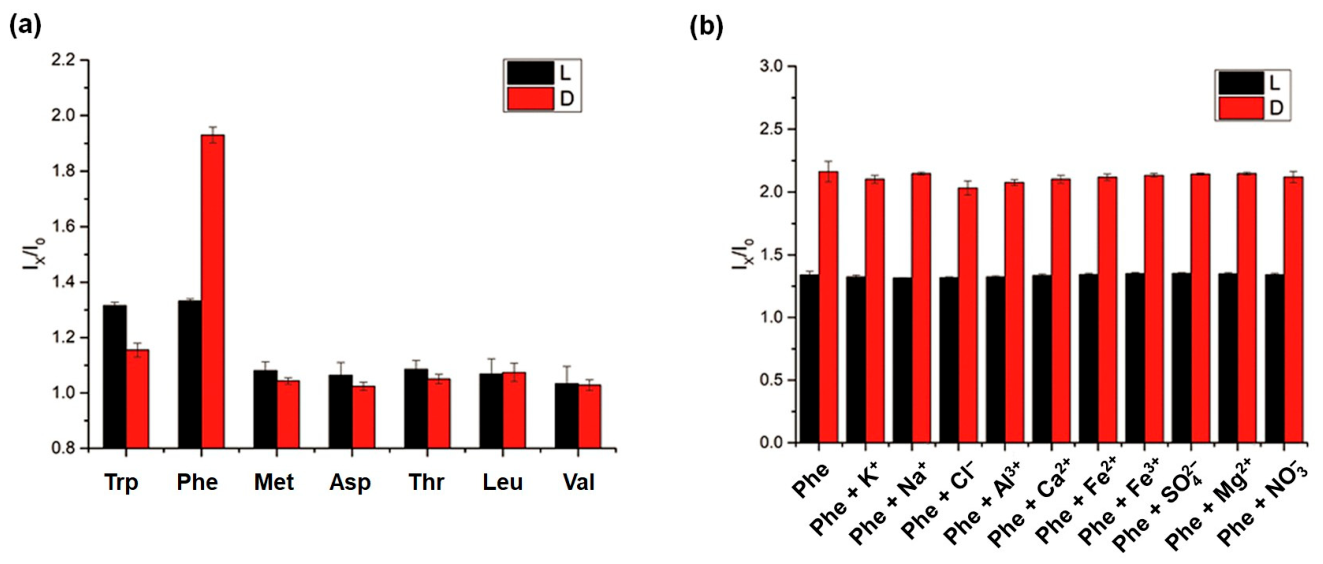
| CC-COFs | D-Phenylalanine | PET-Suppressed Enhancement | 0.027 μM | N.R. | 80% within 10 min | Unaffected by ten common ions: K+, Na+, Mg2+, Fe3+, Fe2+, Ca2+, Al3+, Cl−, SO32−, and NO3− | [68] | |
| (R)-CCOF 17 | L-PGL, L-Phenylalanine | PET-Suppressed Enhancement | N.R. | EF = 12.85–14.72 | N.R. | N.R. | [72] | |
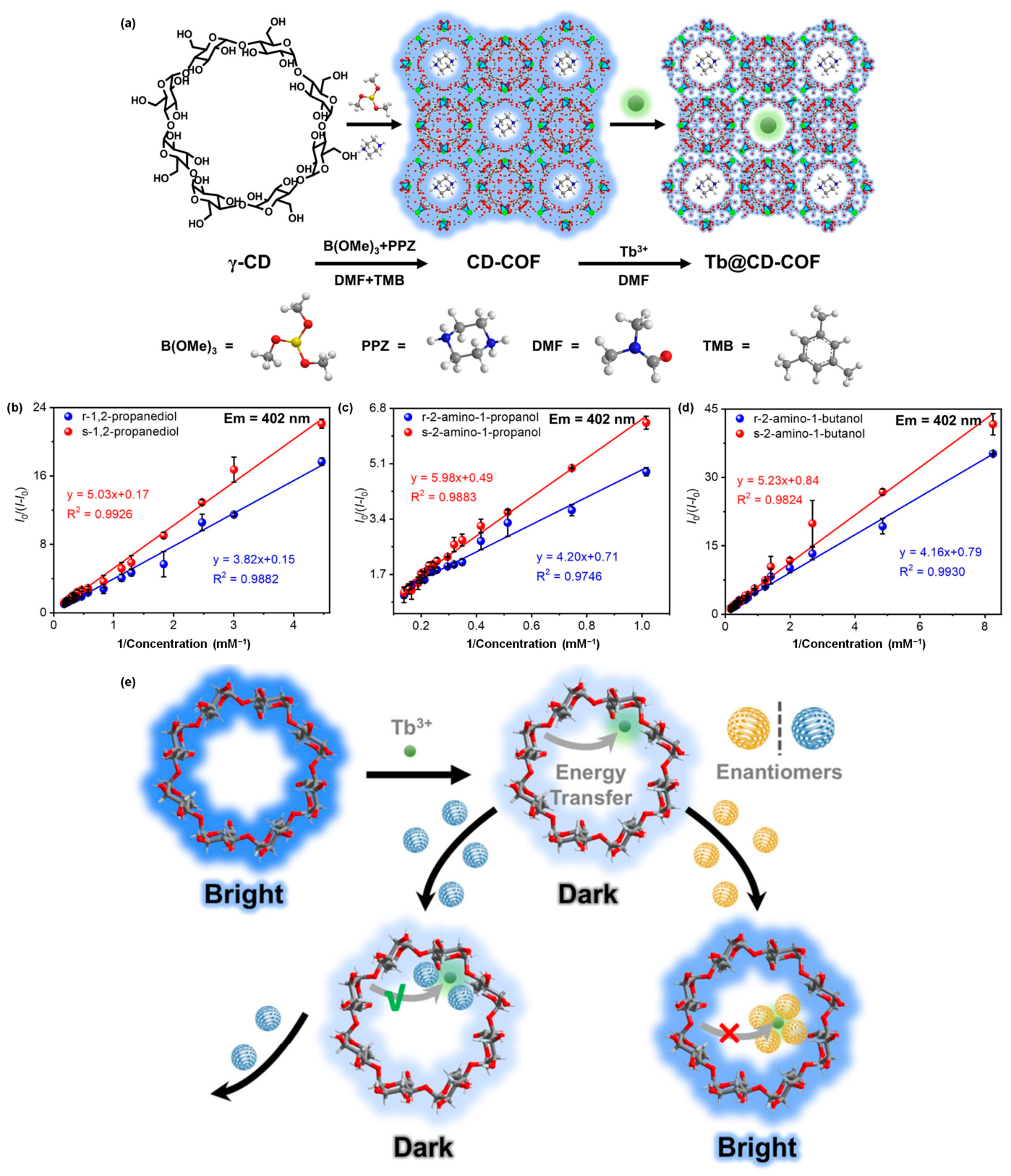
| Ratiometric | Tb@CD-COF | R-1,2-Propanediol, R-2-Amino-1-propanol, R-2-Amino-1-butanol | Antenna Effect-Modulated | 7.50–11.80 μM | KBH ratio = 1.25–1.45 | Stabilized within 30 s | Stable under variations in scan slit width and excitation wavelength | [74] |
Disclaimer/Publisher’s Note: The statements, opinions and data contained in all publications are solely those of the individual author(s) and contributor(s) and not of MDPI and/or the editor(s). MDPI and/or the editor(s) disclaim responsibility for any injury to people or property resulting from any ideas, methods, instructions or products referred to in the content. |
© 2026 by the authors. Licensee MDPI, Basel, Switzerland. This article is an open access article distributed under the terms and conditions of the Creative Commons Attribution (CC BY) license.
Share and Cite
Wang, L.-K.; Chen, X.-R.; Lin, T.-Y.; Ban, Y.-L.; Liu, Z.-C.; Jia, H.-L.; Wang, H.; Lan, Y.-B. Chiral Covalent Organic Frameworks for Enantioselective Fluorescence Sensing. Chemosensors 2026, 14, 120. https://doi.org/10.3390/chemosensors14050120
Wang L-K, Chen X-R, Lin T-Y, Ban Y-L, Liu Z-C, Jia H-L, Wang H, Lan Y-B. Chiral Covalent Organic Frameworks for Enantioselective Fluorescence Sensing. Chemosensors. 2026; 14(5):120. https://doi.org/10.3390/chemosensors14050120
Chicago/Turabian StyleWang, Li-Ke, Xin-Ru Chen, Tong-Yu Lin, Yong-Liang Ban, Zeng-Chen Liu, Hua-Li Jia, Hong Wang, and Yu-Bao Lan. 2026. "Chiral Covalent Organic Frameworks for Enantioselective Fluorescence Sensing" Chemosensors 14, no. 5: 120. https://doi.org/10.3390/chemosensors14050120
APA StyleWang, L.-K., Chen, X.-R., Lin, T.-Y., Ban, Y.-L., Liu, Z.-C., Jia, H.-L., Wang, H., & Lan, Y.-B. (2026). Chiral Covalent Organic Frameworks for Enantioselective Fluorescence Sensing. Chemosensors, 14(5), 120. https://doi.org/10.3390/chemosensors14050120