Article

Escherichia coli Optoelectronic Sensors for In Situ Monitoring of Selected Materials Across Water Supply Systems


1
Institute of Applied Physics, The Hebrew University of Jerusalem, Jerusalem 9190401, Israel
2
Shenkar College of Engineering, Design and Art, Ramat Gan 5252626, Israel
3
Department of Plant & Environmental Sciences, Institute of Life Sciences, The Hebrew University of Jerusalem, Jerusalem 9190401, Israel
*
Author to whom correspondence should be addressed.
Chemosensors 2026, 14(3), 62; https://doi.org/10.3390/chemosensors14030062
Submission received: 9 December 2025 / Revised: 26 February 2026 / Accepted: 3 March 2026 / Published: 5 March 2026

Abstract

Chemical monitoring of pollutants and hazardous materials in water supply systems traditionally depends on centralized laboratories, advanced instrumentation, and trained personnel, limiting accessibility and preventing real-time, on-site analysis. This work presents an alternative cost-effective, field-deployable approach that uses genetically engineered bioluminescent bioreporters, encapsulated in self-sufficient alginate capsules and integrated with an optoelectronic detection circuit, to detect and quantify target materials in water. We have developed a scalable single-channel prototype featuring four sensing tracks—two for sample measurement, one for clean water, and one for a standard reference solution. The latter employs the standard ratio (SR) method to ensure robust quantification, compensating for batch variability and environmental effects. System characterization showed high uniformity across tracks. Validation with nalidixic acid (NA) demonstrated reliable quantitative performance, with a blind test estimation of 5.6 mg/L for a true concentration of 5 mg/L, well within the calibration error range. Additional sensitivity testing confirmed detection of mitomycin C (MMC) at concentrations as low as 50 µg/L. Overall, the results highlight the potential of bacterial chemical sensing as a practical and scalable tool for real-time, in situ water quality monitoring networks.

1. Introduction

We describe a technology based on bacterial sensing that performs detection and concentration assessments of traces of target materials (TMs) in water. The technology was implemented in a prototype that demonstrated its realization in small systems, deployable in large numbers at critical points in water supply networks, and sample water on location in real-time. The technology is specifically designed for use by untrained personnel, which makes it a benchmark for demonstrating the potential of bacterial sensing as a cost-effective, viable, and versatile chemical analysis technology. The demonstrated prototype is a single-channel unit, but it was designed as a modular unit that can be scaled up into a multi-channel system capable of simultaneously detecting and quantifying a collection of TMs in water.
The technology presented takes advantage of the fact that live microbial sensors may be molecularly “tailored” to sensitively detect diverse types of chemicals, both toxic and beneficial, provided that they exert an effect on the biology of the living cell [1]. This has been previously demonstrated for numerous compound classes, including heavy metals [2,3], polycyclic aromatic hydrocarbons [3], naphthalene [4], endocrine-disrupting compounds, and even explosives [5]. This flexible diversity embodies an almost unlimited potential for water quality monitoring; potential examples include contaminants in water supply networks, fertilizers in irrigation systems, or disinfection byproducts in water treatment facilities. In the present study, we have concentrated on a class of toxic chemicals characterized by their genotoxic (i.e., DNA-damaging) activities. The two model genotoxic compounds we have employed for demonstrating the efficacy of the system were nalidixic acid (NA) and mitomycin C (MMC); as indicated above, however, these could be replaced with other biosensor types, depending on the envisaged application.
Traditional water analysis methods include mass spectrometry (MS) [6], chromatographic techniques such as gas or liquid chromatography (GC) [7,8,9] for compound separation and quantification, and spectroscopic methods, such as infrared (IR) and ultraviolet–visible (UV-Vis) spectroscopy, nuclear magnetic resonance (NMR) [10], or X-ray spectroscopy for structural and compositional analysis [11]. However, due to the complexity of these techniques, detailed chemical analysis requires sample transportation to central facilities equipped with advanced instrumentation, operated by highly trained personnel. The need for controlled conditions and for expert data interpretation limits accessibility and real-time deployment, making on-site or field-based analysis challenging.
Bacterial sensing offers a promising alternative approach for in situ chemical analysis. The ability of the sensing bacteria (“bioreporters”), the core sensing elements of bacterial biosensing systems, to operate in situ makes them ideal for deployment in a plethora of environments where conventional sensing methods may be impractical [12,13].
Bioreporters harness the natural ability of living cells to continuously monitor their microenvironment and respond to local changes by expressing specific gene sets [14,15]. As indicated above, due to their amenability to genetic engineering, bioreporters can be tailored to detect a wide range of TMs, making this sensing methodology inherently versatile [5,16,17,18]. The response of the bioreporters is dose-dependent [19,20,21] and may be manifested in different ways, the most noteworthy of which are bioluminescence and fluorescence [22,23,24,25].
The challenge posed by adopting this approach is to create a synergy between the live bioreporters and the optoelectronic circuit that detects the optical signal they emit and transforms it into digital data [26]. The bioreporters, which are live biological entities, operate in wet surroundings and need water and nutrients for their upkeep [1]. The optoelectronic circuit, which is a “technological entity”, needs to be supplied with electricity, is governed by digital instructions, and reports its findings by transmitting digital data. This challenge was addressed by packaging the bioreporters in capsules that are small polymeric spheres made of alginate, containing, nutrients and water, providing the necessities for bioreporter operation [27,28,29,30]. These capsules are self-sufficient, can operate outdoors for 12 h under normal weather conditions, and can be mass-produced. In addition, they can be stored under refrigeration at 4 °C for several weeks without deterioration in the bioreporter performance [31]. As such, the capsules “hold both ends of the stick”. They function both as “artificial fireflies” that provide the bioreporters with their natural wet habitat, and at the same time, they function as optoelectronic devices that operate in tandem with the optoelectronic circuit that receives the light emitted by the reporters and converts it into an electronic signal.
By virtue of the fact that bioreporters respond exclusively to the specific TM for which they were genetically engineered [32,33,34,35], the fundamental architecture of a bioreporter sensor remains unchanged, irrespective of the TM it is designed to detect. A single (bioluminescent) bioreporter sensor comprises two units: (i) the “sensing unit”- which consists of the core sensing elements (i.e., the bioreporters) and the analog optoelectronic circuit in which they are installed and (ii) the “digital unit” that performs data processing and communication, digitizing and processing the analog output from the sensing module. In addition, the digital unit creates a digital record of the sensing operation and transmits the data to a remote receiver, which also sends commands to the sensor and controls its operation [36].
As such, bioluminescent bioreporter sensors can be implemented in various configurations suitable for large-scale deployment, enabling autonomous operation [37] either as standalone units [38] or as sensors in an interconnected network. The bacterial biosensing system presented herein is a stationary chemical analysis platform designed to detect and quantify selected TMs in inspected solutions [36]. The system was designed for large-scale deployment as the fundamental unit in a chemical sensor network. Within the framework of the research described herein, a prototype single-channel unit was developed to detect and measure the concentration of one specific TM. The prototype was designed to be scalable, forming the fundamental building block of a multichannel system capable of simultaneously monitoring multiple TMs.
Beyond its applicability as the basis for constructing multichannel systems for monitoring water supply systems, the prototype also constitutes a proof of concept for constructing networks of sensors that perform chemical analysis. Namely, exporting bacterial chemical sensing from the realm of academic research to become a viable technology, relating in particular to the coexistence between the bioreporters, which are biological entities, with the technological environment in which they operate as optoelectronic devices. Put differently, this necessitated bringing together bioengineering and optoelectronic engineering to form a combined technological methodology that can be employed outside the controlled conditions prevailing in the research laboratory. Moreover, a necessary condition for the viability of this methodology necessitates that it can be maintained and operated by regular technicians who are trained to handle conventional instrumentation. To that end, special attention was given to issues relating to the bioengineering aspects of the methodology by which live bioreporters can be mass-produced, stored for long periods of time, and readied for their role as optoelectronic devices.

2. Materials and Methods

2.1. Operational Platform

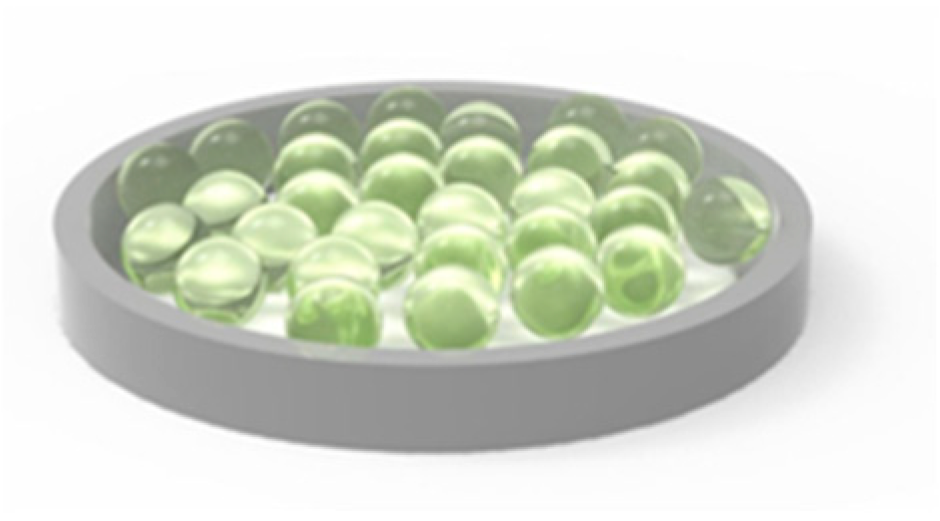
As said, the main challenge in developing chemical bacterial sensing is to create a synergy between the bioreporters and the optoelectronic (OE) hardware in which they are installed. This challenge was addressed by packaging the bioreporters in polymericcapsules. Prior to their operation, the capsules go through a refresh process [39,40] and are loaded in the “capsule cassettes”. These are open rings that contain a single layer of capsules and serve as the operational platform. It is important to emphasize that incorporating the capsule cassettes into the optoelectronic circuitry represents a significant technological milestone, constituting the basis for implementing networks of versatile chemical sensors. In addition, to enable wide use of the technology, it was necessary to package the bioreporters in a cost-effective way so that they can be handled, stored, and transported by untrained users. A capsule cassette is illustrated schematically in Figure 1.

2.2. System Underlying Principle

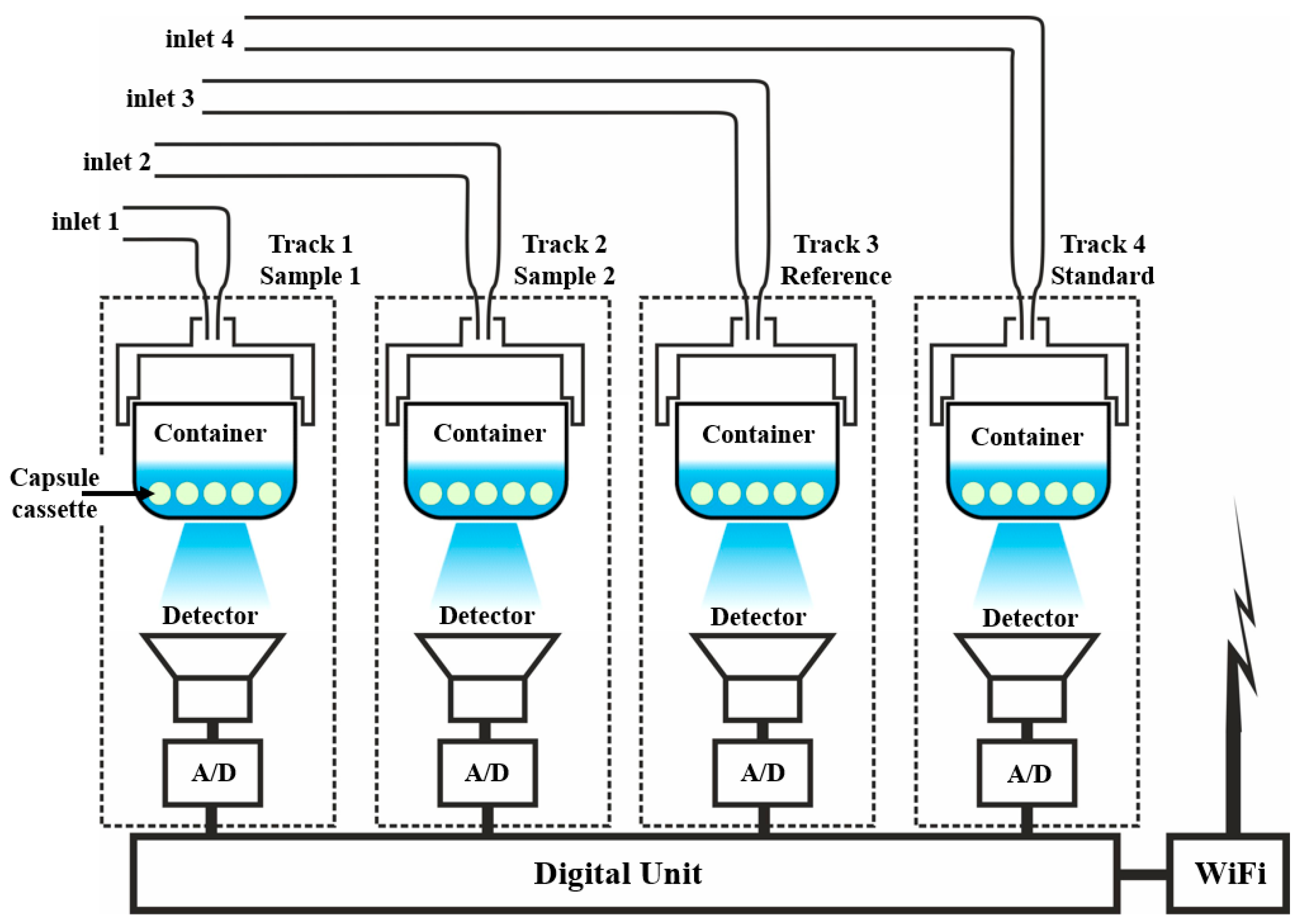
The one-channel prototype constructed within the framework of this research consists of four sensing tracks: two sampling tracks (tracks 1 and 2) performing the sensing of the TM in two identical samples of the inspected water source; one “clean water” track (track 3) performing the sensing of the TM in a sample of clean water for sampling the spontaneous emission of bioluminescence by the bioreporters, and one standard solution track (track 4) measuring the emission from a sample of solution containing a known concentration of the TM. The latter is required for performing the quantitative assessment of the concentration of the TM in the sample. This is done by computing the “standard ratio” (SR) parameter, defined as the ratio between the maximal output signal of the inspected sample track and the standard track. A calibration curve of the SR vs. the TM concentration in a set of pre-prepared samples is used to gauge the TM concentration in the inspected sample, based on the respective SR extracted from the sensor response. The quantitative assessment technique is described in detail in [41].

2.3. Measurement System Architecture

The one-channel prototype consists of three units as follows: (i) A container unit in which four containers are installed in a metallic chassis that serves as a heat bath. Each container is loaded with a capsule cassette that contains the bioreporter capsules and water samples as follows: a 2 mL sample of the inspected solution is inserted into containers 1 and 2, a 2 mL sample of clean water is inserted into container 3, and a 2 mL sample of the standard solution is inserted into container 4. Prior to loading the cassettes in the containers, they were subjected to a refresh process, which consisted of stirring them at 200 rpm for two hours in a solution of the nutrient lysogeny broth (LB) at 37 °C [42]. (ii) An OE unit was designed to detect in parallel the weak light signals emitted from the solutions contained in each of the four containers and convert them into analog electronic signals. The OE circuit was equipped with a printed circuit board (PCB) containing four detectors, which are photodiodes with a 10 × 10 mm active area (model S1227-BQ, Hamamatsu, Hamamatsu City, Japan), and four trans-impedance amplifiers (TIAs—model opa2300, Texas Instruments, Dallas, TX, USA) for low noise signal amplification. (iii) A digital unit that digitizes the said analog signals and transmits them to a distant computer that also processes the information they convey regarding the presence and concentration of the selected TM in the samples. The digital unit is based on the ESP32 module (model WROOM32, Espressif Systems, Shanghai, China), whose primary function is to transmit the digital signals received from the ADC (model ADS1115, Texas Instruments, Dallas, TX, USA) via a WiFi connection. The one-channel prototype is schematically illustrated in Figure 2.

2.4. Mechanical Design and Construction

To convert the prototype into an autonomous and self-sustaining system, the design of the operational platform addressed several key considerations. First, given that the measurements rely on living organisms, significant attention was given to establishing a controlled temperature for the bioreporters [43]. For this purpose, a temperature-controlled chassis was designed to enclose the containers using a ring heater, a PID controller, and a power driver (model CN16PT, Omega Engineering, Norwalk, CT, USA). Additionally, a fresh-air supply system (standard aquarium air pump) was incorporated in the prototype to maintain bacterial efficiency by continuously ventilating the internal space of the prototype [44].

2.5. Reagents and Bacterial Strain

The following chemicals and reagents were used: nalidixic acid sodium salt (Sigma Aldrich, St. Louis, MO, USA) and mitomycin C from Streptomyces caespitosus (Sigma Aldrich, St. Louis, MO, USA). The bacterial strain employed was an Escherichia coli bioreporter carrying the luxCDABE reporter genre cassette from Photorhabdus luminescens (Pl). Specifically, the genotoxicity bioreporter strain used was the recA strain harboring plasmid pBR-recA-Pl, in which reporter expression is driven by the DNA-damage-inducible recA gene promoter [45].

3. Results

3.1. System Characterization

Performance of the prototype was evaluated by monitoring changes in the bioluminescent signal emitted by the bacteria over time, both spontaneously and in response to varying water concentrations of the TM, nalidixic acid (NA). To assess system consistency, the uniformity of the response across the four measurement tracks was examined. This uniform response is essential for ensuring the accuracy and reliability of quantitative measurements involving bacterial bioluminescence. Maintaining uniformity minimizes potential external influences, thereby enhancing the robustness of the detection system.
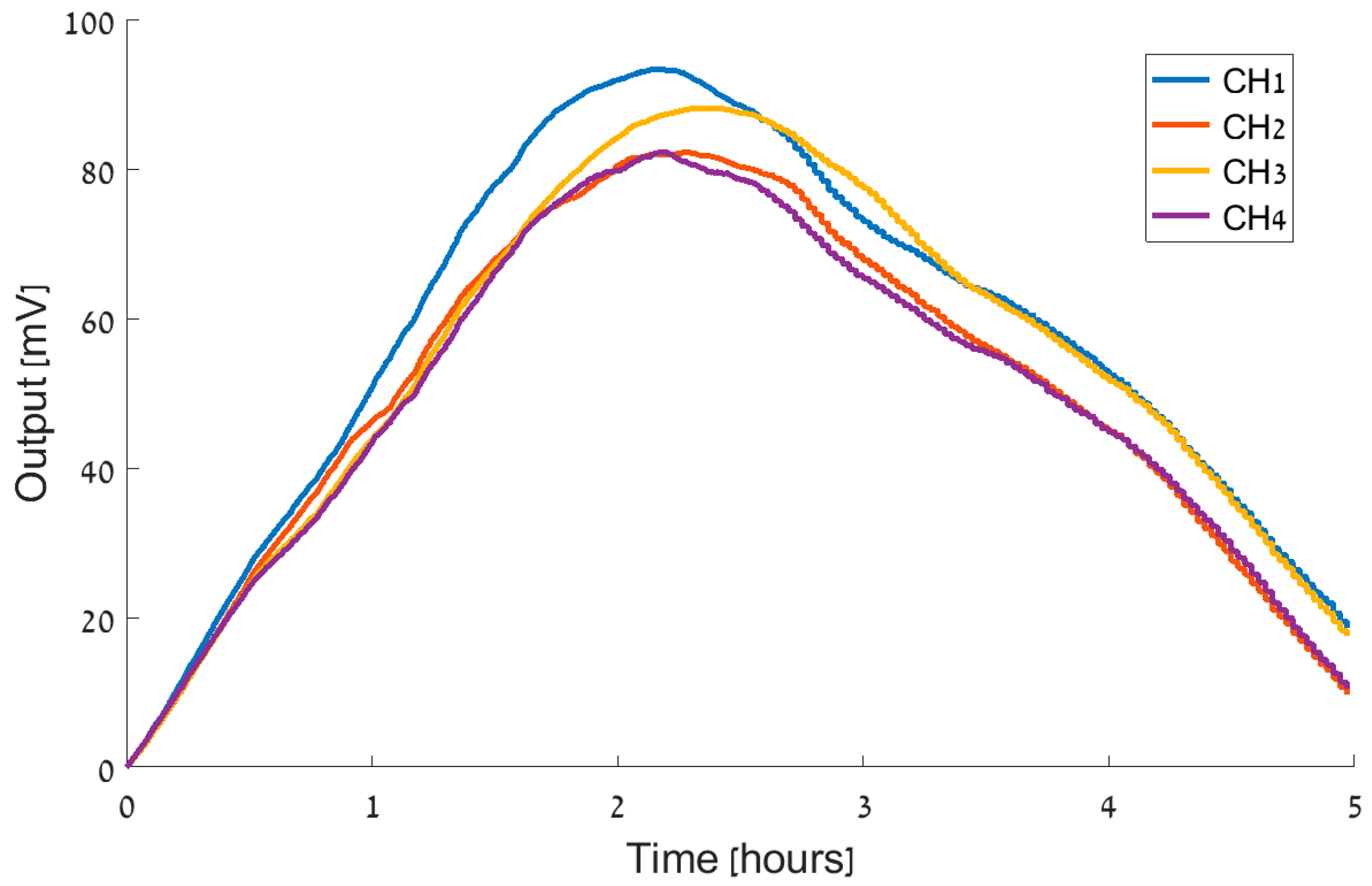
For this validation, a 6 mg/L NA solution was introduced into four containers, with all tracks monitoring the reaction. As shown in Figure 3, a high degree of uniformity was observed across all tracks.
The overall signal-to-noise ratio (SNR) of the system is limited by two factors: electronic noise and biological noise. The electronic noise originates from the dark current generated by the photodiode and is proportional to its active area. The effective noise voltage of the electronic system, expressed as the standard deviation of the voltage across the output impedance of the photodiode circuit, was measured to be 1.11 mV. The biological noise, which arises from the variance in the background bioluminescence of the bioreporters, exceeds by orders of magnitude the electronic noise and was measured to have a standard deviation of σ = 22%, a value represented in % as the bioluminescent response is batch dependent. This is the main limitation for a monitoring application, as it is currently fundamentally limited by the background bioluminescent signal of the bioreporters. This may be potentially lowered further (thus raising the overall SNR) by optimizing the genetic circuit to further reduce background (i.e., spontaneous) bioluminescence.

3.2. Calibration Curve

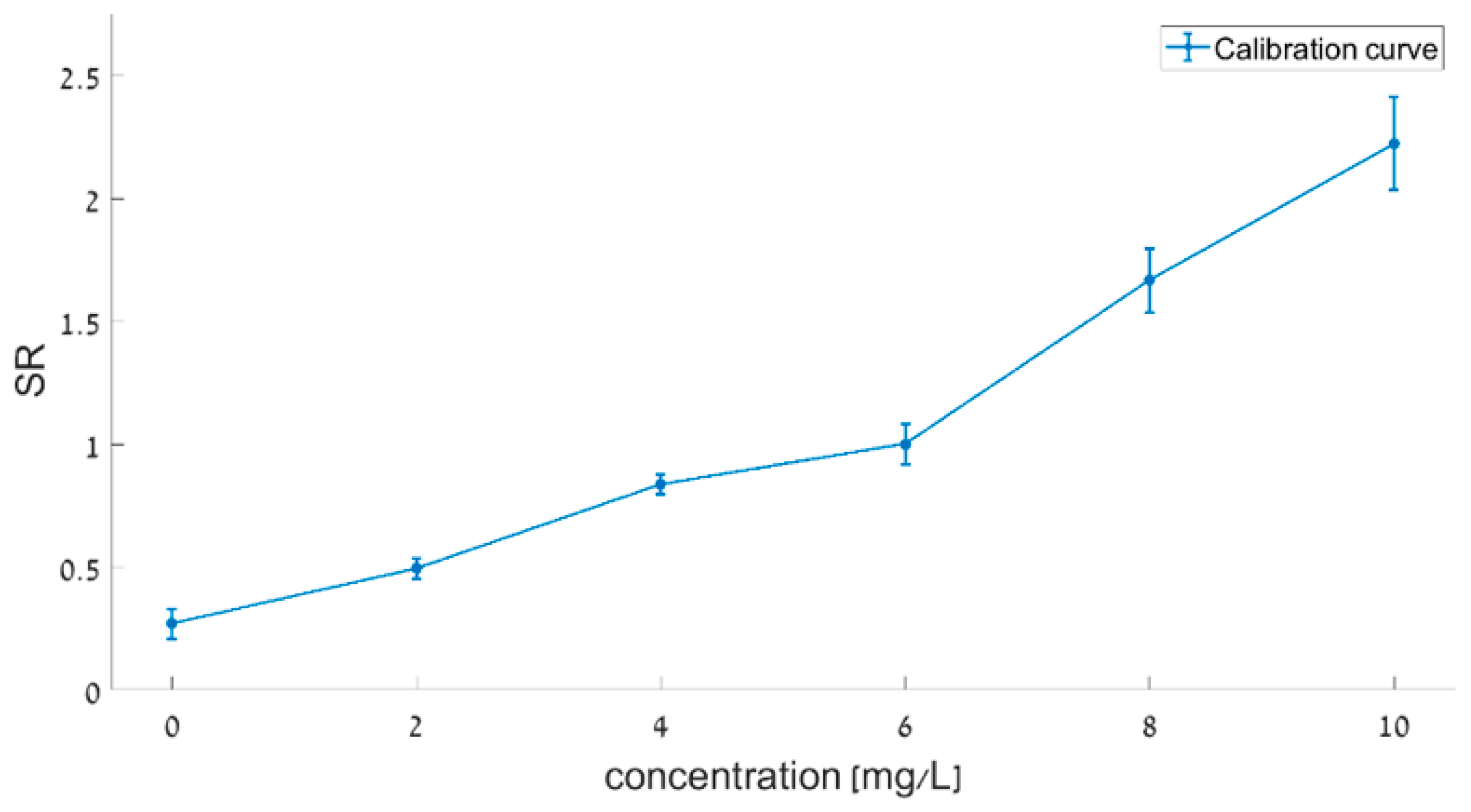
As previously mentioned, measurement results are influenced by both bacterial batch and the environmental conditions. Therefore, signal intensities vary between measurements and across batches, posing a strict limit on the ability to assess the TM concentration. To address this, a “standard measurement” approach was implemented. The underlying concept of the “standard ratio” (SR) factor assumes that, since both measurements are conducted under identical conditions with bacteria from the same batch, any variations will occur similarly in both measurements. This ensures that the SR factor remains independent of batch variability and environmental changes. Implementing the SR technique for quantitative assessment of the concentration necessitates the production of a calibration curve, namely a plot of the SR versus the TM concentration in a series of pre-prepared samples for each TM. This was demonstrated by assessing the concentration of NA in several samples. At least three independent measurements were conducted where three tracks were exposed to a known NA concentration, and the SR value was extracted using the ratio of the fourth sensing track; as such, each point on the calibration curve is the average SR value of these three tracks. This procedure was conducted for each bacterial batch (twice overall) to measure the variance of the SR value across batches, resulting in a variance value not exceeding 13%. The NA concentration in the standard sample was selected to be in the approximate middle of the dynamic range for which the bacterial strain was found to be effective. In this case, the standard concentration was 6 mg/L. The calibration curve for recA bioreporters genetically engineered to respond to NA is presented in Figure 4.

3.3. Validation of the Quantitative Technique

The accuracy of the SR technique was demonstrated by a blind test. The four tracks of the system were exposed as follows: the two sample tracks were exposed to a solution with an unknown concentration of NA, while the standard and the reference tracks were exposed to a concentration of 6 mg/L and 0 mg/L (clean water) of NA, respectively. After all track samples reached the maximum signal, the SR value of the unknown solution was determined. According to the calibration curve, the concentration of the blind measurement was determined to be 5.6 mg/L, whereas the actual concentration of the solution was 5 mg/L. This result falls well within the acceptable error range of the calibration curve, indicating that the measurement system provides a reliable estimation of the true concentration.

3.4. Bioreporter Sensitivity

The detection sensitivity of bacterial sensing of the presence of the TM in the inspected solution is defined as the minimum detectable concentration of the TM that can be reliably identified. This threshold is determined as the lowest concentration of the TM that produces a measurable signal exceeding the spontaneous background signal observed in a solution with zero TM concentration.
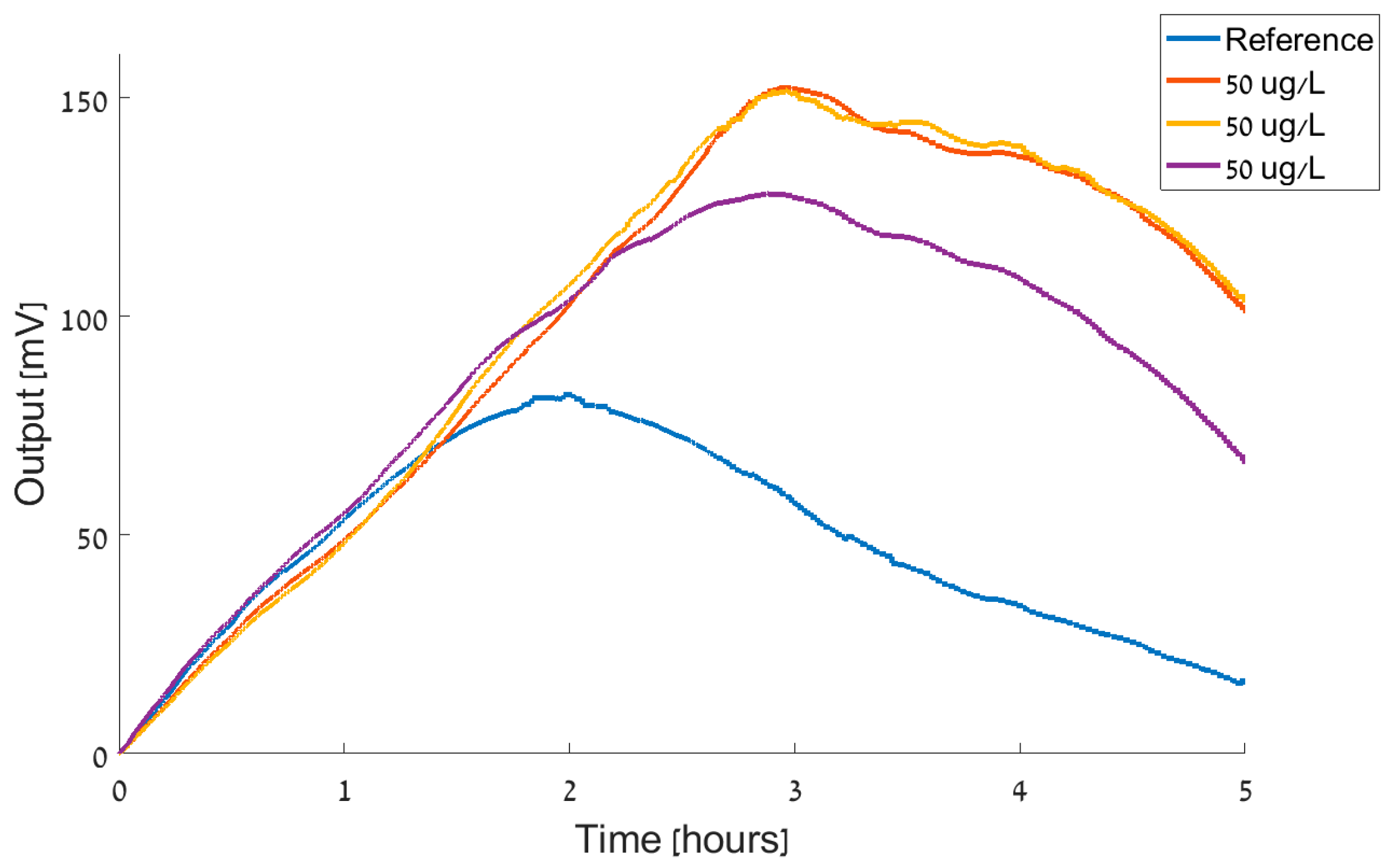
To evaluate the sensitivity of the prototype, a series of proof-of-concept measurements was conducted using three samples of inspected solutions containing 50 µg/L of mitomycin C (MMC). These samples were exposed to capsules loaded with recA bioreporters, genetically engineered to respond to the genotoxic effect of MMC, and compared to an identical measurement performed on a distilled water sample. The results, presented in Figure 5, demonstrate the system’s ability to differentiate between the presence and absence of MMC, highlighting its effectiveness in detecting low concentrations of the TM given adequate genetic engineering optimizations on the background bioluminescence.

4. Discussion

The results of this study demonstrate the feasibility and effectiveness of using bacterial bioreporters for real-time chemical sensing in water monitoring applications. The developed system successfully integrated living bioreporters with an optoelectronic detection platform, achieving accurate and reliable detection of TMs. In addition, the developed system provided a quantitative assessment of the TM in the inspected samples by employing the SR technique, which ensured consistency by mitigating variations due to bacterial batch differences and environmental influences. A key strength of this approach lies in its ability to provide in situ, field-deployable chemical analysis without the need for delivering samples from the sampling points to a central laboratory facility operated by highly trained personnel. Compared to conventional analytical techniques, which require complex instrumentation and controlled conditions, the bacterial sensing system offers a cost-effective, versatile, and scalable alternative, as summarized in Table 1. The encapsulation of bioreporters in alginate capsules further enhances usability, enabling long-term storage and simplified handling.
Despite these advantages, several challenges remain in optimizing the system for large-scale deployment. One limitation observed is the detection sensitivity of the system, which is currently constrained by the bioreporter strain used, determining the lowest detectable concentration of the TM. Engineering bioreporters with enhanced sensitivity and specificity could further improve the detection limits and expand the range of detectable TMs. Another important consideration is long-term stability and operational robustness. The controlled temperature and aeration mechanisms implemented in this prototype contribute to stable bacterial activity, but further testing under diverse environmental conditions is necessary to assess performance in real-world settings. Future research should explore sensor miniaturization and automation to facilitate continuous monitoring with minimal human intervention. Ultimately, this study highlights the significant potential of bacterial sensing technology in bridging the gap between traditional laboratory-based chemical analysis and real-time environmental monitoring. With further advancements in bioreporter engineering, system integration and automation, bacterial sensors could become a key tool for ensuring water quality, detecting environmental contaminants, and supporting industrial safety applications.

5. Summary and Conclusions

This article presents a bacterial chemical sensing system designed for autonomous operation and large-scale deployment in water supply monitoring. The system utilizes genetically engineered bioreporters to detect and quantify TMs in real-time, offering a cost-effective and field-deployable alternative to traditional chemical analysis methods. The prototype that was developed and described herein is a single-channel unit, designed to be scalable into a multi-channel system for simultaneous detection of multiple TMs. The system architecture integrates bioreporters encapsulated in polymeric alginate capsules, allowing stable operation within a controlled technological environment. The prototype features four sensing tracks: two for sample measurement, one for reference with clean water, and one for standard calibration. Quantitative assessment is performed using the standard ratio technique, which minimizes variability due to bacterial batch differences and environmental conditions [41]. A calibration curve was produced to correlate SR values with TM concentrations, ensuring accuracy and reproducibility. The system was validated using nalidixic acid as a model TM. Results demonstrated high uniformity across measurement tracks and a strong correlation between SR values and actual TM concentrations, with a blind test confirming an estimated concentration of 5.6 mg/L for a true concentration of 5 mg/L—well within the system’s error range. Additionally, sensitivity testing with mitomycin C revealed a detection threshold of 50 µg/L, underscoring the system’s capability to detect low TM concentrations reliably.
These findings highlight the potential of bacterial bioreporters as a practical and scalable solution for in situ chemical sensing in water monitoring applications. The developed prototype demonstrated high sensitivity, reliability, and quantitative accuracy in detecting TMs, validating its use as an alternative to conventional laboratory-based chemical analysis. By integrating biological sensing elements with an optoelectronic detection platform, the system achieves real-time monitoring capabilities suitable for deployment in diverse environmental and industrial settings. The successful implementation of the SR technique further enhances measurement consistency, addressing key challenges related to bacterial variability and environmental influences. Future work should focus on scaling the prototype into a multi-channel system for simultaneous detection of multiple contaminants, optimizing sensor miniaturization, and improving long-term stability for continuous field operation. Additionally, expanding the range of detectable TMs through further genetic engineering of bioreporters could broaden the system’s applicability in environmental monitoring, industrial safety, and biomedical diagnostics.
The proposed sensing system can be scaled up through unit multiplication, which naturally enables parallel sensing of multiple TMs or samples. However, currently, its form factor poses a practical limitation to the number of units that can be placed and operated simultaneously, mainly because it requires an operator to take measurements. As such, the system could be reimagined to detect multiple TMs in parallel by adapting the optoelectronic modules, using smaller containers and heating elements, which in turn will reduce the form factor. However, achieving truly high parallelism requires integration and automation of a few aspects. First, bioreporter capsules require refrigeration for long-term storage and must undergo a process of refreshment before being inserted into the sensing containers. Second, TM sensing requires three fluids: distilled water, the sample, and the standard solution, which may require specialized treatment by a human operator. Third, the sensing output is bioluminescence, which is very much limited by stray light; consequently, the system must be dark for the photodiodes’ operational range, which contradicts the requirement for readily available oxygen, and so an air ventilation system is a necessary addition. Collectively, these limitations can be classified into engineering challenges and fundamental biological constraints. Engineering-related challenges, including system size, manual operation, fluid handling, and storage requirements, primarily affect usability and scalability and can be addressed through integration, automation, and miniaturization. In contrast, constraints related to oxygen availability and light sensitivity are inherent to bioluminescent whole-cell systems and represent fundamental biological limitations. Among these, ensuring sufficient oxygen supply while maintaining low background light is considered the most critical factor for future field deployment, as it directly impacts signal stability and measurement reliability.

Author Contributions

Conceptualization, A.J.A., O.S., S.B. and Y.U.; methodology, A.J.A., Y.U. and N.O.; software, N.O.; hardware, O.S., L.A. and N.O.; validation, N.O., Y.U., L.A. and O.S.; formal analysis, N.O. and Y.U.; investigation, N.O. and L.A.; resources, S.B.; data curation, N.O. and L.A.; writing—original draft preparation, A.J.A. and Y.U.; writing—review and editing, A.J.A., Y.U. and N.O.; supervision, A.J.A. and S.B.; project administration, Y.U.; funding acquisition, A.J.A. and S.B. All authors have read and agreed to the published version of the manuscript.

Funding

This study was supported by project “intoDBP—Innovative tools to control organic matter and disinfection byproducts in drinking water”, funded by the European Union, grant number 101081728.

Institutional Review Board Statement

Not applicable.

Informed Consent Statement

Not applicable.

Data Availability Statement

The original contributions presented in this study are included in the article. Further inquiries can be directed to the corresponding author.

Acknowledgments

This research was supported in part by the US Army Research Office and the Defense Advanced Research Projects Agency (DARPA) Biological Technologies Office (BTO).

Conflicts of Interest

The authors declare no conflicts of interest.

References

  1. van der Meer, J.R.; Belkin, S. Where Microbiology Meets Microengineering: Design and Applications of Reporter Bacteria. Nat. Rev. Microbiol. 2010, 8, 511–522. [Google Scholar] [CrossRef]
  2. Hakkila, K.; Green, T.; Leskinen, P.; Ivask, A.; Marks, R.; Virta, M. Detection of Bioavailable Heavy Metals in EILATox-Oregon Samples Using Whole-Cell Luminescent Bacterial Sensors in Suspension or Immobilized onto Fibre-Optic Tips. J. Appl. Toxicol. 2004, 24, 333–342. [Google Scholar] [CrossRef]
  3. Lee, H.J.; Villaume, J.; Cullen, D.C.; Kim, B.C.; Gu, M.B. Monitoring and Classification of PAH Toxicity Using an Immobilized Bioluminescent Bacteria. Biosens. Bioelectron. 2003, 18, 571–577. [Google Scholar] [CrossRef] [PubMed]
  4. Werlen, C.; Jaspers, M.C.M.; Van Der Meer, J.R. Measurement of Biologically Available Naphthalene in Gas and Aqueous Phases by Use of a Pseudomonas putida Biosensor. Appl. Environ. Microbiol. 2004, 70, 43–51. [Google Scholar] [CrossRef] [PubMed]
  5. Yagur-Kroll, S.; Lalush, C.; Rosen, R.; Bachar, N.; Moskovitz, Y.; Belkin, S. Escherichia coli Bioreporters for the Detection of 2,4-Dinitrotoluene and 2,4,6-Trinitrotoluene. Appl. Microbiol. Biotechnol. 2014, 98, 885–895. [Google Scholar] [CrossRef] [PubMed]
  6. Cooks, R.G.; Busch, K.L.; Glish, G.L. Mass Spectrometry: Analytical Capabilities and Potentials. Science 1983, 222, 273–291. [Google Scholar] [CrossRef]
  7. Baba, T.; Sakamoto, R.; Shibukawa, M.; Oguma, K. Solute Retention and the States of Water in Polyethylene Glycol and Poly(Vinyl Alcohol) Gels. J. Chromatogr. A 2004, 1040, 45–51. [Google Scholar] [CrossRef]
  8. Nováková, L.; Vlčková, H. A Review of Current Trends and Advances in Modern Bio-Analytical Methods: Chromatography and Sample Preparation. Anal. Chim. Acta 2009, 656, 8–35. [Google Scholar] [CrossRef]
  9. Nikolin, B.; Imamović, B.; Medanhodzić-Vuk, S.; Sober, M. High Perfomance Liquid Chromatography in Pharmaceutical Analyses. Bosn. J. Basic Med. Sci. 2004, 4, 5–9. [Google Scholar] [CrossRef]
  10. Khalil, A.; Kashif, M. Nuclear Magnetic Resonance Spectroscopy for Quantitative Analysis: A Review for Its Application in the Chemical, Pharmaceutical and Medicinal Domains. Crit. Rev. Anal. Chem. 2023, 53, 997–1011. [Google Scholar] [CrossRef]
  11. Prasad, R.D.; Sarvalkar, P.D.; Prasad, N.; Prasad, S.R.; Prasad, R.S.; Prasad, R.B.; Prasad, R.R.; Desai, C.B.; Vaidya, A.K.; Shivan, B.T.; et al. A Review on Spectroscopic Techniques for Analysis of Nanomaterials and Biomaterials. ES Energy Environ. 2024, 27, 1264. [Google Scholar] [CrossRef]
  12. Shin, H.J. Genetically Engineered Microbial Biosensors for in Situ Monitoring of Environmental Pollution. Appl. Microbiol. Biotechnol. 2011, 89, 867–877. [Google Scholar] [CrossRef]
  13. Hansen, L.H.; Sørensen, S.J. The Use of Whole-Cell Biosensors to Detect and Quantify Compounds or Conditions Affecting Biological Systems. Microb. Ecol. 2001, 42, 483–494. [Google Scholar] [CrossRef] [PubMed]
  14. Xu, T.; Close, D.M.; Sayler, G.S.; Ripp, S. Genetically Modified Whole-Cell Bioreporters for Environmental Assessment. Ecol. Indic. 2013, 28, 125–141. [Google Scholar] [CrossRef]
  15. Zanger, N.; Eltzov, E. Optimizing Whole-Cell Biosensors for the Early Detection of Crop Infections: A Proof-of-Concept Study. Biosensors 2025, 15, 300. [Google Scholar] [CrossRef]
  16. Applegate, B.M.; Kehrmeyer, S.R.; Sayler, G.S. A Chromosomally Based Tod-luxCDABE Whole-Cell Reporter for Benzene, Toluene, Ethybenzene, and Xylene (BTEX) Sensing. Appl. Environ. Microbiol. 1998, 64, 2730–2735. [Google Scholar] [CrossRef]
  17. Trang, P.T.K.; Berg, M.; Viet, P.H.; Van Mui, N.; Van Der Meer, J.R. Bacterial Bioassay for Rapid and Accurate Analysis of Arsenic in Highly Variable Groundwater Samples. Environ. Sci. Technol. 2005, 39, 7625–7630. [Google Scholar] [CrossRef]
  18. Lee, J.H.; Youn, C.H.; Kim, B.C.; Gu, M.B. An Oxidative Stress-Specific Bacterial Cell Array Chip for Toxicity Analysis. Biosens. Bioelectron. 2007, 22, 2223–2229. [Google Scholar] [CrossRef]
  19. Zhang, X.; Li, B.; Schillereff, D.N.; Chiverrell, R.C.; Tefsen, B.; Wells, M. Whole-Cell Biosensors for Determination of Bioavailable Pollutants in Soils and Sediments: Theory and Practice. Sci. Total Environ. 2022, 811, 152178. [Google Scholar] [CrossRef] [PubMed]
  20. Kim, B.C.; Gu, M.B. A Bioluminescent Sensor for High Throughput Toxicity Classification. Biosens. Bioelectron. 2003, 18, 1015–1021. [Google Scholar] [CrossRef] [PubMed]
  21. Biran, A.; Ben Yoav, H.; Yagur-Kroll, S.; Pedahzur, R.; Buchinger, S.; Shacham-Diamand, Y.; Reifferscheid, G.; Belkin, S. Microbial Genotoxicity Bioreporters Based on sulA Activation. Anal. Bioanal. Chem. 2011, 400, 3013–3024. [Google Scholar] [CrossRef]
  22. Close, D.M.; Ripp, S.; Sayler, G.S. Reporter Proteins in Whole-Cell Optical Bioreporter Detection Systems, Biosensor Integrations, and Biosensing Applications. Sensors 2009, 9, 9147–9174. [Google Scholar] [CrossRef]
  23. Liu, X.; Germaine, K.J.; Ryan, D.; Dowling, D.N. Whole-Cell Fluorescent Biosensors for Bioavailability and Biodegradation of Polychlorinated Biphenyls. Sensors 2010, 10, 1377–1398. [Google Scholar] [CrossRef]
  24. Li, Y.-F.; Li, F.-Y.; Ho, C.-L.; Liao, V.H.-C. Construction and Comparison of Fluorescence and Bioluminescence Bacterial Biosensors for the Detection of Bioavailable Toluene and Related Compounds. Environ. Pollut. 2008, 152, 123–129. [Google Scholar] [CrossRef]
  25. Belkin, S. Microbial Whole-Cell Sensing Systems of Environmental Pollutants. Curr. Opin. Microbiol. 2003, 6, 206–212. [Google Scholar] [CrossRef]
  26. Brooks, S.M.; Alper, H.S. Applications, Challenges, and Needs for Employing Synthetic Biology beyond the Lab. Nat. Commun. 2021, 12, 1390. [Google Scholar] [CrossRef]
  27. Paul, A.A.; Kadosh, Y.S.; Kushmaro, A.; Marks, R.S. Microbead-Encapsulated Luminescent Bioreporter Screening of P. Aeruginosa via Its Secreted Quorum-Sensing Molecules. Biosensors 2024, 14, 383. [Google Scholar] [CrossRef] [PubMed]
  28. Lee, K.; Choi, S.; Kim, C.; Kang, W.S.; Son, W.; Bae, S.C.; Oh, J.-W.; Lee, S.K.; Cha, C. Implementation of Combinatorial Genetic and Microenvironmental Engineering to Microbial-Based Field-Deployable Microbead Biosensors for Highly Sensitive and Remote Chemical Detection. ACS Sens. 2019, 4, 2716–2723. [Google Scholar] [CrossRef] [PubMed]
  29. Saberi Riseh, R.; Skorik, Y.A.; Thakur, V.K.; Moradi Pour, M.; Tamanadar, E.; Noghabi, S.S. Encapsulation of Plant Biocontrol Bacteria with Alginate as a Main Polymer Material. Int. J. Mol. Sci. 2021, 22, 11165. [Google Scholar] [CrossRef] [PubMed]
  30. Demitri, C.; Lamanna, L.; De Benedetto, E.; Damiano, F.; Cappello, M.S.; Siculella, L.; Sannino, A. Encapsulation of Lactobacillus Kefiri in Alginate Microbeads Using a Double Novel Aerosol Technique. Mater. Sci. Eng. C 2017, 77, 548–555. [Google Scholar] [CrossRef]
  31. Bassani, J.C.; Queiroz Santos, V.A.; Barbosa-Dekker, A.M.; Dekker, R.F.H.; da Cunha, M.A.A.; Pereira, E.A. Microbial Cell Encapsulation as a Strategy for the Maintenance of Stock Cultures. LWT 2019, 102, 411–417. [Google Scholar] [CrossRef]
  32. Kim, Y.; Jeon, Y.; Jang, G.; Kim, B.-G.; Yoon, Y. A Novel Escherichia coli Cell–Based Bioreporter for Quantification of Salicylic Acid in Cosmetics. Appl. Microbiol. Biotechnol. 2024, 108, 148. [Google Scholar] [CrossRef]
  33. Gui, Q.; Lawson, T.; Shan, S.; Yan, L.; Liu, Y. The Application of Whole Cell-Based Biosensors for Use in Environmental Analysis and in Medical Diagnostics. Sensors 2017, 17, 1623. [Google Scholar] [CrossRef] [PubMed]
  34. Zeng, N.; Wu, Y.; Chen, W.; Huang, Q.; Cai, P. Whole-Cell Microbial Bioreporter for Soil Contaminants Detection. Front. Bioeng. Biotechnol. 2021, 9, 622994. [Google Scholar] [CrossRef] [PubMed]
  35. Wu, Y.; Wang, C.-W.; Wang, D.; Wei, N. A Whole-Cell Biosensor for Point-of-Care Detection of Waterborne Bacterial Pathogens. ACS Synth. Biol. 2021, 10, 333–344. [Google Scholar] [CrossRef]
  36. Agranat, A.J.; Kabessa, Y.; Shemer, B.; Shpigel, E.; Schwartsglass, O.; Atamneh, L.; Uziel, Y.; Ejzenberg, M.; Mizrachi, Y.; Garcia, Y.; et al. An Autonomous Bioluminescent Bacterial Biosensor Module for Outdoor Sensor Networks, and Its Application for the Detection of Buried Explosives. Biosens. Bioelectron. 2021, 185, 113253. [Google Scholar] [CrossRef]
  37. Belkin, S.; Yagur-Kroll, S.; Kabessa, Y.; Korouma, V.; Septon, T.; Anati, Y.; Zohar-Perez, C.; Rabinovitz, Z.; Nussinovitch, A.; Agranat, A.J. Remote Detection of Buried Landmines Using a Bacterial Sensor. Nat. Biotechnol. 2017, 35, 308–310. [Google Scholar] [CrossRef]
  38. Kabessa, Y.; Korouma, V.; Ilan, H.; Yagur-Kroll, S.; Belkin, S.; Agranat, A.J. Simultaneous Quantification of the Fluorescent Responses of an Ensemble of Bacterial Sensors. Biosens. Bioelectron. 2013, 49, 394–398. [Google Scholar] [CrossRef] [PubMed]
  39. Trabelsi, I.; Bejar, W.; Ayadi, D.; Chouayekh, H.; Kammoun, R.; Bejar, S.; Ben Salah, R. Encapsulation in Alginate and Alginate Coated-Chitosan Improved the Survival of Newly Probiotic in Oxgall and Gastric Juice. Int. J. Biol. Macromol. 2013, 61, 36–42. [Google Scholar] [CrossRef]
  40. Sultana, K.; Godward, G.; Reynolds, N.; Arumugaswamy, R.; Peiris, P.; Kailasapathy, K. Encapsulation of Probiotic Bacteria with Alginate–Starch and Evaluation of Survival in Simulated Gastrointestinal Conditions and in Yoghurt. Int. J. Food Microbiol. 2000, 62, 47–55. [Google Scholar] [CrossRef]
  41. Uziel, Y.; Kabessa, Y.; Shemer, B.; Shpigel, E.; Belkin, S.; Agranat, A.J. Quantitative Chemical Sensing Using Genetically Engineered Bacterial Bioreporters. Chemosensors 2024, 12, 207. [Google Scholar] [CrossRef]
  42. Shahzadi, I.; Al-Ghamdi, M.A.; Nadeem, M.S.; Sajjad, M.; Ali, A.; Khan, J.A.; Kazmi, I. Scale-up Fermentation of Escherichia coli for the Production of Recombinant Endoglucanase from Clostridium thermocellum. Sci. Rep. 2021, 11, 7145. [Google Scholar] [CrossRef]
  43. Gilchrist, K.H.; Giovangrandi, L.; Whittington, R.H.; Kovacs, G.T.A. Sensitivity of Cell-Based Biosensors to Environmental Variables. Biosens. Bioelectron. 2005, 20, 1397–1406. [Google Scholar] [CrossRef]
  44. Scheerer, S.; Gomez, F.; Lloyd, D. Bioluminescence of Vibrio fischeri in Continuous Culture: Optimal Conditions for Stability and Intensity of Photoemission. J. Microbiol. Methods 2006, 67, 321–329. [Google Scholar] [CrossRef]
  45. Yagur-Kroll, S.; Bilic, B.; Belkin, S. Strategies for Enhancing Bioluminescent Bacterial Sensor Performance by Promoter Region Manipulation. Microb. Biotechnol. 2010, 3, 300–310. [Google Scholar] [CrossRef] [PubMed]
  46. Hynninen, A.; Tönismann, K.; Virta, M. Improving the Sensitivity of Bacterial Bioreporters for Heavy Metals. Bioeng. Bugs 2010, 1, 132–138. [Google Scholar] [CrossRef]
  47. Buffi, N.; Merulla, D.; Beutier, J.; Barbaud, F.; Beggah, S.; van Lintel, H.; Renaud, P.; van der Meer, J.R. Development of a Microfluidics Biosensor for Agarose-Bead Immobilized Escherichia coli Bioreporter Cells for Arsenite Detection in Aqueous Samples. Lab Chip 2011, 11, 2369–2377. [Google Scholar] [CrossRef] [PubMed]
  48. Zajíc, J.; Ripp, S.; Trögl, J.; Kuncová, G.; Pospíšilová, M. Repetitive Detection of Aromatic Hydrocarbon Contaminants with Bioluminescent Bioreporters Attached on Tapered Optical Fiber Elements. Sensors 2020, 20, 3237. [Google Scholar] [CrossRef]
Figure 1. The capsule cassette: an open ring holding a single layer of capsules.
Chemosensors 14 00062 g001
Figure 2. A schematic illustration of the prototype of the single-channel sensing unit. containing four parallel tracks: Tracks 1 and 2 are the sampling tracks, used for measuring the TM in duplicate water samples. Track 3 is the clean-water track, used to quantify spontaneous bioluminescence (system background). Track 4 is the standard-solution track measuring the response to a known concentration of the TM for system calibration. The light signals from the solutions contained in each of the four tracks are detected by the integrated optoelectronic (OE) circuit (the analog unit), which converts the weak light signals into analog electronic signals. These analog signals are then digitized by the digital unit (A/D converter) and wirelessly transmitted to a distant computer for data processing, enabling the determination of the presence and concentration of the selected TM.
Chemosensors 14 00062 g002
Figure 3. Validation of system uniformity: Light signals measured from the four sensing tracks following the introduction of a 6 mg/L NA solution into all containers, demonstrating high uniformity and consistent responses across all tracks.
Chemosensors 14 00062 g003
Figure 4. NA calibration curve for recA bioreporters: the mean values of the SR and their standard deviation (denoted by the error bars) are presented (STD = 0.13).
Chemosensors 14 00062 g004
Figure 5. System response to low concentration: Measured light signals from four inspected solutions containing 50 µg/L MMC. The results demonstrate the prototype’s ability to clearly differentiate the presence of TM at low concentrations.
Chemosensors 14 00062 g005
Table 1. Comparison of bacterial whole-cell bioreporter platforms for water monitoring.
FormatTMPerformanceAdvantagesLimitationsReference
Pseudomonas putida KT2440 bioreporter (lux)Heavy metals: Zn, Cd, Pbng–µg/LHigh sensitivityRequires controlled conditions; no encapsulation[46]
Agarose-bead immobilized E. coli in microfluidic chipArsenite (As3+)µg/LLow sample volume; defined geometryComplex microfabrication; lab-based operation[47]
Hydrogel-immobilized bioluminescent bioreporter on optical fiberAromatic hydrocarbons (BTEX/PAHs)µg/LRemote and repetitive sensing; optical integrationFragile setup; limited long-term stability[48]
Alginate capsules and OE systemGenotoxic compounds (NA, MMC)µg/LSelf-sufficient capsules; in situ use; SR quantificationManual operation; system’s sizeThis work
Disclaimer/Publisher’s Note: The statements, opinions and data contained in all publications are solely those of the individual author(s) and contributor(s) and not of MDPI and/or the editor(s). MDPI and/or the editor(s) disclaim responsibility for any injury to people or property resulting from any ideas, methods, instructions or products referred to in the content.