Review

Electrospun Nanofiber-Based SERS Substrates: Fabrication, Multiphasic Analysis, and Advanced Applications

1
School of Textiles, Guangdong Polytechnic, Foshan 528041, China
2
Key Laboratory of Materials and Technologies for Advanced Batteries, School of Energy, Materials and Chemical Engineering, Hefei University, Hefei 230601, China
3
School of Materials Science and Engineering, Anhui University, Hefei 230601, China
*
Author to whom correspondence should be addressed.
These authors contributed equally to this work.
Chemosensors 2026, 14(3), 57; https://doi.org/10.3390/chemosensors14030057
Submission received: 30 December 2025 / Revised: 11 February 2026 / Accepted: 24 February 2026 / Published: 2 March 2026
(This article belongs to the Section Materials for Chemical Sensing)

Abstract

Surface-enhanced Raman scattering (SERS) technology, with its high sensitivity and fingerprinting capability, has shown broad application prospects in environmental monitoring, food safety, biomedicine, and other fields. Electrospinning technology can produce flexible nanofiber membranes with high specific surface area and three-dimensional porous structures, providing an ideal platform for constructing high-performance SERS substrates for multiphasic analysis. This review systematically summarizes the fabrication strategies of fiber-based SERS substrates by using electrospinning technology, classified from three perspectives: material composition (polymer-based, ceramic-based, carbon fiber-based, and metal-based), spatial configuration (inner, surface, and inner-surface), and temporal sequence of plasmonic nanostructure (pre-synthesis, pre-reduction, post-reduction, post-modification, etc.). Furthermore, the sampling methods and measurement approaches of such substrates in liquid-phase, solid-phase, and gas-phase detection are discussed, with a focus on their applications in environmental pollution monitoring, food safety inspection, microbial identification, and biomedical diagnostics. Finally, the comparison of different preparation strategies and potential future directions are discussed, which could offer helpful guidance for the design and application of high-performance flexible SERS substrates.

1. Introduction

The Raman effect, first experimentally observed by Raman and Krishnan in 1928 [1,2], originates from the inelastic scattering of light accompanied by a shift in wavelength [3]. Raman spectroscopy techniques can directly probe the vibrational and rotational-vibrational states of molecules and materials, providing a characteristic fingerprint for their identification [4]. However, spontaneous Raman scattering is notoriously weak, which stems from an extremely small Raman cross-section, resulting in only about one in every 108 photons incident undergoing inelastic scattering [5]. Therefore, surface-enhanced Raman scattering (SERS), in which analytes are placed in close proximity to the plasmonic metallic nanostructures, has been developed for enhancing the sensitivity of Raman spectroscopy. SERS was first observed from pyridine on a roughened Ag electrode by Fleischmann and colleagues in 1974 [6]. Notably, the plasmon resonance contribution of the roughened Ag surfaces was thought to be more effective for the signal enhancement than the enlarged surface area due to roughness [6,7].
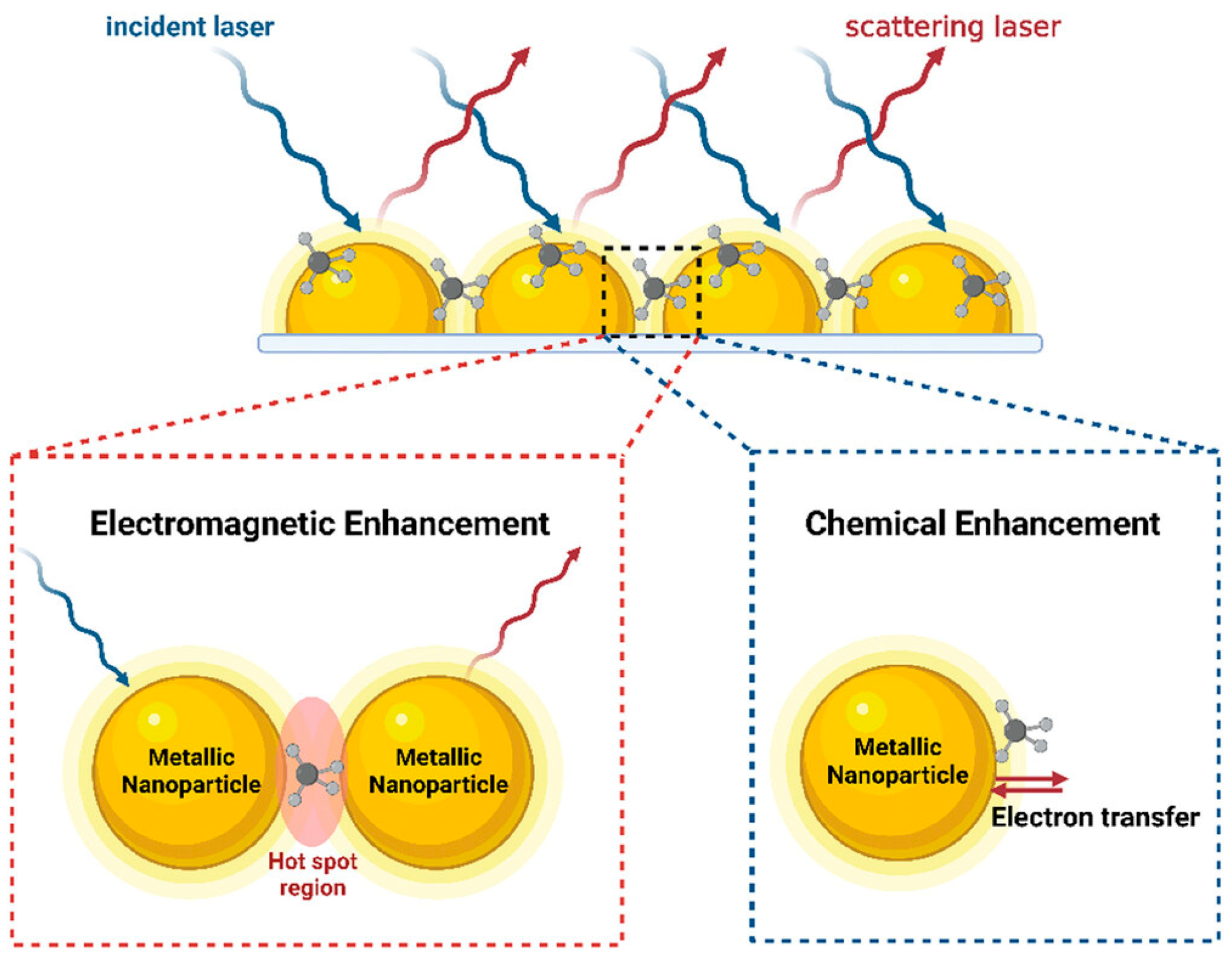
Now, two primary mechanisms, namely electromagnetic (EM) and chemical enhancement (CE), are widely adopted for the signal enhancement of SERS, as shown in Figure 1. The EM enhancement mechanism arises from the strong localized surface plasmon resonance (LSPR) field generated when metallic nanostructures are laser-illuminated, which significantly amplifies the electromagnetic field around them [8,9]. The strong EM enhancement predominantly occurs on nanorough noble metal structures (e.g., Au, Ag) [6], particularly at sharp tips and corners [10] or within nanoscale gaps (<10 nm) [11,12] (known as “hot spots” [13]). In comparison, the CE is based on the charge-transfer theory that the chemical interaction between the adsorbed molecule and the substrate surface could directly affect the electron density distribution and thus increase the polarizability of the bound molecule [14,15]. The contribution from electromagnetic mechanism (106–1011) [16] typically surpasses that from chemical enhancement (102–103) [17,18] by several orders of magnitude. Importantly, a synergistic enhancement [19,20] exists between the physical and chemical effects—the electromagnetic field not only directly amplifies the Raman signal but also significantly promotes the charge transfer process. This charge transfer, in turn, influences the distribution of the local electromagnetic field, forming a mutually reinforcing enhancement mechanism.
For SERS detection, the sensitivity and uniformity of SERS signals are critically important. SERS sensitivity relies on the construction of noble metal nanostructures with abundant SERS-active hot spots or metal-semiconductor (such as GaN [19] or ZnO [22]) composite structures. Such composite structures can achieve a synergistic effect between electromagnetic enhancement and chemical enhancement, thereby yielding superior SERS performance. Furthermore, the target molecules must actively or passively enter the hot spots or enhancement regions to obtain enhanced Raman signals; thus, the SERS substrate’s capacity for adsorbing, capturing, and enriching molecules is equally vital [23]. Additionally, a frequently overlooked aspect is that the SERS substrate itself should exhibit no or extremely low background noise or signals, especially when the concentration of target molecules is very low [24]. Molecular signals may be interfered with or even completely obscured by background signals, leading to diminished signal sensitivity. More importantly, for nearly all detection technologies, favorable signal repeatability and uniformity are important guarantees for ensuring detection reliability [25]. Particularly in SERS quantitative detection, high signal uniformity with a relative standard deviation (RSD) of less than 10% is generally recognized as a prerequisite for valid quantitative analysis [26]. Consequently, an ideal SERS substrate must possess high SERS activity, favorable signal repeatability and uniformity, minimal background noise or signals, and a strong affinity for analytes (or the capability to capture and enrich them).
Over the past two decades, numerous strategies have been developed to fabricate a wide variety of surface-enhanced Raman scattering (SERS) substrates. These SERS substrates are broadly categorized into two main types: liquid-phase substrates and solid-state substrates. SERS measurements could be performed directly using colloidal solutions of well-synthesized noble metal or alloy nanoparticles with various shapes and sizes [27]. For more versatile and convenient testing, noble metal nanostructures were usually constructed on rigid or flexible substrates through various techniques such as nanoparticle loading [28], physical vapor deposition [29], or in situ growth [30]. These underlying substrates could be natural or readily available materials, such as psychotria rubra leaves [31] or carbon fiber cloths [32]. Alternatively, precisely engineered arrayed nanostructures fabricated either through bottom-up templating methods (e.g., polystyrene microsphere templates [33], anodic aluminum oxide (AAO) templates [34]) or top-down micro/nanofabrication techniques (e.g., electron beam lithography (EBL) [35], nanoimprint lithography [36]) were also widely employed.
While significant advances have been made in the fabrication of SERS substrates over the past few decades, these developments continue to face multiple challenges that hinder their widespread practical application. First, an intractable trade-off exists among achieving ultra-high sensitivity, maintaining large-area uniformity, and ensuring low-cost fabrication. Although noble metal nanostructures deposited on traditional rigid substrates can provide strong electromagnetic enhancement, their irregular hotspot distribution results in poor signal reproducibility, which often fails to meet the quantitative requirements for reliable analysis. While methods such as bottom-up templating methods or top-down micro/nanofabrication techniques can produce ordered nanostructures with improved uniformity, these approaches are typically limited by complex fabrication procedures, high costs, and poor scalability, preventing their use in large-area substrate production. Second, conventional SERS substrates suffer from insufficient analyte capture efficiency. Most existing substrates are two-dimensional planar structures with a limited specific surface area, leading to weak adsorption and inadequate enrichment of trace-level molecules. Third, many SERS platforms exhibit poor adaptability to real-world application scenarios. Traditional substrates often lack the necessary flexibility and mechanical robustness [37,38,39], which restricts their ability to perform in situ sampling on irregular surfaces such as fruit peels or biological tissues or to be integrated into wearable sensing systems.
Notably, the electrospun nanofibrous membranes have carved out a niche in SERS underlying substrate engineering due to their scalable fabrication, ultrahigh-surface-area 3D network, good flexibility, and functional versatility [40]. Electrospinning is an electrohydrodynamic (EHD) technique to spin ultrafine polymer fibers from viscous polymer solutions [41,42]. A pendant droplet of the polymer solution forms at the spinneret tip first, and then high voltage is applied at the spinneret. As the electrostatic forces progressively overcome the surface tension, the pendant droplet deforms from spherical to a conical meniscus (“Taylor cone”). Finally, upon exceeding a critical voltage, a continuous electrified jet is ejected from the tip of the Taylor cone. Simultaneously, the jet thins while undergoing solvent evaporation, leading to its solidification into ultrafine fibers that are deposited on the collector. Electrospinning demonstrates remarkable versatility in controlling both the architecture and material composition of nanofibers. This versatile approach enables the production of nanofibers composed of polymers, metal oxides, carbon, metals, as well as composite formulations [42]. While commonly employed for smooth nanofiber production, the technique also enables direct one-step fabrication of porous [43], core–shell [44], and hollow [45] nanofiber structures. Importantly, through coaxial electrospinning (co-electrospinning), in which two or more fluids are delivered concentrically, even more complex architectures can be produced [46], such as multilayer coaxial fibers [47], fiber-in-tube structures [48], and multi-channel hollow microtubes [49].
Fabricating SERS substrates using the electrospinning method involves electrospinning a nanofibrous membrane as the underlying substrate, constructing plasmonic nanostructures, and achieving their integration. Combining the rapid, ultra-sensitive, and fingerprint-identifying potential of plasmonic nanostructures with the flexible, high-surface-area, and porous 3D scaffold provided by electrospinning, flexible fiber-based SERS substrates offer a versatile platform suitable for various sampling and measurement methodologies and are applied in diverse fields. When polymer nanofibers meet with plasmonic nanostructures, the design and performance revolve around three fundamental dimensions: elemental existence, temporal behavior, and spatial organization.
(i) 
Elemental Existence: Fiber Components
For SERS substrates, plasmonic nanostructures serve as the functional materials responsible for signal enhancement, whereas the polymer matrix itself does not usually contribute to the Raman enhancement effect. This implies that the polymer is not an indispensable component in the final SERS substrate. Therefore, after the integration of the polymer nanofibers with plasmonic nanostructures, the polymer template can be either directly removed via calcination [50,51] or dissolution [52,53] or transformed into carbon fibers [54,55], while the electrospinning-derived nanofibrous structure could be retained. Based on the composition of the underlying substrate, SERS substrates can be classified into two categories: (1) polymer-based SERS substrates, where the polymer component is retained after electrospinning [56,57,58]; and (2) non-polymer-based SERS substrates, including ceramic-based [50,51], carbon fiber-based [54,55], and metal-based variants [52,53].
(ii) 
Spatial Organization: Component Arrangement
From a spatial perspective, this concerns the relative positions between the polymer nanofibers and the plasmonic nanostructures. The plasmonic structures can be primarily embedded within the polymer nanofibers (inner) [59,60], decorated on their surfaces (surf) [61,62], or a combination of both (inner-surf) [63,64]. It is worth noting that, due to the random distribution of nanoparticles and the diffusion of metal salts, some particles may appear on the fiber surface even in the “inner” configuration, and some surface-decorated nanoparticles may penetrate into the fiber interior during processing.
(iii) 
Temporal Behavior: Sequence of Fabrication
The temporal dimension in substrate fabrication primarily concerns the sequence of constructing plasmonic structures and polymer nanofibers. This process can be categorized into two main scenarios defined by the fabrication sequence: one involves pre-constructing plasmonic structures [65]; conversely, the other begins with fabricating polymer nanofibers [66].
The core advantages of electrospun nanofiber membranes as SERS substrates can be summarized in four key aspects. First, their three-dimensional porous network structure, characterized by high porosity and large specific surface area, provides an ideal platform for efficient analyte adsorption and enrichment. Second, the inherent averaging effect across the three-dimensional fibrous network contributes to improved signal uniformity. This effect arises because a single laser spot typically interrogates multiple layers of stacked fibers and nanoparticles simultaneously, which helps to mitigate local variations in hotspot intensity and enhances measurement reproducibility. Third, they exhibit excellent mechanical flexibility and durability, allowing the fiber membranes to be bent, folded, or stretched, which makes them particularly suitable for wearable sensing and in situ detection on curved or irregular surfaces. Fourth, these membranes offer controllable structural design (such as random, aligned, core-shell, or hollow fibers) and can be readily prepared by adjusting spinning parameters, enabling precise spatial control of hotspot distribution. Furthermore, they provide a rich and versatile material platform with straightforward functionalization pathways. Polymers, ceramics, carbon materials, and metals can all be incorporated through electrospinning or post-processing. The abundant functional groups and tunable surface chemistry of polymer fibers facilitate robust nanoparticle immobilization, while the integration of ceramic or carbon components enables the construction of multifunctional composites with electromagnetic-chemical synergistic enhancement.
Based on these advantages, this review systematically summarizes the design strategies and application progress of electrospun nanofiber-based SERS substrates. First, the fabrication methods of such substrates are categorized from three perspectives: material composition (polymer-based, ceramic-based, carbon fiber-based, and metal-based fibers), spatial configuration (inner, surface, and inner-surface), and temporal sequence of plasmonic nanostructure integration (pre-synthesis, pre-reduction, post-reduction, post-modification, etc.). Subsequently, the sampling methods and measurement approaches enabled by these substrates in liquid-phase, solid-phase, and gas-phase detection are discussed. Finally, the review highlights their applications in environmental pollution monitoring, food safety inspection, microbial identification, and biomedical diagnostics and provides an outlook on future directions, aiming to offer helpful guidance for the design and application of high-performance flexible SERS substrates.

2. Fabrication of Polymer-Based SERS Substrates

For polymer-based SERS substrates, they can be categorized into five distinct fabrication methods according to the principles of temporal behavior and spatial organization. These include the following:
(i) 
Inner/pre-synthesizing strategy: pre-synthesizing noble metal nanoparticles, then dispersing them into the polymer solution for one-step electrospinning of composite fibers with embedded nanoparticles;
(ii) 
Inner/pre-reduction strategy: mixing metal precursors with the polymer solution, followed by in situ reduction to form noble metal nanoparticles before electrospinning;
(iii) 
Inner-surf/post-reduction strategy: electrospinning nanofibrous membranes containing metal precursors, followed by a post-reduction treatment to convert precursors into metal nanoparticles;
(iv) 
Surf/pre-synthesizing strategy: directly assembling the pre-synthesized nanoparticles onto the surfaces of nanofibrous membranes;
(v) 
Surf/post-modification strategy: electrospinning polymer nanofibers, then performing surface modification of plasmonic nanostructures through in situ chemical growth or physical vapor deposition (PVD).

2.1. Inner/Pre-Synthesizing Strategy: Embedding Pre-Synthesized Nanoparticles Within Fibers

To date, a wide variety of Au, Ag, and Au/Ag alloy nanoparticles (NPs) with diverse morphologies (such as Au [67,68], Ag [59,69], and Au/Ag alloy [70] nanospheres; Au [71,72] and Au@Ag [73] nanorods; Au nanoprisms [74]; Ag nanowires [65,75,76]; and Ag nanocubes [77]) have been synthesized via chemical routes and embedded in the electrospun nanofibers. To prevent aggregation and sedimentation, as-synthesized nanoparticles are typically capped with stabilizers such as polyvinylpyrrolidone (PVP), cetyltrimethylammonium bromide (CTAB), or citrate [78]. The standard procedure for preparing the metal-nanoparticle/polymer solutions involves several steps. First, noble metal nanoparticles with specific shapes and sizes are synthesized and then subjected to multiple cycles of centrifugation and solvent redispersion to remove excess stabilizers, ultimately forming a concentrated nanoparticle dispersion [76]. The redispersion process is often difficult, particularly when surfactant levels are low, typically requiring prolonged high-intensity ultrasonication to achieve a homogeneous dispersion. It is noteworthy that directly redispersing centrifuged nanoparticles into a viscous polymer solution is highly challenging and generally not recommended. Once a stable nanoparticle dispersion is obtained, it can be blended with the polymer solution under ultrasonication or stirring to form a homogeneous electrospinning solution. This mixture can then be directly one-step electrospun into composite nanofibers embedded with nanoparticles. Owing to the significant density difference between noble metals and polymers, a high weight content of metal nanoparticles is essential to achieve a high volumetric loading within the resulting nanofibers.
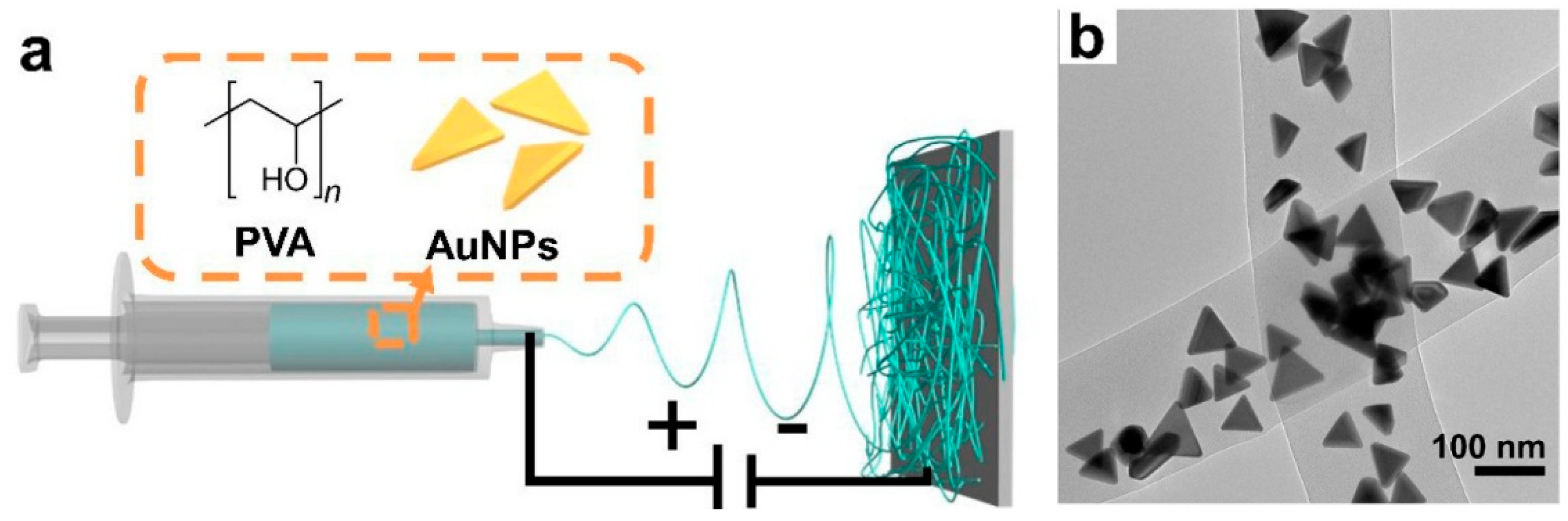
A critical challenge in this approach lies in the compatibility between the nanoparticles and the solvent used for electrospinning. For instance, CTAB-capped gold nanorods can disperse well in water and ethanol but will aggregate directly into N,N-Dimethylacetamide (DMAc). Furthermore, PVP-capped silver nanocubes show good dispersion in water, ethanol, and DMAc, yet severely aggregate in acetone [77]. The choice of polymer often dictates the solvent required for electrospinning, making it essential to select appropriate surface ligands or perform surface modification of the nanoparticles to ensure colloidal stability. Critically, the compatibility between nanoparticles and polymers must also be considered: ionic polymers, such as anionic polymers like poly(acrylic acid) (PAA) and sodium alginate (SA), as well as cationic polymers including poly(ethylenimine) (PEI) and chitosan (CS), may induce the aggregation of highly concentrated nanoparticles that carry an opposite surface charge to the polymer due to electrostatic attraction. Furthermore, the addition of high concentrations of electrolytes can screen electrostatic repulsion between nanoparticles, also leading to aggregation. Therefore, electrospinning of noble metal nanoparticles with high-concentration salts such as HAuCl4 or AgNO3 is generally not feasible. These dispersion limitations severely constrain the selection of compatible nanoparticle–polymer-solvent systems. The nanoparticles are typically randomly and well-monodispersed within the nanofiber matrix, with a small fraction located near the fiber surface. For example, Dang Alei et al. fabricated gold nanoprism/poly(vinyl alcohol) (PVA) nanofibers as the flexible and free-standing SERS substrates (Figure 2). The gold nanoprisms can generate a strong electromagnetic field through dipolar plasmonic resonance at their sharp corners and quadrupolar plasmonic resonance along their edges and center. Interestingly, nanoparticles with high aspect ratios (e.g., nanorods [71,72] and nanowires [75,76]) tend to align along the fiber axis due to the electrostatic stretching during the electrospinning process. Importantly, the random dispersion of metal nanoparticles in polymer nanofibers contributes to the excellent spatial uniformity of the SERS signal across the membrane. Furthermore, the spatial distribution of nanoparticles within fibers can be precisely regulated through coaxial electrospinning. For example, by using the coaxial electrospinning technique with poly(N-isopropylacrylamide-co-N-hydroxymethylacrylamide) aqueous solution as the core fluid and its Au@AgNRs mixture as the shell fluid, core-shell structure thermoresponsive nanofibers with Au@AgNRs mostly distributed in the shell layer and directionally aligned along the axes of the fibers are produced [79]. On the other hand, the limited nanoparticle loading often results in large interparticle distances (>10 nm), which inhibits the formation of SERS hot spots and therefore leads to moderate SERS activity.
To improve the SERS activity of nanoparticles embedded in nanofiber membranes, controlled and moderate aggregation can be strategically utilized to create Raman hot spots, while excessive aggregation can cause failed spinning solution preparation or electrospinning difficulty. For instance, the Yu group found that PVA can induce the self-assembling of Ag NPs into chain-like Ag dimers by vigorous stirring of an AgNPs–PVA solution, leading to a highly sensitive, reproducible, and free-standing electrospun SERS substrate [69]. Furthermore, the Yu group prepared AuNR–AgNW assemblies by electrostatic adsorption and then assembled the nanocomposites within the PVA nanofibers via electrospinning [75]. The resulting AuNR–AgNW/PVA electrospun mats show higher SERS activity than randomly dispersed AuNRs and AgNWs. In contrast to polymer-induced and electrostatic-driven controlled aggregation, poor solvents tend to cause extensive nanoparticle aggregation and eventual precipitation. However, we observed that the high viscosity of polymer solutions can help to suppress the severe nanoparticle aggregation [77]. Consequently, an Ag-nanocubes/cellulose acetate solution with controlled aggregation but slightly poor spinnability could be prepared by mixing an Ag-nanocubes/DMAc dispersion with a CA/DMAc-acetone (v/v 2:1) solution. Subsequently, high-SERS-sensitive cellulose acetate nanofibers loaded with aggregated Ag nanocubes were co-electrospun with the aid of the well-spinnable outer CA/DMAc–acetone (v/v 2:1) solution. The distribution of the random aggregates among the nanofibers was inherently non-uniform; however, the averaging effect of stacking layer upon layer of numerous randomly deposited nanofibers within a focused incident laser spot still facilitated the generation of reproducible SERS signals with an RSD of 10.4% over a 100 × 100 μm2 area. Remarkably, even when the measurement area was expanded to 1 mm × 1 mm2, the RSD only increased slightly to 11.8%. In contrast, the flat SERS sample prepared by liquid–liquid self-assembly of silver nanocubes (AgNCs) on a silicon wafer showed the signal uniformity with the RSD of 15.9% over a 50 × 50 μm2 area and 46.2% over a larger area of 0.5 × 0.5 mm2 [26]. Moreover, when monomeric AgNCs are uniformly distributed within the nanofibers, their signal uniformity can be referenced to their encapsulation within microspheres [26], enabling the achievement of super-uniform SERS signals at the square-centimeter level (with the RSD far below 10%). These results demonstrate that electrospun SERS substrates enable the generation of highly uniform SERS signals over large areas.

2.2. Inner/Pre-Reduction Strategy: Pre-Reducing Precursors in the Spinning Solution

The inner/pre-reduction strategy presents a much simpler alternative to the inner/pre-synthesizing method in terms of operational complexity. Several studies have directly dissolved noble metal salts into polymer solutions, followed by in situ reduction to prepare nanoparticle-dispersed polymer solutions for subsequent electrospinning, ultimately producing nanoparticle-embedded nanofibrous membranes as SERS substrates. AgNO3 is the most frequently chosen metal salt for this method, whereas HAuCl4 sees limited use due to its higher reduction potential [80]. Notably, the addition of salts significantly influences the electrospinning process. The incorporation of a small amount of salt enhances the solution’s conductivity, which aids in reducing fiber diameter and yielding uniform fibers. However, excessively high conductivity hinders jet control, resulting in multiple jet ejections or jet splitting rather than a stable single jet, leading to a broadened fiber diameter distribution, frequent nozzle clogging, and the formation of beaded fibers [81,82].
Polymers with reducing moieties (e.g., hydroxyls in PVA [83]) and reducing solvents like DMF [84] can serve as reducing agents to convert AgNO3 into nanoparticles under thermal activation. Ultraviolet (UV) irradiation can also be employed to induce the reduction of metal precursors via a photochemical process without additional agents [85,86]. However, there is little scope for manipulating either their size or morphology. Owing to the mild reducing nature of the polymers, solvents, and UV light, the synthesized nanoparticles are generally limited to sub-10 nm diameters, while their morphology is restricted to spherical or quasi-spherical forms. Experimental measurements have established that silver nanoparticles synthesized via UV reduction possess a consistent average diameter of 4 nm [86]. It is well-established that such spherical nanoparticles with small diameters inherently possess weak SERS activity [11]. To overcome the size limitation, supplemental reducing agents can be introduced into the spinning solution to promote nanoparticle growth, as evidenced by the successful formation of well-dispersed Au nanoparticles (15–20 nm) in a citric acid-supplemented HAuCl4/PVA solution [87]. Nevertheless, the inner/pre-reduction strategy generally fails to yield high-performance SERS substrates, which explains its scarce adoption in the literature, even when considering the simplicity of its procedure.

2.3. Inner-Surface/Post-Reduction Strategy: Post-Reducing Precursors After Electrospinning

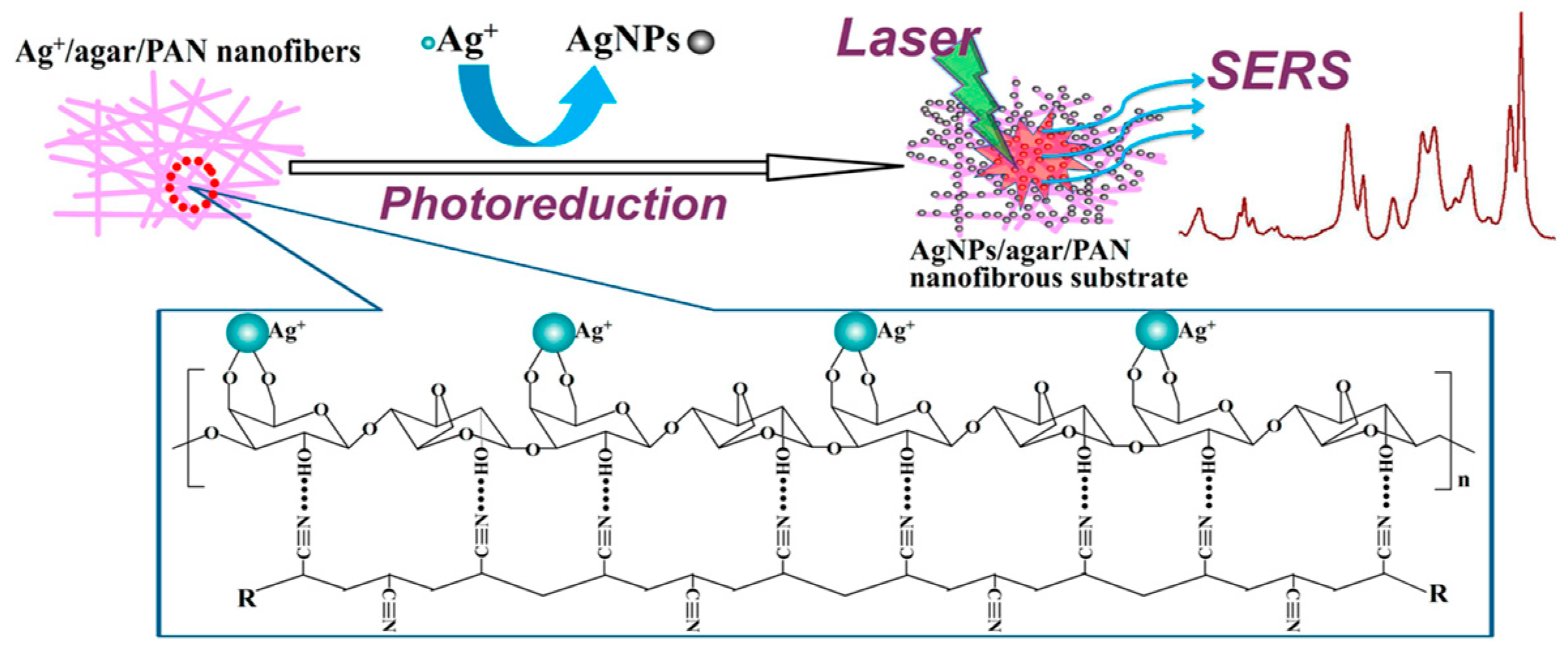
The procedure for the inner-surf/post-reduction strategy closely resembles that of the inner/pre-reduction, diverging at the reduction stage, which is applied to the as-spun metal precursor-loaded nanofibrous membrane rather than the spinning solution (Figure 3). Consequently, the post-reduction method appears to be more effective than its pre-reduction counterpart, as evidenced by the fact that the post-treatment approach yields both larger nanoparticle sizes (7.6 nm [88] vs. 4.0 nm [86]) and higher loading density. And the spectrum of post-reduction methods is also notably broad. Beyond UV irradiation [89] and various chemical reductants (e.g., NaBH4 [90], hydrazine hydrate [91,92]), physical reduction strategies including O2 [61,93] or argon plasma treatment [62] are also applicable for converting metal precursors into nanoparticles within the nanofibers. For example, Lu Bai et al. reported the use of plasma treatment to fabricate Au and Ag nanoparticle-decorated electrospun nanofibers [62]. Before plasma exposure, small dark dots observed in TEM images of the nanofibers might result from the mild pre-reduction of Ag+ by the DMF solvent. The size and density of the formed nanoparticles could be readily tuned by controlling the plasma exposure time. Even more importantly, while metal precursors are embedded throughout the fibers, the reduction effect is predominantly superficial due to limited penetration depth. As a result, the fiber surfaces become densely decorated with nanoparticles in addition to those formed internally. SEM and TEM observations confirm this architecture leads to higher overall loading and larger particle size (5–19 nm), thereby significantly augmenting SERS sensitivity [62].
Based on the foregoing analysis, we consider inner-surf/post-treatment to be a comprehensively superior strategy compared with inner/pre-reduction.

2.4. Surf/Pre-Synthesizing Strategy: Assembling Pre-Synthesized Nanoparticles on Fiber Surfaces

The surf/pre-synth strategy refers to the surface assembly of the precisely pre-synthesized metal nanoparticles on polymer nanofibers. The binding force emerges as the defining factor for immobilization stability, distinguishing it from inner/pre-synth structures and demanding precise interfacial control. For the inner/pre-synth strategy, the selection of the polymer-solvent system plays a decisive role in the dispersion stability of the nanoparticles. Notably, strong electrostatic attraction between the polymer and nanoparticles leads to the destabilization of the spinning solution. Conversely, in the surf/pre-synth method, the polymers with strong affinity or binding capacity for the nanoparticles are preferred. The integration between polymer nanofibers and metal nanoparticles can be mediated by covalent bonding [94,95], electrostatic attraction [63,96,97,98], or physical interaction [99,100]. Therefore, the predominant assembly strategies for decorating electrospun membranes with metal nanoparticles are, namely, dipping the nanofibrous mat into a nanoparticle dispersion or drop-casting the dispersion onto the electrospun substrate, corresponding to the chemical (covalent and electrostatic) attraction and physical interaction, respectively.

2.4.1. Chemical Attraction

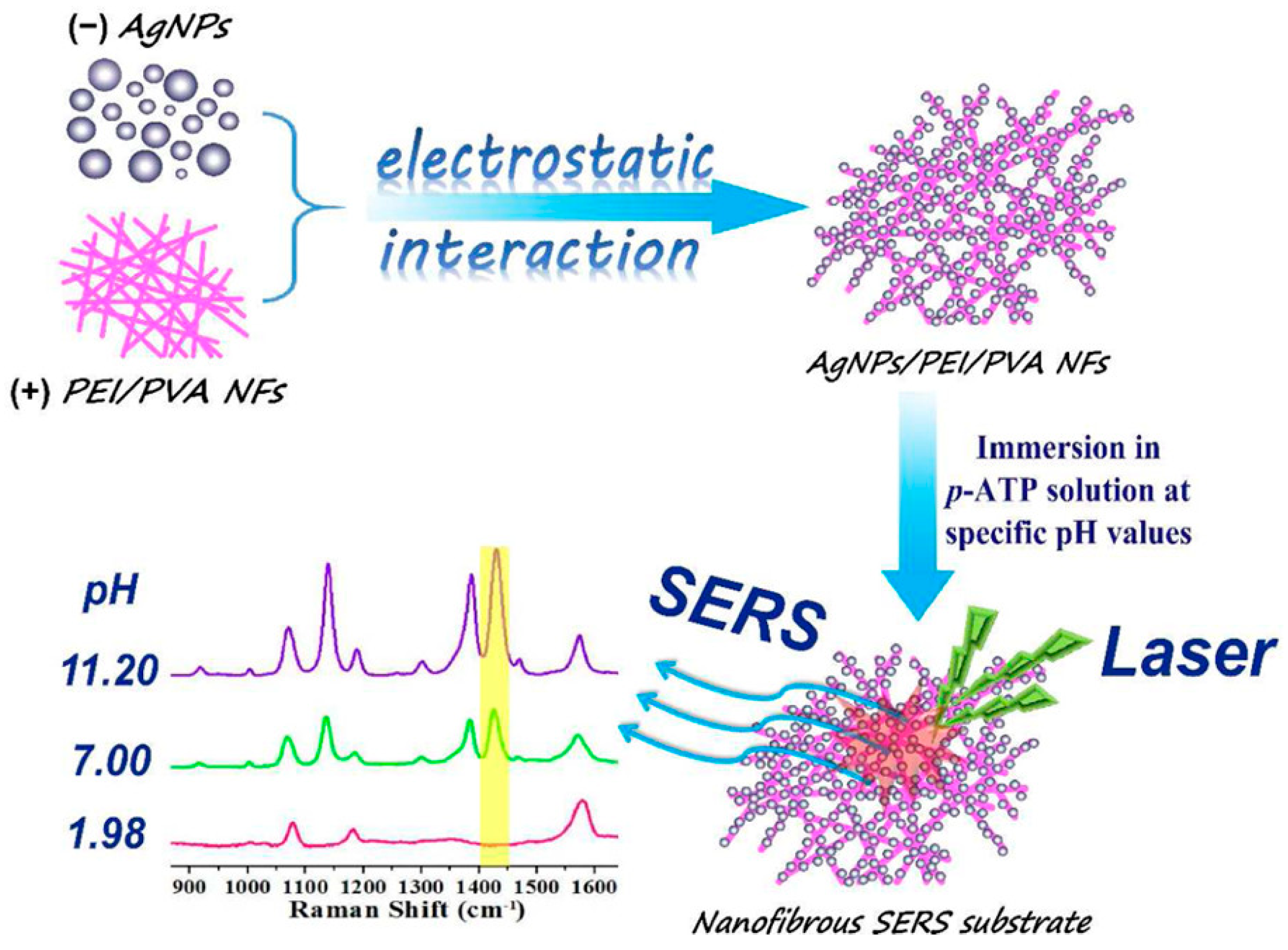
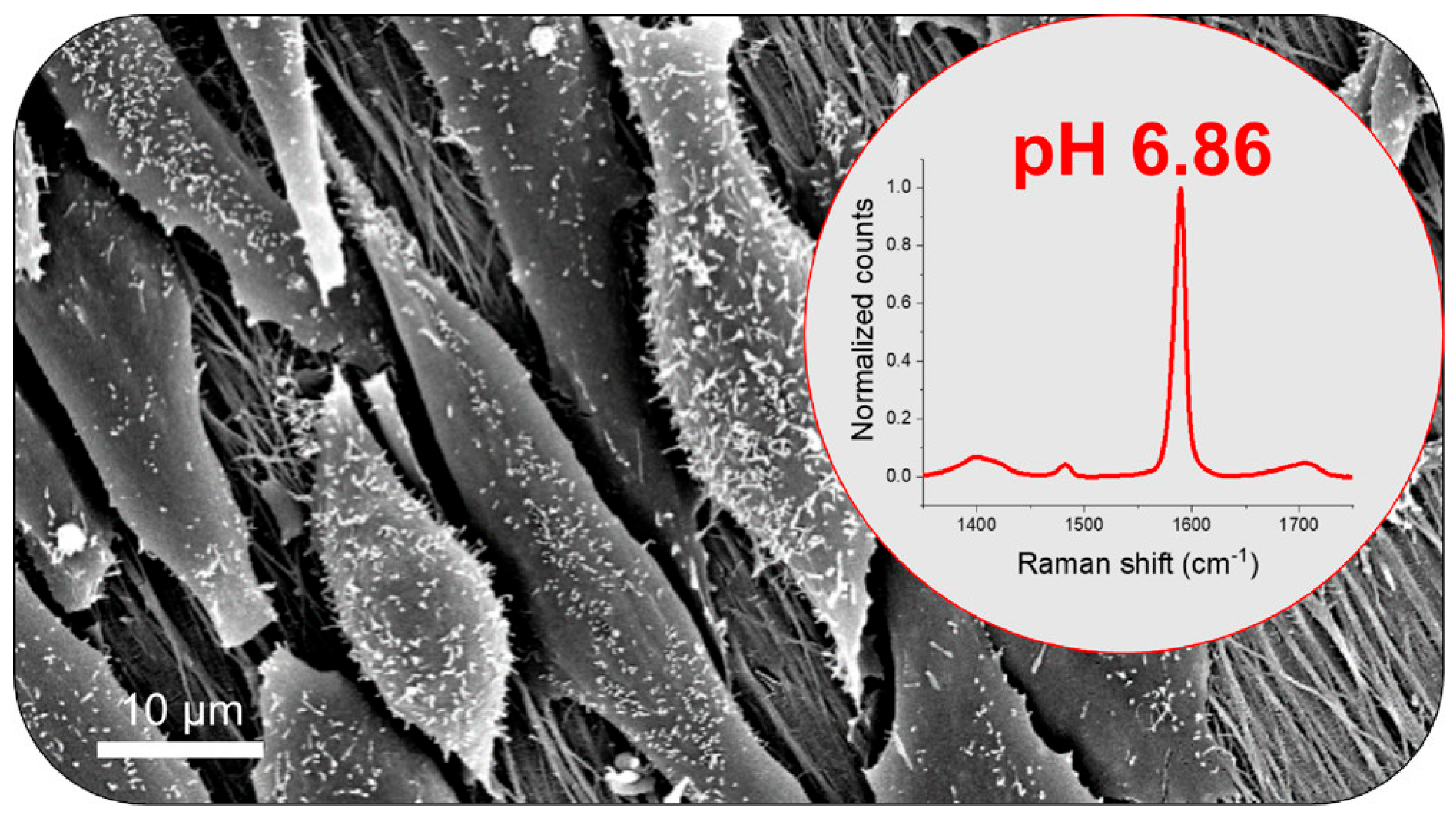
The immersion method, in particular, establishes favorable interfacial conditions that facilitate nanoparticle-fiber attachment. Utilizing Au-N coordination chemistry, Sang et al. reported a facile method to decorate sea urchin-like gold nanoparticles (SUGNPs) onto poly(methyl methacrylate)/poly(4-vinylpyridine) (PMMA/P4VP) nanofibers via the interaction between the Au nanoparticles and the pyridyl groups [94]. TEM observations indicate that SUGNPs are predominantly embedded within the fiber subsurface, as opposed to being simply surface-attached. Furthermore, Sandeep Verma’s team introduced 8-mercapto-9-propyladenine into PAN, with its thiol groups serving as covalent linkers that mediated the attachment of Au nanosheets to the fibers via Au–S bonds [95]. Compared with covalent binding, electrostatic interaction offers broader selectivity, given that most synthesized nanoparticles inherently possess surface charges or can be readily modified to carry them. As shown in Figure 4, negatively charged AgNPs were assembled on the PEI/PVA nanofiber surface via electrostatic attraction, which then served as an excellent pH sensor in urine with an enhancement factor of 107~108 [96]. Furthermore, Gao Yueming et al. electrostatically assembled negatively charged silver triangular nanoplates onto MPD-modified PEI nanofibers, imparted with a positive surface charge for human beta-defensin 2 (HBD-2) detection [101].

2.4.2. Physical Interaction

Physical adsorption during immersion is feasible for the case relying solely on non-specific interactions. However, the direct application of plasmonic nanoparticle dispersions onto polymer membranes via drop-casting [99], screen printing [102], electrospraying [103], co-electrospinning [104], or liquid–liquid self-assembly [105,106] is a considerably more effective and simpler method for physical retention. In comparison to planar substrates, the notably high SERS intensity can be achieved with the electrospun nanofibrous mat, primarily attributed to its enhanced specific surface area that accommodates a greater number of nanoparticles. Additionally, the inherently porous structure of the fibrous mat facilitates the efficient adsorption and transport of analyte molecules to the surfaces of the AuNRs, thereby further promoting the significantly enhanced SERS effect. Furthermore, the averaging effect of plasmonic nanoparticles distributed across stacked nanofibers within a focused incident laser spot, combined with the uniform adsorption of analyte molecules throughout the three-dimensional fibrous network, significantly facilitates the generation of reproducible SERS signals.
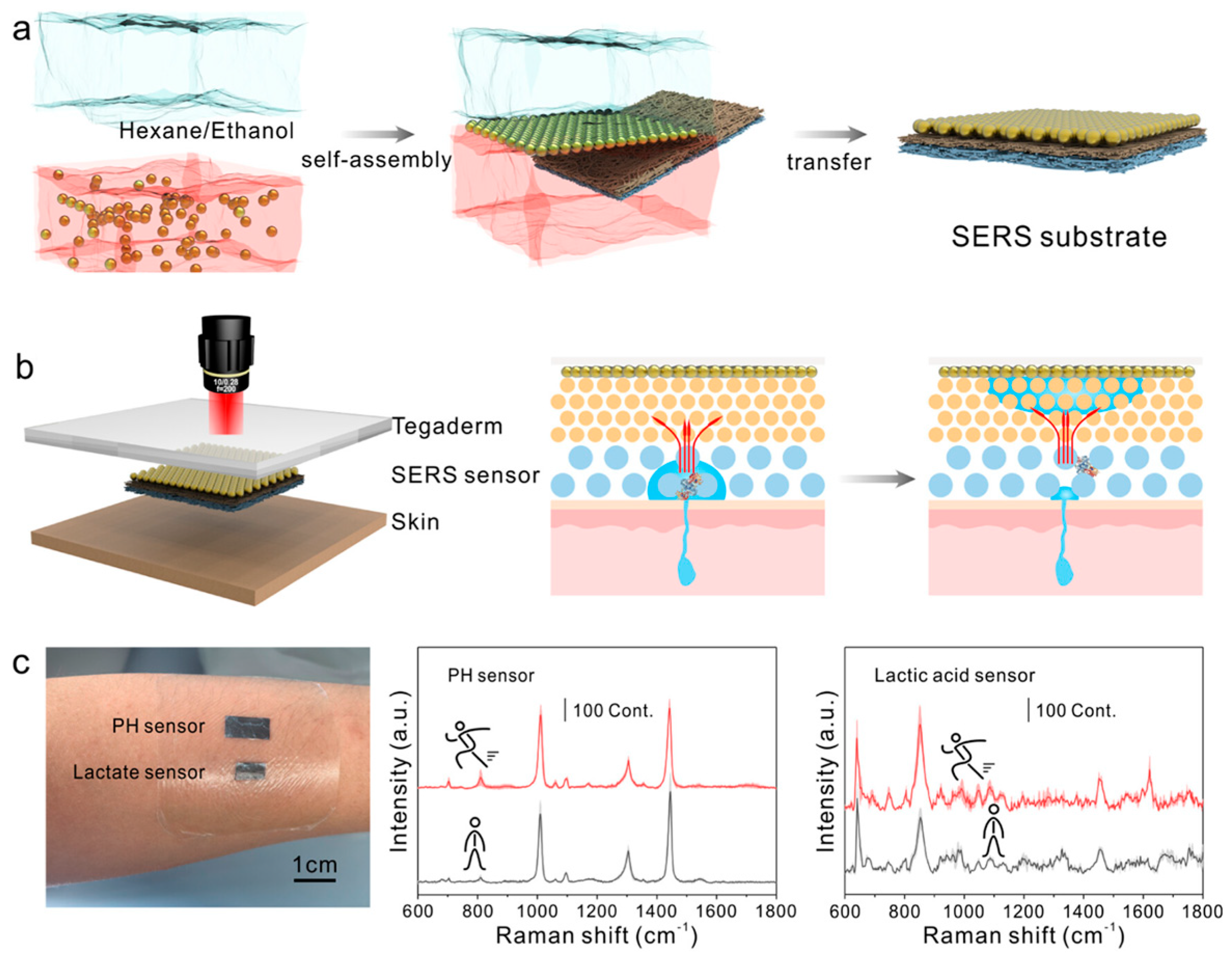
However, a major challenge arises when drop-casting aqueous dispersions onto hydrophilic polymer surfaces: the formation of coffee rings with localized high nanoparticle densities produces intense yet highly variable SERS signals [107]. Therefore, Hoa T. et al. developed an inverted drop-coating geometry where the Au nanostar solution was introduced to the amidoximated PAN substrate from below [107]. This approach promoted the formation of a natural coffee ring and minimized the deposition of aggregated nanostructures at the ring interior so that the plasmonic properties inside the coffee ring were highly uniform. Across identical sampling areas, samples prepared via the inverted deposition geometry demonstrated markedly more uniform SERS signals (RSD of 10%) than those obtained through conventional drop-casting. To address the inhomogeneity of SERS signals caused by the coffee-ring effect during drop-casting processes, Wei X. et al. reported a liquid–liquid interfacial self-assembly strategy to uniformly deposit Au@Ag gold nanostars on a PVDF/CQDs film. After assembly, the nanoparticles were evenly distributed on the fiber surfaces, exhibiting a smooth, wrapped morphology. This approach yielded a highly uniform nanoparticle distribution and consequently achieved homogeneous Raman enhancement for the detection of carbendazim in apples with the RSD of only 4.16% [105]. Furthermore, Niu Qian et al. also transported self-assembled AuNPs from the water/hexane interface to the PAN/PEI fiber surface, resulting in a densely populated and uniformly distributed membrane-based SERS sensor for monitoring sweat post-exercise (Figure 5) [106]. EDS mapping illustrated that AuNPS are uniformly distributed across each fiber, and Raman signals from different batches and samples exhibited high consistency, with relative deviations in characteristic peak intensities remaining at low levels (<10%).
A second issue stems from the weak nanoparticle-nanofiber binding when drop-casting onto hydrophilic polymer surfaces, which leads to extensive leaching of NPs during the wetting and wiping steps, resulting in a petty response [100]. To solve the leaching problem, the surface of the polystyrene nanofibers that contains uniformly distributed nanopores (70–100 nm) formed by evaporative cooling was fabricated [100]. These “breathe figure” pores serve as anchoring sites that facilitate robust nanoparticle adsorption. Notably, when AuNRs were drop-cast onto poly(2-vinyl pyridine) (P2VP) fibers, the strong affinity between the pyridyl groups of P2VP and Au facilitated the robust and homogeneous adsorption of AuNRs onto the fiber surfaces. Therefore, robust nanoparticle-nanofiber binding was achieved, while simultaneously yielding a uniform coverage of randomly oriented AuNRs across the fiber surface, with no significant aggregation or structural inhomogeneity detected. The resulting SERS substrate demonstrates excellent homogeneity, with intensity variations maintained below 10%. Furthermore, it was also demonstrated that the highly aligned electrospun nanofibers can act as micro/nano-channels to directly assemble aligned gold nanorods on their surfaces via hydrodynamic drag forces. The random nanofibrous mats exhibited an order of magnitude higher SERS enhancement compared with the randomly oriented nanorods on a silicon substrate, while the aligned nanofibers with uniformly aligned AuNRs yielded a SERS signal ~50-fold greater than that from planar SERS substrates [99].
Notwithstanding the operational reliability conferred by covalent and electrostatic binding forces, nanoparticles exhibiting weak adhesion to the fiber surface driven by sole physical adsorption/retention are susceptible to detachment during handling. Consequently, the practical application of these SERS substrates may be limited, particularly in scenarios requiring mechanical contact, such as wipe sampling, where abrasion-induced damage leads to signal drift and compromised performance stability.

2.5. Surface/Post-Modification Strategy: In Situ Growth or Deposition of Plasmonic Nanostructures on Fiber Surfaces

Surf/post-modification refers to the post-modification of as-spinning nanofibrous membranes with plasmonic nanostructures on their surfaces, primarily achieved through two approaches: in situ chemical growth and physical vapor deposition.

2.5.1. In Situ Chemical Growth

In situ chemical growth typically involves immersing polymer nanofiber membranes in a solution containing noble metal precursor salts and chemical reducing agents or sequentially immersing them in precursor and reducing agent solutions. Similar to surf/pre-synth, this approach typically requires the use of polymers containing carboxyl (e.g., sodium alginate [108] and poly(amic acid) [109,110]) or amino groups (e.g., PEI [111], CS [112], polyurethane [113], and polyamide [114,115]; or hydrophilic modification (such as PAN modified with amidoxime [116] and plasma treatment [117]) of the nanofibrous membrane to attract Ag+ or AuCl4 ions, thereby ensuring the in situ formation of nanostructures on the fiber surface. A variety of reducing agents are applicable, including aldehydes (glutaraldehyde [118], glucose [119]), organoborane complexes (methylamine-borane [110], dimethylamine-borane [108]), organic acids (ascorbic acid [111], sodium citrate [66]), poly(ethylene glycol) diacid [30], polyol (ethylene glycol) [120], and polydopamine (PDA) [121].
Among them, Tollens’ reagent is one of the most widely utilized, which involves the preparation of the silver–ammonia complex solution followed by the aldehyde reduction of silver ions into elemental silver. In a typical Tollens’ reaction growth process, a PAN nanofibrous membrane first underwent surface hydrophilic functionalization to introduce amidoxime groups, followed by activation with Pd seeds via a typical SnCl2/PdCl2 method, and was finally immersed in Tollens’ reagent reduced by dextrose for the electroless deposition of AgNPs [116]. Over the deposition period, the AgNPs underwent a morphological evolution from discrete spherical/ellipsoidal nuclei to coalesced polyhedral structures, which was accompanied by a significant size increase and the reduction of individual gap sizes, and ultimately resulted in a drastic drop in interparticle gap density. Consequently, the SERS activity of the substrate exhibits a non-monotonic trend: it first increases as nanogaps form and sharpen, but then decreases as these nanogaps coalesce and their population diminishes. However, the in situ growth of nanostructures with extremely sharp features presents a significant challenge. Innovatively, Li Dongyan et al. realized the direct in situ growth of Ag nanoplates on CS/PEO fibers by changing the addition mode of glucose and Tollens’ reagent. Stacking faults directed the two-dimensional growth into nanoplates [112]. The procedure involved adsorbing glucose onto the chitosan fibers, followed by the dropwise addition of Tollens’ reagent under vortex to initiate the nucleation, and then continuing to complete the growth for 30 min on an oscillator. Without additional capping agents, the Ag seeds with stacking faults govern the morphology and dictate the two-dimensional growth into nanoplates. Significantly, the Ag-nanoplates/CS/PEO fibers exhibited a 13-fold higher SERS intensity towards 2-naphthylthiol than that of the Ag-nanoparticles/CS/PEO fibers.
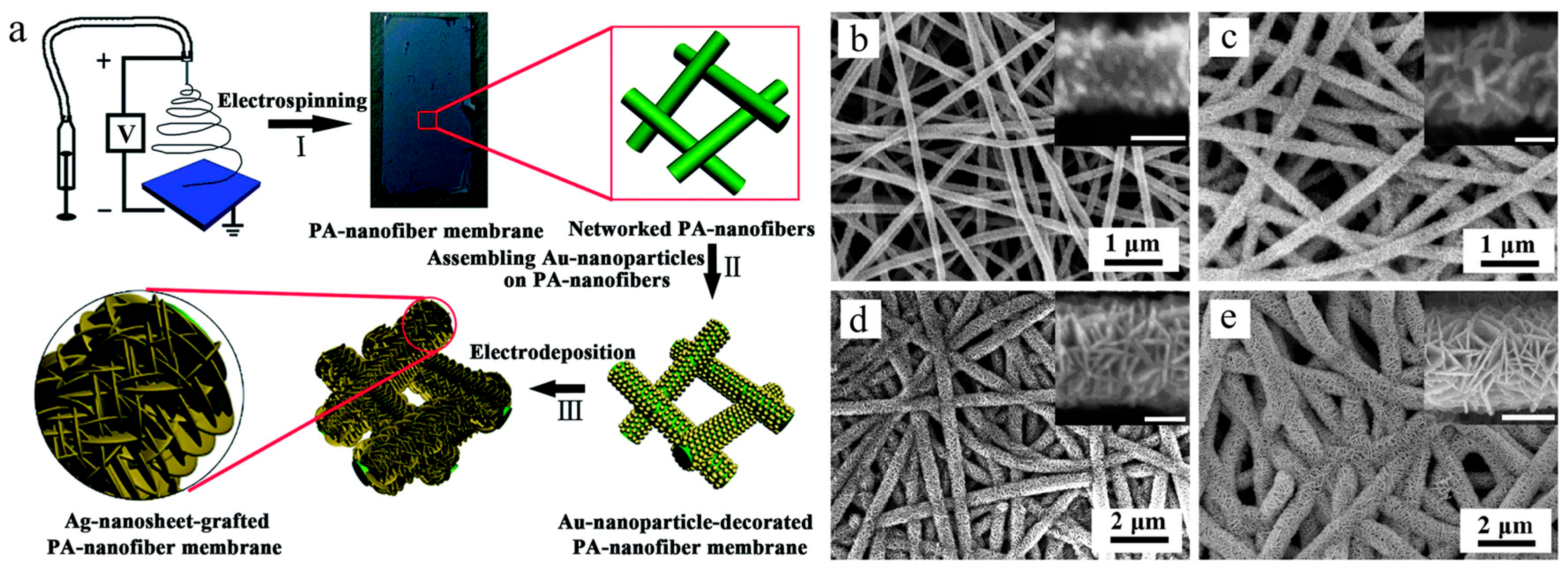
In addition to the Tollens’ reaction, Ag-nanosheet-grafted PA6 nanofibers also could be fabricated by chemical adsorption of small AuNPs (~10 nm) on the PA nanofibers as seeds and subsequent electrodepositing growth of Ag-nanosheets, as shown in Figure 6 [114]. Furthermore, in situ growth of AuNPs was also accomplished through the electrostatic adsorption of Au3+ ions onto amino-grafted PCL/PA6 nanofibers, with PEG diacid serving as both a reductant and a stabilizing agent [30]. However, in the absence of seeded mediation, the nucleation process was unregulated, predominantly leading to the formation of spherical nanoparticles with uncontrolled morphology.
In surface post-modification, the nucleation and growth of nanostructures are governed by a multitude of parameters. The procedure for uncontrolled nanoparticle decoration is operationally simple; however, this simplicity comes with a significant sacrifice in reproducibility and performance. Precisely tuning the morphology, size, and density of metal nanostructures necessitates meticulous manipulation of the metal precursor and reductant addition protocol (i.e., sequence, concentration, and feed rate) alongside key parameters such as growth time, temperature, and stirring rate [112,116]. Under optimized synthesis conditions, uniform plasmonic nanostructure-decorated polymer nanofibrous membranes could be constructed with a high density of SERS hot spots generated from abundant nanogaps and sharp features, leading to both exceptionally high SERS activity and good signal uniformity.

2.5.2. Physical Vapor Deposition

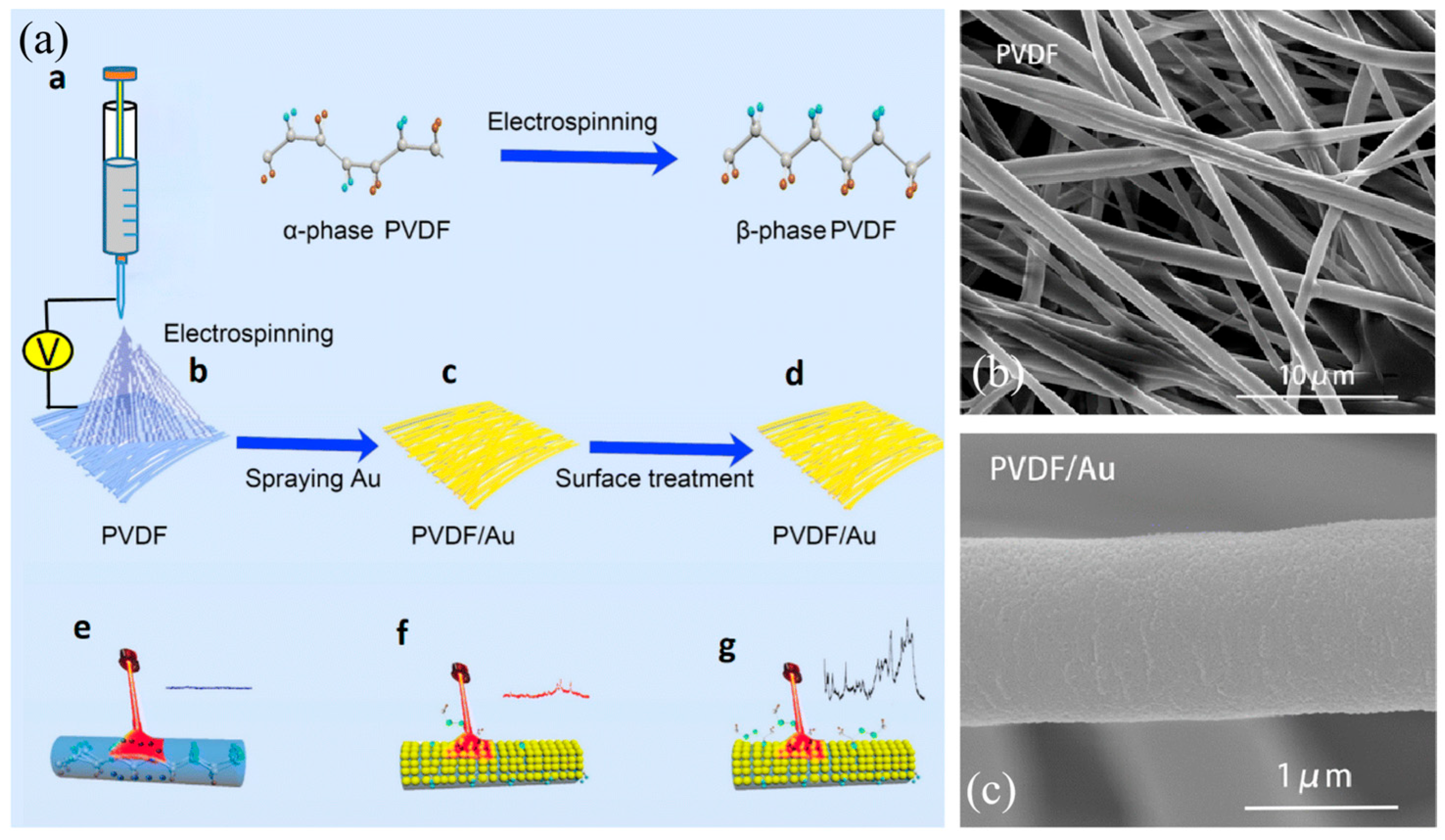
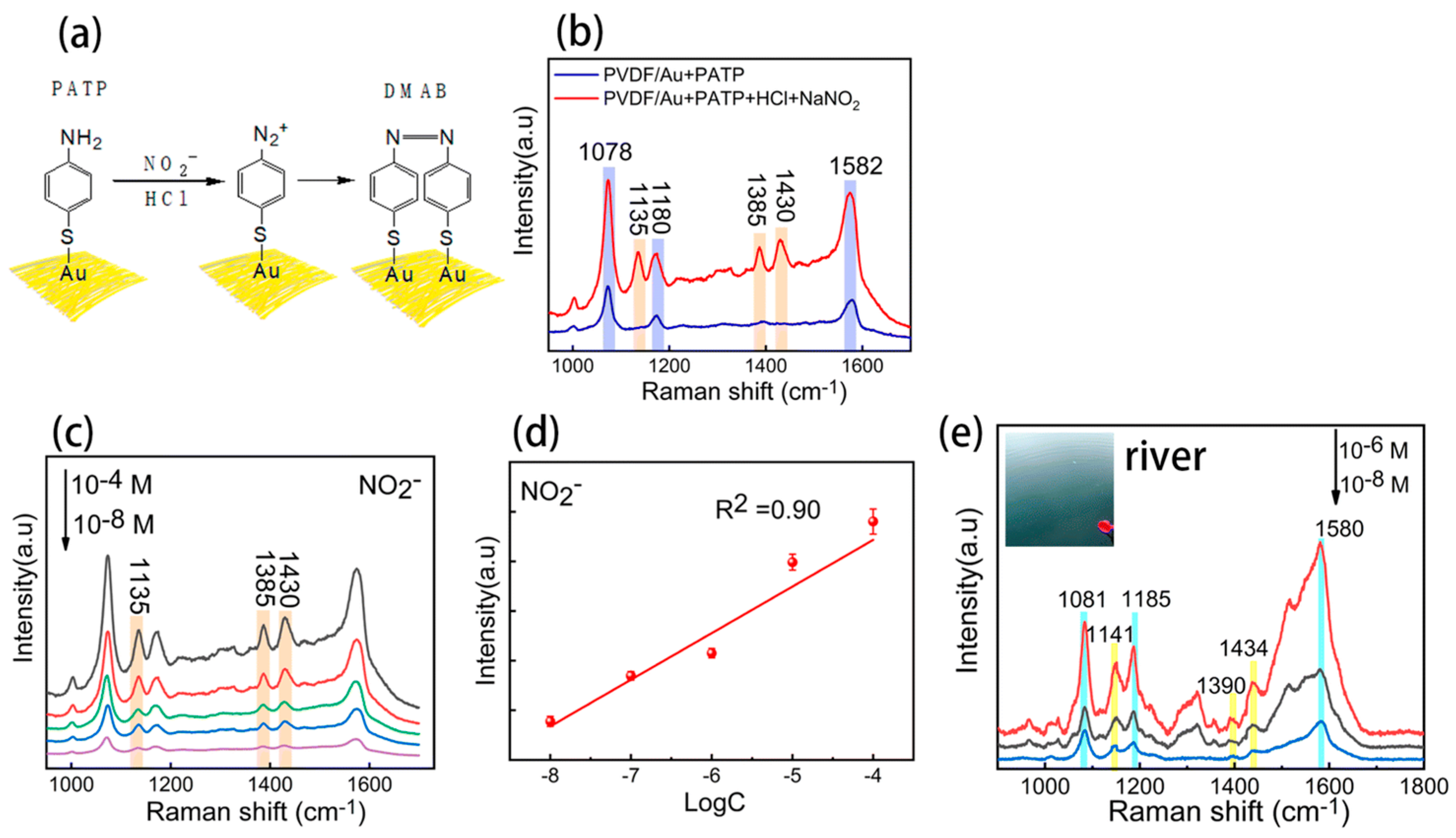
Compared with other methods, physical vapor deposition (e.g., thermal evaporation [122,123] and sputtering [64,124]) is characterized by operational simplicity and is highly effective for the uniform, quantitative loading of gold nanoparticles onto high curvature and smooth nanofiber surfaces. Due to the highly uniform deposition, the noble metals tend to form a continuous, smooth shell encapsulating the fiber rather than discrete or coalesced nanoparticles, with a typical thickness ranging from 10 to 50 nm [123]. For instance, the patterned SU-8 (a photoresist polymer) nanofiber film showed almost no morphological change after the deposition of a ~20 nm Ag nanolayer [125]. Furthermore, Sun M. et al. fabricated a highly sensitive SERS sensor based on PVDF/Au nanofibers for nitrite ion detection (Figure 7) [122]. As shown in Figure 7a, The uniformity and high density of SERS activity “hot spots” were achieved through a process involving the electrospinning of PVDF nanofibers (a,b), subsequent coating with a 50–100 nm Au layer via thermal evaporation (c), and plasma treatment (d). By simultaneously applying mechanical stretching and electric polarization, electrospinning oriented the dipole moments of PVDF chains, which not only amplified the electric dipole moment but also enriched the electroactive β-phase, culminating in superior piezoelectric performance. The enhanced Raman responses were due to the combined effects of photoelectric and piezoelectric properties of PVDF (e) and local surface plasmon resonance of Au nanoparticles (f). Importantly, the surface treatment of the PVDF/Au nanofibers resulted in a hydrophilic surface that facilitated the rapid and substantial adsorption of the tested molecules, demonstrating a substantial enhancement in the Raman signal (g). As shown in Figure 7b,c, this conformal metal film is often barely discernible under SEM in most studies. Its presence typically requires confirmation via elemental analysis, while its subtle nanoscale topography is characterized by AFM.
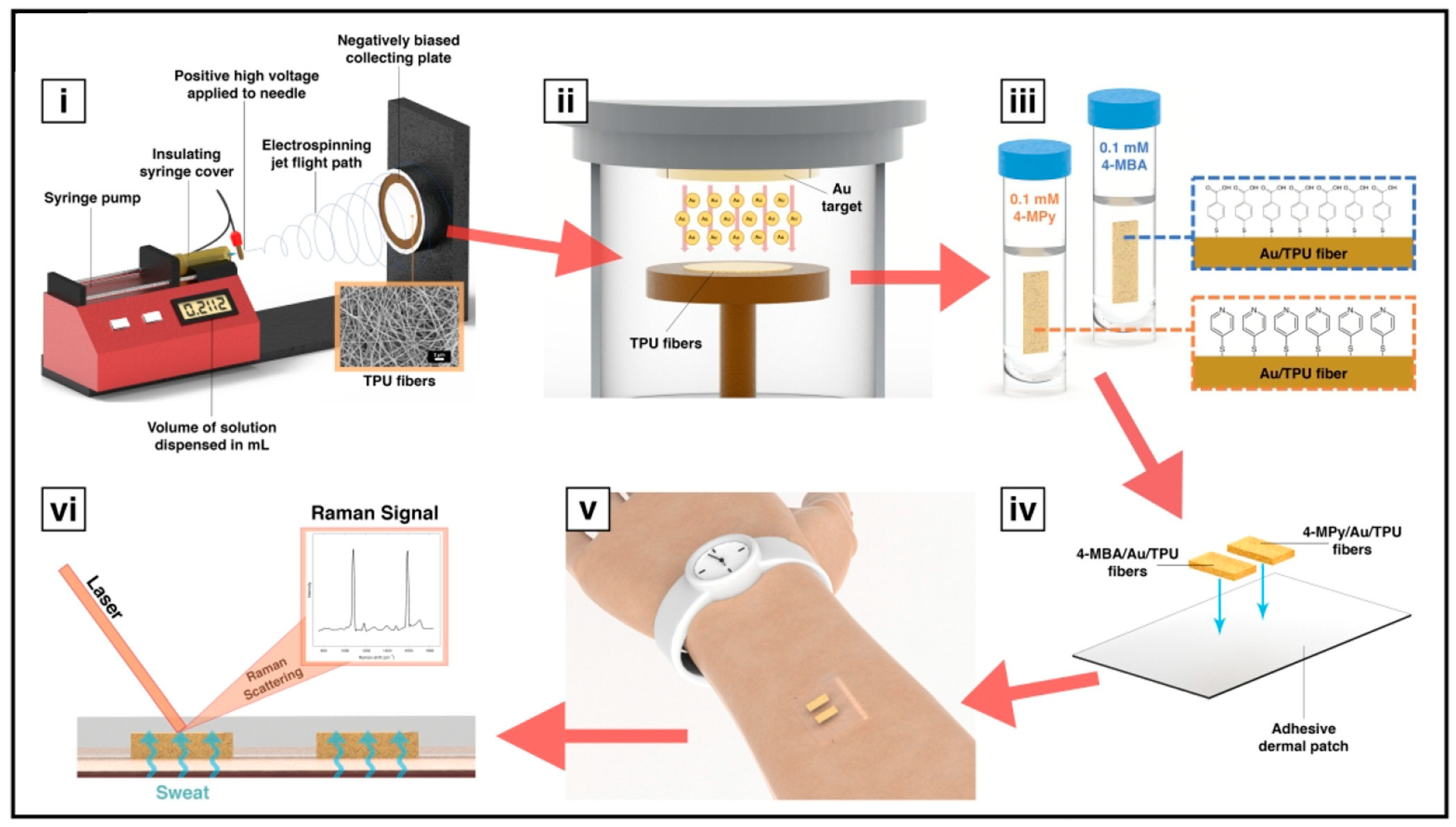
In the study by Roman Elashnikov et al., it was believed that Ag nanoclusters (20–40 nm) sputtered onto 3D PAN nanofiber scaffolds created 1–4 nm plasmonic gaps, which effectively generate localized hot spots and strong near-field enhancement for high SERS activity [124]. However, the prevailing view suggests that the plasmonic enhancement in PVD-coated nanofibrous membranes primarily originates from the intersections of adjacent polymer/metal nanofibers, rather than from the coupling of nanoparticles on individual fibers, given the typically negligible nanoscale roughness [123,125,126]. For example, a SERS-active substrate was fabricated by a combination of electrospinning of thermoplastic polyurethane (TPU) and Au sputter coating (30 nm) for a wearable flexible sweat pH sensor [126]. The hot spots provided by the Au/TPU fiber intersections were considered the main contributors to the improved signal.
While rarely discussed, the adhesion of the PVD metal coatings is effectively ensured by its continuous, encapsulating shell structure around the polymer fibers, which physically locks them in place against detachment.

3. Non-Polymer-Based SERS Substrates

Polymer nanofiber SERS substrates effectively combine the structural advantages of a flexible 3D network (notably its high specific surface area and porosity) with the strong electromagnetic enhancement provided by noble metal nanoparticles. However, they also suffer from polymer-related drawbacks: thermal instability under laser irradiation [127], intrinsic background noise [24], and generally limited functionality beyond serving as a passive structural template—despite exceptions like thermoresponsive [79], piezoelectric [121], or highly elastic polymers [106]. To expand the multifunctionality of SERS substrates while overcoming inherent polymer limitations such as instability and background noise, a strategic approach involves transforming the as-fabricated polymer nanofiber scaffold into alternative inorganic materials (e.g., ceramics, carbon fibers) or removing it entirely after its 3D architecture is replicated by plasmonic materials. This leads to three primary categories of inorganic fibrous SERS substrates, including ceramic-based, carbon fiber-based, and metal-based types.

3.1. Ceramic-Based Fibrous SERS Substrates

The ceramic materials currently used for SERS substrates include NiO [128], CuO [129], SiO2 [130], TiO2 [131], ZnO [132], Al2O3 [50], ZrO2 [50], CoFe2O4 [133], and CoTiO2 [134,135]. Among these, TiO2 and SiO2, as well as their multicomponent composites, have been the most extensively studied. Ceramic-based plasmonic nanofibers not only combine the intrinsic merits of ceramics (e.g., high stability, mechanical strength, and biocompatibility) with the structural benefits of nanofibers (e.g., high surface area and porosity) [130] but also serve as a multifunctional platform. This platform can be endowed with additional functionalities beyond sensing through the tailorable optoelectronic and catalytic properties of ceramics such as TiO2 [131], ZnO [132], and CoFe2O4 [133]. Moreover, their SERS performance could also be synergistically enhanced through the combined electromagnetic effect from noble metal nanostructures and the chemical enhancement contributed by some semiconducting ceramics.
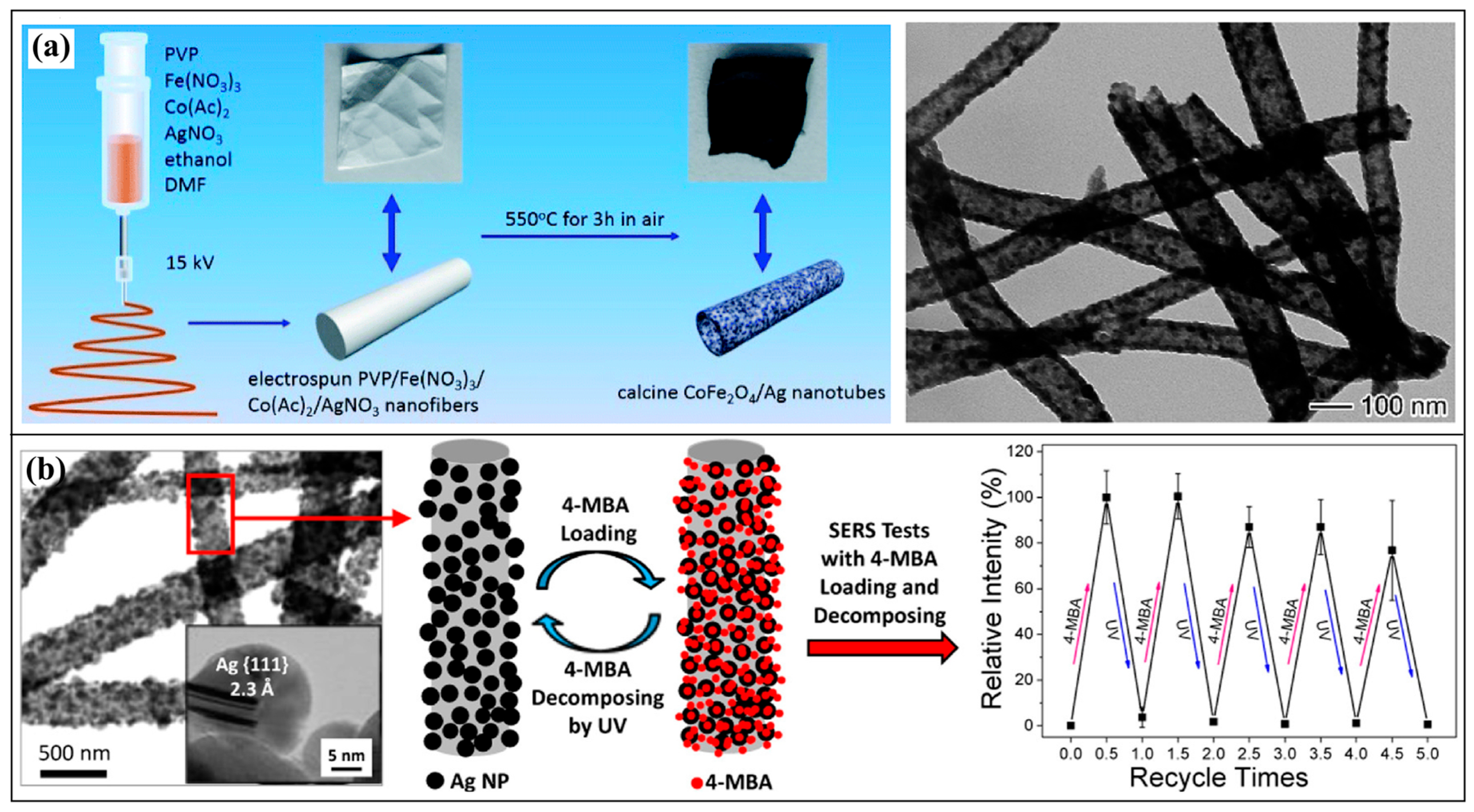
Conventionally, ceramic nanofibers are produced via an integrated sol–gel and electrospinning approach: the process begins with formulating an electrospinning solution, whereby precursors (metal alkoxides or inorganic salts) undergo controlled hydrolysis (or alcoholysis) and condensation to yield a spinnable viscous sol–gel solution assisted by the polymer (PVP). This precursor/polymer solution is then electrospun into composite nanofibers. Finally, calcination at 500–1200 °C removes the polymer template and drives the crystallization and phase transformation into the desired oxide ceramic [136]. The integration of noble metal nanostructures with ceramic nanofibers can be achieved through two strategies: (1) One-pot precursor integration: involves co-mixing the precursors of both the metal and the ceramic into a viscous sol–gel solution [133] (direct nanoparticle addition has also been employed [130]) (Figure 8a); alternatively, the precursors of the metal and ceramic can be loaded separately into the inner and outer fluids [137], respectively. This approach enables the one-step fabrication of polymer-composite nanofiber membranes via electrospinning or coaxial electrospinning, followed by calcination, which concurrently induces ceramic formation and the thermal reduction of the metal precursor into nanoparticles. (2) In situ chemical growth: involves first calcining to obtain pure ceramic fibers, followed by the in situ electrodeposition or electroless plating of plasmonic nanostructures (Figure 8b), similar to that employed for polymer-based substrates [50,138]. Importantly, most ceramic nanofibers (e.g., SiO2, TiO2, ZnO) are intrinsically hydrophilic, and the abundance of surface hydroxyl groups (-OH) can adsorb Ag+ ions without modification [139]; therefore, the ceramic fibers can also act as anchors or clusters whence growth begins [140]. Furthermore, surface modifications (e.g., with PDA [141] or APTES [127,130]) are also recommended for ceramic nanofibers to enhance metal binding before in situ growth.

3.1.1. Good Flexibility: SiO2 Substrates

SiO2 nanofibers have been widely studied as a SERS substrate platform. First, they retain good flexibility even after high-temperature calcination, attributed to their highly amorphous structure [136]. Second, and critically, SiO2 does not exhibit any intrinsic Raman signals, preventing spectral interference during SERS detection [127,141]. For example, Wan Menghui et al. fabricated Ag@PDA@SiO2 nanofibrous membranes by first electrospinning tetraethyl orthosilicate/PVP composite nanofibers, calcining them to convert into SiO2 fibers, subsequently coating the fibers with polydopamine (PDA) via self-polymerization, and finally conducting the in situ growth of Ag nanoparticles using Tollens’ reagent [141]. As the AgNO3 concentration increases from 3 to 10 mg mL−1, the deposited Ag nanoparticles transition from being discrete and sparse to forming an evenly distributed, dense coating and ultimately to larger, agglomerated structures on the PDA@SiO2 nanofibers. The as-prepared Ag@PDA@SiO2 nanofibrous membranes possess flexibility and have not broken after being folded, which can be applied for bacteria label-free SERS detection. Finally, SiO2 nanofibers are convenient for combination with other ceramics to enhance their flexibility [142,143,144].

3.1.2. Multifunctional Platform

For polymer-based substrates that leverage EM-CT synergy, four approaches are feasible: (1) co-blending semiconductor nanoparticles with the polymer/metal-precursor solution, followed by electrospinning and in situ reduction to form plasmonic structures [60]; (2) pre-synthesizing semiconductor/metal hybrid nanoparticles and subsequently decorating onto polymer fibers; (3) fabricating polymer/semiconductor composite fibers first, followed by the deposition of noble metal nanostructures [145]; and (4) sequentially sputtering the semiconductor and metal layers directly onto the polymer fibers [146]. All approaches, however, often suffer from limitations in process complexity and low semiconductor/metal interaction efficiency, highlighting the need for directly fabricating semiconductor/metal composite nanofibers or metal-nanoparticle-decorated semiconductor nanofibers. For example, electrospun porous CuO–Ag nanofibers exhibited a large Raman enhancement ability and can be applied for the quantitative detection of the analyte azobenzene [129].
TiO2 and ZnO are both prominent ceramic materials for multifunctional SERS substrates, primarily due to their photocatalytic activity [147] and charge-transfer (CT) enhancement mechanisms [132,148]. For example, Narendra Singh reported that Ta doping in TiO2 inhibits the anatase-to-rutile transition, enhances visible-light absorption, suppresses charge recombination, and promotes charge transfer through the introduction of Ti3+ defects [51]. Consequently, an optimal 5% Ta doping boosts the photocatalytic degradation and SERS detection of methylene blue by factors of up to 5.1 and 2.2 under UV and solar light, respectively. The Ta-doped electrospun TiO2 nanofibers were explored for SERS detection of methylene blue dye molecules via the CT effect and degrading methylene blue via photocatalysis. Furthermore, ZnO also has excellent photocatalytic performance and can provide an enhancement factor of ~103 via CT resonance [149]. However, compared with ZnO, anatase-phase TiO2, a UV-responsive semiconductor known for degrading organics, has garnered greater interest as a matrix material owing to its superior chemical stability, resistance to breakdown, and better mechanical flexibility [150]. As such, TiO2 is widely employed in SERS platforms, as it offers an integrated solution for both detecting and degrading organic pollutants in aquatic environments.
Zhao Yong et al. reported a reusable SERS substrate developed by decorating TiO2 nanofibers with Ag nanoparticles via Tollens’ reaction [139]. The TiO2/Ag nanofelt offered high SERS sensitivity to 4-mercaptobenzoic acid (∼15 ppb), and the analyte could be effectively degraded post-detection by UV irradiation in O2-rich water due to the photocatalytic activity of TiO2 (Figure 8b). Furthermore, Song Wei et al. prepared a magnetic, catalytic, and SERS-sensitive CoFe2O4/Ag hybrid nanotube as a tri-functional SERS substrate via one-pot electrospinning of Co(Ac)2/Fe(NO3)3/AgNO3/PVP solution followed by a calcination process [133]. This tri-functional platform operates through a synergistic workflow: first, its inherent magnetic properties enable rapid aggregation in a small area in the solution to enrich target molecules; second, the CoFe2O4/Ag hybrid nanotubes serve as efficient catalysts for degrading pollutants like methylene blue in the presence of NaBH4; third, and crucially, the entire degradation process can be tracked in real-time via in situ SERS spectroscopy, allowing for direct monitoring of the reaction progress. Furthermore, Song Wei et al. also fabricated ZnO nanofibers on silver foil that not only show high Raman enhancement owing to the EM-CT synergy but also exhibit enhanced photocatalytic activity because of the charge separation effect. Therefore, this new substrate could be applied as a SERS substrate to in suit determine the catalytic activity and reaction kinetics during the photodegradation of organic pollutants under ultraviolet light irradiation [132].

3.2. Metal-Based Fibrous SERS Substrates

The construction of metallic nanotube networks typically follows a templating approach: polymer nanofibers are first fabricated as sacrificial templates, onto which a metallic layer (e.g., Au [53,151], Ag [52], or Cu-Ni [152]) tens of nanometers thick is deposited via physical vapor deposition or in situ chemical growth. Subsequently, the polymer core (e.g., nylon-66 [53], polystyrene [151], hydroxypropyl cellulose [52], or polyvinyl butyral [152]) is dissolved, resulting in a network film of hollow metallic nanotubes, as shown in Figure 9a. This pure plasmonic architecture offers several distinct advantages. Firstly, hollow nanofibers possess a larger specific surface area comprising both inner and outer surfaces for adsorbing detected molecules [150]. Secondly, the highly interconnected nanofiber network within the film generates a sensitive plasmonic response, which can be harnessed effectively for SERS-based applications [52]. Finally, and of critical importance, the plasmonic resonances of as-fabricated noble-metal sub-micro/nanotubes can be systematically controlled by their tube diameter and metal shell thickness, which are in turn dictated by the initial polymer fiber diameter and the deposited metal layer thickness, respectively. Therefore, they exhibit superior tunability of surface plasmon resonance from visible light to the near-infrared region compared with their solid counterparts to meet certain requirements [52,53].
It is noteworthy that, through electrodeposition of a Cu/Ni bilayer on electrospun polyvinyl butyral nanofiber templates, then dissolution of the polymer core, and finally selective chemical etching of the Ni component, Pan Wei’s group successfully engineered porous Cu hollow nanofiber films with evenly distributed nanoscale pores on sidewalls [152]. This hierarchical plasmonic nano-architecture generated a high density of uniform “hot spots” on the sidewalls, thereby granting the porous sub-microtubes superior surface-enhanced Raman scattering (SERS) activity compared with conventional nanoporous thin films and smooth-walled counterparts. Similarly, 3D hierarchically porous Au sub-microtubes were also constructed via a displacement reaction (galvanic replacement) using an Ag-coated electrospun polystyrene nanofiber template [151]. The film with such a structure exhibited significant SERS performance with both good stability and reproducibility and showed potential for molecule-level detection.

3.3. Carbon Fibrous SERS Substrates

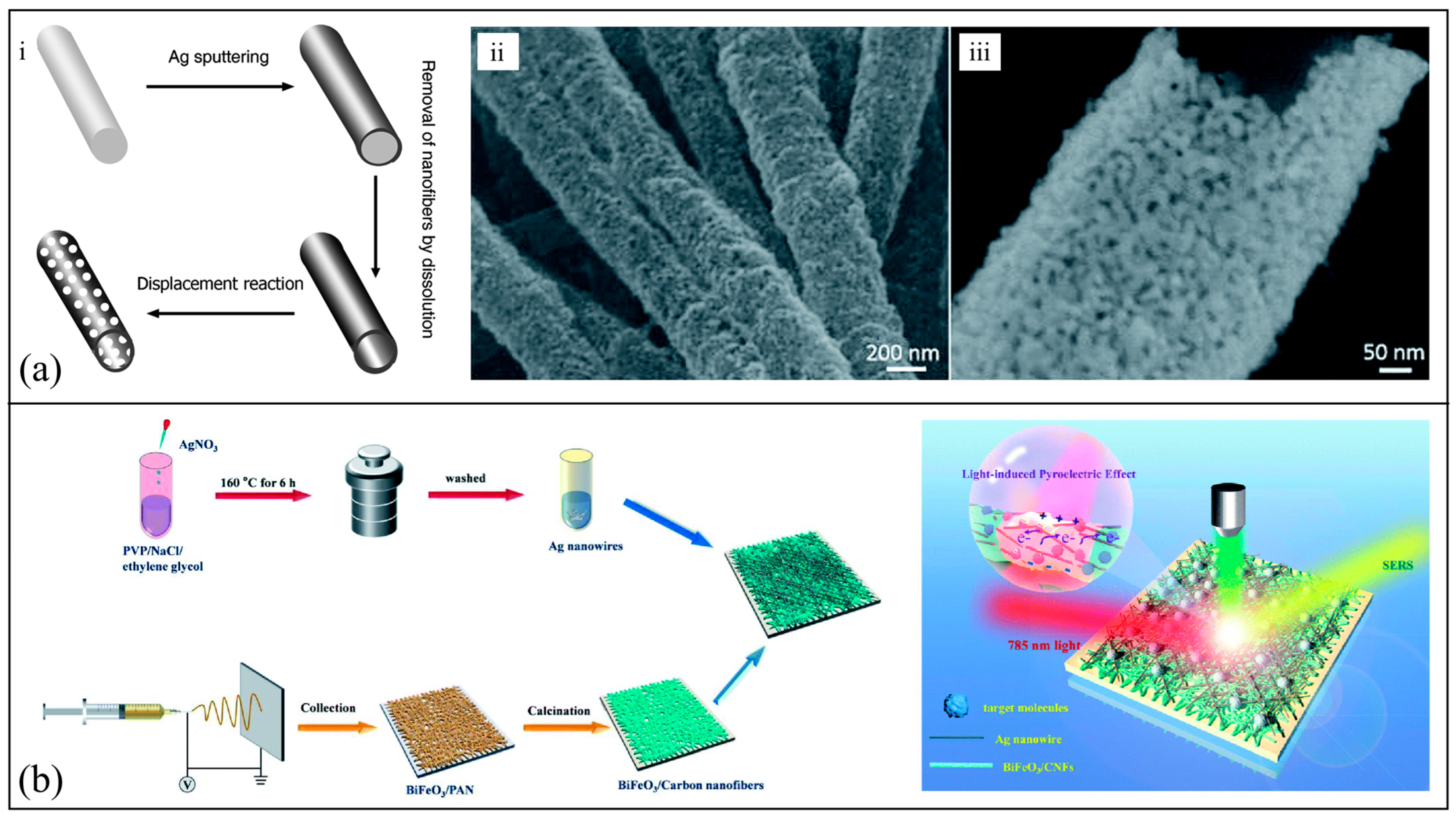
The rationale for selecting carbon nanotubes as SERS substrates is multifaceted owing to their inherent material properties, including excellent stability, high mechanical strength, non-corrosive nature, and large specific surface area, providing a robust and advantageous platform [54,154]. Therefore, metal nanostructures attached to carbon nanofibers can adsorb more analyte molecules directly onto their surfaces, thereby enhancing SERS sensitivity [55]. Furthermore, hollow carbon nanofibers possess twice the surface area due to their accessible inner and outer surfaces. This makes them ideal as active sites for anchoring nanoparticles or functional molecules, thereby contributing to SERS enhancement [54]. More importantly, carbon nanofibers possess high thermal conductivity, strong optical absorption, and optimal electrical conductivity. These intrinsic properties, combined with strategic modifications such as nitrogen doping [155], can effectively modulate their electronic structures. For instance, nitrogen-doped carbon nanomaterials have been shown to optimize Raman sensitivity via a charge transfer process, achieving a maximum enhancement factor of 3.8 × 10⁴ [156]. For example, You Daotong et al. constructed a multilayer architecture comprising a pyroelectric BiFeO3 functional layer, an electron and heat conduction layer of carbon nanofibers, and a top plasmonic layer of silver (Ag) nanowires (Figure 9b). This design provided excellent near-infrared (NIR) light absorption and achieved a 5.6-fold SERS signal enhancement compared with the non-pyroelectric counterpart [153]. The mechanism involves the BiFeO3 layer effectively converting thermal energy induced by light into pyroelectric charge, which subsequently modulates the electron density of the adjacent Ag nanowires and, in turn, boosts the electromagnetic fields at the “hot spots.”

3.4. Mechanical Durability and Flexibility Considerations

While ceramic and carbon nanofibers offer superior thermal stability and often enhanced SERS performance through synergistic enhancement mechanisms, their mechanical behavior post-calcination requires careful consideration. High-temperature treatment (typically 500–1200 °C) inevitably alters the material’s microstructure, often leading to increased crystallinity and, in some cases, embrittlement. Nevertheless, the term “flexibility” in the context of fibrous SERS substrates should be interpreted with nuance. Despite lacking the intrinsic flexibility and elastomeric resilience characteristic of polymer-based systems, strategies such as controlling crystallite size, engineering porous or hierarchical fibrillar architectures, and integrating flexible scaffolds have been shown to mitigate brittleness [136]. Many ceramic nanofiber mats retain sufficient macro-scale bendability and conformability to be handled and repeatedly folded. For instance, Wan et al. performed flexibility bending tests on SiO2 nanofibrous membranes and observed that even after high-temperature calcination, the membranes did not fracture upon folding. This excellent bending resistance was attributed to the interwoven three-dimensional network of SiO2 nanofibers and the presence of amorphous SiO2, which reduces surface defects and lowers the brittleness typically associated with crystalline materials [127]. Furthermore, Daniela S.G. et al. demonstrated that SiO2 can improve the mechanical properties of TiO2 by acting as a supporting phase and imparting flexibility after calcination [144]. Therefore, properly engineered ceramic substrates can still meet the practical demands of many flexible sensing scenarios. Unfortunately, reports on flexible applications of ceramic-based substrates remain scarce. Furthermore, flexibility is generally not emphasized for carbon nanofiber-based substrates in the literature, as their main advantages lie in high thermal stability, excellent electrical conductivity, and synergistic enhancement effects. In addition, metal-based nanotube networks provide unique plasmonic tunability. However, their hollow architectures may exhibit reduced structural integrity under mechanical stress compared with solid or composite counterparts. Nevertheless, hierarchically porous Au films still exhibit good flexibility due to their interconnected porous nanotube-woven network [53,151] and have been utilized for in situ and real-time detection of trace pollutants on irregular solid surfaces, such as malachite green on fish skin. In summary, while inorganic fibrous substrates still hold potential as flexible substrates for practical swabbing [53,138] and wearable SERS monitoring, polymer-based substrates are generally recommended for these scenarios.

4. SERS Application

Combining the rapid, ultra-sensitive, and fingerprint-identifying potential of plasmonic nanostructures with the flexible, high-surface-area, and porous 3D scaffold provided by electrospinning, electrospun SERS substrates offer a versatile platform suitable for diverse fields such as environmental pollution monitoring [66,109,114], food safety [64,122], public security (chemical warfare simulant [67] and illicit drug use [124,157]), microbiological-detection/biomedical-diagnostics [30,102], preservation of cultural relics [108,158], and in situ monitoring of chemical reactions [132,159]. The architectural and compositional design of electrospun SERS substrates with the required performance metrics, such as uniformity and sensitivity, as detailed in the preceding sections, is fundamentally guided by their intended application scenarios and the associated detection modalities. The fabrication strategies, encompassing material selection, fiber architecture control, and the spatiotemporal integration of plasmonic nanostructures, collectively govern the substrate’s structural features (e.g., fiber morphology, membrane porosity, mechanical flexibility, and surface wettability), dictate its core enhancement performance (including electromagnetic enhancement, charge-transfer efficiency, signal uniformity, and background noise level), and ultimately define its application-specific functional properties (such as analyte enrichment capacity, molecular selectivity, environmental stability, operational practicality, and added functionalities like photocatalysis or antimicrobial activity). These properties, in turn, dictate the optimal sampling methodology and measurement approach for a given analyte and sample matrix. The following discussion of these core sampling and measurement methodologies establishes a logical bridge between substrate engineering and the subsequent application-oriented analyses, with a primary focus on environmental monitoring, food safety, microbiological detection, and biomedical diagnostics.

4.1. SERS Sampling and Measurement Methodology

In practical applications, SERS sampling strategies are broadly categorized into three modalities based on the physical state of the sample, each imposing distinct requirements on substrate design: liquid-phase, solid-phase, and gas-phase detection. Importantly, SERS measurement operates through two primary modalities: direct (label-free) detection, which exploits the intrinsic Raman fingerprint of the analyte, and indirect (tag-mediated) detection that converts and amplifies the specific binding event between a capture probe and the target into a strong, characteristic Raman signal from synthetic tags [160]. Furthermore, SERS detection encompasses not only qualitative identification but also quantitative analysis. The latter imposes stricter demands on substrate uniformity. Reliable quantification is particularly challenging, and uniform SERS signal intensity with relative standard deviation (RSD) less than 10% is widely considered acceptable for ensuring result fidelity [26]. Driven by significant progress in substrate engineering, quantitative SERS analysis has become the primary research focus.

4.1.1. SERS Sampling Methodology

SERS sampling methodology can be broadly categorized into three modalities: liquid-, solid-, and gas-phase detection, each with distinct design imperatives.
(i) 
Liquid-phase analysis
Liquid-phase analysis represents the most common mode of SERS detection. It typically involves preparing analyte solutions at various concentrations, using solvents such as water or ethanol. For practical applications, the liquid sample can be a direct environmental or biological matrix (e.g., contaminated water [161], milk [162], blood [124], saliva [55]), an extract (e.g., leachate from soil [109], extract from meat [68]), or a pretreated bacterial suspension [141]. The detection is then performed by either immersing a small piece of the nanofibrous membrane into the liquid for a period before withdrawal and measurement or by drop-casting the liquid onto the membrane and allowing the solvent to evaporate prior to SERS analysis. While immersion favors optimal analyte–substrate interaction through prolonged contact, drop-casting provides a time-efficient approach for physical retention of analytes either within or on the surface of the plasmonic fibrous membrane.
(ii) 
Solid-phase detection
Solid-phase detection is typically performed by directly swabbing [76] or attaching [74,93] a flexible SERS substrate onto the target solid surface (e.g., fruit peel [76], shrimp shell [98], tissue [101]) for in situ sampling. This approach necessitates substrates with high flexibility and conformability to ensure intimate contact with irregular topographies. Importantly, the SERS-active sites should be located predominantly on or near the outer surface of the membrane to maximize analyte interaction.
(iii) 
Gas testing
Compared with liquid and solid detection, gas testing poses greater challenges, primarily attributed to the rapid molecule diffusion and the significant difficulty in effectively capturing them on substrates and the low intensity of gas molecules. As a result, relatively few studies have been undertaken to address these challenges in recent years. Promisingly, the three-dimensional network structure, combined with high porosity and a large specific surface area, enables the nanofiber membrane to permit rapid airflow while simultaneously capturing target analyte molecules [115,145,163].
These phase-specific sampling methods, leveraging the flexibility, porosity, and high specific surface area of electrospun substrates, lay the foundation for their wide applications in environmental monitoring, food safety, microbial detection, and biomedical diagnostics, which require high sensitivity, rapid response, and adaptability to complex matrices.

4.1.2. Direct and Indirect SERS Detection Strategies

SERS-based measurements are typically classified into two categories: direct detection, often referred to as label-free SERS, and indirect detection utilizing SERS probes, which is particularly powerful in bioanalytical applications. Detailed aspects of SERS probe design, recent advancements in instrumentation, and their expanding applications have been extensively covered in the review literature by Chang, H. et al. [164]. In brief, label-free SERS operates by analyzing the intrinsic vibrational signatures of molecules, providing direct chemical information without external labels. This approach simplifies experimental procedures and eliminates potential interference from labeling agents, making it suitable for rapid clinical screening. However, it suffers from inherent limitations, including weak Raman signals of molecules with extremely small scattering cross-sections, overlapping spectral bands in complex environments, and poor reproducibility arising from inconsistent molecular adsorption on SERS substrates. In contrast, indirect detection employs engineered SERS probes designed to overcome these limitations. For example, sweat pH (corresponding to H+/OH [126]) and nitrite in food [122], which are typically not directly detectable via SERS, can be measured using pH-sensitive 4-MBA/4-MPy and 4-ATP as probes, respectively. A wearable SERS-based pH sensor using gold-coated electrospun TPU nanofibers functionalized with 4-MBA or 4-MPy was designed to monitor sweat pH [126]. pH measurement was achieved by depositing 1 μL of sweat/buffer onto the sensor and monitoring the intensity ratio changes of pH-sensitive Raman peaks. To ensure accurate detection across the full physiologically relevant sweat pH range (4.0–7.0), an optimized dual-sensor strategy is employed. For the primary sweat pH range (5.5–7.0), the 4-MBA functionalized sensor is used, analyzing the ν(COO)/νref (1590) and/or ν(C=O)/νref (1590) intensity ratios. This provides the highest measurement resolution, achieving 0.14 and 0.33 pH units for the respective ratios, alongside excellent long-term stability. For the lower pH range (4.0–5.5), the 4-MPy functionalized sensor is utilized, specifically monitoring the ν (1613)/νref (1573) intensity ratio. This maintains good resolution (0.51 pH units) where 4-MBA sensitivity significantly decreases. Similarly, 4-aminothiophenol was utilized both as a SERS reporter and a specific recognition element for nitrite [122]. A surface plasmon-assisted oxidation reaction occurs, involving electron transfer, which converts 4-ATP into 4,4′-dimercaptoazobenzene (DMAB). The characteristic Raman signal of this product forms the basis for the quantitative detection of nitrite in food.
Furthermore, by conjugating such chemically responsive probes with biomolecular recognition ligands (such as antibodies, aptamers, and DNA), this indirect detection paradigm evolves into a far more powerful analytical platform. A functional SERS probe is engineered by integrating several key components: a plasmonic SERS substrate for enhancing the Raman signals; extrinsic label molecules attached to the surface of SERS substrates that generate a characteristic spectral fingerprint; and a targeting ligand for selective binding to biomarkers of interest [164]. To achieve improved biocompatibility and physical and chemical stability, protective layers are also often applied. For the early diagnosis of laryngeal cancer, miRNA-223-3p has been identified as a promising biomarker with high diagnostic and prognostic potential [30]. Sara Martino et al. developed AuNP-decorated polyesteramide nanofibers as a 3D flexible SERS biosensor for detecting miRNA-223-3p. To selectively detect the target miRNA, a stem-loop structure probe (NH2-iMS-Cy3), also known as the inverse amino terminal molecular sentinel (iMS, bio-ligands), DNA sequence labeled with Cyanine 3 (Cy3, label molecules), was immobilized on the surface of AuNPs. The detection is achieved through a “on-to-off” SERS strategy, where the binding of the target miRNA-223-3p to the stem-loop probe causes conformational opening, distancing the Raman reporter from the AuNP surface and reducing the SERS signal of Cy3. Importantly, the selectivity was rigorously confirmed by the significant signal decrease only in the presence of the fully complementary target, while non-complementary miRNA and miRNA with three base mismatches induced negligible responses, respectively. As a result, the sensor demonstrated a wide linear detection range from 10 fM to 250 fM with an ultra-low limit of detection (LOD) of 19.50 ± 0.05 fM for miRNA-223-3p. Therefore, this indirect detection technique using SERS labels transforms a technology limited by weak signals and background interference into a robust diagnostic tool with exceptional sensitivity, high specificity, and powerful targeting capability.

4.1.3. Qualitative and Quantitative SERS Measurements

As thoroughly discussed in the review article by Sloan-Dennison et al., the process of quantitative SERS detection typically involves selecting a characteristic peak of the analyte (direct detection) or labeled probe (indirect detection) at a specific Raman shift, measuring its intensity or integrated area, and correlating the signal intensity/area with the known concentrations of the analyte solutions [165]. A calibration curve is then constructed, typically plotting the peak intensity against the analyte concentration (or the logarithm of concentration). This established correlation allows for the quantitative determination of unknown analyte concentrations, thereby achieving reliable and reproducible SERS-based quantification. However, SERS quantitative detection imposes clear and stringent requirements on the substrate. Specifically, variations in SERS signals primarily stem from differences in instrument configurations and the inherent lack of reproducibility of the substrates themselves, with the latter posing the greatest obstacle to achieving reliable and reproducible quantitative measurements. Furthermore, batch-to-batch consistency of substrates is also crucial. Therefore, beyond high sensitivity, substrates intended for quantitative applications must exhibit nanostructural uniformity, batch-to-batch consistency, and temporal stability to ensure excellent uniformity, reproducibility, and longevity.
Compared with flat substrates, the large-area, uniform three-dimensional network structure of electrospun nanofiber membranes contributes to achieving uniform SERS signals (RSD < 10%), regardless of whether the plasmonic nanostructures are embedded within the fibers [77] or deposited on the fiber surfaces [106]. Furthermore, encapsulating nanoparticles within the fibers, or even depositing plasmonic nanoparticles on electrospun nanofibers, can significantly extend the substrate’s shelf life [166], as the protective polymer layer provides effective physical isolation and chemical protection. This encapsulation mitigates oxidation, aggregation, or detachment of the nanostructures from the substrate. Furthermore, electrospinning enables rapid, low-cost, and scalable production of large-area uniform mats. For instance, a one-square-meter sample can be readily cut into ten thousand square-centimeter-scale SERS substrates, thereby ensuring excellent batch-to-batch reproducibility. These advantages thereby enable broad applicability of such nanofibrous substrates for reliable quantitative SERS detection.

4.2. Environmental Pollution Monitoring

Various chemicals and medicinal products used in industry and daily life can potentially enter environmental water bodies and the atmosphere or contaminate soil, posing ongoing threats to human health and safety. These pollutants include pesticides/insecticides, polycyclic aromatic hydrocarbons (PAHs), antibiotics, per- and polyfluoroalkyl substances (PFAS), plasticizers, heavy metals, nitrite contamination, volatile organic compounds (VOCs), and many others. Therefore, the detection of these pollutants is of critical importance. The high sensitivity of SERS technology enables the qualitative or quantitative analysis of these trace pollutants in the environment, offering a promising solution for their monitoring.

4.2.1. Liquid Samples

Trace detection of pollutants in water samples can often be performed directly by using SERS substrates through liquid-phase sampling, which has been successfully applied to a variety of analytes, including polychlorinated biphenyls (PCBs, a kind of PAHs) [114], hexafluoropropylene oxide dimer acid (a short-chain PFAS) [66], phthalate esters (a plasticizer) [161], malachite green (a biocide) [88,89,167], pesticides (e.g., paraquat [104], deltamethrin, quinalphos, thiacloprid [123], and imidacloprid [131]), sulfamethoxazole (an antibiotic) [24], various arsenic compounds [168], nitrites [122], and radioactive uranyl species [107,169,170].
For example, we have developed Ag-nanosheet-grafted PA nanofibers through Au-seed-mediated electrodeposition as effective 3D SERS substrates for trace detection of PCBs [114]. To effectively capture PCB molecules, mono-6-β-cychlodextrin modification was performed. As a result, not only is a low concentration down to 10−6 M reached, but also the mixture of PCB-77 and PCB-3 could be identified. Rong Fei et al. developed a novel SERS substrate for the detection of phthalate esters by integrating electrospinning, molecular imprinting, and SERS detection [161]. The substrate was prepared by electrospinning a PES solution with dimethyl phthalate (DMP) templates and Au nanoparticles, followed by template removal with methanol. This process generated abundant imprinted pores on the fiber surface, which exhibited excellent spatial matching with DMP, facilitating selective capture. Consequently, the substrate achieved the quantitative determination of DMP with a low detection limit of 10−8 mol/L in a real lake water environment. Furthermore, Amanda J. Haes’ group also reported a quantitative SERS method for uranyl detection by first capturing uranyl ions on amidoximated PAN nanofibers, followed by inverted drop-coating carboxylated Au nanostars onto the mats for SERS detection. The system exhibited a linear response from ∼0.3 to 3.4 μg U/mg polymer, with signal variations ≤ 10% [107,168].
Moreover, Sun Mei et al. fabricated a highly sensitive SERS sensor by coating plasma-synthesized Au nanoparticles onto electrospun PVDF nanofibers via thermal evaporation, generating uniform high-density hot spots [122]. The PVDF/Au membrane combined electromagnetic enhancement of Au and the inherent photoelectric/piezoelectric properties of PVDF and thus demonstrated exceptional sensitivity with a high enhancement factor of 9.4 × 10⁷. Furthermore, the sensor was functionalized with p-ATP for effectively capturing NO2 and successfully detected nitrite ions at 10−8 M in river water (Figure 10). Furthermore, to address the issue of low signal-to-noise ratio caused by background Raman interference, Fan Zilin et al. synthesized an optically transparent polyurethane (PU) and a rigid polyarylene ether amidoxime (PEA), which were then electrospun into core-shell beads-on-web structural nanofibrous membranes [24]. These membranes were then coated with an ultrathin Ag layer and thermally annealed, resulting in flexible Ag-PU-PEA nanofiber membranes with no background noise. The optimized sensor demonstrated label-free detection of sulfamethoxazole down to 0.1 nM in two actual environmental samples of tap water and drinking water.

4.2.2. Soil Samples

Direct testing of soil samples is challenging due to the heterogeneous distribution of pollutants within the soil matrix, necessitating an extraction step to isolate the pollutants before measurement. For example, Yang Ziwen et al. present a flexible and recyclable Ag/PI nanofiber-based SERS platform for ultrasensitive detection of pesticide residues in both aqueous solutions and soil, synthesized through a process involving electrospinning of a PAA nanofiber membrane, chemical reduction with NaBH4, and thermal imidization [109]. The extracts were applied for the SERS analysis in soil samples, and a low detection limit of 1 × 10⁻⁹ M was achieved for 2,4-dichlorophenoxyacetic acid (2,4-D) pesticide, demonstrating the robust anti-interference capability of the Ag/PI nanofiber-based platform in complex media.

4.2.3. Gas Testing

Compared with solid detection, gas testing poses greater challenges, primarily attributed to the rapid molecule diffusion and the significant difficulty in effectively capturing them on substrates and the low intensity of gas molecules. As a result, relatively few studies have been undertaken to address these challenges in recent years. Promisingly, the three-dimensional network structure, combined with high porosity and a large specific surface area, enables the nanofiber membrane to permit rapid airflow while simultaneously capturing target analyte molecules.
Wei Jing et al. fabricated photo-reduced Ag-NPs deposited on WO3/PAN nanofiber membranes for gas detection of aldehydes, which exhibit a high SERS enhancement factor of up to 2.9 × 10⁵ due to the integration of electromagnetic and chemical enhancement. Specifically, a flow-through detection scheme was employed. A small disc of functionalized NFM (~1 mm diameter) was fixed in a filter, while a large volume of gas from the syringe was driven through the small filter [145]. This forces a high gas flux through the confined sensing zone, thereby increasing analyte collision probability and boosting molecule adsorption. Furthermore, to solve the low SERS response of aldehydes, the Raman-active p-ATP molecule acts as a bridge between gaseous aldehydes and NFMs via the crosslinking between the -NH2 group and the –CHO group. As a result, this method achieves a good linear response from 0 to 100 ppb for benzaldehyde and also enables the detection of other aldehydes with distinct Raman signatures at the 100 ppb level, such as glyoxal and glutaraldehyde.
As an alternative molecular enrichment strategy, Nie Guangzhi et al. fabricated a flexible and breathable SERS substrate by first assembling Ag NPs on electrospun PA-66 nanofibers, followed by the in situ growth of a ZIF-8 shell to form Ag@ZIF-8/nylon nanofibers [115]. The microporous structure of the fibrous membrane promoted the transport and accumulation of volatile organic compounds around the PA nanofibers. Meanwhile, the high porosity of the ZIF-8 shell performed a second-stage, molecular-sieving capture, delivering analytes to the vicinity of the Ag nanoparticles. After p-ATP modification as the gas capture agent, the optimized substrate achieved high SERS sensitivity with a detection limit of 6.64 × 10⁻¹¹ M, excellent reproducibility with an RSD of 5.9%, 30-day stability, and a linear response (R2 = 0.99) of Raman intensity at 1070 cm−1 to the concentration of dithiohydroquinone gas. Furthermore, the membranes were applied for deep learning detection and analysis of low-concentration gaseous glutaraldehyde (GA) and achieved 100% accuracy, using a residual neural network model, showing their potential for practical and precise detection of gaseous molecules in various environments [171,172,173].
Recently, Hou Liwei et al. also reported the collaborative integration of a MIL-100(Fe)/PAN composite fiber SERS substrate with a photoelectric QCM sensor, which could convert the change in surface mass of quartz crystals into a change in the frequency of the electrical signal output [163]. In this work, MIL-100(Fe) was grown hydrothermally on PAN fibers, serving as both an excellent gas-sensitive material and an effective Raman enhancer due to its charge-transfer enhancement mechanism. The integrated platform leverages QCM for “weighing” (precisely quantifying total adsorbed mass with high sensitivity) and SERS for “fingerprinting” (identifying single or constituent gas species and evaluating their concentration ratio), with their synergistic signals enabling mutual verification for single analytes and algorithm-assisted differentiation/quantification of gas mixtures. Based on the testing method described above, the toluene and benzaldehyde mixtures were qualitatively and quantitatively analyzed within a concentration range of 0–100 ppm, achieving good accuracy and reliability with deviations of all samples less than 10%. This study thereby demonstrates a promising new approach for the detection of structurally similar VOC gases.

4.3. Food Safety

Foodborne acute or chronic poisoning poses a serious public health threat. Therefore, the development of detection technologies capable of accurately identifying trace contaminants in food is of critical importance. Surface-enhanced Raman spectroscopy (SERS) provides a powerful tool for rapid, highly sensitive qualitative and quantitative analysis of these contaminants, such as pesticide residues [174], veterinary drug residues [61,68], illegal additives [162], and biological toxins [64,105]. For contaminant detection in food, liquid-phase sampling is readily applicable to liquid matrices such as milk [162], soy milk, and soy sauce [175]. It can also be performed on solid samples, including fruits, vegetables, and meat, via the preparation of juice [105,112,174] or extraction [103].

4.3.1. Liquid-Phase Sampling

In the study by Mehdi Hajikhani et al., Au@Ag nanoparticle-assembled PAN nanofibers were used as a SERS substrate to quantitatively detect thiabendazole in soy sauce and soy milk. Prior to analysis, soy milk was pre-treated to remove proteins, while soy sauce was processed to eliminate soluble compounds [175]. The limits of quantification were demonstrated as 69.9 ppb and 240.59 ppb for soy milk and soy sauce, respectively. Furthermore, the Ag nanoplates/CS/PEO fiber-based sensor achieved a detection concentration as low as 10−11 M for target analytes in apple, pear, tomato, and cucumber juices. This detection limit is substantially lower than the maximum residue limit of 7 ppm (29 μM) established by the US Environmental Protection Agency (EPA) for fruits [112].
Not only in fruits and vegetables, but antibiotic residues in meat can also be effectively detected and monitored by electrospun nanofiber SERS substrates [68,144]. For example, Dipjyoti Sarma et al. fabricated AuNP-embedded PVA nanofiber membranes via one-step electrospinning as the SERS platform for detecting two commonly used poultry antibiotics, doxycycline hydrochloride (DCH) and enrofloxacin (ENX), in chicken meat purchased from a local poultry market. The chicken meat extraction was prepared by first homogenizing the tissue, then chelating with ethylenediaminetetraacetic acid (EDTA), followed by salting-out and centrifugation [68]. The extraction was then drop-casted on the fiber SERS substrate. Indeed, DCH and ENX were SERS recognized to be 0.238 ± 0.0024 ppm and 0.389 ± 0.0046 ppm, respectively, which exceeded the maximum residue limit (MRL) established by the European Union (EU).

4.3.2. Solid-Phase Sampling

Compared with liquid-phase sampling, direct solid-phase sampling and analysis on irregular fruit [74,76,93,121,174,176], vegetables [176], and prawn [98] surfaces benefit from the core capabilities of SERS: rapid, on-site, and visually guided detection, enabling targeted interrogation of specific surface areas of interest or suspected contamination.
In the study of Bai Lu et al., sustainable AgNP-decorated PLA nanofibers were fabricated by facile electrospinning of AgNO3/PLA solution and then green plasma treatment (in situ surface/post-reduction method). These nanofibers were then applied as a flexible SERS substrate [93]. Plasma treatment offers a straightforward and rapid method to form dense AgNPs mainly concentrated on nanofiber surfaces, which generates high-density hot spots and endows the substrate with high sensitivity for detection. Due to the flexibility of the nanofibers, the nanofibrous membrane was directly attached onto the apple surface for sampling residual thiram (a commonly used pesticide) and SERS detection. Even at a concentration as low as 10−7 M, the thiram could be clearly identified. Recently, Zhao L. et al. developed a flexible TiO2/ZrO2-based SERS substrate decorated with concave Au nanorods for the detection of fungicides (asomate) in apple peel (Figure 11). This substrate achieved an impressive enhancement factor of up to 9.4 × 10⁷ and a detection limit below 10 nM for asomate.
However, direct swabbing or attaching was not used for pesticide sampling on orange exocarps by Au-nanoprisms/PVA nanofibrous membrane, possibly owing to the encapsulation of AuNPs inside the fibers. The Au-nanoprisms/PVA nanofibrous membrane was prepared through one-step electrospinning (inner/pre-synthesizing), followed by vapor-phase glutaraldehyde cross-linking. Instead, a drop of acetone was applied to dissolve trace thiram, after which the nanofiber mat was covered over the wetted area to uptake the analytes for SERS detection [74]. Consequently, 10−6 M thiram could also be distinctly identified. Similarly, Ag@PVA/PEI SERS substrate via electrostatic adsorption of AgNPs on the electrospun nanofibers presented high SERS sensitivity and facilitates a simple, direct in situ method for enrofloxacin residue (10–4 M) detection on an irregular prawn surface [98].

4.3.3. The Comparison of Solid-Phase Sampling and Liquid-Phase Sampling

While direct solid sampling yields relatively lower signal intensity compared with liquid-phase extraction, it still provides sufficient detection sensitivity and serves as a rapid, non-destructive, and minimal-pretreatment detection method. In the work of PVDF/CQDs/AuNS@Ag film by Wei X. et al. [105], the SERS detection of carbendazim (CBZ) in apple was achieved by using Au@Ag-nanostar interfacial self-assembled PVDF/CQDs electrospun film. The PVDF/CQDs/AuNS@Ag film was then immobilized with thiol-modified CBZ aptamer acting as a capture substrate, while AuNPs linked with both 4-(Mercaptomethyl) benzonitrile (MMBN) and CBZ aptamer (aptamer-AuNP-MMBN) served as reporter probes. And the apple juice sample was also prepared by homogenizing apple tissue, followed by centrifugation, filtration through a 0.22 μm membrane, and a final dilution step. The presence of CBZ in apple juice triggers the specific binding of the aptamer, leading to the formation of a (capture-substrate)-(reporter probe) complex. Therefore, the CBZ levels were quantified via the SERS intensity of the reporter probes. The aptamer-based detection method exhibited satisfactory recoveries ranging from 98.24% to 105.4%, with RSDs below 4.12%, and achieved a detectable concentration as low as 10 nM. Furthermore, solid-phase sampling was also performed to non-destructively detect residual CBZ on apple peel for comparison. The SERS signal from the “paste and peel-off” method was notably lower than that of solution immersion, due to limited spiking volume and partial CBZ penetration into the peel. Despite these constraints, the flexible SERS film achieved a high SERS sensitivity as low as 1.20 ng/cm2 for CBZ on apple peel. Even more importantly, the solid-phase sampling realized the non-destructive detection of CBZ on apple peel without complicated pretreatment.
Similarly, Zhang Yipeng et al. prepared an Ag-coated nanofiber substrate by electrospraying as-synthesized Ag NP colloid onto an electrospun gluten/zein nanofiber membrane for nitrite qualitative detection in food. Five common high-nitrite foods (chicken sausage, canned pork, cured meat, ham, and pickled vegetables) were chosen for the measurement. The crude extracted samples were obtained by homogenization in distilled water. Subsequently, the fine extracted samples were prepared by treating the crude extract with NaOH and ZnSO4 at 60 °C, followed by filtration [103]. The SERS measurements were carried out using three preparation methods: direct solid sampling, crude extract immersion, and fine extract immersion, and the results were compared accordingly. For cured meat, ham, and pickled vegetables, both sampling methods yielded results consistent with the colorimetric method. Whereas for chicken sausage and canned pork, direct solid sampling showed low recoveries (27.13% and 34.81%), significantly lower than those from fine extract immersion (108.21% and 86.30%), due to their low moisture content restricting uniform nitrite distribution on the surface.

4.3.4. Multifunctional SERS Platform in Food Safety

The intrinsic antimicrobial activity of silver makes Ag-based SERS substrates inherently antimicrobial. In a recent study, Ha Ji-Hwan et al. reported a multifunctional platform by first preparing a nanoimprinted polyurethane acrylate (PUA) mold and then slanted Au deposition, followed by oxygen plasma treatment to regulate Au-fiber adhesion; subsequently, transferring the Au nanostructure onto electrospun curcumin/TPU fibers; and finally drop-casting Ag NPs [177]. Owing to the antimicrobial properties of Ag and curcumin and the enhanced elasticity provided by TPU nanofibers, the nanostructured SERS sensor is integrated into an antimicrobial and stretchable wrapper, which not only enables on-site, non-destructive, and sensitive SERS detection of nutrients, freshness, and toxicants in food but also enhances preservation by inhibiting microbial growth. As a smart packaging solution, it is capable of detecting purines, proteins, and lipids in foods such as salmon, beef, and pork, as well as carotenoids and thiram in oranges, while also monitoring and delaying spoilage over time, as evidenced by tracking bacterial emissions.

4.4. Microbiological Detection

For public health, the rapid and sensitive detection of pathogenic bacteria and viruses across liquid, airborne, and surface environments is imperative. A key technical challenge lies in the mismatch of scales: bacterial cells are typically larger than or comparable to the laser excitation spot (>1 μm3), while flat SERS substrates are ineffective because the bacteria themselves shield the critical plasmonic nanostructures from the laser, preventing signal enhancement [178]. As a platform for microbiological SERS detection, flexible electrospun nanofibrous membranes offer distinct advantages. Their 3D porous network provides an exceptionally high specific surface area, thereby enabling not only enhanced probe adhesion but also efficient physical filtration [179], pre-concentration [178], and entrapment [52] of bacteria. As evidence, it can be clearly observed that the bacteria are captured by 3D multilayered nanofibers [178].

4.4.1. Label-Free SERS Detection

Importantly, bacterial detection in practical applications is typically performed via label-free, direct SERS, which captures the intrinsic molecular “fingerprint” spectra of bacterial constituents [127]. Alternatively, a highly specific SERS-based immunoassay, which relies on antibody-antigen recognition with the transduction capability of SERS tags, can also be selected as a complementary approach for targeted detection [102,117]. Bacterial samples are typically processed via three main methods: (1) dropping pretreated bacterial suspensions onto nanofiber membranes for surface retention [127,141,150]; (2) immersing the membranes into bacterial suspensions to facilitate sufficient interaction with plasmonic nanostructures [52,180,181]; or (3) filtering bacterial suspensions through the membranes, thereby trapping cells on the surface [179]. Notably, given that a standard laser spot is comparable to or smaller than a single bacterium, measurements are estimated to be performed at the single- or two-cell level, thereby enabling direct spectral fingerprinting of individual bacteria [52]. The characteristic Raman peaks arising from vibrations of biomolecules like purine (adenine, guanine) [127,180], amino acid (tyrosine) [127,180], and lipid (phospholipids and polysaccharides) [178,179,182] allow not only for identification but also for discrimination between species (e.g., differentiating Gram-negative E. coli from Gram-positive S. aureus [117,178]).
The work of Zhang Ran et al. focuses on the strain-level bacterial identification. Therefore, Ag cylindrical nanotrough networks were fabricated to maximize the interaction efficiency between the plasmonic nanostructures and bacteria. The interconnected, concave nanostructures can physically trap individual bacterial cells while the substrate is entirely composed of a pure metallic structure, maximizing plasmonic “hot spot” coverage, thereby enabling single-bacterium analysis. Importantly, by using PCA multivariate statistical analysis on a large number of measured bacterial spectra, different strain clusters and overlapping between origin type and its derivatives (E. coli K12, E. coli DH 5α, and E. coli BL21(DE3)) were SERS recognized [52].

4.4.2. Indirect SERS Detection with Labeled Probes

The multilayer integration of 3D cell culture scaffolds with biosensors based on SERS-based immunoassays allowed for non-invasive, continuous monitoring of biomarkers secreted by cells (e.g., stem cells) over time without the need for destructive sampling [117]. The bottom layer serves as a static 3D cell culture scaffold, allowing stem cells to grow and secrete proteins over time. Directly above it, multiple SERS capture substrates are vertically stacked, with each layer pre-functionalized with antibodies specific to distinct biomarkers to capture and detect different secreted analytes (e.g., alkaline phosphatase, osteocalcin, and fibronectin) from the stem cells below. Therefore, this multilayer integration can use SERS to monitor not only the differentiation of various stem cells but also various metabolites from cultured cells.
Furthermore, in carcinoma research, the cellular microenvironment, particularly extracellular pH (pHe), serves as a crucial indicator reflecting metabolic activity and drug response. For spatially localized pHe measurement, William H. Skinner et al. developed a SERS biosensor based on gold-coated thermoplastic polyurethane (TPU) nanofibers on a PDMS film [183]. The detection mechanism relies on the principle that cellular metabolic activity alters the acidity/alkalinity (pH) of its surrounding microenvironment, and the MBA molecules immobilized on the substrate are highly sensitive to these pH changes, causing corresponding shifts in their Raman “fingerprint” spectrum. By pre-establishing a quantitative relationship between spectral changes and pH, the precise pH around cells can be measured non-invasively. Using this method, the study successfully measured local acidification (pH ~6.86) induced by cancer cell metabolism (Figure 12) and subsequent local alkalinization (an increase of ~0.22 pH units) following drug-induced apoptosis.
COVID-19 is caused by infection with SARS-CoV-2. Accurate early diagnosis of infected individuals is crucial for preventing future pandemics of similar respiratory infections. In addition to bacterial detection, SERS biosensors can also be applied for the rapid and highly sensitive detection of SARS-CoV-2 viruses [102]. In the work of Yang Sun et al., an electrospun fiber SERS sensor utilizes a sandwich immunoassay structure where capture probes (Au nanoplates with antibodies) are screen-printed onto the biocompatible and biodegradable polylactic acid (PLA) membrane to efficiently enrich the virus, and SERS nanotags (silver nanoparticles with antibodies and a Raman reporter) are used for signal generation. The flexible, wearable, and biocompatible substrate allows for non-invasive sampling (e.g., integration into the inside of masks) and enables high-throughput, mass-producible detection with a very low limit of detection (10 TU/mL). This approach provides a rapid, sensitive, and portable method for the early diagnosis of respiratory infectious diseases like COVID-19.

4.5. Biomedical Diagnostics

Biomarkers and physiological indicators in human body fluids, such as urine [96], sweat [106,126], saliva [55], and gastric juice [184], hold significant physiological and pathological implications. Their detection is essential for early disease warning, dynamic monitoring, and personalized health management. SERS technology enables non-invasive, rapid, and precise detection and dynamic monitoring of diverse biomarkers and physiological indicators from pH values to cancer cell metabolites, which can serve as a critical frontier technology driving precision medicine and personalized health management.

4.5.1. Static Measurement of Cancer

The paramount value of biomarkers and physiological indicators for early cancer diagnosis lies in enabling timely detection, precise treatment, and improved patient survival. As a rapid and non-invasive analytical technique, SERS enables the detection of biomarkers via both tag-mediated (indirect) and label-free approaches. Adenosine is widely explored as a possible biomarker for monitoring the progress of lung cancer [59]. As a proof-of-concept application, Wang Lin et al. fabricated temperature-responsive electrospun AgNPs/PNIPAAm mats for label-free SERS detection of adenosine, performed via immersion sampling in an adenosine/urea solution [59]. In this system, the thermoresponsive shift from hydrophilic to hydrophobic states of AgNP/PNIPAAm mats can trap more hydrophobic adenosine while excluding more hydrophilic urea. Consequently, the interference from urea becomes negligible, which contributes to achieving a detection limit as low as 10−7 M for adenosine. For lung cancer diagnosis, imidazole compounds are also regarded as potential salivary biomarkers [55]. Biji Pullithadathil’s group designed Ni@Ag/CNF-based SERS substrates to quantitatively determine the trace-level spiked analytes in pretreated salivary samples from healthy volunteers [55]. For all the imidazole compounds (histidine, urocanic acid, and histamine), their characteristic SERS peaks remained clearly discernible even at concentrations as low as 10−10 M, owing to the cooperation of both chemical enhancement and electromagnetic enhancement. Furthermore, their group also developed hollow carbon nanofibers decorated with Ag-NPs to quantitatively monitor anomalous concentrations of nitrite in real-time salivary samples for pre-diagnosis of oral cancer [54]. Notably, the presence of common anions (CH3COO, Cl, CO32−, NO3, SCN, and SO42−) does not significantly interfere with the characteristic peaks of nitrite. This high specificity demonstrates the feasibility of trace-level nitrite detection within the clinically significant range (50–300 μM), even in the complex matrix of real saliva. As a result, a SERS-based immunoassay for prostate-specific antigen (a biomarker for prostate cancer) detection was achieved with a detection limit of 1 pg/mL within 1 h by using AgNP-deposited polycaprolactone (PCL) fibers [185].

4.5.2. Static Measurement of Other Diseases

While pivotal for cancer diagnostics, the value of SERS detection is equally evident for a range of other diseases. For example, beta-defensin 2 (HBD-2) can serve as a biomarker for the pathophysiology of psoriasis, offering new insights for diagnosis [101]. Therefore, the Ag-TNPs@mPD@PAN substrate fabricated by Gao Yueming et al. was applied as a skin patch for SERS detection of HBD-2 on chicken skin, which serves as a simulated human skin. The detection of HBD-2 employs an antigen–antibody binding immunoassay, using a specific probe that was prepared by first modifying Ag TNPs with thiol-functionalized 4-MBA via Ag–S bonds and then conjugating the HBD-2 antibody to 4-MBA [101]. This substrate demonstrated a good linear correlation (R = 0.990) between the logarithm of HBD-2 concentration from 10−10 to 10−5 mg/mL. As a result, the analytical results demonstrate good accuracy and precision for HBD-2 (1–1000 pg/mL) quantitative analysis, with a recovery rate for the skin patch ranging from 93.69% to 104.21% and a relative standard deviation of 6.45% to 9.62%. For monitoring metabolic disorders, uric acid serves as a crucial biomarker linked to conditions such as gout and cardiovascular diseases. Inspired by the need for simple and sensitive detection platforms, R. Kamal Saravanan et al. developed a novel SERS biosensor based on gold nanoparticle-decorated PAN nanofibrous mats blended with thiol-modified purine [95]. The incorporation of thiol-modified adenine molecules facilitates the specific anchoring of gold nanoparticles, thereby creating dense electromagnetic “hot spots” that greatly enhance the Raman signal of uric acid molecules adsorbed onto the fiber matrix through interactions with PAN and the adenine moieties. As a result, trace amounts of uric acid can be detected with a remarkably low detection limit of 10−7 M.

4.5.3. Dynamic Monitoring of Health Status

Monitoring individual health status is critical for assessing physical condition and enabling early disease detection. In this regard, sweat serves as a readily accessible but valuable source of physiological information, containing molecules such as hydrogen ions, lactic acid, and other hormones that can provide health-related data on acid–base balance, dehydration, exercise intensity, and other conditions [126,186]. Compared with the static measurement of urine pH that reflects the acid-base status, renal disease, or urinary tract infection of a person [96], wearable devices are capable of real-time dynamic monitoring [106,126,186]. They can not only continuously track data but also enable real-time molecular health monitoring, which is essential for accurate individual diagnosis and personalized assessment of physical signs.
For stable and comfortable wearable monitoring of sweat pH, Michael Chung et al. fabricated a dual-sided gold-coated thermoplastic polyurethane (Au-TPU-Au) nanofibrous membrane via electrospinning and integrated it into a transparent medical dressing [126]. As shown in Figure 13, the design combines material and structural features to achieve both comfort and functionality. The TPU nanofibrous network offers inherent air permeability for comfort, along with the flexibility and fatigue resistance needed for prolonged wearability. Functionally, the “hydrophilic Au (sensing layer)–hydrophobic TPU–hydrophilic Au (contact layer)” structure drives sweat to quickly wick through the bottom hydrophilic contact layer, cross the hydrophobic TPU core, and arrive at the top hydrophilic sensing zone via capillary action. The resulting continuous liquid supply enables reliable, real-time SERS-based monitoring, solving the persistent issue of sweat transport in wearable biochemical sensors.
Furthermore, Niu Qian et al. designed a Janus hydrophilic PAN-PEI/hydrophobic PU membrane-based sensor via electrospinning (Figure 5) [106]. This structure improves fluid transport efficiency via the Laplace pressure difference and thus maintains a “dry skin” interface for greater long-term wearing comfort. Moreover, the system was expanded to dual-channel SERS monitoring of both pH and lactic acid. This multi-analyte capability, combined with the use of principal component analysis and linear discriminant analysis for intelligent discrimination of physiological states (“resting” vs. “anaerobic exercise”), establishes a comprehensive wearable sensing platform. Furthermore, Chen Dongzhen et al. engineered a multimodal sensor based on bioinspired PVDF@Ag helical fibers [186]. This sensor integrates SERS effects and piezoelectric responses derived from PVDF, enabling simultaneous monitoring of biomolecules (e.g., urea and lactate in sweat and respiratory secretions) and of biomechanical signals (such as muscle contraction and respiration) via the piezoelectric effect. Importantly, inspired by the spiral morphology of butterfly antennae, the fiber is twisted into a stable 3D helical structure that maintains SERS “hot spot” distribution under tensile deformation, effectively resisting signal attenuation during wear. With broad-spectrum detection capability covering both sweat and respiratory secretions, the system also incorporates machine learning algorithms to classify complex motion signals with an accuracy of 88%, thereby establishing a holistic health monitoring platform bridging physical movement and chemical metabolism.

5. Comparative Analysis and Selection Guidelines

As detailed in the preceding sections, a diverse array of fabrication strategies has been developed to construct electrospun nanofiber-based SERS substrates, each with its distinct material requirements, processing steps, and resulting structural characteristics. While this methodological richness offers great flexibility, it can also present a challenge for researchers, particularly those new to the field, in selecting the most appropriate technique for a specific analytical problem or application scenario. To address this need and synthesize the extensive information presented, this section provides a systematic comparison and practical evaluation of the major fabrication approaches. Furthermore, Table 1 offers a high-level overview, juxtaposing the core characteristics of each method, including material compatibility, preparation complexity, structural control, performance profiles, and suitability for different detection scenarios. This table is designed as a primary tool for rapid comparison, enabling readers to quickly discern the fundamental merits, limitations, and optimal application spaces of each technique. For a detailed, data-driven perspective on achievable performance and key metrics, including enhancement factor, detection limit, signal uniformity, sampling methodology, and application field, 77 representative studies across all substrate categories are comprehensively summarized in Table S1 (Supporting Information) for direct reference and comparison. Together, these complementary analyses establish a practical framework for selecting the most appropriate fabrication strategy, balancing performance targets, operational constraints, and specific analytical needs.

5.1. Inner/Pre-Synthesis Strategy

For this approach, the priority in system selection lies in ensuring compatibility among the polymer, solvent, and pre-synthesized nanoparticles. The surface charge of nanoparticles must be carefully considered, and surface modification is recommended when necessary to enhance dispersion stability. Non-ionic polymers are generally preferred to avoid undesirable aggregation of oppositely charged nanoparticles via electrostatic attraction. The chosen solvent must simultaneously dissolve the polymer and stabilize the nanoparticle dispersion. The size, morphology, and volume ratio of nanoparticles to polymer directly determine the final fiber morphology, diameter, and the density/inter-particle spacing of the embedded nanostructures. Nanoparticles with sharp edges or corners are advantageous for generating strong localized electromagnetic fields, thereby enhancing SERS signals. Substrates fabricated by this method exhibit excellent signal uniformity, with a relative standard deviation (RSD) typically below 10% over large areas. However, limited by nanoparticle dispersibility in the polymer solution and the spatial constraints imposed by the polymer matrix, it is often challenging to form high-density hot spots with sub-10 nm gaps, resulting in moderate enhancement factors. Fortunately, controlled and moderate aggregation of nanoparticles, induced by polymer chains or the solvent environment, can improve sensitivity to some extent, usually at the cost of a slight reduction in signal uniformity. The overall process is simple and reproducible, yielding substrates with outstanding uniformity and good enhancement, making them suitable for the qualitative and quantitative detection of small organic molecules in the liquid phase. Since nanoparticles are primarily embedded within the fibers, immersion of the substrate in the analyte solution is recommended to allow sufficient diffusion of analytes into the enhancement zones, while drop-casting is a secondary option. Importantly, this method is not recommended for direct swabbing on solid surfaces and has limited applicability in flexible, wearable sensing due to the embedded nanostructure configuration.

5.2. Inner/Pre-Reduction and Inner-Surf/Post-Reduction Strategies

Both approaches require ensuring the solubility of metal–salt precursors in the spinning solution. However, excessively high salt concentrations can interfere with electrospinning, leading to jet instability or poor fiber morphology [81,82]. The pre-reduction method often employs reducing polymers (e.g., PVA) or solvents (e.g., DMF), which can reduce metal ions in situ under thermal or photochemical activation. The resulting nanoparticles are mostly spherical or quasi-spherical, small in size (often <5 nm), and sparsely distributed, offering limited SERS activity. Consequently, inner/pre-reduction is less frequently reported and is not currently a mainstream recommendation. Post-reduction is typically performed on as-spun fibers containing precursors. Because reducing agents have better access to precursors near the fiber surface, this method tends to produce larger and denser nanoparticles (still predominantly spherical) both within the fiber bulk and on/near the fiber surface, exhibiting significantly higher SERS activity than the pre-reduction route. However, due to its limited adjustability and control over nanoparticle characteristics, this approach has also seen relatively few reports and is similarly not a primary recommendation.

5.3. Surf/Pre-Synthesis Strategy

Immersion and drop-casting are the most common assembly techniques for this strategy. To enhance the binding strength between nanoparticles and fibers, polymers capable of forming covalent bonds or strong electrostatic interactions with Au/Ag (e.g., those containing pyridyl, thiol, or amino groups) are recommended. Alternatively, surface modification of either the fibers or nanoparticles can strengthen interfacial adhesion. Immersion relies on chemical adsorption, where the maximum achievable nanoparticle density is limited by the number of available binding sites on the fiber surface. Since particles are predominantly distributed on the surface, a higher areal density compared with the embedding method can be achieved, facilitating the formation of sub-10 nm gaps and thus stronger SERS enhancement. Neglecting the inherent size dispersion of nanoparticles, signal uniformity largely depends on the homogeneity of particle distribution on the fiber surface. Combined with the averaging effect of the three-dimensional fibrous network, signal uniformity is generally superior to that of two-dimensional planar substrates; thus, satisfactory signal uniformity with an RSD of <10% can also be achieved [106]. Furthermore, drop-casting is simpler and faster but susceptible to coffee-ring effects, leading to non-uniform particle deposition. Inverted drop-casting [107] or liquid–liquid interfacial self-assembly strategies [106] can effectively improve uniformity. This approach is experimentally straightforward, yielding substrates with good signal uniformity and significant enhancement. It is therefore widely studied and applicable to most detection scenarios, including solid-surface swabbing, flexible wearable sensing, and the biological detection of bacteria and viruses. However, caution is warranted when using such substrates as cell-culture platforms due to potential nanoparticle leaching and associated cytotoxicity risks.

5.4. Surf/Post-Modification Strategy

Physical vapor deposition typically coats fibers with a continuous, smooth metallic shell (~30–50 nm thick). SERS enhancement in such systems mainly originates from electromagnetic coupling at the junctions of adjacent fibers, offering a limited number of hot spots and generally moderate enhancement factors. However, the process is simple and yields uniform coatings. PVD-deposited substrates exhibit distinct advantages for bio-interface sensing, including excellent resistance to nanoparticle leaching and aggregation, along with high batch-to-batch reproducibility. These characteristics make them particularly promising for applications such as in vitro cellular pH monitoring [183] and in situ sweat pH detection [122], where signal stability and biocompatibility are critical.
In situ chemical growth requires prior adsorption of metal ions onto the fiber surface; therefore, polymers with high affinity for metal ions or pre-modified fibers are recommended. This process involves complex nucleation and growth kinetics. To precisely control nanostructure morphology, pre-deposition of Pd or Au nanocrystal seeds is often employed. By optimizing growth parameters, not only common spherical or near-spherical particles but also more enhanced morphologies, such as polyhedral or nanosheets, can be obtained. Well-optimized substrates feature uniformly distributed plasmonic nanostructures on the fiber surface, generating abundant high-density nanogaps and sharp features, thereby ensuring both excellent sensitivity and good signal uniformity. This is the most intensively studied method; however, precise control over nanostructure size, morphology, and density, along with performance optimization and experimental reproducibility, all depend on sophisticated parameter tuning and skilled operation. The Surf/post-modification strategy is suitable for most demanding detection scenarios, including long-term bacterial culture and monitoring platforms.

5.5. Non-Polymer Substrates: Ceramic-, Carbon-, and Metal-Based Fibers

Ceramic substrates commonly use PVP as a polymeric spinning template combined with metal–salt precursors, followed by calcination at high temperatures (500–1200 °C) to obtain corresponding oxide ceramic fibers (e.g., SiO2, TiO2, ZnO). Strategies for constructing plasmonic nanostructures are similar to those for polymer systems: metal salts can be added before calcination and thermally reduced simultaneously, or nanostructures can be loaded onto the formed ceramic fibers via surface modification, in situ growth, or PVD. Carbon fibers are typically derived from PAN precursors through high-temperature carbonization. The common advantages of these inorganic substrates include superior thermal stability and enhanced SERS performance through semiconductor–metal synergistic effects. Additionally, ceramic fibers often possess photocatalytic degradation capabilities. Their applications are broad, but increased brittleness after high-temperature treatment compromises flexibility, limiting their use in highly deformable wearable scenarios. They show unique value in specialized applications such as photocatalytic degradation [187], in situ monitoring of reaction processes, and reusable substrates. Metallic nanotube networks, usually fabricated by metal deposition on polymer fiber templates followed by template removal, offer advantages such as high specific surface area, uniformly distributed nanoscale pores on the sidewalls, and tunable plasmonic resonance. Current reports on such systems are relatively few, but they have demonstrated potential for scalable bacterial Raman biosensing. It is noteworthy that inorganic fibrous substrates are not generally recommended for practical swabbing and wearable SERS monitoring due to their reduced flexibility, although they still hold potential as flexible substrates.

6. Summary and Perspective

The plasmonic nanofiber membranes fabricated via electrospinning technology have emerged as a versatile platform for high-performance surface-enhanced Raman scattering (SERS) substrates, owing to their high specific surface area, three-dimensional interconnected structure, tunable composition and morphology, and excellent mechanical flexibility. This review systematically organizes the fabrication strategies of various flexible fiber-based SERS substrates from three dimensions: material composition, spatial configuration, and preparation sequence.
Among these, polymer-based SERS substrates demonstrate comprehensive advantages in several aspects. In terms of fabrication flexibility, the wide selection of polymers and well-established spinning techniques provide extensive design possibilities. In terms of performance regulation, the diverse integration strategies of plasmonic nanostructures with three-dimensional polymer nanofibers characterized by a high surface area facilitate the creation of high-density enhancement sites. These include sharp geometric features of nanoparticles that form localized electric-field “hot spots,” sub-10 nm interparticle gaps that enable strong coupling enhancement, and fiber junctions that provide additional spatially confined electromagnetic enhancement. Together, these features collectively contribute to significantly improved SERS detection sensitivity. Meanwhile, polymer nanofibers can be readily fabricated into large-area, uniform membranes. By optimizing the integration process of polymer nanofibers with noble metal nanostructures, a uniform distribution of plasmonic nanostructures inside or on the surface of fibers can be achieved. Moreover, the multilayered stacking structure of nanofiber membranes allows a single laser spot to cover multiple nanofiber carriers, further enhancing signal uniformity through spatial averaging effects. Notably, even when nanoparticles form random and severe aggregates within the fibers, their confined distribution in the polymer matrix still facilitates relatively consistent SERS responses [77], highlighting the unique advantages of polymer-based composites in uniformity control.
In practical applications, the lightweight, flexible, and biocompatible properties of polymers make them particularly suitable for wearable devices and biomedical detection scenarios. Specifically, polymer-based SERS substrates exhibit distinct advantages in structural design and functional modulation. By constructing Janus structures with gradient hydrophilic/hydrophobic properties or multilayered asymmetric wetting interfaces, they enable directional transport and controlled enrichment of biofluids such as sweat and interstitial fluid, balancing both detection sensitivity and wearing comfort. This capability allows flexible SERS substrates to achieve in situ, continuous, and dynamic monitoring of metabolic markers in sweat (e.g., lactate, urea, electrolytes), providing robust technical support for personalized health management, early disease warning, and exercise physiological analysis.
It is also worth emphasizing that non-polymer materials, represented by ceramics, carbon fibers, and metal nanostructures, not only significantly enhance SERS sensitivity through the synergistic effects of electromagnetic enhancement and chemical enhancement from semiconductors but also open new pathways for developing multifunctional integrated SERS platforms by leveraging their excellent mechanical properties, thermal stability, photocatalytic activity, and tunable electronic structures. For example, composite structures of ceramic semiconductors (e.g., TiO2, ZnO) and plasmonic metals enable real-time SERS monitoring and simultaneous photocatalytic degradation of pollutants. The high electrical and thermal conductivity of carbon fibers allows coupling with pyroelectric effects to achieve photothermally enhanced SERS detection. Metal nanofiber substrates exhibit unique tunability of surface plasmon resonance, allowing precise optical response regulation across the visible to near-infrared spectrum. Moreover, nanoscale pores on the metal tube walls can create additional enhancement “hot spots,” while the pure metal composition provides ample opportunities for interaction between analytes and plasmonic structures. These characteristics give metal-based substrates distinct advantages in bacterial capture and single-cell-level SERS detection.
The review further elaborates on the sampling methods and technical advantages of these substrates in liquid-phase, solid-phase, and gas-phase detection. In liquid-phase detection, their three-dimensional porous network efficiently adsorbs and enriches target molecules, improving the signal-to-noise ratio. In solid-phase sampling, the excellent flexibility and conformability of the substrates allow direct wiping or attachment onto irregular surfaces such as fruits, leather, and biological tissues, enabling in situ, rapid, and non-destructive detection. In gas-phase detection, the highly porous fiber network serves as an ideal matrix for gas diffusion and capture. Through integration with functional materials such as metal–organic frameworks (e.g., ZIF-8), highly selective and sensitive detection of volatile organic compounds can be achieved. Based on these technical advantages, this review details the application progress of such substrates in environmental pollution monitoring, food safety inspection, microbial identification, and biomedical diagnostics.
Despite significant advances in this field, several critical challenges at the materials engineering level must be addressed to fully realize the potential of electrospun SERS substrates. First, the polymer or organic matrix should ideally possess a well-defined porous architecture with tunable pore size and porosity. Such structural controllability is essential for facilitating the diffusion of target molecules into the fiber interior, thereby enabling effective access to embedded plasmonic nanostructures and maximizing SERS enhancement. Second, there is an urgent need to improve the controllability over the density and spatial distribution of noble metal nanoparticles. Ideally, nanoparticle loading should be both high and uniformly distributed throughout the fiber from the core to the subsurface region or, depending on specific detection requirements, precisely confined within the interior or shallow subsurface without being exposed on the outer surface. Third, achieving highly tunable nanoparticle density is critical for balancing sensitivity, uniformity, and fabrication reproducibility across different application scenarios [188]. Fourth, the functional design of nanofibers, for instance, introducing strong analyte affinity or selective recognition capabilities toward specific classes of molecules, remains underexplored. When combined with high nanoparticle density and optimized fiber porosity, such functionalization strategies hold great promise for realizing ultrasensitive and selective SERS detection in complex real-world samples. Addressing these challenges will not only deepen the fundamental understanding of structure–property relationships in fiber-based plasmonic systems but also pave the way for their rational design and broader adoption in practical sensing applications.
Parallel to these material-level challenges, clear evolutionary trends have emerged. First, the research focus of SERS substrates has gradually shifted from early-stage fundamental material construction and performance validation using model molecules (e.g., R6G, p-ATP) toward practical application-oriented exploration, with a notable increase in applied research in food safety, biomedicine, and health monitoring. Second, in these application scenarios, SERS technology is progressively transitioning from qualitative detection to quantitative analysis. This shift imposes higher demands on the signal uniformity, reproducibility, and calibration methods of substrates, highlighting the remaining challenges for flexible fiber-based SERS substrates in achieving reliable quantitative detection, such as the need to develop more precise spatial control strategies for nanostructures to improve signal consistency. Third, at the same time, research trends indicate a move from complex fabrication processes toward simpler and more operable methods, although this may come at the cost of some SERS enhancement performance.
However, there remains a lack of systematic guidance regarding the correspondence between SERS substrate types and their practical application scenarios. For example, the selection of polymer or ceramic materials for different applications and the design of nanostructure distribution within fibers (embedded internally or decorated on the surface) are not yet well-defined. Particularly in solid-surface sampling, if nanoparticles are fully encapsulated within fibers, target molecules have difficulty directly accessing the enhancement sites, often requiring assisted approaches such as solvent pre-spraying. This suggests that surface-enriched structures offer greater advantages for rapid in situ detection. Furthermore, the quantitative relationship between SERS substrate performance metrics (such as detection sensitivity and signal uniformity) and the actual requirements of different application scenarios has not yet been established, which limits the targeted design and optimization of substrates.
Even more importantly, research on the adsorption processes and kinetic mechanisms between substrates and target molecules remains insufficient. Current studies show that immersion methods often require several hours or even longer to reach SERS signal saturation, limiting detection efficiency. For nanoparticles located inside fibers, it is still unclear how target molecules diffuse into the fibers and interact with internal enhancement sites. For surface-decorated substrates, the proportion of molecules that effectively adsorb near enhancement sites also lacks quantitative analysis. The spatial distribution of target molecules in solution, on the fiber surface, and within the fibers; their actual proportion in enhancement regions; and their competitive adsorption relationships with solvents, polymers, and noble metal nanostructures all directly affect SERS sensitivity. More importantly, solvent properties, such as polarity, viscosity, and compatibility with polymers, can also significantly influence the diffusion of target molecules into the fibers and their final enrichment at enhancement sites, altering molecular transport kinetics and interfacial adsorption behavior. These aspects remain underexplored in current research.
Furthermore, the selective recognition capability of substrates in complex real samples still requires enhancement. Although functionalization strategies such as molecular imprinting, aptamer modification, and hydrophilic/hydrophobic design have been employed to improve specificity, their anti-interference ability and long-term stability in real complex matrices (e.g., blood, soil extracts, food mixtures) need further optimization. Particularly for multi-component simultaneous detection, avoiding cross-reactivity and signal overlap between different analytes and between analytes and matrix components, as well as developing interface engineering strategies with multi-recognition capabilities, remains a critical challenge to be addressed. At the same time, promoting the development of SERS substrates toward multifunctional integration and intelligence remains key to their practical application. Future efforts should further integrate sensing, catalysis, energy conversion, and other functions to construct intelligent SERS platforms responsive to external stimuli (e.g., light, heat, pH, and molecular recognition). Finally, developing low-cost, scalable, and process-stable continuous fabrication technologies to advance flexible fiber-based SERS substrates from the laboratory to industrial applications is also a major challenge facing the field.
Looking ahead, with the deep integration of materials synthesis, micro-nanofabrication, intelligent data acquisition, and sensing technologies, flexible fiber-based SERS substrates are expected to evolve toward higher performance, stronger environmental adaptability, and greater intelligence and integration. They will not only continue to play a significant role in fundamental research in chemistry and biology but also hold great potential to become the next generation of key sensing technology platforms in fields such as on-site rapid detection, wearable health monitoring, and real-time environmental early warning.

Supplementary Materials

The following supporting information can be downloaded at https://www.mdpi.com/article/10.3390/chemosensors14030057/s1. Table S1: Summary of Performance Metrics from Representative Studies on Electrospun SERS Substrates.

Author Contributions

Conceptualization: Y.K., Z.L. and C.Z. Visualization, Investigation, and Data Collection: Y.K., N.Z., M.Y., T.H. and J.X. Writing—original draft preparation: Y.K., G.C., N.Z. and C.Z. Writing—review and editing: Y.K., G.C., Z.L. and C.Z. Supervision: C.Z. All authors have read and agreed to the published version of the manuscript.

Funding

The study was funded by the High-level Talent Research Start-up Fund of Guangdong Polytechnic: No. XJGCC202510; 2025 Foshan Self-funded Science and Technology Innovation Project: No. 2520001002692; National Natural Science Foundation of China: Grant 52402111; Guangdong Polytechnic Interdisciplinary Innovation Team Project: XJTD202502.

Institutional Review Board Statement

Not applicable.

Informed Consent Statement

Not applicable.

Data Availability Statement

No new data were created or analyzed in this study.

Acknowledgments

The authors gratefully acknowledge the financial support from the Collaborative Innovation Center of Modern Textile Technology, the Advanced Textile Technology Engineering Research Center of Foshan, the Guangdong Provincial Engineering Research Center for Digitalized Textile and Apparel Technology.

Conflicts of Interest

The authors declare no competing interests.

References

  1. Raman, C.V.; Krishnan, K.S. A new type of secondary radiation. Nature 1928, 121, 501–502. [Google Scholar] [CrossRef]
  2. Das, R.S.; Agrawal, Y.K. Raman spectroscopy: Recent advancements, techniques and applications. Vib. Spectrosc. 2011, 57, 163–176. [Google Scholar] [CrossRef]
  3. Smekal, A. Zur quantentheorie der dispersion. Naturwissenschaften 1923, 11, 873–875. [Google Scholar] [CrossRef]
  4. Petry, R.; Schmitt, M.; Popp, J. Raman spectroscopy—A prospective tool in the life sciences. ChemPhysChem 2003, 4, 14–30. [Google Scholar] [CrossRef]
  5. Cialla-May, D.; Schmitt, M.; Popp, J. Theoretical principles of Raman spectroscopy. Phys. Sci. Rev. 2019, 4, 20170040. [Google Scholar] [CrossRef]
  6. Fleischmann, M.; Hendra, P.J.; McQuillan, A.J. Raman spectra of pyridine adsorbed at a silver electrode. Chem. Phys. Lett. 1974, 26, 163–166. [Google Scholar] [CrossRef]
  7. Jeanmaire, D.L.; Van Duyne, R.P. Surface raman spectroelectrochemistry: Part I. Heterocyclic, aromatic, and aliphatic amines adsorbed on the anodized silver electrode. J. Electroanal. Chem. Interfacial Electrochem. 1977, 84, 1–20. [Google Scholar] [CrossRef]
  8. Willets, K.A.; Van Duyne, R.P. Localized surface plasmon resonance spectroscopy and sensing. Annu. Rev. Phys. Chem. 2007, 58, 267–297. [Google Scholar] [CrossRef]
  9. Liao, P.F.; Wokaun, A. Lightning rod effect in surface enhanced Raman scattering. J. Chem. Phys. 1982, 76, 751–752. [Google Scholar] [CrossRef]
  10. Ahmed, K.; Dhawan, A. Cross-shaped nanoaperture nanoantennas inside plasmonic nanorings for large SERS enhancement and multiple hotspots. Phys. Scr. 2024, 99, 045969. [Google Scholar] [CrossRef]
  11. Benz, F.; Chikkaraddy, R.; Salmon, A.; Ohadi, H.; De Nijs, B.; Mertens, J.; Carnegie, C.; Bowman, R.W.; Baumberg, J.J. SERS of individual nanoparticles on a mirror: Size does matter, but so does shape. J. Phys. Chem. Lett. 2016, 7, 2264–2269. [Google Scholar] [CrossRef]
  12. Xie, T.; Cao, Z.; Li, Y.; Li, Z.; Zhang, F.L.; Gu, Y.; Han, C.; Yang, G.; Qu, L. Highly sensitive SERS substrates with multi-hot spots for on-site detection of pesticide residues. Food Chem. 2022, 381, 132208. [Google Scholar]
  13. Chen, J.; Lin, H.; Guo, M.; Cao, L.; Sui, J.; Wang, K. Improving the detection accuracy of the dual SERS aptasensor system with uncontrollable SERS "hot spot" using machine learning tools. Anal. Chim. Acta 2024, 1307, 342631. [Google Scholar] [CrossRef] [PubMed]
  14. Kim, J.; Jang, Y.; Kim, N.-J.; Kim, H.; Yi, G.-C.; Shin, Y.; Kim, M.H.; Yoon, S. Study of chemical enhancement mechanism in non-plasmonic surface enhanced Raman spectroscopy (SERS). Front. Chem. 2019, 7, 582. [Google Scholar] [CrossRef] [PubMed]
  15. Yu, X.; Cai, H.; Zhang, W.; Li, X.; Pan, N.; Luo, Y.; Wang, X.; Hou, J.G. Tuning chemical enhancement of SERS by controlling the chemical reduction of graphene oxide nanosheets. ACS Nano 2011, 5, 952–958. [Google Scholar] [CrossRef]
  16. Zhou, H.; Qiu, J.; Zhang, Y.; Liang, Y.; Han, L.; Zhang, Y. Self-assembled C-Ag hybrid nanoparticle on nanoporous GaN enabled ultra-high enhancement factor SERS sensor for sensitive thiram detection. J. Hazard. Mater. 2024, 469, 133868. [Google Scholar] [CrossRef]
  17. Smeliková, V.; Kopal, I.; Clupek, M.; Dendisová, M.; Svecova, M. Unveiling the crucial role of chemical enhancement in the SERS analysis of amphetamine–metal interactions on gold and silver surfaces: Importance of selective amplification of the narrow interval of vibrational modes. Anal. Chem. 2024, 96, 5416–5427. [Google Scholar] [CrossRef] [PubMed]
  18. Diao, C.; Li, C.; Sun, Y.; Wang, X.; Gao, M.; Zhang, X.; Li, D.; Li, Y.; Xu, G.; Yu, J. Multi-edge vertically aligned MoS2 as a SERS-enhanced substrate. Mater. Today Nano 2025, 29, 100595. [Google Scholar] [CrossRef]
  19. Zhang, C.; Tan, J.; Du, B.; Ji, C.; Pei, Z.; Shao, M.; Jiang, S.; Zhao, X.; Yu, J.; Man, B. Reversible thermoelectric regulation of electromagnetic and chemical enhancement for rapid SERS detection. ACS Appl. Mater. Interfaces 2024, 16, 12085–12094. [Google Scholar] [CrossRef]
  20. Peng, Y.; Yang, L.; Li, Y.; Zhang, W.; Xu, M.; Lin, C.; Liu, J.; Huang, Z.; Yang, Y. Design of MXene-based multiporous nanosheet stacking structures integrating multiple synergistic SERS enhancements for ultrasensitive detection of chloramphenicol. JACS Au 2024, 4, 730–743. [Google Scholar] [CrossRef]
  21. Al-Shaebi, Z.; Akdeniz, M.; Ahmed, A.O.; Altunbek, M.; Aydin, O. Breakthrough Solution for Antimicrobial Resistance Detection: Surface-Enhanced Raman Spectroscopy-based on Artificial Intelligence. Adv. Mater. Interfaces 2025, 12, 2300664. [Google Scholar] [CrossRef]
  22. Chantaraklud, A.; Rattanabut, C.; Bamrungsap, S.; Bora, T. Light-driven in situ deposited Au nanoparticles on ZnO substrate with ultrasensitive SERS enhancement for molecular detection. Microchim. Acta 2025, 192, 277. [Google Scholar] [CrossRef]
  23. Yu, X.; Kong, L.; Lan, T.; Chen, J.; Fu, Y.; Sun, Q.; Huang, M.; Wang, J.; Huang, Z.; Liu, T. An integrated enrichment-enhancement membrane SERS substrate for rapid detection of polycyclic aromatic hydrocarbons in aquatic environments. Spectrochim. Acta Part A Mol. Biomol. Spectrosc. 2025, 328, 125429. [Google Scholar] [CrossRef]
  24. Fan, Z.; Ran, Q.; Li, Y.; Xu, X.; Zheng, L.; Liu, X.; Jia, K. Surface segregation of rigid polyarylene ether amidoxime on polyurethane nanofiber into hierarchical membranes as substrate of flexible SERS nanosensor for sulfamethoxazole detection. Talanta 2024, 276, 126166. [Google Scholar] [CrossRef]
  25. Suganami, Y.; Oshikiri, T.; Mitomo, H.; Sasaki, K.; Liu, Y.-E.; Shi, X.; Matsuo, Y.; Ijiro, K.; Misawa, H. Spatially uniform and quantitative surface-enhanced raman scattering under modal ultrastrong coupling beyond nanostructure homogeneity limits. ACS Nano 2024, 18, 4993–5002. [Google Scholar] [CrossRef] [PubMed]
  26. Ke, Y.; Meng, G.; Huang, Z.; Zhou, N. Electrosprayed large-area membranes of Ag-nanocubes embedded in cellulose acetate microspheres as homogeneous SERS substrates. J. Mater. Chem. C 2017, 5, 1402–1408. [Google Scholar] [CrossRef]
  27. Han, Z.; Liu, H.; Wang, B.; Weng, S.; Yang, L.; Liu, J. Three-dimensional surface-enhanced Raman scattering hotspots in spherical colloidal superstructure for identification and detection of drugs in human urine. Anal. Chem. 2015, 87, 4821–4828. [Google Scholar] [CrossRef]
  28. Guo, Z.; Zheng, Y.; Wang, C.; Jayan, H.; Yin, L.; El-Seedi, H.R.; Gong, Y.; Zou, X. Flexible label-free SERS substrate with alginate-chitosan@ silver nanocube for in situ nondestructive detection of thiram on apples. Talanta 2025, 283, 127168. [Google Scholar] [CrossRef] [PubMed]
  29. Chin-Heng, L.; Chun-Hung, T.; Ding-Zheng, L. Optimization of physical vapor deposition process for low background nanoimprinted SERS substrate in quantitative melamine analysis. Spectrochim. Acta Part A Mol. Biomol. Spectrosc. 2024, 306, 123563. [Google Scholar] [CrossRef]
  30. Martino, S.; Yilmaz, D.; Tammaro, C.; Misso, G.; Esposito, A.; Falco, M.; Cossu, A.M.; Lombardi, A.; Amler, E.; Divin, R.; et al. Flexible 3D nanofiber-based SERS biosensor for detection of miRNA-223-3p in early Laryngeal Cancer diagnosis. Talanta 2025, 285, 127293. [Google Scholar] [CrossRef]
  31. Vijayaragaventhiran, K.; Wang, T.-J.; Chang, S.-M. Biodegradable leaf substrate with plasmonic silver nanoflowers for disposable sensitive SERS detection of cationic dyes. Z. Phys. Chem. 2025. [Google Scholar] [CrossRef]
  32. Wang, Z.; Meng, G.; Huang, Z.; Li, Z.; Zhou, Q. Ag-nanoparticle-decorated porous ZnO-nanosheets grafted on a carbon fiber cloth as effective SERS substrates. Nanoscale 2014, 6, 15280–15285. [Google Scholar] [CrossRef]
  33. Dong, J.; Li, X.; Tu, S.; Han, Q.; Zhang, C.; Ren, K.; Li, T.; Gao, W.; Qi, J. Stencil-patterned AuNPs@PMMA spherical-cavity substrates for ultrasensitive SERS detection. Sens. Actuators A Phys. 2025, 399, 117384. [Google Scholar] [CrossRef]
  34. Dong, J.; Li, C.; Wang, Y.; Fan, Y.; Han, Q.; Gao, W.; Wang, Y.; Ren, K.; Qi, J.; He, E. Fabrication of complexed nanostructure using AAO template for ultrasensitive SERS detection. Spectrochim. Acta Part A Mol. Biomol. Spectrosc. 2024, 312, 124044. [Google Scholar] [CrossRef] [PubMed]
  35. Li, H.; Liu, G.; Zhang, Y.; Hao, L.; Zou, P.; Xu, Y.; Ji, M.; Yu, X.; Li, J.; Ma, Y. Study of SERS activity of different gold nanostructures prepared by electron beam lithography. J. Mater. Sci. Mater. Eng. 2024, 19, 44. [Google Scholar] [CrossRef]
  36. Hu, M.; Liu, R.; Zhou, N.; Zheng, H.; Tang, H.; Liu, D.; Huang, Z.; Meng, G. Insights into engineering of Ag-NPs on Al nanotip arrays for UV irradiation-induced surface-enhanced Raman scattering. Microchem. J. 2025, 213, 113904. [Google Scholar] [CrossRef]
  37. Zhang, L.; Duan, Y.; Wang, Y.; Pineda, E.; Yang, Y.; Pelletier, J.-M.; Wada, T.; Kato, H.; Crespo, D.; Qiao, J. Creep and recovery behavior of metallic glasses in a global strain approach within transition state theory. Acta Mech. Sin. 2026, 42, 425311. [Google Scholar] [CrossRef]
  38. Deng, C.; Li, Y.; Xiong, F.; Liu, H.; Li, X.; Zeng, Y. Detection of Rupture Damage Degree in Laminated Rubber Bearings Using a Piezoelectric-Based Active Sensing Method and Hybrid Machine Learning Algorithms. Struct. Control Health Monit. 2025, 2025, 6694610. [Google Scholar] [CrossRef]
  39. Li, Y.; Han, T.; Zhao, M.; Han, J.; Zhao, R.; Xu, Z.; Cao, W.; Ma, M.; Zhang, C.; Luo, J. Modulating interfacial shear of nanoconfined hydration layer via surface charging. Nano Energy 2026, 148, 111692. [Google Scholar] [CrossRef]
  40. Arzhanukhina, A.I.; Komova, N.S.; Pavlov, A.M.; Serdobintsev, A.A.; Rusanova, T.Y.; Goryacheva, I.Y. SERS assays based on electrospun nanofibers: Preparation and analytical applications. Crit. Rev. Anal. Chem. 2024, 54, 2309–2324. [Google Scholar] [CrossRef]
  41. Li, D.; Xia, Y. Electrospinning of nanofibers: Reinventing the wheel? Adv. Mater. 2004, 16, 1151–1170. [Google Scholar] [CrossRef]
  42. Cho, Y.; Baek, J.W.; Sagong, M.; Ahn, S.; Nam, J.S.; Kim, I.D. Electrospinning and nanofiber technology: Fundamentals, innovations, and applications. Adv. Mater. 2025, 37, 2500162. [Google Scholar] [CrossRef]
  43. Kong, L.; Wang, Y.; Andrews, C.B.; Zheng, C. One-step construction of hierarchical porous channels on electrospun MOF/polymer/graphene oxide composite nanofibers for effective arsenate removal from water. Chem. Eng. J. 2022, 435, 134830. [Google Scholar] [CrossRef]
  44. Zhang, W.; Liu, H.; Yan, L.; Mei, X.; Hou, Z. Combining emulsion electrospinning with surface functionalization to fabricate multistructural PLA/CS@ ZIF-8 nanofiber membranes toward pH-responsive dual drug delivery. Int. J. Biol. Macromol. 2023, 253, 126506. [Google Scholar] [CrossRef]
  45. Balusamy, B.; Senthamizhan, A.; Celebioglu, A.; Uyar, T. Single nozzle electrospinning promoted hierarchical shell wall structured zinc oxide hollow tubes for water remediation. J. Colloid Interface Sci. 2021, 593, 162–171. [Google Scholar] [CrossRef]
  46. Han, D.; Steckl, A.J. Coaxial electrospinning formation of complex polymer fibers and their applications. ChemPlusChem 2019, 84, 1453–1497. [Google Scholar] [CrossRef]
  47. Yang, H.; Lightner, C.R.; Dong, L. Light-emitting coaxial nanofibers. ACS Nano 2012, 6, 622–628. [Google Scholar] [CrossRef] [PubMed]
  48. Chen, H.; Wang, N.; Di, J.; Zhao, Y.; Song, Y.; Jiang, L. Nanowire-in-microtube structured core/shell fibers via multifluidic coaxial electrospinning. Langmuir 2010, 26, 11291–11296. [Google Scholar] [CrossRef]
  49. Zhao, Y.; Cao, X.; Jiang, L. Bio-mimic multichannel microtubes by a facile method. J. Am. Chem. Soc. 2007, 129, 764–765. [Google Scholar] [CrossRef]
  50. Garibay-Alvarado, J.A.; Pizá-Ruiz, P.; Zaragoza-Contreras, A.E.; Espinosa-Magaña, F.; Reyes-López, S.Y. SiO2-Al2O3-ZrO2-Ag composite and its signal enhancement capacity on Raman spectroscopy. Chemosensors 2025, 13, 266. [Google Scholar] [CrossRef]
  51. Singh, N.; Prakash, J.; Misra, M.; Sharma, A.; Gupta, R.K. Dual functional Ta-doped electrospun TiO2 nanofibers with enhanced photocatalysis and SERS detection for organic compounds. ACS Appl. Mater. Interfaces 2017, 9, 28495–28507. [Google Scholar] [CrossRef]
  52. Zhang, R.; Hong, Y.; Reinhard, B.M.; Liu, P.; Wang, R.; Dal Negro, L. Plasmonic nanotrough networks for scalable bacterial Raman biosensing. ACS Appl. Mater. Interfaces 2018, 10, 27928–27935. [Google Scholar] [CrossRef]
  53. Lin, Y.; Wang, L.; Zhang, H.; Wu, L.; Fan, H.; Liu, X.; Zheng, R.; Tian, X.; He, H. Widely tunable surface plasmon resonance and uniquely superior SERS performance of Au nanotube network films. Nanotechnology 2021, 32, 295706. [Google Scholar] [CrossRef]
  54. Sunil, N.; Unnathpadi, R.; Pullithadathil, B. Ag nanoisland functionalized hollow carbon nanofibers as a non-invasive, label-free SERS salivary biosensor platform for salivary nitrite detection for pre-diagnosis of oral cancer. Analyst 2024, 149, 4443–4453. [Google Scholar] [CrossRef] [PubMed]
  55. Sunil, N.; Unnathpadi, R.; Pullithadathil, B. Label-Free SERS Salivary Biosensor Based on Ni@Ag Core-Shell Nanoparticles Anchored on Carbon Nanofibers for Prediagnosis of Lung Cancer. ACS Appl. Nano Mater. 2023, 6, 11334–11350. [Google Scholar] [CrossRef]
  56. Wang, S.; Su, D.; Zhou, H.; Jiang, X.; Zhang, X.; Zhang, T. Hybrid Wetting Surface with Plasmonic Alloy Nanocomposites for Sensitive SERS Detection. Molecules 2023, 28, 2190. [Google Scholar] [CrossRef] [PubMed]
  57. Soto-Nieto, F.; Farias, R.; Reyes-Lopez, S.Y. Sol–Gel and Electrospinning Synthesis of Silica–Hydroxyapatite–Silver Nanofibers for SEIRAS and SERS. Coatings 2020, 10, 910. [Google Scholar] [CrossRef]
  58. Lv, C.L.; Cao, Y.D.; Feng, Y.; Fan, L.L.; Zhang, J.Y.; Song, Y.H.; Liu, H.; Gao, G.G. Crosslinked Vinyl-Capped Polyoxometalates to Construct a Three-Dimensional Porous Inorganic–Organic Catalyst to Effectively Suppress Polysulfide Shuttle in Li–S Batteries. Adv. Energy Mater. 2025, e05978. [Google Scholar] [CrossRef]
  59. Wang, L.; Zhang, Y.; Zhang, W.; Ren, T.; Wang, F.; Yang, H. Laser-induced plasmonic heating on silver nanoparticles/poly(N-isopropylacrylamide) mats for optimizing SERS detection. J. Raman Spectrosc. 2017, 48, 243–250. [Google Scholar] [CrossRef]
  60. Karagoz, S.; Kiremitler, N.B.; Sakir, M.; Salem, S.; Onses, M.S.; Sahmetlioglu, E.; Ceylan, A.; Yilmaz, E. Synthesis of Ag and TiO2 modified polycaprolactone electrospun nanofibers (PCL/TiO2-Ag NFs) as a multifunctional material for SERS, photocatalysis and antibacterial applications. Ecotoxicol. Environ. Saf. 2020, 188, 109856. [Google Scholar] [CrossRef] [PubMed]
  61. Sarma, D.; Nath, K.K.; Biswas, S.; Ahmed, G.A.; Nath, P. Plasma treated bimetallic nanofibers as sensitive SERS platform and deep learning model for detection and classification of antibiotics. Spectrochim. Acta Part A Mol. Biomol. Spectrosc. 2025, 327, 125417. [Google Scholar] [CrossRef] [PubMed]
  62. Bai, L.; Jia, L.; Yan, Z.; Liu, Z.; Liu, Y. Plasma-assisted fabrication of nanoparticle-decorated electrospun nanofibers. J. Taiwan Inst. Chem. Eng. 2018, 82, 360–366. [Google Scholar] [CrossRef]
  63. Tang, W.; Chase, D.B.; Rabolt, J.F. Immobilization of Gold Nanorods onto Electrospun Polycaprolactone Fibers Via Polyelectrolyte Decoration-A 3D SERS Substrate. Anal. Chem. 2013, 85, 10702–10709. [Google Scholar] [CrossRef]
  64. Yi, K.; Fan, Z.; Ran, Q.; Jia, K.; Liu, X.; Wang, L. Scalable fabrication of silver covered polyurethane nanofibers as flexible SERS nanosensors for aflatoxin detection. Talanta 2023, 263, 124636. [Google Scholar] [CrossRef]
  65. Chen, S.; Ding, C.; Lin, Y.; Wu, X.; Yuan, W.; Meng, X.; Su, W.; Zhang, K.-Q. SERS-active substrate assembled by Ag NW-embedded porous polystyrene fibers. RSC Adv. 2020, 10, 21845–21851. [Google Scholar] [CrossRef]
  66. Ismail, A.K.; Mantripragada, S.; Zhao, R.; Obare, S.O.; Zhang, L. Rapid and Ultrasensitive Short-Chain PFAS (GenX) Detection in Water via Surface-Enhanced Raman Spectroscopy with a Hierarchical Nanofibrous Substrate. Nanomaterials 2025, 15, 655. [Google Scholar] [CrossRef]
  67. Bharathi, M.S.S.; Byram, C.; Banerjee, D.; Sarma, D.; Barkakaty, B.; Soma, V.R. Gold nanoparticle nanofibres as SERS substrate for detection of methylene blue and a chemical warfare simulant (methyl salicylate). Bull. Mater. Sci. 2021, 44, 103. [Google Scholar] [CrossRef]
  68. Sarma, D.; Nath, K.K.; Biswas, S.; Chetia, I.; Badwaik, L.S.; Ahmed, G.A.; Nath, P. SERS determination and multivariate classification of antibiotics in chicken meat using gold nanoparticle–decorated electrospun PVA nanofibers. Microchim. Acta 2023, 190, 64. [Google Scholar] [CrossRef]
  69. He, D.; Hu, B.; Yao, Q.F.; Wang, K.; Yu, S.H. Large-Scale Synthesis of Flexible Free-Standing SERS Substrates with High Sensitivity: Electrospun PVA Nanofibers Embedded with Controlled Alignment of Silver Nanoparticles. ACS Nano 2009, 3, 3993–4002. [Google Scholar] [CrossRef]
  70. Li, X.; Cao, M.; Zhang, H.; Zhou, L.; Cheng, S.; Yao, J.L.; Fan, L.J. Surface-enhanced Raman scattering-active substrates of electrospun polyvinyl alcohol/gold-silver nanofibers. J. Colloid Interface Sci. 2012, 382, 28–35. [Google Scholar] [CrossRef] [PubMed]
  71. Zhang, C.L.; Lv, K.P.; Cong, H.P.; Yu, S.H. Controlled Assemblies of Gold Nanorods in PVA Nanofiber Matrix as Flexible Free-Standing SERS Substrates by Electrospinning. Small 2012, 8, 648–653. [Google Scholar] [CrossRef]
  72. Bao, Y.; Fong, H.; Jiang, C. Manipulating the Collective Surface Plasmon Resonances of Aligned Gold Nanorods in Electrospun Composite Nanofibers. J. Phys. Chem. C 2013, 117, 21490–21497. [Google Scholar] [CrossRef]
  73. Chen, S.; Wang, L.; Dong, X.; Liu, X.; Zhou, J.; Yang, J.; Zha, L. Fabrication of monodispersed Au@Ag bimetallic nanorod-loaded nanofibrous membrane with fast thermo-responsiveness and its use as a smart free-standing SERS substrate. RSC Adv. 2016, 6, 48479–48488. [Google Scholar] [CrossRef]
  74. Dang, A.; Wang, Y.; Zhang, H.; Panatdasirisuk, W.; Xia, Y.; Wang, Z.; Jariwala, D.; Li, T.; Yang, S. Electrospun Gold Nanoprism/Poly(vinyl alcohol) Nanofibers for Flexible and Free-Standing Surface-Enhanced Raman Scattering Substrates. ACS Appl. Nano Mater. 2022, 5, 6650–6658. [Google Scholar] [CrossRef]
  75. Zhang, C.L.; Lv, K.P.; Huang, H.T.; Cong, H.P.; Yu, S.H. Co-assembly of Au nanorods with Ag nanowires within polymer nanofiber matrix for enhanced SERS property by electrospinning. Nanoscale 2012, 4, 5348–5355. [Google Scholar] [CrossRef]
  76. Xu, Y.; Zhang, Y.; Li, Z.; Liao, Y.; Sa, R.; Yu, H.; Wang, Y.; Peng, J.; Lin, Y.; Wang, J. Exploring the potential of electrospun polymer-coated Ag nanofibers for synergistic SERS performance and real-world applications. Sens. Actuators B-Chem. 2023, 396, 134542. [Google Scholar] [CrossRef]
  77. Ke, Y.; Chen, B.; Zhou, N.N.; Huang, Z.L.; Meng, G.W. Surface-Enhanced Raman Scattering from Electrospun Cellulose Acetate Nanofibers Loaded with Aggregated Ag-Nanocubes. J. Chin. Ceram. Soc. 2021, 49, 220–228. [Google Scholar]
  78. Song, T.; Gao, F.; Guo, S.; Zhang, Y.; Li, S.; You, H.; Du, Y. A review of the role and mechanism of surfactants in the morphology control of metal nanoparticles. Nanoscale 2021, 13, 3895–3910. [Google Scholar] [CrossRef]
  79. Chen, S.; Liu, X.; Zhou, J.; Zha, L. Fabrication and SERS application of the thermoresponsive nanofibers with monodisperse Au@Ag bimetallic nanorods loaded shells. J. Appl. Polym. Sci. 2017, 134, 45375. [Google Scholar] [CrossRef]
  80. Paul, K.; Bag, B.G.; Samanta, K. Green coconut (Cocos nucifera Linn) shell extract mediated size controlled green synthesis of polyshaped gold nanoparticles and its application in catalysis. Appl. Nanosci. 2014, 4, 769–775. [Google Scholar] [CrossRef]
  81. Li, C.; Qiu, M.; Li, R.; Li, X.; Wang, M.; He, J.; Lin, G.; Xiao, L.; Qian, Q.; Chen, Q. Electrospinning engineering enables high-performance sodium-ion batteries. Adv. Fiber Mater. 2022, 4, 43–65. [Google Scholar] [CrossRef]
  82. Ghorani, B.; Tucker, N. Fundamentals of electrospinning as a novel delivery vehicle for bioactive compounds in food nanotechnology. Food Hydrocoll. 2015, 51, 227–240. [Google Scholar] [CrossRef]
  83. Celebioglu, A.; Aytac, Z.; Umu, O.C.O.; Dana, A.; Tekinay, T.; Uyar, T. One-step synthesis of size-tunable Ag nanoparticles incorporated in electrospun PVA/cyclodextrin nanofibers. Carbohydr. Polym. 2014, 99, 808–816. [Google Scholar] [CrossRef]
  84. Rehan, M.; Nada, A.A.; Khattab, T.A.; Abdelwahed, N.A.M.; Abou El-Kheir, A.A. Development of multifunctional polyacrylonitrile/silver nanocomposite films: Antimicrobial activity, catalytic activity, electrical conductivity, UV protection and SERS-active sensor. J. Mater. Res. Technol.-JMRT 2020, 9, 9380–9394. [Google Scholar] [CrossRef]
  85. Chen, Y.; Cao, J.; Wei, H.; Wu, Z.; Wang, X.; Pei, Y. Synthesis of Polyvinyl Alcohol/Ag Electrospun Nanofibers as Highly Efficient Flexible SERS Substrates. Vib. Spectrosc. 2021, 114, 103246. [Google Scholar] [CrossRef]
  86. Liu, X.; Wang, L.; Chen, S.; Zha, L. Silver nanoparticles embedded temperature-sensitive nanofibrous membrane as a smart free-standing SERS substrate. Chin. Chem. Lett. 2019, 30, 2021–2026. [Google Scholar] [CrossRef]
  87. Cao, M.; Cheng, S.; Zhou, X.; Tao, Z.; Yao, J.; Fan, L.J. Preparation and surface-enhanced Raman performance of electrospun poly(vinyl alcohol)/high-concentration-gold nanofibers. J. Polym. Res. 2012, 19, 9810. [Google Scholar] [CrossRef]
  88. Yang, T.; Yang, H.; Zhen, S.J.; Huang, C.Z. Hydrogen-Bond-Mediated in Situ Fabrication of AgNPs/Agar/PAN Electrospun Nanofibers as Reproducible SERS Substrates. ACS Appl. Mater. Interfaces 2015, 7, 1586–1594. [Google Scholar] [CrossRef] [PubMed]
  89. Yang, H.; Huang, C.Z. Polymethacrylic acid-facilitated nanofiber matrix loading Ag nanoparticles for SERS measurements. RSC Adv. 2014, 4, 38783–38790. [Google Scholar] [CrossRef]
  90. Cao, M.; Zhou, L.; Xu, X.; Cheng, S.; Yao, J.L.; Fan, L.J. Galvanic replacement approach for bifunctional polyacrylonitrile/Ag-M (M = Au or Pd) nanofibers as SERS-active substrates for monitoring catalytic reactions. J. Mater. Chem. A 2013, 1, 8942–8949. [Google Scholar] [CrossRef]
  91. Wang, Y.; Yang, Q.; Shan, G.; Wang, C.; Du, J.; Wang, S.; Li, Y.; Chen, X.; Jing, X.; Wei, Y. Preparation of silver nanoparticles dispersed in polyacrylonitrile nanofiber film spun by electrospinning. Mater. Lett. 2005, 59, 3046–3049. [Google Scholar] [CrossRef]
  92. Song, W.; Li, T.-T.; Wang, X.; Zhao, B. Preparation Polyacrylonitrile/Ag Nanoparticle Composite Nanofibers Via an Electrospinning Technique and Their Surface Enhanced Raman Scattering Study. Spectrosc. Spectr. Anal. 2015, 35, 1899–1903. [Google Scholar]
  93. Bai, L.; Pan, X.; Liu, Z. Fabrication of a flexible nanofiber membrane for SERS detection of pollutants: An efficient and eco-friendly approach. Spectrochim. Acta Part A-Mol. Biomol. Spectrosc. 2025, 334, 125920. [Google Scholar] [CrossRef]
  94. Sang, Y.; Chen, X.; Zhang, L.; Li, D.; Xu, H. Electrospun polymeric nanofiber decorated with sea urchin-like gold nanoparticles as an efficient and stable SERS platform. J. Colloid Interface Sci. 2021, 590, 125–133. [Google Scholar] [CrossRef] [PubMed]
  95. Saravanan, R.K.; Naqvi, T.K.; Patil, S.; Dwivedi, P.K.; Verma, S. Purine-blended nanofiber woven flexible nanomats for SERS-based analyte detection. Chem. Commun. 2020, 56, 5795–5798. [Google Scholar] [CrossRef] [PubMed]
  96. Yang, T.; Ma, J.; Zhen, S.J.; Huang, C.Z. Electrostatic Assemblies of Well-Dispersed AgNPs on the Surface of Electrospun Nanofibers as Highly Active SERS Substrates for Wide Range pH Sensing. ACS Appl. Mater. Interfaces 2016, 8, 14802–14811. [Google Scholar] [CrossRef]
  97. Xu, S.; Tang, W.; Chase, D.B.; Sparks, D.L.; Rabolt, J.F. A Highly Sensitive, Selective, and Reproducible SERS Sensor for Detection of Trace Metalloids in the Environment. ACS Appl. Nano Mater. 2018, 1, 1257–1264. [Google Scholar] [CrossRef]
  98. Chen, Y.; Cao, J.; Wei, H.; Wu, Z.; Wei, Y.; Wang, X.; Pei, Y. Fabrication of Ag NPs decorated on electrospun PVA/PEI nanofibers as SERS substrate for detection of enrofloxacin. J. Food Meas. Charact. 2022, 16, 2314–2322. [Google Scholar] [CrossRef]
  99. Lee, C.H.; Tian, L.; Abbas, A.; Kattumenu, R.; Singamaneni, S. Directed assembly of gold nanorods using aligned electrospun polymer nanofibers for highly efficient SERS substrates. Nanotechnology 2011, 22, 275311. [Google Scholar] [CrossRef]
  100. Jalaja, K.; Bhuvaneswari, S.; Ganiga, M.; Divyamol, R.; Anup, S.; Cyriac, J.; George, B.K. Effective SERS detection using a flexible wiping substrate based on electrospun polystyrene nanofibers. Anal. Methods 2017, 9, 3998–4003. [Google Scholar] [CrossRef]
  101. Gao, Y.; Weng, G.; Li, J.; Zhu, J.; Zhao, J. Electrospun polyacrylonitrile film modified with Ag triangle nanoplates as flexible SERS substrates for HBD-2 detection. Microchim. Acta 2025, 192, 429. [Google Scholar] [CrossRef]
  102. Sun, Y.; Zhou, L.; Ding, Y.; Liu, C.; Mao, Z.S.; Jiang, Q.Y.; Chen, J.; Chen, F.; Cao, Y. Fabrication of flexible electrospinning nano-fiber membrane for detection of respiratory tract transmission virus based on SERS. Talanta 2024, 266, 125127. [Google Scholar] [CrossRef]
  103. Zhang, Y.; Yang, Z.; Zou, Y.; Farooq, S.; Li, Y.; Zhang, H. Novel Ag-coated nanofibers prepared by electrospraying as a SERS platform for ultrasensitive and selective detection of nitrite in food. Food Chem. 2023, 412, 135563. [Google Scholar] [CrossRef]
  104. Chen, Y.F.; Lee, Y.C.; Lee, J.C.M.; Li, J.W.; Chiu, C.W. Coaxial electrospinning of Au@ silicate/poly (vinyl alcohol) core/shell composite nanofibers with non-covalently immobilized gold nanoparticles for preparing flexible, freestanding, and highly sensitive SERS substrates amenable to large-scale fabrication. Adv. Compos. Hybrid Mater. 2024, 7, 124. [Google Scholar] [CrossRef]
  105. Wei, X.; Song, W.; Fan, Y.; Sun, Y.; Li, Z.; Chen, S.; Shi, J.; Zhang, D.; Zou, X.; Xu, X. A SERS aptasensor based on a flexible substrate for interference-free detection of carbendazim in apple. Food Chem. 2024, 431, 137120. [Google Scholar] [CrossRef]
  106. Niu, Q.; Yuan, R.; Zhan, H.; Jin, J.; Qiao, X. Janus Membrane-Based Wearable Dual-Channel SERS Sensor for Sweat Collection and Monitoring of Lactic Acid and pH Levels. Anal. Chem. 2025, 97, 6083–6091. [Google Scholar] [CrossRef]
  107. Phan, H.T.; Vinson, C.; Haes, A.J. Gold Nanostar Spatial Distribution Impacts the Surface-Enhanced Raman Scattering Detection of Uranyl on Amidoximated Polymers. Langmuir 2021, 37, 4891–4899. [Google Scholar] [CrossRef] [PubMed]
  108. Zhang, Y.; Huang, X.; Chen, J.; Li, J.; Chen, J. In situ assembly of silver nanoparticles throughout electrospun oriented alginate nanofibers for hazardous rust trace detection on bronze. Spectrochim. Acta Part A-Mol. Biomol. Spectrosc. 2024, 308, 123739. [Google Scholar] [CrossRef]
  109. Yang, Z.; Guo, B.; Liu, K.; Zhu, Z.; Han, D.; Wang, C.; Song, J. Flexible and recyclable PI/Ag Nanofiber SERS substrates for ultrasensitive detection of pesticide residues. Mater. Sci. Semicond. Process. 2025, 199, 109835. [Google Scholar] [CrossRef]
  110. Kong, L.; Dong, N.; Tian, G.; Qi, S.; Wu, D. Highly enhanced Raman scattering with good reproducibility observed on a flexible PI nanofabric substrate decorated by silver nanoparticles with controlled size. Appl. Surf. Sci. 2020, 511, 145443. [Google Scholar] [CrossRef]
  111. Huang, G.J.; Chen, Y.; Li, Y. Preparation of Ag NPs @Polyvinyl alcohol/Chitosan as a SERS substrate for Norfloxacin Detection. Dig. J. Nanomater. Biostruct. 2022, 17, 171–178. [Google Scholar] [CrossRef]
  112. Li, D.; Gu, Y.; Feng, Y.; Xu, X.; Wang, M.; Liu, Y. Synthesis of silver nanoplates on electrospun fibers via tollens reaction for SERS sensing of pesticide residues. Microchim. Acta 2020, 187, 560. [Google Scholar] [CrossRef]
  113. Amarjargal, A.; Tijing, L.D.; Shon, H.K.; Park, C.-H.; Kim, C.S. Facile in situ growth of highly monodispersed Ag nanoparticles on electrospun PU nanofiber membranes: Flexible and high efficiency substrates for surface enhanced Raman scattering. Appl. Surf. Sci. 2014, 308, 396–401. [Google Scholar] [CrossRef]
  114. Qian, Y.; Meng, G.; Huang, Q.; Zhu, C.; Huang, Z.; Sun, K.; Chen, B. Flexible membranes of Ag-nanosheet grafted polyamide-nanofibers as effective 3D SERS substrates. Nanoscale 2014, 6, 4781–4788. [Google Scholar] [CrossRef] [PubMed]
  115. Nie, G.; Xue, J.; Gao, Y.; Wang, Z.; Wang, H.; Wu, J.; Long, Y.; Han, W. Electrospun nylon/Ag@ ZIF-8 nanofibers for robust SERS detection of gaseous molecules assisted by deep learning. Microchem. J. 2025, 210, 113007. [Google Scholar] [CrossRef]
  116. Zhang, L.; Gong, X.; Bao, Y.; Zhao, Y.; Xu, M.; Jiang, C.; Fong, H. Electrospun Nanofibrous Membranes Surface-Decorated with Silver Nanoparticles as Flexible and Active/Sensitive Substrates for Surface-Enhanced Raman Scattering. Langmuir 2012, 28, 14433–14440. [Google Scholar] [CrossRef]
  117. Ko, J.; Ham, J.; Lee, H.; Lee, K.; Koh, W.-G. Integration of a fiber-based cell culture and biosensing system for monitoring of multiple protein markers secreted from stem cells. Biosens. Bioelectron. 2021, 193, 113531. [Google Scholar] [CrossRef]
  118. Li, P.; Zhang, Y.; Huang, X.; Chen, J.; Chen, J.; Li, L.; Xi, X. Highly Sensitive Surface-Enhanced Raman spectroscopy for the Surface Corrosion Analysis of Bronze Relics Using the Polyacrylonitrile/Polyvinylpyrrolidone Silver Nanoparticle Flexible Substrate. ACS Omega 2023, 8, 3091–3101. [Google Scholar] [CrossRef]
  119. Prikhozhdenko, E.S.; Lengert, E.V.; Parakhonskiy, B.V.; Gorin, D.A.; Sukhorukov, G.B.; Yashchenok, A.M. Biocompatible Chitosan Nanofibers Functionalized with Silver Nanoparticles for SERS Based Detection. Acta Phys. Pol. A 2016, 129, 247–249. [Google Scholar] [CrossRef]
  120. Amarjargal, A.; Tijing, L.D.; Kim, C.S. Simple fabrication of Ag nanoparticle-impregnated electrospun nanofibres as SERS substrates. Bull. Mater. Sci. 2015, 38, 267–270. [Google Scholar] [CrossRef]
  121. Xu, Y.; Li, Z.; Liao, Y.; Wang, J.; Zhang, T.; Liu, X.; Zhang, Y. Unveiling the Dual-Enhancing Mechanisms of Kinetically Controlled Silver Nanoparticles on Piezoelectric PVDF Nanofibers for Optimized SERS Performance. ACS Sens. 2024, 9, 849–859. [Google Scholar] [CrossRef] [PubMed]
  122. Sun, M.; Tang, X.; Chen, K.; Hu, H.; Yang, M.; Zhou, H.; Chen, P. A highly sensitive SERS sensor based on PVDF/Au nanofibers for trace analysis of nitrite ions. Anal. Methods 2024, 16, 7178–7187. [Google Scholar] [CrossRef]
  123. Chamuah, N.; Bhuyan, N.; Das, P.P.; Ojah, N.; Choudhary, A.J.; Medhi, T.; Nath, P. Gold-coated electrospun PVA nanofibers as SERS substrate for detection of pesticides. Sens. Actuators B-Chem. 2018, 273, 710–717. [Google Scholar] [CrossRef]
  124. Elashnikov, R.; Khrystonko, O.; Trelin, A.; Kuchar, M.; Svorcik, V.; Lyutakov, O. Label-free SERS-ML detection of cocaine trace in human blood plasma. J. Hazard. Mater. 2024, 472, 134525. [Google Scholar] [CrossRef] [PubMed]
  125. Zhang, W.Y.; Xiao, X.Z.; Lv, C.; Zhao, J.; Wang, G.; Gu, X.; Zhang, R.; Xu, B.B.; Zhang, D.D.; Li, A.W.; et al. Fabrication of photopolymer hierarchical micronanostructures by coupling electrospinning and photolithography for SERS substrates. Macromol. Res. 2013, 21, 306–310. [Google Scholar] [CrossRef]
  126. Chung, M.; Skinner, W.H.; Robert, C.; Campbell, C.J.; Rossi, R.M.; Koutsos, V.; Radacsi, N. Fabrication of a Wearable Flexible Sweat pH Sensor Based on SERS-Active Au/TPU Electrospun Nanofibers. ACS Appl. Mater. Interfaces 2021, 13, 51504–51518. [Google Scholar] [CrossRef]
  127. Wan, M.; Zhao, H.; Wang, Z.; Zou, X.; Zhao, Y.; Sun, L. Fabrication of Ag modified SiO2 electrospun nanofibrous membranes as ultrasensitive and high stable SERS substrates for multiple analytes detection. Colloid Interface Sci. Commun. 2021, 42, 100428. [Google Scholar] [CrossRef]
  128. Wu, H.; Sun, X.; Hou, C.; Hou, J.; Lei, Y. Preparation of Quasi-Three-Dimensional Porous Ag and Ag-NiO Nanofibrous Mats for SERS Application. Sensors 2018, 18, 2862. [Google Scholar] [CrossRef]
  129. Wang, W.; Feng, Z.; Jiang, W.; Zhan, J. Electrospun porous CuO-Ag nanofibers for quantitative sensitive SERS detection. CrystEngComm 2013, 15, 1339–1344. [Google Scholar] [CrossRef]
  130. Wan, M.; Zhao, H.; Peng, L.; Zou, X.; Zhao, Y.; Sun, L. Loading of Au/Ag bimetallic nanoparticles within and outside of the flexible SiO2 electrospun nanofibers as highly sensitive, stable, repeatable substrates for versatile and trace SERS detection. Polymers 2020, 12, 3008. [Google Scholar] [CrossRef]
  131. Anju, K.S.; Mohan, P.A.; Priya, M.J.; Antony, A.; Jayaraj, M.K. Exploring the Surface-Enhanced Raman Scattering on Electrospun TiO2/Ag Hybrid Structure for Pesticide Detection. Plasmonics 2022, 17, 1479–1488. [Google Scholar]
  132. Song, W.; Ji, W.; Vantasin, S.; Tanabe, I.; Zhao, B.; Ozaki, Y. Fabrication of a highly sensitive surface-enhanced Raman scattering substrate for monitoring the catalytic degradation of organic pollutants. J. Mater. Chem. A 2015, 3, 13556–13562. [Google Scholar] [CrossRef]
  133. Song, W.; Yang, Z.; Ma, F.; Chi, M.; Zhao, B.; Lu, X. Electrospun magnetic CoFe2O4/Ag hybrid nanotubes for sensitive SERS detection and monitoring of the catalytic degradation of organic pollutants. RSC Adv. 2017, 7, 40334–40341. [Google Scholar]
  134. Nasr, O.; Lin, Y.-Y.; Chou, Y.-S.; Huang, C.-W.; Chuang, W.-S.; Lee, S.-W.; Chen, C.-Y. Surface-enhanced Raman scattering of CoTiO3@ Ag nanofibers for high-performance sensing applications. Appl. Surf. Sci. 2022, 573, 151509. [Google Scholar] [CrossRef]
  135. Huang, J.; He, X.; Zou, S.; Ling, K.; Zhu, H.; Jiang, Q.; Zhang, Y.; Feng, Z.; Wang, P.; Duan, X. A Flexible Electrochemical Sensor Based on Porous Ceria Hollow Microspheres Nanozyme for Sensitive Detection of H2O2. Biosensors 2025, 15, 664. [Google Scholar] [CrossRef]
  136. Li, P.; Zhang, X.; Li, Y.; Zhao, C.; Yu, J.; Si, Y. Electrospun Nanofiber-Based Ceramic Aerogels: Synergistic Strategies for Design and Functionalization. Nano-Micro Lett. 2025, 18, 23. [Google Scholar] [PubMed]
  137. Kumar, E.A.; Kokulnathan, T.; Wang, T.J.; Kumar, K.M.A.; Chang, Y.H. Coaxially electrospun TiO2@ Au core-shell nanofibers for ultrasensitive and reusable SERS detection of furazolidone. J. Environ. Chem. Eng. 2023, 11, 110148. [Google Scholar]
  138. Zhao, L.; Sun, Z.; Shen, Y.; Chen, Z.; Zhang, Y.; Shi, J.; Tahir, H.E.; Xu, X.; Zhang, M.; Zou, X.; et al. Flexible TiO2/ZrO2/AuCNAs Surface-Enhanced Raman Scattering Substrates for the Detection of Asomate in Apple Peel. Foods 2025, 14, 2062. [Google Scholar] [CrossRef]
  139. Zhao, Y.; Sun, L.; Xi, M.; Feng, Q.; Jiang, C.; Fong, H. Electrospun TiO2 Nanofelt Surface-Decorated with Ag Nanoparticles as Sensitive and UV-Cleanable Substrate for Surface Enhanced Raman Scattering. ACS Appl. Mater. Interfaces 2014, 6, 5759–5767. [Google Scholar] [PubMed]
  140. Roque-Ruiz, J.H.; Martinez-Maynez, H.; Zalapa-Garibay, M.A.; Arizmendi-Moraquecho, A.; Farias, R.; Reyes-Lopez, S.Y. Surface enhanced Raman spectroscopy in nanofibers mats of SiO2-TiO2-Ag. Results Phys. 2017, 7, 2520–2527. [Google Scholar] [CrossRef]
  141. Wan, M.; Zhao, H.; Wang, Z.; Zhao, Y.; Sun, L. Preparation of Ag@ PDA@ SiO2 electrospinning nanofibrous membranes for direct bacteria SERS detection and antimicrobial activities. Mater. Res. Express 2020, 7, 095012. [Google Scholar] [CrossRef]
  142. Cabello-Ribota, B.S.; Farias, R.; Reyes-Lopez, S.Y. Surface enhanced infrared absorption studies of SiO2–TiO2–Ag nanofibers: Effect of silver electrodeposition time on the amplification of signals. Crystals 2021, 11, 563. [Google Scholar] [CrossRef]
  143. Solorio-Grajeda, D.; Torres-Perez, J.; Medellin-Castillo, N.; Reyes-Lopez, S.Y. Surface enhanced Raman spectroscopy effect and acicular growth of copper structures on Titania-Silica fibers. Inorg. Chem. Commun. 2023, 150, 110484. [Google Scholar] [CrossRef]
  144. Solorio-Grajeda, D.; de Jesus Ruiz-Baltazar, A.; Zalapa-Garibay, M.A.; Zaragoza-Contreras, E.A.; Reyes-Lopez, S.Y. TiO2–SiO2–Ag electrospun fibers for oxytetracycline detection by SERS. Mater. Chem. Phys. 2023, 305, 127968. [Google Scholar] [CrossRef]
  145. Wei, J.; Qayum, A.; Jiao, X.; Wang, T.; Chen, D. Photo-reduced WO3/PAN nanofiber membranes with deposited Ag nanoparticles as efficient SERS substrates. Appl. Surf. Sci. 2021, 568, 150936. [Google Scholar] [CrossRef]
  146. Camacho-Berrios, A.; Suarez, O.M. Sputtering deposition under limited adatom mobility: An effective method to prepare a SERS substrate based on Ag@ZnO composite deposited onto electrospun cellulose acetate fibers. Appl. Phys. A 2023, 129, 772. [Google Scholar] [CrossRef]
  147. Ghamarpoor, R.; Fallah, A.; Jamshidi, M. A review of synthesis methods, modifications, and mechanisms of ZnO/TiO2-based photocatalysts for photodegradation of contaminants. ACS Omega 2024, 9, 25457–25492. [Google Scholar] [CrossRef] [PubMed]
  148. Wei, J.; Yu, K.; Yu, Y.; Li, S.; Yu, H.; Li, B.; Cui, Y.; Abdul, Q.; Chen, Q.; Hao, Z.; et al. Photo-reduced TiO2@WO3 electrospun nanofibers for efficient SERS and photoelectrochemical performances. Compos. Commun. 2024, 46, 772. [Google Scholar] [CrossRef]
  149. Wang, Y.; Ruan, W.; Zhang, J.; Yang, B.; Xu, W.; Zhao, B.; Lombardi, J.R. Direct observation of surface-enhanced Raman scattering in ZnO nanocrystals. J. Raman Spectrosc. 2009, 40, 1072–1077. [Google Scholar] [CrossRef]
  150. Yang, Y.; Zhang, Z.; He, Y.; Wang, Z.; Zhao, Y.; Sun, L. Fabrication of Ag@TiO2 electrospinning nanofibrous felts as SERS substrate for direct and sensitive bacterial detection. Sens. Actuators B-Chem. 2018, 273, 600–609. [Google Scholar] [CrossRef]
  151. He, H.; Li, K.; Dong, J.; Xia, J.; Zhang, Y.; Yang, T.; Zhao, X.; Huang, Q.; Zeng, X. Mesoporous Au nanotube-constructed three-dimensional films with excellent SERS performance based on the nanofiber template-displacement reaction strategy. RSC Adv. 2016, 6, 4429–4433. [Google Scholar] [CrossRef]
  152. Wu, H.; Lin, D.; Pan, W. High Performance Surface-Enhanced Raman Scattering Substrate Combining Low Dimensional and Hierarchical Nanostructures. Langmuir 2010, 26, 6865–6868. [Google Scholar] [CrossRef]
  153. You, D.; Wang, R.; Xie, J.; Liu, L.; Li, K.; Han, X.; Guo, T.; Xu, C. Synergistic SERS enhancement and in situ monitoring of photocatalytic reactions in a plasmonic metal/ferroelectric hybrid system by the light-induced pyroelectric effect. J. Mater. Chem. A 2022, 10, 14078–14089. [Google Scholar] [CrossRef]
  154. Armenta-Monzon, F.; Aguilar-Hernandez, I.; Garcia-Garcia, A.; Holmberg, S.; Pisano, E.; Morales-Luna, G.; Garcia-Mendez, M.; Ornelas-Soto, N. Characterization of Rhodamine 110 adsorbed on carbon-based electrospun nanofibers decorated with gold nanoparticles by Raman spectroscopy and SERS. Mater. Res. Express 2019, 6, 125012. [Google Scholar] [CrossRef]
  155. Liu, J.; Du, S.; Huang, Z.; Liu, N.; Shao, Z.; Qin, N.; Wang, Y.; Wang, H.; Ni, Z.; Yang, L. Enhanced Reduction of Nitrate to Ammonia at the Co-N Heteroatomic Interface in MOF-Derived Porous Carbon. Materials 2025, 18, 2976. [Google Scholar] [CrossRef] [PubMed]
  156. Chang, I.C.Y.; Sun, Y.S.; Yang, Y.W.; Wang, C.H.; Cheng, S.L.; Hut, W.W. Effects of Graphitization and Bonding Configuration in Iron-Nitrogen-Doped Carbon Nanostructures on Surface-Enhanced Raman Scattering. ACS Appl. Nano Mater. 2020, 3, 858–868. [Google Scholar] [CrossRef]
  157. Mao, K.; Yang, Z.; Zhang, H.; Li, X.; Cooper, J.M. Paper-based nanosensors to evaluate community-wide illicit drug use for wastewater-based epidemiology. Water Res. 2021, 189, 116559. [Google Scholar] [CrossRef] [PubMed]
  158. Zhang, Y.; Zhou, S.; Li, J.; Chen, J.; Chen, J.; Huang, X. Ag/ZIF-8/polyacrylonitrile flexible SERS substrate with high sensitivity for the surface corrosion analysis. Polym. Adv. Technol. 2024, 35, e6255. [Google Scholar] [CrossRef]
  159. Chen, F.; Shi, X.; Liang, W.; Chen, Q.; Jiang, L.; Zhang, Y. Synthesis of PAN/PANI/rGO/Au Fibers and Their Catalytic, In-situ SERS Monitoring Performance. Rare Met. Mater. Eng. 2021, 50, 2957–2966. [Google Scholar]
  160. Lane, L.A.; Qian, X.; Nie, S. SERS nanoparticles in medicine: From label-free detection to spectroscopic tagging. Chem. Rev. 2015, 115, 10489–10529. [Google Scholar] [CrossRef]
  161. Rong, F.; Wang, J.; Li, P. Enhanced Raman Scattering substrates based on Au-molecularly imprinted nanofibers for phthalate esters detection. J. Photochem. Photobiol. A-Chem. 2024, 456, 115839. [Google Scholar] [CrossRef]
  162. Shi, J.; You, T.; Gao, Y.; Liang, X.; Li, C.; Yin, P. Large-scale preparation of flexible and reusable surface-enhanced Raman scattering platform based on electrospinning AgNPs/PCL nanofiber membrane. RSC Adv. 2017, 7, 47373–47379. [Google Scholar] [CrossRef]
  163. Hou, L.; Xu, X.; Tian, F.; Xu, Y. Collaborative integration of SERS and QCM sensing for label-free multi-component gas detection. Talanta 2025, 286, 127509. [Google Scholar] [CrossRef]
  164. Chang, H.; Hur, W.; Kang, H.; Jun, B.-H. In vivo surface-enhanced Raman scattering techniques: Nanoprobes, instrumentation, and applications. Light Sci. Appl. 2025, 14, 79. [Google Scholar] [CrossRef]
  165. Sloan-Dennison, S.; Wallace, G.Q.; Hassanain, W.A.; Laing, S.; Faulds, K.; Graham, D. Advancing SERS as a quantitative technique: Challenges, considerations, and correlative approaches to aid validation. Nano Converg. 2024, 11, 33. [Google Scholar] [CrossRef]
  166. Yao, Y.; Chen, S.; Hu, L.; Cheng, C.; Wu, L.; Liu, X.; Zhang, S.; Jiang, S. Rapid and scalable fabrication of electrospun cellulose acetate nanofiber-based SERS sensors for ultrasensitive pesticide residue detection on non-planar surfaces. Microchim. Acta 2026, 193, 37. [Google Scholar] [CrossRef] [PubMed]
  167. Pradhan, N.; Soma, V.R. Gold and gold–silver alloy nanoparticle-functionalized PMMA nanofibers for ultrasensitive SERS-based detection of Nile blue and malachite green. Plasmonics 2026, 21, 1377–1392. [Google Scholar] [CrossRef]
  168. Xu, S.; Sabino, F.P.; Janotti, A.; Chase, D.B.; Sparks, D.L.; Rabolt, J.F. Unique Surface Enhanced Raman Scattering Substrate for the Study of Arsenic Speciation and Detection. J. Phys. Chem. A 2018, 122, 9474–9482. [Google Scholar] [CrossRef]
  169. Lu, G.; Johns, A.J.; Neupane, B.; Phan, H.T.; Cwiertny, D.M.; Forbes, T.Z.; Haes, A.J. Matrix-Independent Surface-Enhanced Raman Scattering Detection of Uranyl Using Electrospun Amidoximated Polyacrylonitrile Mats and Gold Nanostars. Anal. Chem. 2018, 90, 6766–6772. [Google Scholar] [CrossRef] [PubMed]
  170. Yin, J.; Tong, J.; Shao, G.; Shao, J.; Liang, M.; Zong, W.; Xie, N.; Wang, Y.; Lv, S.; Mu, Y. A Handheld Fully Automated Rotating Magnetic Field-Driven Integrated Tube System with Sample-In–Answer-Out Capability. Sens. Actuators B Chem. 2026, 452, 139442. [Google Scholar] [CrossRef]
  171. Lv, C.; Lv, X.-L.; Wang, Z.; Zhao, T.; Tian, W.; Zhou, Q.; Zeng, L.; Wan, M.; Liu, C. A Focal Quotient Gradient System Method for Deep Neural Network Training. Appl. Soft Comput. 2025, 184, 113704. [Google Scholar] [CrossRef]
  172. Wu, X.; Zhang, Y.; Shi, M.; Li, P.; Li, R.; Xiong, N.N. An adaptive federated learning scheme with differential privacy preserving. Future Gener. Comput. Syst. 2022, 127, 362–372. [Google Scholar]
  173. He, Q. A unified metric architecture for ai infrastructure: A cross-layer taxonomy integrating performance, efficiency, and cost. arXiv 2025, arXiv:2511.21772. [Google Scholar]
  174. Shao, F.; Cao, J.; Ying, Y.; Liu, Y.; Wang, D.; Guo, X.; Wu, Y.; Wen, Y.; Yang, H. Preparation of hydrophobic film by electrospinning for rapid SERS detection of trace triazophos. Sensors 2020, 20, 4120. [Google Scholar] [CrossRef]
  175. Hajikhani, M.; Kousheh, S.; Zhang, Y.; Lin, M. Design of a novel SERS substrate by electrospinning for the detection of thiabendazole in soy-based foods. Food Chem. 2024, 436, 137703. [Google Scholar]
  176. Turasan, H.; Cakmak, M.; Kokini, J. A disposable ultrasensitive surface enhanced Raman spectroscopy biosensor platform fabricated from biodegradable zein nanofibers. J. Appl. Polym. Sci. 2022, 139, e52622. [Google Scholar] [CrossRef]
  177. Ha, J.-H.; Yang, J.; Kim, D.; Lee, W.; Yun, C.; Hwang, S.H.; Jeon, S.; Choi, J.; Lim, H.; Kim, M.; et al. SERS sensor integrated in stretchable and antimicrobial wrapper for food quality monitoring and preservation. Small 2025, 21, 2501808. [Google Scholar] [CrossRef]
  178. Chen, D.; Zhang, L.; Ning, P.; Yuan, H.; Zhang, Y.; Zhang, M.; Fu, T.; He, X. In-situ growth of gold nanoparticles on electrospun flexible multilayered PVDF nanofibers for SERS sensing of molecules and bacteria. Nano Res. 2021, 14, 4885–4893. [Google Scholar] [CrossRef]
  179. Szymborski, T.; Witkowska, E.; Adamkiewicz, W.; Waluk, J.; Kaminska, A. Electrospun polymer mat as a SERS platform for the immobilization and detection of bacteria from fluids. Analyst 2014, 139, 5061–5064. [Google Scholar]
  180. Yang, Y.; Zhang, Z.; Wan, M.; Wang, Z.; Zhao, Y.; Sun, L. Highly Sensitive Surface-Enhanced Raman Spectroscopy Substrates of Ag@PAN Electrospinning Nanofibrous Membranes for Direct Detection of Bacteria. ACS Omega 2020, 5, 19834–19843. [Google Scholar]
  181. Prikhozhdenko, E.S.; Atkin, V.S.; Parakhonskiy, B.V.; Rybkin, I.A.; Lapanje, A.; Sukhorukov, G.B.; Gorin, D.A.; Yashchenok, A.M. New post-processing method of preparing nanofibrous SERS substrates with a high density of silver nanoparticles. RSC Adv. 2016, 6, 84505–84511. [Google Scholar] [CrossRef]
  182. Zhang, J.; Qi, H.; Wu, J.J.; Mao, X.; Zhang, H.; Amin, N.; Xu, F.; Dong, C.; Wang, C.; Wang, P. Disposable peptidoglycan-specific biosensor for noninvasive real-time detection of broad-spectrum Gram-positive bacteria in exhaled breath condensates. Anal. Chem. 2024, 96, 9817–9825. [Google Scholar] [PubMed]
  183. Skinner, W.H.; Chung, M.; Mitchell, S.; Akidil, A.; Fabre, K.; Goodwin, R.; Stokes, A.A.; Radacsi, N.; Campbell, C.J. A SERS-Active Electrospun Polymer Mesh for Spatially Localized pH Measurements of the Cellular Microenvironment. Anal. Chem. 2021, 93, 13844–13851. [Google Scholar] [CrossRef]
  184. Cheng, Y.; Zhao, L.; Wen, Y.; Ren, Z.; Zeng, J.; Shi, R.; Cai, X.; Dong, Q.; Chen, L.; Lin, C.; et al. In vivo spatiotemporal acquisition of metabolic vibrational signatures for unraveling gastric ulcer genesis. Biomaterials 2025, 322, 123383. [Google Scholar] [CrossRef] [PubMed]
  185. Yun, B.J.; Koh, W.-G. Highly-sensitive SERS-based immunoassay platform prepared on silver nanoparticle-decorated electrospun polymeric fibers. J. Ind. Eng. Chem. 2020, 82, 341–348. [Google Scholar] [CrossRef]
  186. Chen, D.; Li, Y.; Gao, J.; Zhang, M.; Liang, J.; Fu, T.; Wu, X.; He, X.; Xia, L.; Xu, W. Biomimetic fiber of PVDF@Ag enabling the multimodal sensing for biomechanics and biomolecules integrated by textile carrier. Nano Energy 2024, 128, 109821. [Google Scholar] [CrossRef]
  187. Chen, Q.; Shi, X.; Rao, X.; Qin, X.; Zheng, Z.; Ge, H.; Ling, Y.; Li, J.; Chen, F. Necklace-architected Ag/AgBr/TiO2; nanofiber composites: Dual-mode catalysis for synchronous SERS detection and solar-driven decontamination of RhB/Cr(VI) in wastewater. J. Nanopart. Res. 2025, 27, 55. [Google Scholar] [CrossRef]
  188. Fan, D.; Zhu, X.; Xiang, Z.; Lu, Y.; Quan, L. Dimension-Reduction Many-Objective Optimization Design of Multimode Double-Stator Permanent Magnet Motor. IEEE Trans. Transp. Electrif. 2024, 11, 1984–1994. [Google Scholar] [CrossRef]
Figure 1. Schematic illustration of SERS enhancement mechanism [21].
Chemosensors 14 00057 g001
Figure 2. (a) Schematic illustration of the electrospinning process for fabrication of the AuNP/PVA nanofiber mat and (b) the resultant TEM image of the electrospun AuNP/PVA nanofibers [74].
Chemosensors 14 00057 g002
Figure 3. Schematic image illustrating the fabrication process of AgNPs/agar/PAN nanofibers and their application in the SERS detection of malachite green [88].
Chemosensors 14 00057 g003
Figure 4. Schematic illustration of the preparation of AgNPs/PEI/PVA nanofibrous SERS substrates and their application as a pH sensor [96].
Chemosensors 14 00057 g004
Figure 5. (a) Fabrication of the Janus membrane wearable SERS sensor for monitoring sweat post-exercise. (b) Schematic representation for the SERS sensing process, wherein the wearable device captures sweat and transmits it to the detection site. (c) Photograph depicting a dual-channel pH and lactic acid sensor worn on the arm, and Raman spectra capture sweat to obtain pH and lactic acid information before and after exercise [106].
Chemosensors 14 00057 g005
Figure 6. (a) Schematic for the fabrication of Ag-nanosheet-grafted PA-nanofiber membranes and the SEM images of membranes obtained at different electrodeposition durations: (b) 2 min, (c) 12 min, (d) 20 min, and (e) 28 min [114].
Chemosensors 14 00057 g006
Figure 7. (a) Schematic diagram of the PVDF/Au fabrication process and (b,c) the SEM images of the resultant PVDF and PVDF/Au nanofibers [122].
Chemosensors 14 00057 g007
Figure 8. (a) Schematic illustration of the fabrication of the CoFe2O4/Ag hybrid nanotubes through electrospinning followed by a calcination process and the TEM image of the resultant nanotubes annealed at 550 °C [133]. (b) TEM image of TiO2 nanofiber surface decorated with Ag NPs and schematic representation for SERS detection of 4-MBA with UV-cleanable property [139].
Chemosensors 14 00057 g008
Figure 9. (a) Schematic illustration of the strategy for fabricating mesoporous Au nanotubes (i) and the SEM image of the resultant nanotubes (ii,iii) [151]. (b) Schematic illustration of the synthesis process of the Ag nanowires–BiFeO3/CNF substrate: synthesis of Ag nanowires; synthesis of BiFeO3/CNFs; deposition of Ag nanowires on the surface of BiFeO3/CNFs; and mechanism of Raman enhancement of Ag nanowires-BiFeO3/CNFs under 785 nm light irradiation [153].
Chemosensors 14 00057 g009
Figure 10. Application of PVDF/Au to detect trace NO2: (a) a schematic drawing of PVDF/Au detection of NO2; (b) characteristic peaks of DMAB Raman spectra. (c) SERS detection limit of NO2; (d) the correlation between Raman intensity of NO2 and concentration logarithm data; and (e) detection of NO2 using river water as a real sample [122].
Chemosensors 14 00057 g010
Figure 11. Schematic illustration of the synthesis procedure for TiO2/ZrO2/AuCNAs films and their application in detecting fungicides on apple surfaces using SERS [138].
Chemosensors 14 00057 g011
Figure 12. SEM images of HepG2/C3A cultured on MBA-AuNF and calculated cellular pH of 6.86 from the SERS spectra collected from the MBA-AuNF surface [183].
Chemosensors 14 00057 g012
Figure 13. Concept outline of SERS-active Au/TPU electrospun wearable sweat pH sensor fabrication and application with (i) electrospinning of TPU nanofibers; (ii) gold sputter coating of TPU electrospun fibers; (iii) pH-responsive SAM assembly on Au/TPU fibers; (iv) attachment of SERS-active Au/TPU electrospun fibers to a transparent adhesive dermal patch; (v) attachment of wearable pH sensor to the subject’s arm; (vi) Raman spectroscopy performed [126].
Chemosensors 14 00057 g013
Table 1. Comparison of various fabrication strategies.
DimensionSub-DimensionInner/Pre-SynthesisInner/Pre-ReductionPost-ReductionSurf/Pre-SynthesisSurf/Post-ModificationCeramic-BasedCarbon-BasedMetal-Based
Material CompatibilityRecommended PolymersPVA (mainly), PNIPAAm, CA, PANPVA (mainly), PCL, PMMAPAN (mainly), PCL, PVAPAN, PCL, PEI, PAA, PLA, PVDF, TPUPAN, PCL, CS, PA, PVDF, PEI, TPU, PIPVPPANTemplate polymers
Non-ionic preferredReduction preferredNot requiredContain cations/anions or are easy to modify
Recommended SolventsWater, DMFDMF, waterWater, ethanolDMF/
Nanoparticle dispersionPrecursor dissolutionPrecursor dissolution//
Other ComponentsMetal nanoparticlesAgNO3, HAuCl4Metal nanoparticlesNot requiredTEOS, TTIP, Zn(Ac)2, AgNO3, HAuCl4Not requiredNot required
Surface modification possible for better compatibilitySurface modification possible for improved adhesion
Preparation ComplexityPre-spinning TreatmentPre-synthesis and dispersion of nanoparticlesMixing of precursors, reduction requiredMixing of precursorsNot requiredNot requiredSol–gel processNot requiredNot required
Recommended fiber ModificationNot requiredNot requiredNot requiredSurface charging or hydrophilic modificationHydrophilic modification, Au/Pd seedSurface charging or hydrophilic modificationNot required
Post-treatmentNot requiredNot requiredReductionAssembly and washingIn-suit grown (ISG) or PVDSome require particle assemblyDissolution, replacement reaction recommended
Structural Control PrecisionParticle size or Layer thicknessDetermined by pre-synthesis, highly tunableSmall (<5 nm), difficult to controlSmall (5–25 nm), moderately controlledDetermined by pre-synthesis, highly tunableHighly tunableTunable (precursor) or highly tunable (assembled particles)Tunable (via fiber diameter and layer thickness)
MorphologyDiverse (spheres, rods, cubes, plates, etc.)Mainly spherical/quasi-sphericalDiverseISG: tunable (spheres, plates, polyhedra, etc.)
PVD: Metal layer
Spherical/quasi-spherical (precursor), highly tunable (assembled particles)Tunable (Diverse (spheres, rods, etc.)Metal nanotube networks
Sub-10 nm hot spotsVia controlled aggregationNoCan formEasy to formISG: High-density, PVD: inter-fiber junctionCan formCan form
SERS PerformanceUniformityExcellent-GoodGoodGoodGoodGoodGood
SensitivityGoodLowGoodGoodISG: Excellent PVD: GoodExcellentGoodGood
Suitable Detection ScenariosLiquid-phase detectionExcellentPossibleGoodExcellentExcellentExcellentGoodGood
Solid-phase detectionDemonstrated-DemonstratedExcellentExcellentDemonstrated-Demonstrated
Gas-phase detection----Good---
Biological detectionDemonstrated--ExcellentExcellentGoodGood-
Wearable sensing---ExcellentExcellent---
Main AdvantagesSimple preparation, excellent large-area uniformitySimple preparationSimple preparationSimple preparation, wide applicabilityISG: excellent sensitivity & tunabilityHigh stability, chemical enhancement, integrated catalytic functionalityHighly tunable plasmonic, two-fold surface area
Main LimitationsLow hotspot density, nanoparticles embeddedPoor performance, nanoparticles embeddedLimited tunabilityParticle detachment, Assembly controlISG: Complex parameterReduced flexibility, complex processlow compressive strength
Disclaimer/Publisher’s Note: The statements, opinions and data contained in all publications are solely those of the individual author(s) and contributor(s) and not of MDPI and/or the editor(s). MDPI and/or the editor(s) disclaim responsibility for any injury to people or property resulting from any ideas, methods, instructions or products referred to in the content.