A Ratiometric Fluorescence Sensor Based on BSA Assembled Gold–Silver Bimetallic Nanoclusters for Highly Selective Detection of Chlortetracycline in Water


Abstract
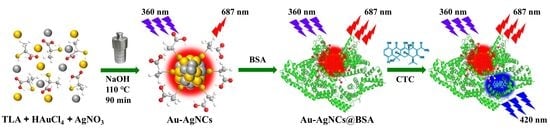
1. Introduction
2. Experimental Details
2.1. Reagents and Instruments
2.2. Synthesis of Au-AgNCs
2.3. Fluorescence Sensing Procedure
2.4. Selectivity and Interference Studies
3. Results and Discussion
3.1. Preparation, Optimization and Characterization of Au-AgNCs
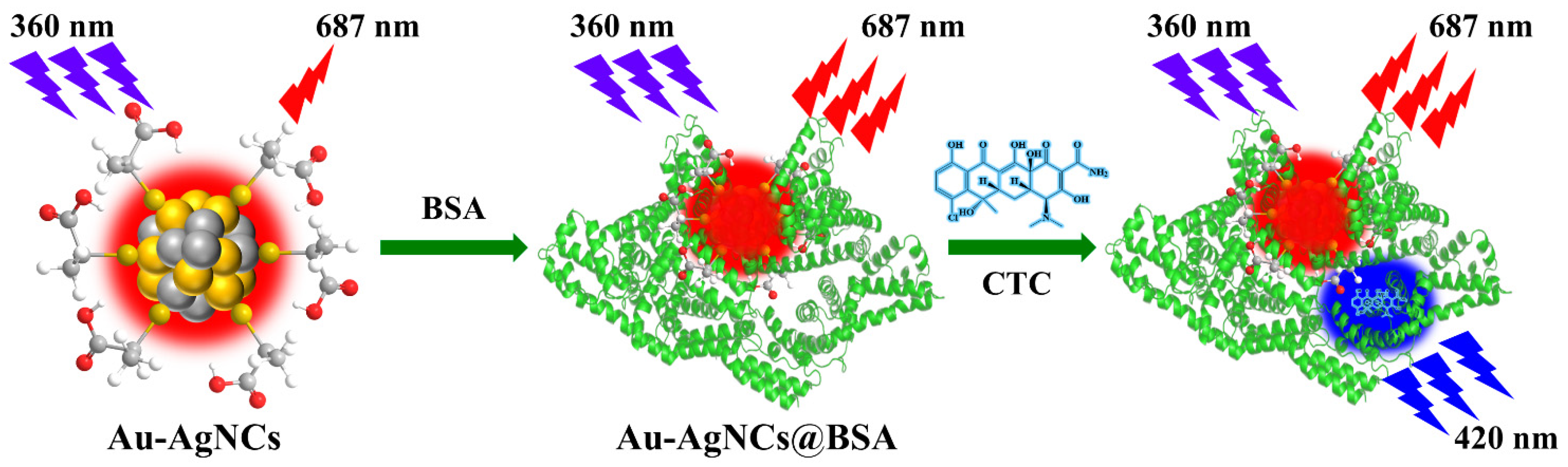
3.2. Formation and Properties of the Au-AgNCs@BSA Assembly
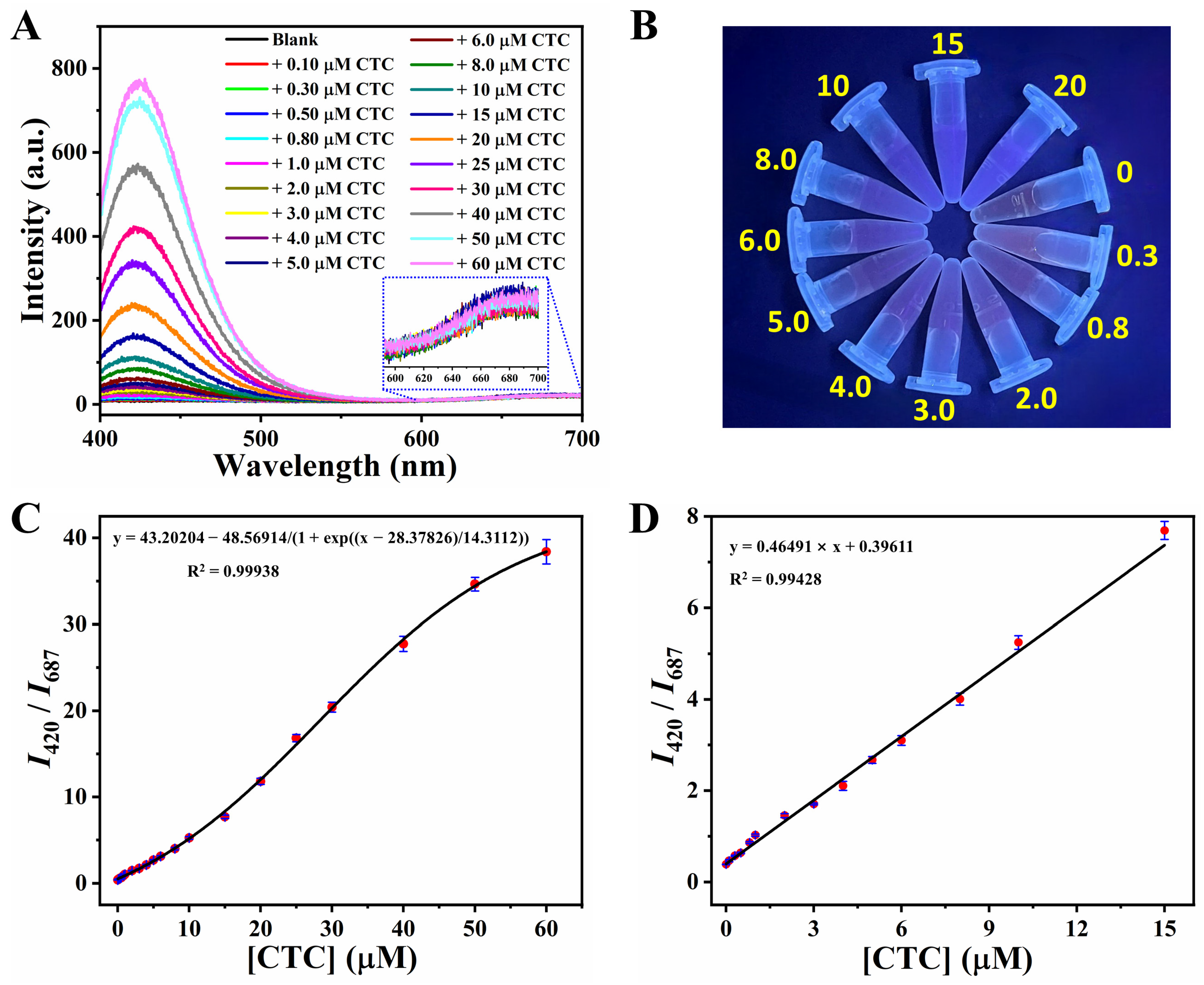
3.3. Fluorescence Detection of CTC by Using the Au-AgNCs@BSA Assembly
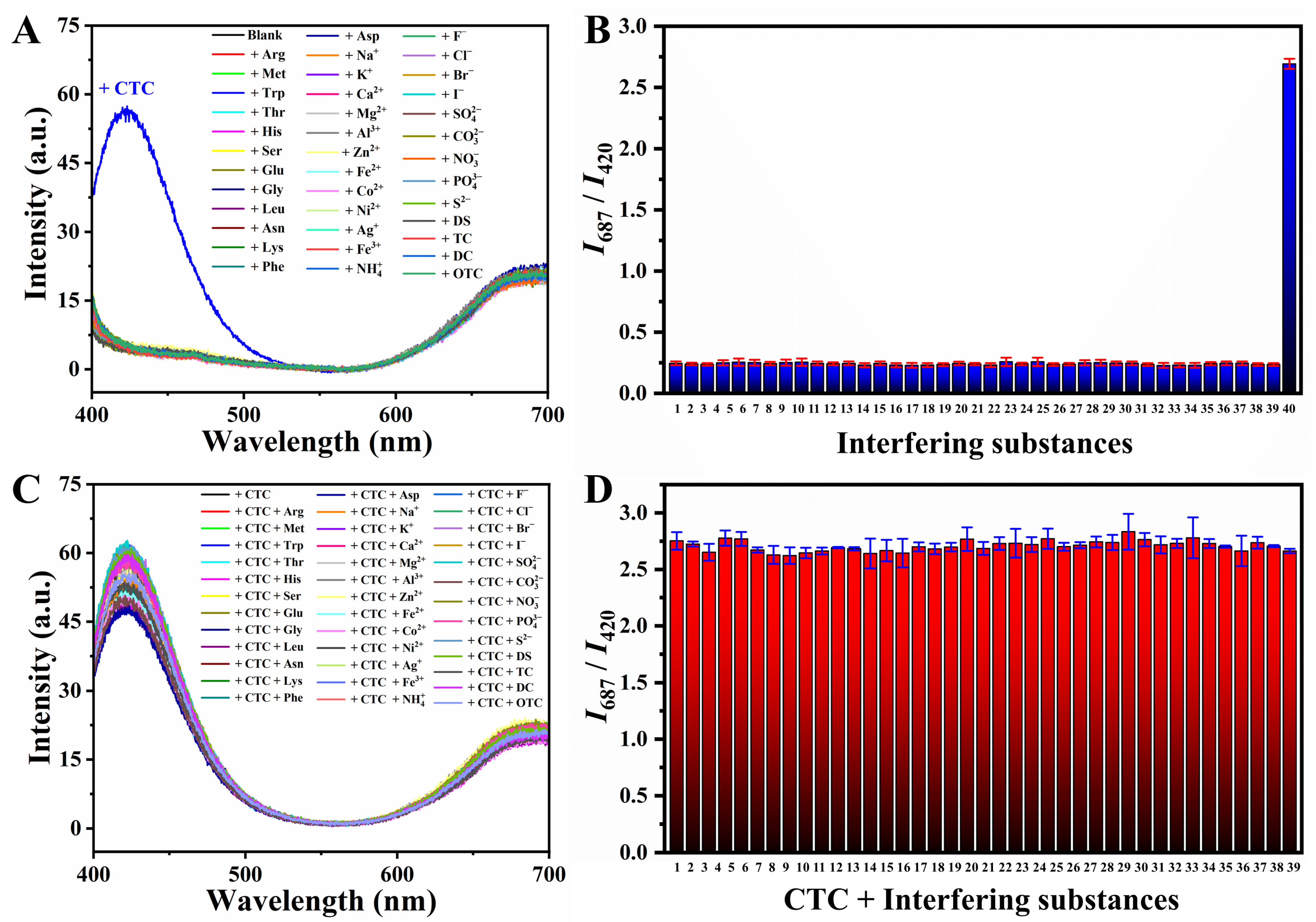
3.4. Selectivity and Anti-Interference Performance of Au-AgNCs@BSA for CTC Detection
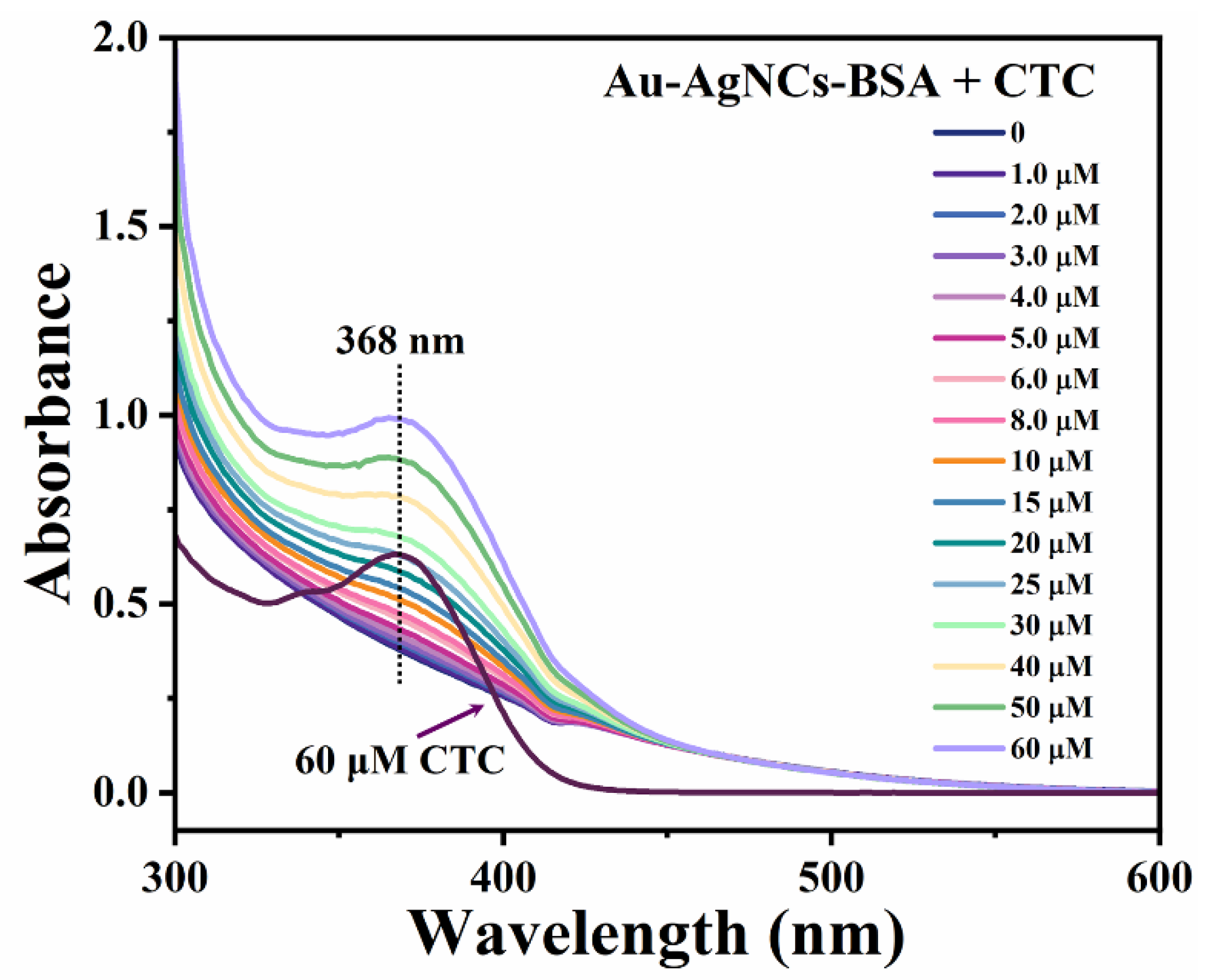
3.5. Investigation of the Sensing Mechanism
3.6. Practical Application: Detection of CTC in Real Water Samples
4. Conclusions
Supplementary Materials
Author Contributions
Funding
Institutional Review Board Statement
Informed Consent Statement
Data Availability Statement
Conflicts of Interest
References
- Rong, M.; Huang, Y.; Lin, C.; Lai, L.; Wu, Y.; Niu, L. Recent advances in optical sensing for tetracycline antibiotics. Trends Anal. Chem. 2024, 178, 117839. [Google Scholar] [CrossRef]
- Liu, Q.; Ning, D.; Li, W.-J.; Du, X.-M.; Wang, Q.; Li, Y.; Ruan, W.-J. Metal-organic framework-based fluorescent sensing of tetracycline-type antibiotics applicable to environmental and food analysis. Analyst 2019, 144, 1916–1922. [Google Scholar] [CrossRef] [PubMed]
- Xu, L.; Zhang, H.; Xiong, P.; Zhu, Q.; Liao, C.; Jiang, G. Occurrence, fate, and risk assessment of typical tetracycline antibiotics in the aquatic environment: A review. Sci. Total Environ. 2021, 753, 141975. [Google Scholar] [CrossRef] [PubMed]
- Lee, C.; An, J.; Lee, Y.S.; Choi, K.; Kim, J.Y. Uncertainty-based concentration estimation of chlortetracycline antibiotics in swine farms and risk probability assessment for agricultural application of manure. J. Hazard. Mater. 2021, 402, 123763. [Google Scholar] [CrossRef]
- Nguyen, F.; Starosta, A.L.; Arenz, S.; Sohmen, D.; Dönhöfer, A.; Wilson, D.N. Tetracycline antibiotics and resistance mechanisms. Biol. Chem. 2014, 395, 559–575. [Google Scholar] [CrossRef]
- Xiong, W.; Zeng, G.; Yang, Z.; Zhou, Y.; Zhang, C.; Cheng, M.; Liu, Y.; Hu, L.; Wan, J.; Zhou, C.; et al. Adsorption of tetracycline antibiotics from aqueous solutions on nanocomposite multi-walled carbon nanotube functionalized MIL-53(Fe) as new adsorbent. Sci. Total Environ. 2018, 627, 235–244. [Google Scholar] [CrossRef]
- Zhang, F.; Wang, J.; Tian, Y.; Liu, C.; Zhang, S.; Cao, L.; Zhou, Y.; Zhang, S. Effective removal of tetracycline antibiotics from water by magnetic functionalized biochar derived from rice waste. Environ. Pollut. 2023, 330, 121681. [Google Scholar] [CrossRef]
- Thornber, K.; Bashar, A.; Ahmed, M.-S.; Bell, A.; Trew, J.; Hasan, M.; Hasan, N.-A.; Alam, M.-M.; Chaput, D.-L.; Haque, M.-M.; et al. Antimicrobial Resistance in Aquaculture Environments: Unravelling the Complexity and Connectivity of the Underlying Societal Drivers. Environ. Sci. Technol. 2022, 56, 14891–14903. [Google Scholar] [CrossRef]
- Gajda, A.; Jablonski, A.; Bladek, T.; Posyniak, A. Oral Fluid as a Biological Material for Antemortem Detection of Oxytetracycline in Pigs by Liquid Chromatography-Tandem Mass Spectrometry. J. Agric. Food. Chem. 2017, 65, 494–500. [Google Scholar] [CrossRef]
- Kowalski, P. Capillary electrophoretic method for the simultaneous determination of tetracycline residues in fish samples. J. Pharm. Biomed. Anal. 2008, 47, 487–493. [Google Scholar] [CrossRef] [PubMed]
- Wang, X.; Li, J.; Jian, D.; Zhang, Y.; Shan, Y.; Wang, S.; Liu, F. Paper-based antibiotic sensor (PAS) relying on colorimetric indirect competitive enzyme-linked immunosorbent assay for quantitative tetracycline and chloramphenicol detection. Sens. Actuators B-Chem. 2021, 329, 129173. [Google Scholar] [CrossRef]
- Akbarzadeh, S.; Khajehsharifi, H.; Hajihosseini, S. Detection of Oxytetracycline Using an Electrochemical Label-Free Aptamer-Based Biosensor. Biosensors 2022, 12, 468. [Google Scholar] [CrossRef]
- Song, J.; Huang, M.; Lin, X.; Li, S.F.Y.; Jiang, N.; Liu, Y.; Guo, H.; Li, Y. Novel Fe-based metal-organic framework (MOF) modified carbon nanofiber as a highly selective and sensitive electrochemical sensor for tetracycline detection. Chem. Eng. J. 2022, 427, 130913. [Google Scholar] [CrossRef]
- Granelli, K.; Elgerud, C.; Lundström, Å.; Ohlsson, A.; Sjöberg, P. Rapid multi-residue analysis of antibiotics in muscle by liquid chromatography-tandem mass spectrometry. Anal. Chim. Acta 2009, 637, 87–91. [Google Scholar] [CrossRef]
- Chen, X.; Xu, J.; Gong, S.; Zhang, L.; Bi, N.; Gou, J.; Li, Y.; Zhao, T.; Jia, L. Portable fluorescent film and gel microspheres for sensitive multi-color detection and efficient adsorption of tetracycline. Sep. Purif. Technol. 2025, 2, 128258. [Google Scholar] [CrossRef]
- Li, C.; Zhu, L.; Yang, W.; He, X.; Zhao, S.; Zhang, X.; Tang, W.; Wang, J.; Yue, T.; Li, Z. Amino-Functionalized Al-MOF for Fluorescent Detection of Tetracyclines in Milk. J. Agric. Food Chem. 2019, 67, 1277–1283. [Google Scholar] [CrossRef]
- Dong, H.; Zheng, L.; Wang, M.; Zhao, L.; Xu, K.; Zhou, Y.; Zhang, Y.; Xu, M. Two-Photon Carbon Quantum Dots for Detection of Chlortetracycline in Foods. ACS Appl. Nano Mater. 2023, 6, 19168–19175. [Google Scholar] [CrossRef]
- Yin, S.; Tong, C. Lanthanide coordination polymer nanoparticles as a ratiometric fluorescence sensor for real-time and visual detection of tetracycline by a smartphone and test paper based on the analyte-triggered antenna effect and inner filter effect. ACS Appl. Nano Mater. 2023, 6, 19168–19175. [Google Scholar] [CrossRef] [PubMed]
- Liang, N.; Hu, X.; Li, W.; Wang, Y.; Guo, Z.; Huang, X.; Li, Z.; Zhang, X.; Zhang, J.; Xiao, J.; et al. A dual-signal fluorescent sensor based on MoS2 and CdTe quantum dots for tetracycline detection in milk. Food Chem. 2022, 378, 132076. [Google Scholar] [CrossRef]
- Liang, Q.-Y.; Wang, C.; Li, H.-W.; Qi, D.-Y.; Wu, Y. Controlled-fabrication and assembly-induced emission enhancement (AIEE) of near-infrared emitted gold nanoclusters capped by thiolactic acid. J. Mol. Liq. 2023, 377, 121516. [Google Scholar] [CrossRef]
- Ding, L.; Zhao, Y.; Li, H.; Zhang, Q.; Yang, W.; Fu, B.; Pan, Q. A highly selective ratiometric fluorescent probe for doxycycline based on the sensitization effect of bovine serum albumin. J. Hazard. Mater. 2021, 416, 125759. [Google Scholar] [CrossRef]
- Lu, Z.; Chen, S.; Chen, M.; Ma, H.; Wang, T.; Liu, T.; Yin, J.; Sun, M.; Wu, C.; Su, G.; et al. Trichromatic ratiometric fluorescent sensor based on machine learning and smartphone for visual and portable monitoring of tetracycline antibiotics. Chem. Eng. J. 2023, 454, 140492. [Google Scholar] [CrossRef]
- Jiang, M.; Wang, M.; Lai, W.; Ren, H.; Li, H.; Qi, Y.; Hong, C.; Chen, S. Study on the Enhancement of Electrochemical and Electrochemiluminescence Behaviors of Au-Ag Nanoclusters Based on Synergistic and Ligand Effects. Anal. Chem. 2025, 97, 22380–22389. [Google Scholar] [CrossRef]
- Huang, Q.; Zhu, X.; Sun, X.; Wang, X.; Li, Y.; Ma, H.; Ju, H.; Wei, Q. Synergetic-effect-enhanced electrochemiluminescence of zein-protected Au-Ag bimetallic nanoclusters for CA15-3 detection. Anal. Chim. Acta 2023, 1278, 341760. [Google Scholar] [CrossRef]
- Londoño-Larrea, P.; Vanegas, J.P.; Cuaran-Acosta, D.; Zaballos-García, E.; Pérez-Prieto, J. Water-Soluble Naked Gold Nanoclusters Are Not Luminescent. Chem. Eur. J. 2017, 252, 119519. [Google Scholar] [CrossRef]
- Chen, W.; Chen, Y.; Zhu, X.; Xu, M.; Han, Z.; Wang, L.; Weng, L. NaBH4-Mediated Co-Reduction Synthesis of Glutathione Stabilized Gold/Silver Nanoclusters for Detection of Magnesium Ions. Chemosensors 2023, 11, 435. [Google Scholar] [CrossRef]
- Hikosou, D.; Saita, S.; Miyata, S.; Miyaji, H.; Furuike, T.; Tamura, H.; Kawasaki, H. Aggregation/Self-Assembly-Induced Approach for Efficient AuAg Bimetallic Nanocluster-Based Photosensitizers. J. Phys. Chem. C 2018, 122, 12494−12501. [Google Scholar] [CrossRef]
- Zhou, T.; Su, Z.; Tu, Y.; Yan, J. Determination of dopamine based on its enhancement of gold-silver nanocluster fluorescence. Anal. Chim. Acta 2023, 1278, 341760. [Google Scholar] [CrossRef] [PubMed]
- Yu, X.; Zhang, C.-X.; Zhang, L.; Xue, Y.-R.; Li, H.-W.; Wu, Y. The construction of a FRET assembly by using gold nanoclusters and carbon dots and their application as a ratiometric probe for cysteine detection. Sens. Actuators B-Chem. 2018, 263, 327–335. [Google Scholar] [CrossRef]
- Gao, Y.-C.; Wang, C.; Zhang, C.-X.; Li, H.-W.; Wu, Y. Controlled preparation and application of glutathione capped gold and platinum alloy nanoclusters with high peroxidase-like activity. J. Mater. Sci. Technol. 2022, 109, 140–146. [Google Scholar] [CrossRef]
- Fu, L.; Gao, X.; Dong, S.; Hsu, H.-Y.; Zou, G. Surface-Defect-Induced and Synergetic-Effect-Enhanced NIR-II Electrochemiluminescence of Au-Ag Bimetallic Nanoclusters and Its Spectral Sensing. Anal. Chem. 2021, 93, 4909–4915. [Google Scholar] [CrossRef] [PubMed]
- Liu, J.; Yuan, X.-X.; Li, H.-W.; Wu, Y. Hydrothermal synthesis of novel photosensitive gold and silver bimetallic nanoclusters protected by adenosine monophosphate (AMP). J. Mater. Chem. C 2017, 5, 9979–9985. [Google Scholar] [CrossRef]
- Sun, J.; Wu, H.; Jin, Y. Synthesis of thiolated Ag/Au bimetallic nanoclusters exhibiting an anti-galvanic reduction mechanism and composition-dependent fluorescence. Nanoscale 2014, 6, 5449–5457. [Google Scholar] [CrossRef]
- Jiang, J.; Conroy, C.-V.; Kyetny, M.-M.; Lake, G.-J.; Padelford, J.-W.; Ahuja, T.; Wang, G. Oxidation at the Core-Ligand Interface of Au Lipoic Acid Nanoclusters That Enhances the Near-IR Luminescence. J. Phys. Chem. C 2014, 118, 20680–20687. [Google Scholar] [CrossRef]
- Wang, Y.; Liu, L.; Gong, L.; Chen, Y.; Liu, J. Reactivity Toward Ag+: A General Strategy to Generate a New Emissive Center from NIR-Emitting Gold Nanoparticles. J. Phys. Chem. Lett. 2018, 9, 557–562. [Google Scholar] [CrossRef]
- Ran, N.-N.; Luo, Q.; Li, H.-W.; Wu, Y. A novel fluorescence nanoprobe for unique determination of chlortetracycline based on zinc-doped carbon dots. Colloid Surf. A 2025, 726, 137935. [Google Scholar] [CrossRef]
- Bi, S.; Song, D.; Tian, Y.; Zhou, X.; Liu, Z.; Zhang, H. Molecular spectroscopic study on the interaction of tetracyclines with serum albumins. Spectrochim. Acta A 2005, 61, 629–636. [Google Scholar] [CrossRef]
- Li, Y.; Cai, Y.; Zhang, M.; Xu, Z.; Luo, Y.; Cai, Y.; Xun, Z.; Lv, T.; Wang, Y.; Qin, T.; et al. Rational design of a ratiometric indicator-displacement assay for the monitoring of chlortetracycline and intracellular imaging. Talanta 2025, 284, 127251. [Google Scholar] [CrossRef]
- Barimah, A.-O.; Chao, M.; Tai, S.; Sun, C.; Agyekum, A.-A.; Mao, M.; Peng, C.; Wang, Z.; Adoley Addotey, T.-N. Aggregation induced emission enhancement of nickel nanoclusters for highly sensitive fluorescent “turn on” sensing of chlortetracycline in food. Microchem. J. 2025, 210, 112927. [Google Scholar] [CrossRef]
- Ran, J.-M.; Yang, L.; Liu, C.-T.; Liu, Q.-H.; Liu, Y.-L.; Li, S.-J.; Fu, Y.; Ye, F. A novel fluorescence platform for specific detection of tetracycline antibiotics based on [MQDA-Eu3+] system. Sci. Total Environ. 2024, 931, 172866. [Google Scholar] [CrossRef] [PubMed]
- Cai, X.; Ye, J.; Duan, D.; Li, K. Ratiometric fluorescence determination of chlortetracycline based on the aggregation of copper nanoclusters triggered by aluminum ion. Microchim. Acta. 2021, 189, 28. [Google Scholar] [CrossRef]
- Zhang, Q.; Wu, Y.; Xu, X.; Wang, X.; Kong, F.; Xiao, Q. pH-responsive intelligent hydrogels based on YCDs-mSiO2 for CTC visual detection and anti-counterfeiting. Dyes Pigm. 2026, 246, 1133322. [Google Scholar] [CrossRef]
- Fan, Y.; Shen, L.; Liu, Y.; Hu, Y.; Long, W.; Fu, H.; She, Y. A sensitized ratiometric fluorescence probe based on N/S doped carbon dots and mercaptoacetic acid capped CdTe quantum dots for the highly selective detection of multiple tetracycline antibiotics in food. Food Chem. 2023, 421, 136105. [Google Scholar] [CrossRef]
- Lee, Y.-S.; Hu, C.-C.; Chiu, T.-C. Electrochemical synthesis of fluorescent carbon dots for the selective detection of chlortetracycline. J. Environ. Chem. Eng. 2022, 10, 107413. [Google Scholar] [CrossRef]
- Ni, Y.; Liu, Q.; Kokot, S. Spectrophotometric study of the interaction between chlorotetracycline and bovine serum albumin using Eosin Y as site marker with the aid of chemometrics. Spectrochim. Acta A 2011, 78, 443–448. [Google Scholar] [CrossRef] [PubMed]
- Zhang, M.; Zhang, S.; Xu, Z.; Lv, T.; Liu, X.; Wang, L.; Liu, B. Fluorescence determination of the total amount of tetracyclines by a flavonol-based supramolecular sensor. Talanta 2024, 266, 124982. [Google Scholar] [CrossRef] [PubMed]



| Sensor | Detection Pattern | Working Range (μM) | Assay Time | LOD (nM) | Real Samples | Ref. |
|---|---|---|---|---|---|---|
| BSA-NiNCs | Turn on | 0.01–75 | 30 min | 4.2 | honey and milk | [39] |
| [MQDA-Eu3+] | Turn on | 5.0–95.0 | 30 s | 0.93 | piped water, milk, and river water | [40] |
| CuNC-Al3+ | Ratiometric | 0.1–3.0 | 15 min | 25.3 | environmental water, milk | [41] |
| YCDs-mSiO2@PVA | Turn on | 5.0–300 | 3 min | 24 | tap water and lake water | [42] |
| CdTe QDs@ZIF-8 | Ratiometric | 1.0–30 | 10 min | 37 | milk, honey and urine | [43] |
| CuNCs@TA | Turn on | 0.5–200 | 120 min | 84 | lake water, and urine | [44] |
| Au-AgNCs@BSA | Ratiometric | 0.10–15 | 120 min | 20 | tap water and lake water | This work |
| Sample | Spiked (μM) | Found (μM) | RSD (%) | Recovery (%) |
|---|---|---|---|---|
| Tap water | 0 | N.d. | 0 | 0 |
| 5.0 | 4.95 ± 0.102 | 3.3 | 99.0 | |
| 10 | 10.14 ± 0.203 | 2.7 | 101.4 | |
| 15 | 15.38 ± 0.262 | 3.6 | 102.5 | |
| Lake water | 0 | N.d. | 0 | 0 |
| 5.0 | 5.12 ± 0.114 | 3.8 | 102.4 | |
| 10 | 9.86 ± 0.223 | 3.2 | 98.6 | |
| 15 | 15.08 ± 0.308 | 4.3 | 100.5 |
Disclaimer/Publisher’s Note: The statements, opinions and data contained in all publications are solely those of the individual author(s) and contributor(s) and not of MDPI and/or the editor(s). MDPI and/or the editor(s) disclaim responsibility for any injury to people or property resulting from any ideas, methods, instructions or products referred to in the content. |
© 2026 by the authors. Licensee MDPI, Basel, Switzerland. This article is an open access article distributed under the terms and conditions of the Creative Commons Attribution (CC BY) license.
Share and Cite
Dai, Y.-M.; Ruan, W.; Li, H.-W. A Ratiometric Fluorescence Sensor Based on BSA Assembled Gold–Silver Bimetallic Nanoclusters for Highly Selective Detection of Chlortetracycline in Water. Chemosensors 2026, 14, 56. https://doi.org/10.3390/chemosensors14030056
Dai Y-M, Ruan W, Li H-W. A Ratiometric Fluorescence Sensor Based on BSA Assembled Gold–Silver Bimetallic Nanoclusters for Highly Selective Detection of Chlortetracycline in Water. Chemosensors. 2026; 14(3):56. https://doi.org/10.3390/chemosensors14030056
Chicago/Turabian StyleDai, Yu-Meng, Weidong Ruan, and Hong-Wei Li. 2026. "A Ratiometric Fluorescence Sensor Based on BSA Assembled Gold–Silver Bimetallic Nanoclusters for Highly Selective Detection of Chlortetracycline in Water" Chemosensors 14, no. 3: 56. https://doi.org/10.3390/chemosensors14030056
APA StyleDai, Y.-M., Ruan, W., & Li, H.-W. (2026). A Ratiometric Fluorescence Sensor Based on BSA Assembled Gold–Silver Bimetallic Nanoclusters for Highly Selective Detection of Chlortetracycline in Water. Chemosensors, 14(3), 56. https://doi.org/10.3390/chemosensors14030056