Humidity Sensing in Extreme Environments: Mechanisms, Materials, Challenges, and Future Directions



Abstract
1. Introduction
2. Fundamentals and Performance of Chemical Sensing Materials
2.1. Carbon-Based Materials: A High-Performance System Featuring Rapid Response and Tunable Microstructures
2.1.1. CNTs
2.1.2. GO
2.1.3. Carbon Black
2.1.4. CQDs
2.1.5. Biochar
2.2. Metal Oxides: A Core Material System for Extreme Environments
2.2.1. ZnO
2.2.2. SnO2
2.2.3. Co3O4
2.2.4. TiO2
2.2.5. Insulating Metal Oxides
2.3. Conducting Polymers: Advantages of Structural Order and Conduction Coupling
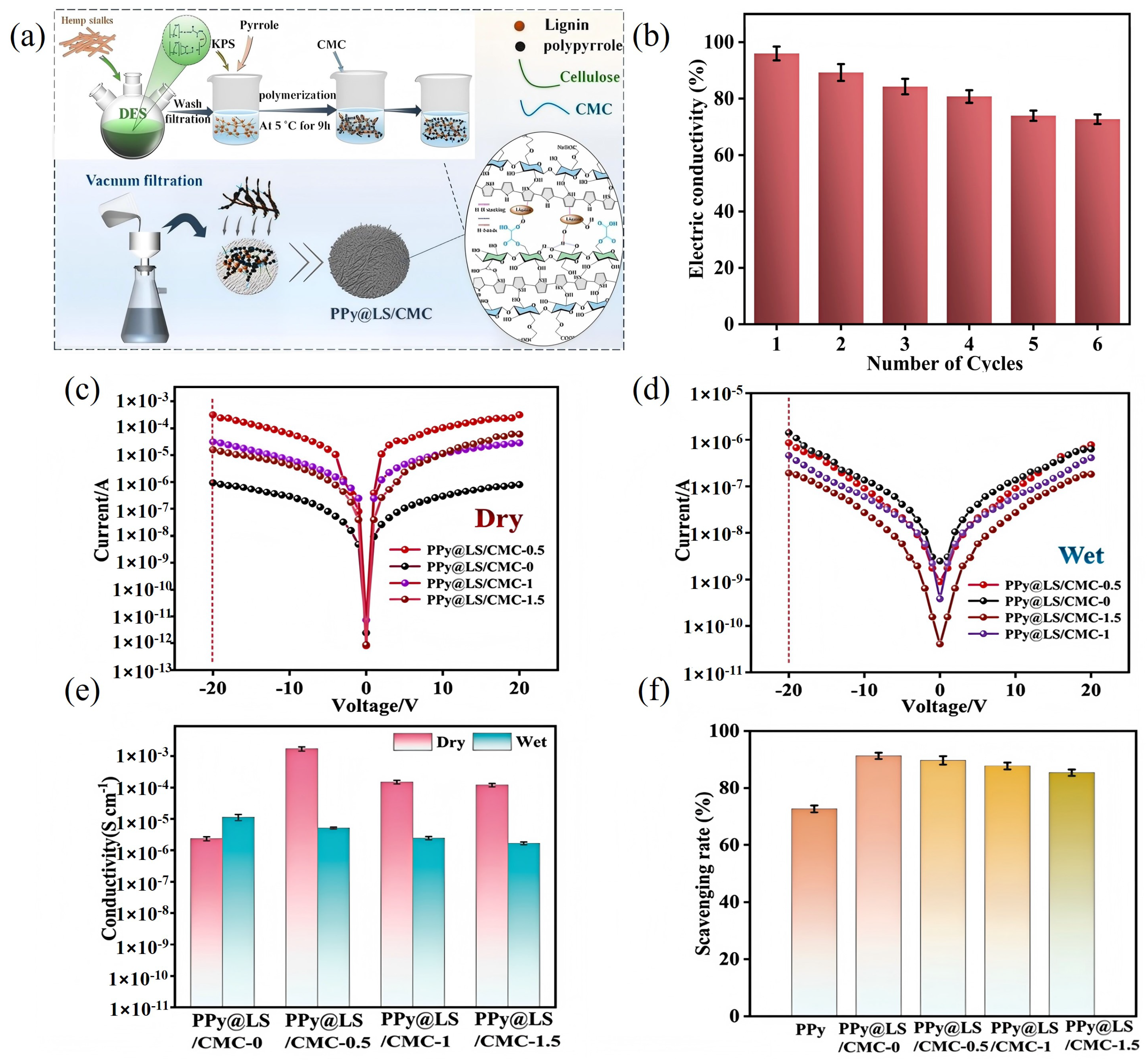
2.3.1. PPy
2.3.2. PANI
2.3.3. PEDOT:PSS
2.4. Insulating Polymers: Interfacial Modification and Moisture Regulation Mechanisms
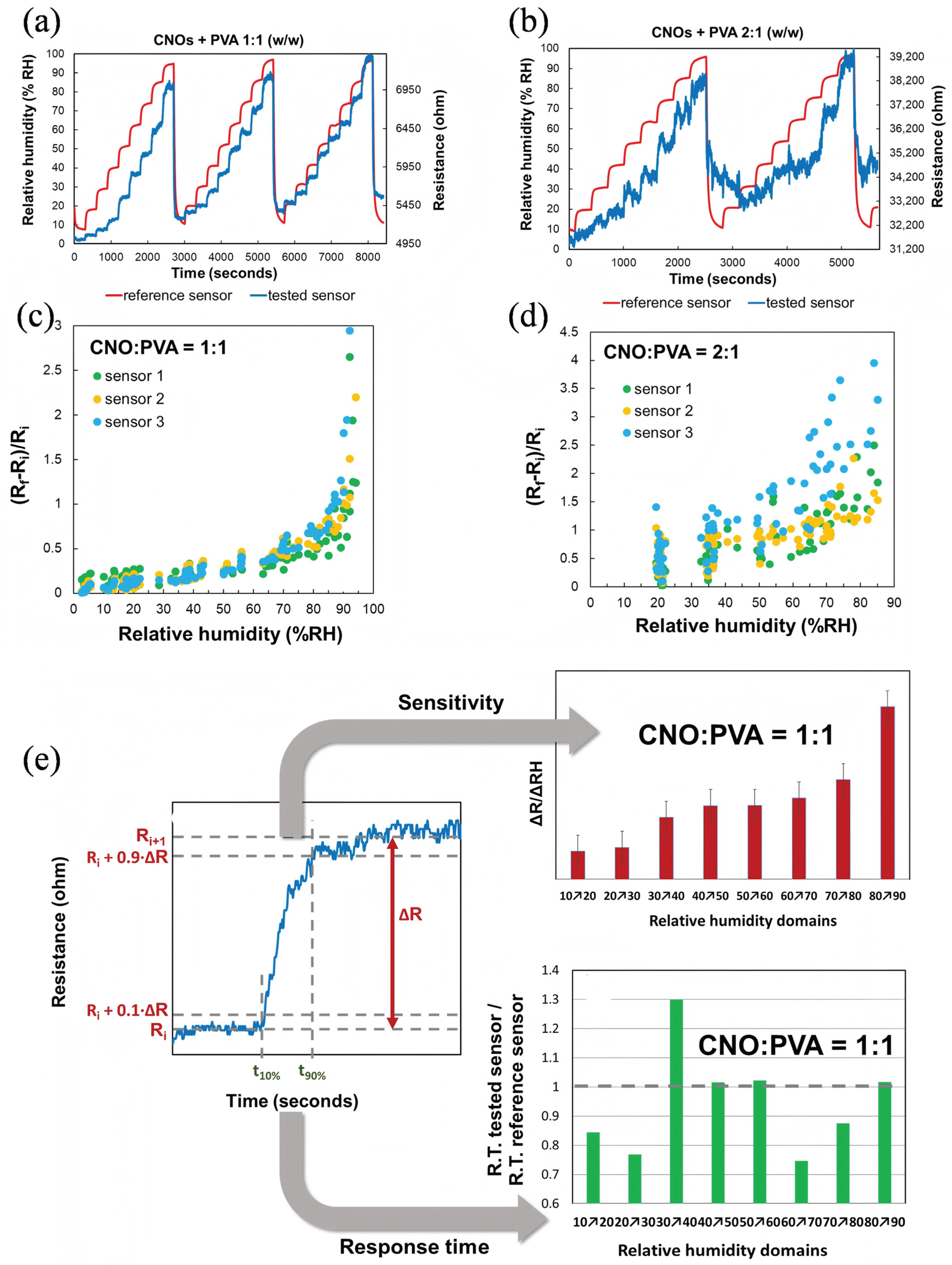
2.4.1. PVA
2.4.2. PI

2.4.3. Cellulose
2.4.4. PMMA
2.4.5. PA
2.5. 2D Materials: Highly Responsive and Tunable Platforms for Extreme-Condition Humidity Sensing
2.5.1. TMDs Materials
2.5.2. NiPS3
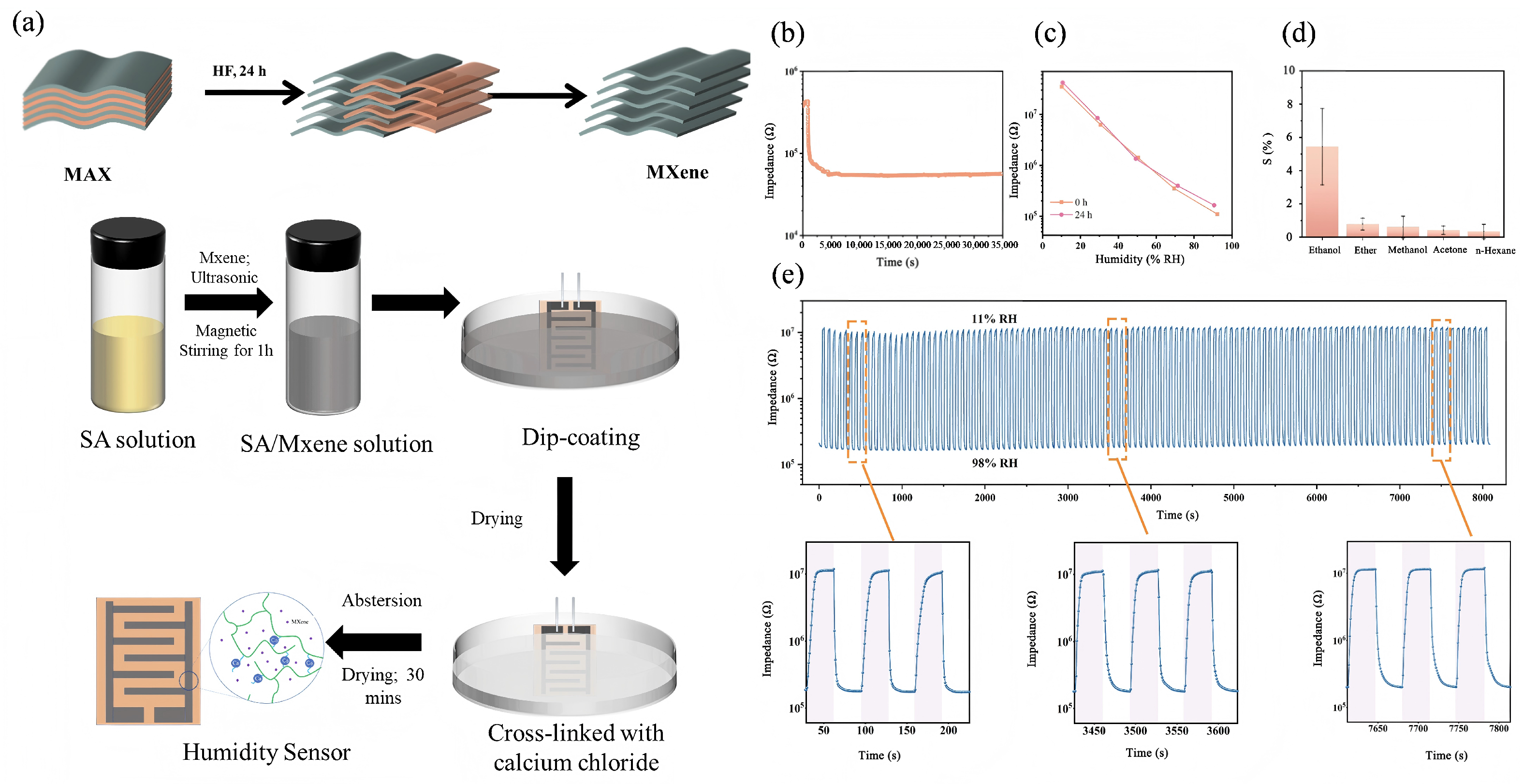
2.5.3. MXene Materials
2.6. Composite Materials: Multimodal Mechanisms for Humidity Detection

| Material | Nanostructure | Synthesis Method | Method of Measuring | Humidity Range/%RH | Response/Recovery a | Sensitivity | Ref. |
|---|---|---|---|---|---|---|---|
| Cu-doped LaFeO3 | Nanoparticles | Hydrothermal method | Resistive | 11–90 | 5.4/3.8 s | 11705 () | [170] |
| Fe/Mg/Cu-ZnO | Nanoparticles | Wet chemical precipitation | Resistive | 55–95 | 4/9 s | 98.58% | [171] |
| GOQDs/WS2 | Nanosheets | Drop-casting | Resistive | 11–98 | 1.55/41.1 s | – | [141] |
| LiCl/Cellulose (LCNF) | Nanofibers | Electrospinning | Resistive | 5–98 | 99/110 s | 4191% | [172] |
| AgNWs/PA66 | Nanofibers | Electrospinning/Extraction–Filtration | Resistive | 5–75 | – | – | [173] |
| Bi2O2–NiO–rGO | Nanoparticles | Co-precipitation | Resistive | 11–97 | – | 1.76 M/RH | [174] |
| CNFs/MWCNTs | Nanofibers/Nanotubes | Adapted ice-templating method | Resistive | 0–75 | 18/47 s | 0.953%/RH | [163] |
| SnO2/Ti3C2Tx/TiO2 | Nanosheets | Hydrothermal method | Resistive | 11–85 | 8 s | 34271 | [65] |
| CNF–AgNP | Nanofibers | In-situ wet-chemical reduction/Inkjet printing | Resistive | 10–90 | 4/43 s | 0.0654 () | [175] |
| HKUST-1 | Nanosheets | Two-step room-temperature solution method | Resistive | 11–95 | 2/15 s | [176] | |
| BPQDs/HKUST-1 | Nanosheets | Thermal exfoliation | Resistive | 11–95 | 3/7 s | [176] | |
| ZnO MS/GR | Nanosheets/nanoparticles | Hydrothermal/Dispersion | Resistive | 20–95 | 6/18 s | [177] | |
| MoS2/GO | Nanosheets | Liquid-phase ultrasonic exfoliation/Drop-casting | SAW | 20–95 | 6.6/3.5 s | 331.6 ppm/% | [178] |
| TiO2/CNC | Nanoparticles/nanofibers | Ultrasonication/Vacuum-assisted filtration | Resistive | 11–95 | 22/13 s | 450.9 | [179] |
| VO2(B)@ZnO | Nanorods | Solution method/Hydrothermal method | Resistive | 11–95 | 7/35 s | [180] | |
| 2% Fe-doped ZnO/rGO | Nanosheets | Hydrothermal method/Doping | Resistive | 11–97 | 27/24 s | 2.2 k @ 100 Hz | [181] |
| MoS2/GOQD | Nanosheets | Ultrasonic dispersion/Simple mixing/Drop-casting | Capacitive | 11–97 | 20/12 s | 369 pF/% | [182] |
| GO/MXene | Nanosheets | Ultrasonic exfoliation/Dispersion/Spin-coating | Resistive | 6–97 | 0.8/0.9 s | / | [183] |
| NiFe3O4 | Nanoparticles | Wet-chemical co-precipitation/Heat treatment | Capacitive | 35–90 | 19/10 s | @ 100 Hz | [184] |
| rGO/NiFe2O4 | Nanosheets/nanoparticles | Chemical reduction/Physical mixing | Capacitive | 35–90 | 8/4 s | 360% @ 100 Hz | [184] |
| CS/GO/SnO2 | Nanosheets/nanoparticles | Simple solution mixing/Drop-casting | Resistive | 15–95 | 8/8 s | 402.5 k/% | [185] |
| Co3O4/NiO/graphene | Nanosheets/nanoparticles | CVD/Hydrothermal method | Resistive | 11–97 | 90/36 s | – | [186] |
| BC/GO (20BG-5-60) | Nanosheets/nanofibers | Dry-film formation/Green reduction | Resistive | 5–85 | 13/47 s | Max. resistance change | [119] |
| Ag-doped ZnGa2O4/ZnO (ZG-Ag-2) | Nanofibers/nanoparticles | Electrospinning/Calcination | Resistive | 11–95 | 2.2/1.5 s | 7.36 M/% | [187] |
| TiO2/GO | Nanosheets/nanoparticles | Dispersion preparation/Device fabrication | Resistive | 10–97 | 0.61/0.87 s | /% | [188] |
| BC/MXene/GO | Nanosheets/nanofibers | Dispersion-based preparation | Resistive | 11–98 | 24.2/14.6 s | 3.505%/% | [120] |
| Nanochitin/MXene (NCM-C) | Nanosheets/nanoparticles | Dispersion-based preparation/Drop-casting | QCM | 11.3–97.3 | 4.4/4.1 s | 20.54 Hz/% | [161] |
| PEI/AgNO3–MXene (PMX6-A7) | Nanosheets/nanoparticles | Dispersion-based preparation/Screen printing | Capacitive | 11–97 | 6.9/11.9 s | 819.90% | [189] |
| PDA/MXene (PDMX2) | Nanosheets | MILD etching/Dispersion/Drop-casting | Capacitive | 11–97 | 14.8/1.8 s | 5261.30% | [190] |
| Carrageenan-modified MXene (CAMX-2) | Nanosheets | MILD etching/Melt-mixing/Screen printing | Capacitive | 11–97 | 5.8/4.6 s | 2073.50% | [157] |
| PDDA-modified MXene nanoribbons (KPMX7) | Nanoribbons | LiF/HCl etching/KOH treatment/Screen printing | Capacitive | 11–97 | 8.794/2.656 s | 48813% | [156] |
| MXene/GO | Nanosheets | LiF/HCl etching/Modified Hummers method/Drop-casting | Capacitive | 11–97 | 17/7 s | [191] |
3. Discussion
4. Future Prospect
- Precise regulation of interfacial water behavior will be a decisive breakthrough for advancing the entire field. The fundamental causes of hysteresis, high-humidity saturation, and irreversible adsorption can almost always be traced to the configurational evolution and asymmetric potential-energy landscape of interfacial water. Therefore, future materials must enable active control over interfacial adsorption energetics and hydrogen-bond dynamics. For example, by constructing reversible hydrogen-bond networks, tuning the polarity and spatial distribution of surface functional groups, and guiding adsorption pathways through interfacial electric-field effects. Such strategies will be essential for achieving truly low-hysteresis, fully reversible, and rapid humidity responses.
- Multiscale structural engineering will become a central strategy for achieving rapid and stable water migration under extreme environmental conditions. In natural systems, water transport is governed by finely orchestrated hierarchical architectures, exemplified by the dendritic fractal networks of leaf veins, the capillary-gradient structures of insect limbs, and the microtextured surfaces found on desert beetles. These biomimetic structural principles offer a broad design space for creating hierarchical channels, capillary pathways, and dual-domain interfaces that facilitate efficient water transport. By integrating such features, materials can effectively suppress water retention in high-humidity or near-saturated environments and achieve controllable adsorption–desorption kinetics.
- The environmental robustness of materials must shift from being an auxiliary consideration to a primary design criterion from the earliest stages of development. Issues such as MXene oxidation, interlayer degradation in TMDCs, and hydration-induced fatigue in polymers collectively indicate that humidity sensing under extreme environments concerns not only the optimization of device performance but also the fundamental survivability of the underlying materials. Future material systems will therefore depend more heavily on chemically and structurally robust strategies, such as engineering hydrophobic–hydrophilic gradient interfaces to regulate water transport into sensitive regions, incorporating ultrathin antioxidant coatings to protect two-dimensional architectures, and designing hybrid rigid–flexible mechanical frameworks to delay structural fatigue. These approaches will be essential for ensuring long-term stability and reliability under harsh environmental conditions.
- Selectivity will emerge as a defining challenge for next-generation humidity sensing, particularly in complex and extreme environments where humidity signals coexist with chemically and physically similar interferences. In practical scenarios, humidity variations are often accompanied by volatile organic compounds, acidic or alkaline vapors, background gases, and radiation- or temperature-induced parasitic effects, making it increasingly difficult for single sensing elements to unambiguously distinguish humidity-driven responses from cross-sensitivity artifacts. Material-level selectivity engineering alone is therefore insufficient for addressing this challenge in real-world applications.Multisensor array–based strategies, inspired by electronic nose concepts, are expected to play a central role in overcoming selectivity limitations in humidity detection. By integrating multiple sensing units with differentiated materials, surface chemistries, microstructures, or transduction mechanisms, sensor arrays generate characteristic response patterns rather than relying on single-parameter outputs. When coupled with multivariate analysis, pattern recognition, or machine-learning-assisted decoding, such arrays enable reliable discrimination of humidity from interfering analytes and environmental perturbations. In extreme environments, this paradigm offers a robust route toward selective, fault-tolerant, and self-consistent humidity identification beyond the capability of individual sensors.
- Humidity detection mechanisms are expected to evolve from single-channel material responses to multichannel, multimodal, and multiscale integrated sensing systems. In extreme environments, humidity often coexists with variations in temperature, pressure, corrosive species, and electromagnetic radiation, making reliable identification impossible when relying on a single type of signal. Consequently, multimodal sensing will become a key development direction. Its core lies not only in acquiring multiple signals but also in leveraging machine learning to decouple complex response modes, compensate for hysteresis, correct signal drift, and predict interacting environmental factors. Through such approaches, humidity sensing systems will transition from passive response to intelligent interpretation.
- Intelligent and system-level design will become key drivers of future humidity detection in extreme environments. With the rapid advancement of edge computing, AI-assisted sensing, and self-calibration algorithms, humidity sensors are transitioning from simple material-based devices to fully integrated systems that combine materials, algorithms, and hardware architectures. Future sensors will aim to minimize error sources at the material level while maximizing usable signal extraction at the system level, thereby overcoming the intrinsic limitations of individual materials and enabling long-term operation with high precision and high reliability.Despite the growing emphasis on system-level integration, the rational design of humidity sensing systems for extreme environments remains fundamentally challenging. One major bottleneck lies in the absence of unified design frameworks capable of coherently linking material properties, interfacial phenomena, device physics, signal transduction, and long-term reliability. In practice, system performance is often governed by highly nonlinear and coupled interactions among humidity, temperature, pressure, radiation, and material aging, rendering the simultaneous optimization of sensitivity, selectivity, stability, response speed, and power consumption intrinsically difficult. Consequently, many existing humidity sensing systems still rely on empirical optimization and application-specific calibration, which limits their scalability, transferability, and predictive reliability across diverse extreme conditions.Artificial-intelligence-driven methodologies offer a promising pathway to overcome these limitations by extending beyond data interpretation toward material and structural design. Data-driven materials discovery, inverse design strategies, and physics-informed machine learning models enable the identification of optimal compositions, surface chemistries, and microstructural features that maximize humidity responsiveness while suppressing hysteresis, drift, and degradation. At the architectural level, AI-assisted structural design can guide the development of hierarchical porous networks, interfacial layouts, and sensor-array configurations by learning complex structure–property–performance relationships from large experimental and computational datasets. Through closed-loop integration of modeling, experimentation, and machine learning, future humidity sensors are expected to transition from heuristic, trial-and-error development toward predictive, adaptive, and system-aware design paradigms.
Author Contributions
Funding
Institutional Review Board Statement
Informed Consent Statement
Data Availability Statement
Acknowledgments
Conflicts of Interest
References
- Abdel-Karim, R. Advanced Approaches in Micro-and Nano-sensors for Harsh Environmental Applications: A Review. In Modern Nanotechnology: Volume 1: Environmental Sustainability and Remediation; Springer: Cham, Switzerland, 2023; pp. 585–612. [Google Scholar]
- Liu, Q.; Wang, Y.; Zhao, F.; Zheng, C.; Xie, J. A Review of the Research Progress of Sensor Monitoring Technology in Harsh Engineering Environments. Sensors 2025, 25, 6308. [Google Scholar] [CrossRef]
- Zhang, Q.; Liu, Y.; Li, H.; Wang, J.; Wang, Y.; Cheng, F.; Han, H.; Zhang, P. A review of SiC sensor applications in high-temperature and radiation extreme environments. Sensors 2024, 24, 7731. [Google Scholar] [CrossRef] [PubMed]
- Ma, Z.; Fei, T.; Zhang, T. An overview: Sensors for low humidity detection. Sens. Actuators B Chem. 2023, 376, 133039. [Google Scholar] [CrossRef]
- Kou, H.; Tan, Q.; Wang, Y.; Zhang, G.; Su, S.; Xiong, J. A wireless slot-antenna integrated temperature-pressure-humidity sensor loaded with CSRR for harsh-environment applications. Sens. Actuators B Chem. 2020, 311, 127907. [Google Scholar] [CrossRef]
- Gu, X.; Cao, L.; Miao, S.; Tao, X.; Zhao, Y.; Huang, S. A comprehensive review on preparation and humidity sensing applications of metal-halide perovskites. Mater. Sci. Eng. B 2025, 311, 117834. [Google Scholar] [CrossRef]
- Haque, M.F.; Park, S.; Yang, D. Gas Sensors in Harsh Environments: Challenges and Advances in High Temperature, High Humidity, Radiative and Corrosive Conditions. J. Sci. Adv. Mater. Devices 2025, 10, 101049. [Google Scholar] [CrossRef]
- Sajid, M.; Khattak, Z.; Rahman, K.; Hassan, G.; Choi, K. Progress and future of relative humidity sensors: A review from materials perspective. Bull. Mater. Sci. 2022, 45, 238. [Google Scholar] [CrossRef]
- Kok, S.P.; Go, Y.I.; Wong, M. Effect of Hygroscopic and Electronic Materials, Challenges, and Sensing Requirements in Humidity-Controlled Industry. J. Electron. Mater. 2025, 54, 6960–6981. [Google Scholar] [CrossRef]
- Qian, J.; Tan, R.; Feng, M.; Shen, W.; Lv, D.; Song, W. Humidity sensing using polymers: A critical review of current technologies and emerging trends. Chemosensors 2024, 12, 230. [Google Scholar] [CrossRef]
- Qiu, H.; Zhu, M.; Mo, S.; Gao, Y.; Yao, Y.; Dong, Y.; Tian, J. Low-temperature-crosstalk humidity fiber sensor based on a thermal expansion-resistant Fabry-Perot interferometer. Measurement 2025, 242, 116302. [Google Scholar] [CrossRef]
- Jahanshahi, H.; Zhu, Z.H. A comprehensive review of tactile sensing technologies in space robotics. Chin. J. Aeronaut. 2025, 38, 103423. [Google Scholar] [CrossRef]
- Kapić, A.; Tsirou, A.; Verdini, P.G.; Carrara, S. Analysis of Proton Radiation-Induced Effects on Polymer-Based Relative Humidity Sensor. Preprints 2023. [Google Scholar] [CrossRef]
- Luo, W.; Ma, J.; Li, M.; Xu, H.; Wan, C.; Li, Z. Spatial and Temporal Characterization of Near Space Temperature and Humidity and Their Driving Influences. Remote Sens. 2024, 16, 4307. [Google Scholar] [CrossRef]
- Shaukat, R.A.; Tamim, A.M.; Hwang, G.T.; Jeong, C.K. Humidity Sensors Using 2D and 3D Nanomaterials: From Materials Selection to Technological Aspects. Trans. Electr. Electron. Mater. 2024, 25, 123–140. [Google Scholar] [CrossRef]
- Leelasree, T.; Sidhartha, P.; Tathacharya, M.; Chappanda, K.N.; Aggarwal, H. A low-cost, swift response, highly sensitive MOF-based dual sensing device enables detection of ultralow humidity levels and solvent polarity changes. J. Mater. Chem. C 2024, 12, 7295–7305. [Google Scholar] [CrossRef]
- Farahani, H.; Wagiran, R.; Hamidon, M.N. Humidity sensors principle, mechanism, and fabrication technologies: A comprehensive review. Sensors 2014, 14, 7881–7939. [Google Scholar] [CrossRef]
- Chen, Z.; Lu, C. Humidity sensors: A review of materials and mechanisms. Sens. Lett. 2005, 3, 274–295. [Google Scholar] [CrossRef]
- Zhang, Y.; Liu, Y.; Lin, L.; Zhou, M.; Zhang, W.; Lin, L.; Li, Z.; Piao, Y.; Paek, S.H. Advanced flexible humidity sensors: Structures, techniques, mechanisms and performances. Front. Mater. Sci. 2023, 17, 230662. [Google Scholar] [CrossRef]
- Chen, Q.; Yao, Y.; Ao, J.; Yu, X.; Wu, D.; Shou, M.; Li, R.; Yang, P. Advances in quartz crystal microbalance relative humidity sensors: A review. Measurement 2025, 243, 116415. [Google Scholar] [CrossRef]
- Tulliani, J.M.; Inserra, B.; Ziegler, D. Carbon-based materials for humidity sensing: A short review. Micromachines 2019, 10, 232. [Google Scholar] [CrossRef]
- Wang, C.; Xia, K.; Wang, H.; Liang, X.; Yin, Z.; Zhang, Y. Advanced carbon for flexible and wearable electronics. Adv. Mater. 2019, 31, 1801072. [Google Scholar] [CrossRef] [PubMed]
- Arunachalam, S.; Izquierdo, R.; Nabki, F. Low-hysteresis and fast response time humidity sensors using suspended functionalized carbon nanotubes. Sensors 2019, 19, 680. [Google Scholar] [CrossRef] [PubMed]
- Zeng, S.; Pan, Q.; Huang, Z.; Gu, C.; Wang, T.; Xu, J.; Yan, Z.; Zhao, F.; Li, P.; Tu, Y.; et al. Ultrafast response of self-powered humidity sensor of flexible graphene oxide film. Mater. Des. 2023, 226, 111683. [Google Scholar] [CrossRef]
- Qin, J.; Yang, X.; Shen, C.; Chang, Y.; Deng, Y.; Zhang, Z.; Liu, H.; Lv, C.; Li, Y.; Zhang, C.; et al. Carbon nanodot-based humidity sensor for self-powered respiratory monitoring. Nano Energy 2022, 101, 107549. [Google Scholar] [CrossRef]
- Jagdale, P.; Ziegler, D.; Rovere, M.; Tulliani, J.M.; Tagliaferro, A. Waste coffee ground biochar: A material for humidity sensors. Sensors 2019, 19, 801. [Google Scholar] [CrossRef]
- Liu, L.; Ye, X.; Wu, K.; Han, R.; Zhou, Z.; Cui, T. Humidity sensitivity of multi-walled carbon nanotube networks deposited by dielectrophoresis. Sensors 2009, 9, 1714–1721. [Google Scholar] [CrossRef]
- Tripathi, D.; Tripathi, S.; Rawat, R.K.; Chauhan, P. Highly Sensitive Humidity Sensor Based on Freestanding Graphene Oxide Sheets for Respiration and Moisture Detection. J. Electron. Mater. 2023, 52, 2396–2408. [Google Scholar] [CrossRef]
- Bi, H.; Yin, K.; Xie, X.; Ji, J.; Wan, S.; Sun, L.; Terrones, M.; Dresselhaus, M.S. Ultrahigh humidity sensitivity of graphene oxide. Sci. Rep. 2013, 3, 2714. [Google Scholar] [CrossRef]
- Zhang, X.; Ming, H.; Liu, R.; Han, X.; Kang, Z.; Liu, Y.; Zhang, Y. Highly sensitive humidity sensing properties of carbon quantum dots films. Mater. Res. Bull. 2013, 48, 790–794. [Google Scholar] [CrossRef]
- Lin, D.; Huang, Y.; Liao, Z.; Jiang, J.; Li, G. Self-powered fast-response humidity sensor based on electrolyte-loaded porous carbon black film. Microchem. J. 2025, 213, 113703. [Google Scholar] [CrossRef]
- Ziegler, D.; Palmero, P.; Giorcelli, M.; Tagliaferro, A.; Tulliani, J.M. Biochars as innovative humidity sensing materials. Chemosensors 2017, 5, 35. [Google Scholar] [CrossRef]
- Oya, T.; Saito, T.; Morita, Y.; Arai, K. Simple Moisture Sensing Element Using Carbon Nanotube Composite Paper. Chemosensors 2025, 13, 373. [Google Scholar] [CrossRef]
- Al-Hamry, A.; Lu, T.; Chen, H.; Adiraju, A.; Nasraoui, S.; Brahem, A.; Bajuk-Bogdanović, D.; Weheabby, S.; Pašti, I.A.; Kanoun, O. Ultra-sensitive and fast humidity sensors based on direct laser-scribed graphene oxide/carbon nanotubes composites. Nanomaterials 2023, 13, 1473. [Google Scholar] [CrossRef]
- Wang, C.; Jiao, C.; Wang, M.; Pan, J.; Wang, Q. GO/CNT- OH/Nafion Nanocomposite Humidity Sensor Based on the LC Wireless Method. Nanomaterials 2023, 13, 1925. [Google Scholar] [CrossRef]
- Wang, Y.K.; Hu, C.; Li, Z.X.; Zhao, Q.L.; Wang, H.Y.; Chen, J.H.; Zheng, D.Z.; Yang, G.Y.; Liu, B. A fast response humidity sensor based on MXene-SWCNTs for the monitoring of respiration. Sens. Actuators B Chem. 2024, 410, 135655. [Google Scholar] [CrossRef]
- Chen, X.; Ma, K.; Ou, J.; Mo, D.; Lian, H.; Li, X.; Cui, Z.; Luo, Y. Fast-response non-contact flexible humidity sensor based on direct-writing printing for respiration monitoring. Biosensors 2023, 13, 792. [Google Scholar] [CrossRef]
- Al-Kadhim, S.A.S.O.; Zhang, Y.; Cheng, Z.; Muhammad, W.; Gao, W.; Zhao, M.; Wei, X. Enhanced humidity sensing performance of a triple-electrode ionization sensor utilizing carbon nanotubes. Sens. Actuators A Phys. 2024, 376, 115612. [Google Scholar] [CrossRef]
- Suman, G.; Pulikkathara, M.; Wilkins, R.; Treadwell, L.J. Ionizing Radiation Sensing with Functionalized and Copper-Coated SWCNT/PMMA Thin Film Nanocomposites. Nanomaterials 2023, 13, 2653. [Google Scholar] [CrossRef]
- Laera, A.M.; Cassano, G.; Burresi, E.; Protopapa, M.L.; Penza, M. Flexible humidity sensor based on chemically reduced graphene oxide. Chemosensors 2024, 12, 245. [Google Scholar] [CrossRef]
- Liang, H.; Guo, L.; Niu, Y.; Tang, Z.; Zhao, Z.; Mei, H.; Fang, R.; Liu, C.; Gong, W. High-Sensitivity, Low-Hysteresis, Flexible Humidity Sensors Based on Carboxyl-Functionalized Reduced-Graphene Oxide/Ag Nanoclusters. Nanomaterials 2025, 15, 800. [Google Scholar] [CrossRef]
- Cho, H.; Lee, C.; Lee, C.; Lee, S.; Kim, S. Robust, ultrathin, and highly sensitive reduced graphene oxide/silk fibroin wearable sensors responded to temperature and humidity for physiological detection. Biomacromolecules 2023, 24, 2606–2617. [Google Scholar] [CrossRef] [PubMed]
- Parthasarathy, P. Graphene/polypyrrole/carbon black nanocomposite material ink-based screen-printed low-cost, flexible humidity sensor. Emergent Mater. 2023, 6, 2053–2060. [Google Scholar] [CrossRef]
- Yu, W.; Huang, C.; Xia, C.; Wang, Z. Carbon black nanoparticles modified gelatin composite-based thin film for rapid-response humidity sensing. Meas. Sci. Technol. 2022, 34, 015101. [Google Scholar] [CrossRef]
- Huang, P.; Xu, S.; Liu, L.; Fu, K.; Fu, H.; Shao, K.; Huang, Q.; Xiao, Z.; Huang, J.; Jin, H. Hydrophilic carbon quantum dots assisting porous P (VDF–HFP) film for self-powered humidity sensing with high sensitivity and low hysteresis. J. Mater. Chem. C 2024, 12, 18800–18806. [Google Scholar] [CrossRef]
- Morsy, M.; Gomaa, I.; Mokhtar, M.; ElHaes, H.; Ibrahim, M. Design and implementation of humidity sensor based on carbon nitride modified with graphene quantum dots. Sci. Rep. 2023, 13, 2891. [Google Scholar] [CrossRef]
- Fiori, S.; Scroccarello, A.; Della Pelle, F.; Del Carlo, M.; Cozzoni, E.; Compagnone, D. Integrating electrochemical sensors in circular economy: Biochar-film sensors based on paper industry waste for agri-food by-product valorization. Green Anal. Chem. 2025, 13, 100277. [Google Scholar] [CrossRef]
- Alfadhli, S.; Darwish, A.; Al-Ghamdi, S.; Aljohani, M.M.; Seleim, S.M.; Mahmoud, M.E.; Khasim, S.; Hamdalla, T.A. Synthesis, characterization, optical, and sensing investigations for Fe-BDC doped with 10 wt.% of activated food waste biochar. J. Asian Ceram. Soc. 2024, 12, 23–33. [Google Scholar] [CrossRef]
- Xie, T.; Abdul Rahman, A.F.; Abu Bakar, A.; Arsad, A. Design and Optimization of Metal Oxide-Based Humidity Sensors: A Review on Mechanisms and Material Engineering. J. Clust. Sci. 2025, 36, 148. [Google Scholar] [CrossRef]
- Velumani, M.; Meher, S.; Alex, Z. Composite metal oxide thin film based impedometric humidity sensors. Sens. Actuators B Chem. 2019, 301, 127084. [Google Scholar] [CrossRef]
- Traversa, E. Ceramic sensors for humidity detection: The state-of-the-art and future developments. Sens. Actuators B Chem. 1995, 23, 135–156. [Google Scholar] [CrossRef]
- Sekulić, D.L.; Ivetić, T.B. Characterization of an impedance-Type humidity sensor based on porous SnO2/TiO2 composite ceramics modified with molybdenum and zinc. Sensors 2023, 23, 8261. [Google Scholar] [CrossRef] [PubMed]
- Zhang, D.; Wang, M.; Tang, M.; Song, X.; Zhang, X.; Kang, Z.; Liu, X.; Zhang, J.; Xue, Q. Recent progress of diversiform humidity sensors based on versatile nanomaterials and their prospective applications. Nano Res. 2023, 16, 11938–11958. [Google Scholar] [CrossRef]
- Zhang, Y.; Yu, K.; Jiang, D.; Zhu, Z.; Geng, H.; Luo, L. Zinc oxide nanorod and nanowire for humidity sensor. Appl. Surf. Sci. 2005, 242, 212–217. [Google Scholar] [CrossRef]
- Kumar, A.; Kumari, P.; Kumar, M.S.; Gupta, G.; Shivagan, D.; Bapna, K. SnO2 nanostructured thin film as humidity sensor and its application in breath monitoring. Ceram. Int. 2023, 49, 24911–24921. [Google Scholar] [CrossRef]
- Zhang, Y.; Wu, Y.; Duan, Z.; Liu, B.; Zhao, Q.; Yuan, Z.; Li, S.; Liang, J.; Jiang, Y.; Tai, H. High performance humidity sensor based on 3D mesoporous Co3O4 hollow polyhedron for multifunctional applications. Appl. Surf. Sci. 2022, 585, 152698. [Google Scholar] [CrossRef]
- Zhang, Y.; Fu, W.; Yang, H.; Qi, Q.; Zeng, Y.; Zhang, T.; Ge, R.; Zou, G. Synthesis and characterization of TiO2 nanotubes for humidity sensing. Appl. Surf. Sci. 2008, 254, 5545–5547. [Google Scholar] [CrossRef]
- Ku, C.A.; Hung, C.W.; Chung, C.K. Influence of anodic aluminum oxide nanostructures on resistive humidity sensing. Nanomanufacturing 2024, 4, 58–68. [Google Scholar] [CrossRef]
- Wang, Z.; Lu, Y.; Yuan, S.; Shi, L.; Zhao, Y.; Zhang, M.; Deng, W. Hydrothermal synthesis and humidity sensing properties of size-controlled zirconium oxide (ZrO2) nanorods. J. Colloid Interface Sci. 2013, 396, 9–15. [Google Scholar] [CrossRef]
- Tang, Y.; Li, Z.; Ma, J.; Wang, L.; Yang, J.; Du, B.; Yu, Q.; Zu, X. Highly sensitive surface acoustic wave (SAW) humidity sensors based on sol–gel SiO2 films: Investigations on the sensing property and mechanism. Sens. Actuators B Chem. 2015, 215, 283–291. [Google Scholar] [CrossRef]
- Park, S.; Lee, D.; Kwak, B.; Lee, H.S.; Lee, S.; Yoo, B. Synthesis of self-bridged ZnO nanowires and their humidity sensing properties. Sens. Actuators B Chem. 2018, 268, 293–298. [Google Scholar] [CrossRef]
- Zhang, M.; Zhang, H.; Li, L.; Tuokedaerhan, K.; Jia, Z. Er-enhanced humidity sensing performance in black ZnO-based sensor. J. Alloy. Compd. 2018, 744, 364–369. [Google Scholar] [CrossRef]
- Akçay, N.; Algün, G.; Öztel, H.O. Contribution of lanthanum doping to the fast humidity sensing capability of zinc oxide nanostructured thin films. Indian J. Phys. 2025, 99, 2803–2816. [Google Scholar] [CrossRef]
- Priyadharshini, B.; Valsalal, P. An improved humidity sensor with GO-Mn-doped ZnO nanocomposite and dimensional orchestration of comb electrode for effective bulk manufacturing. Nanomaterials 2022, 12, 1659. [Google Scholar] [CrossRef] [PubMed]
- Yu, H.; Liu, T. Ultra-responsive humidity sensor based on SnO2/Ti3C2Tx/TiO2 nanocomposite. Vacuum 2025, 233, 114016. [Google Scholar] [CrossRef]
- Pan, S.; Gayathri, G.; Reshma, T.; Mangamma, G.; Prasad, A.K.; Das, A. A sensitive humidity sensor at low pressure with SnO2 QDs. Sens. Actuators A Phys. 2022, 346, 113835. [Google Scholar] [CrossRef]
- Chellamuthu, P.; Savarimuthu, K.; Alsath, M.G.N.; Krishnamoorthy, R.; Yuvaraj, T.; Alnaimat, F.; Shabaz, M. CTAB modified SnO2 PEDOT PSS heterojunction humidity sensor with enhanced sensitivity stability and machine learning evaluation. Sci. Rep. 2025, 15, 29042. [Google Scholar] [CrossRef]
- Kajal, R.; Kataria, B.; Asokan, K.; Mohan, D. Effects of gamma radiation on structural, optical, and electrical properties of SnO2 thin films. Appl. Surf. Sci. Adv. 2023, 15, 100406. [Google Scholar] [CrossRef]
- Seekaew, Y.; Chin, S.X.; Wongchoosuk, C. Flexible humidity sensor by p-type Co3O4/p-type AgO heterojunction nanoparticles. Nano-Struct. Nano-Objects 2024, 38, 101157. [Google Scholar] [CrossRef]
- Andre, R.S.; Pereira, J.C.; Mercante, L.A.; Locilento, D.; Mattoso, L.H.; Correa, D.S. ZnO-Co3O4 heterostructure electrospun nanofibers modified with poly (sodium 4-styrenesulfonate): Evaluation of humidity sensing properties. J. Alloy. Compd. 2018, 767, 1022–1029. [Google Scholar] [CrossRef]
- Zhang, J.; Shen, H.; Li, Y.; Li, X.; Sun, J.; Yan, D.; Jin, X.; Wu, X. High-performance flexible humidity sensor based on B-TiO2/SnS2 nanoflowers for non-contact sensing and respiration detection. Surfaces Interfaces 2024, 54, 105136. [Google Scholar] [CrossRef]
- Lensch, H.; Bastuck, M.; Baur, T.; Schütze, A.; Sauerwald, T. Impedance model for a high-temperature ceramic humidity sensor. J. Sensors Sens. Syst. 2019, 8, 161–169. [Google Scholar] [CrossRef]
- Ghadiry, M.; Gholami, M.; Choon Kong, L.; Wu Yi, C.; Ahmad, H.; Alias, Y. Nano-anatase TiO2 for high performance optical humidity sensing on chip. Sensors 2015, 16, 39. [Google Scholar] [CrossRef] [PubMed]
- Tong, X.; Wang, H.; Ding, H.; Li, J.; Zhao, H.; Lin, Z.; Xi, H.; Zhang, X. Flexible humidity sensors based on multidimensional titanium dioxide/cellulose nanocrystals composite film. Nanomaterials 2022, 12, 1970. [Google Scholar] [CrossRef] [PubMed]
- Carneiro, J.O.; Ribeiro, A.; Miranda, F.; Segundo, I.R.; Landi, S., Jr.; Teixeira, V.; Costa, M.F. Development of capacitive-type sensors by electrochemical anodization: Humidity and touch sensing applications. Sensors 2021, 21, 7317. [Google Scholar] [CrossRef]
- Tran, K.N.; Tran, H.N.Q.; Abell, A.D.; Law, C.S.; Santos, A. Nanoporous anodic alumina-based gas sensors: Insights into advances and perspectives. Microchim. Acta 2025, 192, 441. [Google Scholar] [CrossRef]
- Chung, C.; Ku, C.; Wu, Z. A high-and-rapid-response capacitive humidity sensor of nanoporous anodic alumina by one-step anodizing commercial 1050 aluminum alloy and its enhancement mechanism. Sens. Actuators B Chem. 2021, 343, 130156. [Google Scholar] [CrossRef]
- Le, T.H.; Kim, Y.; Yoon, H. Electrical and electrochemical properties of conducting polymers. Polymers 2017, 9, 150. [Google Scholar] [CrossRef]
- Ravikiran, Y.; Chethan, B. Humidity sensing studies on conducting polymers: Polyaniline and polypyrrole. Inorg. Chem. Commun. 2022, 145, 110019. [Google Scholar] [CrossRef]
- Gupta, N.; Neelisetty, S.S.B.; Pragya; Mahendran, A.R. Multi-sensing functional polymers: A review on humidity, strain, temperature, and smart packaging applications. Monatshefte Chem. 2025, 1–15. [Google Scholar] [CrossRef]
- Likhite, R.; Banerjee, A.; Majumder, A.; Karkhanis, M.; Kim, H.; Mastrangelo, C.H. Parametrically amplified low-power MEMS capacitive humidity sensor. Sensors 2019, 19, 3954. [Google Scholar] [CrossRef]
- Pasalwad, K.A.; Baby, N.; Edjenguele, A.; Sadhasivam, S.; Palanisamy, G.; Magdum, S.S.; Thangarasu, S.; Oh, T.H. Progress on polymer-based materials and composites for humidity sensors applications: Materials aspects to sensor performances. J. Mater. Chem. A 2025, 13, 23248–23311. [Google Scholar] [CrossRef]
- Yalcin, D.; Bamford, S.; Espiritu, M.; Rigopoulos, N.; Martinez-Botella, I.; Alexander, D.; Gozukara, Y.; Greaves, M.; Bruton, E.A.; Kinlen, P.J.; et al. New insight into degradation mechanisms of conductive and thermally resistant polyaniline films. Polym. Degrad. Stab. 2023, 215, 110427. [Google Scholar] [CrossRef]
- Mendes, S.R.; da Silva, G.M.; Araújo, E.S.; Faia, P.M. A Review on Low-Temperature Protonic Conductors: Principles and Chemical Sensing Applications. Chemosensors 2024, 12, 96. [Google Scholar] [CrossRef]
- Azevedo, A.M.d.; da Silveira, P.H.P.M.; Lopes, T.J.; da Costa, O.L.B.; Monteiro, S.N.; Veiga-Júnior, V.F.; Silveira, P.C.R.; Cardoso, D.D.; Figueiredo, A.B.H.d.S. Ionizing Radiation and Its Effects on Thermoplastic Polymers: An Overview. Polymers 2025, 17, 1110. [Google Scholar] [CrossRef]
- Chani, M.T.S.; Karimov, K.S.; Khalid, F.A.; Moiz, S.A. Polyaniline based impedance humidity sensors. Solid State Sci. 2013, 18, 78–82. [Google Scholar] [CrossRef]
- Hussain, S.; Tahir, M.; Ibraheem; Ali, S.; Muhammad, F.; Gul, Z.; Ud Din, S.I.; Brekhna; Wahab, F.; Khan, A.U.; et al. Polypyrrole: Synthesis, characterization and its potential application for humidity sensor. Polym. Bull. 2024, 81, 8869–8882. [Google Scholar] [CrossRef]
- Kuş, M.; Okur, S. Electrical characterization of PEDOT: PSS beyond humidity saturation. Sens. Actuators B Chem. 2009, 143, 177–181. [Google Scholar] [CrossRef]
- Roslan, N.A.; Bakar, A.A.; Bawazeer, T.M.; Alsoufi, M.S.; Alsenany, N.; Majid, W.H.A.; Supangat, A. Enhancing the performance of vanadyl phthalocyanine-based humidity sensor by varying the thickness. Sens. Actuators B Chem. 2019, 279, 148–156. [Google Scholar] [CrossRef]
- Mahadeva, S.K.; Yun, S.; Kim, J. Flexible humidity and temperature sensor based on cellulose–polypyrrole nanocomposite. Sens. Actuators A Phys. 2011, 165, 194–199. [Google Scholar] [CrossRef]
- Chethan, B.; Prakash, H.R.; Ravikiran, Y.; Vijayakumari, S.; Thomas, S. Polypyyrole based core-shell structured composite based humidity Sensor operable at room temperature. Sens. Actuators B Chem. 2019, 296, 126639. [Google Scholar] [CrossRef]
- Ni, Q.; Wang, Y.; Wang, S.; Gibril, M.E.; Kong, F. Constructing Multifunctional Composite Paper Coated with Polypyrrole@ Lignocellulosic Slurry with Humidity Sensing, Conductivity, Antibacterial, and Photothermal Properties. Polymers 2025, 17, 898. [Google Scholar] [CrossRef] [PubMed]
- Parangusan, H.; Bhadra, J.; Ahmad, Z.; Mallick, S.; Touati, F.; Al-Thani, N. Capacitive type humidity sensor based on PANI decorated Cu–ZnS porous microspheres. Talanta 2020, 219, 121361. [Google Scholar] [CrossRef] [PubMed]
- Chethan, B.; Prasad, V.; Mathew, S.; Jan, H. Polyaniline/Graphene oxide composite as an Ultra-Sensitive humidity sensor. Inorg. Chem. Commun. 2024, 166, 112633. [Google Scholar] [CrossRef]
- Wu, Z.; Zhu, S.; Dong, X.; Yao, Y.; Guo, Y.; Gu, S.; Zhou, Z. A facile method to graphene oxide/polyaniline nanocomposite with sandwich-like structure for enhanced electrical properties of humidity detection. Anal. Chim. Acta 2019, 1080, 178–188. [Google Scholar] [CrossRef]
- Zhang, D.; Wang, D.; Li, P.; Zhou, X.; Zong, X.; Dong, G. Facile fabrication of high-performance QCM humidity sensor based on layer-by-layer self-assembled polyaniline/graphene oxide nanocomposite film. Sens. Actuators B Chem. 2018, 255, 1869–1877. [Google Scholar] [CrossRef]
- Seiti, M.; Giuri, A.; Corcione, C.E.; Ferraris, E. Advancements in tailoring PEDOT: PSS properties for bioelectronic applications: A comprehensive review. Biomater. Adv. 2023, 154, 213655. [Google Scholar] [CrossRef]
- Qiu, Y.; Li, L.; Xu, H.; Yang, R.; Song, Y.; Geng, Y.; Zhang, S.; Wang, X. High-Performance Humidity Sensor for Advanced Respiratory Monitoring and Educational Applications: Flexible and Wearable Design Based on Ag/PEDOT: PSS Binary Nanocomposites. ACS Appl. Electron. Mater. 2025, 7, 2776–2784. [Google Scholar] [CrossRef]
- Shan, X.; Fang, M.; Wu, L.; Rong, H.; Liao, Q.; Qian, D.; Lin, M. Enhanced water resistance of PEDOT: PSS through crosslinking agent incorporation for efficient and stable organic solar cells. Sci. China Mater. 2025, 68, 1452–1461. [Google Scholar] [CrossRef]
- Chaloeipote, G.; Wongchoosuk, C. Flexible humidity sensor based on PEDOT: PSS/Mxene nanocomposite. Flex. Print. Electron. 2024, 9, 015015. [Google Scholar] [CrossRef]
- Boudaden, J.; Steinmaßl, M.; Endres, H.E.; Drost, A.; Eisele, I.; Kutter, C.; Müller-Buschbaum, P. Polyimide-based capacitive humidity sensor. Sensors 2018, 18, 1516. [Google Scholar] [CrossRef]
- Guo, Y.; Xi, H.; Gu, Z.; Li, M.; Li, X.; Gao, D. A self-powered PVA-based flexible humidity sensor with humidity-related voltage output for multifunctional applications. Colloids Surfaces A Physicochem. Eng. Asp. 2023, 658, 130700. [Google Scholar] [CrossRef]
- Li, Z.; Wang, J.; Xu, Y.; Shen, M.; Duan, C.; Dai, L.; Ni, Y. Green and sustainable cellulose-derived humidity sensors: A review. Carbohydr. Polym. 2021, 270, 118385. [Google Scholar] [CrossRef] [PubMed]
- Liehr, S.; Breithaupt, M.; Krebber, K. Distributed humidity sensing in PMMA optical fibers at 500 nm and 650 nm wavelengths. Sensors 2017, 17, 738. [Google Scholar] [CrossRef] [PubMed]
- Chen, X.; Mei, S.; Zhao, W.; Zhang, Y.; Zhang, X.; Cui, Z.; Fu, P.; Pang, X.; Liu, M.; Ye, Y. Thermoplastic polyamide elastomer based flexible humidity sensor for breath monitoring. Mater. Des. 2023, 235, 112438. [Google Scholar] [CrossRef]
- Dang, H.; Chen, F.; Li, J.; Liu, F.; Yang, J. Compact FPI-Based Fiber Optic Humidity Sensors Functionalized with PMMA/PVA/PEG. Polymers 2025, 17, 2810. [Google Scholar] [CrossRef]
- Li, Z.; Xue, C.; Wang, Y.; Yin, T.; Li, J.; Liu, S. Nafion film-based microcantilever humidity sensor for highly sensitive humidity detection and moisture sensitive characterization. Sens. Rev. 2025. [Google Scholar] [CrossRef]
- Yan, H.; Sun, D.; Hou, Z.; Wang, G. Miniature and high-performance optical fiber relative humidity sensor based on Fabry-Perot structure interacting with hydroxyethyl cellulose. Opt. Mater. 2023, 141, 113962. [Google Scholar] [CrossRef]
- Wen, H.Y.; Liu, Y.C.; Chiang, C.C. The use of doped conductive bionic muscle nanofibers in a tennis racket–shaped optical fiber humidity sensor. Sens. Actuators B Chem. 2020, 320, 128340. [Google Scholar] [CrossRef]
- Chen, H.; Han, K.; Li, Y. Laser-direct-writing assisted preparation of flexible humidity sensors based on semi-interpenetrating polymer network for applications in non-contact human-machine interaction. Sens. Actuators B Chem. 2023, 394, 134486. [Google Scholar] [CrossRef]
- Gassab, M.; Papanastasiou, D.T.; Sylvestre, A.; Bellet, D.; Dridi, C.; Basrour, S. Dielectric Study of Cost-Effective, Eco-Friendly PVA-Glycerol Matrices with AgNW Electrodes for Transparent Flexible Humidity Sensors. Adv. Mater. Interfaces 2023, 10, 2201652. [Google Scholar] [CrossRef]
- Serban, B.C.; Dumbravescu, N.; Buiu, O.; Bumbac, M.; Dumbravescu, C.; Brezeanu, M.; Pachiu, C.; Nicolescu, C.M.; Romanitan, C.; Brincoveanu, O. Carbon Nano-Onions–Polyvinyl Alcohol Nanocomposite for Resistive Monitoring of Relative Humidity. Sensors 2025, 25, 3047. [Google Scholar] [CrossRef] [PubMed]
- Zhao, H.; Han, K.; Li, Y. Strip-type flexible capacitive humidity sensor based on composite of polyimide and poly (glycidyl methacrylate): Fabrication, humidity sensitive performance and potential for detecting water content in liquids. Colloids Surfaces Physicochem. Eng. Asp. 2023, 675, 132092. [Google Scholar] [CrossRef]
- Han, K.; Li, Y. Flexible parallel-type capacitive humidity sensors based on the composite of polyimide aerogel and graphene oxide with capability of detecting water content both in air and liquid. Sens. Actuators B Chem. 2024, 401, 135050. [Google Scholar] [CrossRef]
- Itoh, E.; Iguchi, J.; Aruga, Y. Stable, ultra-fast vertical polyimide capacitive-type humidity sensors by CNT gas permeable electrodes and hydrophobic underlayer. IEICE Trans. Electron. 2025, E108, 274–277. [Google Scholar] [CrossRef]
- Mu, Y.; Jin, P.; Zheng, L.; Wang, C.; Hou, Y.; Liu, W.; Si, L.; Liu, Z. An enhanced MEMS-based polyimide capacitive-type relative-humidity sensor with halloysite nanotube as a modifier. Microchem. J. 2023, 191, 108934. [Google Scholar] [CrossRef]
- Korotcenkov, G.; Simonenko, N.P.; Simonenko, E.P.; Sysoev, V.V.; Brinzari, V. Paper-Based Humidity Sensors as Promising Flexible Devices, State of the Art, Part 2: Humidity-Sensor Performances. Nanomaterials 2023, 13, 1381. [Google Scholar] [CrossRef]
- Zhu, P.; Liu, Y.; Fang, Z.; Kuang, Y.; Zhang, Y.; Peng, C.; Chen, G. Flexible and highly sensitive humidity sensor based on cellulose nanofibers and carbon nanotube composite film. Langmuir 2019, 35, 4834–4842. [Google Scholar] [CrossRef]
- Song, J.; Fan, M.; Zhang, R.; Qu, M.; Tang, P.; Wang, H.; Bin, Y. Highly sensitive humidity sensor based on composite film of partially reduced graphene oxide and bacterial cellulose. Biosens. Bioelectron. 2024, 257, 116296. [Google Scholar] [CrossRef]
- Zhang, Z.; Ma, H.; Si, F.; Liu, Q.; Li, J.; Tian, L.; Ding, J.; Zhang, W.; Fan, X. Highly Sensitive Flexible Humidity Sensor Based on Bacterial Cellulose/MXene/Graphene Oxide Composite Film. ACS Appl. Electron. Mater. 2025, 7, 9946–9954. [Google Scholar] [CrossRef]
- Li, J.; Lai, M.; Zhang, H.; Song, H.; He, J.; Chen, Y.; Qi, Y.; Zhu, B.; Ma, Y.; Liu, B. Performance-enhanced fiber optic humidity sensors based on SiO2/porous PMMA coatings. Appl. Opt. 2023, 62, 1575–1581. [Google Scholar] [CrossRef]
- Li, M.; Ma, C.; Li, D.; Bao, S.; Jin, J.; Zhang, Y.; Liu, Q.; Liu, M.; Zhang, Y.; Li, T.; et al. Dual-parameter optical fiber sensor for temperature and humidity based on PMMA-microsphere and FBG composite structure. Opt. Fiber Technol. 2023, 78, 103292. [Google Scholar] [CrossRef]
- Hossain, M.M.; Islam, M.A.; Shima, H.; Kafeela, M.; Hasan, M.; Lee, M. Synergistic effect in moisture sensing of nylon-6 Polymer films through molecular-level interfacial interactions of amide linkages in the presence of graphene. J. Phys. Chem. C 2018, 122, 24672–24683. [Google Scholar] [CrossRef]
- Sulleiro, M.V.; Dominguez-Alfaro, A.; Alegret, N.; Silvestri, A.; Gómez, I.J. 2D Materials towards sensing technology: From fundamentals to applications. Sens. Bio-Sens. Res. 2022, 38, 100540. [Google Scholar] [CrossRef]
- Lv, C.; Hu, C.; Luo, J.; Liu, S.; Qiao, Y.; Zhang, Z.; Song, J.; Shi, Y.; Cai, J.; Watanabe, A. Recent advances in graphene-based humidity sensors. Nanomaterials 2019, 9, 422. [Google Scholar] [CrossRef]
- Riazi, H.; Taghizadeh, G.; Soroush, M. MXene-based nanocomposite sensors. ACS Omega 2021, 6, 11103–11112. [Google Scholar] [CrossRef]
- Korotcenkov, G. Black phosphorus-new nanostructured material for humidity sensors: Achievements and limitations. Sensors 2019, 19, 1010. [Google Scholar] [CrossRef]
- Zhang, S.L.; Jung, H.; Huh, J.S.; Yu, J.B.; Yang, W.C. Efficient exfoliation of MoS2 with volatile solvents and their application for humidity sensor. J. Nanosci. Nanotechnol. 2014, 14, 8518–8522. [Google Scholar] [CrossRef]
- Awais, M.; Khan, M.U.; Hassan, A.; Bae, J.; Chattha, T.E. Printable highly stable and superfast humidity sensor based on two dimensional molybdenum diselenide. Sci. Rep. 2020, 10, 5509. [Google Scholar] [CrossRef]
- Shelke, N.T.; Late, D.J. Hydrothermal growth of MoSe2 nanoflowers for photo-and humidity sensor applications. Sens. Actuators A Phys. 2019, 295, 160–168. [Google Scholar] [CrossRef]
- Pataniya, P.; Solanki, G.; Zankat, C.K.; Tannarana, M.; Patel, K.; Pathak, V. Giant humidity responsiveness of WSe2 nanosheets for novel electronic listening and touchless positioning interface. J. Mater. Sci. Mater. Electron. 2019, 30, 3137–3143. [Google Scholar] [CrossRef]
- Shaukat, R.A.; Khan, M.U.; Saqib, Q.M.; Chougale, M.Y.; Kim, J.; Bae, J. All range highly linear and sensitive humidity sensor based on 2D material TiSi2 for real-time monitoring. Sens. Actuators B Chem. 2021, 345, 130371. [Google Scholar] [CrossRef]
- Shaukat, R.A.; Khan, M.U.; Saqib, Q.M.; Chougale, M.Y.; Kim, J.; Bermak, A.; Bae, J. Two dimensional Zirconium diselenide based humidity sensor for flexible electronics. Sens. Actuators B Chem. 2022, 358, 131507. [Google Scholar] [CrossRef]
- Zhang, C.; Zhang, Y.; Cao, K.; Guo, Z.; Han, Y.; Hu, W.; Wu, Y.; She, Y.; He, Y. Ultrasensitive and reversible room-temperature resistive humidity sensor based on layered two-dimensional titanium carbide. Ceram. Int. 2021, 47, 6463–6469. [Google Scholar] [CrossRef]
- Jenjeti, R.N.; Kumar, R.; Sampath, S. Two-dimensional, few-layer NiPS 3 for flexible humidity sensor with high selectivity. J. Mater. Chem. A 2019, 7, 14545–14551. [Google Scholar] [CrossRef]
- Mondal, S.; Min, B.K.; Yi, Y.; Choi, C.G. Highly sensitive and fast responsive humidity sensor based on 2D PtSe2 with gamma radiation tolerance. ADvanced Mater. Technol. 2022, 7, 2100751. [Google Scholar] [CrossRef]
- Sun, L.; Wang, B.; Wang, Y. A novel silicon carbide nanosheet for high-performance humidity sensor. Adv. Mater. Interfaces 2018, 5, 1701300. [Google Scholar] [CrossRef]
- Li, D.; Zhang, H.; Chen, A.; Dong, X.; Yang, Y.; Zheng, D.; Na, R. Adaptive temperature compensation for MoS2 humidity sensor in complex environments using ISSA-BP neural network. Sens. Actuators A Phys. 2024, 379, 115982. [Google Scholar] [CrossRef]
- Pereira, N.M.; Rezende, N.P.; Cunha, T.H.; Barboza, A.P.; Silva, G.G.; Lippross, D.; Neves, B.R.; Chacham, H.; Ferlauto, A.S.; Lacerda, R.G. Aerosol-printed MoS2 ink as a high sensitivity humidity sensor. ACS Omega 2022, 7, 9388–9396. [Google Scholar] [CrossRef]
- Guo, P.; Cui, D.; Dai, Q.; Cheng, H.; Yu, J.; Guan, H.; Luo, Y.; Lu, H.; Xiao, Y.; Zhong, Y.; et al. Ultrafast microfiber humidity sensor based on three dimensional molybdenum disulfide network cladding. Front. Phys. 2022, 10, 863344. [Google Scholar] [CrossRef]
- Wang, J.; Ma, H.; Si, F.; Ke, N.; Wang, G.; Zhang, S.; Ding, J.; Zhang, W.; Fan, X. A Flexible Wearable Humidity Sensor with Fast Response and High Responsivity Based on GOQDs/WS2 Heterojunctions. ACS Appl. Nano Mater. 2025, 8, 5193–5206. [Google Scholar] [CrossRef]
- Hussain, S.; Vikraman, D.; Sheikh, Z.A.; Mehran, M.T.; Shahzad, F.; Batoo, K.M.; Kim, H.S.; Kim, D.K.; Ali, M.; Jung, J. WS2-embedded MXene/GO hybrid nanosheets as electrodes for asymmetric supercapacitors and hydrogen evolution reactions. Chem. Eng. J. 2023, 452, 139523. [Google Scholar] [CrossRef]
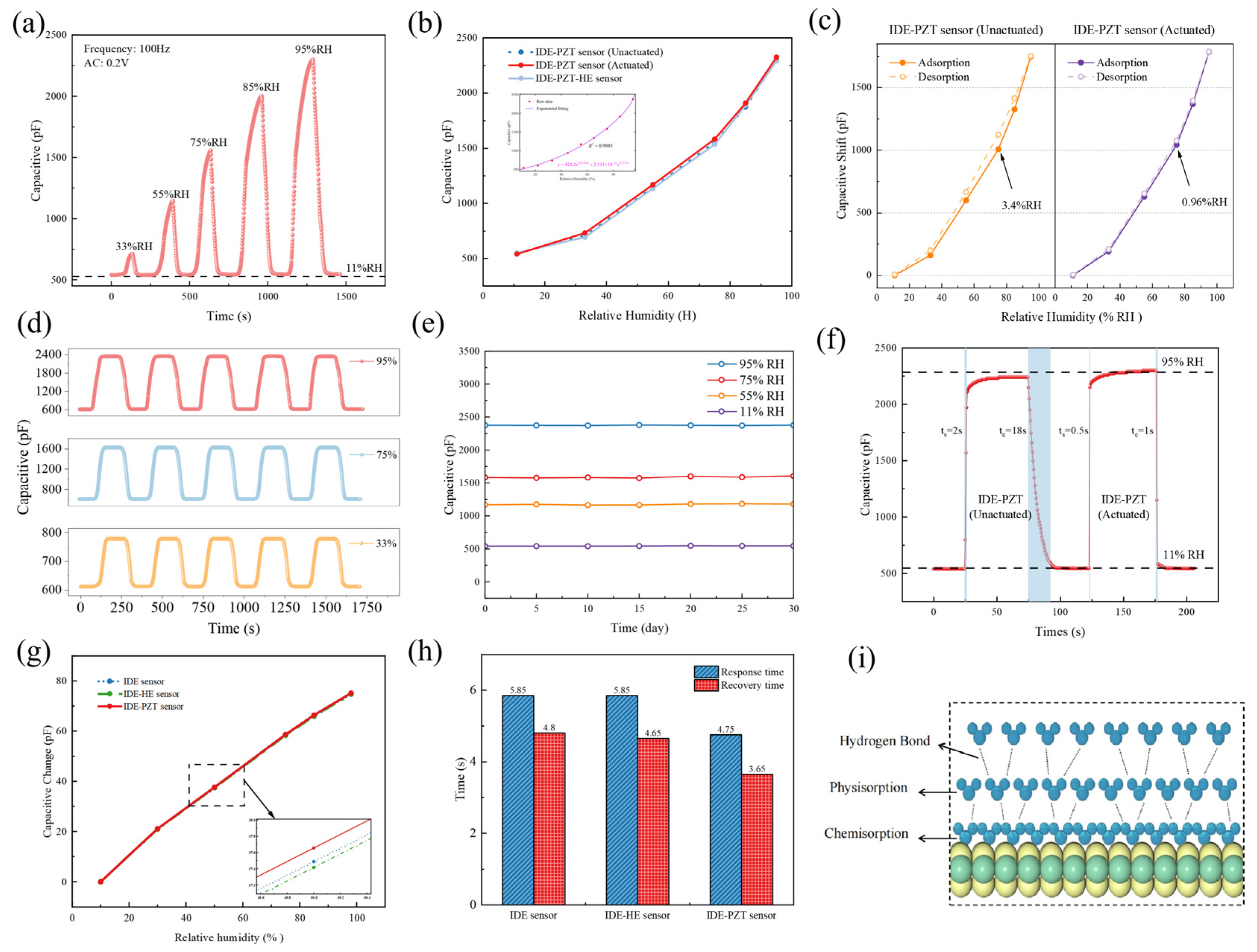
- Li, D.; Chen, A.; Dong, X.; Zheng, D.; Na, R. Modeling analysis and experimental verification of IDE humidity sensor integrated with PZT: Ultra-fast response and recovery times. Sens. Actuators B Chem. 2025, 426, 136985. [Google Scholar] [CrossRef]
- Guo, W.; He, Z.; Li, J.; Yao, L.; Qiao, Y.; Wang, F.; Wang, Y.; Wang, F. 3D MoSe2@ MoS2 heterojunction for humidity sensors to improve sensing performance. J. Alloy. Compd. 2024, 983, 173833. [Google Scholar] [CrossRef]
- Trovato, V.; Konar, R.; Teblum, E.; Lazzaroni, P.; Re, V.; Rosace, G.; Nessim, G.D. Humidity-and Temperature-Sensing Properties of 2D-Layered Tungsten Di-Selenide (2H-WSe2) Electroconductive Coatings for Cotton-Based Smart Textiles. Polymers 2025, 17, 752. [Google Scholar] [CrossRef] [PubMed]
- Bhadra, J.; Sassi, L.M.; Oliveira, E.F.; Hachtel, J.A.; Parangusan, H.; Mallick, S.A.; Ahmad, Z.; Galvao, D.S.; Puthirath, A.B.; Vajtai, R.; et al. An impedance humidity sensor based on CVD grown WSe2 2D films. ACS Appl. Electron. Mater. 2024, 6, 7734–7743. [Google Scholar] [CrossRef]
- Sharma, D.; Kumar, R.; Sakhuja, N.; Pal, A.; Bhat, N. Ultra-Sensitive Chemiresistive Humidity Sensor based on 2D GeS Nanoflakes. In Proceedings of the 2024 8th IEEE Electron Devices Technology & Manufacturing Conference (EDTM 2024), Bangalore, India, 3–6 March 2024; pp. 1–3. [Google Scholar]
- Jiang, M.; Xu, J.; Xie, Z.H.; Munroe, P.; Lu, H. Enhancing Humidity Sensing with NiPS3: A Theoretical Study on Selectivity and Sensitivity. Phys. B Condens. Matter 2025, 711, 417306. [Google Scholar]
- Li, H.; Liu, S.; Xu, S.; Sun, D.; Fu, Y. Relative humidity sensor based on U-shaped microfiber interferometer coated with MoS2 films. Mater. Lett. 2021, 301, 130245. [Google Scholar] [CrossRef]
- He, W.; Shen, Y.; Wohlfeld, K.; Sears, J.; Li, J.; Pelliciari, J.; Walicki, M.; Johnston, S.; Baldini, E.; Bisogni, V.; et al. Magnetically propagating Hund’s exciton in van der Waals antiferromagnet NiPS3. Nat. Commun. 2024, 15, 3496. [Google Scholar] [CrossRef]
- Ho, C.H.; Hsu, T.Y.; Muhimmah, L.C. The band-edge excitons observed in few-layer NiPS3. Npj 2D Mater. Appl. 2021, 5, 8. [Google Scholar] [CrossRef]
- Bhardwaj, R.; Hazra, A. MXene-based gas sensors. J. Mater. Chem. C 2021, 9, 15735–15754. [Google Scholar] [CrossRef]
- Wang, Y.; Hu, C.; Li, Z.; Zheng, D.; Cui, F.; Yang, X. Theoretical and simulation analysis of static and dynamic properties of mxene-based humidity sensors. Appl. Sci. 2022, 12, 8254. [Google Scholar] [CrossRef]
- Tang, K.; Ding, X.; Yu, X.; Lu, J.; Liu, F.; Li, H.; Chen, X. High fundamental frequency QCM humidity sensor based on C60-OH/Ti3C2TX nanocomposite with superior response. Sens. Actuators B Chem. 2025, 426, 137014. [Google Scholar] [CrossRef]
- Yang, M.Y.; Huang, M.L.; Li, Y.Z.; Feng, Z.S.; Huang, Y.; Chen, H.J.; Xu, Z.Q.; Liu, H.G.; Wang, Y. Printing assembly of flexible devices with oxidation stable MXene for high performance humidity sensing applications. Sens. Actuators B Chem.l 2022, 364, 131867. [Google Scholar] [CrossRef]
- Huang, M.L.; Lu, J.; Ji, J.X.; Zhang, H.W.; Xu, Z.Q.; Feng, Z.S.; Wu, W.; Wang, Y. Non-contact humidity monitoring: Boosting the performance of all-printed humidity sensor using PDDA-modified Ti3C2Tx nanoribbons. Chem. Eng. J. 2024, 485, 149633. [Google Scholar] [CrossRef]
- Wang, Y.S.; Lou, Y.F.; Xu, P.J.; Wei, W.H.; Yu, Y.; Feng, Z.S.; Wan, L.Y.; Kang, F.; Wang, Y. Carrageenan-modified MXene nanocomposite-based all-printed flexible humidity sensor for healthcare application. Sens. Actuators B Chem. 2024, 418, 136316. [Google Scholar] [CrossRef]
- Chen, H.; Huang, X.; Yang, Y.; Li, Y. Sodium Alginate/MXene-Based Flexible Humidity Sensors with High-Humidity Durability and Application Potentials in Breath Monitoring and Non-Contact Human–Machine Interfaces. Nanomaterials 2024, 14, 1694. [Google Scholar] [CrossRef]
- Li, X.; Sun, B.; Xue, T.; Pan, K.; Su, Y.; Jiang, Y.; Du, B.; Yang, D. MXene-based fiber-optic humidity sensor for fast human breath monitoring. Photonics 2024, 11, 79. [Google Scholar] [CrossRef]
- Xiao, Y.; Pu, Q.; Jia, X.; Gu, T.; Liu, Y.; Sun, P.; Liu, F.; Lu, G. Ti3C2Tx Aerogel-Based Wearable Humidity Sensors with Low Hysteresis and High Linearity for Expiratory Comfort Management. ACS Sens. 2024, 9, 6709–6716. [Google Scholar] [CrossRef]
- Li, Y.; Huang, X.; Chen, Q.; Yao, Y.; Pan, W. Nanochitin/MXene composite coated on quartz crystal microbalance for humidity sensing. Nanomaterials 2023, 13, 3135. [Google Scholar] [CrossRef]
- Nair, S.S.; Illyaskutty, N.; Tam, B.; Yazaydin, A.O.; Emmerich, K.; Steudel, A.; Hashem, T.; Schöttner, L.; Wöll, C.; Kohler, H.; et al. ZnO@ ZIF-8: Gas sensitive core-shell hetero-structures show reduced cross-sensitivity to humidity. Sens. Actuators B Chem. 2020, 304, 127184. [Google Scholar] [CrossRef]
- Jin, G.; Sun, M.; Gao, Y.; Zhou, X.; Wei, C.; Lyu, L. A CNFs/MWCNTs aerogel film-based humidity sensor with directionally aligned porous structure for substantially enhancing both sensitivity and response speed. Chem. Eng. J. 2023, 473, 145304. [Google Scholar] [CrossRef]
- Chen, G.; Liu, Y.; Shi, M.; Zhou, N.; Dai, X.; Mao, H.; Chen, D. Performance enhanced humidity sensor by in-situ integration of nanoforests. IEEE Electron Device Lett. 2021, 42, 585–588. [Google Scholar] [CrossRef]
- Musa, M.Z.; Mamat, M.H.; Othman, M.; Shameem, B.I.; Nagamalai, V.; Malek, M.F.; Rusop, M. Enhanced sensitivity of humidity sensor prepared using vertically aligned v-doped TiO2 nanorods array. J. Electr. Electron. Syst. Res. (JEESR) 2020, 17, 68–73. [Google Scholar] [CrossRef]
- Wu, K.; Fei, T.; Zhang, T. Humidity sensors based on metal–organic frameworks. Nanomaterials 2022, 12, 4208. [Google Scholar] [CrossRef]
- Sapsanis, C.; Omran, H.; Chernikova, V.; Shekhah, O.; Belmabkhout, Y.; Buttner, U.; Eddaoudi, M.; Salama, K.N. Insights on capacitive interdigitated electrodes coated with MOF thin films: Humidity and VOCs sensing as a case study. Sensors 2015, 15, 18153–18166. [Google Scholar] [CrossRef]
- Zhang, Y.; Fu, B.; Liu, K.; Zhang, Y.; Li, X.; Wen, S.; Chen, Y.; Ruan, S. Humidity sensing properties of FeCl3-NH2-MIL-125 (Ti) composites. Sens. Actuators B Chem. 2014, 201, 281–285. [Google Scholar] [CrossRef]
- Liu, X.; Gao, Z.; Wan, Z.; Wu, Z.; Li, T.; Mao, T.; Liang, X.; Zheng, D.; Zhang, J. Toward Near-Space Communication Network in the 6G and Beyond Era. Space Sci. Technol. 2025, 5, 0337. [Google Scholar] [CrossRef]
- Kumari, M.; Dhariwal, N.; Yadav, P.; Kumar, V.; Thakur, O. Urea modified Cu-doped LaFeO3 nano-particles for humidity sensing with contactless moisture detection for medical and agricultural application. Sens. Actuators B Chem. 2025, 423, 136749. [Google Scholar] [CrossRef]
- Taka, G.; Das, T. Synthesis and application of Fe/Mg/Cu-doped ZnO nanoparticles in humidity sensors and low-voltage varistors. Phys. B Condens. Matter 2025, 708, 417228. [Google Scholar] [CrossRef]
- Liu, X.; Wang, L.; Lei, Y.; Li, X.; Cheng, C.; Yang, L.; Jiao, L.; Yang, S.; Shu, D.; Cheng, B. Highly sensitivity and wide-range flexible humidity sensor based on LiCl/cellulose nanofiber membrane by one-step electrospinning. Chem. Eng. J. 2025, 503, 158018. [Google Scholar] [CrossRef]
- Fu, Y.; Wang, Y.; Zuo, H.; Li, Y.; Li, D. Ag Nanowire/Polyamide 66 Nanofiber Membranes for Strain Sensing, Humidity Detection, and Dual-Mode Thermal Response. ACS Appl. Nano Mater. 2025, 8, 20499–20508. [Google Scholar] [CrossRef]
- Abdel Salam, A.I.; Soliman, T.; Matar, H.A.; Khalid, A.; Morsy, M. Nickel and graphene oxide enhanced bismuth oxide for humidity sensing capabilities. Opt. Quantum Electron. 2025, 57, 567. [Google Scholar] [CrossRef]
- Won, M.; Jung, M.; Kim, J.; Kim, D.S. Fully printed cellulose nanofiber–ag nanoparticle composite for high-performance humidity sensor. Nanomaterials 2024, 14, 343. [Google Scholar] [CrossRef] [PubMed]
- Wang, Q.; Lian, M.; Zhu, X.; Chen, X. Excellent humidity sensor based on ultrathin HKUST-1 nanosheets. RSC Adv. 2021, 11, 192–197. [Google Scholar] [CrossRef]
- Huo, C.; Chen, H.; Chen, L.; Yang, S.; Cui, P.; Song, J. Humidity Sensor Based on ZnO MS/GR Composite Material. J. Electron. Mater. 2024, 53, 5238–5245. [Google Scholar] [CrossRef]
- Li, X.; Tan, Q.; Qin, L.; Zhang, L.; Liang, X.; Yan, X. A high-sensitivity MoS2/graphene oxide nanocomposite humidity sensor based on surface acoustic wave. Sens. Actuators A Phys. 2022, 341, 113573. [Google Scholar] [CrossRef]
- Wu, J.; Chen, Y.; Shen, W.; Wu, Y.; Corriou, J.P. Highly sensitive, flexible and transparent TiO2/nanocellulose humidity sensor for respiration and skin monitoring. Ceram. Int. 2023, 49, 2204–2214. [Google Scholar] [CrossRef]
- Li, W.; Ma, Y.; Ji, S.; Sun, G.; Jin, P. Synthesis and humidity sensing properties of the VO2 (B)@ ZnO heterostructured nanorods. Ceram. Int. 2016, 42, 9234–9240. [Google Scholar] [CrossRef]
- Karamat, S.; Majeed, W.; Albaqami, M.D.; Sheikh, M.; Talha, M.; Batool, U.; Imran, Z.; Khan, S.; Kashif, M. High-performance humidity sensors based on reduced graphene oxide sheets decorated with Cobalt and iron doped ZnO nanorods. Mater. Today Commun. 2024, 40, 109742. [Google Scholar] [CrossRef]
- Guo, L.; Li, X.; Li, W.; Gou, C.; Zheng, M.; Zhang, Y.; Chen, Z.; Hong, Y. High-sensitive humidity sensor based on MoS2/graphene oxide quantum dot nanocomposite. Mater. Chem. Phys. 2022, 287, 126146. [Google Scholar] [CrossRef]
- Waheed, W.; Anwer, S.; Khan, M.U.; Sajjad, M.; Alazzam, A. 2D Ti3C2Tx-MXene nanosheets and graphene oxide based highly sensitive humidity sensor for wearable and flexible electronics. Chem. Eng. J. 2024, 480, 147981. [Google Scholar] [CrossRef]
- Aziz, A.; Shah, M.; Khattak, S.G.; Muhammad, Y.; Hassan, H. High-performance and sensitive humidity sensors based on reduced Graphene Oxide/Nickel Ferrite nanocomposites. Mater. Sci. Eng. B 2024, 307, 117519. [Google Scholar] [CrossRef]
- Wang, S.; Yan, H.; Zheng, H.; He, Y.; Guo, X.; Li, S.; Yang, C. Fast response humidity sensor based on chitosan/graphene oxide/tin dioxide composite. Sen. Actuators B Chem. 2023, 392, 134070. [Google Scholar] [CrossRef]
- Abdel-Haleem, F.M.; Morsy, M.; Ataya, M.; Hussein, B.H. Co3O4/NiO/graphene nanostructured composite for humidity sensing: Synthesis, characterization, and performance analysis. Diam. Relat. Mater. 2025, 159, 112795. [Google Scholar] [CrossRef]
- Sun, C.; Li, W.; Lv, Z.; Guo, Y. High-performance humidity sensor based on Ag-doped ZnGa2O4/ZnO composite nanofibers. RSC Appl. Interfaces 2024, 1, 1233–1240. [Google Scholar] [CrossRef]
- Al-Hamry, A.; Pašti, I.A.; Kanoun, O. Titanium Dioxide/Graphene Oxide Nanocomposite-Based Humidity Sensors with Improved Performance. J. Compos. Sci. 2025, 9, 60. [Google Scholar] [CrossRef]
- Zhang, H.W.; Xu, X.; Huang, M.L.; Wang, Y.S.; Xu, Z.Q.; Feng, Z.S.; Zhang, Y.; Wang, Y. Interlayer cross-linked MXene enables ultra-stable printed paper-based flexible sensor for real-time humidity monitoring. Chem. Eng. J. 2024, 495, 153343. [Google Scholar] [CrossRef]
- Wang, Y.S.; Huang, M.L.; Lu, J.; Zhang, H.W.; Wang, L.; Feng, Z.S.; Wang, Y. Mussel-inspired dopamine/MXene composite: Improved oxidation stability for humidity sensing and non-contact monitoring. Sens. Actuators B Chem. 2025, 433, 137533. [Google Scholar] [CrossRef]
- Li, L.; Zhang, C.; Xu, Z.; Gu, L.; Xu, R.; Zhao, J. Synergistic MXene/GO Composites for Flexible Capacitive Humidity Sensors with Ultrahigh Sensitivity and Fast Response. Surfaces and Interfaces 2025, 72, 106948. [Google Scholar] [CrossRef]


| Material | Synthesis Method | Method of Measuring | Humidity Range/% RH | Response/Recovery Time a | Sensitivity | Ref. |
|---|---|---|---|---|---|---|
| MWCNT | Dispersion and Enrichment | Resistive | 25–95 | 3 s/25 s | 0.5%/% RH | [27] |
| GO | Modified Hummers’ method | Resistive | 11–97 | 13 s/32 s | 1.38%/% RH | [28] |
| GO | Dispersion and Enrichment | Capacitive | 15–95 | 10.5 s/41 s | 37,800% | [29] |
| CQDs | Electrochemical ablation | Resistive | 7–95 | 25 s/60 s | 0.40 /% RH | [30] |
| Carbon black | Plasma treatment | Resistive | 11–90 | 11.7 s/23.9 s | 0.03 | [31] |
| OSR700 biochar | Drop-casting | Resistive | 0–99 | 50 s/70 s | 94.50% | [32] |
| SWP700 biochar | Drop-casting | Resistive | 0–99 | 1 min/1 min | 97.70% | [32] |
| Material | Synthesis Method | Method of Measuring | Humidity Range/% RH | Response/Recovery Time a | Sensitivity | Ref. |
|---|---|---|---|---|---|---|
| ZnO (nanorod film) | Vapor transport/VPT method | Resistive | 12–97 | 3 s/20 s | [54] | |
| ZnO (nanowire film) | Vapor transport/VPT method | Resistive | 12–97 | 3 s/30 s | [54] | |
| SnO2 | Solution process/Spin-coating | Resistive | 11–95 | 84 s/576 s | 1329 /% RH | [55] |
| Co3O4 | Centrifugation/ Calcination/Drop-coating | Resistive | 10–95 | 1.0 s/13.5 s | 2730 /% RH | [56] |
| TiO2 | Ultrasonic treatment/Electrochemical processing | Resistive | 11–95 | 100 s/190 s | 2339.2 /% RH | [57] |
| AAO | Electro-polishing/Hybrid-pulse anodization | Resistive | 20–80 | 9 s/9 s | 117.6 /% RH | [58] |
| ZrO2 | Paste screen-printing | Resistive | 33–95 | 7 s/53 s | / | [59] |
| SiO2 | Sol–gel Stöber method and Spin-coating | surface acoustic wave (SAW) | 30–93 | <10 s/<10 s | Total frequency shift: kHz | [60] |
| Material | Synthesis Method | Method of Measuring | Humidity Range/% RH | Response/ Recovery Time a | Sensitivity | Hysteresis | Ref. |
|---|---|---|---|---|---|---|---|
| PANI | Drop-casting | Impedance | 36–90 | 8 s/27 s | 0.11/% RH | 2% RH | [86] |
| PPy | Drop-casting | Capacitive | 0–95 | 5.20 s/6.43 s | 233 nF/% RH | 1.79% RH | [87] |
| PEDOT:PSS | Drop-casting | Resistive | 20–90 | – | 0.82 cm/% RH | – | [88] |
| VTP | Drop-casting | Capacitive | 20–95 | 15 s/10 s | 9.2 pH/% RH | 1.26% RH | [89] |
| Material | Synthesis Method | Method of Measuring | Humidity Range/% RH | Response/Recovery Time a | Sensitivity | Ref. |
|---|---|---|---|---|---|---|
| PI | Spin-coating | Capacitive | 5–85 | 18 s/31 s | 15.2 fF/% RH | [101] |
| PMMA | Coating | Fabry–Perot interferometer (FPI) | 5–95 | 8 s/– | 188.3 lux/% RH | [106] |
| PVA | Coating | FPI | 35–95 | 1.33 ms/– | nm/% RH | [106] |
| Nafion | Drop-coating/Spin-coating | Microcantilever | – | 8 s/8.5 s | 628.31 nm/% RH | [107] |
| HEC | Coating | FPI | 48–60 | 1.61 s/– | 1.24 nm/% RH | [108] |
| Material | Synthesis Method | Method of Measuring | Humidity Range/% RH | Response/Recovery Time a | Ref. |
|---|---|---|---|---|---|
| MoS2 | Drop-casting | Resistive | 0–60 | 9 s/17 s | [128] |
| WS2 | Thermal evaporation | Resistive | 40–80 | 13 s/17 s | [129] |
| MoSe2 | Hydrothermal growth | Resistive | 20–90 | 53 s/13 s | [130] |
| WSe2 | Sonochemical exfoliation/Coating/ Drop-casting | Resistive | 20–95 | 3.9 s/3 s | [131] |
| TiSi2 | Wet grinding/Printing process | Capacitive | 0–100 | 0.9 s/8 s | [132] |
| ZrSe2 | Wet grinding/ Spin-coating | Capacitive | 15–80 | 1 s/2 s | [133] |
| MXene | Etching/ Film-coating | Resistive | 11–95 | 1.57 s/1.09 s | [134] |
| NiPS3 | Liquid-phase exfoliation/Coating | Resistive | 10–90 | 3 s/3 s | [135] |
| PtSe2 | chemical vapor deposition(CVD) | Resistive | 20–85 | 60 ms/70 ms | [136] |
| SiC | Carbothermal reduction | Impedance | 11–95 | 3 s/3 s | [137] |
| Material System | Advantages | Limitations | Applicable Extreme Environments |
|---|---|---|---|
| Carbon-Based Materials | Hierarchical porous structures enabling rapid vapor diffusion; ultrafast response in low-humidity regimes; strong structural and chemical stability; excellent resistance to temperature fluctuations and environmental interference | Water trapping at high relative humidity causing pronounced hysteresis; limited inherent hydrophilicity; oxidation susceptibility for certain carbon allotropes | Dry and low-humidity environments, aerospace cabins, high-altitude platforms, precision-manufacturing environments |
| Metal Oxides | Outstanding thermal stability; strong corrosion and radiation resistance; high structural rigidity; minimal hysteresis in low-humidity regions; long operational lifetime | Water-film formation at high RH leading to hysteresis and saturation; ionic conduction dominating under high humidity; poor mechanical flexibility | High-temperature (>200 °C) environments, corrosive atmospheres, nuclear facilities, industrial pipelines |
| Conductive Polymers | High sensitivity in high/ultra-high RH regions via proton–polaron transport; fast response; excellent flexibility; compatible with printing and solution processing; tunable redox/charge-transport properties | Severe saturation and hysteresis under high RH; mechanical fatigue and aging; unstable under thermo-hygrometric cycling; dedoping or structural collapse at low temperatures | Saturated and ultra-high humidity environments, wearable systems, respiration monitoring, skin-interfacing micro-environments |
| Insulating Polymers | High dielectric contrast enabling capacitive sensing; highly flexible; tunable chemical functional groups for selective moisture adsorption; scalable fabrication | Slow response/recovery due to low conductivity; moisture-induced swelling and mechanical degradation; significant hysteresis at high RH; brittleness under freezing/hypothermal conditions | High-humidity and saturated environments, flexible/wearable sensors, biomedical moisture-monitoring applications |
| 2D Materials | High carrier mobility; tunable interlayer spacing; rich defect-engineering flexibility; excellent mechanical pliability; potential for ultrahigh humidity sensitivity | Oxidation susceptibility (notably MXenes); interlayer expansion and structural degradation; scale-up challenges; insufficient environmental robustness | Lightweight, flexible, high-sensitivity sensing nodes; wearable extreme-environment monitoring |
| Composite Materials | Synergistic integration of multiple material systems; wide-range humidity detection; interfacial engineering enabling hysteresis reduction; enhanced environmental durability | Architectural complexity; challenging interfacial control; long-term reliability requires further validation; high manufacturing cost for some composite types | Multi-stress coupling environments, wide-range humidity extremes, engineering-grade high-reliability humidity sensing |
Disclaimer/Publisher’s Note: The statements, opinions and data contained in all publications are solely those of the individual author(s) and contributor(s) and not of MDPI and/or the editor(s). MDPI and/or the editor(s) disclaim responsibility for any injury to people or property resulting from any ideas, methods, instructions or products referred to in the content. |
© 2026 by the authors. Licensee MDPI, Basel, Switzerland. This article is an open access article distributed under the terms and conditions of the Creative Commons Attribution (CC BY) license.
Share and Cite
Dong, X.; Li, D.; Chen, A.; Zheng, D. Humidity Sensing in Extreme Environments: Mechanisms, Materials, Challenges, and Future Directions. Chemosensors 2026, 14, 20. https://doi.org/10.3390/chemosensors14010020
Dong X, Li D, Chen A, Zheng D. Humidity Sensing in Extreme Environments: Mechanisms, Materials, Challenges, and Future Directions. Chemosensors. 2026; 14(1):20. https://doi.org/10.3390/chemosensors14010020
Chicago/Turabian StyleDong, Xiaoyuan, Dapeng Li, Aobei Chen, and Dezhi Zheng. 2026. "Humidity Sensing in Extreme Environments: Mechanisms, Materials, Challenges, and Future Directions" Chemosensors 14, no. 1: 20. https://doi.org/10.3390/chemosensors14010020
APA StyleDong, X., Li, D., Chen, A., & Zheng, D. (2026). Humidity Sensing in Extreme Environments: Mechanisms, Materials, Challenges, and Future Directions. Chemosensors, 14(1), 20. https://doi.org/10.3390/chemosensors14010020