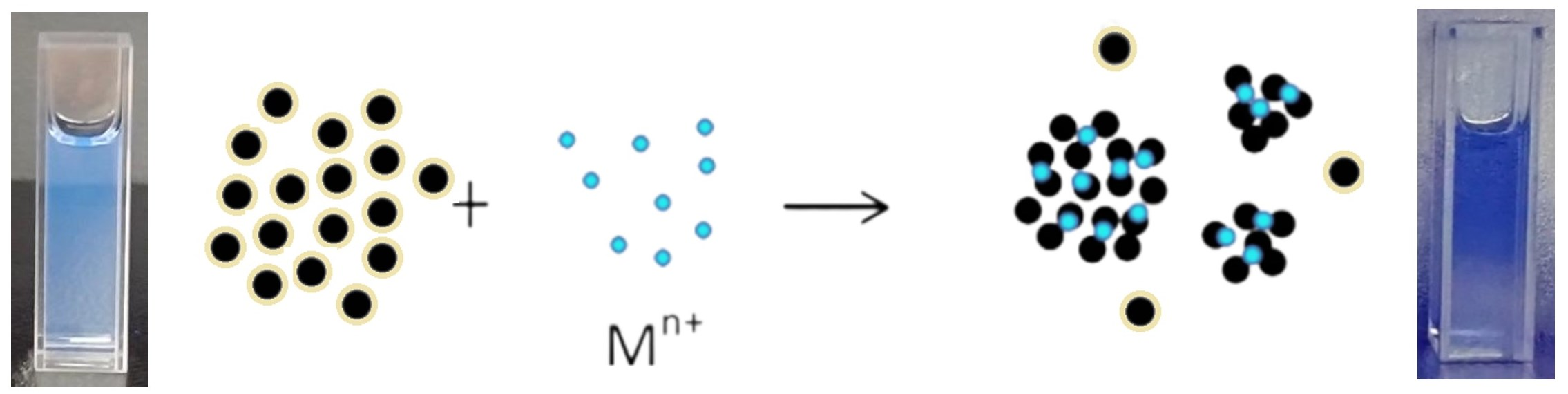

Copper Ion Detection Using Green Precursor-Derived Carbon Dots in Aqueous Media



Abstract
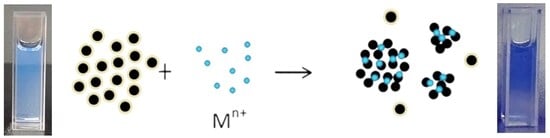
1. Introduction
2. Materials and Methods
2.1. Materials
2.2. Apparatus
2.3. Synthesis and Purification of Luminescent C-Dots
2.4. Stability Studies of C-Dots
2.5. Optical, Structural, and Morphological Characterization of C-Dots
2.6. Copper and Other Metal Ion Detection of C-Dots
2.7. Quenching Data and Job’s Plot Analysis
2.8. Copper Ion Detection of C-Dots in Water and Real Sample Detection
3. Results and Discussion
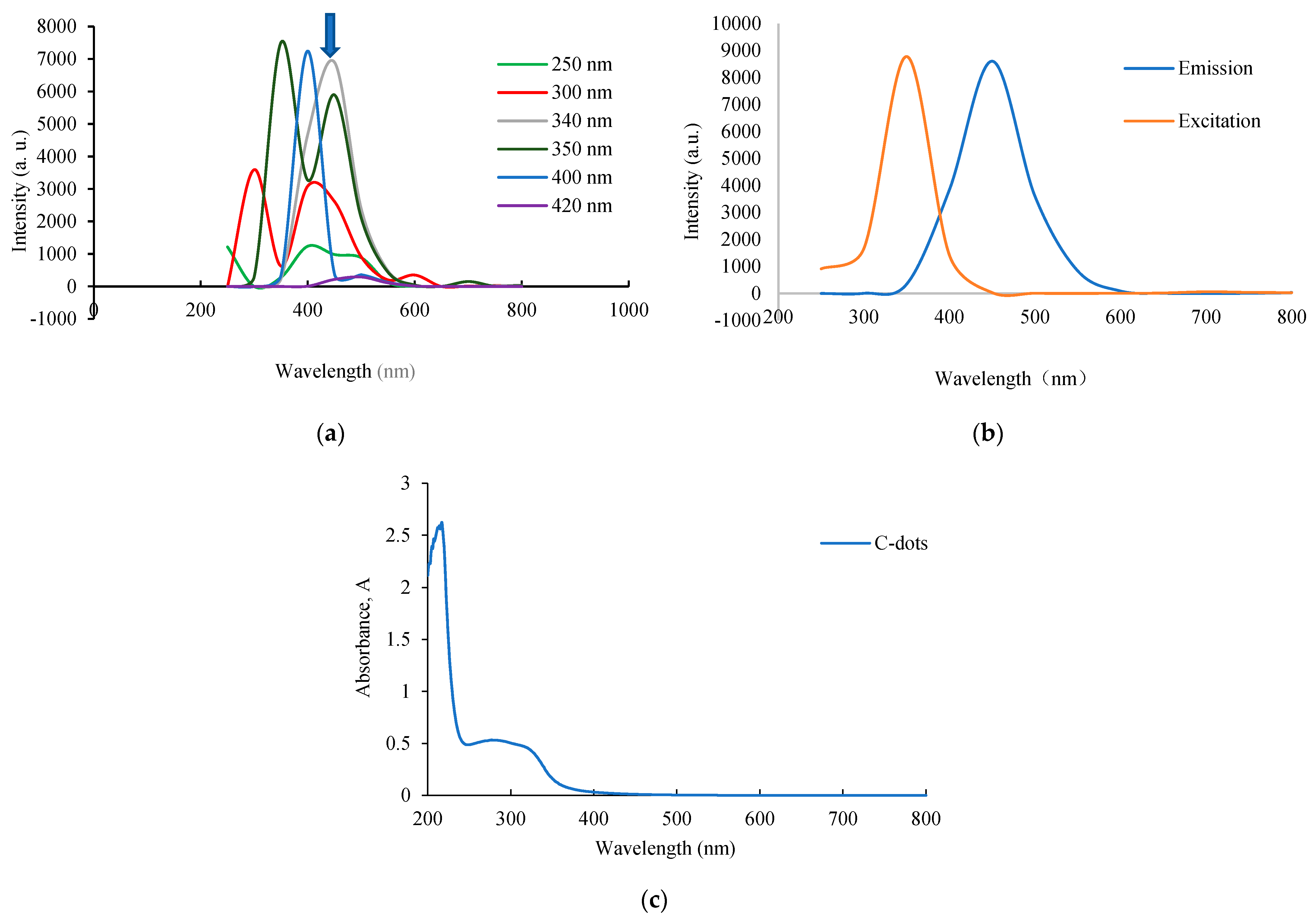
3.1. Optical Properties of C-Dots
3.2. Photoluminescence Stability Studies of C-Dots
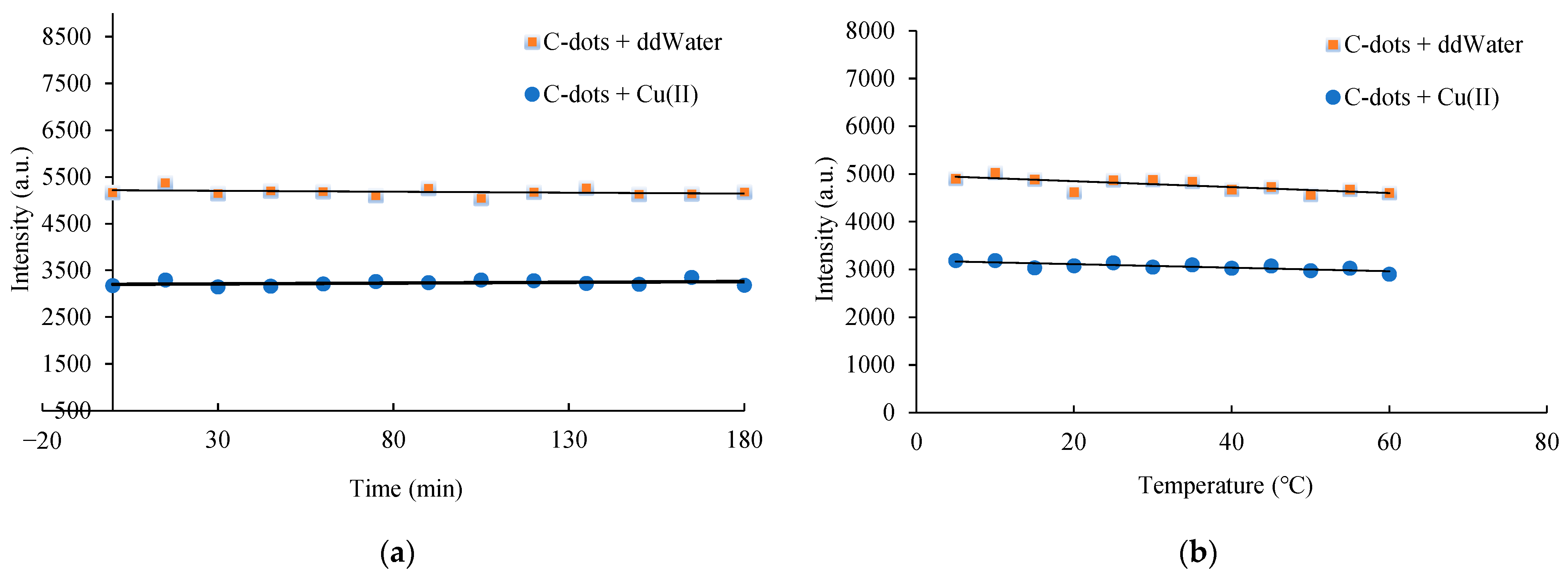
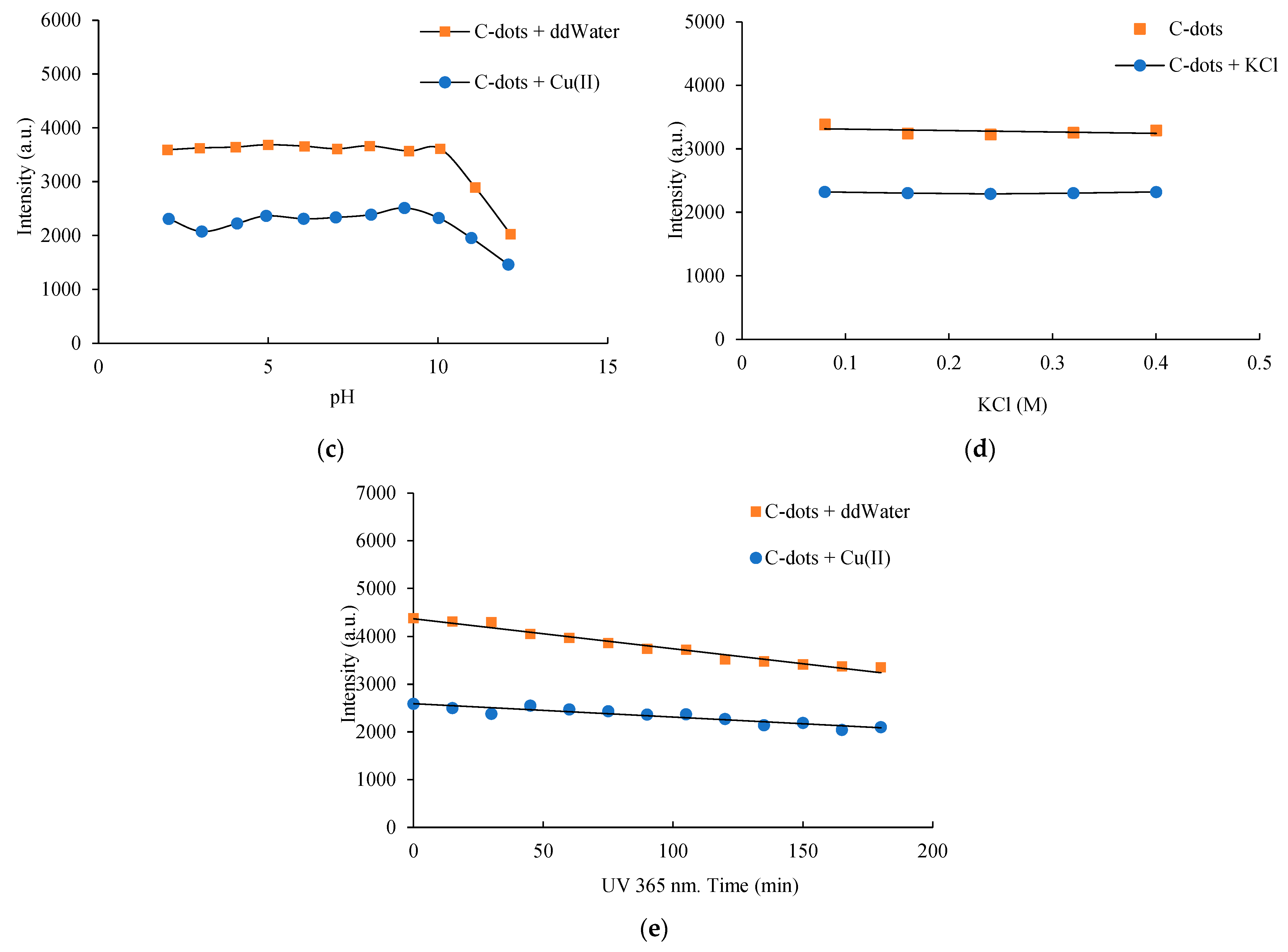
3.2.1. Effects of Time, Temperature, and pH
3.2.2. Effects of Ionic Strength and Exposure Duration
3.3. C-Dots as a Photoluminescent Probe for Heavy Metal Cu2+ Ions Detection
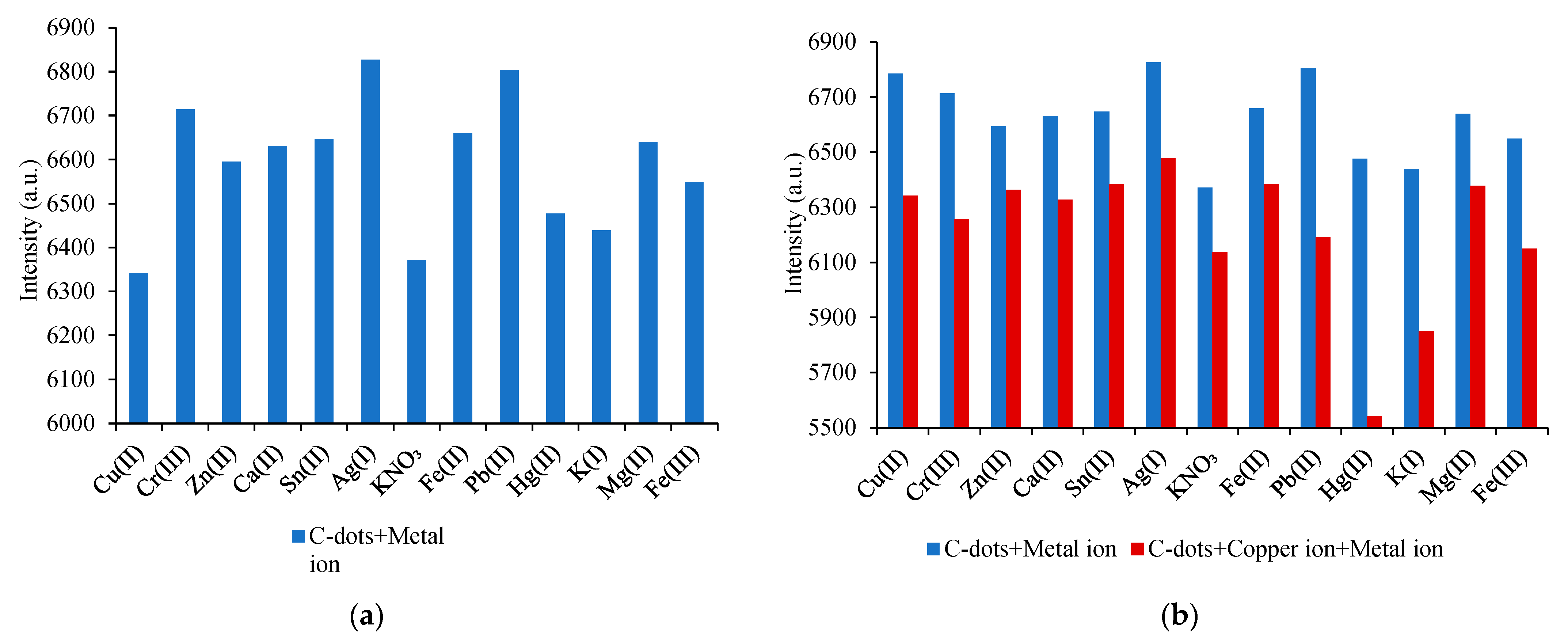
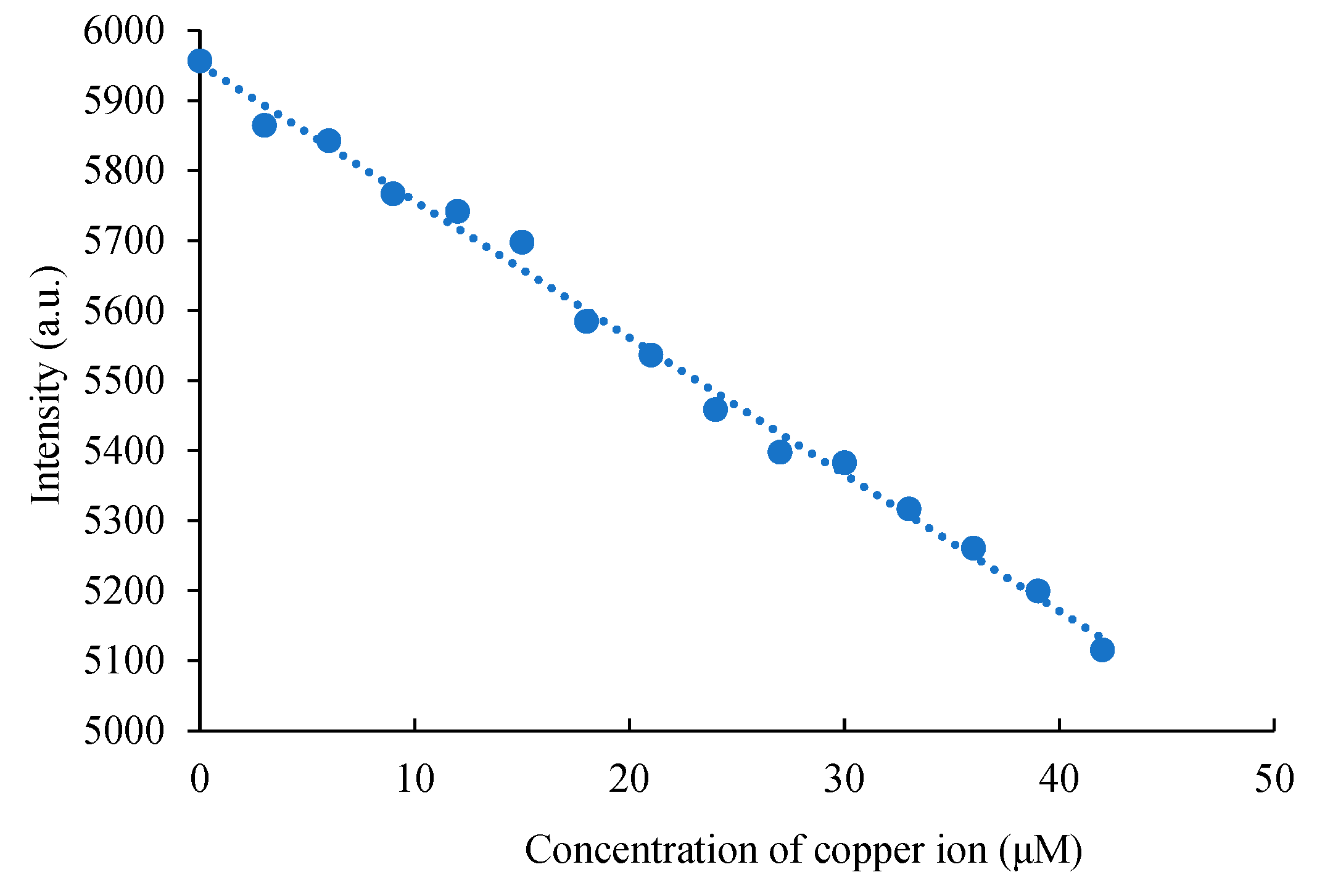
3.3.1. Selectivity and Sensitivity of the C-Dots
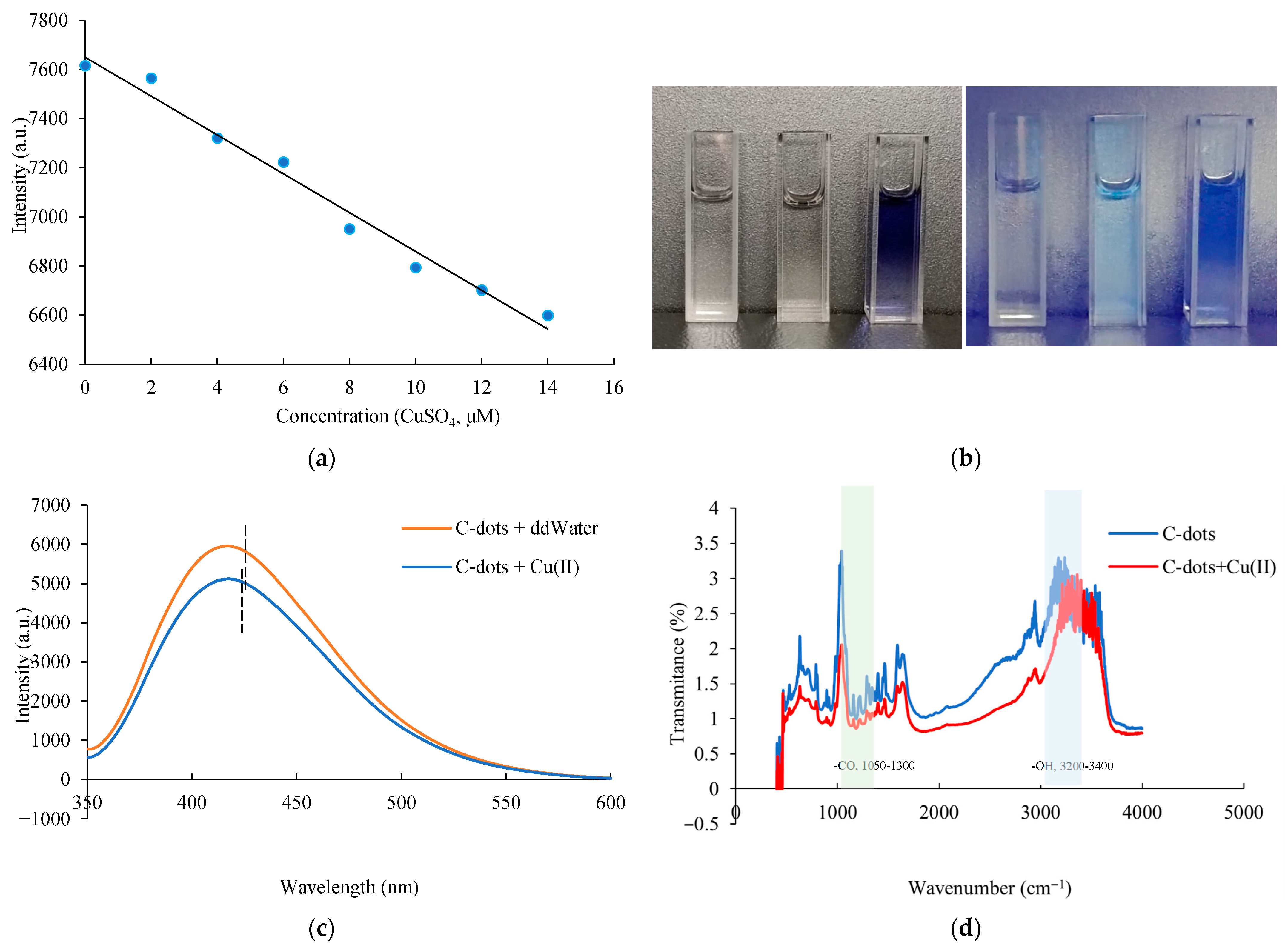
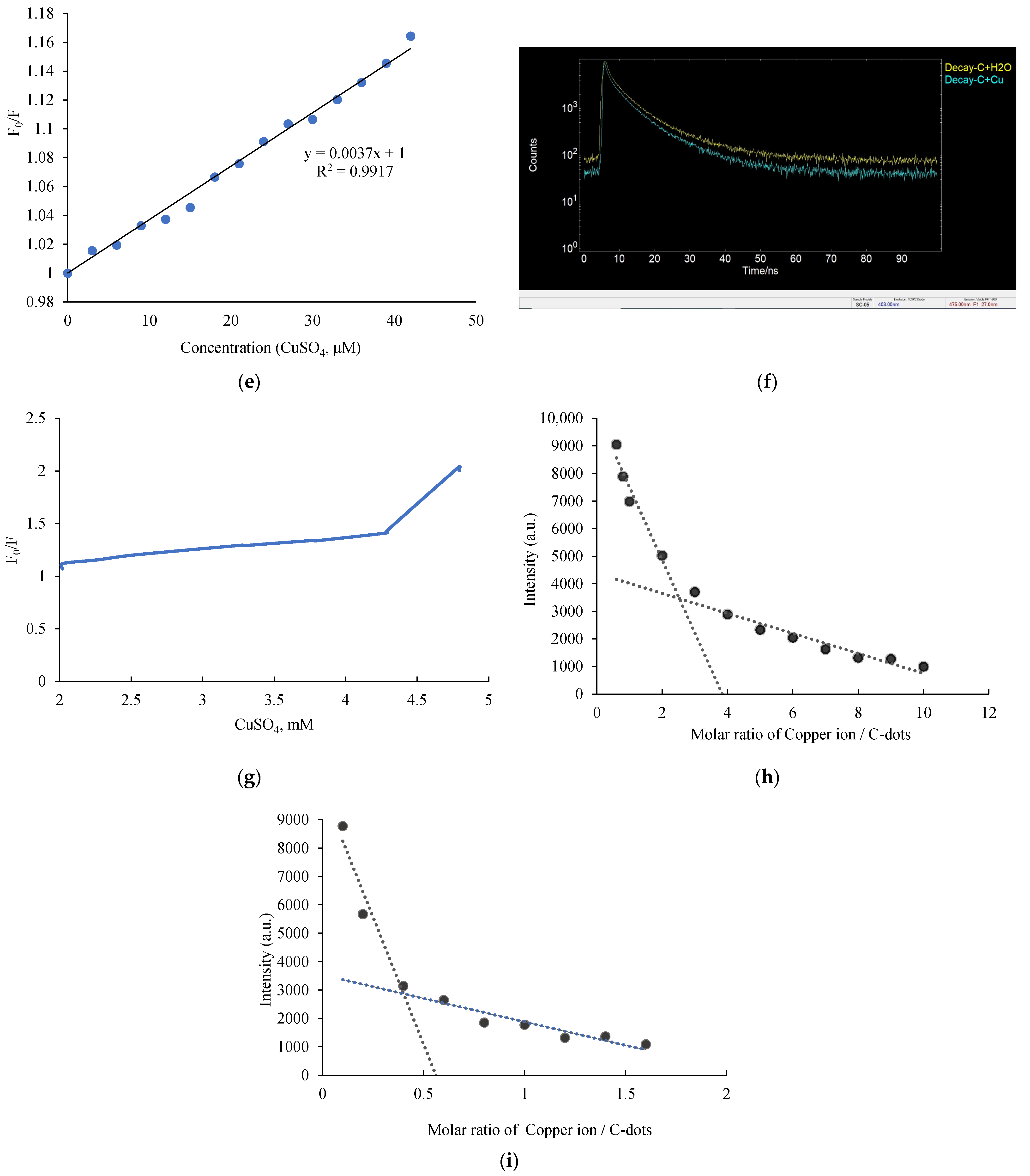
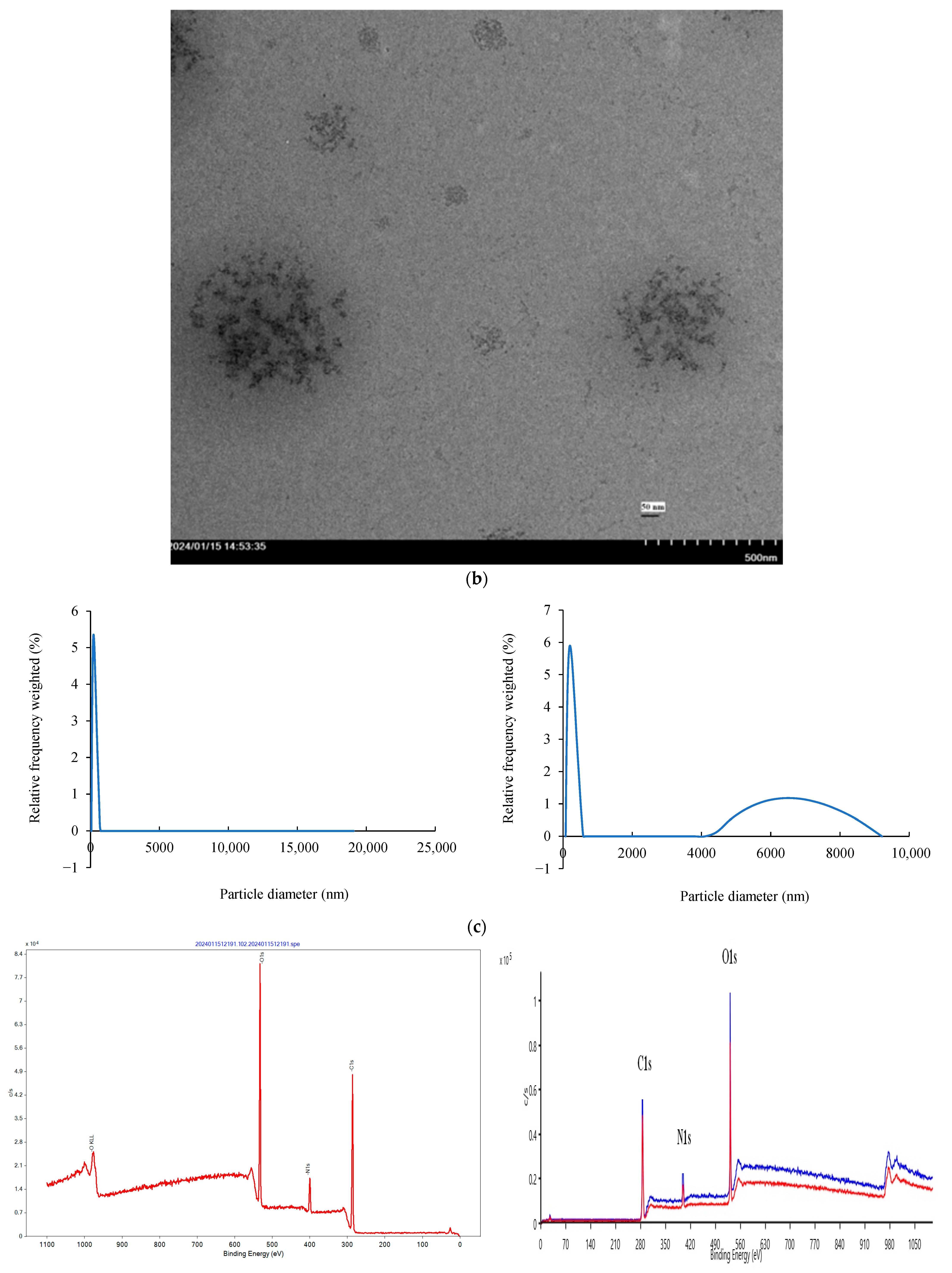
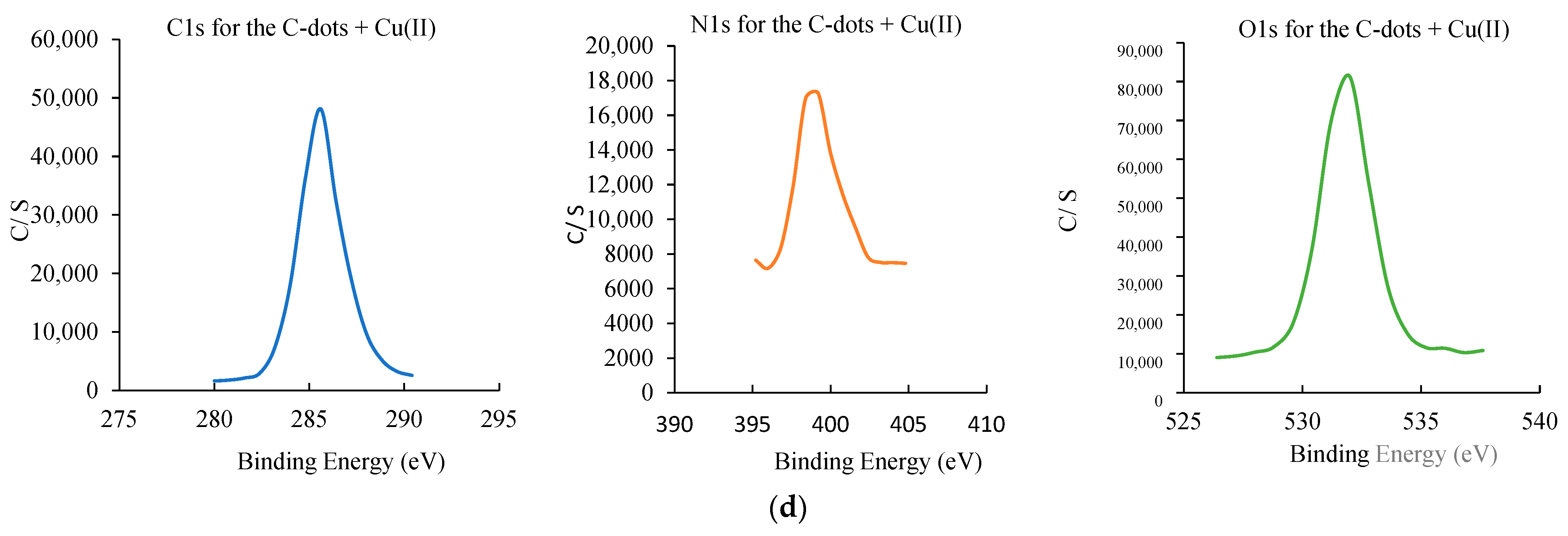
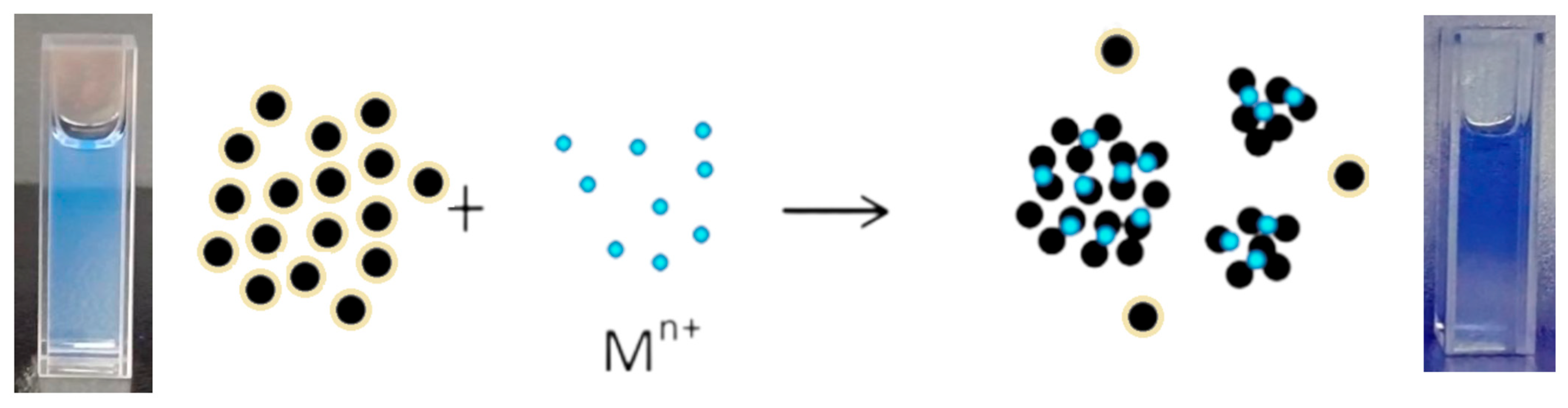
3.3.2. Characterization of C-Dots Interacting with Copper Ions
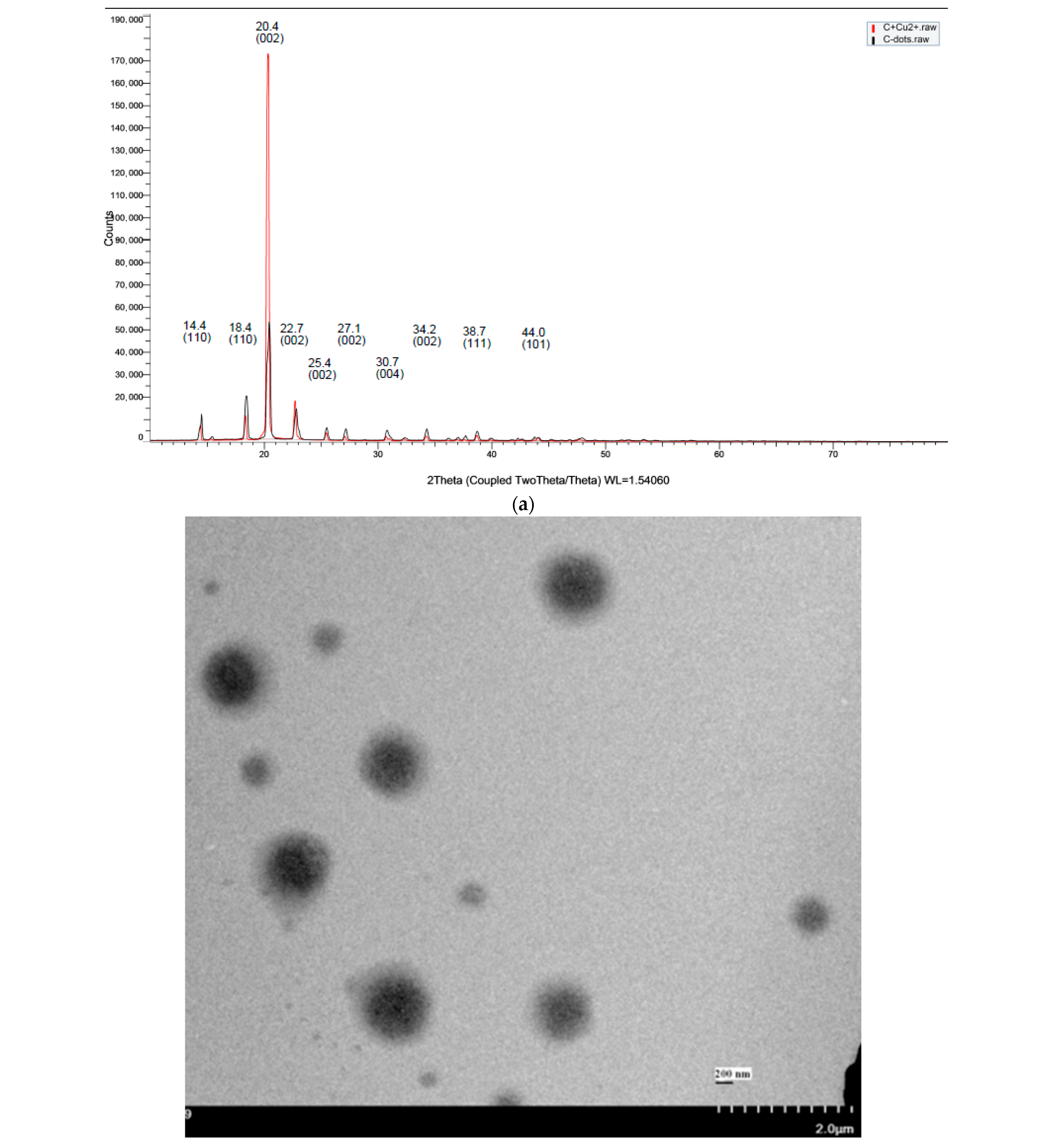
3.4. Structural and Morphological Analysis of C-Dots
3.5. Detection of Copper Ions in Real Samples
4. Conclusions
Supplementary Materials
Author Contributions
Funding
Institutional Review Board Statement
Informed Consent Statement
Data Availability Statement
Acknowledgments
Conflicts of Interest
Abbreviations
| C-dots | carbon dots |
| PL | photoluminescence |
| QDs | quantum dots |
| QY | quantum yield |
| USEPA | the United States Environmental Protection Agency |
| MCLT | the metal-to-ligand electron transfer |
| UV–vis | ultraviolet–visible |
| FT-IR spectra | Fourier transform infrared spectroscopy |
| TEM | transmission electron microscopy |
| XPS | X-ray photoelectron spectroscopy |
| XRD | X-ray diffraction |
| TCSPC | time-correlated single photon counting |
| DLS | dynamic light scattering |
| Cu2+ | copper(II) |
| Fe3+ | iron(III) |
| Al3+ | aluminum(III) |
| Cr3+ | chromium(III) |
| Cr6+ | chromium(VI) |
| Pb2+ | lead(II) |
| As3+ | arsenic(III) |
| Cd2+ | cadmium(II) |
| Hg2+ | mercury(II) |
| LOD | limit of detection |
| QS | quinine sulfate |
| RI | refractive index |
| OD | optical density |
References
- Angon, P.B.; Islam, M.S.; Kc, S.; Das, A.; Anjum, N.; Poudel, A.; Suchi, S.A. Sources, effects and present perspectives of heavy metals contamination: Soil, plants and human food chain. Heliyon 2024, 10, e28357. [Google Scholar] [CrossRef]
- Mebane, C.A. Bioavailability and Toxicity Models of Copper to Freshwater Life: The State of Regulatory Science. Environ. Toxicol. Chem. 2023, 42, 2529–2563. [Google Scholar] [CrossRef]
- Jomova, K.; Alomar, S.Y.; Nepovimova, E.; Kuca, K.; Valko, M. Heavy metals: Toxicity and human health effects. Arch. Toxicol. 2025, 99, 153–209. [Google Scholar] [CrossRef]
- Rehman, M.; Liu, L.; Wang, Q.; Saleem, M.H.; Bashir, S.; Ullah, S.; Peng, D. Copper environmental toxicology, recent advances, and future outlook: A review. Environ. Sci. Pollut. Res. Int. 2019, 26, 18003–18016. [Google Scholar] [CrossRef] [PubMed]
- de Carvalho Machado, C.; Dinis-Oliveira, R.J. Clinical and Forensic Signs Resulting from Exposure to Heavy Metals and Other Chemical Elements of the Periodic Table. J. Clin. Med. 2023, 12, 2591. [Google Scholar] [CrossRef] [PubMed]
- Teschke, R.; Eickhoff, A. Wilson Disease: Copper-Mediated Cuproptosis, Iron-Related Ferroptosis, and Clinical Highlights, with Comprehensive and Critical Analysis Update. Int. J. Mol. Sci. 2024, 25, 4753. [Google Scholar] [CrossRef]
- Yegambaram, M.; Manivannan, B.; Beach, T.G.; Halden, R.U. Role of Environmental Contaminants in the Etiology of Alzheimer’s Disease: A Review. Curr. Alzheimer Res. 2015, 12, 116–146. [Google Scholar] [CrossRef]
- Matés, J.M.; Segura, J.A.; Alonso, F.J.; Márquez, J. Roles of dioxins and heavy metals in cancer and neurological diseases using ROS-mediated mechanisms. Free Radic. Biol. Med. 2010, 49, 1328–1341. [Google Scholar] [CrossRef]
- Agency, U.E.P. Aquatic Life Ambient Fresh-Water Quality Criteria—Copper. 2007. Available online: https://www.epa.gov/sites/default/files/2019-02/documents/al-freshwater-copper-2007-revision.pdf (accessed on 10 December 2025).
- Yuan, X.; Chapman, R.L.; Wu, Z. Analytical methods for heavy metals in herbal medicines. Phytochem. Anal. 2011, 22, 189–198. [Google Scholar] [CrossRef] [PubMed]
- Kirichkov, M.V.; Polyakov, V.A.; Shende, S.S.; Minkina, T.M.; Nevidomskaya, D.G.; Wong, M.H.; Bauer, T.V.; Shuvaeva, V.A.; Mandzhieva, S.S.; Tsitsuashvili, V.S. Application of X-ray based modern instrumental techniques to determine the heavy metals in soils, minerals and organic media. Chemosphere 2024, 349, 140782. [Google Scholar] [CrossRef]
- Fakayode, S.O.; Walgama, C.; Fernand Narcisse, V.E.; Grant, C. Electrochemical and Colorimetric Nanosensors for Detection of Heavy Metal Ions: A Review. Sensors 2023, 23, 9080. [Google Scholar] [CrossRef]
- Singh, M.; Kumar, J. Flourescence sensors for heavy metal detection: Major contaminants in soil and water bodies. Anal. Sci. 2023, 39, 1829–1838. [Google Scholar] [CrossRef]
- Huang, C.W.; Lin, C.; Nguyen, M.K.; Hussain, A.; Bui, X.T.; Ngo, H.H. A review of biosensor for environmental monitoring: Principle, application, and corresponding achievement of sustainable development goals. Bioengineered 2023, 14, 58–80. [Google Scholar] [CrossRef] [PubMed]
- Nguyen, D.H.H.; Muthu, A.; Elsakhawy, T.; Sheta, M.H.; Abdalla, N.; El-Ramady, H.; Prokisch, J. Carbon Nanodots-Based Sensors: A Promising Tool for Detecting and Monitoring Toxic Compounds. Nanomaterials 2025, 15, 725. [Google Scholar] [CrossRef] [PubMed]
- Mankoti, M.; Meena, S.S.; Mohanty, A. Exploring the potential of eco-friendly carbon dots in monitoring and remediation of environmental pollutants. Environ. Sci. Pollut. Res. Int. 2024, 31, 43492–43523. [Google Scholar] [CrossRef] [PubMed]
- Xu, J.; Huang, B.B.; Lai, C.M.; Lu, Y.S.; Shao, J.W. Advancements in the synthesis of carbon dots and their application in biomedicine. J. Photochem. Photobiol. B 2024, 255, 112920. [Google Scholar] [CrossRef]
- Kar, D.K.; V, P.; Si, S.; Panigrahi, H.; Mishra, S. Carbon Dots and Their Polymeric Nanocomposites: Insight into Their Synthesis, Photoluminescence Mechanisms, and Recent Trends in Sensing Applications. ACS Omega 2024, 9, 11050–11080. [Google Scholar] [CrossRef]
- Zhang, X.; Gong, J.; Zhou, H.; Yin, X.; Wu, G.; Wang, Q.; Lin, W.; Wang, H.; Ji, W.; Zhang, Z. Fluorescent carbon dots in PEC-GS/BG hybrids and their application for bioimaging. Front. Mol. Biosci. 2025, 12, 1555995. [Google Scholar] [CrossRef]
- Bartkowski, M.; Zhou, Y.; Nabil Amin Mustafa, M.; Eustace, A.J.; Giordani, S. CARBON DOTS: Bioimaging and Anticancer Drug Delivery. Chemistry 2024, 30, e202303982. [Google Scholar] [CrossRef]
- Sead, F.F.; Jadeja, Y.; Kumar, A.; M, R.M.; Kundlas, M.; Saini, S.; Joshi, K.K.; Noorizadeh, H. Carbon quantum dots for sustainable energy: Enhancing electrocatalytic reactions through structural innovation. Nanoscale Adv. 2025, 7, 3961–3998. [Google Scholar] [CrossRef]
- Hu, C.; Li, M.; Qiu, J.; Sun, Y.P. Design and fabrication of carbon dots for energy conversion and storage. Chem. Soc. Rev. 2019, 48, 2315–2337. [Google Scholar] [CrossRef]
- Kadamannil, N.N.; Shames, A.I.; Bisht, R.; Biswas, S.; Shauloff, N.; Lee, H.; Kim, J.M.; Jelinek, R. Light-Induced Self-Assembled Polydiacetylene/Carbon Dot Functional “Honeycomb”. ACS Appl. Mater. Interfaces 2024, 16, 22593–22603. [Google Scholar] [CrossRef]
- Lamba, R.; Yukta, Y.; Mondal, J.; Kumar, R.; Pani, B.; Singh, B. Carbon Dots: Synthesis, Characterizations, and Recent Advancements in Biomedical, Optoelectronics, Sensing, and Catalysis Applications. ACS Appl. Bio Mater. 2024, 7, 2086–2127. [Google Scholar] [CrossRef] [PubMed]
- Singh, H.; Razzaghi, M.; Ghorbanpoor, H.; Ebrahimi, A.; Avci, H.; Akbari, M.; Hassan, S. Carbon dots in drug delivery and therapeutic applications. Adv. Drug Deliv. Rev. 2025, 224, 115644. [Google Scholar] [CrossRef] [PubMed]
- Rosales, S.; Zapata, K.; Medina, O.E.; Rojano, B.A.; Taborda, E.A.; Cortés, F.B.; Pérez-Cadenas, A.F.; Bailón-García, E.; Carrasco-Marín, F.; Franco, C.A. Effect of the chemical nature of the nitrogen source on the physicochemical and optoelectronic properties of carbon quantum dots (CQDs). Nanoscale Adv. 2025, 7, 5193–5211. [Google Scholar] [CrossRef]
- Ozyurt, D.; Al Kobaisi, M.; Hocking, R.K.; Fox, B. Properties, synthesis, and applications of carbon dots: A review. Carbon Trends 2023, 12, 100276. [Google Scholar] [CrossRef]
- Batool, M.; Junaid, H.M.; Tabassum, S.; Kanwal, F.; Abid, K.; Fatima, Z.; Shah, A.T. Metal Ion Detection by Carbon Dots-A Review. Crit. Rev. Anal. Chem. 2022, 52, 756–767. [Google Scholar] [CrossRef] [PubMed]
- Chen, C.S.; Yokokawa, A.S.; Tseng, K.H.; Wang, M.H.; Ma, K.S.K.; Wan, C.F. A novel method for synthesis of carbon dots and their applications in reactive oxygen species (ROS) and glucose detections. Rsc Adv. 2023, 13, 28250–28261. [Google Scholar] [CrossRef]
- Papaioannou, N.; Marinovic, A.; Yoshizawa, N.; Goode, A.E.; Fay, M.; Khlobystoyv, A.; Titirici, M.M.; Sapelkin, A. Structure and solvents effects on the optical properties of sugar-derived carbon nanodots. Sci. Rep. 2018, 8, 6559. [Google Scholar] [CrossRef]
- Rigodanza, F.; Burian, M.; Arcudi, F.; Dordevic, L.; Amenitsch, H.; Prato, M. Snapshots into carbon dots formation through a combined spectroscopic approach. Nat. Commun. 2021, 12, 2640. [Google Scholar] [CrossRef]
- Wurth, C.; Grabolle, M.; Pauli, J.; Spieles, M.; Resch-Genger, U. Relative and absolute determination of fluorescence quantum yields of transparent samples. Nat. Protoc. 2013, 8, 1535–1550. [Google Scholar] [CrossRef] [PubMed]
- Sun, M.; Han, Y.; Yuan, X.; Jing, P.; Zhang, L.; Zhao, J.; Zheng, Y. Efficient full-color emitting carbon-dot-based composite phosphors by chemical dispersion. Nanoscale 2020, 12, 15823–15831. [Google Scholar] [CrossRef] [PubMed]
- Javed, N.; O’Carroll, D.M. Long-term effects of impurities on the particle size and optical emission of carbon dots. Nanoscale Adv. 2021, 3, 182–189. [Google Scholar] [CrossRef] [PubMed]
- Goncalves, H.M.; Duarte, A.J.; Esteves da Silva, J.C. Optical fiber sensor for Hg(II) based on carbon dots. Biosens. Bioelectron. 2010, 26, 1302–1306. [Google Scholar] [CrossRef]
- Lakowicz, J.R. Principles of Fluorescence Spectroscopy, 3rd ed.; Springer Science and Business Media LLC: New York, NY, USA, 2006; pp. 278–286. [Google Scholar]
- Atchudan, R.; Edison, T.N.J.I.; Perumal, S.; Muthuchamy, N.; Lee, Y.R. Eco-friendly synthesis of tunable fluorescent carbon nanodots from for sensors and multicolor bioimaging. J. Photochem. Photobiol. A Chem. 2020, 390, 112336. [Google Scholar] [CrossRef]
- Tang, Y.F.; Wei, W.; Liu, Y.; Liu, S.Q. Fluorescent Assay of FEN1 Activity with Nicking Enzyme-Assisted Signal Amplification Based on ZIF-8 for Imaging in Living Cells. Anal. Chem. 2021, 93, 4960–4966. [Google Scholar] [CrossRef]
- Ross, S.; Wu, R.S.; Wei, S.C.; Ross, G.M.; Chang, H.T. The analytical and biomedical applications of carbon dots and their future theranostic potential: A review. J. Food Drug Anal. 2020, 28, 677–695. [Google Scholar] [CrossRef]
- Liu, C.; Zhang, F.; Hu, J.; Gao, W.H.; Zhang, M.Z. A Mini Review on pH-Sensitive Photoluminescence in Carbon Nanodots. Front. Chem. 2021, 8, 605028. [Google Scholar] [CrossRef]
- Maillard, J.; Klehs, K.; Rumble, C.; Vauthey, E.; Heilemann, M.; Fürstenberg, A. Universal quenching of common fluorescent probes by water and alcohols. Chem. Sci. 2021, 12, 1352–1362. [Google Scholar] [CrossRef]
- Gehlen, M.H. The centenary of the Stern-Volmer equation of fluorescence quenching: From the single line plot to the SV quenching map. J. Photochem. Photobiol. C Photochem. Rev. 2020, 42, 100338. [Google Scholar] [CrossRef]
- Koppal, V.V.; Melavanki, R.; Kusanur, R.; Bagewadi, Z.K.; Yaraguppi, D.A.; Deshpande, S.H.; Patil, N.R. Investigation of the Fluorescence Turn-off Mechanism, Genome, Molecular Docking In Silico and In Vitro Studies of 2-Acetyl-3H-benzo[f]chromen-3-one. ACS Omega 2022, 7, 23759–23770. [Google Scholar] [CrossRef] [PubMed]
- Rajapakshe, B.U.; Li, Y.H.; Corbin, B.; Wijesinghe, K.J.; Pang, Y.; Abeywickrama, C.S. Copper-Induced Fluorescence Quenching in a [2-(2′-hydroxyphenyl)benzoxazole]pyridinium Derivative for Quantification of Cu in Solution. Chemosensors 2022, 10, 382. [Google Scholar] [CrossRef]
- Mohandoss, S.; Palanisamy, S.; Priya, V.V.; Mohan, S.K.; Shim, J.J.; Yelithao, K.; You, S.; Lee, Y.R. Excitation-dependent multiple luminescence emission of nitrogen and sulfur co-doped carbon dots for cysteine sensing, bioimaging, and photoluminescent ink applications. Microchem. J. 2021, 167, 106280. [Google Scholar] [CrossRef]
- Molaei, M.J. Principles, mechanisms, and application of carbon quantum dots in sensors: A review. Anal. Methods 2020, 12, 1266–1287. [Google Scholar] [CrossRef]
- Ma, Y.; Wang, S.; Sun, W.; Zhou, L.; Deng, Y.; Zhao, Q. Nitrogen-Doped Carbon Dots Prepared via Microchannel Method for Visual Detection of Copper Ions. Luminescence 2025, 40, e70113. [Google Scholar] [CrossRef]
- Goda, M.N.; Alqarni, L.S.; Ibrahim, H.; El-Wekil, M.M.; Ali, A.B.H. First fluorometric sensor for dronedarone detection based on aggregation-induced quenching of red-emissive carbon dots: Application to pharmacokinetics. J. Photochem. Photobiol. A Chem. 2025, 468, 116535. [Google Scholar] [CrossRef]
- Smith, B.C. Infrared Spectral Interpretation: A Systematic Approach; CRC Press: Boca Raton, FL, USA, 2018. [Google Scholar]
- Kwon, W.; Do, S.; Kim, J.H.; Seok Jeong, M.; Rhee, S.W. Control of Photoluminescence of Carbon Nanodots via Surface Functionalization using Para-substituted Anilines. Sci. Rep. 2015, 5, 12604. [Google Scholar] [CrossRef]
- Genc, R.; Alas, M.O.; Harputlu, E.; Repp, S.; Kremer, N.; Castellano, M.; Colak, S.G.; Ocakoglu, K.; Erdem, E. High-Capacitance Hybrid Supercapacitor Based on Multi-Colored Fluorescent Carbon-Dots. Sci. Rep. 2017, 7, 11222. [Google Scholar] [CrossRef]
- Ramos-Ramon, J.A.; Bogireddy, N.K.R.; Giles Vieyra, J.A.; Karthik, T.V.K.; Agarwal, V. Nitrogen-Doped Carbon Dots Induced Enhancement in CO2 Sensing Response From ZnO-Porous Silicon Hybrid Structure. Front. Chem. 2020, 8, 291. [Google Scholar] [CrossRef]
- Fan, J.; Kang, L.; Gao, J.L.; Cheng, X.; Zhang, Q.; Wu, Y.L. Preparation of Microcrystalline Cellulose-Derived Carbon Dots as a Sensor for Fe Detection. Coatings 2023, 13, 1979. [Google Scholar] [CrossRef]
- Chandra, S.; Das, P.; Bag, S.; Laha, D.; Pramanik, P. Synthesis, functionalization and bioimaging applications of highly fluorescent carbon nanoparticles. Nanoscale 2011, 3, 1533–1540. [Google Scholar] [CrossRef] [PubMed]
- Holder, C.F.; Schaak, R.E. Tutorial on Powder X-ray Diffraction for Characterizing Nanoscale Materials. Acs Nano 2019, 13, 7359–7365. [Google Scholar] [CrossRef] [PubMed]
- Susi, T.; Pichler, T.; Ayala, P. X-ray photoelectron spectroscopy of graphitic carbon nanomaterials doped with heteroatoms. Beilstein J. Nanotechnol. 2015, 6, 177–192. [Google Scholar] [CrossRef]
- Ayiania, M.; Smith, M.; Hensley, A.J.R.; Scudiero, L.; McEwen, J.S.; Garcia-Perez, M. Deconvoluting the XPS spectra for nitrogen-doped chars: An analysis from first principles. Carbon 2020, 162, 528–544. [Google Scholar] [CrossRef]
- Liu, Y.S.; Zhao, Y.N.; Zhang, Y.Y. One-step green synthesized fluorescent carbon nanodots from bamboo leaves for copper(II) ion detection. Sens. Actuat B 2014, 196, 647–652. [Google Scholar] [CrossRef]
- Das, P.; Ganguly, S.; Bose, M.; Mondal, S.; Das, A.K.; Banerjee, S.; Das, N.C. A simplistic approach to green future with eco-friendly luminescent carbon dots and their application to fluorescent nano-sensor ‘turn-off’ probe for selective sensing of copper ions. Mater. Sci. Eng. C 2017, 75, 1456–1464. [Google Scholar] [CrossRef]
- Pizzoferrato, R.; Bisauriya, R.; Antonaroli, S.; Cabibbo, M.; Moro, A.J. Colorimetric and Fluorescent Sensing of Copper Ions in Water through o-Phenylenediamine-Derived Carbon Dots. Sensors 2023, 23, 3029. [Google Scholar] [CrossRef]
- You, Y.J.; Li, D.; Chen, Z.Z.; Zhang, X.N.; Hu, Y.X.; Ouyang, S.G.; Li, N. Fluorescent and colorimetric dual-mode detection of Cu based on carbon dots. Microchim. Acta 2024, 191, 563. [Google Scholar] [CrossRef]
- Li, T.E.; Wu, T.T.; Lu, M.J.; Li, N.; Ma, Y.; Song, L.J.; Huang, X.Q.; Zhao, J.S.; Wang, T.L. An intelligent device with double fluorescent carbon dots based on smartphone for visual and point-of-care testing of Copper(II) in water and food samples. Food Chem. X 2024, 24, 101834. [Google Scholar] [CrossRef]
- Xiong, Y.Y.; Chen, M.X.; Mao, Z.; Deng, Y.Q.; He, J.; Mu, H.X.; Li, P.N.; Zou, W.C.; Zhao, Q. Synthesis of Up-Conversion Fluorescence N-Doped Carbon Dots with High Selectivity and Sensitivity for Detection of Cu Ions. Crystals 2023, 13, 812. [Google Scholar] [CrossRef]
- Zarei, A.; Rezaei, A.; Shahlaei, M.; Asani, Z.; Ramazani, A.; Wang, C.Y. Selective and sensitive CQD-based sensing platform for Cu detection in Wilson’s disease. Sci. Rep. 2024, 14, 13183. [Google Scholar] [CrossRef]
- Magnaye, R.C.; Gonzales KRG, A.D.; Plaza, K.M.T.; Silang, J.Y.D. Potentiality of nanosilica-doped carbon dots as fluorescence detector for copper (Cu2+) ions in simulated wastewater. Malays. J. Anal. Sci. 2023, 27, 777–789. [Google Scholar]
- Salman, B.I.; Hassan, A.I.; Al-Harrasi, A.; Ibrahim, A.E.; Saraya, R.E. Copper and nitrogen-doped carbon quantum dots as green nano-probes for fluorimetric determination of delafloxacin; characterization and applications. Anal. Chim. Acta 2024, 1327, 343175. [Google Scholar] [CrossRef] [PubMed]
- Lin, J.; Huang, X.; Kou, E.; Cai, W.; Zhang, H.; Zhang, X.; Liu, Y.; Li, W.; Zheng, Y.; Lei, B. Carbon dot based sensing platform for real-time imaging Cu2+ distribution in plants and environment. Biosens. Bioelectron. 2023, 219, 114848. [Google Scholar] [CrossRef] [PubMed]
- Chahal, S.; Yousefi, N.; Tufenkji, N. Green Synthesis of High Quantum Yield Carbon Dots from Phenylalanine and Citric Acid: Role of Stoichiometry and Nitrogen Doping. Acs Sustain. Chem. Eng. 2020, 8, 5566–5575. [Google Scholar] [CrossRef]
- Kumar, V.B.; Mirsky, S.K.; Shaked, N.T.; Gazit, E. High Quantum Yield Amino Acid Carbon Quantum Dots with Unparalleled Refractive Index. Acs Nano 2024, 18, 2421–2433. [Google Scholar] [CrossRef]



| Sample | Fluorescence (a.u.) | Copper Ion (μM) | Average (μM) |
|---|---|---|---|
| Sample 1 | 5281 | 14.60 | 13.94 ± 0.6 |
| 5296 | 13.50 | ||
| 5293 | 13.73 | ||
| Sample 2 | 5447 | 1.89 | 1.89 ± 0.2 |
| 5445 | 2.05 | ||
| 5459 | 1.74 | ||
| H river | 5134 | 26.00 | 20.36 ± 4.9 |
| 5245 | 17.43 | ||
| 5242 | 17.66 | ||
| G river | 5452 | 1.51 | 1.82 ± 0.3 |
| 5446 | 1.97 | ||
| 5469 | 2.00 | ||
| T river | 5458 | 1.05 | 1.46 ± 0.6 |
| 5457 | 1.12 | ||
| 5443 | 2.20 |
| Reference | Precursor/Synthesis Method | Detection Limit | Quenching Mechanism | Key Features/Advantages Reported | Comparison with Present Study |
|---|---|---|---|---|---|
| [58] | Bamboo leaves; one-step green hydrothermal synthesis | 0.25 µM | Static quenching via Cu2+ chelation | Simple green synthesis; selective Cu2+ sensing in river water | Present study achieves comparable environmental detection and superior pH/ionic strength stability. |
| [59] | Lemon juice + L-arginine; hydrothermal | 0.15 µM | Static + charge-transfer process | Eco-friendly; good biocompatibility; efficient Cu2+ “turn-off” | Similar green approach; our dots have comparable selectivity and higher aqueous stability. |
| [60] | o-Phenylenediamine; solvothermal | 0.03 µM | Metal-to-ligand charge transfer (MLCT) | Dual colorimetric–fluorescent sensing; ultra-low LOD | Their dual-mode system shows higher sensitivity; our synthesis is simpler and non-toxic. |
| [61] | Carbon dots via solvothermal route | 0.1 µM | Static quenching and LMCT | Dual fluorescent–colorimetric mode for Cu detection | Their ratiometric design enhances robustness; our work emphasizes scalability and green chemistry. |
| [62] | Double-emission carbon dots, smartphone-assisted device | 0.2 µM | Dual-emission ratiometric sensing | Portable device integration; point-of-care testing for Cu2+ | Their system demonstrates field portability; ours demonstrates comparable sensitivity with simpler equipment. |
| [63] | N-doped C-dots from citric acid + ethylenediamine | 0.46 µM | Ligand-to-metal charge transfer (LMCT) | Up-conversion fluorescence; N-doping enhances Cu2+ selectivity | Our undoped system avoids additional reagents while maintaining selectivity and photostability. |
| [64] | CQDs for biomedical Cu2+ sensing (Wilson’s disease) | 0.18 µM | Static quenching | Biomedical application; high biocompatibility | Their design targets biological Cu2+ imaging; ours focuses on environmental water detection. |
| [47] | N-doped C-dots via microchannel synthesis | 0.9 µM | Static + inner filter effect (IFE) | Fast detection; scalable synthesis | Our one-pot hydrothermal method is more accessible and cost-effective. |
| This Work | Tris base + lactose; one-pot hydrothermal (green precursor) | 4.77 µM (≈1.2 ppm) | Proposed static quenching via Cu2+–C-dot complexation and MLCT | Green, low-cost synthesis; stable in aqueous medium; selective detection below EPA limit | Balanced performance: sustainable synthesis, strong photostability, practical sensitivity for real water samples. |
Disclaimer/Publisher’s Note: The statements, opinions and data contained in all publications are solely those of the individual author(s) and contributor(s) and not of MDPI and/or the editor(s). MDPI and/or the editor(s) disclaim responsibility for any injury to people or property resulting from any ideas, methods, instructions or products referred to in the content. |
© 2026 by the authors. Licensee MDPI, Basel, Switzerland. This article is an open access article distributed under the terms and conditions of the Creative Commons Attribution (CC BY) license.
Share and Cite
Chen, C.-S.; Lin, M.-W.; Wan, C.-F. Copper Ion Detection Using Green Precursor-Derived Carbon Dots in Aqueous Media. Chemosensors 2026, 14, 21. https://doi.org/10.3390/chemosensors14010021
Chen C-S, Lin M-W, Wan C-F. Copper Ion Detection Using Green Precursor-Derived Carbon Dots in Aqueous Media. Chemosensors. 2026; 14(1):21. https://doi.org/10.3390/chemosensors14010021
Chicago/Turabian StyleChen, Chao-Sheng, Miao-Wei Lin, and Chin-Feng Wan. 2026. "Copper Ion Detection Using Green Precursor-Derived Carbon Dots in Aqueous Media" Chemosensors 14, no. 1: 21. https://doi.org/10.3390/chemosensors14010021
APA StyleChen, C.-S., Lin, M.-W., & Wan, C.-F. (2026). Copper Ion Detection Using Green Precursor-Derived Carbon Dots in Aqueous Media. Chemosensors, 14(1), 21. https://doi.org/10.3390/chemosensors14010021