Article

Glucose Sensor Using Fe3O4 Functionalized MXene Nanosheets as a Promising Sensing Platform: Exploring the Potential of Electrochemical Detection of Glucose


1
College of Chemistry and Chemical Engineering, Shenyang Normal University, Shenyang 110034, China
2
Research Center for Analytical Sciences, Department of Chemistry, College of Sciences, Northeastern University, Shenyang 110819, China
*
Authors to whom correspondence should be addressed.
Chemosensors 2026, 14(1), 19; https://doi.org/10.3390/chemosensors14010019
Submission received: 12 November 2025 / Revised: 18 December 2025 / Accepted: 4 January 2026 / Published: 8 January 2026
(This article belongs to the Special Issue Electrochemical Biosensors for Global Health Challenges)

Abstract

Enzymatic electrochemical sensors are promising for real-time glucose monitoring due to their high sensitivity and continuous detection capability. In this work, a magnetic Fe3O4@MXene nanocomposite was synthesized hydrothermally. The introduction of Fe3O4 not only reduced MXene’s inherent negative surface charge, improving interaction with glucose oxidase (GOD), but also formed a porous structure that enhances enzyme immobilization via physical adsorption. Based on these properties, a Fe3O4@MXene/GOD/Nafion/GCE electrode was fabricated. The composite’s high specific surface area, excellent conductivity, and good biocompatibility significantly promoted the direct electron transfer (DET) of GOD. Meanwhile, the apparent electron transfer rate constant (ks) was calculated to be 9.57 s−1, representing a 1.26-fold enhancement over the MXene-based electrode (7.57 s−1) and confirming faster electron transfer kinetics. The sensor showed a bilinear glucose response in the ranges of 0.05–15 mM, with sensitivity of 120.47 μA·mM−1·cm−2 and a detection limit of 38 μM. It also exhibited excellent selectivity, reproducibility and stability. Satisfactory recovery rates were achieved in artificial serum samples while demonstrating comparable detection performance to commercial blood glucose meters.

1. Introduction

Diabetes mellitus, a chronic metabolic disorder diagnosed through the measurement of blood glucose concentration in human blood, leads to systemic health deterioration as prolonged hyperglycemia triggers complications, including cardiovascular diseases, nephropathy, and retinopathy [1,2,3]. Therefore, rational monitoring of blood glucose within individualized target ranges is essential to optimize overall health outcomes in people with diabetes. Electrochemical glucose detection methods have attracted significant attention due to their advantages of simplicity, low cost, and high sensitivity, enabling precise and rapid determination of blood glucose levels in clinical samples [4,5]. Third-generation enzymatic electrochemical sensors achieve direct electron transfer (DET) through minimized pathways without requiring electron mediators, rendering them ideal sensing platforms [6,7]. However, the active sites of enzymes are encapsulated within the protein structure, leading to challenges in achieving DET between the enzymes and the electrode interface [8,9,10]. Consequently, identifying suitable electrode materials to enhance the DET between enzymes and electrode surfaces remains a critical challenge in constructing these sensors.
MXenes represent a family of two-dimensional nanomaterials composed of transition metal nitrides, carbides, and carbonitrides [11]. As an emerging class of nanostructured materials, they have attracted significant research interest in fields such as energy storage [12], capacitors [13], and electrochemical sensing [14] due to their large specific surface area and remarkable mechanical stability [15,16]. It is noteworthy that the surface of MXene exhibits a strong negative charge, resulting in significant electrostatic repulsion toward similarly charged enzymes, such as glucose oxidase (GOD). Consequently, this repulsion impedes the effective immobilization of enzymes when MXene is employed as a supporting substrate. Recent studies have indicated that MXene demonstrates exceptional potential as a composite substrate, capable of integrating with diverse nanomaterials to amplify their inherent advantages and realize synergistic interactions within hybrid systems [17]. This demonstrates that effective surface modifications of MXene can modulate its intrinsic surface charge and generate architectures that facilitate enzyme immobilization. These combined characteristics not only establish an enzyme-friendly microenvironment that preserves biocatalytic activity but also significantly enhance interfacial electron transfer efficiency at electrode surfaces.
Fe3O4, as a representative member of magnetic nanomaterials, has emerged as a promising candidate in electrochemical catalysis and sensing applications due to its unique combination of magnetic stability, environmental benignity, biocompatibility and exceptional electrical conductivity [18,19,20]. These distinctive physicochemical properties have driven extensive research efforts to exploit Fe3O4’s potential in developing advanced sensors and electrocatalytic systems. Research has demonstrated that Fe3O4 nanoparticles exhibit favorable electrical conductivity, enabling highly efficient electron conduction pathways in DET systems for redox enzymes and significantly enhancing electron transfer between enzymes and electrode surfaces. Their good biocompatibility also contributes to the stabilization of immobilized enzymes [21]. In recent years, nanostructured Fe3O4-based composites, especially those incorporated into two-dimensional nanomaterials, have been developed. These systems retain the intrinsic advantages of Fe3O4 while substantially enhancing enzyme loading capacity, thus leading to improved overall performance in sensing applications [22]. Therefore, if Fe3O4 nanoparticles are integrated with MXene, the resulting magnetic nanocomposites can synergistically combine the high specific surface area of MXene with the excellent biocompatibility and electrical conductivity inherent to Fe3O4 nanoparticles. When coupled with GOD, this composite is anticipated to facilitate enhanced electron transfer efficiency, thereby achieving highly sensitive glucose detection. However, there are no reports yet on direct electron transfer of GOD from Fe3O4@MXene nanocomposites.
In this study, we successfully synthesized magnetic MXene (Fe3O4@MXene) nanocomposites for the first time through a one-pot hydrothermal synthetic strategy. The Fe3O4@MXene/GOD/Nafion/GCE sensing platform was then constructed via electrostatic assembly. Electrochemical research demonstrated that the Fe3O4@MXene/GOD/Nafion/GCE exhibited superior sensitivity, lower detection limit, and broader linear range compared to the MXene/GOD/Nafion/GCE. It was successfully applied to the detection of glucose in artificial serum samples.

2. Materials and Methods

2.1. Materials

Glucose oxidase (derived from Aspergillus niger, 50 KU), Ti3AlC2 powder (purity ≥ 99%, 300 mesh), lithium fluoride (LiF), hydrochloric acid (HCl, 12 mol/L) and bovine serum albumin (BSA, ≥96%) were obtained from Aladdin Bio-Chem Technology Co., Ltd. (Shanghai, China). Dimethyl sulphoxide (DMSO) was purchased from Tianjin Damao Chemical Reagent Factory (Tianjin, China). D-(+)-glucose, Ferric chloride hexahydrate (FeCl3∙6H2O), ascorbic acid (AA), uric acid (UA), dopamine (DA), L-cysteine (L-Cys), ammonium hydroxide, and anhydrous ethanol (C2H6O) were purchased from Sinopharm Chemical Reagent Co., Ltd. (Shanghai, China). Deionized double-distilled water was used for preparing all the solutions (18 MΩ·cm−1), and the other chemicals were of analytical reagent grade and were used without further purification.

2.2. Apparatus

The specific morphology of the material was determined using a scanning electron microscope (SEM, Hitachi S-4800, Hitachi High-Tech Corporation, Tokyo, Japan). Morphological features and particle dimensions were characterized by transmission electron microscopy (TEM, JEM-2100, JEOL Ltd., Akishima, Japan). The crystal structure was characterized using an X-ray diffractometer (XRD, Ultima IV, Rigaku Corporation, Beijing, China). The infrared absorption peaks of the material were collected using a Fourier Transform Infrared (FTIR) spectrometer (TENSOR II, Bruker, Bremen, Germany) in transmission mode. X-ray photoelectron spectroscopy (XPS) analysis was performed on an ESCALAB 250 Xi system (Thermo Fisher Scientific, Waltham, MA, USA) equipped with a monochromatic Al Kα X-ray source (1486.6 eV, 150 W) and a 500 μm spot size. Zeta potential measurements were conducted using a Malvern Zetasizer (Nano ZS90, Malvern Panalytical, Shanghai, China) at 25 °C. Glucose concentration in artificial serum was measured using a Sinocare blood glucose meter (GA-3, Tianjin Gangyuan Test Instrument Factory, Tianjin, China).
Electrochemical characterization was carried out in a conventional three-electrode configuration using a CHI620B Potentiostat (Shanghai Chenhua Instruments, Shanghai, China).
Glassy carbon electrodes (modified with different MXene nanomaterials), a Pt wire, and an Ag/AgCl (saturated KCl) electrode were used as the working electrode, the counter electrode, and the reference electrode, respectively. Measurements were performed in 0.1 M phosphate-buffered saline (PBS, pH 7.4) under N2-saturated and air-saturated solution conditions for electrochemical and electrocatalytic evaluations, respectively. Electrochemical impedance spectroscopy (EIS) was conducted using an Autolab PGSTAT302N workstation (Metrohm AG, Beijing, China) with 5 mM K3[Fe(CN)6]/K4[Fe(CN)6] in 0.5 M KCl electrolyte, with scanning frequencies from 10 mHz to 100 kHz with a 5 mV AC signal amplitude.

2.3. Preparation of 2D Layered MXene (Ti3C2)

Two-dimensional layered MXene (Ti3C2) was synthesized by etching the Al layer from Ti3AlC2 MAX phase using an in situ-formed HF solution [23]. Specifically, 1.6 g of LiF was gradually added to 20 mL of 9 M HCl with stirring for 15 min. Then, 1 g of Ti3AlC2 powder was slowly introduced and stirred at 35 °C for 24 h. The mixture was diluted with water and centrifuged; the sediment was washed repeatedly until a neutral pH was achieved. The resulting black paste was freeze-dried to obtain multilayer Ti3C2 nanosheets. Delamination was carried out via DMSO intercalation: 0.05 g of Ti3C2 was dispersed in 10 mL of DMSO and stirred at 35 °C for 24 h. After centrifugation, the sample was redispersed in 50 mL of water and ultrasonicated to yield a 1 mg/mL MXene dispersion.

2.4. Preparation of Fe3O4@MXene Nanocomposites

To prepare the Fe3O4@MXene nanocomposite, 600 mg of D-glucose and 400 mg of FeCl3·6H2O were added to 50 mL of MXene solution (1 mg/mL) under stirring. The mixture was stirred uniformly for 10 min to form a black suspension. Then, 15 mL of ammonia solution was introduced, and stirring was continued for another 15 min under the same conditions. The resulting suspension was transferred into a Teflon-lined autoclave and heated at 180 °C for 48 h. After cooling to room temperature, the black precipitate was collected using a magnet and thoroughly washed with deionized water and ethanol. Finally, it was dried at 60 °C to obtain the Fe3O4@MXene nanocomposite and stored in a refrigerator at 4 °C.

2.5. Preparation Fe3O4@MXene/GOD/Nafion/GCE

The GCE was sequentially polished using 0.3 μm and 0.05 μm alumina slurry, followed by thorough rinsing and sonication in ethanol and deionized water, respectively. After cleaning, the electrode was dried under a stream of purified nitrogen. The enzyme electrode was fabricated by a simple casting method. Specifically, 1 mL of the Fe3O4@MXene suspension (2.5 mg·mL−1) was mixed with 1 mL of GOD (45 mg·mL−1) in the phosphate-buffered saline (PBS). Then, 1 mL of Nafion (1% w/v) was added to the mixture. A volume of 7 μL of the resulting suspension was cast onto the freshly polished GCE surface to obtain the Fe3O4@MXene/GOD/Nafion/GCE, which was subsequently stored at 4 °C before use.
For comparison, MXene/GOD/Nafion/GCE, and Fe3O4@MXene/Nafion/GCE were prepared following a similar modification procedure. All modified electrodes were thoroughly rinsed with deionized water and stored at 4 °C when not in use.

3. Results and Discussions

3.1. Characterization of Fe3O4@MXene Nanocomposites

As for the fabrication of the Fe3O4@MXene modified electrode, single-layer MXene was first synthesized through HF etching and DMSO intercalation. Fe3O4 nanoparticles were then in situ grown onto the MXene nanosheets via a hydrothermal method. The low isoelectric point of GOD causes it to carry a negative charge at pH 7.4 [24]. Similarly, unmodified MXene nanosheets possess a strongly negative surface charge. Due to the similar charge characteristics of GOD and MXene, the presence of electrostatic repulsion hinders the effective immobilization of GOD on MXene. To address this issue, we introduced Fe3O4 nanoparticles to modify the MXene surface. This composite strategy modulates the surface charge characteristics of MXene, reducing its strong innate negative charge and thus improving interactions with GOD. Moreover, the dense packing of Fe3O4 nanoparticles on MXene forms a porous architecture, enabling effective immobilization of enzyme molecules through physical adsorption. The Fe3O4@MXene nanocomposite exhibits a high specific surface area and excellent biocompatibility, providing a stable platform for GOD immobilization. This facilitates direct electron transfer between the enzyme and electrode, thereby enabling highly specific electrochemical detection of glucose.
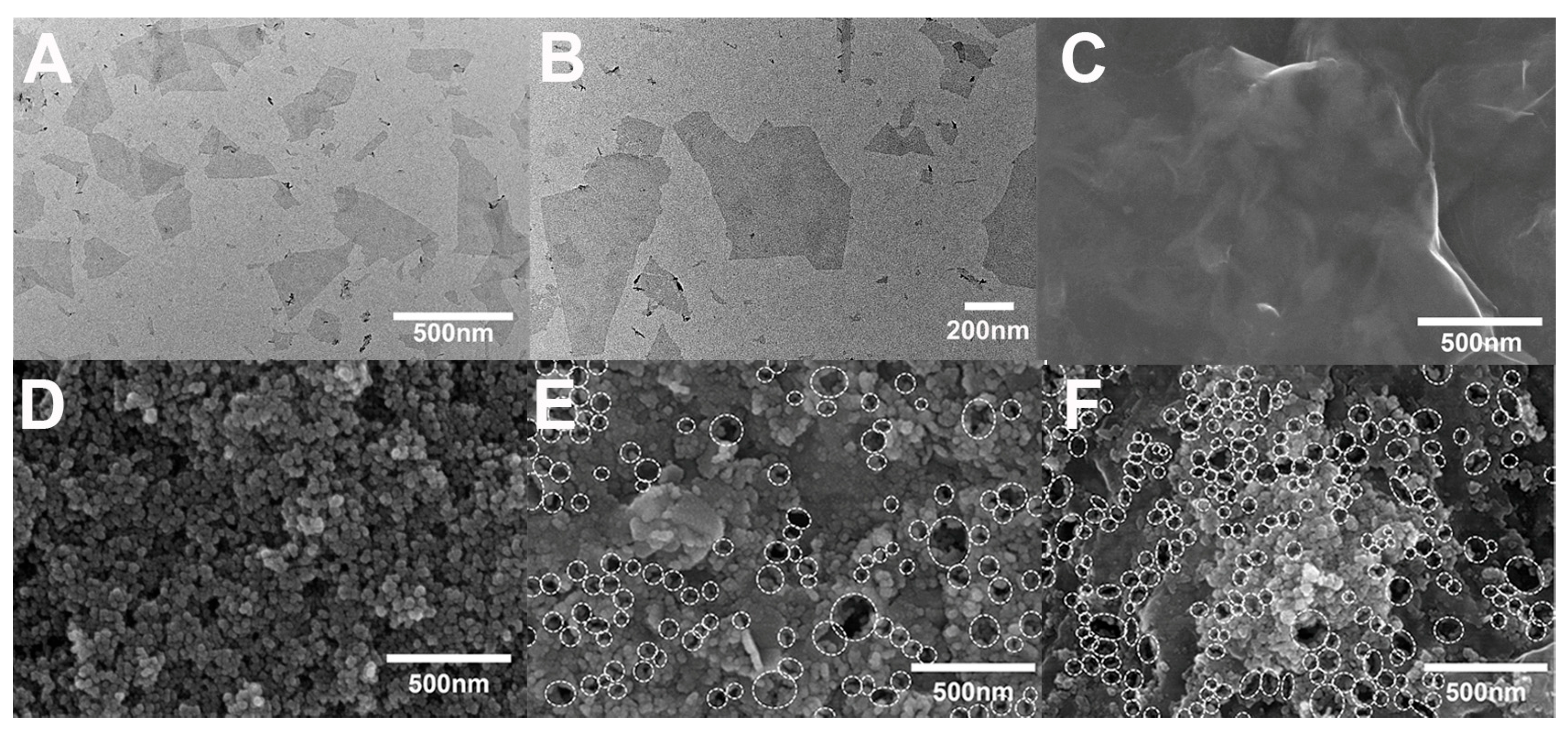
Figure 1 shows the morphological images of monolayer MXene (A–C), Fe3O4 (D), Fe3O4@MXene composites (E and F), and those obtained from TEM and SEM. The intercalated MXene exhibits a monolithic and highly dispersed morphology with lateral dimensions ranging from approximately 38 to 196 nm (Figure 1A,B). Additionally, Figure 1C, as revealed by SEM, shows that the surface of single-layer MXene is smooth, with numerous wrinkles. This structural configuration endows MXene with an enlarged specific surface area, which is advantageous for enhancing interfacial interactions. With a spherical morphology and diameters of approximately 18 to 29 nm, the Fe3O4 nanoparticles are densely anchored onto the MXene surface (Figure 1D–F). These results indicate that the hydrothermal treatment effectively facilitates the in situ growth of Fe3O4 on the MXene surface. Thus, the negative surface charge state of MXene is altered. The resulting dense architecture forms a porous structure throughout the composite, with pore sizes ranging from approximately 4.16 to 59.20 nm. This porous network offers abundant physical adsorption sites for GOD immobilization.
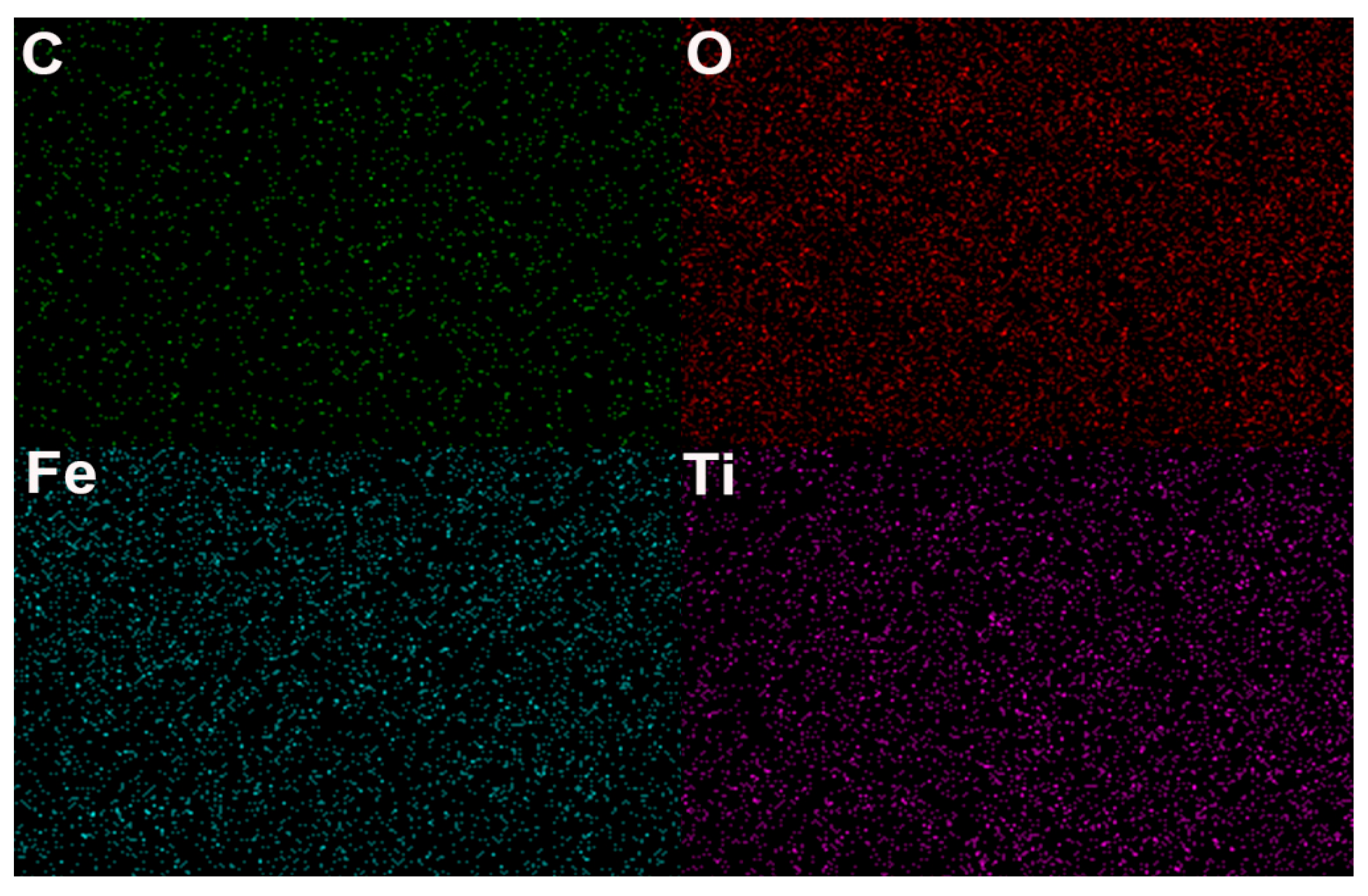
Figure 2 presents the Energy-Dispersive Spectroscopy (EDS) mapping of the Fe3O4@MXene nanocomposite. The EDS analysis reveals homogeneous spatial distributions of C, O, and Ti elements originating from the MXene substrate, along with Fe signals corresponding to the loaded Fe3O4 nanoparticles. Notably, the modified MXene nanosheets show a uniform iron distribution (Figure 2), confirming that the in situ hydrothermal treatment achieved homogeneous surface modification of the MXene nanosheets.
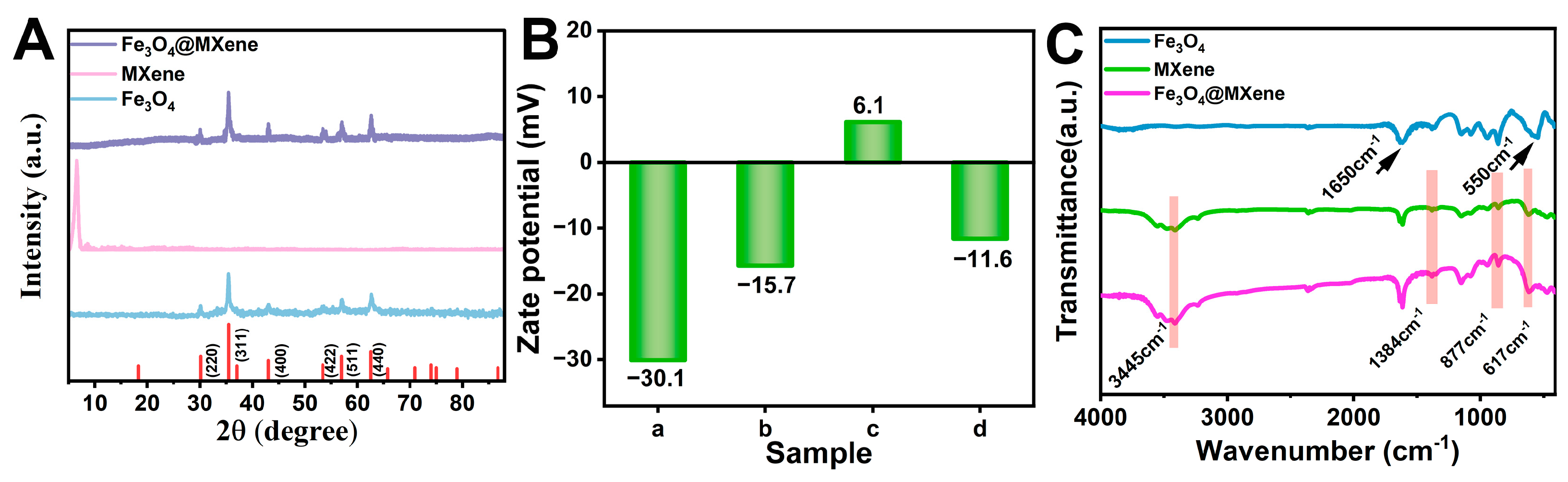
Figure 3A displays the X-ray diffraction (XRD) patterns of Fe3O4, MXene, and the Fe3O4@MXene composite. For Fe3O4, distinct diffraction peaks are observed at 2θ = 30.09°, 35.42°, 43.05°, 56.94°, and 62.51°, which correspond to the (220), (311), (400), (511), and (440) crystal planes of magnetite (JCPDS No. 19-0629), respectively [25]. For MXene, a characteristic peak appears at 2θ = 6.9°, indexed to the (002) plane. The absence of the Al (104) peak near 39.1° confirms the complete removal of the Al layer and successful synthesis of MXene [13,16]. In the case of the Fe3O4@MXene composite, all characteristic diffraction peaks of Fe3O4 are retained. The disappearance of the MXene-associated (002) plane indicates that Fe3O4 nanoparticles in the outer layer effectively suppress restacking of MXene nanosheets, endowing the MXene material with a two-dimensional open structure [26]. This two-dimensional open structure provides a favorable environment for enzyme immobilization.
Figure 3B displays the surface charge properties of MXene, GOD, Fe3O4@MXene, and Fe3O4@MXene-GOD. The exfoliated single-layer MXene nanosheets exhibit a zeta potential of −30.1 mV. However, GOD with an isoelectric point of approximately 4.2 exhibits a negative charge at pH 7.4 (zeta potential = −15.7 mV). Under these conditions, strong electrostatic repulsion exists between MXene nanosheets and GOD, which prevents enzyme immobilization on the material surface efficiently. Following modification with Fe3O4, the zeta potential of the composite shifted to +6.1 mV, reflecting a positively charged surface. This shift indicates that the in situ growth of Fe3O4 effectively tuned the surface charge characteristics of MXene, thereby mitigating electrostatic repulsion between the electrode and the enzyme. After the interaction between GOD and Fe3O4@MXene, it can be seen in Figure 3B that the zeta potential of Fe3O4@MXene-GOD shifted to −11.6 mV. The results were similar to those obtained with free GOD, confirming the successful immobilization of GOD on the Fe3O4@MXene substrate.
Figure 3C presents the Fourier transform infrared (FTIR) spectra of Fe3O4, MXene, and the Fe3O4@MXene composite, which reflect their surface functional groups. For bare Fe3O4 nanoparticles (blue curve), a broad absorption band in the range of 550–1650 cm−1 is observed, corresponding to Fe-O stretching vibrations characteristic of the metal oxide. After etching, the surface of MXene (green curve) is typically terminated with abundant -OH and =O groups. Furthermore, the infrared absorption bands observed at 3445 cm−1 and 1384 cm−1 in MXene are assigned to the broad O-H stretching vibration and C=O stretching vibration, respectively. The broad peaks located around 617 cm−1 and 877 cm−1 are attributed to combined vibrations of Ti-O and Ti-O-Ti bonds, indicating bond formation within the MXene interlayers [27,28,29,30,31]. In the case of the Fe3O4@MXene composite (pink curve), the FTIR spectrum retains all characteristic features of MXene and additionally exhibits the Fe–O vibration band, providing clear evidence for the successful anchoring of Fe3O4 nanoparticles onto the MXene substrate.
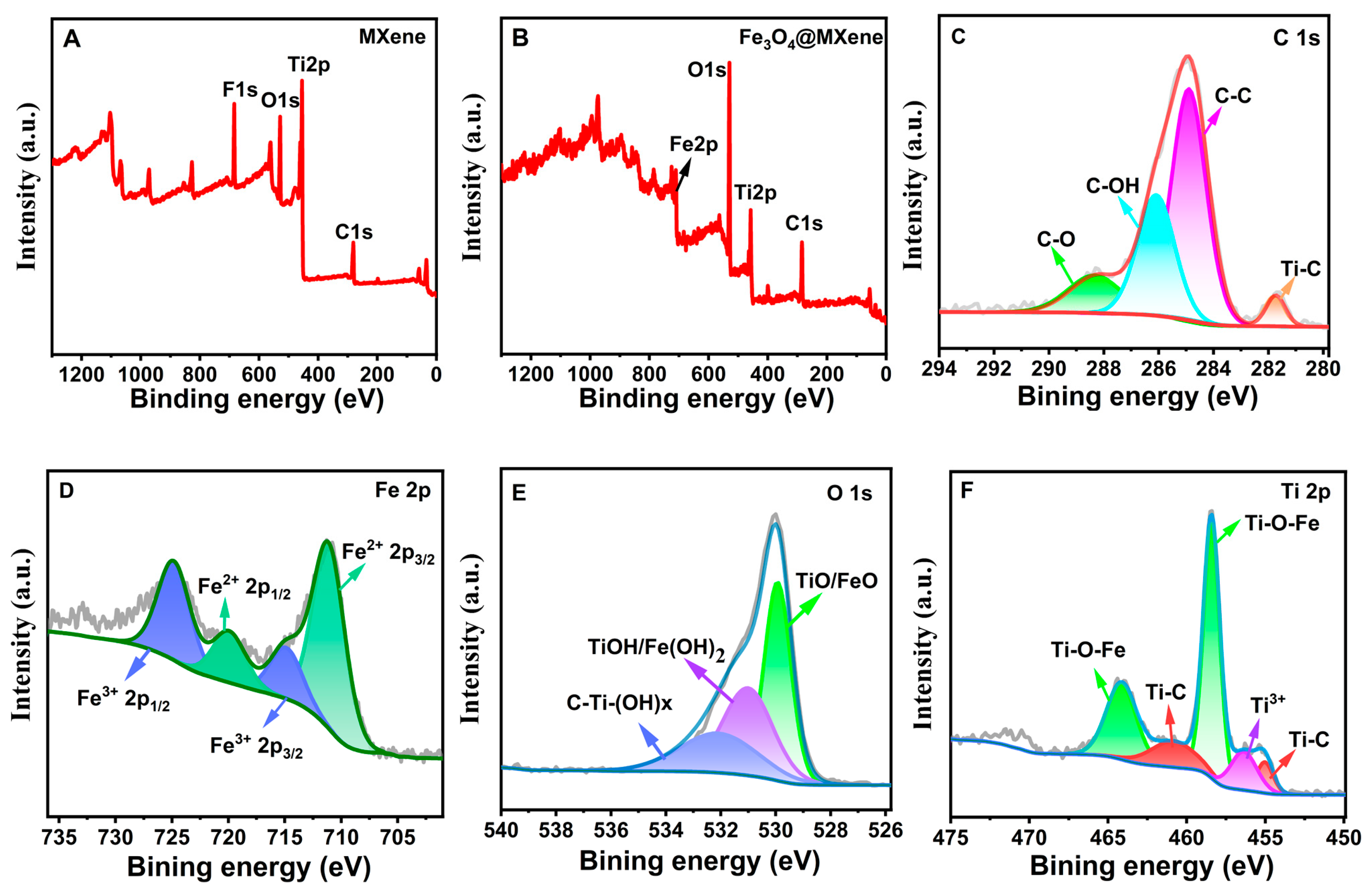
XPS analysis was performed to investigate the chemical composition and surface modifications of MXene and Fe3O4@MXene (Figure 4A,B). The high-resolution XPS spectra of Fe3O4@MXene revealed characteristic peaks corresponding to C 1s, O 1s, Ti 2p, and Fe 2p. The high-resolution C 1s spectrum of Fe3O4@MXene (Figure 4C) was deconvoluted into several peaks at 281.8 eV, 284.9 eV, 286.1 eV, and 288.3 eV, assigned to C–Ti, C–C, C–OH, and C=O species, respectively. Notably, Fe3O4@MXene exhibited a distinct peak at 288.3 eV corresponding to C=O. This suggests chemical binding between Fe3O4 and MXene [32,33]. The high-resolution Fe 2p spectrum (Figure 4D) exhibited characteristic doublet peaks corresponding to Fe 2p3/2 and Fe 2p1/2 core levels. The deconvoluted peaks at binding energies of 711.2 eV and 715.0 eV are assigned to Fe2+ and Fe3+ species in the Fe 2p3/2 region, respectively, while those at 720.1 eV and 725.0 eV are attributed to Fe2+ and Fe3+ in the Fe 2p1/2 region. It is noteworthy that the higher binding energy peaks (715.0 eV and 725.0 eV) originate specifically from the Fe3+ within the Fe3O4 structure, confirming the coexistence of mixed-valence iron states in the composite material [34]. The high-resolution O 1s spectrum (Figure 4E) reveals three deconvoluted peaks at binding energies of 529.9 eV, 531.1 eV, and 532.1 eV, corresponding to Ti–O/Fe–O bonds, Ti–OH/Fe(OH)2 groups, and C–Ti–(OH)x bonds, respectively [32]. As shown in Figure 4F, the high-resolution Ti 2p spectrum reveals multiple chemical states. The peaks located at 455.1 eV and 460.7 eV are assigned to Ti–C bonds, while the peak at 456.3 eV corresponds to Ti3+ species. Notably, the peaks observed at 458.4 eV and 464.2 eV are attributed to Ti–O–Fe bonding configurations. The enhancement of the characteristic Fe-related peaks attests to the successful in situ generation of Fe3O4 on the MXene surface, ruling out mere electrostatic adsorption and pointing to robust interfacial interactions between the nanoparticles and MXene nanosheets [32,35].

3.2. Direct Electrochemistry of Fe3O4@MXene/GOD/Nafion/GCE

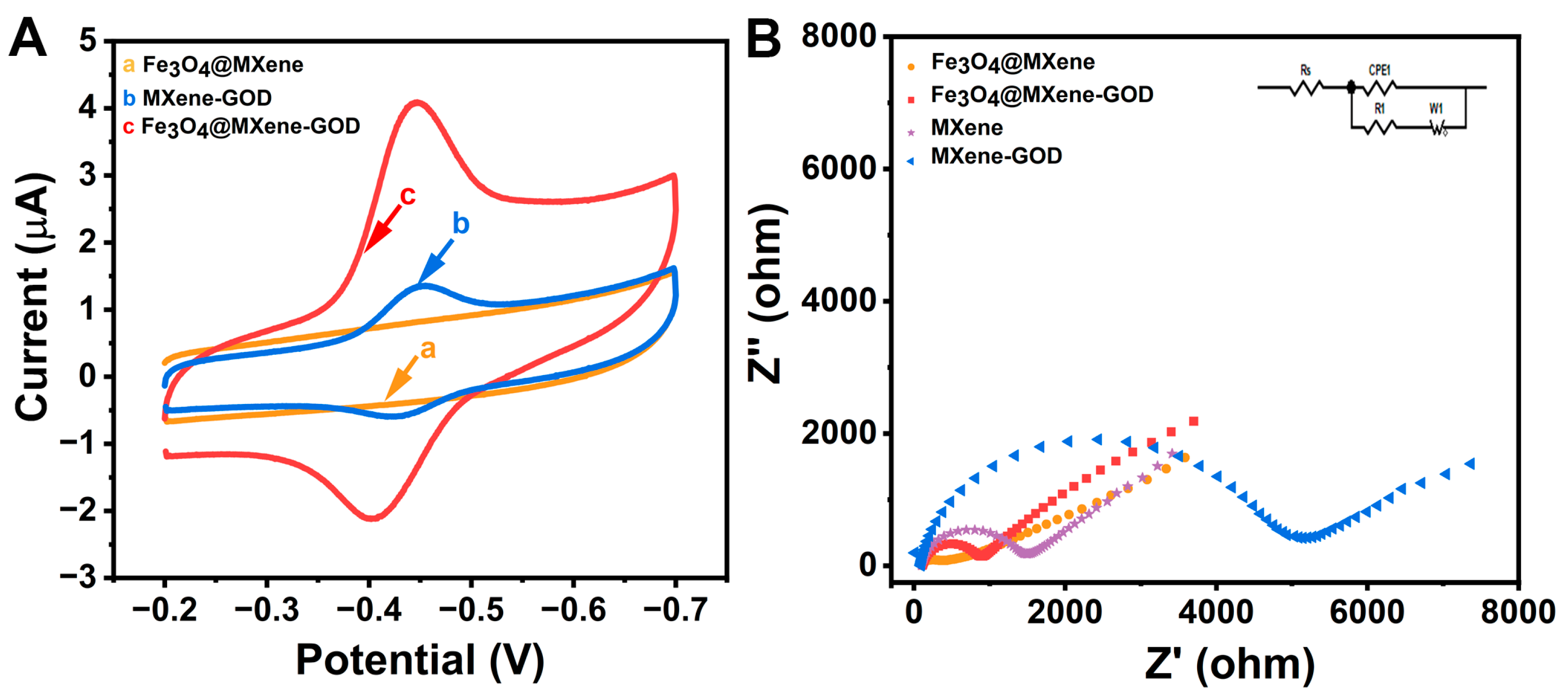
Figure 5A displays cyclic voltammetry (CV) measurements of different material-modified electrodes in N2-saturated 0.1 M phosphate-buffered solution (PBS, pH 7.4) at a scan rate of 100 mV/s. As shown in Figure 5, no redox peaks are observed for Fe3O4@MXene/Nafion/GCE (curve a), suggesting the absence of intrinsic electroactivity of the Fe3O4@MXene nanocomposite. Moreover, when GOD is directly immobilized onto the electrode surface, it lacks efficient electrical communication with the electrode [36]. This leads to negligible electrochemical activity in DET processes. In contrast, well-defined redox peaks appear for both Fe3O4@MXene/GOD/Nafion/GCE (curve c) and MXene/GOD/Nafion/GCE (curve b). The formal potentials (E0 = Epa/2 + Epc/2) versus Ag/AgCl were calculated to be –0.423 V, respectively. These values correspond closely to the standard electrode potential of the FAD/FADH2 redox couple at pH 7.0 [37], confirming that both Fe3O4@MXene and MXene promote direct electron transfer for GOD. Moreover, notable differences in the electron transfer behavior between the two composite electrodes can be discerned from the comparative analysis. CV measurements revealed a peak current of 4.08 μA for the Fe3O4@MXene/GOD/Nafion/GCE electrode, which is approximately three times greater than that recorded for the MXene/GOD/Nafion/GCE electrode (1.34 μA), demonstrating that Fe3O4@MXene greatly enhances the electron transfer efficiency of GOD at the electrode interface. The surface coverage (Γ) of GOD on the modified electrodes was calculated using Equation (1), where Ip, A, R, n, T, and F represent peak current, electrode surface area (0.72 cm2), gas constant (8.314 J·K−1·mol−1), electron number (2), temperature (298.15 K), and Faraday constant (96,500 C·mol−1) [38], respectively. The calculated Γ values for MXene/GOD/Nafion/GCE and Fe3O4@MXene/GOD/Nafion/GCE were 5.99 × 10⁻¹¹ mol·cm−2 and 1.70 × 10⁻¹⁰ mol·cm−2, respectively. These values align closely with the theoretical Γ value of GOD (1.7 × 10⁻¹⁰ mol·cm−2) [39], thus verifying the participation of a thin-layer GOD in the electrochemical reaction. It is worth noting that the higher surface coverage observed for the Fe3O4@MXene/GOD/Nafion/GCE further validates that Fe3O4@MXene, with its large specific surface area and excellent conductivity, serves as a critical factor in improving GOD performance. This enhanced conductivity not only accelerates electron transfer kinetics but also optimizes the electroactive environment for enzyme immobilization, thereby amplifying the redox signal intensity [40].
I p = n 2 F 2 A Γ v 4 R T
Figure 5B presents the Nyquist plots of four electrodes, and the equivalent circuit model used for EIS fitting is shown by the illustration, which includes the ohmic resistance of the electrolyte (Rs), a double-layer capacitance (CPE1), the charge-transfer resistance (R1), and the Warburg impedance (W1) [41,42]. The red and blue curves correspond to the two GOD-modified electrodes, respectively. The charge-transfer resistance (Rct) of the Fe3O4@MXene/Nafion/GCE electrode after GOD immobilization is 812.5 Ω, which is greater than that of the Fe3O4@MXene/Nafion/GCE (361.8 Ω), confirming the successful loading of GOD onto the Fe3O4@MXene composite. Further comparison with MXene-based electrodes shows that the Rct values for MXene/Nafion/GCE and MXene/GOD/Nafion/GCE are 1431 Ω and 4767 Ω, respectively. In comparison, the Fe3O4@MXene-based electrodes exhibit significantly lower Rct values than their MXene-based counterparts, both with and without GOD modification. These trends are consistent with the CV data (Figure 5A), suggesting that the Fe3O4@MXene composite possesses a remarkable ability to promote electron transport, thereby leading to a significant enhancement in the electron transfer efficiency of GOD at the electrode surface.
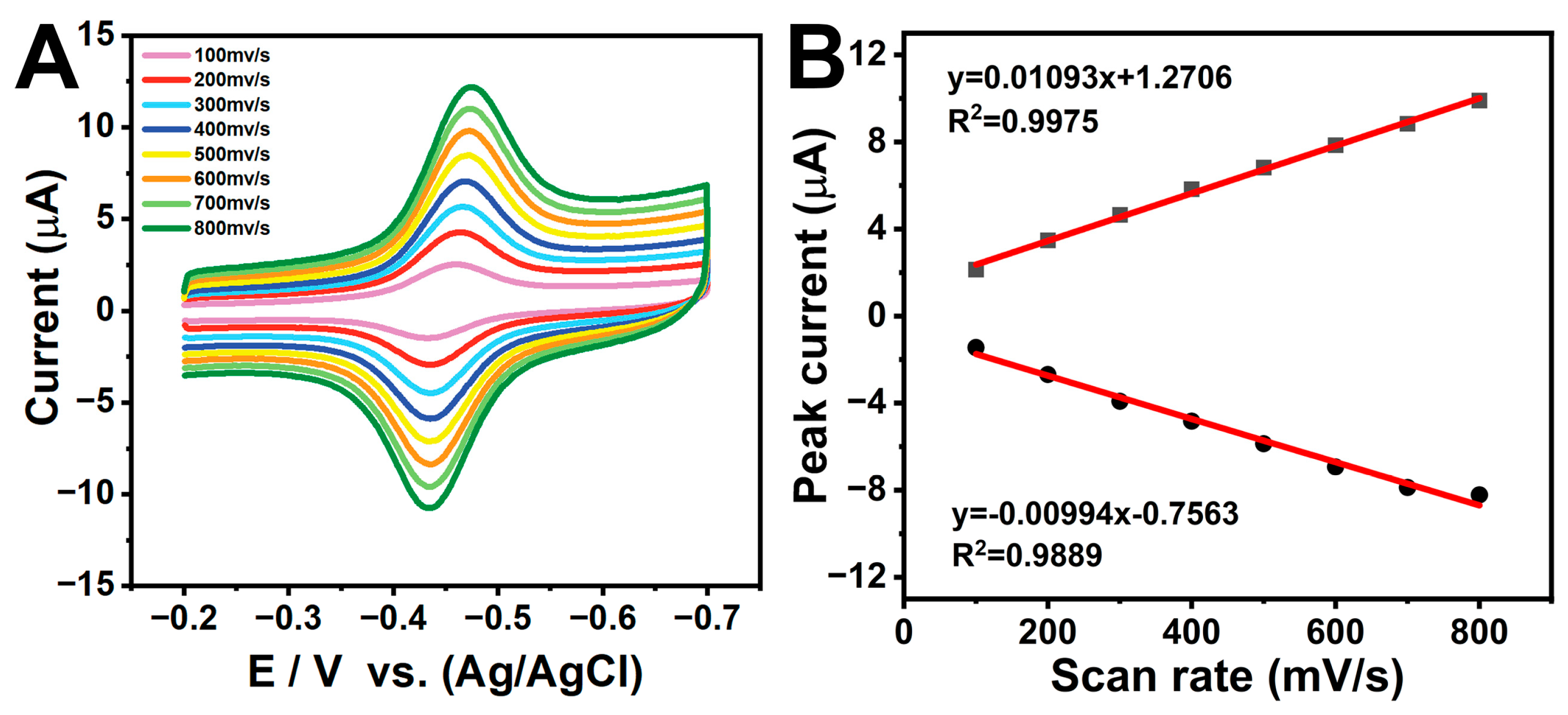
Figure 6 demonstrates the effect of varying scan rates on the electrochemical behavior of the Fe3O4@MXene/GOD/Nafion/GCE in N2-saturated 0.1 M PBS (pH 7.4). As shown in Figure 6B, both the cathodic (Ipc) and anodic (Ipa) peak currents exhibit linear increases with scan rates ranging from 100 to 800 mV·s−1, indicating a surface-controlled electrochemical process [43]. Additionally, the apparent heterogeneous electron transfer rate constant (kₛ) was calculated using Laviron’s equation (Equation (2)) [44]:
ln k s = α ln 1 α + 1 α ln α ln R T n F v α 1 α n F Δ E p R T
where R is the gas constant, T is the temperature (293 K), α is the electron transfer coefficient, n is the number of electrons transferred, and F is the Faraday constant. The values of n and α were set as 2 and 0.5, respectively [45]. ΔEp is the peak potential separation. The kₛ values of Fe3O4@MXene/GOD/Nafion/GCE and MXene/GOD/Nafion/GCE were determined as 9.57 s−1 and 7.57 s−1, respectively (Figure S1). Notably, the ks value of Fe3O4@MXene/GOD/Nafion/GCE demonstrates a 1.26-fold enhancement compared to that of MXene/GOD/Nafion/GCE, confirming superior electron transfer kinetics in the Fe3O4@MXene composite. Such remarkably high ks values signify exceptionally rapid electron transport in the Fe3O4@MXene-based system, which primarily originates from the enhanced electrical conductivity of Fe3O4@MXene.
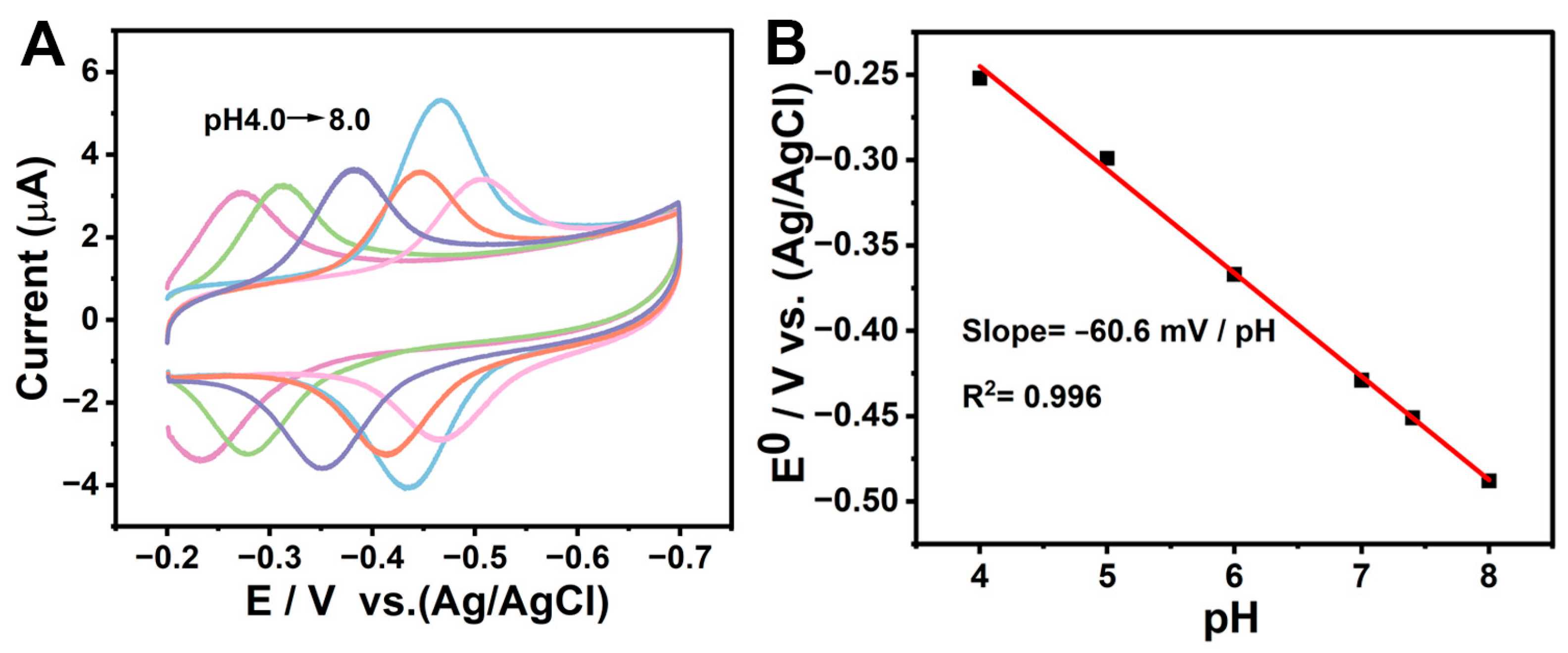
Figure 7A shows the cyclic voltammetry (CV) curves of the Fe3O4@MXene/GOD/Nafion/GCE in N2-saturated PBS solutions at varying pH values (4.0–8.0) with a scan rate of 100 mV·s−1, aiming to investigate its electrochemical reaction mechanism [46,47,48]. As observed, both the anodic peak potential (Epa) and cathodic peak potential (Epc) shift negatively as pH increases from 4.0 to 8.0, demonstrating pH-dependent redox behavior. Figure 7B plots the formal potential (E0 = Epa/2 + Epc/2) as a function of pH, demonstrating a well-defined linear relationship between E0 and pH values. A linear relationship is obtained with the equation E0 = −0.061 pH − 0.0026 (R2 = 0.996), yielding a slope of −60.6 mV/pH. This value closely matches the theoretical Nernstian slope of −58.6 mV/pH for a two-electron and two-proton transfer process, confirming the involvement of two protons and two electrons in the electrochemical reaction [49].

3.3. Optimization of Experimental Conditions

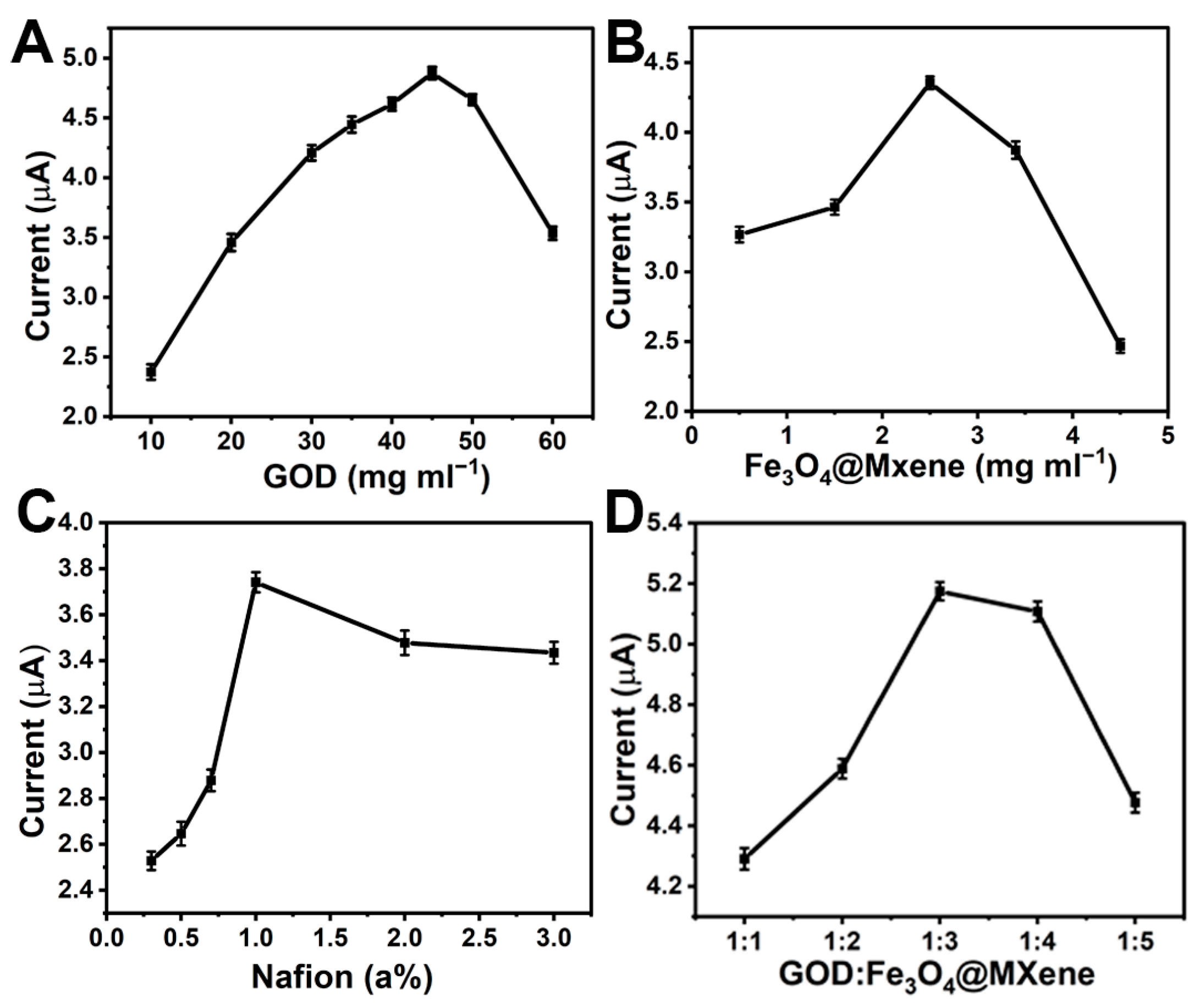
A systematic optimization of the preparation conditions was carried out in the fabrication process of the electrochemical sensor (Figure 8). As shown in Figure 8A, the maximum current response was observed at a GOD concentration of 45 mg·mL−1. Lower concentrations led to insufficient enzyme loading, reducing catalytic efficiency. A further increase in GOD concentration resulted in a decline in current response, primarily due to its non-conductive nature, which hindered electronic communication. Similarly, the concentration of the Fe3O4@MXene suspension significantly affected the current response (Figure 8B). The current increased gradually with higher concentrations of Fe3O4@MXene, reaching a maximum at 2.5 mg·mL−1. Beyond this point, the current decreased, mainly owing to the inherent lack of electroactivity of Fe3O4@MXene at high concentrations, which impeded electron transfer between GOD and the electrode surface.
The influence of Nafion content is shown in Figure 8C. The optimal peak current occurred at 1% Nafion. Lower Nafion content failed to fully immobilize GOD on the electrode surface, while higher concentrations thickened the Nafion film, obstructing electron transport and reducing peak currents. It is noteworthy that the mixing ratio of the GOD solution and the Fe3O4@MXene suspension also significantly influenced the electrochemical performance (Figure 8D). An inadequate amount of Fe3O4@MXene resulted in reduced conductivity, which led to a weaker current signal. The strongest response was achieved at a mixing ratio of 1:3. However, a further increase in the proportion of Fe3O4@MXene caused a decrease in the current response. This can be attributed to the dilution of the enzyme concentration at higher Fe3O4@MXene ratios, thereby reducing the loading of active GOD. Based on these findings, the optimized parameters (45 mg·mL−1 GOD, 2.5 mg·mL−1 Fe3O4@MXene, 1% Nafion, and 1:3 GOD/Fe3O4@MXene ratio) were selected for subsequent sensor fabrication.

3.4. Electrocatalytic Study of the Fe3O4@MXene/GOD/Nafion/GCE

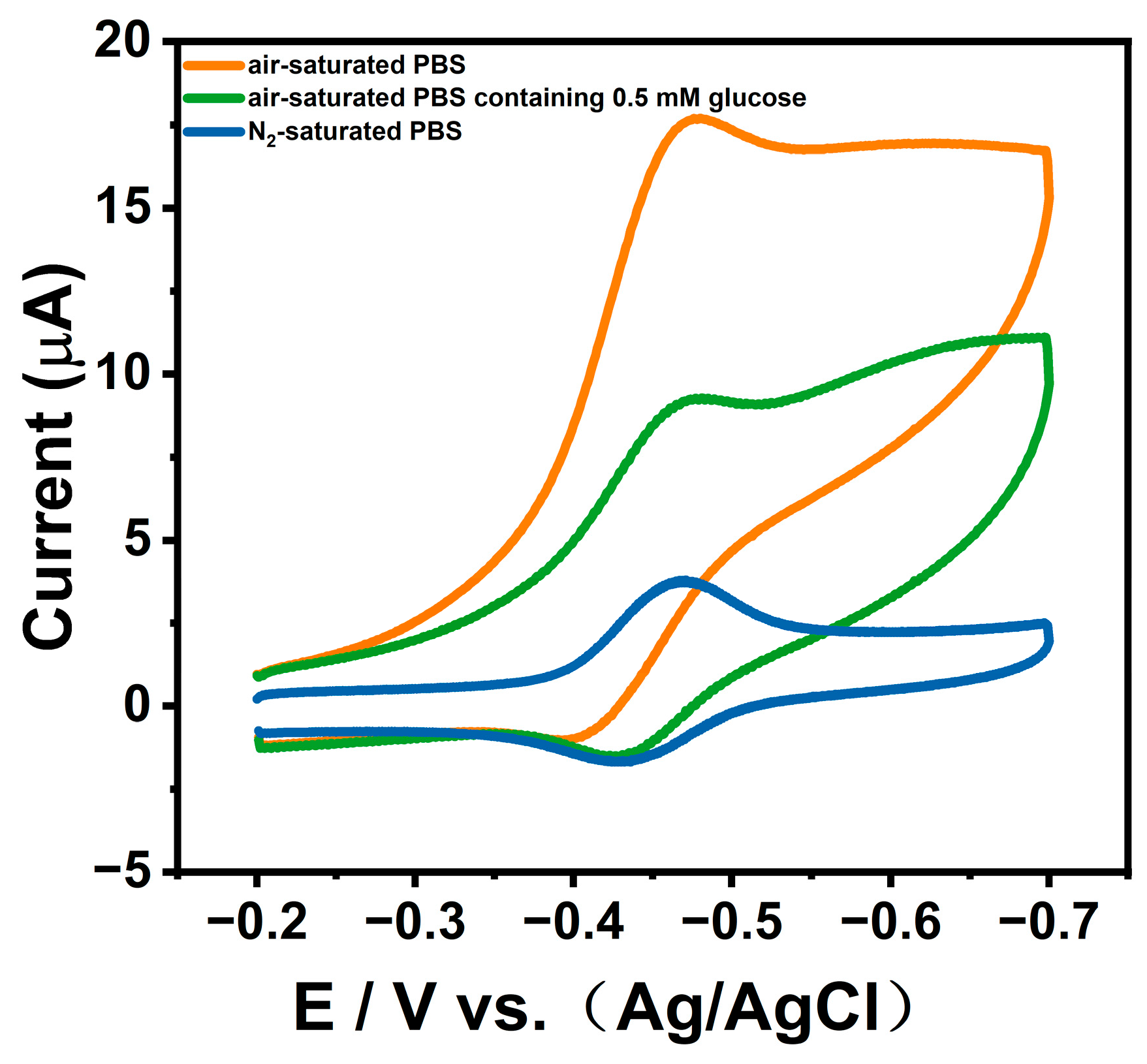
Figure 9 shows that, compared to the cyclic voltammogram (CV) obtained in N2-saturated PBS, the Fe3O4@MXene/GOD/Nafion/GCE in air-saturated PBS shows a markedly increased anodic current and a decreased cathodic current, along with a distinct anodic peak. This is because dissolved oxygen (O2) effectively re-oxidizes the reduced glucose oxidase (GOD-FADH2) to its active oxidized form (GOD-FAD), thereby promoting the oxidation process as outlined in Equation (4). When 0.5 mM glucose is introduced into the air-saturated PBS, it undergoes enzymatic oxidation to gluconolactone, consuming GOD-FAD and generating GOD-FADH2. As a result, the reduction process (Equation (5)) is enhanced. At the same time, the surface concentration of oxidized GOD decreases, and dissolved O2 is progressively depleted during the reaction, which suppresses the re-oxidation of GOD-FADH2 (Equations (3) and (4)). Consequently, relative to the glucose-free system, the cathodic current increases while the anodic current decreases. Thus, the anodic current response is directly dependent on the glucose concentration, forming the basis for quantitative detection [6,37,44].
GOD(FAD) + 2H+ + 2e ↔ GOD(FADH2)
GOD(FADH2) + O2 → GOD(FAD) + H2O2
Glucose + GOD (FAD) ↔ Gluconolactone + GOD (FADH2)

3.5. Detection of Glucose by Fe3O4@MXene/GOD/Nafion/GCE

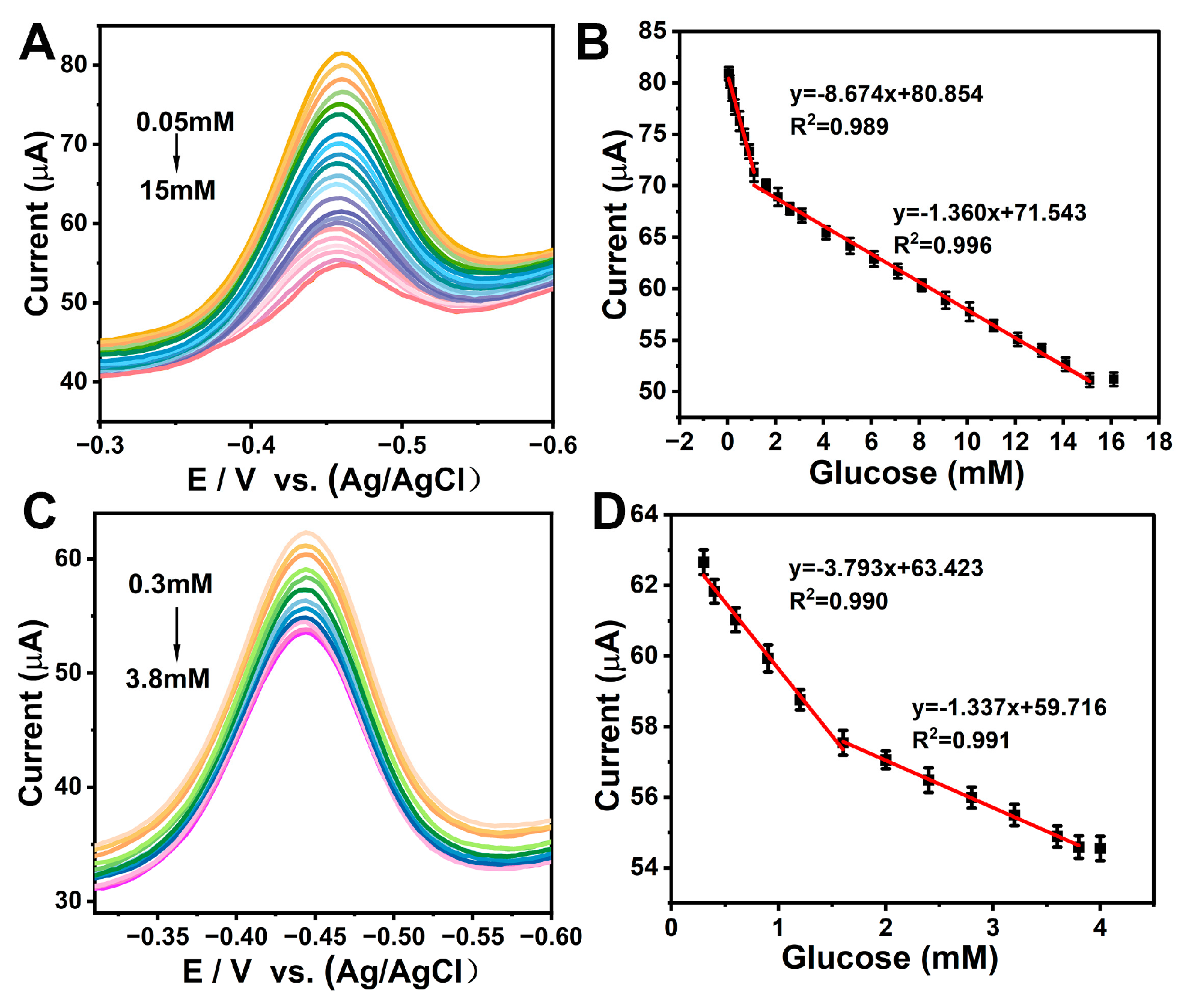
To further investigate the relationship between the electrocatalytic current and glucose concentration for the Fe3O4@MXene/GOD/Nafion/GCE glucose sensor, differential pulse voltammetry (DPV) measurements were conducted in air-saturated 0.1 M PBS (pH 7.4) over a potential range of −0.3 to −0.6 V (Figure 10). As shown in Figure 10A, the oxidation peak current at −0.450 V progressively decreases with increasing glucose concentration. The resulting calibration curve exhibits two distinct linear ranges: 0.05–1.1 mM and 1.1–15 mM, which are well described by the equations y = −8.674x + 80.854 (R2 = 0.989) and y = −1.360x + 71.543 (R2 = 0.996), respectively. A limit of detection (LOD) of 38 μM (S/N = 3) was achieved, with sensitivities of 120.47 μA·mM−1·cm−2 and 18.89 μA·mM−1·cm−2 corresponding to the low and high-concentration ranges, respectively (Figure 10B). For direct comparison, the glucose sensing performance of the MXene/GOD/Nafion/GCE was also evaluated under identical experimental conditions. As presented in Figure 10C,D, the MXene-based biosensor shows two narrower linear ranges of 0.3–1.6 mM and 1.6–3.8 mM, with a higher LOD of 174 μM (S/N = 3) and lower sensitivities of 52.68 μA·mM−1·cm−2 and 18.56 μA·mM−1·cm−2, respectively. In contrast, the Fe3O4@MXene/GOD/Nafion/GCE biosensor exhibits a significantly wider linear detection range, lower LOD, and higher sensitivity. Moreover, its extended linear range—compared to the MXene/GOD/Nafion/GCE sensor—fully encompasses the clinically relevant blood glucose concentration range of 3.9–6.1 mmol/L, and concentrations greater than 11.1 mmol/L. This enables the direct detection of blood glucose without dilution, highlighting its enhanced catalytic efficiency and superior analytical performance for glucose sensing [50,51].
When compared with other glucose sensors listed in Table 1, the developed sensor demonstrated a wider detection range, a lower detection limit, and higher sensitivity. In addition, its higher kₛ value relative to those of the listed sensors reflects a faster electron transfer rate, further highlighting the superior analytical performance of the proposed sensor. The enhanced performance is attributed to the synergistic effect between the two components in the composite. MXene offers a large specific surface area, whereas Fe3O4 contributes good biocompatibility and high electrical conductivity. The combination of these properties promotes direct electron transfer between GOD and the electrode surface, leading to a significant improvement in the electrocatalytic efficiency of the sensor.

3.6. Study of Analytical Signal Selectivity, Stability, Reproducibility and Repeatability

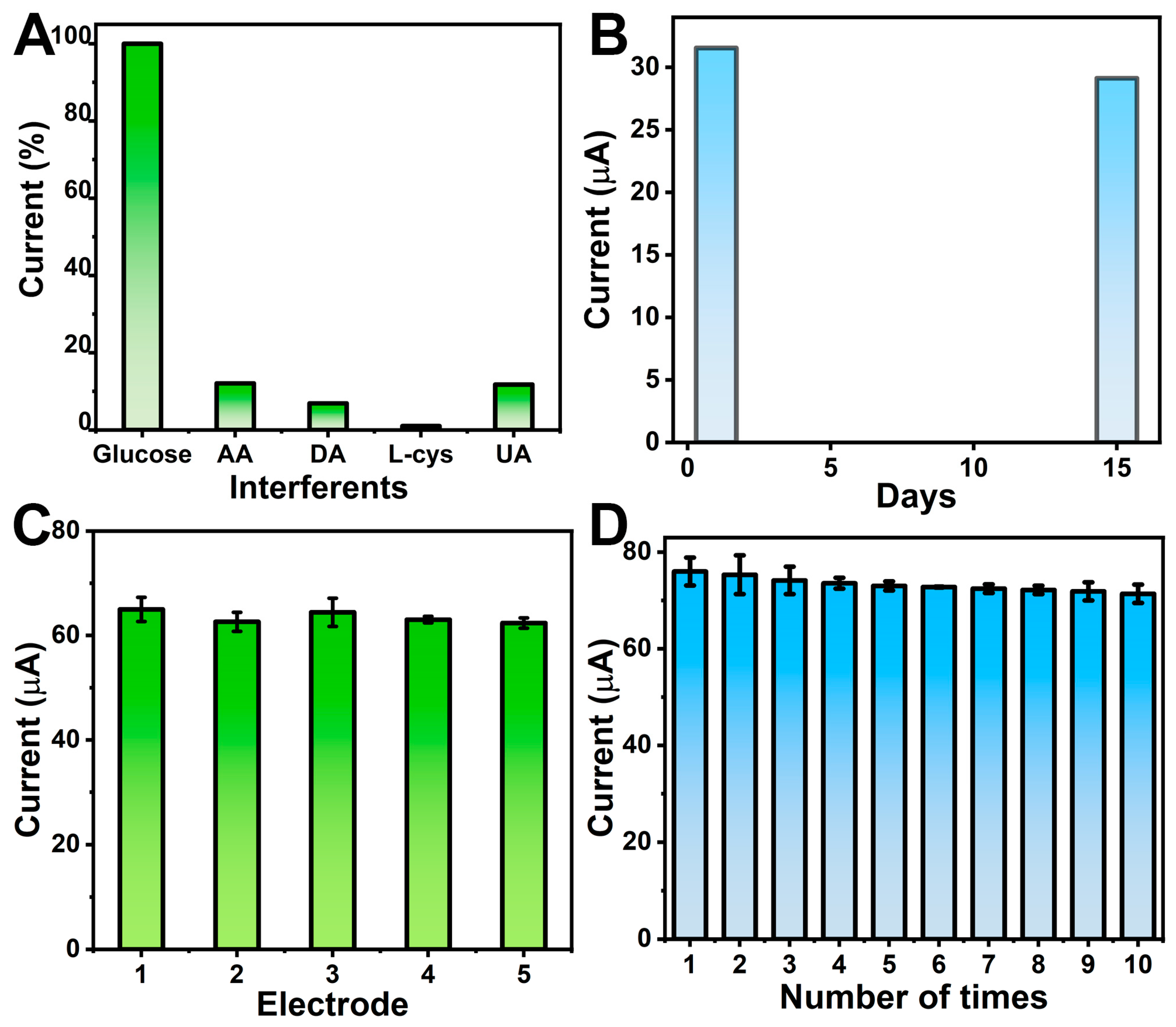
The selectivity of the sensor was further investigated in the presence of potential interfering substances. As shown in Figure 11A, when 1 mM uric acid (UA), ascorbic acid (AA), dopamine (DA), and L-Cysteine (L-cys) were added to air-saturated 0.1 M PBS (pH 7.4) containing 0.5 mM glucose, the interfering substances exhibited negligible effects on the glucose-derived current signal. This confirms the high selectivity of the developed sensor for glucose detection. The long-term stability was evaluated by testing the sensor after 15 days of storage at 4 °C. The electrochemical response current retained 92.3% of its initial value (Figure 11B), confirming excellent stability.
To assess the reproducibility of the Fe3O4@MXene/GOD/Nafion/GCE sensor, five independently prepared electrodes were tested under the same conditions for the detection of 0.5 mM glucose. The results showed a relative standard deviation (RSD) of 2.4% (Figure 11C). Additionally, the repeatability was evaluated by performing ten consecutive measurements of 0.1 mM glucose using the same sensor (Figure 11D), yielding an RSD of 2.04%. These results confirm that the Fe3O4@MXene/GOD/Nafion/GCE sensor exhibits excellent reproducibility and repeatability.

3.7. Real Sample Analysis

To validate the practical application of the glucose sensor in clinical analysis, artificial serum was prepared as described in the literature [62,63], and the Fe3O4@MXene/GOD/Nafion/GCE was employed to detect glucose in artificial serum samples. As summarized in Table 2, recovery tests were performed by spiking the artificial serum samples with varying concentrations of glucose. The recovery rates ranged from 101.40% to 103.48% with RSD values between 1.93% and 2.68%, demonstrating high reproducibility. Furthermore, the glucose measurements obtained using the fabricated sensor were compared with those from a commercial Sinocare glucometer (Figure S2), showing close agreement. These results confirm the reliability and accuracy of the Fe3O4@MXene/GOD/Nafion/GCE electrode, making it suitable for practical clinical analysis of human samples.

4. Conclusions

In this work, we developed a Fe3O4@MXene nanocomposite by in situ growth of Fe3O4 nanoparticles on monolayer MXene via a hydrothermal method. The Fe3O4 modification effectively modulated the strong negative surface charge of MXene and introduced a porous architecture on the nanosheets, which not only mitigated electrostatic repulsion with GOD but also facilitated high enzyme immobilization. Benefiting from the large specific surface area of MXene and the high conductivity and biocompatibility of Fe3O4, the resulting sensor exhibited enhanced electron transfer efficiency. The Fe3O4@MXene/GOD/Nafion/GCE electrode showed a wide linear range from 0.05 to 15 mM, a low detection limit of 38 μM (S/N = 3), and a high sensitivity of 120.47 μA·mM−1·cm−2, exhibiting good catalytic performance. Moreover, the sensor achieved satisfactory recovery in artificial serum samples, accuracy comparable to commercial glucometers, excellent selectivity, reproducibility, and storage stability. This Fe3O4@MXene-based platform offers a reliable strategy for precise glucose monitoring in clinical diagnostics, demonstrating promising potential for practical application.

Supplementary Materials

The following supporting information can be downloaded at https://www.mdpi.com/article/10.3390/chemosensors14010019/s1, Figure S1. (A) Cyclic voltammograms of the MXene/GOD/Nafion/GCE electrode at different scan rates. (B) The calibration curves of the peak current vs. scan rates; Figure S2. The test result graph of glucose levels in three artificial sera using a commercial blood glucose meter.

Author Contributions

Investigation, Writing—original draft, Validation, Investigation, Formal analysis, Data curation, Conceptualization, Y.Y.; Writing—review and editing, Supervision, Resources, Methodology, Conceptualization, D.L.; formal analysis, methodology, C.Z.; Writing—review and editing, Software, Resources, Methodology, L.Z.; Writing—review and editing, Supervision, Resources, Project administration, X.C. All authors have read and agreed to the published version of the manuscript.

Funding

This research was funded by the 2024 College Students’ Innovation and Entrepreneurship Training Program of Liaoning Provincial Department of Education, grant number X202410166221, and College Students’ Innovation and Entrepreneurship Training Program of Shenyang Normal University, grant number 2024100112.

Institutional Review Board Statement

Not applicable.

Informed Consent Statement

Not applicable.

Data Availability Statement

The original contributions presented in this study are included in the article/Supplementary Material. Further inquiries can be directed to the corresponding authors.

Conflicts of Interest

The authors declare no conflicts of interest.

References

  1. Han, D.K.; Li, C.A.; Song, S.H.; Cho, K.; Choi, J.-S.; Son, S.E.; Seong, G.H. Electroanalytical Biosensor Based on GOx/FCA/PEG-Modified SWCNT Electrode for Determination of Glucose. J. Anal. Sci. Technol. 2023, 14, 9. [Google Scholar] [CrossRef]
  2. Hao, Y.; Fang, M.; Xu, C.; Ying, Z.; Wang, H.; Zhang, R.; Cheng, H.-M.; Zeng, Y. A Graphene-Laminated Electrode with High Glucose Oxidase Loading for Highly-Sensitive Glucose Detection. J. Mater. Sci. Technol. 2021, 66, 57–63. [Google Scholar] [CrossRef]
  3. German, N.; Popov, A.; Ramanaviciene, A. The Development and Evaluation of Reagentless Glucose Biosensors Using Dendritic Gold Nanostructures as a Promising Sensing Platform. Biosensors 2023, 13, 727. [Google Scholar] [CrossRef]
  4. Celik Kazici, H.; Yayla, M. An Electrocatalyst for Detection of Glucose in Human Blood: Synergy in Pd–AuNPs/GOx/C Surfaces. Chem. Eng. Commun. 2019, 206, 1731–1742. [Google Scholar] [CrossRef]
  5. Rakhi, R.B.; Nayak, P.; Xia, C.; Alshareef, H.N. Novel Amperometric Glucose Biosensor Based on MXene Nanocomposite. Sci. Rep. 2016, 6, 36422. [Google Scholar] [CrossRef]
  6. Khalil Sultan, I.; Mahmoud, Z.H. Polyaniline/Titanium Phosphate as a Biosensor Detection of Glucose Performance. Int. J. Electrochem. Sci. 2024, 19, 100671. [Google Scholar] [CrossRef]
  7. Ahamed, M.I.; Khan, I.M.; Inamuddin; Rezakazemi, M. Silver Nanoparticles Anchored on Zinc Oxide Synthesized via Green Route as Scaffold for Enzymatic Biofuel Cell Application. Int. J. Hydrogen Energy 2024, 52, 681–693. [Google Scholar] [CrossRef]
  8. Lv, C.; Yang, X.; Wang, Z.; Ying, M.; Han, Q.; Li, S. Enhanced Performance of Bioelectrodes Made with Amination-Modified Glucose Oxidase Immobilized on Carboxyl-Functionalized Ordered Mesoporous Carbon. Nanomaterials 2021, 11, 3086. [Google Scholar] [CrossRef]
  9. German, N.; Ramanaviciene, A.; Ramanavicius, A. Dispersed Conducting Polymer Nanocomposites with Glucose Oxidase and Gold Nanoparticles for the Design of Enzymatic Glucose Biosensors. Polymers 2021, 13, 2173. [Google Scholar] [CrossRef]
  10. German, N.; Popov, A.; Ramanaviciene, A. Reagentless Glucose Biosensor Based on Combination of Platinum Nanostructures and Polypyrrole Layer. Biosensors 2024, 14, 134. [Google Scholar] [CrossRef]
  11. Feng, L. Ti3C2Tx MXene/Graphene/AuNPs 3D Porous Composites for High Sensitivity and Fast Response Glucose Biosensing. Microchem. J. 2023, 184, 108142. [Google Scholar] [CrossRef]
  12. Xiu, Z.; Li, X.; Zhang, M.; Huang, B.; Ma, J.; Yu, J.; Meng, X. Carbon-Coated Fe3O4 Nanocomposites Anchored on Ti3C2 Nanosheets for Enhanced Li-Storage. J. Alloys Compd. 2022, 921, 166068. [Google Scholar] [CrossRef]
  13. Yan, P.; Zuo, Z.; Hou, M.; Zhao, S.; Zhang, Z. MXene/Nano-Sized Carbide-Derived Carbon Composite with Enhanced Supercapacitive Performance in Acidic Electrolyte. Ionics 2023, 29, 411–418. [Google Scholar] [CrossRef]
  14. Su, X.; You, Q.; Zhuang, L.; Chang, Z.; Ge, M.; Yang, L.; Dong, W.-F. Bifunctional Electrochemical Biosensor Based on PB-MXene Films for the Real-Time Analysis and Detection of Living Cancer Cells. J. Pharm. Biomed. Anal. 2023, 234, 115479. [Google Scholar] [CrossRef]
  15. Huang, Y.; Long, Z.; Zou, J.; Luo, L.; Zhou, X.; Liu, H.; He, W.; Shen, K.; Wu, J. A Glucose Sensor Based on Surface Functionalized MXene. IEEE Trans. Nanotechnol. 2022, 21, 399–405. [Google Scholar] [CrossRef]
  16. Tong, X.; Jiang, L.; Ao, Q.; Lv, X.; Song, Y.; Tang, J. Highly Stable Glucose Oxidase polynanogel@MXene/Chitosan Electrochemical Biosensor Based on a Multi-Stable Interface Structure for Glucose Detection. Biosens. Bioelectron. 2024, 248, 115942. [Google Scholar] [CrossRef]
  17. Tang, M.; Yue, Z.; Li, J.; Sun, T.; Chen, C. Nanozymes Based on MXene Nanosheets Decorated with Pt Nanoparticles for Hyperthermal-Enhanced Cascade Catalytic Therapy of Tumors. ACS Appl. Nano Mater. 2023, 6, 14609–14616. [Google Scholar] [CrossRef]
  18. Peng, H.-P.; Liang, R.-P.; Zhang, L.; Qiu, J.-D. Facile Preparation of Novel Core–Shell Enzyme–Au–Polydopamine–Fe3O4 Magnetic Bionanoparticles for Glucosesensor. Biosens. Bioelectron. 2013, 42, 293–299. [Google Scholar] [CrossRef]
  19. Prabu, D.; Senthil Kumar, P.; Indraganti, S.; Sathish, S.; Aravind Kumar, J.; Vijai Anand, K. One-Step Fabrication of Amino-Functionalized Fe3O4@SiO2 Core-Shell Magnetic Nanoparticles as a Potential Novel Platform for Removal of Cadmium (II) from Aqueous Solution. Sustainability 2022, 14, 2290. [Google Scholar] [CrossRef]
  20. Chen, C.; Liu, Y.; Gu, H.-Y. Cellular Biosensor Based on Red Blood Cells Immobilized on Fe3O4 Core/Au Shell Nanoparticles for Hydrogen Peroxide Electroanalysis. Microchim. Acta 2010, 171, 371–376. [Google Scholar] [CrossRef]
  21. Pakapongpan, S.; Poo-Arporn, R.P. Self-Assembly of Glucose Oxidase on Reduced Graphene Oxide-Magnetic Nanoparticles Nanocomposite-Based Direct Electrochemistry for Reagentless Glucose Biosensor. Mater. Sci. Eng. C 2017, 76, 398–405. [Google Scholar] [CrossRef]
  22. Wang, Y.; Liu, X.; Xu, X.; Yang, Y.; Huang, L.; He, Z.; Xu, Y.; Chen, J.; Feng, Z. Preparation and Characterization of Reduced Graphene Oxide/Fe3O4 Nanocomposite by a Facile in-Situ Deposition Method for Glucose Biosensor Applications. Mater. Res. Bull. 2018, 101, 340–346. [Google Scholar] [CrossRef]
  23. Ghidiu, M.; Lukatskaya, M.R.; Zhao, M.-Q.; Gogotsi, Y.; Barsoum, M.W. Conductive Two-Dimensional Titanium Carbide ‘Clay’ with High Volumetric Capacitance. Nature 2014, 516, 78–81. [Google Scholar] [CrossRef]
  24. Jasim, H.A.; Dakhil, O.A.A. Sensitive Glucose Biosensor Based on ZnO/CuO Nanorods. J. Electron. Mater. 2023, 52, 697–706. [Google Scholar] [CrossRef]
  25. Shahsavari, M.; Sheikhshoaie, I.; Beitollahi, H. Electrochemical Sensor Based on Fe3O4/ZIF-4 Nanoparticles for Determination of Bisphenol A. J. Food Meas. Charact. 2023, 17, 1109–1118. [Google Scholar] [CrossRef]
  26. Xu, D.; Ma, K.; Chen, L.; Hu, Y.; Jiang, H.; Li, C. MXene Interlayer Anchored Fe3O4 Nanocrystals for Ultrafast Li-Ion Batteries. Chem. Eng. Sci. 2020, 212, 115342. [Google Scholar] [CrossRef]
  27. Qiao, Q.; Wang, J.; Long, K.; Li, L.; Chen, J.; Guo, Y.; Xu, Z.; Kuang, Y.; Ji, T.; Li, C. A Cascaded Enzyme System Based on the Catalase-like Activity of Ti3C2Tx MXene Nanosheets for the Efficient Combination Cancer Therapy. Nano Today 2024, 54, 102059. [Google Scholar] [CrossRef]
  28. Alkhudaydi, A.M.; Samy, B.A.; Danish, E.Y.; Lima, E.C.; Gabal, M.A.; Salam, M.A. Novel Sensitive Electrochemical Detection of Paracetamol Using Magnetite/MXene Electrode by Differential Pulse Voltammetry. Int. J. Electrochem. Sci. 2024, 19, 100797. [Google Scholar] [CrossRef]
  29. Xu, J.; Tang, S.; Liu, D.; Bai, Z.; Xie, X.; Tian, X.; Xu, W.; Hou, W.; Meng, X.; Yang, N. Rational Design of Hollow Fe3O4 Microspheres on Ti3C2Tx MXene Nanosheets as Highly-Efficient and Lightweight Electromagnetic Absorbers. Ceram. Int. 2022, 48, 2595–2604. [Google Scholar] [CrossRef]
  30. Hu, X.; Li, G.; Zhang, Y.; Lu, M.; Pu, W.; Dai, Y.; Yang, M.; Wang, H. A Novel Iron Oxide (Fe3O4)-Laden Titanium Carbide (Ti3C2) MXene Stacks for the Efficient Removal of Tetracycline from Aqueous Solution. Chemosphere 2024, 364, 143210. [Google Scholar] [CrossRef]
  31. Lin, S.; Hu, X.; Lin, J.; Wang, S.; Xu, J.; Cai, F.; Lin, J. Sensitive pH-Responsive Point-of-Care Electrochemical Immunoassay for Influenza a (H1N1) Virus Using Glucose Oxidase-Functionalized Ti3C2–MXene Nanosheets. Analyst 2021, 146, 4391–4399. [Google Scholar] [CrossRef]
  32. Rethinasabapathy, M.; Bhaskaran, G.; Park, B.; Shin, J.-Y.; Kim, W.-S.; Ryu, J.; Huh, Y.S. Iron Oxide (Fe3O4)-Laden Titanium Carbide (Ti3C2Tx) MXene Stacks for the Efficient Sequestration of Cationic Dyes from Aqueous Solution. Chemosphere 2022, 286, 131679. [Google Scholar] [CrossRef]
  33. Zhuang, L.; You, Q.; Su, X.; Chang, Z.; Ge, M.; Mei, Q.; Yang, L.; Dong, W.; Li, L. High-Performance Detection of Exosomes Based on Synergistic Amplification of Amino-Functionalized Fe3O4 Nanoparticles and Two-Dimensional MXene Nanosheets. Sensors 2023, 23, 3508. [Google Scholar] [CrossRef] [PubMed]
  34. Li, H.; Liu, Y.; Lin, S.; Li, H.; Wu, Z.; Zhu, L.; Li, C.; Wang, X.; Zhu, X.; Sun, Y. Laser Crystallized Sandwich-like MXene/Fe3O4/MXene Thin Film Electrodes for Flexible Supercapacitors. J. Power Sources 2021, 497, 229882. [Google Scholar] [CrossRef]
  35. Guo, Y.; Zhang, D.; Yang, Y.; Wang, Y.; Bai, Z.; Chu, P.K.; Luo, Y. MXene-Encapsulated Hollow Fe3O4 Nanochains Embedded in N-Doped Carbon Nanofibers with Dual Electronic Pathways as Flexible Anodes for High-Performance Li-Ion Batteries. Nanoscale 2021, 13, 4624–4633. [Google Scholar] [CrossRef]
  36. Liang, T.; Zou, L.; Guo, X.; Ma, X.; Zhang, C.; Zou, Z.; Zhang, Y.; Hu, F.; Lu, Z.; Tang, K.; et al. Rising Mesopores to Realize Direct Electrochemistry of Glucose Oxidase toward Highly Sensitive Detection of Glucose. Adv. Funct. Mater. 2019, 29, 1903026. [Google Scholar] [CrossRef]
  37. Dong, L.; Yu, W.; Liu, M.; Liu, Y.; Shao, Q.; Li, A.; Yan, W.; Zhang, J. Novel Composite Electrode of the Reduced Graphene Oxide Nanosheets with Gold Nanoparticles Modified by Glucose Oxidase for Electrochemical Reactions. Catalysts 2019, 9, 764. [Google Scholar] [CrossRef]
  38. Shan, B.; Ji, Y.; Zhong, Y.; Chen, L.; Li, S.; Zhang, J.; Chen, L.; Liu, X.; Chen, Y.; Yan, N.; et al. Nitrogen-Containing Three-Dimensional Biomass Porous Carbon Materials as an Efficient Enzymatic Biosensing Platform for Glucose Sensing. RSC Adv. 2019, 9, 25647–25654. [Google Scholar] [CrossRef]
  39. Gao, Y.-F.; Yang, T.; Yang, X.-L.; Zhang, Y.-S.; Xiao, B.-L.; Hong, J.; Sheibani, N.; Ghourchian, H.; Hong, T.; Moosavi-Movahedi, A.A. Direct Electrochemistry of Glucose Oxidase and Glucose Biosensing on a Hydroxyl Fullerenes Modified Glassy Carbon Electrode. Biosens. Bioelectron. 2014, 60, 30–34. [Google Scholar] [CrossRef]
  40. Li, Y.-Y.; Ma, X.-X.; Song, X.-Y.; Ma, L.-L.; Li, Y.-Y.; Meng, X.; Chen, Y.-J.; Xu, K.-X.; Moosavi-Movahedi, A.A.; Xiao, B.-L.; et al. Glucose Biosensor Based on Glucose Oxidase Immobilized on BSA Cross-Linked Nanocomposite Modified Glassy Carbon Electrode. Sensors 2023, 23, 3209. [Google Scholar] [CrossRef]
  41. Shi, Y.; Niu, Z.; Chen, S.; Wang, S.; Yang, L.; Wang, Y. Sensitive Detection of Umami Substances in Meat with Synthesized Electrochemical Sensor Enhanced by MXene Surface-Doped Peroxidase-Mimic Nanoenzymes (Fe3O4). Food Bioprocess Technol. 2025, 18, 807–817. [Google Scholar] [CrossRef]
  42. Kuznetsova, L.S.; Arlyapov, V.A.; Kamanina, O.A.; Lantsova, E.A.; Tarasov, S.E.; Reshetilov, A.N. Development of Nanocomposite Materials Based on Conductive Polymers for Using in Glucose Biosensor. Polymers 2022, 14, 1543. [Google Scholar] [CrossRef]
  43. Xu, Q.; Gu, S.-X.; Jin, L.; Zhou, Y.; Yang, Z.; Wang, W.; Hu, X. Graphene/Polyaniline/Gold Nanoparticles Nanocomposite for the Direct Electron Transfer of Glucose Oxidase and Glucose Biosensing. Sens. Actuators B 2014, 190, 562–569. [Google Scholar] [CrossRef]
  44. Mehdizadeh, B.; Maleknia, L.; Amirabadi, A.; Shabani, M. Glucose Sensing by a Glassy Carbon Electrode Modified with Glucose Oxidase/Chitosan/Graphene Oxide Nanofibers. Diam. Relat. Mater. 2020, 109, 108073. [Google Scholar] [CrossRef]
  45. Luong, J.H.T.; Glennon, J.D.; Gedanken, A.; Vashist, S.K. Achievement and Assessment of Direct Electron Transfer of Glucose Oxidase in Electrochemical Biosensing Using Carbon Nanotubes, Graphene, and Their Nanocomposites. Microchim. Acta 2017, 184, 369–388. [Google Scholar] [CrossRef]
  46. Jiang, C.; Zheng, L.; Liu, Y. Aligned Carbon Nanotube Films for Immobilization of Glucose Oxidase and Its Application in Glucose Biosensor. Aust. J. Chem. 2021, 75, 89–93. [Google Scholar] [CrossRef]
  47. Kouravand, N.; Rafiee-Pour, H.-A.; Moradi, L. Facile Glucose Oxidase Immobilization onto Amino-Functionalized Multi-Walled Carbon Nanotubes for Glucose Detection. Diam. Relat. Mater. 2025, 158, 112595. [Google Scholar] [CrossRef]
  48. Cai, Y.; Tu, T.; Li, T.; Zhang, S.; Zhang, B.; Fang, L.; Ye, X.; Liang, B. Research on Direct Electron Transfer of Native Glucose Oxidase at PEDOT:PSS Hydrogels Modified Electrode. J. Electroanal. Chem. 2022, 922, 116738. [Google Scholar] [CrossRef]
  49. Zeng, Q.; Cheng, J.-S.; Liu, X.-F.; Bai, H.-T.; Jiang, J.-H. Palladium Nanoparticle/Chitosan-Grafted Graphene Nanocomposites for Construction of a Glucose Biosensor. Biosens. Bioelectron. 2011, 26, 3456–3463. [Google Scholar] [CrossRef]
  50. Zhang, Y.; Chen, J.; Wang, H.; Gao, X.; Niu, B.; Li, W.; Wang, H. Electrochemical Biosensor Based on Copper Sulfide/Reduced Graphene Oxide/Glucose Oxidase Construct for Glucose Detection. Anal. Biochem. 2025, 696, 115696. [Google Scholar] [CrossRef]
  51. Alam, S.; Hasan, M.d.K.; Neaz, S.; Hussain, N.; Hossain, M.d.F.; Rahman, T. Diabetes Mellitus: Insights from Epidemiology, Biochemistry, Risk Factors, Diagnosis, Complications and Comprehensive Management. Diabetology 2021, 2, 36–50. [Google Scholar] [CrossRef]
  52. Phasuksom, K.; Ariyasajjamongkol, N.; Sirivat, A. Screen-Printed Electrode Designed with MXene/Doped-Polyindole and MWCNT/Doped-Polyindole for Chronoamperometric Enzymatic Glucose Sensor. Heliyon 2024, 10, e24346. [Google Scholar] [CrossRef]
  53. Hyun, K.; Han, S.W.; Koh, W.-G.; Kwon, Y. Direct Electrochemistry of Glucose Oxidase Immobilized on Carbon Nanotube for Improving Glucose Sensing. Int. J. Hydrogen Energy 2015, 40, 2199–2206. [Google Scholar] [CrossRef]
  54. Gu, H.; Xing, Y.; Xiong, P.; Tang, H.; Li, C.; Chen, S.; Zeng, R.; Han, K.; Shi, G. Three-Dimensional Porous Ti3C2Tx MXene–Graphene Hybrid Films for Glucose Biosensing. ACS Appl. Nano Mater. 2019, 2, 6537–6545. [Google Scholar] [CrossRef]
  55. Xia, J.; Zou, B.; Liu, F.; Wang, P.; Yan, Y. Sensitive Glucose Biosensor Based on Cyclodextrin Modified Carbon Nanotubes for Detecting Glucose in Honey. J. Food Compos. Anal. 2022, 105, 104221. [Google Scholar] [CrossRef]
  56. Chuah, Y.Y.; Lee, S.P.; Lim, E.H.; Tan, C.H.; Chee, P.S. Material Properties of a Laser-Induced Graphene-Based Biosensor on Kevlar Textile for NonInvasive Glucose Sensing. IEEE Sens. Lett. 2025, 9, 4502304. [Google Scholar] [CrossRef]
  57. Pilo, M.I.; Baluta, S.; Loria, A.C.; Sanna, G.; Spano, N. Poly(Thiophene)/Graphene Oxide-Modified Electrodes for Amperometric Glucose Biosensing. Nanomaterials 2022, 12, 2840. [Google Scholar] [CrossRef]
  58. Razmi, H.; Mohammad-Rezaei, R. Graphene Quantum Dots as a New Substrate for Immobilization and Direct Electrochemistry of Glucose Oxidase: Application to Sensitive Glucose Determination. Biosens. Bioelectron. 2013, 41, 498–504. [Google Scholar] [CrossRef]
  59. Lin, M.-H.; Gupta, S.; Chang, C.; Lee, C.-Y.; Tai, N.-H. Carbon Nanotubes/Polyethylenimine/Glucose Oxidase as a Non-Invasive Electrochemical Biosensor Performs High Sensitivity for Detecting Glucose in Saliva. Microchem. J. 2022, 180, 107547. [Google Scholar] [CrossRef]
  60. Nashruddin, S.; Abdullah, J.; Mohammad Haniff, M.; Mat Zaid, M.; Choon, O.; Mohd Razip Wee, M. Label Free Glucose Electrochemical Biosensor Based on Poly(3,4-Ethylenedioxy Thiophene):Polystyrene Sulfonate/Titanium Carbide/Graphene Quantum Dots. Biosensors 2021, 11, 267. [Google Scholar] [CrossRef]
  61. Ali Mohsin, M.; Liu, B.; Zhang, X.; Li, J.; Yang, W.; Jiang, X. 3D Hybrid Branched Carbon/ZnO Core-Shell Nanostructure as Biosensor for Sensitive and Selective Detection of Glucose. Inorg. Chem. Commun. 2024, 168, 112959. [Google Scholar] [CrossRef]
  62. Yezer, I.; Demirkol, D.O. Cellulose Acetate–Chitosan Based Electrospun Nanofibers for Bio-Functionalized Surface Design in Biosensing. Cellulose 2020, 27, 10183–10197. [Google Scholar] [CrossRef]
  63. Kirbay, F.O.; Yazgan, İ.; Demirkol, D.O. Comparison of Direct and Sandwich Type Immunoassays on Electrospun Nanofibers Using of Metal Organic Frameworks as a Fluorescence Probe. Sens. Actuators B 2022, 372, 132621. [Google Scholar] [CrossRef]
Figure 1. TEM microscopy images of MXene (A,B). SEM microscopy images of MXene, Fe3O4 and Fe3O4@MXene nanocomposite (CF).
Chemosensors 14 00019 g001
Figure 2. Elemental mapping images of Fe3O4@MXene nanocomposite.
Chemosensors 14 00019 g002
Figure 3. X-ray diffraction (XRD) patterns of Fe3O4, MXene and Fe3O4@MXene nanocomposite (A). Zeta potential diagram of (a–d) MXene, GOD, Fe3O4@MXene nanocomposite, and Fe3O4@MXene-GOD (B). FTIR spectra of Fe3O4, MXene and Fe3O4@MXene nanocomposite (C).
Chemosensors 14 00019 g003
Figure 4. XPS survey spectra of (A) MXene and (B) Fe3O4@MXene. High-resolution XPS spectra of C 1s, Fe 2p, O 1s, Ti 2p for the Fe3O4@MXene nanocomposite (CF).
Chemosensors 14 00019 g004
Figure 5. (A) Cyclic voltammetric responses of Fe3O4@MXene, Fe3O4@MXene/GOD and MXene/GOD-modified electrodes. (B) Electrochemical impedance spectroscopy of Fe3O4@MXene, Fe3O4@MXene/GOD, MXene and MXene/GOD-modified electrodes. (Inset is equivalent circuit model used for fitting).
Chemosensors 14 00019 g005
Figure 6. (A) Cyclic voltammograms of the Fe3O4@MXene/GOD/Nafion/GCE electrode at different scan rates. (B) The calibration curves of the peak current vs. scan rates.
Chemosensors 14 00019 g006
Figure 7. (A) Cyclic voltammograms of the Fe3O4@MXene/GOD/Nafion/GCE electrode with different pH values. (B) The calibration curve of formal potentials vs. pH.
Chemosensors 14 00019 g007
Figure 8. Optimized experimental parameters: (A) modified amount of GOD concentrations, (B) modified amount of Fe3O4@MXene suspension, (C) modified amount of Nafion content and (D) mixing ratio of Fe3O4@MXene and GOD (All experimental conditions were performed in triplicate (n = 3)).
Chemosensors 14 00019 g008
Figure 9. Cyclic voltammograms of the Fe3O4@MXene/GOD/Nafion/GCE were recorded under three distinct conditions: air-saturated PBS, air-saturated PBS containing 0.5 mM glucose and N2-saturated PBS.
Chemosensors 14 00019 g009
Figure 10. (A) Differential pulse voltammetry response of Fe3O4@MXene/GOD/Nafion/GCE to different concentrations of glucose and their (B) fitted curves. (C) Differential pulse voltammetry response of MXene/GOD/Nafion/GCE to different concentrations of glucose and their (D) fitted curves. (All experimental conditions were performed in triplicate (n = 3)).
Chemosensors 14 00019 g010
Figure 11. (A) The amperometric response of the Fe3O4@MXene/GOD/Nafion/GCE in a 0.5 mM glucose solution containing 1 mM interfering species. (B) Long-term stability of Fe3O4@MXene/GOD/Nafion/GCE. (C) Comparison of signal intensity of 5 mM glucose detected by five Fe3O4@MXene/GOD/Nafion/GCE. (D) Comparison of signal intensity of 5 mM glucose detected by the same Fe3O4@MXene/GOD/Nafion/GCE electrode for ten consecutive times.
Chemosensors 14 00019 g011
Table 1. A comparison of the performance of various GOD based modified electrodes.
ElectrodeLinear RangeSensitivityLODKsReference
(mM)(μA·mM−1 cm−2)(μM)(s−1)
rGO/Fe3O4/GOD0.5–10--106.5--[22]
CHI-GOD/Mo3C2-dPIn2.5–10.03.531574--[52]
CNT/GOD0.1–2.053.5--1.14[53]
Ti3C2Tx MXene/Graphene/GOD0.20–5.512.10100 [54]
(air-saturated and O2-saturated) 20.16130
RFG/rGO/CS/GOD--46.7179.65--[2]
β-CD/MWCNTs/GOD0.05–1.1532.280.423.24[55]
LIG/PB/GOD0.010–2.01.8557.3--[56]
GC/poly(dTT-bT)/GrO/GOD0.20–10.09.4036--[57]
GQD/GOD0.005–1.270.0851.731.12[58]
FTO-CNTs/PEI/GOD0.07–0.76.3870--[59]
PEDOT:PSS/Ti3C2/GQD-GOD0–0.521.6465--[60]
CF/ZnO/GOD/CS0.10–1.0--100--[61]
Fe3O4@Mxene/GOD/Nafion0.05–1.1120.47389.57This work
1.1–15.018.89
Table 2. Analytical detection of glucose in artificial serum samples by Fe3O4@MXene/GOD/Nafion/GCE.
Glucose Concentration
Mmol
SampleAddedFoundRecovery (%)RSD (%)
mMmM
Artificial serum2.52.55101.80%2.07%
3.03.10103.48%1.93%
5.05.07101.40%2.68%
12.012.20101.67%2.25%
15.015.43102.86%2.34%
Disclaimer/Publisher’s Note: The statements, opinions and data contained in all publications are solely those of the individual author(s) and contributor(s) and not of MDPI and/or the editor(s). MDPI and/or the editor(s) disclaim responsibility for any injury to people or property resulting from any ideas, methods, instructions or products referred to in the content.