
Next Article in Journal
Spiropyran-Modified Cellulose for Dual Solvent and Acid/Base Vapor Sensing
Previous Article in Journal
Benzoxazole Iminocoumarins as Multifunctional Heterocycles with Optical pH-Sensing and Biological Properties: Experimental, Spectroscopic and Computational Analysis
Previous Article in Special Issue
Fast and Non-Invasive Electronic Nose Devices for Screening Out COVID-19 Virus Infection Based on Exhaled Breath VOC Detection
error_outline You can access the new MDPI.com website here. Explore and share your feedback with us.
 
 
Review

In-Vehicle Gas Sensing and Monitoring Using Electronic Noses Based on Metal Oxide Semiconductor MEMS Sensor Arrays: A Critical Review


1
Faculty of Electrical Engineering and Computer Science, Ningbo University, Ningbo 315211, China
2
Ningbo Institution of Materials Technology and Engineering, Chinese Academy of Sciences, Ningbo 315201, China
3
University of Chinese Academy of Sciences, Beijing 100049, China
*
Authors to whom correspondence should be addressed.
Chemosensors 2026, 14(1), 16; https://doi.org/10.3390/chemosensors14010016
Submission received: 1 December 2025 / Revised: 22 December 2025 / Accepted: 31 December 2025 / Published: 4 January 2026
(This article belongs to the Special Issue Detection of Volatile Organic Compounds in Complex Mixtures)

Abstract

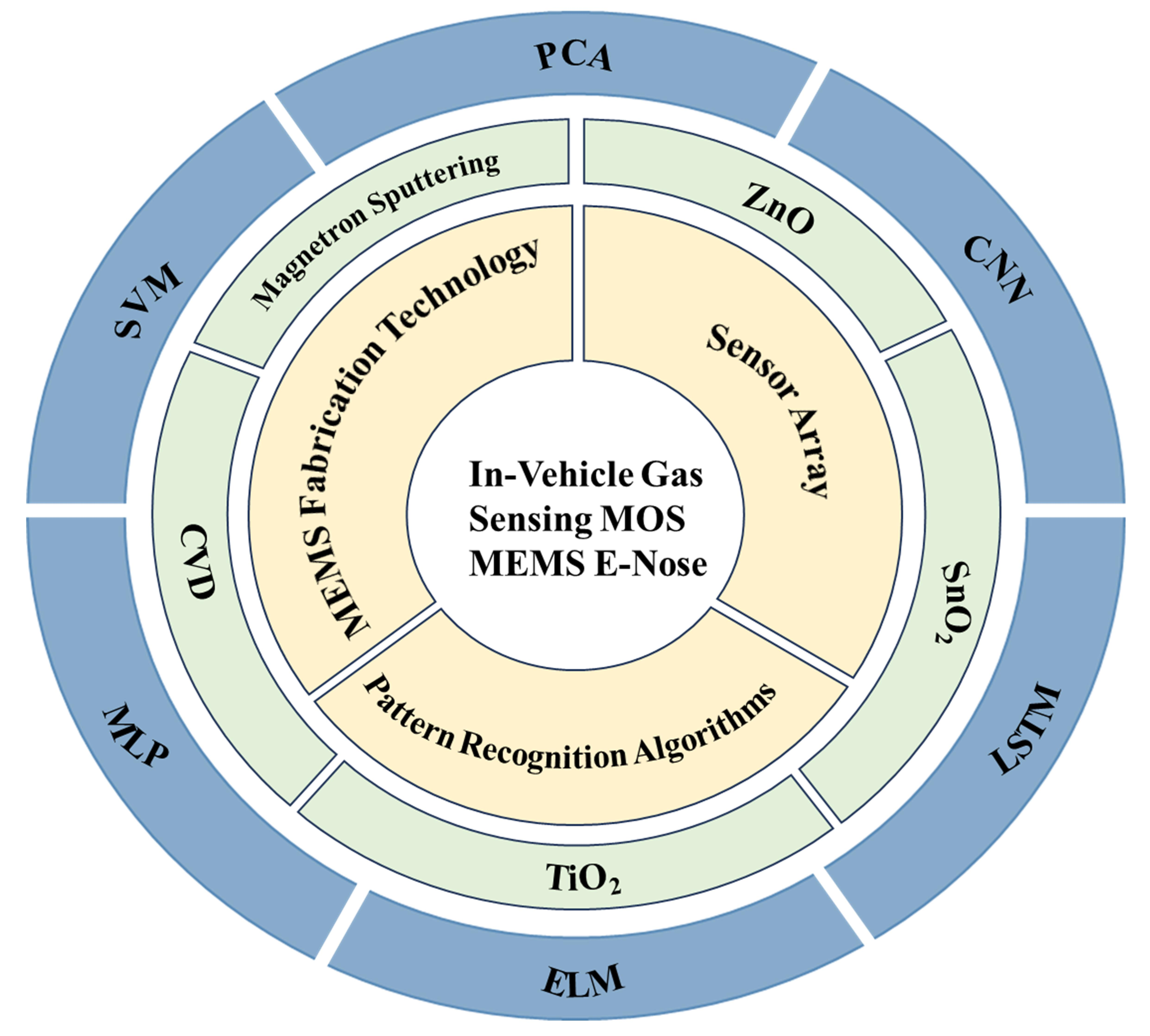
Volatile organic compounds (VOCs) released from automotive interior materials and exchanged with external air seriously compromise cabin air quality and pose health risks to occupants. Electronic noses (E-noses) based on metal oxide semiconductor (MOS) micro-electro-mechanical system (MEMS) sensor arrays provide an efficient, real-time solution for in-vehicle gas monitoring. This review examines the use of SnO2-, ZnO-, and TiO2-based MEMS sensor arrays for this purpose. The sensing mechanisms, performance characteristics, and current limitations of these core materials are critically analyzed. Key MEMS fabrication techniques, including magnetron sputtering, chemical vapor deposition, and atomic layer deposition, are presented. Commonly employed pattern recognition algorithms—principal component analysis (PCA), support vector machines (SVM), and artificial neural networks (ANN)—are evaluated in terms of principle and effectiveness. Recent advances in low-power, portable E-nose systems for detecting formaldehyde, benzene, toluene, and other target analytes inside vehicles are highlighted. Future directions, including circuit–algorithm co-optimization, enhanced portability, and neuromorphic computing integration, are discussed. MOS MEMS E-noses effectively overcome the drawbacks of conventional analytical methods and are poised for widespread adoption in automotive air-quality management.

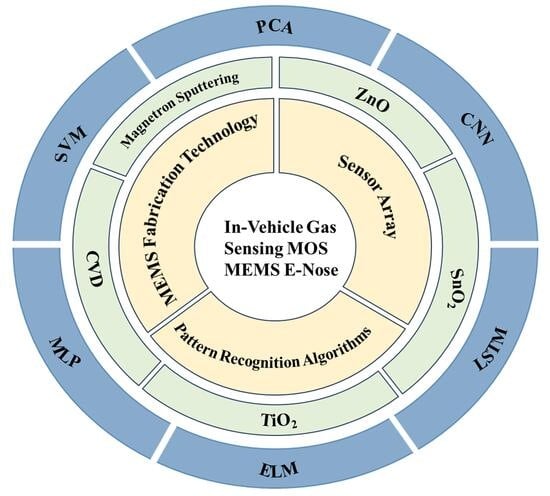
Graphical Abstract

1. Introduction

With the rapid development of the automotive industry and the improvement of people’s living standards, in-vehicle air quality has attracted increasing attention. The air inside vehicles contains hundreds of different volatile organic compounds (VOCs) [1] and harmful gases, with core components including formaldehyde (CH2O), xylene (C8H10), carbon monoxide (CO), and others [2]. Their sources are mainly divided into two categories. One is the various and complex interior materials in the vehicle, such as plastic parts, adhesives, leather, and seats, which may release VOCs and significantly affect in-vehicle odor [3]. The other is the infiltration of externally polluted air through ventilation systems or door gaps. These harmful gases not only directly affect driving comfort by irritating the eyes, nose, and respiratory tract, as well as indirectly influencing overall body sensation, but also pose serious threats to human health when their concentrations exceed safety thresholds. Among them, formaldehyde (CH2O), recognized by the World Health Organization as a strong carcinogen, may induce asthma, lung tissue damage, and even nasopharyngeal carcinoma [4]. VOCs such as toluene (C7H8) and xylene (C8H10) can damage cardiovascular and respiratory system functions [5]. Carbon monoxide (CO) binds with hemoglobin to cause tissue hypoxia, leading to headaches, dizziness, and in severe cases, direct fatality [6].
Therefore, developing an efficient, accurate, and real-time vehicle interior odor and harmful gas recognition system has important practical significance. Traditional in-vehicle odor and harmful gas detection methods mainly include gas chromatography–mass spectrometry (GC-MS) and artificial sensory evaluation. GC-MS is often used for accurate qualitative and quantitative analysis of complex gas mixtures [7], but it suffers from high equipment cost, complex operation, lengthy detection cycles, and the need for professional laboratory environments, making it unable to meet the actual demands of on-site real-time monitoring in vehicle scenarios. Artificial sensory evaluation relies on trained olfactory assessors and is greatly affected by subjective factors such as individual differences, fatigue, and environmental conditions, resulting in poor repeatability and difficulty in guaranteeing quantitative accuracy [8]. In addition, Buchecker et al. [9] adopted gas chromatography–olfactometry (GC-O), which combines instrumental analysis with human olfactory evaluation, to identify key odor-active compounds in the entire vehicle cabin. In contrast, although metal oxide semiconductor (MOS) gas sensors are slightly inferior in detection precision compared to laboratory analytical instruments, they possess significant advantages, including low cost, small size, easy mass production, fast response and recovery speed, and good durability, making them more suitable and reliable for in-vehicle gas monitoring applications [10]. At present, a large number of high-performance commercial and research-grade MOS sensors are available. However, limited by the inherent “broad-spectrum response” characteristic of MOS gas sensors, a single sensor exhibits poor selectivity toward a specific target gas and is easily interfered with by coexisting gases. Nevertheless, an E-nose composed of an array of multiple MOS sensors with partially overlapping selectivity toward different target gases can effectively overcome this limitation. Moreover, owing to its advantages of short detection time, simple or even no sample pretreatment, and reliable detection results, the E-nose has gradually become a research hotspot in the field of odor and harmful gas detection [11].
Inspired by the biological olfactory system, the E-nose is an artificial olfactory instrument composed of a gas sensor array and corresponding pattern recognition algorithms (such as PCA, ANN, SVM, etc.) that can achieve qualitative identification and quantitative analysis of simple or complex gas mixtures [12]. With the continuous development of micro-electro-mechanical system (MEMS) technology, its application in gas sensor fabrication has dramatically improved sensor integration, making it feasible to construct high-density, miniaturized sensor arrays on a single chip. Additionally, the thermal mass of MEMS-based sensors is significantly reduced, which helps improve response speed and greatly reduce power consumption. From the perspective of industrial production, the mature batch fabrication capability of MEMS processes can effectively enhance device-to-device consistency and yield [13]. Currently, MEMS gas sensors are not only widely used for environmental polluted gas monitoring but also successfully applied in fields such as exhaled breath analysis for health diagnosis [14,15,16], food quality detection and freshness evaluation [17], and agricultural product maturity and disease monitoring [18,19].
In addition to continuously optimizing the hardware performance of sensor arrays, efficient qualitative and quantitative analysis of the collected gas response data is also a crucial step for the E-nose system to function properly. Pattern recognition algorithms constitute the core technology to achieve such analysis. These algorithms typically first preprocess the original sensor response signals to remove noise, baseline drift, and environmental interference. Then they extract effective features to screen and compress key information from high-dimensional data. Finally, they complete classification or regression tasks for qualitative identification and quantitative prediction through machine learning or deep learning models [20]. Commonly used algorithms such as support vector machine (SVM) and artificial neural network (ANN) can effectively mine hidden data patterns and significantly improve the recognition accuracy and robustness of E-noses when dealing with complex gas mixtures.
In recent years, several review articles have emerged focusing on the application of E-noses for odor recognition within vehicle cabins and enclosed environments. However, most existing reviews focus on general E-nose principles or broad gas sensor applications, with limited emphasis on CMOS-MEMS integration or commercial implementations. Table 1 summarizes papers on in-vehicle gas sensing and E-nose systems published between 2020 and 2025, highlighting gaps in coverage that underscore the timeliness and necessity of the present review.
The structure of this review is organized as follows. Section 2 introduces the basic structure, working principle, and performance characteristics of MEMS-based MOS gas sensors, and reviews the applications of sensor arrays composed of these sensors in odor and harmful gas recognition. Section 3 summarizes several commonly used MEMS fabrication technologies in the manufacturing of gas sensor arrays. Section 4 overviews various widely adopted pattern recognition algorithms in E-noses and specifically analyzes their respective advantages, disadvantages, and practical performance through typical application cases. Finally, Section 5 summarizes the current research achievements and practical progress of MEMS E-noses in in-vehicle air quality monitoring and proposes future development directions and prospects.

2. MOS MEMS Gas Sensors and Their Arrays

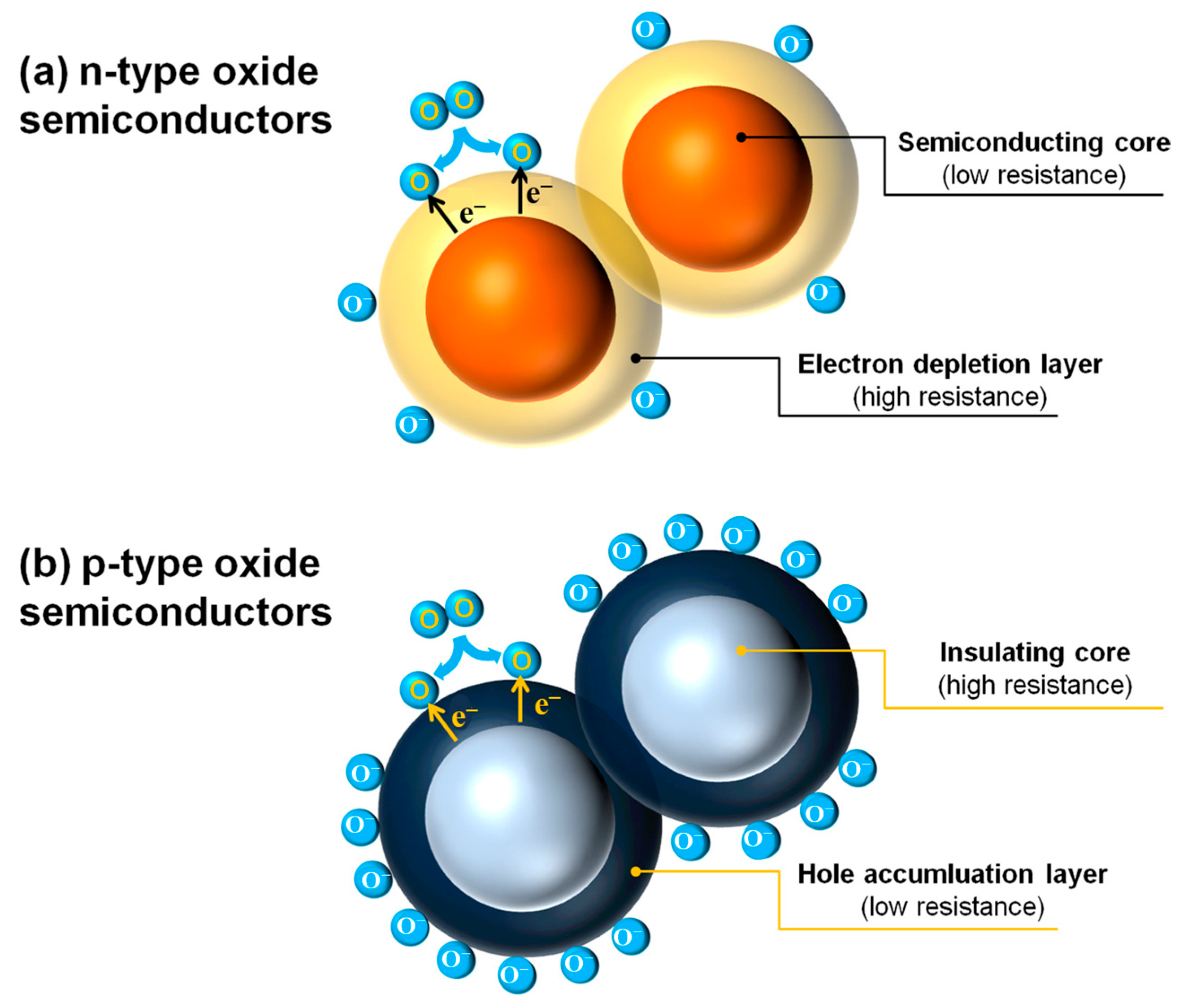
MOS materials can be classified into n-type and p-type according to the type of majority charge carriers, and their gas sensing mechanism primarily relies on the modulation of charge carrier concentration induced by surface chemical reactions [24]. In an air environment, oxygen molecules adsorb onto the surface of n-type semiconductor oxides and subsequently capture free electrons from the conduction band, forming various chemisorbed oxygen species such as O2, O, and O2− depending on the operating temperature. This electron extraction process generates an electron depletion layer near the material surface (also known as the space-charge layer), which significantly increases the overall resistance of the sensing film [25], as schematically illustrated in Figure 1a [24]. When the n-type material is exposed to a reducing target gas (e.g., CO, H2, or VOCs), the gas molecules react with the pre-adsorbed oxygen ions through a redox reaction. During this process, the trapped electrons are released back into the conduction band, thereby increasing the carrier concentration, narrowing the width of the depletion layer, and ultimately causing a marked decrease in resistance. Enhancing the chemical interaction between surface-adsorbed oxygen and target gas molecules can amplify this resistance modulation effect and consequently improve the sensor response magnitude.
In contrast, charge transport in p-type semiconductor oxides is dominated by holes. When oxygen molecules adsorb on the surface, they still capture electrons from the valence band (effectively generating additional holes), which leads to the formation of a hole accumulation layer near the surface and a corresponding decrease in resistance, as depicted in Figure 1b [24]. Upon exposure to a reducing target gas, the redox reaction releases electrons that recombine with holes, thereby reducing the hole concentration in the accumulation layer and resulting in an increase in resistance.
Fundamentally, the response of a chemoresistive MOS sensor originates from the adsorption/desorption dynamics of target gas molecules on the sensing material surface, followed by charge transfer processes that alter the conductance of the material and enable gas detection [26]. Sensitivity in metal oxide semiconductor gas sensors is governed by five principal factors. From the perspective of chemical composition, composite or mixed metal oxides generally exhibit higher sensitivity than their single-oxide counterparts owing to synergistic effects between components and the formation of heterojunction interfaces at grain boundaries, provided that the catalytic roles of the constituents are complementary. Surface modification with noble metals such as Pt, Pd, Au, or Ag can dramatically enhance sensitivity through the well-known “spillover effect,” wherein the noble metal nanoparticles dissociate oxygen molecules more efficiently and spill atomic oxygen onto the oxide surface, thereby accelerating the redox reaction with target gases. With respect to microstructure, smaller grain size, exposure of high-energy crystal facets, and hierarchical, porous, or one-dimensional morphologies that offer large specific surface area and abundant active sites are beneficial for increasing the effective reaction interface and thus improving sensitivity. However, excessively small grains may compromise long-term thermal stability. Among external environmental factors, humidity typically degrades sensitivity by competitively adsorbing on active sites, blocking oxygen re-adsorption, and hindering target gas diffusion, although this interference can be largely eliminated at elevated operating temperatures above 400 °C. Temperature itself profoundly influences reaction kinetics, surface adsorption/desorption equilibrium, and charge carrier mobility, giving rise to a characteristic optimal operating temperature at which the sensor exhibits maximum response [27].
This section will review the most commonly employed MOS sensing materials in recent gas sensing research and highlight their practical implementation in constructing high-performance MEMS sensor arrays for E-nose systems.

2.1. SnO2-Based MEMS Gas Sensor Array

SnO2 is widely recognized as the most representative and extensively used n-type metal oxide semiconductor material in gas sensor arrays due to its well-established sensing mechanism, excellent process compatibility, and broad modification potential. Its core advantages are manifested in three key aspects. First, the gas sensing mechanism of SnO2 is mature and relies on surface oxygen adsorption–desorption processes coupled with redox reactions that effectively modulate electrical conductivity in response to a wide variety of toxic and harmful gases, including CO, VOCs, and nitrogen oxides (NOx). Second, SnO2 exhibits outstanding compatibility with micro-integration technologies such as complementary metal-oxide-semiconductor (CMOS) and MEMS platforms, thereby enabling the realization of highly miniaturized, low-power-consumption sensor arrays. A representative example is the CMOS-integrated SnO2 sensor array developed by Egger et al. [28], in which the primary power consumption originates from the polysilicon micro-hotplate heater designed to maintain an operating temperature range of 100–200 °C without requiring additional complex driving circuitry. Third, SnO2 offers substantial room for performance optimization through nanostructural engineering (e.g., nanowires, nanosheets, hierarchical assemblies), elemental doping, and noble metal nanoparticle functionalization, allowing deliberate tailoring of selectivity across different sensing units within an array to facilitate multi-gas discrimination.
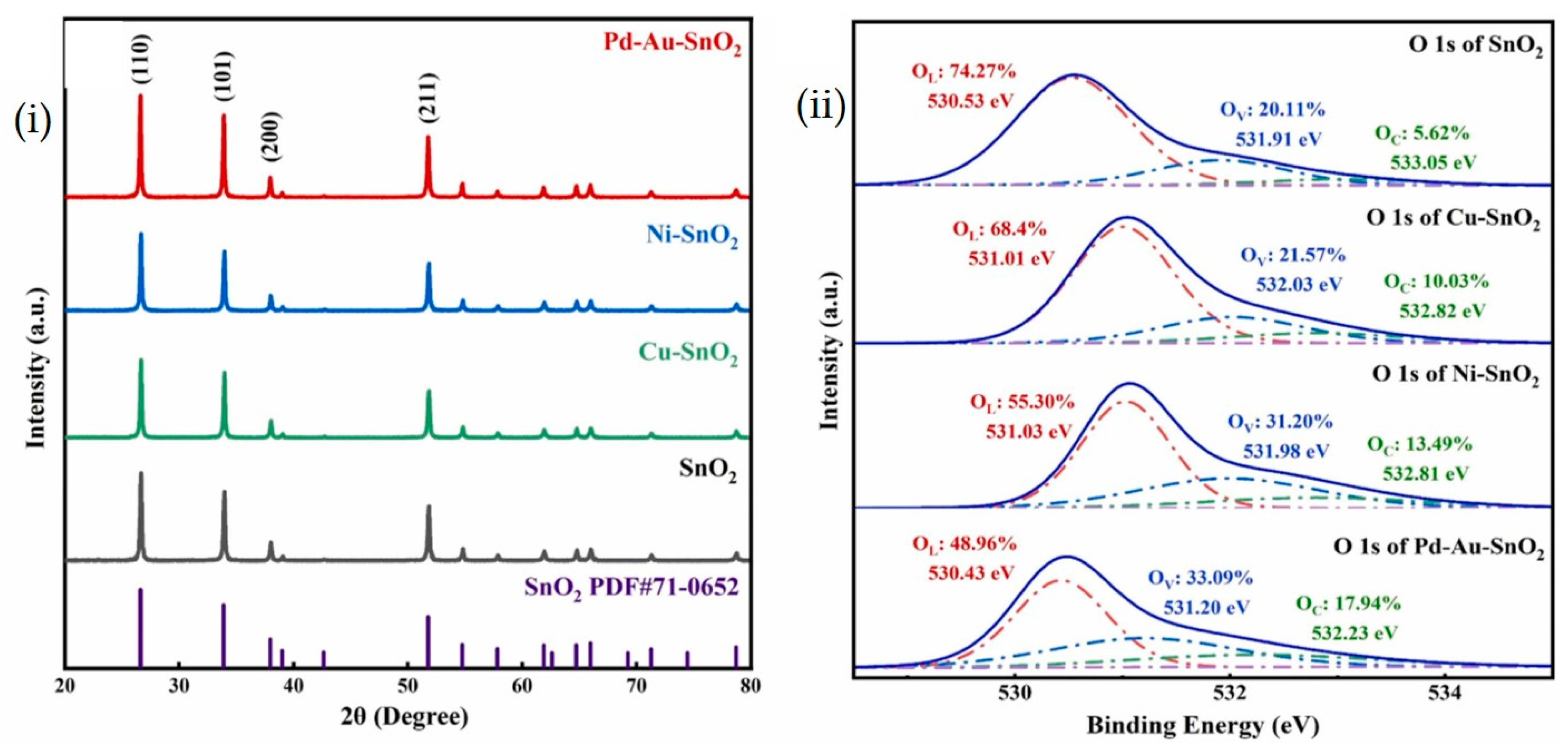
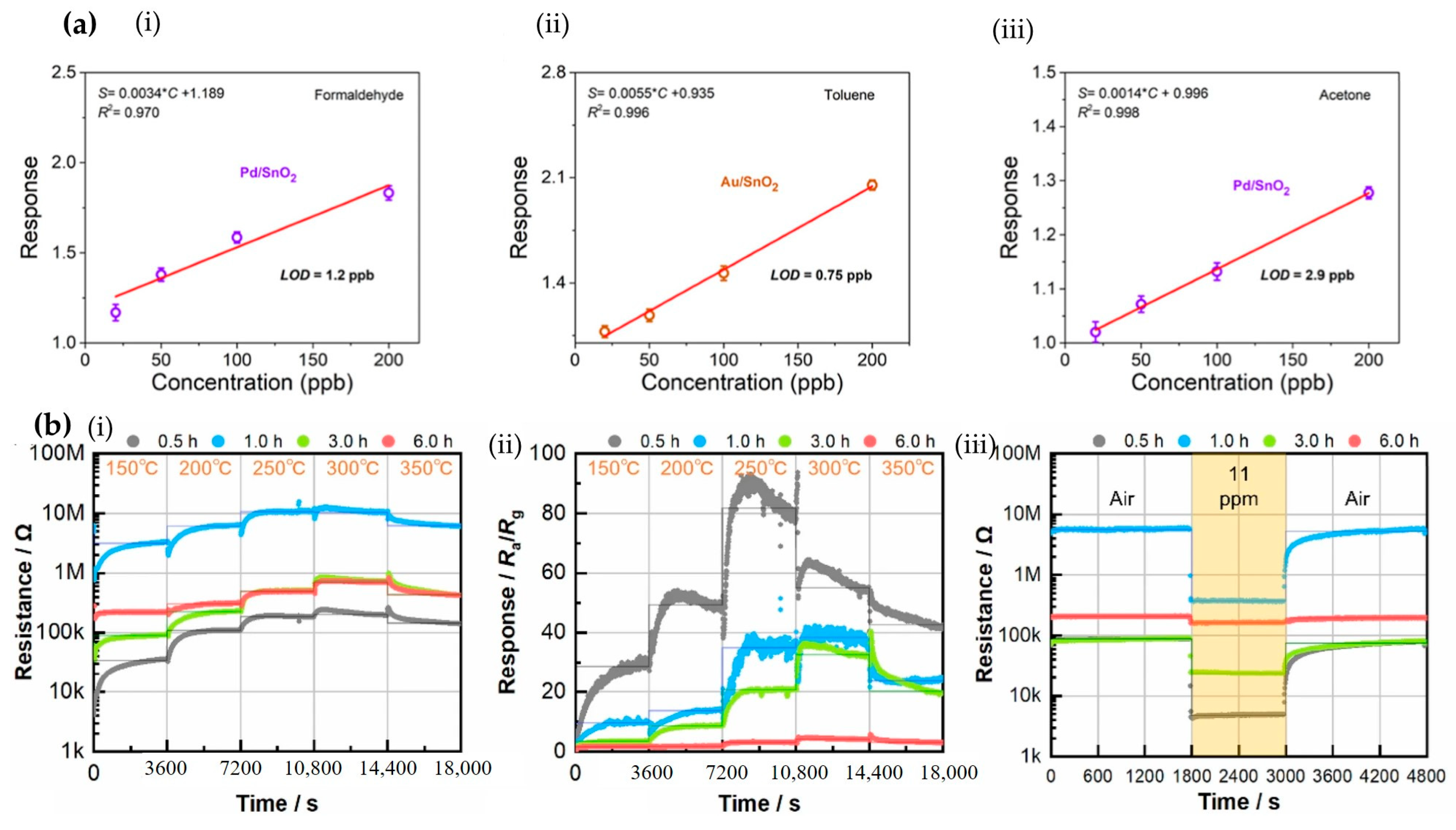
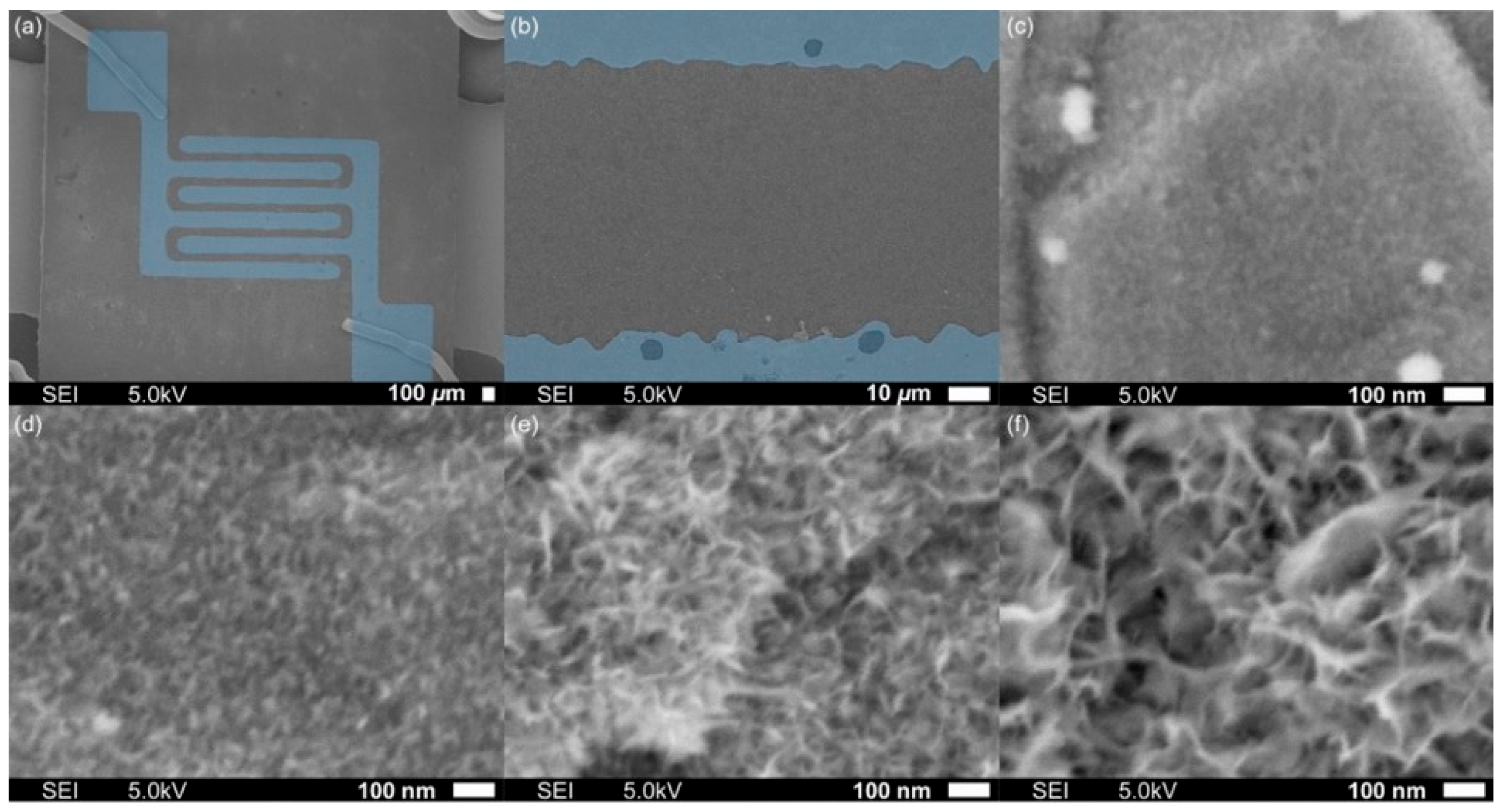
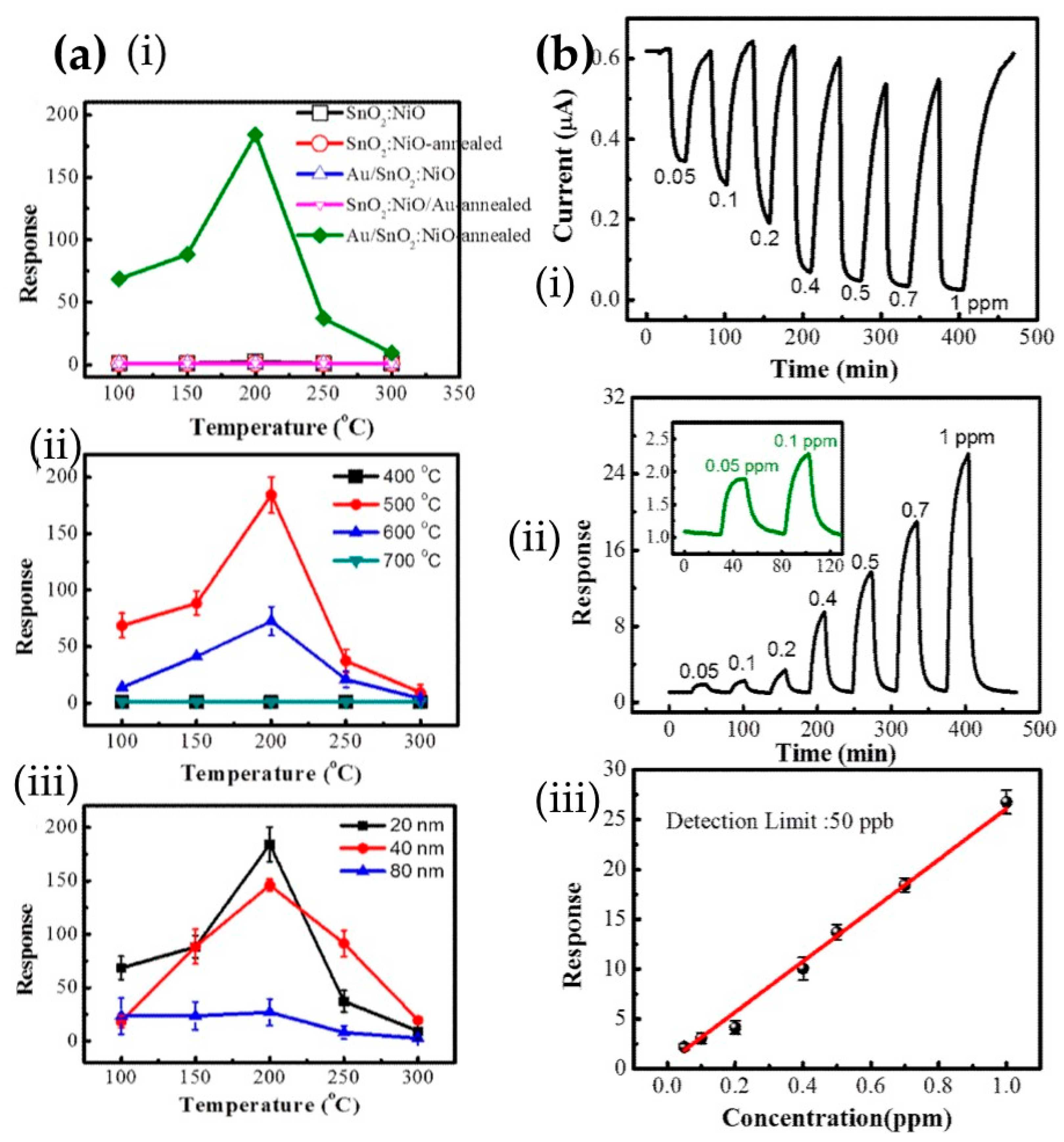
Several recent studies have demonstrated the successful implementation of modified SnO2 in high-performance MEMS sensor arrays. Yan et al. [29] fabricated three-dimensional SnO2 nanotube arrays decorated with Pd/Au bimetallic nanoclusters via atomic layer deposition, achieving remarkably low detection limits for formaldehyde (CH2O), toluene (C7H8), and acetone (C3H6O) at room temperature (1.2, 0.75, and 2.9 ppb, respectively), as illustrated in Figure 2a. When integrated into an array and coupled with support vector machine (SVM) algorithms, these units enabled highly accurate discrimination of the target gases, with performance enhancement attributed primarily to the catalytic and electronic effects of the Pd/Au bimetallic nanoclusters. Guo et al. [30] deposited SnO2 sensitive films onto MEMS micro-hotplates by sputtering followed by high-temperature annealing, utilizing an O/N/O multilayer suspended structure with a 3 μm air gap fabricated through a CMOS-compatible MEMS process. Choi et al. [31] employed metastable nanosheet-shaped SnO2 exposing the high-energy crystal facet, which contains abundant bridging oxygen vacancies and surface defects that confer superior catalytic activity toward allyl mercaptan (a biomarker for psychological stress) compared with commercial SnO2 nanoparticles. These nanosheets were integrated with comb-shaped Pt interdigitated electrodes on an Al2O3-based MEMS substrate (FE-SEM image shown in Figure 3), forming an array composed of nanosheets synthesized under varying durations. The resulting array exhibited rapid response to allyl mercaptan (reaching 90% of the steady-state signal within 5–10 s) and an ultralow detection limit of 200 ppt, with corresponding resistance transients and response curves presented in Figure 2b. Wang et al. [32] developed Au nanoparticle-decorated SnO2/NiO heterostructured thin films through a combination of self-assembly and magnetron sputtering. After activation via H2 annealing at 500 °C, the sensor displayed an exceptionally high response of 185 toward 5 ppm NO2 and a detection limit as low as 50 ppb (Figure 4a,b). This fabrication approach is fully compatible with MEMS processes and has been extended to other heterostructures such as Au/WO3 and Au/SnO2. Zhao et al. [33] utilized inkjet printing technology to deposit pure SnO2 as well as Cu-, Ni-, and Pd/Au-modified SnO2 onto MEMS micro-hotplates, producing four distinct sensing units. XRD patterns of the pristine and modified SnO2 materials together with O 1s XPS spectra are shown in Figure 5. The resulting array demonstrated high sensitivity toward trimethylamine (TMA) and hydrogen sulfide (H2S), both established spoilage markers, and when combined with machine learning algorithms, achieved 95.5% accuracy in meat species identification, 100% accuracy in freshness classification of chicken, pork, and pomfret, and 94.03% accuracy for nine mixed sample categories.
Despite these advances, SnO2-based sensor arrays still face several inherent limitations. Pure SnO2 exhibits nearly identical response polarity (resistance decrease) toward almost all reducing gases (e.g., CH2O, acetone, CO, H2S), with only minor differences in response threshold and sensitivity, making high-accuracy discrimination of complex gas mixtures (such as multi-VOC indoor environments) challenging when relying solely on pristine material. Moreover, the gas-sensitive activity of unmodified SnO2 at room temperature is extremely low due to sluggish surface reaction kinetics. Effective sensing typically requires elevated operating temperatures to achieve sufficient reactivity and measurable resistance modulation. This high-temperature operation requirement poses a significant drawback for MEMS-based arrays, as the miniaturized micro-hotplate must continuously dissipate electrical power (typically 1–10 mW per sensing unit) to sustain the desired temperature, resulting in considerably higher total power consumption that conflicts with low-power application scenarios. Additionally, noble metal modification, while generally beneficial, can occasionally introduce undesirable side effects. For instance, Pt loading enhances VOC sensitivity at elevated temperatures but may catalyze reactions between NO and VOCs at lower temperatures, generating additional O ions that promote further VOC adsorption and consequently exacerbate cross-interference with NO detection [34].

2.2. ZnO-Based MEMS Gas Sensor Array

ZnO has emerged as one of the most versatile and widely investigated n-type metal oxide semiconductor materials for gas sensing applications owing to its unique combination of advantages in synthesis, sensing performance, and practical adaptability. From the preparation perspective, ZnO benefits from abundant and inexpensive raw materials as well as a broad spectrum of cost-effective synthetic routes, including co-precipitation, sol–gel, and hydrothermal methods that do not require extreme experimental conditions. At the same time, it is fully compatible with advanced thin-film deposition techniques such as radio-frequency magnetron sputtering and spray pyrolysis, which facilitate both large-scale production and precise morphological control, thereby enabling widespread industrial implementation. In terms of sensing performance, ZnO nanostructures (e.g., nanorods, nanowires, nanoflowers, and hierarchical microspheres) typically possess exceptionally high specific surface area that provides abundant active sites, routinely achieving detection limits at the ppb level or below. Furthermore, sensitivity, selectivity, and especially low-temperature operation can be dramatically enhanced through deliberate modification strategies, including noble metal decoration (Au, Ag, Pt, Pd), carbon-based nanocomposites, conductive polymer hybridization (e.g., polyaniline, PANI), and heterojunction engineering. Additionally, ZnO exhibits excellent chemical stability, strong resistance to corrosive gaseous environments, and remarkable morphological diversity, making it highly adaptable to various sensor architectures, ranging from rigid MEMS platforms to flexible and even wearable devices, thus satisfying the requirements of diverse detection scenarios [35].
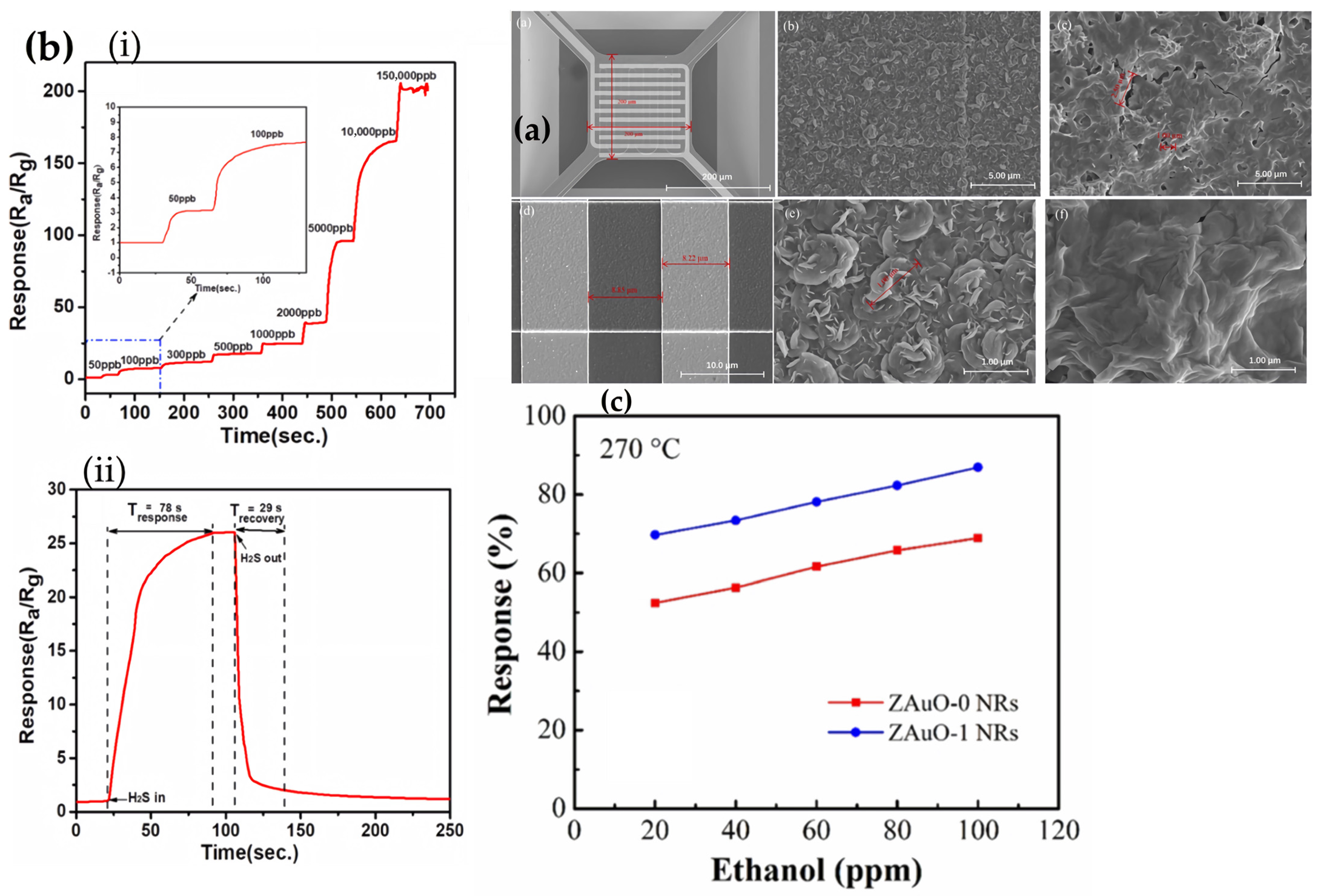
Several representative studies have successfully incorporated ZnO-based sensing films into high-performance MEMS sensor arrays. Zhang et al. [36] developed an inkjet-printed ZnO-based MEMS sensor array for VOC analysis in conjunction with machine learning algorithms. SEM images of the pristine MEMS micro-hotplate substrate and the ZnO thin film obtained after 20 printing cycles are presented in Figure 6a. The array comprises six sensing units individually functionalized with different metal catalysts, exhibiting low power consumption of only 36 mW per element and excellent device-to-device consistency. By extracting 72 transient features and subsequently selecting the five most discriminative ones through feature selection algorithms, the authors achieved VOC classification accuracies as high as 97.9% for species such as formaldehyde and ethanol (C2H5OH) when employing SVM and ANN models, along with an impressive coefficient of determination (R2 = 0.975) for quantitative prediction. Zhu et al. [37] synthesized ZnO-1 nanoparticles via a simple co-precipitation route and deposited them onto MEMS micro-hotplate chips, yielding sensors that displayed outstanding H2S sensing performance at an optimal operating temperature of 220 °C, with a detection limit of 50 ppb and fast response/recovery times of 72 s and 29 s, respectively (Figure 6b). The superior behavior was attributed to the large specific surface area and elevated surface basicity of the ZnO-1 nanoparticles. Chu et al. [38] fabricated Au nanoparticle-modified one-dimensional ZnO nanorod arrays (ZAuO-1) on MEMS platforms through combined hydrothermal growth and photochemical reduction. The resulting sensor delivered a response of 86.9 toward 100 ppm ethanol at 270 °C, significantly outperforming its pristine counterpart, while also demonstrating excellent selectivity, repeatability, and long-term stability (Figure 6c). Nagarjuna et al. [39] constructed p-n heterojunctions by integrating hydrothermally grown ZnO with sputtered CuO layers on MEMS micro-heaters that enabled precise temperature modulation. The resulting devices exhibited high sensitivity, pronounced selectivity toward H2S, ultralow detection limits, compact footprint, and robust stability, rendering them particularly valuable for industrial safety and environmental monitoring applications involving trace-level toxic gases.
Despite these considerable merits, ZnO-based gas sensors still suffer from several practical limitations that must be addressed for broader deployment. First, pure ZnO generally requires elevated operating temperatures (typically 100–400 °C) to achieve sufficient surface reactivity, which not only increases power consumption but also accelerates material degradation and shortens operational lifetime. Excessively high temperatures can furthermore induce rapid desorption of target molecules, thereby compromising detection accuracy at low analyte concentrations. Humidity represents another critical interference factor, as water vapor can occupy active sites on the ZnO surface and give rise to substantial baseline drift and response suppression—often reducing the signal by more than 50% under high relative humidity conditions while simultaneously introducing cross-sensitivity. Finally, unmodified ZnO exhibits inherently poor selectivity and negligible room-temperature activity owing to its relatively uniform surface chemistry and similar adsorption energetics toward many reducing gases, coupled with low charge carrier mobility at ambient temperature. For instance, ZnO nanoparticles typically show only modest response values (e.g., ~3.96 toward ammonia) and prolonged recovery times exceeding 400 s under room-temperature operation. Consequently, effective functionalization or heterostructure engineering remains essential to realize practical room-temperature or near-room-temperature monitoring capabilities [35].

2.3. TiO2-Based MEMS Gas Sensor Array

TiO2 has gained increasing attention as a gas-sensitive material owing to its exceptional chemical and thermal stability, excellent biocompatibility, low production cost, and superior electron transport and photoelectric properties. Its diverse nanostructures, including nanoparticles, nanotubes, nanorods, and nanoflowers, typically offer large specific surface area that significantly increases the number of active sites available for gas–solid interactions, thereby substantially enhancing overall sensing capability [40]. Compared with the more commonly employed SnO2 and ZnO, TiO2 stands out particularly for its biological safety profile. Being non-toxic and highly resistant to photocorrosion and oxidative degradation, TiO2 poses minimal risk in applications involving direct or indirect contact with living organisms, such as exhaled breath analysis for medical diagnostics or food quality monitoring, where SnO2 and ZnO might introduce potential biological hazards. Moreover, its remarkable long-term stability under prolonged exposure to harsh environmental conditions (e.g., ultraviolet radiation, oxidizing atmospheres) ensures more reliable performance retention over extended operational lifetimes.
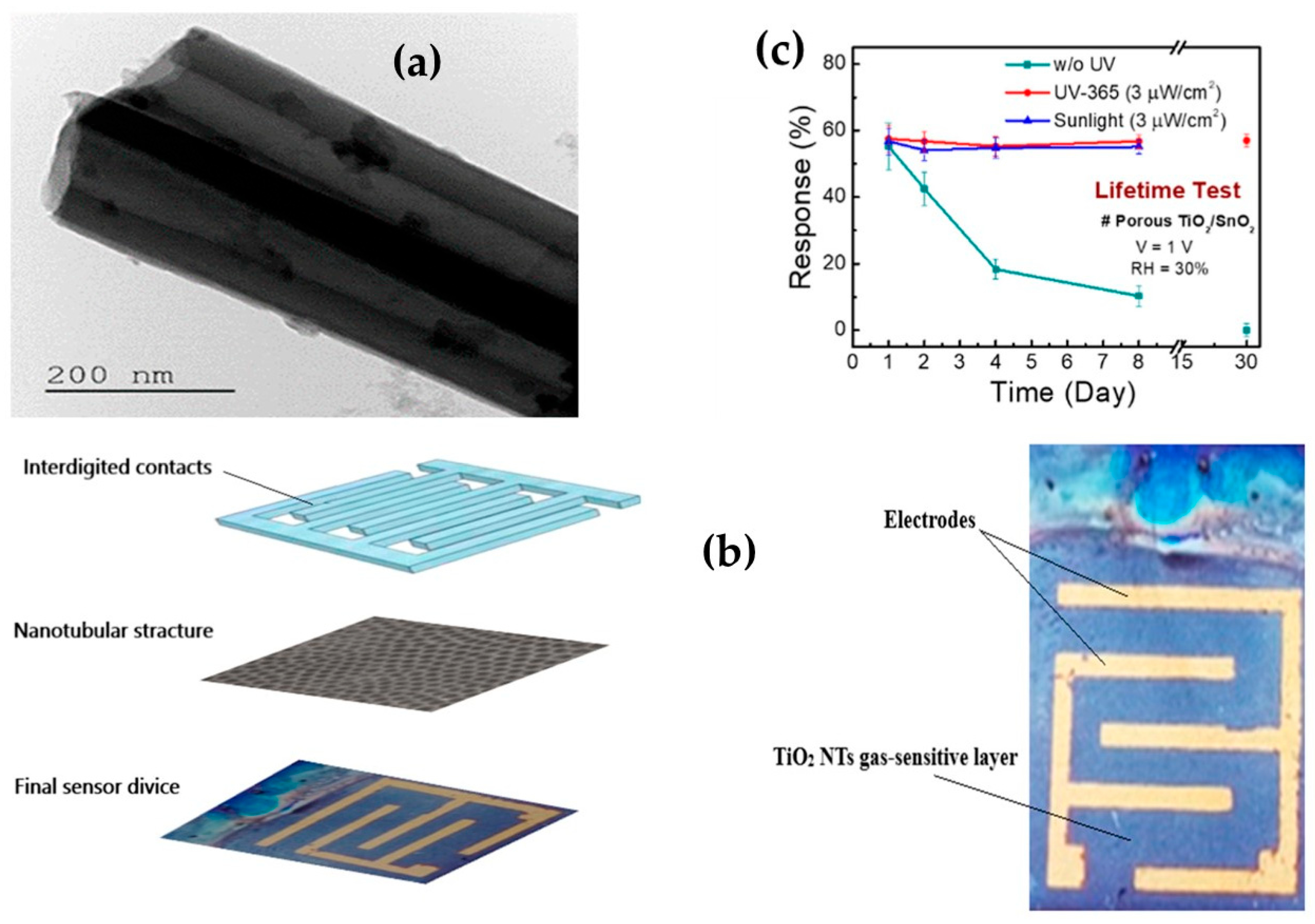
Representative studies have successfully exploited these advantages in practical MEMS-compatible gas sensor designs. Bouktif et al. [41] fabricated highly ordered TiO2 nanotube arrays through electrochemical anodization followed by controlled annealing, with detailed structural and morphological characterization presented in Figure 7a. The resulting sensors exhibited outstanding NO2 sensing performance, achieving a sensitivity of 96% toward 100 ppm NO2 at an operating temperature of 250 °C for samples anodized for 15 min. The complete device architecture, including the nanotube-based sensing element and integrated detector configuration, is illustrated in Figure 7b. In another notable contribution, Deb et al. [42] developed a UV-activated nanoporous TiO2/SnO2 heterojunction MEMS gas sensor using a two-step sol–gel process. Operating at room temperature under low applied bias (1 V) and requiring only modest ultraviolet illumination (3 μW/cm2, obtainable from ambient sunlight), the sensor demonstrated ultralow detection limits of 4 ppb for NO and 10 ppb for NO2, rapid recovery characteristics, robust humidity tolerance, and stable performance exceeding 30 days, as summarized in Figure 7c.
It is worth noting that the inherent abundance of surface hydroxyl groups on TiO2 can lead to pronounced humidity interference in practical deployment, inducing considerable baseline resistance drift and compromises detection accuracy in real-world variable-humidity environments. To mitigate this drawback, continuous irradiation with a dedicated ultraviolet LED source of appropriate wavelength and intensity can be employed during operation. By exploiting the well-established photocatalytic activity of TiO2, such illumination generates electron–hole pairs that effectively decompose adsorbed water molecules and produce reactive oxygen species (e.g., hydroxyl radicals, OH*), thereby desorbing moisture-related species, regenerating active sites, and markedly reducing humidity-induced signal instability [43].

3. Application of MEMS Preparation Technology in Sensor Array Manufacturing

3.1. Magnetron Sputtering

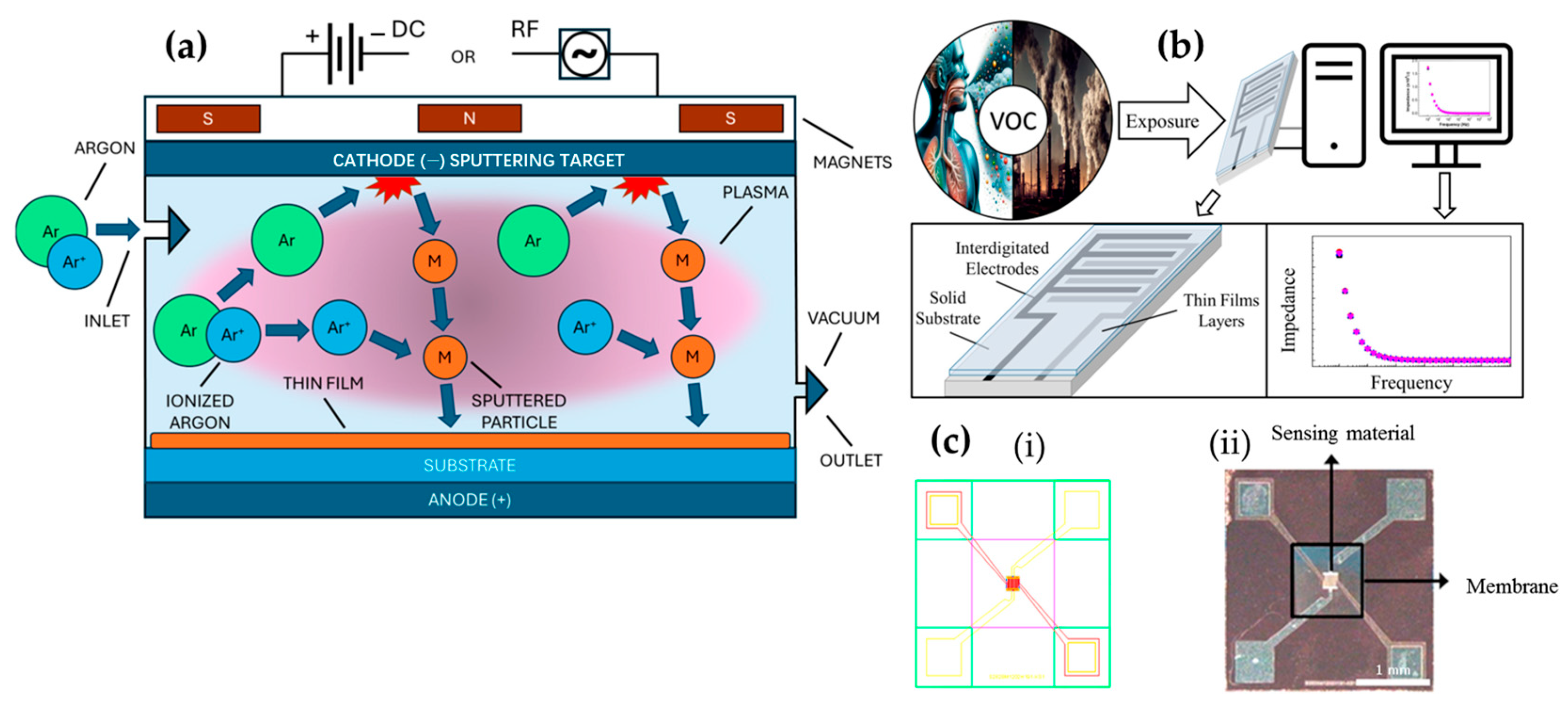
Magnetron sputtering stands out as one of the most widely adopted physical vapor deposition (PVD) techniques for fabricating high-quality metal oxide semiconductor thin films, and it plays a pivotal role in the realization of MEMS-based sensor arrays for gas detection applications. The technique employs a magnetic field to confine secondary electrons near the target surface, thereby dramatically increasing plasma density, enhancing ionization efficiency, and enabling high-rate sputtering even at relatively low substrate temperatures. These characteristics have established magnetron sputtering as a preferred method for depositing large-area, uniform coatings with dense microstructure, excellent adhesion to the substrate, and minimal thermal budget, all of which are critical requirements for CMOS- and MEMS-compatible sensor fabrication. Additional advantages include high deposition rates, the ability to produce films of exceptional purity, precise and reproducible control over thickness (down to the nanometer scale), and straightforward integration into low-power micro-hotplate designs, collectively contributing to significant reductions in overall manufacturing cost [44]. Schematic representations of the magnetron sputtering deposition process and a typical MEMS gas sensor fabricated by this method are provided in Figure 8a,b [44]. To date, magnetron sputtering has been successfully employed for depositing a wide range of metal oxide sensing materials, including ZnO, SnO2, TiO2, WO3, and others [45,46,47,48], with representative examples and performance metrics summarized in Table 2. All of these oxides have demonstrated considerable potential for integration into sensor arrays intended for in-vehicle air quality monitoring.
In the specific case of SnO2 thin-film preparation, radio-frequency (RF) magnetron sputtering has proven particularly effective for obtaining nanocrystalline sensing layers with controlled thickness (typically 50–120 nm) on MEMS micro-hotplate structures, both in pristine and Pt-doped configurations. Subsequent ultra-thin Pt catalyst layers (~0.5 nm) can be selectively deposited by electron-beam evaporation onto the SnO2 surface to further boost response magnitude and selectivity toward target analytes. A representative sensor layout achieved through this combined approach is illustrated in Figure 8c [46]. By systematically optimizing sputtering parameters—such as target power, working pressure, substrate temperature, film thickness, and catalyst loading—researchers have consistently fabricated SnO2-based micro gas sensors that exhibit high selectivity, fast response/recovery kinetics, low power consumption, and excellent batch-to-batch reproducibility, thereby satisfying the stringent demands of cost-effective, high-volume production.
Furthermore, the inherent conformal step coverage capability of magnetron sputtering renders it exceptionally well-suited for coating complex three-dimensional MEMS topologies, including suspended membranes, deep trenches, and high-aspect-ratio electrode structures. This attribute greatly facilitates the scalable and uniform fabrication of multi-sensor arrays on a single chip, making the technique a cornerstone for next-generation E-nose systems.

3.2. Other Key MEMS Preparation Technologies

In addition to magnetron sputtering, chemical vapor deposition (CVD) represents another cornerstone thin-film fabrication technique that is extensively employed in the manufacturing of MEMS gas sensor arrays. CVD enables the growth of high-quality single-crystalline or polycrystalline metal oxide films at relatively low substrate temperatures while providing outstanding step coverage and conformal coating capability over complex three-dimensional microstructures [49]. Among the various CVD variants, aerosol-assisted chemical vapor deposition (AACVD) has emerged as a particularly powerful and cost-effective approach for the direct synthesis of one-dimensional nanostructures on MEMS platforms. For instance, Taylor et al. [50] successfully utilized AACVD to deposit highly textured nanostructured TiO2 coatings directly onto sensor substrates using a single-source precursor composed of titanium isopropoxide (TIPP) complexed with acetylacetone (ACAC), demonstrating the simplicity and scalability of this method for producing morphologically tailored sensing layers.
Atomic layer deposition (ALD) stands out for its unparalleled ability to deliver atomic-scale control over film thickness, composition, and uniformity, making it ideally suited for engineering ultrathin metal oxide films and sophisticated heterostructures on MEMS devices. A representative example is the room-temperature NO2 sensor based on an In2O3/ZnO core–shell heterostructure fabricated by sequentially depositing conformal ZnO layers onto pre-formed In2O3 nanostructures via ALD, which achieved a remarkable response of 7.9 toward 10 ppm NO2 under ambient conditions owing to the enhanced charge transfer across the precisely controlled heterointerface [51].
Photolithography combined with wet and dry etching constitutes the foundational patterning toolkit for MEMS sensor fabrication. A typical CMOS-compatible MEMS process flow encompasses sequential steps such as thermal growth or deposition of dielectric insulation layers, deposition and patterning of heater materials (usually Pt or polysilicon), deposition of passivation layers followed by contact opening, interdigitated electrode formation, definition of suspended membrane geometry through front- or backside silicon etching, and final deposition of the metal oxide sensing film. For the critical membrane release step, tetramethylammonium hydroxide (TMAH) has become the etchant of choice in most industrial and academic cleanrooms because it offers excellent selectivity to silicon while remaining fully compatible with integrated circuitry, unlike potassium hydroxide (KOH), which can contaminate CMOS wafers with mobile alkali ions [52].
The lift-off process is another indispensable patterning technique that is widely adopted when high-resolution features or materials incompatible with etching are required. In a notable application targeting in-vehicle air quality monitoring, researchers employed standard UV lithography followed by a lift-off sequence to integrate 50 nm thick p-type CuO sensing films onto pre-patterned MEMS micro-hotplates. The resulting sensors exhibited sensitive and selective responses toward key cabin pollutants including CO, NH3, and NO2, highlighting the effectiveness of lift-off for rapid prototyping and small-to-medium scale production of multicomponent sensor arrays [53].
While the above deposition and patterning techniques enable precise control of MOX films on MEMS platforms, traditional vacuum-based methods (e.g., CVD and certain PVD processes) face challenges in cost and scalability for mass production. The following subsection discusses these limitations and highlights promising low-cost alternatives.

3.3. Scalability and Cost Challenges in Synthesis Processes for MOX Sensing Films

Although PVD and CVD offer excellent film uniformity and control—ideal for depositing high-quality SnO2, ZnO, and TiO2 films on MEMS microhotplates—these techniques face significant limitations in scalability and cost for mass production of in-vehicle E-nose arrays [54]. PVD (e.g., sputtering) and CVD require high-vacuum equipment, elevated substrate temperatures, and precise precursor control, leading to high capital costs, low throughput, and energy-intensive processes [55]. These factors hinder their adoption for low-cost, large-scale manufacturing of disposable or high-volume automotive sensors.
In contrast, solution-based methods such as ALD (in low-temperature variants), inkjet printing, hydrothermal synthesis, and sol–gel processing have emerged as promising low-cost alternatives that are highly compatible with MEMS fabrication and enable scalable production [56].
Inkjet printing stands out for its additive nature, minimal material waste, and room-temperature operation, allowing direct patterning of MOX inks on flexible or rigid MEMS substrates without masks [57]. Recent advances demonstrate fully inkjet-printed SnO2 or ZnO-based sensors with excellent uniformity and scalability for array fabrication [58].
Sol–gel and hydrothermal methods are particularly attractive due to their simplicity, low equipment costs, and ability to produce porous, high-surface-area nanostructures at moderate temperatures (<200 °C in many cases) [59]. Sol–gel dip- or spin-coating enables uniform deposition of TiO2/SnO2 composites, while hydrothermal growth yields hierarchical nanorods or nanosheets directly on MEMS platforms [60].
Low-temperature ALD variants provide atomic-scale control similar to CVD but with better step coverage in high-aspect-ratio MEMS structures and reduced thermal budget [61]. Table 3 compares the synthesis methods of MOX sensing films in MEMS gas sensors.
These low-cost alternatives not only reduce production expenses but also facilitate integration with flexible or large-area MEMS arrays, paving the way for widespread deployment in automotive cabin air quality monitoring.

3.4. Integration and Packaging Technology of Sensor Arrays

The integration of individual sensing elements into high-density, high-performance arrays constitutes a critical step in realizing fully functional E-nose systems for real-world applications. Among the various components, the micro-heater represents the core element of every MEMS gas sensor, as its design and thermal efficiency directly dictate both the power consumption and the overall sensing performance of the device. Doped polysilicon is frequently selected as the heating resistor material because it offers excellent long-term stability, full compatibility with standard CMOS processes, and reliable operation at temperatures up to approximately 500 °C [62]. Careful optimization of the heater geometry—typically through serpentine or meander layouts combined with finite-element thermal simulations—can significantly improve temperature uniformity across the active sensing area while simultaneously minimizing power dissipation, often achieving values below 10–30 mW for continuous operation at 300–400 °C.
Electrode design and patterning technology play an equally decisive role in determining sensor sensitivity, response time, and signal-to-noise ratio. Interdigitated electrodes (IDEs) have become the predominant configuration owing to their ability to maximize the effective collection of resistance changes within the overlying sensing film. Key geometric parameters, including finger width, finger spacing, finger length, and overlap area, must be precisely tailored to the electrical and morphological properties of the specific metal oxide employed. Platinum (Pt) is the material of choice for most high-temperature applications due to its chemical inertness and low reactivity with target analytes. High-resolution IDEs with sub-micrometer to several-micrometer spacing are routinely fabricated using standard UV lithography followed by lift-off or etching sequences, ensuring low contact resistance and excellent mechanical adhesion to the underlying dielectric membrane [63].
Packaging technology serves as the final yet crucial barrier that protects the fragile MEMS structures from mechanical damage, contamination, and environmental stressors while maintaining unrestricted access of analyte gases to the sensing layer. Conventional ceramic or TO-can packages, although robust, suffer from excessive cost, large footprint, and poor thermal isolation, rendering them unsuitable for compact in-vehicle monitoring systems. In recent years, wafer-level packaging (WLP) and chip-scale packaging strategies have gained considerable traction owing to their inherent advantages of dramatically reduced size, lower production cost, higher reliability, and seamless integration with downstream electronics. A notable example is provided by Avraham et al. [64], who developed a fully wafer-level-packaged thermal sensor platform based on CMOS-SOI-MEMS technology that maintains stable performance across an extraordinarily wide pressure range from high vacuum (0.01 Pa) to atmospheric pressure, demonstrating the maturity of such approaches for commercial deployment. Beyond general-purpose solutions, specialized packaging variants have also been engineered for specific use cases, including intrinsically safe explosion-proof enclosures for hydrogen detection in hazardous locations and selectively permeable membranes that enable breathable packaging for humidity and VOC monitoring without compromising sensor responsiveness.

3.5. Development of CMOS-MEMS Integration Technology

CMOS-MEMS integration technology has emerged as a cornerstone approach for achieving true miniaturization, enhanced intelligence, and cost-effective production of advanced gas sensor systems, particularly in the context of E-nose platforms. By monolithically integrating the sensing elements, micro-hotplates, and associated signal-conditioning circuitry (including amplifiers, analog-to-digital converters, and temperature controllers) on the same silicon die, parasitic capacitance and electromagnetic interference are dramatically suppressed, overall packaging footprint is minimized, and system-level reliability is substantially improved [65].
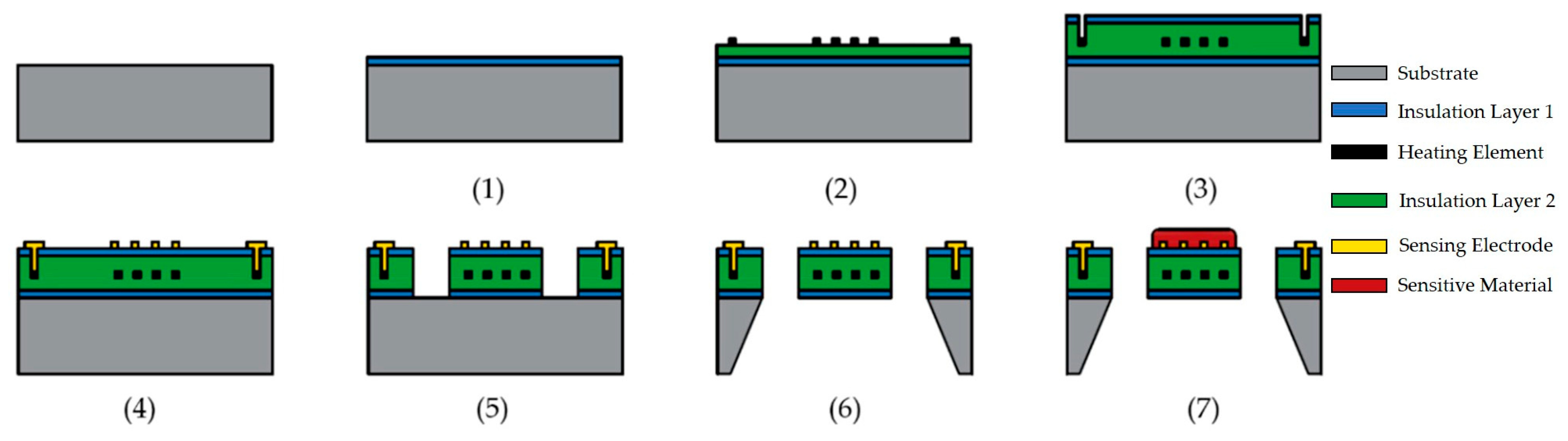
Successful implementation, however, demands strict adherence to CMOS compatibility throughout the entire process flow, imposing rigorous constraints on material selection, thermal budget, contamination control, and post-processing sequence to prevent degradation of the underlying integrated circuits. The typical fabrication process of a suspended membrane microhotplate with a metal heating element includes the thermal growth or deposition of the insulation layer, as well as the lift-off, sputtering, patterning, and etching of the heater material, etc. [66], the detailed process flow is shown in Figure 9.
Among the various deposition techniques that satisfy these stringent requirements, plasma-enhanced chemical vapor deposition (PECVD) has become widely adopted for fabricating dielectric and passivation layers in MOS-based MEMS gas sensors. Operating effectively over a broad temperature window of 60–300 °C, PECVD enables precise control of film thickness, stoichiometry, residual stress, and surface roughness, all of which are critical parameters for ensuring mechanical robustness and reproducible sensing performance of suspended micro-hotplate structures [67].
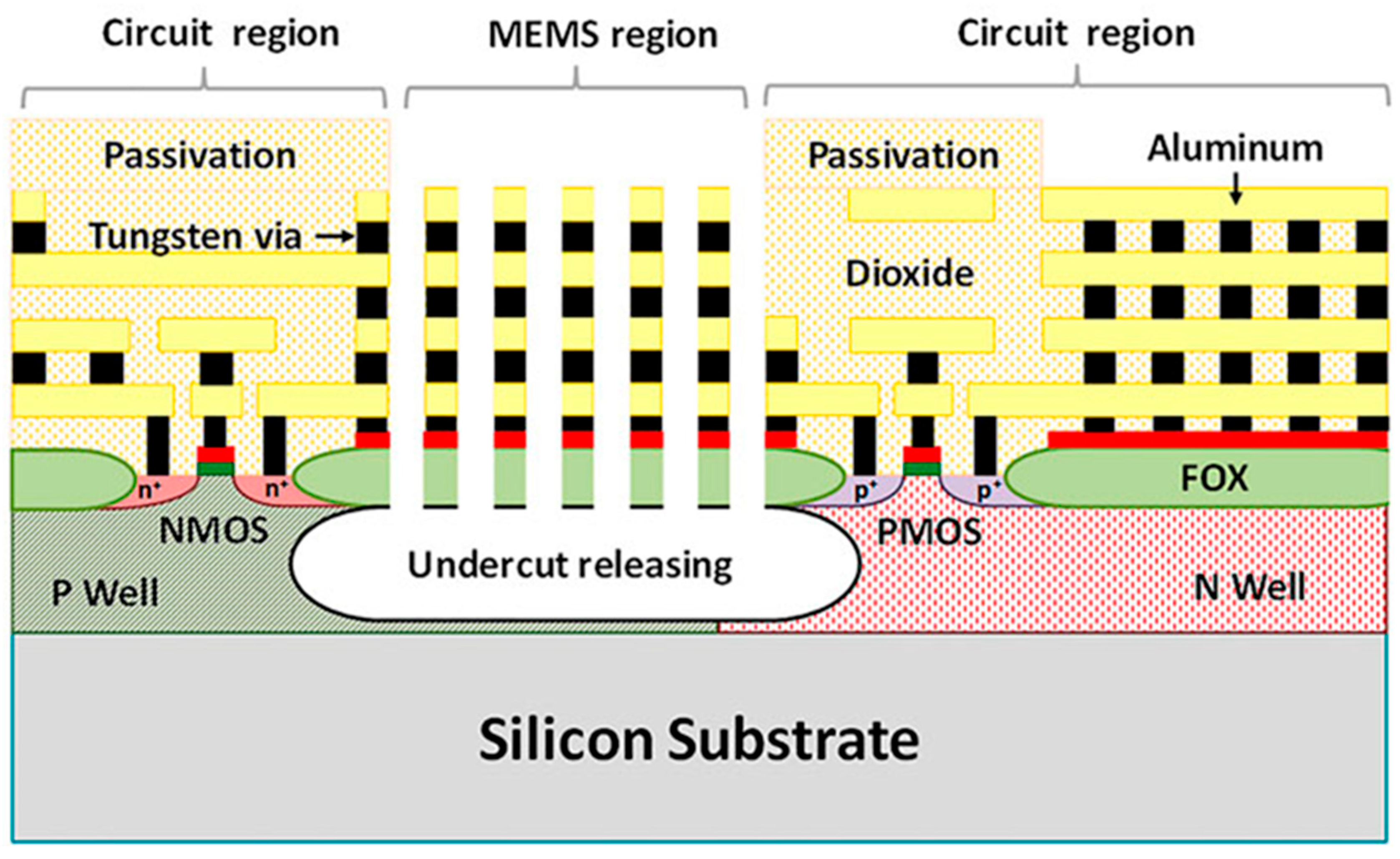
A mature and representative example of industrial-grade CMOS-MEMS integration is provided by the open-foundry platform developed by the Taiwan Semiconductor Research Institute (TSRI). This comprehensive service encompasses the full process flow from front-end CMOS fabrication (supporting standard 0.35 μm, 0.18 μm, and even bipolar-CMOS-DMOS high-voltage nodes) through dedicated post-CMOS MEMS modules, design rule checking, multi-project wafer shuttles, dicing, and customized packaging solutions, thereby offering researchers and companies flexible yet highly standardized pathways to prototype and commercialize sophisticated sensor systems [68]. A schematic cross-sectional view of a typical TSRI CMOS-MEMS gas sensor structure is presented in Figure 10.
This integrated approach not only reduces power consumption and improves signal-to-noise ratio but also facilitates scalable production of multi-sensor arrays essential for in-vehicle E-noses.
Recent advances have further pushed the boundaries of integration density and material sophistication by combining “top-down” microfabrication with “bottom-up” nanomaterial synthesis strategies. Researchers first fabricated arrays of micro-hotplate-based sensor chips on 2-inch silicon wafers using conventional MEMS processes and subsequently employed a template-guided controlled dewetting technique to pattern porous thermoplastic elastomer films as sacrificial masks. These masks enabled the selective in situ growth of hierarchical nickel hydroxide nanowall sensing layers directly on the preheated active areas. The resulting wafer-level miniaturized gas sensors exhibited exceptional batch-to-batch reproducibility of baseline electrical characteristics (relative standard deviation < 0.8%, n = 8) and highly uniform H2S sensing response (RSD < 3.5%, n = 8), underscoring the viability of hybrid manufacturing paradigms for next-generation E-nose devices [69].

3.6. From MEMS Sensor Chip to Complete E-Nose System

While the previous sections have detailed MEMS sensor preparation and CMOS integration, the full assembly of an E-nose system requires a structured sequence of steps to transform individual MEMS-based gas sensors into a functional array capable of detecting and classifying complex VOC mixtures in automotive cabins. The process involves sensor array fabrication, signal conditioning, data processing, and system calibration, ensuring low power consumption, robustness, and real-time performance. This section outlines the key assembly procedures for the E-nose.
The assembly begins with MEMS sensor array fabrication, which starts with the deposition of MOX sensing films on microhotplates using compatible techniques like magnetron sputtering. This step includes patterning electrodes and heaters on silicon substrates via photolithography and etching. To ensure diversity in selectivity, multiple sensors are arrayed (e.g., 4 × 4) with varied materials or dopants [70]. CMOS integration is achieved by bonding the MEMS array to a CMOS readout chip using wire bonding or flip-chip techniques. This process integrates analog front-ends for signal amplification, ADCs for digitization, and microcontrollers for heater control, while recent designs incorporate Schottky contacts or pulse-driven modes to enhance room-temperature performance and reduce power [71,72].
Effective signal conditioning and packaging are then performed by implementing on-chip filters to mitigate noise from vibrations or humidity in vehicles. The hybrid chip is encapsulated in hermetic enclosures with gas-permeable membranes to protect against dust and contamination while allowing VOC diffusion [73].
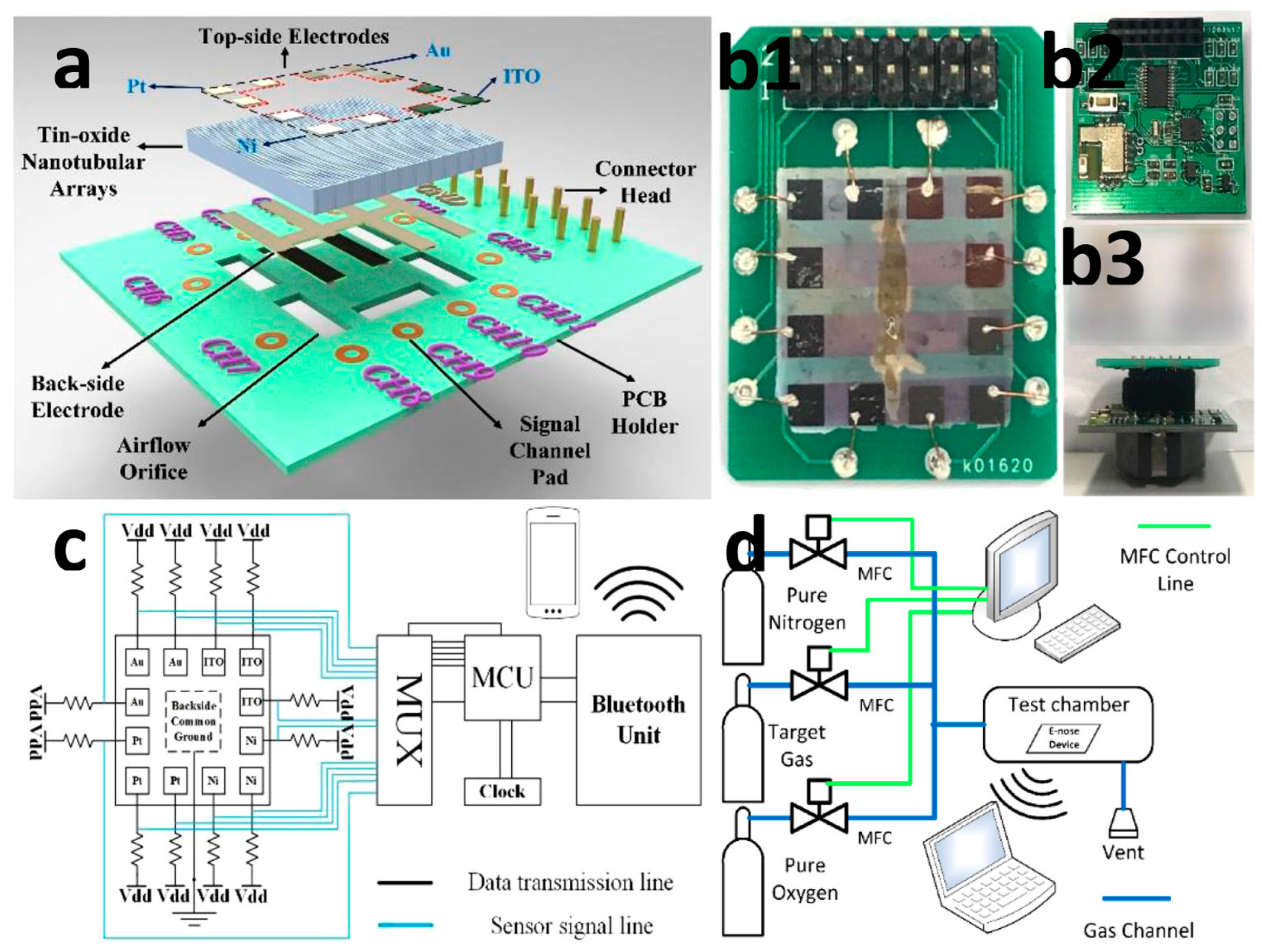
To realize a complete functional E-nose, the monolithically integrated MEMS-CMOS sensor array is typically mounted on a printed circuit board (PCB) assembly, where individual sensor electrodes are wired to dedicated signal channels. A representative practical implementation involves a dual-PCB configuration: the upper board hosts the sensor array chip, while the lower board incorporates data acquisition circuitry, including multiplexers, analog-to-digital converters, and a microcontroller unit (MCU) for on-board processing and power management (e.g., powered by a compact CR2032 battery for portability) [74], as illustrated in Figure 11. This modular yet compact design facilitates wireless communication, low-power operation, and easy integration into vehicle dashboards.
For intelligent analysis, pattern recognition integration—to be discussed in detail in Section 4—involves embedding machine learning algorithms into the CMOS MCU firmware or offloading tasks to edge computing platforms. This phase also includes calibration through exposure to standard VOC mixtures to train the system for classification.
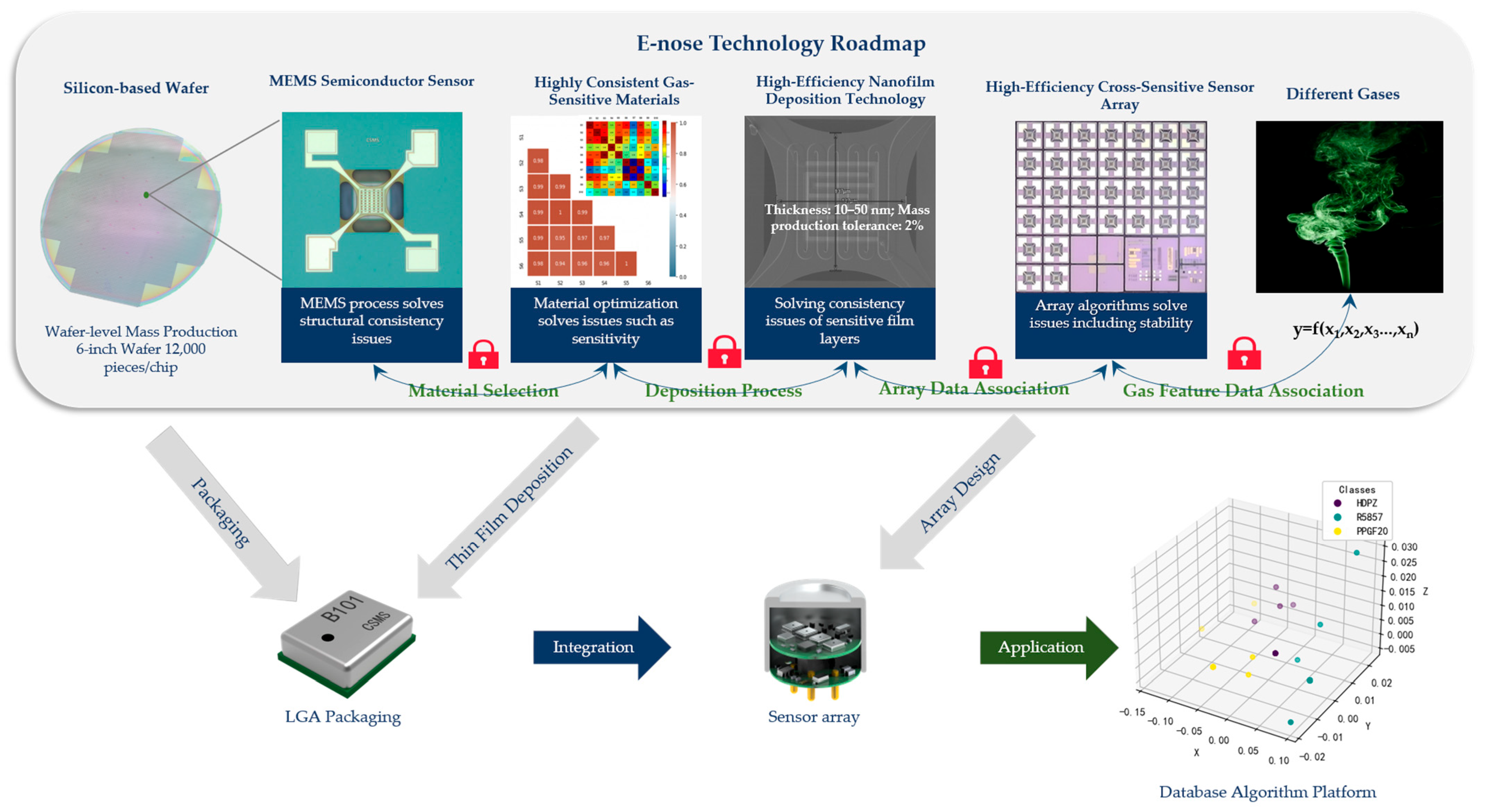
Finally, the process concludes with system testing and optimization, where the device is validated in simulated cabin environments and optimized for drift compensation and low-power modes. Figure 12 shows the integrated technology roadmap of the E-nose system.

3.7. Advanced Material Engineering Strategies for Performance Enhancement in MEMS Sensor Arrays

While the MEMS fabrication technologies discussed in the previous subsections enable the miniaturization, integration, and cost-effective production of MOX sensor arrays, further improvements in sensitivity, selectivity, response/recovery time, and power consumption are essential for practical in-vehicle applications. These enhancements are primarily achieved through advanced material engineering strategies applied to the sensing films (typically SnO2, ZnO, and TiO2) deposited on MEMS microhotplates. Importantly, most of these strategies are fully compatible with MEMS processes such as sputtering, ALD, and inkjet printing, ensuring seamless integration into sensor array manufacturing. This subsection reviews the most promising approaches reported in recent years.

3.7.1. Nanostructuring and Morphology Control

Reducing the grain size of MOX materials to the nanoscale significantly increases surface area and enhances gas adsorption sites, leading to higher sensitivity and faster response. One-dimensional (1D) nanostructures such as nanowires and nanorods, as well as hierarchical 3D assemblies, have shown particular promise for MEMS-based sensors.
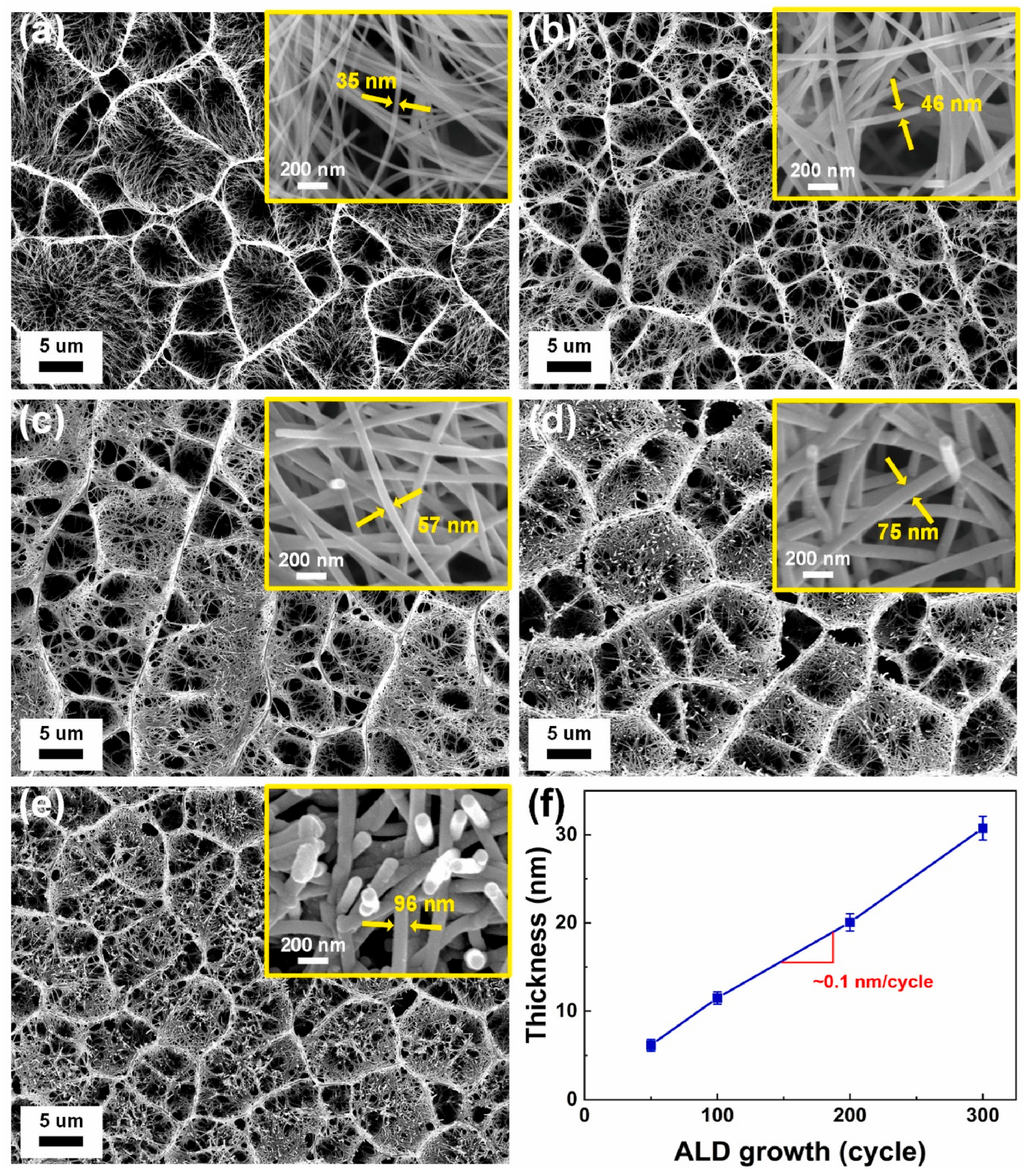
For SnO2, core–shell TiO2/SnO2 nanowires fabricated on MEMS platforms have demonstrated enhanced H2S detection with responses up to 5.9 for 5 ppm at 300 °C due to optimal shell thickness and heterojunction effects [75]. SEM images of TiO2/SnO2 NWs with SnO2 shell thicknesses from 0 to 30 nm are shown in Figure 13. Similarly, Porous ZnO nanosheets, by virtue of their high specific surface area and open structure, accelerate gas diffusion and electron transfer, exhibiting a response/recovery time of ~8/20 s toward ethylene (C2H4) [76]. ZnO nanotetrapods and nanofiber heterostructures exhibit excellent selectivity toward VOCs like C3H6O and C2H5OH, with ppb-level detection enabled by high surface-to-volume ratios [77]. These nanostructures also reduce operating temperature by exploiting size-induced depletion layers.

3.7.2. Noble Metal Decoration and Heterojunction Engineering

Surface functionalization with noble metals (Pt, Pd, Au) and construction of heterojunctions (p-n, n-n, or Schottky) are widely used to catalyze surface reactions and modulate charge carrier transport.
Noble metal nanoparticles act as chemical sensitizers and electronic spill-over sites. Recent reviews highlight Pt/Pd/Au-decorated SnO2/ZnO heterostructures achieving several-fold sensitivity enhancement to H2S and VOCs at reduced power on MEMS devices [78], with specific examples like Pt-decorated ZnO nanorods showing a 5.8-fold response improvement toward ppb-level H2S compared to pure ZnO [79]. For heterojunctions, the ZnO/SnO2 heterojunction achieves enhanced sensitivity and better stability for low-concentration ethanol at room temperature by leveraging synergistic effects and barrier height enhancement, while reducing grain size to obtain a higher specific surface area [80].

3.7.3. Photoactivation and Light-Assisted Sensing

Photoactivation using UV or visible light reduces operating temperature to near room temperature, dramatically lowering power consumption [81]—a critical requirement for battery-powered in-vehicle systems.
Recent advances in light-activated materials, including defect-engineered ZnO/SnO2 and plasmonic enhancements, extend activation to visible light, with monolithic LED integration achieving <10 mW power [82]. Additionally, a nanoporous TiO2/SnO2 heterojunction gas sensor has been developed, utilizing ultra-low ultraviolet light activation (3 μW/cm2) to enhance electron transfer and photocatalytic efficiency, achieving stable ppb-level NOx (NO and NO2) detection at room temperature (as low as 4 ppb for NO and 10 ppb for NO2) [42]. Progress toward olfactory applications emphasizes fast response in composite nanostructures [76].

3.7.4. Compatibility with MEMS Fabrication and Outlook

All aforementioned strategies—nanostructuring via hydrothermal/ALD growth, heterojunctions via sequential deposition, noble metal decoration via sputtering, and photoactivation via on-chip integration—are highly compatible with standard MEMS-CMOS processes [83]. Challenges remain in uniformity over large arrays and long-term stability under automotive conditions, but rapid progress suggests these enhanced materials will soon dominate next-generation in-vehicle E-noses. The comparison of fabrication processes for the four types of substrate materials is presented in Table 4. The adoption of these alternative substrates is expected to accelerate commercialization of MEMS E-noses in vehicles by addressing power, durability, and cost barriers associated with conventional silicon platforms.

3.8. Emerging Substrate Materials for Automotive-Grade MEMS Gas Sensors

Traditionally, silicon has been the dominant substrate for MEMS-based MOX gas sensor arrays due to its excellent mechanical properties, mature CMOS compatibility, and well-established micromachining processes [87]. However, for in-vehicle applications, silicon substrates face challenges such as high thermal conductivity (leading to increased power consumption for microheater operation), brittleness under vibration, and relatively high cost for large-scale production [70]. In recent years, alternative substrates including glass, ceramics, and polymers have gained significant attention as they offer improved thermal isolation, mechanical robustness, flexibility, and cost-effectiveness while maintaining compatibility with MOX sensing layers and MEMS fabrication [88,89].

3.8.1. Glass Substrates

Glass (e.g., borosilicate or quartz) provides superior thermal insulation compared to silicon, reducing heat loss from microheaters and enabling lower power consumption—a critical requirement for battery-powered automotive systems. Its optical transparency also facilitates integration of photoactivated sensing strategies. Qian et al. [85] proposed a MEMS micro-hotplate platform based on a glass substrate with an integrated TGV (Through Glass Via) structure. Simulation results demonstrate that the device achieves a low power consumption of 20.3 mW at 300 °C, which is approximately 50 times lower than that of conventional Si-based counterparts.

3.8.2. Ceramic Substrates

Ceramics such as alumina (Al2O3) and LTCC (low-temperature co-fired ceramics) excel in high-temperature stability and mechanical strength, making them ideal for harsh automotive environments involving vibration and thermal shock [90]. Tang et al. [91] developed a MEMS micro-hotplate platform based on a multilayer Al2O3 ceramic substrate. This substrate significantly enhances the mechanical stress resistance of the structure at high temperatures and effectively prevents thin-film cracking. Furthermore, it demonstrates excellent thermal stability and uniformity under a high-temperature operating environment of 702 °C. While traditional Al2O3 substrates offer superior mechanical strength in extreme high-temperature environments, the LTCC platform demonstrates unique process flexibility in system miniaturization. Its advantages lie in achieving a compact 3D multilayer structure and thermally stable fused electrical interconnects through laser patterning and dedicated via technologies [92]. This not only reduces the device footprint but also ensures long-term reliability under rigorous thermal cycling.

3.8.3. Polymer and Flexible Substrates

Flexible polymers (e.g., polyimide (PI), PDMS, PET) open possibilities for conformal or curved-surface integration in vehicle interiors [93]. Although limited by lower maximum processing temperature (~250 °C), recent advances using low-temperature MOX deposition (inkjet printing, sol–gel) have enabled ZnO and SnO2 sensors on PI substrates with acceptable sensitivity to VOCs. These flexible MEMS sensors also exhibit superior vibration tolerance compared to rigid silicon [86].

4. Recognition Algorithm

Since the early 1990s, the field of E-nose technology has progressively evolved from proof-of-concept prototypes toward fully systematized, application-oriented instruments capable of delivering reliable performance in real-world environments. This maturation process has been accompanied by the widespread adoption and continuous refinement of a series of classic pattern recognition algorithms that now constitute the cornerstone of data interpretation in modern E-nose systems. These algorithms enable robust qualitative classification of gas mixtures, accurate identification of individual volatile compounds, and precise quantitative prediction of analyte concentrations or associated sample properties by systematically processing the complex, multivariate response patterns generated by sensor arrays. Through a standardized pipeline that typically involves signal preprocessing, feature extraction or selection, and model training or inference, these methods effectively transform raw, high-dimensional, and often noisy sensor signals into meaningful chemical information. This section provides a comprehensive overview of the most commonly employed and best-established pattern recognition algorithms in the E-nose domain, highlighting their theoretical foundations, practical implementation considerations, and demonstrated performance in gas sensing and odor analysis applications.

4.1. PCA

PCA is one of the most widely adopted unsupervised linear dimensionality reduction and feature extraction techniques in E-nose applications. Its fundamental objective is to project high-dimensional sensor array response data onto a much lower-dimensional subspace while retaining as much of the original variance as possible, thereby preserving the most salient patterns with minimal information loss [94]. In practice, only the first k principal components that collectively account for a predefined cumulative explained variance ratio (typically 80–95%) are retained, dramatically reducing computational complexity and noise while preserving the core discriminative information embedded in the original high-dimensional response profiles.
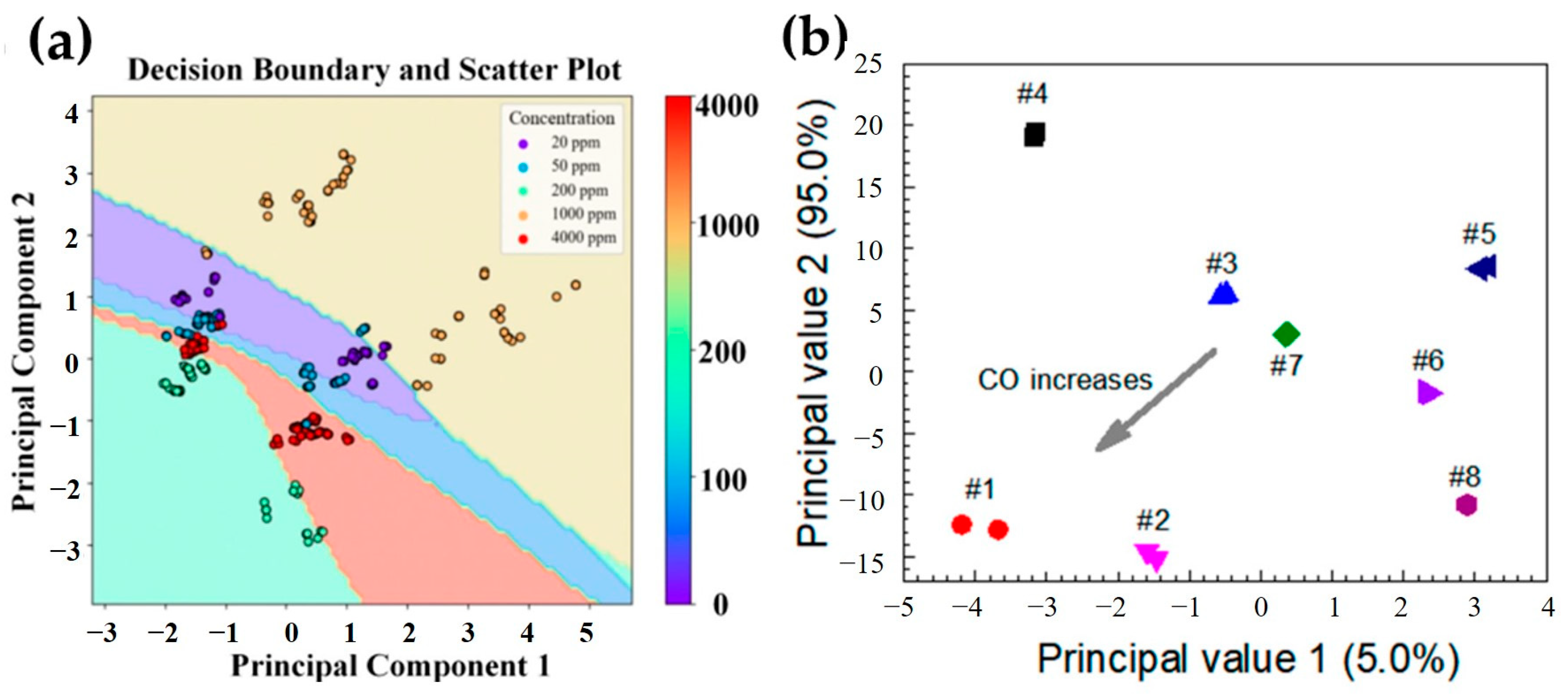
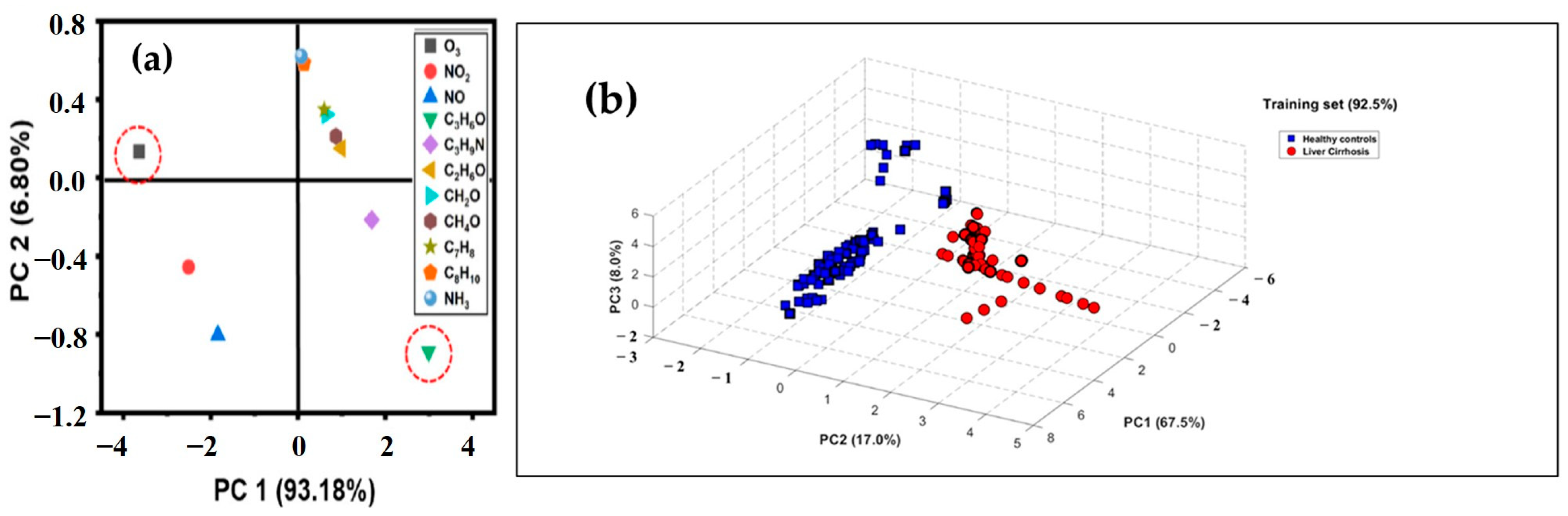
Numerous studies have demonstrated the power of PCA for exploratory data analysis and visualization in gas sensing and E-nose systems. Wawrzyniak [95] employed PCA to process transient response signals obtained from a single thermally modulated MOS sensor exposed to ethanol–methanol mixtures. The original 501 highly correlated variables were transformed into 44 uncorrelated principal components, of which the first three PCs (all with eigenvalues > 1.0) explained 99.28% of the total variance, effectively encoding the essential waveform characteristics of the target analyte mixtures. Gao et al. [96] collected 461 response–recovery curves of a hydrogen sensor under 80% relative humidity and applied PCA to extract six dominant features that contributed most significantly to data variance. The resulting two-dimensional score plot after dimensionality reduction clearly revealed well-separated clusters corresponding to different H2 concentrations, as illustrated in Figure 14a. Similarly, Yang et al. [97] performed PCA individually on the steady-state responses of sensor array modules and successfully discriminated four hazardous gases. In the CO–NO2 binary system, eight distinct concentration combinations were resolved primarily along the NO2 axis in the PC score space (Figure 14b). Sui et al. [98] utilized PCA to validate the dual selectivity of a single sensor toward ozone (O3) and acetone (C3H6O). By incorporating both response magnitude and operating temperature for 11 analytes (three oxidizing gases and eight VOCs), the resulting PCA score plot exhibited complete separation between O3 and C3H6O data points (Figure 15a). In a biomedical application, War et al. [99] applied PCA to E-nose datasets derived from exhaled breath, generating a three-dimensional score plot in which liver cirrhosis patients and healthy controls formed distinctly separated clusters even after inclusion of smoking-related samples. The first three PCs accounted for 92.50% of total variance (Figure 15b).
Despite its widespread success, PCA is not without limitations. Being a linear technique, it may fail to capture nonlinear relationships inherent in complex gas mixtures. For automotive applications, PCA fails to capture non-linear relationships in complex, noisy data from cabin environments (e.g., humidity interference or sensor drift). In dynamic vehicle settings with varying temperatures and vibrations, PCA often requires combination with non-linear methods like kernel PCA [100] to improve robustness, as it can lead to loss of discriminative information for subtle VOC mixtures. Furthermore, PCA is sensitive to outliers from sensor poisoning and computational memory demands grow rapidly with dataset size [101], potentially degrading performance in long-term deployment without adaptive recalibration.
Nevertheless, PCA remains an indispensable first-step tool for data visualization, sensor array orthogonality assessment, and preliminary classification feasibility studies in virtually all E-nose investigations.

4.2. SVM

SVM is a powerful supervised learning algorithm rooted in statistical learning theory and has become one of the most popular and effective classification and regression tools in E-nose applications. Its core principle consists of mapping the original input vectors into a higher-dimensional (possibly infinite-dimensional) feature space via a nonlinear transformation and then constructing an optimal linear decision surface in this new space that exhibits maximum generalization capability on unseen data. To circumvent the computational burden of explicit high-dimensional mapping, SVM employs kernel functions that satisfy Mercer’s condition, allowing the required inner products to be computed directly in the original input space. The most commonly used kernels are the polynomial kernel and the radial basis function (RBF) kernel, whose mathematical expressions are given in Equations (1) and (2), where u and v denote input vectors, d is the polynomial degree, and σ represents the Gaussian width parameter, respectively [102]:
K u , v = u v + 1 d
K u , v = exp u v 2 σ 2
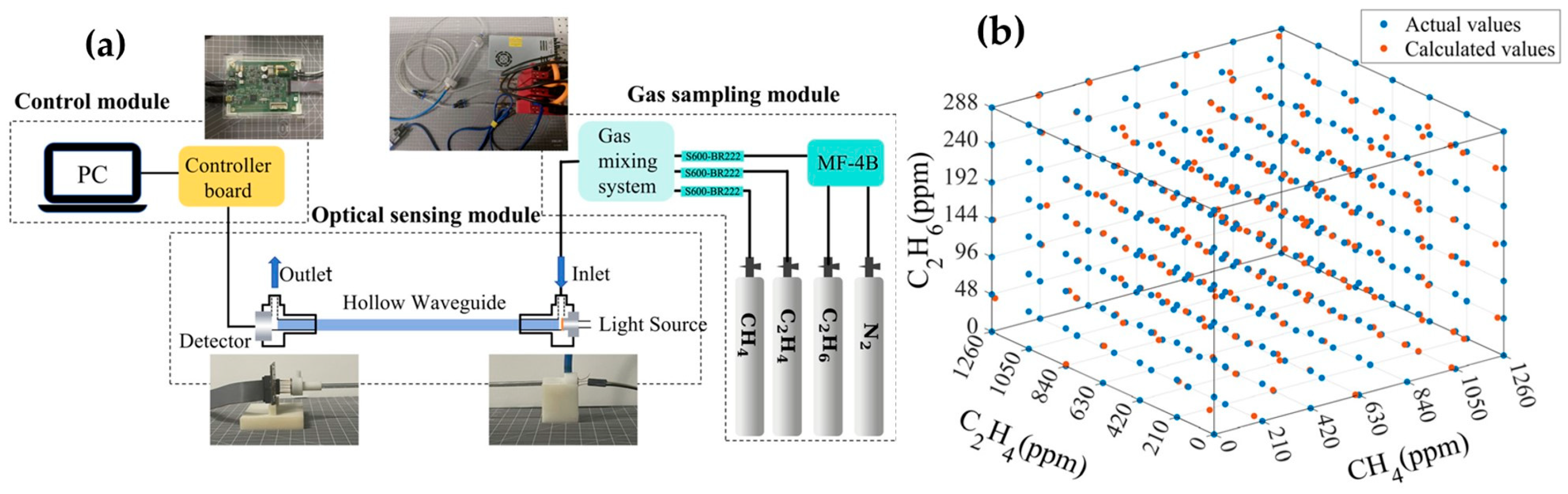
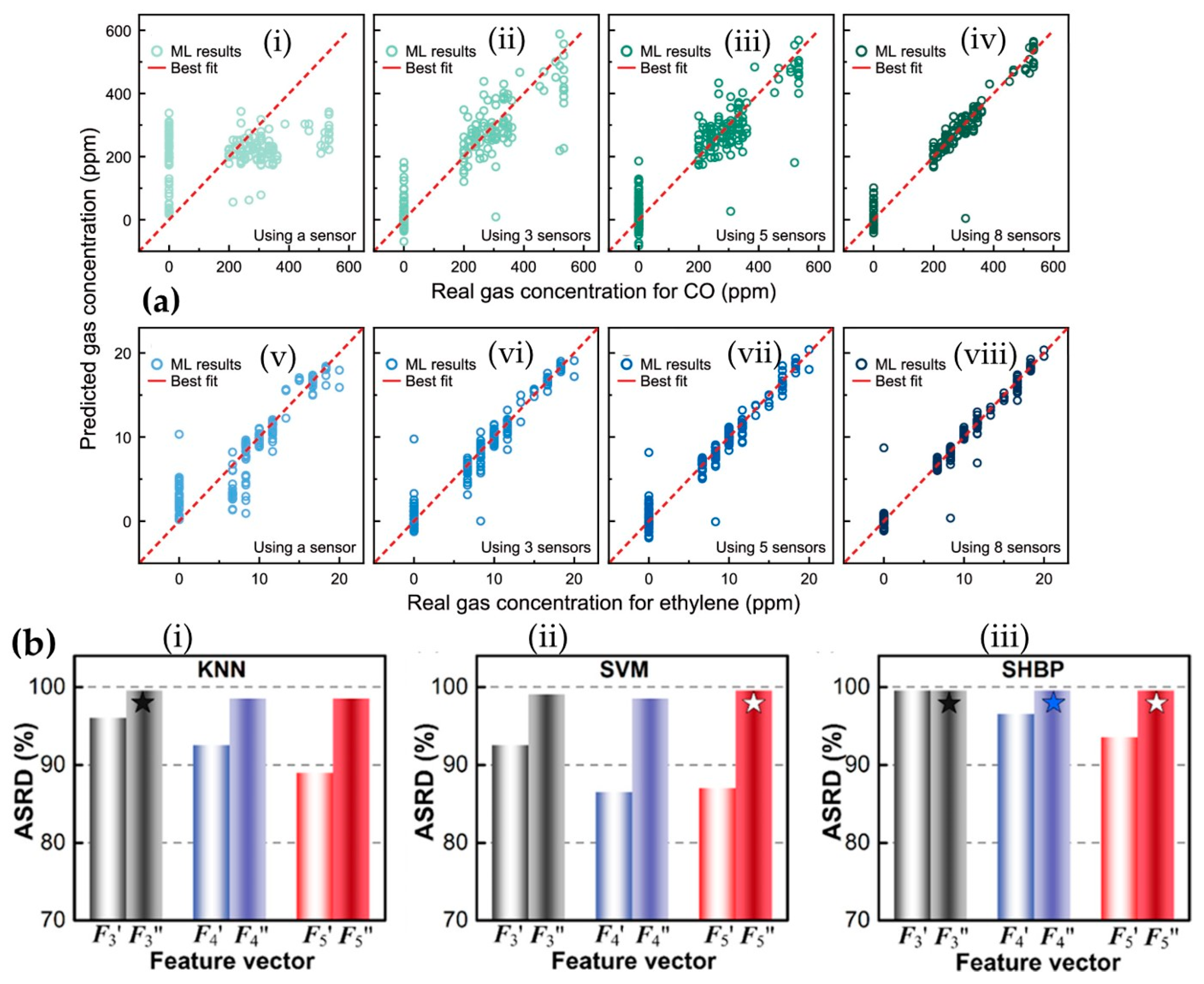
Several representative studies illustrate the outstanding performance of SVM in E-nose and gas analysis contexts. Shao et al. [103] developed a mid-infrared multi-gas sensor for simultaneous detection of methane (CH4), C2H4, and other hydrocarbons using a broadband source, hollow waveguide absorption cell, and Fabry–Pérot detector (hardware schematic shown in Figure 16a). Severe spectral overlap was successfully resolved by an SVM classifier employing an RBF kernel, with hyperparameters optimized via 5-fold cross-validation on 343 mixed spectra, yielding substantially reduced root-mean-square errors of prediction across all target gases (Figure 16b). Singh et al. [104] fabricated an array of three metal oxide thin films (including NiO) deposited by DC reactive magnetron sputtering onto Au interdigitated electrodes and combined it with SVM regression. The system achieved coefficients of determination R2 > 0.99 and ultralow limits of detection between 0.012 and 0.025 ppm for key VOCs such as acetone and toluene in mixtures. Bae et al. [101] systematically investigated the influence of sensor selectivity on concentration prediction accuracy using a commercial 16-sensor array exposed to CO–ethylene mixtures. An SVM model trained with 5-fold cross-validation revealed a clear positive correlation between individual sensor selectivity and overall prediction performance, demonstrating that low-selectivity sensors can significantly benefit from complementary pairing with highly selective ones and that expanding array size (i.e., feature dimensionality) consistently improves accuracy (Figure 17a). Zhang et al. [105] applied SVM to data from ultrasonically catalyzed MOX sensors for identification of five volatile compounds including ethanol and acetone. After careful feature selection and RBF kernel mapping, hyperparameter optimization produced an average classification success rate of 99.5% (Figure 17b).
SVMs excel in classification tasks for automotive gas sensing, offering high accuracy in distinguishing VOC profiles through hyperplane separation, even with small datasets from E-nose arrays. Their robustness to overfitting and ability to handle non-linear data via kernels make them effective for vehicle air quality applications where sensor signals are noisy.
Despite these advantages, SVM’s suitability is critiqued for automotive contexts due to high computational complexity during training, which hinders real-time processing on resource-limited embedded systems in vehicles. SVM struggles with multi-class problems common in VOC mixtures, often necessitating one-vs-one strategies that scale poorly for large arrays. Additionally, in dynamic scenarios with drifting sensor data (e.g., temperature variations), SVM requires frequent retraining or kernel optimization, increasing power consumption and latency. These shortcomings can noticeably degrade classification accuracy and model stability [106]. Consequently, rigorous data preprocessing is almost always mandatory before applying SVM. Common strategies include removal of highly correlated redundant features via Pearson product-moment correlation coefficient (PPMCC) analysis to mitigate multicollinearity, and normalization of all feature values to a uniform interval (typically [−1, 1] or [0, 1]) to eliminate scale disparities that would otherwise cause the optimizer to favor features with larger numerical ranges, thereby reducing training bias and improving convergence behavior [107]. When combined with such preprocessing steps, SVM continues to deliver state-of-the-art performance in E-nose classification and quantification tasks.

4.3. ANN

In recent years, ANNs have achieved remarkable breakthroughs in the signal processing and pattern recognition tasks associated with gas sensor arrays and E-nose systems, gradually surpassing traditional machine learning methods in both accuracy and robustness when dealing with complex, nonlinear, and noisy response patterns. Compared with support vector machines (SVMs), ANNs offer several distinctive advantages that are particularly valuable in practical E-nose deployments [108]. First, ANNs possess significantly stronger nonlinear modeling capability and universal function approximation properties rooted in the Cybenko theorem and subsequent theoretical developments. Second, as parametric models with a fixed number of learnable weights regardless of training set size, ANNs avoid the linear or super-linear growth of computational complexity and memory requirements that afflict kernel-based SVMs as the number of support vectors increases with sample count, making ANNs far more scalable for large datasets and embedded implementation. Third, modern ANN architectures enable fully end-to-end learning that automatically extracts hierarchical, task-relevant features directly from raw or minimally preprocessed sensor transients, eliminating the need for labor-intensive manual feature engineering. Fourth, pretrained ANN models exhibit superior transfer learning performance across different sensors, operating conditions, or analyte sets with minimal fine-tuning. Finally, the highly flexible, non-linear decision boundaries learned by ANNs are generally less sensitive to shifts in data distribution caused by sensor drift or environmental variations. A comprehensive summary of recent studies employing various ANN architectures for the identification and quantification of typical in-vehicle pollutants and odorants, along with their reported recognition accuracies, is presented in Table 5.
This section provides a detailed examination of the theoretical foundations, architectural characteristics, and practical performance of four representative and widely adopted artificial neural network paradigms in the context of in-vehicle air quality monitoring and odor recognition: multilayer perceptron (MLP), extreme learning machine (ELM), convolutional neural network (CNN), and long short-term memory (LSTM) network. Through systematic analysis of state-of-the-art literature, the distinctive strengths, implementation considerations, and current limitations of each algorithm when applied to multivariate, time-dependent gas sensor array data are elucidated, offering valuable guidance and reference points for researchers and engineers working toward robust, real-time E-nose systems for automotive cabin environments. Relevant quantitative results and comparative performance metrics from key studies are additionally compiled in Table 5 for direct reference.

4.3.1. MLP

MLP represents the most classical and widely implemented form of feedforward artificial neural network, capable of learning highly complex mappings from input vectors to output vectors through a structured hierarchy of interconnected neuron layers. Structurally, an MLP can be viewed as a directed acyclic graph consisting of an input layer, one or more hidden layers, and an output layer, where each layer is fully connected to the subsequent one and (except for the input nodes) every neuron applies a nonlinear activation function to the weighted sum of its inputs. In the specific context of in-vehicle pollutant and odor recognition, the number of neurons in the input layer typically equals the number of sensors in the array (or the dimensionality of the extracted feature vector), whereas the output layer dimension corresponds either to the number of target gas classes (for classification tasks) or to a single regression node when concentration prediction is required [115]. Theoretically, a single-hidden-layer MLP with sufficient neurons and appropriate activation functions can approximate any continuous function on a compact domain to arbitrary accuracy (universal approximation theorem), making it exceptionally well-suited for capturing the intricate, nonlinear response patterns exhibited by metal oxide sensor arrays exposed to complex in-vehicle gas mixtures.
In practical in-vehicle air quality monitoring scenarios, several studies have successfully deployed MLPs with excellent results. Goh et al. [116] incorporated an MLP as a core predictive model within a broader machine learning pipeline for cabin air quality assessment. Six input features—including CO2 concentration, PM2.5 level, temperature, humidity, vehicle speed, and ventilation status—were fed into a single-hidden-layer architecture comprising 128 neurons, trained with a learning rate of 0.001, tanh activation, and stochastic gradient descent optimization. Hyperparameters were systematically selected via grid search, and the final model demonstrated strong agreement between predicted and measured air quality indices. Similarly, Sukor et al. [117] conducted a comprehensive comparative study of MLP against support vector regression (SVR), long short-term memory (LSTM), and gated recurrent unit (GRU) networks for real-time prediction of multiple in-vehicle pollutants (CO2, PM10, PM2.5, etc.). After standardized preprocessing and grid-search-based hyperparameter tuning, the MLP exhibited competitive performance, confirming its continued relevance even when benchmarked against more modern recurrent and attention-based architectures.
MLP’s flexibility in handling multi-sensor inputs makes them suitable for fusing data from MOX arrays with environmental variables like temperature and humidity. However, MLP’s suitability for automotive applications is limited by susceptibility to overfitting on noisy or imbalanced datasets common in cabin monitoring, leading to poor generalization under varying conditions (e.g., sensor aging or interference) [118]. High training time and computational demand also pose challenges for edge deployment in vehicles with limited processing power, often requiring regularization techniques or hybrid models to mitigate. In real-time air quality scenarios, MLP can suffer from local minima issues, reducing reliability for safety-critical detection.

4.3.2. ELM

ELM is an efficient single-hidden-layer feedforward neural network (SLFN) learning algorithm originally proposed by Professor Guang-Bin Huang from Nanyang Technological University in 2006 [119]. In sharp contrast to conventional gradient-based training methods, ELM offers several compelling advantages, including dramatically faster learning speeds (often by orders of magnitude), excellent generalization performance across diverse datasets, and remarkably simple hyperparameter selection that typically requires tuning only the number of hidden neurons. The core innovation of ELM lies in its non-iterative training paradigm: the input-to-hidden-layer weights and hidden neuron biases are randomly assigned and remain fixed throughout the process, while the hidden-to-output-layer weights are determined analytically in a single step. By completely bypassing iterative gradient descent, ELM eliminates issues such as slow convergence, stopping criteria selection, and learning rate tuning that plague traditional backpropagation algorithms.
A key theoretical strength of ELM is its universal approximation capability combined with robust generalization, even under random hidden parameter assignment [120]. Rigorous proofs demonstrate that, for any infinitely differentiable activation function (e.g., sigmoid, tanh, ReLU, or Gaussian), SLFNs with randomly generated hidden nodes can approximate any continuous target function with probability one, provided a sufficient number of hidden neurons is employed. This property liberates practitioners from laborious parameter optimization loops, enabling rapid model prototyping and deployment in resource-constrained environments such as embedded automotive electronics. Over the past decade, the original ELM framework has inspired a rich family of enhanced variants that address specific limitations while preserving the core speed advantage. Notable extensions include kernel extreme learning machine (KELM), which incorporates kernel methods for improved stability in high-dimensional spaces [121], incremental extreme learning machine (IELM), designed for online and sequential learning scenarios [122], and weighted extreme learning machine (WELM), which introduces sample weighting to handle imbalanced datasets more effectively [123]. These developments have collectively broadened the applicability of ELM-based approaches in real-world gas sensing tasks.
In the domain of in-vehicle pollutant and odor recognition, ELM and its derivatives have emerged as highly efficient and practical solutions, particularly when real-time performance and low computational overhead are critical. Wang et al. [110] developed a compact E-nose comprising only three MOS gas sensors and applied it to both qualitative classification and quantitative prediction of six common VOCs. The authors constructed a cascaded ELM–ELM ensemble, where the output probabilities from a classification ELM served as additional input features for a regression ELM. Hyperparameters were optimized via 5-fold cross-validation, yielding impressive results: 99% classification accuracy and an R2 of 0.97 on the validation folds, 93% classification accuracy and R2 of 0.94 on an independent test set, with both training and testing phases completing in under 0.1 s—demonstrating the remarkable speed advantage for on-board deployment. In another targeted application focused on formaldehyde detection within mixed cabin atmospheres, Zhao et al. [124] designed a lightweight ELM network with two input nodes (fed by PCA-reduced features), 18 hidden neurons employing sigmoid activation, and two output nodes for binary decision making. The entire model trained in merely 0.04 s—substantially faster than comparable BP neural networks or SVM implementations—while achieving a recognition accuracy of 94%, underscoring ELM’s suitability for rapid, low-power in-vehicle monitoring systems where quick retraining or adaptation to sensor drift may be required.
However, ELM’s suitability is also critiqued due to random initialization of input weights (while computationally efficient), which can lead to instability and inconsistent performance in noisy automotive environments (e.g., vibration-induced signal variations or drift). In multi-class VOC detection, ELM may underperform in complex scenarios with high-dimensional data, requiring ensemble variants or regularization to improve robustness. For real-time in-vehicle applications, ELM’s lack of deep feature extraction limits its handling of temporal dependencies in gas mixtures.

4.3.3. CNN

CNN is a class of deep feedforward neural networks specifically engineered for processing data with grid-like topology, most prominently images, and has revolutionized numerous domains, including computer vision, speech recognition, and, more recently, chemical sensor signal analysis. The defining innovation of CNN lies in its ability to automatically learn hierarchical feature representations through local receptive fields, parameter sharing, and spatial subsampling, thereby achieving dramatic reductions in trainable parameters while maintaining or exceeding the expressive power of fully connected networks.
The canonical CNN architecture comprises three fundamental building blocks that are typically stacked in alternating fashion [125]. The convolutional layer constitutes the core component, wherein a set of learnable filters (kernels) systematically slide across the input tensor, computing dot products between kernel weights and local input patches to generate feature maps that capture spatially (or temporally) localized patterns such as edges, gradients, or characteristic response transients in sensor data. The pooling layer (or subsampling layer) follows, performing non-linear downsampling—most commonly max-pooling or average-pooling—to progressively reduce spatial dimensionality, confer translation invariance, and enhance robustness to minor shifts or distortions in the input. Finally, one or more fully connected layers at the network apex integrate the high-level features extracted by preceding layers and map them to the desired output space, such as gas identity probabilities or concentration values.
In the specific context of in-vehicle pollutant and odor recognition, CNNs are predominantly applied by first transforming the multivariate time-series responses from sensor arrays into structured two-dimensional representations (e.g., response matrices, Gramian angular fields, Markov transition fields, or pseudo-images derived from dynamic transients), thereby fully exploiting the powerful image-processing capabilities of convolutional architectures. Zhou et al. [113] elegantly demonstrated this principle by incorporating convolutional front-end modules within a hybrid convolutional long short-term memory (CLSTM) framework, where early CNN layers rapidly and automatically extracted spatially and temporally localized features from raw sensor array time-series before feeding them into recurrent units for sequence modeling.
Recent years have witnessed the emergence of specialized CNN variants tailored to the unique characteristics of gas sensor data. One-dimensional convolutional neural networks (1D-CNNs) have gained particular popularity because they can be applied directly to raw or minimally preprocessed temporal response curves without the need for explicit 2D conversion, thereby preserving fine-grained kinetic information that might otherwise be lost during transformation [126]. Further performance enhancements have been realized through architectural innovations such as attention mechanisms that dynamically focus on the most informative sensors or time segments, residual connections (ResNet-style) that facilitate training of very deep networks by mitigating vanishing gradient issues, dense connectivity patterns, and multi-scale feature fusion, all of which collectively improve classification accuracy, regression precision, and robustness against sensor drift, humidity variations, and concentration fluctuations commonly encountered in real vehicular cabins.
However, CNN’s suitability is limited in automotive contexts by high computational requirements, leading to overfitting on small datasets and poor efficiency on resource-constrained vehicle ECUs without GPU support. In noisy environments with sensor drift or interference, CNN can struggle with generalization, requiring data augmentation or transfer learning to mitigate [127]. For battery-powered systems, CNN’s energy demand poses challenges, often necessitating lightweight variants for deployment. Therefore, developing lightweight CNN architectures that are resilient to sensor drift is imperative for the practical implementation of in-vehicle olfactory systems.

4.3.4. LSTM

LSTM networks represent a specialized and highly effective variant of recurrent neural networks (RNNs) explicitly designed to model long-range dependencies in sequential data. Unlike vanilla RNNs, which suffer from severe vanishing or exploding gradient problems during backpropagation through time, LSTMs successfully mitigate these issues through an elegant gating mechanism that regulates the flow of information into and out of a persistent memory cell [128]. The architecture and operation of a standard LSTM unit are illustrated schematically in Figure 18.
At the heart of each LSTM cell lies a linear memory unit (the cell state) augmented by three multiplicative gating components: the forget gate, the input gate, and the output gate. The forget gate selectively discards irrelevant or outdated information from the previous cell state via a sigmoid-activated weighted combination of the current input and prior hidden state. The input gate determines which new candidate values—computed by a tanh layer—should be added to the cell state, while simultaneously scaling the magnitude of the update. Finally, the output gate controls the extent to which the updated cell state influences the current hidden state that is passed to the next time step and used for predictions. Through this sophisticated yet interpretable system of gates, all implemented with element-wise multiplications and sigmoid/tanh nonlinearities, LSTMs acquire the ability to selectively remember relevant information over hundreds of time steps and forget irrelevant noise, making them exceptionally well-suited for processing the inherently dynamic, time-dependent response curves generated by gas sensor arrays.
In the specific domain of in-vehicle pollutant and odor recognition, LSTM-based models excel at capturing the rich temporal kinetics of sensor transients—including adsorption/desorption rates, overshoot behavior, and recovery characteristics—that are often critical for accurate discrimination under varying concentration and interference conditions. Zhang et al. [129] systematically optimized LSTM hyperparameters (including batch size, number of layers, hidden units, and learning rate) for real-time prediction of cabin pollutant concentrations from multi-sensor time-series data. Their trained model faithfully reproduced overall trends, peak/valley positions, and inflection points, achieving a remarkably low mean squared error of 0.003, demonstrating the power of LSTMs for high-precision quantitative monitoring in automotive environments. Numerous enhanced LSTM variants, such as Bidirectional LSTM (Bi-LSTM) [130], Convolutional LSTM (ConvLSTM) [131] have been proposed to further improve performance. Collectively, these advancements continue to solidify LSTM-based models as a cornerstone for next-generation intelligent in-vehicle air quality monitoring systems.
While its unique gated architecture excels at handling long-term dependencies (making it ideal for predicting pollutant concentrations under complex conditions such as traffic pollution peaks), the practical deployment of LSTM in vehicles faces engineering trade-offs. Its suitability is often scrutinized due to high memory usage and computational intensity, which strain embedded processors and increase latency in real-time detection. Furthermore, while LSTMs effectively address gradient vanishing in typical sequences, they can still struggle with stability or convergence when faced with the extreme noise and irregular sampling common in raw automotive datasets. In such cases, LSTM is prone to overfitting and may require substantial training data, limiting its standalone deployment on resource-constrained edge devices. Hybrid LSTM-CNN models are often needed to enhance feature robustness, as power consumption remains a barrier for continuous monitoring. Despite these challenges, through model compression or hardware acceleration, LSTM remains a predominant choice in this field due to its unparalleled temporal modeling capabilities.

4.4. Advanced Circuit-Algorithm Synergy and Future Integration Strategies

Breakthroughs in gas sensor array E-noses for future in-vehicle monitoring require deep synergy between circuit design and algorithmic research, building upon existing academic studies on environmental gases such as automotive exhaust [132], outdoor air [133,134,135], and indoor environments [136,137,138,139]. Algorithmic efforts must focus on enhancing robustness against noise, sensor drift, and complex multi-analyte backgrounds through continued refinement of classical methods, deep neural networks, and neuromorphic approaches such as spiking neural networks (SNNs), while hardware development must simultaneously push integration density and energy efficiency to automotive-grade levels. For instance, the computational complexity of high-accuracy ANNs can be effectively mitigated through dedicated Application-Specific Integrated Circuit (ASIC) or FPGA accelerators tailored specifically for on-board inference [140].
Chen et al. [140] outlined several critical research directions and these encompass five dimensions: (1) hybrid training paradigms that leverage ANN-supervised learning to close the accuracy gap of SNNs while preserving their ultra-low power consumption; (2) establishment of standardized SNN design frameworks, including unified neuron models, spike encoding schemes (rate vs. temporal coding), and biologically plausible learning rules such as spike-timing-dependent plasticity (STDP); (3) full monolithic integration of MEMS sensor arrays, CMOS readout circuitry, and neuromorphic processing cores on a single chip to eliminate off-chip data transfer bottlenecks; (4) incorporation of auxiliary temperature and humidity sensors coupled with dedicated compensation algorithms (e.g., the PCA-based correction strategy demonstrated by Chou et al. [141]); and (5) preferential adoption of asynchronous event-driven circuits and subthreshold operation, exemplified by the 519 nW training-mode SNN processor reported by Huang et al. [142], to enable energy-harvesting-powered or multi-year battery operation. Furthermore, future systems will benefit from optimized array configurations with fewer yet highly orthogonal sensors, dynamic temperature modulation of micro-hotplates, advanced gas sampling cavities, and edge-computing architectures supported by low-power wireless protocols [143], while drawing inspiration from biological olfactory receptor structures [144].
The integration of advanced AI paradigms at the edge also holds tremendous promise for enhancing in-vehicle E-nose performance. Edge AI and neuromorphic computing, inspired by biological olfactory systems, enable event-driven, ultra-low-power processing directly on-chip, drastically reducing latency and energy consumption while mitigating sensor drift through real-time adaptive learning [145].

5. Challenges and Benchmarking for Real-World In-Vehicle Deployment

Beyond the algorithmic advancements in pattern recognition, the transition from laboratory prototypes to practical automotive applications remains a critical challenge. Such benchmarking is essential to evaluate the real-world viability of reported MOX MEMS sensors against established commercial solutions. Academic studies have demonstrated impressive sensitivities (often near-ppb or low-ppm levels for VOCs like benzene and formaldehyde) through advanced material engineering and temperature modulation. However, real-vehicle deployment introduces harsh conditions, including mechanical vibration with a risk of structural damage [146], thermal shock (−40 to 85 °C cycles), high humidity (up to 95% RH) [70], long-term signal drift (from heater resistance changes and baseline shifts), irreversible poisoning from exhaust gases/silicone volatiles (e.g., HMDS surface passivation degrading SnO2 layers), and complex background VOC mixtures from cabin materials (plastics, leather, adhesives). These factors significantly impact long-term stability, selectivity, and power efficiency [87]. Temperature-cycling and pulsed heating strategies mitigate power while enabling drift compensation [147], but require on-chip filters for vibration and software-based compensation algorithms for humidity noise. Hermetic packaging with gas-permeable membranes protects against dust/contamination, yet recovery slows in humid/poisoned states due to increased diffusion resistance.
Commercial in-vehicle systems (e.g., in Tesla Model 3/Y, VW ID series, GM vehicles) prioritize reliability, low power (<10 mW average), and integration with HVAC (Heating, Ventilation, and Air Conditioning) for automatic recirculation. Sensors like Bosch BME688 and Sensirion SGP41 use MOX MEMS with on-chip algorithms for drift compensation and humidity robustness, achieving >5-year lifetimes in production vehicles [148,149].
The following tables, including Table 6, Table 7 and Table 8 provide quantitative benchmarks based on 2020–2025 literature and datasheets.

6. Conclusions and Future Outlook

The rapid advancements in MEMS-based MOX sensor arrays, particularly using SnO2, ZnO, and TiO2 as sensing materials, have positioned E-noses as promising tools for in-vehicle air quality monitoring. Through optimized nanostructuring, heterojunction engineering, photoactivation, and CMOS-compatible fabrication, these systems achieve ppb-level sensitivity, low power consumption, and compact integration suitable for automotive cabins. The detailed benchmarking presented in Section 5 demonstrates that laboratory prototypes now rival or exceed commercial sensors in certain respects, while alternative substrates (glass, ceramics, polymers) and low-cost synthesis routes further enhance scalability and robustness.
Current technology readiness levels (TRLs) [155] for MEMS MOX E-noses in automotive applications range from TRL 4–6 in academic and prototype stages to TRL 8–9 in commercial deployments. Bosch BME688- and Sensirion SGP41-based systems in production vehicles have reached TRL 9, with proven long-term stability under AEC-Q100 qualification. Advanced academic designs incorporating photoactivation or flexible substrates remain at TRL 4–5, limited by insufficient validation in real-vehicle environments.
Despite these achievements, several barriers hinder widespread commercialization. Primary challenges include long-term drift under thermal/vibrational stress, poisoning from cabin outgassing, high development costs for automotive-grade qualification, and the need for standardized multi-VOC calibration protocols. Integration complexity, regulatory compliance (e.g., ISO 26262 functional safety [156]), and competition from established NDIR/electrochemical CO2 sensors further delay adoption of broadband MOX E-noses.
Looking ahead, the next 5 years are likely to witness accelerated progress through hybrid material strategies, edge-AI drift compensation, and monolithic integration of UV LEDs for room-temperature operation. Suggested research directions include: (1) conducting accelerated life testing in simulated automotive environments, (2) developing machine learning-based self-calibration algorithms, (3) exploring emerging 2D materials and neuromorphic computing for ultra-low power operation and (4) establishing industry-academia cooperation models to bridge the gap in technology readiness levels (from TRL 6 to 8). Successful navigation of these barriers will enable MEMS MOX E-noses to become standard features in future connected and autonomous vehicles, significantly enhancing occupant health and comfort.

Author Contributions

R.T., D.L. and X.L. conceived and designed the study; X.L., D.L., R.T., W.S. (Wenfeng Shen) and W.S. (Weijie Song) analyzed and summarized the relevant articles; X.L. and R.T. wrote the manuscript; and R.T. revised the manuscript. All authors have read and agreed to the published version of the manuscript.

Funding

This work is supported by the Ningbo Key Scientific and Technological Project (NBSTI 2023Z021).

Institutional Review Board Statement

Not applicable.

Informed Consent Statement

Not applicable.

Data Availability Statement

The original contributions presented in this study are included in the article material. Further inquiries can be directed to the corresponding authors.

Conflicts of Interest

The authors declare no conflicts of interest.

Abbreviations

The following abbreviations are used in this manuscript:
MEMSMicro-Electro-Mechanical System
MOSMetal Oxide Semiconductor
VOCsVolatile Organic Compounds
GC-MSGas Chromatography–Mass Spectrometry
GC-OGas Chromatography–Olfactometry
PCAPrincipal Component Analysis
ANNArtificial Neural Network
ELMExtreme Learning Machine
SnO2Tin Oxide
ZnOZinc Oxide
TiO2Titanium Dioxide
NOxNitrogen Oxides
CMOSComplementary Metal Oxide Semiconductor
PdPalladium
AuGold
NiONickel Oxide
WO3Tungsten Trioxide
FE-SEMField Emission Scanning Electron Microscope
XRDX-ray Diffraction
XPSX-ray Photoelectron Spectroscopy
ppmParts Per Million
ppbParts Per Billion
pptParts Per Trillion
CuOCopper Oxide
Al2O3Aluminum Oxide
CVDChemical Vapor Deposition
RTRoom temperature
AACVDAerosol Assisted Chemical Vapor Deposition
ALDAtomic Layer Deposition
TMAHTetramethylammonium Hydroxide
KOHPotassium Hydroxide
IDEsInterdigitated Electrodes
WLPWafer-Level Packaging
SOISilicon on Insulator
PECVDPlasma-Enhanced Chemical Vapor Deposition
BCDBipolar-CMOS-DMOS
RSDRelative Standard Deviation
SVMSupport Vector Machine
MLPMultilayer Perceptron
CNNConvolutional Neural Network
LSTMLong Short-Term Memory
RNNRecurrent Neural Network
Bi-LSTMBidirectional Long Short-Term Memory
ConvLSTMConvolutional Long Short-Term Memory
GRUGated Recurrent Unit
KNNk-Nearest Neighbor
PSOParticle Swarm Optimization
SNNSpiking Neural Network
ASICApplication-Specific Integrated Circuit
FPGAField-Programmable Gate Array
STDPSpike-Timing-Dependent Plasticity
LODLimit of Detection
PPMCCPearson Product Moment Correlation Coefficient
SVRSupport Vector Regression
CMUTCapacitive Micromachined Ultrasonic Transducer
CH2OFormaldehyde
CH4OMethanol
NDIRNon-dispersive infrared
PIDPhotoionization Detector

References

  1. Yoshida, T.; Matsunaga, I.; Tomioka, K.; Kumagai, S. Interior Air Pollution in Automotive Cabins by Volatile Organic Compounds Diffusing from Interior Materials: I. Survey of 101 Types of Japanese Domestically Produced Cars for Private Use. Indoor Built Environ. 2006, 15, 425–444. [Google Scholar] [CrossRef]
  2. Szczurek, A.; Maciejewska, M. Categorisation for Air Quality Assessment in Car Cabin. Transp. Res. Part Transp. Environ. 2016, 48, 161–170. [Google Scholar] [CrossRef]
  3. Buchecker, F.; Loos, H.M.; Buettner, A. Volatile Compounds in the Vehicle-Interior: Odorants of an Aqueous Cavity Preservation and Beyond. In Proceedings of the Progress in Flavour Research: Proceedings of the 16th Weurman Flavour Research Symposium, Dijon, France, 4–6 May 2021; pp. 289–292. [Google Scholar]
  4. Huang, L.; Mo, J.; Sundell, J.; Fan, Z.; Zhang, Y. Health Risk Assessment of Inhalation Exposure to Formaldehyde and Benzene in Newly Remodeled Buildings, Beijing. PLoS ONE 2013, 8, e79553. [Google Scholar] [CrossRef] [PubMed]
  5. Tsai, W.-T. An Overview of Health Hazards of Volatile Organic Compounds Regulated as Indoor Air Pollutants. Rev. Environ. Health 2019, 34, 81–89. [Google Scholar] [CrossRef] [PubMed]
  6. Yadava, R.N.; Bhatt, V. Carbon Monoxide: Risk Assessment, Environmental, and Health Hazard. In Hazardous Gases; Elsevier: Amsterdam, The Netherlands, 2021; pp. 83–96. [Google Scholar]
  7. Moufid, M.; Bouchikhi, B.; Tiebe, C.; Bartholmai, M.; El Bari, N. Assessment of Outdoor Odor Emissions from Polluted Sites Using Simultaneous Thermal Desorption-Gas Chromatography-Mass Spectrometry (TD-GC-MS), Electronic Nose in Conjunction with Advanced Multivariate Statistical Approaches. Atmos. Environ. 2021, 256, 118449. [Google Scholar] [CrossRef]
  8. Tan, L.; Feng, Z.; Zheng, H.; Yao, Z.; Weng, X.; Wang, F.; Chang, Z. Development Trend of Electronic Nose Technology in Closed Cabins Gas Detection: A Review. Appl. Sci. 2022, 12, 9326. [Google Scholar] [CrossRef]
  9. Buchecker, F.; Baum, A.; Loos, H.M.; Buettner, A. Follow Your Nose-Traveling the World of Odorants in New Cars. Indoor Air 2022, 32, e13014. [Google Scholar] [CrossRef]
  10. Acharyya, S.; Jana, B.; Nag, S.; Saha, G.; Guha, P.K. Single Resistive Sensor for Selective Detection of Multiple VOCs Employing SnO2 Hollowspheres and Machine Learning Algorithm: A Proof of Concept. Sens. Actuators B Chem. 2020, 321, 128484. [Google Scholar] [CrossRef]
  11. Kiani, S.; Minaei, S.; Ghasemi-Varnamkhasti, M. Application of Electronic Nose Systems for Assessing Quality of Medicinal and Aromatic Plant Products: A Review. J. Appl. Res. Med. Aromat. Plants 2016, 3, 1–9. [Google Scholar] [CrossRef]
  12. Hu, W.; Wan, L.; Jian, Y.; Ren, C.; Jin, K.; Su, X.; Bai, X.; Haick, H.; Yao, M.; Wu, W. Electronic Noses: From Advanced Materials to Sensors Aided with Data Processing. Adv. Mater. Technol. 2019, 4, 1800488. [Google Scholar] [CrossRef]
  13. Asri, M.I.A.; Hasan, M.N.; Fuaad, M.R.A.; Yunos, Y.M.; Ali, M.S.M. MEMS Gas Sensors: A Review. IEEE Sens. J. 2021, 21, 18381–18397. [Google Scholar] [CrossRef]
  14. Li, Y.; Wei, X.; Zhou, Y.; Wang, J.; You, R. Research Progress of Electronic Nose Technology in Exhaled Breath Disease Analysis. Microsyst. Nanoeng. 2023, 9, 129. [Google Scholar] [CrossRef] [PubMed]
  15. Rabih, A.A.S.; Dennis, J.O.; Ahmed, A.Y.; Md Khir, M.H.; Ahmed, M.G.A.; Idris, A.; Mian, M.U. MEMS-Based Acetone Vapor Sensor for Non-Invasive Screening of Diabetes. IEEE Sens. J. 2018, 18, 9486–9500. [Google Scholar] [CrossRef]
  16. Luo, Q.; Liu, R.; Li, Y.; Li, Y.; Wang, K.; Liu, Y.; Sun, J.; Huang, K.; Zhong, L.; Wang, J.; et al. A Portable Breath Acetone Analyzer Using a Low-Power and High-Selectivity MEMS Gas Sensor Based on Pd/In2O3-Decorated SnO2 Nanocomposites. Sens. Actuators B Chem. 2025, 439, 137854. [Google Scholar] [CrossRef]
  17. Chen, L.-Y.; Wong, D.-M.; Fang, C.-Y.; Chiu, C.-I.; Chou, T.-I.; Wu, C.-C.; Chiu, S.-W.; Tang, K.-T. Development of an Electronic-Nose System for Fruit Maturity and Quality Monitoring. In Proceedings of the 2018 IEEE International Conference on Applied System Invention (ICASI), Chiba, Japan, 13–17 April 2018; pp. 1129–1130. [Google Scholar]
  18. Love, C.; Nazemi, H.; El-Masri, E.; Ambrose, K.; Freund, M.S.; Emadi, A. A Review on Advanced Sensing Materials for Agricultural Gas Sensors. Sensors 2021, 21, 3423. [Google Scholar] [CrossRef]
  19. Molleman, B.; Alessi, E.; Passaniti, F.; Daly, K. Evaluation of the Applicability of a Metal Oxide Semiconductor Gas Sensor for Methane Emissions from Agriculture. Inf. Process. Agric. 2024, 11, 573–580. [Google Scholar] [CrossRef]
  20. Yang, X.; Li, M.; Ji, X.; Chang, J.; Deng, Z.; Meng, G. Recognition Algorithms in E-Nose: A Review. IEEE Sens. J. 2023, 23, 20460–20472. [Google Scholar] [CrossRef]
  21. Sun, Z.-H.; Liu, K.-X.; Xu, X.-H.; Meng, Q.-H. Odor Evaluation of Vehicle Interior Materials Based on Portable E-Nose. In Proceedings of the 2020 39th Chinese Control Conference (CCC), Shenyang, China, 27–29 July 2020; pp. 2998–3003. [Google Scholar]
  22. Raj, G.C.A.; Abu-Libdeh, A. Electronic Nose for Gas Sensing Applications in Autonomous Vehicles. In Proceedings of the UWill Discover Student Research Conference, Windsor, ON, Canada, 18–24 March 2024. [Google Scholar]
  23. Ivanov, S.; Wilk-Jakubowski, J.Ł.; Ciopiński, L.; Pawlik, Ł.; Wilk-Jakubowski, G.; Mihalev, G. Modern Trends in the Application of Electronic Nose Systems: A Review. Appl. Sci. 2025, 15, 10776. [Google Scholar] [CrossRef]
  24. Kim, H.-J.; Lee, J.-H. Highly Sensitive and Selective Gas Sensors Using P-Type Oxide Semiconductors: Overview. Sens. Actuators B Chem. 2014, 192, 607–627. [Google Scholar] [CrossRef]
  25. Cretu, V.; Postica, V.; Mishra, A.K.; Hoppe, M.; Tiginyanu, I.; Mishra, Y.K.; Chow, L.; De Leeuw, N.H.; Adelung, R.; Lupan, O. Synthesis, Characterization and DFT Studies of Zinc-Doped Copper Oxide Nanocrystals for Gas Sensing Applications. J. Mater. Chem. A 2016, 4, 6527–6539. [Google Scholar] [CrossRef]
  26. Gao, D.; Yu, Q.; Kebeded, M.A.; Zhuang, Y.; Huang, S.; Jiao, M.; He, X. Advances in Modification of Metal and Noble Metal Nanomaterials for Metal Oxide Gas Sensors: A Review. Rare Met. 2025, 44, 1443–1496. [Google Scholar] [CrossRef]
  27. Wang, C.; Yin, L.; Zhang, L.; Xiang, D.; Gao, R. Metal Oxide Gas Sensors: Sensitivity and Influencing Factors. Sensors 2010, 10, 2088–2106. [Google Scholar] [CrossRef] [PubMed]
  28. Egger, L.; Sosada-Ludwikowska, F.; Steinhauer, S.; Singh, V.; Grammatikopoulos, P.; Köck, A. SnO2-Based CMOS-Integrated Gas Sensor Optimized by Mono-, Bi-, and Trimetallic Nanoparticles. Chemosensors 2025, 13, 59. [Google Scholar] [CrossRef]
  29. Yan, J.; Kang, Y.; Fang, W.; Zhu, B.; Song, Z. Tuning Gas Sensing Properties through Metal-Nanocluster Functionalization of 3D SnO2 Nanotube Arrays for Selective Gas Detection. ACS Sens. 2025, 10, 6084–6094. [Google Scholar] [CrossRef]
  30. Guo, B.; Bermak, A.; Chan, P.C.H.; Yan, G.-Z. A 4×4 Tin Oxide Gas Sensor Array with On-Chip Signal Pre-Processing. In Proceedings of the 2006 International Conference on Microelectronics, Dhahran, Saudi Arabia, 11–13 December 2006; pp. 9–12. [Google Scholar]
  31. Choi, P.G.; Masuda, Y. Nanosheet-Type Tin Oxide Gas Sensor Array for Mental Stress Monitoring. Sci. Rep. 2022, 12, 13874. [Google Scholar] [CrossRef]
  32. Wang, Y.; Liu, C.; Wang, Z.; Song, Z.; Zhou, X.; Han, N.; Chen, Y. Sputtered SnO2:NiO Thin Films on Self-Assembled Au Nanoparticle Arrays for MEMS Compatible NO2 Gas Sensors. Sens. Actuators B Chem. 2019, 278, 28–38. [Google Scholar] [CrossRef]
  33. Zhao, J.; Shen, W.; Gao, Y.; Lv, D.; Song, W.; Tan, R. Optimization of SnO2-Based MEMS Sensor Array for Expeditious and Precise Categorization of Meat Types and Freshness Status. Sens. Actuators Phys. 2025, 391, 116680. [Google Scholar] [CrossRef]
  34. Si, R.; Li, Y.; Tian, J.; Tan, C.; Chen, S.; Lei, M.; Xie, F.; Guo, X.; Zhang, S. Cross-Interference of VOCs in SnO2-Based NO Sensors. Nanomaterials 2023, 13, 908. [Google Scholar] [CrossRef]
  35. Krishna, K.G.; Umadevi, G.; Parne, S.; Pothukanuri, N. Zinc Oxide Based Gas Sensors and Their Derivatives: A Critical Review. J. Mater. Chem. C 2023, 11, 3906–3925. [Google Scholar] [CrossRef]
  36. Zhang, T.; Tan, R.; Shen, W.; Lv, D.; Yin, J.; Chen, W.; Fu, H.; Song, W. Inkjet-Printed ZnO-Based MEMS Sensor Array Combined with Feature Selection Algorithm for VOCs Gas Analysis. Sens. Actuators B Chem. 2023, 382, 133555. [Google Scholar] [CrossRef]
  37. Zhu, L.; Rong, Q.; Yang, Z.; Zhang, W.; Jiao, M.; Song, J.; Wang, C.; Guo, Y. ZnO Nanoparticle-Based MEMS Sensors for H2 S Detection. ACS Appl. Nano Mater. 2022, 5, 11595–11604. [Google Scholar] [CrossRef]
  38. Chu, Y.-L.; Young, S.-J.; Huang, Y.-R.; Arya, S.; Chu, T.-T. Highly Sensitive Ethanol Gas Sensors of Au Nanoparticle-Adsorbed ZnO Nanorod Arrays via a Photochemical Deposition Treatment. ACS Appl. Electron. Mater. 2025, 7, 2327–2338. [Google Scholar] [CrossRef]
  39. Nagarjuna, Y.; Hsiao, Y.-J. CuO/ZnO Heterojunction Nanostructured Sensor Prepared on MEMS Device for Enhanced H2 S Gas Detection. J. Electrochem. Soc. 2021, 168, 067521. [Google Scholar] [CrossRef]
  40. Zhao, J.; Wang, H.; Cai, Y.; Zhao, J.; Gao, Z.; Song, Y.-Y. The Challenges and Opportunities for TiO2 Nanostructures in Gas Sensing. ACS Sens. 2024, 9, 1644–1655. [Google Scholar] [CrossRef]
  41. Bouktif, B.; Rashid, M.; Hajjaji, A.; Choubani, K.; Alrasheedi, N.H.; Louhichi, B.; Dimassi, W.; Ben Rabha, M. Synthesis and Characterization of TiO2 Nanotubes for High-Performance Gas Sensor Applications. Crystals 2024, 14, 928. [Google Scholar] [CrossRef]
  42. Deb, M.; Ghossoub, Y.; Noel, L.; Li, P.-H.; Tsai, H.-Y.; Soppera, O.; Zan, H.-W. Highly Efficient UV-Activated TiO2 /SnO2 Surface Nano-Matrix Gas Sensor: Enhancing Stability for Ppb-Level NOx Detection at Room Temperature. ACS Appl. Mater. Interfaces 2025, 17, 14670–14681. [Google Scholar] [CrossRef]
  43. Wang, D.; Chen, A.; Jen, A.K.-Y. Reducing Cross-Sensitivity of TiO2-(B) Nanowires to Humidity Using Ultraviolet Illumination for Trace Explosive Detection. Phys. Chem. Chem. Phys. 2013, 15, 5017. [Google Scholar] [CrossRef]
  44. Moura, P.C.; Sério, S. Recent Applications and Future Trends of Nanostructured Thin Films-Based Gas Sensors Produced by Magnetron Sputtering. Coatings 2024, 14, 1214. [Google Scholar] [CrossRef]
  45. Pooja; Dahiya, R.; Sheokand, A.; Bulla, M.; Sindhu, S.; Rani, P.; Jeet, K.; Kumar, V. Fabrication of ZnO Thin Film Sensor Using Sputtering for Low-Level NO2 Detection. Indian J. Pure Appl. Phys. 2025, 63, 859–865. [Google Scholar] [CrossRef]
  46. Kang, J.; Park, J.-S.; Lee, H.-J. Pt-Doped SnO2 Thin Film Based Micro Gas Sensors with High Selectivity to Toluene and HCHO. Sens. Actuators B Chem. 2017, 248, 1011–1016. [Google Scholar] [CrossRef]
  47. Vanmathi, M.; Senthil Kumar, M.; Ismail, M.M.; Senguttuvan, G. Optimization of Process Parameters for Al-Doping Back Ground on CO Gas Sensing Characteristics of Magnetron-Sputtered TiO2 Sensors. Mater. Res. Express 2019, 6, 106423. [Google Scholar] [CrossRef]
  48. Dwivedi, C.; Srivastava, S.; Dhanda, A.; Singh, P. Pd-Decorated WO3 Thin Films Deposited by DC Reactive Magnetron Sputtering for Highly Selective NO Gas with Temperature-Dependent Tunable p-n Switching. Materialia 2025, 40, 102413. [Google Scholar] [CrossRef]
  49. Abelson, J.R.; Girolami, G.S. New Strategies for Conformal, Superconformal, and Ultrasmooth Films by Low Temperature Chemical Vapor Deposition. J. Vac. Sci. Technol. A 2020, 38, 030802. [Google Scholar] [CrossRef]
  50. Taylor, M.; Pullar, R.C.; Parkin, I.P.; Piccirillo, C. Nanostructured Titanium Dioxide Coatings Prepared by Aerosol Assisted Chemical Vapour Deposition (AACVD). J. Photochem. Photobiol. Chem. 2020, 400, 112727. [Google Scholar] [CrossRef]
  51. Li, Z.; Lou, C.; Lei, G.; Lu, G.; Pan, H.; Liu, X.; Zhang, J. Regulation of Electronic Properties of ZnO/In2 O3 Heterospheres via Atomic Layer Deposition for High Performance NO2 Detection. CrystEngComm 2021, 23, 5060–5069. [Google Scholar] [CrossRef]
  52. Swarnalatha, V.; Pal, P.; Pandey, A.K.; Narasimha Rao, A.V.; Xing, Y.; Tanaka, H.; Sato, K. Systematic Study of the Etching Characteristics of Si{111} in Modified TMAH. Micro Nano Lett. 2020, 15, 52–57. [Google Scholar] [CrossRef]
  53. Presmanes, L.; Thimont, Y.; El Younsi, I.; Chapelle, A.; Blanc, F.; Talhi, C.; Bonningue, C.; Barnabé, A.; Menini, P.; Tailhades, P. Integration of P-CuO Thin Sputtered Layers onto Microsensor Platforms for Gas Sensing. Sensors 2017, 17, 1409. [Google Scholar] [CrossRef]
  54. Liu, L.; Wang, Y.; Liu, Y.; Wang, S.; Li, T.; Feng, S.; Qin, S.; Zhang, T. Heteronanostructural Metal Oxide-Based Gas Microsensors. Microsyst. Nanoeng. 2022, 8, 85. [Google Scholar] [CrossRef]
  55. Fine, G.F.; Cavanagh, L.M.; Afonja, A.; Binions, R. Metal Oxide Semi-Conductor Gas Sensors in Environmental Monitoring. Sensors 2010, 10, 5469–5502. [Google Scholar] [CrossRef]
  56. Ben Arbia, M.; Helal, H.; Comini, E. Recent Advances in Low-Dimensional Metal Oxides via Sol-Gel Method for Gas Detection. Nanomaterials 2024, 14, 359. [Google Scholar] [CrossRef]
  57. Murthy, H. Inkjet Printing of MOx-Based Heterostructures for Gas Sensing and Safety Applications—Recent Trends, Challenges, and Future Scope. Complex Compos. Met. Oxides Gas. VOC Humidity Sens. 2024, 2, 133–157. [Google Scholar]
  58. Sanketh, H.S.; Vijayan, A.; Poornesh, P.; Rao, A. Scalable, Sensitive, Smart: The Role of Inkjet Printing in next-Generation Chemiresistive Gas Sensors. Mater. Res. Express 2025, 12, 092001. [Google Scholar] [CrossRef]
  59. Mohammed, K.S.; ALzanganawee, J.; Kamil, A.A. A Novel Approach to Low-Temperature Gas Sensing Using Sol-Gel Spin-Coated (NiO:ZnO:SnO2) Thin Films for NO2, H2S, and NH3 Detection. J. Sol-Gel Sci. Technol. 2025, 115, 688–712. [Google Scholar] [CrossRef]
  60. Nagarjuna, Y.; Lin, J.-C.; Wang, S.-C.; Hsiao, W.-T.; Hsiao, Y.-J. AZO-Based ZnO Nanosheet MEMS Sensor with Different Al Concentrations for Enhanced H2S Gas Sensing. Nanomaterials 2021, 11, 3377. [Google Scholar] [CrossRef]
  61. Song, F.; Zhang, J.; Li, W.; Min, T.U. Advances in the Application of Atomic Layer Deposition in Gas Sensors. J. Funct. Mater. Devices. 2025. Available online: https://www.jfmd.net.cn/en/article/id/ae95a38e-1b97-4ec9-8396-4acb68200273.
  62. Michael, A.; Chuang, I.Y.-H.; Kwok, C.Y.; Omaki, K. Low-Thermal-Budget Electrically Active Thick Polysilicon for CMOS-First MEMS-Last Integration. Microsyst. Nanoeng. 2024, 10, 75. [Google Scholar] [CrossRef]
  63. Mielewczyk, L.; Galle, L.; Niese, N.; Grothe, J.; Kaskel, S. Precursor-Derived Sensing Interdigitated Electrode Microstructures Based on Platinum and Nano Porous Carbon. ChemistryOpen 2024, 13, e202400179. [Google Scholar] [CrossRef]
  64. Avraham, M.; Golan, G.; Vaiana, M.; Bruno, G.; Castagna, M.E.; Stolyarova, S.; Blank, T.; Nemirovsky, Y. Wafer-Level Packaged CMOS-SOI-MEMS Thermal Sensor at Wide Pressure Range for IoT Applications. In Proceedings of the 7th International Electronic Conference on Sensors and Applications, MDPI Online, 15–30 November 2020; p. 30. [Google Scholar]
  65. Witvrouw, A. CMOS–MEMS Integration Today and Tomorrow. Scr. Mater. 2008, 59, 945–949. [Google Scholar] [CrossRef]
  66. Liu, H.; Zhang, L.; Li, K.H.H.; Tan, O.K. Microhotplates for Metal Oxide Semiconductor Gas Sensor Applications—Towards the CMOS-MEMS Monolithic Approach. Micromachines 2018, 9, 557. [Google Scholar] [CrossRef]
  67. Amirzada, M.R.; Khan, Y.; Ehsan, M.K.; Rehman, A.U.; Jamali, A.A.; Khatri, A.R. Prediction of Surface Roughness as a Function of Temperature for SiO2 Thin-Film in PECVD Process. Micromachines 2022, 13, 314. [Google Scholar] [CrossRef]
  68. Tseng, S.-H. CMOS MEMS Design and Fabrication Platform. Front. Mech. Eng. 2022, 8, 894484. [Google Scholar] [CrossRef]
  69. Liu, L.; Wang, Y.; Sun, F.; Dai, Y.; Wang, S.; Bai, Y.; Li, L.; Li, T.; Zhang, T.; Qin, S. “Top-down” and “Bottom-up” Strategies for Wafer-Scaled Miniaturized Gas Sensors Design and Fabrication. Microsyst. Nanoeng. 2020, 6, 31. [Google Scholar] [CrossRef] [PubMed]
  70. Zhang, C.; Wang, T.; Zhang, G.; Gao, R.; Gao, C.; Wang, Z.; Xuan, F. Rational Design and Fabrication of MEMS Gas Sensors With Long-Term Stability: A Comprehensive Review. Adv. Sci. 2025, 12, e11555. [Google Scholar] [CrossRef] [PubMed]
  71. Do, T.T.; Li, Y.-C.; Le, Q.T.; Chueh, Y.-L.; Fang, W. Design and Implementation of CMOS-MEMS Schottky Gas Sensor With Asymmetric Metal Contacts for Performance Enhancement at Room Temperature. IEEE Sens. J. 2025, 25, 12587–12598. [Google Scholar] [CrossRef]
  72. Luo, W.; Dai, F.; Liu, Y.; Wang, X.; Li, M. Pulse-Driven MEMS Gas Sensor Combined with Machine Learning for Selective Gas Identification. Microsyst. Nanoeng. 2025, 11, 72. [Google Scholar] [CrossRef]
  73. Zhai, Z.; Liu, Y.; Li, C.; Wang, D.; Wu, H. Electronic Noses: From Gas-Sensitive Components and Practical Applications to Data Processing. Sensors 2024, 24, 4806. [Google Scholar] [CrossRef]
  74. Chen, J.; Chen, Z.; Boussaid, F.; Zhang, D.; Pan, X.; Zhao, H.; Bermak, A.; Tsui, C.-Y.; Wang, X.; Fan, Z. Ultra-Low-Power Smart Electronic Nose System Based on Three-Dimensional Tin Oxide Nanotube Arrays. ACS Nano 2018, 12, 6079–6088. [Google Scholar] [CrossRef]
  75. Zheng, Z.-W.; He, S.-Y.; Huang, Z.-Y.; Wang, Y.-W.; Zhang, X.-F.; Ou, L.-X.; Zhang, D.W.; Yu, H.-X.; Lu, H.-L. Fabrication of MEMS-Based TiO2/SnO2 Core-Shell Nanowires Sensor for Enhanced H2S Sensing. Ceram. Int. 2025, 51, 31703–31712. [Google Scholar] [CrossRef]
  76. Kim, Y.-J.; Woo, C.Y.; Kim, Y.; Kim, S.M.; Kim, N.-Y.; Lee, H.W.; Oh, J.-W. Recent Progress of Gas Sensors toward Olfactory Display Development. Nano Converg. 2025, 12, 42. [Google Scholar] [CrossRef]
  77. Waqas Alam, M.; Sharma, A.; Sharma, A.; Kumar, S.; Mohammad Junaid, P.; Awad, M. VOC Detection with Zinc Oxide Gas Sensors: A Review of Fabrication, Performance, and Emerging Applications. Electroanalysis 2025, 37, e202400246. [Google Scholar] [CrossRef]
  78. Zhu, L.-Y.; Ou, L.-X.; Mao, L.-W.; Wu, X.-Y.; Liu, Y.-P.; Lu, H.-L. Advances in Noble Metal-Decorated Metal Oxide Nanomaterials for Chemiresistive Gas Sensors: Overview. Nano-Micro Lett. 2023, 15, 89. [Google Scholar] [CrossRef]
  79. Yu, A.; Li, Z.; Yi, J. Selective Detection of Parts-per-Billion H2S with Pt-Decorated ZnO Nanorods. Sens. Actuators B Chem. 2021, 333, 129545. [Google Scholar] [CrossRef]
  80. Vanga, S.R.; Sarada, V.; Yadav, A.B. Sol–Gel Drop Coated ZnO/SnO2 Nanostructure Thin Film Heterojunction on Glass Substrate for Ethanol Sensing. Appl. Phys. A 2025, 131, 360. [Google Scholar] [CrossRef]
  81. Lee, J.; Kim, M.; Park, S.; Ahn, J.; Kim, I. Materials Engineering for Light-Activated Gas Sensors: Insights, Advances, and Future Perspectives. Adv. Mater. 2025, 37, e08204. [Google Scholar] [CrossRef] [PubMed]
  82. Nasriddinov, A.; Zairov, R.; Rumyantseva, M. Light-Activated Semiconductor Gas Sensors: Pathways to Improve Sensitivity and Reduce Energy Consumption. Front. Chem. 2025, 13, 1538217. [Google Scholar] [CrossRef]
  83. He, S.-Y.; Zheng, Z.-W.; Wang, Y.-W.; Zhang, Y.-H.; Huang, Z.-Y.; Zhang, X.-F.; Lu, H.-L.; Yu, H.-X. Low-Power MEMS Gas Sensor Based on TiO2/SnO2 Core–Shell Nanorods for Ultrasensitive H2 S Detection. ACS Appl. Electron. Mater. 2025, 7, 9881–9889. [Google Scholar] [CrossRef]
  84. Ray, T.R.; Choi, J.; Bandodkar, A.J.; Krishnan, S.; Gutruf, P.; Tian, L.; Ghaffari, R.; Rogers, J.A. Bio-Integrated Wearable Systems: A Comprehensive Review. Chem. Rev. 2019, 119, 5461–5533. [Google Scholar] [CrossRef]
  85. Qian, H.; Dai, H.; Chen, F.; Liu, S.; Du, X.; Li, B.; Zhu, M.; Xue, G. Development of Glass-Substrate-Based MEMS Micro-Hotplate with Low-Power Consumption and TGV Structure Through Anodic Bonding and Glass Thermal Reflow. In Proceedings of the 2024 IEEE 37th International Conference on Micro Electro Mechanical Systems (MEMS), Austin, TX, USA, 21–25 January 2024; pp. 891–894. [Google Scholar]
  86. Andrysiewicz, W.; Krzeminski, J.; Skarżynski, K.; Marszalek, K.; Sloma, M.; Rydosz, A. Flexible Gas Sensor Printed on a Polymer Substrate for Sub-Ppm Acetone Detection. Electron. Mater. Lett. 2020, 16, 146–155. [Google Scholar] [CrossRef]
  87. Wu, Y.; Lei, M.; Xia, X. Research Progress of MEMS Gas Sensors: A Comprehensive Review of Sensing Materials. Sensors 2024, 24, 8125. [Google Scholar] [CrossRef]
  88. Dong, Z.; He, Q.; Shen, D.; Gong, Z.; Zhang, D.; Zhang, W.; Ono, T.; Jiang, Y. Microfabrication of Functional Polyimide Films and Microstructures for Flexible MEMS Applications. Microsyst. Nanoeng. 2023, 9, 31. [Google Scholar] [CrossRef]
  89. Niu, F.; Zhou, F.; Wang, Z.; Wei, L.; Hu, J.; Dong, L.; Ma, Y.; Wang, M.; Jia, S.; Chen, X.; et al. Synthesizing Metal Oxide Semiconductors on Doped Si/SiO2 Flexible Fiber Substrates for Wearable Gas Sensing. Research 2023, 6, 0100. [Google Scholar] [CrossRef]
  90. Fallah Nia, E.; Kouki, A. Ceramics for Microelectromechanical Systems Applications: A Review. Micromachines 2024, 15, 1244. [Google Scholar] [CrossRef] [PubMed]
  91. Tang, B.; Shi, Y.; Li, J.; Tang, J.; Feng, Q. Design, Simulation, and Fabrication of Multilayer Al2O3 Ceramic Micro-Hotplates for High Temperature Gas Sensors. Sensors 2022, 22, 6778. [Google Scholar] [CrossRef] [PubMed]
  92. Kharbanda, D.K.; Suri, N.; Khanna, P.K. Design, Fabrication and Characterization of Laser Patterned LTCC Micro Hotplate with Stable Interconnects for Gas Sensor Platform. Microsyst. Technol. 2019, 25, 2197–2204. [Google Scholar] [CrossRef]
  93. Zhang, T.; Chai, Y.; Wang, S.; Yu, J.; Jiang, S.; Zhu, W.; Fang, Z.; Li, B. Recent Study Advances in Flexible Sensors Based on Polyimides. Sensors 2023, 23, 9743. [Google Scholar] [CrossRef]
  94. Sainani, K.L. Introduction to Principal Components Analysis. Phys. Med. Rehabil. 2014, 6, 275–278. [Google Scholar] [CrossRef]
  95. Wawrzyniak, J. Quantification of Volatile Compounds in Mixtures Using a Single Thermally Modulated MOS Gas Sensor with PCA–ANN Data Processing. Sensors 2025, 25, 6913. [Google Scholar] [CrossRef]
  96. Gao, D.; Gao, S.; Deng, H.; Liu, H.; Hou, D.; Lu, Q.; He, X.; Huang, S. Surface Electronic Structure Modulation of PdO/SnO2 through Loading Pd for Superior Hydrogen Sensing Performance. Chem. Eng. J. 2025, 515, 163694. [Google Scholar] [CrossRef]
  97. Yang, I.-H.; Jin, J.-H.; Min, N.K. A Micromachined Metal Oxide Composite Dual Gas Sensor System for Principal Component Analysis-Based Multi-Monitoring of Noxious Gas Mixtures. Micromachines 2019, 11, 24. [Google Scholar] [CrossRef]
  98. Sui, N.; Wei, X.; Cao, S.; Zhang, P.; Zhou, T.; Zhang, T. Nanoscale Bimetallic AuPt-Functionalized Metal Oxide Chemiresistors: Ppb-Level and Selective Detection for Ozone and Acetone. ACS Sens. 2022, 7, 2178–2187. [Google Scholar] [CrossRef]
  99. War, M.; Bouchikhi, B.; Zaim, O.; Lagdali, N.; Ajana, F.Z.; El Bari, N. Electronic Nose System Based on Metal Oxide Semiconductor Sensors for the Analysis of Volatile Organic Compounds in Exhaled Breath for the Discrimination of Liver Cirrhosis Patients and Healthy Controls. Chemosensors 2025, 13, 260. [Google Scholar] [CrossRef]
  100. Yu, Y.; Cao, X.; Li, C.; Zhou, M.; Liu, T.; Liu, J.; Zhang, L. A Review of Machine Learning-Assisted Gas Sensor Arrays in Medical Diagnosis. Biosensors 2025, 15, 548. [Google Scholar] [CrossRef] [PubMed]
  101. Bae, G.; Kim, M.; Song, W.; Myung, S.; Lee, S.S.; An, K.-S. Impact of a Diverse Combination of Metal Oxide Gas Sensors on Machine Learning-Based Gas Recognition in Mixed Gases. ACS Omega 2021, 6, 23155–23162. [Google Scholar] [CrossRef] [PubMed]
  102. Cortes, C.; Vapnik, V. Support-Vector Networks. Mach. Learn. 1995, 20, 273–297. [Google Scholar] [CrossRef]
  103. Shao, W.; Jia, Y.; Su, X.; Zhao, B.; Jiang, J.; Gao, L.; Zhu, X.; Shi, Y. CH4, C2H6, and C2H4 Multi-Gas Sensing Based on Mid-Infrared Spectroscopy and SVM Algorithm. Sensors 2025, 25, 1427. [Google Scholar] [CrossRef]
  104. Singh, S.; Sajana, S.; Varma, P.; Sreelekha, G.; Adak, C.; Shukla, R.P.; Kamble, V.B. Metal Oxide-Based Gas Sensor Array for VOCs Determination in Complex Mixtures Using Machine Learning. Microchim. Acta 2024, 191, 196. [Google Scholar] [CrossRef]
  105. Zhang, T.; Lin, S.; Zhou, Y.; Hu, J. Several ML Algorithms and Their Feature Vector Design for Gas Discrimination and Concentration Measurement with an Ultrasonically Catalyzed MOX Sensor. ACS Sens. 2023, 8, 665–672. [Google Scholar] [CrossRef]
  106. Kanamori, T.; Fujiwara, S.; Takeda, A. Breakdown Point of Robust Support Vector Machine. Entropy 2014, 19, 83. [Google Scholar] [CrossRef]
  107. Zhao, X.; Li, P.; Xiao, K.; Meng, X.; Han, L.; Yu, C. Sensor Drift Compensation Based on the Improved LSTM and SVM Multi-Class Ensemble Learning Models. Sensors 2019, 19, 3844. [Google Scholar] [CrossRef]
  108. Ren, J. ANN vs. SVM: Which One Performs Better in Classification of MCCs in Mammogram Imaging. Knowl. Based Syst. 2012, 26, 144–153. [Google Scholar] [CrossRef]
  109. Chung, W.; Lee, S. A Selective AQS System with Artificial Neural Network in Automobile. Sens. Actuators B Chem. 2008, 130, 258–263. [Google Scholar] [CrossRef]
  110. Wang, T.; Zhang, H.; Wu, Y.; Chen, X.; Chen, X.; Zeng, M.; Yang, J.; Su, Y.; Hu, N.; Yang, Z. Classification and Concentration Prediction of VOCs With High Accuracy Based on an Electronic Nose Using an ELM-ELM Integrated Algorithm. IEEE Sens. J. 2022, 22, 14458–14469. [Google Scholar] [CrossRef]
  111. Zhao, L.; Wang, J.; Li, X. Identification of Formaldehyde under Different Interfering Gas Conditions with Nanostructured Semiconductor Gas Sensors. Nanomater. Nanotechnol. 2015, 5, 38. [Google Scholar] [CrossRef]
  112. Wang, X.; Xu, M.; Yang, Y.; Jiang, Z. Heterogeneous Data Fusion Model for Gas Leakage Detection. J. Loss Prev. Process Ind. 2025, 98, 105767. [Google Scholar] [CrossRef]
  113. Zhou, K.; Liu, Y. Early-Stage Gas Identification Using Convolutional Long Short-Term Neural Network with Sensor Array Time Series Data. Sensors 2021, 21, 4826. [Google Scholar] [CrossRef]
  114. Ye, Z.; Li, Y.; Jin, R.; Li, Q. Toward Accurate Odor Identification and Effective Feature Learning With an AI-Empowered Electronic Nose. IEEE Internet Things J. 2024, 11, 4735–4746. [Google Scholar] [CrossRef]
  115. Popescu, M.-C.; Balas, V.E.; Perescu-Popescu, L.; Mastorakis, N. Multilayer Perceptron and Neural Networks. Wseas Trans. Circuits Syst. 2009, 8, 579–588. [Google Scholar]
  116. Goh, C.C.; Kamarudin, L.M.; Zakaria, A.; Nishizaki, H.; Ramli, N.; Mao, X.; Syed Zakaria, S.M.M.; Kanagaraj, E.; Abdull Sukor, A.S.; Elham, M.F. Real-Time In-Vehicle Air Quality Monitoring System Using Machine Learning Prediction Algorithm. Sensors 2021, 21, 4956. [Google Scholar] [CrossRef]
  117. Sukor, A.S.A.; Cheik, G.C.; Kamarudin, L.M.; Mao, X.; Nishizaki, H.; Zakaria, A.; Syed Zakaria, S.M.M. Predictive Analysis of In-Vehicle Air Quality Monitoring System Using Deep Learning Technique. Atmosphere 2022, 13, 1587. [Google Scholar] [CrossRef]
  118. Liu, T.; Guo, L.; Wang, M.; Su, C.; Wang, D.; Dong, H.; Chen, J.; Wu, W. Review on Algorithm Design in Electronic Noses: Challenges, Status, and Trends. Intell. Comput. 2023, 2, 0012. [Google Scholar] [CrossRef]
  119. Huang, G.-B.; Zhu, Q.-Y.; Siew, C.-K. Extreme Learning Machine: Theory and Applications. Neurocomputing 2006, 70, 489–501. [Google Scholar] [CrossRef]
  120. Ding, S.; Xu, X.; Nie, R. Extreme Learning Machine and Its Applications. Neural Comput. Appl. 2014, 25, 549–556. [Google Scholar] [CrossRef]
  121. Huang, G.-B.; Zhou, H.; Ding, X.; Zhang, R. Extreme Learning Machine for Regression and Multiclass Classification. IEEE Trans. Syst. Man Cybern. Part B Cybern. 2011, 42, 513–529. [Google Scholar] [CrossRef] [PubMed]
  122. Huang, G.-B.; Chen, L.; Siew, C.-K. Universal Approximation Using Incremental Constructive Feedforward Networks with Random Hidden Nodes. IEEE Trans. Neural Netw. 2006, 17, 879–892. [Google Scholar] [CrossRef] [PubMed]
  123. Huynh, H.T.; Won, Y. Weighted Least Squares Scheme for Reducing Effects of Outliers in Regression Based on Extreme Learning Machine. Int. J. Digit. Content Technol. Its Appl. 2008, 2, 40–46. [Google Scholar]
  124. Zhao, L.; Li, X.; Wang, J.; Yao, P.; Akbar, S.A. Detection of Formaldehyde in Mixed VOCs Gases Using Sensor Array With Neural Networks. IEEE Sens. J. 2016, 16, 6081–6086. [Google Scholar] [CrossRef]
  125. Alzubaidi, L.; Zhang, J.; Humaidi, A.J.; Al-Dujaili, A.; Duan, Y.; Al-Shamma, O.; Santamaría, J.; Fadhel, M.A.; Al-Amidie, M.; Farhan, L. Review of Deep Learning: Concepts, CNN Architectures, Challenges, Applications, Future Directions. J. Big Data 2021, 8, 53. [Google Scholar] [CrossRef]
  126. Li, X.; Hu, X.; Li, A.; Kometani, R.; Yamada, I.; Sashida, K.; Noma, M.; Nakanishi, K.; Fukuda, Y.; Takemori, T.; et al. Identification of Binary Gases’ Mixtures from Time-Series Resistance Fluctuations: A Sensitivity-Controllable SnO2 Gas Sensor-Based Approach Using 1D-CNN. Sens. Actuators Phys. 2023, 349, 114070. [Google Scholar] [CrossRef]
  127. Mao, G.; Zhang, Y.; Xu, Y.; Li, X.; Xu, M.; Zhang, Y.; Jia, P. An Electronic Nose for Harmful Gas Early Detection Based on a Hybrid Deep Learning Method H-CRNN. Microchem. J. 2023, 195, 109464. [Google Scholar] [CrossRef]
  128. Greff, K.; Srivastava, R.K.; Koutnik, J.; Steunebrink, B.R.; Schmidhuber, J. LSTM: A Search Space Odyssey. IEEE Trans. Neural Netw. Learn. Syst. 2017, 28, 2222–2232. [Google Scholar] [CrossRef]
  129. Zhang, T.; Song, S.; Li, S.; Ma, L.; Pan, S.; Han, L. Research on Gas Concentration Prediction Models Based on LSTM Multidimensional Time Series. Energies 2019, 12, 161. [Google Scholar] [CrossRef]
  130. Graves, A.; Schmidhuber, J. Framewise Phoneme Classification with Bidirectional LSTM and Other Neural Network Architectures. Neural Netw. 2005, 18, 602–610. [Google Scholar] [CrossRef]
  131. Shi, X.; Chen, Z.; Wang, H.; Yeung, D.-Y.; Wong, W.; Woo, W. Convolutional LSTM Network: A Machine Learning Approach for Precipitation Nowcasting. Adv. Neural Inf. Process. Syst. 2015, 9, 802–810. [Google Scholar]
  132. Hong, H.-K.; Kwon, C.H.; Kim, S.-R.; Yun, D.H.; Lee, K.; Sung, Y.K. Portable Electronic Nose System with Gas Sensor Array and Artificial Neural Network. Sens. Actuators B Chem. 2000, 66, 49–52. [Google Scholar] [CrossRef]
  133. Nake, A.; Dubreuil, B.; Raynaud, C.; Talou, T. Outdoor in Situ Monitoring of Volatile Emissions from Wastewater Treatment Plants with Two Portable Technologies of Electronic Noses. Sens. Actuators B Chem. 2005, 106, 36–39. [Google Scholar] [CrossRef]
  134. Fuchs, S.; Strobel, P.; Siadat, M.; Lumbreras, M. Evaluation of Unpleasant Odor with a Portable Electronic Nose. Mater. Sci. Eng. C 2008, 28, 949–953. [Google Scholar] [CrossRef]
  135. Matatagui, D.; Bahos, F.A.; Gràcia, I.; Horrillo, M.D.C. Portable Low-Cost Electronic Nose Based on Surface Acoustic Wave Sensors for the Detection of BTX Vapors in Air. Sensors 2019, 19, 5406. [Google Scholar] [CrossRef]
  136. Tian, F.C.; Kadri, C.; Zhang, L.; Feng, J.W.; Juan, L.H.; Na, P.L. A Novel Cost-Effective Portable Electronic Nose for Indoor-/In-Car Air Quality Monitoring. In Proceedings of the 2012 International Conference on Computer Distributed Control and Intelligent Environmental Monitoring, Zhangjiajie, China, 5–6 March 2012; pp. 4–8. [Google Scholar]
  137. Feng, J.; Tian, F.; Hu, B.; Ye, Q.; Xiao, B.; Guo, J. On-Line Drift Reduction for Portable Electronic Nose Instrument in Monitoring Indoor Formaldehyde. In Proceedings of the 2012 12th International Conference on Control, Automation and Systems, Jeju Island, Republic of Korea, 17–21 October 2012. [Google Scholar]
  138. Mahmud, M.M.; Seok, C.; Wu, X.; Sennik, E.; Biliroglu, A.O.; Adelegan, O.J.; Kim, I.; Jur, J.S.; Yamaner, F.Y.; Oralkan, O. A Low-Power Wearable E-Nose System Based on a Capacitive Micromachined Ultrasonic Transducer (CMUT) Array for Indoor VOC Monitoring. IEEE Sens. J. 2021, 21, 19684–19696. [Google Scholar] [CrossRef]
  139. Itoh, T.; Koyama, Y.; Shin, W.; Akamatsu, T.; Tsuruta, A.; Masuda, Y.; Uchiyama, K. Selective Detection of Target Volatile Organic Compounds in Contaminated Air Using Sensor Array with Machine Learning: Aging Notes and Mold Smells in Simulated Automobile Interior Contaminant Gases. Sensors 2020, 20, 2687. [Google Scholar] [CrossRef]
  140. Chen, H.; Huo, D.; Zhang, J. Gas Recognition in E-Nose System: A Review. IEEE Trans. Biomed. Circuits Syst. 2022, 16, 169–184. [Google Scholar] [CrossRef]
  141. Chou, T.-I.; Chang, K.-H.; Jhang, J.-Y.; Chiu, S.-W.; Wang, G.; Yang, C.-H.; Chiueh, H.; Chen, H.; Hsieh, C.-C.; Chang, M.-F.; et al. A 1-V 2.6-mW Environmental Compensated Fully Integrated Nose-on-a-Chip. IEEE Trans. Circuits Syst. II Express Briefs 2018, 65, 1365–1369. [Google Scholar] [CrossRef]
  142. Huang, P.-C.; Rabaey, J.M. A Bio-Inspired Analog Gas Sensing Front End. IEEE Trans. Circuits Syst. Regul. Pap. 2017, 64, 2611–2623. [Google Scholar] [CrossRef]
  143. Cheng, L.; Meng, Q.-H.; Lilienthal, A.J.; Qi, P.-F. Development of Compact Electronic Noses: A Review. Meas. Sci. Technol. 2021, 32, 062002. [Google Scholar] [CrossRef]
  144. Covington, J.A.; Marco, S.; Persaud, K.C.; Schiffman, S.S.; Nagle, H.T. Artificial Olfaction in the 21st Century. IEEE Sens. J. 2021, 21, 12969–12990. [Google Scholar] [CrossRef]
  145. Zhou, H.; Zhang, H.; Zhang, R.; Yuan, X.; Chang, H. AI-driven Photonic Noses: From Conventional Sensors to Cloud-to-Edge Intelligent Microsystems. Microsyst. Nanoeng. 2025, 11, 209. [Google Scholar] [CrossRef]
  146. Das, S.; Saha, P.; Patro, S.K. Vibration-Based Damage Detection Techniques Used for Health Monitoring of Structures: A Review. J. Civ. Struct. Health Monit. 2016, 6, 477–507. [Google Scholar] [CrossRef]
  147. Solà-Penafiel, N.; Manyosa, X.; Navarrete, E.; Ramos-Castro, J.; Jiménez, V.; Bermejo, S.; Gracia, I.; Llobet, E.; Domínguez-Pumar, M. Acceleration and Drift Reduction of MOX Gas Sensors Using Active Sigma-Delta Controls Based on Dielectric Excitation. Sens. Actuators B Chem. 2022, 365, 131940. [Google Scholar] [CrossRef]
  148. AG, S. SGP41-VOC and NOx Sensor for Indoor Air Quality Applications. Available online: https://sensirion.com/products/catalog/SGP41 (accessed on 20 December 2025).
  149. Gas Sensor BME688. Available online: https://www.bosch-sensortec.com/products/environmental-sensors/gas-sensors/bme688/ (accessed on 20 December 2025).
  150. Kadhim, I.H.; Hassan, H.A.; Abdullah, Q.N. Hydrogen Gas Sensor Based on Nanocrystalline SnO2 Thin Film Grown on Bare Si Substrates. Nano-Micro Lett. 2016, 8, 20–28. [Google Scholar] [CrossRef]
  151. 3M Innovative Properties Co. Vehicle Cabin Air Filter Monitoring System. U.S. Patent Application 2023/0256373 A1, 17 August 2023.
  152. Fu, L.; You, S.; Li, G.; Fan, Z. Enhancing Methane Sensing with NDIR Technology: Current Trends and Future Prospects. Rev. Anal. Chem. 2023, 42, 20230062. [Google Scholar] [CrossRef]
  153. Wijesinghe, D.R.; Zobair, M.A.; Esmaeelpour, M. A Review on Photoacoustic Spectroscopy Techniques for Gas Sensing. Sensors 2024, 24, 6577. [Google Scholar] [CrossRef]
  154. Coelho Rezende, G.; Le Calvé, S.; Brandner, J.J.; Newport, D. Micro Photoionization Detectors. Sens. Actuators B Chem. 2019, 287, 86–94. [Google Scholar] [CrossRef]
  155. Mankins, J.C. Technology Readiness Assessments: A Retrospective. Acta Astronaut. 2009, 65, 1216–1223. [Google Scholar] [CrossRef]
  156. ISO 26262; Road vehicles—Functional safety. International Organization for Standardization: Geneva, Switzerland, 2018.
Figure 1. Formation of electronic core–shell structures in (a) n-type and (b) p-type oxide semiconductors [24].
Chemosensors 14 00016 g001
Figure 2. (a) The linear relationship of concentration vs. response based on (i) Pd/SnO2 sensor for formaldehyde sensing, (ii) Au/SnO2 for toluene sensing, and (iii) Pd/SnO2 sensor for acetone sensing [29]; (b) (i) electrical resistance variations under air flow; (ii) Sensor signal response for 54 ppm allyl mercaptan gas; (iii) Electrical resistance variation at 300 °C for 11 ppm allyl mercaptan [31].
Chemosensors 14 00016 g002
Figure 3. Field emission scanning electron microscopy (FE-SEM) images of the sensor chip (blue area is electrode); (a) Pt electrodes on Al2O3 substrate, (b) between Pt electrodes, and nanosheet-type of tin oxide after synthesis for (c) 0.5 h, (d) 1.0 h, (e) 3.0 h, and (f) 6.0 h [31].
Chemosensors 14 00016 g003
Figure 4. (a) (iiii) The dependence of the sensor response to 5 ppm NO2 of thin films upon the functionalization of AuNPs, the annealing, temperature and the film thickness of sputtered SnO2:NiO; (b) (iiii) The dynamic sensing response measurements of the optimal Au/SnO2:NiO heterostructured sensors exposed to different concentrations of NO2 gases at 200 °C [32].
Chemosensors 14 00016 g004
Figure 5. (i) XRD patterns of SnO2 and modified SnO2; (ii) XPS spectra of O 1s of SnO2 and modified SnO2 [33].
Chemosensors 14 00016 g005
Figure 6. (a) SEM images depict the (a) original MEMS substrate, (d) MEMS electrodes, and ZnO films fabricated via (b,e) one printing pass as well as (c,f) 20 printing cycles [36]; (b) (i,ii) the sensing behaviors of MEMS-based sensors with ZnO-1 toward 50–15,000 ppb H2S and the dynamic response-recovery curves of such sensors to 1 ppm H2S gas are both measured at 220 °C [37]; (c) responses of the 1D ZAuO-0 and ZAuO-1 sensors tested as a function of ethanol vapor concentration (20–100 ppm) [38].
Chemosensors 14 00016 g006
Figure 7. (a) TEM image of TiO2 nanotubes formed anodically at 60 min and annealed at 400 °C for 3 h in air [41]; (b) design of a gas sensor device and TiO2 nanotube array gas detector [41]; (c) comparison of lifetime test data for 500 ppb NO sensing without UV, under UV, and under sunlight for the proposed sensor after 8 days and 30 days [42].
Chemosensors 14 00016 g007
Figure 8. (a) Process of thin films deposition through magnetron sputtering [44]; (b) schematic of a generic gas sensor produced via magnetron sputtering exposed to a target VOC and evaluation of the impedance variation [44]; (c) the design of gas sensor (i) and its fabricated optical microscope (OM) image (ii) [46].
Chemosensors 14 00016 g008
Figure 9. (1) Thermally grown/deposition of the insulation layer; (2) lift-off/sputtering, patterning and etching of the heater material; (3) deposition of the passivation layer, patterning and etching for electrical contact; (4) lift-off/sputtering, patterning and etching of electrode material; (5) patterning the oxide/nitride layer to define the geometry of the membrane and bridge; (6) backside/frontside etching to release the suspended membrane; (7) deposition of the metal oxide layer [66].
Chemosensors 14 00016 g009
Figure 10. The cross-section view of CMOS MEMS process [68].
Chemosensors 14 00016 g010
Figure 11. Illustration of E-nose and testing setup: (a) E-nose packaging structure; (b) Photographs of the sensor system, showing (b1) the sensor PCB, (b2) the data acquisition PCB, and (b3) the actual device; (c) Readout circuitry; (d) Experimental testing platform [74].
Chemosensors 14 00016 g011
Figure 12. E-nose Technology Roadmap.
Chemosensors 14 00016 g012
Figure 13. SEM images of TiO2/SnO2 NWs with SnO2 shell thicknesses from 0 to 30 nm: (a) 0, (b) 5, (c) 10, (d) 20, and (e) 30 nm; (f) The curves of the number of ALD growth cycles versus the shell layer thicknesses [75].
Chemosensors 14 00016 g013
Figure 14. (a) Scatter plot of the decision boundary after PCA dimensionality reduction [96]; (b) PCA-based dual-gas sensor monitoring for the CO-NO2 system, where #1–#8 denote combinations of CO and NO2 at different concentrations (ppm) [97].
Chemosensors 14 00016 g014
Figure 15. (a) pattern recognition by the PCA method to analyze the selectivity of the In2O3−AuPt 1-based sensor to various gases (dashed circles indicate gases with the highest degree of separation) [98]; (b) three-dimensional PCA plot performed on breath VOC samples when processing global database including smokers of 27 LC patients (red circles) and 28 healthy subjects (blue squares) [99].
Chemosensors 14 00016 g015
Figure 16. (a) Schematic diagram of the established sensing system; (b) actual concentrations of CH4, C2H6, and C2H4 and calculated ones using SVM [103].
Chemosensors 14 00016 g016
Figure 17. (a) relationships of predicted gas concentration vs. real gas concentration for (iiv) CO and (vviii) ethylene with increasing numbers of unit sensors [101]; (b) average success rate of discrimination (ASRD) under feature vectors for (i) KNN, (ii) SVM, and (iii) SHBP models (stars indicate the optimal performance achieved) [105].
Chemosensors 14 00016 g017
Figure 18. Detailed schematic of the SRN unit (left) and an LSTM block (right) as used in the hidden layers of a recurrent neural network [128].
Chemosensors 14 00016 g018
Table 1. Summary of literature on in-vehicle gas sensing and E-nose systems (2020–2025).
YearTitle and AuthorsTypeCMOS-MEMS IntegrationCommercial ComparisonsReferences
2020Odor evaluation of vehicle interior materials based on portable E-nose (Sun et al.)Research paperNot coveredNot covered[21]
2022Development Trend of E-nose Technology in Closed Cabins Gas Detection: A Review (Tan et al.)ReviewPartial (MEMS mentioned)Not covered[8]
2024E-nose for Gas Sensing Applications in Autonomous Vehicles (Raj et al.)Conference paperNot coveredPartial[22]
2025Modern Trends in the Application of E-nose Systems: A Review (Ivanov et al.)ReviewPartial (general trends)Partial[23]
2025This paperReviewIntegration of CMOS-MEMS process with E-noseComparison between commercial vehicle sensors-
Table 2. Magnetron Sputtering deposited sensitive material sensor.
TargetFilm Thickness (nm)Gas (ppm)Power Consumption (mW)References
Zn-NO2 (5–200)-[45]
SnO2,
Pt-doped SnO2
50/120CO (25)
C7H8 (25)
CH2O (1)
24.5–45
(300–440 °C)
[46]
The mixture of TiO2 and Al-CO (100–250)-[47]
W, Pd300 (WO3)
5–6 (Pd)
NO (1–50)-[48]
Table 3. Comparison of synthesis methods for MOX sensing films in MEMS gas sensors.
MethodCost LevelScalabilityTemperature (°C)Compatibility with MEMSKey AdvantagesReferences
PVD (Sputtering)HighGoodRT-600GoodHigh purity[54,55]
CVDMediumGood>500Limited (thermal stress)Excellent uniformity[55]
Inkjet printingLowExcellentRT-200ExcellentMask-less[58]
Sol–GelLowGood<200GoodPorous structures[59]
Hydrothermal synthesisLowExcellent<100GoodHierarchical nanostructures[60]
Low-Temp ALDHighExcellentRT-300SuperiorConformal coverage in 3D structures[61]
Table 4. Comparison of substrate fabrication processes for different types of sensors.
MaterialsProcessingMechanical CompatibilityTemperature (°C)References
SiliconDeep Reactive Ion EtchingRigid and Brittle>1000[84]
GlassLaser DrillingRigid/Insulating~500–850[85]
AluminaTape Casting/SinteringRigid/Hard>1500[86]
PolyimideSpin Coating/Laser CuttingFlexible/Conformal<400[86]
Table 5. Summary of Gas Recognition accuracy of different ANNs.
GasAlgorithm/ModelRecognition Accuracy (%)References
CO, CH4 and NO2Momentum Back-Propagation Algorithm-[109]
6 VOCs (including CH2O, CH3COCH3)The integrated model based on ELM-ELM structure99% (training),
93% (testing)
[110]
CH2O (in various mixed gases)ELM100%[111]
Four gas sourcesSpatio-temporal
Cross-attention Gas identification Algorithm
99.6% (training),
99.2% (testing)
[112]
CO, CH4, C3H8 (50, 80, 100 ppm)Convolutional Long
Short-Term Neural Network
96.76% (Overall Recognition Rate)[113]
9 different essential oils (volatile gases)1D-CNN97.76%[114]
Table 6. Performance benchmark of reported MOX MEMS sensors for In-Vehicle gas detection.
Sensor Type/MaterialTarget GasesDetection RangeResponse Time (s)Power ConsumptionEstimated Lifetime/StabilityReferences
Bosch BME688VOCs, VSCs, CO2, H2ppb level0.75–92 (depending on the mode)<0.1 mA in ultra-low power modeLong-term stability[149]
Sensirion SGP41VOCs, NOxppb level<10 (C2H5OH, from 5000 to 10,000 ppb)<15 mW (Measurement Mode)10 years (tested in a simulated indoor environment)[148]
Pd/SnO2H2150–1000 ppm182 (75 °C)65/86 μW (two devices)-[150]
Au/ZnO (nanofibers)NO20.125–5 ppm2300 (red LED)<10 mW>30 days (blue LED irradiation)[81]
Pd/CeO2 (nanofibers)CH4O5 ppm (limit of detection)1<10 mW (MEMS)-[78]
Table 7. Commercial In-Vehicle gas sensing solutions.
SupplierSensorDetected ParametersPower ConsumptionKey FeaturesReferences
Sensirion AG, Stäfa, SwitzerlandSGP41VOCs, NOx<15 mW (Measurement Mode)high stability, portability[148]
Bosch Sensortec GmbH, Reutlingen, GermanyBME688VOCs, VSCs<0.1 mA in ultra-low power modeAI-integrated, low power consumption[149]
Vehicle cabin air filter monitoring systemElectrochemical sensorNOx, NH3-Cabin monitoring patents[151]
Table 8. MOX MEMS vs. competing technologies for In-Vehicle cabin air quality monitoring.
TechnologyPrincipleSensitivityPowerCommercial MaturitySuitability for Multi-Gas E-NoseReferences
MOX MEMS sensorsResistiveppb level (temperature dependence)Low power consumptionWhile commercial use has been achieved, there is still room for improvement in cost reduction.Can be combined with temperature and humidity sensors easily[87]
NDIRInfrared absorptionppm level (light source impact)Affected by the light sourceA highly effective and commonly used method.Optical E-nose system based on NDIR sensors[152]
Photoacoustic SpectroscopyAcoustic detectionppb levelDirectly proportional to the incident light powerThe overall system cost remains high.Suitable (utilizing tunable lasers)[153]
PIDUV ionizationppb levelmW level (e.g., 1.4 mW for μDPID)The existing portable PIDs are already small (20 mm) and lightweight (8 g)Suitable (low power consumption)[154]
Disclaimer/Publisher’s Note: The statements, opinions and data contained in all publications are solely those of the individual author(s) and contributor(s) and not of MDPI and/or the editor(s). MDPI and/or the editor(s) disclaim responsibility for any injury to people or property resulting from any ideas, methods, instructions or products referred to in the content.