1. Introduction
Creatinine is a metabolic byproduct of creatine phosphate degradation in muscle tissue. This biomarker is widely recognized for assessing renal function and the glomerular filtration rate (GFR). Abnormal creatinine concentrations in serum or urine are strongly associated with acute kidney injury (AKI), chronic kidney disease (CKD), and other systemic disorders. Reliable and accessible quantification of this biomarker is therefore essential for early diagnosis, clinical decision-making, and continuous monitoring of renal health.
CKD continues to expand globally due to its association with diabetes, hypertension, and cardiovascular disease [
1]. The Kidney Disease: Improving Global Outcomes (KDIGO 2024) guidelines emphasize the need for improved screening methods, particularly serum creatinine and albumin-to-creatinine measurements, to enable early detection and timely management of renal dysfunction [
2]. Serum creatinine typically ranges from 52 to 92 µM (0.59–1.04 mg dL
−1) in women and 65–119 µM (0.74–1.35 mg dL
−1) in men, while values above ~115 µM indicate mild impairment and those exceeding ~442 µM are characteristic of severe renal failure [
3]. These values reinforce the need for sensing platforms with both high sensitivity and a wide linear range to screen patients across the physiological-to-pathophysiological spectrum.
Electrochemical sensing technologies are being adopted for point-of-care (POC) diagnostics due to their low cost, fast response, portability, and suitability for real-sample analysis. Recent studies show that non-enzymatic sensors based on nanostructured materials often surpass enzymatic counterparts in terms of stability and linear range while maintaining adequate selectivity [
4,
5,
6]. Nevertheless, enzymatic systems, despite their inherent selectivity, present notable drawbacks, as enzyme activity is highly dependent on temperature, pH, and ionic strength, which compromises stability under real-sample conditions. Enzymes are also prone to denaturation during storage or repeated cycling, leading to reduced operational stability, shortened sensor lifetimes, and increased fabrication costs. These limitations justify the search for robust non-enzymatic alternatives that combine sensitivity with long-term stability [
7].
Graphitic carbon nanomaterials, including graphene derivatives, carbon nanotubes, porous carbon, and carbon quantum dots (CQDs), have shown strong utility in non-enzymatic sensing due to their high electroactive surface area, rich surface chemistry, and rapid electron-transfer kinetics. For instance, CNT-based electrodes (β-PbO
2/CNT) and reduced graphene oxide platforms have achieved linear ranges of 0.05–600 µM and LODs as low as 0.013 µM, with performance suitable for POC applications [
8]. Similarly, metal–organic frameworks (MOFs) have emerged as promising conductive substrates: ZIF-8 NP/PEDOT:PSS/ITO electrodes demonstrated an LOD of ~30 µM and a linear detection range of 0.05–2.5 mM, underscoring how porous and conductive architectures can be tailored to optimize analytical figures of merit [
9].
CQDs are attractive for electroanalytical applications because they provide quantum-confinement effects, abundant oxygenated functional groups (–OH, –COOH, –NH
2), high conductivity, and strong affinity toward nitrogen-containing biomolecules [
9,
10,
11,
12]. CQDs can be integrated by drop-casting, electrodeposition, or layer-by-layer assembly and their doping chemistry can be tuned to modulate electronic states and active sites, thereby enhancing faradaic responses while minimizing noise. Although CQDs have been applied in photoluminescent detection of creatinine, their electrochemical use remains emerging, including hybrid systems such as rGO–CQD platforms for real-sample analysis.
Nickel-based nanostructures also offer significant promise in alkaline media due to the catalytic Ni(II)/Ni(III) redox couple, which enables fast electron transfer for nitrogen-rich analytes. Nickel nanoparticles (NiNPs) and their oxides/hydroxides have achieved sub-micromolar LODs and high sensitivity in non-enzymatic sensing. For example, electrodeposited NiNP films and nanoporous NiO electrodes have demonstrated LODs of 0.25–1.0 µM with steep calibration slopes [
13].
Integrating CQDs with NiNPs has emerged as a valuable strategy to enhance both electron transfer and catalytic activity, yet this combination has only been explored for a limited number of analytes [
14,
15,
16]. The literature confirms that the benefit of the combined material is inherently dual, encompassing both morphological and electronic/electrocatalytic improvements [
17]. Morphologically, the CQDs serve as support platforms that not only increase the active area of the electrode but also ensure uniform dispersion and high density of the nickel active sites [
14]. Specific architectures, such as hollow nickel nanospheres (HNiNS) or carbon/NiNP nanosheets, facilitate analyte accessibility [
17]. From an electronic perspective, the combination leverages the excellent conductivity of CQDs, which enhances electron transfer capacity, complemented by the strong electrocatalytic activity of NiNPs [
16]. Crucially, this interfacial interaction can result in changes in the electron density of nickel, accelerating the heterogeneous kinetics of charge transfer and boosting electrocatalytic activity toward the analyte [
15].
According to this, the NiNP–CQD system demonstrate the following benefits: (i) morphological enhancement, where CQDs provide a high-surface-area scaffold that disperses nickel uniformly and increases the density of accessible catalytic sites, (ii) electronic synergy, where CQDs contribute a conductive, sp2-rich network that facilitates fast charge transfer, and (iii) NiNPs supply redox-active NiOOH/Ni(OH)2 centers. These interactions can modify the local electronic structure of nickel, accelerate heterogeneous electron-transfer kinetics, and improve overall electrocatalytic performance. Despite these advantages, open challenges remain, including reproducibility, stability in complex fluids, and scalable fabrication, which justify further investigation of NiNP–CQD hybrid interfaces.
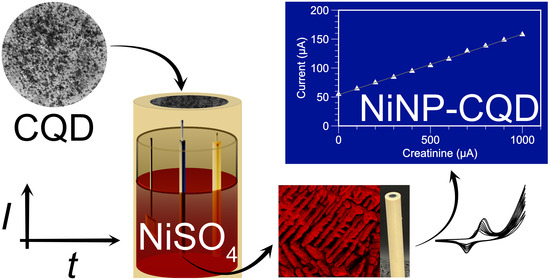
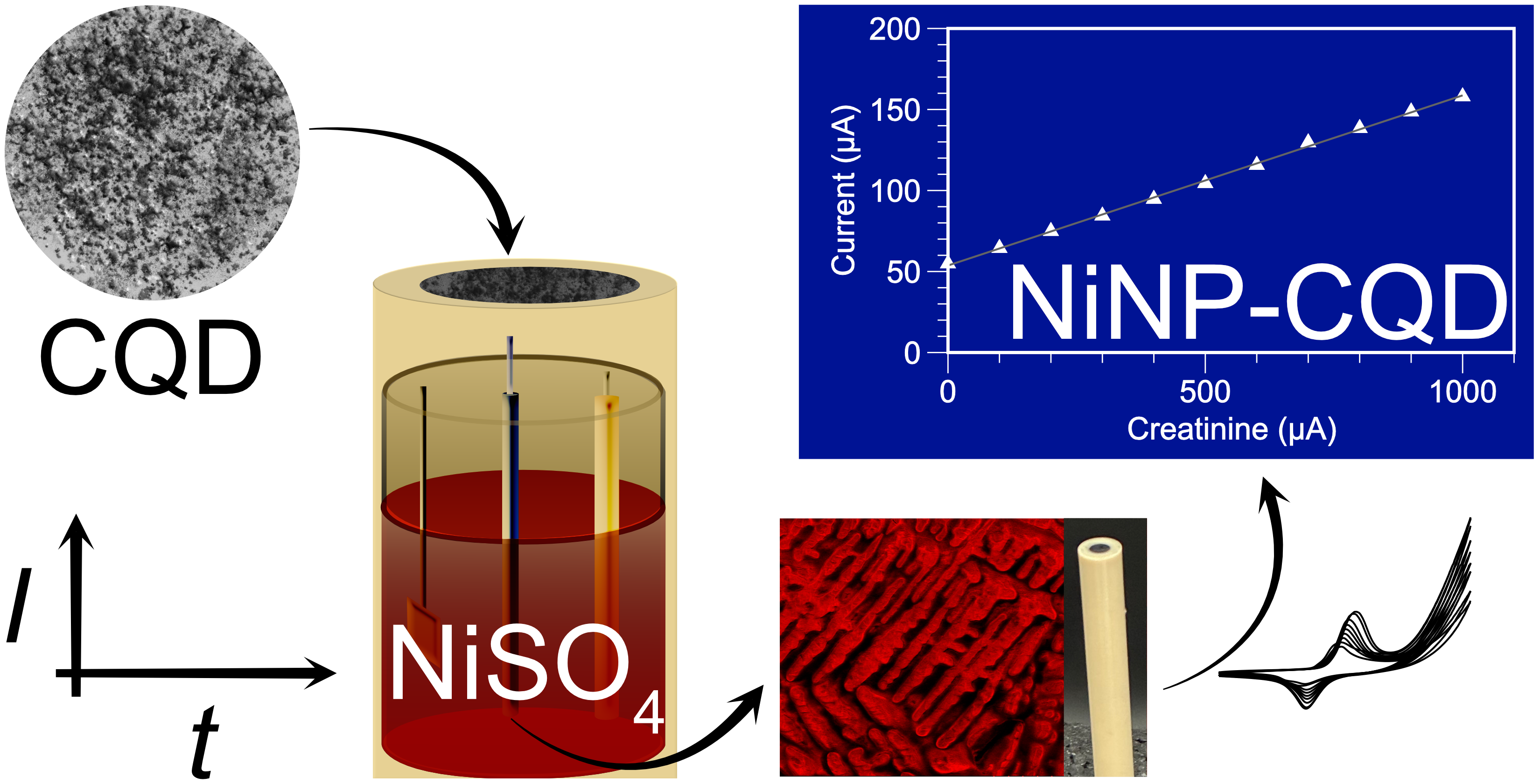
In this work, we report an emerging hybrid non-enzymatic electrochemical platform based on CQDs and NiNPs for the detection of creatinine, a clinically essential biomarker. Here, the “non-enzymatic” term refers to a direct, label-free electrochemical process in which creatinine undergoes oxidation at the catalytic NiOOH/Ni(OH)2 surface without the use of enzymes or mediators. Within this architecture, CQDs provide a conductive and hydrophilic matrix that enables adsorption and interaction with creatinine, NiNPs supply abundant redox-active sites, and the CQD–Ni interface enhances charge-transfer efficiency. By coupling these attributes, the resulting NiNP–CQD hybrid offers improved sensitivity, an expanded linear range, and enhanced stability, aligning with the analytical requirements for point-of-care assessment of renal function.
2. Materials and Methods
2.1. Materials and Reagents
Creatinine (≥99% purity), nickel(II) sulfate heptahydrate (≥98%), potassium ferricyanide (≥99%), potassium ferrocyanide (≥99%), ascorbic acid (≥99%), urea (≥99%), uric acid (≥99%), and potassium hydroxide (≥85%) were purchased from Sigma-Aldrich (Toluca, Mexico) and used as received. Sodium nitrate (99%), potassium permanganate (99.2%), nitric acid (70%), and sulfuric acid (96.2%) were supplied by Fermont (Monterrey, Mexico). All aqueous solutions were prepared using tridistilled water.
2.2. Characterization and Methods
TEM characterization was performed using a transmission electron microscope (HT7700, Hitachi, Tokyo, Japan). CQD samples were dispersed in isopropanol, sonicated for 15 min, and a drop of the suspension was deposited on a carbon-coated copper grid and dried at 30 °C prior to imaging. The microscope was operated at 100 kV with magnifications up to ×200k. Morphological examination of the modified electrodes was conducted using a scanning electron microscope (SU3500, Hitachi, Tokyo, Japan) operated at 5 kV in backscattered electron mode to directly reveal surface features after modification.
Electrochemical measurements were performed using a potentiostat (Squidstat Prime, Admiral Instruments, Tempe, AZ, USA) in a three-electrode configuration (glassy carbon working electrode, Ag/AgCl reference electrode, Pt counter electrode). All experiments used 0.10 M NaOH as a supporting electrolyte for nickel redox and creatinine sensing. Nickel electrodeposition was monitored by chronoamperometry in the NiSO4/H3BO3 bath, stepping the potential to −0.90 V vs. Ag/AgCl and recording i–t transients at deposition time of 50 s. After deposition, the electrodes were electrochemically activated by cyclic voltammetry between −0.20 and +0.80 V (100 mV s−1) until stable Ni(II)/Ni(III) redox peaks were obtained.
For creatinine sensing, cyclic voltammetry was performed under the same potential window. Thus, creatinine solution were added directly to the 80 mL NaOH electrolyte. The system was allowed to equilibrate for 2 min to permit adsorption of creatinine on the surface before data acquisition. The analytical signal corresponded to the anodic peak current associated with creatinine oxidation extracted from the forward scan and used to construct calibration curves.
Differential pulse voltammetry was used for interference studies employing a potential window of −0.40 to +1.00 V (pulse amplitude 50 mV, pulse width 50 ms). The interferents were evaluated under identical electrolyte conditions and compared with the creatinine response.
2.3. Synthesis of Carbon Quantum Dots (CQD)
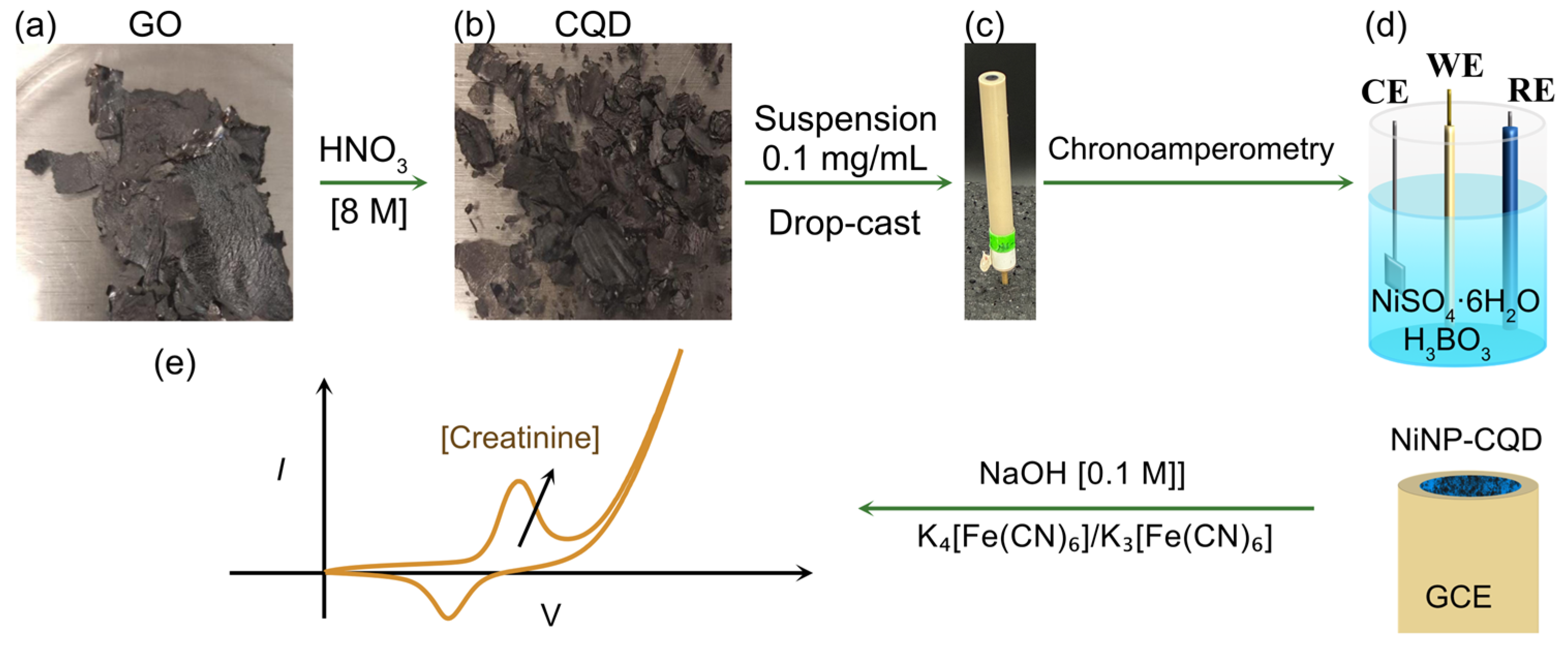
Graphene oxide (GO) was prepared using the Hummers method with modifications (
Scheme 1a) [
18]. Then CQDs (
Scheme 1b) were synthesized based on the method of Dong et al. [
19] with adjustments. Briefly, 0.30 g of GO was mixed with 150 mL of HNO
3 (8 M) in a 300 mL round-bottomed flask. This mixture was refluxed at 110 °C for 12 h. After cooling to room temperature, the reaction mixture was diluted with tridistilled water, and the pH was adjusted to 7, by adding 0.1 M NH
4OH (total 50 mL) solution. The neutralized dispersion was clarified (supernatant collected) and dialyzed using a 14 kDa cellulose membrane for 48 h. The tridistilled water was replaced every 6 h until the dialysate remained clear. The dialyzed product was sonicated for 30 min and then dried at 60 °C for 24 h to afford CQDs. The solids were stored for later use.
2.4. Electrode Preparation
Glassy carbon electrodes (3 mm of diameter) were mechanically polished with 0.05 µm alumina slurry, sonicated in isopropanol and water, and dried in air. A CQD suspension (4 µL, 0.1 mg mL
−1 in water) was drop-cast onto the polished surface and dried at room temperature (
Scheme 1c). Nickel nanoparticles were then deposited by chronoamperometry in a bath of 0.1 M NiSO
4 and 0.2 M H
3BO
3 (pH 4.5). The potential was stepped to −0.90 V versus Ag/AgCl and held for 50 s. After deposition, the electrodes were electrochemically activated by cyclic voltammetry between −0.20 and +0.80 V (100 mV s
−1) until stable Ni(II)/Ni(III) redox features were achieved. The deposition potential (−0.90 V) is independent of the potential window used during analytical detection.
2.5. Electrochemical Measurements
The electrochemical measurements were carried out in a three-electrode configuration (modified GCE as working electrode, Ag/AgCl as reference electrode, and Pt as counter electrode). The electrolyte was 0.10 M NaOH for creatinine sensing and 5 mM K4[Fe(CN)6]/K3[Fe(CN)6] to evaluate electron transfer properties.
Electrode modification procedure: The GCE surface was first modified by drop-casting the CQD suspension and allowing it to dry at room temperature. Nickel was subsequently electrodeposited onto the CQD-modified electrode by chronoamperometry at −0.90 V (versus Ag/AgCl). The resulting NiNP–CQD electrode was then electrochemically stabilized by cyclic voltammetry (−0.20 to +0.80 V, 100 mV s−1 in 0.10 M NaOH) until a reproducible voltammetric profile was obtained, indicating homogenization of the sensing surface with no further variations in current response.
Electron-transfer performance was evaluated by cyclic voltammetry using the ferricyanide redox probe (−0.20 to +0.80 V, 100 mV s−1), to compare the interfacial electron-transfer behavior of the three systems: (i) CQD-modified electrode, (ii) NiNP-modified electrode, and (iii) NiNP–CQD composite electrode.
For creatinine sensing, a 100 mM stock solution was prepared in deionized water, and working concentrations (0–1000 µM) were obtained by serial dilution in 0.10 M NaOH. Aliquots of creatinine were added directly to the 80 mL electrolyte in the electrochemical cell. After each addition, the solution was allowed to equilibrate for 2 min to permit adsorption of creatinine onto the sensing surface before acquisition. The evaluated analytical signal corresponded to the anodic peak current of creatinine oxidation, extracted from the forward scan without baseline subtraction.
Interference study: Differential pulse voltammetry (−0.40 to +1.00 V, pulse height 50 mV, pulse width 50 ms) was performed after addition of potential interferents under the same electrolyte conditions. The resulting signals were compared to the creatinine response to assess selectivity.
2.6. Analytical Figures of Merit
Calibration curves were constructed by plotting the anodic peak current versus creatinine concentration (0–1000 µM). The linear working ranges and regression equations are reported in
Table 1.
3. Results
3.1. Morphological and Structural Characterization
The structural and chemical features of the CQDs were examined by X-ray diffraction (XRD) and Fourier-transform infrared spectroscopy (FTIR), respectively.
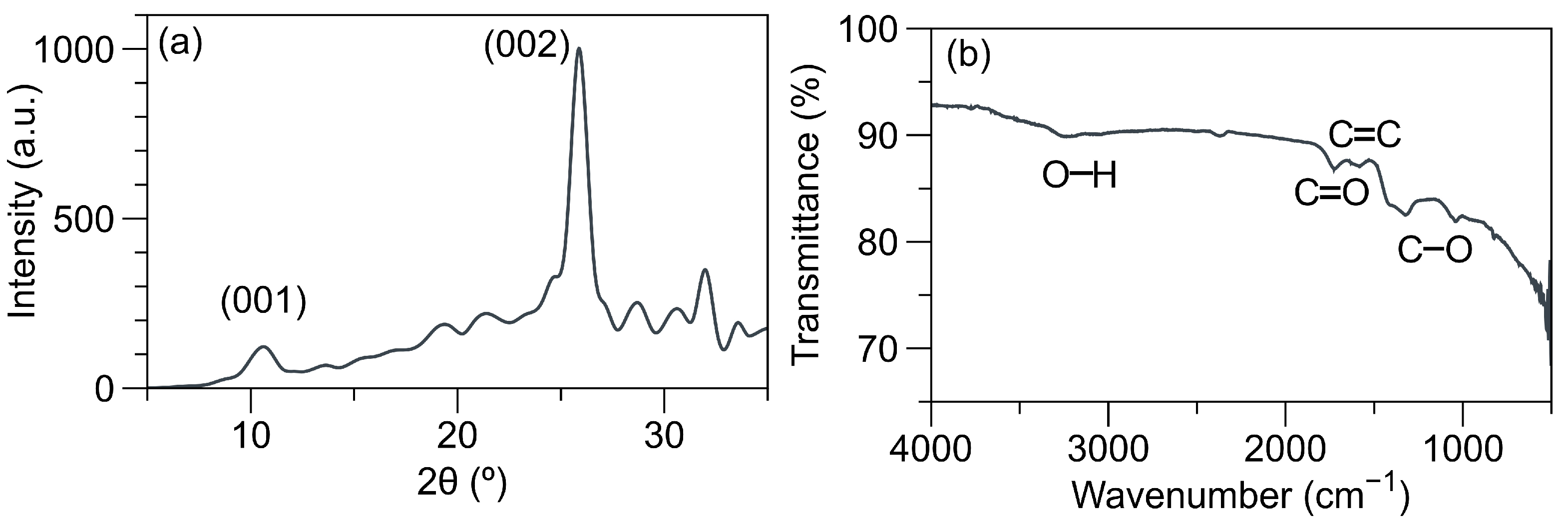
Figure 1a presents the XRD pattern of the CQDs. A broad reflection at 2θ ≈ 11° (d ≈ 0.80 nm), indexed to the (001) plane, indicates highly disordered and oxidized graphitic layers with enlarged interlayer spacing arising from oxygen functionalities and adsorbed water. In contrast, a more intense feature at 2θ ≈ 26° (d ≈ 0.34 nm), assigned to the (002) plane, is consistent with short-range graphitic stacking. The coexistence of a diffuse (001) peak and a pronounced, broadened (002) reflection is characteristic of turbostratic nanocrystalline carbons containing small graphitic domains embedded within an oxidized, disordered matrix [
20,
21].
The FTIR spectrum (
Figure 1b) confirms the presence of oxygenated surface groups. The broad band at ~3400 cm
−1 is attributed to O–H stretching from hydroxyl groups and adsorbed water. The absorption at ~2920 cm
−1 corresponds to aliphatic C–H stretching. An intense peak at ~1720 cm
−1 arises from C=O stretching of carboxyl/carbonyl groups, while the signal near ~1620 cm
−1 is assigned to C=C stretching of sp
2 domains (with possible contribution from H–O–H bending). The 1200–1050 cm
−1 region shows C–O stretching vibrations from epoxy and alkoxy groups. Collectively, these results confirm that the CQDs comprise graphitic nanodomains decorated with a rich population of oxygen-containing functionalities (C=O, C–O, O–H), which impart hydrophilicity and provide reactive sites for interfacial interactions [
22].
Microscopy techniques enabled observation of the CQDs’ structure and morphological features.
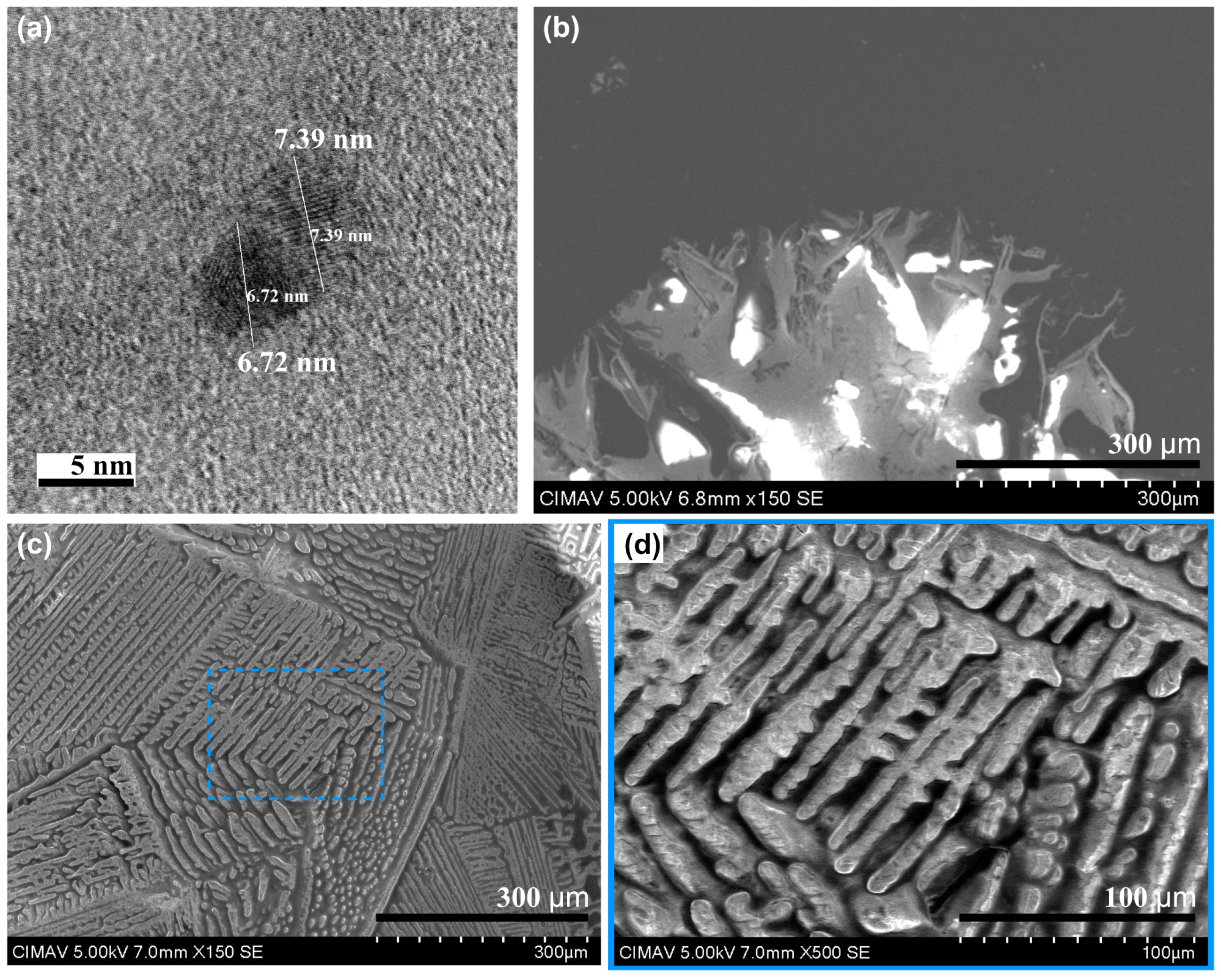
Figure 2a shows predominantly spherical CQDs with a narrow nanoscale size distribution. These features are consistent with successful bottom-up synthesis routes typically reported for CQDs [
23]. The CQDs exhibit average diameters of 6–8 nm, with no evidence of large agglomerates or irregular structures. This uniformity in size and shape is critical, as it affects the electronic and optical properties of CQDs by governing the quantum confinement effect. High-resolution TEM images show lattice fringes with spacings of ~2–3 Å, suggesting partial graphitic ordering [
24]. Such structural features are beneficial for electronic applications since they provide pathways for efficient charge delocalization while maintaining abundant edge sites decorated with functional groups (–OH, –COOH, –NH
2) [
25]. Additionally, these surface functionalities enhance hydrophilicity and provide active sites for hydrogen bonding and electrostatic interactions with nitrogen-containing molecules such as creatinine, which is relevant for the sensing application targeted in this work.
Figure 2b shows the SEM micrograph of the nickel-modified electrode. As observed, nickel electrodeposition in the absence of CQDs produced a markedly heterogeneous surface. The nickel deposits are irregularly distributed across the GCE, with localized regions of dense agglomerates coexisting with areas of bare substrate. This suggests that nucleation and growth occurred at preferential sites rather than uniformly across the electrode. These agglomerated structures are characteristic of uncontrolled growth and coalescence of nickel nuclei, which results in clusters with limited surface accessibility [
26,
27,
28]. Such morphology reduces the effective electroactive surface area (ECSA), as only the outermost Ni sites remain available for electrochemical reactions.
The SEM micrograph of the NiNP-CQD composite electrode (
Figure 2c) shows a strikingly different pattern compared with nickel nanoparticles alone. With CQDs present, nickel was electrodeposited homogeneously across the electrode surface, forming well-defined dendritic structures (
Figure 2d), with branches distributed evenly across the substrate, unlike its nickel-free counterpart.
The dendritic structures indicate rapid nucleation followed by diffusion-limited growth [
29], a process facilitated by the CQDs, acting as nucleation promoters. Their abundant surface functional groups (–OH, –COOH, –NH
2) lower the energy barrier for nickel nucleation and provide anchoring sites, enabling the simultaneous formation of a high density of nuclei. This leads to uniform spatial distribution and controlled anisotropic growth into dendrites.
3.2. Electrodeposition and Nucleation Analysis of Ni and Ni–CQD Systems
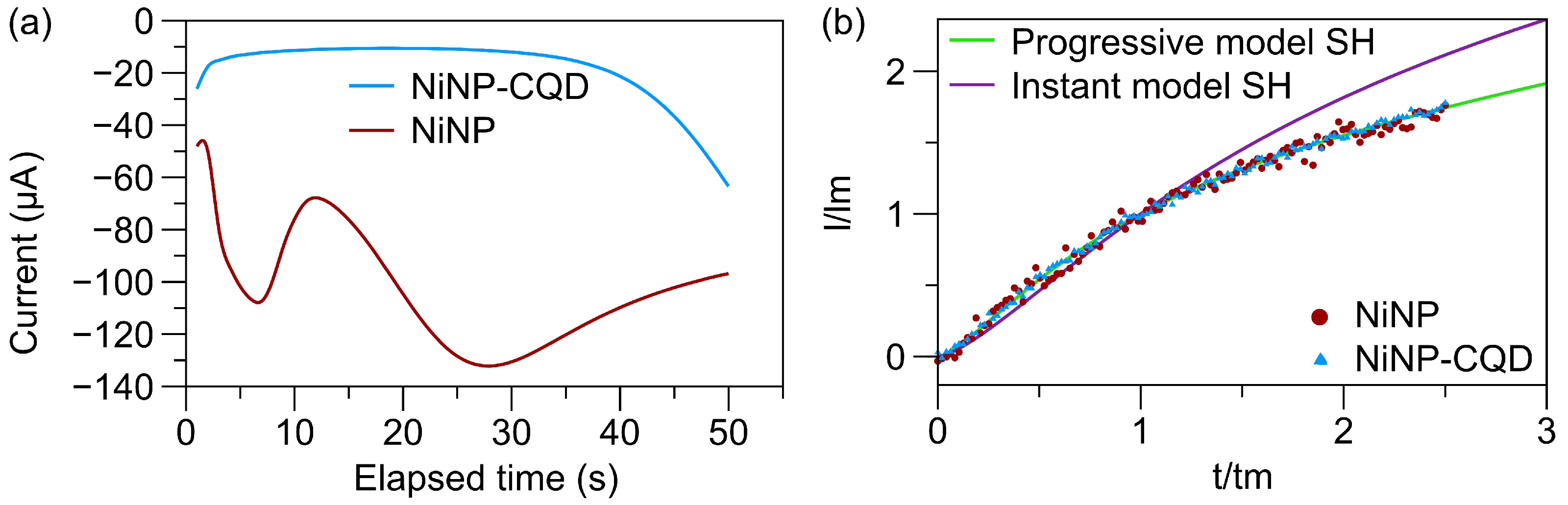
Figure 3a presents the chronoamperometric transients recorded at −0.9 V for nickel electrodeposition on bare GCE (black curve) and on electrodes premodified with CQDs (red curve). The chronoamperometric transients (
Figure 3b) were analyzed using the Scharifker–Hills (SH) model to elucidate the nucleation and growth mechanism of nickel electrodeposition on both the bare (NiNP) and the CQD-modified electrodes (NiNP–CQD). After normalizing the current-time curves (
vs.
), the experimental data were compared with the theoretical SH profiles corresponding to instantaneous and progressive nucleation [
30].
Agreement between experimental and theoretical curves was quantified using the Root Mean Square Deviation (RMSD), which measures the average deviation of the experimental points from the model predictions. A lower RMSD value indicates better agreement between experiment and theory. For the bare electrode, the progressive nucleation model yielded an RMSD of 5.34, slightly smaller than the 6.81 obtained for the instantaneous model. Although both values are relatively high, indicating a significant deviation from ideal theoretical behavior, the smaller RMSD for the progressive case suggests that new nuclei continue to appear over time rather than forming simultaneously at the beginning of the deposition. Such behavior can result from a heterogeneous distribution of surface energy and a limited number of favorable nucleation sites, leading to an irregular growth process that only partially follows the ideal SH model.
In contrast, the CQD-modified electrode showed significantly lower RMSD values (0.081 for the progressive and 0.129 for the instantaneous model), showing a clear correspondence with progressive nucleation. The CQDs provide a high density of oxygen-containing groups and sp2-hybridized domains that serve as energetically favorable nucleation sites for Ni(II) reduction. These sites become activated gradually during electrodeposition, producing a continuous increase in the number of active centers and resulting in a progressive nucleation regime.
The electrochemical interpretation is consistent with the SEM observations. After deposition, the bare electrode exhibits heterogeneous coverage with uncovered regions and agglomerated clusters, consistent with limited and spatially non-uniform nucleation. Conversely, the CQD-modified surface exhibited well-defined dendritic nickel structures, reflecting a higher nucleation density and continuous growth over time. Such dendritic morphology is characteristic of progressive nucleation and diffusion-controlled growth.
Overall, the correlation between the Scharifker–Hills analysis and the microscopic evidence confirms that the introduction of CQDs fundamentally alters the nucleation dynamics of Ni. While the bare electrode exhibits an imperfect, partially progressive behavior, the CQD-modified electrode follows a well-defined progressive nucleation mechanism, leading to homogeneous dendritic architectures that enhance the electroactive area and potentially improve the catalytic response in electrochemical sensing applications.
3.3. Electrochemical Characterization of NiNP-CQD
Cyclic voltammetry in the ferricyanide/ferrocyanide redox probe (K
4[Fe(CN)
6], K
3[Fe(CN)
6]) was employed to benchmark the interfacial electron-transfer properties of the three electrodes.
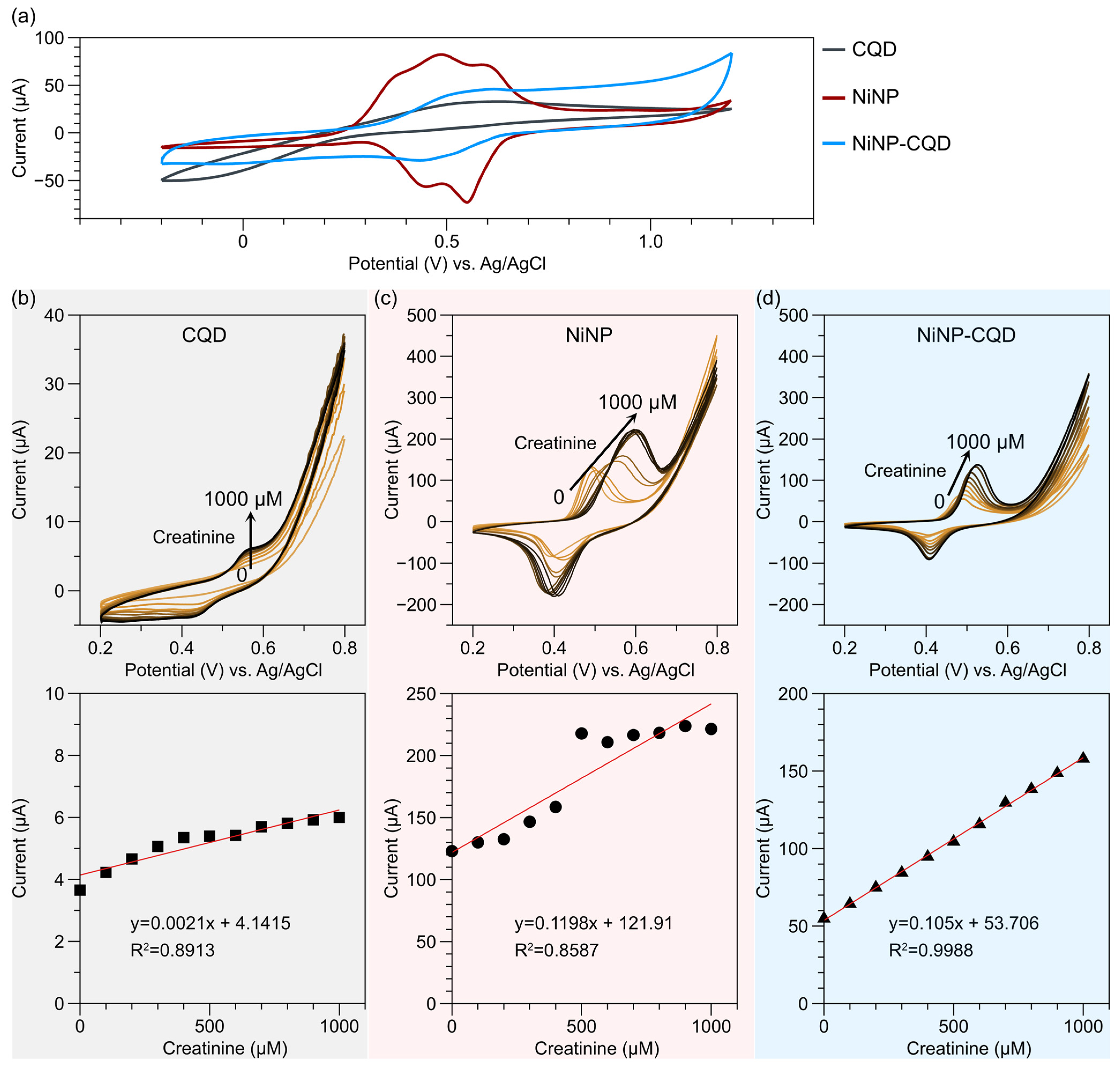
Figure 4a compares the cyclic voltammograms of the CQDs (gray), NiNP (blue), and NiNP–CQD composite (red) electrodes. Among the three materials, the CQD-modified electrode exhibits the weakest response, characterized by broad, poorly defined redox peaks and low current intensity. This behavior is consistent with sluggish heterogeneous electron transfer between the redox probe and the CQD surface, confirming the intrinsically limited electrochemical activity of the CQDs.
In contrast, the NiNP-modified electrode exhibits a markedly different profile, with a much stronger redox response and well-defined peaks. However, the voltammogram of the NiNP electrode displays more than one redox contribution rather than a single reversible ferricyanide/ferrocyanide pair. It is important to note that ferricyanide was used solely in this characterization experiment and not in the creatinine sensing measurements. Therefore, the additional features observed here do not correspond to intrinsic Ni(II)/Ni(III) transitions, but rather to the interaction of the ferricyanide redox probe with heterogeneous electron-transfer domains on the NiNP surface. The uneven distribution of nanoparticles across the electrode likely produces regions densely coated with nickel and regions with little or no nickel coverage, producing spatially distinct charge-transfer environments. Consequently, ferricyanide undergoes electron transfer through domains with different surface energetics, giving rise to partially overlapping redox contributions and a less reversible voltammetric profile.
The NiNP–CQD composite electrode (red curve) exhibits the most favorable behavior among the three materials. Its voltammogram exhibits high peak intensity together with a more symmetric and reversible redox response compared with either CQDs or NiNPs alone. Notably, the additional voltammetric features observed in the NiNP electrode are attenuated in the composite, indicating that the presence of CQDs contributes to a more homogeneous and efficient electron-transfer interface. In this hybrid configuration, the sp2-rich CQDs network provides a continuous and conductive pathway that enhances charge mobility and improves wetting, while the NiNPs supply abundant electroactive sites. This synergistic interaction reduces surface heterogeneity and access resistance, thereby enhancing both electron-transfer kinetics and reversibility. These enhanced electron-transfer characteristics are critical for creatinine sensing, as the analytical signal arises from the electrocatalytic oxidation of creatinine mediated by surface Ni(II)/Ni(III) redox species (NiOOH/Ni(OH)2). The improved conductivity and uniformity of the NiNP–CQD interface facilitate rapid regeneration of NiOOH, sustaining the catalytic pathway responsible for the faradaic response.
At identical probe concentration and scan rate, differences in |Ip| predominantly reflect variations in electrochemically active surface area (ECSA) and interfacial access resistance. According to the Randles–Ševčík equation for a diffusion-controlled, one-electron process (Ip ∝ A·v
1/2) [
31], the NiNP–CQD hybrid exhibits a sufficiently high current response to indicate substantial ECSA and effective probe accessibility, even if its peak current is not the highest among the three. More importantly, the hybrid provides a high current density while preserving superior reversibility and linearity, suggesting that CQDs contribute not only to charge conduction but also help distribute nickel-based active sites more uniformly across the surface. Therefore, the signal intensity of the hybrid should be interpreted as a balance between accessible electroactive area and efficient charge-transfer pathways, rather than peak magnitude alone. The CQD film likely contributes a percolating, sp
2-rich network with abundant edge/defect sites and improved wetting, while the incorporation of NiNPs increases nanoscale roughness and double-layer capacitance, both of which promote probe accessibility [
9,
28].
Taken together, the voltammetric evolution, from weak for CQDs, to strong but heterogeneous for NiNPs, to highly reversible for the NiNP–CQD composite, demonstrates a clear synergistic effect between CQDs and NiNPs. The hybrid interface integrates conductivity and electroactivity, which is crucial for advanced electroanalytical sensing applications. Owing to its superior interfacial electron-transfer performance, the NiNP–CQD composite was selected as the active sensing layer for creatinine determination.
3.4. Creatinine Detection and Sensor Parameters
Figure 4b–d display the cyclic voltammograms obtained for increasing creatinine concentrations (0–1000 µM) using CQD-, NiNP-, and NiNP–CQD-modified electrodes, together with their corresponding calibration curves. In all cases, the anodic current increases upon creatinine addition, confirming electrocatalytic oxidation of the analyte; however, the magnitude, linearity, and analytical quality of the response vary strongly with the electrode material.
For the CQD-modified electrode (
Figure 4b), the current increases only slightly from ~4.0 to ~5.8 µA across the tested range (ΔI ≈ 1.8 µA), resulting in a low sensitivity and a modest linear correlation (R
2 = 0.88). This weak amplification is consistent with sluggish charge-transfer kinetics and a limited number of electroactive sites on the CQD surface, restricting the quantitative applicability of this material.
The NiNP-modified electrode (
Figure 4c) exhibits a much larger current change, from ~120 to ~230 µA (ΔI ≈ 110 µA), confirming strong catalytic activity toward creatinine. Nevertheless, the calibration deviates from linearity (R
2 = 0.84), particularly at higher concentrations, revealing a non-proportional response. This curvature is attributed to heterogeneous accessibility of Ni active sites and progressive surface saturation, which trigger adsorption or site-limited kinetics consistent with Langmuir-type behavior. Such non-linear behavior is commonly reported for Ni(II)/Ni(III) oxyhydroxide-mediated reactions in alkaline conditions [
32,
33]. In alkaline media, creatinine undergoes electrocatalytic oxidation through the Ni(III)/Ni(II) redox cycle, Ni(OH)
2 is oxidized to NiOOH, which chemically oxidizes creatinine and is subsequently regenerated during the electrochemical sweep. This catalytic sequence produces the measurable anodic peak used for quantification.
The NiNP–CQD composite electrode (
Figure 4d) exhibits the most balanced and analytically desirable performance. The current increases steadily and proportionally with concentration from ~60 to ~160 µA (ΔI ≈ 100 µA) while maintaining excellent linearity across the entire 0–1000 µM range (R
2 = 0.996). Unlike the NiNP electrode, no curvature or plateau is observed, indicating that the composite preserves continuous catalytic accessibility even at high analyte concentrations. This behavior arises from the synergistic interplay between the two components: the CQDs provide a percolating, conductive sp
2-rich network with high wettability and electroactive area, while the NiNPs supply abundant catalytic NiOOH/Ni(OH)
2 redox sites. The CQD framework disperses NiNPs, increasing the density and accessibility of NiOOH catalytic sites. By promoting uniform distribution and reducing local saturation, the NiNP–CQD composite maintains first-order kinetics with respect to creatinine concentration, enabling a highly linear response over the 10–1000 µM range.
Linear regression of the calibration plots quantifies this trend: the CQD electrode exhibits a sensitivity of 2 µA·mM−1 (R2 = 0.88), the NiNP electrode reaches 120 µA·mM−1 (R2 = 0.84), and the NiNP–CQD composite combines high sensitivity with excellent proportionality, achieving 100 µA·mM−1 and an outstanding R2 of 0.996. Thus, the linear amplification observed for the NiNP–CQD composite reflects both its enlarged electroactive area and the sustained cycling of Ni(III)/Ni(II) species that mediate creatinine oxidation, fully supporting its non-enzymatic sensing capability.
3.5. Detection Limit and Interferent Test
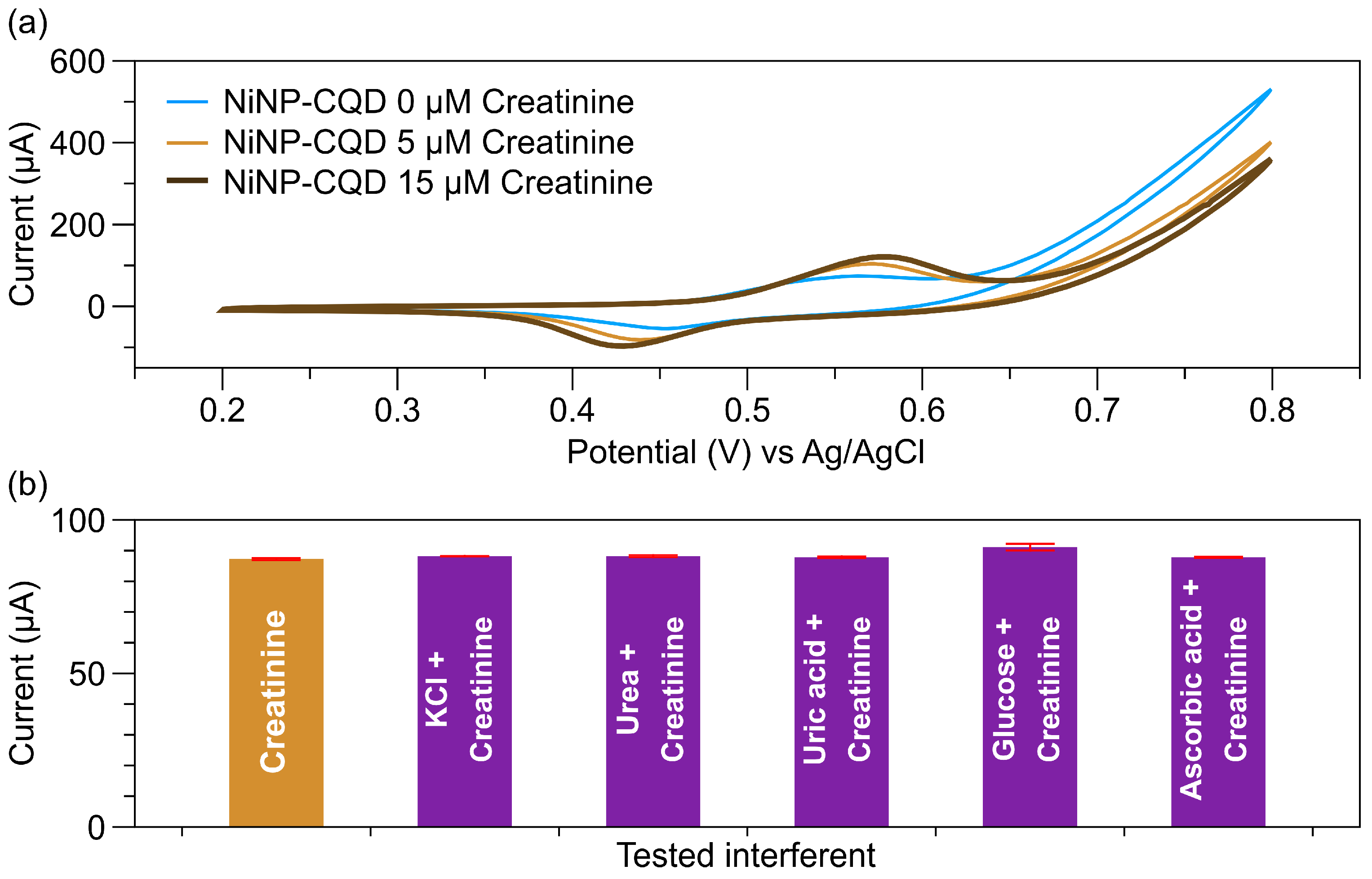
The NiNP–CQD electrode exhibited a linear working range of 10–1000 µM for the NiNP–CQD electrode. The analytical signal corresponded to the anodic peak current of creatinine oxidation (
Figure 5a), extracted from the forward scan. The calibration curve followed the regression described in Equation (1):
where
Ipa is the anodic peak current (µA) and
C is the creatinine concentration (µM). The limit of detection (LOD) was calculated using the criterion shown in Equation (2),
where
m is the calibration slope and
σblank is the standard deviation of the blank current (
n = 10). Based on this definition, the sensor delivered a LOD of 5 µM and a sensitivity of 1.41 µA µM
−1 cm
−2 when normalized to the geometric electrode area (7 mm
2). Precision was assessed from five independent measurements at 100 µM creatinine, yielding a repeatability of 2 µA and a coefficient of variation of 1.7%, confirming the high reproducibility of the sensing platform. The statistical parameters (slope, intercept, R
2, sensitivity, and
σblank) were computed from net peak currents recorded under identical conditions to ensure comparability across all concentrations.
As shown in
Figure 5b, selectivity was assessed against common coexisting species in biological matrices: urea, uric acid, glucose, ascorbic acid, KCl, and NaCl tested at respective concentrations of 6 mM, 125 µM, 6 mM, 125 µM, 4 mM, and 140 mM. Uric acid displayed a distinct oxidation process at ~−0.10 V, well separated from the creatinine peak at ~+0.50 V, which minimizes spectral overlap in the chosen potential window. Urea, KCl, NaCl, and ascorbic acid produced no measurable interference within experimental error. Glucose caused a modest increase in the measured current < 5% at the creatinine detection potential.
Interference was quantified as the relative signal change at the creatinine peak potential, as expressed in Equation (3):
where
is the net current for creatinine alone and
is the current in the presence of the interferent (same creatinine level). Using a ±5% acceptance threshold, glucose is deemed tolerable under our operating conditions, while the remaining species are non-interfering. These results confirm that the potential-window separation (uric acid at ~−0.10 V versus creatinine at ~+0.50 V) and the electrode architecture suppress matrix effects, yielding accurate quantification across the clinically relevant range.
Collectively, the low LOD, high sensitivity, and excellent selectivity profile, especially the negligible impact from urea and electrolytes and the sub-5% bias from glucose, support the applicability of this platform for creatinine determination in complex samples.
For context,
Table 2 compares this work with representative literature. In brief, the 50–1000 µM analytical window squarely spans healthy serum (~50–120 µM) and extends well into renal impairment (≥~180–440+ µM), matching point-of-care needs better than many ultra-sensitive platforms capped at ≤200 µM. The calibration curve is highly linear (R
2 = 0.996), comparable to typical MIP systems (~0.995) and MOF/metal architectures that often report strong, though less rigorously quantified linearity. Selectivity is also favorable, as the clear potential separation between uric acid (−0.10 V) and creatinine (~0.55 V) minimizes spectral overlap. KCl, NaCl, and urea show no effect, and the <8% glucose bias remains within customary acceptance limits (±10%) and is readily addressed via matrix-matched calibration or standard addition. Finally, the NiNP–CQD composite is practical to fabricate, integrates easily on common electrodes, and avoids lead-based chemistries, yet still delivers a strong signal and robust kinetics, contrasting with the added complexity of microfabricated MEAs, MIPs, or PbO
2-based films.
This selectivity is reinforced by the mechanistic requirement that creatinine must interact with surface NiOOH/Ni(OH)2 catalytic sites to generate a faradaic signal. Species that do not participate in this Ni(III)-mediated oxidation pathway contribute little or no current at the creatinine potential, improving anti-interference performance.
4. Conclusions
The integrating nickel nanoparticles with carbon quantum dots produces a synergistic, fully non-enzymatic sensing interface for creatinine. Compared with either component alone, the NiNP–CQD hybrid exhibited a markedly higher current response, improved proportionality between signal and concentration, and more favorable electron-transfer kinetics, consistent with an expanded electroactive area and reduced surface site saturation. The system achieves an area-normalized sensitivity of 1.41 µA µM−1 cm−2 and a wide linear working range of 10–1000 µM (R2 = 0.996), demonstrating efficient amplification of the faradaic signal across both low and high concentration regimes.
The electrode also shows a strong anti-interference profile, with common physiological species (KCl, NaCl, urea, glucose, ascorbic and uric acid) producing minimal or well-resolved contributions relative to the creatinine oxidation peak. This confirms the practical robustness of the platform under conditions relevant to biological matrices.
Overall, the NiNP–CQD composite fulfills several key requirements for a clinically relevant creatinine sensor, including wide linearity, high sensitivity, and tolerance to coexisting molecules, positioning it as a promising candidate for future implementation in real-sample analysis and longitudinal monitoring of renal function.



 ,
,