Article

Silver Nanowires with Efficient Peroxidase-Emulating Activity for Colorimetric Detection of Hydroquinone in Various Matrices


by
Huda Salem AlSalem
1,
Sara Naif Alharbi
1,
Rabeea D. Abdel-Rahim
2,
Adham M. Nagiub
2 and
Mohamed A. Abdel-Lateef
3,*
1
Department of Chemistry, College of Science, Princess Nourah Bint Abdulrahman University, P.O. Box 84428, Riyadh 11671, Saudi Arabia
2
Department of Chemistry, Faculty of Science, Al-Azhar University, Assiut Branch, Assiut 71524, Egypt
3
Department of Pharmaceutical Analytical Chemistry, Faculty of Pharmacy, Al-Azhar University, Assiut Branch, Assiut 71524, Egypt
*
Author to whom correspondence should be addressed.
Chemosensors 2025, 13(12), 415; https://doi.org/10.3390/chemosensors13120415 (registering DOI)
Submission received: 18 October 2025 / Revised: 24 November 2025 / Accepted: 27 November 2025 / Published: 1 December 2025
(This article belongs to the Section Nanostructures for Chemical Sensing)

Abstract

Hydroquinone is a phenolic compound widely used in industry and cosmetics, yet its toxicity has raised global environmental and health concerns. It has been listed by both the US EPA and the European Union as a priority contaminant for monitoring in aquatic systems. In this proof-of-concept (PoC) study, silver nanowires (Ag-NWs) were synthesized via a modified one-pot polyol methodology and characterized by various techniques, including TEM, EDX, SEM, XRD, and UV–vis spectroscopy. The Ag-NWs exhibited peroxidase-like activity, catalyzing the oxidation of TMB/H2O2 to yield a blue product. This activity was effectively suppressed by hydroquinone, forming the basis of a simple colorimetric sensing approach. The PoC method showed linearity over 0.08–0.8 µg/mL with a LOD of 26 ng/mL. Furthermore, it was preliminarily applied to tap water, river water, and medicated cream samples, demonstrating acceptable recovery in preliminary applications. As a PoC, the study establishes the feasibility of the Ag-NWs–TMB–H2O2 system for hydroquinone detection, while recognizing that comprehensive reproducibility assessment and temporal stability evaluation are required in future work.

1. Introduction

Hydroquinone (1,4-dihydroxybenzene, HQN) is widely employed in industrial applications, including the synthesis of dyes and some pharmaceutical formulations [1,2]. Nevertheless, HQN contamination poses a serious global concern due to its harmful effects via respiratory, dermal, and oral exposure routes [3]. Accordingly, both the U.S. EPA and the European Union classify HQN as a priority pollutant in aquatic systems [4], highlighting the urgent need for sensitive and selective detection methods. In addition to its industrial relevance, HQN serves as a potent depigmenting agent and has been incorporated into numerous skin-lightening products for managing hyperpigmentation disorders such as melasma, freckles, and lentigines [5,6,7,8]. While concentrations of 1.5–2.0% w/w are considered effective, higher levels (>5% w/w) can trigger skin irritation, inflammation, and leukodermic effects [8,9]. Consequently, its cosmetic use has been banned in several countries [6,10], despite clinical reports confirming its therapeutic value against hyperpigmentation disorders [11,12]. Given these contrasting benefits and risks, accurate quantification of HQN in pharmaceutical and cosmetic formulations is essential. In response to this demand, several colorimetric techniques for hydroquinone detection have been published recently (Table S1) [13,14,15,16,17,18,19,20,21,22,23,24]. These recent colorimetric methods, particularly those utilizing nanozymes or chromogenic systems, aim to provide rapid, simple, and cost-effective detection of HQN through visible color changes.
Recently, nanomaterials have gained increasing attention in electrochemical, spectroscopic, and analytical fields, driving the development of novel nanoscale sensing devices for biological, pharmaceutical, environmental, and electronic applications [25,26,27,28,29,30,31]. The improvement in sensitivity and lower detection limit can be attributed to the high surface-to-volume ratio offered by all types of nanomaterials on the transducer surface. Additionally, nanomaterials exhibit fast electron transfer efficiency and possess unique electrical and optical features. Among metal nanomaterials, nanowires and nanotubes are widely employed in the field of sensor applications [25,32,33]. Silver stands out among noble metals due to its excellent electrical, thermal, and optoelectronic properties, especially when incorporated into polymer composites [34]. Although 0D nanomaterials (e.g., metal and metal-oxide NPs) have been widely used in peroxidase-like sensing, their tendency to aggregate and restricted electron pathways often limit stability and reproducibility [35]. In contrast, one-dimensional (1D) nanostructures like silver nanowires (Ag-NWs) offer intrinsic structural advantages: their elongated morphology and high aspect ratio facilitate more efficient electron transport—a behavior demonstrated in electrochemical biosensors where Ag-NWs outperformed AgNPs in both electron transfer and sensitivity (lower LOD) [36]. Moreover, the anisotropic growth and porous network architecture of Ag-NWs contribute to improved structural stability and electron transport properties [37,38].
Enzymes have remarkable efficiency in catalyzing many reactions with high activity and specificity towards their substrates, and also their reactions are carried out under mild reaction conditions [39,40]. Consequently, there is considerable interest in employing enzymes for applications in the analytical chemistry field (sensing processes), pharmaceutical processes, agrochemical production, and food industry [39,41]. Nevertheless, their applications are significantly restricted by a variety of problems, such as their low operational stability (digestion and denaturation), difficulties in recycling and recovery, sensitivity and efficacy of their catalytic activity to the surrounding conditions of the reaction environment, and costly purification and preparation processes [26,42]. To overcome the aforementioned disadvantages, artificial enzymes (nanozymes) have been developed as easily prepared products, cost-effective and extremely stable substitutes for natural enzymes [43,44]. Recently, research endeavors have focused on the design of functional nanomaterials that display features intrinsic to enzymes [41,45].
Recently, Ag-NWs have attracted significant attention due to their unique electrical, catalytic, and physicochemical properties, combined with low cost, stability, and flexibility [34,46]. According to the literature survey, Ag-NWs have been applied for sensing certain analytes based on their catalytic activity, such as the detection of antibiotic chloramphenicol, bisphenol A, and hydrogen peroxide [46,47,48]. Peroxidase activity possesses numerous practical applications in the field of analytical chemistry as a detection tool, such as the capacity to catalyze the oxidation of organic substrates to induce a distinctive color change or formation of a characteristic fluorescence signal. Accordingly, this study explores the peroxidase-like activity of Ag-NWs and demonstrates its potential for developing a colorimetric method for preliminary hydroquinone detection in environmental and pharmaceutical samples

2. Experimental

2.1. Chemicals, Reagents, and Materials

Silver nitrate, glycerol, 3,3′,5,5′-Tetramethylbenzidine (TMB), Polyvinylpyrrolidone (PVP) (Mo. Wt. ≈ 90,000), and potassium chloride were purchased from Sigma-Aldrich Inc., St. Louis, MO, USA. Hydroquinone powder and Hydrogen peroxide solution (30% w/v) were produced by El-Nasr Co., Cairo, Egypt. Meloquin 4% topical cream®, with a batch No. of 241703 and labeled as containing 40 mg of hydroquinone/gram, was manufactured by SAJA Pharmaceuticals Co., 6th of October City, Egypt.

2.2. Instrumentation

Spectrophotometric measurements were carried out on the Optizen POP spectrophotometer device (Mecasys Co., Ltd., Daejon, Republic of Korea). A Transmission Electron Microscopy (TEM) device of JEM-100CX II type (JEOL Co., Akishima, Japan) was utilized to take TEM photos of the prepared silver nanowires. Images obtained through Scanning Electron Microscopy (SEM) were captured using a Joel (Tokyo, Japan) JSM 5600 LV Scanning Electron Microscope, which was outfitted with an Oxford Instruments 6587 EDX Microanalysis detector. For X-ray diffraction (XRD) spectra, a Philips PW 1710 (Tokyo, Japan) V-530 X-ray diffractometer was utilized, operating with Cu; Kα radiation at 40.1 V and 30 mA, where λ = 0.154 nm. Additionally, UV spectroscopy was performed using a JASCO Model V-530 (Tokyo, Japan) UV-Vis spectrophotometer.

2.3. Synthesis of Silver Nanowires

The high-quality and highly uniform Ag-NWs were synthesized using a modified polyol (one-pot polyol) method based on our previous report [49]. A solution mixture of 30 mL of glycerol containing 0.005 g of KCl and 0.3 g of PVP (Mo. Wt. ≈ 90,000). The previous solution was heated to 145 °C for 20 min on the hotplate with a slow stirring speed of 100 rpm. Then 0.15 g of AgNO3 was added to the heated mixture. The temperature gradually increased to 170 °C at a heating rate of 3 °C/min. The color of the mixture changed from brown to black until the desired gray color was reached. Finally, the Ag-NWs product was collected and washed thrice using a centrifuge at 3000 rpm for five minutes. The final product was re-dispersed in de-ionized water using ultra-sonic for 10 min to obtain a solution of Ag-NWs of 1%.

2.4. Analytical Procedures for the Determination of Hydroquinone

In volumetric flasks (5.0 mL), 400.0 μL of 0.10 M acetate buffer (pH = 3.5), 300.0 μL of TMB solution (1.0 mM/in absolute ethyl alcohol), 200.0 μL of H2O2 solution (6.0% w/v), different concentrations of HQN standard solution, and 150.0 μL of Ag-NWs were mixed. After incubating for 10.0 min, the volume of the flasks was completed with water, and changes in the absorbance values were recorded at 650 nm.

2.5. Application to Water Samples

Water samples were collected from Assiut City, Assiut, Egypt. Each sample was collected in wide-mouth glass vessels, and 50 mL was filtered through filter paper for the experiment. The samples included river water and local tap water. The general analytical experiments were carried out on 10 mL flasks by separately spiking a known concentration of hydroquinone into each sample, and the recovery values were calculated.

2.6. Determination of HQN in Pharmaceutical Cream

An accurate amount (1.0 g) of medicated cream sample, Meloquin 4% topical cream®, was transferred to a polypropylene centrifuge tube (10 mL). The tube was vortexed, sonicated, and stirred with 5.0 mL of methanol until thoroughly mixed. The tube underwent centrifuging at a velocity of 5000 rpm for 10 min. The resultant supernatant was filtered using a 0.2-micron filter and subsequently diluted to an appropriate concentration of HQN. The general analytical procedure was applied, and the concentration of HQN was calculated using the pre-plotted calibration curve.

3. Results and Discussion

The synthesis of Ag-NWs utilizes glycerol, which acts as a solvent and a reducing agent for silver ions. PVP is used as a capping agent, while halide plays a significant role in controlling the concentration of silver ions. At a high temperature of about 160 °C, the reaction proceeds in accordance with the following equations [49,50].
2 A g + + 2 X 2 A g X
2 H O C H 2 C H O H C H 2 O H + O 2 160   ° C 2 H O C H 2 C H O H C H O + 2 H 2 O
2 H O C H 2 C H O H C H O + 2 A g X     170   ° C   2 H O C H 2 C H O H C H O + 2 H 2 O
Equation (1) illustrates that AgNO3 combines with halide anions to form AgX. This product supports the reduction of Ag+ and controls the silver concentration as mentioned previously [51,52]. The terminal hydroxide group of glycerol is converted to an aldehyde at elevated temperatures, which then reduces the silver atoms (Equation (2)). When Glyceraldehyde reduces Ag+ ions, silver atoms (Ag-NWs nuclei) are formed in the second step, as shown in Equation (3). When the nucleus concentration exceeds the supersaturation point, silver atoms form and begin to evolve into silver nanostructures in the solution phase [50,53].
In the synthesis of Ag-NWs, PVP serves as an exceptional capping agent, significantly influencing the morphology of the silver nanostructures [54,55]. Due to the presence of polar carbonyl groups (C=O) on the PVP structure, which is located in the (pyrrolidone ring), it has a high ability to form coordination bonds with Ag+ ions to form the PVP-Ag complex. These Ag+ ions are absorbed onto the active sites of the PVP polymer surfactant, where they are subsequently reduced to form silver nuclei [51]. The silver nuclei grow in a single direction because PVP selectively covers the other sides, limiting growth in those areas. As a result, silver atoms are forced to form nanowires, creating well-defined Ag-NWs.

3.1. Characterization of Ag-NWs

3.1.1. SEM Analysis

SEM is the most significant characterization tool for nanomaterials because it reveals the true form and size of the particles. Figure 1 displays SEM images of Ag-NWs that are synthesized by the one-pot polyol method. The figure exhibits SEM Ag-NWs images at different magnifications, demonstrating that the synthesized Ag-NWs are of high purity without any indication of AgNPs or silver nanorods (AgNR). Figure 1a shows the SEM image at 10 microns, while the corresponding wire length histogram is displayed in Figure 1c. Based on the image and its histogram, the wires’ average length was found to be 85.86 microns. The average diameter of the synthesized Ag-NWs was calculated from the SEM images and their corresponding histogram, and it was found to be 58.35 (Figure 1b,d). SEM images confirmed that the obtained Ag-NWs possess high purity, high uniformity, and a high aspect ratio higher than 1400.

3.1.2. XRD Analysis

Figure 1e presents the X-ray diffraction data for the prepared silver nanowires sample with a main diameter of 58.38 nm. The obtained X-ray diffraction data examined the synthesized Ag-NWs having a high crystalline structure and were fitted with JCPDS No. 98-018-0878, which refers to a face-centered cubic structure (FCC) [56,57]. The XRD reveals five different peaks appeared at 2-thita values of 38.37°, 44.6°, 64.91°, 77.991°, and 82.18°, corresponding to Miller Indices of (111), (200), (220), (311) and (222), respectively. Moreover, the data referring to the crystal lattice structure constant was determined to be a = b = c = 4.0861 Å, which is consistent with the standard published value of 4.0862 Å [58]. In addition, the obtained d value referred to synthesized Ag-NWs were successfully prepared with a high purity and excellent crystallinity structure.

3.1.3. UV-Spectroscopy Analysis

Silver nanostructures exhibit unique optical phenomena based on their structure and size caused by the surface Plasmon resonances (SPR) [53,59]. UV absorption can be utilized to illustrate the size and shape of silver nanoparticles due to distinct SPR bands occurring at various frequencies [59]. Figure 1f exhibits the UV spectroscopy of the synthesized silver nanowires to characterize them and prove that they were prepared in a pure form and highly uniform. Two absorbance peaks appeared at 378 and 378 nm, which are characteristics of the presence of Ag-NWs [60]. No UV-absorbance peaks had been observed in the range from 400 to 500 nm, confirming the absence of silver nanoparticles (Ag-NPs) [61]. Accordingly, UV-spectroscopy data confirmed that Ag-NWs were successfully synthesized in a pure form.

3.1.4. TEM Analysis

Transmission Electron Microscopy (TEM) is one of the best analyses that describe nano morphological structure. The TEM micrograph (Figure 1g) unequivocally illustrates the effective synthesis of Ag-NWs exhibiting a consistent one-dimensional shape. The nanowires manifest as elongated and smooth entities with diameters varying from 55 to 68 nm and lengths reaching several micrometers, yielding elevated aspect ratios. Moreover, the TEM image refers to the synthesized Ag-NWs in ultra-pure form without AgNPs or silver nanorods. This data fitted with data obtained from SEM images about Ag-NWs size (length and diameter) and UV analysis. On the other hand, structural properties are anticipated to enhance effective electron transmission and offer numerous active surface locations, especially at the wire edges and junctions. These characteristics are essential for augmenting the peroxidase-mimicking activity of Ag-NWs in contrast to zero-dimensional Ag nanoparticles, which exhibit a greater tendency for aggregation.

3.1.5. EDX Spectroscopy

The elemental composition of the produced Ag-NWs was analyzed using energy-dispersive X-ray spectroscopy (EDX), with the matching spectrum illustrated in Figure 1h. The EDX data confirmed that the synthesized Ag-NWs consist predominantly of metallic silver, as evidenced by the strong Ag peaks at 3.0 and 3.2 keV. The minor signals for carbon, nitrogen, and oxygen arise from trace organic residues of the PVP stabilizing agent. Besides silver, diminished peaks associated with C, N, and O were observed in the low-energy range (<1 keV) [62]. The weak peaks are attributed to residual organic species from the capping agents (PVP) used in the synthesis process. The prominence of the Ag peaks, with no interference from other elements, underscores the exceptional purity of the synthesized nanowires. This compositional confirmation confirms the structural and morphological investigations, revealing that the synthesized Ag-NWs are primarily composed of elemental silver, with only trace amounts of adventitious components on the surface, preserving the silver’s morphological structure. By another expression, these results confirm the high chemical purity of the Ag-NWs and are consistent with their expected elemental composition.

3.2. Peroxidase-Emulating Activity of the Prepared Ag-NWs

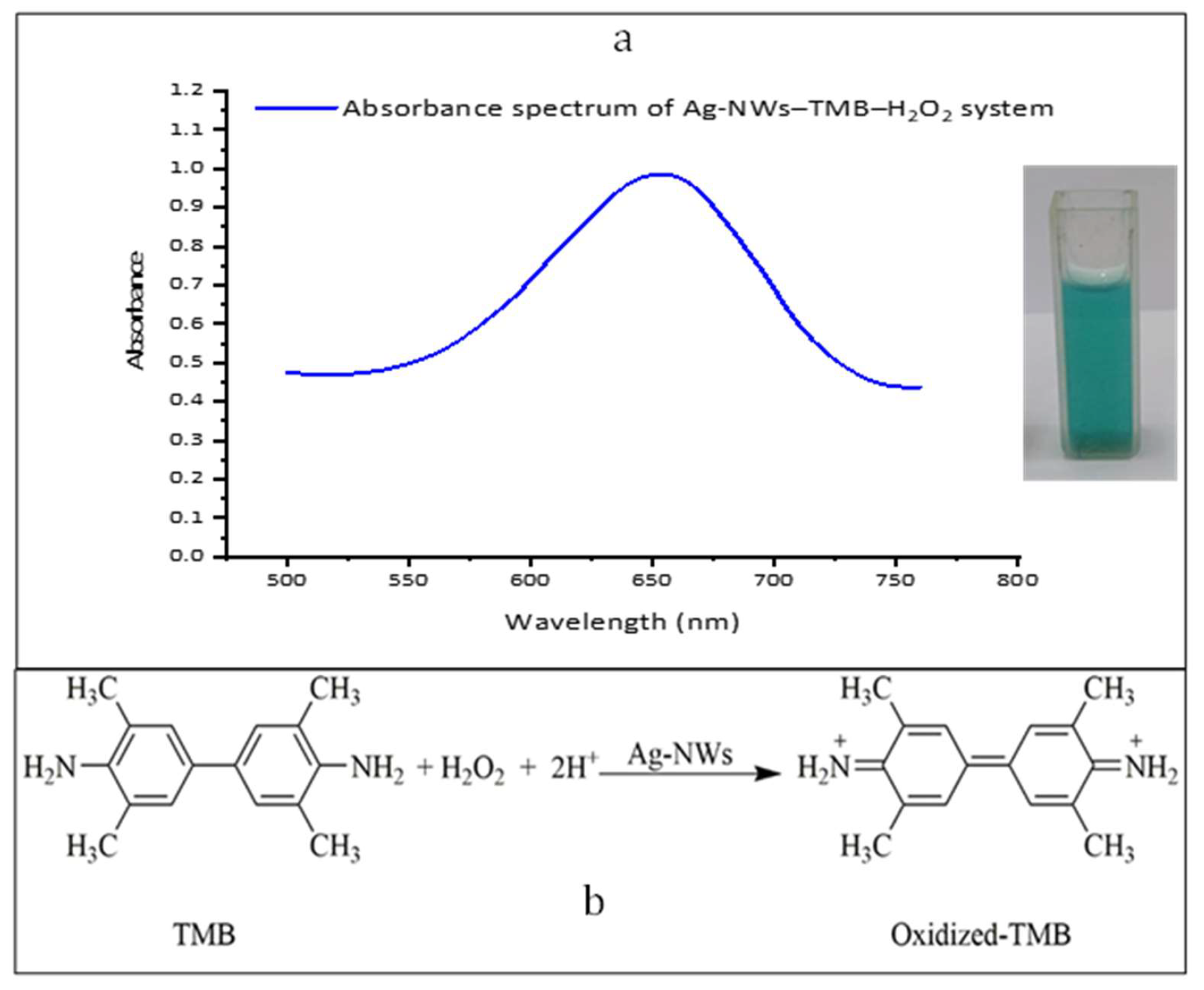
The peroxidase-emulating activity of the prepared Ag-NWs was assessed through the catalysis of the common peroxidase substrate TMB in the presence of H2O2 solution. As can be observed, the prepared Ag-NWs catalyzed the oxidation of TMB by H2O2 in an acidic medium (0.1 M acetate buffer), producing a typical blue color accompanied by a characteristic absorbance peak at 650 nm (Figure 2a) [48]. In contrast, neither Ag-NWs nor H2O2 alone yielded any significant color change or absorbance response under the same conditions. These results indicate that Ag-NWs exhibit peroxidase-mimicking activity toward TMB, and the corresponding catalytic reaction is illustrated in Figure 2b. The enhanced peroxidase-like activity of Ag-NWs may be ascribed to their one-dimensional and high-aspect-ratio morphology, which provides a larger accessible surface area and facilitates rapid electron transfer, thereby accelerating the catalytic turnover. Similar effects have been observed in silver- and transition-metal-based nanozymes, where both surface structure and electron-transfer efficiency significantly affect catalytic effectiveness [46].

3.3. Optimization of the Catalytic Conditions

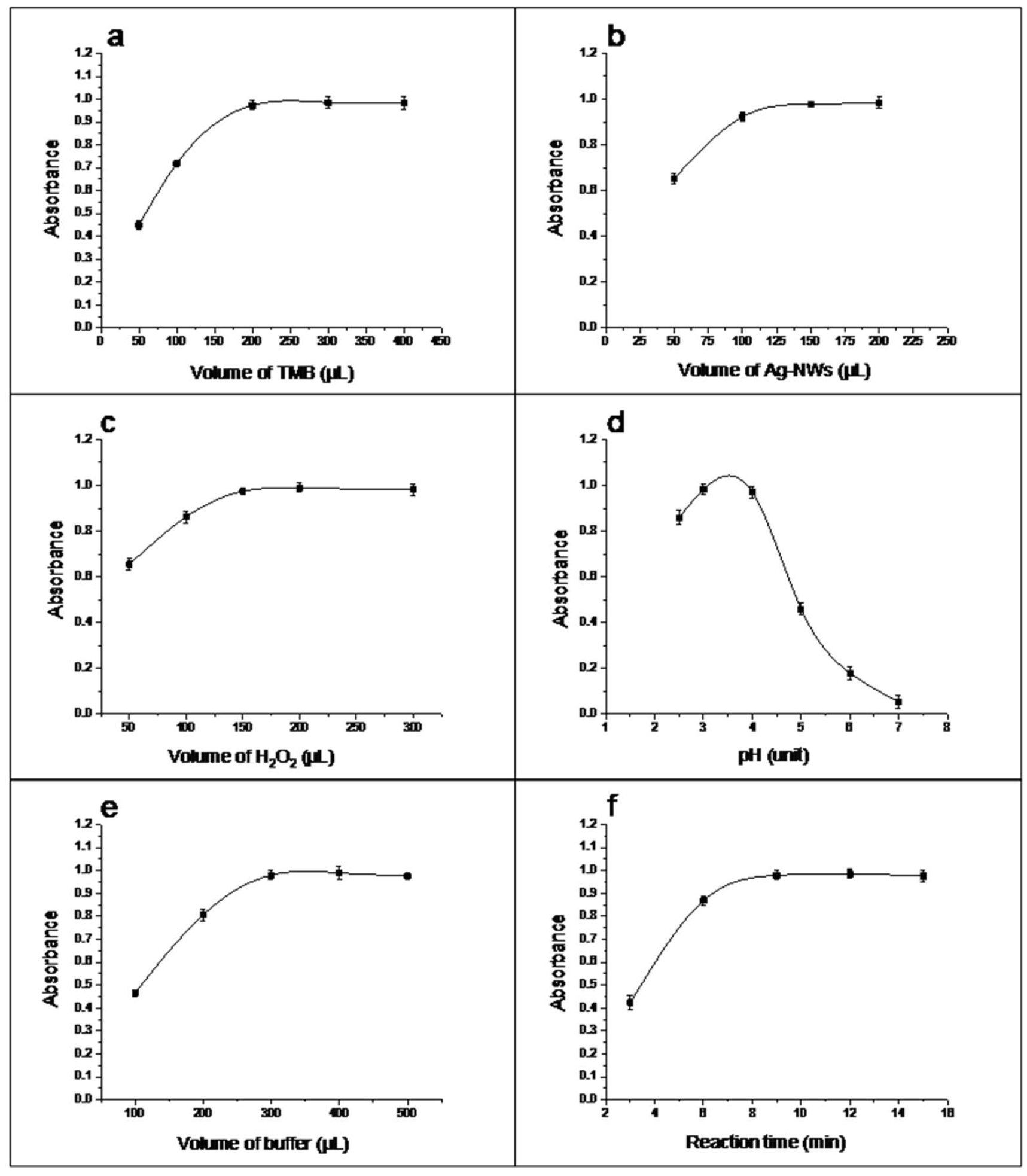
The catalytic activity of Ag-NWs was systematically optimized by evaluating the effects of reaction time, pH, temperature, and reagent concentrations. To ensure reliable spectrophotometric measurements within Beer’s law range, the absorbance of the Ag-NWs–TMB–H2O2 system was adjusted to ~0.8–1.0. Optimization of TMB concentration revealed that 300 µL yielded an absorbance close to 1.0 (Figure 3a). Similarly, the optimum volumes of Ag-NWs and H2O2 were determined to be 150 µL and 200 µL, respectively (Figure 3b,c). The catalytic activity was further influenced by pH and buffer volume, with maximum activity observed at pH 3.5 using 400 µL of 0.1 M acetate buffer at 25 °C (Figure 3d,e). Reaction time studies (Figure 3f) showed that absorbance increased steadily from 3 to 9 min before reaching a plateau, and no significant change was observed between 9 and 15 min. Thus, 10 min was selected as the optimal reaction time.

3.4. Principle of the Detection and Method Validation

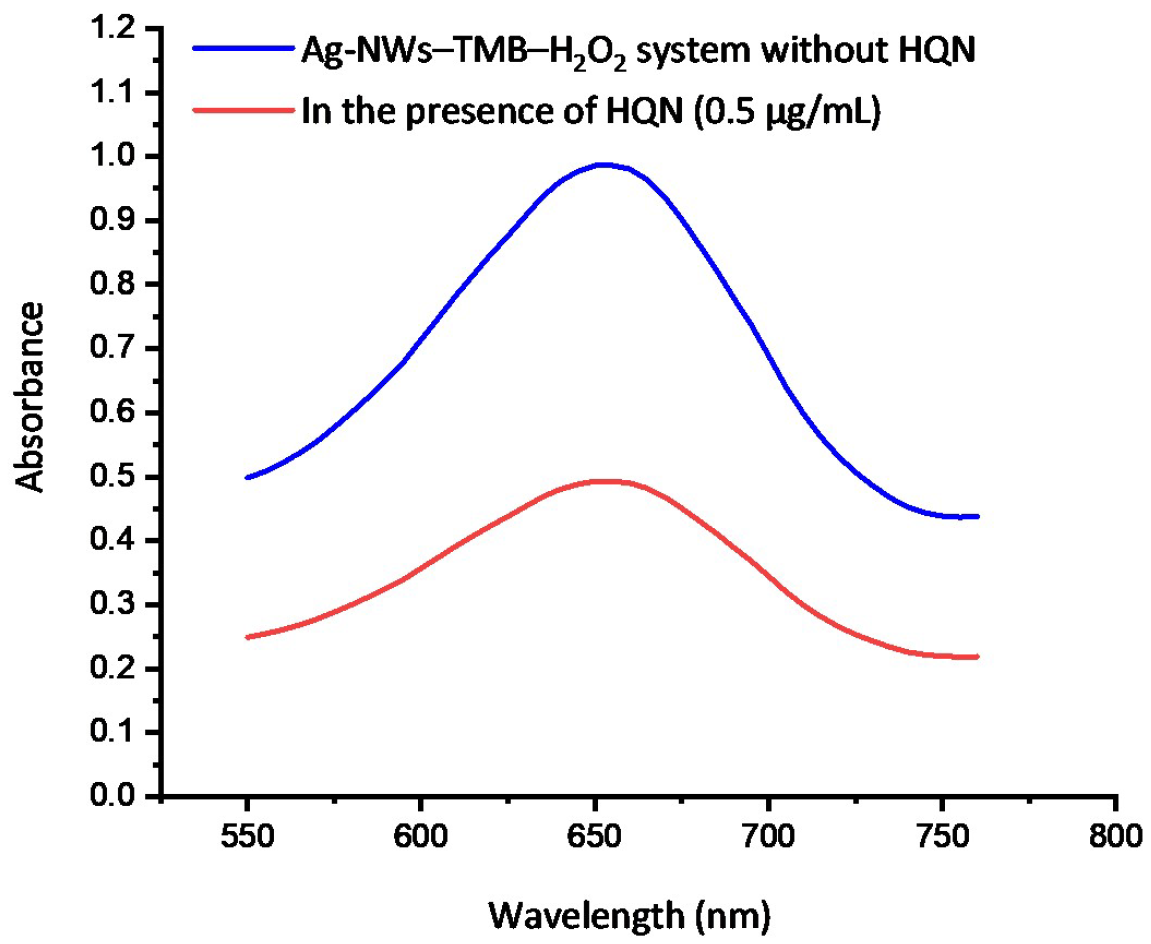
The synthesized Ag-NWs displayed distinct peroxidase-like activity by catalyzing the oxidation of TMB with H2O2 in acidic medium (0.1 M acetate buffer), producing a blue-colored product with a characteristic absorbance peak at 650 nm (Figure 4). The presence of HQN, a potent reducing agent, effectively quenched this colorimetric response through two complementary pathways: (i) scavenging reactive oxygen species, thereby competing with TMB for oxidation, and (ii) reducing oxTMB back to its colorless form. This dual inhibition formed the basis of HQN detection. A calibration plot of HQN concentration versus absorbance quenching was constructed, yielding a linear range of 0.08–0.8 µg/mL with the regression equation y = 0.836x + 0.0769 and an LOD of 26 ng/mL (Table 1, Figure S1). The preliminary evaluation of accuracy and precision at three concentrations (0.25, 0.5, and 0.75 µg/mL) suggests promising analytical performance for HQN determination (Table 2). Robustness was further demonstrated by minor variations in Ag-NWs, TMB, H2O2, buffer volumes, and pH, without significant deviation in results (Table 3). These findings verify the robustness of the developed method for HQN determination.

3.5. Selectivity Study

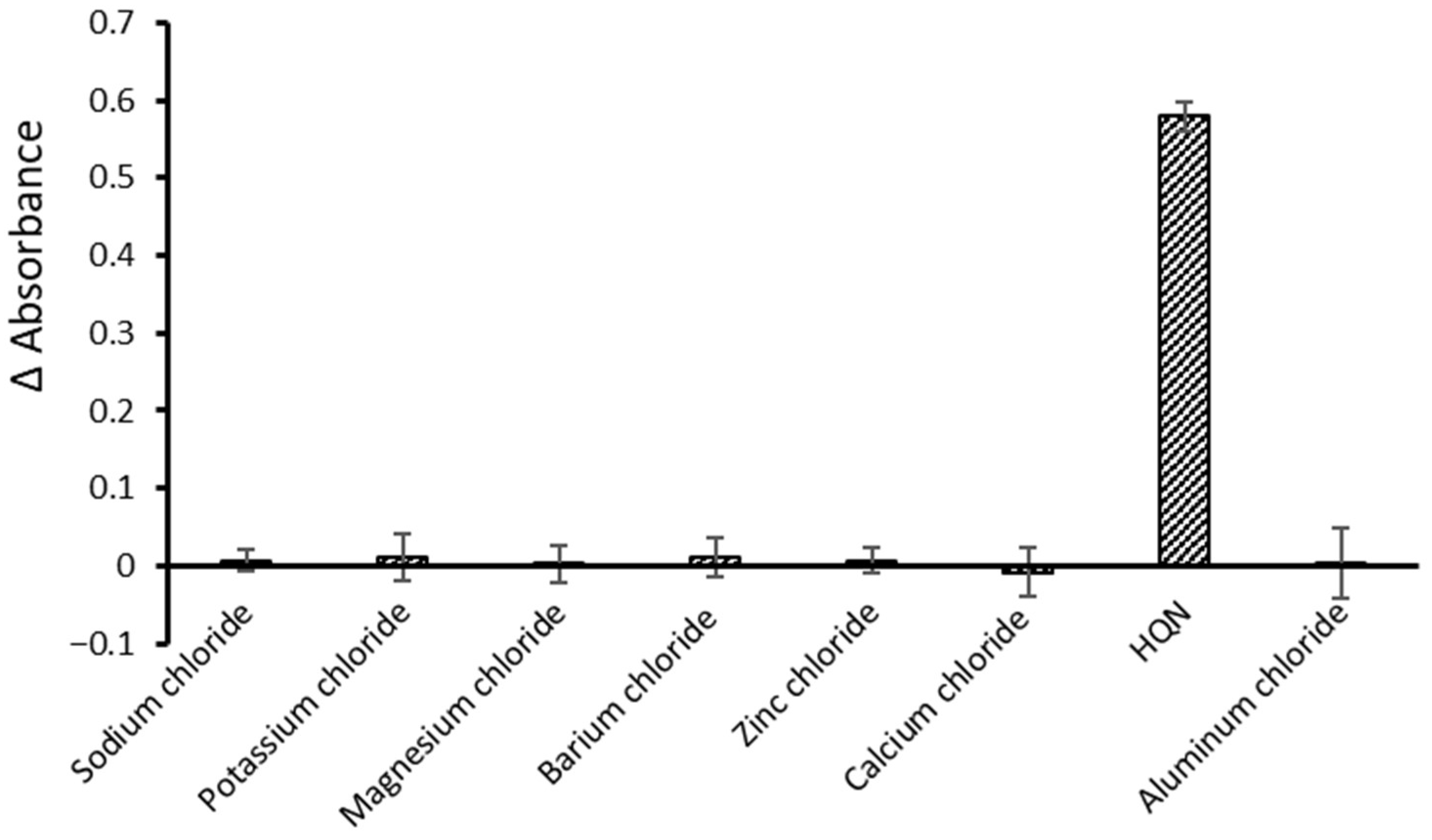
The selectivity of the Ag-NWs/TMB/H2O2 colorimetric system was evaluated in the presence of common inorganic ions that may exist in water samples, including Na+, K+, Mg2+, Ba2+, Zn2+, Ca2+, and Al3+. The effect of these potential interferents was examined at a relatively high concentration (6 µg/mL) while monitoring the response of HQN at 0.6 µg/mL (Figure 5). The tested ions exhibited negligible influence on the absorbance intensity, indicating that the assay demonstrates preliminary selectivity for HQN in the presence of the studied ions. This selectivity is likely associated with the preferential interaction of HQN with the catalytic products of the Ag-NWs/TMB/H2O2 system, which is not significantly affected by the studied metal ions.

3.6. Application to Water and Pharmaceutical Samples

The developed colorimetric method was applied to real samples to assess its practical applicability for HQN determination. Tap water was collected from the laboratory faucet, and river water was obtained from the Nile River in Assiut City, Egypt. Known amounts of HQN were spiked into these samples for recovery studies. In addition, the method was used to quantify HQN in a commercial product (Meloquin® 4% topical cream). The recoveries (±SD) of HQN were 102.66 ± 3.16%, 104.97 ± 5.07%, and 98.59 ± 2.19% for tap water, river water, and Meloquin cream, respectively. These results demonstrate promising preliminary performance for HQN determination in environmental and pharmaceutical matrices.

3.7. Advantages of Ag-NWs as a Hydroquinone Detector

In comparison to previously documented nanozymes, Ag-NWs have numerous unique benefits for peroxidase-mimicking catalysis and hydroquinone detection. Fe3O4 and nanozymes are recognized for their catalytic efficacy; yet, they frequently have restricted electron transport efficiency and significant particle aggregation, which diminish their repeatability and long-term stability [63,64]. Noble metal nanoparticles, including Au and Ag-NPs, have significant catalytic activity; nevertheless, their zero-dimensional structure renders them susceptible to aggregation, resulting in diminished activity and inadequate recyclability [65,66]. In fact, Ag-NWs have a distinctive one-dimensional high-aspect-ratio architecture that facilitates efficient electron transmission and offers numerous surface-active sites, especially at wire junctions and edges [67]. Furthermore, the linked network of Ag-NWs promotes dispersion stability while preventing agglomeration, resulting in constant catalytic activity. These structural and physicochemical features enable Ag-NWs to achieve comparable or even superior activity while maintaining better stability than common nanozymes. Therefore, Ag-NWs demonstrate potential as a low-cost and sensitive detection platform for future development.

3.8. Limitations

This study serves as a proof-of-concept for the Ag-NWs–TMB–H2O2 system in hydroquinone detection, acknowledging some inherent limitations. First, full reproducibility testing, batch-to-batch variability evaluation, and temporal stability study of the nanozyme activity were not conducted and remain essential for future validation. Second, while the system showed good selectivity in the presence of common inorganic ions, the possible interference from phenolic compounds with similar structures was not extensively tested. Third, the application to real samples was restricted to a narrow range of matrices, necessitating the exploration of more extensive environmental and industrial matrices in future research.

4. Conclusions

Silver nanowires were successfully synthesized and characterized by TEM, EDX, XRD, SEM, and UV-vis analyses. They exhibited strong peroxidase-mimicking activity, catalyzing the oxidation of TMB to the blue-colored ox-TMB. The presence of HQN efficiently suppressed this reaction, enabling the development of a simple and effective colorimetric sensor for HQN detection at λmax of 650 nm under optimized sensing conditions. The method showed promising preliminary applicability in real-world samples, including tap water, river water, and a pharmaceutical cream formulation, demonstrating promising performance in preliminary tests. Moreover, the approach is adaptable and cost-effective, requiring minimal sample preparation and employing readily available components, indicating potential applicability in environmental monitoring and preliminary quality control studies. Although the proposed sensor showed excellent selectivity toward hydroquinone in the presence of common inorganic ions, the possible influence of structurally related phenolic compounds (such as phenol, catechol, and resorcinol) remains to be investigated in future studies.

Supplementary Materials

The following supporting information can be downloaded at: https://www.mdpi.com/article/10.3390/chemosensors13120415/s1, Figure S1: The calibration curve of the proposed method; Table S1: The recent reported nanozymes based colorimetric methods for the detection of hydroquinone in various samples.

Author Contributions

Conceptualization, H.S.A., R.D.A.-R. and M.A.A.-L.; methodology, H.S.A., R.D.A.-R. and M.A.A.-L.; software, H.S.A., S.N.A., R.D.A.-R., A.M.N. and M.A.A.-L.; validation, R.D.A.-R., A.M.N. and M.A.A.-L.; formal analysis, S.N.A., R.D.A.-R. and M.A.A.-L.; investigation, H.S.A., R.D.A.-R., A.M.N. and M.A.A.-L.; resources, H.S.A., S.N.A., R.D.A.-R. and M.A.A.-L.; data curation, H.S.A., S.N.A., R.D.A.-R. and M.A.A.-L.; writing—original draft preparation, H.S.A., S.N.A., R.D.A.-R., A.M.N. and M.A.A.-L.; writing—review and editing, R.D.A.-R. and M.A.A.-L.; visualization, H.S.A. and M.A.A.-L.; supervision, M.A.A.-L.; project administration, H.S.A. and M.A.A.-L.; funding acquisition, H.S.A. All authors have read and agreed to the published version of the manuscript.

Funding

Princess Nourah bint Abdulrahman University Researchers Supporting Project number (PNURSP2025R185), Princess Nourah bint Abdulrahman University, Riyadh, Saudi Arabia.

Data Availability Statement

Data is contained within the article or Supplementary Material.

Conflicts of Interest

The authors declare no conflict of interest.

References

  1. Pu, H.; Sun, Q.; Tang, P.; Zhao, L.; Li, Q.; Liu, Y.; Li, H. Characterization and antioxidant activity of the complexes of tertiary butylhydroquinone with β-cyclodextrin and its derivatives. Food Chem. 2018, 260, 183–192. [Google Scholar] [CrossRef]
  2. Wang, X.; Cheng, Z.; Zhou, Y.; Tammina, S.K.; Yang, Y. A double carbon dot system composed of N, Cl-doped carbon dots and N, Cu-doped carbon dots as peroxidase mimics and as fluorescent probes for the determination of hydroquinone by fluorescence. Microchim. Acta 2020, 187, 350. [Google Scholar] [CrossRef]
  3. Liu, Y.; Wang, Q.; Guo, S.; Jia, P.; Shui, Y.; Yao, S.; Huang, C.; Zhang, M.; Wang, L. Highly selective and sensitive fluorescence detection of hydroquinone using novel silicon quantum dots. Sens. Actuators B Chem. 2018, 275, 415–421. [Google Scholar] [CrossRef]
  4. He, K.; Wang, X.; Meng, X.; Zheng, H.; Suye, S.-i. Amperometric determination of hydroquinone and catechol on gold electrode modified by direct electrodeposition of poly (3, 4-ethylenedioxythiophene). Sens. Actuators B Chem. 2014, 193, 212–219. [Google Scholar] [CrossRef]
  5. Sheth, V.M.; Pandya, A.G. Melasma: A comprehensive update: Part II. J. Am. Acad. Dermatol. 2011, 65, 699–714. [Google Scholar] [CrossRef]
  6. Alqarni, M.H.; Alam, P.; Shakeel, F.; Foudah, A.I.; Alshehri, S. Highly sensitive and ecologically sustainable reversed-phase hptlc method for the determination of hydroquinone in commercial whitening creams. Processes 2021, 9, 1631. [Google Scholar] [CrossRef]
  7. Rachmin, I.; Ostrowski, S.M.; Weng, Q.Y.; Fisher, D.E. Topical treatment strategies to manipulate human skin pigmentation. Adv. Drug Deliv. Rev. 2020, 153, 65–71. [Google Scholar] [CrossRef]
  8. Nordin, F.N.; Aziz, A.; Zakaria, Z.; Wan Mohamed Radzi, C.W.J. A systematic review on the skin whitening products and their ingredients for safety, health risk, and the halal status. J. Cosmet. Dermatol. 2021, 20, 1050–1060. [Google Scholar] [CrossRef]
  9. MC, S.; Becker Jr, S. A hydroquinone effect. Clin. Med. 1963, 70, 1111–1114. [Google Scholar]
  10. Peters, M.; Jones, T.W.; Monks, T.J.; Lau, S.S. Cytotoxicity and cell-proliferation induced by the nephrocarcinogen hydroquinone and its nephrotoxic metabolite 2, 3, 5-(tris-glutathion-S-yl) hydroquinone. Carcinogenesis 1997, 18, 2393–2401. [Google Scholar] [CrossRef]
  11. Katsambas, A.; Antoniou, C. Melasma. Classification and treatment. J. Eur. Acad. Dermatol. Venereol. 1995, 4, 217–223. [Google Scholar] [CrossRef]
  12. Amer, M.; Metwalli, M. Topical hydroquinone in the treatment of some hyperpigmentary disorders. Int. J. Dermatol. 1998, 37, 449–450. [Google Scholar] [CrossRef]
  13. Xing, N.; Yang, L.; Wang, L.; Lu, Y.; Zhang, H.; Sun, X.; Zhao, M.; Tan, W.; Yang, J. Cu/Mn synergy catalysis-based colorimetric sensor for visual detection of hydroquinone. Coatings 2024, 14, 453. [Google Scholar] [CrossRef]
  14. Zhao, J.; Shi, Z.; Chen, M.; Xi, F. Highly active nanozyme based on nitrogen-doped graphene quantum dots and iron ion nanocomposite for selective colorimetric detection of hydroquinone. Talanta 2025, 281, 126817. [Google Scholar] [CrossRef] [PubMed]
  15. Deng, D.; Wang, Y.; Wen, S.; Kang, Y.; Cui, X.; Tang, R.; Yang, X. Metal-organic framework composite Mn/Fe-MOF@ Pd with peroxidase-like activities for sensitive colorimetric detection of hydroquinone. Anal. Chim. Acta 2023, 1279, 341797. [Google Scholar] [CrossRef]
  16. Liu, B.; Wang, Z.; Wei, T.; Liu, Z.; Li, J. Bimetallic FeMn-N nanoparticles as nanocatalyst with dual enzyme-mimic activities for simultaneous colorimetric detection and degradation of hydroquinone. J. Environ. Chem. Eng. 2023, 11, 110186. [Google Scholar]
  17. Liang, N.; Ge, X.; Zhao, Y.; Xia, L.; Song, Z.-L.; Kong, R.-M.; Qu, F. Promoting sensitive colorimetric detection of hydroquinone and Hg2+ via ZIF-8 dispersion enhanced oxidase-mimicking activity of MnO2 nanozyme. J. Hazard. Mater. 2023, 454, 131455. [Google Scholar] [CrossRef]
  18. Zhu, X.; Xue, Y.; Hou, S.; Song, P.; Wu, T.; Zhao, H.; Osman, N.A.; Alanazi, A.K.; Gao, Y.; Abo-Dief, H.M. Highly selective colorimetric platinum nanoparticle-modified core-shell molybdenum disulfide/silica platform for selectively detecting hydroquinone. Adv. Compos. Hybrid Mater. 2023, 6, 142. [Google Scholar] [CrossRef]
  19. Zhang, Y.; Liu, B.; Li, J.; Liu, Z. Water-induced CsPbBr3@ PbBr (OH) semiconductor for highly sensitive colorimetric detection of hydroquinone. Mater. Lett. 2023, 338, 134014. [Google Scholar] [CrossRef]
  20. Zhang, X.; Liu, B.; Wei, T.; Liu, Z.; Li, J. Self-propelled Janus magnetic micromotors as peroxidase-like nanozyme for colorimetric detection and removal of hydroquinone. Environ. Sci. Nano 2023, 10, 476–488. [Google Scholar] [CrossRef]
  21. Gao, S.; Liu, K.; Ji, X.; Cui, Y.; Li, R.; Ma, G.; Zhang, Y.; Wang, L. Biocompatible palladium nanoparticles prepared using vancomycin for colorimetric detection of hydroquinone. Polymers 2023, 15, 3148. [Google Scholar] [CrossRef]
  22. He, Y.; Feng, M.; Zhang, X.; Huang, Y. Metal-organic framework (MOF)-derived flower-like Ni-MOF@ NiV-layered double hydroxides as peroxidase mimetics for colorimetric detection of hydroquinone. Anal. Chim. Acta 2023, 1283, 341959. [Google Scholar] [CrossRef] [PubMed]
  23. Kaka, M.N.; Borah, N.; Baruah, D.; Phukan, A.; Tamuly, C. Ag-nanozyme as peroxidase mimetic for colorimetric detection of dihydroxybenzene isomers and hydroquinone estimation in real samples. Inorg. Chem. Commun. 2024, 166, 112580. [Google Scholar] [CrossRef]
  24. Xin, J.; Pang, H.; Khan, S.U.; Wu, Q.; Jin, Z.; Yu, X.; Ma, H.; Wang, X.; Yang, G.; Tan, L. Polyoxometalate-based metal–organic frameworks directed fabrication of defective-1 T/2H-MoS2/ZnS heterostructured nanozyme for colorimetric determination of hydroquinone. Appl. Surf. Sci. 2023, 619, 156713. [Google Scholar] [CrossRef]
  25. Holzinger, M.; Le Goff, A.; Cosnier, S. Nanomaterials for biosensing applications: A review. Front. Chem. 2014, 2, 63. [Google Scholar] [CrossRef]
  26. Abdel-Lateef, M.A. Utilization of the peroxidase-like activity of silver nanoparticles nanozyme on O-phenylenediamine/H2O2 system for fluorescence detection of mercury (II) ions. Sci. Rep. 2022, 12, 6953. [Google Scholar] [CrossRef]
  27. Al-Onazi, W.A.; Abdel-Lateef, M.A. Catalytic oxidation of O-phenylenediamine by silver nanoparticles for resonance Rayleigh scattering detection of mercury (II) in water samples. Spectrochim. Acta A Mol. Biomol. Spectrosc. 2022, 264, 120258. [Google Scholar] [CrossRef]
  28. AlSalem, H.S.; Binkadem, M.S.; Al-Goul, S.T.; Abdel-Lateef, M.A. Synthesis of green emitted carbon dots from Vachellia nilotica and utilizing its extract as a red emitted fluorescence reagent: Applying for visual and spectroscopic detection of iron (III). Spectrochim. Acta Part A Mol. Biomol. Spectrosc. 2023, 295, 122616. [Google Scholar] [CrossRef] [PubMed]
  29. Abdel-Lateef, M.A.; Alzahrani, E.; Pashameah, R.A.; Almahri, A.; Abu-Hassan, A.A.; El Hamd, M.A.; Mohammad, B.S. A specific turn-on fluorescence probe for determination of nitazoxanide based on feasible oxidation reaction with hypochlorite: Applying cobalt ferrite nanoparticles for pre-concentration and extraction of its metabolite from real urine samples. J. Pharm. Biomed. Anal. 2022, 219, 114941. [Google Scholar] [CrossRef] [PubMed]
  30. Xie, Z.X.; Wu, Y.; Zhou, J.; Lu, J.Y.; Huang, W.T. Multifunctional Antimonene-Silver Nanocomposites for Ultra-Multi-Mode and Multi-Analyte Sensing, Parallel and Batch Logic Computing, Long-Text Information Protection. Small 2024, 20, 2401510. [Google Scholar] [CrossRef]
  31. Chen, J.; Long, Z.; Li, Y.; Qiu, H. Colorimetric Detection of Acid Phosphatase and Malathion Using NiCo2O4 Nanosheets as Peroxidase-Mimicking Activity. J. Anal. Test. 2024, 8, 170–179. [Google Scholar] [CrossRef]
  32. Vatsyayan, P.; Iffelsberger, C.; Mayorga-Martinez, C.C.; Matysik, F.-M. Imaging of localized enzymatic peroxidase activity over unbiased individual gold nanowires by scanning electrochemical microscopy. Anal. Methods 2016, 8, 6847–6855. [Google Scholar] [CrossRef]
  33. Hsu, C.-Y.; Rheima, A.M.; sabri Abbas, Z.; Faryad, M.U.; Kadhim, M.M.; Altimari, U.S.; Dawood, A.H.; Abed, Z.T.; Radhi, R.S.; Jaber, A.S. Nanowires properties and applications: A review study. S. Afr. J. Chem. Eng. 2023, 46, 286–311. [Google Scholar] [CrossRef]
  34. Kumar, A.; Kumar, M.; Goyat, M.; Avasthi, D. A review of the latest developments in the production and applications of Ag-nanowires as transparent electrodes. Mater. Today Commun. 2022, 33, 104433. [Google Scholar] [CrossRef]
  35. Li, L.; Wong, S.S. Ultrathin metallic nanowire-based architectures as high-performing electrocatalysts. ACS Omega 2018, 3, 3294–3313. [Google Scholar] [CrossRef] [PubMed]
  36. Salvo-Comino, C.; Martin-Pedrosa, F.; Garcia-Cabezon, C.; Rodriguez-Mendez, M.L. Silver nanowires as electron transfer mediators in electrochemical catechol biosensors. Sensors 2021, 21, 899. [Google Scholar] [CrossRef]
  37. Qin, H.; Jiang, L.; He, Y.; Liu, J.; Cao, K.; Wang, J.; He, Y.; Ni, H.; Chi, H.; Ji, Z. Carbon supported silver nanowires with enhanced catalytic activity and stability used as a cathode in a direct borohydride fuel cell. J. Mater. Chem. A 2013, 1, 15323–15328. [Google Scholar] [CrossRef]
  38. Koenigsmann, C.; Wong, S.S. One-dimensional noble metal electrocatalysts: A promising structural paradigm for direct methanol fuel cells. Energy Environ. Sci. 2011, 4, 1161–1176. [Google Scholar] [CrossRef]
  39. Wolfenden, R.; Snider, M.J. The depth of chemical time and the power of enzymes as catalysts. Acc. Chem. Res. 2001, 34, 938–945. [Google Scholar] [CrossRef]
  40. Garcia-Viloca, M.; Gao, J.; Karplus, M.; Truhlar, D.G. How enzymes work: Analysis by modern rate theory and computer simulations. Science 2004, 303, 186–195. [Google Scholar] [CrossRef]
  41. Lin, Y.; Ren, J.; Qu, X. Catalytically active nanomaterials: A promising candidate for artificial enzymes. Acc. Chem. Res. 2014, 47, 1097–1105. [Google Scholar] [CrossRef]
  42. Xie, J.; Zhang, X.; Wang, H.; Zheng, H.; Huang, Y.; Xie, J. Analytical and environmental applications of nanoparticles as enzyme mimetics. TrAC Trends Anal. Chem. 2012, 39, 114–129. [Google Scholar] [CrossRef]
  43. Murakami, Y.; Kikuchi, J.-i.; Hisaeda, Y.; Hayashida, O. Artificial enzymes. Chem. Rev. 1996, 96, 721–758. [Google Scholar] [CrossRef] [PubMed]
  44. Breslow, R. Biomimetic chemistry and artificial enzymes: Catalysis by design. Acc. Chem. Res. 1995, 28, 146–153. [Google Scholar] [CrossRef]
  45. Kotov, N.A. Inorganic nanoparticles as protein mimics. Science 2010, 330, 188–189. [Google Scholar] [CrossRef] [PubMed]
  46. Kotelnikova, P.A.; Iureva, A.M.; Nikitin, M.P.; Zvyagin, A.V.; Deyev, S.M.; Shipunova, V.O. Peroxidase-like activity of silver nanowires and its application for colorimetric detection of the antibiotic chloramphenicol. Talanta Open 2022, 6, 100164. [Google Scholar] [CrossRef]
  47. Abdel-Rahim, R.D.; Emran, M.Y.; Nagiub, A.M.; Farghaly, O.A.; Taher, M.A. Silver nanowire size-dependent effect on the catalytic activity and potential sensing of H2O2. Electrochem. Sci. Adv. 2021, 1, e2000031. [Google Scholar] [CrossRef]
  48. AlSalem, H.S.; Alharbi, S.N.; Abdel-Lateef, M.A.; Abdel-Rahim, R.D.; El-Koussi, W.M. Nanozyme activity of silver nanowires for colorimetric detection of bisphenol A following salting-out assisted liquid-liquid extraction. Talanta Open 2025, 12, 100587. [Google Scholar] [CrossRef]
  49. Alharshan, G.A.; Uosif, M.A.; Abdel-Rahim, R.D.; Yousef, E.S.; Shaaban, E.R.; Nagiub, A.M. Developing a simple, effective, and quick process to make silver nanowires with a high aspect ratio. Materials 2023, 16, 5501. [Google Scholar] [CrossRef]
  50. Mao, H.; Feng, J.; Ma, X.; Wu, C.; Zhao, X. One-dimensional silver nanowires synthesized by self-seeding polyol process. J. Nanoparticle Res. 2012, 14, 887. [Google Scholar] [CrossRef]
  51. Johan, M.R.; Aznan, N.A.K.; Yee, S.T.; Ho, I.H.; Ooi, S.W.; Darman Singho, N.; Aplop, F. Synthesis and growth mechanism of silver nanowires through different mediated agents (CuCl2 and NaCl) polyol process. J. Nanomater. 2014, 2014, 105454. [Google Scholar] [CrossRef]
  52. Korte, K.E.; Skrabalak, S.E.; Xia, Y. Rapid synthesis of silver nanowires through a CuCl-or CuCl2-mediated polyol process. J. Mater. Chem. 2008, 18, 437–441. [Google Scholar] [CrossRef]
  53. Abdel-Rahim, R.D.; Nagiub, A.M.; Taher, M.A. Electrical and Optical Properties of Flexible Transparent Silver Nanowires electrodes. Int. J. Thin. Film. Sci. Technol 2022, 11, 123–132. [Google Scholar]
  54. Sun, Y.; Yin, Y.; Mayers, B.T.; Herricks, T.; Xia, Y. Uniform silver nanowires synthesis by reducing AgNO3 with ethylene glycol in the presence of seeds and poly (vinyl pyrrolidone). Chem. Mater. 2002, 14, 4736–4745. [Google Scholar] [CrossRef]
  55. Coskun, S.; Aksoy, B.; Unalan, H.E. Polyol synthesis of silver nanowires: An extensive parametric study. Cryst. Growth Des. 2011, 11, 4963–4969. [Google Scholar] [CrossRef]
  56. Yan, X.-S.; Lin, P.; Qi, X.; Yang, L. Finnis–Sinclair potentials for fcc Au–Pd and Ag–Pt alloys. Int. J. Mater. Res. 2011, 102, 381–388. [Google Scholar] [CrossRef]
  57. Abdel-Rahim, R.D.; Nagiub, A.M.; Pharghaly, O.A.; Taher, M.A. Optical properties for flexible and transparent silver nanowires electrodes with different diameters. Opt. Mater. 2021, 117, 111123. [Google Scholar] [CrossRef]
  58. Shkir, M.; Khan, M.T.; Ashraf, I.; AlFaify, S.; El-Toni, A.M.; Aldalbahi, A.; Ghaithan, H.; Khan, A. Rapid microwave-assisted synthesis of Ag-doped PbS nanoparticles for optoelectronic applications. Ceram. Int. 2019, 45, 21975–21985. [Google Scholar] [CrossRef]
  59. Sun, Y.; Xia, Y. Gold and silver nanoparticles: A class of chromophores with colors tunable in the range from 400 to 750 nm. Analyst 2003, 128, 686–691. [Google Scholar] [CrossRef]
  60. Song, J.; Huang, Y.; Fan, Y.; Zhao, Z.; Yu, W.; Rasco, B.A.; Lai, K. Detection of prohibited fish drugs using silver nanowires as substrate for surface-enhanced Raman scattering. Nanomaterials 2016, 6, 175. [Google Scholar] [CrossRef]
  61. Lizoń, A.; Tisończyk, J.; Gajewska, M.; Drożdż, R. Silver nanoparticles as a tool for the study of spontaneous aggregation of immunoglobulin monoclonal free light chains. Int. J. Mol. Sci. 2021, 22, 9703. [Google Scholar] [CrossRef]
  62. Feng, X.; Wang, X.; Zhang, B.; Gu, J.; Xu, C.; Zhang, S. Flexible transparent conductive films based on silver nanowires by ultrasonic spraying process. J. Mater. Sci. Mater. Electron. 2022, 33, 25939–25949. [Google Scholar] [CrossRef]
  63. Zhang, B.; Wang, X.; Hu, W.; Liao, Y.; He, Y.; Dong, B.; Zhao, M.; Ma, Y. SPR-enhanced Au@ Fe3O4 nanozyme for the detection of hydroquinone. Chemosensors 2023, 11, 392. [Google Scholar] [CrossRef]
  64. Dong, J.; Song, L.; Yin, J.-J.; He, W.; Wu, Y.; Gu, N.; Zhang, Y. Co3O4 nanoparticles with multi-enzyme activities and their application in immunohistochemical assay. ACS Appl. Mater. Interfaces 2014, 6, 1959–1970. [Google Scholar] [CrossRef]
  65. He, J.; Li, S.; Lyu, D.; Zhang, D.; Wu, X.; Xu, Q.-H. Aggregation induced emission enhancement by plasmon coupling of noble metal nanoparticles. Mater. Chem. Front. 2019, 3, 2421–2427. [Google Scholar] [CrossRef]
  66. Piella, J.; Bastús, N.G.; Puntes, V. Modeling the optical responses of noble metal nanoparticles subjected to physicochemical transformations in physiological environments: Aggregation, dissolution and oxidation. Z. Für Phys. Chem. 2017, 231, 33–50. [Google Scholar] [CrossRef]
  67. Wang, R.; Chen, C.; Zheng, Y.; Wang, H.; Liu, J.-W.; Yu, S.-H. Structure–property relationship of assembled nanowire materials. Mater. Chem. Front. 2020, 4, 2881–2903. [Google Scholar] [CrossRef]
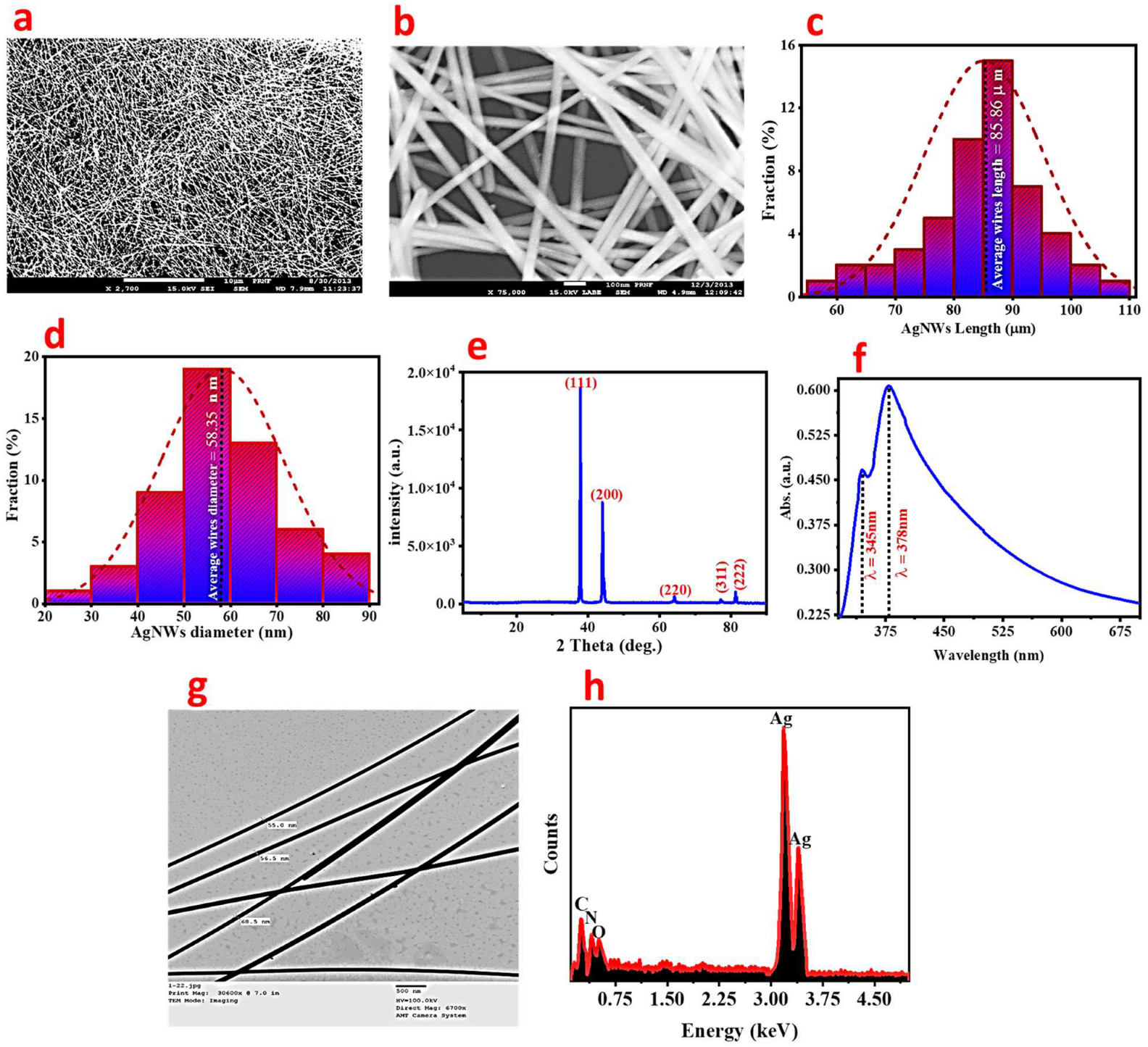
Figure 1. Characterization of Ag-NWs: SEM images at 10 μm (a) and 100 nm (b), length distribution (c), diameter distribution (d), XRD analysis (e), UV-vis spectroscopy (f), TEM image (g), and EDx spectroscopy (h).
Chemosensors 13 00415 g001
Figure 2. (a) for the absorbance spectrum of ox-TMB upon the catalytic interaction between TMB, Ag-NWs, and H2O2, and (b) for reaction pathways for the catalytic oxidation of TMB by the prepared Ag-NWs in the presence of hydrogen peroxide.
Chemosensors 13 00415 g002
Figure 3. Effect of the catalytic conditions; volume of TMB (a), volume of Ag-NWs (b), volume of H2O2 (c), pH (d), volume of buffer (e), and time of reaction (f) on the absorbance of the Ag-NWs–TMB–H2O2 system.
Chemosensors 13 00415 g003
Figure 4. The absorbance spectrum for Ag-NWs–TMB–H2O2 system alone (blue line) and in the presence of hydroquinone (0.5 µg/mL, red line).
Chemosensors 13 00415 g004
Figure 5. Selectivity study for the proposed method against the predicted interfering substances.
Chemosensors 13 00415 g005
Table 1. Analytical parameters of the developed method.
ParameterResult
λmax650 nm
Linear range (µg/mL)0.08–0.8
Slope0.8359
SD of slope0.01366
Intercept0.0769
SD of intercept0.00663
r0.9994
r20.9989
LOQ (ng/mL)79.4
LOD (ng/mL)26.1
Table 2. Accuracy and precision of the suggested method.
Assayµg/mLRecovery ± SDRSD
Inter-day0.2599.81 ± 1.571.57
0.598.11 ± 1.101.10
0.75101.93 ± 1.461.46
Intra-day0.25101.48 ± 2.092.09
0.599.94 ± 2.032.03
0.7599.70 ± 1.691.69
Table 3. Evaluation of robustness of the suggested method.
Variable% Recovery ± SD *
Volume of TMB solution (1.0 mM)
270.0 µL100.43 ± 0.94
330.0 µL101.56 ± 1.51
Volume of H2O2 solution (6.0% w/v)
170.0 μL99.44 ± 1.88
230.0 μL98.77 ± 1.55
Volume of Ag-NWs
130.0 μL99.9 ± 1.7
170.0 μL98.24 ± 0.81
Volume of acetate buffer (0.10 M)
350.0 µL101.43 ± 2.02
450.0 µL98.31 ± 1.58
pH of the reaction environment
3.0101.56 ± 1.22
4.097.91 ± 1
* HQN concentration is 0.6 µg/mL.
Disclaimer/Publisher’s Note: The statements, opinions and data contained in all publications are solely those of the individual author(s) and contributor(s) and not of MDPI and/or the editor(s). MDPI and/or the editor(s) disclaim responsibility for any injury to people or property resulting from any ideas, methods, instructions or products referred to in the content.