Bionic Sensing and BCI Technologies for Olfactory Improvement and Reconstruction

Abstract
1. Introduction
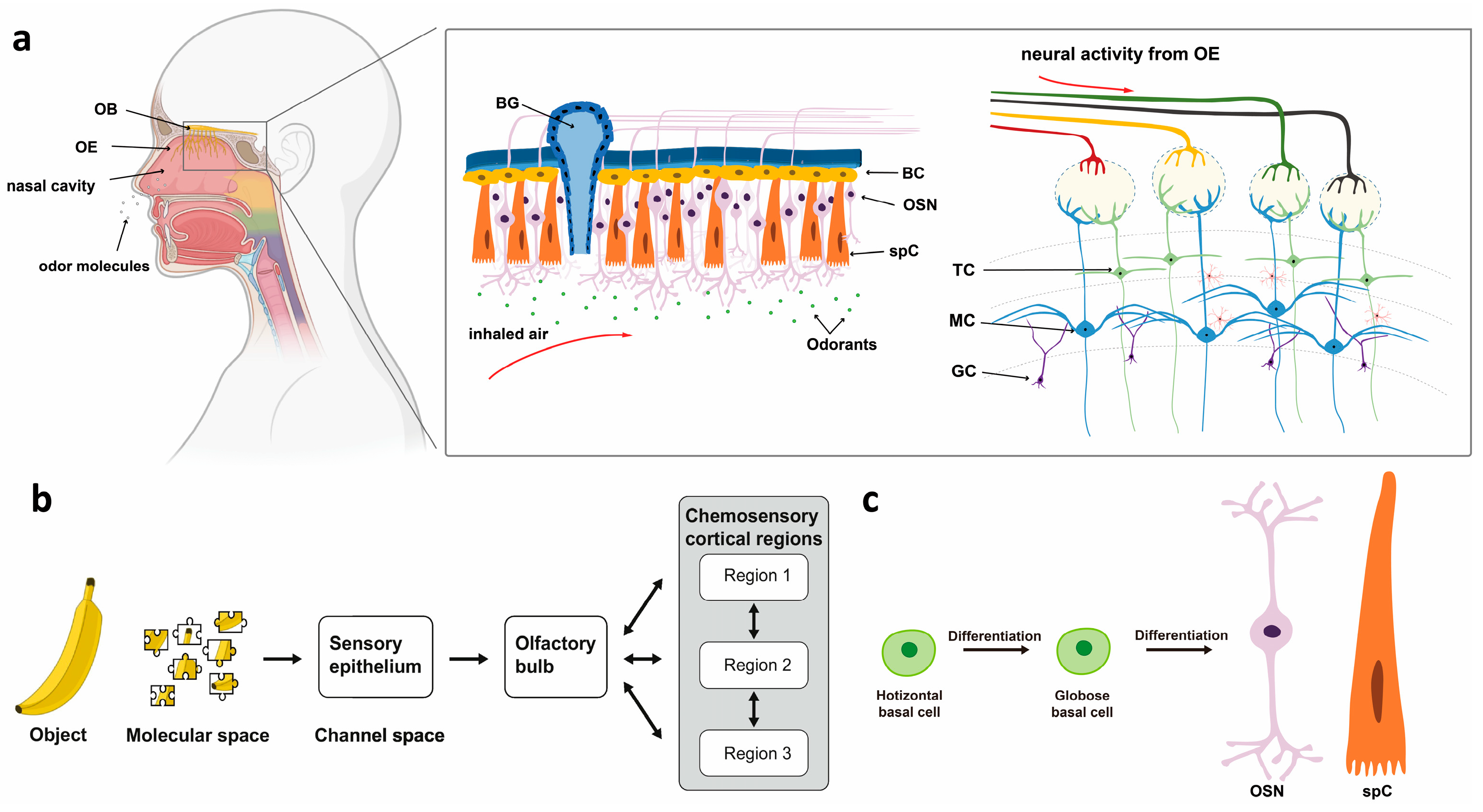
2. Overview of OD

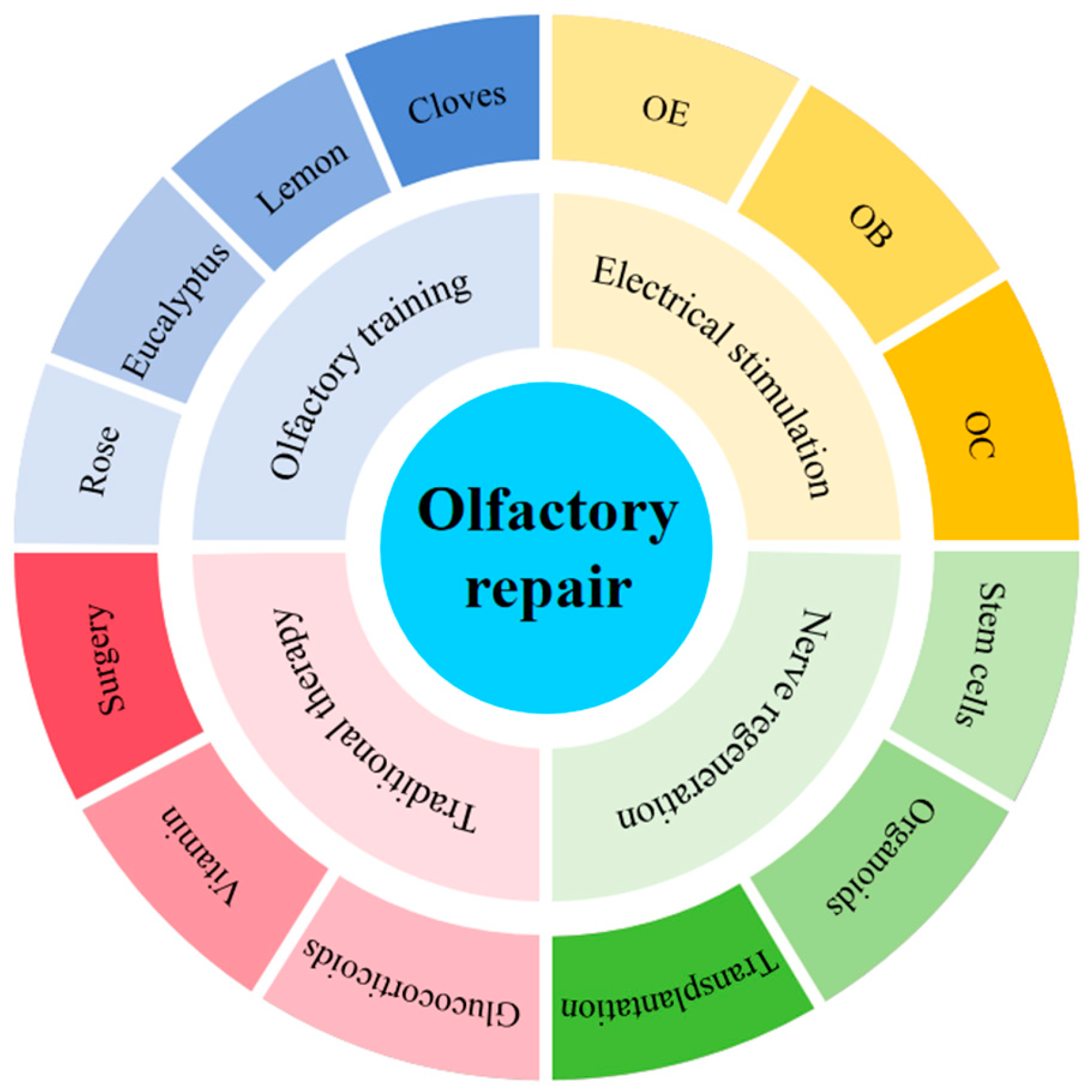
3. Olfactory Training
4. Electrical Stimulation
5. Nerve Regeneration
5.1. Stem Cell of Olfaction
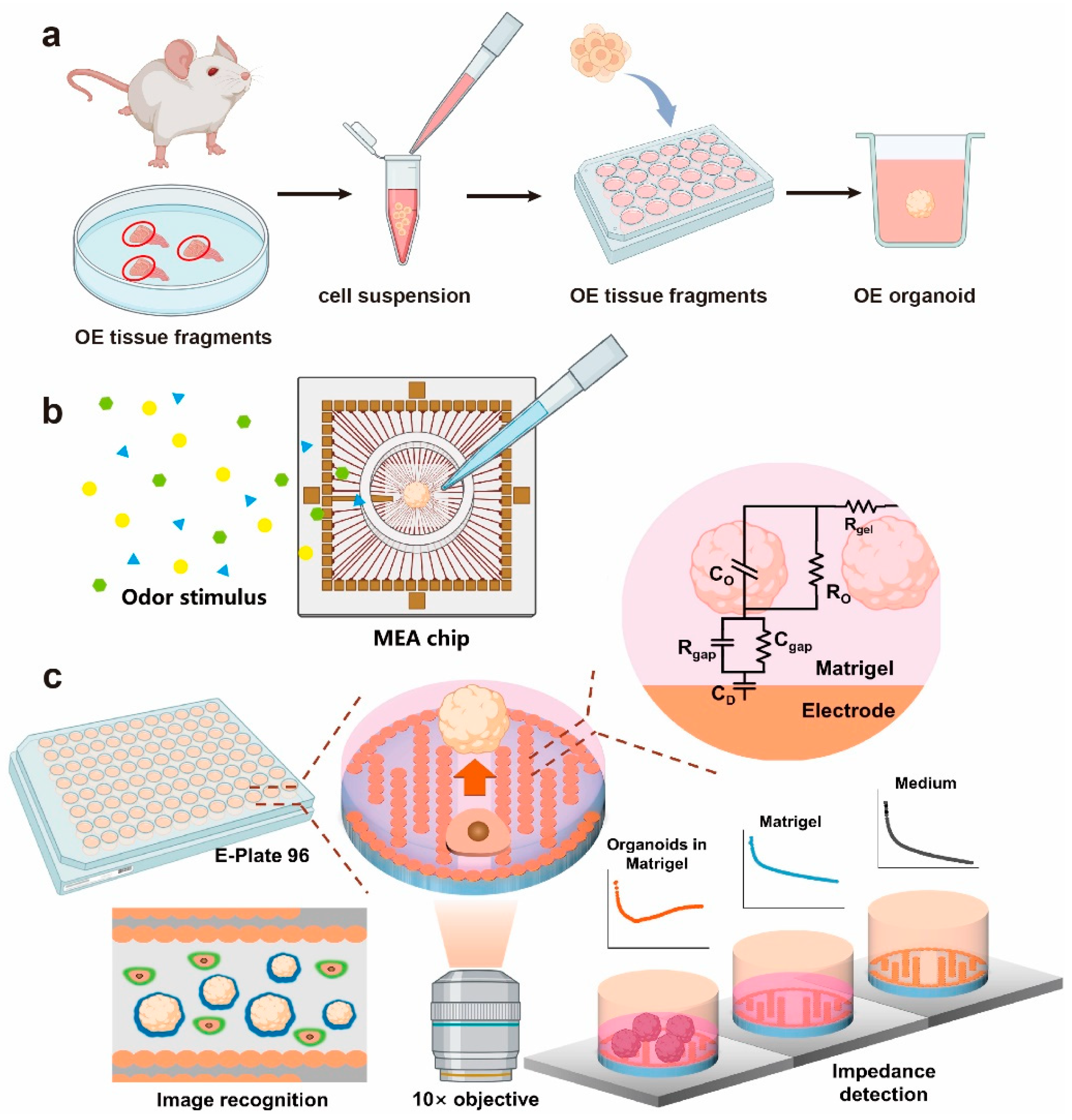
5.2. Olfactory Organoids

5.3. Transplantation
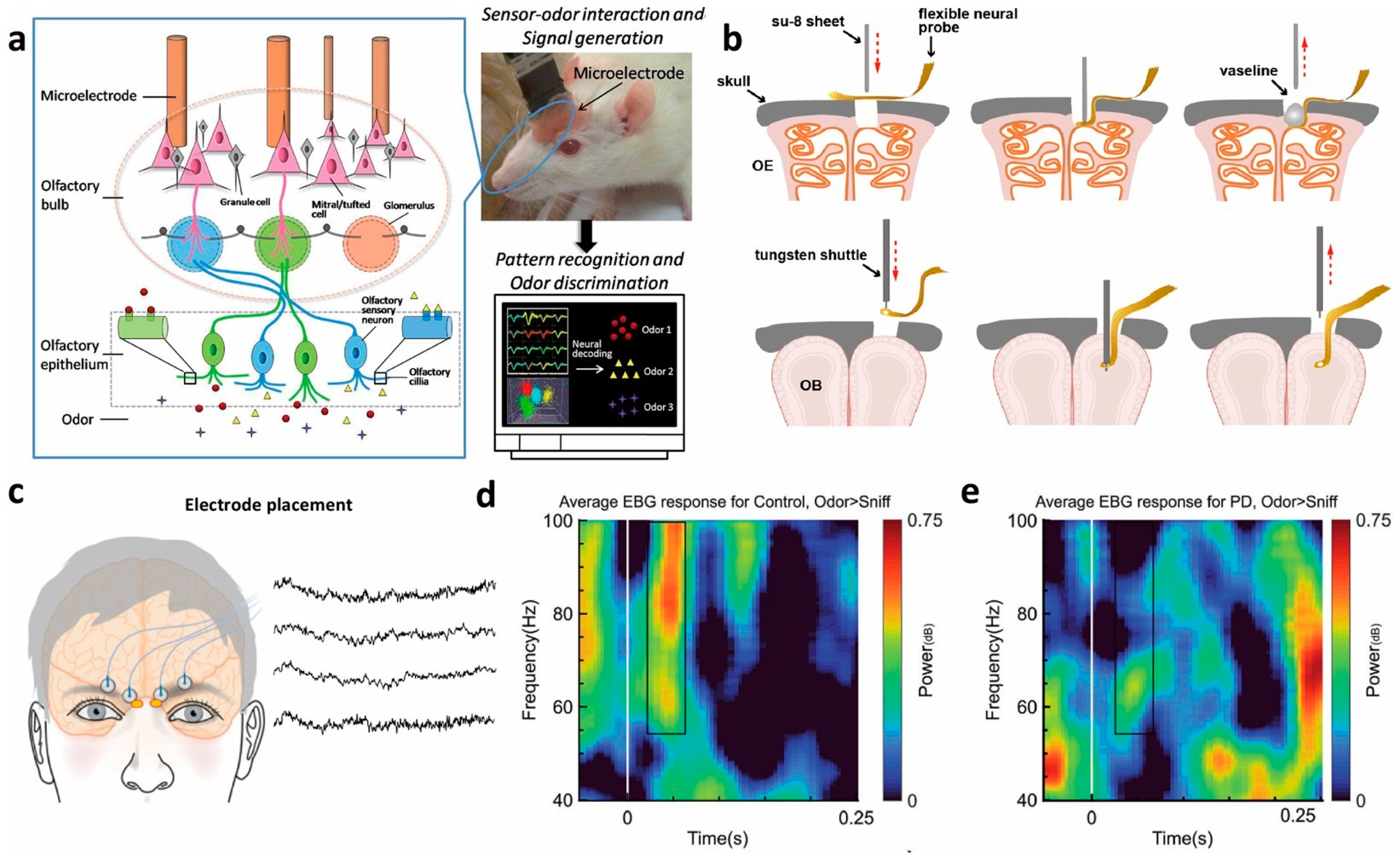
6. Olfactory Bionic Sensing Technology
7. Olfactory BCI-Based Approaches

8. Conclusions
Funding
Conflicts of Interest
References
- Firestein, S. How the olfactory system makes sense of scents. Nature 2001, 413, 211–218. [Google Scholar] [CrossRef]
- de March, C.A.; Matsunami, H.; Abe, M.; Cobb, M.; Hoover, K.C. Genetic and functional odorant receptor variation in the Homo lineage. iScience 2023, 26, 105908. [Google Scholar] [CrossRef] [PubMed]
- Bratman, G.N.; Bembibre, C.; Daily, G.C.; Doty, R.L.; Hummel, T.; Jacobs, L.F.; Kahn, P.H., Jr.; Lashus, C.; Majid, A.; Miller, J.D.; et al. Nature and human well-being: The olfactory pathway. Sci. Adv. 2024, 10, eadn3028. [Google Scholar] [CrossRef] [PubMed]
- Dikeçligil, G.N.; Gottfried, J.A. What Does the Human Olfactory System Do, and How Does It Do It? Annu. Rev. Psychol. 2024, 75, 155–181. [Google Scholar] [CrossRef] [PubMed]
- Mori, K.; Nagao, H.; Yoshihara, Y. The olfactory bulb: Coding and processing of odor molecule information. Science 1999, 286, 711–715. [Google Scholar] [CrossRef]
- Buck, L.B. Information coding in the vertebrate olfactory system. Annu. Rev. Neurosci. 1996, 19, 517–544. [Google Scholar] [CrossRef]
- Seubert, J.; Laukka, E.J.; Rizzuto, D.; Hummel, T.; Fratiglioni, L.; Bäckman, L.; Larsson, M. Prevalence and Correlates of Olfactory Dysfunction in Old Age: A Population-Based Study. J. Gerontol. A Biol. Sci. Med. Sci. 2017, 72, 1072–1079. [Google Scholar] [CrossRef]
- Zhang, Y.J.; Lee, J.Y.; Igarashi, K.M. Circuit dynamics of the olfactory pathway during olfactory learning. Front. Neural Circuits 2024, 18, 1437575. [Google Scholar] [CrossRef]
- Nagayama, S.; Homma, R.; Imamura, F. Neuronal organization of olfactory bulb circuits. Front. Neural Circuits 2014, 8, 98. [Google Scholar] [CrossRef]
- Igarashi, K.M.; Ieki, N.; An, M.; Yamaguchi, Y.; Nagayama, S.; Kobayakawa, K.; Kobayakawa, R.; Tanifuji, M.; Sakano, H.; Chen, W.R.; et al. Parallel mitral and tufted cell pathways route distinct odor information to different targets in the olfactory cortex. J. Neurosci. 2012, 32, 7970–7985. [Google Scholar] [CrossRef]
- Rokni, D.; Ben-Shaul, Y. Object-oriented olfaction: Challenges for chemosensation and for chemosensory research. Trends Neurosci. 2024, 47, 834–848. [Google Scholar] [CrossRef] [PubMed]
- Chen, Y.; Chen, X.; Baserdem, B.; Zhan, H.; Li, Y.; Davis, M.B.; Kebschull, J.M.; Zador, A.M.; Koulakov, A.A.; Albeanu, D.F. High-throughput sequencing of single neuron projections reveals spatial organization in the olfactory cortex. Cell 2022, 185, 4117–4134.e4128. [Google Scholar] [CrossRef] [PubMed]
- Avaro, V.; Hummel, T.; Calegari, F. Scent of stem cells: How can neurogenesis make us smell better? Front. Neurosci. 2022, 16, 964395. [Google Scholar] [CrossRef] [PubMed]
- Liu, G.; Patel, J.M.; Tepe, B.; McClard, C.K.; Swanson, J.; Quast, K.B.; Arenkiel, B.R. An Objective and Reproducible Test of Olfactory Learning and Discrimination in Mice. J. Vis. Exp. 2018, 133, 57142. [Google Scholar] [CrossRef]
- Jobin, B.; Roy-Côté, F.; Frasnelli, J.; Boller, B. Olfaction and declarative memory in aging: A meta-analysis. Chem. Senses 2023, 48, bjad045. [Google Scholar] [CrossRef]
- Li, Q.; Liberles, S.D. Aversion and attraction through olfaction. Curr. Biol. 2015, 25, R120–R129. [Google Scholar] [CrossRef]
- Wu, Y.; Chen, K.; Ye, Y.; Zhang, T.; Zhou, W. Humans navigate with stereo olfaction. Proc. Natl. Acad. Sci. USA 2020, 117, 16065–16071. [Google Scholar] [CrossRef]
- Bushdid, C.; Magnasco, M.O.; Vosshall, L.B.; Keller, A. Humans can discriminate more than 1 trillion olfactory stimuli. Science 2014, 343, 1370–1372. [Google Scholar] [CrossRef]
- Miwa, T.; Ikeda, K.; Ishibashi, T.; Kobayashi, M.; Kondo, K.; Matsuwaki, Y.; Ogawa, T.; Shiga, H.; Suzuki, M.; Tsuzuki, K.; et al. Clinical practice guidelines for the management of olfactory dysfunction—Secondary publication. Auris Nasus Larynx 2019, 46, 653–662. [Google Scholar] [CrossRef]
- Desiato, V.M.; Levy, D.A.; Byun, Y.J.; Nguyen, S.A.; Soler, Z.M.; Schlosser, R.J. The Prevalence of Olfactory Dysfunction in the General Population: A Systematic Review and Meta-analysis. Am. J. Rhinol. Allergy 2021, 35, 195–205. [Google Scholar] [CrossRef]
- Attems, J.; Walker, L.; Jellinger, K.A. Olfaction and Aging: A Mini-Review. Gerontology 2015, 61, 485–490. [Google Scholar] [CrossRef]
- Dintica, C.S.; Marseglia, A.; Rizzuto, D.; Wang, R.; Seubert, J.; Arfanakis, K.; Bennett, D.A.; Xu, W. Impaired olfaction is associated with cognitive decline and neurodegeneration in the brain. Neurology 2019, 92, e700–e709. [Google Scholar] [CrossRef]
- Doty, R.L. Olfactory dysfunction in neurodegenerative diseases: Is there a common pathological substrate? Lancet Neurol. 2017, 16, 478–488. [Google Scholar] [CrossRef]
- Fatuzzo, I.; Niccolini, G.F.; Zoccali, F.; Cavalcanti, L.; Bellizzi, M.G.; Riccardi, G.; de Vincentiis, M.; Fiore, M.; Petrella, C.; Minni, A.; et al. Neurons, Nose, and Neurodegenerative Diseases: Olfactory Function and Cognitive Impairment. Int. J. Mol. Sci. 2023, 24, 2117. [Google Scholar] [CrossRef] [PubMed]
- Keller, A.; Malaspina, D. Hidden consequences of olfactory dysfunction: A patient report series. BMC Ear Nose Throat Disord. 2013, 13, 8. [Google Scholar] [CrossRef] [PubMed]
- Boesveldt, S.; Postma, E.M.; Boak, D.; Welge-Luessen, A.; Schöpf, V.; Mainland, J.D.; Martens, J.; Ngai, J.; Duffy, V.B. Anosmia—A Clinical Review. Chem. Senses 2017, 42, 513–523. [Google Scholar] [CrossRef] [PubMed]
- Abolmaali, N.D.; Hietschold, V.; Vogl, T.J.; Hüttenbrink, K.B.; Hummel, T. MR evaluation in patients with isolated anosmia since birth or early childhood. AJNR Am. J. Neuroradiol. 2002, 23, 157–164. [Google Scholar]
- Damm, M.; Eckel, H.E.; Jungehülsing, M.; Hummel, T. Olfactory changes at threshold and suprathreshold levels following septoplasty with partial inferior turbinectomy. Ann. Otol. Rhinol. Laryngol. 2003, 112, 91–97. [Google Scholar] [CrossRef]
- Wan, Y.M.; Deng, X.; Tan, E.K. Olfactory dysfunction and COVID-19. Lancet Psychiatry 2020, 7, 663. [Google Scholar] [CrossRef]
- Karamali, K.; Elliott, M.; Hopkins, C. COVID-19 related olfactory dysfunction. Curr. Opin. Otolaryngol. Head Neck Surg. 2022, 30, 19–25. [Google Scholar] [CrossRef]
- Nishijima, H.; Kondo, K.; Yamamoto, T.; Nomura, T.; Kikuta, S.; Shimizu, Y.; Mizushima, Y.; Yamasoba, T. Influence of the location of nasal polyps on olfactory airflow and olfaction. Int. Forum Allergy Rhinol. 2018, 8, 695–706. [Google Scholar] [CrossRef]
- Paksoy, Z.B.; Cayonu, M.; Yucel, C.; Turhan, T. The treatment efficacy of nasal polyposis on olfactory functions, clinical scoring systems and inflammation markers. Eur. Arch. Otorhinolaryngol. 2019, 276, 3367–3372. [Google Scholar] [CrossRef]
- Zhang, X.; Zhou, Y.; Liu, Z.; Liu, Y. Olfactory Dysfunction in Allergic Rhinitis. Clin. Rev. Allergy Immunol. 2024, 68, 3. [Google Scholar] [CrossRef]
- Fornazieri, M.A.; Garcia, E.C.D.; Montero, R.H.; Borges, R.; Bezerra, T.F.P.; Pinna, F.R.; Doty, R.L.; Voegels, R.L. Prevalence and Magnitude of Olfactory Dysfunction in Allergic Rhinitis. Am. J. Rhinol. Allergy 2024, 38, 306–315. [Google Scholar] [CrossRef] [PubMed]
- Kutlug, S.; Gunbey, E.; Sogut, A.; Celiksoy, M.H.; Kardas, S.; Yildirim, U.; Karli, R.; Murat, N.; Sancak, R. Evaluation of olfactory function in children with allergic rhinitis and nonallergic rhinitis. Int. J. Pediatr. Otorhinolaryngol. 2016, 86, 172–176. [Google Scholar] [CrossRef] [PubMed]
- Bachert, C.; Marple, B.; Schlosser, R.J.; Hopkins, C.; Schleimer, R.P.; Lambrecht, B.N.; Bröker, B.M.; Laidlaw, T.; Song, W.J. Adult chronic rhinosinusitis. Nat. Rev. Dis. Primers 2020, 6, 86. [Google Scholar] [CrossRef] [PubMed]
- Ahmed, O.G.; Rowan, N.R. Olfactory Dysfunction and Chronic Rhinosinusitis. Immunol. Allergy Clin. N. Am. 2020, 40, 223–232. [Google Scholar] [CrossRef]
- Rombaux, P.; Huart, C.; Levie, P.; Cingi, C.; Hummel, T. Olfaction in Chronic Rhinosinusitis. Curr. Allergy Asthma Rep. 2016, 16, 41. [Google Scholar] [CrossRef]
- Litvack, J.R.; Mace, J.C.; Smith, T.L. Olfactory function and disease severity in chronic rhinosinusitis. Am. J. Rhinol. Allergy 2009, 23, 139–144. [Google Scholar] [CrossRef]
- Sienkiewicz-Oleszkiewicz, B.; Hummel, T. Olfactory function in diabetes mellitus. J. Clin. Transl. Endocrinol. 2024, 36, 100342. [Google Scholar] [CrossRef]
- Chen, C.; Kong, W.; Liang, J.; Lu, J.; Chen, D.; Sun, Y.; Zhang, X.; Qing, Z.; Feng, X.; Sun, L.; et al. Impaired olfactory neural circuit in patients with SLE at early stages. Lupus 2021, 30, 1078–1085. [Google Scholar] [CrossRef]
- Bombini, M.F.; Peres, F.A.; Lapa, A.T.; Sinicato, N.A.; Quental, B.R.; Pincelli Á, S.M.; Amaral, T.N.; Gomes, C.C.; Del Rio, A.P.; Marques-Neto, J.F.; et al. Olfactory function in systemic lupus erythematosus and systemic sclerosis. A longitudinal study and review of the literature. Autoimmun. Rev. 2018, 17, 405–412. [Google Scholar] [CrossRef] [PubMed]
- Mete, A.; Bayar Muluk, N.; Şahan, M.H.; Karaoğlan, I. Evaluation of peripheral and central olfactory pathways in HIV-infected patients by MRI. Clin. Radiol. 2024, 79, e295–e304. [Google Scholar] [CrossRef] [PubMed]
- Mirmosayyeb, O.; Ebrahimi, N.; Barzegar, M.; Afshari-Safavi, A.; Bagherieh, S.; Shaygannejad, V. Olfactory dysfunction in patients with multiple sclerosis; A systematic review and meta-analysis. PLoS ONE 2022, 17, e0266492. [Google Scholar] [CrossRef] [PubMed]
- Costanzo, R.M. Regeneration and rewiring the olfactory bulb. Chem. Senses 2005, 30 (Suppl. S1), i133–i134. [Google Scholar] [CrossRef]
- Dan, X.; Wechter, N.; Gray, S.; Mohanty, J.G.; Croteau, D.L.; Bohr, V.A. Olfactory dysfunction in aging and neurodegenerative diseases. Ageing Res. Rev. 2021, 70, 101416. [Google Scholar] [CrossRef]
- Doty, R.L. Olfaction in Parkinson’s disease and related disorders. Neurobiol. Dis. 2012, 46, 527–552. [Google Scholar] [CrossRef]
- Kouzuki, M.; Suzuki, T.; Nagano, M.; Nakamura, S.; Katsumata, Y.; Takamura, A.; Urakami, K. Comparison of olfactory and gustatory disorders in Alzheimer’s disease. Neurol. Sci. 2018, 39, 321–328. [Google Scholar] [CrossRef]
- Patino, J.; Karagas, N.E.; Chandra, S.; Thakur, N.; Stimming, E.F. Olfactory Dysfunction in Huntington’s Disease. J. Huntingt. Dis. 2021, 10, 413–422. [Google Scholar] [CrossRef]
- Kikuta, S.; Nagayama, S.; Hasegawa-Ishii, S. Structures and functions of the normal and injured human olfactory epithelium. Front. Neural Circuits 2024, 18, 1406218. [Google Scholar] [CrossRef]
- Kovalová, M.; Gottfriedová, N.; Mrázková, E.; Janout, V.; Janoutová, J. Cognitive impairment, neurodegenerative disorders, and olfactory impairment: A literature review. Otolaryngol. Pol. 2024, 78, 1–17. [Google Scholar] [CrossRef]
- Kamath, V.; Paksarian, D.; Cui, L.; Moberg, P.J.; Turetsky, B.I.; Merikangas, K.R. Olfactory processing in bipolar disorder, major depression, and anxiety. Bipolar Disord. 2018, 20, 547–555. [Google Scholar] [CrossRef]
- Kazour, F.; Richa, S.; Desmidt, T.; Lemaire, M.; Atanasova, B.; El Hage, W. Olfactory and gustatory functions in bipolar disorders: A systematic review. Neurosci. Biobehav. Rev. 2017, 80, 69–79. [Google Scholar] [CrossRef]
- Athanassi, A.; Dorado Doncel, R.; Bath, K.G.; Mandairon, N. Relationship between depression and olfactory sensory function: A review. Chem. Senses 2021, 46, bjab044. [Google Scholar] [CrossRef] [PubMed]
- Hummel, T.; Rissom, K.; Reden, J.; Hähner, A.; Weidenbecher, M.; Hüttenbrink, K.B. Effects of olfactory training in patients with olfactory loss. Laryngoscope 2009, 119, 496–499. [Google Scholar] [CrossRef] [PubMed]
- Oleszkiewicz, A.; Bottesi, L.; Pieniak, M.; Fujita, S.; Krasteva, N.; Nelles, G.; Hummel, T. Olfactory training with Aromastics: Olfactory and cognitive effects. Eur. Arch. Oto-Rhino-Laryngol. 2021, 279, 225–232. [Google Scholar] [CrossRef] [PubMed]
- Moura, G.O.C.; da Silva, A.L.S.; de Santana, F.R.T.; Walker, C.I.B. Classical Olfactory Training for Smell Restoration: A Systematic Review. Int. Forum Allergy Rhinol. 2025, 15, 428–437. [Google Scholar] [CrossRef]
- Denis, F.; Septans, A.L.; Periers, L.; Maillard, J.M.; Legoff, F.; Gurden, H.; Moriniere, S. Olfactory Training and Visual Stimulation Assisted by a Web Application for Patients with Persistent Olfactory Dysfunction After SARS-CoV-2 Infection: Observational Study. J. Med. Internet Res. 2021, 23, e29583. [Google Scholar] [CrossRef]
- Kim, B.Y.; Park, J.Y.; Kim, E.J.; Kim, B.G.; Kim, S.W.; Kim, S.W. The neuroplastic effect of olfactory training to the recovery of olfactory system in mouse model. Int. Forum Allergy Rhinol. 2019, 9, 715–723. [Google Scholar] [CrossRef]
- Damm, M.; Pikart, L.K.; Reimann, H.; Burkert, S.; Göktas, Ö.; Haxel, B.; Frey, S.; Charalampakis, I.; Beule, A.; Renner, B.; et al. Olfactory training is helpful in postinfectious olfactory loss: A randomized, controlled, multicenter study. Laryngoscope 2014, 124, 826–831. [Google Scholar] [CrossRef]
- Sorokowska, A.; Drechsler, E.; Karwowski, M.; Hummel, T. Effects of olfactory training: A meta-analysis. Rhinol. J. 2017, 55, 17–26. [Google Scholar] [CrossRef]
- Treder-Rochna, N.; Mańkowska, A.; Kujawa, W.; Harciarek, M. The effectiveness of olfactory training for chronic olfactory disorder following COVID-19: A systematic review. Front. Hum. Neurosci. 2024, 18, 1457527. [Google Scholar] [CrossRef]
- Hwang, S.H.; Kim, S.W.; Basurrah, M.A.; Kim, D.H. The Efficacy of Olfactory Training as a Treatment for Olfactory Disorders Caused by Coronavirus Disease-2019: A Systematic Review and Meta-Analysis. Am. J. Rhinol. Allergy 2023, 37, 495–501. [Google Scholar] [CrossRef] [PubMed]
- Ojha, P.; Dixit, A. Olfactory training for olfactory dysfunction in COVID-19: A promising mitigation amidst looming neurocognitive sequelae of the pandemic. Clin. Exp. Pharmacol. Physiol. 2022, 49, 462–473. [Google Scholar] [CrossRef] [PubMed]
- Huang, T.; Wei, Y.; Wu, D. Effects of olfactory training on posttraumatic olfactory dysfunction: A systematic review and meta-analysis. Int. Forum Allergy Rhinol. 2021, 11, 1102–1112. [Google Scholar] [CrossRef] [PubMed]
- Lin, L.J.; Li, K.Y. Comparing the effects of olfactory-based sensory stimulation and board game training on cognition, emotion, and blood biomarkers among individuals with dementia: A pilot randomized controlled trial. Front. Psychol. 2022, 13, 1003325. [Google Scholar] [CrossRef]
- Birte-Antina, W.; Ilona, C.; Antje, H.; Thomas, H. Olfactory training with older people. Int. J. Geriatr. Psychiatry 2018, 33, 212–220. [Google Scholar] [CrossRef]
- Zambom-Ferraresi, F.; Zambom-Ferraresi, F.; Fernández-Irigoyen, J.; Lachén-Montes, M.; Cartas-Cejudo, P.; Lasarte, J.J.; Casares, N.; Fernández, S.; Cedeño-Veloz, B.A.; Maraví-Aznar, E.; et al. Olfactory Characterization and Training in Older Adults: Protocol Study. Front. Aging Neurosci. 2021, 13, 757081. [Google Scholar] [CrossRef]
- Loughnane, M.; Tischler, V.; Khalid Saifeldeen, R.; Kontaris, E. Aging and Olfactory Training: A Scoping Review. Innov. Aging 2024, 8, igae044. [Google Scholar] [CrossRef]
- Kattar, N.; Do, T.M.; Unis, G.D.; Migneron, M.R.; Thomas, A.J.; McCoul, E.D. Olfactory Training for Postviral Olfactory Dysfunction: Systematic Review and Meta-analysis. Otolaryngol. Head Neck Surg. 2021, 164, 244–254. [Google Scholar] [CrossRef]
- Vance, D.E.; Del Bene, V.A.; Kamath, V.; Frank, J.S.; Billings, R.; Cho, D.Y.; Byun, J.Y.; Jacob, A.; Anderson, J.N.; Visscher, K.; et al. Does Olfactory Training Improve Brain Function and Cognition? A Systematic Review. Neuropsychol. Rev. 2024, 34, 155–191. [Google Scholar] [CrossRef] [PubMed]
- Hummel, T.; Stupka, G.; Haehner, A.; Poletti, S.C. Olfactory training changes electrophysiological responses at the level of the olfactory epithelium. Rhinol. J. 2018, 56, 330–335. [Google Scholar] [CrossRef] [PubMed]
- Bérubé, S.; Demers, C.; Bussière, N.; Cloutier, F.; Pek, V.; Chen, A.; Bolduc-Bégin, J.; Frasnelli, J. Olfactory Training Impacts Olfactory Dysfunction Induced by COVID-19: A Pilot Study. ORL J. Otorhinolaryngol. Relat. Spec. 2023, 85, 57–66. [Google Scholar] [CrossRef] [PubMed]
- Le Bon, S.D.; Konopnicki, D.; Pisarski, N.; Prunier, L.; Lechien, J.R.; Horoi, M. Efficacy and safety of oral corticosteroids and olfactory training in the management of COVID-19-related loss of smell. Eur. Arch. Oto-Rhino-Laryngol. 2021, 278, 3113–3117. [Google Scholar] [CrossRef]
- Serrano, T.L.I.; Antonio, M.A.; Giacomin, L.T.; Morcillo, A.M.; Dirceu Ribeiro, J.; Sakano, E. Olfactory training for the treatment of COVID-19 related smell loss: A randomised double-blind controlled trial. Rhinology 2025, 63, 325–333. [Google Scholar] [CrossRef]
- Taheri, A.; Naderi, M.; Jonaidi Jafari, N.; Emadi Koochak, H.; Saberi Esfeedvajani, M.; Abolghasemi, R. Therapeutic effects of olfactory training and systemic vitamin A in patients with COVID-19-related olfactory dysfunction: A double-blinded randomized controlled clinical trial. Braz. J. Otorhinolaryngol. 2024, 90, 101451. [Google Scholar] [CrossRef]
- Al Aïn, S.; Poupon, D.; Hétu, S.; Mercier, N.; Steffener, J.; Frasnelli, J. Smell training improves olfactory function and alters brain structure. NeuroImage 2019, 189, 45–54. [Google Scholar] [CrossRef]
- Li, Z.; Anne, A.; Hummel, T. Olfactory training: Effects of multisensory integration, attention towards odors and physical activity. Chem. Senses 2023, 48, bjad037. [Google Scholar] [CrossRef]
- Heian, I.T.; Thorstensen, W.M.; Myklebust, T.A.; Hummel, T.; Nordgard, S.; Bratt, M.; Helvik, A.S.; Helvik, A.S. Olfactory training in normosmic individuals: A randomised controlled trial. Rhinology 2024, 62, 46–54. [Google Scholar] [CrossRef]
- Rezaeyan, A.; Asadi, S.; Kamrava, S.K.; Zare-Sadeghi, A. Olfactory training affects the correlation between brain structure and functional connectivity. Neuroradiol. J. 2025, 38, 450–463. [Google Scholar] [CrossRef]
- Ottoson, D. Olfactory bulb potentials induced by electrical stimulation of the nasal mucosa in the frog. Acta Physiol. Scand. 1959, 47, 160–172. [Google Scholar] [CrossRef]
- Min, S.; Lu, T.; Chen, M.; Mao, J.; Hu, X.; Li, S. Forward Electric Stimulation-Induced Interference in Intracochlear Electrocochleography of Acoustic Stimulation in the Cochlea of Guinea Pigs. Front. Neurosci. 2022, 16, 853275. [Google Scholar] [CrossRef]
- Canfarotta, M.W.; Dillon, M.T.; Buss, E.; Pillsbury, H.C.; Brown, K.D.; O’Connell, B.P. Frequency-to-Place Mismatch: Characterizing Variability and the Influence on Speech Perception Outcomes in Cochlear Implant Recipients. Ear Hear. 2020, 41, 1349–1361. [Google Scholar] [CrossRef]
- Straschill, M.; Stahl, H.; Gorkisch, K. Effects of electrical stimulation of the human olfactory mucosa. Appl. Neurophysiol. 1983, 46, 286–289. [Google Scholar] [CrossRef]
- Ishimaru, T.; Shimada, T.; Sakumoto, M.; Miwa, T.; Kimura, Y.; Furukawa, M. Olfactory evoked potential produced by electrical stimulation of the human olfactory mucosa. Chem. Senses 1997, 22, 77–81. [Google Scholar] [CrossRef] [PubMed][Green Version]
- Weiss, T.; Shushan, S.; Ravia, A.; Hahamy, A.; Secundo, L.; Weissbrod, A.; Ben-Yakov, A.; Holtzman, Y.; Cohen-Atsmoni, S.; Roth, Y.; et al. From Nose to Brain: Un-Sensed Electrical Currents Applied in the Nose Alter Activity in Deep Brain Structures. Cereb. Cortex 2016, 26, 4180–4191. [Google Scholar] [CrossRef] [PubMed][Green Version]
- Dong, Q.; Du, L.; Zhuang, L.; Li, R.; Liu, Q.; Wang, P. A novel bioelectronic nose based on brain-machine interface using implanted electrode recording in vivo in olfactory bulb. Biosens. Bioelectron. 2013, 49, 263–269. [Google Scholar] [CrossRef] [PubMed]
- Coelho, D.H.; Costanzo, R.M. Spatial Mapping in the Rat Olfactory Bulb by Odor and Direct Electrical Stimulation. Otolaryngol. Head Neck Surg. 2016, 155, 526–532. [Google Scholar] [CrossRef]
- Coelho, D.H.; Socolovsky, L.D.; Costanzo, R.M. Activation of the rat olfactory bulb by direct ventral stimulation after nerve transection. Int. Forum Allergy Rhinol. 2018, 8, 922–927. [Google Scholar] [CrossRef]
- Holbrook, E.H.; Puram, S.V.; See, R.B.; Tripp, A.G.; Nair, D.G. Induction of smell through transethmoid electrical stimulation of the olfactory bulb. Int. Forum Allergy Rhinol. 2019, 9, 158–164. [Google Scholar] [CrossRef]
- Strickland, E. A Bionic Nose to Smell the Roses Again: Covid Survivors Drive Demand for a Neuroprosthetic Nose. IEEE Spectr. 2022, 59, 22–27. [Google Scholar] [CrossRef]
- Menzel, S.; Konstantinidis, I.; Valentini, M.; Battaglia, P.; Turri-Zanoni, M.; Sileo, G.; Monti, G.; Castelnuovo, P.G.M.; Hummel, T.; Macchi, A. Surgical Approaches for Possible Positions of an Olfactory Implant to Stimulate the Olfactory Bulb. ORL J. Otorhinolaryngol. Relat. Spec. 2023, 85, 253–263. [Google Scholar] [CrossRef] [PubMed]
- Kumar, G.; Juhász, C.; Sood, S.; Asano, E. Olfactory hallucinations elicited by electrical stimulation via subdural electrodes: Effects of direct stimulation of olfactory bulb and tract. Epilepsy Behav. 2012, 24, 264–268. [Google Scholar] [CrossRef] [PubMed]
- Bérard, N.; Landis, B.N.; Legrand, L.; Tyrand, R.; Grouiller, F.; Vulliémoz, S.; Momjian, S.; Boëx, C. Electrical stimulation of the medial orbitofrontal cortex in humans elicits pleasant olfactory perceptions. Epilepsy Behav. 2021, 114, 107559. [Google Scholar] [CrossRef] [PubMed]
- Mazzola, L.; Royet, J.P.; Catenoix, H.; Montavont, A.; Isnard, J.; Mauguière, F. Gustatory and olfactory responses to stimulation of the human insula. Ann. Neurol. 2017, 82, 360–370. [Google Scholar] [CrossRef]
- Senf, K.; Karius, J.; Stumm, R.; Neuhaus, E.M. Chemokine signaling is required for homeostatic and injury-induced neurogenesis in the olfactory epithelium. Stem Cells 2021, 39, 617–635. [Google Scholar] [CrossRef]
- McClintock, T.S.; Khan, N.; Xie, C.; Martens, J.R. Maturation of the Olfactory Sensory Neuron and Its Cilia. Chem. Senses 2020, 45, 805–822. [Google Scholar] [CrossRef]
- Chen, X.; Fang, H.; Schwob, J.E. Multipotency of purified, transplanted globose basal cells in olfactory epithelium. J. Comp. Neurol. 2004, 469, 457–474. [Google Scholar] [CrossRef]
- Schwob, J.E.; Jang, W.; Holbrook, E.H.; Lin, B.; Herrick, D.B.; Peterson, J.N.; Hewitt Coleman, J. Stem and progenitor cells of the mammalian olfactory epithelium: Taking poietic license. J. Comp. Neurol. 2017, 525, 1034–1054. [Google Scholar] [CrossRef]
- Goldstein, B.J.; Goss, G.M.; Choi, R.; Saur, D.; Seidler, B.; Hare, J.M.; Chaudhari, N. Contribution of Polycomb group proteins to olfactory basal stem cell self-renewal in a novel c-KIT+ culture model and in vivo. Development 2016, 143, 4394–4404. [Google Scholar] [CrossRef]
- Fletcher, R.B.; Das, D.; Gadye, L.; Street, K.N.; Baudhuin, A.; Wagner, A.; Cole, M.B.; Flores, Q.; Choi, Y.G.; Yosef, N.; et al. Deconstructing Olfactory Stem Cell Trajectories at Single-Cell Resolution. Cell Stem Cell 2017, 20, 817–830.e818. [Google Scholar] [CrossRef]
- Peterson, J.; Lin, B.; Barrios-Camacho, C.M.; Herrick, D.B.; Holbrook, E.H.; Jang, W.; Coleman, J.H.; Schwob, J.E. Activating a Reserve Neural Stem Cell Population In Vitro Enables Engraftment and Multipotency after Transplantation. Stem Cell Rep. 2019, 12, 680–695. [Google Scholar] [CrossRef] [PubMed]
- Chen, M.; Reed, R.R.; Lane, A.P. Chronic Inflammation Directs an Olfactory Stem Cell Functional Switch from Neuroregeneration to Immune Defense. Cell Stem Cell 2019, 25, 501–513.e5. [Google Scholar] [CrossRef] [PubMed]
- Chen, M.; Tian, S.; Yang, X.; Lane, A.P.; Reed, R.R.; Liu, H. Wnt-responsive Lgr5⁺ globose basal cells function as multipotent olfactory epithelium progenitor cells. J. Neurosci. 2014, 34, 8268–8276. [Google Scholar] [CrossRef] [PubMed]
- Li, X.; Tong, M.; Wang, L.; Qin, Y.; Yu, H.; Yu, Y. Age-Dependent Activation and Neuronal Differentiation of Lgr5+ Basal Cells in Injured Olfactory Epithelium via Notch Signaling Pathway. Front. Aging Neurosci. 2020, 12, 602688. [Google Scholar] [CrossRef]
- Dai, Q.; Duan, C.; Ren, W.; Li, F.; Zheng, Q.; Wang, L.; Li, W.; Lu, X.; Ni, W.; Zhang, Y.; et al. Notch Signaling Regulates Lgr5(+) Olfactory Epithelium Progenitor/Stem Cell Turnover and Mediates Recovery of Lesioned Olfactory Epithelium in Mouse Model. Stem Cells 2018, 36, 1259–1272. [Google Scholar] [CrossRef]
- Durante, M.A.; Kurtenbach, S.; Sargi, Z.B.; Harbour, J.W.; Choi, R.; Kurtenbach, S.; Goss, G.M.; Matsunami, H.; Goldstein, B.J. Single-cell analysis of olfactory neurogenesis and differentiation in adult humans. Nat. Neurosci. 2020, 23, 323–326. [Google Scholar] [CrossRef]
- Child, K.M.; Herrick, D.B.; Schwob, J.E.; Holbrook, E.H.; Jang, W. The Neuroregenerative Capacity of Olfactory Stem Cells Is Not Limitless: Implications for Aging. J. Neurosci. 2018, 38, 6806–6824. [Google Scholar] [CrossRef]
- Ressler, K.J.; Sullivan, S.L.; Buck, L.B. Information coding in the olfactory system: Evidence for a stereotyped and highly organized epitope map in the olfactory bulb. Cell 1994, 79, 1245–1255. [Google Scholar] [CrossRef]
- Yu, C.R.; Wu, Y. Regeneration and rewiring of rodent olfactory sensory neurons. Exp. Neurol. 2017, 287, 395–408. [Google Scholar] [CrossRef]
- Gheusi, G.; Cremer, H.; McLean, H.; Chazal, G.; Vincent, J.D.; Lledo, P.M. Importance of newly generated neurons in the adult olfactory bulb for odor discrimination. Proc. Natl. Acad. Sci. USA 2000, 97, 1823–1828. [Google Scholar] [CrossRef]
- Kondo, K.; Suzukawa, K.; Sakamoto, T.; Watanabe, K.; Kanaya, K.; Ushio, M.; Yamaguchi, T.; Nibu, K.; Kaga, K.; Yamasoba, T. Age-related changes in cell dynamics of the postnatal mouse olfactory neuroepithelium: Cell proliferation, neuronal differentiation, and cell death. J. Comp. Neurol. 2010, 518, 1962–1975. [Google Scholar] [CrossRef] [PubMed]
- van der Linden, C.J.; Gupta, P.; Bhuiya, A.I.; Riddick, K.R.; Hossain, K.; Santoro, S.W. Olfactory Stimulation Regulates the Birth of Neurons That Express Specific Odorant Receptors. Cell Rep. 2020, 33, 108210. [Google Scholar] [CrossRef] [PubMed]
- Coleman, J.H.; Lin, B.; Louie, J.D.; Peterson, J.; Lane, R.P.; Schwob, J.E. Spatial Determination of Neuronal Diversification in the Olfactory Epithelium. J. Neurosci. 2019, 39, 814–832. [Google Scholar] [CrossRef] [PubMed]
- Zhou, H.Q.; Zhuang, L.J.; Bao, H.Q.; Li, S.J.; Dai, F.Y.; Wang, P.; Li, Q.; Yin, D.M. Olfactory regulation by dopamine and DRD2 receptor in the nose. Proc. Natl. Acad. Sci. USA 2022, 119, e2118570119. [Google Scholar] [CrossRef]
- Doty, R.L. The olfactory vector hypothesis of neurodegenerative disease: Is it viable? Ann. Neurol. 2008, 63, 7–15. [Google Scholar] [CrossRef]
- Imamura, F.; Hasegawa-Ishii, S. Environmental Toxicants-Induced Immune Responses in the Olfactory Mucosa. Front. Immunol. 2016, 7, 475. [Google Scholar] [CrossRef]
- Kikuta, S.; Sakamoto, T.; Nagayama, S.; Kanaya, K.; Kinoshita, M.; Kondo, K.; Tsunoda, K.; Mori, K.; Yamasoba, T. Sensory deprivation disrupts homeostatic regeneration of newly generated olfactory sensory neurons after injury in adult mice. J. Neurosci. 2015, 35, 2657–2673. [Google Scholar] [CrossRef]
- Cox, D.; Wang, B.; Oliver, J.; Pyburn, J.; Rodriguez-Gil, D.J.; Hagg, T.; Jia, C. Stem cell CNTF promotes olfactory epithelial neuroregeneration and functional recovery following injury. Stem Cells 2025, 43, sxaf033. [Google Scholar] [CrossRef]
- Sipione, R.; Liaudet, N.; Rousset, F.; Landis, B.N.; Hsieh, J.W.; Senn, P. Axonal Regrowth of Olfactory Sensory Neurons In Vitro. Int. J. Mol. Sci. 2023, 24, 12863. [Google Scholar] [CrossRef]
- Kretzschmar, K.; Clevers, H. Organoids: Modeling Development and the Stem Cell Niche in a Dish. Dev. Cell 2016, 38, 590–600. [Google Scholar] [CrossRef]
- Rauth, S.; Karmakar, S.; Batra, S.K.; Ponnusamy, M.P. Recent advances in organoid development and applications in disease modeling. Biochim. Biophys. Acta Rev. Cancer 2021, 1875, 188527. [Google Scholar] [CrossRef]
- Krolewski, R.C.; Jang, W.; Schwob, J.E. The generation of olfactory epithelial neurospheres in vitro predicts engraftment capacity following transplantation in vivo. Exp. Neurol. 2011, 229, 308–323. [Google Scholar] [CrossRef]
- Ren, W.; Wang, L.; Zhang, X.; Feng, X.; Zhuang, L.; Jiang, N.; Xu, R.; Li, X.; Wang, P.; Sun, X.; et al. Expansion of murine and human olfactory epithelium/mucosa colonies and generation of mature olfactory sensory neurons under chemically defined conditions. Theranostics 2021, 11, 684–699. [Google Scholar] [CrossRef]
- Wang, L.; Ren, W.; Li, X.; Zhang, X.; Tian, H.; Bhattarai, J.P.; Challis, R.C.; Lee, A.C.; Zhao, S.; Yu, H.; et al. Chitinase-Like Protein Ym2 (Chil4) Regulates Regeneration of the Olfactory Epithelium via Interaction with Inflammation. J. Neurosci. 2021, 41, 5620–5637. [Google Scholar] [CrossRef] [PubMed]
- Li, W.; Wu, T.; Zhu, K.; Ba, G.; Liu, J.; Zhou, P.; Li, S.; Wang, L.; Liu, H.; Ren, W.; et al. A single-cell transcriptomic census of mammalian olfactory epithelium aging. Dev. Cell 2024, 59, 3043–3058.e3048. [Google Scholar] [CrossRef] [PubMed]
- Chen, Z.H.; Luo, X.C.; Yu, C.R.; Huang, L. Matrix metalloprotease-mediated cleavage of neural glial-related cell adhesion molecules activates quiescent olfactory stem cells via EGFR. Mol. Cell Neurosci. 2020, 108, 103552. [Google Scholar] [CrossRef] [PubMed]
- Wang, H.; Deng, L.; Qin, X. Development of an olfactory epithelial organoid culture system based on small molecule screening. Sheng Wu Gong Cheng Xue Bao 2023, 39, 318–336. [Google Scholar] [CrossRef]
- Cho, Y.H.; Park, Y.-G.; Kim, S.; Park, J.-U. 3D Electrodes for Bioelectronics. Adv. Mater. 2021, 33, 2005805. [Google Scholar] [CrossRef]
- Jiang, N.; Qin, C.; Yuan, Q.; Duan, Y.; Liu, M.; Zhuang, L.; Wang, P.; IEEE. A bioinspired olfactory sensor based on organoid-on-a-chip. In Proceedings of the 2022 IEEE International Symposium on Olfaction and Electronic Nose (ISOEN 2022), Aveiro, Portugal, 29 May–1 June 2022; IEEE: New York, NY, USA, 2022. [Google Scholar]
- Duan, Y.; Wang, S.; Yuan, Q.; Shi, Y.; Jiang, N.; Jiang, D.; Song, J.; Wang, P.; Zhuang, L. Long-Term Flexible Neural Interface for Synchronous Recording of Cross-Regional Sensory Processing along the Olfactory Pathway. Small 2023, 19, 2205768. [Google Scholar] [CrossRef]
- Jiang, N.; Liu, M.X.; Yuan, Q.C.; Zhuang, L.J.; Wang, P.; IEEE. Biomimetic olfactory sensor based on uniform OE organoids. In Proceedings of the International Symposium on Olfaction and Electronic Nose (ISOEN), Grapevine, TX, USA, 12–15 May 2024; IEEE: New York, NY, USA, 2024. [Google Scholar]
- Liu, M.; Jiang, N.; Qin, C.; Xue, Y.; Wu, J.; Qiu, Y.; Yuan, Q.; Chen, C.; Huang, L.; Zhuang, L.; et al. Multimodal spatiotemporal monitoring of basal stem cell-derived organoids reveals progression of olfactory dysfunction in Alzheimer’s disease. Biosens. Bioelectron. 2024, 246, 115832. [Google Scholar] [CrossRef]
- Costanzo, R.M.; Yagi, S. Olfactory epithelial transplantation: Possible mechanism for restoration of smell. Curr. Opin. Otolaryngol. Head Neck Surg. 2011, 19, 54–57. [Google Scholar] [CrossRef][Green Version]
- Morrison, E.E.; Graziadei, P.P. Transplants of olfactory mucosa in the rat brain I. A light microscopic study of transplant organization. Brain Res. 1983, 279, 241–245. [Google Scholar] [CrossRef] [PubMed]
- Holbrook, E.H.; DiNardo, L.J.; Costanzo, R.M. Olfactory epithelium grafts in the cerebral cortex: An immunohistochemical analysis. Laryngoscope 2001, 111, 1964–1969. [Google Scholar] [CrossRef] [PubMed][Green Version]
- Yagi, S.; Costanzo, R.M. Grafting the olfactory epithelium to the olfactory bulb. Am. J. Rhinol. Allergy 2009, 23, 239–243. [Google Scholar] [CrossRef] [PubMed]
- Kwon, J.W.; Jo, H.G.; Park, S.M.; Ku, C.H.; Park, D.J. Engraftment and regenerative effects of bone marrow stromal cell transplantation on damaged rat olfactory mucosa. Eur. Arch. Otorhinolaryngol. 2016, 273, 2585–2590. [Google Scholar] [CrossRef]
- Kurtenbach, S.; Goss, G.M.; Goncalves, S.; Choi, R.; Hare, J.M.; Chaudhari, N.; Goldstein, B.J. Cell-Based Therapy Restores Olfactory Function in an Inducible Model of Hyposmia. Stem Cell Rep. 2019, 12, 1354–1365. [Google Scholar] [CrossRef]
- Seo, Y.; Ahn, J.S.; Shin, Y.Y.; Oh, S.J.; Song, M.H.; Kang, M.J.; Oh, J.M.; Lee, D.; Kim, Y.H.; Lee, B.C.; et al. Mesenchymal stem cells target microglia via galectin-1 production to rescue aged mice from olfactory dysfunction. Biomed. Pharmacother. 2022, 153, 113347. [Google Scholar] [CrossRef]
- Hazir, B.; Ceylan, A.; Bagariack, E.; Dayanir, D.; Araz, M.; Ceylan, B.T.; Oruklu, N.; Sahin, M.M. Effects of intranasal neural stem cells transplantation on olfactory epithelium regeneration in an anosmia-induced mouse model. Sci. Rep. 2025, 15, 17015. [Google Scholar] [CrossRef]
- Lee, T.J.; Fu, C.H.; Wu, C.L.; Lee, Y.C.; Huang, C.C.; Chang, P.H.; Chen, Y.W.; Tseng, H.J. Surgical outcome for empty nose syndrome: Impact of implantation site. Laryngoscope 2018, 128, 554–559. [Google Scholar] [CrossRef]
- Chang, F.-Y.; Fu, C.-H.; Lee, T.-J. Outcomes of olfaction in patients with empty nose syndrome after submucosal implantation. Am. J. Otolaryngol. 2021, 42, 102989. [Google Scholar] [CrossRef]
- Xu, J.; Liu, K.; Zhang, C. Electronic nose for volatile organic compounds analysis in rice aging. Trends Food Sci. Technol. 2021, 109, 83–93. [Google Scholar] [CrossRef]
- Xing, Z.; Zogona, D.; Wu, T.; Pan, S.; Xu, X. Applications, challenges and prospects of bionic nose in rapid perception of volatile organic compounds of food. Food Chem. 2023, 415, 135650. [Google Scholar] [CrossRef] [PubMed]
- Zhang, D.; Yu, S.; Wang, X.; Huang, J.; Pan, W.; Zhang, J.; Meteku, B.E.; Zeng, J. UV illumination-enhanced ultrasensitive ammonia gas sensor based on (001)TiO2/MXene heterostructure for food spoilage detection. J. Hazard. Mater. 2022, 423, 127160. [Google Scholar] [CrossRef] [PubMed]
- Pereira, P.F.M.; de Sousa Picciani, P.H.; Calado, V.; Tonon, R.V. Electrical gas sensors for meat freshness assessment and quality monitoring: A review. Trends Food Sci. Technol. 2021, 118, 36–44. [Google Scholar] [CrossRef]
- Huang, X.W.; Zou, X.B.; Shi, J.Y.; Li, Z.H.; Zhao, J.W. Colorimetric sensor arrays based on chemo-responsive dyes for food odor visualization. Trends Food Sci. Technol. 2018, 81, 90–107. [Google Scholar] [CrossRef]
- Andre, R.S.; Sanfelice, R.C.; Pavinatto, A.; Mattoso, L.H.C.; Correa, D.S. Hybrid nanomaterials designed for volatile organic compounds sensors: A review. Mater. Des. 2018, 156, 154–166. [Google Scholar] [CrossRef]
- Liu, K.; Zhang, C. Volatile organic compounds gas sensor based on quartz crystal microbalance for fruit freshness detection: A review. Food Chem. 2021, 334, 127615. [Google Scholar] [CrossRef]
- Yue, X.; Wang, J.; Yang, H.; Li, Z.; Zhao, F.; Liu, W.; Zhang, P.; Chen, H.; Jiang, H.; Qin, N.; et al. A Drosophila-inspired intelligent olfactory biomimetic sensing system for gas recognition in complex environments. Microsyst. Nanoeng. 2024, 10, 153. [Google Scholar] [CrossRef]
- Wu, X.; Shi, S.; Jiang, J.; Lin, D.; Song, J.; Wang, Z.; Huang, W. Bionic Olfactory Neuron with In-Sensor Reservoir Computing for Intelligent Gas Recognition. Adv. Mater. 2025, 37, e2419159. [Google Scholar] [CrossRef]
- Liu, M.; Zhang, Y.; Wang, J.; Qin, N.; Yang, H.; Sun, K.; Hao, J.; Shu, L.; Liu, J.; Chen, Q.; et al. A star-nose-like tactile-olfactory bionic sensing array for robust object recognition in non-visual environments. Nat. Commun. 2022, 13, 79. [Google Scholar] [CrossRef]
- Jodat, Y.A.; Kiaee, K.; Vela Jarquin, D.; De la Garza Hernández, R.L.; Wang, T.; Joshi, S.; Rezaei, Z.; de Melo, B.A.G.; Ge, D.; Mannoor, M.S.; et al. A 3D-Printed Hybrid Nasal Cartilage with Functional Electronic Olfaction. Adv. Sci. 2020, 7, 1901878. [Google Scholar] [CrossRef]
- Makin, S. Restoring smell with an electronic nose. Nature 2022, 606, S12–S13. [Google Scholar] [CrossRef] [PubMed]
- Boisvert, I.; Reis, M.; Au, A.; Cowan, R.; Dowell, R.C. Cochlear implantation outcomes in adults: A scoping review. PLoS ONE 2020, 15, e0232421. [Google Scholar] [CrossRef] [PubMed]
- Guo, T.T.; Zhuang, L.J.; Qin, Z.; Zhang, B.; Hu, N.; Wang, P. Multi-odor discrimination by a novel bio-hybrid sensing preserving rat’s intact smell perception in vivo. Sens. Actuators B-Chem. 2016, 225, 34–41. [Google Scholar] [CrossRef]
- Zhuang, L.; Guo, T.; Cao, D.; Ling, L.; Su, K.; Hu, N.; Wang, P. Detection and classification of natural odors with an in vivo bioelectronic nose. Biosens. Bioelectron. 2015, 67, 694–699. [Google Scholar] [CrossRef]
- Ninenko, I.; Kleeva, D.F.; Bukreev, N.; Lebedev, M.A. An experimental paradigm for studying EEG correlates of olfactory discrimination. Front. Hum. Neurosci. 2023, 17, 1117801. [Google Scholar] [CrossRef]
- Morozova, M.; Bikbavova, A.; Bulanov, V.; Lebedev, M.A. An olfactory-based Brain-Computer Interface: Electroencephalography changes during odor perception and discrimination. Front. Behav. Neurosci. 2023, 17, 1122849. [Google Scholar] [CrossRef]
- Ninenko, I.; Medvedeva, A.; Efimova, V.L.; Kleeva, D.F.; Morozova, M.; Lebedev, M.A. Olfactory neurofeedback: Current state and possibilities for further development. Front. Hum. Neurosci. 2024, 18, 1419552. [Google Scholar] [CrossRef]
- Cakmak, Y.O.; Nazim, K.; Thomas, C.; Datta, A. Optimized Electrode Placements for Non-invasive Electrical Stimulation of the Olfactory Bulb and Olfactory Mucosa. Front. Neurosci. 2020, 14, 581503. [Google Scholar] [CrossRef]
- Iravani, B.; Arshamian, A.; Ohla, K.; Wilson, D.A.; Lundström, J.N. Non-invasive recording from the human olfactory bulb. Nat. Commun. 2020, 11, 648. [Google Scholar] [CrossRef] [PubMed]
- Iravani, B.; Arshamian, A.; Schaefer, M.; Svenningsson, P.; Lundström, J.N. A non-invasive olfactory bulb measure dissociates Parkinson’s patients from healthy controls and discloses disease duration. npj Park. Dis. 2021, 7, 75. [Google Scholar] [CrossRef] [PubMed]
- Doty, R.L.; Shaman, P.; Applebaum, S.L.; Giberson, R.; Siksorski, L.; Rosenberg, L. Smell identification ability: Changes with age. Science 1984, 226, 1441–1443. [Google Scholar] [CrossRef] [PubMed]
- Hummel, T.; Sekinger, B.; Wolf, S.R.; Pauli, E.; Kobal, G. ‘Sniffin’ sticks’: Olfactory performance assessed by the combined testing of odor identification, odor discrimination and olfactory threshold. Chem. Senses 1997, 22, 39–52. [Google Scholar] [CrossRef]
- Haehner, A.; Mayer, A.M.; Landis, B.N.; Pournaras, I.; Lill, K.; Gudziol, V.; Hummel, T. High test-retest reliability of the extended version of the “Sniffin’ Sticks” test. Chem. Senses 2009, 34, 705–711. [Google Scholar] [CrossRef]
- Nordin, S.; Brämerson, A.; Lidén, E.; Bende, M. The Scandinavian Odor-Identification Test: Development, reliability, validity and normative data. Acta Otolaryngol. 1998, 118, 226–234. [Google Scholar] [CrossRef]
- Kobayashi, M. The Odor Stick Identification Test for the Japanese (OSIT-J): Clinical suitability for patients suffering from olfactory disturbance. Chem. Senses 2005, 30 (Suppl. S1), i216–i217. [Google Scholar] [CrossRef]
- Feng, G.; Zhuang, Y.; Yao, F.; Ye, Y.; Wan, Q.; Zhou, W. Development of the Chinese Smell Identification Test. Chem. Senses 2019, 44, 189–195. [Google Scholar] [CrossRef]


| Study (Year) | Participants/Etiology | Duration | Training Frequency | Odorants |
|---|---|---|---|---|
| Hummel et al. (2009) [55] | olfactory loss | 12 weeks | twice a day | Classical OT |
| Oleszkiewicz et al. (2021) [56] | idiopathic/post-infectious/post-traumatic olfactory loss | 14–48 weeks | twice or four times a day | Initially: grapefruit, lavender, lemon grass, ylang-ylang, peppermint. After approximately 3 months: menthol, thyme, tangerine, green tea, and bergamot. |
| Denis et al. (2021) [58] | persistent olfactory dysfunction after SARS-CoV-2 infection | 4 weeks | twice a day | OT and visual stimulation |
| Damm et al. (2014) [60] | post-infectious olfactory loss | 18 weeks | four times a day | Classical OT |
| Zambom-Ferraresti et al. (2021) [68] | order people | 12 weeks | once a day | Classical OT |
| Birte-Antina et al. (2018) [67] | order people | 12 weeks | twice a day | Classical OT |
| Lin et al. (2022) [66] | dementia | 12 weeks | twice a week | 15 odorants |
| Bérubé et al. (2023) [73] | olfactory dysfunction after SARS-CoV-2 infection | 12 weeks | twice a day | Classical OT |
| Hummel et al. (2018) [72] | post-traumatic/post-infectious olfactory loss | 16–24 weeks | twice a day | Phenyl ethyl alcohol, H2S |
| Al Aïn et al. (2019) [77] | healthy people | 6 weeks | ≥20 min/d | Phenyl ethyl alcohol, n-butyl alcohol |
| Li et al. (2023) [78] | healthy participants | 12 weeks | four times a day | Single-molecule odor vs. complex odor |
| Heian et al. (2024) [79] | healthy people | 12 weeks | Twice a day | Classical OT |
| Rezaeyan et al. (2025) [80] | post-traumatic anosmia | 16 weeks | Twice a day | Classical OT vs. modified OT (4 groups with 4 different odorants) |
Disclaimer/Publisher’s Note: The statements, opinions and data contained in all publications are solely those of the individual author(s) and contributor(s) and not of MDPI and/or the editor(s). MDPI and/or the editor(s) disclaim responsibility for any injury to people or property resulting from any ideas, methods, instructions or products referred to in the content. |
© 2025 by the authors. Licensee MDPI, Basel, Switzerland. This article is an open access article distributed under the terms and conditions of the Creative Commons Attribution (CC BY) license (https://creativecommons.org/licenses/by/4.0/).
Share and Cite
Zhang, Y.; Wang, Q.; Wu, F.; Yang, Q.; Tang, X.; Shang, S.; Hu, S.; Zhou, G.; Zhuang, L. Bionic Sensing and BCI Technologies for Olfactory Improvement and Reconstruction. Chemosensors 2025, 13, 381. https://doi.org/10.3390/chemosensors13110381
Zhang Y, Wang Q, Wu F, Yang Q, Tang X, Shang S, Hu S, Zhou G, Zhuang L. Bionic Sensing and BCI Technologies for Olfactory Improvement and Reconstruction. Chemosensors. 2025; 13(11):381. https://doi.org/10.3390/chemosensors13110381
Chicago/Turabian StyleZhang, Yajie, Qifei Wang, Fan Wu, Qin Yang, Xinrui Tang, Shunuo Shang, Sunhong Hu, Guojin Zhou, and Liujing Zhuang. 2025. "Bionic Sensing and BCI Technologies for Olfactory Improvement and Reconstruction" Chemosensors 13, no. 11: 381. https://doi.org/10.3390/chemosensors13110381
APA StyleZhang, Y., Wang, Q., Wu, F., Yang, Q., Tang, X., Shang, S., Hu, S., Zhou, G., & Zhuang, L. (2025). Bionic Sensing and BCI Technologies for Olfactory Improvement and Reconstruction. Chemosensors, 13(11), 381. https://doi.org/10.3390/chemosensors13110381