Review

The Efficacy of School-Based Interventions in Preventing Adolescent Obesity in Australia

by
Kakale Buru
1,
Theophilus I. Emeto
2,
Aduli E. O. Malau-Aduli
2 and
Bunmi S. Malau-Aduli
1,*
1
College of Medicine and Dentistry, James Cook University, Townsville, QLD 4811, Australia
2
College of Public Health, Medical and Veterinary Sciences, James Cook University, Townsville, QLD 4811, Australia
*
Author to whom correspondence should be addressed.
Healthcare 2020, 8(4), 514; https://doi.org/10.3390/healthcare8040514

Submission received: 2 November 2020 / Revised: 19 November 2020 / Accepted: 22 November 2020 / Published: 25 November 2020
(This article belongs to the Special Issue Food Reward and Obesity)

Abstract

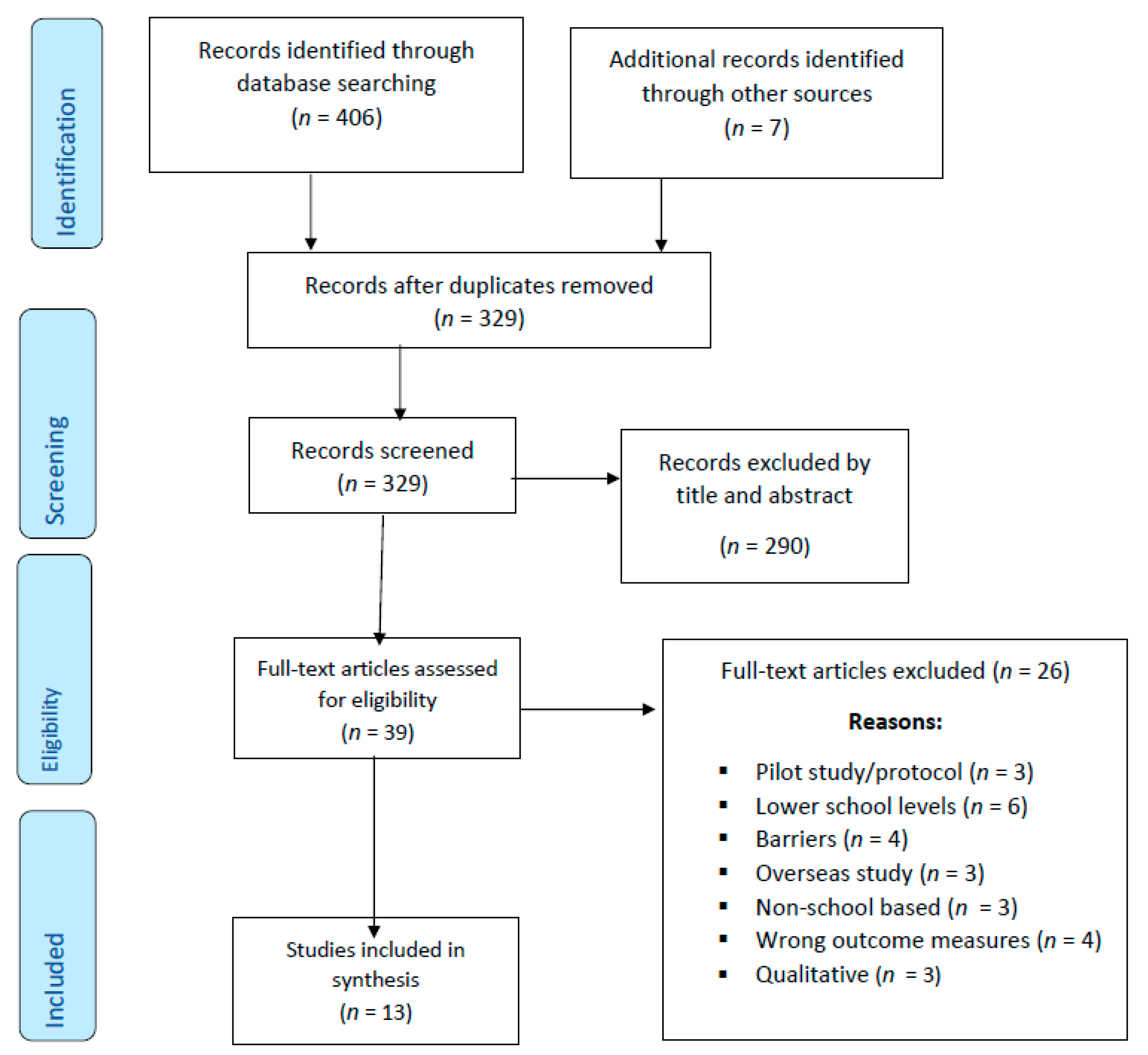
Current trends suggest that adolescent obesity is an on-going and recurrent decimal that is still on the rise in Australia and the social burden associated with it can significantly cause low self-esteem and lack of confidence in personal body image in adulthood. Nonetheless, evidence-based prevention programs are not widely implemented in schools, even though they are commonplace for easy access to adolescents. The primary objective of this systematic review was to assess the scope and efficacy of adolescent obesity intervention strategies in Australian schools, to guide future research. Seven electronic databases were searched for peer-reviewed school-based intervention articles written in the English language and targeting 12–18-year-old adolescents. Intervention characteristics were extracted, and quality, efficacy and outcome measures were assessed utilizing thirteen studies that met the inclusion criteria for this review. Most of the Australian adolescent obesity research emanated from the State of New South Wales and none were nationwide. Five studies successfully met all the requirements in all measured outcomes, four met at least one measured outcome and the remaining four were unsuccessful. Despite the weak evidence of intervention efficacy for most of the reviewed studies, school-based interventions with multi-component combinations of physical activity, nutrition and alignment to a theory yielded promising results. Our findings point to the need for future research to assess the perceptions of school stakeholders in relation to the barriers and enablers to establishing school-based prevention and intervention programs for adolescents.
Keywords: adolescent obesity; Australia; school-based interventions adolescent obesity; Australia; school-based interventions