Effectiveness Assessment of a Multi-Functional Neonatal Incubator in the NICU


Abstract
1. Introduction
2. Materials and Methods
2.1. Requirements Analysis
2.2. Conceptual Design
2.3. Redesign and Verification
2.4. Medical Device with Validation
2.4.1. Participants
2.4.2. Study Procedures
2.4.3. Data Analysis
3. Results
3.1. Results of User Requirements Analysis
3.2. Design and Verification Process
3.3. Summative Evaluation of Multi-Functional Neonatal Incubator
3.3.1. Participants Analysis
3.3.2. Usability Test and Survey Analysis
4. Discussion
4.1. Main Findings
4.2. Strengths and Limitations
5. Conclusions
Author Contributions
Funding
Institutional Review Board Statement
Informed Consent Statement
Data Availability Statement
Acknowledgments
Conflicts of Interest
Abbreviations
| ASQ | After-Scenario Questionnaire |
| FDA | Food and Drug Administration |
| GUI | Graphical User Interface |
| HFE | Human Factors Engineering |
| IEC | International Electrotechnical Commission |
| IRB | Institutional Review Board |
| ISO | International Organization for Standardization |
| MFDS | Ministry of Food and Drug Safety (Korea) |
| NICU | Neonatal Intensive Care Unit |
| SUS | System Usability Scale |
| UCD | User-Centered Design |
| NASA-TLX | National Aeronautics and Space Administration Task Load Index |
Appendix A

| No | Category | Potential Use Error | Potential Clinical Harm | Root Cause | Risk Control and Design Improvement |
|---|---|---|---|---|---|
| 1 | Warmer mode transition | Failure to activate warmer mode after opening canopy | Inadequate thermal support leading to hypothermia risk | Mental model based on conventional incubators | Improve transition feedback mode and ensure workflow-consistent interaction |
| 2 | Surgical light activation | Failure to locate or activate surgical light | Delayed procedure or reduced visibility during clinical intervention | Mismatch with typical NICU workflow and unclear navigation pathway | Improve menu structure and provide clearer navigation cues |
| 3 | Parameter adjustment | Incorrect parameter setting | Inappropriate patient management or monitoring errors | Interface complexity or unfamiliar layout | Simplify interface and improve parameter visibility |
References
- Ferris, T.; Shepley, M. The design of neonatal incubators: A systems-oriented, human-centered approach. J. Perinatol. 2013, 33, S24–S31. [Google Scholar] [CrossRef]
- Baker, J.P. The incubator and the medical discovery of the premature infant. J. Perinatol. 2000, 20, 321–328. [Google Scholar] [CrossRef]
- Brown, G. NICU noise and the preterm infant. Neonatal Netw. 2009, 28, 165–173. [Google Scholar] [CrossRef]
- Ohuma, E.O.; Moller, A.-B.; Bradley, E.; Chakwera, S.; Hussain-Alkhateeb, L.; Lewin, A.; Okwaraji, Y.B.; Mahanani, W.R.; Johansson, E.W.; Lavin, T. National, regional, and global estimates of preterm birth in 2020, with trends from 2010: A systematic analysis. Lancet 2023, 402, 1261–1271. [Google Scholar] [CrossRef]
- Perin, J.; Mulick, A.; Yeung, D.; Villavicencio, F.; Lopez, G.; Strong, K.L.; Prieto-Merino, D.; Cousens, S.; Black, R.E.; Liu, L. Global, regional, and national causes of under-5 mortality in 2000–19: An updated systematic analysis with implications for the Sustainable Development Goals. Lancet Child Adolesc. Health 2022, 6, 106–115. [Google Scholar] [CrossRef] [PubMed]
- Jonckers, T.; Ruhe, K.; Giezen, A.; van den Hoogen, A.; Wielenga, J. Humidification of incubator air for premature infants: An empty systematic review. J. Neonatal Nurs. 2025, 31, 1–5. [Google Scholar] [CrossRef]
- Finer, N.N.; Woo, B.-C.; Hayashi, A.; Hayes, B. Neonatal surgery: Intensive care unit versus operating room. J. Pediatr. Surg. 1993, 28, 645–649. [Google Scholar] [CrossRef] [PubMed]
- Fanning, N.; Casey, W.; Corbally, M. In-situ emergency paediatric surgery in the intensive care unit. Pediatr. Surg. Int. 1998, 13, 587–589. [Google Scholar] [CrossRef]
- Cesare, M.; D’Agostino, F.; Nurchis, M.C.; Magliozzi, E.; Damiani, G.; The Nursing and Public Health Group; Cocchieri, A. Determinants of prolonged hospitalization in children and adolescents: A retrospective observational study. J. Nurs. Scholarsh. 2025, 57, 412–430. [Google Scholar] [CrossRef] [PubMed]
- Harte, R.; Glynn, L.; Rodríguez-Molinero, A.; Baker, P.M.; Scharf, T.; Quinlan, L.R.; ÓLaighin, G. A human-centered design methodology to enhance the usability, human factors, and user experience of connected health systems: A three-phase methodology. JMIR Hum. Factors 2017, 4, e5443. [Google Scholar] [CrossRef]
- Gabbard, J.L.; Hix, D.; Swan, J.E. User-centered design and evaluation of virtual environments. IEEE Comput. Graph. Appl. 2002, 19, 51–59. [Google Scholar] [CrossRef]
- Rostetter, R.; Jenni, B.; Eggmann, S.; Meyer, J.T.; Schmitt, K.-U. Implementing an interprofessional user-centered design approach to develop a bedside leg exercise device. Technol. Health Care 2022, 30, 981–992. [Google Scholar] [CrossRef] [PubMed]
- Andrade, E.; Quinlan, L.; Harte, R.; Byrne, D.; Fallon, E.; Kelly, M.; Casey, S.; Kirrane, F.; O’Connor, P.; O’Hora, D. Novel interface designs for patient monitoring applications in critical care medicine: Human factors review. JMIR Hum. Factors 2020, 7, e15052. [Google Scholar] [CrossRef] [PubMed]
- ISO 9241-11: 2018; Ergonomics of Human-System Interaction—Part 11: Usability: Definitions and Concepts. ISO: Geneva, Switzerland, 2018.
- Viviani, C.A.B.; Elias, L.A.; Calil, S.J. Design and usability assessment of touchscreen interface in medical devices: A case study of a neonatal incubator. Res. Biomed. Eng. 2025, 41, 24. [Google Scholar] [CrossRef]
- FDA. Content of Human Factors Information in Medical Device Marketing Submissions; FDA: Rome, Italy, 2022.
- US Food and Drug Administration. Applying Human Factors and Usability Engineering to Medical Devices: Guidance for Industry and Food and Drug Administration Staff; US Food and Drug Administration: Rockville, MD, USA, 2016.
- Bitkina, O.V.; Kim, H.K.; Park, J. Usability and user experience of medical devices: An overview of the current state, analysis methodologies, and future challenges. Int. J. Ind. Ergon. 2020, 76, 102932. [Google Scholar] [CrossRef]
- Pinto, J.A.D.; Córdova, E.Á.; Lévano, C.B.C. Design and implementation of a digital PID temperature controller for neonatal incubator ESVIN. J. Mech. Eng. Autom. 2015, 5, 167–172. [Google Scholar] [CrossRef][Green Version]
- Design Control Guidance for Medical Device Manufacturers. Available online: https://www.hhs.gov/guidance/document/design-control-guidance-medical-device-manufacturers-guidance-industry (accessed on 3 October 2025).
- ISO 13485:2016; Medical Devices—Quality Management Systems—Requirements for Regulatory Purposes. ISO: Geneva, Switzerland, 2016.
- ISO/IEC 62366-1: 2015; Medical Devices–Part 1: Application of Usability Engineering to Medical Devices. ISO: Geneva, Switzerland, 2015.
- IEC TR 62366-2: 2016; Medical Devices–Part 2: Guidance on the Application of Usability Engineering to Medical Devices. IEC: Geneva, Switzerland, 2016.
- Lewis, J.R. An after-scenario questionnaire for usability studies: Psychometric evaluation over three trials. ACM SIGCHI Bull. 1991, 23, 79. [Google Scholar] [CrossRef]
- Muhammad, H.A.B.; Hamid, K.; Iqbal, M.W.; Khurram, S.; Shahzad, F.; Shaheryar, M. Usability impact of adaptive culture in smart phones. In Proceedings of the VIPERC2022: 1st International Virtual Conference on Visual Pattern Extraction and Recognition for Cultural Heritage Understanding, Pescara, Italy, 12–13 September 2022. [Google Scholar]
- Lewis, J.R. Psychometric evaluation of an after-scenario questionnaire for computer usability studies: The ASQ. ACM Sigchi Bull. 1991, 23, 78–81. [Google Scholar] [CrossRef]
- Choi, H.; Kim, S.; Jang, W. User Experience Evaluation of a Spinal Surgery Robot: Workload, Usability, and Satisfaction Study. JMIR Hum. Factors 2024, 11, e54425. [Google Scholar] [CrossRef]
- Hart, S.G. NASA-task load index (NASA-TLX); 20 years later. In Proceedings of the Human Factors and Ergonomics Society Annual Meeting; Sage publications: Thousand Oaks, CA, USA, 2006; pp. 904–908. [Google Scholar]
- Hart, S.G.; Staveland, L.E. Development of NASA-TLX (Task Load Index): Results of empirical and theoretical research. In Advances in Psychology; Elsevier: Amsterdam, The Netherlands, 1988; Volume 52, pp. 139–183. [Google Scholar]
- Lewis, J.R. The system usability scale: Past, present, and future. Int. J. Hum.—Comput. Interact. 2018, 34, 577–590. [Google Scholar] [CrossRef]
- Lima, I.B.; Jeong, Y.; Lee, C.; Suh, G.; Hwang, W. Correlation Between Number of Usability Problems and System Usability Scale (SUS) Score. In Proceedings of the 2020 Fall Conference of ESK 2020, Pittsburgh, PA, USA, 9–11 July 2020; pp. 191–194. [Google Scholar]
- Marzuki, M.F.M.; Yaacob, N.A.; Yaacob, N.M. Translation, cross-cultural adaptation, and validation of the Malay version of the system usability scale questionnaire for the assessment of mobile apps. JMIR Hum. Factors 2018, 5, e10308. [Google Scholar] [CrossRef] [PubMed]
- Vlachogianni, P.; Tselios, N. Perceived usability evaluation of educational technology using the System Usability Scale (SUS): A systematic review. J. Res. Technol. Educ. 2022, 54, 392–409. [Google Scholar] [CrossRef]
- Sugarindra, M.; Suryoputro, M.; Permana, A. Mental workload measurement in operator control room using NASA-TLX. IOP Conference Series: Materials Science and Engineering. IOP Publ. 2017, 277, 012022. [Google Scholar] [CrossRef]
- Jamil, M.G.; Bhuiyan, Z. Deep learning elements in maritime simulation programmes: A pedagogical exploration of learner experiences. Int. J. Educ. Technol. High. Educ. 2021, 18, 18. [Google Scholar] [CrossRef]
- ISO 14971:2019; Medical Devices—Application of Risk Management to Medical Devices. ISO: Geneva, Switzerland, 2019.


| Steps | Activities | Outcomes | |
|---|---|---|---|
| Requirements Analysis |
|
|
|
| Conceptual Design |
|
|
|
| Redesign and Verification |
|
|
|
| Medical Device with Validation |
|
|
|
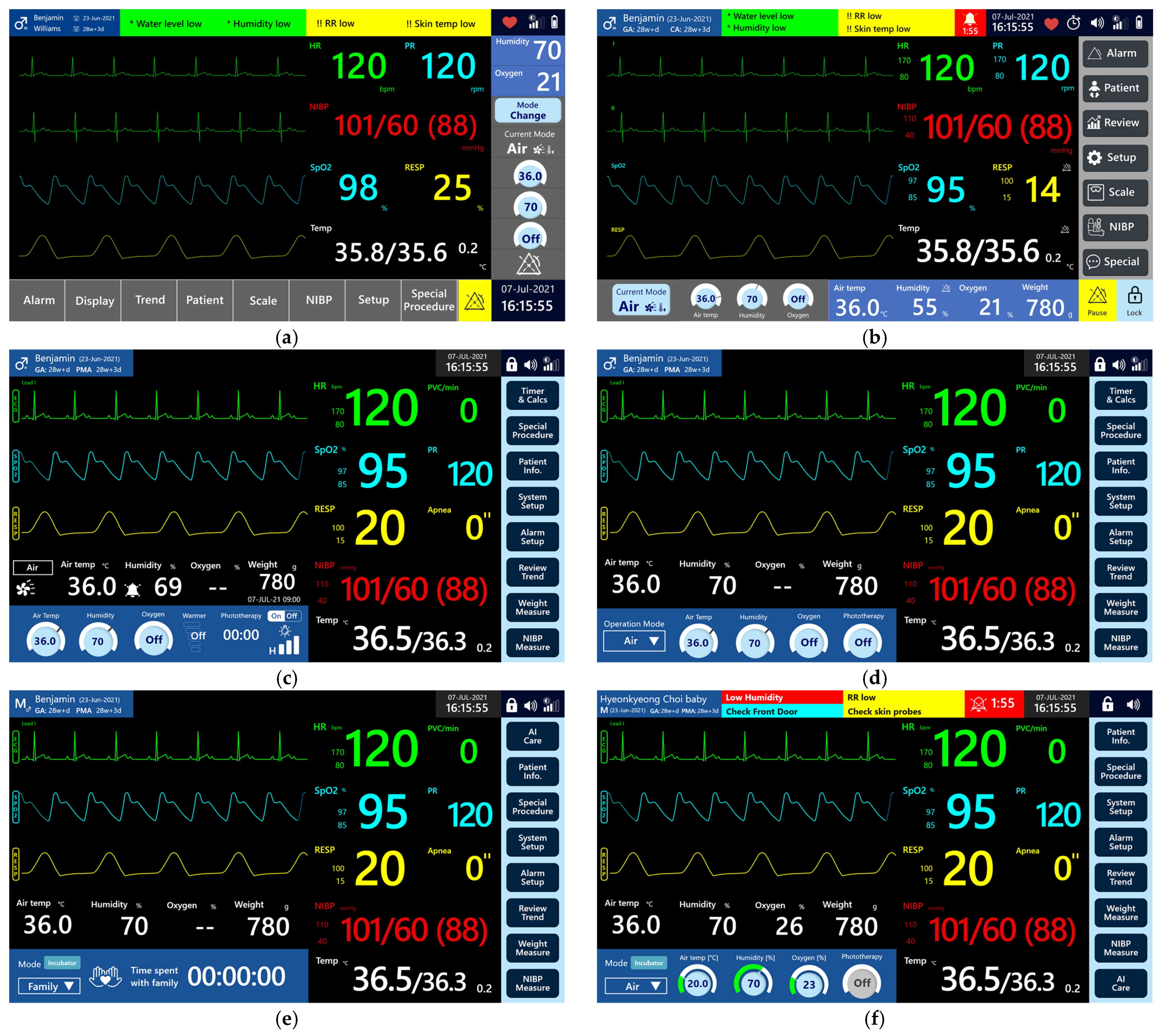
| Category | Component | Details |
|---|---|---|
| Main layout |
|
|
| Waveform |
|
|
| Numeric value |
|
|
| Patient Info |
|
|
| Menu button |
|
|
| Mode (bottom) |
|
|
| Alarm message |
|
|
| Status bar |
|
|
| Evaluation Method | Description | Performance Metric | Result Analysis |
|---|---|---|---|
| Usability Test |
|
|
|
| ASQ |
|
|
|
| NASA TLX |
|
|
|
| SUS |
|
|
|
| Process | Evaluation Method | User Feedback |
|---|---|---|
| Conceptual design | Expert review |
|
| 1st Iteration | Advisory panel review |
|
| 2nd Iteration | Focus group interview |
|
| 3rd Iteration | Focus group interview |
|
| 4th Iteration | Survey |
|
| Final design | Focus group interview | - |
| Variable | Option | Frequency |
|---|---|---|
| Clinical role | Physician | 5 |
| Nurses | 15 | |
| Age | 20–29 years | 5 |
| 30–39 years | 8 | |
| 40–49 years | 6 | |
| 50–59 years | 1 | |
| Department of participants | Neonatal Intensive Care Unit(NICU) | 20 |
| Manufacturer name (incubator) | GE | 13 1 |
| Drager | 18 1 | |
| Use experience with similar devices (incubator) | Less than 3 years | 3 |
| More than 3 years, less than 5 years | 2 | |
| More than 5 years, less than 10 years | 9 | |
| More than 10 years | 6 | |
| Manufacturer name (patient monitor) | GE | 13 1 |
| Phillips | 12 1 | |
| Drager | 13 1 | |
| Use experience with similar devices (patient monitor) | Less than 3 years | 2 |
| More than 3 years, less than 5 years | 2 | |
| More than 5 years, less than 10 years | 9 | |
| More than 10 years | 7 |
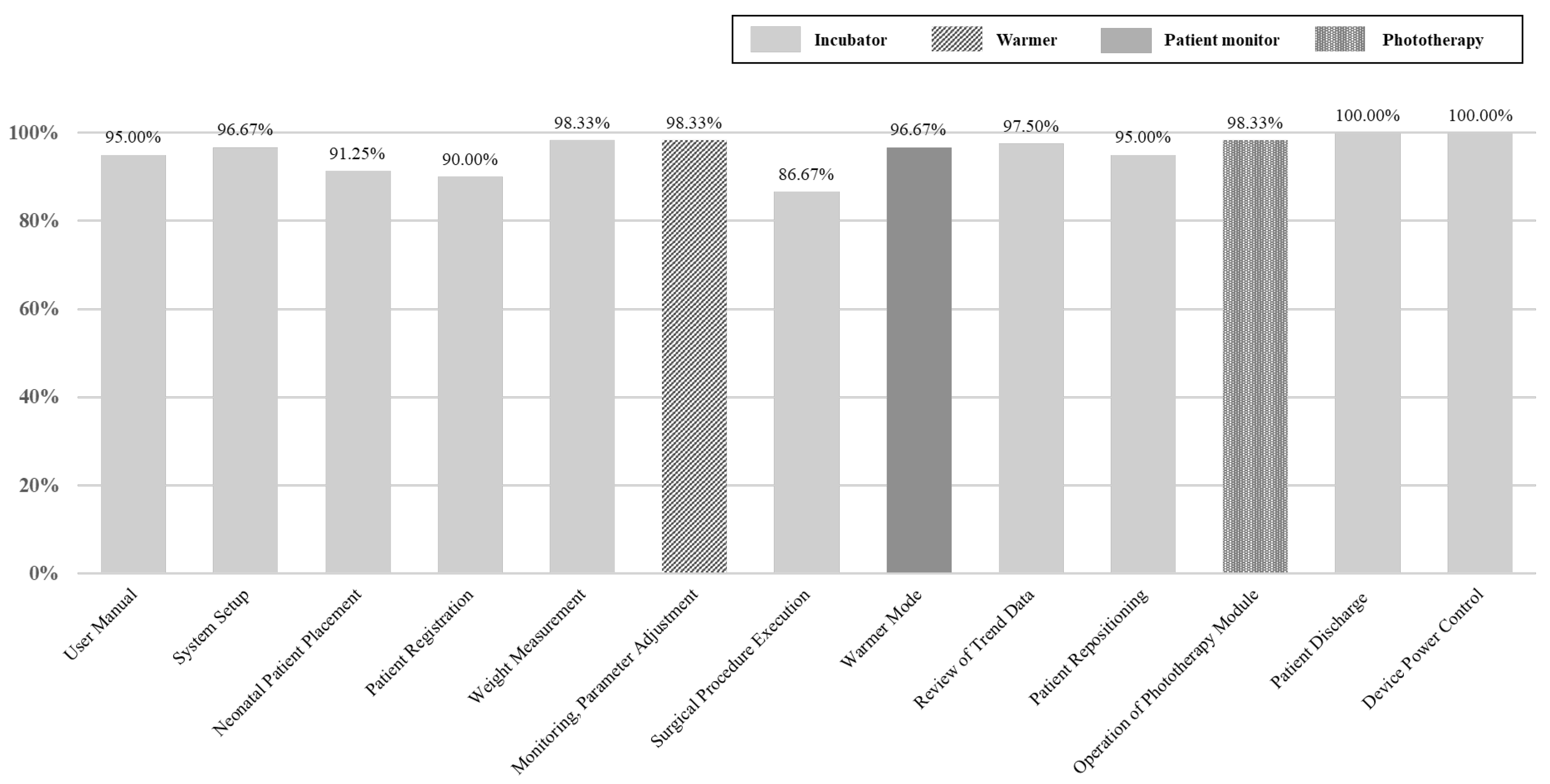
| No | Use Scenario | Success Rate | ASQ1 | ASQ2 | ASQ3 |
|---|---|---|---|---|---|
| 1 | User Manual | 95.00% | 5.60 ± 1.16 | 5.40 ± 1.36 | 5.95 ± 0.97 |
| 2 | System Setup | 96.67% | 6.80 ± 0.54 | 6.38 ± 1.10 | 6.65 ± 0.61 |
| 3 | Neonatal Patient Placement | 91.25% | 6.70 ± 0.46 | 6.75 ± 0.43 | 6.75 ± 0.43 |
| 4 | Patient Registration | 90.00% | 6.70 ± 0.56 | 6.60 ± 0.58 | 6.65 ± 0.57 |
| 5 | Weight Measurement | 98.33% | 6.30 ± 0.95 | 6.05 ± 1.43 | 6.20 ± 1.08 |
| 6 | Monitoring, Parameter Adjustment | 98.33% | 6.65 ± 0.57 | 6.65 ± 0.48 | 6.60 ± 0.49 |
| 7 | Surgical Procedure Execution | 86.67% | 6.70 ± 0.46 | 6.75 ± 0.43 | 6.75 ± 0.43 |
| 8 | Warmer Mode | 96.67% | 6.20 ± 1.03 | 6.25 ± 1.09 | 6.25 ± 0.89 |
| 9 | Review of Trend Data | 97.50% | 6.60 ± 0.58 | 6.55 ± 0.67 | 6.50 ± 0.67 |
| 10 | Patient Repositioning | 95.00% | 5.80 ± 1.36 | 6.00 ± 1.26 | 5.80 ± 1.40 |
| 11 | Operation of Phototherapy Module | 98.33% | 6.50 ± 0.92 | 6.50 ± 1.12 | 6.45 ± 1.12 |
| 12 | Patient Discharge | 100.00% | 7.00 ± 0.00 | 7.00 ± 0.00 | 7.00 ± 0.00 |
| 13 | Device Power Control | 100.00% | 7.00 ± 0.00 | 7.00 ± 0.00 | 7.00 ± 0.00 |
| Overall | 95.64% | 6.50 ± 0.66 | 6.45 ± 0.77 | 6.50 ± 0.67 |
| No | Category | ALL | Clinical Role | NICU Staff Experience | ||
|---|---|---|---|---|---|---|
| Physician | Nurses | ≥8 Years | <8 Years | |||
| 1 | Multi-functional neonatal incubator | 95.64% | 94.00% | 95.73% | 96.15% | 94.62% |
| 2 | Neonatal incubator | 94.63% | 94.07% | 94.32% | 95.22% | 93.38% |
| 3 | Patient monitoring | 98.33% | 93.33% | 100% | 100.00% | 96.67% |
| 4 | Radiant warmer | 96.67% | 93.33% | 97.78% | 96.67% | 96.67% |
| 5 | Phototherapy | 98.33% | 100% | 97.78% | 96.67% | 100.00% |
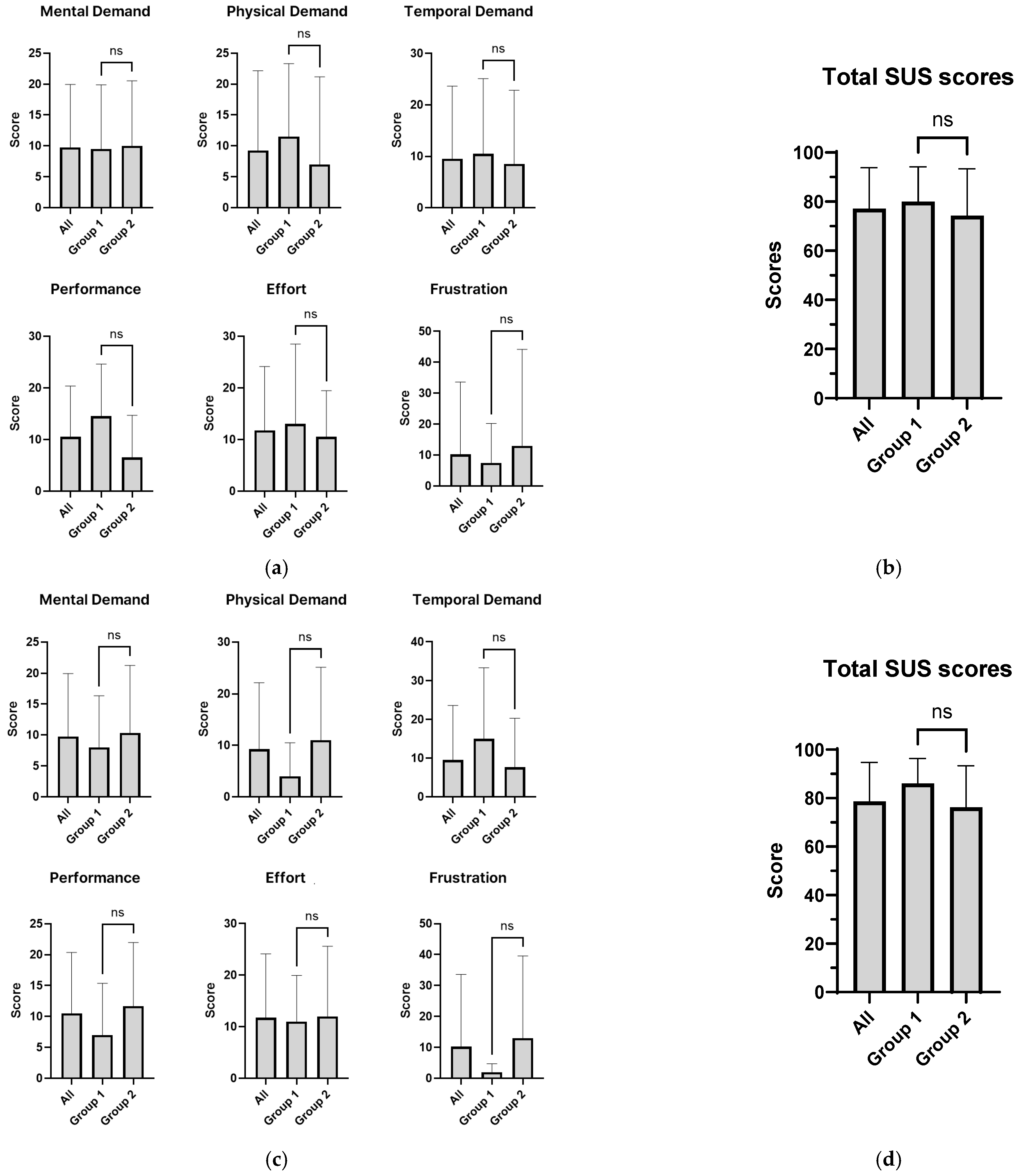
| Questionnaire items | All Mean ± SD | Group1 1 Mean ± SD | Group2 2 Mean ± SD | Mann– Whitney U | Z | Effect Size (r) | p-Value | |
|---|---|---|---|---|---|---|---|---|
| NASA TLX | Mental Demand | 9.75 ± 9.934 | 9.5 ± 10.395 | 10.0 ± 10.541 | 34.5 | −0.27 | 0.060 | 0.800 |
| Physical Demand | 9.25 ± 12.577 | 11.5 ± 11.797 | 7.0 ± 14.181 | 26.5 | −1.013 | 0.227 | 0.349 | |
| Temporal Demand | 9.5 ± 13.775 | 10.5 ± 14.615 | 8.5 ± 14.347 | 25 | −1.171 | 0.262 | 0.306 | |
| Performance | 10.5 ± 9.605 | 14.5 ± 10.124 | 6.5 ± 8.182 | 35 | −0.257 | 0.057 | 0.866 | |
| Effort | 11.75 ± 12.07 | 13.0 ± 15.492 | 10.5 ± 8.960 | 35.5 | −0.181 | 0.040 | 0.866 | |
| Frustration | 10.25 ± 22.775 | 7.5 ± 12.748 | 13.0 ± 31.198 | 29 | −0.794 | 0.178 | 0.497 | |
| SUS | 78.63 ± 15.702 | 80.0 ± 14.142 | 74.25 ± 19.114 | 23.5 | −1.227 | 0.274 | 0.230 | |
| Questionnaire Items | All Mean ± SD | Group1 1 Mean ± SD | Group2 2 Mean ± SD | Mann– Whitney U | Z | Effect Size (r) | p-Value | |
|---|---|---|---|---|---|---|---|---|
| NASA TLX | Mental Demand | 9.75 ± 9.934 | 8.0 ± 7.483 | 10.33 ± 10.562 | 49 | −0.078 | 0.017 | 0.971 |
| Physical Demand | 9.25 ± 12.577 | 4.0 ± 5.831 | 11.00 ± 13.687 | 33 | −1.355 | 0.303 | 0.218 | |
| Temporal Demand | 9.5 ± 13.775 | 15.0 ± 16.432 | 7.67 ± 12.2259 | 46 | −0.324 | 0.072 | 0.796 | |
| Performance | 10.5 ± 9.605 | 7.0 ± 7.483 | 11.67 ± 9.944 | 28.5 | −1.74 | 0.389 | 0.105 | |
| Effort | 11.75 ± 12.07 | 11.0 ± 8.000 | 12.00 ± 13.14 | 49.5 | −0.039 | 0.009 | 0.971 | |
| Frustration | 10.25 ± 22.775 | 2.0 ± 2.449 | 13.00 ± 25.677 | 47 | −0.267 | 0.060 | 0.853 | |
| SUS | 78.63 ± 15.702 | 86.0 ± 9.301 | 76.17 ± 16.605 | 45.5 | −0.341 | 0.076 | 0.739 | |
Disclaimer/Publisher’s Note: The statements, opinions and data contained in all publications are solely those of the individual author(s) and contributor(s) and not of MDPI and/or the editor(s). MDPI and/or the editor(s) disclaim responsibility for any injury to people or property resulting from any ideas, methods, instructions or products referred to in the content. |
© 2026 by the authors. Licensee MDPI, Basel, Switzerland. This article is an open access article distributed under the terms and conditions of the Creative Commons Attribution (CC BY) license.
Share and Cite
Choi, H.; Jang, W. Effectiveness Assessment of a Multi-Functional Neonatal Incubator in the NICU. Healthcare 2026, 14, 949. https://doi.org/10.3390/healthcare14070949
Choi H, Jang W. Effectiveness Assessment of a Multi-Functional Neonatal Incubator in the NICU. Healthcare. 2026; 14(7):949. https://doi.org/10.3390/healthcare14070949
Chicago/Turabian StyleChoi, Hyeonkyeong, and Wonseuk Jang. 2026. "Effectiveness Assessment of a Multi-Functional Neonatal Incubator in the NICU" Healthcare 14, no. 7: 949. https://doi.org/10.3390/healthcare14070949
APA StyleChoi, H., & Jang, W. (2026). Effectiveness Assessment of a Multi-Functional Neonatal Incubator in the NICU. Healthcare, 14(7), 949. https://doi.org/10.3390/healthcare14070949