Physical Activity as a Habit in Long-Term Care: A Multidisciplinary Guideline

Abstract
1. Introduction
2. Methods
2.1. Setting and Target Group
2.2. Guideline Development
2.2.1. Needs Assessment of Key Challenges
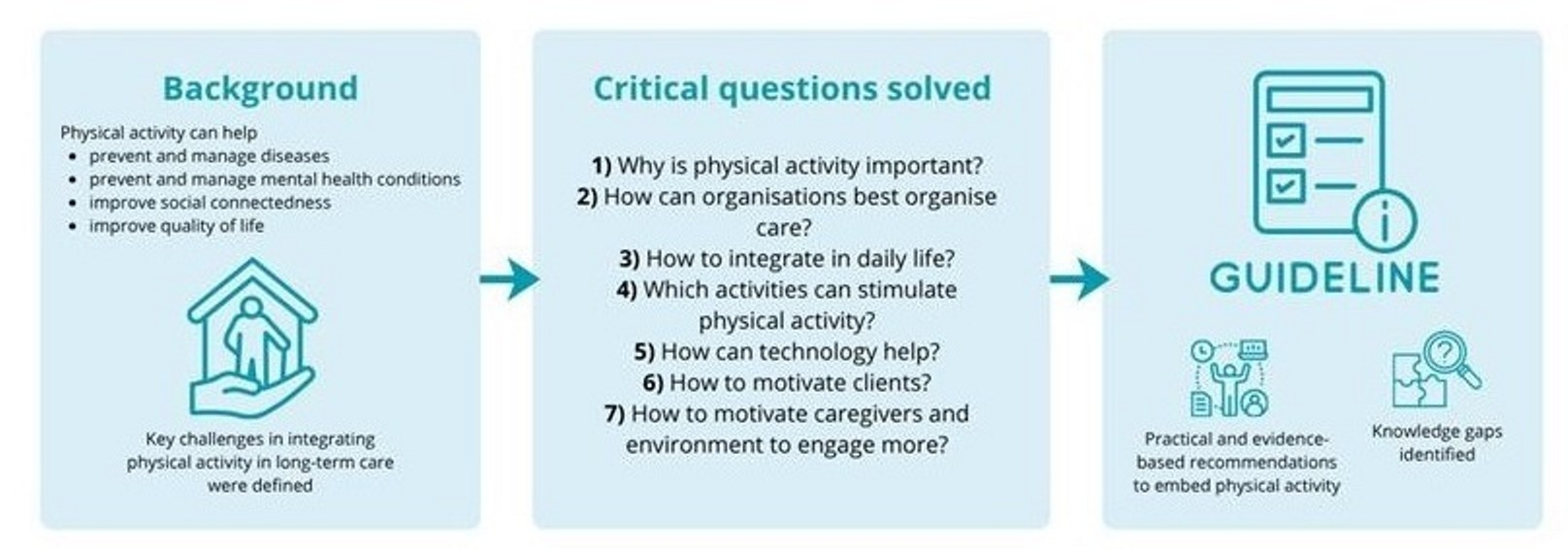
2.2.2. Critical Questions
2.2.3. Recommendations
2.2.4. Feedback and Authorisation
3. Results
3.1. Needs Assessment of Key Challenges
3.2. Key Challenges
3.3. Critical Questions
3.4. Recommendations
3.4.1. Module: The Importance of Physical Activity
- Physical activity has many health benefits and virtually no negative side effects. The most important benefit is the potential improvement in health, which may also be cost-effective.
- Physical activity has positive effects on physical health. It also positively influences mental health, well-being and social interactions. This can ultimately improve overall quality of life.
- Encouraging clients to be physically active can also have positive effects on care and support professionals and care organisations. It can reduce the workload, increase job satisfaction, and lower absenteeism.
3.4.2. Module: Organisation of Care
- Establish policies on promoting physical activity within the care organisation. Ensure this includes a clear vision on physical activity and translates this policy into practical implementations.
- Collaborate with clients in the preparation, execution, and evaluation of policies related to physical activity promotion. This ensures the policy aligns with the motivation, wishes, and needs of clients.
- Embed the physical activity policy and its promotion into the organisational structure. Involve a physical activity ambassador and care and support professionals from all levels and departments within the organisation.
- Provide training and education for staff, volunteers, clients, and their relatives about the importance, benefits, and possibilities of physical activity.
- Document agreements on promoting physical activity and integrating it into daily life, for example, in the client’s care and support plan.
- Create opportunities within the care organisation’s environment that encourage clients, relatives, volunteers, and staff to be physically active.
- Collaborate with existing services and facilities in the local community.
3.4.3. Module: A Habit in Daily Life
- Create opportunities for clients to participate in daily activities and enable them to be as independent as possible. Do not automatically take over tasks from the client. Be aware that what a client can do independently may vary from day to day and moment to moment.
- Enable clients to do what they are capable of themselves and expand this where possible. In the long term, this may help reduce workload and physical strain for care and support professionals (and relatives).
- Engage in conversations with clients about how physical activity can be more integrated into their daily lives, ensuring that activities align with what they enjoy doing.
- Use existing practical examples for inspiration on how and when physical activity can be incorporated into daily routines.
3.4.4. Module: Physical Activities
- Create a plan together with the client (and, if applicable, their relatives) on how the client can become more physically active. Align with activities and sports that bring the client joy. Also consider physical activity that can take place during daily activities, as well as specific exercises to improve fitness and strengthen muscles. Keep evaluating the plan, as needs and abilities may change over time. If you are unable to figure it out together, include a movement specialist to help develop a plan to get the client more active.
- Take into account specific considerations for different client populations, tailored approaches are important when applying physical activities. Clients with specific needs may include clients with acquired brain injury, clients with (advanced) dementia, clients with severe and multiple disabilities, or clients who are wheelchair- or bed-bound;
- When implementing physical activity interventions, take into account the physical and cognitive abilities of clients. You can tailor physical activities by providing simple instructions and predictable exercises, demonstrating and repeating exercises regularly, offering exercises with varying levels of difficulty, choosing safe and easy exercises and ensuring a safe environment. Consider consulting with other disciplines to develop a plan for increasing the client’s physical activity.
3.4.5. Module: Technology
- Consider using digital technology with the goal to engage clients in physical activity who would otherwise not be active without digital tools, to offer variety alongside analog activities, and to encourage clients to move more independently.
- Support clients in using digital technology. For example, take the lead in starting a digital game or assist the client with using a device.
- Guide and encourage volunteers and relatives in using digital technology (such as digital movement games) with the client.
- When using digital technology, take privacy and safety into account. For instance, do not enter client data into a system without proper consideration.Discuss with the client whether they understand the privacy and security settings. If in doubt, consider contacting the organisation’s IT staff.
3.4.6. Module: Motivating Clients
- Make physical activity moments enjoyable for the client by exploring together what is suitable and fun.
- Consider incorporating a social component to encourage physical activity.
- Set positively formulated goals together that align with the client’s wishes. Break these goals down into achievable steps and avoid placing too much emphasis on “more physical activity”, instead, use physical activity as a means to reach meaningful goals.
- Provide appropriate tasks and clear, concrete instructions to clients.
- Encourage clients, reward physical activity, and celebrate successes.
- Together with clients, reflect on and appreciate the benefits of being active.
- Boost (self-)confidence and/or reduce fears related to physical activity among clients.
3.4.7. Module: Encouraging Informal Caregivers
- Increase knowledge among relatives and volunteers about the benefits and possibilities of engaging in physical activity with clients;
- Boost enthusiasm among relatives and volunteers to be active together with clients;
- Strengthen the (self-)confidence of relatives and volunteers to engage in physical activity with the client and reduce fears of injury or falling.
3.5. Knowledge Gaps
4. Discussion
5. Conclusions
Supplementary Materials
Author Contributions
Funding
Institutional Review Board Statement
Informed Consent Statement
Data Availability Statement
Acknowledgments
Conflicts of Interest
References
- World Health Organization. Global Levels of Physical Inactivity in Adults: Off Track for 2030; World Health Organization: Geneva, Switzerland, 2024. [Google Scholar]
- Pedersen, B.K.; Saltin, B. Exercise as medicine—Evidence for prescribing exercise as therapy in 26 different chronic diseases. Scand. J. Med. Sci. Sports 2015, 25, 1–72. [Google Scholar] [CrossRef] [PubMed]
- Alnawwar, M.A.; Alraddadi, M.I.; Algethmi, R.A.; Salem, G.A.; Salem, M.A.; Alharbi, A.A. The Effect of Physical Activity on Sleep Quality and Sleep Disorder: A Systematic Review. Cureus 2023, 15, e43595. [Google Scholar] [CrossRef] [PubMed]
- Jacob, U.S.; Pillay, J.; Johnson, E.; Omoya, O.T.; Adedokun, A.P. A systematic review of physical activity: Benefits and needs for maintenance of quality of life among adults with intellectual disability. Front. Sports Act. Living 2023, 5, 1184946. [Google Scholar] [CrossRef] [PubMed]
- Geneen, L.J.; Moore, R.A.; Clarke, C.; Martin, D.; Colvin, L.A.; Smith, B.H. Physical activity and exercise for chronic pain in adults: An overview of Cochrane Reviews. Cochrane Database Syst. Rev. 2017, 4, CD011279. [Google Scholar] [CrossRef]
- Aitchison, B.; Rushton, A.B.; Martin, P.; Barr, M.; Soundy, A.; Heneghan, N.R. The experiences and perceived health benefits of individuals with a disability participating in sport: A systematic review and narrative synthesis. Disabil. Health J. 2022, 15, 101164. [Google Scholar] [CrossRef]
- De Nys, L.; Anderson, K.; Ofosu, E.F.; Ryde, G.C.; Connelly, J.; Whittaker, A.C. The effects of physical activity on cortisol and sleep: A systematic review and meta-analysis. Psychoneuroendocrinology 2022, 143, 105843. [Google Scholar] [CrossRef]
- Garrett, S.; Elley, C.R.; Rose, S.B.; O’Dea, D.; Lawton, B.A.; Dowell, A.C. Are physical activity interventions in primary care and the community cost-effective? A systematic review of the evidence. Br. J. Gen. Pract. 2011, 61, e125–e133. [Google Scholar] [CrossRef]
- Naci, H.; Ioannidis, J.P. Comparative effectiveness of exercise and drug interventions on mortality outcomes: Metaepidemiological study. Br. J. Sports Med. 2015, 49, 1414–1422. [Google Scholar] [CrossRef]
- Lobelo, F.; Stoutenberg, M.; Hutber, A. The Exercise is Medicine Global Health Initiative: A 2014 update. Br. J. Sports Med. 2014, 48, 1627–1633. [Google Scholar] [CrossRef]
- Steinacker, J.M.; van Mechelen, W.; Bloch, W.; Börjesson, M.; Casasco, M.; Wolfarth, B.; Knoke, C.; Papadopoulou, T.; Wendt, J.; Al Tunaiji, H.; et al. Global Alliance for the Promotion of Physical Activity: The Hamburg Declaration. BMJ Open Sport Exerc. Med. 2023, 9, e001626. [Google Scholar] [CrossRef]
- World Health Organization. Global Status Report on Physical Activity 2022; World Health Organization: Geneva, Switzerland, 2022. [Google Scholar]
- Lee, I.M.; Shiroma, E.J.; Lobelo, F.; Puska, P.; Blair, S.N.; Katzmarzyk, P.T. Effect of physical inactivity on major non-communicable diseases worldwide: An analysis of burden of disease and life expectancy. Lancet 2012, 380, 219–229. [Google Scholar] [CrossRef] [PubMed]
- Klepac Pogrmilovic, B.; Ramirez Varela, A.; Pratt, M.; Milton, K.; Bauman, A.; Biddle, S.J.H.; Pedisic, Z. National physical activity and sedentary behaviour policies in 76 countries: Availability, comprehensiveness, implementation, and effectiveness. Int. J. Behav. Nutr. Phys. Act. 2020, 17, 116. [Google Scholar] [CrossRef] [PubMed]
- Ptomey, L.; Morgan, K.A.; Blauwet, C.A.; Boudreaux, B.D.; Fernhall, B.O.; Hauck, J.; Legg, D.; Tow, S.; Martin Ginis, K.A. ACSM Expert Consensus Statement: Considerations and Recommendations for Prescribing Exercise and Designing Physical Activity Programs for People with Disabilities. Med. Sci. Sports Exerc. 2025, 57, 2588–2598. [Google Scholar] [CrossRef] [PubMed]
- Bouma, A.J.; Nauta, J.; van Nassau, F.; Krops, L.A.; van den Akker-Scheek, I.; Diercks, R.L.; de Groot, V.; van der Leeden, M.; Leutscher, H.; Stevens, M.; et al. Implementing Individually Tailored Prescription of Physical Activity in Routine Clinical Care: A Process Evaluation of the Physicians Implement Exercise = Medicine Project. J. Phys. Act. Health 2024, 21, 916–927. [Google Scholar] [CrossRef]
- Matheson, G.O.; Klügl, M.; Dvorak, J.; Engebretsen, L.; Meeuwisse, W.H.; Schwellnus, M.; Blair, S.N.; van Mechelen, W.; Derman, W.; Börjesson, M.; et al. Responsibility of sport and exercise medicine in preventing and managing chronic disease: Applying our knowledge and skill is overdue. Br. J. Sports Med. 2011, 45, 1272–1282. [Google Scholar] [CrossRef]
- Hilgenkamp, T.; Oppewal, A. Physical activity, exercise and fitness: The new medicine. J. Intellect. Disabil. Res. 2022, 66, 901–902. [Google Scholar] [CrossRef]
- de Souto Barreto, P.; Morley, J.E.; Chodzko-Zajko, W.; Pitkala, K.H.; Weening-Djiksterhuis, E.; Rodriguez-Mañas, L.; Barbagallo, M.; Rosendahl, E.; Sinclair, A.; Landi, F.; et al. Recommendations on Physical Activity and Exercise for Older Adults Living in Long-Term Care Facilities: A Taskforce Report. J. Am. Med. Dir. Assoc. 2016, 17, 381–392. [Google Scholar] [CrossRef]
- Douma, J.G.; Volkers, K.M.; Engels, G.; Sonneveld, M.H.; Goossens, R.H.M.; Scherder, E.J.A. Setting-related influences on physical inactivity of older adults in residential care settings: A review. BMC Geriatr. 2017, 17, 97. [Google Scholar] [CrossRef]
- Valenzuela, P.L.; Saco-Ledo, G.; Morales, J.S.; Gallardo-Gómez, D.; Morales-Palomo, F.; López-Ortiz, S.; Rivas-Baeza, B.; Castillo-García, A.; Jiménez-Pavón, D.; Santos-Lozano, A.; et al. Effects of physical exercise on physical function in older adults in residential care: A systematic review and network meta-analysis of randomised controlled trials. Lancet Healthy Longev. 2023, 4, e247–e256. [Google Scholar] [CrossRef]
- Dahlgren, G.; Whitehead, M. The Dahlgren-Whitehead model of health determinants: 30 years on and still chasing rainbows. Public Health 2021, 199, 20–24. [Google Scholar] [CrossRef]
- World Health Organization. WHO Guidelines on Physical Activity and Sedentary Behaviour; World Health Organization: Geneva, Switzerland, 2020. [Google Scholar]
- Zorginstituut Nederland. AQUA-Leidraad. Available online: https://www.zorginstituutnederland.nl/wie-wij-zijn/commissies/advies--en-expertgroep-kwaliteitsstandaarden-aqua (accessed on 26 February 2026).
- Hilbink, M.; Ouwens, M.; Kool, T. De HARING-Tools. Dertien Instrumenten voor Ondersteuning bij het Opstellen, Herzien, Implementeren en Evalueren van Richtlijnen; Scientific Institute for Quality of Healthcare: Nijmegen, The Netherlands, 2013. [Google Scholar]
- Brouwers, M.C.; Kho, M.E.; Browman, G.P.; Burgers, J.S.; Cluzeau, F.; Feder, G.; Fervers, B.; Graham, I.D.; Grimshaw, J.; Hanna, S.E.; et al. AGREE II: Advancing guideline development, reporting and evaluation in health care. J. Clin. Epidemiol. 2010, 63, 1308–1311. [Google Scholar] [CrossRef] [PubMed]
- Shea, B.J.; Reeves, B.C.; Wells, G.; Thuku, M.; Hamel, C.; Moran, J.; Moher, D.; Tugwell, P.; Welch, V.; Kristjansson, E.; et al. AMSTAR 2: A critical appraisal tool for systematic reviews that include randomised or non-randomised studies of healthcare interventions, or both. BMJ 2017, 358, j4008. [Google Scholar] [CrossRef] [PubMed]
- Schünemann, H.; Brożek, J.; Guyatt, G.; Oxman, A. GRADE Handbook for Grading Quality of Evidence and Strength of Recommendations; The GRADE Working Group: Hamilton, ON, Canada, 2013. [Google Scholar]
- Resnick, B.; Galik, E. Using function-focused care to increase physical activity among older adults. Annu. Rev. Nurs. Res. 2013, 31, 175–208. [Google Scholar] [CrossRef] [PubMed]
- Resnick, B.; Galik, E.; Boltz, M. Function focused care approaches: Literature review of progress and future possibilities. J. Am. Med. Dir. Assoc. 2013, 14, 313–318. [Google Scholar] [CrossRef]
- Kjerstad, E.; Tuntland, H.K. Reablement in community-dwelling older adults: A cost-effectiveness analysis alongside a randomized controlled trial. Health Econ. Rev. 2016, 6, 15. [Google Scholar] [CrossRef][Green Version]
- Mulquiny, L.; Oakman, J. Exploring the experience of reablement: A systematic review and qualitative evidence synthesis of older people’s and carers’ views. Health Soc. Care Community 2022, 30, e1471–e1483. [Google Scholar] [CrossRef]
- Rostgaard, T.; Graff, L. Better care, better work? Reablement in Danish home care and the implications for care workers. In Reablement in Long-Term Care for Older People: International Perspectives and Future Directions; Rostgaard, T., Parsons, J., Tuntland, H., Eds.; Bristol University Press: Bristol, UK, 2023; pp. 189–216. [Google Scholar]
- Ansell, C.; Sørensen, E.; Torfing, J. Improving policy implementation through collaborative policymaking. Policy Politics 2017, 45, 467–486. [Google Scholar] [CrossRef]
- McArthur, C.; Bai, Y.; Hewston, P.; Giangregorio, L.; Straus, S.; Papaioannou, A. Barriers and facilitators to implementing evidence-based guidelines in long-term care: A qualitative evidence synthesis. Implement. Sci. 2021, 16, 70. [Google Scholar] [CrossRef]
- Hall, A.M.; Flodgren, G.M.; Richmond, H.L.; Welsh, S.; Thompson, J.Y.; Furlong, B.M.; Sherriff, A. Champions for improved adherence to guidelines in long-term care homes: A systematic review. Implement. Sci. Commun. 2021, 2, 85. [Google Scholar] [CrossRef]

| Presented Challenges | % Experienced |
|---|---|
| 84.0% |
| 75.7% |
| 65.1% |
| 62.1% |
| 57.3% |
| 44.0% |
| 41.3% |
| 37.9% |
| 33.5% |
| 28.2% |
| Key Challenges | Underlying Critical Questions | Module (Information Sources) |
|---|---|---|
| Why is physical activity important for clients receiving long-term care? | The importance of physical activity (existing reviews, key articles and physical activity guidelines) |
| How can long-term care organisations best organise physical activity-focused care to encourage and normalise physical activity among clients? | Organisation of care (systematic review n = 11 and existing key articles) |
| How can care and support professionals integrate physical activity into the daily lives of clients receiving long-term care? | A habit in daily life (existing reviews, key articles and physical activity guidelines) |
| How and which physical activities can best be applied to stimulate physical activity in clients receiving long-term care? | Physical activities (systematic review n = 6) |
| How can technology best be used to encourage physical activity in clients receiving long-term care? | Technology (systematic review n = 8) |
| How can clients in long-term care be best motivated to be more physically active? | Motivating clients (systematic review n = 11) |
| How can informal caregivers and the surrounding environment in long-term care be best motivated to engage in physical activity together with clients? | Encouraging informal caregivers (systematic review n = 11) |
Disclaimer/Publisher’s Note: The statements, opinions and data contained in all publications are solely those of the individual author(s) and contributor(s) and not of MDPI and/or the editor(s). MDPI and/or the editor(s) disclaim responsibility for any injury to people or property resulting from any ideas, methods, instructions or products referred to in the content. |
© 2026 by the authors. Licensee MDPI, Basel, Switzerland. This article is an open access article distributed under the terms and conditions of the Creative Commons Attribution (CC BY) license.
Share and Cite
Oppewal, A.; Sterke, S.; Weterings, S.; Engelen, M.M.; Mol, T. Physical Activity as a Habit in Long-Term Care: A Multidisciplinary Guideline. Healthcare 2026, 14, 631. https://doi.org/10.3390/healthcare14050631
Oppewal A, Sterke S, Weterings S, Engelen MM, Mol T. Physical Activity as a Habit in Long-Term Care: A Multidisciplinary Guideline. Healthcare. 2026; 14(5):631. https://doi.org/10.3390/healthcare14050631
Chicago/Turabian StyleOppewal, Alyt, Shanty Sterke, Stijn Weterings, Marscha M. Engelen, and Tanja Mol. 2026. "Physical Activity as a Habit in Long-Term Care: A Multidisciplinary Guideline" Healthcare 14, no. 5: 631. https://doi.org/10.3390/healthcare14050631
APA StyleOppewal, A., Sterke, S., Weterings, S., Engelen, M. M., & Mol, T. (2026). Physical Activity as a Habit in Long-Term Care: A Multidisciplinary Guideline. Healthcare, 14(5), 631. https://doi.org/10.3390/healthcare14050631