
High-Intensity Functional Training for Older Adults with Mobility Disabilities: A Feasibility Pilot Study
 ,
,  , , and
Abstract
1. Introduction
2. Materials & Method
2.1. Design
2.2. Recruitment
2.3. Intervention
2.4. Measures
2.5. Data Analysis
3. Results
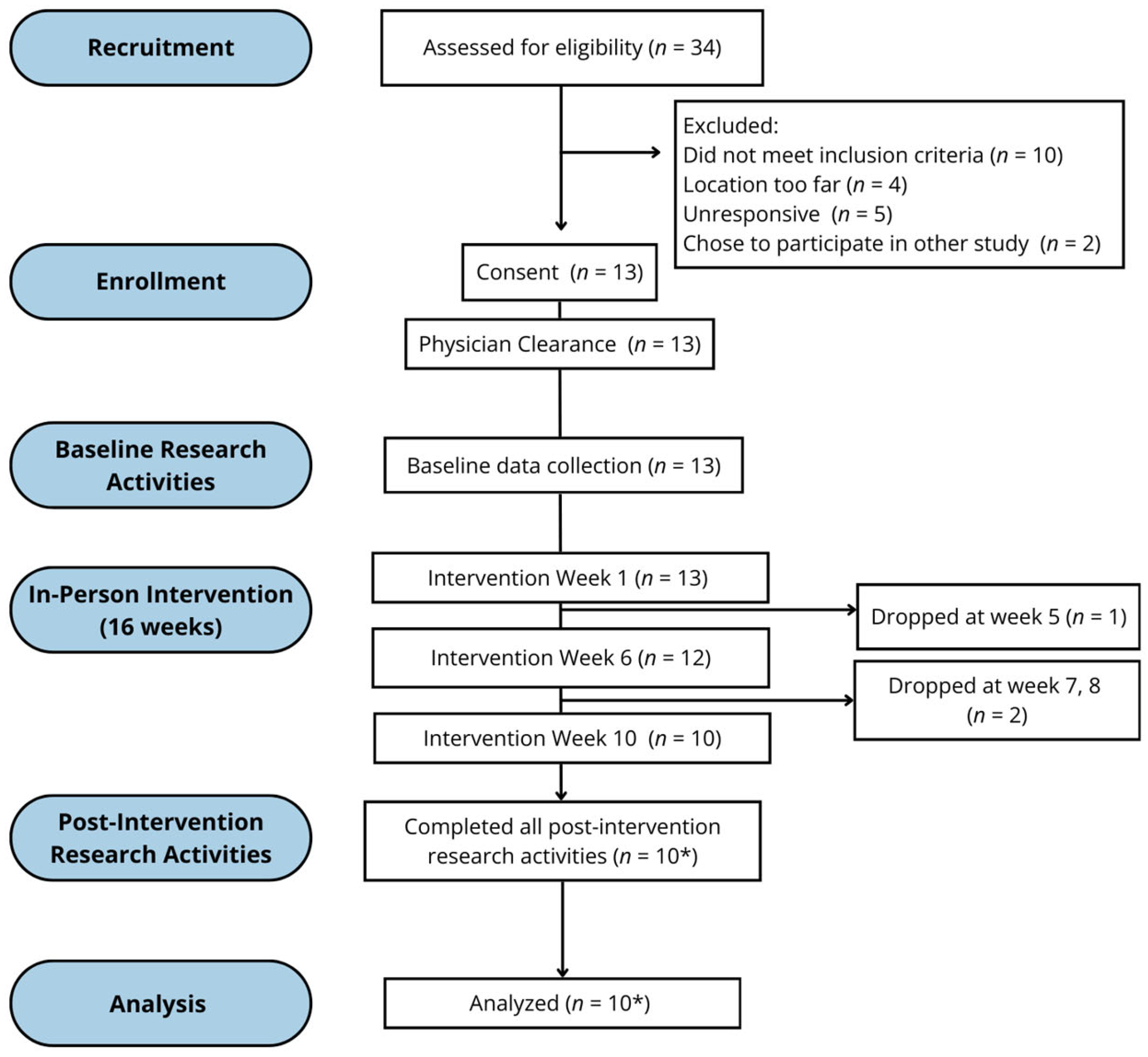
3.1. Participants
3.2. Feasibility
3.3. Physical Function
3.4. Health, Fitness, and Quality of Life
4. Discussion
5. Conclusions
Author Contributions
Funding
Institutional Review Board Statement
Informed Consent Statement
Data Availability Statement
Acknowledgments
Conflicts of Interest
References
- LaPlante, M.P. Key goals and indicators for successful aging of adults with early-onset disability. Disabil. Health J. 2014, 7, S44–S50. [Google Scholar] [CrossRef] [Scilit] [PubMed]
- Koon, L.M.; Remillard, E.T.; Mitzner, T.L.; Rogers, W.A. Aging Concerns, Challenges, and Everyday Solution Strategies (ACCESS) for adults aging with a long-term mobility disability. Disabil. Health J. 2020, 13, 100936. [Google Scholar] [CrossRef] [Scilit] [PubMed]
- Erickson, W.; Lee, C.; Von Schrader, S. Disability Statistics from the American Community Survey (ACS); Cornell University Yang-Tan Institute (YTI): Ithaca, NY, USA, 2017; Retrieved from Cornell University Disability Statistics Website; Available online: https://www.disabilitystatistics.org (accessed on 15 October 2022).
- Roberts, A.W.; Ogunwole, S.U.; Blakeslee, L.; Rabe, M.A. The Population 65 Years and Older in the United States: 2016; US Department of Commerce, Economics and Statistics Administration: Washinton, DC, USA; US Census Bureau: Suitland, MD, USA, 2018.
- Verbrugge, L.M.; Yang, L.-S. Aging with disability and disability with aging. J. Disabil. Policy Stud. 2002, 12, 253–267. [Google Scholar] [CrossRef] [Scilit]
- Campbell, M.L.; Putnam, M. Reducing the Shared Burden of Chronic Conditions Among Persons Ageing with Disability and Older Adults in the United States Through Bridging Ageing and Disability. Handb. Ageing Disabil. 2021, 5, 57–68. [Google Scholar]
- Klingbeil, H.; Baer, H.R.; Wilson, P.E. Aging with a disability. Arch. Phys. Med. Rehabil. 2004, 85, 68–73. [Google Scholar] [CrossRef] [Scilit] [PubMed]
- Verbrugge, L.M.; Latham, K.; Clarke, P.J. Aging with disability for midlife and older adults. Res. Aging 2017, 39, 741–777. [Google Scholar] [CrossRef] [Scilit]
- Sosnoff, J.J.; Sung, J. Reducing falls and improving mobility in multiple sclerosis. Expert Rev. Neurother. 2015, 15, 655–666. [Google Scholar] [CrossRef] [Scilit]
- Lai, B.; Young, H.-J.; Bickel, C.S.; Motl, R.W.; Rimmer, J.H. Current trends in exercise intervention research, technology, and behavioral change strategies for people with disabilities: A scoping review. Am. J. Phys. Med. Rehabil. 2017, 96, 748–761. [Google Scholar] [CrossRef] [Scilit]
- Sosnoff, J.J.; Finlayson, M.; McAuley, E.; Morrison, S.; Motl, R.W. Home-based exercise program and fall-risk reduction in older adults with multiple sclerosis: Phase 1 randomized controlled trial. Clin. Rehabil. 2014, 28, 254–263. [Google Scholar] [CrossRef] [Scilit]
- Levine, S.; Malone, E.; Lekiachvili, A.; Briss, P. Health care industry insights: Why the use of preventive services is still low. Prev. Chronic Dis. 2019, 16, 180625. [Google Scholar] [CrossRef] [Scilit]
- Lai, B.; Kim, Y.; Wilroy, J.; Bickel, C.S.; Rimmer, J.H.; Motl, R.W. Sustainability of exercise intervention outcomes among people with disabilities: A secondary review. Disabil. Rehabil. 2019, 41, 1584–1595. [Google Scholar] [CrossRef] [Scilit] [PubMed]
- Bull, F.C.; Al-Ansari, S.S.; Biddle, S.; Borodulin, K.; Buman, M.P.; Cardon, G.; Carty, C.; Chaput, J.-P.; Chastin, S.; Chou, R. World Health Organization 2020 guidelines on physical activity and sedentary behaviour. Br. J. Sports Med. 2020, 54, 1451–1462. [Google Scholar] [CrossRef] [Scilit]
- Man, K.E.; Varkul, O.; Konikoff, L.; Bruno, N.; Konikoff, M.; Yehuala, Y.S.; Latimer-Cheung, A.E.; Tomasone, J.R. Barriers and Facilitators to Initial and Ongoing Implementation of Community-Based Exercise Programs for Persons with Physical Disabilities: Qualitative Perspectives of Program Providers. Disabilities 2025, 5, 21. [Google Scholar] [CrossRef] [Scilit]
- Shirazipour, C.H.; Evans, M.B.; Leo, J.; Lithopoulos, A.; Martin Ginis, K.A.; Latimer-Cheung, A.E. Program conditions that foster quality physical activity participation experiences for people with a physical disability: A systematic review. Disabil. Rehabil. 2020, 42, 147–155. [Google Scholar] [CrossRef] [Scilit]
- Morgan, K.A.; Taylor, K.L.; Walker, C.W.; Tucker, S.; Dashner, J.L.; Hollingsworth, H. Mobility disability and exercise: Health outcomes of an accessible community-based center. Front. Rehabil. Sci. 2022, 3, 836655. [Google Scholar] [CrossRef] [Scilit]
- Kehn, M.; Kroll, T. Staying physically active after spinal cord injury: A qualitative exploration of barriers and facilitators to exercise participation. BMC Public Health 2009, 9, 168. [Google Scholar] [CrossRef] [Scilit]
- Sharon-David, H.; Siekanska, M.; Tenenbaum, G. Are gyms fit for all? A scoping review of the barriers and facilitators to gym-based exercise participation experienced by people with physical disabilities. Perform. Enhanc. Health 2021, 9, 100170. [Google Scholar] [CrossRef] [Scilit]
- Koon, L.M.; Remillard, E.T.; Rogers, W.A. Understanding everyday challenges of aging with disability through lived experiences. Gerontol. 2025, 65, gnaf129. [Google Scholar] [CrossRef] [Scilit]
- Ginis, K.A.M.; van der Ploeg, H.P.; Foster, C.; Lai, B.; McBride, C.B.; Ng, K.; Pratt, M.; Shirazipour, C.H.; Smith, B.; Vásquez, P.M. Participation of people living with disabilities in physical activity: A global perspective. Lancet 2021, 398, 443–455. [Google Scholar] [CrossRef] [Scilit]
- Heeb Desai, R.; Kiserow, R.; Mullings, A.; Smith, M.; Tucker, S.; Eyler, A.; Stark, S.; Morgan, K. Exploring the perspectives of adults aging with long-term physical disabilities on physical activity: A qualitative study. Am. J. Health Promot. 2023, 37, 654–663. [Google Scholar] [CrossRef] [Scilit] [PubMed]
- Finlayson, M.L.; Peterson, E.W. Falls, aging, and disability. Phys. Med. Rehabil. Clin. 2010, 21, 357–373. [Google Scholar] [CrossRef] [Scilit] [PubMed]
- Feito, Y.; Heinrich, K.M.; Butcher, S.J.; Poston, W.S.J. High-Intensity Functional Training (HIFT): Definition and Research Implications for Improved Fitness. Sports 2018, 6, 76. [Google Scholar] [CrossRef] [Scilit] [PubMed]
- Glassman, G. Understanding CrossFit. CrossFit Journal. 2007. Available online: https://journal.crossfit.com/article/understanding-crossfit (accessed on 15 October 2022).
- Handlery, R.; Handlery, K.; Kahl, D.; Koon, L.; Regan, E.W. High intensity functional training for people with spinal cord injury & their care partners. Spinal Cord 2024, 62, 357–366. [Google Scholar] [PubMed]
- Handlery, R.; Handlery, K.; Kahl, D.; Koon, L.; Cabe, S.L.; Regan, E.W. High Intensity Functional Training for People with Parkinson’s & Their Care Partners: A Feasibility Study. Am. J. Health Promot. 2024, 38, 648–660. [Google Scholar] [CrossRef] [Scilit]
- Koon, L.M.; Donnelly, J.E.; Washburn, R.; Sherman, J.R.; Kroeger, M.M.; Swinburne Romine, R.E.; Handlery, R.; Handlery, K. Feasibility and preliminary functional, physical, and psychosocial effects of high-intensity functional training for adults with mobility disabilities. Pilot Feasibility Stud. 2025, 11, 152. [Google Scholar] [CrossRef] [Scilit]
- Heinrich, K.M.; Crawford, D.A.; Langford, C.R.; Kehler, A.; Andrews, V. High-Intensity Functional Training Shows Promise for Improving Physical Functioning and Activity in Community-Dwelling Older Adults: A Pilot Study. J. Geriatr. Phys. Ther. 2021, 44, 9–17. [Google Scholar] [CrossRef] [Scilit]
- ATA. Adaptive and Inclusive Training: A Practical Guide for the Adaptive and Inclusive Trainer Certification Course; Adaptive Training Academy: Sandiego, CA, USA, 2024. [Google Scholar]
- Borg, G. Borg’s Perceived Exertion and Pain Scales; Human Kinetics: Champaign, IL, USA, 1998. [Google Scholar]
- Crawford, D.A.; Drake, N.B.; Carper, M.J.; DeBlauw, J.; Heinrich, K.M. Validity, reliability, and application of the session-RPE method for quantifying training loads during high intensity functional training. Sports 2018, 6, 84. [Google Scholar] [CrossRef] [Scilit]
- Tibana, R.A.; de Sousa, N.M.F. Are extreme conditioning programmes effective and safe? A narrative review of high-intensity functional training methods research paradigms and findings. BMJ Open Sport Exerc. Med. 2018, 4, e000435. [Google Scholar] [CrossRef] [Scilit]
- Foster, C.; Florhaug, J.A.; Franklin, J.; Gottschall, L.; Hrovatin, L.A.; Parker, S.; Doleshal, P.; Dodge, C. A new approach to monitoring exercise training. J. Strength Cond. Res. 2001, 15, 109–115. [Google Scholar]
- Glassman, G. The CrossFit Level 1 Training Guide: The CrossFit Journal. 2020. Available online: http://library.crossfit.com/free/pdf/CFJ_English_Level1_TrainingGuide.pdf (accessed on 20 February 2021).
- Teresi, J.A.; Yu, X.; Stewart, A.L.; Hays, R.D. Guidelines for designing and evaluating feasibility pilot studies. Medical Care 2022, 60, 95–103. [Google Scholar] [CrossRef] [Scilit]
- Eldridge, S.M.; Chan, C.L.; Campbell, M.J.; Bond, C.M.; Hopewell, S.; Thabane, L.; Lancaster, G.A. CONSORT 2010 statement: Extension to randomised pilot and feasibility trials. BMJ 2016, 355, i5239. [Google Scholar] [CrossRef] [Scilit] [PubMed]
- Byrne, M.M. Understanding life experiences through a phenomenological approach to research. AORN J. 2001, 73, 830–832. [Google Scholar] [CrossRef] [Scilit]
- Donnelly, C.; Eng, J.J.; Hall, J.; Alford, L.; Giachino, R.; Norton, K.; Kerr, D.S. Client-centred assessment and the identification of meaningful treatment goals for individuals with a spinal cord injury. Spinal Cord 2004, 42, 302–307. [Google Scholar] [CrossRef] [Scilit] [PubMed]
- Law, M.; Baptiste, S.; McColl, M.; Carswell, A.; Polatajko, H.; Pollock, N. Canadian Occupational Performance Measure (COPM) Manual; CAOT Publications ACE: Ottawa, ON, Canada, 1998. [Google Scholar]
- Cook, K.F.; Jensen, S.E.; Schalet, B.D.; Beaumont, J.L.; Amtmann, D.; Czajkowski, S.; Dewalt, D.A.; Fries, J.F.; Pilkonis, P.A.; Reeve, B.B. PROMIS measures of pain, fatigue, negative affect, physical function, and social function demonstrated clinical validity across a range of chronic conditions. J. Clin. Epidemiol. 2016, 73, 89–102. [Google Scholar] [CrossRef] [Scilit] [PubMed]
- Cella, D.; Riley, W.; Stone, A.; Rothrock, N.; Reeve, B.; Yount, S.; Amtmann, D.; Bode, R.; Buysse, D.; Choi, S. The Patient-Reported Outcomes Measurement Information System (PROMIS) developed and tested its first wave of adult self-reported health outcome item banks: 2005–2008. J. Clin. Epidemiol. 2010, 63, 1179–1194. [Google Scholar] [CrossRef] [Scilit]
- Hays, R.D.; Bjorner, J.B.; Revicki, D.A.; Spritzer, K.L.; Cella, D. Development of physical and mental health summary scores from the patient-reported outcomes measurement information system (PROMIS) global items. Qual. Life Res. 2009, 18, 873–880. [Google Scholar] [CrossRef] [Scilit]
- Kamudoni, P.; Amtmann, D.; Johns, J.; Cook, K.F.; Salem, R.; Salek, S.; Raab, J.; Middleton, R.; Repovic, P.; Alschuler, K.N. The validity, responsiveness, and score interpretation of the PROMISnq Physical Function–Multiple Sclerosis 15a short form in multiple sclerosis. Mult. Scler. Relat. Disord. 2022, 62, 103753. [Google Scholar] [CrossRef] [Scilit]
- HealthMeasures. PROMIS Scoring Manuals and HealthMeasures Scoring Service: Northwestern University and National Institutes of Health, 2024. Available online: https://www.healthmeasures.net/ (accessed on 20 December 2024).
- Hill, K.D.; Schwarz, J.A.; Kalogeropoulos, A.J.; Gibson, S.J. Fear of falling revisited. Arch. Phys. Med. Rehabil. 1996, 77, 1025–1029. [Google Scholar] [CrossRef] [Scilit]
- Edwards, N.; Lockett, D. Development and validation of a modified falls-efficacy scale. Disabil. Rehabil. Assist. Technol. 2008, 3, 193–200. [Google Scholar] [CrossRef] [Scilit]
- Hauer, K.A.; Kempen, G.I.; Schwenk, M.; Yardley, L.; Beyer, N.; Todd, C.; Oster, P.; Zijlstra, G.R. Validity and sensitivity to change of the falls efficacy scales international to assess fear of falling in older adults with and without cognitive impairment. Gerontology 2011, 57, 462–472. [Google Scholar] [CrossRef] [Scilit]
- Sosnoff, J.J.; Socie, M.J.; Boes, M.K.; Sandroff, B.M.; Pula, J.H.; Suh, Y.; Weikert, M.; Balantrapu, S.; Morrison, S.; Motl, R.W. Mobility, balance and falls in persons with multiple sclerosis. PLoS ONE 2011, 6, e28021. [Google Scholar] [CrossRef] [Scilit]
- Matsuda, P.N.; Verrall, A.M.; Finlayson, M.L.; Molton, I.R.; Jensen, M.P. Falls among adults aging with disability. Arch. Phys. Med. Rehabil. 2015, 96, 464–471. [Google Scholar] [CrossRef] [Scilit] [PubMed]
- Rikli, R.E.; Jones, C.J. Development and validation of a functional fitness test for community-residing older adults. J. Aging Phys. Act. 1999, 7, 129–161. [Google Scholar] [CrossRef] [Scilit]
- Podsiadlo, D.; Richardson, S. The timed “Up & Go”: A test of basic functional mobility for frail elderly persons. J. Am. Geriatr. Soc. 1991, 39, 142–148. [Google Scholar] [CrossRef] [Scilit]
- Csuka, M.; McCarty, D.J. Simple method for measurement of lower extremity muscle strength. Am. J. Med. 1985, 78, 77–81. [Google Scholar] [CrossRef] [Scilit]
- Sanders, O.; Wang, B.; Kontson, K. Concurrent validity evidence for pressure-sensing walkways measuring spatiotemporal features of gait: A systematic review and meta-analysis. Sensors 2024, 24, 4537. [Google Scholar] [CrossRef] [Scilit]
- Graham, J.E.; Ostir, G.V.; Fisher, S.R.; Ottenbacher, K.J. Assessing walking speed in clinical research: A systematic review. J. Eval. Clin. Pract. 2008, 14, 552–562. [Google Scholar] [CrossRef] [Scilit]
- Berg, K.O.; Wood-Dauphinee, S.L.; Williams, J.I.; Maki, B. Measuring balance in the elderly: Validation of an instrument. Can. J. Public Health/Rev. Can. Sante Publique 1992, 83, S7–S11. [Google Scholar]
- Major, M.J.; Fatone, S.; Roth, E.J. Validity and reliability of the Berg Balance Scale for community-dwelling persons with lower-limb amputation. Arch. Phys. Med. Rehabil. 2013, 94, 2194–2202. [Google Scholar] [CrossRef] [Scilit]
- Blum, L.; Korner-Bitensky, N. Usefulness of the Berg Balance Scale in stroke rehabilitation: A systematic review. Physical Ther. 2008, 88, 559–566. [Google Scholar] [CrossRef] [Scilit] [PubMed]
- Hou, Y.; Wang, S.; Li, J.; Komal, S.; Li, K. Reliability and validity of a wearable inertial sensor system for gait assessment in healthy young adults. In Proceedings of the 2021 14th International Congress on Image and Signal Processing, BioMedical Engineering and Informatics (CISP-BMEI), Shanghai, China, 23–25 October 2021. [Google Scholar]
- Ling, C.H.; Taekema, D.; De Craen, A.J.; Gussekloo, J.; Westendorp, R.G.; Maier, A.B. Handgrip strength and mortality in the oldest old population: The Leiden 85-plus study. CMAJ 2010, 182, 429–435. [Google Scholar] [CrossRef] [Scilit] [PubMed]
- Mathiowetz, V.; Kashman, N.; Volland, G.; Weber, K.; Dowe, M.; Rogers, S. Grip and pinch strength: Normative data for adults. Arch. Phys. Med. Rehabil. 1985, 66, 69–74. [Google Scholar] [PubMed]
- Lohman, T.; Roche, A.F.; Martorell, R. Anthropometric Standardization Reference Manual; Human Kinetics Books: Champaign, IL, USA, 1988. [Google Scholar]
- Crawford, D.A.; Drake, N.B.; Carper, M.J.; DeBlauw, J.; Heinrich, K.M. Are changes in physical work capacity induced by high-intensity functional training related to changes in associated physiologic measures? Sports 2018, 6, 26. [Google Scholar] [CrossRef] [Scilit]
- Glassman, G. What is Fitness? CrossFit J. 2002, 1–11. Available online: https://journal.crossfit.com/article/what-is-fitness (accessed on 15 October 2022).
- Skevington, S.M.; Lotfy, M.; O’Connell, K.A. The World Health Organization’s WHOQOL-BREF quality of life assessment: Psychometric properties and results of the international field trial. A report from the WHOQOL group. Qual. Life Res. 2004, 13, 299–310. [Google Scholar] [CrossRef] [Scilit]
- Cohen, J. Statistical Power Analysis for the Behavioral Sciences; Routledge: London, UK, 2013. [Google Scholar]
- Braun, V.; Clarke, V. Using thematic analysis in psychology. Qual. Res. Psychol. 2006, 3, 77–101. [Google Scholar] [CrossRef] [Scilit]
- Braun, V.; Clarke, V. Reflecting on reflexive thematic analysis. Qual. Res. Sport Exerc. Health 2019, 11, 589–597. [Google Scholar] [CrossRef] [Scilit]
- Martin Ginis, K.A.; Van Der Scheer, J.W.; Latimer-Cheung, A.E.; Barrow, A.; Bourne, C.; Carruthers, P.; Bernardi, M.; Ditor, D.S.; Gaudet, S.; De Groot, S. Evidence-based scientific exercise guidelines for adults with spinal cord injury: An update and a new guideline. Spinal Cord 2018, 56, 308–321. [Google Scholar] [CrossRef] [Scilit]
- Piercy, K.L.; Troiano, R.P.; Ballard, R.M.; Carlson, S.A.; Fulton, J.E.; Galuska, D.A.; George, S.M.; Olson, R.D. The physical activity guidelines for Americans. JAMA 2018, 320, 2020–2028. [Google Scholar] [CrossRef] [Scilit] [PubMed]
- Buffart, L.M.; Westendorp, T.; Van Den Berg-Emons, R.J.; Stam, H.; Roebroeck, M.E. Perceived barriers to and facilitators of physical activity in young adults with childhood-onset physical disabilities. J. Rehabil. Med. 2009, 41, 881–885. [Google Scholar] [CrossRef] [Scilit]
- Rimmer, J.H.; Chen, M.-D.; McCubbin, J.A.; Drum, C.; Peterson, J. Exercise intervention research on persons with disabilities: What we know and where we need to go. Am. J. Phys. Med. Rehabil. 2010, 89, 249–263. [Google Scholar] [CrossRef] [Scilit]
- Koon, L.M.; Hall, J.P.; Arnold, K.A.; Donnelly, J.E.; Heinrich, K.M. High-Intensity Functional Training: Perceived Functional and Psychosocial Health-Related Outcomes from Current Participants with Mobility-Related Disabilities. Sports 2023, 11, 116. [Google Scholar] [CrossRef] [Scilit] [PubMed]
- Newitt, R.; Barnett, F.; Crowe, M. Understanding factors that influence participation in physical activity among people with a neuromusculoskeletal condition: A review of qualitative studies. Disabil. Rehabil. 2016, 38, 1–10. [Google Scholar] [CrossRef] [Scilit] [PubMed]
- Williams, T.L.; Ma, J.K.; Martin Ginis, K.A. Participant experiences and perceptions of physical activity-enhancing interventions for people with physical impairments and mobility limitations: A meta-synthesis of qualitative research evidence. Health Psychol. Rev. 2017, 11, 179–196. [Google Scholar] [CrossRef] [Scilit] [PubMed]
- Koon, L.M.; Donnelly, J.E.; Sherman, J.R.; Rice, A.M.; Clina, J.G.; Thyfault, J.; Handlery, R.; Handlery, K.; Crawford, D.A. Feasibility and Preliminary Effects of Community-Based High-Intensity Functional Training for Adults with Mobility Disabilities and Overweight/Obesity: A Pilot Study. Sports 2025, 13, 361. [Google Scholar] [CrossRef] [Scilit]


| Session Type | Standing | Seated |
|---|---|---|
| As many rounds as possible (AMRAP) | 10 min AMRAP: 10 Burpees; 5 squats; 10 push-ups; 5 dips | 10 min AMRAP: 10 slam balls; 5 dips; 5 shoulder presses; 3 dips |
| Rounds for Time (RFT) | 3 RFT: 20 squats; 20 sit-ups; 20 shoulder press; 20 kettlebell swings | 3 RFT: 12 dips; 40 weighted twists; 20 dumbbell shoulder press; 20 dumbbell front raise |
| Every minute on the minute (EMOM) | 12 min Total: Minute 1: 18 alternating dumbbell row; Minute 2: 200 m bike; Minute 3: 9 deadlifts; Minute 4: rest (repeat for rest of time) | 12 min Total: Minute 1: 18 alternating dumbbell row; Minute 2: 200 m bike; Minute 3: 10 side-to-side deadlifts; Minute 4: rest (repeat for rest of time) |
| 26-Aug | Participant A: (19/48 Sessions) | Participant B: (30/48 Sessions) |
|---|---|---|
| Location/Time | Mission, 10:30 a.m. | NKC, 3:30 p.m. |
| Week of Intervention | 8 | 12 |
| Adapted WOD | Standing | Seated |
| RPE | 4 | 7 |
| Personal Adaptation Notes | AMRAP 8: shuttle runs + deadlifts; 4 min rest; AMRAP 8: shuttle runs + push-ups. | AMRAP 8 min: shuttle rolls + landmine rows; 4 min rest; AMRAP 8 min: shuttle rolls + landmine press. |
| PPT Results | 6 rounds + 3 reps | 9 rounds + 7 reps |
| Adverse Events | None | None |
| Additional Notes | Reported fatigue from previous night’s sleep | __ |
| Work Capacity | Description | Standardized Test Condition | Outcome Measured | Functional Relevance |
|---|---|---|---|---|
| 10 min AMRAP | Perform as many rounds + repetitions as possible: 9 Calorie Row + 15 Dumbbell Clean and Press (standing); 6 Calorie Row + 15 Ground-to-Overhead Plate (seated) | Rower damper setting Load used (DBs or plate) Rower serial # | Total rounds + repetitions completed in 10 min | Lifting/carrying under fatigue Multi-joint movement integration |
| 20 min AMRAP | Perform as many rounds + repetitions as possible: 5 Calorie Bike + 7 Push-ups + 9 Box Squats (standing); 2 Dips + 3 Calorie Arms-Only Bike + 8 Side-to-Side Deadlifts with Kettlebell (seated) | Push-up/dip bar height Box height/ Kettlebell weight Bike serial # Station setup for transition time | Total rounds and repetitions completed in 20 min | Transfers, toileting, lap-floor reach Total-body endurance in functional tasks |
| For Time | Complete: 250 m Row (standing); 180 m Ski (seated) | Damper setting Row/Ski Erg serial # Consistent warm-up protocol | Time to completion | High-output, rapid work tasks (e.g., emergency transfers, sprint-carry, quick response in daily activities) |
| Variable | Category | n (%) |
|---|---|---|
| Sex | Female | 6 (60%) |
| Male | 4 (40%) | |
| Age | 61–66 | 4 (40%) |
| 67–73 | 4 (40%) | |
| 74–79 | 1 (10%) | |
| 80+ | 1 (10%) | |
| Education | 1–3 years of college | 1 (10%) |
| College degree or more | 9 (90%) | |
| Race | White | 9 (90%) |
| American Indian/Alaskan Native | 1 (10%) | |
| Hispanic/ Latino | No | 10 (100%) |
| Marital Status | Married | 7 (70%) |
| Divorced | 2 (20%) | |
| Widowed | 1 (10%) | |
| Income | <$50,000 | 2 (20%) |
| $50,000–$100,000 | 6 (60%) | |
| >$100,000 | 1 (10%) | |
| No response | 1 (10%) | |
| Disability Type | Neurological (e.g., Parkinsons, Stroke) | 3 (30%) |
| Health Impairment (e.g., Rheumatoid Arthritis, Stenosis) | 4 (40%) | |
| Injury (e.g., Traumatic Brain Injury) | 1 (10%) | |
| Other (e.g., Essential Tremor, Osteoarthritis) | 2 (20%) | |
| Time since onset of disability | <10 years | 5 (50%) |
| 10–29 years | 4 (40) | |
| ≥30 years | 1 (10%) | |
| Assistive Devices | Yes, utilizes assistive devices (e.g., cane, grab bars, orthotic device, walker, grabber) | 5 (50%) |
| No, does not utilize assistive devices | 5 (50%) |
| Outcome | N | Baseline M (SD) | Post M (SD) | Δ M (SD) | Cohen’s d | Interpretation |
|---|---|---|---|---|---|---|
| Self-Report Physical Function | ||||||
| COPM—Performance a | 10 | 4.6 (1.33) | 6.2 (1.84) | 1.7 (1.24) | 1.03 * | Large |
| COPM—Satisfaction a | 10 | 3.7 (1.14) | 6.2 (2.01) | 2.5 (1.87) | 1.54 * | Large |
| PROMIS Physical Function b (T-score) | 10 | 39.3 (3.97) | 40.9 (4.76) | 1.6 (3.14) | 0.36 | Small |
| Modified Falls Efficacy Scale c (MFES) | 10 | 6.8 (1.8) | 8.4 (1.5) | 1.6 (1.8) | 0.97 * | Large |
| Performance-Based Physical Function | ||||||
| 2-Minute Step Test d | 9 | 68.7 (10.3) | 79.2 (10.6) | 10.6 (9.1) | 1.01 * | Large |
| (Number of steps) | ||||||
| Timed Up and Go e (sec) | 10 | 7.5 (1.5) | 7.7 (3.1) | 0.2 (2.4) | 0.08 | Small |
| Five-Times Sit-to-Stand e (sec) | 9 | 10.1 (2.9) | 9.29 (2.6) | −0.8 (1.9) | −0.29 | Small |
| 10-Meter Walk f (sec) | 10 | 7.4 (1.7) | 7.9 (2.3) | 0.5 (1.0) | 0.25 | Small |
| 10-Meter Walk f (mph) | 10 | 3.7 (1.1) | 3.5 (1.1) | −0.2 (0.5) | −0.18 | Small |
| Berg Balance Scale g | 10 | 50.8 (4.0) | 53.1 (4.4) | 2.3 (5.1) | 0.55 | Moderate |
| Postural Sway h (°)—eyes open, firm surface | 10 | 1.1 (0.8) | 1.6 (1.1) | 0.5 (1.6) | 0.52 | Small |
| Postural Sway h (°)—eyes open, foam surface | 10 | 5.0(4.0) | 5.6 (4.3) | 0.7 (3.2) | 0.17 | Small |
| Postural Sway h (°)—eyes closed, firm surface | 10 | 1.9 (1.2) | 2.3 (1.2) | 0.4 (1.8) | 0.33 | Small |
| Postural Sway h (°)—eyes closed, foam surface | 6 | 21.9 (10.8) | 14.5 (7.0) | −7.4 (15.9) | −0.81 | Small |
| Grip Strength (kg)—dominant hand | 10 | 26.8 (8.8) | 28.1 (7.4) | 1.2 (6.2) | 0.16 | Small |
| Grip Strength i (kg)—non-dominant hand | 10 | 25.8 (9.8) | 26.9 (8.8) | 1.17 (5.7) | 0.12 | Small |
| Health, Fitness, Quality of Life | ||||||
| BMI j (kg/m2) | 10 | 26.0 (3.7) | 26.2 (3.7) | 0.1 (0.8) | 0.05 | Small |
| Waist-circumference k | 9 | 86.8 (12.8) | 87.1 (16.2) | 0.4 (5.1) | 0.02 | Small |
| Work Capacity l 10 min AMRAP (rounds + repetitions) | 8 | 3.3 (1.1) | 4.1 (1.5) | 0.7 (0.7) | 0.61 | Moderate |
| Work Capacity l 20 min AMRAP (rounds + repetitions) | 8 | 6.6 (1.8) | 9.8 (2.6) | 3.2 (1.2) | 1.43 * | Large |
| Work Capacity m 250 m row (sec) | 8 | 98.0 (8.9) | 84.2 (13.6) | −13.8 (15.6) | −1.20 * | Large |
| WHOQOL-BREF n (Overall) | 3.8 (0.5) | 3.9 (0.5) | 0.1 (0.2) | 0.20 | Small | |
Disclaimer/Publisher’s Note: The statements, opinions and data contained in all publications are solely those of the individual author(s) and contributor(s) and not of MDPI and/or the editor(s). MDPI and/or the editor(s) disclaim responsibility for any injury to people or property resulting from any ideas, methods, instructions or products referred to in the content. |
© 2026 by the authors. Licensee MDPI, Basel, Switzerland. This article is an open access article distributed under the terms and conditions of the Creative Commons Attribution (CC BY) license.
Share and Cite
Koon, L.M.; Donnelly, J.E.; Sosnoff, J.J.; Tabatabaei, A.; Sherman, J.R.; Rice, A.M.; Means, M.; Handlery, R.; Handlery, K. High-Intensity Functional Training for Older Adults with Mobility Disabilities: A Feasibility Pilot Study. Healthcare 2026, 14, 349. https://doi.org/10.3390/healthcare14030349
Koon LM, Donnelly JE, Sosnoff JJ, Tabatabaei A, Sherman JR, Rice AM, Means M, Handlery R, Handlery K. High-Intensity Functional Training for Older Adults with Mobility Disabilities: A Feasibility Pilot Study. Healthcare. 2026; 14(3):349. https://doi.org/10.3390/healthcare14030349
Chicago/Turabian StyleKoon, Lyndsie M., Joseph E. Donnelly, Jacob J. Sosnoff, Abbas Tabatabaei, Joseph R. Sherman, Anna M. Rice, Morgan Means, Reed Handlery, and Kaci Handlery. 2026. "High-Intensity Functional Training for Older Adults with Mobility Disabilities: A Feasibility Pilot Study" Healthcare 14, no. 3: 349. https://doi.org/10.3390/healthcare14030349
APA StyleKoon, L. M., Donnelly, J. E., Sosnoff, J. J., Tabatabaei, A., Sherman, J. R., Rice, A. M., Means, M., Handlery, R., & Handlery, K. (2026). High-Intensity Functional Training for Older Adults with Mobility Disabilities: A Feasibility Pilot Study. Healthcare, 14(3), 349. https://doi.org/10.3390/healthcare14030349